An excerpt from “Strangers We’ve Become” – Coming Soon

I wandered back to my villa.

It was in darkness.  I was sure I had left several lights on, especially over the door so I could see to unlock it.

I looked up and saw the globe was broken.

Instant alert.

I went to the first hiding spot for the gun, and it wasn’t there.  I went to the backup and it wasn’t there either.  Someone had found my carefully hidden stash of weapons and removed them.

Who?

There were four hiding spots and all were empty.  Someone had removed the weapons.  That could only mean one possibility.

I had a visitor, not necessarily here for a social call.

But, of course, being the well-trained agent I’d once been and not one to be caught unawares, I crossed over to my neighbor and relieved him of a weapon that, if found, would require a lot of explaining.

Suitably armed, it was time to return the surprise.

There were three entrances to the villa, the front door, the back door, and a rather strange escape hatch.  One of the more interesting attractions of the villa I’d rented was its heritage.  It was built in the late 1700s, by a man who was, by all accounts, a thief.  It had a hidden underground room which had been in the past a vault but was now a wine cellar, and it had an escape hatch by which the man could come and go undetected, particularly if there was a mob outside the door baying for his blood.

It now gave me the means to enter the villa without my visitors being alerted, unless, of course, they were near the vicinity of the doorway inside the villa, but that possibility was unlikely.  It was not where anyone could anticipate or expect a doorway to be.

The secret entrance was at the rear of the villa behind a large copse, two camouflaged wooden doors built into the ground.  I move aside some of the branches that covered them and lifted one side.  After I’d discovered the doors and rusty hinges, I’d oiled and cleaned them, and cleared the passageway of cobwebs and fallen rocks.  It had a mildew smell, but nothing would get rid of that.  I’d left torches at either end so I could see.

I closed the door after me, and went quietly down the steps, enveloped in darkness till I switched on the torch.  I traversed the short passage which turned ninety degrees about halfway to the door at the other end.  I carried the key to this door on the keyring, found it and opened the door.  It too had been oiled and swung open soundlessly.

I stepped in the darkness and closed the door.

I was on the lower level under the kitchen, now the wine cellar, the ‘door’ doubling as a set of shelves which had very little on them, less to fall and alert anyone in the villa.

Silence, an eerie silence.

I took the steps up to the kitchen, stopping when my head was level with the floor, checking to see if anyone was waiting.  There wasn’t.  It seemed to me to be an unlikely spot for an ambush.

I’d already considered the possibility of someone coming after me, especially because it had been Bespalov I’d killed, and I was sure he had friends, all equally as mad as he was.  Equally, I’d also considered it nigh on impossible for anyone to find out it was me who killed him because the only people who knew that were Prendergast, Alisha, a few others in the Department, and Susan.

That raised the question of who told them where I was.

If I was the man I used to be, my first suspect would be Susan.  The departure this morning, and now this was too coincidental.  But I was not that man.

Or was I?

I reached the start of the passageway that led from the kitchen to the front door and peered into the semi-darkness.  My eyes had got used to the dark, and it was no longer an inky void.  Fragments of light leaked in around the door from outside and through the edge of the window curtains where they didn’t fit properly.  A bone of contention upstairs in the morning, when first light shone and invariably woke me up hours before I wanted to.

Still nothing.

I took a moment to consider how I would approach the visitor’s job.  I would get a plan of the villa in my head, all entrances, where a target could be led to or attacked where there would be no escape.

Coming in the front door.  If I was not expecting anything, I’d just open the door and walk-in.  One shot would be all that was required.

Contract complete.

I sidled quietly up the passage staying close to the wall, edging closer to the front door.  There was an alcove where the shooter could be waiting.  It was an ideal spot to wait.

Crunch.

I stepped on some nutshells.

Not my nutshells.

I felt it before I heard it.  The bullet with my name on it.

And how the shooter missed, from point-blank range, and hit me in the arm, I had no idea.  I fired off two shots before a second shot from the shooter went wide and hit the door with a loud thwack.

I saw a red dot wavering as it honed in on me and I fell to the floor, stretching out, looking up where the origin of the light was coming and pulled the trigger three times, evenly spaced, and a second later I heard the sound of a body falling down the stairs and stopping at the bottom, not very far from me.

Two assassins.

I’d not expected that.

The assassin by the door was dead, a lucky shot on my part.  The second was still breathing.

I checked the body for any weapons and found a second gun and two knives.  Armed to the teeth!

I pulled off the balaclava; a man, early thirties, definitely Italian.  I was expecting a Russian.

I slapped his face, waking him up.  Blood was leaking from several slashes on his face when his head had hit the stairs on the way down.  The awkward angle of his arms and legs told me there were broken bones, probably a lot worse internally.  He was not long for this earth.

“Who employed you?”

He looked at me with dead eyes, a pursed mouth, perhaps a smile.  “Not today my friend.  You have made a very bad enemy.”  He coughed and blood poured out of his mouth.  “There will be more …”

Friends of Bespalov, no doubt.

I would have to leave.  Two unexplainable bodies, I’d have a hard time explaining my way out of this mess.  I dragged the two bodies into the lounge, clearing the passageway just in case someone had heard anything.

Just in case anyone was outside at the time, I sat in the dark, at the foot of the stairs, and tried to breathe normally.  I was trying not to connect dots that led back to Susan, but the coincidence was worrying me.


A half-hour passed and I hadn’t moved.  Deep in thought, I’d forgotten about being shot, unaware that blood was running down my arm and dripping onto the floor.

Until I heard a knock on my front door.

Two thoughts, it was either the police, alerted by the neighbors, or it was the second wave, though why would they be knocking on the door?

I stood, and immediately felt a stabbing pain in my arm.  I took out a handkerchief and turned it into a makeshift tourniquet, then wrapped a kitchen towel around the wound.

If it was the police, this was going to be a difficult situation.  Holding the gun behind my back, I opened the door a fraction and looked out.

No police, just Maria.  I hoped she was not part of the next ‘wave’.

“You left your phone behind on the table.  I thought you might be looking for it.”  She held it out in front of her.

When I didn’t open the door any further, she looked at me quizzically, and then asked, “Is anything wrong?”

I was going to thank her for returning the phone, but I heard her breathe in sharply, and add, breathlessly, “You’re bleeding.”

I looked at my arm and realized it was visible through the door, and not only that, the towel was soaked in blood.

“You need to go away now.”

Should I tell her the truth?  It was probably too late, and if she was any sort of law-abiding citizen she would go straight to the police.

She showed no signs of leaving, just an unnerving curiosity.  “What happened?”

I ran through several explanations, but none seemed plausible.  I went with the truth.  “My past caught up with me.”

“You need someone to fix that before you pass out from blood loss.  It doesn’t look good.”

“I can fix it.  You need to leave.  It is not safe to be here with me.”

The pain in my arm was not getting any better, and the blood was starting to run down my arm again as the tourniquet loosened.  She was right, I needed it fixed sooner rather than later.

I opened the door and let her in.  It was a mistake, a huge mistake, and I would have to deal with the consequences.  Once inside, she turned on the light and saw the pool of blood just inside the door and the trail leading to the lounge.  She followed the trail and turned into the lounge, turned on the light, and no doubt saw the two dead men.

I expected her to scream.  She didn’t.

She gave me a good hard look, perhaps trying to see if I was dangerous.  Killing people wasn’t something you looked the other way about.  She would have to go to the police.

“What happened here?”

“I came home from the cafe and two men were waiting for me.  I used to work for the Government, but no longer.  I suspect these men were here to repay a debt.  I was lucky.”

“Not so much, looking at your arm.”

She came closer and inspected it.

“Sit down.”

She found another towel and wrapped it around the wound, retightening the tourniquet to stem the bleeding.

“Do you have medical supplies?”

I nodded.  “Upstairs.”  I had a medical kit, and on the road, I usually made my own running repairs.  Another old habit I hadn’t quite shaken off yet.

She went upstairs, rummaged, and then came back.  I wondered briefly what she would think of the unmade bed though I was not sure why it might interest her.

She helped me remove my shirt, and then cleaned the wound.  Fortunately, she didn’t have to remove a bullet.  It was a clean wound but it would require stitches.

When she’d finished she said, “Your friend said one day this might happen.”

No prizes for guessing who that friend was, and it didn’t please me that she had involved Maria.

“Alisha?”

“She didn’t tell me her name, but I think she cares a lot about you.  She said trouble has a way of finding you, gave me a phone and said to call her if something like this happened.”

“That was wrong of her to do that.”

“Perhaps, perhaps not.  Will you call her?”

“Yes.  I can’t stay here now.  You should go now.  Hopefully, by the time I leave in the morning, no one will ever know what happened here, especially you.”

She smiled.  “As you say, I was never here.”


© Charles Heath 2018-2020
In a word: Great

Or is it grate?

Is it possible to mix the two up?  I don’t think so.

Great usually means: everything is great, or good, or excellent, whatever degree of goodness you want to put to it.

It could also mean something else, like:  Well, you were a great help! when in fact you want to say how useless they were.

Large or little.

Like all creatures great and small,  Why not say big or small.  Big doesn’t quite have the same effect.

Of course, you could be a great person, well, what I really mean is distinguished.  Besides, great could mean way above average, too.  Or grand, or impressive, the list goes on.

And haven’t we all, at some time had a great-aunt.  No not the good one, the ‘great’ one, denoting her seniority, not necessarily how nice she is.


As for the other grate, we can build a fire in it.

Or add an ‘un’ in front and ‘ful’ at the end, to denote what parents sometimes think of their children

Or get a block of cheese and ‘grate’ it into small shreds.

Or speak in a voice that grates on your nerves, possibly by that great-aunt.

Having something to say is one thing, saying it is something else

As accomplished as we can be at putting words on paper, what is it that makes it so difficult to sit in a chair with a camera on you, and say words rather than write them?

Er and um seem to crop up a lot in verbal speech.

OK, it was a simple question; “What motivates you to write?”

Damn.

My brain just turned to mush, and the words come out sounding like a drunken sailor after a night out on the town.

The written answer to the question is simple; “The idea that someone will read what I have written, and quite possibly enjoy it; that is motivation enough.”

It highlights the difficulties of the novice author.

Not only are there the constant demands of creating a ‘brand’ and building a ‘following’, there is also the need to market oneself, and the interview is one of the more effective ways of doing this.

If only I can settle the nerves.

I mean, really, it is only my granddaughter who is conducting the interview, and the questions are relatively simple.

The trouble is, I’ve never had to do it before, well, perhaps in an interview for a job, but that is less daunting.  That usually sticks to a predefined format.

Here the narrative can go in any direction.  There are set questions, but the interviewer, in her inimitable manner, can sometimes slide a question in out of left field.

For instance, “Your character Zoe the assassin, is she based on someone you know, or an amalgam of other characters you’ve read about or seen in movies?”

That was an interesting question, and one that has several answers, but the one most relevant was; “It was the secret alter ego of one of the women I used to work with.  I asked her one day if she wasn’t doing what she was, what she would like to do.  It fascinated me that other people had the desire to be something more exotic in an alter ego.”

Of course, the next question was about what I wanted to be in an alter ego.

Maybe I’ll tell you next time.

First Dig Two Graves – The Final Draft – Day 1

The second Zoe thriller.

At the end of the first book in the series, Alistair, Zoe the assassin’s handler, was killed.

As far as he was concerned, Zoe had reneged on the contract to kill a target, and for that, she had to be punished, just to let the rest of the team know they could not decide arbitrarily who or who they would not kill.

For her sins, Zoe had been captured and was about to be executed when John, the man who wanted to become her boyfriend, turned up on a luckless and unplanned rescue mission.

But as ad-hoc operations go, that one was very successful.  Zoe, though badly injured aided John in a do-or-die escape.

Alistair learned to his chagrin, that a badly injured Zoe and untrained well-meaning friend trumped overconfidence.

Of course, Alistair’s death does not go unnoticed, and his mother, a renowned and very capable ex-KGB agent with connections, wanted to avenge his death.  Her influence reaches as far as the upper echelons of the State’s intelligence services, and requests from her would never be ignored.

Such a request for information is made, and so starts the next book in the series.

Revenge.

Of course, nothing to do with Zoe or John, or their relationship, runs smoothly, and once again in pursuit of the impossible, makes it his mission in life to win over the assassin-on-sabbatical.

But first, he has to find her., and sort through the lies and treachery of his best friend who is also looking for Zoe, but for entirely different reasons.

Todays writing, the first three chapters, 2,109 words

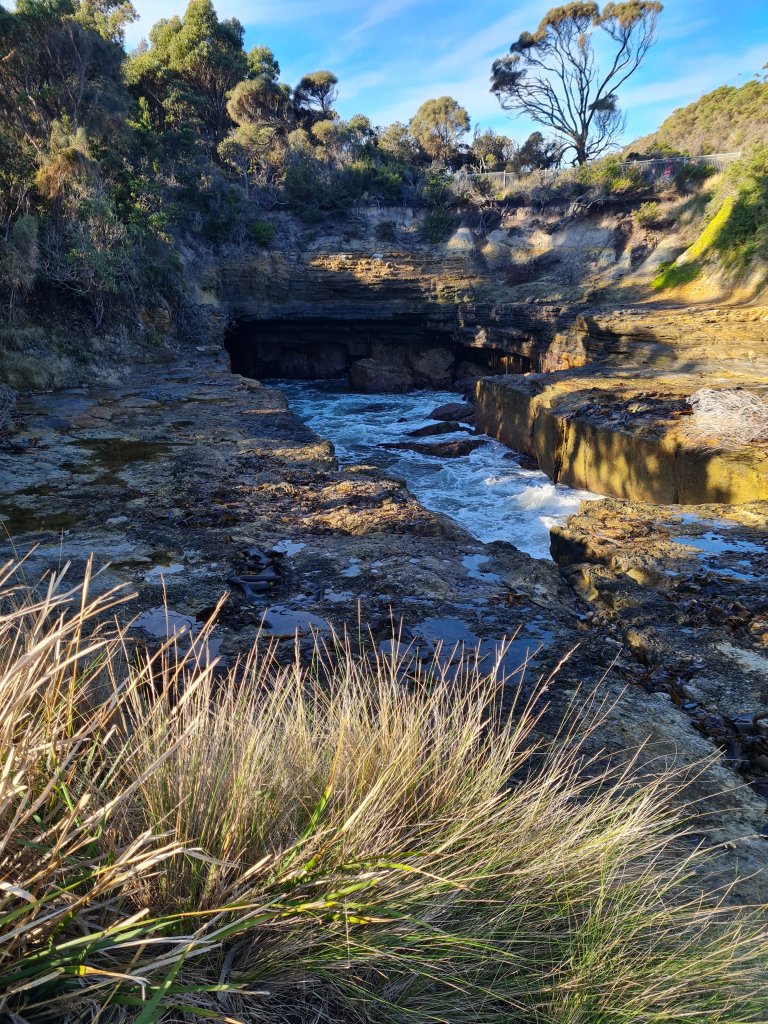
A photograph from the inspirational bin – 43

This is a blow hole, where the sea meets a rocking shoreline, and when there’s a big enough swell, crashes through to the other side.

On a quiet day, there’s nothing to see.

On a stormy day, when the waves are crashing into the base of the cliffs, water comes crashing through, and leaves the swirling, foamy water that can be seen above.

An interesting oddity, but nothing to fuel the imagination.

But…

What if, aside from the blowhole, there are caves, or there’s an underwater opening, and a channel leading up to it?

What if those caves were supposedly used by pirates to store treasure.

What if there is an underwater channel, and it is being used by small submarines to get to a base that has been hewn our of the rock?

What if no one knew until one night, a photographer, looking for caves to photograph and explore is investigating when people suddenly appear from nowhere?

The cinema of my dreams – I always wanted to see the planets – Episode 25

Are we there yet?

Even being in the fastest ship we had in the fleet, it still felt like it would take a lifetime to catch up to the alien ship, and I had to wonder at the pioneers of space travel who had to hibernate for the better part of a year, and sometimes a lot longer, to get to the other planets.

For us, time versus distance was measured a lot less that it used to be, but it would still take a long time, and we were prepared for it. What the real problem was, how long it would take us to be in a position to rescue our crew members.

Or how they felt being prisoners on an alien space craft, and how they were being treated, or even whether the aliens were either willing or capable of looking after them.

It was going to be a very interesting conversation I would have with the captain if or when we finally found them.

But knowing we might be in a fruitless chase to rescue our crew members just added to the frustration. I divided my time between the day room and pacing the bridge, looking out into the inky blackness, at times wishing something, anything, would appear to break the monotony

The science department on the other hand had a plethora of data, and no shortage of theories, but little concrete evidence of what they were calling space corridors, which were much like elevators only horizontal.

Chalmers still stuck to his belief in what he called worm hole, but was unable to advance a theory of whether the pre existed, or whether the alien ships created them as a means if getting quickly from one part if the universe to the other.

My report to the Admiral was scant on facts, except for one, that we were not alone in the universe. It Waldo precipitated a meeting of the brightest scientific minds back on the planet on the subject of alien life, and the universe itself.

At least some people were happy.

Meanwhile, the question of the ship’s speed became another topic, and it was being suggested that with a little tinkering, we could push more out of the propulsion unit, ‘tinkering’ being the operative word.

The subject was quite technical and although I had some knowledge of the mechanics, it was not enough, and I felt a little out of my depth when included in the discussions, relying heavily on the expertise of the Chief Engineer and his staff.

It was quite daunting that they were mentioning speeds up to the speed of light, now that they knew the structural integrity of the ship was not affected by the higher speed. I was not aware that it could have been a factor, but then I hadn’t known the ship was made out of an alloy that some said came from alien technology found on our planet.

Like most I believed the story that the compound that enabled us to get onto space was a freak discovery, even despite the rumours. Now, within the confines of a select group on board the ship and back at space command, those rumours had become a reality.

It was a lot to take in and I had to wonder how much the previous captain knew, and whether he was ever going to tell me. Sometimes ignorance was bliss, or so the saying went.

We’d been hurtling through space for three days when the Chief Engineer called me. I was in the day room reading up on the protocols we were supposed to adopt if or when we met new entities, and at a point where I couldn’t believe some of what I was reading.

“Sir, we think we might be able the squeeze a little more out of the engines.”

I wondered how much that little more was.

“How so?”

“The technical explanation would probably take a week, but with a few adjustments we might get a hundred percent improvement.”

“Risk factor?”

“Nothing comes without a risk, sir, but more or less as it was explained at the last conference “

In other words, any risk was worth it.

“The downside being we could be stuck in space until someone could come and rescue us.”

“Provided life support remains up and running, yes. But I believe the risk is minimal. We all signed up knowing that in all likelihood it might be a one way trip.”

Stating the obvious didn’t make the decision Amy easier. That responsibility for over 2,000 others on board weighed heavily.

“OK. I’ll make an announcement to the crew. Be on the bridge in fifteen minutes.”

“Aye, sir.”

Fifteen minutes precisely, we were looking out into the inky blackness, everyone battened down. For the first time, I sat in the captains chair with the feeling that I should be there rather than just keeping the seat warm for when the real captain returned.

A strange phrase came into my head, just seconds before I gave the order, death or glory.

“Helmsman?”

He turned. “Sir?”

“Let’s go.”

© Charles Heath 2021

Is there a reason to get out of bed?

I sometimes wonder if there is.

Is that depression speaking, or am I just tired from all the late nights?

Unlike most writers, authors and bloggers I don’t have a day job.  You could say it’s one of the benefits of getting old, this retirement thing, but after a while, not having a reason to get out of bed starts working on your subconscious.

The idea of having a job, and going to work, is a good reason to drag yourself out of bed every morning.  And because of this, the idea of sleeping in takes on a whole new meaning.

You know, I’ll just lie here for a few more minutes, and then I’ll get up.  Having turned off the alarm, the eyelids flutter, and before you know it, half an hour had passed, and you wake up in fright, knowing you’re going to be late.

In retirement, that doesn’t happen.  There is no alarm, there is no guilty pleasure in spending those extra minutes in bed.

Of course, this tardiness, or lack of desire could be because I find I do my best writing in the dead of night, often not getting to bed before 2 a.m.   Last night it was a little later because of a story I’m working on came to life with a new idea.

It had been stagnating because it’s part two and whilst I had an idea about where it was going to go, in the end, we’re off in a different direction, and the words flowed.  You just don’t stop writing when you hit a vein.

But this isn’t always the case.  This morning I have an excuse to stay in bed, but most others I don’t.

Perhaps I should find something else to do, something that will give me that same reason I used to have to get up every morning.

Or maybe I should be more organized in my retirement life, you know, set a schedule and do things according to a timetable.  I was never one for being organized, but perhaps it’s time to start.

Just let me lie here for a few more minutes and think about that.

The cinema of my dreams – I always wanted to go on a treasure hunt – Episode 63

Here’s the thing…

Every time I close my eyes, I see something different.

I’d like to think the cinema of my dreams is playing a double feature but it’s a bit like a comedy cartoon night on Fox.

But these dreams are nothing to laugh about.

Once again there’s a new installment of an old feature, and we’re back on the treasure hunt.

Back to the newspaper office

I went around to Boggs’s house on the chance that he might have come home, just as his mother was heading off to her night job.  I raised the possibility that something might have happened to him but she didn’t agree, nor did she look all that concerned.

The fact he had experience in cave exploration and used to camping out with his father and later uncle Rico and had told he might not be back for a few days was not cause for concern, and we left it at that, telling her I would drop in again soon.

She didn’t seem to think that he might get into trouble considering the instability of some of the caves, nor the fact they have warning signs and or been boarded up to stop explorers concern her.

The possibility it could happen and had happened to others, bothered me, as was the fact he was starting to emulate his father with this obsession.  If the story in the paper was anything to go by, at worst he could finish up just like his father, buried under a pile of rubble.

Did I believe that was where his father was?

I didn’t know what to think, because the waters were so muddied by people who were driven by self-interest.

There was so much more to this story, mostly driven by self-interest, revenge perhaps, and, worse, greed.  It was perhaps a symptom of everything that had gone wrong in not only this town but what was happening on a much larger scale to the whole country.  But, that was someone else’s problem.  My concern was here, now, and saving Biggs from following the same destructive path his father had

And, to do that, I needed to know more.  That meant, first thing the next morning, a trip to the newspaper office.

When I returned to the newspaper office Lenny was in his usual seat with a paper in hand, reading.  Keeping up with the competition, he said, though the difference in circulation was counted in millions.

There was a woman behind the other desk.

“Staff journalist,” he said when he saw me looking at her.  “And family.  My wife, Jennifer.”

I’d not seen her before, and she didn’t come from here, or I would have recognized her.

She smiled, and there was something in that expression that struck me as familiar.

“Are you related to the Ormistons?”

It was a vague resemblance, after seeing so many pictures of the Ormistons, that everyone looked like them.

“It’s a name I don’t use anymore,” she said, “for obvious reasons.  My grandfather stirred a lot of resentment.”

“And,” Lenny added, “it’s between us and these four walls, Sam.”

I nodded.  I could understand the sentiment.  And it explained Lenny’s depth of knowledge.

“Just to be clear, your grandfather didn’t find the treasure?”

She sighed.

Lenny said, sharply, “Sam!”

I shrugged.  “Sorry.  I had to ask.”

“No, he did not, and believe me, that’s a sore point with everyone whose lives he destroyed.”

“I can imagine.  Does anyone know what happened to him, the real story?”

“There is no real story Sam.  I tried to discover the truth and failed.  For Jennifer’s peace of mind.  We may never know what happened to him.”

“But surely you don’t believe he died in a cave somewhere?”

“It’s the most plausible.”

“And what about Boggs’s father?”

“He was a fool,” Jennifer said.  “From what I remember of him, he was always insistent that the treasure was in a cavern up in the hills, accessible only by an underground river that flowed down to the sea.  He originally thought it was the one the mall was built over, except every cave had a dead end.”

“Before or after the mall was built?”

“My father explored the cave system, with my grandfather, extensively, before the mall was built.  There was no underground river.”

“How did the mall get destroyed in a flood then?”

“That was the Benderby’s cost-cutting the foundations.  The flooding was man-made, not an act of nature like they said it was.  That was just so they could claim the insurance.  No one could really tell the difference, and the specialist the got to sign off on it lied.  The same guy that turned up dead on Rico’s boat, by the way.”

“The Benderby’s cleaning up another mess, but their way.”  Jennifer sounded, and probably had every right to be, resentful.

“Then there still could be an underground river somewhere along the coast?”

“If there is, I haven’t found it, and neither has Alex and that fancy boat of his.  It’s another dead end, and like as not, another nail in the coffin of what was a fairy tale, to begin with.  There was no treasure, just a fable invented by the Cossatinos.”

“Even so, it’s part of the folklore of this county and will have a place in the history I’m writing.  I noticed over the years the treasure had a prominent place in the paper.”

“My father, and his before him thought it would be good for the town. You know, bring in tourists.  It was my father’s idea to print treasure maps, and then the Cossatino’s embellished it but producing what they called ‘the real map’ each a slight variation on the other, commanding a special fee, and swearing the purchases to a promise of silence, and adding to the authenticity, demanding a 19 percent share of whatever they found.  People lapped it up and my father said they’d made a fortune out of it.  Boggs’s father hand-made the copies, and used that money to fund his own explorations.  Everyone made money out of it, one way or another except Ormiston.”

A bitter irony if there was ever one.  There was more money in the illusion of treasure than the actual treasure itself.

“And the so-called real map that Boggs reputedly found in the pirate’s hideaway?”

“No one ever saw it, except that one time it was authenticated age-wise, so no one ever got to see it.  Boggs made sure of that, and never let it out of his sight.  Now we’ll never know.  I’m sure Boggs junior doesn’t have it, but with him, he’s as daft as his father was.”

“He had a lot of his father’s stuff he found in a box in the attic recently.  I’ve seen some of it, but not an authentic map, so maybe your right.”

“Of course I am.  When you have an idea of what this history of yours is going to look like, let me know. And I’ll publish it in parts if you want, maybe pass it on to the dailies.  It might be worth something.”

“Thanks.  I will.  But more study first, you have the history of the place in that back room, maybe you should write something yourself. Being the journalist.”

“Too busy with births deaths and marriages, Sam, and the antics of the Benderby’s and Cossatino’s.  You know that Benderby is demolishing the mall and putting a marina in its place?  Talk of building a hotel, boosting tourism.  Talking of running for mayor, you know, the first stop on the way to the presidency?”

“A crook for a mayor?”

“Wouldn’t be the first, won’t be the last.  But one thing is for sure, that kind of news sells papers.”

It did, but I had a feeling the Benderby’s were all about creating a distraction, and something else was going on at that mall site.

© Charles Heath 2020-2022

Skeletons in the closet, and doppelgangers

A story called “Mistaken Identity”

How many of us have skeletons in the closet that we know nothing about? The skeletons we know about generally stay there, but those we do not, well, they have a habit of coming out of left field when we least expect it.

In this case, when you see your photo on a TV screen with the accompanying text that says you are wanted by every law enforcement agency in Europe, you’re in a state of shock, only to be compounded by those same police, armed and menacing, kicking the door down.

I’d been thinking about this premise for a while after I discovered my mother had a boyfriend before she married my father, a boyfriend who was, by all accounts, the man who was the love of her life.

Then, in terms of coming up with an idea for a story, what if she had a child by him that we didn’t know about, which might mean I had a half brother or sister I knew nothing about. It’s not an uncommon occurrence from what I’ve been researching.

There are many ways of putting a spin on this story.

Then, in the back of my mind, I remembered a story an acquaintance at work was once telling us over morning tea, that a friend of a friend had a mother who had a twin sister and that each of the sisters had a son by the same father, without each knowing of the father’s actions, both growing up without the other having any knowledge of their half brother, only to meet by accident on the other side of the world.

It was an encounter that in the scheme of things might never have happened, and each would have remained oblivious of the other.

For one sister, the relationship was over before she discovered she was pregnant, and therefore had not told the man he was a father. It was no surprise the relationship foundered when she discovered he was also having a relationship with her sister, a discovery that caused her to cut all ties with both of them and never speak to either from that day.

It’s a story with more twists and turns than a country lane!

And a great idea for a story.

That story is called ‘Mistaken Identity’.

An excerpt from “Amnesia”, a work in progress

I remembered a bang.
I remembered the car slewing sideways.
I remember another bang, and then it was lights out.
When I opened my eyes again, I saw the sky.
Or I could be underwater.
Everything was blurred.
I tried to focus but I couldn’t. My eyes were full of water.
What happened?
Why was I lying down?
Where was I?
I cast my mind back, trying to remember.
It was a blank.
What, when, who, why and where, questions I should easily be able to answer. Questions any normal person could answer.
I tried to move. Bad, bad mistake.
I did not realise the scream I heard was my own. Just before my body shut down.

“My God! What happened?”
I could hear, not see. I was moving, lying down, looking up.
I was blind. Everything was black.
“Car accident, hit a tree, sent the passenger flying through the windscreen. Pity to poor bastard didn’t get the message that seat belts save lives.”
Was I that poor bastard?
“Report?” A new voice, male, authoritative.
“Multiple lacerations, broken collar bone, broken arm in three places, both legs broken below the knees, one badly. We are not sure of internal injuries, but ruptured spleen, cracked ribs and pierced right lung are fairly evident, x-rays will confirm that and anything else.”
“What isn’t broken?”
“His neck.”
“Then I would have to say we are looking at the luckiest man on the planet.”
I heard shuffling of pages.
“OR1 ready?”
“Yes. On standby since we were first advised.”
“Good. Let’s see if we can weave some magic.”

Magic.
It was the first word that popped into my head when I surfaced from the bottom of the lake. That first breath, after holding it for so long, was sublime, and, in reality, agonising.

Magic, because it seemed like I’d spent a long time under water.
Or somewhere.
I tried to speak, but couldn’t. The words were just in my head.
Was it night or was it day?
Was it hot, or was it cold?
Where was I?
Around me it felt cool.
It was very quiet. No noise except for the hissing of air through an air-conditioning vent. Or perhaps that was the sound of pure silence. And with it the revelation that silence was not silent. It was noisy.
I didn’t try to move.
Instinctively, somehow I knew not to.
A previous bad experience?
I heard what sounded like a door opening, and very quiet footsteps slowly come into the room. They stopped. I could hear breathing, slightly laboured, a sound I’d heard before.
My grandfather.
He had smoked all his life, until he was diagnosed with lung cancer. But for years before that he had emphysema. The person in the room was on their way, down the same path. I could smell the smoke.
I wanted to tell whoever it was the hazards of smoking.
I couldn’t.
I heard a metallic clanging sound from the end of the bed. A moment later the clicking of a pen, then writing.
“You are in a hospital.” A female voice suddenly said. “You’ve been in a very bad accident. You cannot talk, or move, all you can do, for the moment, is listen to me. I am a nurse. You have been here for 45 days, and just come out of a medically induced coma. There is nothing to be afraid of.”
She had a very soothing voice.
I felt her fingers stroke the back of my hand.
“Everything is fine.”
Define fine, I thought. I wanted to ask her what ‘fine’ meant.
“Just count backwards from 10.”
Why?
I didn’t reach seven.

Over the next ten days, that voice became my lifeline to sanity. Every morning I longed to hear it, if only for the few moments she was in the room, those few waking moments when I believed she, and someone else who never spoke, were doing tests. I knew it had to be someone else because I could smell the essence of lavender. My grandmother had worn a similar scent.
It rose above the disinfectant.
I also believed she was another doctor, not the one who had been there the day I arrived. Not the one who had used some ‘magic’ and kept me alive.
It was then, in those moments before she put me under again, that I thought, what if I was paralysed? It would explain a lot. A chill went through me.

The next morning she was back.
“My name is Winifred. We don’t know what your name is, not yet. In a few days, you will be better, and you will be able to ask us questions. You were in an accident, and you were very badly injured, but I can assure you there will be no lasting damage.”
More tests, and then, when I expected the lights to go out, they didn’t. Not for a few minutes more. Perhaps this was how I would be integrated back into the world. A little bit at a time.
The next morning, she came later than usual, and I’d been awake for a few minutes. “You have bandages over your eyes and face. You had bad lacerations to your face, and glass in your eyes. We will know more when the bandages come off in a few days. Your face will take longer to heal. It was necessary to do some plastic surgery.”
Lacerations, glass in my eyes, car accident, plastic surgery. By logical deduction, I knew I was the poor bastard thrown through the windscreen. It was a fleeting memory from the day I was admitted.
How could that happen?
That was the first of many startling revelations. The second was the fact I could not remember the crash. Equally shocking, in that same moment was the fact I could not remember before the crash either, and only vague memories after.
But the most shattering of all these revelations was the one where I realised I could not remember my name.
I tried to calm down, sensing a rising panic.
I was just disoriented, I told myself. After 45 days in an induced coma, it had messed with my mind, and it was only a temporary lapse. Yes, that’s what it was, a temporary lapse. I would remember tomorrow. Or the next day.
Sleep was a blessed relief.

The next day I didn’t wake feeling nauseous. Perhaps they’d lowered the pain medication. I’d heard that morphine could have that effect. Then, how could I know that, but not who I am?
I knew now Winifred the nurse was preparing me for something very bad. She was upbeat, and soothing, giving me a new piece of information each morning. This morning, “You do not need to be afraid. Everything is going to be fine. The doctor tells me you are going to recover with very little scarring. You will need some physiotherapy to recover from your physical injuries, but that’s in the future. We need to let you mend a little bit more before then.”
So, I was not going to be able to leap out of bed, and walk out of the hospital any time soon. I don’t suppose I’d ever leapt out of bed, except as a young boy. I suspect I’d sustained a few broken bones. I guess learning to walk again was the least of my problems.
But, there was something else. I picked it up in the timbre of her voice, a hesitation, or reluctance. It sent another chill through me.
This time I was left awake for an hour before she returned.
This time sleep was restless.
There were scenes playing in my mind, nothing I recognised, and nothing lasting longer than a glimpse. Me. Others, people I didn’t know. Or perhaps I knew them and couldn’t remember them.
Until they disappeared, slowly like the glowing dot in the centre of the computer screen, before finally fading to black.

The morning the bandages were to come off she came in bright and early and woken me. I had another restless night, the images becoming clearer, but nothing recognisable.
“This morning the doctor will be removing the bandages over your eyes. Don’t expect an immediate effect. Your sight may come back quickly or it may come back slowly, but we believe it will come back.”
I wanted to believe I was not expecting anything, but I was. It was probably human nature. I did not want to be blind as well as paralysed. I had to have at least one reason to live.
I dozed again until I felt a gentle hand on my shoulder. I could smell the lavender, the other doctor was back. And I knew the hand on my shoulder was Winifred’s. She told me not to be frightened.
I was amazed to realise in that moment, I wasn’t.
I heard the scissors cutting the bandages.
I felt the bandage being removed, and the pressure coming off my eyes. I could feel the pads covering both eyes.
Then a moment where nothing happened.
Then the pads being gently lift and removed.
Nothing.
I blinked my eyes, once, twice. Nothing.
“Just hold on a moment,” Winifred said. A few seconds later I could feel a cool towel wiping my face, and then gently wiping my eyes. Perhaps there was ointment, or something else in them.
Then a flash. Well, not a flash, but like when a light is turned on and off. A moment later, it was brighter, not the inky blackness of before, but a shade of grey.
She wiped my eyes again.
I blinked a few more times, and then the light returned, and it was like looking through water, at distorted and blurry objects in the distance.
I blinked again, and she wiped my eyes again.
Blurry objects took shape. A face looking down on me, an elderly lady with a kindly face, surely Winifred, who was smiling. And on the opposite side of the bed, the doctor, a Chinese woman of indescribable beauty.
I nodded.
“You can see?”
I nodded again.
“Clearly?”
I nodded.
“Very good. We will just draw the curtains now. We don’t want to overdo it. Tomorrow we will be taking off the bandages on your face. Then, it will be the next milestone. Talking.”
I couldn’t wait.

When morning came, I found myself afraid. Winifred had mentioned scarring, there were bandages on my face. I knew, but wasn’t quite sure how I knew, I wasn’t the handsomest of men before the accident, so this might be an improvement.
I was not sure why I didn’t think it would be the case.
They came at mid morning, the nurse, Winifred, and the doctor, the exquisite Chinese. Perhaps she was the distraction, taking my mind of the reality of what I was about to see.
Another doctor came into the room, before the bandages were removed, and he was introduced as the plastic surgeon that had ‘repaired’ the ravages of the accident. It had been no easy job, but, with a degree of egotism, he did say he was one of the best in the world.
I found it hard to believe, if he was, that he would be at a small country hospital.
“Now just remember, what you might see now is not how you will look in a few months time.”
Warning enough.
The Chinese doctor started removing the bandages. She did it slowly, and made sure it did not hurt. My skin was very tender, and I suspect still bruised, either from the accident or the surgery, I didn’t know.
Then it was done.
The plastic surgeon gave his work a thorough examination and seemed pleased with his work. “Coming along nicely,” he said to the other doctor. He issued some instructions on how to manage the skin, nodded to me, and I thanked him before he left.
I noticed Winifred had a mirror in her hand, and was somewhat reticent in using it. “As I said,” she said noticing me looking at the mirror, “what you see now will not be the final result. The doctor said it was going to heal with very little scarring. You have been very fortunate he was available. Are you ready?”
I nodded.
She showed me.
I tried not to be reviled at the red and purple mess that used to be my face. At a guess I would have to say he had to put it all back together again, but, not knowing what I looked like before, I had no benchmark. All I had was a snippet of memory that told me I was not the tall, dark, and handsome type.
And I still could not talk. There was a reason, he had worked on that area too. Just breathing hurt. I think I would save up anything I had to say for another day. I could not even smile. Or frown. Or grimace.
“We’ll leave you for a while. Everyone needs a little time to get used to the change. I suspect you are not sure if there has been an improvement on last year’s model. Well, time will tell.”
A new face?
I could not remember the old one.
My memory still hadn’t returned.