Inspiration, maybe – Volume 1

50 photographs, 50 stories, of which there is one of the 50 below.

They all start with –

A picture paints … well, as many words as you like.  For instance:

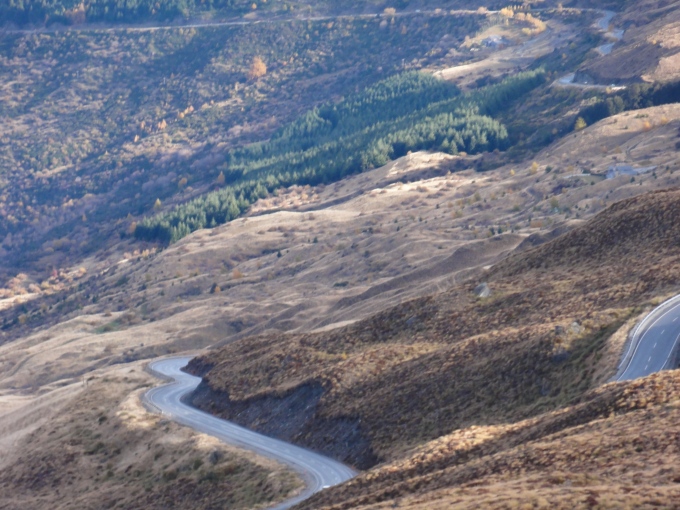
lookingdownfromcoronetpeak

And the story:

It was once said that a desperate man has everything to lose.

The man I was chasing was desperate, but I, on the other hand, was more desperate to catch him.

He’d left a trail of dead people from one end of the island to the other.

The team had put in a lot of effort to locate him, and now his capture was imminent.  We were following the car he was in, from a discrete distance, and, at the appropriate time, we would catch up, pull him over, and make the arrest.

There was nowhere for him to go.

The road led to a dead-end, and the only way off the mountain was back down the road were now on.  Which was why I was somewhat surprised when we discovered where he was.

Where was he going?

“Damn,” I heard Alan mutter.  He was driving, being careful not to get too close, but not far enough away to lose sight of him.

“What?”

“I think he’s made us.”

“How?”

“Dumb bad luck, I’m guessing.  Or he expected we’d follow him up the mountain.  He’s just sped up.”

“How far away?”

“A half-mile.  We should see him higher up when we turn the next corner.”

It took an eternity to get there, and when we did, Alan was right, only he was further on than we thought.”

“Step on it.  Let’s catch him up before he gets to the top.”

Easy to say, not so easy to do.  The road was treacherous, and in places just gravel, and there were no guard rails to stop a three thousand footfall down the mountainside.

Good thing then I had the foresight to have three agents on the hill for just such a scenario.

Ten minutes later, we were in sight of the car, still moving quickly, but we were going slightly faster.  We’d catch up just short of the summit car park.

Or so we thought.

Coming quickly around another corner we almost slammed into the car we’d been chasing.

“What the hell…” Aland muttered.

I was out of the car, and over to see if he was in it, but I knew that it was only a slender possibility.  The car was empty, and no indication where he went.

Certainly not up the road.  It was relatively straightforward for the next mile, at which we would have reached the summit.  Up the mountainside from here, or down.

I looked up.  Nothing.

Alan yelled out, “He’s not going down, not that I can see, but if he did, there’s hardly a foothold and that’s a long fall.”

Then where did he go?

Then a man looking very much like our quarry came out from behind a rock embedded just a short distance up the hill.

“Sorry,” he said quite calmly.  “Had to go if you know what I mean.”

I’d lost him.

It was as simple as that.

I had been led a merry chase up the hill, and all the time he was getting away in a different direction.

I’d fallen for the oldest trick in the book, letting my desperation blind me to the disguise that anyone else would see through in an instant.

It was a lonely sight, looking down that road, knowing that I had to go all that way down again, only this time, without having to throw caution to the wind.

“Maybe next time,” Alan said.

“We’ll get him.  It’s just a matter of time.”

© Charles Heath 2019-2021

Find this and other stories in “Inspiration, maybe”  available soon.

InspirationMaybe1v1

Searching for locations: Hutongs, Beijing, China

What are Hutongs?

In Beijing Hutongs are formed by lines of traditional courtyard residences, called siheyuan.  Neighborhoods were formed by joining many hutongs together. These siheyuan are the traditional residences, usually occupied by a single or extended family, signifying wealth, and prosperity. 

Over 500 of these still exist.Many of these hutongs have been demolished, but recently they have become protected places as a means of preserving some Chinese cultural history.  They were first established in the Yuan Dynasty (1279-1368)Many of these Hutongs had their main buildings and gates built facing south, and lanes connecting them to other hutongs also ran north to south.

Many hutongs, some several hundred years old, in the vicinity of the Bell Tower and Drum Tower and Shichahai Lake are preserved and abound with tourists, many of which tour the quarter in pedicabs.

The optional tour also includes a visit to Shichahai, a historic scenic area consisting of three lakes (Qianhai, meaning Front Sea; Houhai, meaning Back Sea and Xihai, meaning West Sea), surrounding places of historic interest and scenic beauty and remnants of old-style local residences, Hutong and Courtyard.  

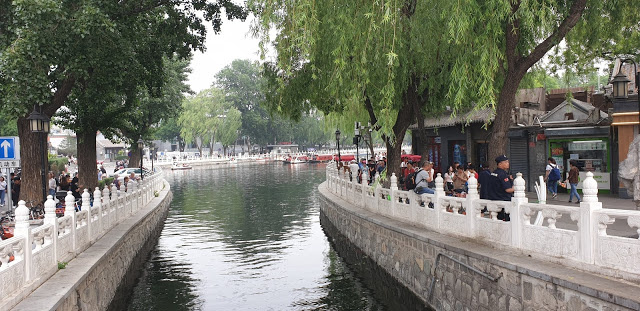
First, we had a short walk through the more modern part of the Hutong area and given some free time for shopping, but we prefer just to meander by the canal.  

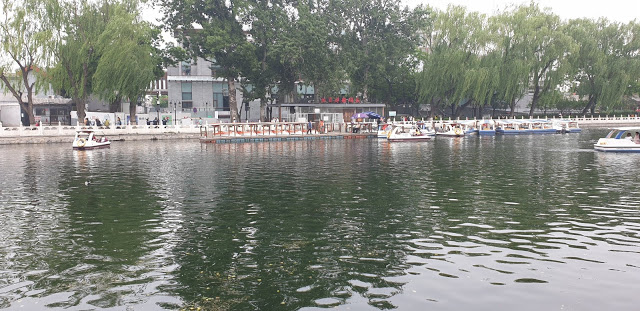
There is a lake, and if we had the time, there were boats you could take.

With some time to spare, we take a quick walk down one of the alleyways where on the ground level are small shops, and above, living quarters.

Then we go to the bell and drum towers before walking through some more alleys was to where the rickshaws were waiting.
The Bell tower

And the Drum tower. Both still working today.

The rickshaw ride took us through some more back streets where it was clear renovations were being made so that the area could apply for world heritage listing.  Seeing inside some of the houses shows that they may look dumpy outside but that’s not the case inside.

The rickshaw ride ends outside the house where dinner will be served, and is a not so typical hose but does have all the elements of how the Chinese live, the boy’s room, the girl’s room, the parent’s room, the living area, and the North-south feng shui.

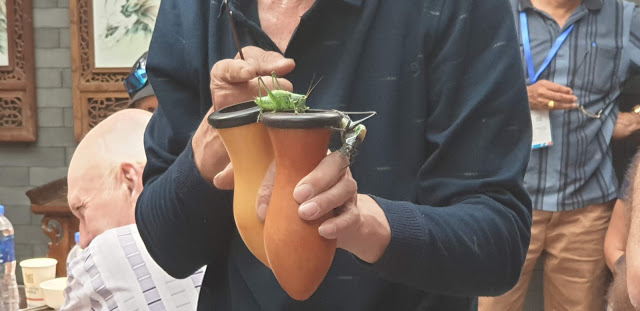
Shortly after we arrive, the cricket man, apparently someone quite famous in Beijing arrives and tells us all about crickets and then grasshoppers, then about cricket racing.  He is animated and clearly enjoys entertaining us westerners.

I’m sorry but the cricket stuff just didn’t interest me.  Or the grasshoppers.

As for dinner, it was finally a treat to eat what the typical Chinese family eats, and everything was delicious, and the endless beer was a nice touch.

And the last surprise, the food was cooked by a man.

An excerpt from “Strangers We’ve Become” – Coming Soon

I wandered back to my villa.

It was in darkness.  I was sure I had left several lights on, especially over the door so I could see to unlock it.

I looked up and saw the globe was broken.

Instant alert.

I went to the first hiding spot for the gun, and it wasn’t there.  I went to the backup and it wasn’t there either.  Someone had found my carefully hidden stash of weapons and removed them.

Who?

There were four hiding spots and all were empty.  Someone had removed the weapons.  That could only mean one possibility.

I had a visitor, not necessarily here for a social call.

But, of course, being the well-trained agent I’d once been and not one to be caught unawares, I crossed over to my neighbor and relieved him of a weapon that, if found, would require a lot of explaining.

Suitably armed, it was time to return the surprise.

There were three entrances to the villa, the front door, the back door, and a rather strange escape hatch.  One of the more interesting attractions of the villa I’d rented was its heritage.  It was built in the late 1700s, by a man who was, by all accounts, a thief.  It had a hidden underground room which had been in the past a vault but was now a wine cellar, and it had an escape hatch by which the man could come and go undetected, particularly if there was a mob outside the door baying for his blood.

It now gave me the means to enter the villa without my visitors being alerted, unless, of course, they were near the vicinity of the doorway inside the villa, but that possibility was unlikely.  It was not where anyone could anticipate or expect a doorway to be.

The secret entrance was at the rear of the villa behind a large copse, two camouflaged wooden doors built into the ground.  I move aside some of the branches that covered them and lifted one side.  After I’d discovered the doors and rusty hinges, I’d oiled and cleaned them, and cleared the passageway of cobwebs and fallen rocks.  It had a mildew smell, but nothing would get rid of that.  I’d left torches at either end so I could see.

I closed the door after me, and went quietly down the steps, enveloped in darkness till I switched on the torch.  I traversed the short passage which turned ninety degrees about halfway to the door at the other end.  I carried the key to this door on the keyring, found it and opened the door.  It too had been oiled and swung open soundlessly.

I stepped in the darkness and closed the door.

I was on the lower level under the kitchen, now the wine cellar, the ‘door’ doubling as a set of shelves which had very little on them, less to fall and alert anyone in the villa.

Silence, an eerie silence.

I took the steps up to the kitchen, stopping when my head was level with the floor, checking to see if anyone was waiting.  There wasn’t.  It seemed to me to be an unlikely spot for an ambush.

I’d already considered the possibility of someone coming after me, especially because it had been Bespalov I’d killed, and I was sure he had friends, all equally as mad as he was.  Equally, I’d also considered it nigh on impossible for anyone to find out it was me who killed him because the only people who knew that were Prendergast, Alisha, a few others in the Department, and Susan.

That raised the question of who told them where I was.

If I was the man I used to be, my first suspect would be Susan.  The departure this morning, and now this was too coincidental.  But I was not that man.

Or was I?

I reached the start of the passageway that led from the kitchen to the front door and peered into the semi-darkness.  My eyes had got used to the dark, and it was no longer an inky void.  Fragments of light leaked in around the door from outside and through the edge of the window curtains where they didn’t fit properly.  A bone of contention upstairs in the morning, when first light shone and invariably woke me up hours before I wanted to.

Still nothing.

I took a moment to consider how I would approach the visitor’s job.  I would get a plan of the villa in my head, all entrances, where a target could be led to or attacked where there would be no escape.

Coming in the front door.  If I was not expecting anything, I’d just open the door and walk-in.  One shot would be all that was required.

Contract complete.

I sidled quietly up the passage staying close to the wall, edging closer to the front door.  There was an alcove where the shooter could be waiting.  It was an ideal spot to wait.

Crunch.

I stepped on some nutshells.

Not my nutshells.

I felt it before I heard it.  The bullet with my name on it.

And how the shooter missed, from point-blank range, and hit me in the arm, I had no idea.  I fired off two shots before a second shot from the shooter went wide and hit the door with a loud thwack.

I saw a red dot wavering as it honed in on me and I fell to the floor, stretching out, looking up where the origin of the light was coming and pulled the trigger three times, evenly spaced, and a second later I heard the sound of a body falling down the stairs and stopping at the bottom, not very far from me.

Two assassins.

I’d not expected that.

The assassin by the door was dead, a lucky shot on my part.  The second was still breathing.

I checked the body for any weapons and found a second gun and two knives.  Armed to the teeth!

I pulled off the balaclava; a man, early thirties, definitely Italian.  I was expecting a Russian.

I slapped his face, waking him up.  Blood was leaking from several slashes on his face when his head had hit the stairs on the way down.  The awkward angle of his arms and legs told me there were broken bones, probably a lot worse internally.  He was not long for this earth.

“Who employed you?”

He looked at me with dead eyes, a pursed mouth, perhaps a smile.  “Not today my friend.  You have made a very bad enemy.”  He coughed and blood poured out of his mouth.  “There will be more …”

Friends of Bespalov, no doubt.

I would have to leave.  Two unexplainable bodies, I’d have a hard time explaining my way out of this mess.  I dragged the two bodies into the lounge, clearing the passageway just in case someone had heard anything.

Just in case anyone was outside at the time, I sat in the dark, at the foot of the stairs, and tried to breathe normally.  I was trying not to connect dots that led back to Susan, but the coincidence was worrying me.


A half-hour passed and I hadn’t moved.  Deep in thought, I’d forgotten about being shot, unaware that blood was running down my arm and dripping onto the floor.

Until I heard a knock on my front door.

Two thoughts, it was either the police, alerted by the neighbors, or it was the second wave, though why would they be knocking on the door?

I stood, and immediately felt a stabbing pain in my arm.  I took out a handkerchief and turned it into a makeshift tourniquet, then wrapped a kitchen towel around the wound.

If it was the police, this was going to be a difficult situation.  Holding the gun behind my back, I opened the door a fraction and looked out.

No police, just Maria.  I hoped she was not part of the next ‘wave’.

“You left your phone behind on the table.  I thought you might be looking for it.”  She held it out in front of her.

When I didn’t open the door any further, she looked at me quizzically, and then asked, “Is anything wrong?”

I was going to thank her for returning the phone, but I heard her breathe in sharply, and add, breathlessly, “You’re bleeding.”

I looked at my arm and realized it was visible through the door, and not only that, the towel was soaked in blood.

“You need to go away now.”

Should I tell her the truth?  It was probably too late, and if she was any sort of law-abiding citizen she would go straight to the police.

She showed no signs of leaving, just an unnerving curiosity.  “What happened?”

I ran through several explanations, but none seemed plausible.  I went with the truth.  “My past caught up with me.”

“You need someone to fix that before you pass out from blood loss.  It doesn’t look good.”

“I can fix it.  You need to leave.  It is not safe to be here with me.”

The pain in my arm was not getting any better, and the blood was starting to run down my arm again as the tourniquet loosened.  She was right, I needed it fixed sooner rather than later.

I opened the door and let her in.  It was a mistake, a huge mistake, and I would have to deal with the consequences.  Once inside, she turned on the light and saw the pool of blood just inside the door and the trail leading to the lounge.  She followed the trail and turned into the lounge, turned on the light, and no doubt saw the two dead men.

I expected her to scream.  She didn’t.

She gave me a good hard look, perhaps trying to see if I was dangerous.  Killing people wasn’t something you looked the other way about.  She would have to go to the police.

“What happened here?”

“I came home from the cafe and two men were waiting for me.  I used to work for the Government, but no longer.  I suspect these men were here to repay a debt.  I was lucky.”

“Not so much, looking at your arm.”

She came closer and inspected it.

“Sit down.”

She found another towel and wrapped it around the wound, retightening the tourniquet to stem the bleeding.

“Do you have medical supplies?”

I nodded.  “Upstairs.”  I had a medical kit, and on the road, I usually made my own running repairs.  Another old habit I hadn’t quite shaken off yet.

She went upstairs, rummaged, and then came back.  I wondered briefly what she would think of the unmade bed though I was not sure why it might interest her.

She helped me remove my shirt, and then cleaned the wound.  Fortunately, she didn’t have to remove a bullet.  It was a clean wound but it would require stitches.

When she’d finished she said, “Your friend said one day this might happen.”

No prizes for guessing who that friend was, and it didn’t please me that she had involved Maria.

“Alisha?”

“She didn’t tell me her name, but I think she cares a lot about you.  She said trouble has a way of finding you, gave me a phone and said to call her if something like this happened.”

“That was wrong of her to do that.”

“Perhaps, perhaps not.  Will you call her?”

“Yes.  I can’t stay here now.  You should go now.  Hopefully, by the time I leave in the morning, no one will ever know what happened here, especially you.”

She smiled.  “As you say, I was never here.”


© Charles Heath 2018-2020

First Dig Two Graves – The Final Draft – Day 16

The second Zoe thriller.

I’ve been looking back at what’s been written, something you shouldn’t do when trying to get 50,000 words written in 30 days, but I’m ahead of the count, and a little checking is needed, just to make sure everything is running smoothly.

Not that any book written on the fly like this runs smoothly.

There are three themes to this story:

1 – Worthington, now head of the Intelligence agency, seeking revenge for Zoe killing his brother by mistake, a mistake that he caused

2 – Alistair’s mother deploys a collection of agents, some being Zoe’s colleagues once, to assassinate the woman who assassinated her son

3 – John’s ever-growing fear that Zoe is tired of him, and, after she leaves, even though she promised to come back, he doesn’t want to wait to find out he’s been dumped.

4 – Sebastian is always lurking in the background, ostensibly to recruit her as an assassin, but really because he’s jealous of John’s good fortune.

Our two intrepid heroes go off to save her in Marseilles where she learns of the identity of who is ostensibly looking for her and sets her off on a lone hunt for him.

We then deploy two new characters, Rupert and Isobel, who along with John will create a private detective agency, that John uses to locate Zoe by any and all means.

Isobel soon finds out that searching for Zoe on the internet brings risks, both at home and abroad, bringing her in contact with another hacker who seems to know where Zoe’s past is hiding. But can they be trusted?

John heads off to Vienna, after being supplied a file on Zoe, full of information he had not known about her. What he learns in Vienna leads him to Bratislava, when a photo identifying where she suddenly arrives on his phone.

John locates her, and she realizes he is being used as bait, and they leave, but not before the hit team almost completes their mission, and leave behind a trail of bodies as they get away, but not without injury.

John gets the answers he is seeking, that if he wants a life of looking over his shoulder, by all means, tag along. She is quite pleased to see him, not so much that he brought ‘friends’ but she might yet get to train him.

Sebastian, feeling left out, grills Isobel and Rupert, and gets sidelined by Worthington because anywhere Sebastian goes, trouble follows, and then convinces Isobel that John is in over his head and needs their help.

He’s not wrong because Worthington has dispatched another hit team to the main railway stations in Vienna where John and Zoe are looking to escape, only another shootout occurs as they once again escape when all the station’s exits are not covered.

The story has now reached a point where everyone is converging on Vienna.

Along with another person who John knows, and will least expect to arrive on his doorstep.

Today’s writing, with Zoe languishing in a dungeon waiting for a white knight, 3,999 words, for a total of 47,066.

“Sunday in New York”, a romantic adventure that’s not a walk in the park!

“Sunday in New York” is ultimately a story about trust, and what happens when a marriage is stretched to its limits.

When Harry Steele attends a lunch with his manager, Barclay, to discuss a promotion that any junior executive would accept in a heartbeat, it is the fact his wife, Alison, who previously professed her reservations about Barclay, also agreed to attend, that casts a small element of doubt in his mind.

From that moment, his life, in the company, in deciding what to do, his marriage, his very life, spirals out of control.

There is no one big factor that can prove Harry’s worst fears, that his marriage is over, just a number of small, interconnecting events, when piled on top of each other, points to a cataclysmic end to everything he had believed in.

Trust is lost firstly in his best friend and mentor, Andy, who only hints of impending disaster, Sasha, a woman whom he saved, and who appears to have motives of her own, and then in his wife, Alison, as he discovered piece by piece damning evidence she is about to leave him for another man.

Can we trust what we see with our eyes or trust what we hear?

Haven’t we all jumped to conclusions at least once in our lives?

Can Alison, a woman whose self-belief and confidence is about to be put to the ultimate test, find a way of proving their relationship is as strong as it has ever been?

As they say in the classics, read on!

Purchase:

http://tinyurl.com/Amazon-SundayInNewYork

In a word: Course

Yes, of course there’s a golf course.

Firstly, of course, means definitely so, and can be said when a revelation is realised, or sarcastically if the answer is obvious.

Then there’s a course, like a golf course where people chase a small usually white ball, sometimes to be found on a fairway, but more often than not in a bunker, in the water, or in the thicket.

It’s meant to be calming, but I’m betting more than one heart attack has been brought on by a slice, a six shot bunker exit, or any more than three putts on the green.

There’s also mini golf courses, less challenging, sometimes.

That course could also be the part of a creek or a river.

It can be a set of classes that makes up a course, I did a course in English literature

Then, rather topically, over the course of the election there was [you fill in the rest]

Then there’s my favourite, a four course dinner

Or when I’m unwell a course of antibiotics.

And lastly, in a supermarket how often does the trolley in front of you unexpectedly and randomly change course?

This is not to be confused with coarse

Which to be honest can be used sometimes to describe people who swear or are abrupt.  They were coarse people, that is unrefined.  These people often use coarse language and tell course jokes, meaning crude and offensive

It had a coarse texture, ie it was rough not smooth

And then there’s Corse which is not exactly an English word, but can refer to a corpse or dead body.

‘What Sets Us Apart’ – A beta readers view

There’s something to be said for a story that starts like a James Bond movie, throwing you straight in the deep end, a perfect way of getting to know the main character, David, or is that Alistair?

A retired spy, well not so much a spy as a retired errand boy, David’s rather wry description of his talents, and a woman that most men would give their left arm for, not exactly the ideal couple, but there is a spark in a meeting that may or may not have been a set up.

But as the story progressed, the question I kept asking myself was why he’d bother.

And, page after unrelenting page, you find out.

Susan is exactly the sort of woman the pique his interest. Then, inexplicably, she disappears. That might have been the end to it, but Prendergast, that shadowy enigma, David’s ex boss who loves playing games with real people, gives him an ultimatum, find her or come back to work.

Nothing like an offer that’s a double edged sword!

A dragon for a mother, a sister he didn’t know about, Susan’s BFF who is not what she seems or a friend indeed, and Susan’s father who, up till David meets her, couldn’t be less interested, his nemesis proves to be the impossible dream, and he’s always just that one step behind.

When the rollercoaster finally came to a halt, and I could start breathing again, it was an ending that was completely unexpected.

I’ve been told there’s a sequel in the works.

Bring it on!

The book can be purchased here: http://amzn.to/2Eryfth

Motive, means, and opportunity – Episode 5

Detective Bryson interviews Wendy Anderson

Worthey called Bryson, in the middle of a hamburger, with the owner of the cell phone number in Bergman’s wallet.  A woman, no surprise there, perhaps his latest conquest.  They settled on a time and Worthey texted the address, and said he would meet Bryson at the apartment, after lunch.

Bryson never really felt comfortable when talking to mistresses, perhaps more because of his beliefs than anything else, and it would be good to have Worthey there just in case he made some inappropriate comment.  It wouldn’t be the first time.

In his mind, being married was monogamous and you didn’t play around, certainly not like the overprivileged people he had to deal with.  The trouble was, they were not the only perpetrators, it just seemed more common.

And it was at the top of the list of motives for crime, especially murder.

Between the time between Worthey’s call and arriving at the apartment, the tech team had the phone company supply the text messages off the phone number his PA had supplied, and, it seemed, after a cursory glance at the swath of text messages on Bergman’s phone, there were several women he was involved with in various parts of the country, and overseas, but only one in New York.

Her name:  Wendy Anderson.  And the text messages were salacious, bordering on pornographic.  Except the last few where it seemed the relationship had turned nasty, and several compromising photographs were in play.  It wasn’t blackmail yet, but it was reason enough to get his bank records.  Bergman was not a scrupulous man.

As for phone calls the last between Bergman and Wendy Anderson was at 7:03 pm.  But that was not the last communication, that was a text message at 9:05 pm, after leaving Anderson’s telling her that he was not signing the papers yet until she clarified her situation with Bergman.  Anderson had asked him, and he had said nothing like they agreed.

There was a reply, that she was available if he wanted to see her to discuss the ‘other’ matter but he said he had another appointment at 10pm.  The other matter was, no doubt, the photos.

A quick search on Wendy’s social media by Worthey turned up the fact she also in the middle of a messy divorce, and that her relationship with Bergman had been since school.  It appeared that all three, Wendy’s husband, James, Bergman, and Wendy had all known each other forever, so the question had be bel when did things go south and why?

More digging through the blog entries discovered that Anderson’s only child had died in a car accident, and Wendy had blamed her husband, who had a blazing row with his son just before it happened.

Worthey looked up the details of the accident and found the son had been high on drugs, and no doubt the husband’s argument was about preventing him from driving.  The blog, he noted, not once mentioned the son’s addiction.  The blog also only mentioned Bergman in passing as a family friend, and supportive in her time of grieving.

Another layer to a complex interrogation, Worthey thought, and texted a brief analysis to Bryson so he had a heads up before meeting her.

Worthey met Bryson in the building foyer.

“Nothing is ever straightforward, is it?”

“Not with the rich and infamous, no.  So, we have a couple who suffer the loss of a son, the wife blames the husband, Bergman’s on the scene sensing an opportunity, and she has an affair, you say the texts turned salacious about a month after the accident.  Who initiated it?”

“Bergman.”

“They start an affair, and soon after divorce proceedings begin.  We need to see who started it, so a lawyer’s name.  Make a note.  Ten gets you a dozen this Wendy Anderson tries to implicate her husband in the murder.  Simple enough, they were a happy trio until the son’s death.”

“This Bergman character, we’re not finished digging up shit on him, are we?”

“No.”  Bryson gave him the list he received from the PA.  “Disgruntled businessmen and husbands.  The suspect list gets longer.  Ready?”

She, like the ex-Mrs Bergman, looked to have done well out of an upcoming divorce, living in a very expensive mid-town apartment.

It elicited a shake of the head from Bryson as he and Worthey waited outside the door, standing next to one of the building’s concierges.  He’d never be able to afford such luxury and only served to cement his low opinion of the so-called rich and infamous.

The door opened, not by a maid, but the occupant herself.  There was an element of grief about her that no amount of makeup could hide.  A look, he thought, that could be genuine, but having dealt with a lot of so-called grieving widows, he’d reserve judgement.  He knew most women thought tears were their best friend in situations like this.

A bit cynical, but from his point of view, it was true.

“Mrs Anderson, I presume.”

She nodded.

“Detectives Bryson and Worthey, NYPD.  You spoke to Worthey earlier.”

“Yes.  He said you would be calling to ask some questions about Alex?”

“May we come in?”

She stood to one side and let them pass then after closing the door followed him into a sitting room the walls adorned with not as many expensive paintings as Bergman’s current wife.

She directed him to a chair opposite where she sat.  Worthey hovered.

“We believe given the circumstances and evidence so far that this will most likely become a murder case, so I need to ask you some routine questions.  I will apologise in advance because some of these may be personal given your relationship with the deceased.  You may not be aware that we discovered your phone number on the deceased.”

She had hardly moved or appeared to have registered what he had said, but that might be part of an act.   Bryson’s experience in matters like these interviews, sometimes he got a reaction, and not necessarily what the interviewer wanted to convey.  She seemed grief-stricken, but it seemed odd that a woman having an affair might be unless it was something more serious.

As far as he was concerned, she was high on the list of suspects.

“At this point, we are just ticking the boxes in the process of interviewing those who were acquainted with the deceased, and to ascertain their movements and relationships with the victim.  So, firstly, what is the nature of your relationship with Alex Bergman.”

“We are very good friends and have been since grade school.  That was the extent of it.  He tried to make more of it, but I was a married woman and didn’t think is was appropriate.”

OK, he thought, that’s the first lie.  She blinked first, a slight hesitation before answering, which meant she was picking options as answers.

That was when he noticed her demeanour had changed, from a grieving friend to a steely-eyed, very wary woman.  If he had to guess, she was hoping the phone details would not be discovered.

“OK.  Now, in the last few days up until yesterday, how would you categorise the nature of your relationship with James Bergman?”

“He was strangely distant.  We had me earlier in the day, yesterday, over his impending divorce, and the fact my husband was stalling signing the papers.

“So, you two were considering taking your relationship to the next level?”

“I was a consideration, but I’d been burned badly with my current marriage and wasn’t about to jump into another.”

“You had reservations about Bergman’s character?”

Suddenly her whole manner changed, and she went defensive.  “What are you getting at, Detective?”

“It’s a simple question.  Did you have reservations about Bergman’s character?”

She was quick to notice his expression.  “Not particularly.”

Bryson decided on a change of tack, to keep her off balance.  “When was the last time you saw Bergman?”

“Yesterday.  We had lunch with another friend, Edward Davies, who is a lawyer.  We were talking about my pending divorce.  Alex had said he thought if he went to see my husband, he might be able to persuade him to sign the papers.  They used to be friends.”

“Alex Bergman went to see your husband last night.  Would you have any idea what time that might have been?”

“I last spoke to him about seven, just before he said he was leaving home.  I saw on the news before that he was found dead near Queens Park.  That’s not very far from where my husband is currently staying.”

True to form, Bryson thought.  An attempt to lay the blame for Alex Bergman’s death at her ex-husband’s feet.  If he was convicted of a crime, and especially murder, would benefit her greatly.

Mistaking his thoughtful expression for one that craved answers, she continued, “He has a gun, you know, and I wouldn’t be surprised if they had a fight, James followed him and shot him dead.  He never really liked James, not even in grade school.”

“Are you saying that your husband believed there was something going on between you and Bergman?”

A second’s delay as she reworked the answer in her head, perhaps not quite expressing it the way she should have.

“I cannot speak as to what he was thinking, but his attitude towards me had changed recently, so maybe he thought there was, and his temper got the better of him.”

The hole she was digging for herself was getting deeper.  Now he had a bad temper.  What it did was add to Bryson’s mental notes to ask James Anderson.  The gun, the temper, the wife, and did he know Bergman and Wendy were more seriously involved.  Bergman had indicated it was not serious.

Perhaps it was time to introduce new evidence.

“What was your last communication with Bergman?”  He deliberately didn’t use the word phone.

“About 7pm as I told you earlier.”

“Are you sure?”

Was that panic he saw in her eyes. 

“I think it’s time I called my lawyer.  This interview is over Detective.  Let me know where and when you want to continue this.  Unless you’re going to charge me?”

“This is just a preliminary enquiry.  However, I suggest you seriously consider what you say because if you are not telling us the truth, or of matters that may help in your defence, you might find yourself in a very serios situation.”  He stood.  “I thank you for your cooperation so far.  I’ll send a message with the place and time I will expect to see you to continue this interview.”

Outside Worthey said, “She doesn’t know we have Bergman’s phone records.”

“She’s hoping we haven’t, but I think she does now.  It’s going to be very interesting to see what she comes up with before tomorrow when we get her in.”

At the very least, Bryson thought, she would have to tell them the true extent of her and Bergman’s relationship, the text messages with the veiled threats, and the photographs, which she referred to as the ‘other’; matter.

“Questions still to ask, where was she at the time of the murder, what’s the extent of her knowledge about the gun her husband has, I’m assuming she had access to it as well, and whether it’s legal, something else for you to look at.  I’m going to see the husband, James, just in case she calls him.”

“They’re divorcing, why would she?”

“Desperate people do desperate things, Worthey.  And she was beginning to look desperate.”

“You think she did it?”

“Motive, means and opportunity, circumstantial, but it’s possible.  But in my experience, up close and personal with a gun is not a woman’s style, but she might be the exception.”

© Charles Heath 2019-2023

And what was the inspiration behind the story “[Any title you’ve written]”

As accomplished as we can be at putting words on paper, what is it that makes it so difficult to sit in a chair with a camera on you, and saying words rather than writing them?

Er and um seem to crop up a lot in verbal speech.

OK, it was a simple question; “What motivates you to write?”

Damn.

My brain just turned to mush, and the words come out sounding like a drunken sailor after a night out on the town.

The written answer to the question is simple; “The idea that someone will read what I have written, and quite possibly enjoy it; that is motivation enough.”

It highlights the difficulties of the novice author.

Not only are there the constant demands of creating a ‘brand’ and building a ‘following’, there is also the need to market oneself, and the interview is one of the more effective ways of doing this.

If only I can settle the nerves.

I mean, really, it is only my granddaughter who is conducting the interview, and the questions are relatively simple.

The trouble is, I’ve never had to do it before, well, perhaps in an interview for a job, but that is less daunting.  That usually sticks to a predefined format.

Here the narrative can go in any direction.  There are set questions, but the interviewer, in her inimitable manner, can sometimes slide a question in out of left field.

For instance, “Your character Zoe the assassin, is she based on someone you know, or an amalgam of other characters you’ve read about or seen in movies?”

That was an interesting question, and one that has several answers, but the one most relevant was; “It was the secret alter ego of one of the women I used to work with.  I asked her one day if she wasn’t doing what she was, what she would like to do.  It fascinated me that other people had a desire to be something more exotic in an alter ego.”

Of course, the next question was about what I wanted to be in an alter ego.

Maybe I’ll tell you next time.

First Dig Two Graves – The Final Draft – Day 15

The second Zoe thriller.

Today, we’re back in Vienna, with Zoe planning their escape. We’re off to the railway station and catching the train. Unfortunately, Worthington is able to track them and knows exactly where they are, and where to direct his hit squad.

And you guessed it, mayhem is about to erupt in the station. But, as Zoe knows all too well, chaos can be her best friend, and they escape.

Sebastian knows something is afoot with Worthington, because all of a sudden, he has disappeared.

That’s good for Sebastian in one sense, he can go ahead with the interrogations of Isobel and Rupert in his quest to find out where John, and ultimately Zoe, is.

But the thing is, they are disinclined to be helpful in any way shape or form, and Isobel in particular, tells him to bring on the torturers.

Weird maybe, but Sebastian knows she’s probably getting a kick out of it.

Today’s writing, with Isobel laughing in the face of danger, 1,905 words, for a total of 43,067.