To write a private detective serial has always been one of the items at the top of my to-do list, though trying to write novels and a serial, as well as a blog, and maintain a social media presence, well, you get the idea.
But I made it happen, from a bunch of episodes I wrote a long, long time ago, used these to start it, and then continue on, then as now, never having much of an idea where it was going to end up, or how long it would take to tell the story.
That, I think is the joy of ad hoc writing, even you, as the author, have as much idea of where it’s going as the reader does.
It’s basically been in the mill since 1990, and although I finished it last year, it looks like the beginning to end will have taken exactly 30 years. Had you asked me 30 years ago if I’d ever get it finished, the answer would be maybe?
My private detective, Harry Walthenson
I’d like to say he’s from that great literary mold of Sam Spade, or Mickey Spillane, or Phillip Marlow, but he’s not.
But, I’ve watched Humphrey Bogart play Sam Spade with much interest, and modeled Harry and his office on it. Similarly, I’ve watched Robert Micham play Phillip Marlow with great panache, if not detachment, and added a bit of him to the mix.
Other characters come into play, and all of them, no matter what period they’re from, always seem larger than life. I’m not above stealing a little of Mary Astor, Peter Lorre or Sidney Greenstreet, to breathe life into beguiling women and dangerous men alike.
Then there’s the title, like
The Case of the Unintentional Mummy – this has so many meanings in so many contexts, though I image back in Hollywood in the ’30s and ’40s, this would be excellent fodder for Abbott and Costello
The Case of the Three-Legged Dog – Yes, I suspect there may be a few real-life dogs with three legs, but this plot would involve something more sinister. And if made out of plaster, yes, they’re always something else inside.
But for mine, to begin with, it was “The Case of the …”, because I had no idea what the case was going to be about, well, I did, but not specifically.
Then I liked the idea of calling it “The Case of the Brother’s Revenge” because I began to have a notion there was a brother no one knew about, but that’s stuff for other stories, not mine, so then went the way of the others.
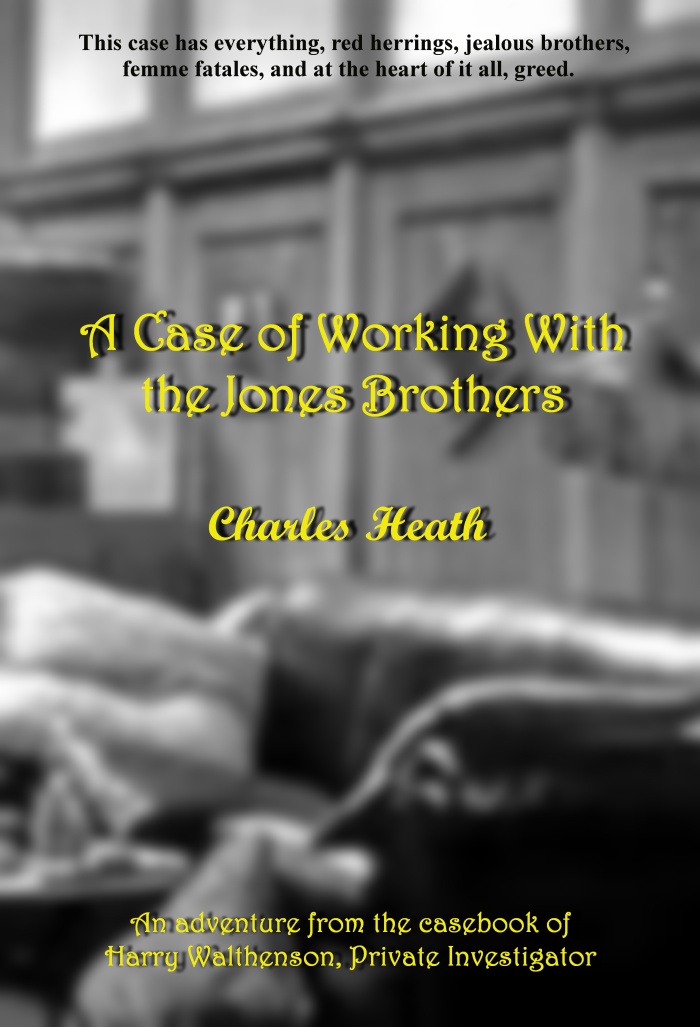
Now it’s called ‘A Case of Working With the Jones Brothers’, finished the first three drafts, and at the editor for the last.
I have high hopes of publishing it in early 2021. It even has a cover.
Under by itself is a rather boring word, you know, under the moon, under the sea, under the influence, which is not hard to be if you’ve been hypnotised or after a few drinks.
Under is anything beneath something else.
But let’s add it to some other words like,
Underrated, which means it is better than what others give it credit for.
Underwear is what you would wear underneath your clothes.
An understudy is a person who takes over a lead role when the lead is incapacitated. And how many understudies are guilty of harming the lead, in order to get a big break?
And not get away with it?
Understood, an agreement that might or might not be in writing that something will happen, that is, it is understood that I will be the next president.
Or not. Who on earth would really want to be president of anything?
So in the spirit of trying to confuse everyone all of the time, I have a conundrum in the form of a question, what is the difference between under and underneath?
To me there is none, you can be under the sea or underneath the sea, or under the table or underneath the table, but then there’s another, you can be under the influence but not underneath the influence, though technically you could, if you wanted to use confusing English.
And, just to add to the confusion further, I can say that the submarine sailed under the sea, underneath the sea, but, in actual fact, it doesn’t.
What is under the sea is the sand, or sea bed, and a submarine does not plough its way through the sand, does it?
What we really should be saying is that a submarine moves through the water.
It was in darkness. I was sure I had left several lights on, especially over the door so I could see to unlock it.
I looked up and saw the globe was broken.
Instant alert.
I went to the first hiding spot for the gun, and it wasn’t there. I went to the backup and it wasn’t there either. Someone had found my carefully hidden stash of weapons and removed them.
Who?
There were four hiding spots and all were empty. Someone had removed the weapons. That could only mean one possibility.
I had a visitor, not necessarily here for a social call.
But, of course, being the well-trained agent I’d once been and not one to be caught unawares, I crossed over to my neighbor and relieved him of a weapon that, if found, would require a lot of explaining.
Suitably armed, it was time to return the surprise.
There were three entrances to the villa, the front door, the back door, and a rather strange escape hatch. One of the more interesting attractions of the villa I’d rented was its heritage. It was built in the late 1700s, by a man who was, by all accounts, a thief. It had a hidden underground room which had been in the past a vault but was now a wine cellar, and it had an escape hatch by which the man could come and go undetected, particularly if there was a mob outside the door baying for his blood.
It now gave me the means to enter the villa without my visitors being alerted, unless, of course, they were near the vicinity of the doorway inside the villa, but that possibility was unlikely. It was not where anyone could anticipate or expect a doorway to be.
The secret entrance was at the rear of the villa behind a large copse, two camouflaged wooden doors built into the ground. I move aside some of the branches that covered them and lifted one side. After I’d discovered the doors and rusty hinges, I’d oiled and cleaned them, and cleared the passageway of cobwebs and fallen rocks. It had a mildew smell, but nothing would get rid of that. I’d left torches at either end so I could see.
I closed the door after me, and went quietly down the steps, enveloped in darkness till I switched on the torch. I traversed the short passage which turned ninety degrees about halfway to the door at the other end. I carried the key to this door on the keyring, found it and opened the door. It too had been oiled and swung open soundlessly.
I stepped in the darkness and closed the door.
I was on the lower level under the kitchen, now the wine cellar, the ‘door’ doubling as a set of shelves which had very little on them, less to fall and alert anyone in the villa.
Silence, an eerie silence.
I took the steps up to the kitchen, stopping when my head was level with the floor, checking to see if anyone was waiting. There wasn’t. It seemed to me to be an unlikely spot for an ambush.
I’d already considered the possibility of someone coming after me, especially because it had been Bespalov I’d killed, and I was sure he had friends, all equally as mad as he was. Equally, I’d also considered it nigh on impossible for anyone to find out it was me who killed him because the only people who knew that were Prendergast, Alisha, a few others in the Department, and Susan.
That raised the question of who told them where I was.
If I was the man I used to be, my first suspect would be Susan. The departure this morning, and now this was too coincidental. But I was not that man.
Or was I?
I reached the start of the passageway that led from the kitchen to the front door and peered into the semi-darkness. My eyes had got used to the dark, and it was no longer an inky void. Fragments of light leaked in around the door from outside and through the edge of the window curtains where they didn’t fit properly. A bone of contention upstairs in the morning, when first light shone and invariably woke me up hours before I wanted to.
Still nothing.
I took a moment to consider how I would approach the visitor’s job. I would get a plan of the villa in my head, all entrances, where a target could be led to or attacked where there would be no escape.
Coming in the front door. If I was not expecting anything, I’d just open the door and walk-in. One shot would be all that was required.
Contract complete.
I sidled quietly up the passage staying close to the wall, edging closer to the front door. There was an alcove where the shooter could be waiting. It was an ideal spot to wait.
Crunch.
I stepped on some nutshells.
Not my nutshells.
I felt it before I heard it. The bullet with my name on it.
And how the shooter missed, from point-blank range, and hit me in the arm, I had no idea. I fired off two shots before a second shot from the shooter went wide and hit the door with a loud thwack.
I saw a red dot wavering as it honed in on me and I fell to the floor, stretching out, looking up where the origin of the light was coming and pulled the trigger three times, evenly spaced, and a second later I heard the sound of a body falling down the stairs and stopping at the bottom, not very far from me.
Two assassins.
I’d not expected that.
The assassin by the door was dead, a lucky shot on my part. The second was still breathing.
I checked the body for any weapons and found a second gun and two knives. Armed to the teeth!
I pulled off the balaclava; a man, early thirties, definitely Italian. I was expecting a Russian.
I slapped his face, waking him up. Blood was leaking from several slashes on his face when his head had hit the stairs on the way down. The awkward angle of his arms and legs told me there were broken bones, probably a lot worse internally. He was not long for this earth.
“Who employed you?”
He looked at me with dead eyes, a pursed mouth, perhaps a smile. “Not today my friend. You have made a very bad enemy.” He coughed and blood poured out of his mouth. “There will be more …”
Friends of Bespalov, no doubt.
I would have to leave. Two unexplainable bodies, I’d have a hard time explaining my way out of this mess. I dragged the two bodies into the lounge, clearing the passageway just in case someone had heard anything.
Just in case anyone was outside at the time, I sat in the dark, at the foot of the stairs, and tried to breathe normally. I was trying not to connect dots that led back to Susan, but the coincidence was worrying me.
A half-hour passed and I hadn’t moved. Deep in thought, I’d forgotten about being shot, unaware that blood was running down my arm and dripping onto the floor.
Until I heard a knock on my front door.
Two thoughts, it was either the police, alerted by the neighbors, or it was the second wave, though why would they be knocking on the door?
I stood, and immediately felt a stabbing pain in my arm. I took out a handkerchief and turned it into a makeshift tourniquet, then wrapped a kitchen towel around the wound.
If it was the police, this was going to be a difficult situation. Holding the gun behind my back, I opened the door a fraction and looked out.
No police, just Maria. I hoped she was not part of the next ‘wave’.
“You left your phone behind on the table. I thought you might be looking for it.” She held it out in front of her.
When I didn’t open the door any further, she looked at me quizzically, and then asked, “Is anything wrong?”
I was going to thank her for returning the phone, but I heard her breathe in sharply, and add, breathlessly, “You’re bleeding.”
I looked at my arm and realized it was visible through the door, and not only that, the towel was soaked in blood.
“You need to go away now.”
Should I tell her the truth? It was probably too late, and if she was any sort of law-abiding citizen she would go straight to the police.
She showed no signs of leaving, just an unnerving curiosity. “What happened?”
I ran through several explanations, but none seemed plausible. I went with the truth. “My past caught up with me.”
“You need someone to fix that before you pass out from blood loss. It doesn’t look good.”
“I can fix it. You need to leave. It is not safe to be here with me.”
The pain in my arm was not getting any better, and the blood was starting to run down my arm again as the tourniquet loosened. She was right, I needed it fixed sooner rather than later.
I opened the door and let her in. It was a mistake, a huge mistake, and I would have to deal with the consequences. Once inside, she turned on the light and saw the pool of blood just inside the door and the trail leading to the lounge. She followed the trail and turned into the lounge, turned on the light, and no doubt saw the two dead men.
I expected her to scream. She didn’t.
She gave me a good hard look, perhaps trying to see if I was dangerous. Killing people wasn’t something you looked the other way about. She would have to go to the police.
“What happened here?”
“I came home from the cafe and two men were waiting for me. I used to work for the Government, but no longer. I suspect these men were here to repay a debt. I was lucky.”
“Not so much, looking at your arm.”
She came closer and inspected it.
“Sit down.”
She found another towel and wrapped it around the wound, retightening the tourniquet to stem the bleeding.
“Do you have medical supplies?”
I nodded. “Upstairs.” I had a medical kit, and on the road, I usually made my own running repairs. Another old habit I hadn’t quite shaken off yet.
She went upstairs, rummaged, and then came back. I wondered briefly what she would think of the unmade bed though I was not sure why it might interest her.
She helped me remove my shirt, and then cleaned the wound. Fortunately, she didn’t have to remove a bullet. It was a clean wound but it would require stitches.
When she’d finished she said, “Your friend said one day this might happen.”
No prizes for guessing who that friend was, and it didn’t please me that she had involved Maria.
“Alisha?”
“She didn’t tell me her name, but I think she cares a lot about you. She said trouble has a way of finding you, gave me a phone and said to call her if something like this happened.”
“That was wrong of her to do that.”
“Perhaps, perhaps not. Will you call her?”
“Yes. I can’t stay here now. You should go now. Hopefully, by the time I leave in the morning, no one will ever know what happened here, especially you.”
That first encounter outside the confines of the hotel has shaken him. He realises that he really has no understanding of women and that his first love with Jane had done nothing to prepare him.
It only reinforces the notion that he should simply avoid her where possible.
Yet, over dinner, she tells him her story, not the real story, but close enough to the truth. In doing so, allowing the door to be ajar, she realises this could become complicated very quickly.
And yet, despite her resolution to remain aloof, she is curious. Who is this Henry?
The beach quickly becomes Henry’s thinking place. He ruminates on what a friend on board the ship, Radly, might think of his situation. Radly is a lady’s man and would have swept Michelle off her feet by now.
Michelle reappears, and, curious about him, asks him who he is, those usual questions, where he lives, and what he does.
Why? If she is only there to hide, why get involved?
I spent years listening to my brother, the perfect child in my parents’ eyes, tell me just how good life was.
For him.
He landed on his feet. One of those students who had no learning difficulties graduated top of his class, was in the right place at the right time to get a dream job, and, yes, you guessed it, the dream wife.
His favourite line every time we met, usually at a very exclusive restaurant, or after celebrating the purchase of a new car or apartment, was “You could have all of this too…”
And, wait for it, “if only…”
His mantra relied on one factor, we both had the same genes and in his mind, we had the same possibilities in life. To him it was simple. And after years of the same, over and over, I began to wonder why it wasn’t so.
The simple fact was that we were as different as the proverbial chalk and cheese.
It was one of those quirks that appeared in families. The progeny although produced by the same father and mother quite often were totally different, even when they looked so similar.
George and I were not alike in appearance although my mother always said I had my father’s hair and nose, whereas George was the spitting image of him.
My two younger sisters Elsa and Adelaide, though two years apart were almost identical twins and looked like our mother.
Our mother, long-suffering at the hands of her husband had died five years ago, and my father, in what was the longest deathbed scene ever, had finally died, the previous evening with all his children in attendance.
I was surprised my father wanted me there, and equally so when he usually spoke to me as though I was dirt under his feet. That he treated me better this time I put down to the fact in dying he had become deranged. The others, George, Elsa, and Adelaide simply ignored me.
His death was the end. I had no reason to stay, less reason to talk to my siblings, and muttering that my duty was done, left.
I never wanted to see any of them again.
…
Of course, we never really get what we wish for.
She had never deigned to come and see me before, and our meetings could be counted on the fingers if one hand, her wedding, my 21st birthday, fleeting as it was, and the death of our father, three times in fifteen years. Nor had I met the two mysterious children they had and wondered briefly what George had told them about me.
I could guess.
Two days later. I was getting ready to go back to my obscure job, the one George said was beneath a man of my talents, without qualifying what those talents were, when the doorbell rang.
Unlike my brother’s apartment building with a concierge and security staff, visitors simply made their way to the front door. I was on the third floor, and the lift was out of service, so it was someone who wanted to see me.
I looked through the door viewer, I didn’t have the CCTV option, and saw it was Wendy, George’s perfect wife.
I could tell she didn’t want to be knocking on my door, much less come into the salubrious apartment, in a building that should have been condemned a long time ago.
I could just ignore her, but she looked increasingly agitated. People sometimes lurked in the corridors, people who looked like jail escapees.
She just pushed the doorbell again when I opened the door. She didn’t wait for me to ask her in, stopping dead in the middle of the one other room I had other than a bedroom.
I could see it written all over her face, this, to her, was how the other half lived. I closed the door but didn’t move.
“How can you live here?” The tone matched the shock on her face.
“When you ignore the faded and peeling wallpaper, the mould on the roof, and the aroma of damp carpets, it isn’t so bad. There are far more of us living like this than you can imagine, almost affordable. My neighbour has the same apartment but has three kids and a wife.”
She shook her head.
“Why are you here Wendy? I can’t believe George would send you down here to do his dirty work.”
“George didn’t send me. He doesn’t know I’m here.”
“Then how did you know where to find me?”
“Don’t ask. The funeral is in three days’ time. You should be there?”
“Why? Everyone hates me. Even your kids hate me, and I haven’t even been formally introduced.”
“Just come, Roger. You don’t deserve to live like this, no one should.”
“It’s the real world, Wendy. Not everyone can afford weekends at Disneyland, and apartments overlooking Central Park.”
She crossed the room back to the door and I opened it for her. “I’ll think about it.”
“Do think too hard. After all is said and done, he was your father.”
Sadly, that was true.
…
I was having dinner in the diner not far from my apartment block, when Alison, a waitress I’d known for a year or so, and like me, could not catch a break, came over to offer a second cup of coffee.
I was a favourite, not everyone got seconds.
“I heard your father died,”: she said.
It was the end of the shift and just before closing. The last of the customers had been shooed out.
“My life hasn’t changed with him in it, or not.”
“He was your father.”
I shrugged. “You free tomorrow?”
“Why, you finally asking me out on a date?”
“If going to a funeral is a date, yes. The service will be boring, the people way above our station in life, and my brother and sisters will be insufferable, but there’ll be good food and top-shelf booze at the wake. Date or not, want to come with me?”
“Why not? I’ve never had real champagne.”
She lived in the same apartment block, and I’d walked her home a few times. “Pick you up at 10?”
She nodded. “I’ll even behave if you want me to.”
…
Alison looked stunning in her simple black dress. She was wearing more black than I was, and looked like she was going to a funeral. She had turned the drab waitress into something I didn’t realize lurked beneath the surface.
She did a pirouette. “You like?”
I smiled, which was something given the way I felt about everything to do with my family. “I do, very much.”
We took the train to Yonkers, upstate, where the family home was, and where my father had gone to die, as he put it. I’d lived there, in the mausoleum until I was old enough to escape. The catholic church would no doubt be gearing up for the service. It was due to start at 11:30, and we made it with a few minutes to spare.
I planned it that way, I did not want to sit with the rest of the family up front.
“You should be sitting with the others,” Alison said, not understanding why I wouldn’t.
“You haven’t met them yet. When you do, you’ll know. Besides, I find it better to sit in the last row. You can escape quickly.”
She shook her head, and we sat. Not in the last row, she was adamant she would not. It was about halfway up, on the same side as the family were situated. From there, I could watch George and Wendy, and my two sisters looking very sombre, receive the guests.
There were quite a few, I counted nearly a hundred. My father may have been awful to me, but a lot of people respected and liked him.
Soon after we sat two young girls came and sat in the seats in front of us.
Then they turned around and looked at me, then Alison, then back at me.
“Daddy said you wouldn’t come,” the elder of the two said.
“Are you his daughters? If you are, you could ask him why I’ve never seen you.”
“He thinks your eccentricity would rub off on us.”
Alison couldn’t contain herself at that remark. “Your father actually said that to you?”
“Not directly. They’ve been talking about him since my mother went and asked you to come. He doesn’t really think much of you, does he?”
An astute child.
“I left home and became a motor mechanic. We are supposed to be bankers, lawyers or doctors. If you got a car you want to be fixed, then I’m your man. You want advice on money, don’t come to see me.”
“Are you coming to sit with us?”
“I don’t think your mother and father could handle the shame. No, we’ll stay here and leave them in peace.”
I watched Wendy glance in the direction of her girls, they came almost running to rescue them from the monster.
The elder girl looked at her mother when she arrived, breathless. “He’s quite normal you know.”
I had to laugh. Wendy looked aghast. She glared at the girl, then her sister. “Come, the pair of you. Enough of this nonsense.” She grabbed their hands and almost dragged them away.
I could see George up the front of the church, glancing down in our direction. The fact he didn’t come said a lot. It was clear neither of them wanted me sitting with them, and that was fine by me.
“They’re lovely girls, Roger.”
“The first time I’ve seen them, but they don’t seem to belong to my brother. They don’t have his arrogance or her disdain.”
“I’m sure, now they’ve met you, it won’t be the last time. It seems odd that Wendy, that was Wendy, wasn’t it?”
I nodded.
“Then it seems odd that she would ask you to come and then treat you like that.”
“No, not at all. I’ve only met her three or four times, and that’s her. I won’t tell you what she thought of my apartment.”
The service took an hour and various people got up to say nice things about a man who was not very nice, but that was the nature of funerals. He was dead now, so there was no need to live in the past.
I didn’t intend to.
I had intended to leave and go back home after the service, but now I’d decided to go to the wake at the old house. It would be nice to show Alison where I grew up and give her some context as to why I hated my family so. I was willing to bet my room would be the same as it was the day I left.
And it would be good to see Alex and Beatrice, the manservant and housekeeper again. There were more parents to me than my mother and father. There were sitting up the front of the church and hadn’t yet seen me.
What I hadn’t noticed during the service, was that a woman had come in and quietly made her way to our pew and sat down. She had given me a curious look, one that said I know you, but can’t place who you are.
But that wasn’t the only odd thing about her. I had the feeling she was related in some way, that sort of feeling you had when you met someone who was family but you didn’t really know them. It was hard to explain. Perhaps she was one of my mother’s friends, there were a few in the church, and they, like me, had a strained relationship with my father.
He had not treated her very well, in the latter stages of her life before she died.
Just before the service ended Alison leaned over and said quietly, “The woman next to you. You and she are related in some way. She has the same profile, perhaps an aunt.”
As far as I knew my mother was an only child, she certainly never spoke of having a sister, in fact, she rarely spoke about her family at all. Now I thought about it, it was all very strange.
The service over we could all finally stand and stretch. The woman slowly stood, then turned to me.
“You are Roger, aren’t you?”
“I am.”
“Shouldn’t you be up the front with the rest of the family?”
“No. I’m the black sheep. I didn’t like my father all that much, and he certainly hated me, so it’s a miracle I came. Perhaps you should introduce yourself to my brother, George.”
“I’m not here to see him, Roger, I’m here to see you.”
“Were you a friend of my mother’s? I know there are a few here, keeping their distance like I am.” This woman was trouble, I could sense it.
“Yes, and no. I knew your mother briefly. I knew your father better, I used to work for him a long time ago.
“Like I said, you’re probably better off talking to George. I rarely saw him when I was a child, and when I did, he ignored me, and as soon as I could I left, and only saw him on a few occasions since.”
“Do you know why he was like that? Did he treat George the same way?”
“No. George was always the favourite son who could do no wrong, the heir apparent.”
“Then I’m sorry to hear that. That was not how it was supposed to be.”
Every year I come back to revisit this, and each year it becomes a harder issue to deal with. All that’s recently changed is the number of characters you can use
I’ve been trawling the endless collection of twitter descriptions provided by their users, noting that there is a restriction of 280 characters.
How do you sum yourself up in 280 characters?
I don’t think I can, so we tend to put down a few catchphrases, something that will draw followers. I’m thinking the word ‘aspiring’ will be my catchword.
I’m aspiring to be a writer, or is that author? Is there a difference, like for instance, one publishes ebooks on Amazon, one publishes hard copies in the traditional manner?
Is there a guide to what I can call myself?
Quite simply put, but in more than 140 characters, married happily, two wonderful children, three amazing grandchildren, and a wealth of experience acquired over the years.
Actually, that sounds rather boring, doesn’t it?
Perhaps it would be better if I was a retired policeman, a retired lawyer, a retired sheriff, a retired private investigator, a retired doctor, someone who had an occupation that was a rich mine of information from which to draw upon.
Retired computer programmers, supermarket shelf stackers, night cleaners, accounts clerks and general dogsbody s don’t quite cut the mustard.
I have also become fascinated with the expression ‘killer biography’. Does it mean that I have to be a ‘killer’?
Better than the self-confession above. Should we try to embellish our personal history in order to make it more appealing?
It’s much the same as writing about daily life. No one wants to read about it, people want to be taken out of the humdrum of normalcy and be taken into a world where they can become the character in the book.
And there you have it, in a nutshell, why I write.
It’s the obvious items in the photograph that you see first, or that your eyes go to first.
The ocean, the beach, the buildings. You can see a shopping mall with MacDonald’s sign above it.
Yes, it’s late afternoon, and you can see long shadows of the buildings.
So, if I asked you what did you see in this photo, what would your reply be?
From a thriller writer or murder mystery writer’s point of view, it’s what you don’t necessarily see.
So, for the purposes of the story, the opening line for the world-weary detective, handing the photo to his partner, “What’s is it you can’t see in this photo?”
A partner that hadn’t been on the job very long, in from the suburbs, and had seen little more than break and enters car theft, and school kids hi-jinks.
“What am I supposed to be looking for?”
“You want to be a detective, or be looking for old ladies cats?”
His partner takes the photo in hand and looks at it again. There has to be a reason why the old man had given it to him, or perhaps there wasn’t and he was just playing with him again.
No, he thought, there has to be something…
And then he saw it, quite by accident. A hand, a gun, and following the line of fire, at the end, what looked like someone in the bushes.
In a photo taken from a higher floor of the building over the road, looking down on what was supposed to be a rooftop recreational area.
Only there had been no report of a missing person or a gunshot wound in the last seven days.
“When was it taken?”
“Two days ago?”
“And no reports of a shooting, or a body?”
“No. And yet the person who took this swears he saw a body, but by the time he came back, there was nothing.”
The detective handed his partner a second photo. Time-stamped five minutes later. With no gun and no body.
And when I woke up, I realised that I had just had a very bad dream. Or don’t they call bad dreams nightmares?
Can you diagnose yourself as having depression?
Of course, if you were to tell someone else, in one of this very serious tones, “I think I have depression” they will ask you what you’ve got to be depressed about.
It’s a good question. My first answer would be, “why did the doctor put my on anti depressants?” You know the stuff they give you, some derivative of serapax,
Then, if you tell anyone you’re on that stuff, they turn around and tell you just how bad it is and get off it right now.
That’s all very well, but you tell them you still have depression, and so the argument goes on.
But…
These days, they use low doses of anti depressants to manage pain, and in my case back pain. The first pill they gave me was lyrica, which slowly took my memory away so that I couldn’t remember what anyone had said earlier in the day.
I thought I had early onset Alzheimer’s, or worse, dementia.
So I got off that, got the pain back, and moved to anti depressants. Now I’m seeing things.
That might help with the imagination for writing stories sometimes, but telling people you see the patterns on tiles moving is not a good start to any conversation.
Back to depression, though. It might be caused by being locked down and not being able to go anywhere, but that has never bothered me because I hate going out.
It might be a result of my childhood coming back to haunt me, and, believe me, you would not want the childhood I had, but it’s a maybe. A lot of old people find their past creeping up on them, and what happened 60 years ago seems more relevant than what happened 60 minutes ago.
You might think you’re badly done by, that everyone else is responsible for the mess you made of your life, if it is indeed a mess, but no, that isn’t true. My life is exactly what it’s meant to be, though how I got here remains the biggest of mysteries.
It’s why I’m writing the autobiography of a very ordinary nobody.
OK, that might be a hint, thinking I’m a nobody. After all, when I go out I always feel like I’m invisible.
A friend of mine tells me he always cries when there’s a sad part of a film on, and that’s his determination of depression.
I do too, but I don’t think it’s that.
After all, I did psychology and should understand the nuances of the human psyche, what makes us happy, what makes us sad, what makes us us.
So, rightly or wrongly I’ve stopped taking the anti depressants.
If suddenly my blog suddenly stops, you’ll know I’ve made the wrong decision.
Michelle, to Henry, was the proverbial black widow, having arrived with every stitch of clothing black or near enough.
They settle into an uneasy co-existence, by the fire, waiting out the rain and weather, not avoiding meals because it would require explanation, but stumbling over the conversation, mainly because of Henry’s shyness and reserve.
The arrangements come to a head when she goes out and comes back soaked. She stands by the fire to get warm; Mrs Mac brings a towel for her to dry her face and hair, and here Henry discovers her injuries make it difficult.
He helps but makes a mess of it through inexperience and fear of, yes, making a mess of a moment, which, word-wise, he does.
At this point, we discover a lot more about who she is and why she is there, and why she can never have a relationship, friendship or anything with that enigmatic, shy, boy.
Then the weather breaks.
Alone, Henry goes out to explore the coast, finds a way down to the beach, goes for a walk to be alone with his thoughts, and remembers where he had seen her before.
In magazines, ads. Not only a model but a lot more. A woman he realizes he is way out of his depth when with her.
She ventures to the beach, and they talk, he discovers small talk is not something that comes easy and is left in despair at his ineptitude.
I know this feeling from experience, and it makes this story easy.
Every time I close my eyes, I see something different.
I’d like to think the cinema of my dreams is playing a double feature but it’s a bit like a comedy cartoon night on Fox.
But these dreams are nothing to laugh about.
Once again there’s a new installment of an old feature, and we’re back on the treasure hunt.
It was an understatement to say I was dreading going to Boggs’ place.
In fact, in the hour it took to get through the morning chores I had time to consider how and why I was in this position. Boggs was a friend. We were friends at school and as best we could we had each other’s back when the bullies came out to play.
At times that didn’t amount to much because as everyone knows, bullies hunt in packs. Six against two wasn’t much of an equation. And it those days, the teachers spent more time hiding from the students than being in front of them.
It was simply a case of what doesn’t kill you makes you stronger.
It didn’t feel like that, not for a very long time.
But, in the end, misfortune can make strange bedfellows, and in a town that depended on a single industry, it soon became apparent that there were more people against the Benderby’s and the Cossatino’s than for, and in small-town politics, that was more than an evening up. Out of school and separated from their acolytes, both Alex and Vince found that whatever influence they had once, was now gone, and all that was left was a grunt, and we were basically left alone.
Boggs was the dreamer.
He had idolized his father and when he went missing it broke him.
This map thing was the first signs of Boggs finally coming back to life, but the problem was, it was all pinned on false hopes. The Sherriff was right. Boggs was in over his head, playing with the two most vicious families from around here, and it was bad enough that his father had fallen foul of them, the Sherriff was not about to see his son go the same way. I was going to try and talk Boggs out of it.
Yet, on the other hand, it was people like us who needed a win, just to show there was still hope in this place. With threats every day that the factory might have to close, there were dark clouds hanging over everyone’s head.
If the factory closed, there was going to be a very large hole in the local economy and a lot of people in financial trouble. I’m not sure how finding the treasure might solve all of that, but I suspect Boggs’ had something up his sleeve.
I knocked on the door and his mother answered. She looked harried. She was a nurse and looked as though she just got home from the night shift at the hospital.
“Boggs is in his room.”
“How are you this morning?”
“Tired. And an afternoon shift, which I might not get to if I don’t get some sleep. You know where he is. Try not to make any noise.”
“Will do.”
I came in and closed the door, watching her dash off down the passage to the other end of the house.
She could not work endless double shifts for much longer, but like all of us, it was not out of desire but necessity. She had implored Boggs to get a job and help, but he seemed oblivious to the problem. I’d tried to speak to him, but he had that insufferable way of just not listening.
Boggs was in his room, sitting on the bed and staring at the ceiling.
“If only. I could use it right now to find something that’s missing>”
“Your cell phone?” Boggs was always misplacing something, of forgetting it. I’d lost count how many times he’d misplaced his phone.
“No. An underground river.”
OK. That was out of left field. I had no idea any rivers were missing, or, in fact, they could actually go missing.
Apparently, they could.
“There’s two,” he said. 300 years ago five or take this part of the coastline had several rivers that ran down from the mountain range. What we now call the hills on the edge of the coastal plain. There was also a lake, not very large, but it used to have several streams flow into it all year round and had an aqua flow that came out along the coastline.”
“And you figured all of this out from what? A copy of the treasure map.”
The moment he started quoting rivers, streams, and lakes, I remembered each of those geographical features appeared on several of the map versions. I had suggested, rather comically, that it would be funny if the treasure was buried in the lake.
It wasn’t all that funny. It was also possible.
“Imagine this. Drop anchor out to sea, in other words on the other side of the natural sandbar that formed at the seaward side of the river, get in the longboats and row inshore to the lake, across the lake, up another river to the base of the hills. Then do a little exploring, north or south, and find a cave. I reckon the treasure was buried in a cave. We know there are caves up there, not many, but I think there used to be more.”
“Someone already did a survey with some rather fancy electronic equipment with the same idea in mind. He found three, not very long, and certainly without treasure. Two had substantial falls inside, which is why they were buried.”
“There’s more.”
He jumped up off the bed and went over to the robe and opened the door. Tacked on the back was a copy of an ordnance survey map of this part of the coastline, and a tracing of the treasure map, to the same scale on top.
“As you can see, I think ‘I’ve found the correlation between the real, and what was real 300 years ago.”
Except there’s no rivers and no lake. And no sand bar as I recall. There was a small marina in what might have been where the river met the sea, but that’s gone. They filled it in and build a shopping mall on it. A huge, now half empty, shopping mall. A modern wonder 40 years ago that was supposed to bring business and shoppers to the town. For a few years it did, until another town 50 miles away got the same idea, sold the land for half the price, and made the rents a quarter of what they were here.
They called it progress.
We called it piracy.
“Then we can hardly row our boat inshore and up the stream, if it’s not there.”
I hated to state the obvious.
“But,” he said, looking like the cat who’d swallowed the canary. “What if it is still there, but we just can’t see it?”


 Thrills, Spills, and just a dash of Romance