Investigation of crimes doesn’t always go according to plan, nor does the perpetrator get either found or punished.
That was particularly true in my case. The murderer was incredibly careful in not leaving any evidence behind, to the extent that the police could not rule out whether it was a male or a female.
At one stage the police thought I had murdered my own wife though how I could be on a train at the time of the murder was beyond me. I had witnesses and a cast-iron alibi.
The officer in charge was Detective First Grade Gabrielle Walters. She came to me on the day after the murder seeking answers to the usual questions like, when was the last time you saw your wife, did you argue, the neighbors reckon there were heated discussions the day before.
Routine was the word she used.
Her fellow detective was a surly piece of work whose intention was to get answers or, more likely, a confession by any or all means possible. I could sense the raging violence within him. Fortunately, common sense prevailed.
Over the course of the next few weeks, once I’d been cleared of committing the crime, Gabrielle made a point of keeping me informed of the progress.
After three months the updates were more sporadic, and when, for lack of progress, it became a cold case, communication ceased.
But it was not the last I saw of Gabrielle.
The shock of finding Vanessa was more devastating than the fact she was now gone, and those images lived on in the same nightmare that came to visit me every night when I closed my eyes.
For months I was barely functioning, to the extent I had all but lost my job, and quite a few friends, particularly those who were more attached to Vanessa rather than me.
They didn’t understand how it could affect me so much, and since it had not happened to them, my tart replies of ‘you wouldn’t understand’ were met with equally short retorts. Some questioned my sanity, even, for a time, so did I.
No one, it seemed, could understand what it was like, no one except Gabrielle.
She was by her own admission, damaged goods, having been the victim of a similar incident, a boyfriend who turned out to be an awfully bad boy. Her story varied only in she had been made to witness his execution. Her nightmare, in reliving that moment in time, was how she was still alive and, to this day, had no idea why she’d been spared.
It was a story she told me one night, some months after the investigation had been scaled down. I was still looking for the bottom of a bottle and an emotional mess. Perhaps it struck a resonance with her; she’d been there and managed to come out the other side.
What happened become our secret, a once-only night together that meant a great deal to me, and by mutual agreement, it was not spoken of again. It was as if she knew exactly what was required to set me on the path to recovery.
And it had.
Since then, we saw each about once a month in a cafe. I had been surprised to hear from her again shortly after that eventful night when she called to set it up, ostensibly for her to provide me with any updates on the case, but perhaps we had, after that unspoken night, formed a closer bond than either of us wanted to admit.
We generally talked for hours over wine, then dinner and coffee. It took a while for me to realize that all she had was her work, personal relationships were nigh on impossible in a job that left little or no spare time for anything else.
She’d always said that if I had any questions or problems about the case, or if there was anything that might come to me that might be relevant, even after all this time, all I had to do was call her.
I wondered if this text message was in that category. I was certain it would interest the police and I had no doubt they could trace the message’s origin, but there was that tiny degree of doubt, about whether or not I could trust her to tell me what the message meant.
I reached for the phone then put it back down again. I’d think about it and decide tomorrow.
I’m back home and this story has been sitting on the back burner for a few months, waiting for some more to be written.
The trouble is, there are also other stories to write, and I’m not very good at prioritizing.
But, here we are, a few minutes opened up and it didn’t take long to get back into the groove.
Chasing leads, maybe
When the room was empty and only Richards and I remained, he cut the ties that bound my hands and legs.
“Bad business,” he said.
I sat again, and flexed the muscles that had begun to stiffen up whilst tightly bound.
“I’m assuming you know a woman by the name of Jan?” I said. “She told me she was working for MI6 so I’m assuming you’re her handler.”
“When she chooses to be handled, yes. Jan is just one of her names. She’s currently missing, and I think we now know why?”
“Her work,” I nodded towards the body.
“God no. She’s charged with chasing down leads and then calling the cavalry. We had a tracker on this chap, found him, and had him in a safe facility awaiting interrogation, what we thought was safe at any rate, and Jan and another agent watching over him until the interrogation team arrived. When the interrogation team got there everyone was gone, but with enough blood on the floor to paint a pretty clear picture. Maury had been interrogated and killed there, dumped here, with no indication of the whereabouts of our agents. She told me this guy and another trained you, and others, in rather strange circumstances. A bogus operation. To what end?”
“From what I could tell, a single surveillance operation. Me and a dozen others. Cut loose after it failed, those of us that survived, that is.”
“A lot of effort to achieve nothing.”
“Pity we can’t ask him what it was about?” I looked over at the body. Maury was hardly recognizable. Whoever carried out the interrogation had been either in a hurry or in a bad mood.
“Indeed. She told me this chap called O’Connell was involved. Now so?”
Another rule that popped into my head from the training: never share information with other agencies unless you absolutely had to. I had no doubt if Dobbin was here, he would agree, but he wasn’t.
I wondered if I should tell him she had allegiance to another branch of the secret services, or mention Dobbin.
“He was the surveillance target. We were charged with observing him, but not what he was suspected of. I followed him as far as the exploding shop, got temporarily disorientated after the blast,, but managed to reacquire the target, following him to an alley where I spoke briefly to him before Maury and Severin arrived, and he was shot, apparently killed.”
“Either he was or he wasn’t.”
“The body disappeared. My view is he is still alive, somewhere.”
“That explosion was supposed to be caused by a gas leak.”
“Standard operational doubletalk. A journalist was killed, apparently in the shop waiting for the target. It went up after the target passed, I’m assuming his tradecraft was to check first then go back. Never got a chance. I think now given the circumstances, the journalist was going to hand something off. I’ve been asked a number of times by various people about a USB drive. You know anything about it?”
“This is the first I’m hearing about anything about a USB drive. You know what was on it?”
“Above my pay grade, I was told.”
“OK. What about this Severin character?:
“All I have is a phone number, and that, I think we can both agree, will be a burner.”
“Agreed, but it might be useful.”
I gave it to him and he put it on his phone.
A new team of men in white suits arrived at the door, no doubt MI5 forensic specialists, and two more agents, bigger and tougher, what I would call the muscle.
“I’m afraid you’re going to have to come back to the office to answer a few more questions. It’s not custody, but mandatory co-operation.”
“And if I refuse?”
“It might make their day if you know what I mean.”
I shrugged. One I might be able to take, but not the both of them. And they both looked like they would be happy to teach me the error of my ways if I tried to escape/
“That won’t be necessary. I’m taking him with me.”
“Dobbin just came to the door, flashing an MI6 warrant card.
“I’ve been charged with cleaning this mess up.”
“And so you shall, but not including this agent. Orders from above, reasons why, as they say, are above your pay grade.
I suspect the warrant card said Dobbin outranked him. Did our people have fake MI6 IDs?
“This is highly irregular.”
“Call your boss, if you don’t like it. I can wait.”
I could see the reluctance in his face.
He glared at me. “Go, but don’t go too far. I still might get clearance to have another chat.”
David is a man troubled by a past he is trying to forget.
Susan is rebelling against a life of privilege and an exasperated mother who holds a secret that will determine her daughter’s destiny.
They are two people brought together by chance. Or was it?
When Susan discovers her mother’s secret, she goes in search of the truth that has been hidden from her since the day she was born.
When David realizes her absence is more than the usual cooling off after another heated argument, he finds himself being slowly drawn back into his former world of deceit and lies.
Then, back with his former employers, David quickly discovers nothing is what it seems as he embarks on a dangerous mission to find Susan before he loses her forever.
It was in the news, and seemed odd to me, that a word such as clip would have any significance beyond that of having a haircut, but apparently, it does.
Maybe they’re referring to the clip of ammunition for a gun?
But for us, a clip can be part of a haircut, letting the scissors loose.
And for those children who had a father who was a hard taskmaster, you would be familiar with a clip around the ears. It can just as easily be used, say when a car clips another car when the driver loses control.
There’s a horse that runs at a fast clip, and can be anything for that matter that moves quickly.
It can be a spring-loaded device that holds all your papers together. Or just about anything else for that matter.
You can clip an item from a newspaper, aptly known as a news clipping.
it can be a portion of a larger film or television programme, but to me, sometimes, when a series has a clip show, an episode where someone reminisces and we see clips from previous episodes.
And last but not least, clip the wings of those so-called high flyers at the office.
To write a private detective serial has always been one of the items at the top of my to-do list, though trying to write novels and a serial, as well as a blog, and maintain a social media presence, well, you get the idea.
But I made it happen, from a bunch of episodes I wrote a long, long time ago, used these to start it, and then continue on, then as now, never having much of an idea where it was going to end up, or how long it would take to tell the story.
That, I think is the joy of ad hoc writing, even you, as the author, have as much idea of where it’s going as the reader does.
It’s basically been in the mill since 1990, and although I finished it last year, it looks like the beginning to end will have taken exactly 30 years. Had you asked me 30 years ago if I’d ever get it finished, the answer would be maybe?
My private detective, Harry Walthenson
I’d like to say he’s from that great literary mold of Sam Spade, or Mickey Spillane, or Phillip Marlow, but he’s not.
But, I’ve watched Humphrey Bogart play Sam Spade with much interest, and modeled Harry and his office on it. Similarly, I’ve watched Robert Micham play Phillip Marlow with great panache, if not detachment, and added a bit of him to the mix.
Other characters come into play, and all of them, no matter what period they’re from, always seem larger than life. I’m not above stealing a little of Mary Astor, Peter Lorre or Sidney Greenstreet, to breathe life into beguiling women and dangerous men alike.
Then there’s the title, like
The Case of the Unintentional Mummy – this has so many meanings in so many contexts, though I image back in Hollywood in the ’30s and ’40s, this would be excellent fodder for Abbott and Costello
The Case of the Three-Legged Dog – Yes, I suspect there may be a few real-life dogs with three legs, but this plot would involve something more sinister. And if made out of plaster, yes, they’re always something else inside.
But for mine, to begin with, it was “The Case of the …”, because I had no idea what the case was going to be about, well, I did, but not specifically.
Then I liked the idea of calling it “The Case of the Brother’s Revenge” because I began to have a notion there was a brother no one knew about, but that’s stuff for other stories, not mine, so then went the way of the others.
Now it’s called ‘A Case of Working With the Jones Brothers’, finished the first three drafts, and at the editor for the last.
I have high hopes of publishing it in early 2021. It even has a cover.
Absence is supposed to make the heart grow stronger.
But…
This is no ordinary romance. There’s a great big ocean between them, in more ways than one. Getting off that ocean, getting to the port, and getting to the girl is proving a very hard task indeed.
Ships have a mind of their own.
Then the planets align…
This date starts out badly. Henry is running behind time, and, the meeting place is, well, far from being private. It’s like he’s in the middle of a spy novel, finding himself surveilling the crowded public square …. For what?
She’s there but hardly acknowledges his presence.
Then he feels the presence of another, hiding in plain sight.
Something is amiss. Michelle is on edge, and from the, the date goes downhill.
They get some time ‘alone’, and words are spoken, but their not anywhere near what he had hoped to hear. There’s fallout from the last date, and we learn a little more about who and what Michelle is, and why she is acting this way.
In a desperate attempt to win her over, Henry proposes marriage.
It doesn’t work.
They part, but not before that old adage ‘eavesdroppers never hear anything good about themselves’ which sends him into a deeper spiral of despair.
It was the message left on my cell phone from Detective Inspector that sometimes threw work my way, usually difficult cases that didn’t have the usual clues leading to a resolution.
I’d been lucky in an old case I’d been researching for a mystery novel and discovered a pattern that, in the end, led to the discovery and resolution of seven other cases spanning thirty years.
It got me into Detective Inspector Clarissa Menzies’ world of criminal investigations, which benefited my research and writing, as well as provided her with another perspective on some of her cases.
I met her at the hospital and was surprised that it was outside a psychiatric ward.
“A little background first. The person you’re about to meet, Angela O’Brien, found herself in a relationship with a criminal, James Dyson, who was portraying himself as a businessman. Things were fine until she discovered who he was, and then, finding herself in too deep asked us to help find a way out. Unfortunately, the best of intentions didn’t quite go the way we planned it.”
“Don’t tell me. You recruited her to get the information you could use against him; you couldn’t resist having someone that close and not try to use it.”
Her expression told me that was exactly what happened. “It was not what I wanted, but to get our help, they wanted something in return.”
“Let me guess. Once she realised who he was and how dangerous he was, she changed. He noticed the change, and when she tried to get the information, he caught her.”
“She was lucky. She was in the wrong place at the wrong time and didn’t get to see or take anything. He was just overly suspicious, realising that sooner or later, she would find out.”
“I’m assuming she is in the psych ward, which means…”
“The Barnsdale warehouse fire. He was using it as a processing centre for stolen goods inside the legitimate organisation trading in second-hand goods and claimed, out of spite, she burned the place to the ground. We found her there, covered in incriminating evidence, unconscious from a beam that fell on her as a result of the fire. The thing is, she has no memory of the night, how she got there, or anything. He’s made all the running in this case, accusing her of arson and demanding we charge her. The only problem is that there was another body in that fire, one of his associates, and we think he murdered him, and the way it’s going, if she can’t remember anything, she will end up paying for his crime. All she can remember is the word Kaleidoscope.”
“How will my talking to her make a difference if her memory is gone?”
“You will no doubt have a completely different perspective on the whole affair, especially since I’m not going to tell you anymore. Treat her as a suspect in one of your stories and ask questions. All you need to know is that it was a crime scene, a man was murdered, the fire is covering that up, and she has been set up to take the fall. It might end up being your next novel.”
“Will you be staying?”
“No. I’ll tell her you are helping us with the case and you have some questions.”
For a victim found in a burnt-out building, she seemed remarkably untouched. Except for bandages on her head and some red welts on her hands, there was little other evidence of her ordeal. She was middle-aged and had the appearance of a woman who had devoted herself to the job, forsaking marriage and children. Larissa hadn’t told me her circumstances, but I suspect she may have worked in his organisation, and he had targeted her. Or the circumstances might be totally different.
Clarissa introduced me and then left. I sat down, aware she was giving me the once over, her expression conveying curiosity and wariness.
“The detective says you might be able to help me remember. Are you a doctor?”
“No, but I do have a degree in psychology, not that I ever wanted to be a psychologist. It sometimes helps analyse people, more to put me at ease in their company than anything else.”
“You’re going to analyse me then?”
“Do you want me to?”
“If it discovers how I could have made such a stupid mistake, yes. I mean, I’m sure I knew there was something about him, but I just ignored it until it was too late.”
“We are either willing to compromise in order to get what we want or not, and finish up becoming old and bitter. The fact that it turns out to be the wrong one, it’s just a mistake we learn from and generally move on from. Rarely does it end up like your current situation. But, in your favour, the Inspector doesn’t believe you are either a murderer or an arsonist, despite the circumstantial evidence. However, it would help if you remembered something, anything from that night. So, tell me the last thing you remember?”
“Getting ready to go out.”
“Was this when you realised, he was on to the fact you knew who he was.”
“It wouldn’t be hard, try as I might, I couldn’t get over the horror and knowing I’d been with such a terrible man.”
“Did he change in any way towards you?”
“Not that I could tell, but then he was a good actor.”
“Do you know where he was taking you?”
“No.”
“Was there a place you’d normally go?”
“Yes. A small restaurant owned by a friend of his. When things were good, we’d all dine together and talk about the future. He had been talking about spending a few months in Sorrento, Italy. He had relations there, he said. It would have been nice.”
I’d been there once. The place was nice, but the circumstances were not. I’d gone there to try and patch up a relationship, but it only made matters worse.
“It would be reasonable to assume he knew you were gathering information and was distancing you from his friends.”
“Do you remember him coming to get you?”
“No.” Then she closed her eyes and had the look of a person trying to squeeze those memories out of their hiding place. After a minute, and then two, with various pained expressions on her face, and then she opened her eyes and looked at me. “He looked worried, even frightened. I can see his face, whether it was that night or not, he was standing in the doorway. It might have been when he found out I had been to the police, it might not. Now that I come to think of it, he did mention once to his friend at the restaurant, that a certain other person was trying to move in on his business.”
“Which might mean that someone else burned down the warehouse and you were there by coincidence.”
“Perhaps. We often dropped in after hours and looked at the new stock that came in that day. I had no idea at the time that any of it was stolen goods, but a lot of it was high quality and worth a lot of money. It seems that he was filling orders; someone would come in and ask for a particular item, and he would go find it. Or, as I know now, steal it. Some of the people who worked for him didn’t look like nice people, and when I asked about them, he simply said he was doing civic duty, giving ex-prisoners a second chance. Oh, another thing I remember, he had a register where everything that passed through the warehouse was kept, including where it came from, who bought it, and how much. I saw it once; showed it to me and then put it away in a large safe. I knew the combination; I’d seen him open it. All I can remember now is that I was going to steal it. Somehow.”
“You had a plan?”
“No, it was going to be based on opportunity. But it was dragging out, because he never let me out of his sight, not after I think he realised what I was doing.”
“Any other places he would take you?”
“Little cafes, another restaurant run by another friend, not as good as the other, and several nightclubs. He would sit with other business owners, he called them, and the women, well in most cases girls that look like they still went to school, were shunted to one side. We didn’t want to hear about boring commerce. I didn’t want to listen to girls who could easily be my children, and they thought it strange he would date me, after his last girl, about 20 they said, had more class than I ever would. When I asked where she was, they didn’t know.”
“You told Clarissa this?”
“Yes. After seeing all of them for the first time, I had to wonder why he was dating me. If I was cynical, I’d say it was to make me a patsy. My guess is the guy they found dead in the ruins was the guy trying to buy him out.”
“What were the nightclub names, do you remember?”
She did, in part, but it was enough. If that was a usual haunt, maybe they’d gone to one first. It was a lead worth following.
When I suggested Clarissa and I go to a few nightclubs, I was not sure what her first thought was, but I hastily added that Angela may have visited one before she ended up in the warehouse inferno, she looked relieved. Perhaps she thought I might be trying to get a date with her, an idea that had passed through my mind, but I knew that would be impossible. Work, for the moment, was her priority, and trying to move up the ranks.
The first two had little to offer, and showing each of the bartenders Angela’s photo did not rouse any signs of recognition. I could tell, even if they were lying.
The third and last were bigger, brighter, and full of people. Clarissa recognised a few, from the other side of the law, as well as a few colleagues mixing with people they should not. It was called Axiom and had continuous blinking coloured lights, like, Clarissa suddenly said, a Kaleidoscope.
“Did you know she was referring to Axiom when she mentioned the word Kaleidoscope?” She had to yell about the white noise all around us, and the thumping music in the background.
“It was a long shot at best. When she mentioned he had taken her to places like this, it gave me the idea.”
Clarissa brought out the photo and went, one by one, to each of the bartenders showing the photo of Angela. Three recognised her, but it was east to see they were lying about it. The fourth said she had been in the night of the fire, with the man, and there had nearly been a ‘set to’ as she called it, resulting in the other man being thrown out.
That was when I discovered Clarissa had had dealings with the owners before, and she picked one out, sitting over the back of the club, surrounded by young women, and went straight over to him. He tried to distance himself from the girls, some of which looked underaged but failed.
“Phillip,” she said. “You do not appear to have learned anything since I was last here, have you?”
He glared at her, then stood. “What do you want, Clarissa?”
“CCTV for the night of the 3rd. There was a scuffle and an ejection. Show me, and I’ll get out of your hair.”
“You know I can’t do that. Privacy and all?”
“Then how about I arrest three of these girls and take them down to the station and find out how old they are?” She pulled out her cell phone and brought up the station house number.
“You look, then you go?”
“Of course.”
He took us out the back to a small room with a lanky young man named Wally lounging in a comfortable chair, watching half a dozen screens. He was, according to Phillip, watching for drug transactions. He ran a clean club wherever possible. Any perpetrators and buyers were instantly removed.
He told Wally to bring up the feed from the night in question, and the scuffle in question occurred about an hour and a half before the first report of the warehouse fire. Dyson was there, pushing and shoving back, he didn’t start the altercation, and then the bouncers moved in. Two takeaways from the footage, the other man was someone both of us had seen before, and Angela appeared to be very drunk. Only it looked more like she had been drugged.
Ten minutes later, both were caught on CCTV, leaving by the front entrance, Dyson supporting her as if she had too much to drink. Clarissa got copies of the footage for both events. Then we left.
Clarissa had what she believed was enough probable cause to bring Dyson in for an interview.
I was allowed to observe from a room where I could see him but he couldn’t see me, but that didn’t mean he didn’t know others were nearby. He loomed over at the window and it was an eerie feeling.
He was in a jovial mood because he obviously thought that he had left no evidence behind. He hadn’t mentioned an altercation at Axiom with the business rival, now identified as Roger Davies’ and the dead man in the burnt warehouse.
Perhaps Dyson was hoping the body may have been incinerated, but it wasn’t.
Clarissa and her partner came in a sat down. She had a small file with her, perhaps deceptively so to make him think their evidence if any wasn’t enough to worry about.
His lawyer sat silently, like a man who didn’t want to be there. Did he know the truth?
“Mr Dyson, let’s go through your movements on the might of the warehouse fire.”
She glared at him, or perhaps it was a half grimace. He was, she had said privately to me, an obnoxious little toad.
“‘We’ve done this. If we’re going to rehash what non-evidence you’ve got…” he stood. “Then we’ve got better things to do.”
She shrugged.
“Then try telling us the truth, Mr Dyson. I rarely asked questions in a third interview when I don’t already know the answer, so I suggest you sit down.”
“You’ve got nothing…”
She pushed a button on her phone and the screen directly in his line of sight started with the altercation at Axiom.
“Sit down Mr Dyson, and while you’re doing so try not to conjure up any more lies.”
So I had an argument with some loudmouth fool.”
“The loud-mouthed foil that ended up in your warehouse, very dead, Mr Dyson.”
“Angela’s Co-conspirator perhaps I don’t know maybe they conspired together to burn the place down.”
His eyes didn’t leave the screen though because I was sure he knew what was coming next.
“About that Mr Dyson. How did the woman you see, quite obviously the so-called arsonist, completely out of it, and remain so even after she left the club? Not someone who couldn’t strike a match let alone perform the perfect set-up that would need the skills of a seasoned well-trained arsonist. Oh, and something else you need to consider. She was drug tested when she was brought in. A complete panel. The doctor in the hospital she was taken was overzealous in doing her job. Didn’t know until an hour ago. Rohypnol Mr Dyson. Now, let’s forget the histrionics, and blame others for your problem. From the top, let’s go through your movements on the day of the fire.”
Just when you think that the story is done, and you’re on the third re-read, just to make sure…
Damn!
I don’t like the way that chapter reads, and what’s worse, it’s about the tenth time I’ve looked at it.
It doesn’t matter the last three times you read it, it was just fine, or, the editor has read it and the chapter passed without any major comment.
I think the main problem I have is letting go. For some odd reason, certain parts of a story sometimes seem to me as though they are not complete, or can be missing a vital clue or connection for the continuity of the story.
That, of course, happens when you rewrite a section that is earlier on in the story, and then have to make ongoing changes.
Yes, I hear the stern warnings, that I should have made a comprehensive outline at the beginning, but the trouble is, I can change the ending, as I’m writing it and then have to go back and add the hooks earlier on. Not the best method, but isn’t that what an editor is for, to pick up the missed connections, and out of the blue events that happen for no reason?
I find that often after leaving a finished story for a month before the next reading, the whole picture must formulate itself in my head, so when I re-read, there was always a problem, one I didn’t want to think about until the re-read.
Even then it might survive a second pass.
I know the scene is in trouble when I get to it and alarm bells are going off. I find anything else to do but look at it.
So, here I am, making major changes.
But, at least now I am satisfied with where it’s going.
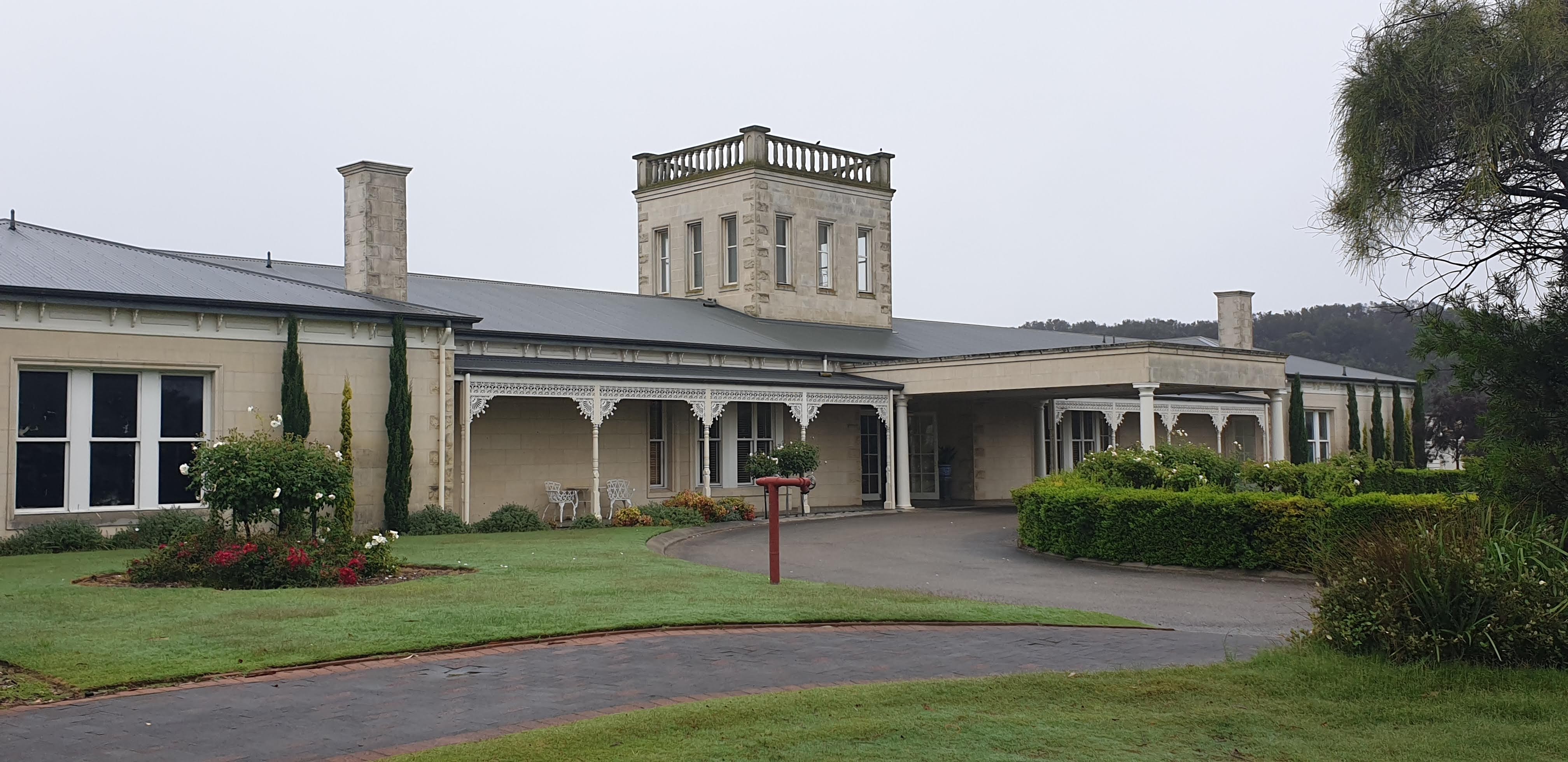
When I first saw it I thought it was an old country estate, converted and expanded into a golf clubhouse.
It wasn’t. It is a purpose-built clubhouse and function center for corporate seminars and wedding receptions, as well as catering to the golfer, and golf tournaments.
It also has a very good outlook over the golf course.
But, in my writer’s mind, this will provide inspiration for a story that could be set in a large country house, with the central tower and lookout featuring in what might be a grisly death, and a group of guests who have gathered together to enact a mock murder that turns out to be very real.
Yes, the idea has been done to death over many many years, but I have a few new twists in mind.
Let’s pause a minute, in space, to get it some measurements right
…
Out there, in space, it’s not like being on the highway, going from one side of the country to the other.
That, effectively, is only a few thousand miles, or kilometres as we now measured distance, the influence of the European counties attached to the space alliance.
But late at night, and astrophysics, or astrology, or whatever the science of space is called, is not a subject to take up, particularly when you’re tired.
The other night I was tired, and confused, and hence got all my numbers muddled up. The thing is, when numbers go up to billions, with all them zeros, it could be confusing for everyone.
Or maybe it was just me.
But, the first constant is the speed of light. That’s approximately 1,079,251,200 km per hour, Pretty fast, eh.
But, as I’m told, nothing can go faster than the speed of light.
So, in this story, it’s a given.
Spaceship speeds, in this story, are measured as SSPD’s.
SSPD 1,000 is the speed of light.
This new spaceship will not go that fast. It is capable of SSPD 5, but even then, it’s not recommended. So, we are, from the beginning, are going to accept that it will go SSPD 4.
Trials got it to 4.5, but that was when the design engineers were aboard and could fix any problems.
So how fast are the SSPD increments?
SSPD 1 is 1,079,251 km per hour. SSPD 2 is double that. That’s the fastest cruising speed the current ships can travel.
This new ship goes twice as fast so at SSPD 4 it can cruise at 4,317,004 km per hour.
Now, where I got everything wrong, is the distance of the planets from earth, and the time it would take to get there.
Mars: about 56 million km when in line between the earth and the sun, but has a min of 54.5 million km
Venus: between 38 million and 261 million km
Mercury: averaging about 77 million km to a max of 222 million km
Jupiter: from a min of 588 million to a max of 968 million km
Saturn: from a min of 1.3 billion to 1.7 billion km
Uranus: from a min of 2.57 billion to 3.15 billion km
Neptune: from a min of 4.3 billion to 4.7 billion km
Since in the story it’s possible the ship might be stopping at Mars briefly, the time it could possibly take, given the position of mars at the time (about 60 million km), is about 14 hours.
As for the ultimate destination, Neptune, at 4.5 billion km approximately, it is going to take 1,042 hours, or 43.5 days.
Hopefully, I’m now over some of the confusion of distances between the planets, and will have some semblance of credible measurements and times.


 Thrills, Spills, and just a dash of Romance