It’s time for Michelle to return to the snake pit, her nickname for the Parlour she had been sent to work, and the only good thing about it, she is reunited with her two friends, Angie and Millie.
She’s also back to dulling the senses with the drugs left at the house, and when Felix comes to make sure she is ready to return, he realises she has gone back to her old ways. He is not pleased.
Henry is getting to the end of another tour, with a few weeks to go, and is admiring the sunset from the bridge. The captain, hoping he does not have to put him off the ship, finds that a talk to the Chief Officer has put him back on track.
At least one of them is happy.
Henry is still trying to reconcile the girl he met in Morganville with the girl he met last break and finds no suitable answers, just a whole host more questions.
Perhaps he should accept that he doesn’t understand women and one in particular.
It was just a simple conversation, or so I thought.
You know how it is, stuck in a long queue, waiting for service when you strike up a conversation with the person in front of the person or behind. Random strangers, never seen before, perhaps will never see again.
The plane had arrived late, along with the three others in quick succession, all with over 300 passengers, and being that time of night, not so many service staff. The line was quite literally a mile long and not moving very fast.
It was apparent the person in front of me, who looked like a university professor, had to be somewhere else and was getting impatient.
“This is ridiculous. You would have thought they’d know about the hold-ups, that every plane would arrive at the same time, and make the appropriate adjustments.”
It was a common sense thing, but apparently not deemed so by airport management. It was the same the world over.
“At least you won’t have to wait for your baggage. It’ll be on the carousel by the time we get out of here.”
He sighed, pulled out a cell phone, and dialled a number, most likely the person picking him up. They didn’t answer, and as he jammed his finger on the disconnect button, he muttered, “Fiddlesticks.”
One second, I was thinking what an odd thing to say, the next, nothing.
When I opened my eyes I was looking at a roof, in unfamiliar surroundings, with two ambulance staff leaning over me, saying, “Mr Giles, Mr Giles,” while gently shaking me by the shoulder.
My first thought was, who was Mr Giles? I looked at one, “Where am I?”
“JFK airport, New York.”
“How, why, when?”
“You collapsed, waiting in line to pass through immigration. The security staff called us.”
“Who is Mr Glies?”
“That’s you.”
“No, it isn’t. My name is Jeremy Watkins.”
“Not according to your passport and ticket information. Samuel Giles.”
No. I’ve never heard of him. Nor did I have any idea why I was in New York, where I came from or why I was there. Seeing the guards surrounding me, I realized airport security staff were naturally paranoid about terrorist attacks, and given my situation, I had just become a number one suspect.
This was not going to end well.
Within five minutes of saying what I’d just said, I was taken to a room somewhere within the innards of the airport, the paramedics having determined there was nothing physically wrong with me, saying it was just a reaction to a long flight, tiredness, and stress from waiting.
All the time, I’d been flanked by three airport security staff, followed by two uniformed officers of the NYPD. When I got to the room, a man was waiting. He looked as tired as I felt. My baggage was on one side of the room, and it had been thoroughly searched. The paramedics’ work was done, and they left. The airport security guards were also dismissed, but the two uniformed officers remained, one in the room and one outside the room. If I tried to escape, I would not get very far.
He pointed to a seat opposite him, and I assumed I was meant to sit. Once I had, he said, “Now, Mr Giles slash Watkins, just who the hell are you?”
I didn’t think he was from the FBI, but just to make sure I asked, “Who are you?”
He glared at me, perhaps considering he didn’t have to tell me anything, then changed his mind. “Detective Barnsdale, NYPD. Someone up there,” he pointed to the roof, “Decided to make this my lucky day. Make it easy for both of us. I’d tend to believe you were hallucinating if you’d banged your head when you collapsed, but the medics tell me you didn’t. I can only assume this is some sort of prank. If it is, then I suggest you give it up. Otherwise, if I escalate this, it’s going to get ugly.”
If he was trying to scare me, it was working. “My name is Jeremy Watkins. If you have access to the internet, you can look me up. I’m an author, not exactly a runaway best-seller, but I make enough. I don’t know how I got here, or why I’m here, and as much in the dark as you why my documents say I’m someone else.”
He brought out his cell phone and pushed a few buttons, typed in my name, and waited. Then, his expression changed, and another glare at me. “OK, it looks like you. Give me some titles of your books.”
“It happened in Syracuse, the end is nigh, and the girl with blue eyes.”
A shake of the head. “Not exactly conclusive proof. You could have looked it up and remembered them. But you look exactly like him.”
He went back to his phone and picked up the driver’s licence with that name and address and typed that name in. Another expression change, one that suggested he’d found nothing. “So you are telling me you know nothing about this Sidney Giles from Houston. It’s your photo, and this licence looks real. And this boarding pass says you came in from Houston.”
“I can’t explain it. No.”
He sighed. “OK. Take me through your last 24 hours. What do you remember?”
That was the problem, I could not remember anything beyond the fact I had just finished a class where I’d been trying to get completely disinterested teenagers to write a story about their ideal day out, and being met with derision. The bell rang and they all left, leaving me somewhat shattered, sitting at the desk contemplating why I’d chosen this career path.
Then Marjorie, the other English teacher who had conducted my orientation, came in and asked me how my first class went. I couldn’t remember what I said, but the next memory was in a bar, she was there, and we were talking about writing, and the fact she was hoping to finish her first book soon, and was asking if I wanted to read it.
“I’m not sure if it’s the last 24 hours, but I’m apparently a new teacher at a college in Syracuse somewhere, who took his first class, not very successfully, I might add.”
“Nothing to indicate how you got to Houston, and then here?”
Another memory popped into my head, a rather disconcerting one. I was with Marjorie, and we were talking about writing thrillers and how sometimes she playacted her character’s roles, the latest, an assassin who had been hypnotised believing she was someone else entirely, fitted out with a complete change of identity and then travelling to a particular city to carry out her assignment. Who said art imitated life? This was the other way around.
“You remembered something, didn’t you?”
“I think whatever it was, it’s just a figment of my writer’s mind. It’s too far out there to be believable.”
“Try me.”
“Apparently, I was discussing aspects of another author’s latest work in progress, where the main character is hypnotised into thinking they are someone else. That’s just too far-fetched, isn’t it?”
The detective picked up his phone and called security and asked if there was any CCTV of the incident. Five minutes later, a guard came with an inadequate and handed it to him. “It’s your lucky day,” he said.
The detective looked at the footage not once but about ten times. “The coverage shows you talking to the man ahead of you in the queue, and then suddenly just collapse. I’m sure he says something to you, a word that sounds like Fiddlesticks.”
The next thing I knew, he was shaking me by the shoulder, and I was on the floor, totally disorientated.
What happened at a Russian missile site? This is also tinged with nuclear fallout.
The US is consulting with allies in Asia about missile sites. Nothing more inflammatory to a country like China, with whom relations are deteriorating at a rapid rate of knots.
Investors rush to buy bonds. OK, that’s short term bonds not long term bonds, and that, of course, caused an inverted curve, or a preclusion to a recession.
Gold and silver investment is booming, and in times past, this could be a precursor to war.
China has a huge fishing fleet in the South China Sea. Why, no one knows.
China is also planning naval exercises in the same area. Are they flexing muscles or sending a warning?
They’ve also had problems in Hong Kong, but it didn’t escalate into what happened at Tiananmen Square. But, bottom line, Hong Kong is not a place to go to or stop over any more because of a constant threat of being arrested. I’m certainly never going there again, which is a shame because it was my second favorite Asian city after Singapore.
And, of course, there’s another flashpoint in Kashmir, which everyone seems to have an opinion, but that had been simmering for a long, long time, and probably will for years to come.
And as for the former world power, the UK, they have got past Brexit, or have they?
So, from a thriller writer’s perspective, it means that if Russia is rearming, the US is trying to pre-empt missile strikes from China, or anything is simmering in North Korea which currently doesn’t seem to be the case, it seems the savvier investors have a notion the world might be on the brink of war, and the US might be in the middle of it all.
The US appears:
to be in a trade war with China, or perhaps a war of words
are selling billions worth of arms to Taiwan, a red rag to a bull if there was ever one
are offering to help out in Kashmir
are sending ships to the South China sea to show the ‘flag’
are standing back and watching North Korea launch missiles
are emphatically denying there will be a recession, at least at home
Can we get a plot line out of all this?
Title: Flashpoint
Synopsis:
A leaked report on a Russian missile base suggests a recent ‘mishap’ with disarming ‘old nuclear missiles’, was more than just routine issue, and a flyover by satellite shows there are more sinister and unexplainable operations in play.
Meanwhile, the arrival of a Russian nuclear specialist and a group of Chinese scientists in North Korea is quickly followed by several missile tests a week later. Are the North Koreans, with the help of the Chinese, looking to arm their missiles with Russian nuclear warheads?
The CIA has sent two of their best operatives to find out what is really going on, one, Sam Stockton, borne of Russian parents, and who has yet to exorcise his demons from the last failed mission, and the other, Elizabeth Chen, a North Korean expert who is coming out of retirement for this particular delicate assignment.
Will they discover the truth before the world descends into a nuclear holocaust?
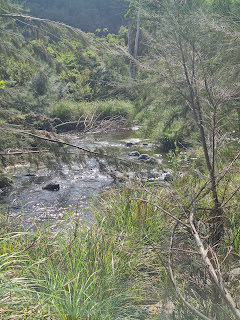
This is a section of what I would call a babbling book, part of the Canungra River, in a valley that is part of the Lamington National Park in Southern Queensland in Australia.
But as we writers are only too aware, it is so much more than that.
For instance: You could have been on a hike through the forest, and by a strange quirk of fate, got lost, and after staggering around in what was circles for a day, or two, you stumble across this creek. That thirst can now be slaked!
Alternatively, following a map to where you have been told there is gold, the river you have been paddling up had slowly narrowed down to this, and is going to make the rest of the journey by land, on foot, still a long way from the spot marked with an x.
Or you could just be on holiday, and this is a swimming hole and up or downriver, the best trout fishing to be found, and one of the best kept secrets. Except, when you finally take the plunge, a body floats to the surface, and suddenly, you are in the middle of a murder mystery.
Add to the situation the fact you are miles from anywhere, and that the killer could be nearby or gone, that idyllic stay in the cabin to be at one with nature is starting to look like the weekend in hell.
We were diverting to Venus, sitting out there on screen, lonely as a cloud, if there could be clouds in space.
So, I wondered if the Captain had a special reason why I should head the team going to the freighter.
It was an opportunity to take one of the new class of shuttles, reported to be faster, more stable, and larger so that we could carry more people and cargo. It would be overkill today.
The crew assigned to collect the cargo was aboard, and my co-pilot for want of a better name was Myrtle, an officer that joined the ship with me, and had excellent qualifications.
We were going through the preflight, ready to lift off.
“First time?”
“In a shuttle, no. In space, real space, more or less.”
I don’t think I wanted to know what more or less meant.
“There’s nothing to it.”
The captain’s voice came over the speaker, “You’re cleared for departure, they’re expecting you imminently.”
“Very good, sir.”
It was never a gentle lift-off, unlike landing, and that initial jerk was an annoyance. Then engaging the thrusters, we began to move forward slowly towards the cargo door, and at the synchronised time, the doors opened and there was nothing but empty space before us.
Outside, we increased speed, turned, and flew under our ship, just to get a look at it, something I knew the people aboard might be interested in seeing, then onto the Aloysius 5 drifting off our port bow.
“Do you see what I see?” Nice to see Myrtle wasn’t blind.
“I do, and that’s worrying.”
What was it? A scorch mark on the side of the Aloysius 5, in a place where we couldn’t see it from our ship, and a direct hit on one of the exhaust manifolds. That would stop a ship dead in its tracks without wrecking it.
Michelle meets Henry on the dock in the pouring rain.
It only takes one look between them, for both of them to know this is not going to end.
But…
She is going to tell him the truth.
They go to her place, and selfishly she decides to consummate the relationship. He is surprised but does not refuse.
…
It wasn’t my first idea to do this, I was going to have her deliver the truth and have him leave in disgust. But, after giving them a lead in at the wharf, it could not just simmer and die.
I decided then that she has to make a decision on whether or not she wanted to find a way for them to be together. Angie makes the suggestion, earlier when she finally had to give in, that the only way they would get free of the Turk was to kill him. And Felix.
It’s why I’ve kept the truth, and she relates it even when he doesn’t want to hear it, and refuses his help when he offers it, because he would not survive in her world.
…
She succeeds in getting him to leave, and it almost breaks her heart to do so in such a fashion. Little does he know he left with something else.
He doesn’t go home, he finds another hideaway hotel and retreats back into himself. Back on the ship a month or so later, the pain is no less than before, and it changes him to the extent the shipboard crew are dismayed, and the captain seriously considers making him ‘walk the plank’.
I first started writing by longhand, still do, in fact, then graduated to my mother’s portable typewriter, right down to the sticking keys and overused ribbon, then moved upwards into the electric world having a pair of IBM electric typewriters I bought from one of the places I worked as second-hand cast-offs.
Just remembering those days gives me the shudders, from the tangled ribbons and messy hands to using carbon paper, how many times before they were useless?
Then the age of the electric typewriter went the same way as the manual ones, simply because I could no longer buy ribbons for my IBM Selectric, so it, too, had to go the way of the dinosaurs.
It was a good thing, then, that computers and word processing software started at about the same time. Word Perfect, to begin with, and then, in the early days of Windows, Word, and others. Sometimes it was easier just to use the text editor, and for convenience, it’s often by choice to get ideas down, quick and dirty.
This was before the days of the internet, where you physically had to do something about finding inspiration. And that, sometimes, was more difficult that it seems. I do not have a writing room with large windows looking out on a rural or urban panorama. The window looks onto a fence, and the house next door.
So much for my dream of owning a castle and having a writing room on the second or third level, with astonishing views.
Which leads me to today. Enough with the reminiscing. I have all the tools I need to get on with the job, but that isn’t enough to switch on the brain and start typing perfect prose. I have to go in search of some inspiration.
It’s just that in that short distance, from, say, the couch where you were reading the latest blog posts in the WordPress reader, and the writer’s chair, your preparation for writing ends up getting confused at some of the blogger’s points because it’s hard to find anything relevant that backs up their assertions, or how things work for them.
I guess success form anyone’s standpoint, is what worked for them. In relaying that to others, two things come to mind. It worked for them, but in telling a million others, and they all take the same approach, no, sorry, it ain’t going to work no how. The other, there’s usually a fee attached to gain the knowledge, and, yes, the same proviso applies. If everyone does it, it ain’t going to work no how.
But, there you are, my attention has been distracted, and unless I’m about to indulge in writing a version of how to achieve success myself, which I haven’t so I’m not, I’m off track, with an out of balance mindset, and therefore unable to write.
Perhaps I should not read blog posts, but the newspapers.
Or not, because they all have an editorial policy that leans either and one way or another, which means their views are not necessarily unbiased.
I was a journalist once and hated the idea of having to toe the editorial line. Or as luck would have it, never let the truth get in the way of a good story. It lends to the theory that you can never quite believe anything the media tells you, which is a very sorry place to be when there are no external influences you can trust.
I’m coming around to thinking that it’s probably best left to the dark hours of the night when you would think all the distractions are behind you. After all, isn’t that what daytime is for?
Every time I close my eyes, I see something different.
I’d like to think the cinema of my dreams is playing a double feature but it’s a bit like a comedy cartoon night on Fox.
But these dreams are nothing to laugh about.
Once again there’s a new installment of an old feature, and we’re back on the treasure hunt.
…
Aside from working on what I was going to tell my mother, and Boggs for that matter, where I’d been all night, the last thing I could say was that I spent the night with Nadia.
It had a curious ring to it when I said to myself, I slept with Nadia. Most people would take it the wrong way, but, by a quirk of fate, it was true. I guess that little gem of truth would have to stay locked away in my head.
One the other hand, if I told my mother I was out doing reconnaissance work for Boggs, she would get very angry, messing around in Boggs’ fantasies. She had no time for people who didn’t want to get a job, and work hard for a living.
At least I’d gone up in her estimation when I started working for the Benderby’s.
But the reconnaissance line would work with Boggs, and all I had to do was come up with a plausible set of circumstances he would believe. At the moment, all I had was Alex going to the mall, and that I waited to see when he came out. The question I would pose, what was he doing in there for four or five hours.
All I had to do was hope Alex had been out of town and Boggs hadn’t seen him. Always a chance of coming unstuck. Perhaps I should just not volunteer anything.
As for my mother, I couldn’t say I was working overtime for Benderby. She was likely to call him and tell him off for making me work so hard.
I was still no further advanced on that point when I got to the library.
It was a familiar place for me, and I had spent a lot of my time there escaping the real world, and of course, being able to keep away from Alex and Vince.
The librarian, Gwen, had been there for a hundred years or more, or so they said, and she should have retired about 20 years ago.
Pity the poor mayor who got the job of telling her to leave. Three had tried, and three had failed. The current incumbent was smarter than that. He just hired an assistant and told her that she had no problems handing over the reins when she was ready.
That woman, Winifred Pankhurst, no relation to the suffragette, was quiet, polite but firm in doing her duties and dealing with the public. She and I had butted heads a few times, especially when Gwen wasn’t in, but today was not going to be one of those days.
I could see Gwen in her office, and headed straight there, under Winnie’s watchful eye. And no, I didn’t dare call her Winnie. Her name, she said, was Miss Pankhurst thank you very much.
Gwen looked up as I knocked on the door, and she smiled.
“Long time no see.”
It had been several weeks. The job and everything else had made it less of a priority to get there,
“New job, crazy hours. Never thought I’d become a working stiff.”
“About time. All that talent being wasted.”
I came in and sat down opposite her.
“How are you?”
“Getting old.”
For her to admit that was a worry. She was, last time I checked, somewhere between 93 and 95. She never quite told anyone her actual date of birth, not even the Mayor’s office who employed her. And she didn’t look a day over 80. Good, clean living she said.
“Isn’t that inevitable?”
“For some of us. Now, enough of being maudlin, what can I do for you?”
“What makes you think I want something?”
“That expression. A cat’s curiosity.”
She could still see through me. The only other people who could was my English teacher in the final year at school and my mother.
“What do you know about the Ormiston’s.”
A change in expression on her face told me it was not a surprise I was asking. Alex’s thug had been here earlier, had someone else?
“They’re popular this week. Young Elmer was in here a few days ago asking the same question. I suspect he was working for Alex Benderby.”
The way she said his name, it was with the usual venom used for him. She had a run in with Benderby a long time ago, and she’d never forgotten. Or ever will. That’s why Alex would never get anything from her about anything.
“He was.”
“Is this in relation to the treasure you and that lad Boggs are searching for?”
Of course, she’d know who and what was going on in this town. No one could keep a secret from her. Or her extensive network of old ladies in the knitting club.
“Boggs seems to think he had some idea of where it might be, though I’m not so sure. I just go along for the ride, it balances out the depressive life we have to live living here.”
“Oh, come now. It’s not all that bad.”
“Perhaps not, now that I have a job. What can you tell me, if there’s anything to tell?”
“Ormiston was as bad if not worse than the Boggs, father and son alike. He had the treasure bug too. Obsessed. In the end drove away his wife and family, eventually ran out of money after mounting six different search operations, and then, when that happened, sold the land to the Navy. Quite an extensive area, about 100 square miles or so, from the coast back to the fault line. Used to be a lake, once, now it’s just a dustbowl.”
A fault line? This was something Boggs didn’t know about, and it could be significant. But just how significant?
This case has everything, red herrings, jealous brothers, femme fatales, and at the heart of it all, greed.
See below for an excerpt from the book…
Coming soon!
An excerpt from the book:
When Harry took the time to consider his position, a rather uncomfortable position at that, he concluded that he was somehow involved in another case that meant very little to him.
Not that it wasn’t important in some way he was yet to determine, it was just that his curiosity had got the better of him, and it had led to this: sitting in a chair, securely bound, waiting for someone one of his captors had called Doug.
It was not the name that worried him so much, it was the evil laugh that had come after the name was spoken.
Doug what? Doug the ‘destroyer’, Doug the ‘dangerous’, Doug the ‘deadly’; there was any number of sinister connotations, and perhaps that was the point of the laugh, to make it more frightening than it was.
But there was no doubt about one thing in his mind right then: he’d made a mistake. A very big. and costly, mistake. Just how big the cost, no doubt he would soon find out.
His mother, and his grandmother, the wisest person he had ever known, had once told him never to eavesdrop.
At the time he couldn’t help himself and instead of minding his own business, listening to a one-sided conversation which ended with a time and a place. The very nature of the person receiving the call was, at the very least, sinister, and, because of the cryptic conversation, there appeared to be, or at least to Harry, criminal activity involved.
For several days he had wrestled with the thought of whether he should go. Stay on the fringe, keep out of sight, observe and report to the police if it was a crime. Instead, he had willingly gone down the rabbit hole.
Now, sitting in an uncomfortable chair, several heat lamps hanging over his head, he was perspiring, and if perspiration could be used as a measure of fear, then Harry’s fear was at the highest level.
Another runnel of sweat rolled into his left eye, and, having his hands tied, literally, it made it impossible to clear it. The burning sensation momentarily took his mind off his predicament. He cursed and then shook his head trying to prevent a re-occurrence. It was to no avail.
Let the stinging sensation be a reminder of what was right and what was wrong.
It was obvious that it was the right place and the right time, but in considering his current perilous situation, it definitely was the wrong place to be, at the worst possible time.
It was meant to be his escape, an escape from the generations of lawyers, what were to Harry, dry, dusty men who had been in business since George Washington said to the first Walthenson to step foot on American soil, ‘Why don’t you become a lawyer?” when asked what he could do for the great man.
Or so it was handed down as lore, though Harry didn’t think Washington meant it literally, the Walthenson’s, then as now, were not shy of taking advice.
Except, of course, when it came to Harry.
He was, Harry’s father was prone to saying, the exception to every rule. Harry guessed his father was referring to the fact his son wanted to be a Private Detective rather than a dry, dusty lawyer. Just the clothes were enough to turn Harry off the profession.
So, with a little of the money Harry inherited from one of his aunts, he leased an office in Gramercy Park and had it renovated to look like the Sam Spade detective agency, you know the one, Spade and Archer, and The Maltese Falcon.
There’s a movie and a book by Dashiell Hammett if you’re interested.
So, there it was, painted on the opaque glass inset of the front door, ‘Harold Walthenson, Private Detective’.
There was enough money to hire an assistant, and it took a week before the right person came along, or, more to the point, didn’t just see his business plan as something sinister. Ellen, a tall cool woman in a long black dress, or so the words of a song in his head told him, fitted in perfectly.
She’d seen the movie, but she said with a grin, Harry was no Humphrey Bogart.
Of course not, he said, he didn’t smoke.
Three months on the job, and it had been a few calls, no ‘real’ cases, nothing but missing animals, and other miscellaneous items. What he really wanted was a missing person. Or perhaps a beguiling, sophisticated woman who was as deadly as she was charming, looking for an errant husband, perhaps one that she had already ‘dispatched’.
Or for a tall, dark and handsome foreigner who spoke in riddles and in heavily accented English, a spy, or perhaps an assassin, in town to take out the mayor. The man was such an imbecile Harry had considered doing it himself.
Now, in a back room of a disused warehouse, that wishful thinking might be just about to come to a very abrupt end, with none of the romanticized trappings of the business befalling him. No beguiling women, no sinister criminals, no stupid policemen.
Just a nasty little man whose only concern was how quickly or how slowly Harry’s end was going to be.
I never really understood why I had an affinity for libraries until I stepped into the one in my grandfather’s house.
The last time I’d seen it was when I turned ten, and we visited him the day after my grandmother had died. I remembered that day very clearly for two reasons. First, my grandfather said I was too young to go, so I was left with the housekeeper and allowed to go into a large room with thousands upon thousands of books. By myself.
So many, in fact, I was so immersed in them that I hadn’t realised my parents had come back and it was time to go. Not until I heard raised voices coming from outside the window. My father and grandfather were in a full bare-knuckle fighting stance, with my mother standing between them.
That second reason, it was also the day my father stopped talking to and visiting my grandfather. I had seen him once, in all the time leading up to my grandmother’s funeral, and never again. The only references to him I found were in the newspapers, along with words like patron, philanthropist, politician, and patriot. My father said he was evil, but he never told me why.
There was a lot of fallout from that day of the funeral. Not only had my father stopped talking to his father, but also his two sisters and brother, all of who were a mystery to me. Later I learned that I belonged to a very dysfunctional family and that my father was the sanest of the four siblings. Of course, that was my mother’s assessment, but I also learned later, my father marrying her had got him disinherited.
But to be honest, at 10 it didn’t seem a big deal. I didn’t know them, and having said no more than a dozen words to my grandfather, it was not as if I knew him enough to miss him. I did remember that library though, and that huge house by the lake. My father never said he’d grown up there, just that his life had been spent in boarding schools and the military. Enough of a life though, to give me a university degree, yes, you guessed it, in Library Science and Information Management.
That I knew so little about him made it all the more difficult to write a eulogy. For him, and my mother who had basically died a few days after him. I wanted to believe she just didn’t want to live on without him, but that was too fanciful. She had been worn down by what I now believed was a very bitter man. That bitterness had caused me to stop visiting home about a year before when relations between us sunk to an all-time low. I spoke to my mother by phone every week, but it was not the same, not being able to see me, and that I hadn’t made it back before she died was a sin I would spend a long time atoning for.
Nor did I have any siblings to turn to for help. That ship had sailed after I was born when my mother discovered she could have no more children.
But, here’s the thing. I had not heard that either of my parents had died until I got a call from my parents’ Pastor of their church. Had he not called, I would not have known. My initial reaction was not to go, that was how deep the scars were from our fractured relationship, but the pastor insisted that I would not get closure if I didn’t.
I still believed it was a huge mistake as I was getting on the plane. I told Wendy, a girl whom I had just become more than friends with that I would have to go, it surprised her because I had told her that I was more or less like her, an orphan. I had met her after the final altercation, and I didn’t think it necessary to bore her with my parents’ odd behaviour.
By the time the plane arrived, I was past the misgivings and telling myself just to get it done and go home. One day, two at the most and it would be all over, filed under, don’t come back to haunt me again.
Shock number one: A girl, about my age or slightly younger, dressed in what might have passed as mourning clothes, was standing in the arrivals section where people held signs of names of people they were to pick up. She had mine, or maybe not. It could be someone else. I went over to her, cautiously.
She smiled when she saw. “My God; Lindsay, you look just like your father.”
How could she possibly know who I was, or what he looked like? None of his family had ever made themselves known or came to see us.
“How…”
“Your photographs. My dad is your uncle by the way, and I’m your something or other, someone explained it to me but it was too much. Your mother sent thousands of photographs and letters to your uncle and aunts and we know about you. It’s just a pity we couldn’t meet until the old bastard died. Now, it’s like we’re old friends. I’m Allie by the way. Wow!”
Wow, indeed. My mother the traitor! She always seemed to have a conspiratorial look about her and now I knew why.
“Travelling light,” she said, seeing my backpack.
“Wasn’t intending to stay.”
“Can’t do that now Lindsay. You have a lifetime of catching up to do. I hope you have a spare week up your sleeve.”
I followed her out of the terminal to the car park.
“Where do you want to go first? By the way, I’m your chauffeur for the duration of your stay, and you tell me, that’s where we go.”
“Haven’t you got better things to do?”
“No. I had to beat up my sister and brother to get this privilege. This is not a chore Lindsay. And I get first dibs to talk to you about everything.”
She had a strange way of talking, so I let most of it go over my head. “Perhaps the funeral parlour, I think the pastor said they were in one of them near the church. Not their church, either.”
“I try not to get involved in heavy family stuff. But I think you’ll find my father had something to do with that. Blood is thicker than water, he says. He says a lot of stuff I don’t understand. Your dad like that?”
We reached the car, she unlocked it and we got in. A RAM 2500. Better than anything we could afford.
“Your car?”
“Mine, hell no. This is Dad’s special truck, only comes out on hunting weekends and special occasions like weddings. Damned if I know why he let me drive given my track record.” She shrugged. “Perhaps it’s another of his tests.”
It sounded like a family trait because my father used to do the same. I left her to the driving and pondered this whole other life that went on around us, ignored simply because my father hated his family. Obviously, there was some deep-seated resentment generated at some point before he struck out on his own, and maybe I could find out. Certainly, it seemed I was not going to be able to escape as easily as I had first imagined.
What worried me was suddenly meeting a whole host of people I’d never seen before but apparently knew everything about me. I’d never have suspected my mother going behind my father’s back, but there was always that air of defiance in her, and in some of their arguments, they didn’t go nuclear, but she did stop talking to him or doing anything for him until he backed down.
A lesser woman would not have been much of anything up against him, which was why he married her.
Our first stop as requested was the funeral home. There I was shown into a special room where both were in their caskets. It was an open casket viewing, and while they had been restored to some of their former glory, my mother was almost unrecognisable. I had the room to myself, and thankfully Allie didn’t come in because there were tears, even though I told myself there would not be.
My father, of course, never changed and looked the same forbidding person he’d always been. I was sure somewhere within him there was kindness, but he never showed it to me. Even so, it was still a shock to know that he had passed.
After a half hour, I came back out into the daylight. Allie handed me a cup of coffee.
“I didn’t know if you wanted or needed something stronger, but we can drop into a bar on the way for some fortification if you like. The next stop, I’m afraid, is the church. Got a call to say the Bishop has arrived. Our family has some brownie points and got the Bishop to come and say a few words. I’m not a keep churchgoer either Lindsay.”
Were any of the younger generations? Those attempts of his to put the fear of God in me never worked, probably because they tried too hard. A more gentler and persuasive method would have had better results, but the priest was all fire and brimstone. I don’t think I could remember one Sunday where the sermon had any levity in it.
“Perhaps if they tried to move into the 21st century, it might be better. I heard that my father’s church Pastor is coming too. He’s as old as the hills, and hopefully, he will not remember the errant and disappointing child I was.”
“Don’t count on it. They keep everything in a big ledger, and it’s opened the day you go to heaven or hell. Hell’s where I’m going, I’m sure of it.”
It was an amusing thought. “Perhaps you’ll see me there, too.”
The Pastor was there with the local church leaders, and the Bishop, all very severe-looking men. Granted it was a sombre occasion, but a little levity wouldn’t go astray. I noted, firstly, the look they gave me was one of surprise, though I had no idea why, and secondly, they hardly approved of the mourning outfit on my chauffeur. Granted it was low cut and the hem high, but it suited her, and in my mind rather a fashion statement, and appropriate. This was not the nineteenth century.
That led to shock number two. My father’s paster recognised me instantly, and the change of expression told me he remembered everyone one of my sins, some of which I still had to atone for. That was not the reason for the shock, the fact I had to write a eulogy and read it was. He had intimated such in the phone call but I had told him I preferred not to. Perhaps he had been hard of hearing.
He was warm in his greeting though. “Lindsay, so glad you could come, and, my, you have grown up into a fine young man.”
Grown-up, may, fine, that was debatable. “They haven’t retired you yet?” It was not meant to be antagonistic, but some memories of injustices never left you.
“There’s still a lot of God’s work to be done. I see you have lost none of your candour. Let us not dwell on the past, and consider only what lies ahead. Your father was a good man, despite your differences, and his disposition. I had urged him, in his last days, to reconcile with you, and I believe he was going to.”
“You knew a different man to me, Pastor. But as you say, let us not dwell upon what was. I think I said I preferred not to participate in the service.”
I saw the other Pastor and the Bishop approach. I thought I remembered the Bishop, but not as a Bishop but as a simple priest, many years before. The trouble was, they all looked the same to me.
“Marriot here tells me you are going to read your eulogy as part of the service. I believe it’s the right thing to so, a fitting end to a life devoted to service to his country and his church.”
He gave me no chance of reneging, and at any rate, there was no denying a Bishop’s request, not if I wanted the wrath of God to befall me.
“Until tomorrow, Pastor Marriot said and left with the other two men.
“I can see that went swimmingly,” Allie said when she came back over. It wasn’t hard to notice she was avoiding the Pastors and Bishop.
“An ambush.”
“Not getting out of the eulogy?”
“Apparently not.”
“Then write and read something wicked. There’s going to be a packed house, so the audience will be in your hands. The trouble is, people rarely bring up the bad stuff at funerals, and the lies they tell about people, it’s outrageous. We had an in-law who died in a police shootout when he tried to rob a gas station. Not one bad word. It’s probably why they didn’t ask me to say anything.”
The thought did cross my mind, but no, I had enough respect for the occasion that I would say a few words.
“Well, the fun’s over,” she said. “You now are about to meet all the people you never knew existed.”
The family had taken over a restaurant in a nearby town, and everyone had come to see the missing link. I felt like a character out of Charles Darwin’s evolution book.
There were about 35, my father’s brother and two sisters, their children, my contemporaries, some grandchildren, and one very old lady, the sister of my grandfather who presided over the gathering like a Queen. She was the first introduction, and from there, it was simply a sea of faces and names.
Inevitably I was asked why I had not tried to seek them out earlier, and that was complicated. My father never told me about his family, and that one memory of my grandfather was fleeting and without context. But the most sinister of reasons was the fact he had changed his surname, making it impossible to trace anyone. While I knew he had siblings, I could never find them. As for my mother, she said she would tell me the truth when he died. That, of course, could not happen, which landed me where I was right now. Even his priest did not know the truth until one of the family contacted him upon learning of my father’s death.
It was, quite simply, the most improbable of situations that most people could not believe possible.
The following day, over a hundred people arrived for the funeral, and it was a beautiful service on a perfect day. My few but heartfelt words were delivered in a broken voice, by a person who should not have but was, overcome with emotion.
Afterwards, when the bodies were lowered into their final resting place, in the family graveyard near my grandfather’s house, exactly as I had remembered it, I was sitting on the seat that overlooked the lake, wondering what it might have been like to like in such a house. Allie had taken me on a guided tour, the house now a museum of sorts, where the family occupied the upper floors and the museum the lower, including that incredible library.
She was sitting next to me, the rock that had got me through a fairly traumatising day.
Shock number three: She handed me an envelope with my name on it. “We had to wait until your father died before it could be delivered. It is a letter all of us in our generation, got when our grandfather died.”
“I’m surprised he considered me part of the family.”
“You were, and are, despite your father’s best efforts. He knew about you, and everything you have done, until the day he died. You can read it, or I can summarise it if you like.”
“You can tell me, I’m just too overwhelmed to read anything at the moment.”
“As you wish. In essence, you and 7 of us, own equal shares in the old building over there.” She nodded in its direction. “You have a suite of rooms set aside, as each of us has, and a job helping in running the museum. He particularly thought you would like to run the library and the research department. There are a lot of historical documents, and books that are considered invaluable to researchers who come here from all over the world. You might not want to, but the rest of us would love it if you did. And there’s a pot of gold, literally at the end of the rainbow. You can, if you so desire, become very, very wealthy. Or just take an annuity as I do. Too much money makes me anxious. Now, you can stay in your rooms tonight, for as long as you want, and tomorrow we will all sit around the table and just talk.”
Just then I saw her turn towards the driveway and heard a car arriving. She smiled. “We also thought it might be too overwhelming on your own so we asked Wendy to come. I hope you don’t mind?”
It was odd because she was on my mind at that exact moment she arrived, and exactly the person I wanted to see.
As I crossed the lawn and reached the car as she got out, and saw the house, there was a look of recognition, surprise and something else I couldn’t place.
“Is this where you grew up?” she asked.
“No. I’d only seen it once when I was ten when my parents came to attend my grandmother’s funeral. Why?”
“Because this is very, very familiar. I lived here with my mother until I was fifteen when she died and I was sent to live with my aunt in New York. I remember a day when a boy came, and stayed in the library, and refused to come and play with me. I was seven, I think, at the time. It means I’ve known you forever, even if I did hate you to pieces then. What a remarkable coincidence.”
“Serendipity,” Allie said. “Welcome home, the both of you.”



 Thrills, Spills, and just a dash of Romance