Michelle is dreaming about the many ways she can dispose of her boss, Emile, and equally ticking them off the list when reality sets in.
It’s another long night, and a customer, one with a difference, and he has this strange request, that she try a concoction he’s invented to embarrass the boy who stole his girlfriend.
It’s an opportunity and another brink in the wall.
Despaired that Henry hasn’t discovered her hidden missive, she starts staking out the Henshaw house to see when he returns, and he does not turn up. She cannot keep going there lest Felix gets suspicious. She calls on the phone but gets no answers.
Next time she arrives at his house Harry is there waiting and they talk.
It’s not the conversation she wants to have, or hear, and realises that it’s going to be a lot more difficult to get Henry back.
A talk with Emile, she tries to set his mind at rest that she wants to escape again, and he leaves unsatisfied.
She realises that she has to deal with Felix first. But, on the other hand, she would be testing the drops given to her by a client, and if it works, another part of the plan might come to fruition.
She also knows she needs another way to communicate with Henry.
I don’t know, at first, what it was that brought back a raft of memories that had been long forgotten, I had woken up in an ambulance on its way to a hospital, and by the way, in which it was moving at breakneck speed, siren wailing, it had on be for a very good reason.
“He’s awake,” a nearby voice yelled near me, and then a face hovered before my eyes, “How do you feel.”
It was an odd question because I felt fine. “OK. I guess. What happened?”
For a minute or so, he checked my vitals and asked, “Do you know who you are?” I gave him my name, which matched my ID, and then my address, which was also correct. He asked me where I was, and got it right too. “You can slow down; I’ll tell them it’s not urgent.”
He made a phone call to the hospital, then turned back to me.
“You had a fall, hit your head on the concrete sidewalk, and started having a fit. When we arrived, you were unconscious, and the signs indicated you had gone into a coma. It was a situation that could have gone anyway, which is why we were trying to get you to the hospital as soon as possible. You need to get an MRI as soon as possible.”
“But I feel fine.”
“That may well be the case, but what happened to you can have ramifications later. You have suffered a heavy knock to your head.”
It was not as if I could feel anything, so I reached up to feel for any indication of the accident and touched a bandage, covering what felt like a big lump. I could not feel any pain when I touched it. “Should I feel something?”
“You should, yes. We have not administered any pain medication, so it should be very sore. It’s a fairly large gash. You say there is no pain?”
“No.”
Not right then, but about five minutes later, I started having blurred vision. The paramedic went back to checking my vitals, and as he was taking blood pressure I started shaking, and moments after that, I passed out.
When I woke up, I was home, in my room, overlooking the stables, and beyond that the hills. Montana. How did I get there?
Everything was exactly as I remembered it, the rodeo curtains, the breeze coming through the open window, the aroma of newly mown grass after the rain wafting in, accompanied by the rustle of the curtains. Summer, my favourite part of the year.
And yet, I could not be here, because after my parents died, the farm was sold to pay of the mountain of debt they’d accumulated, and sadly the reason why they were no longer alive.
I slipped off the covers and went over to the window. Exactly as it was when I returned after graduating from university, just before my father and I was going to make repairs to the roof. I remember that exact time in my life. I had just broken up with the girl I had planned to spend the rest of my life with, and, heartbroken, I’d come home to be miserable.
There was a pounding on the door. “Get up now, lazy bones, there are chores to be done.” Suzie, my older sister, never took crap from me, had no aspirations of getting a university degree, ‘What use would it be in running a farm?’, was always at me since I was six, and had more than once thrown cold water over me, in the morning.
“I’m up,” I yelled back, a reflex action. This must all be in my imagination. The last time I’d seen Suzie, it was when I took her to the airport, off to find peace and tranquillity in Tuscany, and was still there with a friend.
But it was my room, and those were my clothes in the dresser, and … Oh. My. God!
My imagination was in overdrive. I looked exactly like my 23-year-old self. That reflection in the mirror was startling. I touched my face, and it seemed real.
Another bang on the door made me jump. The door opened and Suzie put her head in. “Good, you’re up. You just saved yourself a lot of grief.”
She looked so young, so happy, a far cry from the woman she was now, broken by a man we all thought the world of, but turned out to be a monster. I’d often wished I could go back and change things as we all did.
I crossed the room and gave her a huge hug. It felt real.
“What was that for?” She was taken aback by an action that, back then, I would not have contemplated. Our relationship, then, had been rocky at best.
“You know I love you to pieces, sis, and I don’t think I’ve taken the time or made the effort to tell you.”
“I know that. You don’t have to say anything.”
“Too many things are left unsaid.”
“You’re going batty, I can see that now. That fall off the roof of the barn has affected you, though I have to say this version of you is an improvement. Oh, and by the way, I asked Samantha to come over today, so be nice. She’s had a hard time of it while you’re away and you were good friends once.”
Samantha. The girl I dated all through middle school, the one I was supposed to end up with, everyone had said so, except she had other ideas and chose the local football hero instead. It was around about the time I came back that he was killed in a car accident, though rumours had it, it was not an accident. It would be interesting to see her again. The last time I saw her, it was when she ditched me rather unceremoniously.
“You know me, friends with everyone.”
“She dumped you, and you hate her. I get it, but there’s enough water under that bridge. Later.”
I just remembered that fall off the roof, too, showing off, and paying for it. I didn’t break anything, but I had landed rather hard, and shaken a few things up. The bump on the head hadn’t helped either. I shrugged and pulled out work clothes. It was going to be an interesting day.
At the breakfast table, Mom in her usual manner had everything out and just finished up the last of the cooking. I missed her breakfasts, in fact, I missed that first thing in the morning with family, the food, and, well, just the moments I realised much later I’d taken for granted.
Dad was there, his usual gruff, and jovial, self, complaining about everything that was going wrong, from the tractor to the crops in the south paddock, the lack of rain, and having to pump water from the dam.
When I left for college, we needed help and that’s how Walter Fisk came into our lives, particularly into Suzie’s. He called in one day, in his battered Ford truck asking if there was any employment available in the area, and because I was not there, Dad hired him. He was, at first, a hard worker, and then, once he had charmed Suzie, changed. The first time I met him I took an instant dislike to him, and he knew it. It was why he then spent the time I was away to break the relationship I had with my sister.
I was sitting at the table when he came in. I hadn’t realised he was welcome at the breakfast table, and it marked a turning point in his acceptance, almost into the family. I’d forgotten quite a lot about his time at the farm. It was only several years later when the damage was done, that we learned who he really was, a thoroughly bad man by the name of Walter Reinhart who had murdered his wife and disappeared, only to turn up on our doorstep. It wasn’t until he nearly murdered Suzie that we realised his true nature.
“Morning all.” His eyes stopped at me, and his expression changed for just a second. “David.”
“Walter.” It was a pity all of this was running in my imagination, or I’d go into town and see the sheriff and tell him about Fisk. Just seeing him brought all the old memories back, and it made me angry, so much so that I lost my appetite, and couldn’t sit at the same table with him.
I went past him as he sat down, and muttered, “Don’t get too comfortable, Reinhart.”
He grabbed my arm, stopping me from leaving, the expression on his face now one of fear. “What did you say?”
“You heard me.”
“I think you have me confused with someone else.”
“If you say so. Now, I would like my arm back, Walter.”
Suzie had noticed that something was happening between us, and said, “I hope you two are not going to be tiresome, again. I thought we got past all that nonsense.”
“There’s nothing going on here, is there Walter?”
He let go of my arm. “No, nothing.”
In my imaginary world, I had just scored a small victory.
I went outside into the fresh morning air, something else that I missed greatly after leaving home. The mornings were never the same in the city, with no open spaces to speak of and everyone living on top of each other.
And in a city with millions of people, it was ironic that I never felt more alone than I did back home.
Perhaps my mind had had enough of being where I was and had decided to put me back to a time when I had a chance to make a difference in my life. This moment in time was when I made several regrettable decisions, each of which eventually set me on a path to where I was now.
It was not what I had envisaged my life would turn out like, then or now.
Perhaps I was taking stock, going over the choices and seeing what life might have been like.
I walked slowly towards the barn. I could see materials and tools scattered around in my father’s usual haphazard manner, mine too for that matter. We were in the middle of patching the roof, a job long overdue, and it must be just after I fell off the roof. Luckily, I’d landed on a haystack next to it, but though it softened the fall it still hurt.
I could feel the aches and pains from it still.
Inside the barn, I knew what I was looking for. Grandfather’s Indian motorcycle was the only thing he left in his will to me. I loved that bike and used to go out on it whenever I could. I also remembered that Walter stole it when he finally left, and I never saw it again.
I had to do something about that.
I pulled the tarpaulin cover off it and checked it had fuel, then wheeled it out. A minute later I was off, deciding to go into town. I was still undecided about telling the sheriff about Walter.
About five miles up the road I saw Samantha and her truck on the side of the road, hood up. She heard the bike and turned to see who it was, then waved.
I stopped.
I hadn’t seen her for a long time, much less the in those years following my return. I remember when I came back I was bitter and said some regrettable things. I had a chance to change that.
“David.”
“Samantha.” I switched off the bike and it was suddenly eerily quiet.
“You know I get worried when you ride that thing. I never think it’s safe.”
“One ride and you hated it, Sam. You should embrace the freedom.” It had been a constant basis for conflict between us, neither willing to back down. I realised then that I was still annoyed, and it showed in my tone. Had I learned nothing?
“I’m sorry. I should have listened to your concerns, and I was a little selfish when I didn’t.”
She looked at me as if to say, ‘Who the hell are you, and what have you done with David?’
“You were right though. I should. Perhaps you might consider giving me another opportunity. I know I haven’t been as understanding as I could have been.”
I shrugged. We were both making an effort. “It was what it was. We were young, first love is like that, I guess. What’s up?”
“It just stopped. And you know me, I’m hopeless at everything.”
I got off the bike and had a look. I was not much of a mechanic, but living on a farm you got a rudimentary knowledge of everything, so basic problems I could solve. This one was a loose cable that had come away. I put it back and then asked her to start the car, which it did.
“Are you coming back to the farm,” she asked.
“Yeah, just getting some air before I get back to work. Falling off the roof sort of changes your perspective, especially when you consider what the consequences could have been. It just feels like the world is closing in on me lately.”
She got out of the truck, came over and have me a hug. At that moment a whole raft of memories returned. I kissed her and she kissed me back, and suddenly it felt like we had never been apart.
“I never stopped loving you Sam.” It seemed the right time and the right thing to say.
“I know. I always knew you were the one, but I was young and stupid. I learned my lesson, and it won’t happen again. If you still want me.”
I smiled. Was it that easy to fix?
“I do, very much.” I kissed her again. “Let’s start again. Hello. My name is David Westbrook. What’s yours?”
She smiled back. “Samantha Bailey.”
“Well, Samantha, I like you a lot. Would you be interested in going on a date?”
“Just tell me where and when.”
“Do you like motorbikes?”
“I do now.”
“Good. I’ll see you back at the farm and when my father had finished flogging me to death, I’ll take you to a place I know that has the best burgers in the county.”
After another hug, a tear, perhaps two, she left. I watched until she disappeared out of sight.
…
It was going to be a good day.
I went to the sheriff’s office; Mike was a good friend of my father’s as he was to all the residents of our little town.
I told him about Walter Fisk and his other name, and that I suspected he was a murderer sought by the Sacramento police. Mike had an assistant who was clever enough to access police records from all over the country and found the information on Walter, and the wanted poster photograph was almost an exact copy of the man we had working for us.
He asked me how I knew, and I said a friend of mine was working on an assignment for his forensic science degree and had pulled up a number of cases by wanted posters and seen Walters among them. That and the fact I always thought he was not who he said he was.
Job done; I went home.
Back on the roof, I was careful. Working with my father again was special and I savoured the time together. I hadn’t really wanted to get stuck on the farm, seeing what it had done to him, and his father before him. Farming was a rough business given everything that could go wrong, and I didn’t want that responsibility.
But maybe with Suzie, who had always said she would never leave, between us, we could make it work. Especially if we adopted an idea I had read about back in the city. Time would tell.
Suzie, and Samantha, a farm girl herself, came back from the northern paddocks where we had cattle; and she had been taking feed for them because the grass was getting a little thin after a prolonged dry period.
Then they brought lunch to us, sitting at the table where we’d often have a BBQ Saturday night and inviting the neighbours over. Sam sat next to me and it didn’t go unnoticed. Suzie was pleased but didn’t state the obvious.
I thought that was the moment to tell them my plan for the future. I also knew that from this point on things were only going to get worse, my father getting ill, the drought, Walter, and my departure all compounding onto the terrible end to everything I knew and cared about.
“I have an idea which as some of you know can be a bad thing, but thus might be another string in the bow for the farm. I read a while back that one of the schools back east was considering introducing a farm stay for their students, say for a week or fortnight to get a feel for what happened, other than believing all food came from a supermarket.
“I thought about a dozen bunkhouses down by the river with a mess hall, classrooms, and stables would make that a reality. You know how many schools there are, and we have everything right here. Just think about it. It could become a very good income stream.”
Suzie looked surprised. “You thought of that all by yourself?”
“I am capable of thinking, you know.”
“It’s a good idea. Dad, what do you think?”
“It will cost money we don’t have.” The man was ever practical, quite often the devil’s advocate.
“Then what if I get a journalist to come down and go through the plan, show him everything, and get him to sell it for you. At least it will gauge reaction, and if it’s positive…”
“One of your cronies?” Suzie asked.
“He’s a good journalist and he owes me a favour. I’ll call him later.”
Dad shrugged. To him, it was about the money. Not the idea, which was sound and would work, if there was a market. Secretly I think he was pleased with me, trying to find ways to keep the farm.
The day ended on a date and perhaps for the first time in a long time, I felt content. I had, in my imagination, corrected everything that had gone wrong in my life, and just before I fell asleep, I wished that it could go on forever.
…
I felt a hand roughly shaking me by the shoulder, and a voice in the background saying rather loudly, “David, David, wake up, wake up.”
I put my hand out to grasp the hand that was shaking me while trying to open my eyes and wake from, well, I had no idea what it was.
It felt like I was drowning.
Then, eyes open I was staring directly at Samantha’s face. Only she was 30 years older than the last time I saw her.
“Sam?’
“David. Oh God, I thought I’d lost you. She leaned down and kissed me then hugged me which was difficult.
I was in a hospital bed with cables and tubes everywhere.
“What…”
“You’ve been in a coma. You hit your head on the sidewalk and one minute you were fine, the next, we didn’t know if you were going to live or die.”
My other hand was being held and I looked over to see Suzie equally as concerned.
“Suzie? Why are you here? You live in Tuscany?”
She looked blankly at me as if I was mad. “Where did that come from? I came up from the farm the moment Sam told me what happened. Some second honeymoon you two are having.”
“What? This is all wrong. None of this is real.”
I was back in another nightmare where I was being tormented by the same two protagonists as in the last. But why were they here and what was this second honeymoon business.
Samantha looked concerned, perhaps a little scared. I was too because it seemed I was not back in the ambulance on my to the hospital for other reasons. And that life didn’t have either Suzie or Samantha in it.
Suzie came into view. “You should not be overly worried if none of this is familiar to you. We were told by the doctor that you might have difficulty remembering anything, but that wouldn’t last forever. So, a quick recap may or may not help. You’ve been married to Sam for thirty years, and you have three children, not here of course, I’m now running the farm, that was a great idea of yours and it’s all we do these days, Mom and Dad retired to Florida like they always intended, and you and Sam work with me.”
“Walter?”
“He was arrested and charged with murder. God, that was a bullet dodged. That was your diligence too, David, and I cannot thank you enough.”
“How long have I been out of it then?”
“About a month. We’ve been rather frantic I can tell you.”
A coma? It had seemed very real to me.
The problem was my life had been nothing like this one, but coincidentally it was the one I had always wanted and had dreamed of often. It wasn’t possible I could have gone back in time, so what really happened?
Suddenly around me, alarms were going off and there was a sudden movement of people coming into the room. One minute I was conscious, the next I found myself in a white room, sitting at a table with a bearded man.
St Peter at the pearly gates? Was I dying?
“David, David, David.” His tone had just the right amount of disapproval and, what was it, disappointment. “You are given a second chance and you’re not grasping it with both hands.”
“I don’t understand.”
“That’s been your problem all your life, looking for meaning in something that just is. Are you going to stop procrastinating, and just go back and live your life, the life you have been given? You do not want to miss out on being a grandfather, do you? To go back, a simple yes or no will suffice.”
I didn’t want to think what a no might do, so it had to be a yes. I had no idea what was happening to me, but it was the life I always wanted, to be with Samantha, and have my sister back to her old self again. Whether or not I had intervened, and made it so, was moot. I had hit my head, and basically, everything in it was scrambled anyway.
“Yes.”
“Good. Now don’t come back, not until it’s your time.”
…
There was relief written all over the faces in that room, of the doctors, the nurses, a dozen other spectators, and the two who mattered the most to me. Samantha was holding my hand and I squeezed it, and moments later, opened my eyes. Perhaps I was still dazzled by the white room, but I could have easily confused her with an angel.
“You’re back.”
“Did I go somewhere?” Did she know what had been happening to me?
“I think it might have been that place just before you leave this mortal earth. You weren’t dead, but I think it was touch and go. I’m glad you came back. Our life together is not over yet, and there are so many experiences we have to look forward to.”
“Like being grandparents?”
“How do you know that? I only just got a text message not five minutes ago.”
“I have connections. Don’t worry. I’m back now, and I’m not going anywhere. I think what happened to me was the universe telling me not to be an ass. I’m sure I did something wrong.”
“Well, you’re right about being an ass, but we all have our quirks. We’re together now, as it should be.”
Yes, we succumbed and went to the cinema to see the final chapter.
But, Disney on a winner, will it be?
However…
What was I expecting?
A mega weapon in the hands of the bad guys that can destroy planets. Tick.
The bad guys amassing to destroy the resistance. Tick.
The last of the resistance amassing to take on the bad guys in a battle they can’t win. Tick.
The fate of everything put on the shoulders of the Last Jedi. Tick.
A bad Jedi versus a good Jedi. Tick.
And, of course, the bad Jedi trying to turn the good Jedi to the dark side. Tick.
It doesn’t matter what we call the bad guys, whether it’s the Empire, the First Order or the Last Order. They’re all going to lose; we know that before we stepped into the cinema. It’s what we came to see.
The internal struggle within those who are the Jedi provides some deep thought-provoking moments along the way, but this ever-pervasive sense of doom and gloom is overshadowed, and sometimes counter-balanced by the comic light relief that the robots, sorry droids, provide.
And the fact no one really dies. The physical version might disappear, but they always come back, glowing, and with all of their powers somehow still intact. I’m still trying to wrap my head around that one.
Along with the fact that only the magic of the movies could bring back someone who had died years before, and appear so lifelike.
There were surprises, and a few of my assumptions were dashed, but it was worth it, despite some of the negatives I’ve read about it. Could it be longer and flesh out some of the disjointed plot lines, maybe, but 140 minutes was long enough for me.
Long enough to prove that good will always triumph over evil.
But I do have one question; going back to the days of old westerns where you could always tell the bad guys because they always wore black; why were the empire/first/last order stormtroopers always in white?
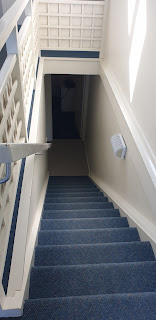
This is the staircase down to the bedroom level of a two-story holiday apartment at the Rosebud Country Club on the Mornington Peninsula in Victoria Australia.
It was the first time we stayed there for a long time.
However…
Innocuous stairs leading downwards to a black hole suggest a great many other things, especially if you left your imagination run wild.
For instance:
What if you are an only child being dropped off by your parents at your creepy grandparent’s place in the middle of the woods. Imagine driving up on a cold, wintry, windy, cloudless dark night, and when you get there, this old rambling mansion looks like the coven for witches.
What if when you get to the door this creepy old man who looks more dead than alive answers the door, and when you step over the threshold you hear what seems to be a high-pitched scream coming from outside the house.
What if, when you are being taken up the staircase, every single wooden step creaks or groans, that at the top of the stairs, every painting you pass, the eyes seem to follow you.
What if, when you explore, against the express wishes of your grandfather, you come across a door that leads down into a basement. There has to be some interesting stuff down there, a torture chamber, a medical laboratory with a half-finished Frankenstein, a workshop with coffins stacked in a corner.
Captains invariably hated the word ‘problem’. I did too, because it conjured up so many different scenarios, each more scarier than the last, and maginified exponentially because we were in space.
We took a closer look, and it was the sort of damage if it was back on Earth, one would associate with weapons fire, lasers to be exact.
Yes, in the 24th century we had ray guns, handheld, and ship bound.
The only problem was, only the cruise class vessels, like the one I was now on, were allowed to have them, and using them, well, the paperwork alone could keep a complement of 20 working day and night for a month.
Test them, yes, less paperwork, use them, no. There had never been a reason to.
But someone had, and on a freighter, which only meant one possibility, that whatever the freighter had been carrying, had been worth violating a thousand regulations and rules.
And bring their ship and selves out into the light.
It was, of course, Space Command’s worst nightmare realised, that the ideal of space exploration as a united effort by everyone, had a member who had decided against unity.
Unless, of course, the improbably had happened, there was life outside our solar system, and we were dealing with a new planet, or people.
Except I would not expect them to use something as conventional as a laser.
Myrtle had put us very close to the damaged area and taken a number of photographs, and the engineer had analysed the damaged area.
Then, cleared to enter the freighter, she took us up to the cargo doors and waited as we watched them open.
It was the same time the engineer’s hand held computer started beeping.
And a warning light on the console in front of Myrtle started flashing, accompanied by a warning klaxon.
Another vessel had just entered our proximity zone.
It’s time for Michelle to return to the snake pit, her nickname for the Parlour she had been sent to work, and the only good thing about it, she is reunited with her two friends, Angie and Millie.
She’s also back to dulling the senses with the drugs left at the house, and when Felix comes to make sure she is ready to return, he realises she has gone back to her old ways. He is not pleased.
Henry is getting to the end of another tour, with a few weeks to go, and is admiring the sunset from the bridge. The captain, hoping he does not have to put him off the ship, finds that a talk to the Chief Officer has put him back on track.
At least one of them is happy.
Henry is still trying to reconcile the girl he met in Morganville with the girl he met last break and finds no suitable answers, just a whole host more questions.
Perhaps he should accept that he doesn’t understand women and one in particular.
I have a stab at improving this starting piece every now and then, a project that started about a year or so ago, and I find myself rewriting the start over and over because I’m not satisfied with the characterization.
It’s not so much the storyline, as it is in trying to create sympathy for the character, and not find him as dull as ditchwater. He’s improving with age. As writers, we tend to create colourful characters and shy away from those who are dull and boring, because after all, as a reader, you want to become something or someone who is far from ordinary. Well, Graham is starting out ordinary, but he will be anything but by the time I write those words ‘The End’.
I promise.
…
I am the master of my own destiny.
My father had drummed that into me, as well as my older brother and younger sister, over and over, until it became a mantra.
For them.
I could not say I didn’t have the same advantages afforded to them, afforded to me. I did.
But somewhere lost in the translation, someone forgot to tell me that it was only advice, not an order, and mistaking it for the latter, I struck out on my own path.
And for the next ten years, it was a long and winding path that led me to this point in time, in a small room that held nothing to tell me where I came from, or who I really was.
My parents were very wealthy with an Upper Westside Apartment in Manhattan and a holiday house in Martha’s Vineyard, my sister had a successful medical career and married a most eligible bachelor, as expected, and my brother, he was a politician.
I’d not seen any of them in at least five years, and they hadn’t called me.
You see, I was the black sheep of the family. I dropped out of college when it all became too much, and drifted. Seasonal labourer, farm hand, factory worker, add job man, and night watchman.
At least now I had a uniform, and a gun, and looked like I’d made something of myself.
It was hard to say why, but just before I was about to head out of the factory to end my shift, those thoughts about them came into my mind. They might be gone, but I guess I would never forget them. I wondered briefly if any of them thought about me.
It was 3 a.m. and it was like standing on the exact epicentre of the South Pole. I’d just stepped from the factory warehouse into the car park.
The car was covered in snow. The weather was clear now, but I could feel more snow was coming. A white Christmas? That’s all I needed. I hoped I remembered to put the antifreeze in my radiator this time.
As I approached my car, the light went on inside an SUV parked next to my car. The door opened and what looked to be a woman was getting out of the car.
“Graham?”
It was a voice I was familiar with, though I hadn’t heard it for a long time.
I looked again and was shocked to see my ultra-successful sister, Penelope. She was leaning against the front fender, and from what I could see, didn’t look too well.
How on earth did she find me, after all the years that had passed? Perhaps that sparked my un-conciliatory question, “What do you want?”
I could see the surprise and then the hurt in her expression. Perhaps I had been a little harsh. Whatever she felt, it passed, and she said, “Help.”
My help? Help with what? I was the last person who could help her, or anyone for that matter, with anything. But curiosity got the better of me. “Why?”
“I think my husband is trying to kill me.”
Then, with that said, she slid down the side of the car, and I could see, in the arc lamps lighting the car park, a trail of blood.
My first thought was she needed the help of a doctor, not a stupid brother, then a second thought, call 911, which I did, and hoped like hell they got here in time.
And, yes, there was a third thought that crossed my mind. Whether or not I would be blamed for this event.
Every time I close my eyes, I see something different.
I’d like to think the cinema of my dreams is playing a double feature but it’s a bit like a comedy cartoon night on Fox.
But these dreams are nothing to laugh about.
Once again there’s a new installment of an old feature, and we’re back on the treasure hunt.
…
“A hundred square miles, that must have run up the coast close to Patterson’s Reach?” I asked.
Patterson’s reach was about five miles to the north, a small town, where there was little fishing done and allegedly a lot of ferrying drugs being dropped off by large ships coming along the offshore shipping lanes. No one could prove it, and every trap set by the coast guard had failed to find any evidence. That meant that someone was tipping them off.
It was also the domain of the Cossatino’s who discouraged anyone else from living there. It was said that Cossatino owned all of the lands the town sat on and the people who lived there worked for him.
“Only as far as Patterson’s reach and then inland for about 20 miles, about as far as the Faultline and perhaps the closest point between the foothills and the sea. Ormiston had bought all the land thinking that the treasure was buried on it. You see, he had a map too, long before Boggs senior had started forging them for the Cossatino’s.”
And in hearing that it begged the question, who had first found the original map? If Cossatino found it, then getting Boggs senior to forge a lot of useless maps would hide where it really was.
What if Boggs ‘original’ map was yet another elaborate forgery, given to him by Cossatino to create others? I put that thought to one side.
I wondered if Boggs had been to see her, to get some background. If there was going to be an expert on the treasure, if it existed or not, she would know. In fact, she probably knew old man Ormiston.
“Does that map still exist?”
“Perhaps. It was not found in his effects after he died. Spent his last years in an asylum. It wasn’t not finding the treasure, or losing his fortune that sent him mad, it was Alzheimer’s, poor old man. Whatever documents that were found when his relatives cleaned the place out were brought to the library to be stored, cataloged at some point, and one day when someone decides to write a history of the area, no doubt they want to see the collection.”
“I couldn’t look at the papers?”
“Are you interested in writing a local history. I’m sure your hunt for the treasure and the many fruitless other expeditions looking for it would make a very entertaining chapter.”
“Maybe I will.”
If that was what it took to look at the documents. There might be something interesting to be found. Especially if he kept a diary. I thought it best not to ask, and fuel suspicions.
“Elmer said there might be relations of Ormiston still around here?”
“Yes, I did say that which I now regret. There are, but I don’t know who they are. I knew his wife’s family name was Maunchen, and that the Maunchens came from California originally, and there’s nothing to say they didn’t go back. Certainly, the wife would be deceased by now, and they had three daughters, all of whom would have married, and changed names. You’d have to go digging through wedding records in at least a dozen parishes. If you were thinking of investigating.”
“Sound like too much hard work. Besides, the treasure doesn’t; exist. I’m only helping Boggs to keep him from doing something stupid.”
“Like father, like son, unfortunately. You do realize the father made some outlandish claim in the hotel one night that he had found the clue to where the treasure was buried. Trouble was, he was prone to making outlandish claims, and by that time, a drunkard. He went missing the next day, and has never been seen since.”
“You think he found it?”
“No. But I’m guessing someone thought he had and killed him trying to find out. We’ll never know.”
“A lesson to be learned then. I’ll keep an eye on Boggs junior just in case he’s thinking of making an equally outlandish claim.”
“You do that.”
She opened a drawer and pulled out a form and handed it to me.
“What’s this for?”
“A request to look at the archives. You have to register, and I have to give you a special card, the key to the history of Arkwon County.”
Where it said signature, I signed it.
“You fill out the rest. When do you want me to pick up the card?”
“Monday next week. In the meantime, be careful.”
She said it like she knew I would be walking into trouble.
By the time I returned to the Savoie, the rain had finally stopped, and there was a streak of blue sky to offer some hope the day would improve.
The ship was not crowded, the possibility of bad weather perhaps holding back potential passengers. Of those I saw, a number of them would be aboard for the lunch by Phillippe Chevrier. I thought about it, but the Concierge had told me about several restaurants in Yvoire and had given me a hand-drawn map of the village. I think he came from the area because he spoke with the pride and knowledge of a resident.
I was looking down from the upper deck observing the last of the boarding passengers when I saw a woman, notable for her red coat and matching shoes, making a last-minute dash to get on board just before the gangway was removed. In fact, her ungainly manner of boarding had also captured a few of the other passenger’s attention. Now they would have something else to talk about, other than the possibility of further rain.
I saw her smile at the deckhand, but he did not smile back. He was not impressed with her bravado, perhaps because of possible injury. He looked at her ticket then nodded dismissively, and went back to his duties in getting the ship underway. I was going to check the departure time, but I, like the other passengers, had my attention diverted to the woman in red.
From what I could see there was something about her. It struck me when the light caught her as she turned to look down the deck, giving me a perfect profile. I was going to say she looked foreign, but here, as in almost anywhere in Europe, that described just about everyone. Perhaps I was just comparing her to Phillipa, so definitively British, whereas this woman was very definitely not.
She was perhaps in her 30’s, slim or perhaps the word I’d use was lissom, and had the look and manner of a model. I say that because Phillipa had dragged me to most of the showings, whether in Milan, Rome, New York, London, or Paris. The clothes were familiar, and in the back of my mind, I had a feeling I’d seen her before.
Or perhaps, to me, all models looked the same.
She looked up in my direction, and before I could divert my eyes, she locked on. I could feel her gaze boring into me, and then it was gone as if she had been looking straight through me. I remained out on deck as the ship got underway, watching her disappear inside the cabin. My curiosity was piqued, so I decided to keep an eye out for her.
I could feel the coolness of the air as the ship picked up speed, not that it was going to be very fast. With stops, the trip would take nearly two hours to get to my destination. It would turn back almost immediately, but I was going to stay until the evening when it returned at about half eight. It would give me enough time to sample the local fare, and take a tour of the medieval village.
Few other passengers ventured out on the deck, most staying inside or going to lunch. After a short time, I came back down to the main deck and headed forward. I wanted to clear my head by concentrating on the movement of the vessel through the water, breathing in the crisp, clean air, and let the peacefulness of the surroundings envelope me.
It didn’t work.
I knew it wouldn’t be long before I started thinking about why things hadn’t worked, and what part I played in it. And the usual question that came to mind when something didn’t work out. What was wrong with me?
I usually blamed it on my upbringing.
I had one of those so-called privileged lives, a nanny till I was old enough to go to boarding school, then sent to the best schools in the land. There I learned everything I needed to be the son of a Duke, or, as my father called it in one of his lighter moments, nobility in waiting.
Had this been five or six hundred years ago, I would need to have sword and jousting skills, or if it had been a few hundred years later a keen military mind. If nothing else I could ride a horse, and go on hunts, or did until they became not the thing to do.
I learned six languages, and everything I needed to become a diplomat in the far-flung British Empire, except the Empire had become the Commonwealth, and then, when no-one was looking, Britain’s influence in the world finally disappeared. I was a man without a cause, without a vocation, and no place to go.
Computers were the new vogue and I had an aptitude for programming. I guess that went hand in hand with mathematics, which although I hated the subject, I excelled in. Both I and another noble outcast used to toss ideas around in school, but when it came to the end of our education, he chose to enter the public service, and I took a few of those ideas we had mulled over and turned them into a company.
About a year ago, I was made an offer I couldn’t refuse. There were so many zeroes on the end of it I just said yes, put the money into a very grateful bank, and was still trying to come to terms with it.
Sadly, I still had no idea what I was going to do with the rest of my life. My parents had asked me to come back home and help manage the estate, and I did for a few weeks. It was as long as it took for my parents to drive me insane.
Back in the city, I spent a few months looking for a mundane job, but there were very few that suited the qualifications I had, and the rest, I think I intimidated the interviewer simply because of who I was. In that time I’d also featured on the cover of the Economist, and through my well-meaning accountant, started involving myself with various charities, earning the title ‘philanthropist’.
And despite all of this exposure, even making one of those ubiquitous ‘eligible bachelor’ lists, I still could not find ‘the one’, the woman I wanted to spend the rest of my life with. Phillipa seemed to fit the bill, but in time she proved to be a troubled soul with ‘Daddy’ issues. I knew that in building a relationship compromise was necessary, but with her, in the end, everything was a compromise and what had happened was always going to be the end result.
It was perhaps a by-product of the whole nobility thing. There was a certain expectation I had to fulfill, to my peers, contemporaries, parents and family, and those who either liked or hated what it represented. The problem was, I didn’t feel like I belonged. Not like my friend from schooldays, and now obscure acquaintance, Sebastian. He had been elevated to his Dukedom early when his father died when he was in his twenties. He had managed to fade from the limelight and was rarely mentioned either in the papers or the gossip columns. He was one of the lucky ones.
I had managed to keep a similarly low profile until I met Phillipa. From that moment, my obscurity disappeared. It was, I could see now, part of a plan put in place by Phillipa’s father, a man who hogged the limelight with his daughter, to raise the profile of the family name and through it their businesses. He was nothing if not the consummate self-advertisement.
Perhaps I was supposed to be the last piece of the puzzle, the attachment to the establishment, that link with a class of people he would not normally get in the front door. There was nothing refined about him or his family, and more than once I’d noticed my contemporaries cringe at the mention of his name, or any reference of my association with him.
Yet could I truthfully say I really wanted to go back to the obscurity I had before Phillipa? For all her faults, there were times when she had been fun to be with, particularly when I first met her when she had a certain air of unpredictability. That had slowly disappeared as she became part of her father’s plan for the future. She just failed to see how much he was using her.
Or perhaps, over time, I had become cynical.
I thought about calling her. It was one of those moments of weakness when I felt alone, more alone than usual.
I diverted my attention back to my surroundings and the shoreline. Out of the corner of my eye, I could see the woman in the red coat, making a move. The red coat was like a beacon, a sort of fire engine red. It was not the sort of coat most of the women I knew would wear, but on her, it looked terrific. In fact, her sublime beauty was the one other attribute that was distinctly noticeable, along with the fact her hair was short, rather than long, and jet black.
I had to wrench my attention away from her.
A few minutes later several other passengers came out of the cabin for a walk around the deck, perhaps to get some exercise, perhaps checking up on me, or perhaps I was being paranoid. I waited till they passed on their way forward, and I turned and headed aft.
I watched the wake sluicing out from under the stern for a few minutes, before retracing my steps to the front of the ship and there I stood against the railing, watching the bow carve its way through the water. It was almost mesmerizing. There, I emptied my mind of thoughts about Phillipa, and thoughts about the woman in the red coat.
Until a female voice behind me said, “Having a bad day?”
I started, caught by surprise, and slowly turned. The woman in the red coat had somehow got very close me without my realizing it. How did she do that? I was so surprised I couldn’t answer immediately.
“I do hope you are not contemplating jumping. I hear the water is very cold.”
Closer up, I could see what I’d missed when I saw her on the main deck. There was a slight hint of Chinese, or Oriental, in her particularly around the eyes, and of her hair which was jet black. An ancestor twice or more removed had left their mark, not in a dominant way, but more subtle, and easily missed except from a very short distance away, like now.
Other than that, she was quite possibly Eastern European, perhaps Russian, though that covered a lot of territory. The incongruity of it was that she spoke with an American accent, and fluent enough for me to believe English was her first language.
Usually, I could ‘read’ people, but she was a clean slate. Her expression was one of amusement, but with cold eyes. My first thought, then, was to be careful.
“No. Not yet.” I coughed to clear my throat because I could hardly speak. And blushed, because that was what I did when confronted by a woman, beautiful or otherwise.
The amusement gave way to a hint of a smile that brightened her demeanor as a little warmth reached her eyes. “So that’s a maybe. Should I change into my lifesaving gear, just in case?”
It conjured up a rather interesting image in my mind until I reluctantly dismissed it.
“Perhaps I should move away from the edge,” I said, moving sideways until I was back on the main deck, a few feet further away. Her eyes had followed me, and when I stopped she turned to face me again. She did not move closer.
I realized then she had removed her beret and it was in her left side coat pocket. “Thanks for your concern …?”
“Zoe.”
“Thanks for your concern, Zoe. By the way, my name is John.”
She smiled again, perhaps in an attempt to put me at ease. “I saw you earlier, you looked so sad, I thought …”
“I might throw myself overboard?”
“An idiotic notion I admit, but it is better to be safe than sorry.”
Then she tilted her head to one side then the other, looking intently at me. “You seem to be familiar. Do I know you?”
I tried to think of where I may have seen her before, but all I could remember was what I’d thought earlier when I first saw her; she was a model and had been at one of the showings. If she was, it would be more likely she would remember Phillipa, not me. Phillipa always had to sit in the front row.
“Probably not.” I also didn’t mention the fact she may have seen my picture in the society pages of several tabloid newspapers because she didn’t look the sort of woman who needed a daily dose of the comings and goings, and, more often than not, scandal associated with so-called celebrities.
She gave me a look, one that told me she had just realized who I was. “Yes, I remember now. You made the front cover of the Economist. You sold your company for a small fortune.”
Of course. She was not the first who had recognized me from that cover. It had raised my profile considerably, but not the Sternhaven’s. That article had not mentioned Phillipa or her family. I suspect Grandmother had something to do with that, and it was, now I thought about it, another nail in the coffin that was my relationship with Phillipa.
“I wouldn’t say it was a fortune, small or otherwise, just fortunate.” Each time, I found myself playing down the wealth aspect of the business deal.
“Perhaps then, as the journalist wrote, you were lucky. It is not, I think, a good time for internet-based companies.”
The latter statement was an interesting fact, one she read in the Financial Times which had made that exact comment recently.
“But I am boring you.” She smiled again. “I should be minding my own business and leaving you to your thoughts. I am sorry.”
She turned to leave and took a few steps towards the main cabin.
“You’re not boring me,” I said, thinking I was letting my paranoia get the better of me. It had been Sebastian on learning of my good fortune, who had warned me against ‘a certain element here and abroad’ whose sole aim would be to separate me from my money. He was not very subtle when he described their methods.
But I knew he was right. I should have let her walk away.
She stopped and turned around. “You seem nothing like the man I read about in the Economist.”
A sudden and awful thought popped into my head. Those words were part of a very familiar opening gambit. “Are you a reporter?”
I was not sure if she looked surprised, or amused. “Do I look like one?”
I silently cursed myself for speaking before thinking, and then immediately ignored my own admonishment. “People rarely look like what they are.”
I saw the subtle shake of the head and expected her to take her leave. Instead she astonished me.
“I fear we have got off on the wrong foot. To be honest, I’m not usually this forward, but you seemed like you needed cheering up when probably the opposite is true. Aside from the fact this excursion was probably a bad idea. And,” she added with a little shrug, “perhaps I talk too much.”
I was not sure what I thought of her after that extraordinary admission. It was not something I would do, but it was an interesting way to approach someone and have them ignoring their natural instinct. I would let Sebastian whisper in my ear for a little longer and see where this was going.
“Oddly enough, I was thinking the same thing. I was supposed to be traveling with my prospective bride. I think you can imagine how that turned out.”
“She’s not here?”
“No.”
“She’s in the cabin?” Her eyes strayed in that direction for a moment then came back to me. She seemed surprised I might be traveling with someone.
“No. She is back in England, and the wedding is off. So is the relationship. She dumped me by text.”
OK, why was I sharing this humiliating piece of information with her? I still couldn’t be sure she was not a reporter.
She motioned to an empty seat, back from the edge. No walking the plank today. She moved towards it and sat down. She showed no signs of being cold, nor interested in the breeze upsetting her hair. Phillipa would be having a tantrum about now, being kept outside, and freaking out over what the breeze might be doing to her appearance.
I wondered, if only for a few seconds if she used this approach with anyone else. I guess I was a little different, a seemingly rich businessman alone on a ferry on Lake Geneva, contemplating the way his life had gone so completely off track.
She watched as I sat at the other end of the bench, leaving about a yard between us. After I leaned back and made myself as comfortable as I could, she said, “I have also experienced something similar, though not by text message. It is difficult, the first few days.”
“I saw it coming.”
“I did not.” She frowned, a sort of lifeless expression taking over, perhaps brought on by the memory of what had happened to her. “But it is done, and I moved on. Was she the love of your life?”
OK, that was unexpected.
When I didn’t answer, she said, “I am sorry. Sometimes I ask personal questions without realizing what I’m doing. It is none of my business.” She shivered. “Perhaps we should go back inside.”
She stood, and held out her hand. Should I take it and be drawn into her web? I thought of Sebastian. What would he do in this situation?
I took her hand in mine and let her pull me gently to my feet. “Wise choice,” she said, looking up at the sky.
It was just a simple conversation, or so I thought.
You know how it is, stuck in a long queue, waiting for service when you strike up a conversation with the person in front of the person or behind. Random strangers, never seen before, perhaps will never see again.
The plane had arrived late, along with the three others in quick succession, all with over 300 passengers, and being that time of night, not so many service staff. The line was quite literally a mile long and not moving very fast.
It was apparent the person in front of me, who looked like a university professor, had to be somewhere else and was getting impatient.
“This is ridiculous. You would have thought they’d know about the hold-ups, that every plane would arrive at the same time, and make the appropriate adjustments.”
It was a common sense thing, but apparently not deemed so by airport management. It was the same the world over.
“At least you won’t have to wait for your baggage. It’ll be on the carousel by the time we get out of here.”
He sighed, pulled out a cell phone, and dialled a number, most likely the person picking him up. They didn’t answer, and as he jammed his finger on the disconnect button, he muttered, “Fiddlesticks.”
One second, I was thinking what an odd thing to say, the next, nothing.
When I opened my eyes I was looking at a roof, in unfamiliar surroundings, with two ambulance staff leaning over me, saying, “Mr Giles, Mr Giles,” while gently shaking me by the shoulder.
My first thought was, who was Mr Giles? I looked at one, “Where am I?”
“JFK airport, New York.”
“How, why, when?”
“You collapsed, waiting in line to pass through immigration. The security staff called us.”
“Who is Mr Glies?”
“That’s you.”
“No, it isn’t. My name is Jeremy Watkins.”
“Not according to your passport and ticket information. Samuel Giles.”
No. I’ve never heard of him. Nor did I have any idea why I was in New York, where I came from or why I was there. Seeing the guards surrounding me, I realized airport security staff were naturally paranoid about terrorist attacks, and given my situation, I had just become a number one suspect.
This was not going to end well.
Within five minutes of saying what I’d just said, I was taken to a room somewhere within the innards of the airport, the paramedics having determined there was nothing physically wrong with me, saying it was just a reaction to a long flight, tiredness, and stress from waiting.
All the time, I’d been flanked by three airport security staff, followed by two uniformed officers of the NYPD. When I got to the room, a man was waiting. He looked as tired as I felt. My baggage was on one side of the room, and it had been thoroughly searched. The paramedics’ work was done, and they left. The airport security guards were also dismissed, but the two uniformed officers remained, one in the room and one outside the room. If I tried to escape, I would not get very far.
He pointed to a seat opposite him, and I assumed I was meant to sit. Once I had, he said, “Now, Mr Giles slash Watkins, just who the hell are you?”
I didn’t think he was from the FBI, but just to make sure I asked, “Who are you?”
He glared at me, perhaps considering he didn’t have to tell me anything, then changed his mind. “Detective Barnsdale, NYPD. Someone up there,” he pointed to the roof, “Decided to make this my lucky day. Make it easy for both of us. I’d tend to believe you were hallucinating if you’d banged your head when you collapsed, but the medics tell me you didn’t. I can only assume this is some sort of prank. If it is, then I suggest you give it up. Otherwise, if I escalate this, it’s going to get ugly.”
If he was trying to scare me, it was working. “My name is Jeremy Watkins. If you have access to the internet, you can look me up. I’m an author, not exactly a runaway best-seller, but I make enough. I don’t know how I got here, or why I’m here, and as much in the dark as you why my documents say I’m someone else.”
He brought out his cell phone and pushed a few buttons, typed in my name, and waited. Then, his expression changed, and another glare at me. “OK, it looks like you. Give me some titles of your books.”
“It happened in Syracuse, the end is nigh, and the girl with blue eyes.”
A shake of the head. “Not exactly conclusive proof. You could have looked it up and remembered them. But you look exactly like him.”
He went back to his phone and picked up the driver’s licence with that name and address and typed that name in. Another expression change, one that suggested he’d found nothing. “So you are telling me you know nothing about this Sidney Giles from Houston. It’s your photo, and this licence looks real. And this boarding pass says you came in from Houston.”
“I can’t explain it. No.”
He sighed. “OK. Take me through your last 24 hours. What do you remember?”
That was the problem, I could not remember anything beyond the fact I had just finished a class where I’d been trying to get completely disinterested teenagers to write a story about their ideal day out, and being met with derision. The bell rang and they all left, leaving me somewhat shattered, sitting at the desk contemplating why I’d chosen this career path.
Then Marjorie, the other English teacher who had conducted my orientation, came in and asked me how my first class went. I couldn’t remember what I said, but the next memory was in a bar, she was there, and we were talking about writing, and the fact she was hoping to finish her first book soon, and was asking if I wanted to read it.
“I’m not sure if it’s the last 24 hours, but I’m apparently a new teacher at a college in Syracuse somewhere, who took his first class, not very successfully, I might add.”
“Nothing to indicate how you got to Houston, and then here?”
Another memory popped into my head, a rather disconcerting one. I was with Marjorie, and we were talking about writing thrillers and how sometimes she playacted her character’s roles, the latest, an assassin who had been hypnotised believing she was someone else entirely, fitted out with a complete change of identity and then travelling to a particular city to carry out her assignment. Who said art imitated life? This was the other way around.
“You remembered something, didn’t you?”
“I think whatever it was, it’s just a figment of my writer’s mind. It’s too far out there to be believable.”
“Try me.”
“Apparently, I was discussing aspects of another author’s latest work in progress, where the main character is hypnotised into thinking they are someone else. That’s just too far-fetched, isn’t it?”
The detective picked up his phone and called security and asked if there was any CCTV of the incident. Five minutes later, a guard came with an inadequate and handed it to him. “It’s your lucky day,” he said.
The detective looked at the footage not once but about ten times. “The coverage shows you talking to the man ahead of you in the queue, and then suddenly just collapse. I’m sure he says something to you, a word that sounds like Fiddlesticks.”
The next thing I knew, he was shaking me by the shoulder, and I was on the floor, totally disorientated.



 Thrills, Spills, and just a dash of Romance