Motive, means, and opportunity – My side of the story

You could say there was a story to tell, because when it came down to it, the answers to the specific questions put to me during an interview which I learned later, had been fueled by another interview, required truthful answers, and those answers were, in reality, quite damning.

It just shows what can happen when you’re ambushed by a very clever detective seeking a specific result.

It ran, in part, thus:

The first: did you know (name).

The simple answer was: yes

So, if I left it at that, the note in the detective’s notebook would say, the suspect knew the victim.

Next question, did you know the victim was dating your ex-wife?

The simple answer to that question was yes. But there was more to it than just a yes, but I was not given the chance to explain the complexities of that answer.

But here’s the story that goes with that answer: I knew my ex was seeing someone else long before we broke up, but it only became clear who it was when she moved out. He inadvertently came to the house when she was out, but that was just confirmation.

It had to be one of her old boyfriends, she had hinted at it often enough.

Did it surprise me? No. She had to be seeing someone because she wasn’t talking to me, and her grief had become more manageable over time. And given her dislike of psychiatrists, she wasn’t getting help from that quarter.

But I was not asked about those circumstances, nor when I tried to, was I given a hearing. If I had anything further to add, I would be given the chance later.

Instead, we moved on to the next question, laying the foundations of the case against me.

What did you think of Garry given his relationship with your wife?

Answer: I didn’t think anything. It was clear early on that the marriage was irrevocably broken, I’m sure you are aware of the circumstances that led to that breakdown, and that it was inevitable she would seek solace elsewhere. She put the blame for the death of our son on my doorstep and was never going to forgive me.

At that point, there was a subtle change in the detective.

Did he or did he not know what the cause of our marital breakdown was? He tried to make it look like he didn’t, but if I knew (name) it would be the second item out of her mouth, after the accusation I was the perpetrator.

He said: You can see how this looks?

I said: How what looks? I was guessing this was the time to start acting dumb and being careful what I said.

As far as the detective was concerned, and had been hinting at, was that I had a motive, and it wouldn’t, in the end, matter what I said, or left unsaid, he had already decided who was guilty.

Me.

An excerpt from “The Devil You Don’t”

Available on Amazon Kindle here:  https://amzn.to/2Xyh1ow

By the time I returned to the Savoie, the rain had finally stopped, and there was a streak of blue sky to offer some hope the day would improve.

The ship was not crowded, the possibility of bad weather perhaps holding back potential passengers.  Of those I saw, a number of them would be aboard for the lunch by Phillippe Chevrier.  I thought about it, but the Concierge had told me about several restaurants in Yvoire and had given me a hand-drawn map of the village.  I think he came from the area because he spoke with the pride and knowledge of a resident.

I was looking down from the upper deck observing the last of the boarding passengers when I saw a woman, notable for her red coat and matching shoes, making a last-minute dash to get on board just before the gangway was removed.  In fact, her ungainly manner of boarding had also captured a few of the other passenger’s attention.  Now they would have something else to talk about, other than the possibility of further rain.

I saw her smile at the deckhand, but he did not smile back.  He was not impressed with her bravado, perhaps because of possible injury.  He looked at her ticket then nodded dismissively, and went back to his duties in getting the ship underway.  I was going to check the departure time, but I, like the other passengers, had my attention diverted to the woman in red.

From what I could see there was something about her.  It struck me when the light caught her as she turned to look down the deck, giving me a perfect profile.  I was going to say she looked foreign, but here, as in almost anywhere in Europe, that described just about everyone.  Perhaps I was just comparing her to Phillipa, so definitively British, whereas this woman was very definitely not.

She was perhaps in her 30’s, slim or perhaps the word I’d use was lissom, and had the look and manner of a model.  I say that because Phillipa had dragged me to most of the showings, whether in Milan, Rome, New York, London, or Paris.  The clothes were familiar, and in the back of my mind, I had a feeling I’d seen her before.

Or perhaps, to me, all models looked the same.

She looked up in my direction, and before I could divert my eyes, she locked on.  I could feel her gaze boring into me, and then it was gone as if she had been looking straight through me.  I remained out on deck as the ship got underway, watching her disappear inside the cabin.  My curiosity was piqued, so I decided to keep an eye out for her.

I could feel the coolness of the air as the ship picked up speed, not that it was going to be very fast.  With stops, the trip would take nearly two hours to get to my destination.  It would turn back almost immediately, but I was going to stay until the evening when it returned at about half eight.  It would give me enough time to sample the local fare, and take a tour of the medieval village.

Few other passengers ventured out on the deck, most staying inside or going to lunch.  After a short time, I came back down to the main deck and headed forward.  I wanted to clear my head by concentrating on the movement of the vessel through the water, breathing in the crisp, clean air, and let the peacefulness of the surroundings envelope me.

It didn’t work.

I knew it wouldn’t be long before I started thinking about why things hadn’t worked, and what part I played in it.  And the usual question that came to mind when something didn’t work out.  What was wrong with me?

I usually blamed it on my upbringing.

I had one of those so-called privileged lives, a nanny till I was old enough to go to boarding school, then sent to the best schools in the land.  There I learned everything I needed to be the son of a Duke, or, as my father called it in one of his lighter moments, nobility in waiting.

Had this been five or six hundred years ago, I would need to have sword and jousting skills, or if it had been a few hundred years later a keen military mind.  If nothing else I could ride a horse, and go on hunts, or did until they became not the thing to do.

I learned six languages, and everything I needed to become a diplomat in the far-flung British Empire, except the Empire had become the Commonwealth, and then, when no-one was looking, Britain’s influence in the world finally disappeared.  I was a man without a cause, without a vocation, and no place to go.

Computers were the new vogue and I had an aptitude for programming.  I guess that went hand in hand with mathematics, which although I hated the subject, I excelled in.  Both I and another noble outcast used to toss ideas around in school, but when it came to the end of our education, he chose to enter the public service, and I took a few of those ideas we had mulled over and turned them into a company.

About a year ago, I was made an offer I couldn’t refuse.  There were so many zeroes on the end of it I just said yes, put the money into a very grateful bank, and was still trying to come to terms with it.

Sadly, I still had no idea what I was going to do with the rest of my life.  My parents had asked me to come back home and help manage the estate, and I did for a few weeks.  It was as long as it took for my parents to drive me insane.

Back in the city, I spent a few months looking for a mundane job, but there were very few that suited the qualifications I had, and the rest, I think I intimidated the interviewer simply because of who I was.  In that time I’d also featured on the cover of the Economist, and through my well-meaning accountant, started involving myself with various charities, earning the title ‘philanthropist’.

And despite all of this exposure, even making one of those ubiquitous ‘eligible bachelor’ lists, I still could not find ‘the one’, the woman I wanted to spend the rest of my life with.  Phillipa seemed to fit the bill, but in time she proved to be a troubled soul with ‘Daddy’ issues.  I knew that in building a relationship compromise was necessary, but with her, in the end, everything was a compromise and what had happened was always going to be the end result.

It was perhaps a by-product of the whole nobility thing.  There was a certain expectation I had to fulfill, to my peers, contemporaries, parents and family, and those who either liked or hated what it represented.  The problem was, I didn’t feel like I belonged.  Not like my friend from schooldays, and now obscure acquaintance, Sebastian.  He had been elevated to his Dukedom early when his father died when he was in his twenties.  He had managed to fade from the limelight and was rarely mentioned either in the papers or the gossip columns.  He was one of the lucky ones.

I had managed to keep a similarly low profile until I met Phillipa.  From that moment, my obscurity disappeared.  It was, I could see now, part of a plan put in place by Phillipa’s father, a man who hogged the limelight with his daughter, to raise the profile of the family name and through it their businesses.  He was nothing if not the consummate self-advertisement.

Perhaps I was supposed to be the last piece of the puzzle, the attachment to the establishment, that link with a class of people he would not normally get in the front door.  There was nothing refined about him or his family, and more than once I’d noticed my contemporaries cringe at the mention of his name, or any reference of my association with him.

Yet could I truthfully say I really wanted to go back to the obscurity I had before Phillipa?  For all her faults, there were times when she had been fun to be with, particularly when I first met her when she had a certain air of unpredictability.  That had slowly disappeared as she became part of her father’s plan for the future.  She just failed to see how much he was using her.

Or perhaps, over time, I had become cynical.

I thought about calling her.  It was one of those moments of weakness when I felt alone, more alone than usual.

I diverted my attention back to my surroundings and the shoreline.  Out of the corner of my eye, I could see the woman in the red coat, making a move.  The red coat was like a beacon, a sort of fire engine red.  It was not the sort of coat most of the women I knew would wear, but on her, it looked terrific.  In fact, her sublime beauty was the one other attribute that was distinctly noticeable, along with the fact her hair was short, rather than long, and jet black.

I had to wrench my attention away from her.

A few minutes later several other passengers came out of the cabin for a walk around the deck, perhaps to get some exercise, perhaps checking up on me, or perhaps I was being paranoid.  I waited till they passed on their way forward, and I turned and headed aft.

I watched the wake sluicing out from under the stern for a few minutes, before retracing my steps to the front of the ship and there I stood against the railing, watching the bow carve its way through the water.  It was almost mesmerizing.  There, I emptied my mind of thoughts about Phillipa, and thoughts about the woman in the red coat.

Until a female voice behind me said, “Having a bad day?”

I started, caught by surprise, and slowly turned.  The woman in the red coat had somehow got very close me without my realizing it.  How did she do that?  I was so surprised I couldn’t answer immediately.

“I do hope you are not contemplating jumping.  I hear the water is very cold.”

Closer up, I could see what I’d missed when I saw her on the main deck.  There was a slight hint of Chinese, or Oriental, in her particularly around the eyes, and of her hair which was jet black.  An ancestor twice or more removed had left their mark, not in a dominant way, but more subtle, and easily missed except from a very short distance away, like now.

Other than that, she was quite possibly Eastern European, perhaps Russian, though that covered a lot of territory.  The incongruity of it was that she spoke with an American accent, and fluent enough for me to believe English was her first language.

Usually, I could ‘read’ people, but she was a clean slate.  Her expression was one of amusement, but with cold eyes.  My first thought, then, was to be careful.

“No.  Not yet.”  I coughed to clear my throat because I could hardly speak.  And blushed, because that was what I did when confronted by a woman, beautiful or otherwise.

The amusement gave way to a hint of a smile that brightened her demeanor as a little warmth reached her eyes.  “So that’s a maybe.  Should I change into my lifesaving gear, just in case?”

It conjured up a rather interesting image in my mind until I reluctantly dismissed it.

“Perhaps I should move away from the edge,” I said, moving sideways until I was back on the main deck, a few feet further away.  Her eyes had followed me, and when I stopped she turned to face me again.  She did not move closer.

I realized then she had removed her beret and it was in her left side coat pocket.  “Thanks for your concern …?”

“Zoe.”

“Thanks for your concern, Zoe.  By the way, my name is John.”

She smiled again, perhaps in an attempt to put me at ease.  “I saw you earlier, you looked so sad, I thought …”

“I might throw myself overboard?”

“An idiotic notion I admit, but it is better to be safe than sorry.”

Then she tilted her head to one side then the other, looking intently at me.  “You seem to be familiar.  Do I know you?”

I tried to think of where I may have seen her before, but all I could remember was what I’d thought earlier when I first saw her; she was a model and had been at one of the showings.  If she was, it would be more likely she would remember Phillipa, not me.  Phillipa always had to sit in the front row.

“Probably not.”  I also didn’t mention the fact she may have seen my picture in the society pages of several tabloid newspapers because she didn’t look the sort of woman who needed a daily dose of the comings and goings, and, more often than not, scandal associated with so-called celebrities.

She gave me a look, one that told me she had just realized who I was.  “Yes, I remember now.  You made the front cover of the Economist.  You sold your company for a small fortune.”

Of course.  She was not the first who had recognized me from that cover.  It had raised my profile considerably, but not the Sternhaven’s.  That article had not mentioned Phillipa or her family.  I suspect Grandmother had something to do with that, and it was, now I thought about it, another nail in the coffin that was my relationship with Phillipa.

“I wouldn’t say it was a fortune, small or otherwise, just fortunate.”  Each time, I found myself playing down the wealth aspect of the business deal.

“Perhaps then, as the journalist wrote, you were lucky.  It is not, I think, a good time for internet-based companies.”

The latter statement was an interesting fact, one she read in the Financial Times which had made that exact comment recently.

“But I am boring you.”  She smiled again.  “I should be minding my own business and leaving you to your thoughts.  I am sorry.”

She turned to leave and took a few steps towards the main cabin.

“You’re not boring me,” I said, thinking I was letting my paranoia get the better of me.  It had been Sebastian on learning of my good fortune, who had warned me against ‘a certain element here and abroad’ whose sole aim would be to separate me from my money.  He was not very subtle when he described their methods.

But I knew he was right.  I should have let her walk away.

She stopped and turned around.  “You seem nothing like the man I read about in the Economist.”

A sudden and awful thought popped into my head.  Those words were part of a very familiar opening gambit.  “Are you a reporter?”

I was not sure if she looked surprised, or amused.  “Do I look like one?”

I silently cursed myself for speaking before thinking, and then immediately ignored my own admonishment.  “People rarely look like what they are.”

I saw the subtle shake of the head and expected her to take her leave.  Instead she astonished me.

“I fear we have got off on the wrong foot.  To be honest, I’m not usually this forward, but you seemed like you needed cheering up when probably the opposite is true.  Aside from the fact this excursion was probably a bad idea.  And,” she added with a little shrug, “perhaps I talk too much.”

I was not sure what I thought of her after that extraordinary admission. It was not something I would do, but it was an interesting way to approach someone and have them ignoring their natural instinct.  I would let Sebastian whisper in my ear for a little longer and see where this was going.

“Oddly enough, I was thinking the same thing.  I was supposed to be traveling with my prospective bride.  I think you can imagine how that turned out.”

“She’s not here?”

“No.”

“She’s in the cabin?”  Her eyes strayed in that direction for a moment then came back to me.  She seemed surprised I might be traveling with someone.

“No.  She is back in England, and the wedding is off.  So is the relationship.  She dumped me by text.”

OK, why was I sharing this humiliating piece of information with her?  I still couldn’t be sure she was not a reporter.

She motioned to an empty seat, back from the edge.  No walking the plank today.  She moved towards it and sat down.  She showed no signs of being cold, nor interested in the breeze upsetting her hair.  Phillipa would be having a tantrum about now, being kept outside, and freaking out over what the breeze might be doing to her appearance.

I wondered, if only for a few seconds if she used this approach with anyone else.  I guess I was a little different, a seemingly rich businessman alone on a ferry on Lake Geneva, contemplating the way his life had gone so completely off track.

She watched as I sat at the other end of the bench, leaving about a yard between us.  After I leaned back and made myself as comfortable as I could, she said, “I have also experienced something similar, though not by text message.  It is difficult, the first few days.”

“I saw it coming.”

“I did not.”  She frowned, a sort of lifeless expression taking over, perhaps brought on by the memory of what had happened to her.  “But it is done, and I moved on.  Was she the love of your life?”

OK, that was unexpected.

When I didn’t answer, she said, “I am sorry.  Sometimes I ask personal questions without realizing what I’m doing.  It is none of my business.”  She shivered.  “Perhaps we should go back inside.”

She stood, and held out her hand.  Should I take it and be drawn into her web?  I thought of Sebastian.  What would he do in this situation?

I took her hand in mine and let her pull me gently to my feet.  “Wise choice,” she said, looking up at the sky.

It just started to rain.

© Charles Heath 2015-2023

newdevilcvr6

In a word: Line

The English language has some marvelous words that can be used so as to have any number of meanings

For instance,

Draw a line in the sand

We would all like to do this with our children, our job, our relationships, but for some reason, the idea sounds really good in our heads, but it never quite works out in reality. What does it mean, whatever it is, this I’d where it ends or changes because it can’t keep going the way it is.

Inevitably it leads to,

You’ve crossed the line

Which at some point in our lives, and particularly when children, we all do a few times until, if we’re lucky we learn where that line is. It’s usually considered 8n tandem with pushing boundaries.

Of course, there is

A line you should never cross

And I like to think we all know where that is. Unfortunately, some do not and often find their seemingly idyllic life totally shattered beyond repair. An affair from either side of a marriage or relationship can do that.

You couldn’t walk a straight line if you tried

While we might debate what straight might mean in this context, for this adaptation it means staying on the right side of legality. Some people find a life of crime more appealing than doing honest days work.

This goes hand in hand with,

You’re spinning me a line

Which means you are being somewhat loose with the truth, perhaps in explaining where you’ve been and what you’ve been doing. I think sometimes liars forget they need to have good memories.

Then there are the more practical uses of the word, such as

I have a new line of products

Is that a new fishing line?

Those I think most of us get, but it’s the more ambiguous that we have trouble with. Still, ambiguity is a writer’s best friend and we can make up a lot of stuff from just using one word.

‘Sunday in New York’ – A beta reader’s view

I’m not a fan of romance novels but …

There was something about this one that resonated with me.

This is a novel about a world generally ruled by perception, and how people perceive what they see, what they are told, and what they want to believe.

I’ve been guilty of it myself as I’m sure we all have at one time or another.

For the main characters Harry and Alison there are other issues driving their relationship.

For Alison, it is a loss of self-worth through losing her job and from losing her mother and, in a sense, her sister.

For Harry, it is the fact he has a beautiful and desirable wife, and his belief she is the object of other men’s desires, and one in particular, his immediate superior.

Between observation, the less than honest motives of his friends, a lot of jumping to conclusions based on very little fact, and you have the basis of one very interesting story.

When it all comes to a head, Alison finds herself in a desperate situation, she realises only the truth will save their marriage.

But is it all the truth?

What would we do in similar circumstances?

Rarely does a book have me so enthralled that I could not put it down until I knew the result. They might be considered two people who should have known better, but as is often the case, they had to get past what they both thought was the truth.

And the moral of this story, if it could be said there is one, nothing is ever what it seems.

Available on Amazon here: amzn.to/2H7ALs8

NaNoWriMo – April – 2023 — Day 28

“The Things We Do For Love”

Henry wakes to the realization that, one, he is in hospital with no memory of how he got there two, his brother Harry is nearby, three that he had no idea if his rescue mission succeeded or failed. And lastly, what happened to Radly.

The reality, he had been used as a human punching back, Michelle had disappeared, along with the Turk, and Harry made the conscious decision not to tell his little brother what had transpired while he was in the hospital.  Good news though, Diana and Radly were in the same hospital, and were alive.

Harry has pieced together the night’s events, and ever relating it, he wonders how any of them are still alive.

His father comes to visit, and it’s apparent he doesn’t know the real reason Henry is there.

There is light at the end of the tunnel.  Henry has bought a house in his now favourite village by the sea, easily accessible by train, for now, and plants to go there when discharged.

Michelle has not returned, and he has told himself that she might never.  It’s that old saying, better to have loved and lost than to never have loved at all.

Then it’s off to Morganville.

Words written 4,637, for a total of 107,771

The A to Z Challenge – 2023 — Z is for Zanzibar

My hobby was something that only a select few had, and that was searching rubbish dumps for useful items.

But there was one exception. 

I didn’t search the average rubbish dump, only those I knew were used by organisations and companies that dumped old technology,

If I was lucky, it would be a government department, and the stuff deemed no longer useful to anyone.  I often found old computers, without memory or storage of course, but otherwise intact, and I had an excellent museum of computers, from almost the very first.

It was amazing what some companies disposed of, and in one instance I picked a complete, working, mainframe computer.  It filled a substantial part of the barn.

Then there were a half dozen communication radios, not the sort that had a short range, no, these devices had almost worldwide coverage.  They were also long-wave radio receivers, and I was able to pick up AM radio stations all over the word, and, sometimes, CB transmissions.  It came with several sets of manuals, very thick books that made it daunting reading, so they remained in a wooden crate until boredom set in.

But the radios, were, for now, my new toys to play with.

Late one night I was switching between frequencies, looking for anything that might be interesting, and just caught the end of a transmission, “This is a code Zanzibar, I repeat a Code Zanzibar.  Will call same time tomorrow.”

Code Zanzibar?

It had to be someone out there somewhere in the world playing a prank.

Perhaps there would be more, so I would tune in tomorrow, fifteen minutes earlier to see if there was any more to the message.

Meantime, full of curiosity, I wondered if there would be anything in any of the books that came with the radios.

I didn’t sleep that night, going through each one practically page by page because the indexes were missing.  It was one of those unexplainable oddities, that made me wonder if there was anything in them that the owners hadn’t wanted anyone to find.  That in itself seemed even more odd because if it was the case, why didn’t they destroy them?

Somewhere around shortly before dawn, tired, and bored from reading, I fell asleep.

After yet another bollocking from my father about letting my foolish hobby get in the way of work, I had to work extra hard to make up for it and was too tired to continue my studies.  I meant to read more before the transmission time, but luckily remembered to set the alarm,

When the alarm went off, I woke with a jolt and nearly forgot why I set it.  I got to the radio just before the transmission.

Then I heard it.

“This is a code Zanzibar; I repeat a Code Zanzibar.  Attack is imminent, I repeat attack is imminent.”

I flicked the switch to send a message, and said, “This is station M.  This is station M.  Can you identify yourself?”

I had discovered in the documentation that the radio set had been set up in what was designated Station M, and that it was one of 26 around the country.

There was no reply, just the same message, “This is a code Zanzibar; I repeat a Code Zanzibar.  Attack is imminent, I repeat attack is imminent.” For exactly three minutes, then the sign-off, “Will call same time tomorrow.”

Back to the books, I was in the middle of the sixth of seven volumes, at page 1,457, of 2,500 when I saw the heading “Warning Codes”, and then shuffled through 26 pages until I found “Zanzibar”.

When I read the explanation my heart almost stopped.

“Zanzibar – The threat of an alien attack is imminent – designates that actual alien aircraft have been positively identified and heading towards earth”

What the…

When I read some of the other codes, it showed varying descriptions for a number of events involving aliens, and at first, I thought this referred to other countries than our own, but then, on another page I realised that aliens meant aliens from outer space.

And the fact everyone but a few debunked the idea there was other life out there, it made no sense.  That transmission could not have come from anywhere on Earth.  At least, I didn’t think so, because there had been nothing in the documentation about similar stations in other countries.

Still utterly gobsmacked, I kept reading and found a page where certain information hadn’t been redacted.  That was something else.  Before the books had been thrown away, a lot of information had been redacted.

Why hadn’t it been destroyed, if it was that sensitive?

This page had a name, Professor Edward Bones.  It looked like it had been missed.

Perhaps I could call and ask him what this all meant.

I spend hours trying to match the surname with the locale of where I found the stuff, thinking the original Station M would be nearby.  It wasn’t easy because the name wasn’t in the current phone book, so I had to dig a little deeper and find where historical phone records were kept.

That got me the Professor’s address and phone number, and the University he worked at.  A search on his name told me he was associated with SETI which had to do with tracking communications, if any, from outer space.

I called the number, but it was decommissioned.  No surprise.  If I did the math, the Professor would be a hundred and twenty-two if he was still alive, I did the next best thing, I went to the address.

It was a hundred and fifty miles, a long way to go and pin hopes on finding something.  The university was on the other side of the country so going there was out of the question.  It was hard enough to get my father to let me have the day off for this trip.

It was a gated community just off the main highway, a group of houses set aside on their own, now looking rather worse for wear.  There was no longer a gate, but the was a guard house, holes on the roof and broken windows, a divided driveway with what was once lawn and flower beds, all now overgrown leading to a fountain in the middle of a roundabout that led, one way to houses, one way to a shopping centre and the other, sports fields.

It looked to me like this was a purpose-built community, perhaps to look after the radio receivers, waiting for a call that may never come.

And just had.

I drove to the Professor’s house and parked out front.  It looked in better condition than those on either side, and when I looked in, saw signs of habitation.  Someone was living in it.  Not the professor’s ghost I hope.

I waited.

It was nearly dark before a battered Ford pickup stopped in the driveway and what looked to be an old man get out.

He saw me as I got out of my car, and come towards him.  He didn’t look surprised, which was worrying.

“Did you know Professor Bones,” I asked?  It was unlikely.

“My father, yes.  Are you from the government?  I have nowhere else to go.”

“No.  I’m not.  Did you know much about what your father did?”

“Why?  Is this going to be another character assassination piece?  Are you a reporter?”

“Me?  No.”

“Then why are you here?”

“I came to ask someone, anyone, if they knew what Cade Zanzibar really means.  It can’t possibly mean there’s an imminent alien invasion.”

His expression changed instantly, and it was clear he did know what it meant.

“How do you know anything about Station M, that was top secret, and no one knows, no one still alive that is, other than a few fools back in Washington.”

“I rescued the radio receivers and documents from a dump.  I collect old technology.  It was just sitting there.  I took it home, connected it up, and listened.  For the last two nights, there’s been this transmission, ‘This is a code Zanzibar; I repeat a Code Zanzibar.  Attack is imminent, I repeat attack is imminent’.

“My God.  Where are they now?”

“My place.”

“Where?”

I told him.

“We have to go.  Now.  Take me.  I’ll fill you in on the way.”

It was the stuff of science fiction comics.  Transmission had been received, many years back, from what was believed an alien race under attack from another.  He hesitated before he said it was believed there was life on Mars, but selling the idea there were Martians didn’t go too well.  However, the government decided to piggyback onto the moon landings, and several other missions, one on the Moon, one to Mars, one to Jupiter and another to Saturn.

Not on the planets. But space stations orbiting the planets, sort of early warning stations.  That first transmission had the implied threat that the aggressive aliens were heading towards Earth.

Apparently not as fast as was suspected.  The stations were built, volunteers were sent on the premise they might never come home, and supplies were sent via a launching pad on the moon.  While we were still discussing the possibility of launching missions to the other planets, it had already been done, And no one knew.

Expect the Professor, who lost the plot when the government shut down the program and virtually abandoned these people in the outer space stations.

And that was the purpose of Station M.  To maintain communications with the space stations, and the moon base.  When they were closed, the stations disappeared.  Where I visited the Professor’s son, that was the whole base, kept isolated, and under very tight security.

“All I can think of is that one of the space stations is still in operation, manned by someone who has to be one of the oldest people alive, or they figured out how to automate a message given certain parameters.  Anyway, if there’s a transmission tonight, we’ll soon find out.”

All I could think of was that I’d just unearthed the biggest secret of all time. One that it was likely I could never tell anyone about.

Unless there really were aliens coming to attack us.

A minute or so later, the transmission came in, “This is a code Zanzibar; I repeat a Code Zanzibar.  Attack is imminent, I repeat attack is imminent”.

Bones had already looked over the units and certified they were in full working order and showed me the sequence of switches that turned on two-way communications.

After the message, he switched to transmit, “This is Station M, repeat, this is Station M receiving you.  Please advise details.”

He switched back to receive and static burst out of the speaker.  This went on for a minute, then a weak voice.  “Is that you Freddie?”

“Yes.  The Prof’s son.  Who are you?”

“Alistair Montgomery.  I was last to arrive when I was six.  There are two of us left.  I think Saturn and Mars have ceased.  What happened back there?”

“Funding.  Lack of results.  Bean-counting accountants thought ramping up for wars at home was more important.  We knew it would happen one day.

“Five years, Freddie.”

“Your transmission?  Code Zanzibar.  Is it relevant, or just to get our attention?”

“It’s real.  We saw about 50 large ships go by on the long-range radar.  Heading for the earth, not moving very fast.  I estimate they would take several days to reach to outer limits of our Thermosphere.”

“They didn’t come to see you?”

“No.  Sad, because I was hoping to be the first to meet an alien.  That might yet be you.”

“Are you going to be OK up there?  I can’t tell you we coming to get you.”

“We knew what we were signing on for.  But it would be nice if you could keep in touch/.”

“Do what I can.  Over and out.”

He went around the back of the unit, and I heard what sounded like the ejecting of a cassette tape.  When he came back, he showed it to me.  “This should make the bastards sit up and take notice.”

He grabbed his coat.  “We have to go.  Take me to the nearest airport.”

We made it outside to the car when three black SUV’s pulled up abruptly and a dozen armed men got out and surrounded us.

Then a man in a suit got out of the lead vehicle and came over.

Bones recognised him.

“I didn’t think it would take you long.  Been monitoring for transmissions, have you?”

“We knew your father didn’t follow orders but had no proof.  Who are you,” he glared at me.

“I rescued the radios.”

He sighed.  “Bloody contractors.  Never do as they’re told.”  He shook his head.  “Cuff them and throw them in the car.”

They might have, had it not been for one minor matter.  In the half-light of night, it suddenly went quite dark, except for the car headlights, until suddenly the whole area was lit up like a movie studio.  We all looked up and…

The aliens had arrived.

©  Charles Heath  2023

Using Hollywood as a source of inspiration

I’m not one for writing Western, I’ll leave the honours for that to Louis L’Amore, whose acquaintance I made when I saw How The West Was Won on the big screen, and then read the book.

That led to reading a few more by Zane Grey, but it was not in the reading of the stories but in the visual splendour of the west depicted in these films that made the actors almost secondary.

But my interest in watching Westerns had been fuelled by the fact my parents watched them on TV, though back in those days, they were in black and white, and starred John Wayne, Gary Cooper, Alan Ladd and, later on, Clint Eastwood among a great many others.

But the mainstay of my interest in the archetypal Western centred on John Wayne whose movies may have almost the same plot line, just a substitution of actors and locations.

Often it was not so much that John Wayne was in it, but the actors he surrounded himself with, like Dean Martin, Ricky Nelson, Walter Brennan, and Robert Mitcham, all of whom made the experience all the better.

Films like The Sons of Katie Elder, True Grit, Rio Bravo, and El Dorado.

Who can forget the vast open spaces, the dry dusty stresses lines with wooden buildings and endless walkways that substituted for footpaths?  Bars in hotels, rooms overlooking the street, havens for sharpshooters, when bad guys outnumber the good guys, and typically the Sherrif who always faced insurmountable odds.

Or the attacks staged by Indians who were routinely killed, in fact, there was not one film I saw where they ended up winning any battle. Only in recent years did they get a more sympathetic role, one film that comes to mind is Soldier Blue, which may have painted them as savages, but a possible reason why they ended up so.

But for those without Indians, there were plenty of others whose intentions were anything but for the good of the settlers.

A lot of films ended in a classic gunfight.  High Noon, 3:10 to Yuma are two, where the story led to gun fights between good and bad in unlikely places like El Dorado or Rio Bravo.

There are countless others I could name, like Shane, or became to be called, the spaghetti westerns with Clint Eastwood, or last but not least, The Magnificent Seven, or Once Upon a time in the west.

All have contributed to a picture in my mind of how the American West was, fearsome men, beleaguered sheriffs, people with good intentions, and those driven by greed and power. All of this plays out in the harshest of conditions where life and death could be determined by a wrong word or a stray bullet.

And let’s not forget the role of the guns, Colt, Winchester, and Remington.  And Smith and Wesson, and the gunslingers of the day. Some were good, but most according to the film world were bad.

So, against the lifelong interest of watching and reading about the archetypal view of the old West, shall I attempt to put pen to paper. Thank God it will be a work of fiction because I don’t think there are many who knew what it was really like.

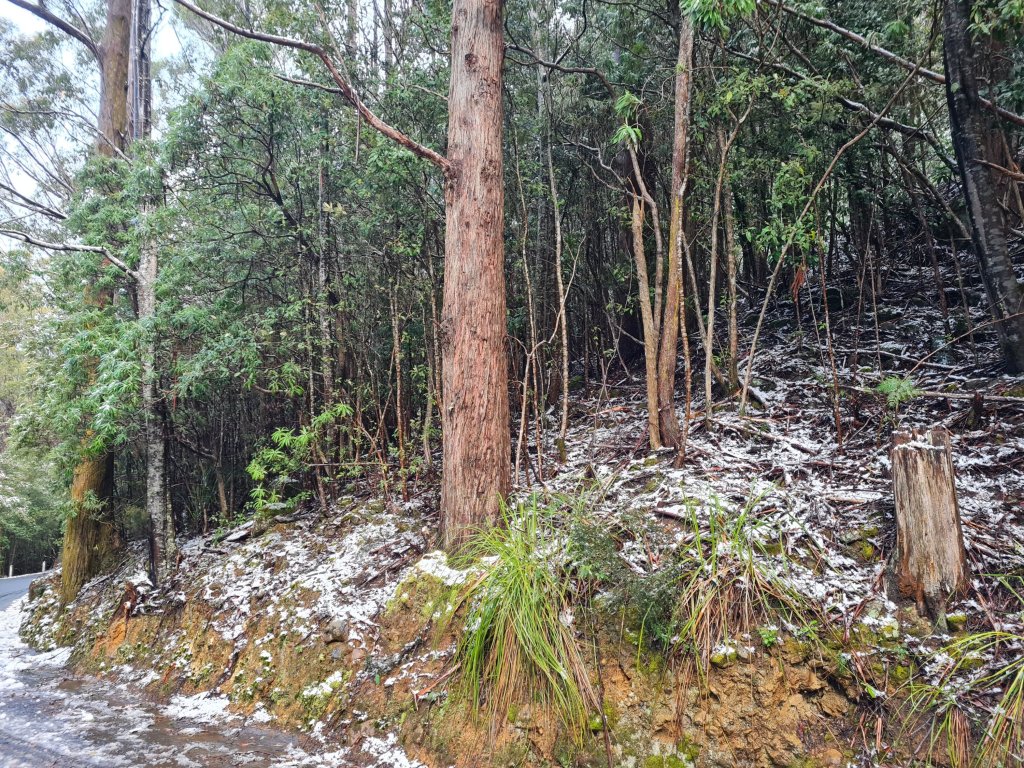
A photograph from the inspirational bin – 41

It’s hard to believe this location is just a few miles from the heart of Hobart, on the road to the top of Mt Wellington.

We were there in winter, not the best time to be going south towards Antarctica, but then, it’s hot most of the time here, and we have to get away from it sometime.

But, what story does this photograph conjure up?

The first thing that comes to mind is staggering out of the forest, three days lost, freezing cold, onto a road, the first sign of civilization, and hope of being rescued.

A car comes…

Yes, it’s that sort of story. Not a rescue but something a whole lot worse.

Then there’s that variation, that the kidnapper locked you up in a cabin deep in the forest with only foot tracks to follow. You break out, get lost trying to find the right trail back and stumble onto the road at exactly the same time the kidnapper is returning.

Talk about bad luck.

Second, you’re part of a work retreat, you know the sort of thing, where everyone gets together in a remote place and bond. Except there’s a killer among you, and it’s a race against time to find him or her, and the bodies mount up.

That’s a fascinating story, if you were there, that you might take to the grave…

…sooner than you think.

Third, and probably the best of the three, two people wanting to get away from everything and rediscover what it is they lost.

If only we could get the time to do that, with kids, ever-increasing bills, ever-increasing demands from employers and a government hell-bent on sending everyone to the poverty line.

Damn, I knew that story was too good to be true!

The cinema of my dreams – I always wanted to see the planets – Episode 23

Where did that ship come from?

When I stepped out on to the bridge number one was waiting, “we received a distress call a few minutes ago, and we’ve been trying to get the ship back to get the details. Then, it just appeared.

Not far off the Port bow, another ship, about half the size of ours was not moving, and it was clear we were doing a circuit to check he outside if the ship.

“It’s the ‘Ionosphere’, one of the research vessels, but according to our records, it should be off Jupiter.”

“Is there anyway we can find out if anyone is alive on board?”

“Our sensors are not clever enough to discern life forms, at least nit yet.  They’re working on it, and it’s going to be in the next upgrade.  We basically restricted to what’s going on outside.”

“Then we’d better send a shuttle, see what’s going on.  Gather a team, take the military rather than security, and a systems expert, and head it up yourself.”

“I’ll let you know when we depart.”

“Make it sooner rather than later, there may be people who need help.  Better add a doctor to the team.”

He nodded and headed towards the elevator, calling up the shuttle bay.

The ‘Ionosphere’ was one of three older research vessels with a crew of about 290, mostly scientists.  The fact it was drifting was not a good sign.

Chalmers was the duty scientist on the bridge, and I went over to his station.

“Are you familiar with the ‘Ionosphere’?”

“Yes sir.  Spent about 6 months on the first exploration to the edge of our universe, surveying and analysing Pluto.”

“Am I correcting on assuming she was lately at Jupiter?”

“Yes sir.  She had been deployed to Saturn first, then Jupiter.”

“You hadn’t heard officially or unofficially she was due back at earth space dock any time soon?”

“No sir.  In fact I was just communicating with a colleague on board a day or so back, who said they had, or though they had discovered an anomaly in space, and had deviated towards it to investigate.  Whatever it was, it had sent some of their instruments crazy.”

Number one’s voice came over the communication system, announcing the shuttle had left the bay and was encountered to the other ship.  A minute later we could see it.

In the same instant, a thought crossed my mind, one that might explain how the ship was not far from us, and on the same course.

“Can you tell me if if Jupiter and Uranus are in alignment, along our projected trajectory?”

“As a matter of fact, they are.”

I was not the greatest scientific mind on the ship, that was why we had a first class scientific team aboard, but I could think outside the box, where some of the scientific minds were closed to ‘out there’ possibilities.

That’s why it didn’t seem impossible to me that the Ionosphere ‘hitched a ride’ in what might be called a wormhole, that sort of anomaly that Jerome Kennedy had been talking about.  It struck me that these worm holes could be like black holes and ships could enter them and come out the other side, a very great distance away, in a very short time.

It would explain how the enemy ship had disappeared, but it didn’t explain why we were able to follow a trail.

That would be a matter for Kennedy

Number one was back on the communications system with a report. “We’ve docked and come on board. At first we thought everyone was dead, there were people on the floor and hunched over in their seats, but the environment is intact and work, and they are mostly unconscious. I have gone directly to the bridge and we’ve woken the Captain. He has no idea what happened, they were investigating what he calls a ripple, and then nothing till we woke him. We’re going to look at the logs and see if what happened has been recorded.”

“Very good.”

Fifteen minutes possibly longer passed when he reported back, not exactly in the serious manner I would expect. “You are not going to believe this, sir, but the ship has just travelled a distance that would normally take them several months, in less than an hour. They were at Jupiter, sir, but that was, according to their log, no more than two hours ago.”

© Charles Heath 2021

NaNoWriMo – April – 2023 — Day 29

“The Things We Do For Love”

What is a love story without a happy ending?

It’s just all the trials and tribulations in between that make it seem like it’s all too much effort with nothing but pain and misery punctuated by a few moments of utter delight.

I’m sure a story where everything works like clockwork might have been easier, but the thought of having some meaty characters standing between them and ultimate happiness was more interesting.

The idea of Emile, or the Turk, being an affable person, was modelled on Sidney Greenstreet, a rather interesting actor in Hollywood in the 1940s and 1950s, and I’d just seen his performance in The Maltese Falcon.

When I first started the story, I wanted Michelle to have a secret, but at the time, it wasn’t for her to be a prostitute, simply a fashion model who fell in with the wrong crowd and got into trouble with drugs and the high life.

But that wasn’t interesting enough.  By that time, I was dabbling in the thriller genre, and realised I couldn’t write a Mills and Boon-type book, so it veered into thriller territory.

Who doesn’t like a guy who wants to rescue a fallen angel?

Why not make the fallen angel an avenging angel?  Her friends help her escape, and then she decided to help her friends escape to the freedom she fleetingly had, and now, determined, would have again.

But, the idea of freedom and the actual getting of it are two entirely different concepts.  400 pages worth of angst, setbacks, love found, and love lost, the love found again.  Henry might be a little too naïve, but he had to be to provide the extreme contrast in backgrounds and notions of what life is like.

Words written 3,914, for a total of 111,685