Searching for locations: A small part of London, England

We were in London in Summer, it was a fine afternoon, going into the evening and we decided to get on the London Eye.  As you can see from the clock it was near 7:00 pm.

housesofparliament3

This photo was taken as we were coming down.

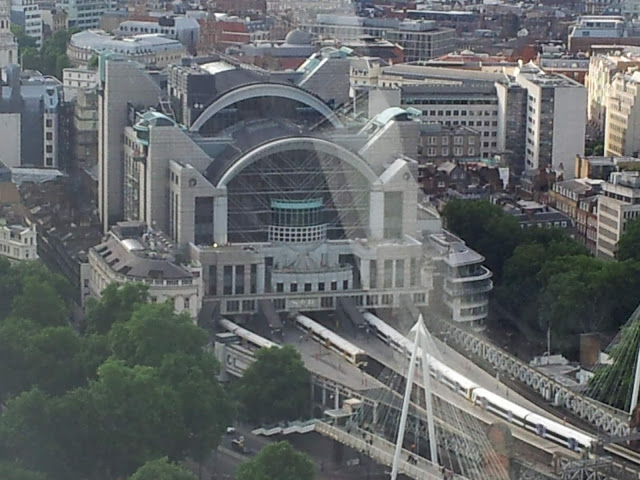
Those long evenings were quite remarkable, not in the least going to a pub and sinking a few pints!  There was one such pub not far from Charing Cross Station

The pub was called ‘The Princess of Wales’

And still be light enough to find your way home.

“Do you believe in g..g..ghosts…?”, a short story

Inside the old building, it was very quiet and almost cold.

Strange, perhaps, because outside the temperature was bordering on the record hottest day ever, nearly 45 degrees centigrade.

The people who’d built this building nearly a hundred years before must have known how to keep that heat at bay, using sandstone.

Back then, the sandstone would have looked very impressive, but now after many years of being closed off and left abandoned, the outside was stained by modern-day pollutants giving it a black streaky look, and inside layers of dust, easily stirred up as we walked slowly into the main foyer.

It was huge, the roof, ornate, with four huge chandelier lights hanging down, and wood panelling, giving way to a long counter with brass serving cages highlighting its former use; a bank.

In its day it would have conveyed power and wealth so that its customers could trust their money to. Of course, that was before the global economy, online banking, and a raft of new and different institutions all vying for that same money.

Then it was a simple choice of a few, now it was a few thousand.

“How many years had this been closed up?” I asked.

“Close to twenty, maybe twenty-five. It was supposed to be pulled down, but someone got it on the heritage list, and that put an end to it. “

Phil was the history nut. He’s spent a month looking into the building, finding construction plans, and correspondence dating back to before and during the construction.

Building methods, he said, that didn’t exist today and were far in advance of anything of its type for the period. It was the reason we were standing in the foyer now.

We were budding civil engineers, and the university had managed to organize a visit, at our own risk. The owner of the building had made sure we’d signed a health and safety waiver before granting access.

And the caretaker only took us as far as the front door. He gave us his cell number to call when we were finished. When we asked him why he didn’t want to come in with us, he didn’t say but it was clear to me he was afraid of something.

But neither of us believed in ghosts.

“You can see aspects of cathedrals in the design,” Phil said. ” You could quite easily turn this space into a church.”

“Or a very large wine cellar.” I brought a thermometer with me, and inside where we were standing it was the ideal temperature to store wine.

Behind the teller cages were four large iron doors to the vaults. They were huge, and once contained a large amount of cash, gold, and whatever else was deemed valuable.

They were all empty now, the shelves and floor had scattered pieces of bank stationery, and in a corner, several cardboard boxes were covered in even more dust.

Behind the vaults were offices, half-height with glass dividers, the desks and chairs still in place, and some with wooden filing cabinets with drawers half-open.

Others had benches, and one, set in the corner, was very large, and looked like the manager’s office. Unlike the other office which had linoleum tiles, this one had carpet. In a corner was a large mirror-backed cabinet, with several half-empty bottles on it.

“Adds a whole new meaning to aged whiskey, don’t you think.” Phil looked at it but didn’t pick it up.

“I wonder why they left it,” I muttered. The place had the feel of having been left in a hurry, not taking everything with them.

I shivered, but it was not from the cold.

We went back to the foyer and the elevator lobby. They were fine examples of the sort of caged elevators that belonged at that time, and there were very few working examples these days.

The elevators would have a driver, who would pull back an inner and outer door when the car arrived on a floor, and close both again when everyone was aboard.

Both cars were on the ground floor, with the shutter doors closed, and when I tried to open one, I found it had been welded shut. The other car was not sitting level with the floor and the reason for that, the cable that raised and lowered it was broken.

Restoring them would be a huge job and would not be in their original condition due to occupational health and safety issues.

The staircase wound around the elevator cage, going up to the mezzanine floor or down to the basement.

“Up or down?” He asked.

“Where do you want to go first?”

“Down. There’s supposed to be a large vault, probably where the safety deposit boxes are.”

And the restrooms I thought. Not that I was thinking of going.

As we descended the stairs it was like going down into a mine shaft, getting darker, and the rising odour of dampness, and mustiness. I suspect it would have been the same back when it was first built being so close to the shoreline of the bay, not more than half a mile away.

The land this building and a number of others in a similar style, was built on was originally a swamp, and it was thought that the seawater still found its way this far inshore. But the foundations were incredibly strong and extensive which was why there’d been no shifting or cracking anywhere in the ten-story structure.

At the bottom, there was a huge arch, with built-in brass caging with two huge gates, both open. It was like the entrance to a mythical Aladdin’s cave.

There was also an indefinable aura coming from the depths of that room. That, and a movement of cold air. Curiously, the air down there was not musty but had a tinge of saltiness to it.

Was there a natural air freshener effect coming from somewhere within that vault?

“Are we going in?”

I checked my torch beam, still very bright. I pointed it into the blackness and after a minute of checking, I said, “We’re here, so why not.”

We had to walk down a dozen steps and then pass under through the open gates into the room. There was a second set of gates, the same as the first, about thirty feet from the first, and, in between, a number of cubicles where customers collected their boxes.

Beyond the second set of gates was a large circular reinforced safe door high enough for us to walk through.

This cavernous space stretched back quite a distance, and along the walls, rows, and rows of safety deposit boxes, some half hanging out of their housing, and a lot more stacked haphazardly on the floor.

I checked a few but they were all empty.

I shivered again. It felt like there was a presence in the room. I turned to ask Phil, but he wasn’t there. I hadn’t heard him walk away, and there were only two sets of footprints on the floor, his and mine, and both ended where I was standing.

It was as if he had disappeared into thin air.

I called out his name, and it echoed off the walls in the confined space. No answer from him.

I went further into the room, thinking he might have ventured towards the end while my back was turned, but he hadn’t. Nor had he left because there were only footprints coming in, not going out.

I turned to retrace my steps and stopped suddenly. An old man, in clothes that didn’t belong to this era, was standing where Phil had last been.

He was looking at me, but not inclined to talk.

“Hello. I didn’t see you come down.”

Seconds later the figure dissolved in front of me and there was no one but me standing in the room.

“Joe.”

Phil, from behind me. I turned and there he was large as life.

“Where were you?”

“I’ve been here all the time. Who were you just talking to?”

“There was an old man, standing just over there,” I said pointing to somewhere between Phil and the entrance.

“I didn’t see anyone. Are you sure you’re not having me on?”

“No. He’s right behind you.” The old man had reappeared.

Phil shook his head, believing I was trying to fool him.

That changed when the man touched his shoulder, and Phil shrieked.

And almost ran out of the room. It took a few minutes for him to catch his breath and steady his palpitating heart.

“Are you real?” I asked, not quite sure what to say.

“To me, I am. To anyone else, let’s just say you are the first not to faint, or run away.”

“Are you a ghost?” Phil wasn’t exactly sure what he was saying.

“Apparently I am and will be until you find out who killed me “

Ok, so what was it called, stuck in the afterlife or limbo until closure?

“When?”

“25 years ago, just before the bank closed. It’s the reason why it’s empty now.”

“And you’re saying we find the killer and you get to leave?”

“Exactly. Now shoo. Go and find him.”

We looked at each other in surprise, or more like shock, then back to the man. Only he was no longer there.

“What the…” Phil sail. “It’s time to go.”

“What about the man and finding his killer?”

“What man? We saw nothing. We’re done here.”

I shrugged. Phil turned to leave, but only managed to take three steps before the gates at the entrance closed with a loud clang.

When he crossed the room to stand in front, he tried pulling them open.

“Locked,” he said. Flat, and without panic, he added, “I guess it looks like we have a murder to solve.”

© Charles Heath 2019-2020

“Strangers We’ve Become” – Countdown to publishing in 2 Days

All’s well …

After an uneventful trip back home with some friendly Russians, it’s back to business for David and Alisha.

There’s the compound in rural England, the one with the fence that would normally be impenetrable.  David and the team, forced into action because of a basic mistake, take the fortress by storm, and discover … nothing.

The birds have flown the coop.

Well, they think they have.

Then there’s the castle, and discreet movements at night mean something’s afoot, and there’s yet another fortress to be stormed.

And, in the process, David is reunited with an old acquaintance.

But, a search of the new buildings finds something David never expected to find.

Back in London, David goes to visit Prendergast, not so well protected these days, at his private residence.  After a meaningful chat, the association between them is over, and Prendergast has played his last game with David.

Then it’s simply a matter of going to pick up Susan from the airport, and Boris getting the word she can come home.

They, too, have a meaningful chat in the car back to the London residence, and then the Castle, where Boris has accepted an invitation from David for a short stay.

Skeet shooting is only one of the things David has lined up.

Then, after a few months, life returns to normal in an unusual place, far, far away on the other side of the world.

That word: Home – in sayings

I’m always on the lookout for inspiration for stories, especially the short stories I attach to photographs in my Being Inspired series, and one of the topics that has been suggested is along the lines of the following.

There is certainly a lot of scope with these.

Home is where the heart is

One’s home is the preferred place to all others, the one you are most emotionally attached, i.e. you have the deepest affection for. It may not necessarily be a physical place though.

I must say I tend to agree with this because every time I go away, I’m always looking forward to coming home.

Even when I’ve had to stay away for a few months, it’s not possible to call that home, it’s just another place to stay.

On the other hand…

It’s the name of a song by Elvis Presley.

And it has been the title of several films.

The Hallmark channel presses this point home time and time again.

Pliny the Elder is credited with coming up with the saying.

Home is what you make it

This is a similar saying, but, to me, it means something completely different

Though many will say this means that it’s where family and friends can come to, a place where memories can be made, I don’t believe it’s the same as the first saying.

What you make of it depends on your circumstances, you can hate it because it might be because you’re stuck with one parent with perhaps a step-parent. Or you might love it because you’ve escaped a bad situation.

But it’s not necessarily where your heart is.

Wherever I hang my hat I call home

Barbra Streisand made this song famous, and probably means that no matter where you are, it is home to you. It would be more fitting for someone who doesn’t necessarily see their true home very often, ie you work in the diplomatic service or in the military and you move around a lot.

Home away from home

This is a place that is as good as your real home.

“Echoes From The Past”, the past doesn’t necessarily stay there


What happens when your past finally catches up with you?

Christmas is just around the corner, a time to be with family. For Will Mason, an orphan since he was fourteen, it is a time for reflection on what his life could have been, and what it could be.

Until a chance encounter brings back to life the reasons for his twenty years of self-imposed exile from a life only normal people could have. From that moment Will’s life slowly starts to unravel and it’s obvious to him it’s time to move on.

This time, however, there is more at stake.

Will has broken his number one rule, don’t get involved.

With his nemesis, Eddie Jamieson, suddenly within reach, and a blossoming relationship with an office colleague, Maria, about to change everything, Will has to make a choice. Quietly leave, or finally, make a stand.

But as Will soon discovers, when other people are involved there is going to be terrible consequences no matter what choice he makes.

https://amzn.to/2CYKxu4

newechocover5rs

The cinema of my dreams – I always wanted to go on a treasure hunt – Episode 1

My mind will not rest.

Down here, it is summer, and the last few days have been rather hot, well, it is summer after all, but tonight it is particularly hot.

So, as I can’t sleep, I’m lying on the couch staring at the ceiling, otherwise known as the cinema of my dreams.

Where am I?

Well, it has to be someplace cool, of course.


I have no idea where or when I got sucked into this game of searching for treasure.  Boggs had been reading some newspaper article relating to a Spaniard who had survived a shipwreck off the coast and had supposedly come ashore dragging his treasure chest, all that he could save from the sinking ship.

I think my priorities may have been slightly different.

Standing on the beach where Boggs believed the man came ashore, we looked inland at the coastal plain now overbuilt with holiday houses and apartments, behind that, some parkland, under threat from the developers, and behind that, the mountains.

I could guess what Boggs was going to say next.

“It has to be somewhere in the mountains, a cave perhaps.”

My map told me there was a mountain face for about 25 miles in either direction and rising to two to three thousand feet up.  I didn’t calculate the area, I just considered it big.

“If he came ashore here, dragging a heavy chest, and barring all of this building, he would take the most direct route inland.”

He pointed in the direction he thought the Spaniard took.

My eyes followed his arm and stopped at a beacon halfway up the hillside. 

That was a long way, pulling a heavy chest.

“Not up the hill, maybe, but somewhere along the base.”

“And don’t you think every man and his dog would have made the same assumption, and covered the ground already.”  The treasure hunt was beginning to bore me.

His expression changed, the sort that told me he might not have considered that possibility.  Boggs was like that, always thinking he had the original idea.

“Perhaps, then, a drink and more thought on the matter.”

We trudged through the soft sand to the bar just off the sand, a small place called The Spaniard.  A sign on the window said ‘Treasure Maps for sale’.


Well, the bar was air-conditioned, and the beer was cold.  I have one myself and see where this cinematic experience goes


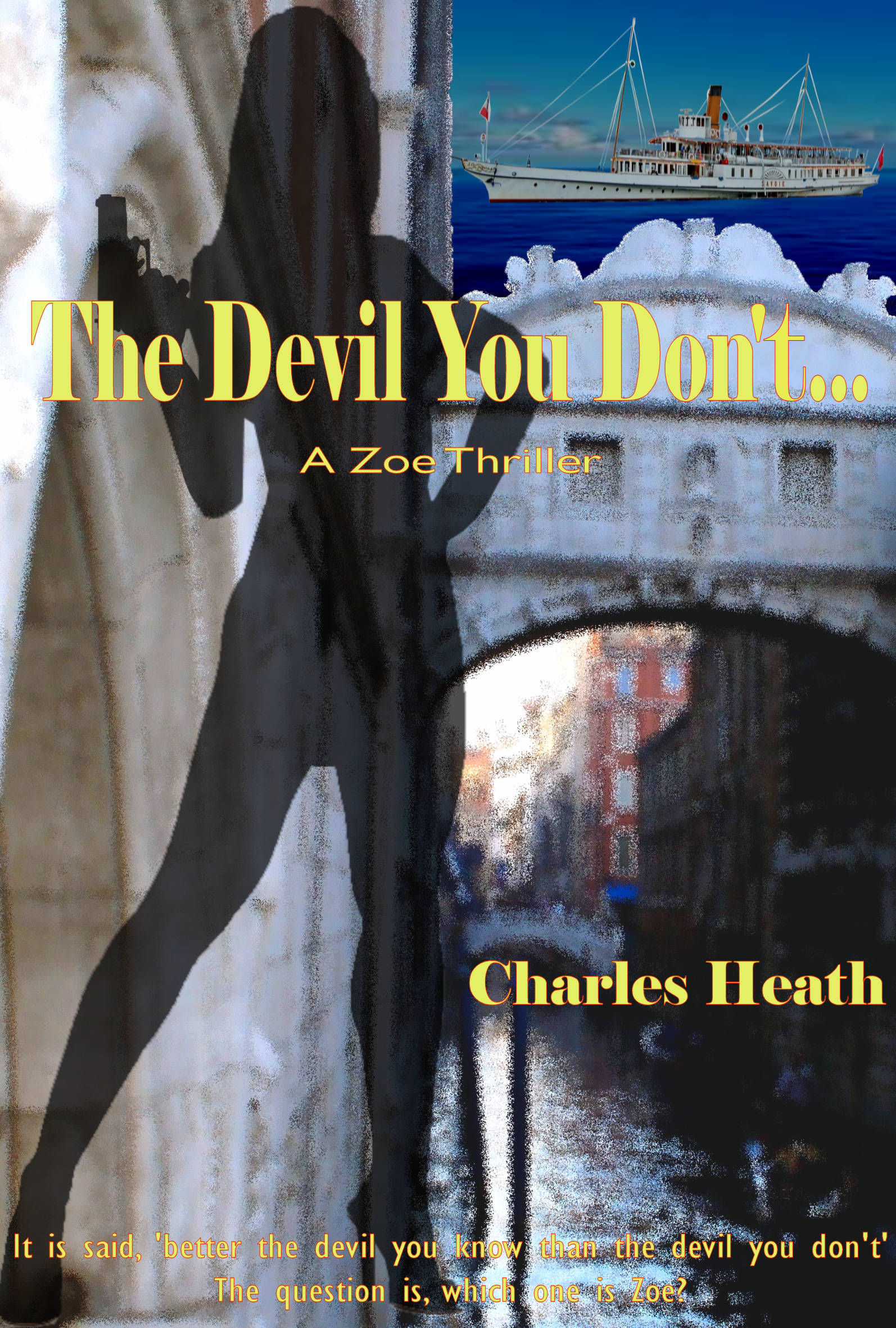
“The Devil You Don’t” – A beta readers view

It could be said that of all the women one could meet, whether contrived or by sheer luck, what are the odds it would turn out to be the woman who was being paid a very large sum to kill you.

John Pennington is a man who may be lucky in business, but not so lucky in love. He has just broken up with Phillipa Sternhaven, the woman he thought was the one, but relatives and circumstances, and perhaps because she was a ‘princess’, may also have contributed to the end result.

So, what do you do when you are heartbroken?

That is a story that slowly unfolds, from the first meeting with his nemesis on Lake Geneva, all the way to a hotel room in Sorrento, where he learns the shattering truth.

What should have been a high turns out to be something else entirely, and from that point every thing goes to hell in a handbasket.

He suddenly realises his so-called friend Sebastian has not exactly told him the truth about a small job he asked him to do, the woman he is falling in love with is not quite who she says she is, and he is caught in the middle of a war between two men who consider people becoming collateral damage as part of their business.

The story paints the characters cleverly displaying all their flaws and weaknesses. The locations add to the story at times taking me back down memory lane, especially to Venice where in those back streets I confess it’s not all that hard to get lost.

All in all a thoroughly entertaining story with, for once, a satisfying end.

Available on Amazon here: https://amzn.to/2Xyh1ow

The cinema of my dreams – Was it just another surveillance job – Episode 4

I didn’t get the last part of the opening sequence sorted until after we arrived in Vancouver.  I made a start on it before breakfast was served, though it was rather odd calling it breakfast when outside the plane it was nearly six in the afternoon.

In finishing it much later, I think I’ve come up with a different direction to the one I planned, but in truth, I was never happy with where it was going from the start.

That’s why I prefer to plot on the run so that it doesn’t necessarily get bogged down with a certain result in mind.  For me, that is the biggest bugbear is writing to a plan.  For some, though, I’m sure it works.  For me, not so much.

So, what happened to the rest of the team?


Just in case I’d made a mistake, I kept one eye on the target, who seemed to be consumed by the events unfolding, and another taking a wider search of the surrounding area to make doubly sure the team was still in control of the mission.

They were not.

A hundred yards back in the direction I’d first seen the target heading when the explosion took me out of play, I found one of the team, Jack, a relatively new member of the surveillance division, roughly hidden behind a dumpster, dead, a victim of a clean, accurate, and methodical stab wound to the heart.  No noise from the weapon, or the victim.

The target knew we were onto him.  It also meant that it was likely the other two members of the team were also out of play, I preferred not to think they might be equally dead, and I didn’t think the chances were good that he might not know about me.

It wasn’t a good sign that he had come back to the site of the explosion because I doubted someone of his stature had time to stand around and watch a search and rescue.

And if he was looking for me I had to make sure he didn’t find me.  Good thing then it was exactly what I was thinking when he turned and started to scan the outer perimeter, as I had, and just managed to miss his gaze in my direction.

Yes, he was definitely looking for me, so it was a good bet he had tortured one of the others to get the information he needed.

All the more reason for me to take him down.

I moved closer, all the time keeping him under surveillance and avoiding his searching eyes. 

Then, satisfied I was not at this location, he started moving to the next, before I’d last seen him in the distance.  It was the epicentre of the explosion and the one where there was a high concentration of police and rescue workers.

He stopped.  I used the cover of the confusion, and in a way, a very efficient organization, to move closer.

I saw him take another look around, perhaps he suspected I might be near, then again satisfied, moved on.

It was clear I was not going to be able to take him on while we were in the immediate vicinity of the explosion, there were too many witnesses.  Perhaps he was hoping that the abundance of cover would aid his mission.

He stopped again, among a smaller group of observers, and checked both sides of the line.  From there he had two choices, to consider if I had retraced my steps, or gone ahead thinking I might catch up to him.  Obviously, he’d realized I’d not kept up, and it had been due to the explosion.

Just as he was about to see me on another sweep, a minor explosion of sorts came from the main disaster site, what sounded like part of the structure collapsing, which explained dust rising into the air, and when my attention returned to the spot I’d last seen him, he was gone.

Not a good sign.  He could be anywhere.

But he wasn’t just anywhere.

“Sam?”

It was an unfamiliar voice, not expected, but I’d been more or less wary from the moment I lost sight of him.  And because I had been alert, it saved me from a far worse injury.  I felt the knife thrust through the fleshy part of my side and caught him with my elbow to the side of his head which sent him sprawling and knocking the knife out of his hand and sliding into the area where three bystanders were.

The scuffled turned their attention to him first on the ground, and then hastily getting to his feet and running away, leaving the weapon behind and me chasing after him.

No one said a word.

And this time he didn’t have a very big break on me and driven by rage at what he had done to the members of my team, it didn’t take long to catch up, in a place where we were alone.

In those few steps I’d made up my mind, he was not going to walk away from this.


So, is revenge on the menu, or something else?


©  Charles Heath 2019


An excerpt from “What Sets Us Apart”, a mystery with a twist

See the excerpt from the story below, just a taste of what’s in store…

http://amzn.to/2Eryfth

whatsetscover

McCallister was old school, a man who would most likely fit in perfectly campaigning on the battlefields of Europe during the Second World War. He’d been like a fish out of water in the army, post-Falklands, and while he retired a hero, he still felt he’d more to give.

He’d applied and was accepted as head of a SWAT team, and, watching him now as he and his men disembarked from the truck in almost military precision, a look passed between Annette, the police liaison officer, and I that said she’d seen it all before. I know I had.

There was a one in four chance his team would be selected for this operation, and she had been hoping it would be one of the other three. While waiting for them to arrive she filled me in on the various teams. His was the least co-operative, and the more likely to make ad-hoc decisions rather than adhere to the plan, or any orders that may come from the officer in charge.

This, she said quite bluntly, was going to end badly.

I still had no idea why Prendergast instructed me to attend the scene of what looked to be a normal domestic operation, but as the nominated expert in the field in these types of situations, it was fairly clear he wasn’t taking any chances. It was always a matter of opinion between us, and generally I lost.

In this case, it was an anonymous report identifying what the authorities believed were explosives in one of the dockside sheds where explosives were not supposed to be.

The only reason why the report was given any credence was the man, while not identifying himself by name, said he’d been an explosive expert once and recognized the boxes. That could mean anything, but the Chief Constable was a cautious man.

With his men settled and preparing their weapons, McCallister came over to the command post, not much more than the SUV my liaison and I arrived in, with weapons, bulletproof vests, and rolls of tape to cordon off the area afterward. We both had coffee, steaming in the cold early morning air. Dawn was slowly approaching and although rain had been forecast it had yet to arrive.

A man by the name of Benson was in charge. He too had groaned when he saw McCallister.

“A fine morning for it.” McCallister was the only enthusiastic one here.

He didn’t say what ‘it’ was, but I thought it might eventually be mayhem.

“Let’s hope the rain stays away. It’s going to be difficult enough without it,” Benson said, rubbing his hands together. We had been waiting for the SWAT team to arrive, and another team to take up their position under the wharf, and who was in the final stages of securing their position.

While we were waiting we drew up the plan. I’d go in first to check on what we were dealing with, and what type of explosives. The SWAT team, in the meantime, were to ensure all the exits to the shed were covered. When I gave the signal, they were to enter and secure the building. We were not expecting anyone inside or out, and no movement had been detected in the last hour since our arrival and deployment.

“What’s the current situation?”

“I’ve got eyes on the building, and a team coming in from the waterside, underneath. Its slow progress, but they’re nearly there. Once they’re in place, we’re sending McKenzie in.”

He looked in my direction.

“With due respect sir, shouldn’t it be one of us?” McCallister glared at me with the contempt that only a decorated military officer could.

“No. I have orders from above, much higher than I care to argue with, so, McCallister, no gung-ho heroics for the moment. Just be ready to move on my command, and make sure you have three teams at the exit points, ready to secure the building.”

McCallister opened his mouth, no doubt to question those orders, but instead closed it again. “Yes sir,” he muttered and turned away heading back to his men.

“You’re not going to have much time before he storms the battlements,” Benson quietly said to me, a hint of exasperation in his tone. “I’m dreading the paperwork.”

It was exactly what my liaison officer said when she saw McCallister arriving.

The water team sent their ‘in position’ signal, and we were ready to go.

In the hour or so we’d been on site nothing had stirred, no arrivals, no departures, and no sign anyone was inside, but that didn’t mean we were alone. Nor did it mean I was going to walk in and see immediately what was going on. If it was a cache of explosives then it was possible the building was booby-trapped in any number of ways, there could be sentries or guards, and they had eyes on us, or it might be a false alarm.

I was hoping for the latter.

I put on the bulletproof vest, thinking it was a poor substitute for full battle armor against an exploding bomb, but we were still treating this as a ‘suspected’ case. I noticed my liaison officer was pulling on her bulletproof vest too.

“You don’t have to go. This is my party, not yours,” I said.

“The Chief Constable told me to stick to you like glue, sir.”

I looked at Benson. “Talk some sense into her please, this is not a kindergarten outing.”

He shrugged. Seeing McCallister had taken all the fight out of him. “Orders are orders. If that’s what the Chief Constable requested …”

Madness. I glared at her, and she gave me a wan smile. “Stay behind me then, and don’t do anything stupid.”

“Believe me, I won’t be.” She pulled out and checked her weapon, chambering the first round. It made a reassuring sound.

Suited up, weapons readied, a last sip of the coffee in a stomach that was already churning from nerves and tension, I looked at the target, one hundred yards distant and thought it was going to be the longest hundred yards I’d ever traversed. At least for this week.

A swirling mist rolled in and caused a slight change in plans.

Because the front of the buildings was constantly illuminated by large overhead arc lamps, my intention had been to approach the building from the rear where there was less light and more cover. Despite the lack of movement, if there were explosives in that building, there’d be ‘enemy’ surveillance somewhere, and, after making that assumption, I believed it was going to be easier and less noticeable to use the darkness as a cover.

It was a result of the consultation, and studying the plans of the warehouse, plans that showed three entrances, the main front hangar type doors, a side entrance for truck entry and exit and a small door in the rear, at the end of an internal passage leading to several offices. I also assumed it was the exit used when smokers needed a break. Our entry would be by the rear door or failing that, the side entrance where a door was built into the larger sliding doors. In both cases, the locks would not present a problem.

The change in the weather made the approach shorter, and given the density of the mist now turning into a fog, we were able to approach by the front, hugging the walls, and moving quickly while there was cover. I could feel the dampness of the mist and shivered more than once.

It was nerves more than the cold.

I could also feel rather than see the presence of Annette behind me, and once felt her breath on my neck when we stopped for a quick reconnaissance.

It was the same for McCallister’s men. I could feel them following us, quickly and quietly, and expected, if I turned around, to see him breathing down my neck too.

It added to the tension.

My plan was still to enter by the back door.

We slipped up the alley between the two sheds to the rear corner and stopped. I heard a noise coming from the rear of the building, and the light tap on the shoulder told me Annette had heard it too. I put my hand up to signal her to wait, and as a swirl of mist rolled in, I slipped around the corner heading towards where I’d last seen the glow of a cigarette.

The mist cleared, and we saw each other at the same time. He was a bearded man in battle fatigues, not the average dockside security guard.

He was quick, but my slight element of surprise was his undoing, and he was down and unconscious in less than a few seconds with barely a sound beyond the body hitting the ground. Zip ties secured his hands and legs, and tape his mouth. Annette joined me a minute after securing him.

A glance at the body then me, “I can see why they, whoever they are, sent you.”

She’d asked who I worked for, and I didn’t answer. It was best she didn’t know.

“Stay behind me,” I said, more urgency in my tone. If there was one, there’d be another.

Luck was with us so far. A man outside smoking meant no booby traps on the back door, and quite possibly there’d be none inside. But it indicated there were more men inside, and if so, it appeared they were very well trained. If that were the case, they would be formidable opponents.

The fear factor increased exponentially.

I slowly opened the door and looked in. A pale light shone from within the warehouse itself, one that was not bright enough to be detected from outside. None of the offices had lights on, so it was possible they were vacant. I realized then they had blacked out the windows. Why hadn’t someone checked this?

Once inside, the door closed behind us, progress was slow and careful. She remained directly behind me, gun ready to shoot anything that moved. I had a momentary thought for McCallister and his men, securing the perimeter.

At the end of the corridor, the extent of the warehouse stretched before us. The pale lighting made it seem like a vast empty cavern, except for a long trestle table along one side, and, behind it, stacks of wooden crates, some opened. It looked like a production line.

To get to the table from where we were was a ten-yard walk in the open. There was no cover. If we stuck to the walls, there was equally no cover and a longer walk.

We needed a distraction.

As if on cue, the two main entrances disintegrated into flying shrapnel accompanied by a deafening explosion that momentarily disoriented both Annette and I. Through the smoke and dust kicked up I saw three men appear from behind the wooden crates, each with what looked like machine guns, spraying bullets in the direction of the incoming SWAT members.

They never had a chance, cut down before they made ten steps into the building.

By the time I’d recovered, my head heavy, eyes watering and ears still ringing, I took several steps towards them, managing to take down two of the gunmen but not the third.

I heard a voice, Annette’s I think, yell out, “Oh, God, he’s got a trigger,” just before another explosion, though all I remember in that split second was a bright flash, the intense heat, something very heavy smashing into my chest knocking the wind out of me, and then the sensation of flying, just before I hit the wall.

I spent four weeks in an induced coma, three months being stitched back together and another six learning to do all those basic actions everyone took for granted. It was twelve months almost to the day when I was released from the hospital, physically, except for a few alterations required after being hit by shrapnel, looking the same as I always had.

But mentally? The document I’d signed on release said it all, ‘not fit for active duty; discharged’.

It was in the name of David Cheney. For all intents and purposes, Alistair McKenzie was killed in that warehouse, and for the first time ever, an agent left the Department, the first to retire alive.

I was not sure I liked the idea of making history.

© Charles Heath 2016-2020

In a word: Prior

Of course, prior means gone before, as in past history, or perhaps only a few moments ago; it happened prior to my arrival on the scene.

But it can also mean, quite confusingly, to something in the future, when trying to get out of a meeting by saying I’ve got a prior appointment.

If you are an aficionado of American police dramas then you will be well acquainted with the prior, meaning a previous criminal conviction.


And for something quite different, a prior is a priest of sorts, who to me were named as such in the middle ages.  A prior is below an Abbot and is head of a house of friars.  By the way, the most notable friar I know is Friar Tuck

A prior could also be a magistrate in the medieval republic of Florence.


It is not to be doubly confused with Pryer or Prier

Someone who pries into another’s business, the most notable prier, the woman across the road from Samantha, in Bewitched.