The first case of PI Walthenson – “A Case of Working With the Jones Brothers”

This case has everything, red herrings, jealous brothers, femme fatales, and at the heart of it all, greed.

See below for an excerpt from the book…

Coming soon!

PIWalthJones1

An excerpt from the book:

When Harry took the time to consider his position, a rather uncomfortable position at that, he concluded that he was somehow involved in another case that meant very little to him.

Not that it wasn’t important in some way he was yet to determine, it was just that his curiosity had got the better of him, and it had led to this: sitting in a chair, securely bound, waiting for someone one of his captors had called Doug.

It was not the name that worried him so much, it was the evil laugh that had come after the name was spoken.

Doug what? Doug the ‘destroyer’, Doug the ‘dangerous’, Doug the ‘deadly’; there was any number of sinister connotations, and perhaps that was the point of the laugh, to make it more frightening than it was.

But there was no doubt about one thing in his mind right then: he’d made a mistake. A very big. and costly, mistake. Just how big the cost, no doubt he would soon find out.

His mother, and his grandmother, the wisest person he had ever known, had once told him never to eavesdrop.

At the time he couldn’t help himself and instead of minding his own business, listening to a one-sided conversation which ended with a time and a place. The very nature of the person receiving the call was, at the very least, sinister, and, because of the cryptic conversation, there appeared to be, or at least to Harry, criminal activity involved.

For several days he had wrestled with the thought of whether he should go. Stay on the fringe, keep out of sight, observe and report to the police if it was a crime. Instead, he had willingly gone down the rabbit hole.

Now, sitting in an uncomfortable chair, several heat lamps hanging over his head, he was perspiring, and if perspiration could be used as a measure of fear, then Harry’s fear was at the highest level.

Another runnel of sweat rolled into his left eye, and, having his hands tied, literally, it made it impossible to clear it. The burning sensation momentarily took his mind off his predicament. He cursed and then shook his head trying to prevent a re-occurrence. It was to no avail.

Let the stinging sensation be a reminder of what was right and what was wrong.

It was obvious that it was the right place and the right time, but in considering his current perilous situation, it definitely was the wrong place to be, at the worst possible time.

It was meant to be his escape, an escape from the generations of lawyers, what were to Harry, dry, dusty men who had been in business since George Washington said to the first Walthenson to step foot on American soil, ‘Why don’t you become a lawyer?” when asked what he could do for the great man.

Or so it was handed down as lore, though Harry didn’t think Washington meant it literally, the Walthenson’s, then as now, were not shy of taking advice.

Except, of course, when it came to Harry.

He was, Harry’s father was prone to saying, the exception to every rule. Harry guessed his father was referring to the fact his son wanted to be a Private Detective rather than a dry, dusty lawyer. Just the clothes were enough to turn Harry off the profession.

So, with a little of the money Harry inherited from one of his aunts, he leased an office in Gramercy Park and had it renovated to look like the Sam Spade detective agency, you know the one, Spade and Archer, and The Maltese Falcon.

There’s a movie and a book by Dashiell Hammett if you’re interested.

So, there it was, painted on the opaque glass inset of the front door, ‘Harold Walthenson, Private Detective’.

There was enough money to hire an assistant, and it took a week before the right person came along, or, more to the point, didn’t just see his business plan as something sinister. Ellen, a tall cool woman in a long black dress, or so the words of a song in his head told him, fitted in perfectly.

She’d seen the movie, but she said with a grin, Harry was no Humphrey Bogart.

Of course not, he said, he didn’t smoke.

Three months on the job, and it had been a few calls, no ‘real’ cases, nothing but missing animals, and other miscellaneous items. What he really wanted was a missing person. Or perhaps a beguiling, sophisticated woman who was as deadly as she was charming, looking for an errant husband, perhaps one that she had already ‘dispatched’.

Or for a tall, dark and handsome foreigner who spoke in riddles and in heavily accented English, a spy, or perhaps an assassin, in town to take out the mayor. The man was such an imbecile Harry had considered doing it himself.

Now, in a back room of a disused warehouse, that wishful thinking might be just about to come to a very abrupt end, with none of the romanticized trappings of the business befalling him. No beguiling women, no sinister criminals, no stupid policemen.

Just a nasty little man whose only concern was how quickly or how slowly Harry’s end was going to be.

© Charles Heath 2019

In a word: Piece

Aside from the fact that it really means part of something else, we’ve got to remember that it is one of those ‘i before e except after c’ things.

I have a piece of the puzzle.  Well, maybe not.  You know what it’s like when you’re assembling a 1,000 piece jigsaw puzzle.  Yes, you get to the end and one piece is missing.

You’re so angry you want to give someone a piece of your mind.

Just remember not to give too many people pieces or you will become mindless.

We might be listening to a musical piece, which can be a movement, I think, in a symphony

Or we might piece together the parts of a child’s toy, especially on that night before Christmas when everything can and will go wrong.  I’ve been there and done that far too many times.

I’ve been known to move a chess piece incorrectly, no, come think of it, I’m always doing that

Some people call a gun a piece.

This is not to be confused with the word peace, which means something else, and hopefully, everyone will put away their pieces (guns) and declare peace.

And, every Sunday, at the church, there’s always an opportunity to say to the people around you ‘peace be with you’.

I wonder if that works very well if the person standing next to you is your enemy?

“One Last Look”, nothing is what it seems

A single event can have enormous consequences.

A single event driven by fate, after Ben told his wife Charlotte he would be late home one night, he left early, and by chance discovers his wife having dinner in their favourite restaurant with another man.

A single event where it could be said Ben was in the wrong place at the wrong time.

Who was this man? Why was she having dinner with him?

A simple truth to explain the single event was all Ben required. Instead, Charlotte told him a lie.

A single event that forces Ben to question everything he thought he knew about his wife, and the people who are around her.

After a near-death experience and forced retirement into a world he is unfamiliar with, Ben finds himself once again drawn back into that life of lies, violence, and intrigue.

From London to a small village in Tuscany, little by little Ben discovers who the woman he married is, and the real reason why fate had brought them together.

It is available on Amazon here:  http://amzn.to/2CqUBcz

The cinema of my dreams – I always wanted to write a war story – Episode 46

For a story that was conceived during those long boring hours flying in a steel cocoon, striving to keep away the thoughts that the plane and everyone in it could just simply disappear as planes have in the past, it has come a long way.

Whilst I have always had a fascination with what happened during the second world war, not the battles or fighting, but in the more obscure events that took place, I decided to pen my own little sidebar to what was a long and bitter war.

And, so, it continues…

——

When Carlo heard the shot, he stopped his ‘interrogation’ and sent a soldier over to investigate.  To avoid getting shot inadvertently, I came out of the woods with my hands up, and, thankfully, was instantly recognized.

I went over to the barn and looked at the man on the ground.  “Do he have anything to say?”

“No.”

The other man, awaiting ‘interrogation’ was visibly shaken by the events.  Two dead including Leonardo, and one a bloody pulp on the ground, with a very angry Carlo standing over him, his outlook was very bleak.

“You speak English,” I asked him.

“Yes.”

“Who are you?”

“Alberto, sir.  I didn’t agree with anything Fernando did.  A few of us refused to kill any of the villagers.  That was Fernando.  He was the one who beat up the women.”

“You could have stopped him.”

“You know the bastard, Carlo.  Not even you could, and you tried.”

Carlo grunted.  To make sure the men on the ground were dead, he shot them again, and emptied his gun into Fernando, adding a curse with each bullet.

I glared at Alberto.  “Pick a side.”

“I’m with you.  There are several others, back in the castle.  We would be able to help if you were planning an attack.”

“The last person who told me that is out there in the woods with a bullet in his head.  I’m sorry, but I don’t believe you.”

“We can help.”

“And, you will.  When we decide to go, we’ll take you with us.  You double-cross us, the Carlo gets his five minutes.  You try to run away, Carlo will hunt you down and kill you.  Understood?”

He nodded.

“Fernando?”  The man sent to find the defectors had come back.

I shot him before he could make any sort of move, just as he realized what had happened.

I motioned to the soldiers to get the defectors, who, hearing the shots, had started to flee.  Two shots in the air stopped them.  Two of them were small children, who would not have survived if they’d been taken to the castle.

All four were visibly frightened by what they’d seen, and of what their fate might be.  I assured them, they were now in safe hands, and we were going not to the castle, but to a different place.  Desperate people in a desperate situation, I couldn’t imagine where they’d come from, or their journey from Germany with nothing on a promise of safety taken at face value.

“We go to the castle now,” Carlo asked.

“Soon.  We need a plan.  Let’s go back and make one.  But, yes.  We go to the castle now.”

Storming the castle might have worked if I had a hundred men, not about ten. Granted Carlo would be the equivalent of another five, but in a hail of bullets, he would not last long.

I had to put myself in Wallace’s shoes and figure out how he would defend the castle once he realized Jackerby and the resistance members were dead.

Panic would be my first thought.  Then, when rational thought returned, block off all the known entrances and exits, and post sentries outside.  We had about twenty men to deal with, but a dozen were hardened battle soldiers, and that would make a difference.  The fact they were inside covering most of the entrance points would make the job harder.

If we had to use the known entrances.

When the time came, they were going to get a surprise because Carlo knew of two others no one but he, and the owners of the castle, were the only ones who knew about them.

But, first, we had to even the odds if possible.

For that, one of Blinky’s team was a sniper, and with him was a sniper rifle and suppressor which meant we would be able to pick off the sentries without anyone hearing the bullets coming for them.

We were only going to get one shot at it because once Wallace discovered the sentries, he wouldn’t post anymore, and would know of our intent.

But, in the end, none of that mattered. 

We just got a short communication that Meyer was in Florence and his arrival would be in two days’ time.  We were charged with making sure he arrived safely and passed into the pipeline.  The only issue with that was that we needed the castle to complete the process.

That meant we had to move up the plans  to retake the castle, and there were always problems when details were missed.  We had the advantage in our knowledge of the castle and its underground passageways, but would that be enough?

Then there was the surprise.  It had just been learned that a very high-ranking Nazi officer was coming to the castle to personally take Meyer back to the fatherland.  That meant we had to be in the castle when he arrived, so he could be sent back home for interrogation.

Both men, it appeared, had the capacity to turn the tide of the war in our favour.

Blinky simply shrugged when he got the news, then said, “We could do with some more men.”

Stating the obvious.

“It’s the war, you know.  Shortages of everything.”

“Didn’t envisage this at Prep school, did we?  Seems the world was a different place, but my father said it couldn’t last.”

“Nothing ever does.  It’s going to be interesting when this ends if it ends.  There are days I wake up and I can’t remember what it was like, before all this.”

”Well, maybe we get this done, and it’ll be a step closer.  At least, we have to believe that.”

I nodded.  “Good pep talk.  As I remember, you were always trying to talk me into doing something stupid.”

Carlo had been listening to us was a puzzled look.  “Are all you English like you two?”

Blinky answered.  “No.  We’re unique.”

Clearly, he had no idea what that meant.  Blinky was going to try and explain but instead, shrugged.  “Let’s go kill some Germans.”

That Carlo did understand.

——-

© Charles Heath 2020-2022

Writing about writing a book – Day 23

I’ve been thinking a lot about Bill’s service, and the characters he meets along the way, some of whom shape the man he became, others he remained friends with after he was discharged, and those that were killed.

Several have a direct bearing in the main story, for instance, Brainless, a rather ubiquitous nickname, given to him because of his actions, that is to say, he acts without thinking, sometimes when in great peril, a man who never quite recovered, but is, for all intents and purposes Bill’s friend and someone he feels responsible to look after, perhaps because of how many times he saved Bill from death, or worse.

There is also Manilow, but we’ll save him for later.

So, this is where ‘Brainless’ get’s his introduction:

It was the first time I’d been hit by a bullet, and it hurt.  It was a steep learning curve, realizing you have been hit, and then the brain going into overdrive to tell you first it going to hurt like hell, and then begin to assess the damage, running every scenario from ‘it’s a flesh wound’ to ‘Oh God, I’m going to die’.

At least, that was what had happened to me for my first time.

Seconds, or minutes, or hours later, a man who doubled as a Medic came scrabbling over to me and looked at the wound.  A silly thought, how did he know I’d been shot?  Had I screamed?  He made a quick assessment, told me I’d live, and dressed it as good and as quickly as he could.

There were other casualties.

I lasted until I was brought into a clearing some miles further on, after the enemy had been killed, or had retreated, and loaded onto a helicopter.  There I was told everything would be OK and then the lights went out.

My first visit to a mobile army hospital, after being hit, was a novelty.  It was nothing like a real hospital.  Nor was the staff.  It took a different sort of medical personnel to man a front-line hospital where you were just as likely to become a casualty yourself.

The doctor was quite jovial about the whole matter saying I would be back out again in no time, not exactly a prospect I was looking forward to.  It was almost a mend job without anesthetic and the memory of it remained with me for some time.  Facilities were not primitive, but they just appeared that way.

I was one of the less needy casualties that day.  After being stitched up, a nurse took me to a bed in a ward with a mixture of serious and not so seriously wounded.

The nurse, whose name was Wendy, had the same sense of humor I had.  She insisted we be on first name terms from the start.  How she kept her humor was a mystery, for most noticeable was her tired look as if she had been doing the same thing for too long.

The bed was comfortable, the temperature bearable, and the food edible.  Being, and remaining, injured had its good points.

I slept well the first night.  I presumed the injection she’d given me was to ensure I had a restful sleep.  It was long overdue and much needed.

The next morning the numbers had thinned.  Two men had died, several others returned to duty.  To my left was a sad and distant private, who, from time to time, would start moaning.  He’d been in the middle of a mortar attack and was both deaf and had serious psychological problems.

To my right, there was a large man who barely fit in the bed.  He was a perpetually unhappy person, with only minor injuries, a bullet wound to his upper leg.  Nothing serious, he said, and just wanted to leave as soon as possible.  Brainless, the nurse called him.  Always wanted to get back to the war and kill some more of the enemy.  An obsession, she said.

He was staring morosely at the ceiling when I woke.  It took a few minutes to regain full consciousness, a sign I’d been in a drugged sleep.

“What are you in for?” he asked.

“Leg wound.  Nothing serious.”  You?”

“Leg.  Bastards snuck up on me.  And the useless rearguard didn’t do his job properly.”

“Landmine?”

“Sniper.”

I’d seen both.  Tread in the wrong place, and you didn’t do it again.  Sniper’s fire came from almost anywhere, taking out soldiers and civilians indiscriminately.  You could never hear the bullet, just feel it.

“Mongrel,” I said with feeling.

“Yours?”

“Probably the same.  I didn’t see it coming.  I hate it when you can’t see the bastards.  There ought to be some law they send you a message first.  Give you a chance….”

“Chap other side killed himself.  Had enough.  It was written all over his face.  What kind of sooks are we bringing over here?”

“National service,” I said quietly.

“You?” he asked.

I could feel his contempt for ‘Nashos’ and to be glad I was not one.  “I believe I volunteered.”

He didn’t ask what I meant, and even if he had, I probably would have made up a lie.  I hardly thought if I said my father in law hated me that much he would send me here, would make any sense, particularly to this man beside me.

He snorted.  “More the fool you, then.”

We were both released on the same day.  His unit had suffered major casualties, and the story he gave me in the hospital was not quite true.  He’d gone down trying to save what men he could in an ambush.  Heroics came to mind, but his selfless actions were much more than that.  Without a unit, he joined ours.

Wendy remained in my mind for some time after that visit.  When I returned the next time, my injuries being more serious, I enquired as to her whereabouts, only to discover she was dead too, a victim of her own hand, simply because she could not cope with the death, mutilation, and waste.

There was no doubt it affected all of us in different ways.  Some didn’t like the idea of going back out into the jungle and found their own peace.  Others, like Wendy, needed something more, but all too often, no-one recognized what the solution was until it was too late.

Now that I have paved the way, I must get back to the main story and write the part where Brainless enters the picture.

© Charles Heath 2016-2020

My grandchildren have just started working

It’s hard to believe that both the 19-year-old and the 16-year-old have just got jobs and started on their path of working for the next 50 to 60 years.

They seem quite amused at the thought, and not without reason, and are not really considering the idea. Not yet, anyway.

The novelty is still quite new, and it has a sense of excitement, but this will no doubt wear off in the coming months. After all, as new workers, they only have to do between 3 and 5-hour shifts.

I guess the fact they decided to work at such a young age reminded me of my experience, way back when I was the same age.

Unlike them, who will be afforded to opportunity to remain in school to the end, Year 12, and possibly the chance to go to University, in my case we did not have the money to continue education beyond Year 10, and there was no question of ever going to University. Only the rich could afford that, and we were anything but rich.

Instead, I guess hating school helped facilitate my departure, and the notion that I would have to pay my own way forced me into working.

Of course, it helped to live in a small country town, and my father had a job that brought him in contact with everyone who was anyone and thus got offers to work in whatever profession I chose.

I ended up in the Post Office, what I considered the easiest of jobs, originally employed as a telegram delivery boy, and mail collector from the post boxes scatted about the town. As you can imagine, there were not many telegrams to deliver, so other duties included sorting mail, and then mail delivery. Yes, I became a postman!

Then, after a few months, I became the night switchboard operator, and with a host of other operators, had some of the most interesting and varied conversations imaginable.

It was a bit of a wrench when we finally moved from the country town back to the city.

When we did, my father bought a small business, and for a year or so, I became a shop assistant.

That lasted for a year or two until I was 17. Realising that a lack of education was going to make it difficult to ever get a good-paying job, I took the opportunity to go back to night school while I had the chance, and it necessitated finding another job to help pay for it.

That was packing books for a wholesale bookseller, part of a small team hidden away in the basement of a very old building. It might not be the best-paying job or the best working conditions, but I suspect it was the universe telling me something.

That job, and being surrounded by books started me off on a journey of reading and eventually writing.

“Remember that time…” – A short story

I don’t remember 40th birthday parties being all that interesting.

It was going to be a momentous year as each of our friends celebrated theirs.  We were of a group that had formed strong friendships at school, and they had lasted over the next 25 years, even when some had ventured further afield, and others had stayed at home.

I was one of those who had remained in place, as had my wife, and several of the neighbors.  I never had dreams of venturing any further than the next state, and except for a couple of years on transfer for the company I worked for, I had lived all my life in the city I was born.

The same could not be said for Janine, my wife, who once had a vision for herself, a career in law in either New York or Washington, and had ventured there after graduating law school, stayed a year, and then returned in circumstances that she had never talked about.  She had accepted my proposal, we had married, and that was that.

Twenty-five years on, there had always been that gap, that part of the story I’d never asked about and one I felt she would never talk about, and it was a small chink in what I wanted to believe was an almost perfect marriage.

But there was one small caveat she had requested, and that she had no desire to have children, or to be a mother, something she said she would be terrible at.  It didn’t bother me, one way or another, though as each of the others had children, there was a small part of me that was, for a while, envious.

Michael Urston was one of my close friends, lived across town, was also a lawyer, and a man of ambition.  He’s taken his law degree to Washington and converted it into a path to public office, and had attained the lofty position of Mayor for a number of years of our fair city, and then paradoxically didn’t run for re-election for reasons I never thought stood up.  But it had been his decision, part of the plan to retire at forty, and he’d achieved it.  Ursula, his wife, was prickly at the best of times and had always considered herself above all of us.  I guess being a prom queen had that effect on some people.  She liked to be the center of attention, and for some reason, she and Janine always managed to rub up against their respective wrong sides.

Something else I knew; he had a thing for Janine, as had several others in our group, and I could see, sometimes the looks that passed between them, and I was not sure how I felt about it.  There was never any indication of either talking it further, but there was a bond between them that sometimes I envied, especially lately when it seemed, to me, that we were drifting apart.

But tonight, it was going to be Janine’s fortieth birthday party, and there was going to be a dozen friends coming.  At the last minute, Janine had changed the venue to a restaurant rather than at our home, and that I suspected was because we lived in a magnificent house that all the others envied, and I was sure it was out of deference to them.  Buying the house had been her idea, and down through the years, as we moved into larger residences, she had been trying to shed the memories of where she had come from.

Neither of us had been from wealthy families, and I had no wealthy family connections.  I was from generations of motor mechanics, which was my first occupation in the family business, and Janine’s family were farmers, something she had no intention of becoming, hence the desire to become a lawyer.  And I didn’t think either of us had airs and graces despite what we owned or how we fitted into the local society.

Fred DeVilliers and Susan, his girlfriend of many years, they didn’t believe they needed a piece of paper to sanctify their relationship, were best friends also, though I knew Janine and Susan were not quite as friendly as it appeared.  That I noticed some years ago when both were having a heated discussion, one they thought no one was around to hear.  Their bone of contention had something to do with Michael, and I didn’t get to discover what it was.

As for the others, they joined in the conversation, ate the food, drank the wine, and then went home again.  Like me, they were not interested in politics, religion, or miscreant children’s stories.  Our get together was children free, and often about reminiscences of older and more carefree times.

Oh, and just to stir the pot a little, this day, I had tendered my resignation as CEO of the company.  It was a matter of principle, the board having decided to downsize, and shift a proportion of manufacturing offshore, a decision I knew I would have to implement if I stayed there.  When I vehemently disagreed, I was given the option to leave on mutually agreeable terms.  It was not something I could spring on Janine, but, equally, it was not something I was going to be able to hide from her.  Not for very long anyway.

She was running late at her office, and I agreed to meet her at the restaurant a half-hour before the other guests were due to arrive.  It was nothing unusual for one or other of us to be running late.

As it happened, I left the office, and the building, an hour after tendering my resignation.  The company didn’t want me hanging around and granted me the two weeks I’d normally have to work off before leaving, for security reasons.  I quit, therefore I had to leave, in case I had some desire to sabotage the company in some way.  I wouldn’t but it was standard practice, and it didn’t go unnoticed that I was escorted by security to my office to clear the desk, and then to my car.  They also gave me the car as a parting gesture.

After leaving the office I went home.

I took what amounted to over twenty year’s service in a cardboard box to my home office and dropped it in the corner.  Not much to show for it, other than a decent salary, annual bonuses when we made a profit, and quite a few shares, not that they were worth much now because of the board’s hesitation to embrace new technologies.

About two hours later I heard a car pull up out the front on the driveway, and two doors close.  A look out the window that overlooked the driveway showed it was Janine and Michael, who as the approached the door were in animated conversation.

I thought about letting them know I was home, but then a voice inside my head said how many men have come home during the day to surprise his wife and found her in bed with another man, or, in these rather liberated days, in bed with another woman?

And that think between them, would it be now I would discover what it was?

It made me feel rather horrible to think I could suspect her of cheating, but it momentarily took away the sting of the resignation.

The door opened and they came inside.  I could just see them from where I was standing, a spot that they would not see me, not unless they were looking.  And my heart missed a beat, they were embraced very passionately, leave me with no other conclusion than this was a middle of the day tryst.

“Come,” she said, taking him by the hand.  “I only have a couple of hours before I have to get back for a deposition.”

With that, they went up the stairs and disappeared into the bedroom, our room.

I sat down before I fell down, then having regained some composure, went over to the bar and poured myself a drink.

Two losses in one day.  A job, and a wife.  I guess it wasn’t exactly a revelation.  I knew something was amiss, and I conveniently ignored all the signs.  I thought about going up and walking in on them, but that, to me, seemed like a childish act.  After a few more drinks, I decided to wait, see if they both left, and then decide what to do.

The front door closing, and the car departing, woke me out of a reverie.  I got up and looked out, expecting to see an empty foyer, but instead saw Janine, in a dressing gown, still holding the front door handle, as if transfixed.  A beautiful memory of what had just happened, or a tinge of regret, and another secret to be kept in a head, I knew now, held so many others.

I decided to make myself known, now rather than later.

“Do you come home often during the day,” I said, standing in the doorway where she could see me.

She jumped, perhaps in fright, or in guilt, it didn’t really matter.

She turned.  “Daniel.  What are you doing here?”

“I resigned this morning.  A difference in opinion on how the company should proceed.  I was escorted out, and decided to come home.  I should have gone to a bar.”

She knew that I knew, so it would be interesting to see what she had to say.  I could see her forming the words in her head, much the same as she did in a court of law.

“It was the first time, Daniel, an impulse.  I’m not going to make an excuse.  It’s on me.  I wanted to find out what it would be like.”

And that made me feel so much better.

“Well, it’s a hell of a fortieth birthday gift, Jan, and one I guess I couldn’t give you.  I trust you didn’t grant that wish to any of the other men who may desire you?”  OK, that wasn’t exactly what I meant to say, but the words didn’t exactly match what I was thinking.

“You mean do I sleep with every man I have a desire to?”  A rather harsh tone, bordering on angry.  She was angry with me.

“You tell me what I’m supposed to think.”

“I had sex with one other man, no one else, since the day we were married.  It was a mistake, and I’m sorry.  If you hadn’t been here, we wouldn’t be having this conversation.”

“Washington,” I said, almost to myself, a light bulb lighting up in my head.

The memory of a distant conversation, on a holiday, when we visited Washington, Philadelphia and New York.

“What about Washington?”  A change in her expression, slight, but I could see it.  She remembered it too.

“Remember that time, at one of those monuments, probably Jefferson’s, when you said something rather odd, and when I asked, you brushed it off as nothing important.  You were looking out over the water and said it was one of your fondest memories after, and then stopped yourself.  Michael had just married when he moved to Washington, and you were there too, for a year.  I suspect now you and he had an affair, and it ended badly as affairs do and the woman has to leave.  There’s always been that bond between you.  Not the first time Jan.  The affair never ended.”

“It did, Daniel.  Like I said, this was a mistake.  It won’t happen again.”

I stepped out of the office and walked down the passage and come out into the foyer.  Two stories high, it had been a debate whether to have a fountain in the space adjacent to the stairs or a statue.  The statue won, I lost.

Close up, I looked at the woman I’d loved from the moment I first saw her, and of the surprise when she agreed to marry me.  I had no idea then I was her second choice.

“I’d say I’m on a roll.  Lost my job, then lost my wife.  Bad luck comes in threes, so I’m going to lose something else.”  I looked around.  “This house?  I don’t think I could stay here, not now.  It would just be a reminder of everything bad that’s happened to me today.”

“It doesn’t have to be that way.  I told you it was a mistake.  I made my choice twenty odd years ago and it hasn’t changed.”

She took a step towards me, and I took one back.  The thought of being close to her now, after what she had just done, didn’t feel right.

“Look, before you do something silly, let’s sit down and talk about it.”

“No.  There’s nothing really to talk about.  I’m sure you can come up with a very convincing argument that will justify everything you’ve done, and why I’m being a fool, but the truth is, there are no words that can justify what you just did.  Yes, I could forgive you, and believe me, I want to, but there’d always be some resentment and the fact I could never trust you again, even if you promise not to.  What’s done is done.   Have a great birthday, and party, and make up some excuse for me not being there, but I’m going away for a while.  You have got everything you ever wanted Jan.  Be grateful for that.”

With that, I turned and headed for the door that led to the garage.  I wasn’t going to leave by the front door.  I expected her to say something, but she didn’t.  I expected a reaction, but there was none.  What choice did I have?

In the car, I found myself heading for the airport.  I couldn’t go to my parents, they were dead.  My sister lived on the other side of the country, and all I would get from her if I told her what happened would be an I told you so, so it was down to my brother, who had moved to the UK to get away from everyone.  I called him, and when he answered, I simply said, “I’m coming to see you for a while.”

And he replied, “It was Washington, wasn’t it?”

He’d know who she was, and who Michael was when he saw them together all those years ago.  And tried to warn me before I married her.

What was it with politicians and women?

—–

© Charles Heath 2020-2021
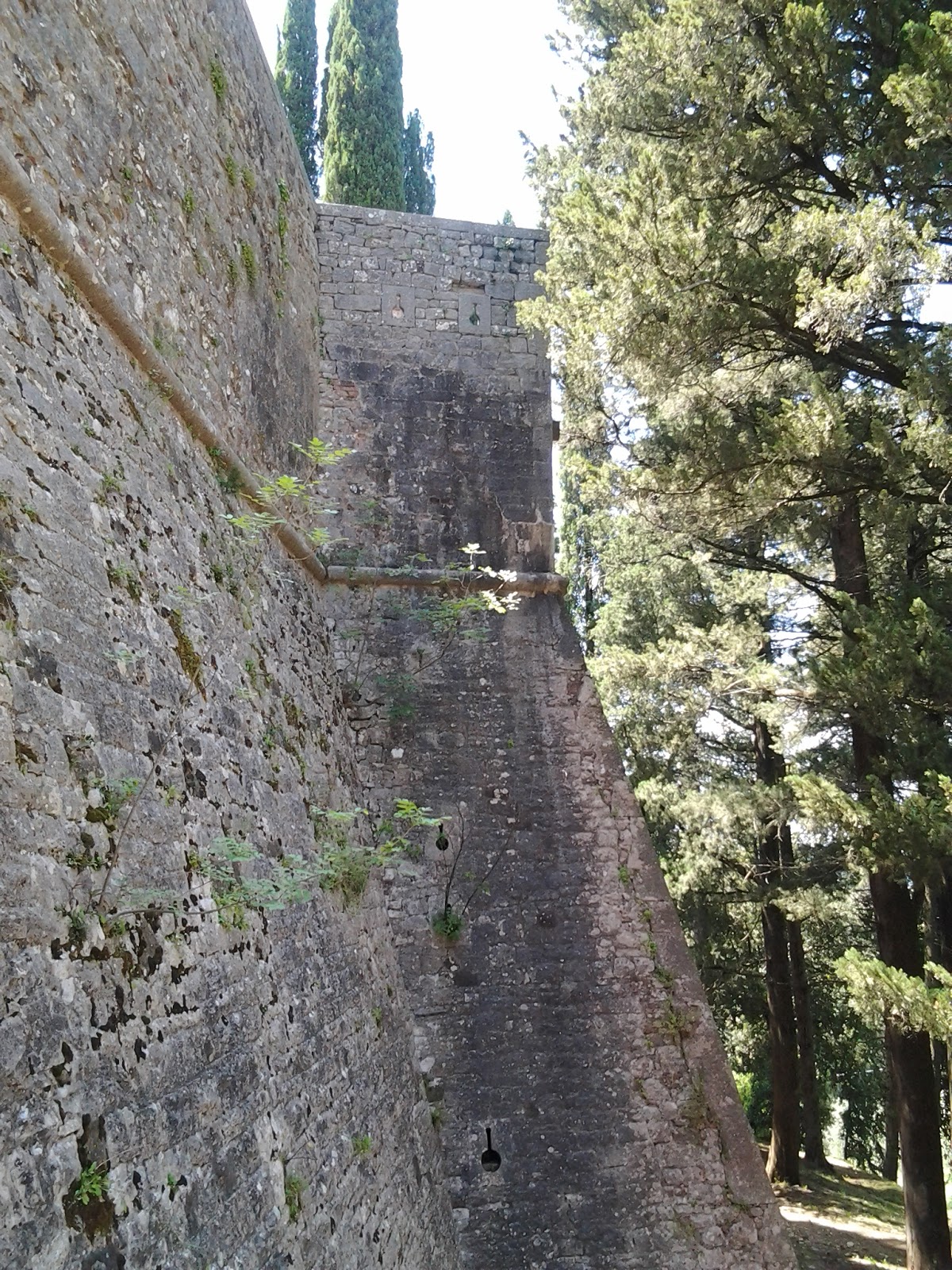
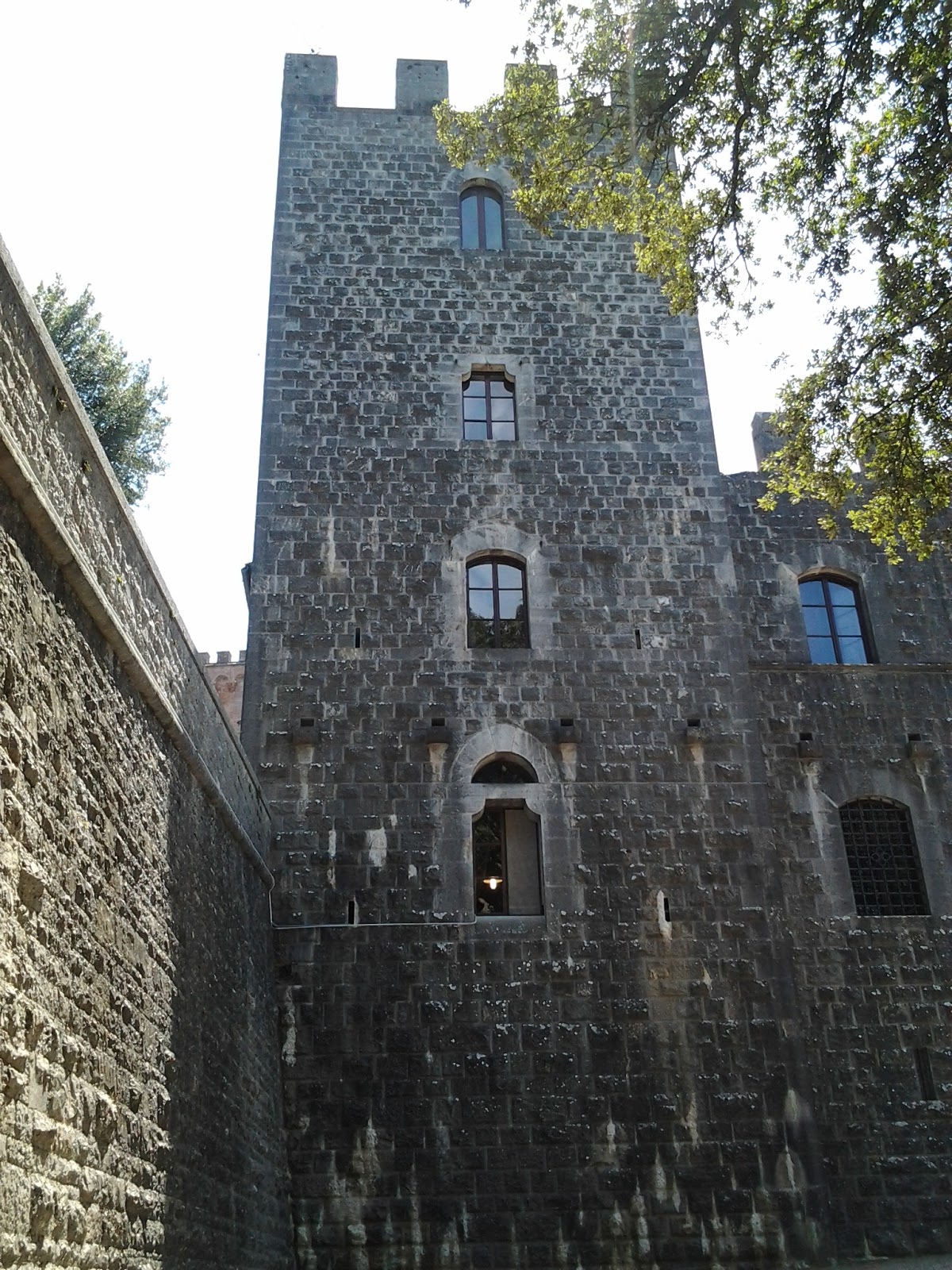
Searching for locations: The Castello di Brolio, Gaiole in Chianti, Tuscany, Italy

The castle is located in the southern Chianti Classico countryside and has been there for over ten centuries, and owned by the Ricasoli family since 1141.

Like any good castle, it has strong defences, and I was looking for a moat and drawbridge, but it looks like the moat has become a lawn.

The very high walls in places no doubt were built to keep the enemy out

The castle has been destroyed and rebuilt many times over the last 900 years.  It was part of the Florentine defences, and withstood, and succumbed to many battles with Siena, which is only 20 km away.  More recently, it still bears the scars of artillery fire and bombing in WW2.

The room at the top of this tower would have an excellent view of the countryside.

Here you can see the old and the new, the red brick part of the rebuilding in the 1800’s in the style of an English Manor

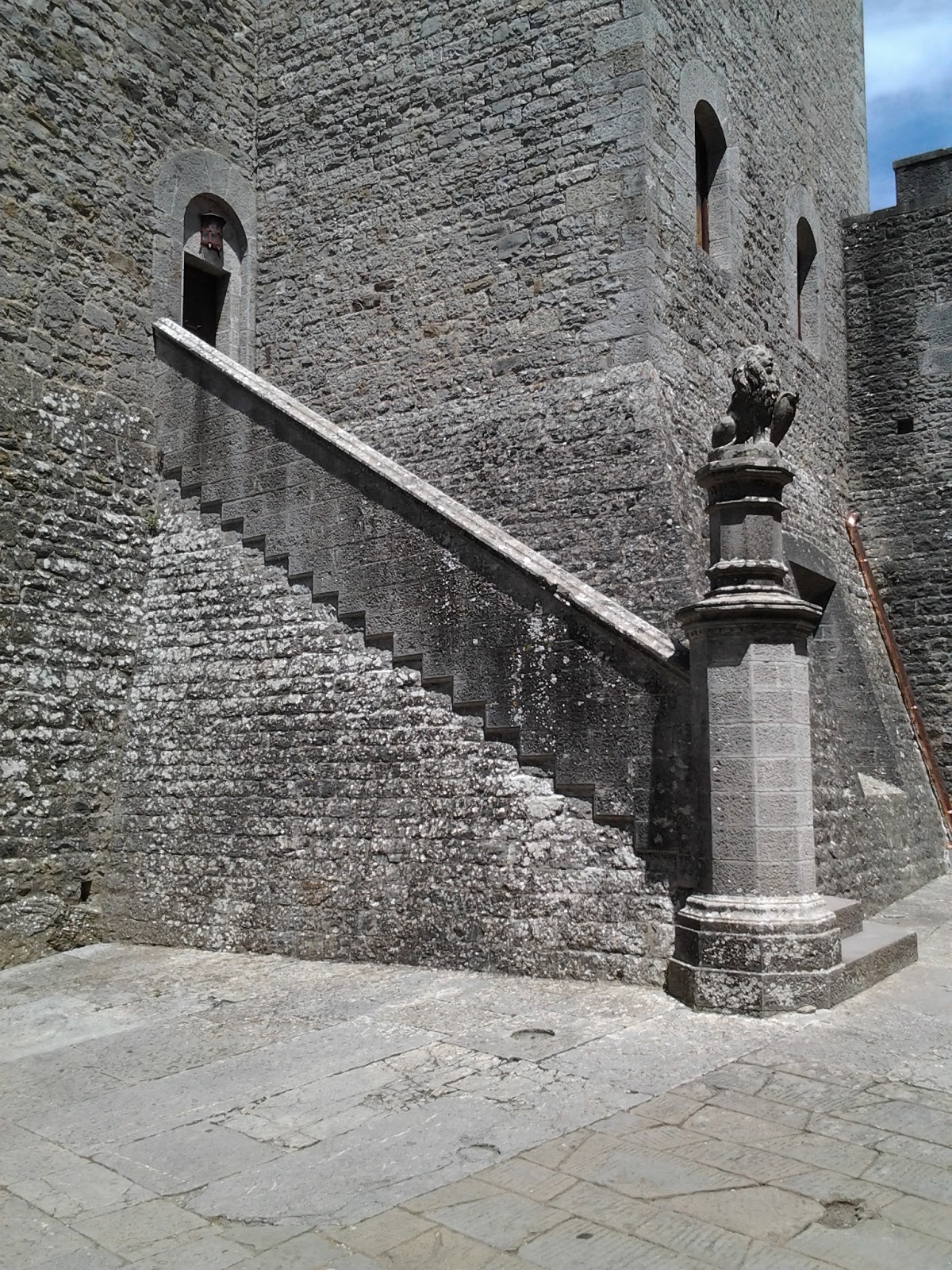
We did not get to see where that archway led.

Nor what was behind door number one at the top of these stairs.  Rest assured, many, many years ago someone wearing armour would have made the climb.   It would not pass current occupational health and safety these days with a number of stairs before a landing.

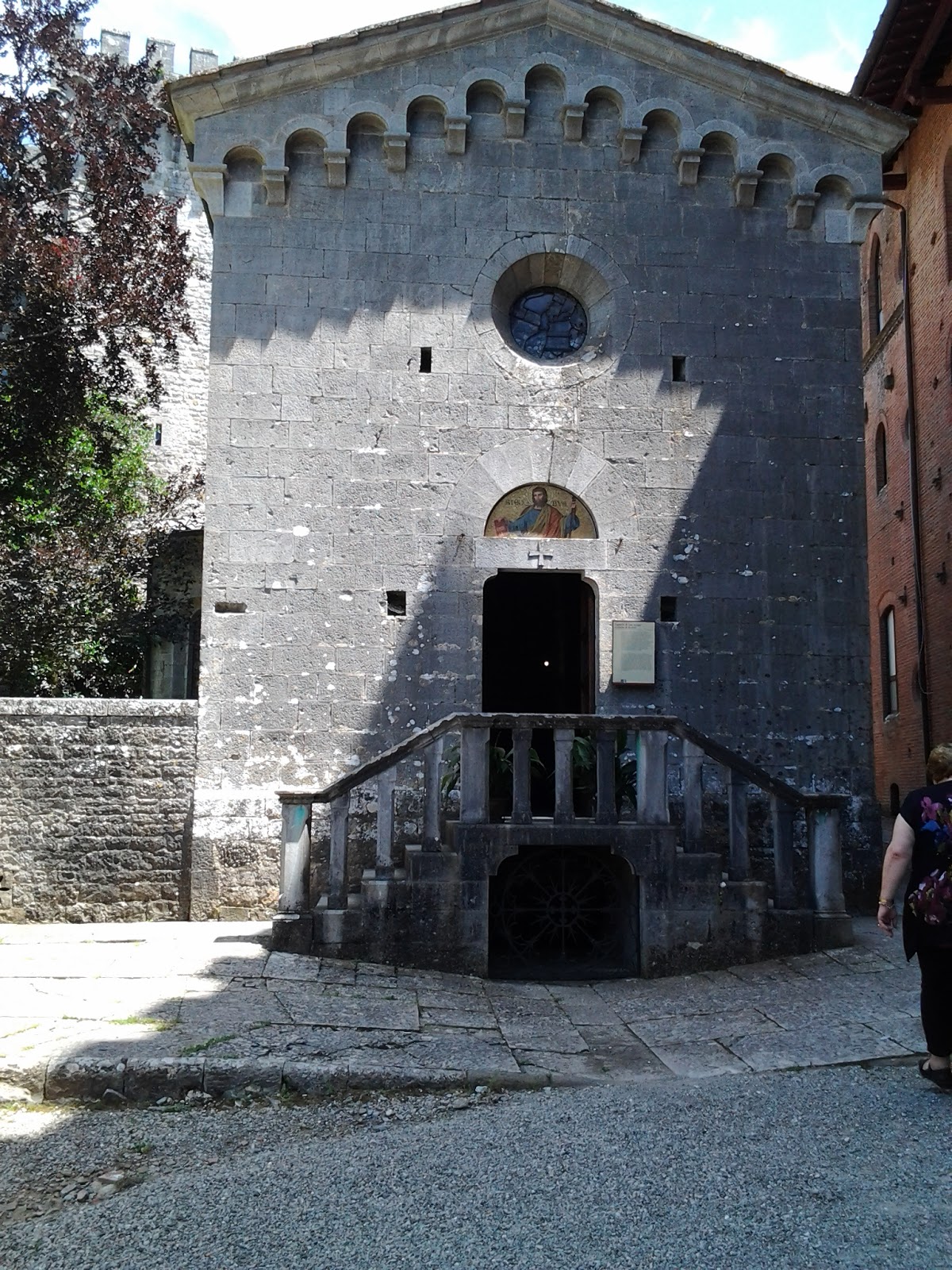
Cappella di San Jacopo.  Its foundations were laid in 1348.

Renovated in 1867-1869, it has a gabled façade preceded by a double stone staircase.  The interior, with a crypt where the members of the Ricasoli family are buried, has a nave divided into three spans with cross vaults.

The 1,200 hectares of the property include 240 hectares of vineyards and 26 of olive groves, in the commune of Gaiole.

Sayings: Irons in the fire

There is an expression you hear a lot, here, there, and everywhere when referring to someone who is very busy, ‘oh, he has a lot of irons in the fire’.

These days we use it as an analogy not to have too many things on the go at the same time, and, in the end, none of them will be finished properly, or finished at all.

There are two old-time literal meanings that can apply to this analogy, the first being that in laundries, they used to have their irons in the fire, warming so that clothes could be ironed. Having too many meant sometimes one would be left too long, and end up scorching the clothes being ironed.

Hopefully, that didn’t happen to a very expensive dress!

The second meaning came from a blacksmith’s foundry where he had iron bars in the fire, heating up so that they could be worked on. Having too many in the fire at once sometimes meant that one became overheated, and ruined.

Conversely, having too many pieces of iron in the fire might cause the fire to be too cool to heat any of the metal bars.

These days, a lot of people need to have a lot of projects on the go at once, in the hope that one or more might suddenly become a winner.

Sadly, that doesn’t happen very often.

And, no, buying a lot of lottery tickets hoping one will win, that is not very likely either.

The story behind the story – Echoes from the Past

The novel ‘Echoes from the past’ started out as a short story I wrote about 30 years ago, titled ‘The birthday’.

My idea was to take a normal person out of their comfort zone and led on a short but very frightening journey to a place where a surprise birthday party had been arranged.

Thus the very large man with a scar and a red tie was created.

So was the friend with the limousine who worked as a pilot.

So were the two women, Wendy and Angelina, who were Flight Attendants that the pilot friend asked to join the conspiracy.

I was going to rework the short story, then about ten pages long, into something a little more.

And like all re-writes, especially those I have anything to do with, it turned into a novel.

There was motivation.  I had told some colleagues at the place where I worked at the time that I liked writing, and they wanted a sample.  I was going to give them the re-worked short story.  Instead, I gave them ‘Echoes from the past’

Originally it was not set anywhere in particular.

But when considering a location, I had, at the time, recently been to New York in December, and visited Brooklyn and Queens, as well as a lot of New York itself.  We were there for New Years, and it was an experience I’ll never forget.

One evening we were out late, and finished up in Brooklyn Heights, near the waterfront, and there was rain and snow, it was cold and wet, and there were apartment buildings shimmering in the street light, and I thought, this is the place where my main character will live.

It had a very spooky atmosphere, the sort where ghosts would not be unexpected.  I felt more than one shiver go up and down my spine in the few minutes I was there.

I had taken notes, as I always do, of everywhere we went so I had a ready supply of locations I could use, changing the names in some cases.

Fifth Avenue near the Rockefeller center is amazing at first light, and late at night with the Seasonal decorations and lights.

The original main character was a shy and man of few friends, hence not expecting the surprise party.  I enhanced that shyness into purposely lonely because of an issue from his past that leaves him always looking over his shoulder and ready to move on at the slightest hint of trouble.  No friends, no relationships, just a very low profile.

Then I thought, what if he breaks the cardinal rule, and begins a relationship?

But it is also as much an exploration of a damaged soul, as it is the search for a normal life, without having any idea what normal was, and how the understanding of one person can sometimes make all the difference in what we may think or feel.

And, of course, I wanted a happy ending.

Except for the bad guys.

Get it here:  https://amzn.to/2CYKxu4

newechocover5rs