The cinema of my dreams – Was it just another surveillance job – Episode 11

I’m back home and this story has been sitting on a back burner for a few months, waiting for some more to be written.

The trouble is, there are also other stories to write, and I’m not very good at prioritising.

But, here we are, a few minutes opened up and it didn’t take long to get back into the groove.

Just the person to see next


I couldn’t imagine what those details were.  But if it was a setup, it was a very elaborate one, by people who knew our systems and procedures.  Naturally, the first thought that sprang to mind, someone who was working here, or used to.

Then I had another thought, what if none of us was meant to survive the operation, and hat we had been selected specifically because we were new to field operations.  At the briefing, we had been told this was simple surveillance, observe and report, nothing more.

Usually we had one experienced member and three new team members, the experienced member was there to continue on the job training and evaluation.  What worried me was that an experienced member could be taken out apparently as easy as the others.

And my money was not on the guy I’d cornered.  Of course, I could be wrong, and no doubt circumstantial evidence would go a long way towards proving that, but in my estimation, a cornered man like he was, with a thirst and talent for killing, would not have hesitated to kill me before I’d got three words out.

I believed him.  He was scared and, now that I thought about it, confused.  That was anything but the m.o. of a conscienceless killer.

The wrinkle that hadn’t been accounted for was the explosion.  No one could have predicted that, or its effect on the operation.  It might well have saved him, except that I didn’t play by the rules and reconnected with him.  Maybe he had felt safe after taking out the others, and assuming I’d been taken down by the explosion.

Except, if I didn’t think he did the killing, who did, and why?  Severin?  Just who the hell is this Severin?  There’s been no indication he wasn’t one of us.

I was pondering that question when the woman returned and sat down again.  This time her stare wasn’t quite as glacial.

“Describe this Severin.”

She opened her notebook, and had her pencil ready.  Odd that she should be taking notes in pencil.

I described him.  Five feet eight inches tall, 250 pounds, thinning black hair, making him anywhere between 35 and 50, though I thought he was mid-forties.  He wore a tweed suit, rather an odd choice for the climate, and had the aroma of cigarette smoke hanging about him.

Every free moment I saw him, he had a cigarette, so I thought he was quite possibly a chain smoker, and from that, perhaps a man with bad nerves, or who worried a lot.  Now I knew he was not one of us, that could be interpreted as thinking he might get caught.

But he was confident, and outgoing, which meant he was quite sure he wouldn’t get caught, and that meant, quite possibly there was someone within our department that was working for or with him and had covered his comings and goings.  Either that or he had a universal passcode key to come and go as he pleased.

When I finished the description I could see a flicker of recognition.  IT was possible she knew who he might be, and if so, I was betting she knew him by another name.  I asked if that was the case.

“You know who this man is, don’t you?”

The stern reproving look returned.  “What makes you think that?”

“I read faces.  Yours is not a poker face.”

“Well, that disappoints me because I like to play poker.  Perhaps the people I play with have a different view.”

“I’m usually a good judge of character.”

“It’s let you down this time.”  She stood.  “Before you go, one of the supervisors here would like a word with you.  His name is Nobbin.  He works out of another office and is coming here directly.  After that, you’re free to go.”

She didn’t wait to say goodbye, and I was glad I managed to keep a straight face long enough.

Nobbin.  Just the man I wanted to see.


© Charles Heath 2019

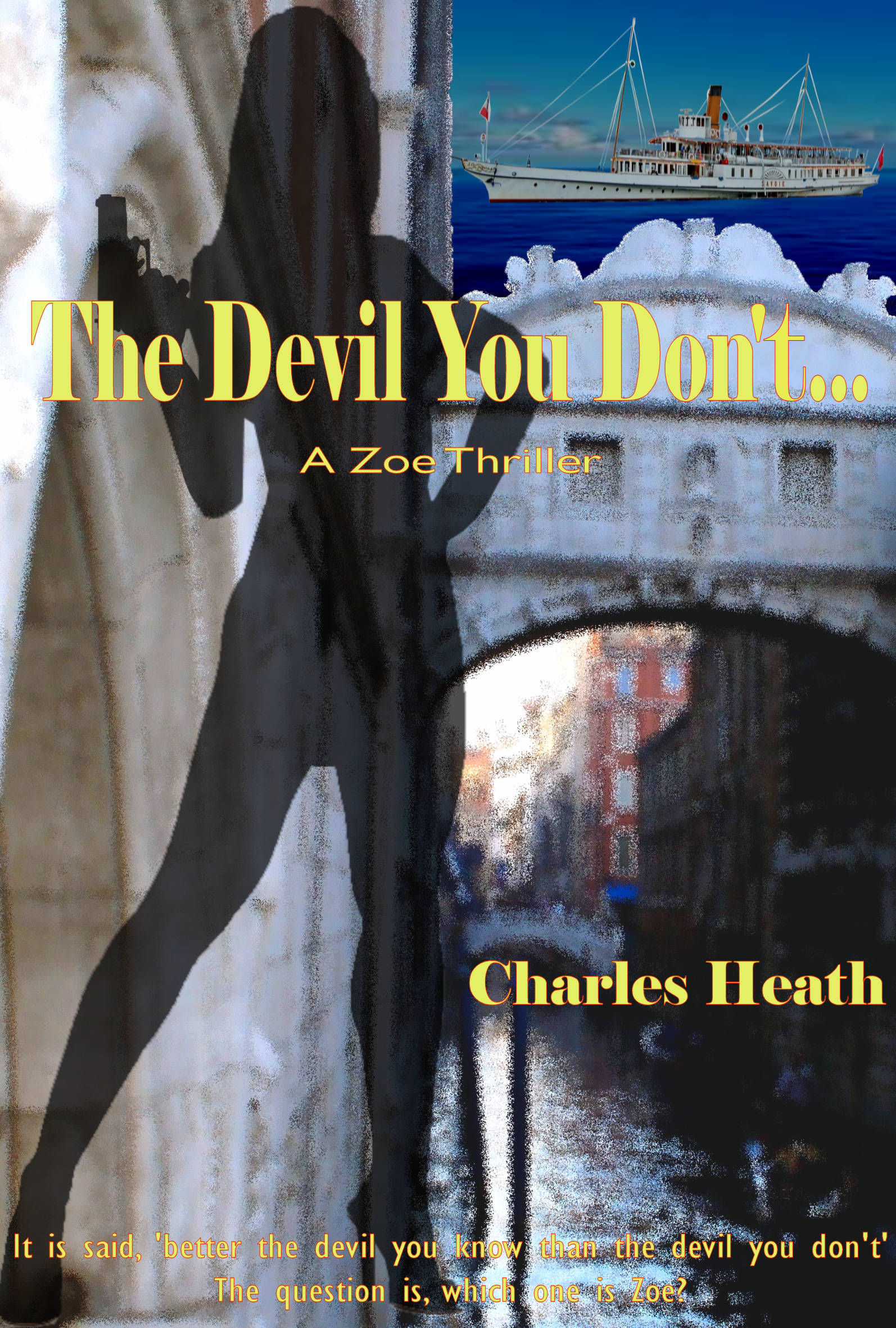
“The Devil You Don’t” – A beta readers view

It could be said that of all the women one could meet, whether contrived or by sheer luck, what are the odds it would turn out to be the woman who was being paid a very large sum to kill you.

John Pennington is a man who may be lucky in business, but not so lucky in love. He has just broken up with Phillipa Sternhaven, the woman he thought was the one, but relatives and circumstances, and perhaps because she was a ‘princess’, may also have contributed to the end result.

So, what do you do when you are heartbroken?

That is a story that slowly unfolds, from the first meeting with his nemesis on Lake Geneva, all the way to a hotel room in Sorrento, where he learns the shattering truth.

What should have been a high turns out to be something else entirely, and from that point every thing goes to hell in a handbasket.

He suddenly realises his so-called friend Sebastian has not exactly told him the truth about a small job he asked him to do, the woman he is falling in love with is not quite who she says she is, and he is caught in the middle of a war between two men who consider people becoming collateral damage as part of their business.

The story paints the characters cleverly displaying all their flaws and weaknesses. The locations add to the story at times taking me back down memory lane, especially to Venice where in those back streets I confess it’s not all that hard to get lost.

All in all a thoroughly entertaining story with, for once, a satisfying end.

Available on Amazon here: https://amzn.to/2Xyh1ow

In a word: Sheet

Well, we all know what a sheet is, it’s one of those things you put on a bed.  A bottom sheet, a fitted sheet, a top sheet, flannelette sheet.

It could also be a piece of paper, e.g. pass me a sheet of paper please, only to get in reply, what size?

There can be a sheet of flames, best if you see one get away as fast as you can.

Of course, that fire can be put out by rain sheeting down.

You can have a sheet map, that is one that opens out.  Funny how you can never get them folded back the same way.  And a problem when you’re in a car and open it out – hang on, I can’t see out the window!

That lake is a lovely sheet of water, very still just as the sun comes up, and then, what a reflection.  Great if you are a landscape painter.

Then there’s sheet metal, did that in school and wasn’t very good at it.

If you’re a philatelist, then there’s always a sheet of stamps, might be worth something in a hundred years’ time.

Then, if it is worth millions, you might turn white as a sheet with shock.

But the best of all, if you drink too much it is said you are ‘two sheets to the wind’.

When you’re given another chance, it is like being given a clean sheet.

And another form might be to do with sailing when you sheet a sail, which is to say you are making it either tauter or less taut.

English can be confusing sometimes, can’t it?

An excerpt from “What Sets Us Apart”, a mystery with a twist

See the excerpt from the story below, just a taste of what’s in store…

http://amzn.to/2Eryfth

whatsetscover

McCallister was old school, a man who would most likely fit in perfectly campaigning on the battlefields of Europe during the Second World War. He’d been like a fish out of water in the army, post-Falklands, and while he retired a hero, he still felt he’d more to give.

He’d applied and was accepted as head of a SWAT team, and, watching him now as he and his men disembarked from the truck in almost military precision, a look passed between Annette, the police liaison officer, and I that said she’d seen it all before. I know I had.

There was a one in four chance his team would be selected for this operation, and she had been hoping it would be one of the other three. While waiting for them to arrive she filled me in on the various teams. His was the least co-operative, and the more likely to make ad-hoc decisions rather than adhere to the plan, or any orders that may come from the officer in charge.

This, she said quite bluntly, was going to end badly.

I still had no idea why Prendergast instructed me to attend the scene of what looked to be a normal domestic operation, but as the nominated expert in the field in these types of situations, it was fairly clear he wasn’t taking any chances. It was always a matter of opinion between us, and generally I lost.

In this case, it was an anonymous report identifying what the authorities believed were explosives in one of the dockside sheds where explosives were not supposed to be.

The only reason why the report was given any credence was the man, while not identifying himself by name, said he’d been an explosive expert once and recognized the boxes. That could mean anything, but the Chief Constable was a cautious man.

With his men settled and preparing their weapons, McCallister came over to the command post, not much more than the SUV my liaison and I arrived in, with weapons, bulletproof vests, and rolls of tape to cordon off the area afterward. We both had coffee, steaming in the cold early morning air. Dawn was slowly approaching and although rain had been forecast it had yet to arrive.

A man by the name of Benson was in charge. He too had groaned when he saw McCallister.

“A fine morning for it.” McCallister was the only enthusiastic one here.

He didn’t say what ‘it’ was, but I thought it might eventually be mayhem.

“Let’s hope the rain stays away. It’s going to be difficult enough without it,” Benson said, rubbing his hands together. We had been waiting for the SWAT team to arrive, and another team to take up their position under the wharf, and who was in the final stages of securing their position.

While we were waiting we drew up the plan. I’d go in first to check on what we were dealing with, and what type of explosives. The SWAT team, in the meantime, were to ensure all the exits to the shed were covered. When I gave the signal, they were to enter and secure the building. We were not expecting anyone inside or out, and no movement had been detected in the last hour since our arrival and deployment.

“What’s the current situation?”

“I’ve got eyes on the building, and a team coming in from the waterside, underneath. Its slow progress, but they’re nearly there. Once they’re in place, we’re sending McKenzie in.”

He looked in my direction.

“With due respect sir, shouldn’t it be one of us?” McCallister glared at me with the contempt that only a decorated military officer could.

“No. I have orders from above, much higher than I care to argue with, so, McCallister, no gung-ho heroics for the moment. Just be ready to move on my command, and make sure you have three teams at the exit points, ready to secure the building.”

McCallister opened his mouth, no doubt to question those orders, but instead closed it again. “Yes sir,” he muttered and turned away heading back to his men.

“You’re not going to have much time before he storms the battlements,” Benson quietly said to me, a hint of exasperation in his tone. “I’m dreading the paperwork.”

It was exactly what my liaison officer said when she saw McCallister arriving.

The water team sent their ‘in position’ signal, and we were ready to go.

In the hour or so we’d been on site nothing had stirred, no arrivals, no departures, and no sign anyone was inside, but that didn’t mean we were alone. Nor did it mean I was going to walk in and see immediately what was going on. If it was a cache of explosives then it was possible the building was booby-trapped in any number of ways, there could be sentries or guards, and they had eyes on us, or it might be a false alarm.

I was hoping for the latter.

I put on the bulletproof vest, thinking it was a poor substitute for full battle armor against an exploding bomb, but we were still treating this as a ‘suspected’ case. I noticed my liaison officer was pulling on her bulletproof vest too.

“You don’t have to go. This is my party, not yours,” I said.

“The Chief Constable told me to stick to you like glue, sir.”

I looked at Benson. “Talk some sense into her please, this is not a kindergarten outing.”

He shrugged. Seeing McCallister had taken all the fight out of him. “Orders are orders. If that’s what the Chief Constable requested …”

Madness. I glared at her, and she gave me a wan smile. “Stay behind me then, and don’t do anything stupid.”

“Believe me, I won’t be.” She pulled out and checked her weapon, chambering the first round. It made a reassuring sound.

Suited up, weapons readied, a last sip of the coffee in a stomach that was already churning from nerves and tension, I looked at the target, one hundred yards distant and thought it was going to be the longest hundred yards I’d ever traversed. At least for this week.

A swirling mist rolled in and caused a slight change in plans.

Because the front of the buildings was constantly illuminated by large overhead arc lamps, my intention had been to approach the building from the rear where there was less light and more cover. Despite the lack of movement, if there were explosives in that building, there’d be ‘enemy’ surveillance somewhere, and, after making that assumption, I believed it was going to be easier and less noticeable to use the darkness as a cover.

It was a result of the consultation, and studying the plans of the warehouse, plans that showed three entrances, the main front hangar type doors, a side entrance for truck entry and exit and a small door in the rear, at the end of an internal passage leading to several offices. I also assumed it was the exit used when smokers needed a break. Our entry would be by the rear door or failing that, the side entrance where a door was built into the larger sliding doors. In both cases, the locks would not present a problem.

The change in the weather made the approach shorter, and given the density of the mist now turning into a fog, we were able to approach by the front, hugging the walls, and moving quickly while there was cover. I could feel the dampness of the mist and shivered more than once.

It was nerves more than the cold.

I could also feel rather than see the presence of Annette behind me, and once felt her breath on my neck when we stopped for a quick reconnaissance.

It was the same for McCallister’s men. I could feel them following us, quickly and quietly, and expected, if I turned around, to see him breathing down my neck too.

It added to the tension.

My plan was still to enter by the back door.

We slipped up the alley between the two sheds to the rear corner and stopped. I heard a noise coming from the rear of the building, and the light tap on the shoulder told me Annette had heard it too. I put my hand up to signal her to wait, and as a swirl of mist rolled in, I slipped around the corner heading towards where I’d last seen the glow of a cigarette.

The mist cleared, and we saw each other at the same time. He was a bearded man in battle fatigues, not the average dockside security guard.

He was quick, but my slight element of surprise was his undoing, and he was down and unconscious in less than a few seconds with barely a sound beyond the body hitting the ground. Zip ties secured his hands and legs, and tape his mouth. Annette joined me a minute after securing him.

A glance at the body then me, “I can see why they, whoever they are, sent you.”

She’d asked who I worked for, and I didn’t answer. It was best she didn’t know.

“Stay behind me,” I said, more urgency in my tone. If there was one, there’d be another.

Luck was with us so far. A man outside smoking meant no booby traps on the back door, and quite possibly there’d be none inside. But it indicated there were more men inside, and if so, it appeared they were very well trained. If that were the case, they would be formidable opponents.

The fear factor increased exponentially.

I slowly opened the door and looked in. A pale light shone from within the warehouse itself, one that was not bright enough to be detected from outside. None of the offices had lights on, so it was possible they were vacant. I realized then they had blacked out the windows. Why hadn’t someone checked this?

Once inside, the door closed behind us, progress was slow and careful. She remained directly behind me, gun ready to shoot anything that moved. I had a momentary thought for McCallister and his men, securing the perimeter.

At the end of the corridor, the extent of the warehouse stretched before us. The pale lighting made it seem like a vast empty cavern, except for a long trestle table along one side, and, behind it, stacks of wooden crates, some opened. It looked like a production line.

To get to the table from where we were was a ten-yard walk in the open. There was no cover. If we stuck to the walls, there was equally no cover and a longer walk.

We needed a distraction.

As if on cue, the two main entrances disintegrated into flying shrapnel accompanied by a deafening explosion that momentarily disoriented both Annette and I. Through the smoke and dust kicked up I saw three men appear from behind the wooden crates, each with what looked like machine guns, spraying bullets in the direction of the incoming SWAT members.

They never had a chance, cut down before they made ten steps into the building.

By the time I’d recovered, my head heavy, eyes watering and ears still ringing, I took several steps towards them, managing to take down two of the gunmen but not the third.

I heard a voice, Annette’s I think, yell out, “Oh, God, he’s got a trigger,” just before another explosion, though all I remember in that split second was a bright flash, the intense heat, something very heavy smashing into my chest knocking the wind out of me, and then the sensation of flying, just before I hit the wall.

I spent four weeks in an induced coma, three months being stitched back together and another six learning to do all those basic actions everyone took for granted. It was twelve months almost to the day when I was released from the hospital, physically, except for a few alterations required after being hit by shrapnel, looking the same as I always had.

But mentally? The document I’d signed on release said it all, ‘not fit for active duty; discharged’.

It was in the name of David Cheney. For all intents and purposes, Alistair McKenzie was killed in that warehouse, and for the first time ever, an agent left the Department, the first to retire alive.

I was not sure I liked the idea of making history.

© Charles Heath 2016-2020

Writing about writing a book – Day 26

On the surface, the relationship between Bill and Barry is an odd one.  I’ve thought about it, and at the moment, there’s some aspects that need to be written to provide background for what follows later.

I think I would like to make Barry one of those people who were built for soldiering, and not for civilian life, and it has to be said, he is a bit of a sloth once he becomes a civilian.

And, yet, under all of that, he’d be the first one in line to help his friends.

I just have to strike that balance so that I don’t make him too unsociable.

So, a little more about them, and Barry in particular.

A groan emanated from the table, and Barry moved his head slightly.

I shifted the drink in front of him, and then a hand went out and moved it back.  He lifted his head to look at me, and then lowered it again.

“I thought it was you.” A croak.

“Mate.  Not looking too good this afternoon?”

He groaned again, and then struggled to sit up, trying to smooth his hair back into place, and failing.  He rubbed his face and realized he had a week’s stubble, giving him the look of a deranged sanatorium inmate.

“Someone’s gotta try and get me off the gut rot Ogilvy calls booze.”  He nodded in Ogilvy’s direction, but typically, Ogilvy ignored him.

“You don’t have to drink it.”

“That’s what I keep telling myself.  Only it doesn’t work.”

“Perhaps you should try harder.”

He looked me over, looking for the changes since the last time he saw me, about four months ago.

“Where you been?”

“Hospital.”

“Not surprising.  Work too hard, no fun.”  He looked at the drink on the table, took it in his hand, then holding it up to the light.  Perhaps he thought it was the magic elixir that would fix him.

“Someone shot at me.  I nearly didn’t make it.  One thing it did, though.  Brought back all those memories I’d shut away.  Now I know why I did.”

“Shot at you?  Why?”

“I don’t know.  You should see the other guy.  He’s dead.”

“What other guy?”  He put the drink down, untouched.  He was beginning to look a little more alert.

I had not expected it would make much of a difference telling him about my problems, but it had.

“Take it from the top.”  Then, over towards Ogilvy, “Bring me some coffee.  Black.”

I started, a little hesitantly, not quite sure how much or little I should say.

Ogilvy came over with coffee for him and my orange juice.  He glared at me, then Barry.

“Your account is a little overdue,” Ogilvy said, standing over him.

“It’ll get paid.”

By little, I assumed it was more than Ogilvy was willing to stand.  He was kind, but kindness had its limits.

I pulled out two hundred dollar notes and gave them to him.  “Will this settle it?”

“I don’t want your money.  You should throw him in a detox center.  That would make more sense.”

“It’s only money.  If he wants to drink himself to death, who am I to argue?”

Ogilvy shrugged and took the money.  As he turned to leave, Barry said, “And take the scotch back.  I’ve had enough.”

He looked at Barry with surprise, no, I think it was more shock, but did as he was asked.  Out of the corner of my eye, I saw Ogilvy drink the scotch himself, and another for good measure.

I picked up the story where Aitchison and I were shot in the street and related what I knew from there.  He asked only two questions, who was Jennifer, and what had happened to Ellen.  He’d absorbed the rest, and judging by his reaction, probably not understood any of it.

“You have a friend?  Does Ellen know about this friend?”

“Ellen and I are divorced.  Don’t you remember me telling you several years ago?”

“Has it been that long?”

He’d been like this off and on over the last twenty years.  It had been getting worse in the last few years, his health failing, and, at times, his memory.  I watched him pick up the coffee cup, his hand shaking so badly, he needed to hold it was two.  It took a minute or so before he could drink it, and then, his face was of a child, taking medicine.

He looked over towards the bar.  “More coffee.”  He set the cup down carefully, and then looked back at me.

“What can I do?”

“I need someone to watch my back.  I have the odd feeling I’ve got myself into a situation.  The people I work for, well, I can’t put my finger on it, but they’re probably doing something they shouldn’t.  I have some evidence, and I think they know I’ve got it, and they’ve attacked me, like I said, at least once since I got out of the hospital.”

“You want me to get this Kowalski character and beat it out of him?

I smiled at the thought.  I had no doubt if I asked him, he would do exactly that.

“Not yet.  We have to get a better case against them first.”

“So, just watch your back?”

“For the moment.  And for Jennifer.”

“But you are not sure about her.  I get the impression you think she might be involved in more ways than one.”

“Did I give that impression?”  I had no idea he would pick up on my doubts.  But he was right.  I did.

“Yes.  But it doesn’t matter.  If she is we’ll find out soon enough.”

In the space of five minutes and the arrival of the second cup of coffee, to be followed by a third, his whole manner had changed.  There was still the pained look from the hangover, but the eyes were brighter, and he had a purpose.

“Then you’re in?”

“Might as well.  It’ll be better than the last bodyguard gig I had.  Had to thump the little turd.  Smart arse needed it.”

To be honest, I didn’t expect Barry to take up the challenge.  Perhaps I’d become used to seeing him down and out, and not expecting anything else.  It was the look in his eyes that changed my opinion.  The same look I’d seen all those years ago, in the jungle.

It was another good sign when he asked for an hour to clean up so he could become inconspicuous.  I told him he could take over my place, gave him the key, gave him some money, and then told him where he could find me in an hour.

It was exactly what I needed.  The Barry of old.

© Charles Heath 2016-2023

“Strangers We’ve Become” – Countdown to publishing in ??? Days

Here’s the thing…

It was down to the day before publishing.

Years of hard work were about to see the light of day…

Then the sky fell in.

Well, it wasn’t quite that dramatic but it came a close second.

My editor had been away and had forgotten to send an email to say that there were some last-minute changes that she wanted considered.

That email finally turned up in our inboxes the day before the book was about to be published.

Now I have a fortnight to read through the suggestions and then write the necessary changes, some of which have a more serious impact than just a localised rewrite.

The publication date is now moved back a month to a date in the first week of April, hopefully not April Fools Day.

I’ll let you know when the countdown restarts.

In the world of ebooks, there is a magic number

Five!

I have spent the last few years studying the art of marketing books, and whilst it seems that in most of the accounts I’ve read, tips, hinds, and everything in between, it seems it works for the writer, but very few if any, others.

And this advice doesn’t come cheap.

But one unequivocal fact seems to be, once an author has five reviews a whole new world opens up.

So…

Out of all this reading, and failing, and watching the slow, if any, sales of my books, one relevant fact remains undeniable.

Reviews sell books.  And five seems to be the number that starts the ball rolling.

And, I have no reviews.

Of course, there is a plethora of writer’s advisors out there that will tell you, for a price, where to look for people who will do reviews, free, if you’re willing to wait a few years (as I still am) or quickly if you are prepared to pay, sometimes upwards of $50 or more.

And it costs more to have these uploaded to Amazon as ‘authentic’ reviews.

So, the issue is, on Amazon you have to be a registered customer, buy a book, and then you can leave a review.  Once upon a time, you could have a review without this requirement, and people were using Fiverr to add reviews at $5 a pop.

I’m not sure how relevant these reviews were, but $5 seemed to equal 5 stars.

Amazon not only stopped that by aforementioned rules, but also took down all the reviews it seemed were written by Fiverr people, and it seems relatives or ghosts of the author (using the same IP address to post reviews of their own books under a different name) as well.

Glad I didn’t spend my money on that.

But there could be the answer to those authors out there with sluggish sales, imminent closure of their author page on Amazon, a means by which they can get authentic reviews and just a small boost to their sales.

REviews, as we all know, means sales.

None of us authors who have books on Amazon with sluggish sales are by any stretch of the imagination rich enough to buy reviews (some of which can be better depending on how much they’re willing to part with).

Me?

I’m willing to pay the price of your book, read it, and post an honest review.

An author who critiques a fellow author’s book carries a lot of weight, and like pushing a manual car with a dead battery, it only takes a small push to get things started.

To get those 5 or more reviews, it might only cost between $30 to $50, the price of one from a ‘professional’ reviewer.

But…

There is a catch.  If I buy your book, you have to buy mine, and leave an honest review.

This has probably been suggested a hundred times before, but I haven’t seen it recently.  It doesn’t mean it hasn’t been around for a while, and by no means is it meant to cut across any other means you may have of getting reviews.

For me, though, this seems a simple and elegant solution to an age-old problem in the indie authors world of marketing.

Nor am I saying that I’m a really good writer, that’s for my contemporaries to decide.

You can, of course, make your book free for a period on Amazon and try to get reviews that way.  I’m not saying that doesn’t work, but it seems to me you’ve put in a lot of effort to write the book, don’t you deserve something out of it?

From what I’ve read by a lot of authors who have gone down this route, it hasn’t exactly provided an adequate response.

I don’t price my books expensively, just $2.99.  I’m one of those ‘you sell more if it’s $3 than you would if it was $24.

Therefore…

This won’t work without others jumping in, even if only to add some comments on how this perhaps unoriginal idea might work for all of us.

By the way…

I write thrillers and mysteries, and have a large library of books in the genre, and will be willing to read your book.  My to be read list is rather lean at the moment, and new books cost more than I can afford at the moment.

Your book, if reasonably priced like mine, would be ideal for both of us.

Does it sound like we are ‘buying’ book reviews?  No.  I believe it is a valuable part of the publishing industry that authors review their fellow author’s books.  After all, so many of those reviews on Goodreads, are from people who have bought books.

And the best part…

We get to meet new authors who have a similar interest in a genre.  This could build into something else, but, of course, that sometimes means a lot of work.  Perhaps that might come later.

As you can see I’m excited about the prospect.

If you’re interested, send me an email at cwheath555@gmail.com.


“Oh, my God!” – a short story


I was one of six people who answered a house-sitting ad.  What stood out was the money, as was intended.

When I arrived at the interview, held in an accountant’s office downtown, there was no suggestion that it was a trick, or there were ulterior motives.

Just $5,000 for a week’s work.  Move-in, act as a security guard, and check all entrances and exits, and all rooms that had windows to the outside every four or so hours, particularly at night.

The reason?

The owner had to maintain residence in the house for the week, as he was going away, under a clause in the sale contract.  The reason for hiring civilians, that it was too expensive to get live-in people from a security company.

The owner freely admitted he was a cheapskate.

But for someone like me, the $5,000 was a lot of money and would help pay beck everyone I owed money to.

I earnestly pleaded my case, submitted myself to a background check, and then waited to hear back.

When I didn’t hear anything by the due date I figured some other lucky person had pleaded a better case, then, exactly a week later I got the call.

The next day a courier delivered the keys to the house and the address.  My week started at exactly 9am the next morning.

The cab dropped Mr off at the front gate of the house, only it wasn’t a house so much as a mansion, and one that had seen better days.

It was at the end of the street, behind two large gates, and a high brick fence.  I could see the driveway on the other side, and just make out the house behind the unkempt shrubbery.

I had a bunch of keys, and it took a few attempts to find the one that fitted the lock and chain preventing the gates from opening.

I just unlocked it when another car pulled up in the same place my can had, and a young woman got out.  She rescued her sports bag from the trunk and paid the cabbie.

“Who are you,” she said.

“The caretaker for the next week.  I might ask the same question.”

“The ex-wife with nowhere to go.”

No one mentioned an ex-wife that was part of the deal.

“I wasn’t told anyone else would be here, so it would be best you left.”

I slipped the lock back in place and stood my ground.  She could be anyone.

She pulled out her phone and rang a number.

A heard the voice on the other end say hello.

“You can tell your deadhead caretaker that I’m staying for a few days.”

Then I watched her expression turn very dark, and then the words, “I have nowhere else to go, and it will only be a few days.”  Then silence and an accompanying ground, ending with, “You don’t want me to come after you because you know how that will end”.

She listened, then handed the phone to me.

“Hello.”

“I’m the owner requesting the service.  You are not responsible for her, but if she becomes a problem, lock her in the basement.”

Then he hung up. It was not the best of answers to the problem.

“Are you going to open the gate?”

I shook my head and then pretended to fumble through the keys looking for the right one.  “You know this place,” I asked without turning around.

“No.  The bastard didn’t tell me about a lot of the stuff he owns.”  Her tone bristled with resentment.

I ‘found’ the key and opened the lock and started pulling the chain through the fence.  I could feel her eyes burning into my back.

When I swung open the gate, she barged past and kept walking.  I stepped through, and immediately felt the change in the temperature.  It was cold, even though the sun was out and I could feel an unnatural chill go through me.

By the time I closed and relocked the gate she had gone as far as, and round a slight bend in the driveway.  I thought about hurrying to catch up, but I didn’t think it mattered, she didn’t have a key.  Or perhaps I hoped she didn’t have one.

I headed towards the house at a leisurely pace.  I didn’t have to be there in the next instant, and I wanted to do a little survey of the grounds.  If I was checking windows, then I needed to know what the access might be like through any of them.

As I got closer to the house, the overgrowth was worse, but that might have been because no one could see it from the roadside, or through the iron gate.

Accessibility via the gardens would-be problematic for anyone who attempted it because there was no easy access.  It was one less immediate problem to deal with.

The driveway widened out into a large gravel-covered square outside the front of the house.  It had an archway under which cars could stop and let out passengers undercover, ideal for ball goers, which meant the house had been built somewhere during the last century.

There were aspects that would warrant me taking a look on the internet about its history.

She was waiting outside the door, showing some exertion, and the mad dash had been for nothing.

“I take it you have a key?”

I decided to ignore that.  I hoped she would disappear to another part of the house and leave me alone.  I had too much to do without having to worry about where she was, or what she was doing.  It seemed, base on the short time I spoke to him, that the owner had a mistake marrying her if they were in fact married.  Ex could mean almost anything these days.

Again, I made a show of trying to find the right key, though in the end it was hit and miss, and it took the fourth of fifth attempt to find it.

The door was solid oak, but it swung open easily and silently.  I had expected it to make a squeaking sound, one associated with rusty hinges.  This time she was a little more circumspect when she passed by me.  I followed and closed and locked the door behind me.

Inside was nothing like I expected.  Whilst the outside looked like the building hadn’t been tended to for years, inside had been recently renovated, and had that new house smell of new carpets and painted walls.

There was a high vaulted roof, and a mezzanine that was accessed by a beautifully restored wooden staircase and ran around the whole upper floor so that anyone could stand anywhere near the balustrading and look down into the living space, and, towards the back, the kitchen and entertaining area.

The walls had strategically placed paintings, real paintings, that looked old, but I doubted were originals, because if they were similar to those I’d seen in a lot of English country estates they would be priceless, but not left in an empty building.

I had also kept her in the corner of my eye, watching her look around almost in awe.

“What do you think these paintings are worth?”

Was she going to suddenly take an inventory?

“Not a lot.  You don’t leave masterpieces in an abandoned house.  I suspect nothing in here would be worth much, and really only for decorative purposes so the owner can have a better chance of selling the place.  Empty cavernous buildings do not sell well.”

“What are you again?”

“No one of any particular note.  I’ve been asked to look after the place for the next week until it is handed over to the new owners.  Aside from that, I know nothing about the place, nor do I want to.  According to the note I got with the key, there are bedrooms off that mezzanine you can see up there.”  I pointed to the balustrading.  The kitchen has food, enough for the few days I’ll be here, but I’m sure there’s enough to share.”

“Good.  You won’t see me again if I can help it.”

I watched her walk to the staircase and go upstairs.  The mud map told me there were bedrooms up of the mezzanine, and also across from this area.  There was another large room adjacent to this, a games area or room big enough to hold a ball, a part of the original house, and which led out onto the side lawns.  I’d check later to see what the access was like because I suspected there would be a few doors that led out from the hall to the garden.

When she disappeared along the upstairs passageway, I headed towards the next room.  IT was large, larger than that next door, and had another grand staircase leading down to the dance floor.  I guess the people used to stay in rooms upstairs, get dressed, then make a grand entrance down those stairs.

I hadn’t expected this house to be anything like the old country estates, and it was a little like icing of the cake.  I would have to explore, and transport myself back to the old days, and imagine what it was like.

She was true to her word, and I didn’t see her the next morning.  I was staying a world away from her.  I was in the refurbished old section and she was staying in the newly renovated and modernized part of the house.

I did discover, on the first day of getting my bearings and checking all of the entrances and windows ready for my rounds, that above the bedrooms on the second floor of the old section, there was a third floor with a number of smaller rooms which I assumed were where the servants lived.

I stayed in one of those rooms.  The other main bedrooms, with ornate fireplaces and large shuttered windows, smelled a little too musty for me, and I wasn’t about to present someone with an open window.  The views from the balconies were remarkable too or would have been in the garden had been kept in its original state.

In the distance, I could see what might have once been a summerhouse and promised myself a look at it later.  A long day had come to a tiring end, and I was only destined for a few hours’ sleep before embarking on my first-midnight run.   I was going to do one at eight, after eating, another at midnight, and another at six in the morning.  I’d make adjustments to the schedule after running the first full night’s program.

I brought my special alarm with me, the one that didn’t make a sound but was very effective in waking me.  It was fortuitous, because I had not been expected someone else to come along for the ride, and didn’t want them to know where and when I would be doing the rounds.

It had taken longer than I expected to get to sleep, the sounds of the housekeeping me awake.  Usually a sound sleeper, perhaps it was the first night in different, and unusual surroundings.

I shuddered as I got out of bed, a cold air surrounding me, a feeling like that when I walked through the gate.  I had the sensation that someone was in the room with me, but in the harsh light after putting the bedside light on, it was clearly my imagination playing tricks.

I dressed quickly and headed out.

The inside of the house was very dark, and the light from my torch stabbed a beam of light through what might have been an inky void.  The circle of light on the walls was never still, and I realized that my hand had acquired a touch of the shakes.

Creaking sounds as I walked across the flooring had not been discernible the previous night, and it was odd they only happened at night.  A thought that the house may be haunted when through my mind, but I didn’t believe in ghosts or anything like that.

The creaking sounds followed me as I started my inspection.  I headed downstairs, and once I reached the back end of what I was going to call the ballroom.  Before I went to bed the previous evening, I drew up a rough map of the places I would be going, ticking them off as I went.

The first inspection was of the doors that led out onto the lawns.  The floor-to-ceiling windows were not curtained, and outside the undergrowth was partially illuminated by moonlight.  The day had been warm, that period in autumn leading into winter where the days were clear but getting colder.  Outside I could see a clear starry night.

Then, out of the corner of my eye, I thought I saw the flash of a torchlight in the gardens.  I stopped and looked more carefully, but there was nothing.  I waited for about ten minutes, but there was still no movement.

I was going to have to park my imagination before starting rounds or I’d never get the job done.

I went out of the room and into the living area.  There seemed to be lights all around me, those small pilot lights that told you appliances were on standby.

I was heading towards the stairs when suddenly there was a blood-curdling scream, followed by what sounded like a gunshot, a sharp loud bang that, on top of the scream, made me jump.

The woman.

I raced as fast as I could up the stairs.  The sounds had come from there, but when I reached the top of the stairs, I realized I had no idea in which direction it came from.  Pointing the torch in both directions, there was nothing to see.

I could see a passage that might lead to the bedrooms on this level, and headed towards it, moving slowly, keeping as quiet as I could, listening for anything, or if someone else was lurking.

I heard a door slam, the echo coming down the passage.  I flashed the light up the passage, but it didn’t seem to penetrate the darkness.  I moved quickly towards the end, half expecting to see someone.

Then I tripped over, and as I tried to get to my feet, realized it was a body.  I flashed the torch on it, and it was the woman.

Dead, a gunshot wound in the chest, and blood everywhere.

I scrambled to my feet, and ran towards the end of the passage, and stopped at what appeared to be a dead end.  With nowhere to go, I turned.

I wasn’t alone, just hearing before seeing the presence of another person, but it was too late to react.  I felt an object hitting me on the back of the head, and after that, nothing.

I could feel a hand shaking me, and a voice coming out of the fog.  I opened my eyes and found myself in completely different surroundings.

A large ornate bedroom, and a four-poster bed, like I had been transported back to another age.  Then I remembered I had been in a large house that had been renovated, and this was probably one of the other bedrooms on the floor where the woman had been staying.

Then I remembered the body, being hit, and sat up.

A voice beside me was saying, “You’re having that nightmare again, aren’t you?”

It was a familiar voice.

I turned to see the woman who I had just moments before had seen dead, the body on the floor of the passage.

“You’re dead,” I said, in a strangely detached tone.

“I know.  I’m supposed to be.  You helped me set it up so I could escape that lunatic ex-husband of mine.”

I must have looked puzzled.

“Don’t worry.  The doctor says your memory will return, one day.  But, for now, all you need to do is rest.  All you need to know is that we’re safe, thanks to you.”

© Charles Heath 2021

Searching for locations: Rome, Italy

We visited Rome in August

It was hot.

It was verrrry hot.

We flew into Rome’s Leonardo da Vinci-Fiumicino airport after a rather bumpy flight from London.  Unlike most other airports the plane parked at a satellite terminal and after we disembarked we had to catch a train to the main terminal.

The most notable memory of this airport was my daughter’s discovery of a salami shop.

We had booked a transfer to take us to the hotel the Roma Corso Trieste Mercure in Via Gradisca from the airport.  It was a white air-conditioned van and so far we had avoided the heat.

One of the rooms had faulty air conditioning an absolute must as the rooms were very hot without it and necessitated a room change which was done quickly and efficiently.

The hotel was in the suburbs and without a car we were dependent on public transport.  According to the reception staff, there was a bus stop nearby, and a longer walk to the tram or light railway.  The bus seemed to be the best option as it would take us to the central terminal near the railway station, where all tour buses also operated from, and particularly the open-top buses that went to all the major tourist attractions.

That first day basically was given over to travelling, arriving by plane and settling into the hotel, thus we didn’t get to feel the force of the heat.  That came the next day.

After a walk around the hotel precinct to get our bearings and see what shops and restaurants were available, on returning to the hotel we were faced with limited choices of room service or to go out for dinner.

My daughter and l go for a long walk up Via Nomentana to find several shops and a restaurant.  We went into the restaurant and sat down.   We waited for 10 minutes and got no service nor did anyone come and ask us if we wanted to order food so instead we left somewhat disappointed and go next door to what seemed to be the Italian version of a delicatessen and ordered sandwiches and beer.   I bought a half dozen cans of Moretti beer two of which I drank on the way home.

It was still very hot even at eight at night and the sandwiches are delicious.  It just might be by that time we were starving and anything would have tasted great.

The next morning we are up and ready to chance the weather and some history.  Breakfast at the hotel is limited but very good.

We were going to use public transport and I’d studied up on the Internet.

Travelling on the bus required pre-purchase of tickets which could be bought in certain shops and locally when exploring the area near the hotel, l found a tobacconist.

Next, we needed to understand how to use the tickets. There was no one on the bus who could help so when l tried to scan the tickets and it failed, l gave up.  We had the same issue each day and in the end, the tickets never got used.

The trip to central Rome by bus took about 15 minutes.  In the morning it was reasonably cool and showed us a little of suburban Rome.  We also saw the trams but we would not be able to use them because our hotel not on a direct route.

That first full day we decided to go and see the Vatican.

Not understanding buses and which one we needed to get to the Vatican, we took a taxi.

Wow.  It was the metaphorical equivalent of driving over the edge of a cliff with a daredevil.  It was quite literally terrifying.

Or maybe we just didn’t know that this was probably the way people drove in Rome.

Shaken but delivered in one piece we found ourselves in the square opposite St Peters Basilica.

The square is impressive, with the statues atop a circular colonnaded walkway.  The church is incredible and took a few hours to take in and to top off the day we did a tour of the Vatican museum which took the rest of the afternoon.

Then it was back to the delicatessen for more sandwiches and beer, and an interesting discussion with several elderly Italian ladies, of which I did not understand one word.

On the second full day we decided to use one of the open-top bus tours and eventually decided on the hop-on hop-off tour simply because the bus was at the central transport terminal for trains and buses and it was getting hotter.

Our first stop was the Colosseum.  There were other monuments nearby, such as the Arch of Constantine, but as the heat factor increased we joined the queue to go into the Colosseum and gladly welcomed the shade once we got inside.

The queue was long and the wait equally so, but it was worth the wait.  It would be more interesting if they could restore part of it to its former glory so we could get a sense of the place as it once was.  But alas that may never happen, but even so, it is still magnificent as a ruin.

Outside in the heat, it was off to the ruins which were a longish walk from the Colosseum, taking Via Sacra, not far from the Arch of Constantine.  This day in the walkway there were a number of illegal vendors, selling knockoff goods such as handbags and watches, and who, at the first sight of the police, packed up their wares in a blanket and ran.

Included in these ruins were The Roman Forum, or just a few columns remaining, the Palatine Hill, Imperial Fori, including the Forum of Augustus, the Forum of Caesar, and more specifically the Forum of Trajan.  It was, unfortunately very hot and dusty in the ruins the day we visited.

We walked all the way to the Foro Romano and the Septimus Severo Arch at the other end of the ruins, past the Temple of Caesar.  I found it very difficult to picture what it was like when the buildings were intact, so I bought a guide to the ruins which showed the buildings as ruins and an overlay of how they would have looked.  The buildings, then, would be as amazing as the Colosseum, and it would have been interesting to have lived back then, though perhaps not as a Christian.

I lost count of the number of bottles of water we bought, but the word ‘frizzante’ was ringing in my ears by the end of the day.  Fortunately, the water did not cost a lot to buy.

At the end of the day, we caught the hop on hop off the bus at the Colosseum and decided not to get off and see any more monuments but observe them from the bus.  The only one I remember seeing was Circo Massimo.  Perhaps if we’d known it was going to be twice as hot on the bus, yes, there was no air-conditioning; we may have chosen another form of transport to get back to the hotel.

On the third and last day in Rome, we decided to go to the Trevi Fountain, see the pantheon and walk up the Spanish Steps.  We spent most of the morning in the cool of a café watching the tourists at the fountain.  By the time we reached the top of the Spanish Steps, we were finished.

Sayings: Beyond the pale

I’ve often said, when espying an injustice that was so outrageously displayed that no one could miss it, as being beyond the pale.

The pale within a fence became an area of land within a boundary such as a county, and then to areas within Ireland that were held by the British. As these became smaller, those areas were deemed to be uncivilized.

This, in modern parlance, beyond the pale refers to someone’s behavior being outside the accepted norm.

There’s also…

In a word: Pale

Which is the color of the face of a person who is usually desperately unwell?

As distinct from a pale face, a white man is described by the American Indians. This, sadly, was learned from American westerns, motion pictures that told a rather interesting version of events between the Indians and the new settlers.

Paleface was in one movie, in particular, Bob Hope.

A pale can also be a single upright piece of wood in a fence.

Something could pale into significance, or be a pale imitation of a better quality article.

Not to be confused with a pail, which is a bucket, wooden or otherwise, that holds liquids.

The most famous of which is that which Jack and Jill went up a hill to fetch a pail of water, and, well, you know how that ended.