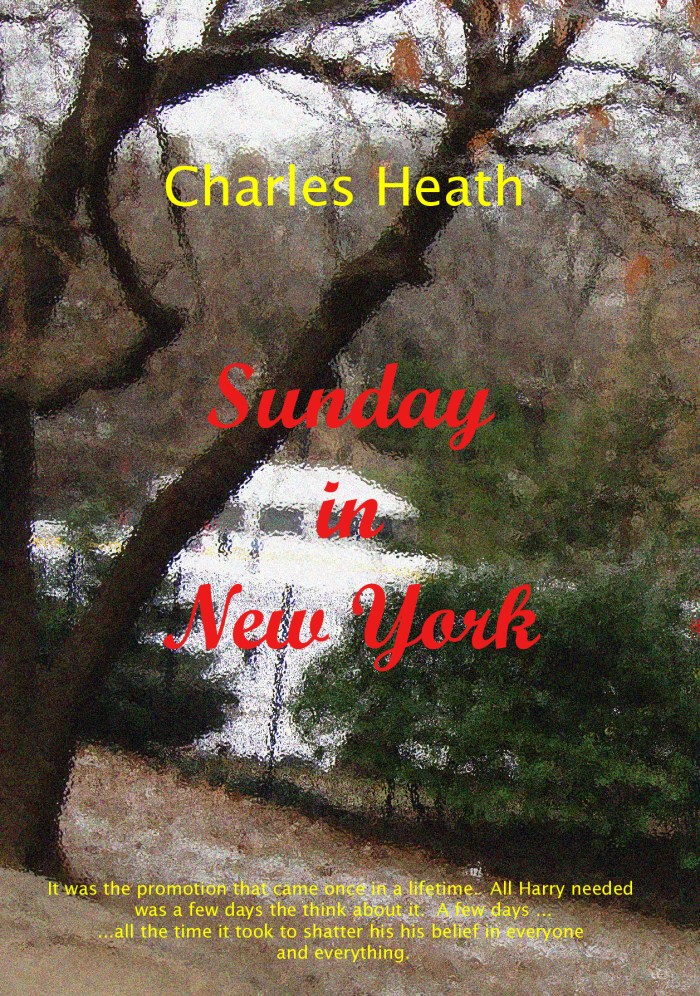
“Sunday in New York”, a romantic adventure that’s not a walk in the park!

“Sunday in New York” is ultimately a story about trust, and what happens when a marriage is stretched to its limits.

When Harry Steele attends a lunch with his manager, Barclay, to discuss a promotion that any junior executive would accept in a heartbeat, it is the fact his wife, Alison, who previously professed her reservations about Barclay, also agreed to attend, that casts a small element of doubt in his mind.

From that moment, his life, in the company, in deciding what to do, his marriage, his very life, spirals out of control.

There is no one big factor that can prove Harry’s worst fears, that his marriage is over, just a number of small, interconnecting events, when piled on top of each other, points to a cataclysmic end to everything he had believed in.

Trust is lost firstly in his best friend and mentor, Andy, who only hints of impending disaster, Sasha, a woman whom he saved, and who appears to have motives of her own, and then in his wife, Alison, as he discovered piece by piece damning evidence she is about to leave him for another man.

Can we trust what we see with our eyes or trust what we hear?

Haven’t we all jumped to conclusions at least once in our lives?

Can Alison, a woman whose self-belief and confidence is about to be put to the ultimate test, find a way of proving their relationship is as strong as it has ever been?

As they say in the classics, read on!

Purchase:

http://tinyurl.com/Amazon-SundayInNewYork

The cinema of my dreams – Was it just another surveillance job – Episode 18

As we all know, writing by the seat of your pants is almost the same as flying by the seat of your pants, a hazardous occupation.

As it happens, I like writing this way because like the reader, I don’t know what to expect next.

And equally, at times, you can write your self into a corner, much like painting, and then have to go back, make a few changes and//or repairs and then move forward.

It’s part of the writing process, only in this case, the changes occur before you’ve finished the novel, if you finish.  Quite often a lot of writers get only so far, then the manuscript hits the bottom drawer, to be brought out on a distant rainy day.

Or your cat has mocked your writing ability one too many times.

Therefore, we’re winding back to Episode 16, and moving forward once again, from there.  This is episode 18 revised…

Ever had the heart-stopping feeling when you’re in the wrong place, and someone has interrupted you?  Especially if you shouldn’t be there, or that you have no right to be there.

I stood quietly on the inside of the door and hoped whoever the visitor was would go away.  No answer meant no one was home, didn’t it?

Unless…

I heard a key in the door, and it turn in the lock.

I moved quickly to the other side of the door so I would be shielded when the person came into the room.  Too late to get out, I was of two minds what to do.  Hit the visitor over the head and flee, or ask them what they were doing, before they asked me that same question.

Then nothing.

Until a few seconds later I heard a voice, a man, say, “Jan, you’re back.  How was the visit to Philadelphia?”

I heard the slight rattle of Jan taking her hand off the handle and moving away from the door.  “Sad, as all funerals are.  Now, we are left with the house, and my father’s stuff; a huge collection of mostly junk over a long period of time.  Seems he never threw anything out.”

Jan?  Did she live here, with O’Connell?

“Yes, “I’m a bit like that.”

Another tenant, or the building super?

“I made sure Herman was looked after while you were away.  I don’t think he missed you at all?”

She laughed.  “He’s a cat, Fred.  We belong to them, not the other way around.”

“True.  Your friend has not been in for a week or so.”

“I know.  The last message I got from him, he was in Prague, lucky bastard.  He was going to take me with him, but at the last moment, they changed his itinerary.  Perhaps next time.  I was just going to make sure everything was OK, before going home myself.”

“I could look in if you want?”

“No.  Thanks anyway, but last time I was here I left a jacket behind.  Thanks, Fred.”

A moment later I could hear his footsteps heading away, and Jan moved back to the door, and opened it.

I heard the light switch, and then, suddenly, the room was filled with bright light.

The girl was unassuming, stepped into the room, and closed the door behind her.  Before she could take a step, I put a hand over her mouth and an arm around her neck and started squeezing.

Instinctively she started to struggle and call out for help.

I whispered in her ear, “I mean you no harm, but if you struggle, or yell out, it could turn out very bad for you.”

We had been taught how to subdue people without killing them, but that always didn’t go to plan.  There was that instinct to fight back in everyone, and it was sometimes hard not to apply excessive pressure which could, depending on the severity of resistance, see the target asphyxiated, or end up with a broken neck.

She was still struggling, which mean I had to exert more force.

“Stop fighting me or you will harm yourself,” I said, this time in a more forceful whisper.

It had an immediate effect, but I don’t think it was her obedience that caused it.  I gently lowered her to the floor and felt for a pulse.  Unconscious, not dead.  I sighed in relief.  I took a good long look at her so that I would remember what she looked like.  At some point, I was going to have to talk to her.

Then footsteps outside the door.  What else could go wrong?

Then knocking on the door.  Short and sharp.  Followed by, “Jan, are you in there?”

Fred, whoever he was.  What did he want?”

Another knock on the door, this time more urgent.  Damn.  O’Connell’s flat was like a busy store.

I looked around for an escape now there would be no going out the front door.  Not unless I had to disable another person, and assuming if he was the building super, he would not be a small man, so it would take a greater, and noisier, effort to subdue him.

A fire escape, all buildings usually had one down the side of the building, in case of fire.  I went over and checked the windows and found it.  The window needed a little force to open it, but the sound of a key in the door motivated me.

Out the window, close the window again, I made it down the stairs far enough that when I looked up, no one was following me.

That was close.  Too close.

© Charles Heath 2019-2022

“Echoes From The Past”, the past doesn’t necessarily stay there


What happens when your past finally catches up with you?

Christmas is just around the corner, a time to be with family. For Will Mason, an orphan since he was fourteen, it is a time for reflection on what his life could have been, and what it could be.

Until a chance encounter brings back to life the reasons for his twenty years of self-imposed exile from a life only normal people could have. From that moment Will’s life slowly starts to unravel and it’s obvious to him it’s time to move on.

This time, however, there is more at stake.

Will has broken his number one rule, don’t get involved.

With his nemesis, Eddie Jamieson, suddenly within reach, and a blossoming relationship with an office colleague, Maria, about to change everything, Will has to make a choice. Quietly leave, or finally, make a stand.

But as Will soon discovers, when other people are involved there is going to be terrible consequences no matter what choice he makes.

https://amzn.to/2CYKxu4

newechocover5rs

I should have paid more attention…

When I was back in school in what seems like a lifetime ago, I realise I should have paid more attention.

Why?

Because for some odd reason, we were taught more about American and English history than that of out own country, Australia.

WE cannot use the excuse that we haven’t been around all that long, because we have, something like 1770, which led to settlement by the English in 1788 or so, but the first landing was in 1606 by a Dutchman.

Of course, these are vague memories of a social studies lesson that briefly touched on our origins, but only to re-affirm our allegiances to Britain. While it wasn’t the Empire when I was in school, it was the Commonwealth, and our atlases still had the ‘wherever the map is red is where the British claimed as theirs’, and there were quite a lot red countries.

But, hey, that pales into insignificance the stuff we learned about England, from the time of William the Conqueror in 1066 through to the modern day. I could at one stage of my life relate from memory all of the kings and queens of England.

I know all about the industrial revolution, travel between Australia and England from the days of sail, right through to the Airbus A380.

It’s why I have a preference reading the English classics of Jane Austen and others of that golden era, and watching period TV, recreated so lavishly by the BBC and ITV in England.

And of course, we were brought up on a steady diet of American TV shows, and films, like out country never existed, and was notorious for producing laughable TV shows of the poorest quality, despite the actors who tried very hard to make it seem believable.

I could not name one Australian prime minister, and have trouble telling who is the current prime minister. Well maybe not, this Covid thing has had his face on the TV every day for nearly a year, but he’s the first. I couldn’t tell you who he took over from, nor who the leader of the opposition is.

It’s probably the reason why over the years people have often said we should become one of the states of the US.

Nowadays we’re trying to put a wall between us and them so China might not see us as an outpost of the US, and come in an attack us. The trouble is 28 million people versus 1.6 billion doesn’t give us any leverage. Come to think of it, the 360 million Americans wouldn’t stand a chance against an invasion of 1.6 billion either.

I’m not sure why it matters any more, because we’ll soon be back to the heady heights of the cold war days in the 50s and 60s, where the only deterrant to perceived enemies was the threat of nuclear annihilation.

It’s the one option where 360 million people could defeat an enemy of 16. billion.

But … there’s only one small problem …

We’ll all be dead.

AS horrifying as that might sound, there is one other problem than might just do the same but not destroy any infrastructure. A pandemic. A virus that can’t be cured, a virus that can mutate and adapt so there is not effective vaccine.

Dystopian? It’s sure a great idea for a story. There’s been a few, but those always have a few survivors, ready willing an able to get along and rebuild the world having learned the lessons of past failures.

This time? I don’t think the next story will have a happy ending. In it though, the aggressors are not going to be better off than the rest, because they forget to build in a fail safe, or couldn’t. Or it just got out before they finished perfecting it, and synthesizing an antidote.

That’s something else we learned a lot about. Nuclear holocausts, and their effect. It reminds me of the day our class was taken to see a movie about the effects of a nuclear war. Was it to scare us, or prepare us? Back then, a nuclear war was more likely than a change of government in this country.

If it was to educate my generation of people who are now the in the government and positions of power, they failed.

So, if I had my time over, I would insist on leaning about my country, the people who have inhabited for tens of thousands of years, without the need for cars, houses, cigarettes and booze, and definitely without the need for nuclear weapons and ideals of aggression towards other countries.

Now, where’s that pesky time machine…

In a word: Lot

I’ve got a lot of time on my hands…

Or not.  It’s just an expression, where a lot means plenty.  Only the rich and idle seem to have a lot of time on their hands, and a lot of money, sometimes more than they know what to do with.

It spawns another saying, the devil finds work for idle hands.

This is distinct from the other form of a lot; a piece of land that can be used to build a house, an office building or warehouse, or just land to graze cattle or sheet.

For those with a lot of money, they can buy two lots or four lots.

Lot can also mean everything, i.e. he bought the lot.

Now it’s getting confusing, as only the English language can.

How about, there’s a lot of love in the room.   Well, it’s certainly not at a political debate that’s for sure!

Then, still having more money than sense I went to an auction and bid for two lots.  Unfortunately, there was someone else who had more money than I did.

My mother had a lot of quaint expressions; once we were sitting opposite a man of dubious character and she said, he’s a bad lot.

Back in the old days, and sometimes these, the word lot was used instead of lottery when names were put in a hat and one drawn as the winner.  Today its a little more sophisticated, balls are put in a cage.

And I was never happy with my lot in life.  Not till I got older, anyway.


“Knowledge can be dangerous…” – A short story

It was, perhaps, the saddest week of my life.

It started with a phone call, then a visit by two police officers.  It was about my parents, but the news could not be imparted over the phone, only in person.  That statement alone told me it was very bad news, so I assumed the worst.

The two police officers, standing at the front door, grim expressions on their faces, completed the picture.  The news, my parents were dead, killed in a freak car accident.

At first, it didn’t sink in.  They were on their way back from another of their extensive holidays, one of many since my father had retired.  I’d seen them probably six months out of the last five years, and the only reason they were returning this time was that my mother needed an operation.

They hadn’t told me why, not that they ever told me very much any time since the day I’d been born, but that was who they were.  I thought them eccentric, being older when I’d come along, and others thought them, well, eccentric.

And being an only child, they packed me off to boarding school, then university, and then found me a job in London, and set me up so that I would only see them weekends if they were home.

I had once wondered if they ever cared about me, keeping me at arm’s length, but my mother some time ago had taken me aside and explained why.  It was my father’s family tradition.  The only part I’d missed was a nanny.

It most likely explained why I didn’t feel their passing as much as I should.

A week later, after a strange funeral where a great many people I’d never met before, and oddly who knew about me, I found myself sitting in the sunroom, a glass of scotch in one hand, and an envelope with my name on it, in the other.

The solicitor, a man I’d never met before, had given it to me at the funeral.   We had, as far as I knew an elderly fellow, one of my father’s old school friends, as the family solicitor, but he hadn’t shown at the funeral and wasn’t at home when I called in on my way home.

It was all very odd.

I refilled the glass and took another look at the envelope.  It was not new, in fact, it had the yellow tinge of age, with discoloration where the flap was.  The writing was almost a scrawl, but identifiable as my father’s handwriting, perhaps an early version as it was now definitely an illegible scrawl.

I’d compared it with the note he’d left me before they had embarked on their last adventure, everything I had to do while caretaking their house.  The last paragraph was the most interesting, instructing me to be present when the cleaning lady came, he’d all but accused her of stealing the candlesticks.

To be honest, I hadn’t realized there were candlesticks to steal, but there they were, on the mantlepiece over the fire in the dining room.  The whole house was almost like being in an adventure park, stairs going up to an array of rooms, mostly no longer used, and staircase to the attic, and then another going down to the cellar.  The attic was locked and had been for as long as I could remember, and the cellar was dank and draughty.

Much like the whole house, but not surprising, it was over 200 years old.

And perhaps it was now mine.  The solicitor, a man by the name of Sir Percival Algernon Bridgewater, had intimated that it might be the last will and testament and had asked me to tell him if it was.  I was surprised that Sir Percival didn’t have the document in question.

And equally. so that the man I knew as his solicitor, Lawerence Wellingham, didn’t have a copy of my father’s last will and testament either.

I finished the drink, picked up the envelope, and opened it.

It contained two sheets of paper, the will, and a letter.  A very short letter.

“If you are reading this I have died before my time.  You will need to find Albert Stritching, and ask him to help you find the murderer.”

Even the tenor of that letter didn’t faze me as it should have, because at this point nothing would surprise me.  In fact, as I  unfolded the document that proclaimed it was the will, I was ready for it to say that whole of his estate and belongings were to be left to some charity, and I would get an annual stipend of a thousand pounds.

In fact, it didn’t.  The whole of his estate was left to my mother should she outlive him, or in the event of her prior decease, to me.

I had to put all of those surprises on hold to answer a knock on the door.

Lawerence Wellingham.

I stood too e side, let him pass, closed the door, and followed him into the front room, the one my mother called the ‘drawing room’ though I never knew why.

He sat in one of the large, comfortable lounge chairs.  I sat in the other.

I showed him the will.  I kept the other back, not knowing what to make of it.

“No surprise there,” Wellingham said.

“Did you have any idea what my father used to do, beyond being, as he put it, a freelance diplomat?”

I thought it a rather odd description but it was better than one he once proffered, ‘I do odd jobs for the government’.

“I didn’t ask.  Knowledge can be dangerous, particularly when associated with your father.  Most of us preferred not to know, but one thing I can tell you.  If anyone tries to tell you what happened to your parents was not an accident, ignore them.  Go live your life, and keep those memories you have of them in the past, and don’t look back.  They were good people, Ken, remember them as such.”

We reminisced for the next hour, making a dent in the scotch, one of my father’s favorite, and he left.

Alone again, the thoughts went back to the second note from my father.  That’s when the house phone rang.

Before I could answer it, a voice said, “My name is Stritching.  Your father might have mentioned me?  We need to talk.”

—-

© Charles Heath 2020-2021
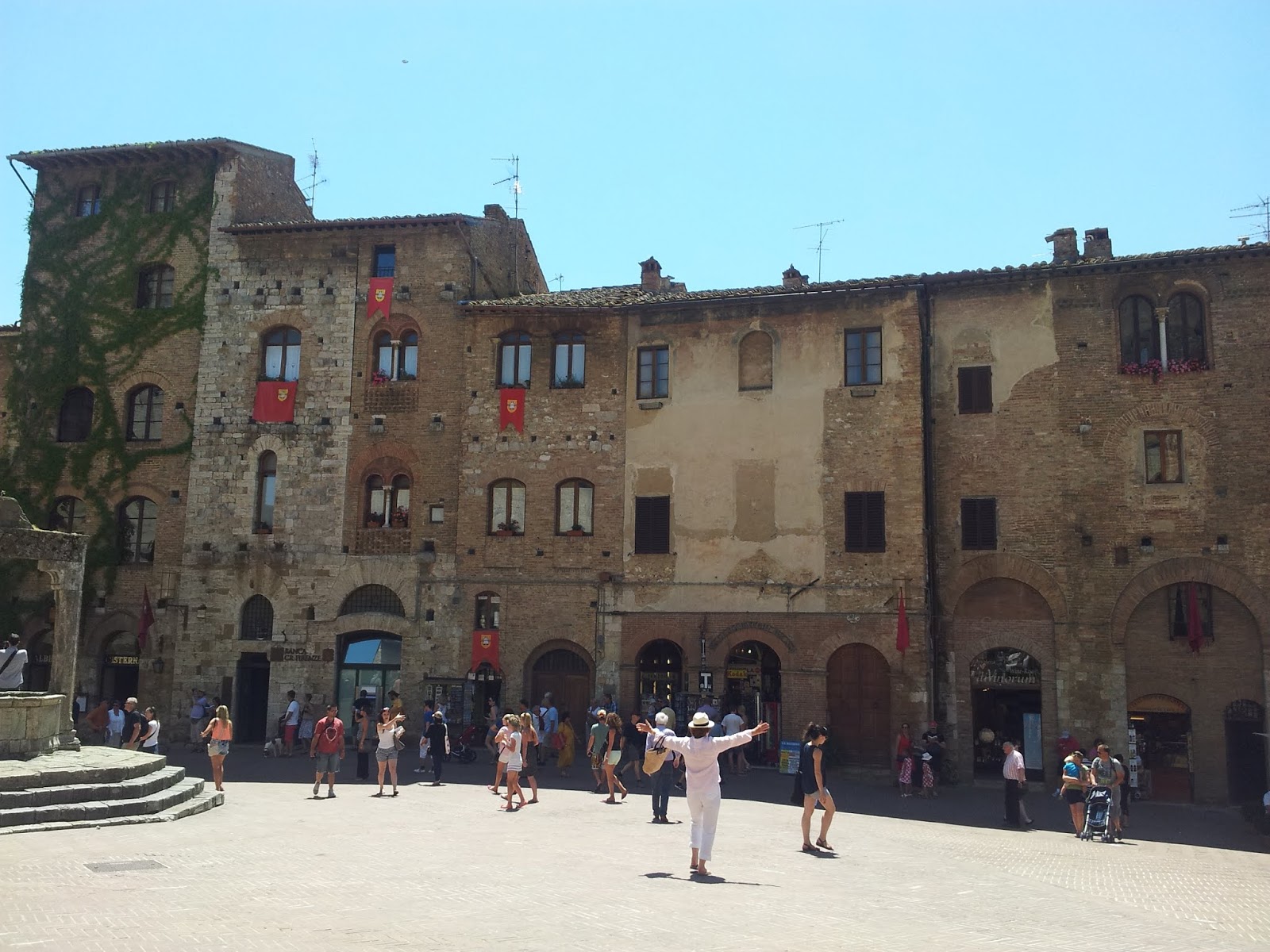
Searching for locations: San Gimignano, Italy

We have visited this town on a hill, famous for its fourteen towers, twice.  The first time we stayed in a hotel overlooking the main piazza, and the second time, for a day visit, and return to a little restaurant tucked away off the main piazza for its home cooking.

No cars are allowed inside the town and parking is provided outside the town walls.  You can drive up to the hotel to deliver your baggage, but the car must return to the carpark overnight.

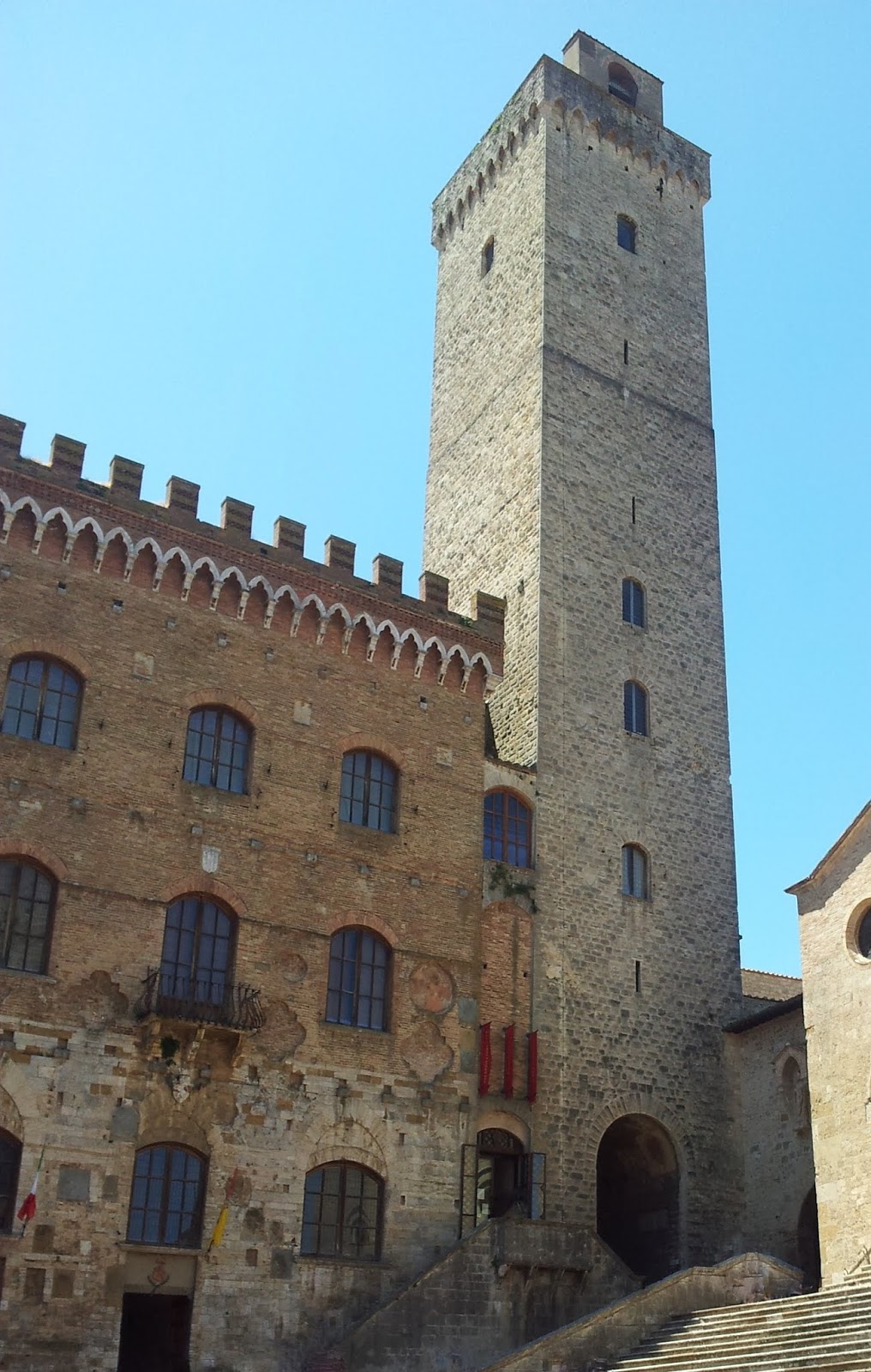
This is one of the fourteen towers

I didn’t attempt to climb to the tower, which you can do in some of them, just getting up the church steps was enough for me.  Inside the building was, if I remember correctly, a museum.

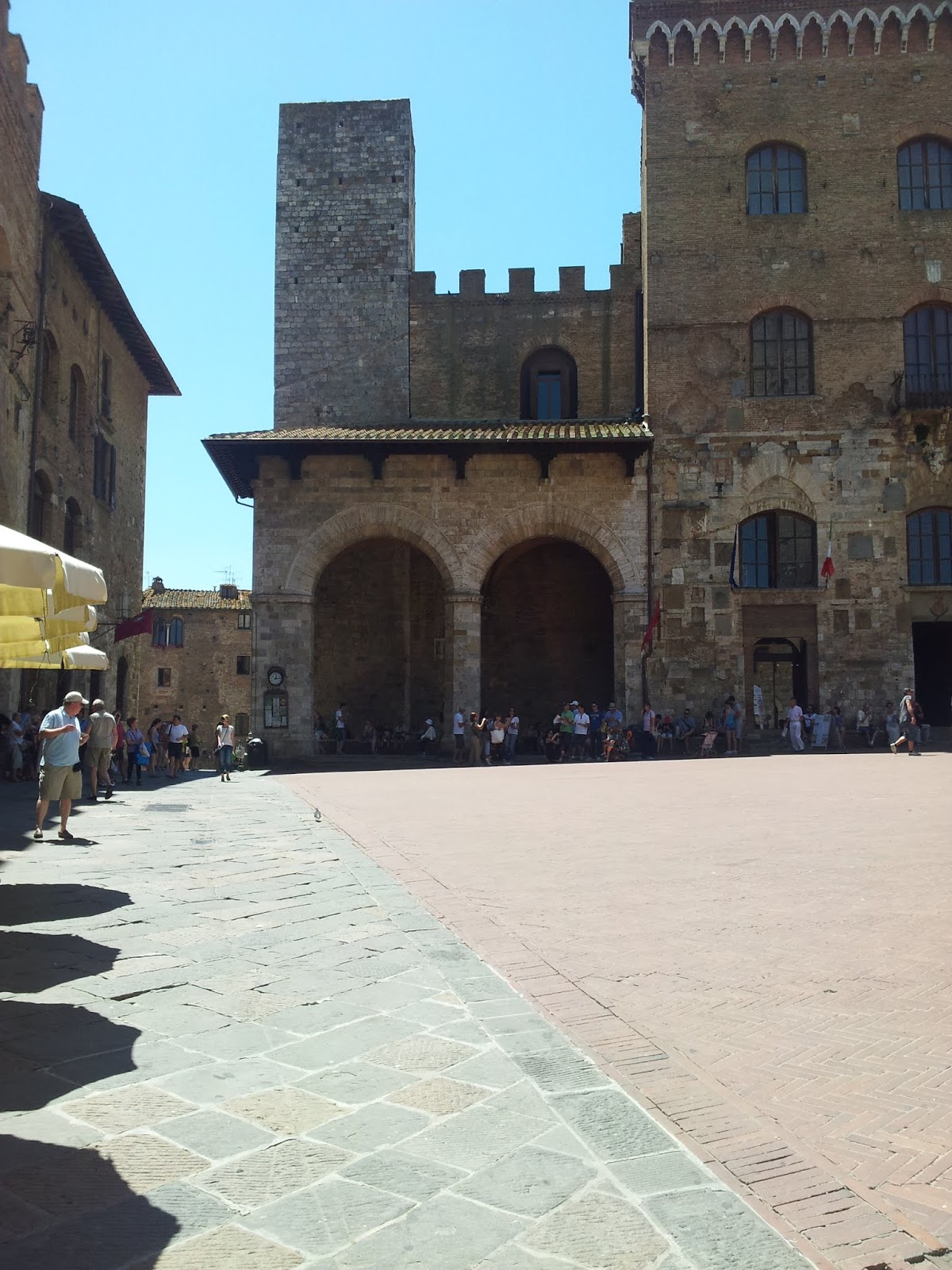
Looking up the piazza towards some battlements, and when you reach the top and turn left, there is a small restaurant on the right-hand side of the laneway that had the best wild boar pasta.

Another of the fourteen towers, and through the arch, down a lane to the gated fence that surrounds the town.  The fortifications are quite formidable and there are several places along the fence where you can stand and look down the hill at the oncoming enemy (if there was one).

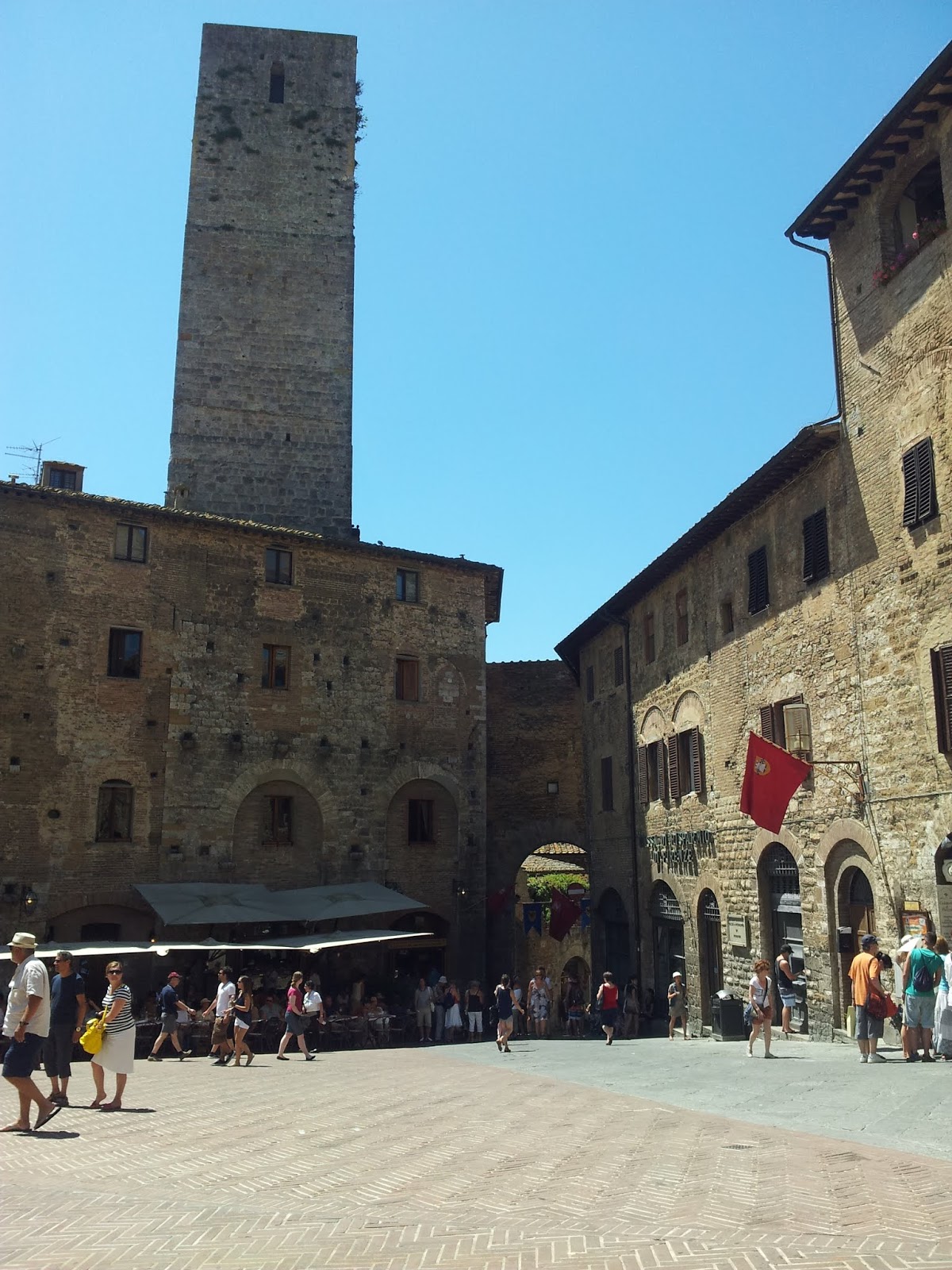
Part of the main piazza which is quite large, and on the right, the wishing well where my wish for a cooler day was not granted.

Officially, the Piazza della Cisterna is the most beautiful square of the town, San Gimignano.  The well was built in 1273 and enlarged in 1346 by Podestà Guccio dei Malavolti.

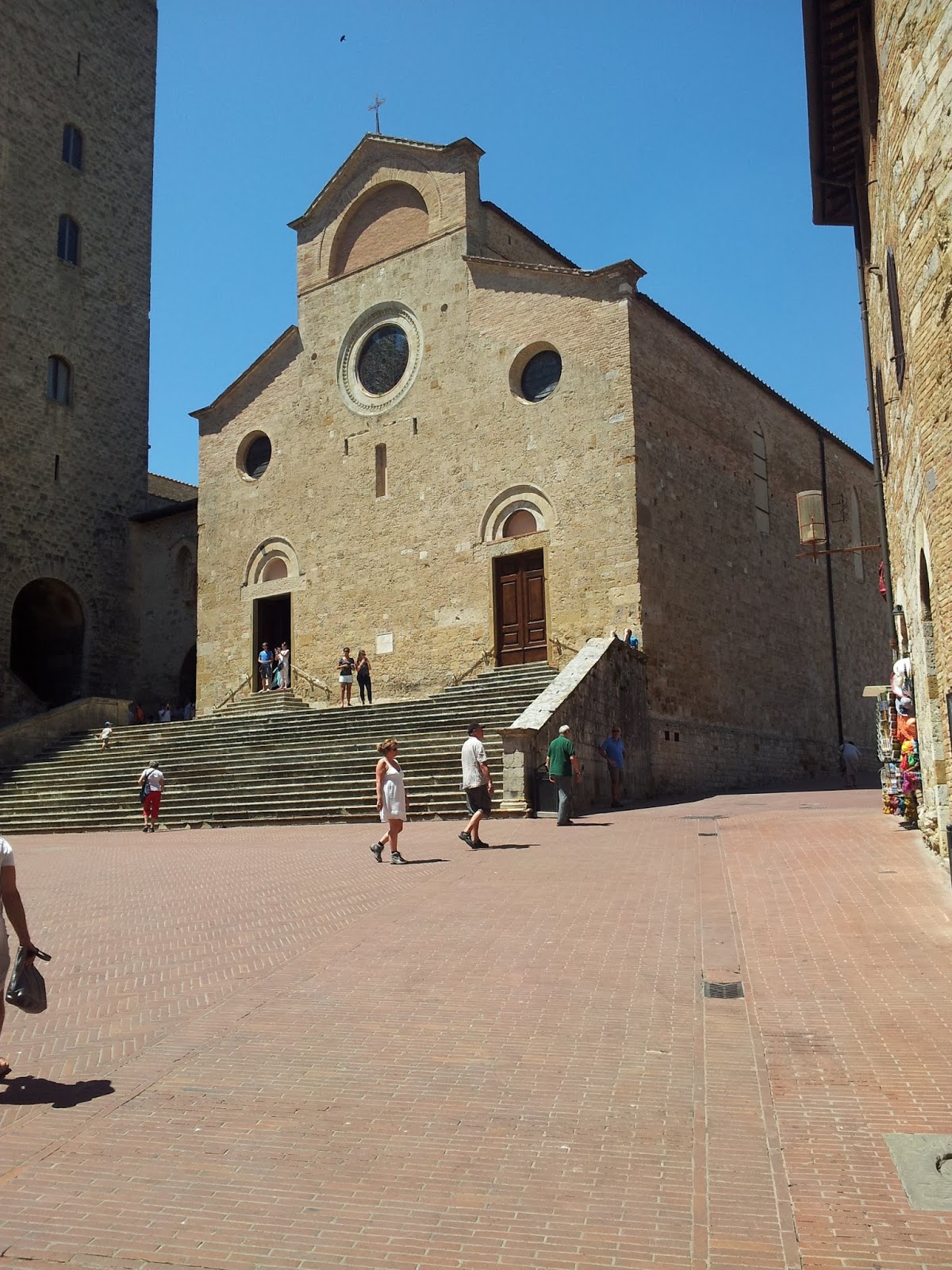
And not to be outdone by any other the other old towns, there is an old church, one of several.  It is the Collegiate Church or the Duomo di San Gimignano, a monument of Romanesque architecture built around 1000 and enlarged over time.

Next door is the Museum of Sacred Art.

And I guess it’s rather odd to see television aerials on top of houses that are quite literally about a thousand years old.  I wonder what they did back then for entertainment?

“Trouble in Store” – Short Stories my way: The end of the story

The stage is set for the big finale, though I’m not quite sure how ‘big’ it’s going to be.

Jack is ready to go having been given the green light by the girl with the gun.  It seems collateral damage is not on the agenda for her, though he does admit to himself she is between that proverbial rock and a hard place.

The storekeeper still has a plan, shaky at best, to regain hold of the situation, once the customer is out of the shop.  Nervy or not, he doesn’t think she had the capability to pull the trigger.  He knows what sort of person it takes to do that, and she isn’t one of them.

The policewoman is not sure what to expect but thinks that surprise is on her side, and whatever is going on, she will be able to resolve it.  She has her weapon drawn and ready to use.  She had yet to shoot anyone with it

The girl is at the point of no return, that point where she had nothing left to lose.  Anything she had before was gone, destroyed by the choices she’d made.  No one ever handed out a manual on how you should live your life, or provide a list of people you should avoid, and her father’s prophetic words the last time they men came home with a thud, ‘your life is defined by the choices you make’.

She was not going to jail so it was going to be death or glory.


Now read on:


Jack had heard there were moments where, in a split second, your whole life flashes before your eyes.  He did, and what he saw he didn’t like.

But, then, neither was he very happy about the fact he was nearly out the door before the policewoman on the other side crashed into him and sent him sprawling to the floor.

That was about the same fraction of a second he heard the gun go off, twice, or so he thought and knew he was a dead man, waiting for the bullet.

Another fraction of a second passed as the policewoman tried to unravel the mess they’d become, and at that moment in time felt the tugging at his sleeve and then, as if in slow motion, the sound of the glass door disintegrating behind him.


Annalisa was quite prepared to let the customer go.

She kept one eye on the shopkeeper and one on the customer, sidling towards the door.  The gun was ready to shoot the first person who made a wrong move.

Or so she told herself.  It was getting heavy in her hand, she was shaking almost uncontrollably now, and was getting more and more frightened of the consequences.  She didn’t think, if she aimed, she could hit the side of a barn let alone a person standing ten feet away from her.

The customer reached the door.

At exactly the moment he put his hand 0on the door handle to open the door, another person was pushing the door, trying to make their way in.

With force.

She saw the blue cap, guess it was the police, though she hadn’t heard the siren, but also guessed the shopkeeper might have a silent alarm.

Damn.

A single shot, instantly in the direction of the door, not necessarily aimed at the two people now collapsing to the floor in a tangled mess, but at the door itself.

The impact, yet another guess, might shatter the glass and make it easier to escape.

After one more job.

The hell with Simmo.  He’d dragged her down the rabbit hole far enough.  Simmo knew her first name, that she had rich parents, but nothing else.  Besides, he was in such bad shape she didn’t think he’d recover.

The shopkeeper had no idea who she was, it was the first time she’d been to his shop, and now, after a few weeks with Simmo, not ever her mother would recognize her.

She swiveled the gun and aimed it at the shopkeeper and pulled the trigger.,  One less dealer in the city was good news not bad.

She saw it hit, not exactly where, but it caused him to twist and start falling to the ground, at the same time letting out a very loud scream.  Panic or anger?

She wasn’t waiting to find out.

A last glance at Simmo, now down for the count, she ran for the door, past the two on the floor, what she could now see was a policewoman with her weapon drawn, but unable to use it.

She crashed through the remainder of the glass shards put into the street and ran.

In the distance she could hear a police car coming, siren blaring.  A warning if there was ever one to run harder, up the road, down an alley, out into another street, then down into the subway.

Gone.


It took fifteen seconds to disentangle herself from the customer, pushing him away, and getting to her feet, weapon aimed.

At nothing but air.

The girl had gone, and then she had the vague recollection of a shadow passing her as she was facing the other way getting to her feet.

And running out the door.

Five more valuable seconds as her brain processed this piece of information before it issued the command to go out the door and see which way she went.

Another ten seconds to get out the door, and see the police car coming from the same direction she had earlier, screeching to a halt outside the shop, a car door opening, and an officer getting out.

Margaret was guessing at the driver to drive down the road where she guessed the girl had run, managing to yell breathlessly at the office getting out, “She’s gone that way,” and pointing.

The officer relayed the message and closed the door as the car sped off.

“What happened?”

“Shots fired by a woman, more a girl, in the process of a robbery.”

She ran back inside the officer following.

The customer had moved to a corner and was standing, testing his limbs, with an expression that said he was amazed he was still alive.

“Over behind the counter.  She shopkeeper.  He was standing there.”

The policeman rounded the end of the counter and looked down.  “He’s here.  It’s not looking good.”

Margaret didn’t hear him.  She was calling an ambulance.


Next:  Perhaps some editing


© Charles Heath 2016-2020


‘Sunday in New York’ – A beta reader’s view

I’m not a fan of romance novels but …

There was something about this one that resonated with me.

This is a novel about a world generally ruled by perception, and how people perceive what they see, what they are told, and what they want to believe.

I’ve been guilty of it myself as I’m sure we all have at one time or another.

For the main characters Harry and Alison there are other issues driving their relationship.

For Alison, it is a loss of self-worth through losing her job and from losing her mother and, in a sense, her sister.

For Harry, it is the fact he has a beautiful and desirable wife, and his belief she is the object of other men’s desires, and one in particular, his immediate superior.

Between observation, the less than honest motives of his friends, a lot of jumping to conclusions based on very little fact, and you have the basis of one very interesting story.

When it all comes to a head, Alison finds herself in a desperate situation, she realises only the truth will save their marriage.

But is it all the truth?

What would we do in similar circumstances?

Rarely does a book have me so enthralled that I could not put it down until I knew the result. They might be considered two people who should have known better, but as is often the case, they had to get past what they both thought was the truth.

And the moral of this story, if it could be said there is one, nothing is ever what it seems.

Available on Amazon here: amzn.to/2H7ALs8

The cinema of my dreams – I always wanted to go on a treasure hunt – Episode 13

Here’s the thing…

Every time I close my eyes, I see something different.

I’d like to think the cinema of my dreams is playing a double feature but it’s a bit like a comedy cartoon night on Fox.

But these dreams are nothing to laugh about.

Once again there’s a new instalment of an old feature, and we’re back on the treasure hunt.

I stood at the entrance and counted to ten, then pushed the door open and went in.

I was not sure what I was expecting, but it was not what I saw.  A country and western bar, with decorations that made you think you were in Texas, booths and tables elegantly set under subdued lighting, and well dressed serving staff serving customers.

Across the back was a long bar, and a bottle of every known drink known to mankind behind it, and two bartenders, looking busy.  Several people were sitting at the bar, including Nadia, who was by herself, having a shot glass, no doubt with tequila, and beer put in front of her.

No one even looked up to note my arrival.

It took a minute to scan the customers I could see, and not recognise any of them, except they were not of the scoundrel variety, and whether or not there was another exit if I needed one.

Always an emergency exit near the restrooms and I could see them in the distance.

Another look around, then I crossed the room, weaving through the tables, to where Nadia was sitting.  She hadn’t noticed my arrival.

“This seat taken?” I asked.

A quick turn of the head and I could see the rebuke on her lips.  Then surprise on her face.

“Smidge.  What are you doing here?”

“You keep asking me that question every time we meet.”

“Perhaps we should stop meeting like this.”  She turned back to the bar and downed the shot glass contents.  “Sit if you must.”

I had expected the back of her hand to slap me to the floor for daring to talk to her, but instead sat before she changed her mind.

“Same question,” she said, still not looking at me.

I’d try flippancy first and see how that went.  “Always wanted to come and see the famous Lantern Inn, but it doesn’t seem to be famous any more, well, not in that respect.”

She looked sideways at me.  “What if it had been?”

“Then I’m guessing this would have been a short encounter.”

“It still might be.”

OK, try not to be too brave, she could still beat me to a pulp with one hand tied behind her back.  “I doubt you want to cause a scene, and especially not with someone like me.”

She turned and looked at me.  Admittedly I was not the skinny assed punk I used to be, but still not her type.

“When did you go and grow up?”  At least, now, she didn’t tower over me, I could see eye to eye, literally and figuratively.

“While you were away.  Amazing what some sunshine and fertilizer will do.”

Was that a hint of a smile, or a grimace?

“Still a smart ass though.”

“You haven’t changed much either.”  Short skirt, low cut top, she’d been wearing a coat when she came in.  Hair was shorter and with a fringe.  Didn’t suit her.  “What happened to this place?”

“The last Mayor cleaned up the waterfront, most of it anyway.”

And died, rather ironically, in the crossfire between the two rival gangs in this very place.  Nothing like killing a public official, corrupt or not, to precipitate a cleanup.  It just sent the gangs into darker corners.

“Why are you here, then?”  I had to ask.

“I’m respectable.”  A nod to the bartended got another shot of tequila.

For me, a Budweiser.

“So does that mean you’re dating a Benderby?”  For her, it would be the only type of respectability she could have in a town like ours unless she moved away to somewhere no one knew who she was.

“Not if they were the last family on earth.”

“So, what’s he got on you?”

She turned much faster this time to look at me, sliding off the chair and standing over me.  There was not a pretty look on her face.

I tried not to exhibit signs of fear and failed.

“Who told you that?”

“No one.”  I took a deep breath to get the tremor out of my voice.  “They got the dirt on everyone, so why should you be an exception?”

I slipped of my chair and stood toe to toe with her.

For a person with an ugly soul, she had beautiful eyes.

Then she leaned forward those last six inches and kissed me briefly on the lips.  Hers was cold.

“What do you really want Smidge?”  She pulled back, and sat down again, picking up the beer and taking a sip.

“To get payback on Alex.”

“And you think I’ll help you?”

“Well, you need a map, and I don’t think you want to cosy up to Rico, do you?”

I had just put together a plan, shaky at best, highly dangerous at worst, but it might work.  It didn’t have to be the real map, just one that was close enough to the real thing.

She reached into her purse and pulled out a key, and slid it across the bar towards me.

Room 14 at the Shingle Hotel.   Where they used to have rooms to rent by the hour.  And cockroaches, people not the bugs, in every corner.

“One hour.  Now leave.”

I heard the door open and close and looked back through the mirror behind the bar.  A large man with a beard and dark glasses.  In a gloomy restaurant.

Her date?

I took the key and left, trying to look like I was not leaving in a hurry.

© Charles Heath 2019-2021