The story behind the story: A Case of Working With the Jones Brothers

To write a private detective serial has always been one of the items at the top of my to-do list, though trying to write novels and a serial, as well as a blog, and maintain a social media presence, well, you get the idea.

But I made it happen, from a bunch of episodes I wrote a long, long time ago, used these to start it, and then continue on, then as now, never having much of an idea where it was going to end up, or how long it would take to tell the story.

That, I think is the joy of ad hoc writing, even you, as the author, have as much idea of where it’s going as the reader does.

It’s basically been in the mill since 1990, and although I finished it last year, it looks like the beginning to end will have taken exactly 30 years.  Had you asked me 30 years ago if I’d ever get it finished, the answer would be maybe?

My private detective, Harry Walthenson

I’d like to say he’s from that great literary mold of Sam Spade, or Mickey Spillane, or Phillip Marlow, but he’s not.

But, I’ve watched Humphrey Bogart play Sam Spade with much interest, and modeled Harry and his office on it.  Similarly, I’ve watched Robert Micham play Phillip Marlow with great panache, if not detachment, and added a bit of him to the mix.

Other characters come into play, and all of them, no matter what period they’re from, always seem larger than life.  I’m not above stealing a little of Mary Astor, Peter Lorre or Sidney Greenstreet, to breathe life into beguiling women and dangerous men alike.

Then there’s the title, like

The Case of the Unintentional Mummy – this has so many meanings in so many contexts, though I image back in Hollywood in the ’30s and ’40s, this would be excellent fodder for Abbott and Costello

The Case of the Three-Legged Dog – Yes, I suspect there may be a few real-life dogs with three legs, but this plot would involve something more sinister.  And if made out of plaster, yes, they’re always something else inside.

But for mine, to begin with, it was “The Case of the …”, because I had no idea what the case was going to be about, well, I did, but not specifically.

Then I liked the idea of calling it “The Case of the Brother’s Revenge” because I began to have a notion there was a brother no one knew about, but that’s stuff for other stories, not mine, so then went the way of the others.

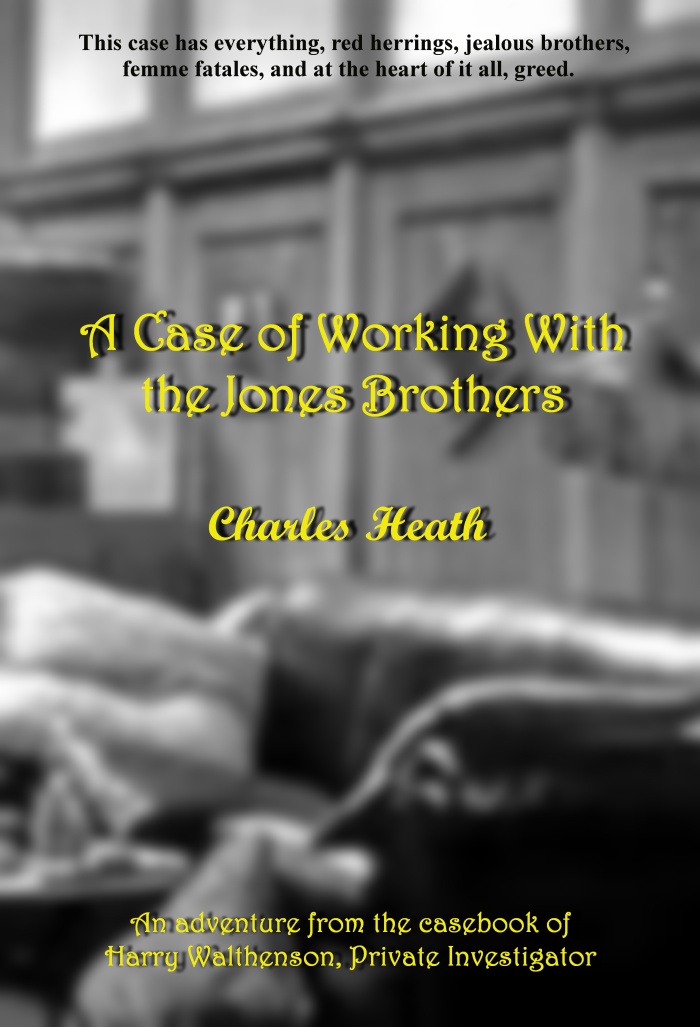
Now it’s called ‘A Case of Working With the Jones Brothers’, finished the first three drafts, and at the editor for the last.

I have high hopes of publishing it in early 2021.  It even has a cover.

PIWalthJones1

It’s all about the Cover

And, of course, the description.

Probably one of the hardest things for a first-time author is not so much the writing but what is needed after the book is written.

You need a good description.  Short, sharp, incisive!

There’s a ream of advice out there, and I have read it all.

And, still, I got it wrong.

Then there is the cover.

I wanted simplistic, a short description to give the reader a taste of what’s in store, and let the story speak for itself.

No.

Apparently, a good cover will attract the reader to the book.

When I tendered my books on various sites to advertise them, sites such as Goodreads, and ThirdScribe, all was well with what I had done.

Then I submitted my books to a third site and they rejected the covers as too simplistic and the descriptions mundane, and wouldn’t post them.

Wow.

There’s a huge blow to the ego.  And just the sort of advice that would make a writer think twice about even bothering to continue.

But…

Perhaps the person who wrote that critique was being cruel to be kind.

At any rate, I am changing the covers, and rewording the descriptions.

Will it be a case of ‘what a difference a cover makes’?

Writing about writing a book – Day 33

So, it seems there’s going to be a few problems at work.  People are dying and no one really knows why.

Perhaps it has something to do with the computer systems and the network.  In the time this novel is set, networking personal computers was in its infancy and a veritable rabbit hole to go down.

We need to throw in a bit more background and involve others, but to what extent should these other people have influence over the storyline?

This is why there are puzzling aspects of Richardson’s death, and why is Aitchison so interested?

Says Aitchison…

“I knew the man better than most.  But even if he was going through a bad patch, and he was a little down, he would not have killed himself, not the way it was presented in his office.  The gun was in the wrong hand, his left hand.  He was ambidextrous to a certain point, left-handed in some cases, right-handed in others.  I knew for a fact he could only shoot with his right hand.  Same as golf.  But most people here would have seen him use only his left hand.”

I let his words sink in for a moment.  How could he possibly know what hand Richardson used for what purpose?  Perhaps golf because it was open to Company employees of any level, but shooting?

It came out of my mouth before I could stop it.  “How …”

“..do I know about his shooting hand?  I ran into him once at the range.  I used to shoot a few skeets back in the day.  Eyesight has gone to pot these days, so it’s been a while.”  The last part was related more for his own benefit.

Good enough answer.  I didn’t know Aitchison was a shooter.  The office grapevine wasn’t as extensively knowledgeable as it purported to be.

“Then is it possible someone here killed him?”

“Like the woman he was supposedly having an affair or her jealous husband?”  He laughed, and it wasn’t a particularly nice one.  “The mystery woman he was spending time with was his daughter.  He asked me to get her a job, but not to let on that he knew her.  Didn’t want her to think he was meddling in her affairs, and that anyone else would see it as favors from the executive to certain employees.”

Aitchison’s voice shook, and he poured another drink to try and steady his nerves.  He was agitated, I could see that.  And he had evidence that the police would need to help solve this crime.  Yet, by the way, he was talking; I don’t think he believed any of what he had just told me would be deemed as relevant.

And I was yet to see a reason why this would affect him so.

“Have you told the police this?

“Yes, but the detective they sent this morning wasn’t interested.”

Perhaps he was writing more into it than there was.  I didn’t know what to say and tried to look noncommittal.  Then he looked at me with a piercing stare, like the thought had just occurred to him.  “You two clashed, heatedly at times.  Did you do this?

Perhaps not quite the question I was expecting from him or anyone.

I was innocent, but I had one of those faces when someone puts a question to you rather abruptly, that reddened, either with embarrassment or guilt.  I had very little control over it.

But to be accused of murder?

I had an alibi; I was home alone in bed trying to sleep.  OK.  It was shaky but the truth.

“No.  Why would I?”

If I was going to kill anyone in this place, it would be Benton, or even Kowalski, another thorn in my side.  Richardson was not on the list, and never would be.  He was just old and pedantic, set in his ways.  He clashed with everyone at one time or another.  In my case, he was just cranky because I replaced his pen and paper accounting with a new application on that computer he refused to use.

He nodded to himself.  “I thought not, but I had to ask.”

He stood and went over to the window and looked out.  Taking time, I guessed, to collect his thoughts.  He remained there with his back to me for a few minutes.  It didn’t seem to be a long time.

Then he said, quietly, “It appears there’s something else going on, something that none of us in the Executive know anything about.”

I was not sure I liked the sound of that or the fact he was telling me.  This was not something I should be privy to.  But that still didn’t stop me from asking, “Like what for instance?”

“The existence of another network.”

“What do you mean?”  Another network?  There was only one.  I had seen it installed, and went through the teething process of getting it up and running, as every bit as hard as bringing a new baby into the world.

I would know if there was another network.  Wouldn’t I?

“Apparently there is supposedly another network of computers running in this office.  I have only the word of a policeman by the name of Chief Inspector Gator, a computer expert, and a consultant from Interpol.  How the hell did this information get to Interpol, of all people?”

I couldn’t tell him.  This was news to me.

“What evidence have they got that this ‘other network’ exists?”

“Intercepted telephone calls reporting a connection error to a network system by the name of Starburst.  There was a log entry on Richardson’s computer referring to it, about the time of a power failure last night.  The computer expert is down in the server room now looking for this other network.”

He swiveled around and looked down at me with a thunderous expression.  “You didn’t set anything up for Halligan, did you?”

“No.”

I was surprised he asked.  We had a discussion some months ago about the fact most of the AGM’s came directly to me to sort out their computer issues.  Halligan was the worst of all of them, using his position to browbeat me into doing work that could only be described as off-book.  Whilst strictly speaking, as AGM – Information Technology, Halligan was quite within his purview to make such requests; it was the security aspects that had to be signed off on before executing such requests.  It added a new level of pain to the approvals process and had made Halligan an enemy of both Aitchison and myself, even though I had nothing to do with it.

The problem was, like all members of the Executive, Halligan was his own worst enemy.  Each of their areas of responsibility was like fiefdoms, and none of them like the others to encroach on their territory.  Halligan’s was the only area that had a shared responsibility with security.  Soon after the new arrangements were put in place, and the fact I had been left off the list of people to be informed, Halligan had asked me to do some work, and not aware of any change in procedure, did it.

Then, playing the usual game of one-upmanship, Halligan told the Executive of the new initiative and left a smoldering Aitchison in his wake.  In the end, all it did was cause me trouble, a severe reprimand, and no apology for being left off the distribution list informing of the new arrangements.

It was still a raw nerve and he had touched it.

© Charles Heath 2015-2021

A blank look means you’re in another world

I can see how it is that a writer’s life can be a lonely one.  That’s why, I guess, so many writers have an animal as a pet, someone to talk to, or just feel as though you are not alone in this quest.

I’m often sitting in front of the computer screen, or in a large lounge chair with my trusty tablet computer, writing the words, or staring into space!

Sometimes the words don’t make any sense, sometimes the thoughts leading to those words don’t make any sense.

Sometimes the most sensible person in the room is the cat.

I’m sure his thoughts are not vague or scrambled, or wrestling with the ploys of several stories on the go, getting locations right, getting characters to think and do their thing with a fair degree of continuity.

The cat’s world is one of which chair to lie on, where is that elusive mouse be it real or otherwise, and is this fool going to feed me, and please, please, don’t let it be the lasagna.  I am not that cat!

Unlike other professions, there is no 9 to 5, no overtime, no point where you can switch off and move into leisure time.  Not while you are writing that next masterpiece.  It’s a steady sometimes frustrating slog where you can’t just walk away, have a great time, and come back and pick up where you left off.

Stories have to be written from beginning to end, not a bit here and a bit there.

It’s a bit like running a marathon.  You are in a zone, the first few miles are the hardest, the middle is just getting the rhythm and breathing under control, and then you hope you get to the end because it can seem that you’ve been going forever and the end is never in sight.

But, when you reach the end, oh, isn’t the feeling one of pure joy and relief.

And, yes, perhaps you’ve just created another masterpiece!

“How could that possibly happen…” – A short story

I had hoped by the time I was promoted to assistant manager it might mean something other than long hours and an increase in pay.

It didn’t.

But unlike others who had taken the job, and eventually become jaded and left, I stayed. Something I realized that others seemed to either ignore or just didn’t understand, this was a company that rewarded loyalty.

It was why there were quite a few who had served 30 years or more. They might not reach the top job, but they are certainly well looked after.

I had a long way to go, having been there only 8 years, and according to some, on a fast track. I was not sure how I would describe this so-called ‘fast track’ other than being in the right place at the right time and making a judicial selection.

When it was my turn to be promoted, I had a choice of a plum department, or one most of my contemporaries had passed over. At the time, the words of my previous manager sprang to mind, that being a manager for the most sought-after department or the least sought-after, came with exactly the same privileges.

And, he was right. I took the least sought-after, much to their disdain and disapproval. One year on, that disapproval had turned almost to envy; that was when the Assistant Managers were granted a new privilege, tea, and lunch in the executive dining room.

“So, what’s it like?” John asked when our group met on a Friday night, this was the first after the privilege was granted.

He had been one of the three, including me, who had the opportunity to take the role. Both he and Alistair had both declined, prepared to wait for a more prestigious department. It hadn’t happened to them yet.

“The same as the staff dining room, only smaller. Except, I guess, the waitstaff and butler. They come and serve you when you have to go to them in the staff room. They’re the same staff, by the way, except for the butler.”

I could see the awe, or was it envy, in their eyes. “but it’s not that great. The Assistant Managers all sit at one end of the table, and we’re not part of the main group, so no sharing of information I’m afraid. And the meals are the same, just served on fancier crockery.”

“Then nothing to write home about?” Will was one of those who they also thought to be on a ‘fast track’. I was still trying to see how my ‘fast track’ was actually that fast.

“Put it this way, the extra pay doesn’t offset the long hours because you get overtime, I don’t, so on a good week, you’d all be earning more than me. Without responsibility, if anything goes wrong. I think that’s why Assistant Managers were created, to take the blame when anything goes wrong.”

That had been the hardest pill to swallow. Until I got the role, I hadn’t realized what it really involved. Nor had the others, and it was not something we could whinge about. My first-day introductory speech from Tomkins, my Manager, was all about taking responsibility, and how I was there to make his life easier. It was a speech he made a few times because he’d been Manager for the last 16 years, much the same as the others, and promotion if ever, would come when they died.

And Manager’s rarely died, because of their Assistant Managers.

“How old is Tomkins now?” Bert, a relative newcomer to our group, asked. He was still in the ‘in awe’ phase.

“About the same as Father Time,” I said. “But the reality is, no one knows, except perhaps for the personnel manager.” O looked over at Wally, the Personnel Department’s Assistant Manager. “Any chance of you telling us?”

“No. You know I can’t.”

“But you know?” I asked.

“Of course, but you know the rules. That’s confidential information. Not like what you are the custodian of, information everyone needs.”

Which, of course, was true. Communication and Secretarial Services had no secrets, except for twice a year when the company Bord of Directors met, and we were responsible for all the documents used at their meetings. Then, and only then, was I privy to all the secrets, including promotions. And be asked ‘What’s happening?’.

“Just be content to know that he’s as old as the hills, as most of them. It seems to me that one of the pre-requisites for managership is that you have been employed here for 30 years.”

Not all, though, I’d noticed, but there wasn’t one under the age of fifty.

And so it would go, the Friday night lament, those ‘in’ the executive, and those who were not quite there yet.
It seemed prophetic, in a sense, that we had been talking about Mangers and their ages. By a quirk of fate, some weeks before, that I learned of Tomkins’s currents state of health via a call on his office phone. At the time he was out, where, he had not told me, but by his the I believed it was something serious, so serious he didn’t want me, or anyone else, to know about it.

That phone call was from his wife, Eleanor, whom I’d met on a number of occasions when she came to take him home from work. I liked her, and couldn’t help but notice she was his exact opposite, Tomkins, silent and at times morose, and Eleanor, the life of the party. I could imagine her being a handful in her younger days, and it was a stark reminder of that old saying ‘opposites attract’.

She was concerned and asked me if he had returned from the specialist. I simply said he had but was elsewhere, and promised to get him to call her when he returned. Then I made a quick call around to see where he was and found that he was in Personnel. I left an innocuous message on his desk, and then let my imagination run wild.

At least for a day or so, the time it took for me to realize that it was probably nothing, the lethargy he’d been showing, gone.

I’d put it out of my mind until my cell phone rang, and it was from the Personnel Manager. On a Sunday, no less. In the few seconds before I answered it, I’d made the assumption that Tomkins’s secretive visits to the specialist meant he needed time off for a routine operation.

Greetings over, O’Reilly, the Personnel Manager, cut straight to the chase, “For your personal information, and not to be repeated, Tomkins will be out of action for about two months, and as that is longer than the standard period, you will become Acting Manager. We’ll talk more about this Tuesday morning.” Monday was a holiday.

All Assistant Managers knew the rules. Any absence of a manager for longer than a month, promotion to Acting Manager. Anything less, you sat in the office, but no change in title. There was one more rule, that in the event of the death of a manager, the assistant manager was immediately promoted to Manager. This had only happened once before. 70 years ago. If a manager retired, then the position of Manager was thrown open to anyone in the organization.

It was an intriguing moment in time.

Tuesday came, and as usual, I went into the office, with only one thought in mind, let the staff in the department know what was happening, of course, the moment I was given the approval to do so by Personnel.

Not a minute after I sat down, the phone rang. I picked it up, gave my name and greeting. It was met with a rather excitable voice of the Assistant Manager, Personnel, “I just got word from on high, you’ve been promoted to manager. How could that possibly happen…”

Then a moment later, as realization set in, “Unless…”

—-

© Charles Heath 2020-2021

Searching for locations: The apartments at Greve in Chianti, Tuscany, Italy

When we first planned to stay in Tuscany for a few days, we wanted to be in a central area.  We had thought of staying in Florence and making daily treks, but the tour operator we selected told us it would be better if we stayed closer to Arezzo.

We picked Greve in Chianti, and a place called Antico Pastificio, we booked a standard apartment with two bedrooms, and it was about as authentic Italian you could get.  The building we stayed in was the yellow pasta factory, and the apartment named ‘Iris’.

It was only steps away from the main square, shops, restaurants, and at the opposite end, the quaint ringing of church bells at various times during the day.

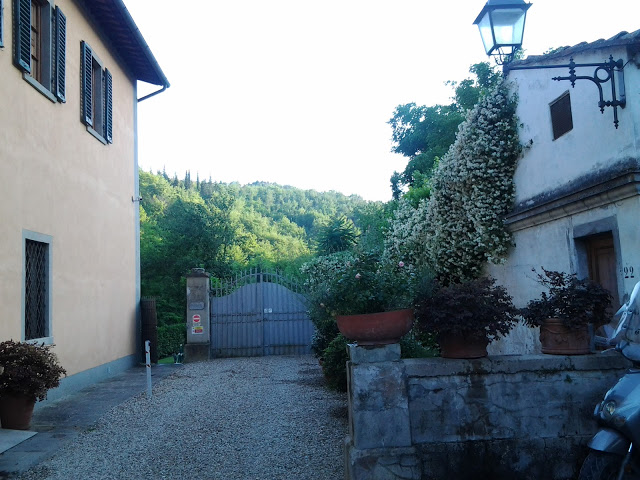
Gaining access was through a very narrow arch which required some deft driving and then up the road.  There were villas and two large apartment blocks.

You can just see the archway at the end of the road. 
This was the entrance to our room,

 along a passage and up the stairs, turning left at the top.

 Going straight ahead through the gate to the car park, 

and access to the grounds behind the buildings.

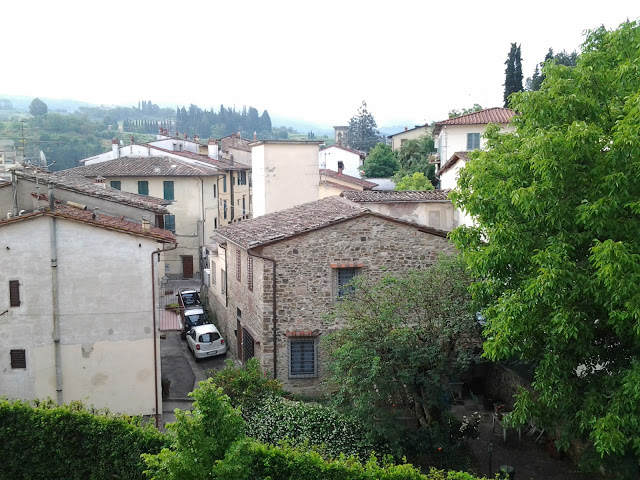
This was the view from the lounge/living room.  The days were hot, and on several evenings it rained, breaking the heat and making the evenings sitting by the window cool and refreshing.

 And the last view is looking towards the town piazza and the church

“Trouble in Store” – Short stories my way: Adding more to the second part

The story fleshed out for the second section, discussed in Point of View


Annalisa looked at the two men facing her, a shopkeeper who, despite his protestations, was a dealer, and the other man, a customer scared shitless.

The poor bastard was not the only one scared. 

It was meant to be simple, arrive at the shop just before closing, force the shopkeeper to hand over the shit, and leave.

What had happened?

The shopkeeper laughed at them and  told them to get out.  Simmo started ranting and waving the gun around, then all of a sudden collapsed. 

There was a race for the gun which spilled out of Simmo’s hand, and she won.  No more arguments, the shopkeeper was getting the stuff when the customer burst into the shop.

This was worse than any bad hair day, or getting out of the wrong side of bed day, this was, she was convinced, the last day of her life.

Her mother said she would never amount to anything, and here she was with a drug addict coming apart because she had been cut off from her money and could no longer pay for his supply, which had led them to this inevitable ending.

She heard a strange sound come from beside her and looked down.  Simmo was getting worse, like he had a fever, and was moaning.


If Alphonse had thought his day was going to get any better after the delivery disaster earlier that day, he was wrong.

If he thought he could maintain his real business and his under the counter business with no one finding out, in that he was wrong too.  He’s know, inevitably, some useless punk would come and do exactly what Simmo was doing.

It might have been salvageable before the customer came in the door, but now it was not.  The customer had heard the words, and given him ‘the look’.  A drug addict telling the cops he was a dealer, it was his word against an  unreliable addict, but this local chap, he had that air of respectability the cops would listen too.

Damn.

But he had to try and salvage the situation, there was a lot of money involved, and other people depending on him.  He looked at the boy, on the floor, then  the girl.

“Listen to me, young lady, I have no idea what you are talking about.  Please, put the gun down before someone gets hurt.  Your friend needs medical help and I can call an ambulance.”

The girl switched her attention back to him.  “Shut up, let me think.  Shit.”

The storekeeper glanced over at the customer.  He’s been in once or twice, probably lived in the neighborhood, but looked the sort who’d  prefer to be anywhere but in his shop.  More so now.  If only he hadn’t burst in when he did.  He would have the gun, called the police, and brazened his way out of trouble.  Now, that remedy was off the table.

Now he had to deal with the fallout, especially if the girl started talking.


© Charles Heath 2016-2020

An excerpt from “One Last Look”: Charlotte is no ordinary girl

This is currently available at Amazon herehttp://amzn.to/2CqUBcz

I’d read about out-of-body experiences, and like everyone else, thought it was nonsense.  Some people claimed to see themselves in the operating theatre, medical staff frantically trying to revive them, and being surrounded by white light.

I was definitely looking down, but it wasn’t me I was looking at.

It was two children, a boy and a girl, with their parents, in a park.

The boy was Alan.  He was about six or seven.  The girl was Louise, and she was five years old.  She had long red hair and looked the image of her mother.

I remember it now, it was Louise’s birthday and we went down to Bournemouth to visit our Grandmother, and it was the last time we were all together as a family.

We were flying homemade kites our father had made for us, and after we lay there looking up at the sky, making animals out of the clouds.  I saw an elephant, Louise saw a giraffe.

We were so happy then.

Before the tragedy.

When I looked again ten years had passed and we were living in hell.  Louise and I had become very adept at survival in a world we really didn’t understand, surrounded by people who wanted to crush our souls.

It was not a life a normal child had, our foster parents never quite the sort of people who were adequately equipped for two broken-hearted children.  They tried their best, but their best was not good enough.

Every day it was a battle, to avoid the Bannister’s and Archie in particular, every day he made advances towards Louise and every day she fended him off.

Until one day she couldn’t.

Now I was sitting in the hospital, holding Louise’s hand.  She was in a coma, and the doctors didn’t think she would wake from it.  The damage done to her was too severe.

The doctors were wrong.

She woke, briefly, to name her five assailants.  It was enough to have them arrested.  It was not enough to have them convicted.

Justice would have to be served by other means.

I was outside the Bannister’s home.

I’d made my way there without really thinking, after watching Louise die.  It was like being on autopilot, and I had no control over what I was doing.  I had murder in mind.  It was why I was holding an iron bar.

Skulking in the shadows.  It was not very different from the way the Bannister’s operated.

I waited till Archie came out.  I knew he eventually would.  The police had taken him to the station for questioning, and then let him go.  I didn’t understand why, nor did I care.

I followed him up the towpath, waiting till he stopped to light a cigarette, then came out of the shadows.

“Wotcha got there Alan?” he asked when he saw me.  He knew what it was, and what it was for.

It was the first time I’d seen the fear in his eyes.  He was alone.

“Justice.”

“For that slut of a sister of yours.  I had nuffing to do with it.”

“She said otherwise, Archie.”

“She never said nuffing, you just made it up.”  An attempt at bluster, but there was no confidence in his voice.

I held up the pipe.  It had blood on it.  Willy’s blood.  “She may or may not have Archie, but Willy didn’t make it up.  He sang like a bird.  That’s his blood, probably brains on the pipe too, Archie, and yours will be there soon enough.”

“He dunnit, not me.  Lyin’ bastard would say anything to save his own skin.”  Definitely scared now, he was looking to run away.

“No, Archie.  He didn’t.  I’m coming for you.  All of you Bannisters.  And everyone who touched my sister.”

It was the recurring nightmare I had for years afterwards.

I closed my eyes and tried to shut out the thoughts, the images of Louise, the phone call, the visit to the hospital and being there when she succumbed to her injuries.  Those were the very worst few hours of my life.

She had asked me to come to the railway station and walk home with her, and I was running late.  If I had left when I was supposed to, it would never have happened and for years afterwards, I blamed myself for her death.

If only I’d not been late…

When the police finally caught the rapists, I’d known all along who they’d be; antagonists from school, the ring leader, Archie Bannister, a spurned boyfriend, a boy whose parents, ubiquitously known to all as ‘the Bannister’s, dealt in violence and crime and who owned the neighbourhood.  The sins of the father had been very definitely passed onto the son.

At school, I used to be the whipping boy, Archie, a few grades ahead of me, made a point of belting me and a few of the other boys, to make sure the rest did as they were told.  He liked Louise, but she had no time for a bully like him, even when he promised he would ‘protect’ me.

I knew the gang members, the boys who tow-kowed to save getting beaten up, and after the police couldn’t get enough information to prosecute them because everyone was too afraid to speak out, I went after Willy.  There was always a weak link in a group, and he was it.

He worked in a factory, did long hours on a Wednesday and came home after dark alone.  It was a half mile walk, through a park.  The night I approached him, I smashed the lights and left it in darkness.  He nearly changed his mind and went the long way home.

He didn’t.

It took an hour and a half to get the names.  At first, when he saw me, he laughed.  He said I would be next, and that was four words more than he knew he should have said.

When I found him alone the next morning I showed him the iron bar and told him he was on the list.  I didn’t kill him then, he could wait his turn, and worry about what was going to happen to him.

When the police came to visit me shortly after that encounter, no doubt at the behest of the Bannister’s, the neighbourhood closed ranks and gave me an ironclad alibi.  The Bannister’s then came to visit me and threatened me.  I told them their days were numbered and showed them the door.

At the trial, he and his friends got off on a technicality.  The police had failed to do their job properly, but it was not the police, but a single policeman, corrupted by the Bannisters.

Archie could help but rub it in my face.  He was invincible.

Joe Collins took 12 bullets and six hours to bleed out.  He apologized, he pleaded, he cried, he begged.  I didn’t care.

Barry Mills, a strong lad with a mind to hurting people, Archie’s enforcer, almost got the better of me.  I had to hit him more times than I wanted to, and in the end, I had to be satisfied that he died a short but agonizing death.

I revisited Willy in the hospital.  He’d recovered enough to recognize me, and why I’d come.  Suffocation was too good for him.

David Williams, second in command of the gang, was as tough and nasty as the Bannisters.  His family were forging a partnership with the Bannister’s to make them even more powerful.  Outwardly David was a pleasant sort of chap, affable, polite, and well mannered.  A lot of people didn’t believe he could be like, or working with, the Bannisters.

He and I met in the pub.  We got along like old friends.  He said Willy had just named anyone he could think of, and that he was innocent of any charges.  We shook hands and parted as friends.

Three hours later he was sitting in a chair in the middle of a disused factory, blindfolded and scared.  I sat and watched him, listened to him, first threatening me, and then finally pleading with me.  He’d guessed who it was that had kidnapped him.

When it was dark, I took the blindfold off and shone a very bright light in his eyes.  I asked him if the violence he had visited upon my sister was worth it.  He told me he was just a spectator.

I’d read the coroner’s report.  They all had a turn.  He was a liar.

He took nineteen bullets to die.

Then came Archie.

The same factory only this time there were four seats.  Anna Bannister, brothel owner, Spike Bannister, head of the family, Emily Bannister, sister, and who had nothing to do with their criminal activities.  She just had the misfortune of sharing their name.

Archie’s father told me how he was going to destroy me, and everyone I knew.

A well-placed bullet between the eyes shut him up.

Archie’s mother cursed me.  I let her suffer for an hour before I put her out of her misery.

Archie remained stony-faced until I came to Emily.  The death of his parents meant he would become head of the family.  I guess their deaths meant as little to him as they did me.

He was a little more worried about his sister.

I told him it was confession time.

He told her it was little more than a forced confession and he had done nothing to deserve my retribution.

I shrugged and shot her, and we both watched her fall to the ground screaming in agony.  I told him if he wanted her to live, he had to genuinely confess to his crimes.  This time he did, it all poured out of him.

I went over to Emily.  He watched in horror as I untied her bindings and pulled her up off the floor, suffering only from a small wound in her arm.  Without saying a word she took the gun and walked over to stand behind him.

“Louise was my friend, Archie.  My friend.”

Then she shot him.  Six times.

To me, after saying what looked like a prayer, she said, “Killing them all will not bring her back, Alan, and I doubt she would approve of any of this.  May God have mercy on your soul.”

Now I was in jail.  I’d spent three hours detailing the deaths of the five boys, everything I’d done; a full confession.  Without my sister, my life was nothing.  I didn’t want to go back to the foster parents; I doubt they’d take back a murderer.

They were not allowed to.

For a month I lived in a small cell, in solitary, no visitors.  I believed I was in the queue to be executed, and I had mentally prepared myself for the end.

Then I was told I had a visitor, and I was expecting a priest.

Instead, it was a man called McTavish. Short, wiry, and with an accent that I could barely understand.

“You’ve been a bad boy, Alan.”

When I saw it was not the priest I told the jailers not to let him in, I didn’t want to speak to anyone.  They ignored me.  I’d expected he was a psychiatrist, come to see whether I should be shipped off to the asylum.

I was beginning to think I was going mad.

I ignored him.

“I am the difference between you living or dying Alan, it’s as simple as that.  You’d be a wise man to listen to what I have to offer.”

Death sounded good.  I told him to go away.

He didn’t.  Persistent bugger.

I was handcuffed to the table.  The prison officers thought I was dangerous.  Five, plus two, murders, I guess they had a right to think that.  McTavish sat opposite me, ignoring my request to leave.

“Why’d you do it?”

“You know why.”  Maybe if I spoke he’d go away.

“Your sister.  By all accounts, the scum that did for her deserved what they got.”

“It was murder just the same.  No difference between scum and proper people.”

“You like killing?”

“No-one does.”

“No, I dare say you’re right.  But you’re different, Alan.  As clean and merciless killing I’ve ever seen.  We can use a man like you.”

“We?”

“A group of individuals who clean up the scum.”

I looked up to see his expression, one of benevolence, totally out of character for a man like him.  It looked like I didn’t have a choice.

Trained, cleared, and ready to go.

I hadn’t realized there were so many people who were, for all intents and purposes, invisible.  People that came and went, in malls, in hotels, trains, buses, airports, everywhere, people no one gave a second glance.

People like me.

In a mall, I became a shopper.

In a hotel, I was just another guest heading to his room.

On a bus or a train, I was just another commuter.

At the airport, I became a pilot.  I didn’t need to know how to fly; everyone just accepted a pilot in a pilot suit was just what he looked like.

I had a passkey.

I had the correct documents to get me onto the plane.

That walk down the air bridge was the longest of my life.  Waiting for the call from the gate, waiting for one of the air bridge staff to challenge me, stepping onto the plane.

Two pilots and a steward.  A team.  On the plane early before the rest of the crew.  A group that was committing a crime, had committed a number of crimes and thought they’d got away with it.

Until the judge, the jury and their executioner arrived.

Me.

Quick, clean, merciless.  Done.

I was now an operational field agent.

I was older now, and I could see in the mirror I was starting to go grey at the sides.  It was far too early in my life for this, but I expect it had something to do with my employment.

I didn’t recognize the man who looked back at me.

It was certainly not Alan McKenzie, nor was there any part of that fifteen-year-old who had made the decision to exact revenge.

Given a choice; I would not have gone down this path.

Or so I kept telling myself each time a little more of my soul was sold to the devil.

I was Barry Gamble.

I was Lenny Buckman.

I was Jimmy Hosen.

I was anyone but the person I wanted to be.

That’s what I told Louise, standing in front of her grave, and trying to apologize for all the harm, all the people I’d killed for that one rash decision.  If she was still alive she would be horrified, and ashamed.

Head bowed, tears streamed down my face.

God had gone on holiday and wasn’t there to hand out any forgiveness.  Not that day.  Not any day.

New York, New Years Eve.

I was at the end of a long tour, dragged out of a holiday and back into the fray, chasing down another scumbag.  They were scumbags, and I’d become an automaton hunting them down and dispatching them to what McTavish called a better place.

This time I failed.

A few drinks to blot out the failure, a blonde woman who pushed my buttons, a room in a hotel, any hotel, it was like being on the merry-go-round, round and round and round…

Her name was Silvia or Sandra, or someone I’d met before, but couldn’t quite place her.  It could be an enemy agent for all I knew or all I cared right then.

I was done.

I’d had enough.

I gave her the gun.

I begged her to kill me.

She didn’t.

Instead, I simply cried, letting the pent up emotion loose after being suppressed for so long, and she stayed with me, holding me close, and saying I was safe, that she knew exactly how I felt.

How could she?  No one could know what I’d been through.

I remembered her name after she had gone.

Amanda.

I remembered she had an imperfection in her right eye.

Someone else had the same imperfection.

I couldn’t remember who that was.

Not then.

I had a dingy flat in Kensington, a place that I rarely stayed in if I could help it.  After five-star hotel rooms, it made me feel shabby.

The end of another mission, I was on my way home, the underground, a bus, and then a walk.

It was late.

People were spilling out of the pub after the last drinks.  Most in good spirits, others slightly more boisterous.

A loud-mouthed chap bumped into me, the sort who had one too many, and was ready to take on all comers.

He turned on me, “Watch where you’re going, you fool.”

Two of his friends dragged him away.  He shrugged them off, squared up.

I punched him hard, in the stomach, and he fell backwards onto the ground.  I looked at his two friends.  “Take him home before someone makes mincemeat out of him.”

They grabbed his arms, lifted him off the ground and took him away.

Out of the corner of my eye, I could see a woman, early thirties, quite attractive, but very, very drunk.  She staggered from the bar, bumped into me, and finished up sitting on the side of the road.

I looked around to see where her friends were.  The exodus from the pub was over and the few nearby were leaving to go home.

She was alone, drunk, and by the look of her, unable to move.

I sat beside her.  “Where are your friends?”

“Dunno.”

“You need help?”

She looked up, and sideways at me.  She didn’t look the sort who would get in this state.  Or maybe she was, I was a terrible judge of women.

“Who are you?” she asked.

“Nobody.”  I was exactly how I felt.

“Well Mr Nobody, I’m drunk, and I don’t care.  Just leave me here to rot.”

She put her head back between her knees, and it looked to me she was trying to stop the spinning sensation in her head.

Been there before, and it’s not a good feeling.

“Where are your friends?” I asked again.

“Got none.”

“Perhaps I should take you home.”

“I have no home.”

“You don’t look like a homeless person.  If I’m not mistaken, those shoes are worth more than my weekly salary.”  I’d seen them advertised, in the airline magazine, don’t ask me why the ad caught my attention.

She lifted her head and looked at me again.  “You a smart fucking arse are you?”

“I have my moments.”

“Have them somewhere else.”

She rested her head against my shoulder.  We were the only two left in the street, and suddenly in darkness when the proprietor turned off the outside lights.

“Take me home,” she said suddenly.

“Where is your place?”

“Don’t have one.  Take me to your place.”

“You won’t like it.”

“I’m drunk.  What’s not to like until tomorrow.”

I helped her to her feet.  “You have a name?”

“Charlotte.”

The wedding was in a small church.  We had been away for a weekend in the country, somewhere in the Cotswolds, and found this idyllic spot.  Graves going back to the dawn of time, a beautiful garden tended by the vicar and his wife, an astonishing vista over hills and down dales.

On a spring afternoon with the sun, the flowers, and the peacefulness of the country.

I had two people at the wedding, the best man, Bradley, and my boss, Watkins.

Charlotte had her sisters Melissa and Isobel, and Isobel’s husband Giovanni, and their daughter Felicity.

And one more person who was as mysterious as she was attractive, a rather interesting combination as she was well over retirement age.  She arrived late and left early.

Aunt Agatha.

She looked me up and down with what I’d call a withering look.  “There’s more to you than meets the eye,” she said enigmatically.

“Likewise I’m sure,” I said.  It earned me an elbow in the ribs from Charlotte.  It was clear she feared this woman.

“Why did you come,” Charlotte asked.

“You know why.”

Agatha looked at me.  “I like you.  Take care of my granddaughter.  You do not want me for an enemy.”

OK, now she officially scared me.

She thrust a cheque into my hand, smiled, and left.

“Who is she,” I asked after we watched her depart.

“Certainly not my fairy godmother.”

Charlotte never mentioned her again.

Zurich in summer, not exactly my favourite place.

Instead of going to visit her sister Isobel, we stayed at a hotel in Beethovenstrasse and Isobel and Felicity came to us.  Her husband was not with her this time.

Felicity was three or four and looked very much like her mother.  She also looked very much like Charlotte, and I’d remarked on it once before and it received a sharp rebuke.

We’d been twice before, and rather than talk to her sister, Charlotte spent her time with Felicity, and they were, together, like old friends.  For so few visits they had a remarkable rapport.

I had not broached the subject of children with Charlotte, not after one such discussion where she had said she had no desire to be a mother.  It had not been a subject before and wasn’t once since.

Perhaps like all Aunts, she liked the idea of playing with a child for a while and then give it back.

Felicity was curious as to who I was, but never ventured too close.  I believed a child could sense the evil in adults and had seen through my facade of friendliness.  We were never close.

But…

This time, when observing the two together, something quite out of left field popped into my head.  It was not possible, not by any stretch of the imagination, but I thought she looked like my mother.

And Charlotte had seen me looking in their direction.  “You seem distracted,” she said.

“I was just remembering my mother.  Odd moment, haven’t done so for a very long time.”

“Why now?”  I think she had a look of concern on her face.

“Her birthday, I guess,” I said, the first excuse I could think of.

Another look and I was wrong.  She looked like Isobel or Charlotte, or if I wanted to believe it possible, Melissa too.

I was crying, tears streaming down my face.

I was in pain, searing pain from my lower back stretching down into my legs, and I was barely able to breathe.

It was like coming up for air.

It was like Snow White bringing Prince Charming back to life.  I could feel what I thought was a gentle kiss and tears dropping on my cheeks, and when I opened my eyes, I saw Charlotte slowly lifting her head, a hand gently stroking the hair off my forehead.

And in a very soft voice, she said, “Hi.”

I could not speak, but I think I smiled.  It was the girl with the imperfection in her right eye.  Everything fell into place, and I knew, in that instant that we were irrevocably meant to be together.

“Welcome back.”

© Charles Heath 2016-2019

onelastlookcoverfinal2

The cinema of my dreams – I always wanted to go on a treasure hunt – Episode 15

Here’s the thing…

Every time I close my eyes, I see something different.

I’d like to think the cinema of my dreams is playing a double feature but it’s a bit like a comedy cartoon night on Fox.

But these dreams are nothing to laugh about.

Once again there’s a new instalment of an old feature, and we’re back on the treasure hunt.


Five minutes past the appointed time, I sat on the end of the clean bed and waited.  The single chair didn’t look very comfortable.

It didn’t worry me she was late, she had not specifically stated how long she would be, but to be there in an hour.  If she had business with dark glasses, then she might be a while.  Giving me the key to her room suggested she was not bringing him back with her.

There was a light rapping on the door, hinting at a sense of urgency.  Without looking,. I opened the door, and she slid through and I closed it quickly and quietly.

“I thought you might not be coming?”

I went to switch on the light, but heard her say, “No lights.”

My eyes were already adjusted to the light, or lack of light, and I could see her standing by the door to the bathroom.  Everything about her manner suggested she was ill at ease, or perhaps frightened of something or someone.

Or waiting for Vince, and had to string me along until he arrived.

“Why?”

“No one knows I’m here.”

“Not even Vince?”

“No.  Especially him.”

“He was here about twenty minutes ago, went into the office and came out with a briefcase.”

“I suggest you forget you ever saw that.”

Drugs then, or protection money, or…  OK forgotten.  “Duly forgotten as requested.”

“Is this pace one of the Cossatino’s places?”

“If you saw Vince, then it is.  It never used to be.  The Benderby’s used to bring their clients here, back in the day.  Vince had some of the rooms wired, you know, blackmail, that kind of stuff.”

I could imagine.  I’m sure the ‘clients’ never brought their wives here to have a good time.

“Why are you staying here?”

“Can’t stay at home.  Things have changed.  I’m not interested in working with the family business.  It’s why I left in the first place.”

Imagination running wild, I think I began feeling sorry for her.  Beautiful girl, stupid men, caught in a seedy hotel.  My respect for old man Cossatino just took a dive.

“Why come back then?”

“Alex.  He’s a bastard, just like his father.  All those Benderby’s are the same.  You say you’ve got a plan that might help get him off my back?”

She took off her coat and threw it on the bed with the other clothes.  It wasn’t that dark I couldn’t see her outline and had to look away.

“A possible plan.  One that might kill two birds with one stone.  I have to look out for Boggs because he had got himself into a mess that he doesn’t realise the full potential of yet.”

“The treasure map?”

“I wish people would stop calling it that.  It’s just a piece of paper with a drawing on it.  I’m sure the whole myth was concocted by Boggs’ father as another one of his schemes.”

Everyone knew Boggs father was a touch crazy and had come up with a number of schemes, some even calling the ‘get rich quick’ schemes, and one had landed him in jail.  He never quite understood the nature of the schemes he’d bought off other people in the hope of getting rich himself.  The treasure map, that was a new one for him, but one of his previous customers had caught up with him, and he’d not lived long enough to play this one out.

Boggs unfortunately, was doing it for him.

“You don’t think it’s real?”

“What I think is irrelevant.”

She moved closer and sat on the side of the bed, not far from me.

“So what is this plan?”

“I get you a copy of the map, you give it to Alex, see what he says.  You know you can’t trust him, or anything he says.”

She was too close, so I moved, trying to look like I was not moving.  But at the same moment, I had no idea what it was about her that scared me.  It was apparent she hadn’t told Vince about this meeting.

“It’s a chance I have to take, and you are right, I don’t want to cosy up to Rico.  I have had previous dealings with him, and he is not nice.  But, if you are willing to do this for me, what do you want in return?”

The inevitable question and I think I could guess what she thought I might want.  And that thought did cross my mind.

“Nothing.”

“That is not possible.  All men want something.”

“I’m not all men.  I owe Alex a little payback and this will be a small cog in a big wheel.  If it helps you, good, but I know the Benderby’s and nothing is easy with them.”

“This plan…”

“The less you know the better.”  I stood, and then moved to the door.  “I’m only going to be able to see you in the early hours of the morning.  I’m working an afternoon shift till midnight, and I don’t want to come here in the daylight.”

She stood and came over to join me.

“You are going to have to do something about Rico because Alex will ask him.”

It was something that also occurred to me just before she raised it.  I knew there was going to be a problem, I just hadn’t realised it at the time.  Now, it seemed like another of those insurmountable things.

“I’ll think of something.”

“Then soon.”  She put a piece of paper in my hand.  “My cell number.  Send me a text before you come.”  

Our hands touched briefly and it sent a shiver down my spine.

“I will.”

There was a moment, looking into her eyes where I didn’t want to leave, but fortunately, common sense kicked in, I opened the door and slipped out in the cold night air.  As it shut behind me I shivered.

It had nothing to do with the cold.


© Charles Heath 2019

“Sunday in New York”, a romantic adventure that’s not a walk in the park!

“Sunday in New York” is ultimately a story about trust, and what happens when a marriage is stretched to its limits.

When Harry Steele attends a lunch with his manager, Barclay, to discuss a promotion that any junior executive would accept in a heartbeat, it is the fact his wife, Alison, who previously professed her reservations about Barclay, also agreed to attend, that casts a small element of doubt in his mind.

From that moment, his life, in the company, in deciding what to do, his marriage, his very life, spirals out of control.

There is no one big factor that can prove Harry’s worst fears, that his marriage is over, just a number of small, interconnecting events, when piled on top of each other, points to a cataclysmic end to everything he had believed in.

Trust is lost firstly in his best friend and mentor, Andy, who only hints of impending disaster, Sasha, a woman whom he saved, and who appears to have motives of her own, and then in his wife, Alison, as he discovered piece by piece damning evidence she is about to leave him for another man.

Can we trust what we see with our eyes or trust what we hear?

Haven’t we all jumped to conclusions at least once in our lives?

Can Alison, a woman whose self-belief and confidence is about to be put to the ultimate test, find a way of proving their relationship is as strong as it has ever been?

As they say in the classics, read on!

Purchase:

http://tinyurl.com/Amazon-SundayInNewYork