The cinema of my dreams – I always wanted to go on a treasure hunt – Episode 20

Here’s the thing…

Every time I close my eyes, I see something different.

I’d like to think the cinema of my dreams is playing a double feature but it’s a bit like a comedy cartoon night on Fox.

But these dreams are nothing to laugh about.

Once again there’s a new instalment of an old feature, and we’re back on the treasure hunt.

As we all stood either on or off the boat, two things were clear to me.  The first, Rico’s genuine surprise at finding the body on his boat, and the second, how quickly the authorities had circled in for the kill.

I know calling 911 was supposed to get a rapid response to dire situations, but to get from the police station to the pier would take at least five minutes longer than it had, and that was breaking all the speed limits.

I might be jumping to conclusions, but someone wanted Rico to be found with an unexplainable body.  His recently departed friend’s maybe?

Johnson waited until the officer off the boat had finished his call, and asked, “What are we doing here?”

It was now obvious the men on the boat was either state police, the coast guard, or some Federal branch-like FBI or, if Rico was suspected of dealing or trafficking drugs, the DEA.

“Take him into custody.  Some of our people will be along to sit in on the questioning.  This is an FBI crime scene and we’ll take it from here.”

“These two?”  Johnson nodded in our direction.

“They’ve just found themselves in the wrong place at the wrong time.  Cut them loose, they have nothing to do with this, other than to contaminate our crime scene.”

And that was it, more men, this time in white overalls, came up from below the deck of the newly arrived boat and came over.  Crime scene investigators.

Johnson grabbed both of us by the scruff of the neck and shoved us in the direction of the shore.  “Get out of here before I find something to charge you with.”

Neither of us waited to be told a second time.  We were lucky, very lucky.

And Johnson was not happy his investigation had been pulled from under him.  He needed a case like this to enhance his prospects for the upcoming election for the new Sherriff.

On dry land again I stopped and turned to look back at the boat, and Rico, now handcuffed and guarded.

In the background something else caught my attention, slowly cruising past the unfolding scene aboard Rico’s boat.  A large ocean-going yacht, one that was owned by the Benderby’s.  With Alex standing at the back of the bridge looking at Rico’s boat, and two others at the stern, dressed in what looked like diving suits, putting equipment away.

Even from this far away I could see the smug expression on his face.

No prizes then, for guessing how the police got an early warning.

Equally so for guessing who it was most likely to dump a body on a boat and have someone else take the rap for it.  I had no doubt that a quantity of drugs would be found in some hidey-hole on Rico’s boat where he usually stashed the drugs he picked up from out in the sea lanes.  A win-win, for law enforcement on many levels, and Benderby.

The question then I needed an answer to was, who was the dead man, and what was his relationship with the Benderby’s.  I think I was now certain Rico had no idea who the man was, or why he was found on his boat, dead.

© Charles Heath 2019

‘Sunday in New York’ – A beta reader’s view

I’m not a fan of romance novels but …

There was something about this one that resonated with me.

This is a novel about a world generally ruled by perception, and how people perceive what they see, what they are told, and what they want to believe.

I’ve been guilty of it myself as I’m sure we all have at one time or another.

For the main characters Harry and Alison there are other issues driving their relationship.

For Alison, it is a loss of self-worth through losing her job and from losing her mother and, in a sense, her sister.

For Harry, it is the fact he has a beautiful and desirable wife, and his belief she is the object of other men’s desires, and one in particular, his immediate superior.

Between observation, the less than honest motives of his friends, a lot of jumping to conclusions based on very little fact, and you have the basis of one very interesting story.

When it all comes to a head, Alison finds herself in a desperate situation, she realises only the truth will save their marriage.

But is it all the truth?

What would we do in similar circumstances?

Rarely does a book have me so enthralled that I could not put it down until I knew the result. They might be considered two people who should have known better, but as is often the case, they had to get past what they both thought was the truth.

And the moral of this story, if it could be said there is one, nothing is ever what it seems.

Available on Amazon here: amzn.to/2H7ALs8

The cinema of my dreams – Was it just another surveillance job – Episode 23

I’m back home and this story has been sitting on a back burner for a few months, waiting for some more to be written.

The trouble is, there are also other stories to write, and I’m not very good at prioritizing.

But, here we are, a few minutes opened up and it didn’t take long to get back into the groove.

An unlikely ally?


The bar in the hotel was tucked away in a small area behind the dining room, or perhaps it was part of the dining room, I wasn’t quite sure.  There were indoor shrubs blocking the view from the front entrance, so we could feel safe enough, and less strenuous in watching the continuous comings and goings of the hotel’s guests and their friends.

For a small hotel, it was quite busy.

We were lucky it was not yet dinner time, so the restaurant was still being set up for the evening dinner service.  I had a look at one of the menus, and the Shepherd’s Pie looked good.  It was mostly hearty British staples like Bangers and Mask and Toad in the Hole.  I guess by calling sausages by their real name sausages, no one really wanted them.

Three drinks down, and looking for the restroom, it ended up an exploration of the passage that led to a rear door, one that could be used by guests, but was mostly used by smoking staff.  When I went outside, there were two housekeepers and a concierge boy talking about the couple in 506.  I hope Jan and I were not labeled an ‘interesting couple’.

“Let’s go outside and make some calls.”  She finished her drink and slid off the barstool.  

I joined her and we went out the back entrance, along an alley to the next main street, then along the busy road to an underground station.  There were two other hotels I noticed along the way, so we would not be making it easy for them if they could track us.

I called Nobbin first using the card he left under the name Wilson, leaving the phone on speaker.

“Yes.”  There was no ring on the other end of the line.

“Wilson?”

“Yes.  Who is this?”

“Sam Jackson.  You said to call you if anything happened.  I have managed to track down an address for O’Connell.  I went there and found two women, one named Josephine, who was definitely not a resident or his friend as she claimed.  Then I met another, whose name I can’t remember, but I suspect she’s not who she said she was, nor a friend.”

“Were they looking for the USB?”

“I don’t know.  One was on the floor when I arrived, and I assumed she had been rendered unconscious by someone else.  I roused her, but she had nothing conclusive to say.  I think she was one of your operatives.”

Silence, then, “Why would you say that?”

“I followed her out onto the street.”

More silence, then, “She was asked to search the flat.”

“For what?”

“Anything that would be useful in telling us what he was doing.”

“I’m sure I told you that Severin was after a USB, so I thoroughly searched O’Connell’s flat and didn’t find it, or anything else.”

“Neither did she, which is unfortunate, but not unexpected.  O’Connell must have been worried about the information he’d uncovered, enough to not be carrying it with him.”

“Well, I don’t think it was his primary residence.  Still too many price tags on the furniture.  He had somewhere else to go, and that might be where the USB is.  I’m surprised you don’t seem to know very much about him or what he was doing given he was one of your operatives.  Unless, of course, he went off-book.”

“I assure you that isn’t the case, and O’Connell’s activities were on a need to know basis.  All I can say is that he was using a Journalist cover, investigating cyber currency being used to purchase weapons.  We were scheduled to meet for a report on his progress late afternoon on the day he was killed.  Are you sure there was no one else near the alley where he was killed?”

“It was empty except for Severin and Maury.

“And you.”

“Are you implying that I took it?”

“No, but there’s a compelling case that might fit you in the frame.  Do you know who the other woman was in O’Connell’s flat?”

“No.  Like I said, she gave me a name, but I don’t think it was real.  She claimed to be his neighbor, but so did Josephine, so it’s likely she wasn’t.  Other than that, she could be anyone.  If he had another place, you might want to try and find out where it was.  I’m going to take up the search tomorrow morning.”

“Are you sure there was nothing to point you in that direction lying around in the flat?”

“The man was a neatness freak.  I doubt it.  And now he’s dead.  The only possibility I can see is that he found out what Severin and Maury are about to do, and by now they will be far more desperate to find it.  We need to get to it first, so perhaps if you have some analysts looking for something to do, see if they can find that second residence.  I’m sure you can get a hold of any CCTV there is.  You might be able to find him that way.  If you do and you get an address, let me know and I’ll go straight there.”

“Yes, of course.  Keep in touch.”

The line went dead.

“Interesting man,” Jan said, “but not a trustworthy one.  You listen to the modulation of his voice.  That’s a man who wouldn’t know the truth even if he fell over it.  And if he does find that address, you will not be the first person he calls.”

I shrugged.  “Probably not.  As for Nobbin, isn’t that the very nature of our business, to tell endless lies in order to get to the truth?”

“Remind me, one day, to tell you about pathological liars.”

© Charles Heath 2019-2020

An excerpt from “Betrayal” – a work in progress

It could have been anywhere in the world, she thought, but it wasn’t.  It was in a city where if anything were to go wrong…

She sighed and came away from the window and looked around the room.  It was quite large and expensively furnished.  It was one of several she had been visiting in the last three months.

Quite elegant too, as the hotel had its origins dating back to before the revolution in 1917.  At least, currently, there would not be a team of KGB agents somewhere in the basement monitoring everything that happened in the room.

There was no such thing as the KGB anymore, though there was an FSB, but such organisations were of no interest to her.

She was here to meet with Vladimir.

She smiled to herself when she thought of him, such an interesting man whose command of English was as good as her command of Russian, though she had not told him of that ability.

All he knew of her was that she was American, worked in the Embassy as a clerk, nothing important, whose life both at work and at home was boring.  Not that she had blurted that out the first they met, or even the second.

That first time, at a function in the Embassy, was a chance meeting, a catching of his eye as he looked around the room, looking, as he had told her later, for someone who might not be as boring as the function itself.

It was a celebration, honouring one of the Embassy officials on his service in Moscow, and the fact he was returning home after 10 years.  She had been there once, and still hadn’t met all the staff.

They had talked, Vladimir knew a great deal about England, having been stationed there for a year or two, and had politely asked questions about where she lived, her family, and of course what her role was, all questions she fended off with an air of disinterested interest.

It fascinated him, as she knew it would, a sort of mental sparring as one would do with swords if this was a fencing match.

They had said they might or might not meet again when the party was over, but she suspected there would be another opportunity.  She knew the signs of a man who was interested in her, and Vladimir was interested.

The second time came in the form of an invitation to an art gallery, and a viewing of the works of a prominent Russian artist, an invitation she politely declined.  After all, invitations issued to Embassy staff held all sorts of connotations, or so she was told by the Security officer when she told him.

Then, it went quiet for a month.  There was a party at the American embassy and along with several other staff members, she was invited.  She had not expected to meet Vladimir, but it was a pleasant surprise when she saw him, on the other side of the room, talking to several military men.

A pleasant afternoon ensued.

And it was no surprise that they kept running into each other at the various events on the diplomatic schedule.

By the fifth meeting, they were like old friends.  She had broached the subject of being involved in a plutonic relationship with him with the head of security at the embassy.  Normally for a member of her rank, it would not be allowed, but in this instance it was.

She did not work in any sensitive areas, and, as the security officer had said, she might just happen upon something that might be useful.  In that regard, she was to keep her eyes and ears open and file a report each time she met him.

After that discussion, she got the impression her superiors considered Vladimir more than just a casual visitor on the diplomatic circuit.  She also formed the impression that he might consider her an ‘asset’, a word that had been used at the meeting with security and the ambassador.

It was where the word ‘spy’ popped into her head and sent a tingle down her spine.  She was not a spy, but the thought of it, well, it would be fascinating to see what happened.

A Russian friend.  That’s what she would call him.

And over time, that relationship blossomed, until, after a visit to the ballet, late and snowing, he invited her to his apartment not far from the ballet venue.  It was like treading on thin ice, but after champagne and an introduction to caviar, she felt like a giddy schoolgirl.

Even so, she had made him promise that he remain on his best behaviour.  It could have been very easy to fall under the spell of a perfect evening, but he promised, showed her to a separate bedroom, and after a brief kiss, their first, she did not see him until the next morning.

So, it began.

It was an interesting report she filed after that encounter, one where she had expected to be reprimanded.

She wasn’t.

It wasn’t until six weeks had passed when he asked her if she would like to take a trip to the country.  It would involve staying in a hotel, that they would have separate rooms.  When she reported the invitation, no objection was raised, only a caution; keep her wits about her.

Perhaps, she had thought, they were looking forward to a more extensive report.  After all, her reports on the places, and the people, and the conversations she overheard, were no doubt entertaining reading for some.

But this visit was where the nature of the relationship changed, and it was one that she did not immediately report.  She had realised at some point before the weekend away, that she had feelings for him, and it was not that he was pushing her in that direction or manipulating her in any way.

It was just one of those moments where, after a grand dinner, a lot of champagne, and delightful company, things happen.  Standing at the door to her room, a lingering kiss, not intentional on her part, and it just happened.

And for not one moment did she believe she had been compromised, but for some reason she had not reported that subtle change in the relationship to the powers that be, and so far, no one had any inkling.

She took off her coat and placed it carefully of the back of one of the ornate chairs in the room.  She stopped for a moment to look at a framed photograph on the wall, one representing Red Square.

Then, after a minute or two, she went to the mini bar and took out the bottle of champagne that had been left there for them, a treat arranged by Vladimir for each encounter.

There were two champagne flutes set aside on the bar, next to a bowl of fruit.  She picked up the apple and thought how Eve must have felt in the garden of Eden, and the temptation.

Later perhaps, after…

She smiled at the thought and put the apple back.

A glance at her watch told her it was time for his arrival.  It was if anything, the one trait she didn’t like, and that was his punctuality.  A glance at the clock on the room wall was a minute slow.

The doorbell to the room rang, right on the appointed time.

She put the bottle down and walked over to the door.

A smile on her face, she opened the door.

It was not Vladimir.  It was her worst nightmare.

© Charles Heath 2020

In a word: Keep

Yes, this is an easy one.

I want to keep the car.  Especially if it’s a Lamborghini and it didn’t cost $500,000.

This form of the word simply means to hang on to something, or up the proper definition, to have or retain possession of

Paring it with other words is where it gets complicated.

For instance,

Keepings off, make sure that the ball doesn’t get into someone else’s possession.

Keep it to yourself, yes, here’s your chance to become the harbinger of secrets and not tell anyone else.  Not unless a lot of money is involved, or a Lamborghini.

You guessed it, the car is the running joke on this post.

How about, keep a low profile, been there tried that, it’s a lot harder than you think.

What about keeping your cards close to your chest, yes, this had both a literal and figurative meaning which makes it sort of unique.

That might follow the second definition, to continue, or cause to continue a particular state.

Another way of using keep is by delaying or stopping someone from doing something or getting somewhere; ie, I was kept waiting at the doctor’s surgery because he was late.

There are any number of examples of using the word keep in tandem with other words

One that specifically doesn’t relate to all the former examples, is simply the word keep.

What is it?

Usually the strongest part of the castle, and the last to fall in an attack.

At least, that was the theory.

A life so ordinary – a little bit more

There’s very little that I remember of those years before I was five or six, because it was that time before I would have cognitive memories.

Most of whatever I knew was from others who delight in telling you how precocious you were, all the naughty things you did, but never the good stuff.

But, oddly enough there are some things I do remember those I suspect these were reinforced later on by being reminded of those events by my parents.

Like falling off the front gate and hurting myself. I think I face planted the ground and finished up in hospital.

Like sleeping in a cot that must have been at the end of my parents bed.

Like playing with the children who lived in the house behind us, the parents of whom were very good friend of our parents, and we visited them off and on long after we left the neighbourhood.

I remember they had a daughter my age, and she had a nickname ‘gigglo’ because of her infectious giggle. I last saw het when we we about 10 and often wondered how like had life turned out for her.

As it happens I ran into her 55 years later, and there was nothing we had in common to talk about, our lives being so different.

That time at Warren Road was to me a lost period, mostly spent at home with my mother, awaiting the birth of my younger brother, a period fraught with medical issues for my mother suffering first a miscarriage and then a difficult delivery.

It was the year before I had to start school, and it there was anything to remember, it was going on the bus to the shops.

Something else that came to mind, my father coming home with goodies from the petrol stations of the time, like cardboard cut out buildings.

And, heading off into the paddocks behind our house to pick daffodils. I was never quite sure why that memory remained.

We had a photo of the three of us taken when Raymond was a baby, and it was the only time any of us smiled when together.

That time was the end of an era for us. Something happened and we moved to Dandenong, the place called Bess Court.

My father stopped working at Lucas’s, a car part manufacturer, and started at General Motors, the company that built Holden cars, as a paint buyer. Yes, he knew every colour of every Holden car.

Cool eh?

Oh, and that was the beginning of a very dark few years.

Is ‘The End’ the end, or is it the start of something else?

Can you actually say you know the exact moment a story is done, finished, and that’s it?

For me, the end never quite seems to be the end, that point where you finally draw a line in the sane and say, that’s it, I’m done, step away from the typewriter.

But are we ever satisfied the story is done, can we not make one more change, it’s just a little tweak, it won’t take long.

Please!

My editor tolerated three ‘minor’ changes.

Firstly, a change of name for a character

Secondly, consistency of word use, such as times and contractions

Thirdly, I wasn’t happy with the overall story, and it needed some more action.  More writing, more editing, more prevaricating.

It took three weeks to sort out all of those issues, and last night I send the final draft to the Editor.

It’s like watching your child go to school on their first day.  Not knowing what will happen but expecting everything will be fine.

This morning I sat in front of the computer, a blank sheet of paper on the screen.  I know it’s not a matter of starting the next story from scratch; I have so many started and finished, sitting in the wings to be ‘tinkered with’.

It’s my way of savoring the moment.

Just before I dive back into the murky waters.

Surely there’s a better way… – a short story

Surely there’s a better way…

When you have secrets, sometimes it’s very hard to hide them from others.

It was something Henry had to do since the day he could speak. The fact that his parents had been murdered because of their profession, something his grandfather told him was akin to ‘working for the government’. The fact that he was from a very wealthy and influential family. The fact he was heir to a fortune. The fact he was anything other than just another boy, who grew up to be just another man.

His whole life, to this point, had been ‘managed’ so that no one, other than a selected few chosen by his grandfather, knew who he was, or what he represented. And more to the point, he had been told to just live his life like any other of his age.

Yes, he went to a private school, but it wasn’t an exclusive one, yes he went to university, but he had got into Oxford on his own merit, and, yes, he was smart, smart enough to create his own business, and make a handsome income from it. And no, he never drew upon the stipend he had been granted by his parents will, so it just gathered dust in the bank.

Henry was an only child, and to a certain extent, introverted. It was a shyness that his grandfather knew existed in his son, Henry’s father. It could be an asset or it could be a liability. With Henry’s father, it had been an asset, a means by which many had misunderstood him. It might even serve him well for the next phase of his life.

Today, Henry was meeting his grandfather at Speaker’s Corner at Hyde Park, and an unusual meeting place because in the past it had always been at his grandfather’s club. At his grandfather’s request, he had undertaken a three-year program, one that his father had, and his father before him, and a pre-requisite for a profession that would be explained to him.

And it was all because Henry said he was bored. The business he’d built could run without him, his attempts at relationships with various girls and women hadn’t quite achieved what he was looking for, even though he had no idea what he was looking for, and, quite frankly, he told his grandfather, he needed something more exciting.

It was, he’d been told, the way of the MacCallisters. Ever since the British tried to put down the Scots.

Henry was listening to a rather animated man preaching the word of the Lord, but he was not sure what Lord that was. Anything he quoted from the bible resembled nothing he had read and remembered. Perhaps the man was on drugs.

Two or three people stopped, listened for a minute or two, shook their heads, some even laughed, and moved on.

“It’s the last bastion of freedom of speech, though I can say this man is not about to gather an army of insurrectionists any time soon. Let’s walk.”

His grandfather was getting old, and walking was getting more and more difficult. More scotch was needed, he had told Henry, to ward of the evils of arthritis. And, he added, ‘I should have had a less devil may care attitude when he was younger.’

It was a slow amble to the serpentine, which, being a bright sunny day, if not a little chilly, was alive with people.

He waited until his grandfather spoke. One lesson he had learned, speak when you’re spoken to, and if you’ve got nothing to say, best to remain silent.

“I have found a job you might like to have a go at. Nothing difficult, mind you, but a perhaps, at times, hard work. I think you’d be good at it.”

“Is that meant to be a hint, and I have to guess?”

“I think you’re smart enough to know what it might be yourself, young Henry.”

I think I did too. Everything I’d been doing over the last three years led me to believe I’d been training to walk in my father’s footsteps. It was with the Army, and I had imagined my father had been a soldier, though I’d never seen him in a uniform. But my Grandfather had said he worked for the government, so I wondered if that might be some sort of policeman, or some sort of internal agent, like MI6. It had not been boring, and the exercises had been ‘interesting’, but no one had said what the end result of this training might be; in fact no one had said who they were.

“Something hush, hush as the saying goes.”

We had gone about fifty yards and reached a cross path. As we did, a youngish woman dressed in leather appeared and walked towards us.

“I’d like you to meet a friend of mine, Henry. Her name is Marion, though I suggest you don’t call her that.”

She smiled. “Call me Mary. There’s only one person in the whole world that would dare call me that, and he’s standing here. Your grandfather has spoken a lot about you.”

Henry’s first impression; she had been to the training school he had. He could see it in her manner, and in the way she scanned the area, even though it didn’t look like she was. He’d been doing it himself, and he had seen her earlier. What made her stand out, she didn’t have a bag like all the other women.

“I hope it was good, not bad.”

“You have no bad traits?”

“Everyone had bad traits. You’ll just have to get to know me if you want to know what they are.”

“Well,” my grandfather said, “enough chit chat. Mary has a task, and she needs a little help. I thought you might want to join her.”

“Doing what?”

“She’ll explain it on the way. When it’s done, come and see me.” With that, a hug from Mary, and a handshake from his grandson, he turned and walked back the way they had come earlier.
“So,” Henry asked, “What’s the job?”

“I have to pick up a computer.”

“That doesn’t sound like something you would need help with.” In fact, if he was right in his assessment of her, he was the last person she needed, if at all. She looked to him as if she could handle anything.

“It’s one of those just in case situations.”

They walked a circuitous route back to Park Lane and crossed both roads, up Deanery Street, left where Tilney Street veered off, and then a short distance to Deanery Mews. Henry noted this was an area with a lot of expensive real estate, and scattered Embassies. If he was not mistaken, the Dorchester Hotel wasn’t far away.

Walking down the mews seemed to Henry to be walking into a trap. When he looked back towards Deanery Street he thought he saw two men position themselves, not quick enough to prevent him from getting a glimpse of them.

“You do realize that getting back out of here could be a problem.”

“It’s why I asked for help. Just in case.”

No visible sign of fear, or of what the consequences might be if this went south. Perhaps his grandfather had considered this a test. But what sort of test?

They reached the end, and, just around the corner, a van was parked with what Henry assumed was the driver, standing by the open driver’s door, smoking a cigarette.

Mary stopped about ten feet away from him. “Have you got the package?”

He reached inside the car and lifted up a computer case. There didn’t necessarily have to be a computer in it. I looked up and around. It was a good place for a meeting. No witnesses. But there were CCTV cameras. I wondered if they were working.

The man tossed the bag back in the car. “Have you got the money?”

She held up her phone. “Just need the bank account details.”

“OK. Just step over here and let’s get this done.”

She moved closer, and in a flash, he had grabbed her, holding her by the neck with a gun to her head. The two men Henry thought he’d seen at the top of the mews were now within sight, and both had guns trained on him. A trap, indeed.

“What do you want?” Henry asked.

“Tell your boss the price just doubled. Two million. You’ve got five minutes.”

I shook my head, not to clear the cobwebs, but to calm down and think rationally.

Talk first. “Surely there’s a better way to do this. You don’t need to hold a gun to her head.”

I held my hands out just to show I wasn’t a threat.

“No, probably not.” He released his grip and lowered the gun.

A very, very bad mistake.

—-

© Charles Heath 2020-2021

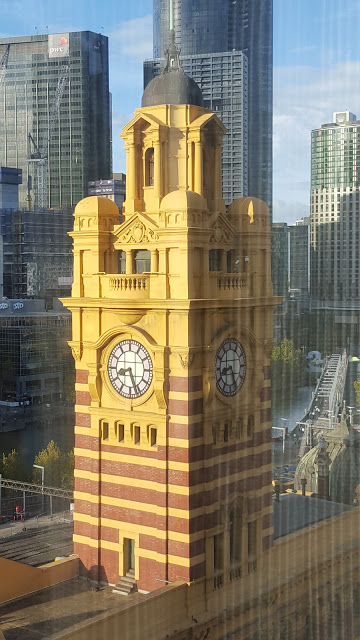
Searching for locations: Flinders Street Station, Melbourne, Australia

This is the famous clock tower of the Flinders Street Station (the main train station for suburban trains) in Melbourne.

We were staying in a hotel (The Doubletree) directly opposite to the station and our room overlooked the station and the clock tower.  I took photos of it during the day:

and this one, at night.  It came out better than I thought it would.

20160302_215639

“Trouble in Store” – Short stories my way:  Jack, the girl, and the shopkeeper

I have reworked the first part of the story with a few new elements about the characters and changed a few of the details of how the characters finish up in the shop before the policewoman makes her entrance.

This is part of the new first section is the one that involves the Jack, the girl, and the shopkeeper


Jack exchanged a look with the shopkeeper, who in return gave him a slight shrug as if to say he had no idea what this was about.

He could see the girl was not strung out on drugs; if she was it would be a good bet both would be shot or dead by now.  She was just the unfortunate partner of a boy who was on drugs and had found herself in a dangerous position.

Beth, his wife, had told him she didn’t like nor trust the shopkeeper and that her friend in the same apartment block had told her he had been seen selling drugs to youths who hung around just before he closed.  She had warned him it would not be safe, but he had ignored her.

It was a bit late to tell her she was right.

He took a half step towards the door, judging the distance and time it would take to open the door and get out.

Too far, and he would be too slow, his reward for running; a bullet in the back.

Perhaps another half step when she wasn’t looking.


The shopkeeper changed his expression to one more placatory, and said quietly to the girl, “Look, this is not this chap’s problem.”  He nodded in the direction of the customer.  “I’m sure he’d rather not be here, and you would glad of one less distraction.”

He could see she was wavering.  She was not holding the gun so steadily, and the longer this dragged on, the more nervous and unpredictable she would become.

And in the longer game, the customer would sing his praises no matter what happened if he could get him out of the shop alive and well.

This could still be a win-win situation.


The girl looked at Jack.  The shopkeeper was right.  If he wasn’t here this could be over. 

But there was another problem.  It didn’t look like Simmo was in any shape to getaway.  In fact, this was looking more like a suicide mission.

She waved the gun in his direction.  ‘Get out now, before I change my mind.’

As the gun turned to the shopkeeper, Jack wasn’t going to wait to be asked twice and started sidling towards the door.


© Charles Heath 2016-2020