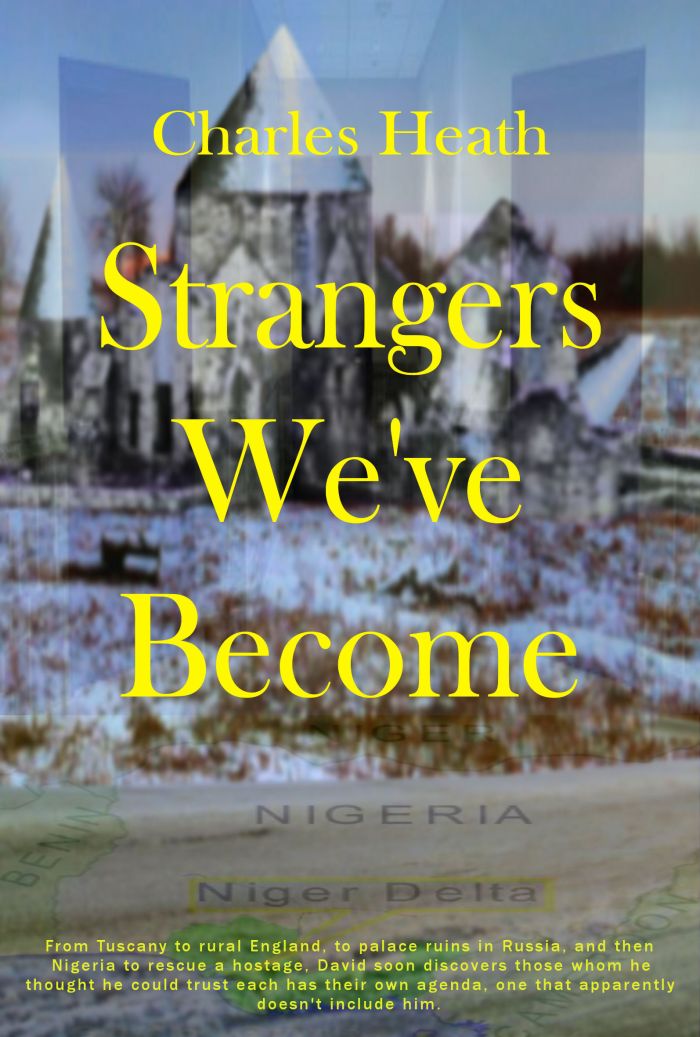
An excerpt from “Strangers We’ve Become” – Coming Soon

I wandered back to my villa.

It was in darkness.  I was sure I had left several lights on, especially over the door so I could see to unlock it.

I looked up and saw the globe was broken.

Instant alert.

I went to the first hiding spot for the gun, and it wasn’t there.  I went to the backup and it wasn’t there either.  Someone had found my carefully hidden stash of weapons and removed them.

Who?

There were four hiding spots and all were empty.  Someone had removed the weapons.  That could only mean one possibility.

I had a visitor, not necessarily here for a social call.

But, of course, being the well-trained agent I’d once been and not one to be caught unawares, I crossed over to my neighbor and relieved him of a weapon that, if found, would require a lot of explaining.

Suitably armed, it was time to return the surprise.

There were three entrances to the villa, the front door, the back door, and a rather strange escape hatch.  One of the more interesting attractions of the villa I’d rented was its heritage.  It was built in the late 1700s, by a man who was, by all accounts, a thief.  It had a hidden underground room which had been in the past a vault but was now a wine cellar, and it had an escape hatch by which the man could come and go undetected, particularly if there was a mob outside the door baying for his blood.

It now gave me the means to enter the villa without my visitors being alerted, unless, of course, they were near the vicinity of the doorway inside the villa, but that possibility was unlikely.  It was not where anyone could anticipate or expect a doorway to be.

The secret entrance was at the rear of the villa behind a large copse, two camouflaged wooden doors built into the ground.  I move aside some of the branches that covered them and lifted one side.  After I’d discovered the doors and rusty hinges, I’d oiled and cleaned them, and cleared the passageway of cobwebs and fallen rocks.  It had a mildew smell, but nothing would get rid of that.  I’d left torches at either end so I could see.

I closed the door after me, and went quietly down the steps, enveloped in darkness till I switched on the torch.  I traversed the short passage which turned ninety degrees about halfway to the door at the other end.  I carried the key to this door on the keyring, found it and opened the door.  It too had been oiled and swung open soundlessly.

I stepped in the darkness and closed the door.

I was on the lower level under the kitchen, now the wine cellar, the ‘door’ doubling as a set of shelves which had very little on them, less to fall and alert anyone in the villa.

Silence, an eerie silence.

I took the steps up to the kitchen, stopping when my head was level with the floor, checking to see if anyone was waiting.  There wasn’t.  It seemed to me to be an unlikely spot for an ambush.

I’d already considered the possibility of someone coming after me, especially because it had been Bespalov I’d killed, and I was sure he had friends, all equally as mad as he was.  Equally, I’d also considered it nigh on impossible for anyone to find out it was me who killed him because the only people who knew that were Prendergast, Alisha, a few others in the Department, and Susan.

That raised the question of who told them where I was.

If I was the man I used to be, my first suspect would be Susan.  The departure this morning, and now this was too coincidental.  But I was not that man.

Or was I?

I reached the start of the passageway that led from the kitchen to the front door and peered into the semi-darkness.  My eyes had got used to the dark, and it was no longer an inky void.  Fragments of light leaked in around the door from outside and through the edge of the window curtains where they didn’t fit properly.  A bone of contention upstairs in the morning, when first light shone and invariably woke me up hours before I wanted to.

Still nothing.

I took a moment to consider how I would approach the visitor’s job.  I would get a plan of the villa in my head, all entrances, where a target could be led to or attacked where there would be no escape.

Coming in the front door.  If I was not expecting anything, I’d just open the door and walk-in.  One shot would be all that was required.

Contract complete.

I sidled quietly up the passage staying close to the wall, edging closer to the front door.  There was an alcove where the shooter could be waiting.  It was an ideal spot to wait.

Crunch.

I stepped on some nutshells.

Not my nutshells.

I felt it before I heard it.  The bullet with my name on it.

And how the shooter missed, from point-blank range, and hit me in the arm, I had no idea.  I fired off two shots before a second shot from the shooter went wide and hit the door with a loud thwack.

I saw a red dot wavering as it honed in on me and I fell to the floor, stretching out, looking up where the origin of the light was coming and pulled the trigger three times, evenly spaced, and a second later I heard the sound of a body falling down the stairs and stopping at the bottom, not very far from me.

Two assassins.

I’d not expected that.

The assassin by the door was dead, a lucky shot on my part.  The second was still breathing.

I checked the body for any weapons and found a second gun and two knives.  Armed to the teeth!

I pulled off the balaclava; a man, early thirties, definitely Italian.  I was expecting a Russian.

I slapped his face, waking him up.  Blood was leaking from several slashes on his face when his head had hit the stairs on the way down.  The awkward angle of his arms and legs told me there were broken bones, probably a lot worse internally.  He was not long for this earth.

“Who employed you?”

He looked at me with dead eyes, a pursed mouth, perhaps a smile.  “Not today my friend.  You have made a very bad enemy.”  He coughed and blood poured out of his mouth.  “There will be more …”

Friends of Bespalov, no doubt.

I would have to leave.  Two unexplainable bodies, I’d have a hard time explaining my way out of this mess.  I dragged the two bodies into the lounge, clearing the passageway just in case someone had heard anything.

Just in case anyone was outside at the time, I sat in the dark, at the foot of the stairs, and tried to breathe normally.  I was trying not to connect dots that led back to Susan, but the coincidence was worrying me.

A half-hour passed and I hadn’t moved.  Deep in thought, I’d forgotten about being shot, unaware that blood was running down my arm and dripping onto the floor.

Until I heard a knock on my front door.

Two thoughts, it was either the police, alerted by the neighbors, or it was the second wave, though why would they be knocking on the door?

I stood, and immediately felt a stabbing pain in my arm.  I took out a handkerchief and turned it into a makeshift tourniquet, then wrapped a kitchen towel around the wound.

If it was the police, this was going to be a difficult situation.  Holding the gun behind my back, I opened the door a fraction and looked out.

No police, just Maria.  I hoped she was not part of the next ‘wave’.

“You left your phone behind on the table.  I thought you might be looking for it.”  She held it out in front of her.

When I didn’t open the door any further, she looked at me quizzically, and then asked, “Is anything wrong?”

I was going to thank her for returning the phone, but I heard her breathe in sharply, and add, breathlessly, “You’re bleeding.”

I looked at my arm and realized it was visible through the door, and not only that, the towel was soaked in blood.

“You need to go away now.”

Should I tell her the truth?  It was probably too late, and if she was any sort of law-abiding citizen she would go straight to the police.

She showed no signs of leaving, just an unnerving curiosity.  “What happened?”

I ran through several explanations, but none seemed plausible.  I went with the truth.  “My past caught up with me.”

“You need someone to fix that before you pass out from blood loss.  It doesn’t look good.”

“I can fix it.  You need to leave.  It is not safe to be here with me.”

The pain in my arm was not getting any better, and the blood was starting to run down my arm again as the tourniquet loosened.  She was right, I needed it fixed sooner rather than later.

I opened the door and let her in.  It was a mistake, a huge mistake, and I would have to deal with the consequences.  Once inside, she turned on the light and saw the pool of blood just inside the door and the trail leading to the lounge.  She followed the trail and turned into the lounge, turned on the light, and no doubt saw the two dead men.

I expected her to scream.  She didn’t.

She gave me a good hard look, perhaps trying to see if I was dangerous.  Killing people wasn’t something you looked the other way about.  She would have to go to the police.

“What happened here?”

“I came home from the cafe and two men were waiting for me.  I used to work for the Government, but no longer.  I suspect these men were here to repay a debt.  I was lucky.”

“Not so much, looking at your arm.”

She came closer and inspected it.

“Sit down.”

She found another towel and wrapped it around the wound, retightening the tourniquet to stem the bleeding.

“Do you have medical supplies?”

I nodded.  “Upstairs.”  I had a medical kit, and on the road, I usually made my own running repairs.  Another old habit I hadn’t quite shaken off yet.

She went upstairs, rummaged, and then came back.  I wondered briefly what she would think of the unmade bed though I was not sure why it might interest her.

She helped me remove my shirt, and then cleaned the wound.  Fortunately, she didn’t have to remove a bullet.  It was a clean wound but it would require stitches.

When she’d finished she said, “Your friend said one day this might happen.”

No prizes for guessing who that friend was, and it didn’t please me that she had involved Maria.

“Alisha?”

“She didn’t tell me her name, but I think she cares a lot about you.  She said trouble has a way of finding you, gave me a phone and said to call her if something like this happened.”

“That was wrong of her to do that.”

“Perhaps, perhaps not.  Will you call her?”

“Yes.  I can’t stay here now.  You should go now.  Hopefully, by the time I leave in the morning, no one will ever know what happened here, especially you.”

She smiled.  “As you say, I was never here.”

© Charles Heath 2018-2022

strangerscover9

The cinema of my dreams – Was it just another surveillance job – Episode 26

I’m back home and this story has been sitting on a back burner for a few months, waiting for some more to be written.

The trouble is, there are also other stories to write, and I’m not very good at prioritizing.

But, here we are, a few minutes opened up and it didn’t take long to get back into the groove.

Maury drops in for a search


I moved to the doorway and switched off the light, sending the room back into inky darkness.  Not good for the eyes, going bright light to instant dark.  We stood together behind the door as it opened inwards, Jan ready with her gun.

The door opened slowly, at the same time letting light in from the corridor, making it easier to see.

Opened fully, the visitor tentatively stepped into the room, and once the shape moved past the door, I slammed it shut and Jan lunged with the gun.  

I was not sure what result she was expecting but the person fought back, and as they turned to wrench the gun out of her hand, I let loose a punch, aiming for the head, and as hard as I could.  I head a cracking sound followed by a thump as the body hit the ground.

When I turned the light back on, there were two surprises.  The first, that I’d managed to knock someone out, and the second, Maury was back for a second look.

Why?

It didn’t matter.  He wasn’t going to be unconscious for very long.  Jan had some twine in her room, I wasn’t going to ask why, and she tied his hands and legs together, trussed almost like a turkey.

We left him on the floor when he’d fallen.  Unconscious, he was too heavy to move, or lift.

“Is this man Severin, Maury or Nobbin?” she asked.  She’d saved the questions until after he’d been neutralized, and we’d taken his gun off him.  Also, a knife.  She’d also look through his pockets to see if he carried any identification.  He didn’t, and I wouldn’t expect to find anything.  At the moment I was the same, and since I threw the phone’s sim card, I was now completely anonymous.

“Maury,” I said.

“The attack dog?”

“Not able to attack us at the moment, but yes.  I wonder why he came back?”

“We should ask him,” she said, “when he wakes up.”

We were sitting in the chairs, turned around to face Maury lying on the ground.  He had wriggled, and realizing he was tied up, tried harder to escape the bonds, and then relaxed when he realized he couldn’t.

His eyes turned to us, and it felt like a death stare.  

“This is a mistake,” he said.  “untie these ropes and I might make an exception for you.

“Why are you here?” I asked him.

“That’s none of your business.”

“But it is mine.  This is my flat, and you’re trespassing,” Jan said.

He switched his death gaze to her.

“I’m not here to cause trouble.”

“Then why are you here?”

“To ask you if your next-door neighbor left anything here with you to collect at a later date.”

No doubt with a menacing attitude, which would end in violence because Maury was not the sort to take no for an answer.

“Most people would knock on the door, and politely wait until it was answered.”

Most people.

“I was told there would be no one at home.”

“And it couldn’t wait until I returned?  I’m sorry, but you have broken into my flat and I’m going to call the police.”

He looked at me.

“That’s not a good idea.  Tell her, Jackson.”

“I don’t work for you, or Severin, anymore.  In fact, when I went back into the office, I got dragged aside and interrogated.  No one seems to know who you and Severin are.”

“That’s because our operation was on a need to know basis.  How do you think our business works?  Not by telling everyone what you’re doing.  Now untie me, and I’ll be on my way.”

“No,” Jan said.  “Not until you tell us exactly who you are and who you work for, and why you deemed it necessary to murder O’Connell.”

Maury looked at me again, and there was no mistaking the anger.

“You do understand what the Official Secrets Act means, don’t you Jackson?”

“More or less.  But it depends on who it is you speak to whether that’s relevant or not.”

Back to Jan.  

“Who are you, then?”

“As you keep pulling out of your hat, it’s on a need to know basis, and, of course, we just tell everyone what we’re doing either.  But one thing I’m sure of, we do not go around killing agents.  As far as I can tell, O’Connell was working for an agency, possibly yours but I don’t think so, and in the course of his investigation, he came across some valuable information.  Information, I’m told, you want.  What is it and why?”

“Are you serious?”

He shifted his glare back to me.

“Seriously Jackson, who is this person?”

“Someone, I fear, who is going to cause you a great deal of grief if you don’t answer her questions.”

“Don’t be ridiculous.  I don’t have to tall you or anyone else the nature of my business.”

I saw her shake her head.  “I take it, that’s a no.”  She shrugged and pulled out her phone and dialed a number.  “Always the hard way with you people.”

“Sir,” she said when the call was answered.  “I’ve got a character named Maury tied up in my flat.  Breaking and entering for starters.  Yes, I’ll be here.”

She put the phone back in her bag.  “They’ll be here in ten minutes.”

All we had to do was hope that Maury didn’t have a backup.

© Charles Heath 2020

Skeletons in the closet, and doppelgangers

A story called “Mistaken Identity”

How many of us have skeletons in the closet that we know nothing about? The skeletons we know about generally stay there, but those we do not, well, they have a habit of coming out of left field when we least expect it.

In this case, when you see your photo on a TV screen with the accompanying text that says you are wanted by every law enforcement agency in Europe, you’re in a state of shock, only to be compounded by those same police, armed and menacing, kicking the door down.

I’d been thinking about this premise for a while after I discovered my mother had a boyfriend before she married my father, a boyfriend who was, by all accounts, the man who was the love of her life.

Then, in terms of coming up with an idea for a story, what if she had a child by him that we didn’t know about, which might mean I had a half brother or sister I knew nothing about. It’s not an uncommon occurrence from what I’ve been researching.

There are many ways of putting a spin on this story.

Then, in the back of my mind, I remembered a story an acquaintance at work was once telling us over morning tea, that a friend of a friend had a mother who had a twin sister and that each of the sisters had a son by the same father, without each knowing of the father’s actions, both growing up without the other having any knowledge of their half brother, only to meet by accident on the other side of the world.

It was an encounter that in the scheme of things might never have happened, and each would have remained oblivious of the other.

For one sister, the relationship was over before she discovered she was pregnant, and therefore had not told the man he was a father. It was no surprise the relationship foundered when she discovered he was also having a relationship with her sister, a discovery that caused her to cut all ties with both of them and never speak to either from that day.

It’s a story with more twists and turns than a country lane!

And a great idea for a story.

That story is called ‘Mistaken Identity’.

In a word: Leg

Aside from the fact it is one of those necessary items to walk with, and the fact we can have two or four for most humans and animals, there are a few other uses for the word ‘leg’.

Like…

‘You haven’t got a leg to stand on’, doesn’t necessarily mean you have no legs, but that you are in a precarious position.

“the table had ornate legs’, yes, even non-living objects can have legs, like tables and chairs.

“It was the fifth leg of the race’, meaning it can be a stage of a race.

“He was legless’, meaning that he was too drunk to stand up.  Some might think being legless is a badge of honour, but I suspect those people have been drinking a long time and the alcohol has destroyed most of their brain cells.

“leg it!’, meaning get the hell out of here before you’re caught.

Then, finally, ‘he’s on his last legs’, meaning that he’s exhausted, or about to die.

I’m sure there’s more but that’ll do for now.

I have to use my legs to get some exercise, of which the first leg is to the tripod to check if its legs are stable, and the second leg is to come back to the table and replace one of the legs which is broken.  Then I’ll leg it to the pub where hopefully I won’t become legless.

Hmm…

An excerpt from “Amnesia”, a work in progress

I remembered a bang.
I remembered the car slewing sideways.
I remember another bang, and then it was lights out.
When I opened my eyes again, I saw the sky.
Or I could be underwater.
Everything was blurred.
I tried to focus but I couldn’t. My eyes were full of water.
What happened?
Why was I lying down?
Where was I?
I cast my mind back, trying to remember.
It was a blank.
What, when, who, why and where, questions I should easily be able to answer. Questions any normal person could answer.
I tried to move. Bad, bad mistake.
I did not realise the scream I heard was my own. Just before my body shut down.

“My God! What happened?”
I could hear, not see. I was moving, lying down, looking up.
I was blind. Everything was black.
“Car accident, hit a tree, sent the passenger flying through the windscreen. Pity to poor bastard didn’t get the message that seat belts save lives.”
Was I that poor bastard?
“Report?” A new voice, male, authoritative.
“Multiple lacerations, broken collar bone, broken arm in three places, both legs broken below the knees, one badly. We are not sure of internal injuries, but ruptured spleen, cracked ribs and pierced right lung are fairly evident, x-rays will confirm that and anything else.”
“What isn’t broken?”
“His neck.”
“Then I would have to say we are looking at the luckiest man on the planet.”
I heard shuffling of pages.
“OR1 ready?”
“Yes. On standby since we were first advised.”
“Good. Let’s see if we can weave some magic.”

Magic.
It was the first word that popped into my head when I surfaced from the bottom of the lake. That first breath, after holding it for so long, was sublime, and, in reality, agonising.

Magic, because it seemed like I’d spent a long time under water.
Or somewhere.
I tried to speak, but couldn’t. The words were just in my head.
Was it night or was it day?
Was it hot, or was it cold?
Where was I?
Around me it felt cool.
It was very quiet. No noise except for the hissing of air through an air-conditioning vent. Or perhaps that was the sound of pure silence. And with it the revelation that silence was not silent. It was noisy.
I didn’t try to move.
Instinctively, somehow I knew not to.
A previous bad experience?
I heard what sounded like a door opening, and very quiet footsteps slowly come into the room. They stopped. I could hear breathing, slightly laboured, a sound I’d heard before.
My grandfather.
He had smoked all his life, until he was diagnosed with lung cancer. But for years before that he had emphysema. The person in the room was on their way, down the same path. I could smell the smoke.
I wanted to tell whoever it was the hazards of smoking.
I couldn’t.
I heard a metallic clanging sound from the end of the bed. A moment later the clicking of a pen, then writing.
“You are in a hospital.” A female voice suddenly said. “You’ve been in a very bad accident. You cannot talk, or move, all you can do, for the moment, is listen to me. I am a nurse. You have been here for 45 days, and just come out of a medically induced coma. There is nothing to be afraid of.”
She had a very soothing voice.
I felt her fingers stroke the back of my hand.
“Everything is fine.”
Define fine, I thought. I wanted to ask her what ‘fine’ meant.
“Just count backwards from 10.”
Why?
I didn’t reach seven.

Over the next ten days, that voice became my lifeline to sanity. Every morning I longed to hear it, if only for the few moments she was in the room, those few waking moments when I believed she, and someone else who never spoke, were doing tests. I knew it had to be someone else because I could smell the essence of lavender. My grandmother had worn a similar scent.
It rose above the disinfectant.
I also believed she was another doctor, not the one who had been there the day I arrived. Not the one who had used some ‘magic’ and kept me alive.
It was then, in those moments before she put me under again, that I thought, what if I was paralysed? It would explain a lot. A chill went through me.

The next morning she was back.
“My name is Winifred. We don’t know what your name is, not yet. In a few days, you will be better, and you will be able to ask us questions. You were in an accident, and you were very badly injured, but I can assure you there will be no lasting damage.”
More tests, and then, when I expected the lights to go out, they didn’t. Not for a few minutes more. Perhaps this was how I would be integrated back into the world. A little bit at a time.
The next morning, she came later than usual, and I’d been awake for a few minutes. “You have bandages over your eyes and face. You had bad lacerations to your face, and glass in your eyes. We will know more when the bandages come off in a few days. Your face will take longer to heal. It was necessary to do some plastic surgery.”
Lacerations, glass in my eyes, car accident, plastic surgery. By logical deduction, I knew I was the poor bastard thrown through the windscreen. It was a fleeting memory from the day I was admitted.
How could that happen?
That was the first of many startling revelations. The second was the fact I could not remember the crash. Equally shocking, in that same moment was the fact I could not remember before the crash either, and only vague memories after.
But the most shattering of all these revelations was the one where I realised I could not remember my name.
I tried to calm down, sensing a rising panic.
I was just disoriented, I told myself. After 45 days in an induced coma, it had messed with my mind, and it was only a temporary lapse. Yes, that’s what it was, a temporary lapse. I would remember tomorrow. Or the next day.
Sleep was a blessed relief.

The next day I didn’t wake feeling nauseous. Perhaps they’d lowered the pain medication. I’d heard that morphine could have that effect. Then, how could I know that, but not who I am?
I knew now Winifred the nurse was preparing me for something very bad. She was upbeat, and soothing, giving me a new piece of information each morning. This morning, “You do not need to be afraid. Everything is going to be fine. The doctor tells me you are going to recover with very little scarring. You will need some physiotherapy to recover from your physical injuries, but that’s in the future. We need to let you mend a little bit more before then.”
So, I was not going to be able to leap out of bed, and walk out of the hospital any time soon. I don’t suppose I’d ever leapt out of bed, except as a young boy. I suspect I’d sustained a few broken bones. I guess learning to walk again was the least of my problems.
But, there was something else. I picked it up in the timbre of her voice, a hesitation, or reluctance. It sent another chill through me.
This time I was left awake for an hour before she returned.
This time sleep was restless.
There were scenes playing in my mind, nothing I recognised, and nothing lasting longer than a glimpse. Me. Others, people I didn’t know. Or perhaps I knew them and couldn’t remember them.
Until they disappeared, slowly like the glowing dot in the centre of the computer screen, before finally fading to black.

The morning the bandages were to come off she came in bright and early and woken me. I had another restless night, the images becoming clearer, but nothing recognisable.
“This morning the doctor will be removing the bandages over your eyes. Don’t expect an immediate effect. Your sight may come back quickly or it may come back slowly, but we believe it will come back.”
I wanted to believe I was not expecting anything, but I was. It was probably human nature. I did not want to be blind as well as paralysed. I had to have at least one reason to live.
I dozed again until I felt a gentle hand on my shoulder. I could smell the lavender, the other doctor was back. And I knew the hand on my shoulder was Winifred’s. She told me not to be frightened.
I was amazed to realise in that moment, I wasn’t.
I heard the scissors cutting the bandages.
I felt the bandage being removed, and the pressure coming off my eyes. I could feel the pads covering both eyes.
Then a moment where nothing happened.
Then the pads being gently lift and removed.
Nothing.
I blinked my eyes, once, twice. Nothing.
“Just hold on a moment,” Winifred said. A few seconds later I could feel a cool towel wiping my face, and then gently wiping my eyes. Perhaps there was ointment, or something else in them.
Then a flash. Well, not a flash, but like when a light is turned on and off. A moment later, it was brighter, not the inky blackness of before, but a shade of grey.
She wiped my eyes again.
I blinked a few more times, and then the light returned, and it was like looking through water, at distorted and blurry objects in the distance.
I blinked again, and she wiped my eyes again.
Blurry objects took shape. A face looking down on me, an elderly lady with a kindly face, surely Winifred, who was smiling. And on the opposite side of the bed, the doctor, a Chinese woman of indescribable beauty.
I nodded.
“You can see?”
I nodded again.
“Clearly?”
I nodded.
“Very good. We will just draw the curtains now. We don’t want to overdo it. Tomorrow we will be taking off the bandages on your face. Then, it will be the next milestone. Talking.”
I couldn’t wait.

When morning came, I found myself afraid. Winifred had mentioned scarring, there were bandages on my face. I knew, but wasn’t quite sure how I knew, I wasn’t the handsomest of men before the accident, so this might be an improvement.
I was not sure why I didn’t think it would be the case.
They came at mid morning, the nurse, Winifred, and the doctor, the exquisite Chinese. Perhaps she was the distraction, taking my mind of the reality of what I was about to see.
Another doctor came into the room, before the bandages were removed, and he was introduced as the plastic surgeon that had ‘repaired’ the ravages of the accident. It had been no easy job, but, with a degree of egotism, he did say he was one of the best in the world.
I found it hard to believe, if he was, that he would be at a small country hospital.
“Now just remember, what you might see now is not how you will look in a few months time.”
Warning enough.
The Chinese doctor started removing the bandages. She did it slowly, and made sure it did not hurt. My skin was very tender, and I suspect still bruised, either from the accident or the surgery, I didn’t know.
Then it was done.
The plastic surgeon gave his work a thorough examination and seemed pleased with his work. “Coming along nicely,” he said to the other doctor. He issued some instructions on how to manage the skin, nodded to me, and I thanked him before he left.
I noticed Winifred had a mirror in her hand, and was somewhat reticent in using it. “As I said,” she said noticing me looking at the mirror, “what you see now will not be the final result. The doctor said it was going to heal with very little scarring. You have been very fortunate he was available. Are you ready?”
I nodded.
She showed me.
I tried not to be reviled at the red and purple mess that used to be my face. At a guess I would have to say he had to put it all back together again, but, not knowing what I looked like before, I had no benchmark. All I had was a snippet of memory that told me I was not the tall, dark, and handsome type.
And I still could not talk. There was a reason, he had worked on that area too. Just breathing hurt. I think I would save up anything I had to say for another day. I could not even smile. Or frown. Or grimace.
“We’ll leave you for a while. Everyone needs a little time to get used to the change. I suspect you are not sure if there has been an improvement on last year’s model. Well, time will tell.”
A new face?
I could not remember the old one.
My memory still hadn’t returned.

Trying to get off, or is that on, the merry-go-round

Self-published authors are fully aware that perhaps the easiest part of the writing journey is the actual writing.  Well, compared to the marketing aspect I believe it is.

I have read a lot of articles, suggestions and tips and tricks to market the book to the reading public.  It is, to say the least, a lot harder to market eBooks than perhaps their hard or paper-covered relatives.

This is despite the millions of eReaders out there.

Then there is that other fickle part of the publishing cycle, the need for reviews.

Proper reviews of course.

As we are learning, reviews can be bought, and in more ways than one.  What happened to finding writers of the same genre and offering to buy one copy and write a review in return for a buy one copy and write a review.

I’ve noticed that all the current best selling novelists do the same for their fellow novelists though I guess when you get to be a best-seller, you might not have to buy a copy, so I can only dream of attaining such lofty heights in the publishing world.

But until I reach such rarefied air, I guess I have to figure out how to appeal to my fellow writers, and, of course, hope that my work is good enough.

It might be a start in getting through that difficult cycle, more reviews means more sales, etc.  And getting those first sales and reviews  …

Therein lies the conundrum.  It is a question of paying for advertising or working it out for ourselves.  I guess if I were to get more sales, I could afford the advertising … yes, back on the merry-go-round!

And yet, the harder the road, the more I enjoy what I do.  It is exhilarating while writing, it is a joy to finish the first draft, it is an accomplishment when it is published, but when you sell that first book, well, there is no other feeling like it.

I am inspired.

Now as for that advertisement and where to post it…

A life so ordinary

Parents can define us.

Or, if we have other family members who understand the effect of that influence and try to neutralise it

Or, if we manage to get a sense of what is, and what is not right, counteract it before it has an effect.

For the majority of children who live in what could be called socially acceptable circumstances rather than ‘normality’, on the whole they have a balanced childhood.

For those who have no counterbalance, and no one looking after them, though you would say it’s s parents job the protect their children, quite a few, and I would include myself in that group, are left in a quandary as to what to think, and question what is right and what is wrong.

Parents do not have to define us, not in ways that make it impossible to know what is socially acceptable, but the sad truth is, if you grow up in a bad environment where you see events that are not socially acceptable continuously, how are you to know whether it is bad or acceptable?

It is how bad behaviour is perpetuated, such as domestic violence.

Take for instance a house where domestic violence is the norm. What a child sees and hears in those formative years, say from 2 or 3 through to 8 to 10, it breeds disrespect for girls and later women, it can sometimes lead to the perpetuation of the same behaviour down through generations.

I say this as a general background and to provide a little context.

From the outset in our life at Bess Court there was an underlying series of events that no one knew about, and I for one didn’t understand the significance of.

My brother three years older probably had an inkling but I doubt if he knew anything other than it was not proper.

We had an uncle who we later discovered to be a pedophile, and much later I learned that he was sexually assaulting my brother.

When he threaten to tell my parents, as I had no doubt he would, our uncle moved his attention to me. I was five and had no idea what was happening let alone protest.

Perhaps after a year I may have said something, most likely to my brother and he in turn finally told my father, suddenly the atmosphere in the house turned ugly.

So. In a sense, I had learned a valuable lesson without understanding the underlying reasons. Sexual assault was not acceptable, particularly when it involved children.

But whatever the results that stopped that particular series of events, it sparked something else in my father, and suddenly he turned his hated towards my older brother and beat him, and my mother, frequently getting on the way, was beaten severely too. I just ran and hid under the bed, trying to escape this new onslaught

The violence only escalated, but at least the molestation had stopped.

Then, suddenly, my father had what I thought was a mental breakdown.

It may have been a buildup of pressure in the household over the sins of my uncle, an onset of malaria which he was still prone to since the end of the war, or finally the ptsd had finally caught up.

No one knew what ptsd was then, and I think it was sometimes called “shell shock” a hangover from the first world war.

Only much, much later did we learn the circumstances of his war service and the reasons for malaria and his anxiety, and the fact he had been living with these memories while trying to fit into a ‘normal life’.

No 5 or 8 year old should have to constantly live on fear of your father, and no wife should have to live with the fact that any moment she could become a punching bag.

This was our normality.

And thankfully we learned from it, not succumb to the inevitably of it.

But something else that came out of all this, from a period that may only have spanned no more than 3 years.

I began retreating into a world where everything was so much better, a world far removed from that grim reality.

And this imaginary world was fuelled by reading.

Let’s talk history

What happened yesterday is history, but that’s not necessarily how we view what is history and what isn’t.

Similarly what is and what isn’t history is usually decided on by academics, because history texts that are used in schools are not written by ‘the man in the street’ authors. They’re usually university types who specialise in a particular field, or specialise section of history.

Even then one doubts that what is written is not a consensus of a panel.

So, when we talk about re-writing history, that takes a very brave bunch of people who want to buck the norm.

Our history, that which was taught when I went to school,. about our own country, Australia, started in 1770. Some brave soul tried to say it began earlier than that, before Captain Cook and the British arrived, out up a flag pole, and declared it belonged to Britain, like in 1606 when the Dutch explorer Willem Janszoon landed on the Cape York peninsula, only it wasn’t called that then.

And he might have been as surprised as Captain Cook that there were people here to observe their arrival. Yes, people had been living in this country for tens of thousands of years before the Europeans arrived.

But that was not what we were taught. No, Captain Cook, 1770, the a fleet of ships in 1788, and off we run as a new country, and a dumping ground for Britain’s convicts. Our history starts there, and then meanders through time, dividing the country up into states, having famous explorers like Burke and Wills, and Blaxland, Wentworth, and Lawson, Hume and Hovell.

And we commemorate all these people and those who were in charge over the years, with names of states, cities, rivers, mountains, everything under the sun. You’ve only got to glance at the list of hundreds of these forefathers and explorers to see just how many places in this country were named after them.

No heed was taken of what they may have been called before because no one really understood the languages of the first people who lived here. And they never seem to rate as a matter of study for us children back then.

Now, as people have begun to realise our history goes way, way back, and that there should be a nod to those inhabitants, they are considering re-writing some of our history to incorporate these people. And change the names of places to their original. A famous instance of recent renaming is of Ayers Rock, now called Uluru.

Even then, Australian History didn’t rate very highly, and I have to say, as a child at school 50 odd years ago, I learned more about the British Empire/Commonwealth, and about the English kings and queens, than we did about our own Governor Generals, Prime Ministers and State Premiers.

Could I tell you the name of our first Prime Minister? No. I can say when Australia became Australia, yes. 1901. Can I tell you the first King of England? Yes, William the Conqueror in 1066. There were kings before that but they only ruled of parts of England.

But over the years since I have read the odd book of Australian History but for some reason it never quite seems as colourful or as interesting as that of England or Scotland, or even some of the European countries.

Now, since I’ve been reading about what’s happening in the United States I have begin to take an interest in American history, and it, too, seems to suffer the same problems we have with ours, a bunch of academics decided what it was, and what it would not include, and then there is this thing called the 1619 project.

Wow, that seems to have stirred up a hornet’s nest.

Can’t wait to see what happens next.

“People have a way of surprising you…” – A short story

Last days were supposed to be joyous, the end of your working life and the start of the rest of your life.

I’d spent the last 35 years working for the company, navigating through three buyouts, five name changes, and three restructures. I was surprised I was still employed after the last, only two years before.

But, here I was, sitting in the divisional manager’s office, my office for one more day, with my successor, Jerry, and best friend, sitting on the other side.

“Last day, what are you thinking?” He asked casually.

It might have been early, but we both had a glass of scotch, a single malt I’d kept aside for an important occasion and this seemed like one.

I picked up the glass and surveyed the contents, giving myself a few moments to consider an answer to what could be a difficult question. To be honest, the thinking had started on the subway on the way in, when I should have been working on the crossword, but instead, I was lamenting the fact that the next chapter of my life would be without Ellen.

We would have been married, coincidently, 43 years ago today, had she been alive. Unfortunately, she had died suddenly about four months ago, after a long battle with cancer.

And I still hadn’t had time to process it. Truth is, it had been work that kept me together, and I was worried about what was going to happen when it would no longer there.

To a certain extent, I was still on autopilot, her death coming in the middle of a major disaster concerning the company, one that had finally, and successfully, been brought to a conclusion with favorable results for everyone.

But what was I thinking right then, at that precise moment in time? Not something he would want to hear, so I made the necessary adjustment. “That I’m basically leaving you a clean slate, so don’t screw it up.”

I could see that was not what he wanted to hear.

He decided to take a different tack. “What have you got planned for the first day of retirement.”

He knew about Ellen and had been there for me, above and beyond what could have been expected from anyone. I owed him more than a platitude.

“Sleep in, probably, but I’m going to be fighting that body clock. It’s going to be difficult after so many years getting up the same time, rail hail or shine. But we had plans to go away for a few months, you know, the trip of a lifetime, then move. Ellen wanted to go back home for a while, now, I’m not sure what I’m going to do.”

“Then perhaps you should, or at the very least, go home for a while. You said you both come from there; who knows, being back among family might just be what you need.”

It was something I had been thinking about and had been issued an open-ended invitation from her parents to come and stay for as long as I wanted, one that I was seriously considering.

But, before I could tell him that, the phone rang.

Never a dull day…
The day went quickly, and as much as it was expected I’d hand over anything that happened to my successor, I couldn’t quite let go. There was the proverbial storm in a teacup, but it was a good opportunity to watch the man who was taking over in action. He had a great teacher, even if I said so myself.

But it was the end of the day and the moment I had been dreading. I’d asked the personnel manager not to make a big deal out of my departure, and that I didn’t want the usual sendoff, where everyone in the office came and I would find myself at a loss of words and feel like I had to speak to a lot of people I didn’t really know.

There were only about a dozen that I really knew, a dozen that had survived the layoffs and restructuring, and although there were others, I didn’t have anything to do with them. My last job took me out of the office more than being there, and so many of the other people were from offices scattered all up and down the east coast.

I’d mostly said my goodbyes to them on the last quarterly visit. Sixteen offices, fifty-odd employees who were as much friends as they were staff who worked for me. There had been small dinners and heartfelt moments.

This I was hoping would be the same.

Jerry had been charged with the responsibility of getting me to the presentation; they called it a presentation because I had no doubt there would be a presentation of some sort. I had told the CEO a handshake and a couple of drinks would suffice, and he just congenially nodded.

Jerry had taken the manager’s chair and I was sitting on the other side of the table. We’d finished off the last of the single malt, and dirt was time to go. I closed the door to the office for the last time, and we walked along the passage towards the dining room. It was a perk I’d fought hard to keep during the last restructure when the money men were trying to cut costs.

It was one of the few battles I won.

He opened the door and stood to one side, and ushered me through.

It was a very large space, usually filled with tables, chairs, and diners. Now it was filled with people, leaving a passageway from the door to a podium that had been set up in front of the servery, where a large curtain stretched across the width of the building with the company logo displayed on it.

There were 2,300 people who worked in this office and another 700 from the regional offices. By the look of the crowd, every single one of them was there.

It took fifteen minutes to get from the door to the podium. Faces of people I’d seen every day, faces I’d seen a few times a year, and faces I’d never seen before. On the podium there was a dozen more, faces I’d only seen in the Annual Accounts document, except for the General Manager and the CEO.

“You will be pleased to know everyone here wanted to come and bid you farewell,” the General Manager said.

“Everyone? Why?”

“Well, I’ve learned a lot about this company and its people over the last week, and frankly, people have a way of surprising you. And given the impact you have had on each and every one of them, I’m not surprised. So much so, they wanted to give you something to remember them by.”

A nod of the head and the curtains were pulled back, and behind them was an original 1968 XJ6 Jaguar, fully restored, a very familiar XJ6. The car had belonged to Helen and I had to sell it to help pay the medical bills. It had been a gut-wrenching experience, coming at a time when everything that was happened to her almost overwhelmed me.

“Jerry told us about this particular car, so all of your friends thought, as a fitting memory to you and of her, that we should find it and restore it. Everyone here contributed. It is our gift to you for everything you have done for us.”

So much for the usual sendoff…

—-

© Charles Heath 2020-2021

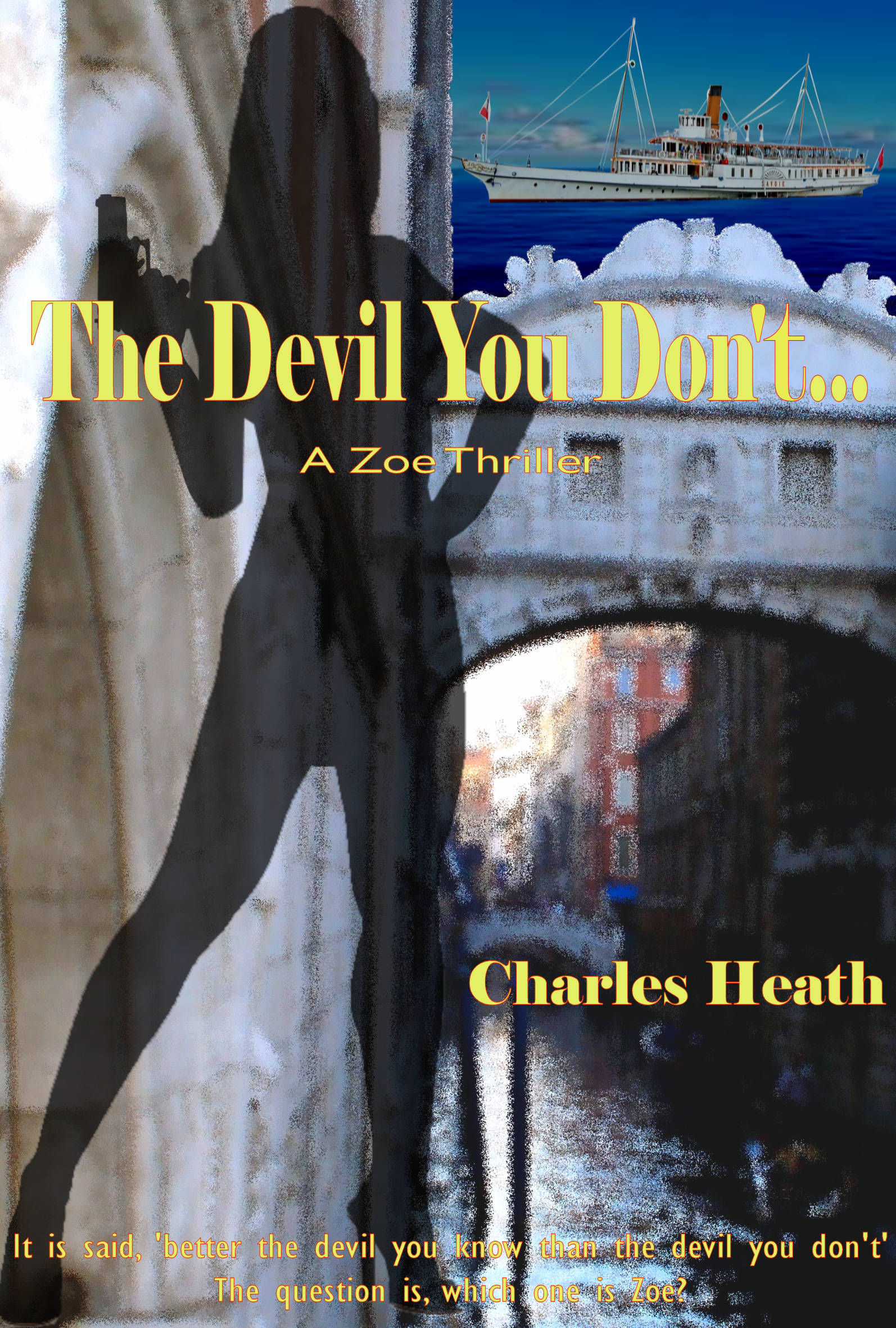
“The Devil You Don’t” – A beta readers view

It could be said that of all the women one could meet, whether contrived or by sheer luck, what are the odds it would turn out to be the woman who was being paid a very large sum to kill you.

John Pennington is a man who may be lucky in business, but not so lucky in love. He has just broken up with Phillipa Sternhaven, the woman he thought was the one, but relatives and circumstances, and perhaps because she was a ‘princess’, may also have contributed to the end result.

So, what do you do when you are heartbroken?

That is a story that slowly unfolds, from the first meeting with his nemesis on Lake Geneva, all the way to a hotel room in Sorrento, where he learns the shattering truth.

What should have been a high turns out to be something else entirely, and from that point every thing goes to hell in a handbasket.

He suddenly realises his so-called friend Sebastian has not exactly told him the truth about a small job he asked him to do, the woman he is falling in love with is not quite who she says she is, and he is caught in the middle of a war between two men who consider people becoming collateral damage as part of their business.

The story paints the characters cleverly displaying all their flaws and weaknesses. The locations add to the story at times taking me back down memory lane, especially to Venice where in those back streets I confess it’s not all that hard to get lost.

All in all a thoroughly entertaining story with, for once, a satisfying end.

Available on Amazon here: https://amzn.to/2Xyh1ow