A photograph from the inspirational bin – 5

I found this:

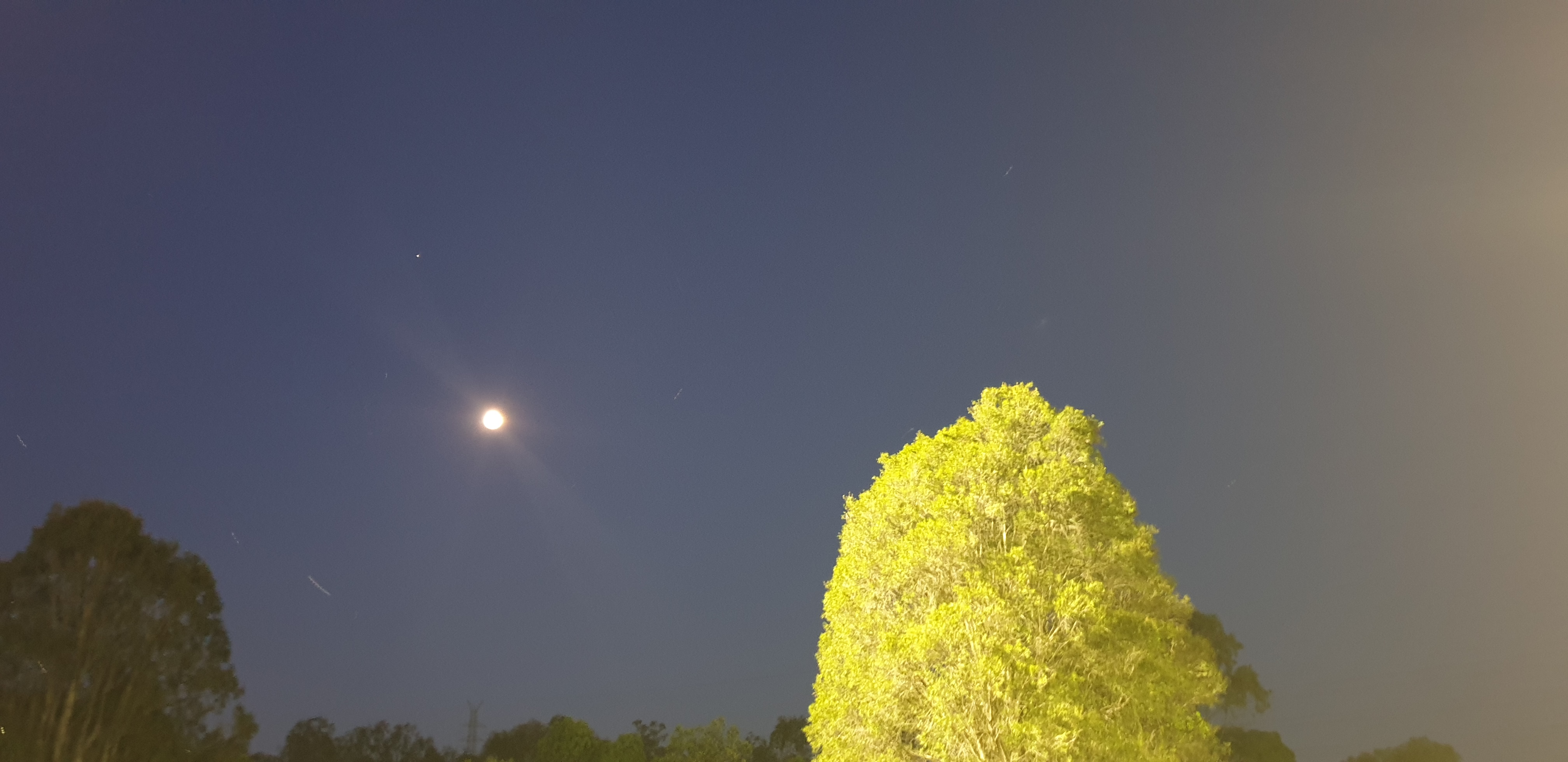
The innocuous explanation for this photo is that I took it at my grand daughter’s little athletics competition, now most sensibly being held on Friday evenings.

For those who don’t know how the weather can be in Brisbane, Queensland, it is generally hot, particularly from November when temperatures are between 35 and 40 degrees centigrade.

But not only is it hot but humidity, the real problem, is around 100 percent.

So at the moment we have reasonably cool evenings, ideal conditions for the young athletes.

But, where a photo could be innocuous there can a more interesting, if not sinister description.

Lurking in the back of my mind, and perhaps a lot of others, that there might be an unidentified flying object somewhere in the sky.

Of course, there might not be any, but it doesn’t mean that we stop looking, or assume, sometimes that a moving light in the sky isn’t a UFO.

And its been said that humans are quite arrogant in thinking that we are the only people in the universe.

Personally, I don’t think we are, and I keep an eye on the sky every time I’m out at night, perhaps the most likely time we might see one.

The only issue I might have is that if I am that lucky to see one, or that it lands nearby, what I would do when confronted by an alien.

And, yes, there’s definitely a story in that.

“For heaven’s sake…” – a short story

It was a combination of circumstances, not all related, but coming at me out of left field, circumstances that would prevent me from going home when I said I would.

I had every intention of getting there and as a testament to that, I had got to the airport with baggage two hours before departure time and had reached the departure gate with 20 minutes to spare, ready to board the plane.

I’d even got a business class ticket so I could travel in style.

What precipitated the set of circumstances? A simple phone call. I should have turned it off five minutes before boarding, but I didn’t but because I’d forgotten to, simply because I’d been distracted.

The call was from Penelope, my hard-working and self-sacrificing personal assistant. I had offered to take her with me so we could work on a business plan that had to be presented the day after I was scheduled to return, but she had declined, which when I thought about it, if she hadn’t it might have created problems for both of us.

With a huge restructure going on, I was running behind in getting it completed and had promised to finish it while at home.

The call: to tell me I had left a folder with vital research back on my desk, and she came to the airport to deliver it, and she was, in fact, was in the terminal building when the boarding call came.

When I met her at the gate, only a few passengers had to be loaded. Being business class had afforded me a few extra minutes. File delivered, I left her looking exasperated and headed down the boarding ramp.

I was last aboard, and seconds after being seated, the door was closed.

I quickly typed and sent a message to tell everyone I was on the plane, eliciting two responses. My mother was glad that I was finally coming, the other from my elder brother, saying he would believe it when he saw me.

It was not without reason; I’d been in this situation before; on the plane ready to go.

Last time the plane didn’t leave the gate, a small problem that caused a big delay, so much so, I couldn’t get home.

Not this time. There was a slight lurch as the push tractor started pushing the plane back from the gate. A minute or so later the pilot fired up the engines, a sure sign of a definite departure. Nothing could stop us now.

It was a reassuring vibration that ran through the plane before the engines settled into a steady whine, a sign of an older plane that had flown many miles in the past and would into the future.

We stopped while the push tractor was disengaged and then the engines picked up speed and we lurched forward, heading towards the runway for take-off. In some airports, this could take a long time, and tonight it seemed to take forever.

I looked out the window and saw a backdrop of lights against the darkness, but no indication of where we were. It didn’t look like the end of the runway because I could not see any other planes waiting to take off.

Then the engines revved louder and for a pronged period. We didn’t move but remained where we were until the engines returned to what might be called idling speed

It was followed by an announcement from the pilot, “This is the captain speaking. We have encountered an anomaly with one of the engines, so to be on the safe side, we are returning to the gate and will have the engineers have a look at it. I do not anticipate this should take longer than 30 minutes.”

A collective groan went through the airplane. Those savvy with these problems would know that the odds were we would not be leaving tonight. The airport curfew would see to that.

But a miracle could still occur.

The plane then started back to the terminal. Another message from the pilot told us we would not be going back to the gate, but to a holding area. Time to have a glass of champagne the steward was offering before going back to the terminal for what, an interminable wait.

It seemed the gods did not want me to go back home.

When we got back to the parking spot, three buses and four delays later, I headed for one of the several bars to get a drink, and perhaps something decent to eat.

Then I saw Penelope, sitting by herself, a glass of champagne sitting half drunk in front of her.

“What are you doing here?” I said as I slid onto the stool beside her.

She started, as if she had been somewhere else, and turned to see who it was. The faraway look turned into a smile when she recognized me. “Getting drunk.”

“I thought you were going home.” A nod in the direction of the bartender, followed by pointing to her glass and indicating I wanted two, got instant service.

“I saw an ex heading to a plane with his latest squeeze. Made me feel depressed. I heard your plane was returning so I decided to wait. Better to get drunk with someone you know than drink by yourself or someone you don’t. I’ve had three offers already.”

I wasn’t surprised. She was very attractive, the sort of woman who was the most popular at any of the work functions but was equally surprising was that she was not with any of those potential suitors. In fact, as far as I knew, she was not in a relationship.

“No one at home to amuse you?” It was not the sort of question I should be asking, because it was really none of my business.

It elicited a sideways glance as if I stepped over an invisible line.

“Sorry, none of my business.”

She finished off the glass in front of her, just as the new round arrived in front of her. I gave the bartender my credit card and asked him to start a tab. I’d just heard that the plane was going to be another two hours before we’d be leaving.

“I live with two other girls, but they are more interested in finding stray men and getting wasted, not necessarily in that order, and that’s not what I want to do.”

“Get wasted or find stray men?”

I was not sure how anyone had the time and inclination to do that, but a few weeks back I spent two evenings with a friend of mine whose marriage had fallen apart. The people there seemed either desperate or looking for a one-night stand. It had amused me to discover most of them were married, and not divorced, and that the girls knew what to expect.

“Both apparently.”

“How do you expect to find the man of your dreams if you don’t go looking.”

“I am, this place seems as good as any, but the man of my dreams doesn’t exist.”

The bemused expression and the tone of her voice told me she had had more than one drink before I got there. Even then, judging from several previous parties for work we had attended, she had a much greater capacity for alcohol than I had.

She finished off the glass just brought, and seconds later her eyes seemed glassy. Perhaps it was time for me to put her in a cab and send her home.

“Another,” she said, “and then you can be responsible for me.”

I had no idea what that meant, and I think, judging by the facial expressions, she didn’t really care.

“Perhaps…”

She didn’t let me finish. “Perhaps you should buy me another drink and lighten up.” And the look that came with it told me not to argue the point.

I got the bartender’s attention, and he responded by bringing two fresh glasses and a bottle. I told him to leave it. It gave me a minute or so to contemplate what she meant by ‘lighten up’. I was so used to seeing her work ethic and diligence, this was a different side to her.

I took a sip and could feel her looking at me. A glance took in the near permanent bemused expression.

“Are you going to be alright getting home?” It was probably not the question I should have asked, but in the back of my mind there was a recent briefing given to all of management on the subject of sexual harassment and intraoffice romances.

“I’m fine. It’s not as if I do this a lot, but the last week has been difficult. Not only for me, but for you too. But you have to admit you put yourself under a lot of pressure.”

She was starting to sound like my conscience. It was something I’d been thinking about on the way to the airport but decided it was part of the job, and I knew when I accepted the position what it would involve. My predecessor, much older than I was, had fallen on his sword, the pressure destroying his marriage and almost his life.

“So I said, lamely, It goes with the job, unfortunately.”

She shook her head. “No, it doesn’t. They might think it does, but they don’t care. They sit in their ivory tower and watch their minions crash and burn. There’s always someone else waiting in the wings to take your place, believe me.”

It was an interesting perspective, but where did it come from? I knew she had been at the corporation for a number of years, and I had been lucky enough to draw the long straw when having her assigned to me as my PA when I took the position. One of the other executives had lamented my good fortune, but he had also said she was one of the few who were there to guide that higher management considered were management prospects.

I just thought I was lucky.

“I might end up in that ivory tower one day.”

“Why?”

She turned to look directly at me. It made me uncomfortable now, as it had on other occasions, and I had begun to think it might have something to do with unspoken feelings. I liked her, but I doubted that was reciprocated. And, after the lecture on office romances, I promptly put those feelings in the bottom drawer and locked it.

“Doesn’t everyone aspire to be the best, and climb to the top of the corporate ladder?”

“For that, you have to be devious and ruthless, and from what I’ve seen, you’re neither. You’ve heard the expression ‘good guys come last’. It’s true.”

I was guessing from the people she had worked for, she had firsthand experience. My predecessor was a ‘good guy’ and some said he was eaten alive by the office predators. I knew who they were, and avoided them. Perhaps she knew something I didn’t, but when would she have told me? Not tonight, no one could have predicted the plane would break down.

“You’re telling me this now, why?”

“You’re smarter than all of those above you put together. You don’t need them, but they need you. But, you won’t get any concessions, not until you get near the top. By then you will have had to sell your soul to the devil.”

Good to know, on one hand, I was about to see my soul to the devil, and on the other that I was smart, just not smart enough to see the wolves in sheep’s clothing.

I noticed she hadn’t touched the latest glass of champagne. Nor was she the languid barfly she’d pretended to be earlier.

“You’re advice, if I’m listening correctly, is that I should be looking for another job.”

“Actually, you shouldn’t be listening to me at all. Too many drinks and I pontificate. Some people become happy, I become,” she shrugged, “unhappy. Take no notice.” She swung around to the front and picked up the glass.

“OK.” I turned around to look at the departures board to see my flight had been canceled, and I should go to the check-in counter. “My plane is completely broken, so it looks like I’m staying home.”

“Or you could take me to dinner.” She looked sideways again, the bemused expression back.

“Wouldn’t that be inappropriate?”

“Only if you were in upper management, married, and asking me to have an affair. Last I looked you’re not in upper management, not married, so there’s no hint of an affair. For heaven’s sake, it’s only dinner.”

She was right on all counts, and it was only dinner.

“Why not?” I said, more to myself than to her.

“Good. And you’d better get me on the plane too. We need to get that report done, and it’ll be an excuse to stay at a hotel. I know you wouldn’t want to stay in your old room at your parents’ house.”

She was right about that too, I had long outgrown them, and staying at home would only lead to arguments. “How could you possibly know that?”

She smiled. “You talk in your sleep.”

© Charles Heath 2021

Travelling after a pandemic: Destination Hobart – 3

Hobart in June – Winter – Day 3 – Monday

Day 3 – Monday

We agreed not to plan what we were going to do today, but I had this idea we should go north or the opposite direction to yesterday.

That meant our destination, following the hop on hop off bus route was to head towards the Botanic Gardens.

Bur first, Rosemary had expressed a desire to go down to the water’s edge to have a look, giving an excellent view of the coastline at what was called Battery Point.

I tried to get there, but there were no roads that specifically went down to the water’s edge, but we did eventually drive-up Salamanca place, where we had walked a few days before.

It was not the same, but it did give us time to look at the line of sandstone buildings that had been there a long time and had been repurposed as Sn arts precinct.

Of course, there was only one flaw in the plan, Rosemary was not able to walk any great distance, so we were limited to what could be seen from the car.

But…

There was really nothing to see, just cars parked haphazardly on the side of the road near an entrance that led down some steps, or a few cars in a proper car park too far away from the entrance.

I was not sure what to make of it other than it was an exercise-intensive effort just to get from the car park to the gate, and then you had to walk around the gardens.

It was all too much.

Government House was on the same road, but it was not open to the public, nor was it in sight of the road, do no photographic moment there, so we were doubly disappointed.

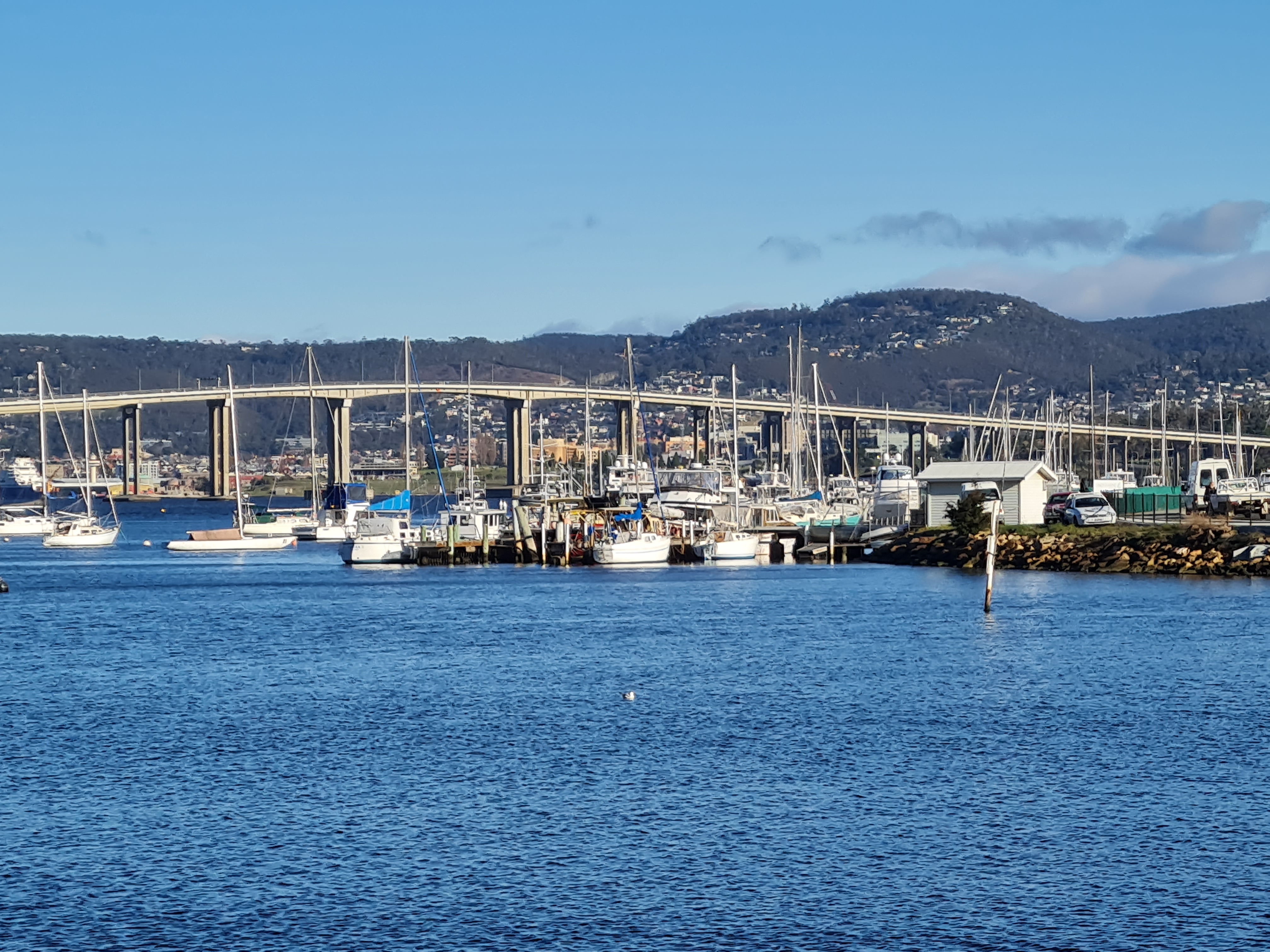
The next phase of our unplanned tour was to go over the Tasman Bridge, perhaps to see the other side of the bay that we could see from our apartment.

Except…

When we got over the other side we veered left to follow the Derwent towards Lindisfarne where there was a yacht basin and several yacht clubs, one of which promised a view while you drank coffee.

Only problem, no parking spaces.

A good idea, unable to be acted on.

Instead, we drove around the esplanade, and continued on our way to Glenorchy, after not being able to get that coffee with a view.

Back on the main road, we take the Glenorchy exit and doesn’t take long to get there, though, by the time we’ve driven through the suburban area, we’re back on the main Hobart Road.

It was a case of don’t blink or you’ll miss it.  We missed Glenorchy.

Change of plans, looking for that elusive coffee, we head for the center of Hobart shopping, Centrepoint, hoping in that center there will be a coffee shop.  Of course, it’s Queen’s Birthday holiday so it’s possible nothing is open.

In the end, we found a parking space nearby. And a Hudson’s.  Coffee and a toasted sandwich went down very well. 

So, once again, we didn’t get to the places we were hoping to get to.  This is what tomorrow, we’re not going to state a place to visit.

After the third attempt, still needs work

I have a stab at improving this starting piece every now and then, a project that started about a year or so ago, and I find myself rewriting the start over and over because I’m not satisfied with the characterization.

It’s not so much the storyline, as it is in trying to create sympathy for the character, and not find him as dull as ditchwater.  He’s improving with age.  As writers, we tend to create colourful characters and shy away from those who are dull and boring, because after all, as a reader, you want to become something or someone who is far from ordinary.  Well, Graham is starting out ordinary, but he will be anything but by the time I write those words ‘The End’.

I promise.

I am the master of my own destiny.

My father had drummed that into me, as well as my older brother and younger sister, over and over, until it became a mantra.

For them.

I could not say I didn’t have the same advantages afforded to them, afforded to me.  I did.

But somewhere lost in the translation, someone forgot to tell me that it was only advice, not an order, and mistaking it for the latter, I struck out on my own path.

And for the next ten years, it was a long and winding path that led me to this point in time, in a small room that held nothing to tell me where I came from, or who I really was.

My parents were very wealthy with an Upper Westside Apartment in Manhattan and a holiday house in Martha’s Vineyard, my sister had a successful medical career and married a most eligible bachelor, as expected, and my brother, he was a politician.

I’d not seen any of them in at least five years, and they hadn’t called me.

You see, I was the black sheep of the family.  I dropped out of college when it all became too much and drifted.  Seasonal labourer, farmhand, factory worker, add job man, and night watchman. 

At least now I had a uniform, and a gun, and looked like I’d made something of myself.

It was hard to say why, but just before I was about to head out of the factory to end my shift, those thoughts about them came into my mind.   They might be gone, but I guess I would never forget them.  I wondered briefly if any of them thought about me.

It was 3 a.m. and it was like standing on the exact epicentre of the South Pole.  I’d just stepped from the factory warehouse into the car park.

The car was covered in snow.  The weather was clear now, but I could feel more snow coming.  A white Christmas?  That’s all I needed.  I hoped I remembered to put the antifreeze in my radiator this time.

As I approached my car, the light went on inside an SUV parked next to my car.  The door opened and what looked to be a woman was getting out of the car.

“Graham?”

It was a voice I was familiar with, though I hadn’t heard it for a long time.

I looked again and was shocked to see my ultra-successful sister, Penelope.  She was leaning against the front fender, and from what I could see, didn’t look too well.

How on earth did she find me, after all the years that had passed?  Perhaps that sparked my un-conciliatory question, “What do you want?”

I could see the surprise and then the hurt in her expression.  Perhaps I had been a little harsh.  Whatever she felt, it passed, and she said, “Help.”

My help?  Help with what? I was the last person who could help her, or anyone for that matter, with anything.   But curiosity got the better of me.  “Why?”

“I think my husband is trying to kill me.”

Then, with that said, she slid down the side of the car, and I could see, in the arc lamps lighting the car park, a trail of blood.

My first thought, she needed the help of a doctor, not a stupid brother, then a second thought, call 911, which I did, and hoped like hell they got here in time.

And, yes, there was a third thought that crossed my mind.  Whether or not I would be blamed for this event.

© Charles Heath 2022

An excerpt from “The Things We Do For Love”; In love, Henry was all at sea!

In the distance he could hear the dinner bell ringing and roused himself.  Feeling the dampness of the pillow, and fearing the ravages of pent up emotion, he considered not going down but thought it best not to upset Mrs. Mac, especially after he said he would be dining.

In the event, he wished he had reneged, especially when he discovered he was not the only guest staying at the hotel.

Whilst he’d been reminiscing, another guest, a young lady, had arrived.  He’d heard her and Mrs. Mac coming up the stairs, and then shown to a room on the same floor, perhaps at the other end of the passage.

Henry caught his first glimpse of her when she appeared at the door to the dining room, waiting for Mrs. Mac to show her to a table.

She was about mid-twenties, slim, long brown hair, and the grace and elegance of a woman associated with countless fashion magazines.  She was, he thought, stunningly beautiful with not a hair out of place, and make-up flawlessly applied.  Her clothes were black, simple, elegant, and expensive, the sort an heiress or wife of a millionaire might condescend to wear to a lesser occasion than dinner.

Then there was her expression; cold, forbidding, almost frightening in its intensity.  And her eyes, piercingly blue and yet laced with pain.  Dracula’s daughter was his immediate description of her.

All in all, he considered, the only thing they had in common was, like him, she seemed totally out of place.

Mrs. Mac came out of the kitchen, wiping her hands on her apron.  She was, she informed him earlier, chef, waitress, hotelier, barmaid, and cleaner all rolled into one.  Coming up to the new arrival she said, “Ah, Miss Andrews, I’m glad you decided to have dinner.  Would you like to sit with Mr. Henshaw, or would you like to have a table of your own?”

Henry could feel her icy stare as she sized up his appeal as a dining companion, making the hair on the back on his neck stand up.  He purposely didn’t look back.  In his estimation, his appeal rating was minus six.  Out of a thousand!

“If Mr. Henshaw doesn’t mind….”  She looked at him, leaving the query in mid-air.

He didn’t mind and said so.  Perhaps he’d underestimated his rating.

“Good.”  Mrs. Mac promptly ushered her over.  Henry stood, made sure she was seated properly and sat.

“Thank you.  You are most kind.”  The way she said it suggested snobbish overtones.

“I try to be when I can.”  It was supposed to nullify her sarcastic tone but made him sound a little silly, and when she gave him another of her icy glares, he regretted it.

Mrs. Mac quickly intervened, asking, “Would you care for the soup?”

They did, and, after writing the order on her pad, she gave them each a look, imperceptibly shook her head, and returned to the kitchen.

Before Michelle spoke to him again, she had another quick look at him, trying to fathom who and what he might be.  There was something about him.

His eyes, they mirrored the same sadness she felt, and, yes, there was something else, that it looked like he had been crying?  There was a tinge of redness.

Perhaps, she thought, he was here for the same reason she was.

No.  That wasn’t possible.

Then she said, without thinking, “Do you have any particular reason for coming here?”  Seconds later she realized she’s spoken it out loud, had hadn’t meant to actually ask, it just came out.

It took him by surprise, obviously not the first question he was expecting her to ask of him.

“No, other than it is as far from civilization, and home, as I could get.”

At least we agree on that, she thought.

It was obvious he was running away from something as well.

Given the isolation of the village and lack of geographic hospitality, it was, from her point of view, ideal.  All she had to do was avoid him, and that wouldn’t be difficult.

After getting through this evening first.

“Yes,” she agreed.  “It is that.”

A few seconds passed, and she thought she could feel his eyes on her and wasn’t going to look up.

Until he asked, “What’s your reason?”

Slight abrupt in manner, perhaps as a result of her question, and the manner in which she asked it.

She looked up.  “Rest.  And have some time to myself.”

She hoped he would notice the emphasis she had placed on the word ‘herself’ and take due note.  No doubt, she thought,  she had completely different ideas of what constituted a holiday than he, not that she had actually said she was here for a holiday.

Mrs. Mac arrived at a fortuitous moment to save them from further conversation.

Over the entree, she wondered if she had made a mistake coming to the hotel.  Of course, there had been no possible way she could know than anyone else might have booked the same hotel, but realized it was foolish to think she might end up in it by herself.

Was that what she was expecting?

Not a mistake then, but an unfortunate set of circumstances, which could be overcome by being sensible.

Yet, there he was, and it made her curious, not that he was a man, by himself, in the middle of nowhere, hiding like she was, but for very different reasons.

On discreet observance whilst they ate, she gained the impression his air of light-heartedness was forced and he had no sense of humor.

This feeling was engendered by his looks, unruly dark hair, and permanent frown.  And then there was his abysmal taste in clothes on a tall, lanky frame.  They were quality but totally unsuited to the wearer.

Rebellion was written all over him.

The only other thought crossing her mind, and rather incongruously, was he could do with a decent feed.  In that respect, she knew now from the mountain of food in front of her, he had come to the right place.

“Mr. Henshaw?”

He looked up.  “Henshaw is too formal.  Henry sounds much better,” he said, with a slight hint of gruffness.

“Then my name is Michelle.”

Mrs. Mac came in to take their order for the only main course, gather up the entree dishes, then return to the kitchen.

“Staying long?” she asked.

“About three weeks.  Yourself?”

“About the same.”

The conversation dried up.

Neither looked at the other, rather at the walls, out the window, towards the kitchen, anywhere.  It was, she thought, almost unbearably awkward.

Mrs. Mac returned with a large tray with dishes on it, setting it down on the table next to theirs.

“Not as good as the usual cook,” she said, serving up the dinner expertly, “but it comes a good second, even if I do say so myself.  Care for some wine?”

Henry looked at Michelle.  “What do you think?”

“I’m used to my dining companions making the decision.”

You would, he thought.  He couldn’t help but notice the cutting edge of her tone.  Then, to Mrs. Mac, he named a particular White Burgundy he liked and she bustled off.

“I hope you like it,” he said, acknowledging her previous comment with a smile that had nothing to do with humor.

“Yes, so do I.”

Both made a start on the main course, a concoction of chicken and vegetables that were delicious, Henry thought, when compared to the bland food he received at home and sometimes aboard my ship.

It was five minutes before Mrs. Mac returned with the bottle and two glasses.  After opening it and pouring the drinks, she left them alone again.

Henry resumed the conversation.  “How did you arrive?  I came by train.”

“By car.”

“Did you drive yourself?”

And he thought, a few seconds later, that was a silly question, otherwise she would not be alone, and certainly not sitting at this table. With him.

“After a fashion.”

He could see that she was formulating a retort in her mind, then changed it, instead, smiling for the first time, and it served to lighten the atmosphere.

And in doing so, it showed him she had another more pleasant side despite the fact she was trying not to look happy.

“My father reckons I’m just another of ‘those’ women drivers,” she added.

“Whatever for?”

“The first and only time he came with me I had an accident.  I ran up the back of another car.  Of course, it didn’t matter to him the other driver was driving like a startled rabbit.”

“It doesn’t help,” he agreed.

“Do you drive?”

“Mostly people up the wall.”  His attempt at humor failed.  “Actually,” he added quickly, “I’ve got a very old Morris that manages to get me where I’m going.”

The apple pie and cream for dessert came and went and the rapport between them improved as the wine disappeared and the coffee came.  Both had found, after getting to know each other better, their first impressions were not necessarily correct.

“Enjoy the food?” Mrs. Mac asked, suddenly reappearing.

“Beautifully cooked and delicious to eat,” Michelle said, and Henry endorsed her remarks.

“Ah, it does my heart good to hear such genuine compliments,” she said, smiling.  She collected the last of the dishes and disappeared yet again.

“What do you do for a living,” Michelle asked in an off-hand manner.

He had a feeling she was not particularly interested and it was just making conversation.

“I’m a purser.”

“A what?”

“A purser.  I work on a ship doing the paperwork, that sort of thing.”

“I see.”

“And you?”

“I was a model.”

“Was?”

“Until I had an accident, a rather bad one.”

“Oh, I’m sorry.”

So that explained the odd feeling he had about her.

As the evening had worn on, he began to think there might be something wrong, seriously wrong with her because she didn’t look too well.  Even the carefully applied makeup, from close up, didn’t hide the very pale, and tired look, or the sunken, dark ringed eyes.

“I try not to think about it, but it doesn’t necessarily work.  I’ve come here for peace and quiet, away from doctors and parents.”

“Then you will not have to worry about me annoying you.  I’m one of those fall-asleep-reading-a-book types.”

Perhaps it would be like ships passing in the night and then smiled to himself about the analogy.

Dinner now over, they separated.

Henry went back to the lounge to read a few pages of his book before going to bed, and Michelle went up to her room to retire for the night.

But try as he might, he was unable to read, his mind dwelling on the unusual, yet the compellingly mysterious person he would be sharing the hotel with.

Overlaying that original blurred image of her standing in the doorway was another of her haunting expressions that had, he finally conceded, taken his breath away, and a look that had sent more than one tingle down his spine.

She may not have thought much of him, but she had certainly made an impression on him.

© Charles Heath 2015-2020

lovecoverfinal1

The cinema of my dreams – I always wanted to go on a treasure hunt – Episode 27

Here’s the thing…

Every time I close my eyes, I see something different.

I’d like to think the cinema of my dreams is playing a double feature but it’s a bit like a comedy cartoon night on Fox.

But these dreams are nothing to laugh about.

Once again there’s a new instalment of an old feature, and we’re back on the treasure hunt.


I was taken to the hospital, despite the fact the paramedics deemed that I might not be as badly concussed as they first thought.  At the very least, I got a ride in the ambulance and painkilling pills that were very effective.

They kept me in the emergency department in between being taken for X-Rays, and I think something they called a CT Scan.  Whatever it was, it didn’t help my claustrophobia.  When that was completed, my mother was waiting in the cubicle.  Benderby, looking concerned, stood behind her.

After the attendant left, he said, “I’ll be going now.  Take all the time you need to recover Sam; I’ll make sure you don’t lose any wages over this.  And you can be assured that it will not happen again, and we will get the people who did this.”

“Thank you, sir.”

“I’m just glad nothing worse happened to you.”

He said something to my mother in hushed tones and then left.  My mother had got over her initial reaction, and a more curious look had replaced the one of fear.

“Tell me you didn’t try to apprehend those thieves yourself, Sam.”

“No, I didn’t.  I didn’t know there was anyone in the building until I was hit from behind.  I’m not sure what they thought they were going to find there that was of any value, it’s just parts for some of the products built there.”

“People will steal anything for money these days.  You should know that.  Times are not as good for some.  Perhaps it’s not a good idea for you to work there is this is going to happen again.”

“You heard Mr Benderby.  He’ll make sure security is improved, and I suspect I was in the wrong place at the wrong time because I don’t normally go into the warehouse itself, that someone else’s purview.  So, stop worrying, and go home.  I’m fine.”

I wished she would go.  I wanted to check if Boggs had been brought in and see what had happened to him.  I also wanted to know if the perpetrator was Vince.  If it was, Nadia was first on my list for a visit when I got out of the hospital.

It seemed to mollify her concern.

“Mr Benderby said to tell you if you need a ride home, to call this number,” she gave me a piece of paper with a phone number on it, “and a driver will come.  He’s been very nice about everything.  You will thank him.”

“I will.  Yes.  Now go home.  Get some rest.  And stop worrying about me.”


Ten minutes later, I got off the bed and stood.  Well, I tried to stand, but my head wasn’t quite ready to accept that it was in command of everything else.  It took only seconds for the room to start spinning, and I had to lie down again.

My reconnaissance was going to have to wait for an hour or so.

A nurse came and checked my blood pressure and pulse, both high but not off the chart, and she went off looking concerned.

A few minutes after that an orderly went by with another bed, empty but recently used, and I recognised him as another of the boys Boggs and I went to school with.  He was destined for bigger things, but it seems he, too, never got out of the neighbourhood.

He saw me looking at him, stopped, and his expression told me he’d recognised me.

“Sam?”

“Angelo?”

“The same.  I’ll be back after I’ve dropped off this bed.  Won’t be long.  I won’t ask how you are, you must be sick if you’re in that bed.”

True.  And it was natural to ask, ‘How are you?’ when you see someone after having not seen them a while, even if you are in a hospital.  A weird custom indeed, which occupied my thoughts till he returned.


Angelo had been the smartest kid in our class, and we had all assumed that he would become a doctor, or a lawyer, one of those jobs that made piles of money.  He was also the boy whom all the girls swooned over.

Being his friend had benefits.

Unfortunately, Boggs and I, not being the two brightest kids, didn’t register on his friend’s scale.  In his favour, he was not a bully like Monty was, but I guess that went with being one of the school’s star athletes, but he did simply ignore us.

Now, it seems the mighty had fallen.  It was a destiny that seemed to befall anyone who came from our neighbourhood.

The same could be said for Monty, who got a sports scholarship to further his sporting career, but he too stumbled at the second hurdle, being done for performance-enhancing drugs, and banished to the boondocks from whence he came.

Now, as far as I knew, he was working for the Colosimo’s.

Angelo seemed bright enough.  That impression was confirmed when he returned with two bottles of soda and handed one to me.

“Hopefully it won’t kill you,” he said, sitting down.

“Shouldn’t.  I’m here because someone hit me over the head.”

“Bar fight?”

Once, in the old days, that might be the case.  “If only I could take the bragging rights, but no.  I work over at Benderby’s warehouse, and someone broke it.  Seems I got in the way.”

“Benderby’s eh?  Thought you said you’d die before ever working for them.”

True, we all said the same, in school, as naïve children who hadn’t yet learned how tough the world was going to be.

“Needs must.  My mother isn’t getting any younger, and it’s a struggle.  But I guess you already know that.  You were going to be a doctor, not a trolley pusher.”

His shook his head.  “As you say, reality trumps dreams.  Education costs, my parents couldn’t raise the money, and, well, I think you know the rest.”

A minute’s silence for the death of whatever dreams we may have had passed.

“Have you seen Boggs.  He’s here somewhere.”

“I saw him in ER, didn’t look too good, but I think it was mostly superficial wounds.  Apparently, some unknown assailants beat him up.  You two still hang out together?”

“Off and on.”

You weren’t with him when this happened.”  He nodded towards the bandage on my head.

“No.”  but, I thought, it was most likely the same person who inflicted both injuries.  Had Boggs set us both up for some reason?  It had to do with the treasure, and now Vince was in on the act.

“Does Boggs still go on about that Pirate treasure he reckons is buried here somewhere?  I mean, his dad used to bang on about it, and there’s no doubt it got him killed.  You reckon someone went after Boggs over it?”

Angelo hadn’t forgotten that even in school, Boggs had said he was going to be a treasure hunter when he grew up, and he had a map that would be the basis of his first quest.  That same map he told me was his father’s.

That same map that had got both of us beaten up.

“Is he here, somewhere?” I asked.

“Next ward.  Last I saw he was out; they gave him a sedative so he could rest.”

Squawking sounds came out of Angelo’s communicator, and only he seemed to know what it meant. 

He stood.  “Got to go now.  Perhaps we can catch up later.”


© Charles Heath 2019

An excerpt from “The Devil You Don’t”

Available on Amazon Kindle here:  https://amzn.to/2Xyh1ow

By the time I returned to the Savoie, the rain had finally stopped, and there was a streak of blue sky to offer some hope the day would improve.

The ship was not crowded, the possibility of bad weather perhaps holding back potential passengers.  Of those I saw, a number of them would be aboard for the lunch by Phillippe Chevrier.  I thought about it, but the Concierge had told me about several restaurants in Yvoire and had given me a hand-drawn map of the village.  I think he came from the area because he spoke with the pride and knowledge of a resident.

I was looking down from the upper deck observing the last of the boarding passengers when I saw a woman, notable for her red coat and matching shoes, making a last-minute dash to get on board just before the gangway was removed.  In fact, her ungainly manner of boarding had also captured a few of the other passenger’s attention.  Now they would have something else to talk about, other than the possibility of further rain.

I saw her smile at the deckhand, but he did not smile back.  He was not impressed with her bravado, perhaps because of possible injury.  He looked at her ticket then nodded dismissively, and went back to his duties in getting the ship underway.  I was going to check the departure time, but I, like the other passengers, had my attention diverted to the woman in red.

From what I could see there was something about her.  It struck me when the light caught her as she turned to look down the deck, giving me a perfect profile.  I was going to say she looked foreign, but here, as in almost anywhere in Europe, that described just about everyone.  Perhaps I was just comparing her to Phillipa, so definitively British, whereas this woman was very definitely not.

She was perhaps in her 30’s, slim or perhaps the word I’d use was lissom, and had the look and manner of a model.  I say that because Phillipa had dragged me to most of the showings, whether in Milan, Rome, New York, London, or Paris.  The clothes were familiar, and in the back of my mind, I had a feeling I’d seen her before.

Or perhaps, to me, all models looked the same.

She looked up in my direction, and before I could divert my eyes, she locked on.  I could feel her gaze boring into me, and then it was gone as if she had been looking straight through me.  I remained out on deck as the ship got underway, watching her disappear inside the cabin.  My curiosity was piqued, so I decided to keep an eye out for her.

I could feel the coolness of the air as the ship picked up speed, not that it was going to be very fast.  With stops, the trip would take nearly two hours to get to my destination.  It would turn back almost immediately, but I was going to stay until the evening when it returned at about half eight.  It would give me enough time to sample the local fare, and take a tour of the medieval village.

Few other passengers ventured out on the deck, most staying inside or going to lunch.  After a short time, I came back down to the main deck and headed forward.  I wanted to clear my head by concentrating on the movement of the vessel through the water, breathing in the crisp, clean air, and let the peacefulness of the surroundings envelope me.

It didn’t work.

I knew it wouldn’t be long before I started thinking about why things hadn’t worked, and what part I played in it.  And the usual question that came to mind when something didn’t work out.  What was wrong with me?

I usually blamed it on my upbringing.

I had one of those so-called privileged lives, a nanny till I was old enough to go to boarding school, then sent to the best schools in the land.  There I learned everything I needed to be the son of a Duke, or, as my father called it in one of his lighter moments, nobility in waiting.

Had this been five or six hundred years ago, I would need to have sword and jousting skills, or if it had been a few hundred years later a keen military mind.  If nothing else I could ride a horse, and go on hunts, or did until they became not the thing to do.

I learned six languages, and everything I needed to become a diplomat in the far-flung British Empire, except the Empire had become the Commonwealth, and then, when no-one was looking, Britain’s influence in the world finally disappeared.  I was a man without a cause, without a vocation, and no place to go.

Computers were the new vogue and I had an aptitude for programming.  I guess that went hand in hand with mathematics, which although I hated the subject, I excelled in.  Both I and another noble outcast used to toss ideas around in school, but when it came to the end of our education, he chose to enter the public service, and I took a few of those ideas we had mulled over and turned them into a company.

About a year ago, I was made an offer I couldn’t refuse.  There were so many zeroes on the end of it I just said yes, put the money into a very grateful bank, and was still trying to come to terms with it.

Sadly, I still had no idea what I was going to do with the rest of my life.  My parents had asked me to come back home and help manage the estate, and I did for a few weeks.  It was as long as it took for my parents to drive me insane.

Back in the city, I spent a few months looking for a mundane job, but there were very few that suited the qualifications I had, and the rest, I think I intimidated the interviewer simply because of who I was.  In that time I’d also featured on the cover of the Economist, and through my well-meaning accountant, started involving myself with various charities, earning the title ‘philanthropist’.

And despite all of this exposure, even making one of those ubiquitous ‘eligible bachelor’ lists, I still could not find ‘the one’, the woman I wanted to spend the rest of my life with.  Phillipa seemed to fit the bill, but in time she proved to be a troubled soul with ‘Daddy’ issues.  I knew that in building a relationship compromise was necessary, but with her, in the end, everything was a compromise and what had happened was always going to be the end result.

It was perhaps a by-product of the whole nobility thing.  There was a certain expectation I had to fulfill, to my peers, contemporaries, parents and family, and those who either liked or hated what it represented.  The problem was, I didn’t feel like I belonged.  Not like my friend from schooldays, and now obscure acquaintance, Sebastian.  He had been elevated to his Dukedom early when his father died when he was in his twenties.  He had managed to fade from the limelight and was rarely mentioned either in the papers or the gossip columns.  He was one of the lucky ones.

I had managed to keep a similarly low profile until I met Phillipa.  From that moment, my obscurity disappeared.  It was, I could see now, part of a plan put in place by Phillipa’s father, a man who hogged the limelight with his daughter, to raise the profile of the family name and through it their businesses.  He was nothing if not the consummate self-advertisement.

Perhaps I was supposed to be the last piece of the puzzle, the attachment to the establishment, that link with a class of people he would not normally get in the front door.  There was nothing refined about him or his family, and more than once I’d noticed my contemporaries cringe at the mention of his name, or any reference of my association with him.

Yet could I truthfully say I really wanted to go back to the obscurity I had before Phillipa?  For all her faults, there were times when she had been fun to be with, particularly when I first met her when she had a certain air of unpredictability.  That had slowly disappeared as she became part of her father’s plan for the future.  She just failed to see how much he was using her.

Or perhaps, over time, I had become cynical.

I thought about calling her.  It was one of those moments of weakness when I felt alone, more alone than usual.

I diverted my attention back to my surroundings and the shoreline.  Out of the corner of my eye, I could see the woman in the red coat, making a move.  The red coat was like a beacon, a sort of fire engine red.  It was not the sort of coat most of the women I knew would wear, but on her, it looked terrific.  In fact, her sublime beauty was the one other attribute that was distinctly noticeable, along with the fact her hair was short, rather than long, and jet black.

I had to wrench my attention away from her.

A few minutes later several other passengers came out of the cabin for a walk around the deck, perhaps to get some exercise, perhaps checking up on me, or perhaps I was being paranoid.  I waited till they passed on their way forward, and I turned and headed aft.

I watched the wake sluicing out from under the stern for a few minutes, before retracing my steps to the front of the ship and there I stood against the railing, watching the bow carve its way through the water.  It was almost mesmerizing.  There, I emptied my mind of thoughts about Phillipa, and thoughts about the woman in the red coat.

Until a female voice behind me said, “Having a bad day?”

I started, caught by surprise, and slowly turned.  The woman in the red coat had somehow got very close me without my realizing it.  How did she do that?  I was so surprised I couldn’t answer immediately.

“I do hope you are not contemplating jumping.  I hear the water is very cold.”

Closer up, I could see what I’d missed when I saw her on the main deck.  There was a slight hint of Chinese, or Oriental, in her particularly around the eyes, and of her hair which was jet black.  An ancestor twice or more removed had left their mark, not in a dominant way, but more subtle, and easily missed except from a very short distance away, like now.

Other than that, she was quite possibly Eastern European, perhaps Russian, though that covered a lot of territory.  The incongruity of it was that she spoke with an American accent, and fluent enough for me to believe English was her first language.

Usually, I could ‘read’ people, but she was a clean slate.  Her expression was one of amusement, but with cold eyes.  My first thought, then, was to be careful.

“No.  Not yet.”  I coughed to clear my throat because I could hardly speak.  And blushed, because that was what I did when confronted by a woman, beautiful or otherwise.

The amusement gave way to a hint of a smile that brightened her demeanor as a little warmth reached her eyes.  “So that’s a maybe.  Should I change into my lifesaving gear, just in case?”

It conjured up a rather interesting image in my mind until I reluctantly dismissed it.

“Perhaps I should move away from the edge,” I said, moving sideways until I was back on the main deck, a few feet further away.  Her eyes had followed me, and when I stopped she turned to face me again.  She did not move closer.

I realized then she had removed her beret and it was in her left side coat pocket.  “Thanks for your concern …?”

“Zoe.”

“Thanks for your concern, Zoe.  By the way, my name is John.”

She smiled again, perhaps in an attempt to put me at ease.  “I saw you earlier, you looked so sad, I thought …”

“I might throw myself overboard?”

“An idiotic notion I admit, but it is better to be safe than sorry.”

Then she tilted her head to one side then the other, looking intently at me.  “You seem to be familiar.  Do I know you?”

I tried to think of where I may have seen her before, but all I could remember was what I’d thought earlier when I first saw her; she was a model and had been at one of the showings.  If she was, it would be more likely she would remember Phillipa, not me.  Phillipa always had to sit in the front row.

“Probably not.”  I also didn’t mention the fact she may have seen my picture in the society pages of several tabloid newspapers because she didn’t look the sort of woman who needed a daily dose of the comings and goings, and, more often than not, scandal associated with so-called celebrities.

She gave me a look, one that told me she had just realized who I was.  “Yes, I remember now.  You made the front cover of the Economist.  You sold your company for a small fortune.”

Of course.  She was not the first who had recognized me from that cover.  It had raised my profile considerably, but not the Sternhaven’s.  That article had not mentioned Phillipa or her family.  I suspect Grandmother had something to do with that, and it was, now I thought about it, another nail in the coffin that was my relationship with Phillipa.

“I wouldn’t say it was a fortune, small or otherwise, just fortunate.”  Each time, I found myself playing down the wealth aspect of the business deal.

“Perhaps then, as the journalist wrote, you were lucky.  It is not, I think, a good time for internet-based companies.”

The latter statement was an interesting fact, one she read in the Financial Times which had made that exact comment recently.

“But I am boring you.”  She smiled again.  “I should be minding my own business and leaving you to your thoughts.  I am sorry.”

She turned to leave and took a few steps towards the main cabin.

“You’re not boring me,” I said, thinking I was letting my paranoia get the better of me.  It had been Sebastian on learning of my good fortune, who had warned me against ‘a certain element here and abroad’ whose sole aim would be to separate me from my money.  He was not very subtle when he described their methods.

But I knew he was right.  I should have let her walk away.

She stopped and turned around.  “You seem nothing like the man I read about in the Economist.”

A sudden and awful thought popped into my head.  Those words were part of a very familiar opening gambit.  “Are you a reporter?”

I was not sure if she looked surprised, or amused.  “Do I look like one?”

I silently cursed myself for speaking before thinking, and then immediately ignored my own admonishment.  “People rarely look like what they are.”

I saw the subtle shake of the head and expected her to take her leave.  Instead she astonished me.

“I fear we have got off on the wrong foot.  To be honest, I’m not usually this forward, but you seemed like you needed cheering up when probably the opposite is true.  Aside from the fact this excursion was probably a bad idea.  And,” she added with a little shrug, “perhaps I talk too much.”

I was not sure what I thought of her after that extraordinary admission. It was not something I would do, but it was an interesting way to approach someone and have them ignoring their natural instinct.  I would let Sebastian whisper in my ear for a little longer and see where this was going.

“Oddly enough, I was thinking the same thing.  I was supposed to be traveling with my prospective bride.  I think you can imagine how that turned out.”

“She’s not here?”

“No.”

“She’s in the cabin?”  Her eyes strayed in that direction for a moment then came back to me.  She seemed surprised I might be traveling with someone.

“No.  She is back in England, and the wedding is off.  So is the relationship.  She dumped me by text.”

OK, why was I sharing this humiliating piece of information with her?  I still couldn’t be sure she was not a reporter.

She motioned to an empty seat, back from the edge.  No walking the plank today.  She moved towards it and sat down.  She showed no signs of being cold, nor interested in the breeze upsetting her hair.  Phillipa would be having a tantrum about now, being kept outside, and freaking out over what the breeze might be doing to her appearance.

I wondered, if only for a few seconds if she used this approach with anyone else.  I guess I was a little different, a seemingly rich businessman alone on a ferry on Lake Geneva, contemplating the way his life had gone so completely off track.

She watched as I sat at the other end of the bench, leaving about a yard between us.  After I leaned back and made myself as comfortable as I could, she said, “I have also experienced something similar, though not by text message.  It is difficult, the first few days.”

“I saw it coming.”

“I did not.”  She frowned, a sort of lifeless expression taking over, perhaps brought on by the memory of what had happened to her.  “But it is done, and I moved on.  Was she the love of your life?”

OK, that was unexpected.

When I didn’t answer, she said, “I am sorry.  Sometimes I ask personal questions without realizing what I’m doing.  It is none of my business.”  She shivered.  “Perhaps we should go back inside.”

She stood, and held out her hand.  Should I take it and be drawn into her web?  I thought of Sebastian.  What would he do in this situation?

I took her hand in mine and let her pull me gently to my feet.  “Wise choice,” she said, looking up at the sky.

It just started to rain.

© Charles Heath 2015-2023

newdevilcvr6

The cinema of my dreams – Was it just another surveillance job – Episode 30

I’m back home and this story has been sitting on a back burner for a few months, waiting for some more to be written.

The trouble is, there are also other stories to write, and I’m not very good at prioritizing.

But, here we are, a few minutes opened up and it didn’t take long to get back into the groove.

Chasing leads, maybe


Collecting the car was easy because it was not kept near my flat.  I could not afford to park nearby, and couldn’t get a permit to park on the street.  I had cursed my bad luck at the time, but now it was very useful.

I spend a few hours resting in the car, stopping along the way at a park, and then, well past nightfall, I drove to the block in Oakwood Avenue, easily recognizable from the exterior photo also provided by the realtor.

Twice around the block, I stopped around the corner, past the block, and noted that I could walk back and then take cover from the trees and shrubs growing in front of, and around the building.  To reach the right flat, I would have to pass down the inner side towards the rear where, hopefully, there might be a door.

Otherwise, it would have to be the hard way.

At 00:45, I left the car, and walked back to the block, keeping an eye out form people walking, or looking out their windows on either side of the street.  Then, satisfied I hadn’t been seen, I ducked through the trees and quickly walked the distance from the front to the side where I stopped and waited.  After a few minutes, and nothing had stirred, I started down the side of the building.

Several flats had lights on, but the curtains were drawn.  Being the ground floor, I doubted whether those curtains would be open at night.  It didn’t take long to be alongside the flat in question.

It was in total darkness, and the curtains had been drawn.

First problem.  There was no back door.  The traditional entry point would be the front door, and no doubt there was a communal back door as well.  Next, I checked the windows, and those that I could see were complete glass and non-opening.  Worse still they had a metal grilled across them to deter thieves.

Near the corner, leading to the rear of the building was a window, higher up and ajar.  By its location, I guessed this was the bathroom or the toilet.  I was hoping for the former.

It took a few minutes to unlatch the window and several more to scramble up the wall, and it through the window opening, which wasn’t much wider than me.  I had to be careful not to drop any of the bottles on the inner ledge.

Once down of the other side, inside the room, it was a narrow bathroom, without a bath, and almost impossible to see.  I fixed the window and put everything back on the ledge, just in case someone did a circuit of the building at a security measure.

Once inside, and after one in the morning, little stirred.

I could just faintly hear the flat owners above, hardly enough noise to be concerned about, and bringing a thought; shouldn’t they be asleep like everyone else.

It was certainly a quiet neighborhood.

I brought a small torch from the car with me and sparingly used it to find my way around.  When my eyes got used to the semi-darkness, I found that the flow from small lights of appliances adequately lit the rooms.

It had two bedrooms, one empty and being used as a storeroom, a lounge room, a dining area, and the bathroom, and kitchen area.  It was big enough for a couple, or even a couple with one child.

Inside what I assumed was the front door, I found several letters shoved under the door.  They were addressed to Mr. Adam Quinley.

I hoped that I’d not made a mistake and broken into a flat belonging to another person.  O’Connell didn’t see to me to be a Quinley, because it was an unusual name.

The dates on the letters went back a week and told me whoever the flat belonged to, they hadn’t visited it for a while.  I went back to the lounge room and over to a desk.  There were the familiar cords leading to no computer, but there was a printer.  It meant he had a laptop he carried with him.

A laptop that no one had found.  It suggested to me that he had it somewhere near him, perhaps in a car, which may be still parked in a garage, or parking station somewhere.

I searched through the neat pile of documents on the desk, and in a folder marked ‘Accounts’ and found one for the car registration, in the name of Quigley.  I noted the registration and type of car, and just in case I forgot it, folded the piece of paper and put it in my pocket.  It would be the subject of my next search if nothing showed up.

The next half hour I made a thorough search of the flat and found nothing of use.  I checked for all the spots he might have hidden the USB, but it was not there.  He had kept it somewhere else.

Done, I left the flat by the front door, and for good measure, checked his mailbox, outside, and found a number of letters.  I took them and would look at them back in the car.  Just as I made the tree line to walk back, a car stopped outside the building.

The door opened and I watched the driver get out of the car, stop and look up and down the street, then walk towards the front door,

By chance, the occupant of the flat above the door switched on a light in the room which, uncurtained, spilled out to shed light on the person now at the front entrance.

I recognized her immediately, just before the light was switched off and darkness took over.

It was Jan.


© Charles Heath 2020

‘Sunday in New York’ – A beta reader’s view

I’m not a fan of romance novels but …

There was something about this one that resonated with me.

This is a novel about a world generally ruled by perception, and how people perceive what they see, what they are told, and what they want to believe.

I’ve been guilty of it myself as I’m sure we all have at one time or another.

For the main characters Harry and Alison there are other issues driving their relationship.

For Alison, it is a loss of self-worth through losing her job and from losing her mother and, in a sense, her sister.

For Harry, it is the fact he has a beautiful and desirable wife, and his belief she is the object of other men’s desires, and one in particular, his immediate superior.

Between observation, the less than honest motives of his friends, a lot of jumping to conclusions based on very little fact, and you have the basis of one very interesting story.

When it all comes to a head, Alison finds herself in a desperate situation, she realises only the truth will save their marriage.

But is it all the truth?

What would we do in similar circumstances?

Rarely does a book have me so enthralled that I could not put it down until I knew the result. They might be considered two people who should have known better, but as is often the case, they had to get past what they both thought was the truth.

And the moral of this story, if it could be said there is one, nothing is ever what it seems.

Available on Amazon here: amzn.to/2H7ALs8

In a word: Joe

Aside from being the short form of the name Joseph, ie a man’s name, there is also a derivative for women, Jo.

The name Joe is said to be used from the mid-1800s.

My favourite Joe name is Joe Bloggs, and he features in some of my stories.

It’s anonymous enough for someone to use as a cover when booking into a sleazy motel and is a little more refined than Smith or Jones, names that more than likely already feature in the register.

Jo could be a short form for Josephine, a name I’m sure some women would prefer not to be called.

But…

Did you know it’s also a name given to a cup of coffee?

Well, that didn’t make much of a splash.  I don’t think anyone these days refers to coffee as Joe because there are so many different variations with names I couldn’t pronounce let alone spell, I think it’s been lost in the mists of time because there was only one type of coffee.

It was called coffee.  Funny about that.

However…

There is another definition, and that is for the ‘average Joe’, an ordinary fellow who works for a living.

Odd, because I thought that was what most of us did, but perhaps it refers to tradespeople, or blue collar workers, not the white collar brigade.

Hang on, isn’t there a GI Joe, a universal description of the average soldier?