In a word: Joe

Aside from being the short form of the name Joseph, ie a man’s name, there is also a derivative for women, Jo.

The name Joe is said to be used from the mid-1800s.

My favourite Joe name is Joe Bloggs, and he features in some of my stories.

It’s anonymous enough for someone to use as a cover when booking into a sleazy motel and is a little more refined than Smith or Jones, names that more than likely already feature in the register.

Jo could be a short form for Josephine, a name I’m sure some women would prefer not to be called.

But…

Did you know it’s also a name given to a cup of coffee?

Well, that didn’t make much of a splash.  I don’t think anyone these days refers to coffee as Joe because there are so many different variations with names I couldn’t pronounce let alone spell, I think it’s been lost in the mists of time because there was only one type of coffee.

It was called coffee.  Funny about that.

However…

There is another definition, and that is for the ‘average Joe’, an ordinary fellow who works for a living.

Odd, because I thought that was what most of us did, but perhaps it refers to tradespeople, or blue collar workers, not the white collar brigade.

Hang on, isn’t there a GI Joe, a universal description of the average soldier?

An excerpt from “Betrayal” – a work in progress

It could have been anywhere in the world, she thought, but it wasn’t.  It was in a city where if anything were to go wrong…

She sighed and came away from the window and looked around the room.  It was quite large and expensively furnished.  It was one of several she had been visiting in the last three months.

Quite elegant too, as the hotel had its origins dating back to before the revolution in 1917.  At least, currently, there would not be a team of KGB agents somewhere in the basement monitoring everything that happened in the room.

There was no such thing as the KGB anymore, though there was an FSB, but such organisations were of no interest to her.

She was here to meet with Vladimir.

She smiled to herself when she thought of him, such an interesting man whose command of English was as good as her command of Russian, though she had not told him of that ability.

All he knew of her was that she was American, worked in the Embassy as a clerk, nothing important, whose life both at work and at home was boring.  Not that she had blurted that out the first they met, or even the second.

That first time, at a function in the Embassy, was a chance meeting, a catching of his eye as he looked around the room, looking, as he had told her later, for someone who might not be as boring as the function itself.

It was a celebration, honouring one of the Embassy officials on his service in Moscow, and the fact he was returning home after 10 years.  She had been there once, and still hadn’t met all the staff.

They had talked, Vladimir knew a great deal about England, having been stationed there for a year or two, and had politely asked questions about where she lived, her family, and of course what her role was, all questions she fended off with an air of disinterested interest.

It fascinated him, as she knew it would, a sort of mental sparring as one would do with swords if this was a fencing match.

They had said they might or might not meet again when the party was over, but she suspected there would be another opportunity.  She knew the signs of a man who was interested in her, and Vladimir was interested.

The second time came in the form of an invitation to an art gallery, and a viewing of the works of a prominent Russian artist, an invitation she politely declined.  After all, invitations issued to Embassy staff held all sorts of connotations, or so she was told by the Security officer when she told him.

Then, it went quiet for a month.  There was a party at the American embassy and along with several other staff members, she was invited.  She had not expected to meet Vladimir, but it was a pleasant surprise when she saw him, on the other side of the room, talking to several military men.

A pleasant afternoon ensued.

And it was no surprise that they kept running into each other at the various events on the diplomatic schedule.

By the fifth meeting, they were like old friends.  She had broached the subject of being involved in a plutonic relationship with him with the head of security at the embassy.  Normally for a member of her rank, it would not be allowed, but in this instance it was.

She did not work in any sensitive areas, and, as the security officer had said, she might just happen upon something that might be useful.  In that regard, she was to keep her eyes and ears open and file a report each time she met him.

After that discussion, she got the impression her superiors considered Vladimir more than just a casual visitor on the diplomatic circuit.  She also formed the impression that he might consider her an ‘asset’, a word that had been used at the meeting with security and the ambassador.

It was where the word ‘spy’ popped into her head and sent a tingle down her spine.  She was not a spy, but the thought of it, well, it would be fascinating to see what happened.

A Russian friend.  That’s what she would call him.

And over time, that relationship blossomed, until, after a visit to the ballet, late and snowing, he invited her to his apartment not far from the ballet venue.  It was like treading on thin ice, but after champagne and an introduction to caviar, she felt like a giddy schoolgirl.

Even so, she had made him promise that he remain on his best behaviour.  It could have been very easy to fall under the spell of a perfect evening, but he promised, showed her to a separate bedroom, and after a brief kiss, their first, she did not see him until the next morning.

So, it began.

It was an interesting report she filed after that encounter, one where she had expected to be reprimanded.

She wasn’t.

It wasn’t until six weeks had passed when he asked her if she would like to take a trip to the country.  It would involve staying in a hotel, that they would have separate rooms.  When she reported the invitation, no objection was raised, only a caution; keep her wits about her.

Perhaps, she had thought, they were looking forward to a more extensive report.  After all, her reports on the places, and the people, and the conversations she overheard, were no doubt entertaining reading for some.

But this visit was where the nature of the relationship changed, and it was one that she did not immediately report.  She had realised at some point before the weekend away, that she had feelings for him, and it was not that he was pushing her in that direction or manipulating her in any way.

It was just one of those moments where, after a grand dinner, a lot of champagne, and delightful company, things happen.  Standing at the door to her room, a lingering kiss, not intentional on her part, and it just happened.

And for not one moment did she believe she had been compromised, but for some reason she had not reported that subtle change in the relationship to the powers that be, and so far, no one had any inkling.

She took off her coat and placed it carefully of the back of one of the ornate chairs in the room.  She stopped for a moment to look at a framed photograph on the wall, one representing Red Square.

Then, after a minute or two, she went to the mini bar and took out the bottle of champagne that had been left there for them, a treat arranged by Vladimir for each encounter.

There were two champagne flutes set aside on the bar, next to a bowl of fruit.  She picked up the apple and thought how Eve must have felt in the garden of Eden, and the temptation.

Later perhaps, after…

She smiled at the thought and put the apple back.

A glance at her watch told her it was time for his arrival.  It was if anything, the one trait she didn’t like, and that was his punctuality.  A glance at the clock on the room wall was a minute slow.

The doorbell to the room rang, right on the appointed time.

She put the bottle down and walked over to the door.

A smile on her face, she opened the door.

It was not Vladimir.  It was her worst nightmare.

© Charles Heath 2020

Meanwhile at the railway station…

This was going to be about my usual taxi run, picking up one or other of the grandchildren from either school, or the railway station, to take them home, a benefit their parents have with grandparents with nothing better to do.

I say that tongue in cheek because I usually have something else to do, but it is a pleasurable experience for both of us because it means we get to spend some time with our grandchildren while they are young, and before they discover that world out there that we ‘oldies’ would know nothing about.

I have no doubt there are times when they think we have passed our use-by date. It’s the bane of all old people sooner or later unless they forge a close relationship with them in those early years.

I like to think we have, but you can never tell.

We’d like to be able to give them an independent ear, people who will listen to them and not judge, not in the way parents would. I remember myself saying that my parents would never understand the problems we had, that it was nothing like that when they were our age.

It’s the same now. The mantra never changes, but the generation has shifted, and I guess to a certain extent they are right. We didn’t have computers, mobile phones, or the endless supply of cash to go out with our friends to the mall, to the movies, to parties, sleepovers. We just didn’t have the money period, even if those activities existed in our time.

There wasn’t television, computer games, we had to find our own amusement, in the street, with other kids, using our imagination. We had to socially mix, talk to other kids, and there wasn’t the level of marriage breakups, broken homes, and distressed kids, not in our day. Divorce was a dirty word, spoken in hushed tones.

Now it seems homes with a mother and a father living together, or still talking to each other civilly, is a miracle rather than the norm. What the hell went wrong in 50 years? It seems to me that in the last 25 years we have presided over a world that has fallen to pieces, and, failing to recognize the looming disaster, we just sat by and watched it unfold.

And just how I managed to get so melancholy while waiting for a child at the railway station, I’ll never know. Perhaps it was the observance of several kids bullying another, perhaps it was because I sat in a locked car partially fearful about that trouble spilling over.

I know when I was a child my parents instilled in me a respect for others, even if I didn’t agree with them, or, god forbid, I didn’t like them. Like now, I get along with anyone and everyone because it was how we were taught.

Then.

What happened since then?

Did we forget slowly over time the virtue of tolerance and respect?

Fortunately, the train and my granddaughter have arrived, so I can cease with the rant. The children hassling each other had to run to the train and what might have been an unpleasant scene dissipated without violence.

She gets in the car after I unlock the doors and it’s the start of a fifteen-minute discussion about her day at school. It, too, is very different from my day, but, in its way, still the same battlefield between students and teachers.

At least some things never change.

I have to stop thinking…

Have you ever wondered what you might have been back in the 1700s, or the 1800s in England, or whatever country you reside.

I live in Australia, so I suspect I would be a convict or the descendant of a convict. Certainly, in those past years, there is nothing to suggest that I would have been much else, based on the fact I used to be a tradesman, and later a computer programmer, only one of which existed back then.

In England I have often imagined what it would be like for the underclasses, and very definitely where I;pd finish up. A servant maybe, like a stable boy or footman, or an agricultural worker before the industrial resolution, or a coal miner after it. Poor people it seemed had no prospects.

In the 1900s, my time on earth, and before the computer era, I trained in a trade school, doing woodwork, machine shop practise, and sheet metal. There was also farming. For the select few there was Accounting and business studies, but to be a clerk you had to go to a different school.

My family couldn’t afford it.

When I left school, as soon as I could, and therefore without the benefit of a good education, my prospects for work didn’t amount to much, and among my first jobs was mail sorter, telegram delivery boy, a packer for a book wholesaler, an odd job boy in an abattoir, and later a clerk.

Perhaps then I formed an idea that one day I might be a writer. I certainly had a go, but never did anything with it. I guess, even then, I knew my limitations borne from what I perceived was my station in life.

What did I want to do though? It didn’t matter. People from our social strata couldn’t afford university fees so I was never going to get a tertiary education. That just about ruled out everything.

So what happpened to change all that?

Reading.

From as young as I could, I read. Not only stories about people who lived so very different lives to me, but reference books about everything. It gave me an understanding of what it might be like to be something else, then gave me the impetus to actually apply for what I would call ‘a real job’.

Whether I could do it or not was irrelevant. I just wanted the chance.

It took a wile but then someone gave me that chance. That door was prised open just a little, enugh for me to get a foot in.

I had several tenets to abide by, don’t speak unless your spoken to, respect your elders, and don’t say anything unless it’s relevant.

First job was mail boy under a very crotchety old man who thought I was a waste of space. I learned everything he knew, listened to everything he said, and did everything I was told, better than everyone else.

I moved up to shipping clerk, creating manifests for ships cargo. It was the golden age just before computers, the days of the mainframes that had the computing power of an IBM XT.

They fascinated me.

My next job was for a new company, working for a mining and shipping company, as a distribution clerk maintaining a shipping timetable. That led to a role in communications, the days of telexes and internal couriers and memos, and memorandums for board meetings.

It wasn’t heady stuff, but I was in management, learned communications, and understood accounting.

When I left there, I became a computer programmers. It was dumb luck, my brother in law was an insurance salesman, created listings of investment outcomes using insurance products, and his individualised reports used to take in a week or so, restricting the number of clients he had.

This was the days of the first Apples, and IBM’s. I had a small personal computer, and told him I could create a program to work out his calculations in seconds not days, and he gave me the opportunity.

The rest is history.

So, it makes me wonder had I been back in those 1700s and 1800s, whether or not I may have started small, and made something of myself. A lord of the manor I would not be, but perhaps something more comfortable than a coal miner maybe.

I guess I’ll never know.

A photograph from the inspirational bin – 6

For those who are wondering what this is a photograph of, it is a tree bordered stream that runs along a long valley that runs from outside Canungra, in Queensland, to the Lamington National Park.

It’s near a place we like to stay for a few days when we want to get away from everything, and I mean everything. There is no television, and cell phone reception is awful if not non existent.

So, you can see the benefits.

Sitting at the table on the veranda overlooking the fields, and this stream, you have time to just think, or not, about what it might have been like before the settlers came.

What is was like when the explorers we seeking new places to live, and they chanced upon this valley. It it was me back then, I would have followed the stream.

But, as for a story…

I have read a great many stories for the explorers of this country, and the hazardous nature of their treks.

What seemed to be the most common theme was crossing from south to north, that is from Melbourne to the Northern most tip of Queensland, or from Adelaide to the Northern Territory. In both cases they would have to traverse a very dry, very hot outback where the sight of a stream, or river, like above, would have been very welcome.

For some, it became an impossible quest, and stuck in the desert, they eventually perished. That in itself, the trials and tribulations of an early explorer would make a great story.

Australia is a very fertile country around the coastal regions, but one you start venturing inland, it is dry, dusty and almost uninhabitable. Unless there’s water from rivers, streams, or underground, or mining settlements, there is very little else to see.

The exceptions to this are Uluru and Kakadu National Park, in the Northern Territory, Shark Bay and The Pinnacles in Western Australia, MacKenzie Falls in Victoria, The Simpson Desert, the Boodjamulla (Lawn Hill) National Park, and the Carnarvon Gorge in Queensland, to name a few.

One day I might get to see them.

“Return to sender” a short story


We all make mistakes, errors of judgment, stupidly or otherwise.

I’ve made a few, just like in the words of a song that rattled around in my head for a long time after.

Regrets, I’ve had a few, but there was one that, in the end, I didn’t.

But I guess it took a while to get to that point.

Sometimes it’s hard to work out why, sometimes because it’s simply time, others, well when you look back you realize that it should have happened for so many reasons, but at the time you couldn’t see the wood for the trees.

We were in a bad place.

I’d been spending too much time traveling in a job that I had begun to hate, and I could see our relationship slipping away.  It was not that neither of us cared for the other, or even stopped loving each other, it was simply the stresses of everyday life.

And it was not as if Chloe didn’t have a high-pressure job, the one she had always wanted, and the one, we agreed, nothing would get in the way if she was given the opportunity.

I was happy with that, and for her.  She was as entitled to have her dream job, as I was.  I thought, I think we both thought, and believed, that would be the foundation of a good relationship.

And it was, to begin with.

There’s a point where there is a catalyst, that action, or statement, or person, or moment in time that comes along like a wrecking ball, and sets a series of events in motion, and no one really knows where it’s going to land or it’s effect.

That event?

I came home early and saw an old friend of mine, Roger, leaving our house.  OK, not so much a big deal, except for the send-off.  Still, even then it might not be such a big deal, because I knew Chloe was a very affectionate, touchy feely sort of person.

It used to faze me, way back in the beginning, but she had said and proved, that I was the love of her life, and that others, well, she made them feel special.

I thought no more about it, of course, and I didn’t even mention it, though at the time when I did walk in the door, she seemed distracted.

And I would not have thought about it again until Roger’s wife, Melissa, called one morning, though why she would call me was a mystery, to say that she was planning to surprise Roger in Las Vegas.

OK, I was suitably surprised, thinking that she was suggesting that Chloe and I should both go and make a weekend of it.  We had done it before because Melissa was a travel agent, and sometimes got airline and hotel deals that made it affordable.

I remember saying that as far as I was aware Chloe was in Pasadena doe the week on a conference.

No, she said, Chloe was co-incidentally in Las Vegas and Roger had accidentally run into her.

Should alarm bells be going off, I wondered, when that sliver of memory of him leaving popped back into my mind?  No, it was just me, running around like a headless chook, failing to read her diary correctly.

I simply said, fine, and told her to make the arrangements.

It was going to be a surprise because I hadn’t seen Chloe for two or three weeks, time seemed to pass too quickly these days, and it would be good for the both of us to spend some time together, away from home and the stresses of our respective jobs.

I met Melissa at the airport.  Unlike Chloe, she was traveling light with only a carry-on bag.  I was used to moving fast and light with a bag that fitted in the overhead locker.

Sher had secured business class which was a treat because, in this day and age of economics, that perk had disappeared a while back and was only available to the senior staff.

Onto the fourth glass of champagne, she dropped her bombshell, whether deliberate or otherwise I was never sure.

“It was very nice of Chloe to find Roger a job in her company.”

Did she, I thought.  It was the first time I’d heard about it, and my expression must have given me away.

“You didn’t know.”

“Chloe never mentioned it, no.  But it is like her.”  She had also employed members of her family that, in my opinion, wouldn’t get a job anywhere else.

“Odd, don’t you think?  It’s been about a year now.  His company went broke, and all the employees were tossed out onto the street with nothing.”

A year was a long time to forget to tell someone.  “Has it.  Perhaps it just slipped her mind.  She doesn’t tell me everything that goes on, nor do I want to know unless she thinks it’s important.”

Except employing my best friend was important, and it surprised me that he hadn’t told me himself.  He was never backward in bragging about his achievements.  Odd, yes, that he hadn’t told me he’d lost his other job.

Melissa had found out the hotel they were staying in, how I had no idea and didn’t ask, and it was simply a matter of telling the front desk clerk their spouses had arrived, and without question, he handed over the keys.

They were staying on different floors which to me made sense.  I wasn’t expecting they would be staying together, but I had an awful feeling Melissa had.

On the floor, I went to the room and knocked on the door.

A minute later the door opened.  Chloe, still in her nightgown, and an expression which lasted a fraction of a second before it registered surprise.

“Tom!”

Any other time, I might have thought she was expecting someone else.

Then my phone buzzed, an incoming message and I looked at it.

From Melissa.  “Lobby, now.”

I looked up, thought how beautiful she still looked, and said, “Hold that thought.  I’ll be back in a few minutes.”

Then I closed the door and headed for the elevators.

Once inside and going down, my brain finally registered what it had just seen.  A woman prime for sex with that lustful look she used to have when we were first married.  Yes, she had been expecting someone, only not me.

Yet, in that moment of realization, I wasn’t mad at her or angry.  She was exactly where she was because of me, and my lack of consideration.  I had several opportunities to toss in the job that was clearly causing us issues, and I didn’t.  It was inevitable we were going to end up here.

When I stepped out of the elevator, I looked for Melissa, but she was not immediately noticeable.  Then, a further scan showed she was outside, and not in a good state.  When I reached her, it was evident she had been crying, and she was angry.

“Is it what I think you’re going to say?”

She nodded.  “When he opened the door, his first words were, “Chloe you sly fox, back for seconds?  And then nearly had a heart attack when he saw me.

“I’m sorry.  But did you have an idea this might happen?”

She nodded.

It explained everything, the hints, the sadness, the trip.  Obviously, she had known about it for some time.

I gave her a hug, and she melted into my arms, and we stayed that way until I saw Roger coming out of the elevator, looking around.

“Roger’s coming,” I said.

“I don’t want to see him, much less talk to him.”

“Then I’ll head him off.  Do you want to go home?” Again she nodded.  “Then get a taxi to the airport and I’ll be along in a short time.  I’ll text you when I’m leaving.”

A quick look in Roger’s direction, she headed to the taxi rank, and just as Roger came out the door, her taxi departed, leaving him standing there.

He saw me coming towards him, and to give him credit, he didn’t run.  It would be difficult for him to know exactly how I might react.

“Tom.”

“My best friend, Roger.  I might have been able to cope if it was some random guy, but not you.”

“Look…”

If he was going to try and justify himself, or make excuses, I didn’t want to hear it.  “Now is not the time.  I’m going to take Melissa home, and I suggest you take the time to figure out how you are going to deal with her because I’m not the problem.”

He was going to reply but possibly thought twice about it.  Instead, he shrugged.  “Later then.”

I watched him go back inside.  What I should have done, then, was go back to see Chloe.  The thing is, I didn’t know what to say, and I didn’t want the conversation to descend into blame, or worse.  Better I just head for the airport and come to grips with what I was going to do next.

As expected, about five minutes after the taxi had left for the airport, Chloe called.

“I’ve been expecting you,” she said.  Her tone was not confident, but a little bit hesitant.

“Sorry.  Roger came looking for Melissa, and seeing him, well, that just threw me.”

“I’m sorry I lied to you?”

“About?”

“Going to Pasadena.  I came here to end it because it made me realize what was missing between us, and I wanted it back.”

“And if Melissa hadn’t played out her worst fears that would have worked.  The world, it seems, works in mysterious ways.”

If I thought about it, I might have had suspicions, but I was not the sort of person to let them get the better of me.  And had it not been for Melissa, my ignorance would have been bliss.

“What is it telling us, then, Tom?”

“That we need to take a step back.  I know that I’m to blame as much as anything else, and although you might find it hard to believe, I don’t hate you, nor am I angry with you.  For what it’s worth, I’m sorry.  I saw the signs and I didn’t do anything about it.  We’ll talk when you come home.”

I disconnected the call.  My voice had broken, and I hadn’t realized just how much it had affected me, suddenly overcome with great sadness.

I didn’t go home.

On the plane back, I realized that where I lived was just a house.  It wasn’t mine, Chloe’s success had contributed most towards it, and everything else.  If I was to be objective, there really wasn’t anything of me there.

It was easy to walk away.

When Chloe came home and found me missing, she called, three times before I answered.  I had thought long and hard about what we had together, and whether or not we could get over what had happened.  Perhaps, if she hadn’t lied about where she was, perhaps if it had not been Roger, my best friend, who, by the way, was no longer my best friend, I might have considered we had a chance.

But the trust was broken, and I’d always be wondering.  She was successful, she had everything she ever wanted, and she was a grown woman who had to take responsibility for her actions.

She would always be the love of my life; it’s just I couldn’t live with her.  We spoke about divorce, but it never seemed to happen.  I think she always had the notion that we would eventually get back together.

We parted friends but never seemed to travel in the same circles.  On our twentieth wedding anniversary, she sent me a letter, perhaps thinking it was the only way she could speak to me, I had long since traded my old phone in for a new one, in another country.

I toyed with the idea of reading it, but in the end scrawled on it black capital letters, “Not known at this address, return to sender”.  It was time to move on.

© Charles Heath 2021

Travelling after a pandemic: Destination Hobart – 4

Hobart in June – Winter – Day 4 – Tuesday

Day 4 – Tuesday

We’re up early because there’s an informal breakfast put on by the resort at 9, with waffles, ice cream, and berries.

It also meant that we will be able to embark on an adventure a lot earlier than we have been previously, somewhere about 10:30.

Breakfast ends at about 10 and we take a few minutes to decide what we’re going to do.  The best option is the go-to Port Arthur, nearly 100km away, about an hour and a half drive.

The weather is great considering so far we’ve had rain and more rain, insidious cold, and snow, so for the day to be sunny with blue skies is as if the planets have lined up.

Nearly 100 km driving in rain to visit a penal colony 8n the rain was not a good prospect.

Along the way, there are a number of scenic points and intermittent views of the water which in places gives views out to sea, but it seems mostly over estuaries because the water is quite calm.

Only as we approach Port Arthur do we get to see the ocean stretch out to the horizon, and there are lookout points over rocks that display the end result of the ocean’s fury with land.

There are several viewing points for landmarks such as the Blowhole. These we will stop at on the way back

Along with a lavender factory and cafe.

Not far from that lavender factory is a Tasmanian Devil union, which seems to be an odd name for scything, but we don’t stop to see exactly what it is

Just at noon, we arrive at the Port Arthur site to be greeted by two overflow carparks, then a three-tiered carpark.  We try for the first, and closest, and get a park, more by good luck than anything else.

Good luck getting into the settlement other than through the edifice built across the whole front.  This is how you make people feel secure.  Not even an ant could get past it.

There us a restaurant, a Cafe, a gift shop, and entrance.  The cost is $45 for an adult, $20 for children, and $36 for us.

And from what I can see if the settlement, and the activities included in the admission price, we could not do any of it, so coming was not exactly a waste of time, we had to come to at least see it.

Maybe when Rosemary can walk again.

We spend time in the gift shop, I get a book that had photos of what we’re missing, sad then we head back.

Lunch at a seafood restaurant beckons.

On the way back we visit the Lavender farm, and, of course, pick up a few lavender items.

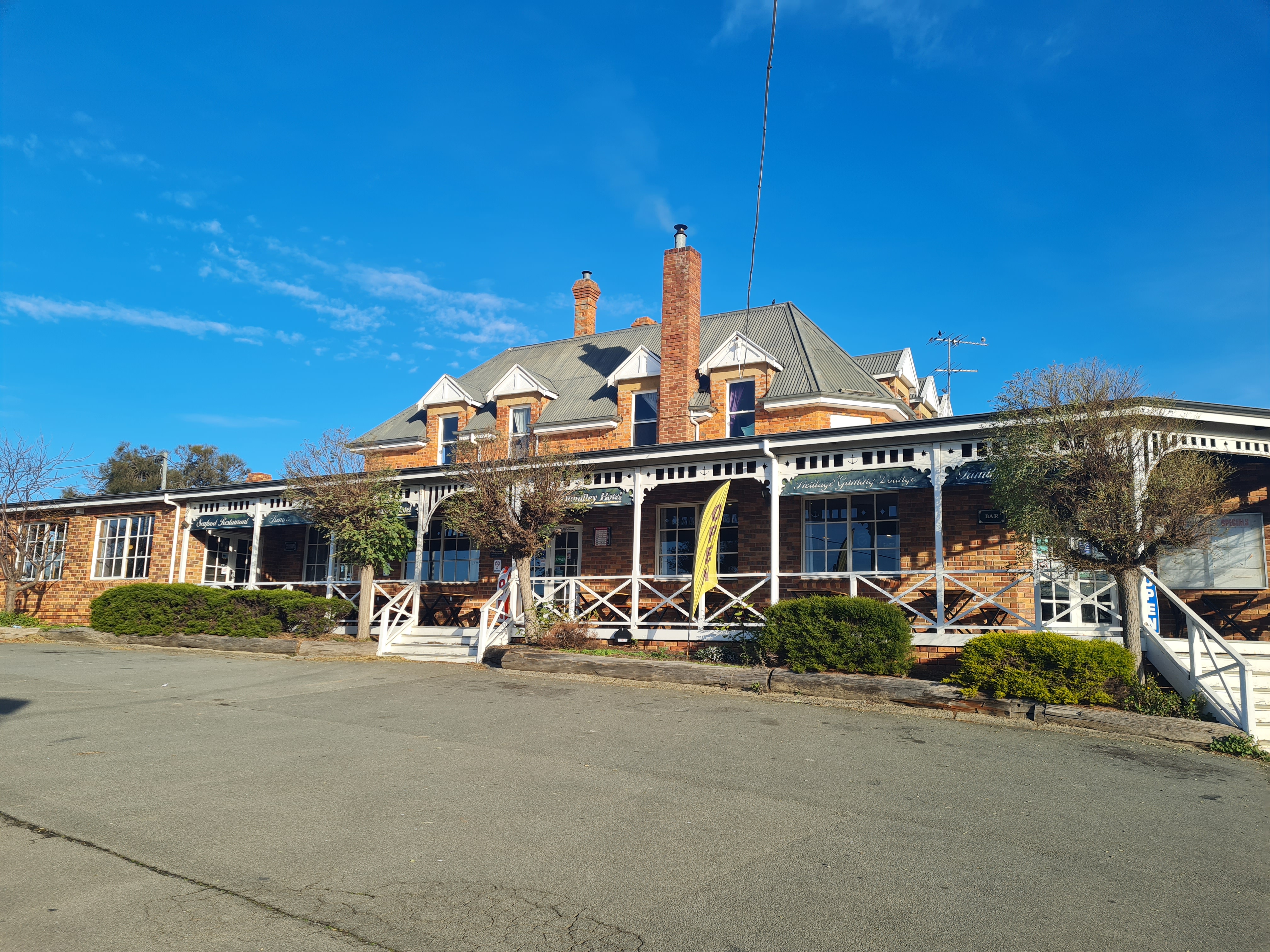
Hotel Dunally Seafood Restaurant, or so the sign outside says.

We saw this place on the way to Poet Arthur and if time allowed, we would check it out for lunch.

About 1 30 pm we go in.

Sadly, the locally caught Flounder is unavailable, no one had been able to go out and get it, so there is no fresh fish at all, not even the flathead.

Asked about the flathead, but it’s frozen seafood out of a bag and fried.  For a seafood restaurant, it’s very disappointing that it lacks fresh seafood.

We opt for the seafood bake, with chips and salad.  It’s not going to be fresh seafood, but maybe the closest thing to it, with prawns, scallops, and calamari, as well as fish pieces.

WE then decided to go back to Daci and Daci again, for another cake.

And got a look at some of the other cakes

The fourth attempt, let’s look at the main character

So there are words on paper, and three times I’ve tried to fix it, or, perhaps just make it sound better because reading it in my head, there’s too little background and too many questions.

The flow of the story isn’t working for me, so I guess it’s time to sit down and work out what it is I’m trying to say.

The notion that our main character, Graham, is a loser seems to shine through, and that’s not what I’m trying to portray him as.  No, far from it, it’s been a lifetime of bad choices that have put him where he is, and he knows it.

So, in part, this is about owning your mistakes, and it’s my job to make him come across as a hero in waiting.  There’s good in him, perhaps too much, but there is also that attitude that led to all those bad choices, the one that can get him into trouble, and a sort of intransigence inherited from his father, that has more or less got him ostracised from the family. 

I want this character to be a chop off the old block, both of whom are the type not to back down, not to say sorry, and, to quote a rather apt allegory, would cut their nose off to spite their face.

Graham’s intransigence led to his refusal to follow his father into business, refusal to go to University despite having the necessary qualifications, and just to round out the defiance, his choice of women whom he knew would meet with family disapproval.

And these factors, over a period of time, saw him bounce from a low-paying job to jobs with no prospects, and a string of failed relationships, until this moment in time, where he was basically on his own, working the graveyard shift as a security guard.  The sort of job where qualifications weren’t looked for and workmates looked like and probably were ex-cons.

There are a few more details like the older brother, Jackson, politician and schemer, the same as his father before him (the seat was passed down through the family), like the younger sister who is a highly successful surgeon, married into immense wealth.  His brother had been less successful in the marital stakes but what he lacked in a wife was more than made up with a string of highly eligible and beautiful women.

And, no, he doesn’t resent the fact they’re rich, or that his parents were, too, just that they treated him with contempt.

It was almost five years since the last time he had seen any of them, that last time he attended the family Christmas in Martha’s Vineyard, the ‘Stockdale Residence’ an ostentatious sprawling fifty-room mansion that, in a drunken rage, he’s tried to burn down.

Once again, he had not received an invitation to the next, due in a few days, and it was not entirely unexpected.

Graham has his faults, but that even, five years ago, had pulled him off the road to self-destruction, helped along by a year stint in jail where he learned a great many lessons about life itself, and survival.

The four years since?

A lot of regrets, and a lot of repentance.  Life after jail was a lot worse than life trying to defy the family and the system.  There were two roads he could have gone down, and thankfully for him, it was not the wrong one.

So, he’s back on the path, a whole lot wiser, a whole lot tougher.

That might not have been exactly what I was thinking for him over the first three attempts.  I don’t think any character really begins to shine until halfway through, as you find him meeting various challenges in ways even you, as the writer, find quite unexpected.

Is that the end result of being a pantser over being a planner?

I don’t think, even as a planner, you can create a character that’s not going to change, or even surprise you, as the story evolves.

And somehow I don’t think I’m about to change from one to the other.

Well, not completely.

But there’s more, and no, it’s not steak knives!

© Charles Heath 2020-2021

“Sunday in New York”, a romantic adventure that’s not a walk in the park!

“Sunday in New York” is ultimately a story about trust, and what happens when a marriage is stretched to its limits.

When Harry Steele attends a lunch with his manager, Barclay, to discuss a promotion that any junior executive would accept in a heartbeat, it is the fact his wife, Alison, who previously professed her reservations about Barclay, also agreed to attend, that casts a small element of doubt in his mind.

From that moment, his life, in the company, in deciding what to do, his marriage, his very life, spirals out of control.

There is no one big factor that can prove Harry’s worst fears, that his marriage is over, just a number of small, interconnecting events, when piled on top of each other, points to a cataclysmic end to everything he had believed in.

Trust is lost firstly in his best friend and mentor, Andy, who only hints of impending disaster, Sasha, a woman whom he saved, and who appears to have motives of her own, and then in his wife, Alison, as he discovered piece by piece damning evidence she is about to leave him for another man.

Can we trust what we see with our eyes or trust what we hear?

Haven’t we all jumped to conclusions at least once in our lives?

Can Alison, a woman whose self-belief and confidence is about to be put to the ultimate test, find a way of proving their relationship is as strong as it has ever been?

As they say in the classics, read on!

Purchase:

http://tinyurl.com/Amazon-SundayInNewYork

The cinema of my dreams – I always wanted to go on a treasure hunt – Episode 28

Here’s the thing…

Every time I close my eyes, I see something different.

I’d like to think the cinema of my dreams is playing a double feature but it’s a bit like a comedy cartoon night on Fox.

But these dreams are nothing to laugh about.

Once again there’s a new instalment of an old feature, and we’re back on the treasure hunt.


I didn’t get to go wandering into the next ward to see Boggs, if he was there, because the head of ER had decided I was well enough to be discharged.  It seems they had kept me there just in case there might be problems with concussion after being whacked on the head.

I still had a dull ache in my head, but they gave me a few days supply of pain killers and sent me on my way.  After I signed some papers to that said anything happened to me outside the hospital was my fault, and that I’d been duly warned about the possible consequences of concussion.

That list of consequences always ended in death, but that could happen by being run over by an ambulance arriving outside the ER just as I was leaving.

I don’t know why, but I’d expected someone to be there, though I was not sure who.

It was a short walk to the main entrance to the hospital, and then a bit of a puzzle to be solved in trying to find the appropriate person who could tell me where Boggs was.

Twenty minutes later I came to an abrupt woman in a hospital uniform with a clipboard in her hand, and a solemn look on her face.  If the brick wall could be personified, this was it.

Nurse Jamieson.  No first name.  No sense of humour.

She looked up at me with utter disgust that someone would dare interrupt what she was doing, something I had not worked out yet unless staring at a screen saver on her computer could be said doing something.

“Can you tell me where Wiliam Boggs is, please,”  I said it nicely, and politely.

“Are you a relative?”

“No, I’m his best friend.”

“That’s not what I asked.  You can hear properly can you?”

“Yes.”

Then, what did I ask you, just before?”

“Was I a relative?”

“And the answer?” followed by what I thought she said, “not that we don’t already know the answer to that one.”

“No.”

“The go away.  Close relatives only.”

“Then if I can’t see him, can you tell me how he is?”

Too late.  Nurse Jamieson had gone back to the mesmerising screen saver.  Perhaps it was being used by some intergalactic alien to brainwash her.

I shook my head and headed back towards the main entrance.

“Excuse me?”

I heard a voice from behind, approaching quickly but quietly.  Another nurse, a different coloured uniform.  Bad nurse, good nurse, was this the latter?

I turned as she reached me.  “Yes?”

“I heard you were looking for Boggs.”

Last name, only used by friends, not that he had many, and none who were female unless he’d been holding out on me.  No, he didn’t know any girls.

“Yes.  He’s my best friend.  Do you know him?”

“A friend of his cousin, Annabelle.  I can take you to him, but you won’t be able to stay very long.”

Annabelle?  I don’t remember him telling me anything about a cousin called Annabelle, but he did say there were family members he still hadn’t met, but that was because of longstanding feuds.

“Is he alright?”

“Nothing a little rest won’t cure.  He looks worse than he is.”

I followed her back along a passage off the main foyer to an elevator, and then up to the sixth floor.  

A sign on one of the ways pointed to what was called ‘Recovery’.  We walked halfway down that passage then stopped at a room.

“He’s in there.”

The door was open, but there was a screen pulled across the entrance blotting out those who walked past from looking it.  I pushed the screen back a short distance and saw the end of the bed.

When I stepped in and reclosed the screen, I realized the bed was empty, though someone had been in it.  I stepped further into the room, and around the corner, sitting in a chair, was Nadia.

© Charles Heath 2019