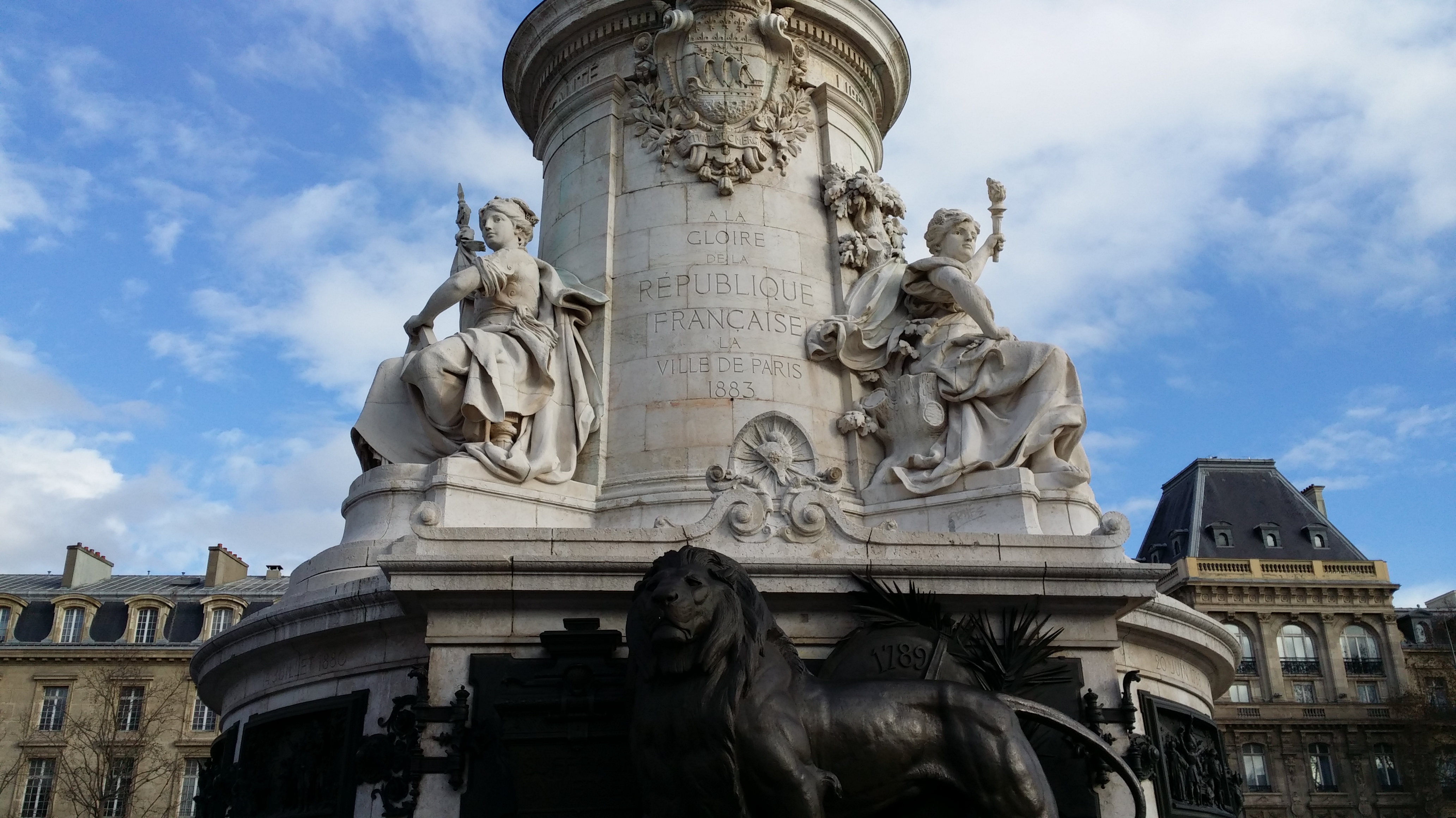
Searching for locations: Paris, France: Place de la Republique

Whilst a rather important place for the French, for us visitors, it has a convenient hotel located just behind the square, and an underground, or Metro station, underneath.

2014-01-07 11.43.05

Added to that was equally convenient cafes, one of which, The Cafe Republique, we had dinner every night.  The service and food were excellent, and we had no problems with the language barriers.

At the top of the monument is a bronze statue of Marianne, said to be the personification of France.

2014-01-07 11.43.41

Surrounding Marianne is three more statues, representing liberty, equality, and fraternity.

2014-01-07 11.43.32

At the base is a lion guarding what is said to be a ballot box.

“Strangers We’ve Become” – Countdown to publishing in 6 Days

I ought to be on holiday

Now that David has finally worked out what it is that Prendergast wants, and what is required to get back to living in the London residence, though he’s not sure he really wants to go back, arrangements are made by Alisha’s trusty assistants.

Of course, Alicia has to go too, despite the short recovery time, but it seems everyone wants to get back to work, and David realizes that being at the coal face is really what he’s been missing.

Nigeria is probably not the best place to be going, and the head of station there is a rather odd fellow who doesn’t quite understand the subtleties of secrecy.  He’s also Prendergast’s man and that means he can’t be trusted.

David pulls in some old friends he used to work with, and the team assembles in Lagos, and will be travelling to the vicinity of the guerrilla’s camp in the Nigerian Delta by float plane landing near a village whose people have been having trouble, and who will take them by boat to the ‘back door’ of the camp.

It seems the villagers have been petitioning the Queen to help them as members of the Commonwealth.  It provides David and his team a perfect excuse to go there if anyone is asking.

All of this works like clockwork.  And the means to gain entry is simply enough, they are going to present themselves at the gate, and allow themselves to be ‘detained’.  As for being shot on sight, David understands the local warlord ‘type’; he would use David and his team as a bargaining chip with the British Government.

Not that it was going to happen, the warlord was about to discover what war was really like.

I’m not perfect…

I was told a long time ago I wasn’t perfect, and it didn’t bother me. Then.

But it’s true. I don’t always get it right, sometimes I get annoyed and say things in the heat of the moment that perhaps shouldn’t be said, and sometimes I can be ‘difficult’.

I’ll be the first in line to say my blog isn’t perfect, in fact sometimes it bothers me some of the bits and pieces that go up because I doubt if they’re interesting, at the time, to anyone but me.

Perhaps it’s because I chose to be a writer.

It’s a hard slog at the best of times. Getting ideas, carving out time to write, having to live a normal life as distinct from that of living in a garret, on your own, writing that next great Nobel prize for literature, or is it a Pulitzer?

I don’t get that, I don’t have that, and I don’t want that.

For those of us living on that ‘edge’ of finding time to write, maintain a blog, keep up with social media, do the daily chores and watch some television, something has to give.

So, I’m not getting any writing done if I’m working on the blog, or I’m on social media. If I’m doing the blog, something else has to be sacrificed.

Mostly it’s my blog. My blog is about writing stuff, visiting places that have been or will be used in stories, and once, a recalcitrant cat who sadly has passed on. It also has running episodic stories, usually four different at a time.

It also had about 2,000 past posts. When I don’t get the time to do my blog, which has been mostly for the last three months off and on, I sometimes repackage or repeat past posts, just to keep it ticking over, much like a scoreboard.

It is also a tool for advertising my books and stories, and what’s coming (if only I stopped using social media) and these are repeated every four or five days. It’d the equivalent of advertising because I can’t afford other advertising. If this is an annoyance, I’m sorry.

And just so everyone knows, I will always keep writing, not because I want to become the next James Patterson, though it would be nice, I write because I want to, and it pleases me when someone reads something I write, and they like it. It is the greatest compliment of all, and I believe in encouragement. It’s why I spend a lot of that social media time highlighting other writers so they can build a following.

After all, we are all in the same boat, it would just be nice if we were all rowing in the same direction.

In a word: Blue

Of course, we all know this word is a colour, or colour depending on where you live.  You know, blue sky, deep blue sea, blonde hair blue eyes.
Very descriptive.
But it can also mean you are down in the dumps, a rather strange, for some, an expression that means you are sad or unhappy.

For others to have a blue means to have a fight with someone

And oddly, and I know this from first-hand experience, a red-haired person will be called bluey, or less pleasing either carrot top or blood nut.  I used to ignore those people who used those expressions, except for my father-in-law.

You can do something until you are blue in the face, which means do it without result until exhaustion, another way of saying you’re wasting your time.

And if something comes out of the blue, it usually means it’s entirely unexpected.  For me, that’s always a bill I wasn’t expecting, for someone else an inheritance.

And in some parts of the world, blue is used as a synonym for a conservative political party, for insistence, the Liberal party in Australia, and the Democrats in the United States

Blue should not be confused with the word blew, which is the past tense of the blow, which is wind causing an air current or blowing air through pursed lips.

That doesn’t mean that if something blew up it was just a giant air mass exploding because it can’t.  If a bomb blew up it means it detonated.

And if that sounds complicated:

What if something blew my mind?  Does that mean my head exploded?  No, it just means it’s incomprehensible, whether good or bad.

Or

What if I blew a fortune on a three-legged horse?  We all throw good money after bad, but you can quickly lose a fortune, or blew it.

It’s the same thing with opportunities, for instance, he had a chance and blew it.  Yes, obviously something better came along, not, or he just ignored a sterling opportunity.

The story behind the story – Echoes from the Past

The novel ‘Echoes from the past’ started out as a short story I wrote about 30 years ago, titled ‘The birthday’.

My idea was to take a normal person out of their comfort zone and led on a short but very frightening journey to a place where a surprise birthday party had been arranged.

Thus the very large man with a scar and a red tie was created.

So was the friend with the limousine who worked as a pilot.

So were the two women, Wendy and Angelina, who were Flight Attendants that the pilot friend asked to join the conspiracy.

I was going to rework the short story, then about ten pages long, into something a little more.

And like all re-writes, especially those I have anything to do with, it turned into a novel.

There was motivation.  I had told some colleagues at the place where I worked at the time that I liked writing, and they wanted a sample.  I was going to give them the re-worked short story.  Instead, I gave them ‘Echoes from the past’

Originally it was not set anywhere in particular.

But when considering a location, I had, at the time, recently been to New York in December, and visited Brooklyn and Queens, as well as a lot of New York itself.  We were there for New Years, and it was an experience I’ll never forget.

One evening we were out late, and finished up in Brooklyn Heights, near the waterfront, and there was rain and snow, it was cold and wet, and there were apartment buildings shimmering in the street light, and I thought, this is the place where my main character will live.

It had a very spooky atmosphere, the sort where ghosts would not be unexpected.  I felt more than one shiver go up and down my spine in the few minutes I was there.

I had taken notes, as I always do, of everywhere we went so I had a ready supply of locations I could use, changing the names in some cases.

Fifth Avenue near the Rockefeller center is amazing at first light, and late at night with the Seasonal decorations and lights.

The original main character was a shy and man of few friends, hence not expecting the surprise party.  I enhanced that shyness into purposely lonely because of an issue from his past that leaves him always looking over his shoulder and ready to move on at the slightest hint of trouble.  No friends, no relationships, just a very low profile.

Then I thought, what if he breaks the cardinal rule, and begins a relationship?

But it is also as much an exploration of a damaged soul, as it is the search for a normal life, without having any idea what normal was, and how the understanding of one person can sometimes make all the difference in what we may think or feel.

And, of course, I wanted a happy ending.

Except for the bad guys.

Get it here:  https://amzn.to/2CYKxu4

newechocover5rs

The cinema of my dreams – I never wanted to go to Africa – Episode 44

Our hero knows he’s in serious trouble.

The problem is, there are familiar faces and a question of who is a friend and who is foe made all the more difficult because of the enemy, if it was the enemy, simply because it didn’t look or sound or act like the enemy.

Now, it appears, his problems stem from another operation he participated in, and because of it, he has now been roped into what might be called a suicide mission.


I spent another hour trading stories of Army life, none of mine bearing any resemblance to the truth, before the party started.

I said to him, several times, that in my estimation, a part would start at a particular time. He seemed intrigued by how that could be possible when all my men were locked up and guarded.

The Captain, it seemed, was a man of limited intellect.

Or just plain overconfident that he had quelled the incursion and attempt to take the prisoners home.

I was under house arrest, just not in the house with the rest of the men. The Captain decided, being the ranking officer of our group, that I should be accorded facilities befitting my rank. It didn’t change my opinion of the Captain, but it did raise the respect level slightly.

As an officer and a gentleman, as he described himself, he was also a student of Army procedures and practices, not only of his own army but that of others. I admired his hobby out of working hours.

We were just discussing aspects of the first World War, and the part Africa played in it, when both of us suddenly heard gunshots. So did the guard and picked his gun and carefully went out the front door.

The Captain pulled his pistol from out of the top drawer and made sure the magazine had bullets in it. Just in case he needed to use it. All the men, suddenly increased to six, armed and dangerous, in that room had a gun, similar to the Captain. They were commanded by another soldier dressed in fatigues, perhaps a Colonel or higher.

I’d notice some Africa countries had a higher proportion of Generals, to say Lieutenants, and deduced from that, field promotions were a regular thing. That was not my experience here. So far.

I heard another gunshot, this time closer to the hut. Was it my people, mounting their attack? Or was it the Commander, back to retake what was his.

There would be no love lost between the Captain and the commander, and if was a betting man, in a fight, my money would be on the commander.

The sounds of gunfire continued for about ten minutes, then it became sporadic, then none at all. There were footsteps on the boards at the front of the hut, and then a cautious entry, gun barrel first, then, “if you have a gun pointed at the door, I suggest you put it down.” Monroe.

Having caught the Captain’s attention from the front, the Colonel came in the rear, and had his gun barrel pointing to the small of the Captain’s back. “Drop it now.”

The Captain did as he was told.

“You had more men on the perimeter?” he said with a sigh.

“Yes. I thought it prudent to have more than one sniper, a fact that the Militia commander hadn’t given a thought to.” I looked over at Monroe. “Have we secured the airfield?”

“Yes. 10 surviving soldiers, some of them in a bad way, are in the second barracks. They won’t be mounting a counterattack.”

I heard an engine; a large plane engine being started.

“That will be Davies playing with her new toy. Someone is on the runway lights; the rest are heading for the plane. Where are the hostages?” She glared at the Captain.

He shrugged.

Shurl burst in the door. “Out, back through that door,” I said. “Be careful there isn’t a guard waiting for you.”

Monroe looked at me. “Can I shoot the insubordinate bastard?”

A look of surprise, not terror, crossed the Captain’s face.

“Just take him back to the cells and lock him up.”

Shurl came out with the two hostages, just as the second plane engine fired. Monroe took the Captain back to the cells and returned a minute or so later. Shurl had taken the hostages to the plane. Baines would be waiting to switch on the lights at the last minute, and hopefully, the rest were on board.

They would be waiting for Monroe and me.

The both engines were running smoothly, and Davies was testing the rudder and flaps. Suddenly the runway lights came on, and Baines came running towards the plane. Monroe and I jumped aboard, then Baines followed, pulling the door shut behind him.

I heard the engine noise increase, and then we were moving.

I headed up to the cockpit and joined Davies. She was now in her element, her fact a picture of concentration. We were slowly moving to the end of the runway, and I could see her working her way through the preflight checklist.

I tried to speak to her, but she couldn’t hear. She had headphones on. There was a pair near the co-pilot’s seat. I sat down and put them on.

“Everything OK?”

“Nearly. Be quiet for a minute.”

We were at the end of the strip and she turned the plane. She would have checked the wind, not that I’d felt any, and adjusted the take-off direction accordingly.

Then, after what looked like a deep breath and slow exhale, she pushed the engine controls to maximum, and we started moving, slowly gathering speed. The runway surface wasn’t exactly flat, but it was enough not to impede forward motion. Not long after the rear of the plane rose, then in what seemed effortless, we were in the air.

Odd then, when we passed through 2,000 feet, I wondered who this plane belonged to.


© Charles Heath 2020

“The Things We Do For Love” – Coming soon

Is love the metaphorical equivalent to ‘walking the plank’; a dive into uncharted waters?

For Henry the only romance he was interested in was a life at sea, and when away from it, he strived to find sanctuary from his family and perhaps life itself.  It takes him to a small village by the sea, s place he never expected to find another just like him, Michelle, whom he soon discovers is as mysterious as she is beautiful.

Henry had long since given up the notion of finding romance, and Michelle couldn’t get involved for reasons she could never explain, but in the end both acknowledge that something happened the moment they first met.  

Plans were made, plans were revised, and hopes were shattered.

A chance encounter causes Michelle’s past to catch up with her, and whatever hope she had of having a normal life with Henry, or anyone else, is gone.  To keep him alive she has to destroy her blossoming relationship, an act that breaks her heart and shatters his.

But can love conquer all?

It takes a few words of encouragement from an unlikely source to send Henry and his friend Radly on an odyssey into the darkest corners of the red light district in a race against time to find and rescue the woman he finally realizes is the love of his life.

The cover, at the moment, looks like this:

lovecoverfinal1

The cinema of my dreams – I always wanted to see the planets – Episode 56

Would a Mexican standoff work?

I couldn’t help thinking just how far behind the technological ball we were, and that even if we had to ability to travel far into space, we were always going to find people more advanced than us.

I remembered back to the time, before this mission was to get underway, an almost finished spacecraft waiting for a crew, the round table discussions that were held to talk about what we might expect and how we would react.

I said then that we would not be able to treat them like we would other nationalities on our own planet, which seemed to be the consensus for first contact.

Some thought it unlikely we’d run into anyone else.

And where we were right now was largely uncharted territory.  Of course, there was a whole team aboard whose job was specifically to handle alien encounters, and all of them had been huddled in their meeting room since day one of our first encounter with the Foroi, taking extensive notes, analysing every aspect of each encounter, and contributing information I would find useful in my dealings with them.

It was there I headed now.

I had already been admonished by their leader, Emile Jacques, over my handling of certain situations, particularly when I chose what he called the ‘death or glory’ option.

I told her it was like the nuclear option, where each side held an Armory of weapons at the ready, threatening to use them, but never with intention of doing so.  The old ‘Mexican standoff’.

I told her I based my decision on the fact we were simply dealing with more evolved human beings who’d moved beyond the corporeal life we were still stuck with.  But, for all their advances, the notion of creating a nuclear wasteland still held respect.

I doubted anyone no matter how advanced could get past the finality of a nuclear attack on a home planet.

And if they had been on ours and seen the effect of the one time our leaders had decided on pre-emptive and retaliatory attacks would see the wastelands of what London, New York, and Moscow looked like.

How much we hadn’t learned from our mistakes, beggared belief.

The table was full, a dozen experts with a lot of books, papers, and computers, all talking at once, a half dozen conversations, each trying to be heard above the others.

I came, and the noise subsided.

The leader of the team, Emile Jacques, was down the other end of the table.

I looked at each one of them, experts in fields that related to humans, and not one had any idea what an alien might be like.  They were trying to apply the human factor to the aliens and every decision they made had been based on flawed theory.

The aliens were nothing like us.

We knew nothing about them, but they knew everything about us.

When I looked at Emile, he said, “The consensus is that we should let her people take her back to her homeland.”

“What if she doesn’t want to go?”

“Is it worth possibly sacrificing this ship and crew just to make a stand?  We want to make friends with these people, not enemies.”

“Did you consider the possibility that if we let her people take her, the other group might object?  I get the impression that no matter what we do, it is going to end badly.”

Was that a possibility they hadn’t considered?

“What do you think we should do?”  Alexandra was the crew representative, and not formally a member of the team, but a person who should have a seat at the table when matters were discussed that concerned the crew.

It was a position I had insisted on before we left on this odyssey, with far-reaching authority to make decisions that would resolve crew issues in a fair and balanced manner.  That included discipline and punishment when warranted.  I did not want the crew to think that their fate rested in the hands of the ship’s officers.  I had ultimate authority but rarely intervened in any decision she made.

“She had offered to become a mediator so that we can sit down and discuss their intentions.  She has also requested what back on earth we would call asylum, she wants to not be taken by either group.  Did anyone back on earth before this began ever consider the possibility that we might be asked for asylum?”

“No.”  Jacob was the international law expert, well versed in all matters that related to problems back home, and was sent with the possibility of him learning or creating a set of rules for intergalactic relations.  “My superiors didn’t think we’d meet any alien races, but now we have, all I have as a basis is earth’s international law, and it has provisions for asylum, and as such, we should be able to extend it galactically, I can’t believe I actually said that, but we may have problems in getting these people to agree to anything we propose.”

“But there’s no reason why we can’t grant her asylum if she formally requests it.  Something that might help, these people as I understand it, have spent time on our planet, which means that aliens have been walking among us for a very long time.”

“Did she tell you that?  It might just be a ploy to gain your trust.”

“She’s not the only one.  The captain of the first vessel we encountered said the same.  They know of us, and our ways, and they’ve been watching our evolution over a very long period.”

“Why didn’t they just invade us, then.  We’re obviously technologically inferior.”  The technological expert, the person who was charged with getting his hands on alien technology, if we found any, asked.

“It explains the UFO’s then,” said another.

“You know what we would have done the moment their ships arrived.  Shoot first and ask questions later.  It’s probably what they’re expecting from us now.  We have to be better than that.” To the lawyer, I said, “Start drafting some intergalactic rules for asylum.  Everyone else, start formulating questions to ask the Princess about anything and everything.  I’m going to see the Chief Engineer.”

© Charles Heath 2021-2023

An excerpt from “If Only” – a work in progress

Investigation of crimes doesn’t always go according to plan, nor does the perpetrator get either found or punished.

That was particularly true in my case.  The murderer was incredibly careful in not leaving any evidence behind, to the extent that the police could not rule out whether it was a male or a female.

At one stage the police thought I had murdered my own wife though how I could be on a train at the time of the murder was beyond me.  I had witnesses and a cast-iron alibi.

The officer in charge was Detective First Grade Gabrielle Walters.  She came to me on the day after the murder seeking answers to the usual questions like, when was the last time you saw your wife, did you argue, the neighbors reckon there were heated discussions the day before.

Routine was the word she used.

Her fellow detective was a surly piece of work whose intention was to get answers or, more likely, a confession by any or all means possible.  I could sense the raging violence within him.  Fortunately, common sense prevailed.

Over the course of the next few weeks, once I’d been cleared of committing the crime, Gabrielle made a point of keeping me informed of the progress.

After three months the updates were more sporadic, and when, for lack of progress, it became a cold case, communication ceased.

But it was not the last I saw of Gabrielle.

The shock of finding Vanessa was more devastating than the fact she was now gone, and those images lived on in the same nightmare that came to visit me every night when I closed my eyes.

For months I was barely functioning, to the extent I had all but lost my job, and quite a few friends, particularly those who were more attached to Vanessa rather than me.

They didn’t understand how it could affect me so much, and since it had not happened to them, my tart replies of ‘you wouldn’t understand’ were met with equally short retorts.  Some questioned my sanity, even, for a time, so did I.

No one, it seemed, could understand what it was like, no one except Gabrielle.

She was by her own admission, damaged goods, having been the victim of a similar incident, a boyfriend who turned out to be an awfully bad boy.  Her story varied only in she had been made to witness his execution.  Her nightmare, in reliving that moment in time, was how she was still alive and, to this day, had no idea why she’d been spared.

It was a story she told me one night, some months after the investigation had been scaled down.  I was still looking for the bottom of a bottle and an emotional mess.  Perhaps it struck a resonance with her; she’d been there and managed to come out the other side.

What happened become our secret, a once-only night together that meant a great deal to me, and by mutual agreement, it was not spoken of again.  It was as if she knew exactly what was required to set me on the path to recovery.

And it had.

Since then, we saw each about once a month in a cafe.   I had been surprised to hear from her again shortly after that eventful night when she called to set it up, ostensibly for her to provide me with any updates on the case, but perhaps we had, after that unspoken night, formed a closer bond than either of us wanted to admit.

We generally talked for hours over wine, then dinner and coffee.  It took a while for me to realize that all she had was her work, personal relationships were nigh on impossible in a job that left little or no spare time for anything else.

She’d always said that if I had any questions or problems about the case, or if there was anything that might come to me that might be relevant, even after all this time, all I had to do was call her.

I wondered if this text message was in that category.  I was certain it would interest the police and I had no doubt they could trace the message’s origin, but there was that tiny degree of doubt, about whether or not I could trust her to tell me what the message meant.

I reached for the phone then put it back down again.  I’d think about it and decide tomorrow.

© Charles Heath 2018-2020

In a word: Saw or Sore or Soar

In the first or is the second instance of the word Sore, we all know this malady can sometimes fester into something a lot worse.

Or that a person could be a sore loser

Or after spending an hour on the obstacle course, they come off very sore and sorry.  I never quite understood why they should be sorry because no one ever apologises to inanimate object.  Or do they?

Or perhaps he was sore at his friend for not telling him the truth.

Then, there’s another meaning, saw, which can mean the past tense of seeing, that is, I saw them down by the pool.

I could also use a saw, you know, that thing that custs through wood, steel, plastic, almost anything.  And yes, it’s possible someone might actually saw through a loaf of bread.

There are hand saws, electric saws, band saws, coping saws, even a bread knife, all of these have one thing in common, a serrated edge with teeth of different sizes, designed to cut, smoothly or roughly depending on the size.

Add it to bones, and you have Captain Kirk’s description of his medical officer on the Enterprise.  I’m not sure any doctor would like to be addressed as saw-bones.

But then, confusingly in the way only English can do, there’s another word that sounds exactly the same, soar

This, of course, means hovering up there in the heavens, with or without propulsion or oxygen.

Yes, it’s difficult to soar with eagles when you work with turkeys.  I’ve always liked this expression though most of the time people don’t quite understand what it means.