The cinema of my dreams – I never wanted to go to Africa – Episode 25

Our hero knows he’s in serious trouble.

The problem is, there are familiar faces and the question of who is a friend and who is a foe is made all the more difficult because of the enemy, if it was the enemy, simply because it didn’t look or sound or act like the enemy.

Now, it appears, his problems stem from another operation he participated in.

When I woke up, it was in a whole new world, but not necessarily of pain.

It was a different room, not quite dark, not hot or cold, and looked much like a hospital room layout with a hospital bed, and bright lights outside the doors.

I had no idea if it was daylight or night.  Classic disorientation procedure before a different sort of interrogation.

What I also realised, though I was not sure why was that the casts and bandages I had back at the previous base hospital were gone, and everything looked, well, different.

That there was nothing wrong with me.

It’s a terrible thing to realise your own people had basically told you a web of lies about your condition, and how the mind adjusted to those lies.  And yet, I would have sworn on a stack of bibles my pain was real.

Drugs.  Not only could they do good, but they could also do some very bad things, to the mind and the body.  At a guess, I would say it was for Breeman’s benefit.  If I’d come back in one piece there would be a truckload of questions.

So, I’d been moved, and kept under the whole time.  And if there was nothing wrong with me, why was I still in what looked like a hospital?  Maybe it wasn’t.  There was only one bed in the room.  Perhaps it was a cell for recovering transportees.

My worst fears then, a black site.

My waking must have triggered an alarm because I heard the door open and someone come into the room.  The exact position of the door was hidden by a curtain, but I could see the light from outside intensify when it opened and slowly drop ass it closed.

The curtain moved on its rings to show a man in a white coat, perhaps a doctor, but more likely the interrogator or his assistant coming to check the viability of their target.

I had to ask, “Where am I?”

“In a camp, at a location, I’m not at liberty to disclose.”

“When did I get here?”

“Yesterday, late last night.  It was busy.  We had three new arrivals.  You must be on the right side because you didn’t arrive in chains, the other two did.”

He took my temperature, blood pressure and some other tests, and wrote the numbers on a page in a file.

“You haven’t reacted to the serum we gave you.  That’s good.”  He saw my look of concern.  “Oh, it’s only used for transporting injured people from one base to another.  It helps to minimise the external forces causing them unnecessary pain.”

“Apparently I’m not injured.”

“No.  Not quite sure what happened there, but, whatever happened, it’s above my pay grade.  By the way, don’t try to leave this room.  There’s a guard outside who had been told to shoot first and ask questions later.  I’ve seen the results of her work.”

It had to be Monroe.

That means Lallo would be around soon enough.

© Charles Heath 2019

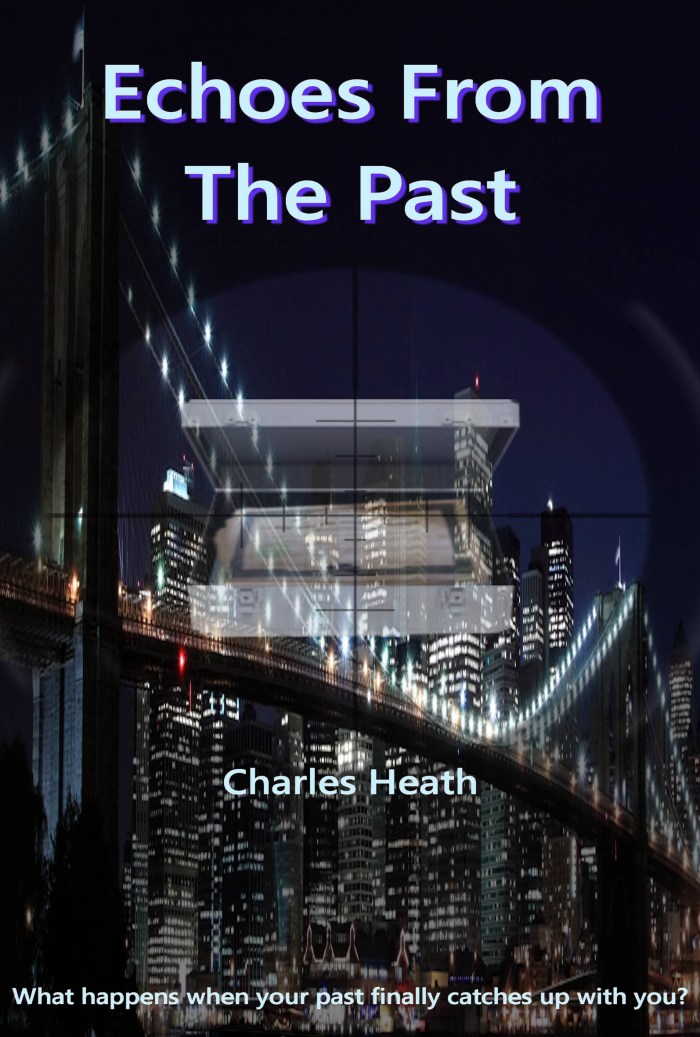
An excerpt from “Echoes from the Past”

Available on Amazon Kindle here:  https://amzn.to/2CYKxu4

With my attention elsewhere, I walked into a man who was hurrying in the opposite direction.  He was a big man with a scar running down the left side of his face from eye socket to mouth, and who was also wearing a black shirt with a red tie.

That was all I remembered as my heart almost stopped.

He apologized as he stepped to one side, the same way I stepped, as I also muttered an apology.

I kept my eyes down.  He was not the sort of man I wanted to recognize later in a lineup.  I stepped to the other side and so did he.  It was one of those situations.  Finally getting out of sync, he kept going in his direction, and I towards the bus, which was now pulling away from the curb.

Getting my breath back, I just stood riveted to the spot watching it join the traffic.  I looked back over my shoulder, but the man I’d run into had gone.  I shrugged and looked at my watch.  It would be a few minutes before the next bus arrived.

Wait, or walk?  I could also go by subway, but it was a long walk to the station.  What the hell, I needed the exercise.

At the first intersection, the ‘Walk’ sign had just flashed to ‘Don’t Walk’.  I thought I’d save a few minutes by not waiting for the next green light.  As I stepped onto the road, I heard the screeching of tires.

A yellow car stopped inches from me.

It was a high powered sports car, perhaps a Lamborghini.  I knew what they looked like because Marcus Bartleby owned one, as did every other junior executive in the city with a rich father.

Everyone stopped to look at me, then the car.  It was that sort of car.  I could see the driver through the windscreen shaking his fist, and I could see he was yelling too, but I couldn’t hear him.  I stepped back onto the sidewalk, and he drove on.  The moment had passed and everyone went back to their business.

My heart rate hadn’t come down from the last encounter.   Now it was approaching cardiac arrest, so I took a few minutes and several sets of lights to regain composure.

At the next intersection, I waited for the green light, and then a few seconds more, just to be sure.  I was no longer in a hurry.

At the next, I heard what sounded like a gunshot.  A few people looked around, worried expressions on their faces, but when it happened again, I saw it was an old car backfiring.  I also saw another yellow car, much the same as the one before, stopped on the side of the road.  I thought nothing of it, other than it was the second yellow car I’d seen.

At the next intersection, I realized I was subconsciously heading towards Harry’s new bar.   It was somewhere on 6th Avenue, so I continued walking in what I thought was the right direction.

I don’t know why I looked behind me at the next intersection, but I did.  There was another yellow car on the side of the road, not far from me.  It, too, looked the same as the original Lamborghini, and I was starting to think it was not a coincidence.

Moments after crossing the road, I heard the roar of a sports car engine and saw the yellow car accelerate past me.  As it passed by, I saw there were two people in it, and the blurry image of the passenger; a large man with a red tie.

Now my imagination was playing tricks.

It could not be the same man.  He was going in a different direction.

In the few minutes I’d been standing on the pavement, it had started to snow; early for this time of year, and marking the start of what could be a long cold winter.  I shuddered, and it was not necessarily because of the temperature.

I looked up and saw a neon light advertising a bar, coincidentally the one Harry had ‘found’ and, looking once in the direction of the departing yellow car, I decided to go in.  I would have a few drinks and then leave by the back door if it had one.

Just in case.

© Charles Heath 2015-2020

newechocover5rs

The cinema of my dreams – I always wanted to see the planets – Episode 37

Could it be an alien spaceship?

“We’re being hailed,” the communications officer said in her matter-of-fact tone.

“Not an alien then?”

The moment I said it, it sounded inappropriate.

“Definitely human, with an accent.”

I was not sure what I was expected to make of that.

“On screen.”

A bridge, not dissimilar to ours appeared, with the captain, or the person I assumed to be captain, standing in front of his chair.

“Whom am I addressing?” He asked.

I gave him my name, the ship, who we were, standard name, rank, and serial number stuff as per regulations.

“Where is the previous Captain?”

He seemed to have information about us, if not recent.

“Dead.”

“I’m sorry to hear that.”

OK, I didn’t think he was coming just to make small talk.

“Ship slowing, no signs of weapons charging,” I saw pop up on the screen.  In situations like this, best not to communicate when there’s an open communication session.

Then, a new notice, “second ship following the first, moving at the same spot, arrival time 18 minutes.”

I looked at the inset on the master screen, and even at that distance and low-quality magnification, it definitely didn’t look like anything in our fleet.

It begged the question, were they running away?

“Are you alone?”

“No.  But it’s not one of our ships.”

Not very helpful.

“I suggest you turn around and go back,” he added.

I saw him turn, as if someone beside him had spoken, or gestured.

“Sorry.  We have to go.  Don’t say we didn’t warn you.”

“Who are they?”

“People you don’t want to meet.”

The screen went back to being a window, and the vessel we’d just been in communication with came clearly into view, then vanished.

It was larger than our ship, but more streamlined, my first thought, like a sleek racing car.

“It seems we’re about to have our first encounter.  Number one, stay on the highest alert, the rest of the crew, battle stations, quick as you can.”

To the navigator, “Did we get anything on that ship, scans, personnel, weapons, engines, anything?”

“A little.  We can go through it later.  If we’re still in one piece.”

If the oncoming ship was alien, it was an unknown quantity, and the navigator could be forgiven for thinking we might not be able to defend ourselves.  Questions we should have asked the other ship were plentiful, and the surprise it caused caught us all offside when I should have been the exception.

There would be time later to analyze everything we did wrong, what I did wrong

Hopefully.

The alien ship was no longer a blurry blob in the distance, but an oddly shaped ship that bore similarities to our own.

I could only guess at the lifeforms aboard if there were any.  It was a moment of thrill, fear, and intense expectation.

Those last few minutes of waiting disappeared as though they were seconds, and suddenly it was opposite us, in space, on station maintaining its distance.  I had us brought to a stop after the other ship left, but in a state of instant readiness to depart just in case we were fired upon.

I was banking on the fact the aliens might be as curious about us as we were about them.

“Can we communicate with that vessel,” I asked, turning the senior communications officer, now on the bridge at the comms station.

“You can speak to them; we have all means of external communication open.”

He didn’t add that they might not understand what I said.

I shrugged.  “We are from the planet Earth on a voyage of exploration and discovery with no other agenda other than to meet and talk to other civilizations.”

It sounded quite strange listening to a somewhat stumbling and unrehearsed greeting that was to be our first words to an alien species.  I hoped that our credibility didn’t rest of those words.”

Silence.

“Any detectable activity aboard their ship?”

“Our scanners can’t penetrate their hull.  Nothing noteworthy outside the hull, but, then, if we don’t know what we’re looking for…”

“We know where you are from and who you are.”

It was a crackling rendition, the sort of sounds I’d expect from a vintage radio broadcast.”

I looked at the comms officer.

“An ancient radio frequency once associated with AM radio, sir, 812 megahertz.”

Did that mean we were more advanced than them?  I didn’t think so.

“Who am I addressing?”

This time the silence was broken by crackling, and what sounded like a tape recorder fast-forwarding.  This went on for about five minutes.

Then, much stronger, and clearer, “Who I am is irrelevant.  If you have similar intentions as the vessel before you, I strongly suggest you turn around and go back to your own galaxy.”

“They’ve moved to FM sir, not sure why they’re using such old technology”, the comms officer said quietly.

Two things popped into my head; from that proverbial left field, I once heard a language professor once pontificate on. The first, was from a scientist at the space training facility on what an alien race mighttry to communicate with us on, and that in his opinion would be the band waves we had been sending out into space for years. AM and FM in that context made perfect sense.

The second: how did an alien speak such good English?

“We have not, though I suspect that will not allay your fears.  All humans, which is what we call ourselves, are not the same.”

“Yet your ship carries weapons.”

“For defense.  If we are attacked, we will respond.  I would expect no less from you.”

There was a minute or so of silence, time I was guessing for my counterpart to formulate his next move.

It came sooner than I expected.

A humanoid form appeared, not exactly like us, but much the same as the early humanoid robots we created at the start of our foray into robotics and for that matter AI.

“We have had much interaction with your kind, one way or another, and it has always ended badly.  If you have no ill intentions towards up, will you accompany me back to my ship?  I assure you, and your crew I have no ill intentions.”

It would be a huge leap of faith.

 Number one, you have the ship.  I’m going to take a short trip to the other vessel.”

“You should take a crew member, as per protocol.”

Yes, the instruction. If we were to were to meet an alien, it was not to go with them without one or more crew members.

“Unfortunately, he’s a stickler for regulations.  I must go with another crew member, just in case.”

I didn’t add the ‘harm cones to me, and retribution will be meted out.’  I didn’t think at this delicate stage that would fly.

“No weapons then.”

“No weapons.  Nancy Woolmer to the bridge immediately.”

She arrived within five minutes, and the moment she was in proximity, we were, I assumed, beamed aboard his ship.

© Charles Heath 2021-2022

“The Things We Do For Love” – Coming soon

Is love the metaphorical equivalent to ‘walking the plank’; a dive into uncharted waters?

For Henry the only romance he was interested in was a life at sea, and when away from it, he strived to find sanctuary from his family and perhaps life itself.  It takes him to a small village by the sea, s place he never expected to find another just like him, Michelle, whom he soon discovers is as mysterious as she is beautiful.

Henry had long since given up the notion of finding romance, and Michelle couldn’t get involved for reasons she could never explain, but in the end both acknowledge that something happened the moment they first met.  

Plans were made, plans were revised, and hopes were shattered.

A chance encounter causes Michelle’s past to catch up with her, and whatever hope she had of having a normal life with Henry, or anyone else, is gone.  To keep him alive she has to destroy her blossoming relationship, an act that breaks her heart and shatters his.

But can love conquer all?

It takes a few words of encouragement from an unlikely source to send Henry and his friend Radly on an odyssey into the darkest corners of the red light district in a race against time to find and rescue the woman he finally realizes is the love of his life.

The cover, at the moment, looks like this:

lovecoverfinal1

In a word: play

I’m going to play a game. 

Is that a video game on the computer, or I’d that a board game with friends?

In reality, I didn’t play games with friends because I’m a poor loser.  Especially monopoly.

But to play a game often means you take on a persona or a role, as one, or one of many.

Personally, I like role-playing games like dungeons and dragons.

I’m going to a play

This is a stage production of a scripted story with various people in roles.

A play can have a star, a lead actor in a pivotal role to draw in the viewers

I’ve been to good plays and bad ones with great actors and some not-so-great ones.

A play can be hard to understand, it can be a musical with singing and dancing, or it can be rollicking good fun where the audience dances in their seats.

The worst play I ever saw was Dr Zhivago, it never seemed to end.

The best play, The Pyjama Game, with John Inman from Are You Being Served, a British comedy TV show.

I’m going to play the game

There’s a slight difference between this and the first example because it means instead of doing something your own way, you’re going to do eat everyone else does, prompting the analogy, you’re going to fight fire with fire.

Yep, even the explanations can be confusing.  You have to love the English language for being that.

I’m going to play a role

So many connotations to this one.  For instance, I’m going to be someone I’m not.  If I’m a kind person, then I’m going to pretend I’m mean.

I’m going to join a group of like-minded people and help further their cause, that is to say, together we changed the course of history, and I had a role in that.

Let’s hope it was for the betterment of mankind and not a leap towards infamy.

And of course, if you play a part in a play, it means you are pretending to be someone else.  I like the idea of playing God, but that’s usually the lead actor, I’m usually the janitor, servant, or just plain dogsbody.

An excerpt from “If Only” – a work in progress

Investigation of crimes doesn’t always go according to plan, nor does the perpetrator get either found or punished.

That was particularly true in my case.  The murderer was incredibly careful in not leaving any evidence behind, to the extent that the police could not rule out whether it was a male or a female.

At one stage the police thought I had murdered my own wife though how I could be on a train at the time of the murder was beyond me.  I had witnesses and a cast-iron alibi.

The officer in charge was Detective First Grade Gabrielle Walters.  She came to me on the day after the murder seeking answers to the usual questions like, when was the last time you saw your wife, did you argue, the neighbors reckon there were heated discussions the day before.

Routine was the word she used.

Her fellow detective was a surly piece of work whose intention was to get answers or, more likely, a confession by any or all means possible.  I could sense the raging violence within him.  Fortunately, common sense prevailed.

Over the course of the next few weeks, once I’d been cleared of committing the crime, Gabrielle made a point of keeping me informed of the progress.

After three months the updates were more sporadic, and when, for lack of progress, it became a cold case, communication ceased.

But it was not the last I saw of Gabrielle.

The shock of finding Vanessa was more devastating than the fact she was now gone, and those images lived on in the same nightmare that came to visit me every night when I closed my eyes.

For months I was barely functioning, to the extent I had all but lost my job, and quite a few friends, particularly those who were more attached to Vanessa rather than me.

They didn’t understand how it could affect me so much, and since it had not happened to them, my tart replies of ‘you wouldn’t understand’ were met with equally short retorts.  Some questioned my sanity, even, for a time, so did I.

No one, it seemed, could understand what it was like, no one except Gabrielle.

She was by her own admission, damaged goods, having been the victim of a similar incident, a boyfriend who turned out to be an awfully bad boy.  Her story varied only in she had been made to witness his execution.  Her nightmare, in reliving that moment in time, was how she was still alive and, to this day, had no idea why she’d been spared.

It was a story she told me one night, some months after the investigation had been scaled down.  I was still looking for the bottom of a bottle and an emotional mess.  Perhaps it struck a resonance with her; she’d been there and managed to come out the other side.

What happened become our secret, a once-only night together that meant a great deal to me, and by mutual agreement, it was not spoken of again.  It was as if she knew exactly what was required to set me on the path to recovery.

And it had.

Since then, we saw each about once a month in a cafe.   I had been surprised to hear from her again shortly after that eventful night when she called to set it up, ostensibly for her to provide me with any updates on the case, but perhaps we had, after that unspoken night, formed a closer bond than either of us wanted to admit.

We generally talked for hours over wine, then dinner and coffee.  It took a while for me to realize that all she had was her work, personal relationships were nigh on impossible in a job that left little or no spare time for anything else.

She’d always said that if I had any questions or problems about the case, or if there was anything that might come to me that might be relevant, even after all this time, all I had to do was call her.

I wondered if this text message was in that category.  I was certain it would interest the police and I had no doubt they could trace the message’s origin, but there was that tiny degree of doubt, about whether or not I could trust her to tell me what the message meant.

I reached for the phone then put it back down again.  I’d think about it and decide tomorrow.

© Charles Heath 2018-2020

The cinema of my dreams – I always wanted to write a war story – Episode 17

For a story that was conceived during those long boring hours flying in a steel cocoon, striving to keep away the thoughts that the plane and everyone in it could just simply disappear as planes have in the past, it has come a long way.

Whilst I have always had a fascination in what happened during the second world war, not the battles or fighting, but in the more obscure events that took place, I decided to pen my own little sidebar to what was a long and bitter war.

And, so, it continues…


Jack was the first to realise that Marina was coming back, hearing her outside long before I did.  He stood up and looked in the direction of where he expected to see her.

A minute later she appeared, looking and sounding out of breath, as if she had been in a hurry? 

Chased, or had some urgent news?

“Is everything OK?” I asked, waiting till she came in and shut the door behind her.

The building we were in used to be a factory or a repair shop.  The strange smell I’d picked up a few hours ago was that of machine oil.

“We need to have a chat with the two who picked you up.”

“Where are they now?”

“I’ve organised to meet them at another facility we have.  Not everyone comes here.  It’s why we are still here.  Francesco nor any of the resistance he took with him were aware of this location.

I considered myself lucky to be among the few.

“Is there a reason why I need to be there?”

“Yes.  But it’ll wait until we get there.  Let’s go.”

She had barely got in the door, nor caught her breath.  It was just enough time to collect a spare clip of ammunition for a gun she had on her, but I couldn’t see.

I followed her out into the darkness, not realising it was night, for the first time since I’d arrived, and once outside, realised that it was an underground bunker rather than a building on an allotment, so it couldn’t be easily seen from any direction.  It was surrounded by trees and bushes, looking as though they had not been tended properly for some time.

It was as much as I could see, close by because it was a moonless night.

We went up some stairs and came out in a clump of bushes, and walked several yards where there was a disguised walkway zig-zagging through the bushes.  It, too, would be hard to see from a distance.  When we came out the other side, I could just barely see a car parked under a tree, looking rather worse for wear, and I thought it had been abandoned there. 

When Marina told me to get in, I realised it was, like everything else, well disguised.

The surrounding area was that of forest and farms.  It was hard to imagine that this part of the world was in the grip of a world war, and not too far away, there was the castle, and further north, the Germans and what was left of the Italian military forces dug in for a last-ditch effort.  The tide was turning, but ever so slowly.

It was hard to imagine just how dangerous it was for those defectors to try and get through without being shot.

And, just for good measure, Marina said, there were quite a few soldiers, disguised as ordinary workers who had infiltrated the villages, and surrounding farms, and reporting back what they saw and heard.

We were, in going about in the vehicle, attracting unwanted attention, but it was why we were doing this at night, she said, perhaps gleaning from my expression the fact I was worried about getting caught.

“The people at the castle tend not to go out at night for fear of being picked off.  I’m surprised you didn’t learn this when you were there.”

“I suspect the suspended any activities from the moment I arrived.  One of the prisoners told me that all movements of people had stopped, and they were waiting to be shipped out.  Obviously, they thought I might discover what was going on.  They definitely stopped me from going below the main floor.”

“I was told you have some knowledge of the castle layout?”

“Some.  We have old plans back in London, but I suspect those would be out of date now and since the German occupation.  The only time I got to look downstairs was when I tried to escape and found an old below ground exit, then when they locked me in a cell, and then when I was set free.  It matched much of what I remember seeing on the plans.  But, I suspect there’s more because I didn’t get to see the holding cells with the other prisoners.”

“Perhaps Carlo can help you with that.”

“We spoke about it.  I think he’s going to pay them a visit and exact revenge.”

“I told him we have to wait for some reinforcements.”

“No word from London?”

“Not yet.”

We stopped and parked the car between a church and what was left of what might have been a rectory, set aside from some other buildings that looked like part of a village.  It was not that dark that I couldn’t see that several of the buildings had been bombed, minus roofs, and one had the front section reduced to rubble.  No attempt had been made to clean it up.

“German tanks,” Marina said.  “An early landing party of your army parachuted in about a kilometre behind the church.  The local commander mobilised his forces and chased them into those buildings, which, at the time, housed four families.  They were given the option to surrender.  They didn’t, so the commander gave the order to raze the buildings to the ground, with them in there.  Along with the four innocent families.  No one survived.”

“The church?”

“The commander thought it would be bad luck to destroy the house of God.  The soldiers should have hidden in there.  They shot the priest anyway.”

It seemed odd to me that any sort of group would parachute into this part of Italy for any reason, castle withstanding.  There was, as far as I knew, nothing of interest or importance here.  Perhaps I’d ask when I made it back to London.  If I made it back.

I followed her through the rubble and in through a side entrance to the church.  Inside it was dark, and Marina was using her torchlight sparingly in case someone was watching.  From what I could see, the inside of the church was untouched, but everything was covered in dust from disuse.

“No one thought to send another priest?” I asked.

“No.  When they heard what happened to the last one, they decided to wait until the war was over.  Besides, with everything that’s happened, the people around here believe God has abandoned them.”

Perhaps he had.  I know that I wasn’t all that religious to begin with, but a lot of people I knew had lost their faith in a God that allowed such tragedies to happen.

We passed through a door at the back of the church, behind the nave, and into what looked like the vestment room.  To one side was another door, and then steps down.  The church had a cellar.

At the bottom of the stairs, there was a large storage area lit by a portable lantern.

Carlo was standing to one side, his weapon ready to use.

Opposite him were a man and a woman, the woman I’d seen before, she was the one who shot me with the tranquilizer.  The man, I’d not seen him before.


© Charles Heath 2019

Writing about writing a book – Day 5 continues – Those annoying people called characters

Whilst it is always an idea to sit down and write and keep going, not worrying too much about the narrative, there’s always the problem of ideas about characters, and relationships that come back and need to be addressed.

I have issues with Jennifer in that we will need to know something about her, and need a little backstory.

Jennifer is the second most important character in this novel and one that has more talents than what my main character, or anyone else for that matter, thinks she has.  Of course, that is deliberate on her part for a number of reasons that will be introduced at the appropriate time.

But, at the start, all we will have to work with, is the introduction provided by the narrator.

It may go something like this:


Jennifer Pennington Smythe was, as you might expect, very English, very reserved, and very private.  She was the definitive ‘don’t judge a book by its cover’, and I was guilty, at first, of suspecting she had once been a schoolmistress due to the severity of dress, demeanor, and expression.

HR had sent her to me when I’d requested an IT Specialist, though of what particular discipline it was never divulged, neither by HR nor by her.  She arrived one morning, told me she was to ‘help resolve our technical difficulties’, moved into an office that had been used as a storeroom, and worked hard to prove her worthiness in the role.

My first attempt at conversation was rebuffed, the second met with a very cold stare.  Everyone, including me, learned very quickly that any other topic of conversation than work would be ignored.  At the time it suited me, there was trouble in paradise and I didn’t want anything more on my plate to deal with.


So, what is this trouble?

There are three distinct stages of this relationship between the two most important characters, and it is the actions of one of the protagonists that brings them together.  This particular protagonist, of course, is the main character’s wife, a woman that is on the periphery for the period the novel covers, but a little background will be needed at some point before we reach this part of the narrative.

This now means that I will have to put together a back story for Bill and his ex-wife Ellen, not too much yet but enough to explain the next part of the evolving relationship between Bill and Jennifer.


I’m sure this topic is going to raise it’s head again and again…

Searching for locations: Oreti Village – No two sunrises are the same – 2

Oreti Village, Pukawa Bay, North Island, New Zeland

On the southern tip of Lake Taupo

Our first morning there, a Saturday.  Winter.  Cold.  And a beautiful sunrise.

20180812_073230

This was taken from the balcony, overlooking the lake.

The sun is just creeping up over the horizon

20180812_073241

It gradually gets lighter, and then the sun breaks free of the low cloud

It lights up the balcony

20180811_074651

And the trees just beyond, a cascade of colorful ferns.

20180811_074622

It looks like it’s going to be a fine day, our first for this trip, and we will be heading to the mountains to see snow, for the first time for two of our granddaughters.

The cinema of my dreams – It all started in Venice – Episode 18

Observing the enemy

“She’s not talking,” the detective who had been trying to get answers to various questions, said, after coming out of the room, looking somewhat exasperated.

I’d been watching him spar with her, and her legal representative telling her that unless the police had concrete evidence, she need not answer any questions, except with a ‘No comment’.  Not once though did she ask to leave, which she could do at any time.

That was interesting.

“I’m not surprised.  Technically she’s done nothing wrong, yet.  Perhaps we need to ask some different questions.”

He sighed.  “Then, by all means, do so.  I’ve been told you know more about her connection to Larry Fortescue, a person we are very familiar with, but this is a connection we’re not fully across yet.  You are aware we found several crates in one of her warehouses with his name on them, one of which had several blocks of C4 in it.  She claims it’s not hers and has no idea who it got there, but not the fact she knows him in passing.”

Denying as one would expect that there was more to the relationship other the acquaintances, and appropriate for so-called rival crime bosses.

“You have to admit, though, it’s not the sort of stuff your average beauty products sales person would have lying around.”

Nominally, she called herself a beautician who runs a chain of so-called health clinics which made the perfect front for other more nefarious activities, allegedly.  No one had yet proved without a doubt anything else happened there.

“These days nothing would surprise me.  Some of the chemicals we also found could very easily be ingredients for bombs, but she had the permits, and it’s all accounted for.  This is the first time we’ve been able to pull her in.”

“A routine check, or a tip?”

“Actually, someone called the hotline to say that men who looked like terrorists in a white van were unloading crates in a suspicious manner.  I kid you not, that was what we were told.”

Men who looked like terrorists.

“Now that Larry is implicated, well be happy to share what we have.  He would be a far likelier owner of the explosive, and this is a rare mistake on his part to leave his name on the crate.  This is the first lead we have on how he keeps one step ahead of us, using others to hold his stuff and why we can never find it in his possession.  He’ll deny it’s his and that it’s one of his enemies setting him up.”

“We’ve been trying to find him.”

“He’s in Sorrento Italy visiting his mother, and no doubt combining business with pleasure.  It’s no coincidence she is there, he’s looking for me.”

“Then he’ll be out of luck then.  Thanks for the info, I’ll get our people onto tracking him down.  He also has a few questions to answer.”

I looked at the screen on which I had been viewing the interview, noted the smug expression, and the body language that said she thought she was untouchable.

In a sense, she had every right to believe that.  She hadn’t been on Rodby’s radar until she took up with Larry.  Larry was Rodby’s obsession, why I never found out, and knew better than to ask.  Both she and Larry were well known to the police, and both had managed to keep out of jail because they were careful, though Larry had been far more careless in his younger days.

And for a person who was firmly entrenched, but more or less invisible in the criminal landscape, joining with Larry was her biggest mistake.

Rodby had brought a file with him and I read it in the car on the way here and it was another very thorough deep dive into a woman who for all intents and purposes was nothing like who she portrayed in real life.

A woman with secrets she believed were still intact.

Secrets I could use to gain some leverage, not that I ever liked doing so because often it involved innocents caught up in a world, not of their choice.

But she chose to be a criminal, and there were always consequences, unintended or otherwise.

Enough thinking, it was time.

© Charles Heath 2022