In a word: Story

All of us writers know what this is, the sort of combination of words that all come together as a story.  A tale about anything whether it is true or just plain fiction.

A story can be long, or it can be short.  It could be a magazine or newspaper article, it could be what a child tells his or her mother or father when they get into trouble.

Come to think of it, I think that’s where I got an interest in writing stories because as a child I was always in trouble.

Of course, if you are telling certain types of stories,, then it’s bound to be a lie.  And made even worse if it is gossip!

That story might even be my interpretation of events, and as it happens, it’s possible no two stories are the same, especially if I and others had witnessed the same event.

This is not to be confused with the other version, storey, which is a single level in a building, one that might have thirty or more stories.

And, just to add to the confusion, living in Brisbane in Australia we have the Storey Bridge.

Just one of many reading lists – part 3

**Please don’t assume that you have to, nor would I ever expect you to,  read any or all of these books.  You don’t.**

Everyone, it seems, will publish what they call the top 100 books that you should read. Some are voted on, some belong to the opinion of the editor of the book review section of a newspaper, and, as you know, there are a lot of newspapers, a lot of editors, and a lot of opinions.

I’m not a newspaper, I’m not an editor, but I have a list, based on personal experience, and many, many years of reading.

It’s in no particular order.

41.  The Hound of the Baskervilles by Sir Arthur Conan Doyle, as well as a host of other Sherlock Holmes stories

42.  The Secret Agent by Joseph Conrad, one of Conrad’s later political novels, set in London in 1886 and deals with anarchism and espionage.  In those days spies were called anarchists.

43.  The Ipcress File by Len Deighton, introducing us to Harry Palmer, who was personified by Michael Caine and led to Horse Under Water, and Funeral in Berlin.  More of Len Deighton later on in the list

44.  The Remorseful Day by Colin Dexter introducing the somewhat enigmatic detective, Morse, his first name not revealed for a long time but oddly, Endeavour.  John Thaw brought him to life

45.  Crime and Punishment by Fyodor Dostoevsky, hard to pronounce and even harder to read, but perhaps worth it in the end.  By the time I read this I was wishing for a Russian writer had could use an economy of words

46.  Dr. Zhivago by Boris Pasternak wasn’t it.  A vast and lengthy dissertation on lost love, I felt very sad for Zhivago in the end.  I saw a stage play of the same name, and I’m sorry, but it’s a few hours of my life I will never get back

47.  Casino Royale, the first of the James Bond novels by Ian Fleming.  I have to say these are among my favorite spy books.  I must say I preferred the new James Bond in Casino Royale, though Sean Connery still rules!

48.  The Day of the Jackal by Frederick Forsythe, a fascinating story about an assassin

49.  Anything written by John Le Carre, but in particular, the George Smiley collection.  Finally unmasking his nemesis the Russian spymaster made it all so satisfying.

50.  The Bourne Identity by Robert Ludlam, inspiring a long series by both Ludlam and Eric Lustbader makes entertaining reading, but the first, the man who did not know who or what he really was, was excellent.  Matt Damon didn’t harm his persona either.

51.  Murder Must Advertise by Dorothy Sayers, whose detective is Lord Peter Whimsey, a 1933 mystery novel that’s eighth in the series

52.  Gorky Park by Martin Cruz Smith.  You have to admit that his Russian detective Arkady Renko is up against it when his investigation goes in a direction that uncovers corruption and dishonest in his superiors

53.  The Way of All Flesh by Samuel Butler, a semi-autobiographical novel written between 1987 and 1884, and published in 1903.  The story of the Pontifex family.

54.  Howards End by E. M. Forster, first published in 1910, is an interesting insight into the behavior of the, and between the classes, with the Schlegels acting as the catalyst.

55.  Washington Square by Henry James, originally published as a serial, and covers the conflict between daughter and father.  I must say I prefer The Ambassadors to Washington Square.

56.  Ulysses by James Joyce, a day in the life of an ordinary man, Leopold Bloom, why could it not be the 7th June rather than the 16th, for obvious reasons

57.  The Go-Between by L. P. Hartley is a view of society at the end of the Victorian period through the eyes of a young boy.  I read this while still at school and had no clue why, but later, when I read it again, I understood the meaning

58.  Atonement by Ian McEwan, I saw the film and then read the book.  Never a good idea.  Basically, a young girl makes a bad mistake and tries to atone for it.

59.  Gone With The Wind by Margaret Mitchell, the War and Peace of Americal novels, and as long by comparison.  The only book written by Mitchell, and the second most read book by Americans.  The film was interesting but awfully long.

60.  The English Patient by Michael Ondaatje, with a man with severe burns and the effect he had on three others.  Colin Firth is villain one day and hero the next, this time in the cinematic version, an out and out cad.

More to come…

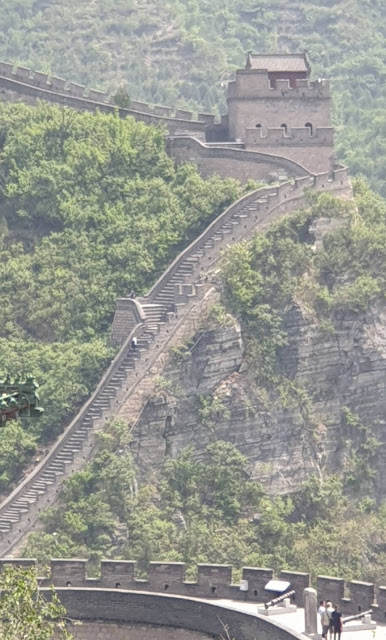
Searching for locations: The Great Wall of China, near Beijing, China

This is in a very scenic area and on the first impression; it is absolutely stunning in concept and in viewing.

As for the idea of walking on it, well, that first view of the mountain climb when getting off the bus, my first question was where the elevator is?  Sorry, there is none.  It’s walk on up or stay down the bottom.

Walk it is.  As far as you feel you are able.  There are quite a few who don’t make it to the top.  I didn’t.  I only made it to the point where the steps narrowed.

But as for the logistics, there’s the gradual incline to the starting point, and what will be the end meeting place.  From there, it’s a few steps up to the guard station no 7, and a few more to get up to the start of the main climb.  The top of the wall is guard station no 12.

Ok, those first few steps are a good indication of what it’s was going to be like and it’s more the awkwardness of the uneven heights of the steps that’s the killer, some as high as about 15 inches.  This photo paints an illusion, that it’s easy.  It’s not.

If you make it to the first stage, then it augers well you will get about 100 steps before you both start feeling it in your legs, particularly the knees, and then suffering from the height if you have a problem with heights as the air is thinner.  And if you have a thing with heights, never look down.

This was from where we stopped, about a third of the way up.  The one below, from almost at the bottom.  One we’re looking almost down on the buildings, the other, on the same level.

It requires rest before you come down, and that’s when you start to feel it in the knees, our tour guide called it jelly legs, but it’s more in the knees down.  Descending should be slow, and it can be more difficult negotiating the odd height steps, and particularly those high ones.  You definitely need to hang onto the rail, even try going backward.

And, no, that rail hasn’t been there as long as the wall.

While you are waiting for the guide to return to the meeting place at the appointed time, there should be time to have some jasmine tea.  Highly refreshing after the climb.

The cinema of my dreams – I always wanted to write a war story – Episode 36

For a story that was conceived during those long boring hours flying in a steel cocoon, striving to keep away the thoughts that the plane and everyone in it could just simply disappear as planes have in the past, it has come a long way.

Whilst I have always had a fascination with what happened during the second world war, not the battles or fighting, but in the more obscure events that took place, I decided to pen my own little sidebar to what was a long and bitter war.

And, so, it continues…

Jackerby came back and sat down.  It was clear he was annoyed his lunch was interrupted.

“Atherton’s not among those Leonardo brought back.”

Johannsen silently breathed a sigh of relief.  While he was still outside there was hope he would not get hurt.  If he had the sense to keep his head down.  Anyone else, Johannesen would not have cared.

“Who did Leonardo bring in?”

“Some woman called Martina, the one he says is in charge of the resistance.  He said he raided their last stronghold, killed everyone except the three people he knew were in the resistance.  They’re now in the dungeons.”

“We should be down there asking questions.”  A pointed glare from Wallace carried the message, what are you doing here?

“No use.  He nearly killed them, and it’ll take a while for them to recover.”

“To find out where Atherton is?”

“It seems that was the least of his concerns.  Apparently, she apparently humiliated him so he was more interested in payback.”

“It wouldn’t be hard to humiliate a fool like him,” Johannsen muttered.

Wallace glared at him.  “You should have more faith in our Italian friends, Richard.”

“My faith in him extends only to the fact he will drink the cellar dry.”

Wallace shrugged.  “Once he’s served his purpose…” and left it at that.  “Have you got onto London and asked them for further information on Mayer?”

“I think, by now, they would have tumbled to what’s going on here.  Especially after I saw Atherton come out of the radio room just before Jackerby arrived.  I asked the operator, and he gave me a coded message, but it’s not like any code I’ve seen.”

“And you’re telling me this now?”

“At least he didn’t smash it, which is what I would have done.  We haven’t heard any more from High Command other than to say the traitor was thought to be heading for Innsbruck and coming over the mountains near the Brenner Pass.  They’ve got people looking, but nothing as yet.”

“Now we’ve lost Carmichael, do we have a description of him?”

“Yes.”

“Good.  At least something is happening.”


After lunch, Johannsson went down to the dungeon to check on the prisoners.  Wallace had assigned their ‘welfare’ to him.  It was a difficult assignment seeing they arrived both exhausted, weak, and then subjected to an initial interrogation that determined whether or not they got medicines or food.

Most were left to starve.  Any women were sent to the soldier’s barracks, where they were out of his control.  None had ever come back, and he was ordered not to go check on them.

All told, there were 12 still in cells, with three due to be executed later that day.  All had worked in an armaments factory and had admitted to having information about the bombs that were being dropped over England.

Another six had yet to say what information they had, and had been subjected to severe torture, the handiwork of two of Jackerby’s men, and who Johannsen thought had been trained by the Gestapo.  In fact, he believed they were Gestapo, and that Jackerby, though he didn’t have the uniform, was a ranking SS officer.

Not a man to cross.  Leonardo would find that out soon enough.

The most recent three, the resistance fighters were put in separate cells next to each other.  The guards had been told to listen to any conversations they had, and report.  As yet, none of them had spoken.

Considering the condition they arrived in, that was no surprise.

He stood outside the cell holding the woman they called Martina.

The leader.

She hadn’t moved from the moment she had been dropped there.

A guard appeared beside him.

“Nothing yet?” Johansson asked him.

“I doubt they’ll speak again.  If that’s what Leonardo does to his so-called countrymen; I’d hate to see what he does to his enemies.”

“You let me know if she says anything.”

The soldier nodded, then went back to his station.

The other two were men, one old, one younger.  An odd group to be part of the resistance.  The woman he could understand and was the key. 

He now believed Atherton would come to rescue her.  Like any good British soldier, his empathy would be his downfall.

© Charles Heath 2020-2023

The cinema of my dreams – Was it just another surveillance job – Episode 51

This story is now on the list to be finished so over the new few weeks, expect a new episode every few days.

The reason why new episodes have been sporadic, there are also other stories to write, and I’m not very good at prioritizing.

But, here we are, a few minutes opened up and it didn’t take long to get back into the groove.

Things are about to get complicated…


Once out of the elevator I could see another security desk halfway up the corridor.  There were no doors before the desk, only after, so my destination was past the desk.

I pulled out my card in readiness, and as I approached, a woman came out of a door behind the desk and joined the security guard.

She spoke to the guard, then looked at me.  “My name is Joanne, I have been assigned to help you, and in accordance with security measures in place on the floor, I will be accompanying you.  One of the conditions of access is to not be anywhere on your own.”

“Except in the restroom, I hope.”

A momentary frown, “Common sense applies, you know.”

OK, try not to be flippant.

She handed me a form, I read it, ticked several boxes, and signed it.  I gave the guard my card and he scanned it.  Logging my movements, was not unexpected.  Having a shadow was.

But, there was nothing I was going to look at, that I didn’t want anyone not to know about.

“Good,”: she said when I handed the form back.  She in turn passed it to the guard, then said, “Follow me.”

A gate opened to let me through, then jolted shit behind me.  Either the mechanism was broken, or the thud was just to remind people going through it, it was not a toy.

We went three doors up the corridor where she stopped, opened the door, and ushered me in.

It was a reasonable-sized room with a desk, a computer with three screens, and two chairs, one I guess for me, and one for her.

We sat.

I thought I’d ask a couple of questions first.  “Do you always look after incoming researchers?”

“Yes.”

“And when there is none?”

“I work in with the research team, creating or updating breeding papers for agents in the field.”

“Do agents normally come in to look stuff up?”

“No.  Generally, they request it through secure channels.”

“Secure channels?”

“Usually, one of our consulates or embassies scattered all over the world.”

Good to remember.

“You’re just going to sit there?”

“Yes.”

I shrugged.  So be it.

I logged in and typed in Severin’s original name David Westcott.

The search engine brought back over a million hits, the first dozen relating to a violinist who seemed to be having a relationship and drug problems.

To narrow that search down, I added ‘Military service” in the hope that he may have been in the military before joining the intelligence services.

He was.  I did the same for Bernie Salvin and found the two of them had served roughly at the same time, in the same places, and were among the last people out in 2014.

When I added “Intelligence” to the search, the computer sent me on a side mission, bringing up documents relating to both men’s service in various branches of the intelligence services, for 5 years, after which it seemed they had just up and left, their service sheet marked ‘retired’, which could have meant anything, but I think it was a euphemism for ‘dead’.

I thought about asking my shadow, but that would lead to too many other questions that I didn’t want to answer.  As it was, I could see she was very interested in the two names I’d just searched on.

It explained how both men were so knowledgeable about the operations and facilities.  A quick search on the training facility we had used showed it had been closed, and abandoned, 6 years before.  I’d always thought it had that abandoned feel about it, and we were using it for the atmosphere value.

Then came searches on Severin and Maury and Arche Laboratories, and that too brought up the Security profiles of both men, but their prior history had been manufactured, though no doubt based on their real experience, being in the military in Afghanistan, and in a branch of the intelligence services, though not mentioning the specifics.

There was information on several security breaches and the computer systems being hacked reportedly by a foreign country, but nothing had been taken, a story perhaps to allay the fears of people who might think dangerous material might have fallen into the wrong hands.

At the very least, it was reported the facility would be shut down, due to its age and everyone being reassigned to a new more secure facility.  The fact Severin and Maury didn’t transfer told me they had either been caught, or they ad jumped before the fingers of accusation were pointed at them.  Either way, both had disappeared off the face of the earth.

Until I and others have become their unwitting recruits.

Everything O’Connell said was true, and it was all there, so Dobbin was as well versed on the pair as I now was.  And, now I had some background before I met Severin later in the day.

When Joanne finally plucked up the courage to ask me about my searches, I told her I had been reading up on a lot of old laboratories that used to contract government research and had narrowed the place where the information came from to several candidates and struck it luck the first search.  Arche Laboratories.

Previously I had got a list of the security staff from half a dozen labs that had closed unexpectedly, looking for possible matches to Severin and Maury, because I thought they would have a military and intelligence background, but the two I’d used, didn’t seem to fir the profile.  Their photographs, those that were posted for Arche Laboratories looked nothing like the Severin and Maury today, but I’d expected that.

She didn’t need to know that and looked satisfied with my answers.

Now it was time to look at some CCTV feeds.

© Charles Heath 2020-2022

A photograph from the inspirational bin – 20

20191216_175251

Suburbia, yes, reddish sky at night, yes, but what else might it be?

For just a moment, close your eyes, toss away everything you might accept as normal, and then, after a minute, open them again, and look at the photo with a new perspective.

Imagine…


It took two days for the dust to settle, figuratively and literally.

We heard screaming jet fighters overhead, followed by multiple explosions, then nothing but smoke and ash.  We assumed one of the jets had crashed.

Two days the media was saying it was an unfortunate accident.

On the third day, we discovered it was the result of multiple missile strikes on our power stations and oil refineries.  The jets had arrived too late to stop the attack.

And we only found out because an Army officer who lived in our street came home to collect his family and told us to leave, go anywhere but stay in the city.

The ash in the air was going to get worse, the sun was going to disappear altogether, and, well, he didn’t stay long enough to tell us the rest, but already the air was almost unbreathable.

But the leaving was easy, just take what we could in the car.  The problem was, everyone had the same idea, and by the time we reached the highway, it was a virtual carpark.

By then, it was day four.

That’s when the bombs started to fall.


It might not be an exact match for the photo, but that was the idea that came from it.

I’m sure there could be a far simpler and more pleasant story to be told.


‘Jungle Cruise’ – a review

Having gone on several of the Disney rides in locations other than in the US, I had no first-hand knowledge of what it might be like.

That aside, I have had a wealth of old movie viewing to fuel my imagination for what to expect, and those experiences didn’t let me down. Hollywood’s vision of the jungle has not changed much in the last 50 odd years.

And, with the Humphrey Bogart classic, The African Queen, firmly planted in the back of my mind, and this latest venture set in the same period, I was ready for anything the jungle could throw at me.

In this outing, the premise is a treasure hunt, not for actual treasure, but a life saving flower that grows on a tree somewhere in the jungle. Adventurers have been seeking it for many centuries, including a hapless expedition of Spaniards.

It was, as it should be, the stuff of legends.

We have all the usual suspects, man eating natives, poison darts, killer creatures including lots of snakes (and I hate snakes), rapids and waterfalls. And, yes, there’s the boat being saved at the last second from going over the edge. I had to wonder if that was a ‘feature’ of the ride in reality.

Visually, the jungle never looked better. If indeed, it was the actual jungle.

Like ‘The Mummy’ there is the hapless brother providing the comic light relief, and, I have to say, he did it quite well.

There is the strong willed, self-sufficient woman ready to face any danger, well, just about everything, except for one simple fear, for which it seems all superheroes have that makes them human.

And the fact she wears pants is the running gag.

Then there’s the Skipper, not the captain, of the boat, who needs no introduction. Oddly though, he drives the boat like it’s an instalment of Fast and Furious. And for those who remember a kangaroo called Skippy, will not be surprised by the heroines retort when he calls her ‘pants’.

Of course, it would not be as exciting if there wasn’t the archetypal baddie and being set around the time of the first world war, it had to be a German who is seeking the ‘prize’ in order to win the war for Germany. It was played with just about the right amount of dripping menace.

For light-hearted entertainment, and one of the better two hours I’ve spent in a movie theatre, there are, surprisingly, a few twists and turns you don’t expect.

Then there is an obvious rapport between the two leads, sometimes missing in stories like these, but their relationship didn’t get in the way of reaching the satisfactory conclusion.

All in all, it was one of the more entertaining films I’ve seen in a while, one where at the end, I found myself wanting more. Perhaps it will be like Pirates of the Caribbean, and we’ll get to go on another ‘cruise’.

“What Sets Us Apart”, a mystery with a twist

David is a man troubled by a past he is trying to forget.

Susan is rebelling against a life of privilege and an exasperated mother who holds a secret that will determine her daughter’s destiny.

They are two people brought together by chance. Or was it?

When Susan discovers her mother’s secret, she goes in search of the truth that has been hidden from her since the day she was born.

When David realizes her absence is more than the usual cooling off after another heated argument, he finds himself being slowly drawn back into his former world of deceit and lies.

Then, back with his former employers, David quickly discovers nothing is what it seems as he embarks on a dangerous mission to find Susan before he loses her forever.

Find the kindle version on Amazon here:  http://amzn.to/2Eryfth

whatsetscover

A door that is always open

My opinions are my own

It’s always a good thing to get that across especially if you work for an organization that could misinterpret what that opinion is, or generally have an opposing opinion.  Of course, by saying your opinions are your own, you’re covering yourself from becoming unemployed, but is this a futile act?

Perhaps it’s better to not say anything because everything you say and do eventually finds its way to those you want most not to hear about it, perhaps one of the big negatives of the internet and social media.

And…

It seems odd to me that more often than not you can’t have an opinion of your own, even if it is contrary to that of the organization you work for, and especially if their opinion has changed over time.  An opposing opinion, not delivered in a derogatory manner, would have the expectation of sparking healthy debate, but it doesn’t always end up like that.

I’m sure there are others out there that will disagree, and use the overused word, ‘loyalty’.   Perhaps their mantra will be ‘keep your opinions to yourself’.

This, too, often crops up in personal relationships, and adds weight to the statement, ‘you can pick your friends but not your relatives’.

I’m told I have an opinion on everything, a statement delivered in a manner that suggests sarcasm.  Whether it’s true or not, isn’t the essence of free speech, working within the parameters of not inciting hate, bigotry, racism or sexism, a fundamental right of anyone in a democracy?

Seems not.

There’s always someone out there, higher up the food chain, with an opinion of their own, obviously the right one, and who will not hesitate to silence yours.  But, isn’t it strange that in order to silence you, they have to use leverage, like your job, to get theirs across.

Well, my opinions are in my writing, and whether or not you agree with them or not, I’m sure you will let me know.  In a robust but respectful manner.

Unlike some, my door is always open.

The story behind the story: A Case of Working With the Jones Brothers

To write a private detective serial has always been one of the items at the top of my to-do list, though trying to write novels and a serial, as well as a blog, and maintain a social media presence, well, you get the idea.

But I made it happen, from a bunch of episodes I wrote a long, long time ago, used these to start it, and then continue on, then as now, never having much of an idea where it was going to end up, or how long it would take to tell the story.

That, I think is the joy of ad hoc writing, even you, as the author, have as much idea of where it’s going as the reader does.

It’s basically been in the mill since 1990, and although I finished it last year, it looks like the beginning to end will have taken exactly 30 years.  Had you asked me 30 years ago if I’d ever get it finished, the answer would be maybe?

My private detective, Harry Walthenson

I’d like to say he’s from that great literary mold of Sam Spade, or Mickey Spillane, or Phillip Marlow, but he’s not.

But, I’ve watched Humphrey Bogart play Sam Spade with much interest, and modeled Harry and his office on it.  Similarly, I’ve watched Robert Micham play Phillip Marlow with great panache, if not detachment, and added a bit of him to the mix.

Other characters come into play, and all of them, no matter what period they’re from, always seem larger than life.  I’m not above stealing a little of Mary Astor, Peter Lorre or Sidney Greenstreet, to breathe life into beguiling women and dangerous men alike.

Then there’s the title, like

The Case of the Unintentional Mummy – this has so many meanings in so many contexts, though I image back in Hollywood in the ’30s and ’40s, this would be excellent fodder for Abbott and Costello

The Case of the Three-Legged Dog – Yes, I suspect there may be a few real-life dogs with three legs, but this plot would involve something more sinister.  And if made out of plaster, yes, they’re always something else inside.

But for mine, to begin with, it was “The Case of the …”, because I had no idea what the case was going to be about, well, I did, but not specifically.

Then I liked the idea of calling it “The Case of the Brother’s Revenge” because I began to have a notion there was a brother no one knew about, but that’s stuff for other stories, not mine, so then went the way of the others.

Now it’s called ‘A Case of Working With the Jones Brothers’, finished the first three drafts, and at the editor for the last.

I have high hopes of publishing it in early 2021.  It even has a cover.

PIWalthJones1