I have seen this television program once or twice, where a television personality digs into their past and sometimes they discover they had famous, or sometimes infamous, relatives.
I don’t think I would be so lucky, or unlucky as the case may be.
But, to be honest I haven’t really been interested in digging into the past.
On the other hand, my older brother has a keen interest in genealogy in general, borne from a desire to find out more about our family tree.
And he has gone back to the 1600s, for the relatives who came out from England, and no, they have no transported convicts, or at least he’s not saying.
Genealogy is a rather fascinating subject, and, I’ve discovered, is taught in university as a degree. My brother has one now.
What I didn’t realize is that I’ve been playing with it for years because in writing what might be called sagas you need to create your own set of mythical families, and then trace to forebears back in time.
I have one novel I’m writing that has required a family tree, and recently another for a story that required starting with a character who participated in the Eureka Stockade. We had to create parents, a migration from England to Australia, and then construct a family tree through to today so we could write a story from the perspective of a fourth-generation girl at school doing a school project.
If that sounds complicated, believe me, it is. But from my granddaughter who came up with the idea, she is very excited about it.
Much better than sitting in front of a computer playing games or a tv watching cartoons.
But once again I digress…
I have found a lot of genealogy stuff that my mother had been working on, and I’m taking it to my brother, and at the same time, l will get the latest installment on our family.
So far I’ve learned that I come from a combination of British relatives on both my mother and father’s side, the most recent my father’s mother who was born in England, and German from my mother’s side, her surname being Auhl.
No doubt, and with a great deal of irony, my relatives probably fought against each other in two world wars.
I’m sure more will be revealed on Wednesday.
But, the more I learn the more I feel inclined to create a fictionalized history with my family members as characters in the story. At the moment a biographical account of the family would be reasonably boring since as yet no one notorious had been discovered.
Month: January 2023
Inspiration, maybe – Volume 1
50 photographs, 50 stories, of which there is one of the 50 below.
They all start with –
A picture paints … well, as many words as you like. For instance:
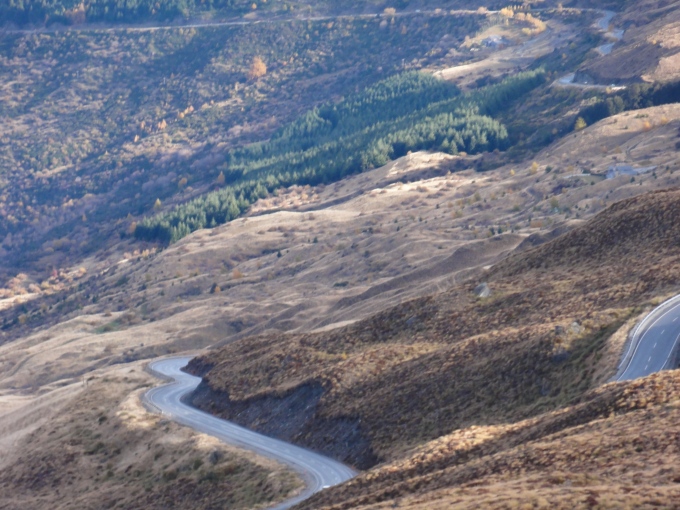
And the story:
It was once said that a desperate man has everything to lose.
The man I was chasing was desperate, but I, on the other hand, was more desperate to catch him.
He’d left a trail of dead people from one end of the island to the other.
The team had put in a lot of effort to locate him, and now his capture was imminent. We were following the car he was in, from a discrete distance, and, at the appropriate time, we would catch up, pull him over, and make the arrest.
There was nowhere for him to go.
The road led to a dead-end, and the only way off the mountain was back down the road were now on. Which was why I was somewhat surprised when we discovered where he was.
Where was he going?
“Damn,” I heard Alan mutter. He was driving, being careful not to get too close, but not far enough away to lose sight of him.
“What?”
“I think he’s made us.”
“How?”
“Dumb bad luck, I’m guessing. Or he expected we’d follow him up the mountain. He’s just sped up.”
“How far away?”
“A half-mile. We should see him higher up when we turn the next corner.”
It took an eternity to get there, and when we did, Alan was right, only he was further on than we thought.”
“Step on it. Let’s catch him up before he gets to the top.”
Easy to say, not so easy to do. The road was treacherous, and in places just gravel, and there were no guard rails to stop a three thousand footfall down the mountainside.
Good thing then I had the foresight to have three agents on the hill for just such a scenario.
Ten minutes later, we were in sight of the car, still moving quickly, but we were going slightly faster. We’d catch up just short of the summit car park.
Or so we thought.
Coming quickly around another corner we almost slammed into the car we’d been chasing.
“What the hell…” Aland muttered.
I was out of the car, and over to see if he was in it, but I knew that it was only a slender possibility. The car was empty, and no indication where he went.
Certainly not up the road. It was relatively straightforward for the next mile, at which we would have reached the summit. Up the mountainside from here, or down.
I looked up. Nothing.
Alan yelled out, “He’s not going down, not that I can see, but if he did, there’s hardly a foothold and that’s a long fall.”
Then where did he go?
Then a man looking very much like our quarry came out from behind a rock embedded just a short distance up the hill.
“Sorry,” he said quite calmly. “Had to go if you know what I mean.”
I’d lost him.
It was as simple as that.
I had been led a merry chase up the hill, and all the time he was getting away in a different direction.
I’d fallen for the oldest trick in the book, letting my desperation blind me to the disguise that anyone else would see through in an instant.
It was a lonely sight, looking down that road, knowing that I had to go all that way down again, only this time, without having to throw caution to the wind.
“Maybe next time,” Alan said.
“We’ll get him. It’s just a matter of time.”
© Charles Heath 2019-2021
Find this and other stories in “Inspiration, maybe” available soon.

“Trouble in Store” – Short Stories my way: The end of the story
The stage is set for the big finale, though I’m not quite sure how ‘big’ it’s going to be.
Jack is ready to go having been given the green light by the girl with the gun. It seems collateral damage is not on the agenda for her, though he does admit to himself she is between that proverbial rock and a hard place.
The storekeeper still has a plan, shaky at best, to regain hold of the situation, once the customer is out of the shop. Nervy or not, he doesn’t think she had the capability to pull the trigger. He knows what sort of person it takes to do that, and she isn’t one of them.
The policewoman is not sure what to expect but thinks that surprise is on her side, and whatever is going on, she will be able to resolve it. She has her weapon drawn and ready to use. She had yet to shoot anyone with it
The girl is at the point of no return, that point where she had nothing left to lose. Anything she had before was gone, destroyed by the choices she’d made. No one ever handed out a manual on how you should live your life, or provide a list of people you should avoid, and her father’s prophetic words the last time they men came home with a thud, ‘your life is defined by the choices you make’.
She was not going to jail so it was going to be death or glory.
Now read on:
Jack had heard there were moments where, in a split second, your whole life flashes before your eyes. He did, and what he saw he didn’t like.
But, then, neither was he very happy about the fact he was nearly out the door before the policewoman on the other side crashed into him and sent him sprawling to the floor.
That was about the same fraction of a second he heard the gun go off, twice, or so he thought and knew he was a dead man, waiting for the bullet.
Another fraction of a second passed as the policewoman tried to unravel the mess they’d become, and at that moment in time felt the tugging at his sleeve and then, as if in slow motion, the sound of the glass door disintegrating behind him.
Annalisa was quite prepared to let the customer go.
She kept one eye on the shopkeeper and one on the customer, sidling towards the door. The gun was ready to shoot the first person who made a wrong move.
Or so she told herself. It was getting heavy in her hand, she was shaking almost uncontrollably now, and was getting more and more frightened of the consequences. She didn’t think, if she aimed, she could hit the side of a barn let alone a person standing ten feet away from her.
The customer reached the door.
At exactly the moment he put his hand 0on the door handle to open the door, another person was pushing the door, trying to make their way in.
With force.
She saw the blue cap, guess it was the police, though she hadn’t heard the siren, but also guessed the shopkeeper might have a silent alarm.
Damn.
A single shot, instantly in the direction of the door, not necessarily aimed at the two people now collapsing to the floor in a tangled mess, but at the door itself.
The impact, yet another guess, might shatter the glass and make it easier to escape.
After one more job.
The hell with Simmo. He’d dragged her down the rabbit hole far enough. Simmo knew her first name, that she had rich parents, but nothing else. Besides, he was in such bad shape she didn’t think he’d recover.
The shopkeeper had no idea who she was, it was the first time she’d been to his shop, and now, after a few weeks with Simmo, not ever her mother would recognize her.
She swiveled the gun and aimed it at the shopkeeper and pulled the trigger., One less dealer in the city was good news not bad.
She saw it hit, not exactly where, but it caused him to twist and start falling to the ground, at the same time letting out a very loud scream. Panic or anger?
She wasn’t waiting to find out.
A last glance at Simmo, now down for the count, she ran for the door, past the two on the floor, what she could now see was a policewoman with her weapon drawn, but unable to use it.
She crashed through the remainder of the glass shards put into the street and ran.
In the distance she could hear a police car coming, siren blaring. A warning if there was ever one to run harder, up the road, down an alley, out into another street, then down into the subway.
Gone.
It took fifteen seconds to disentangle herself from the customer, pushing him away, and getting to her feet, weapon aimed.
At nothing but air.
The girl had gone, and then she had the vague recollection of a shadow passing her as she was facing the other way getting to her feet.
And running out the door.
Five more valuable seconds as her brain processed this piece of information before it issued the command to go out the door and see which way she went.
Another ten seconds to get out the door, and see the police car coming from the same direction she had earlier, screeching to a halt outside the shop, a car door opening, and an officer getting out.
Margaret was guessing at the driver to drive down the road where she guessed the girl had run, managing to yell breathlessly at the office getting out, “She’s gone that way,” and pointing.
The officer relayed the message and closed the door as the car sped off.
“What happened?”
“Shots fired by a woman, more a girl, in the process of a robbery.”
She ran back inside the officer following.
The customer had moved to a corner and was standing, testing his limbs, with an expression that said he was amazed he was still alive.
“Over behind the counter. She shopkeeper. He was standing there.”
The policeman rounded the end of the counter and looked down. “He’s here. It’s not looking good.”
Margaret didn’t hear him. She was calling an ambulance.
Next: Perhaps some editing
© Charles Heath 2016-2020
The first case of PI Walthenson – “A Case of Working With the Jones Brothers”
This case has everything, red herrings, jealous brothers, femme fatales, and at the heart of it all, greed.
See below for an excerpt from the book…
Coming soon!

An excerpt from the book:
When Harry took the time to consider his position, a rather uncomfortable position at that, he concluded that he was somehow involved in another case that meant very little to him.
Not that it wasn’t important in some way he was yet to determine, it was just that his curiosity had got the better of him, and it had led to this: sitting in a chair, securely bound, waiting for someone one of his captors had called Doug.
It was not the name that worried him so much, it was the evil laugh that had come after the name was spoken.
Doug what? Doug the ‘destroyer’, Doug the ‘dangerous’, Doug the ‘deadly’; there was any number of sinister connotations, and perhaps that was the point of the laugh, to make it more frightening than it was.
But there was no doubt about one thing in his mind right then: he’d made a mistake. A very big. and costly, mistake. Just how big the cost, no doubt he would soon find out.
His mother, and his grandmother, the wisest person he had ever known, had once told him never to eavesdrop.
At the time he couldn’t help himself and instead of minding his own business, listening to a one-sided conversation which ended with a time and a place. The very nature of the person receiving the call was, at the very least, sinister, and, because of the cryptic conversation, there appeared to be, or at least to Harry, criminal activity involved.
For several days he had wrestled with the thought of whether he should go. Stay on the fringe, keep out of sight, observe and report to the police if it was a crime. Instead, he had willingly gone down the rabbit hole.
Now, sitting in an uncomfortable chair, several heat lamps hanging over his head, he was perspiring, and if perspiration could be used as a measure of fear, then Harry’s fear was at the highest level.
Another runnel of sweat rolled into his left eye, and, having his hands tied, literally, it made it impossible to clear it. The burning sensation momentarily took his mind off his predicament. He cursed and then shook his head trying to prevent a re-occurrence. It was to no avail.
Let the stinging sensation be a reminder of what was right and what was wrong.
It was obvious that it was the right place and the right time, but in considering his current perilous situation, it definitely was the wrong place to be, at the worst possible time.
It was meant to be his escape, an escape from the generations of lawyers, what were to Harry, dry, dusty men who had been in business since George Washington said to the first Walthenson to step foot on American soil, ‘Why don’t you become a lawyer?” when asked what he could do for the great man.
Or so it was handed down as lore, though Harry didn’t think Washington meant it literally, the Walthenson’s, then as now, were not shy of taking advice.
Except, of course, when it came to Harry.
He was, Harry’s father was prone to saying, the exception to every rule. Harry guessed his father was referring to the fact his son wanted to be a Private Detective rather than a dry, dusty lawyer. Just the clothes were enough to turn Harry off the profession.
So, with a little of the money Harry inherited from one of his aunts, he leased an office in Gramercy Park and had it renovated to look like the Sam Spade detective agency, you know the one, Spade and Archer, and The Maltese Falcon.
There’s a movie and a book by Dashiell Hammett if you’re interested.
So, there it was, painted on the opaque glass inset of the front door, ‘Harold Walthenson, Private Detective’.
There was enough money to hire an assistant, and it took a week before the right person came along, or, more to the point, didn’t just see his business plan as something sinister. Ellen, a tall cool woman in a long black dress, or so the words of a song in his head told him, fitted in perfectly.
She’d seen the movie, but she said with a grin, Harry was no Humphrey Bogart.
Of course not, he said, he didn’t smoke.
Three months on the job, and it had been a few calls, no ‘real’ cases, nothing but missing animals, and other miscellaneous items. What he really wanted was a missing person. Or perhaps a beguiling, sophisticated woman who was as deadly as she was charming, looking for an errant husband, perhaps one that she had already ‘dispatched’.
Or for a tall, dark and handsome foreigner who spoke in riddles and in heavily accented English, a spy, or perhaps an assassin, in town to take out the mayor. The man was such an imbecile Harry had considered doing it himself.
Now, in a back room of a disused warehouse, that wishful thinking might be just about to come to a very abrupt end, with none of the romanticized trappings of the business befalling him. No beguiling women, no sinister criminals, no stupid policemen.
Just a nasty little man whose only concern was how quickly or how slowly Harry’s end was going to be.
© Charles Heath 2019
The cinema of my dreams – I always wanted to see the planets – Episode 22
It’s the most non captain job to be done
…
I hadn’t realised that the ship was, on the one hand, virtually a city, with all the standard infrastructure like hospitals, schools, and a pseudo police force.
And, on the other hand, almost like a hotel, running quarters for the single staff, a restaurant for everyone to eat, and recreational facilities to provide entertainment outside of work.
It was, perhaps on of the reasons why the ship was so large, and its crew so diverse.
And in the way diversity is sometimes a curse or land, so it can be on board the ship, with the usual disagreements between people. I was sure the human resource division took all that diversity into consideration when they chose the crew, but there was always going to be the odd situation.
Which is why I had to attend to the first, and probably not the last, ‘situation’ between two crew members. It seemed strange to me that they hadn’t sent a judge type figure to sort those out, but left it to the captain.
Not to mention the running of a very large cafeterias, a sort of night club, sports venues and so many other items
And like every other city, there was always going to be an element that caused trouble.
A chamber had been set aside where the ship’s security team was located, for either mediation or adjudication.
The matter at hand should have been dealt with long before it reached me, but Masters, head of security, believed a tone had to be set as it was very early in the voyage and simple problems could fester into bigger problems.
This was where the previous captain’s experience was needed.
But, he was not available, and it was in my hands.
In normal circumstances the two crew members involved should have sorted their differences out themselves. The fact that a fight had started over seating arrangements in the restaurant was bad enough, but the fact both were willing to continue it outside, sealed their fate.
Now each sat either side of the table with a glowering Masters sitting between them. He read out the charge sheet.
Neither looked contrite.
I looked at Fred Danvers, storeman, a burley man whom his employment record said was a hard worker, a good man in a crisis, but prone to getting into fights over trivial matters. This was exactly that, trivial.
I switched my look of consternation to the other man, Bryson O’Connell, a red headed Irishman, who worked in the Laboratory, a man specially along to aid in the research of alien life, if we found any.
His employment sheet showed no prelidiction to fighting or even exchanging a cross word with anyone.
An ideal foil for Danvers, then.
I glared at one then the other. “Can either of you give me one good reason why you should not spend the next week in the brig?”
Masters eyebrows went up, registering surprise, but he didn’t comment.
Danvers said, “That’s a bit harsh for an argument over a seat?”
I looked at O’Connell.
“I should have just walked away,” he said.
I shrugged. “Three days in the brig for the both of you. You’ll have time to write down why it shouldn’t be extended for the rest of the week.” To Masters, “put the word out if people want to waste my time over trivial matters, it’ll be a week minimum in the brig where they can figure out what their priorities are. We’re out here to do a job, not get caught up on petty misdemeanours. Make a note in their records, a second infraction and they’re off the ship.”
I stood, just in time to hear the message, “Captain to the bridge.”
I also noticed, coming out of the chamber, that the ship had slowed, or stopped. I hoped it was not a problem with the propulsion unit.
…
© Charles Heath 2021
“One Last Look”, nothing is what it seems
A single event can have enormous consequences.
A single event driven by fate, after Ben told his wife Charlotte he would be late home one night, he left early, and by chance discovers his wife having dinner in their favourite restaurant with another man.
A single event where it could be said Ben was in the wrong place at the wrong time.
Who was this man? Why was she having dinner with him?
A simple truth to explain the single event was all Ben required. Instead, Charlotte told him a lie.
A single event that forces Ben to question everything he thought he knew about his wife, and the people who are around her.
After a near-death experience and forced retirement into a world he is unfamiliar with, Ben finds himself once again drawn back into that life of lies, violence, and intrigue.
From London to a small village in Tuscany, little by little Ben discovers who the woman he married is, and the real reason why fate had brought them together.
It is available on Amazon here: http://amzn.to/2CqUBcz

In a word: Line
The English language has some marvelous words that can be used so as to have any number of meanings
For instance,
Draw a line in the sand
We would all like to do this with our children, our job, our relationships, but for some reason, the idea sounds really good in our heads, but it never quite works out in reality. What does it mean, whatever it is, this I’d where it ends or changes because it can’t keep going the way it is.
Inevitably it leads to,
You’ve crossed the line
Which at some point in our lives, and particularly when children, we all do a few times until, if we’re lucky we learn where that line is. It’s usually considered 8n tandem with pushing boundaries.
Of course, there is
A line you should never cross
And I like to think we all know where that is. Unfortunately, some do not and often find their seemingly idyllic life totally shattered beyond repair. An affair from either side of a marriage or relationship can do that.
You couldn’t walk a straight line if you tried
While we might debate what straight might mean in this context, for this adaptation it means staying on the right side of legality. Some people find a life of crime more appealing than doing honest days work.
This goes hand in hand with,
You’re spinning me a line
Which means you are being somewhat loose with the truth, perhaps in explaining where you’ve been and what you’ve been doing. I think sometimes liars forget they need to have good memories.
Then there are the more practical uses of the word, such as
I have a new line of products
Is that a new fishing line?
Those I think most of us get, but it’s the more ambiguous that we have trouble with. Still, ambiguity is a writer’s best friend and we can make up a lot of stuff from just using one word.
Figures of speech
I found this explanation on the internet: ‘a word or phrase used in a non-literal sense for rhetorical or vivid effect.’
We as writers should not use these in our writing because most people might not understand their use. I think it sometimes adds a degree of whimsy to the story.
I remember some years ago when I working with a Russian chap who’d not been in the country very long, and though he had a reasonable use of English, it was not quite up with our figures of speech.
And made me realize when he kept asking me what they meant, just how many I used in everyday use.
Most of these figures of speech use descriptions that do not necessarily match the word being described, such as ‘I dance like I have two left feet’.
And that pretty much sums up how good I can dance. But …
‘Like a bat out of hell’, not sure how this got into the vernacular
‘Like a bull in a china shop’, describes a toddler let loose, no, you had the securely in their pram but somehow they got loose while you weren’t looking
‘More front than Myers’, as my mother used to say, but in context, Myers is the Australian version of the English Selfridges or Harrods or Paris Galleries Lafayette. It refers to the width of street frontage of the stores, which in fact stretched for a whole block
‘As mad as a hatter’, though not necessarily of the millinery kind, but, well, you can guess, it’s from Alice in Wonderland
‘As nutty as a fruitcake’, provided your fruitcake has nuts in it
And, ‘I haven’t heard from him in donkey’s years’ which means you haven’t heard from someone for a long time, or perhaps as long as it takes donkey’s ears to fully grow.
Yes, someone made a minor adjustment and added a y to ears, because it used to be ‘donkey’s ears’, believe it or not.
You can see, if you get the references, they are somewhat apt, and, yes, they sometimes creep into my stories.
Searching for locations: Hutongs, Beijing, China
What are Hutongs?
In Beijing, Hutongs are formed by lines of traditional courtyard residences, called siheyuan. Neighbourhoods were formed by joining many hutongs together. These siheyuans are the traditional residences, usually occupied by a single or extended family, signifying wealth, and prosperity.
Over 500 of these still exist. Many of these hutongs have been demolished, but recently they have become protected places as a means of preserving some Chinese cultural history. They were first established in the Yuan Dynasty (1279-1368) Many of these Hutongs had their main buildings and gates built facing south, and lanes connecting them to other hutongs also ran north to south.
Many hutongs, some several hundred years old, in the vicinity of the Bell Tower and Drum Tower and Shichahai Lake are preserved and abound with tourists, many of which tour the quarter in pedicabs.
The optional tour also includes a visit to Shichahai, a historic scenic area consisting of three lakes (Qianhai, meaning Front Sea; Houhai, meaning Back Sea and Xihai, meaning West Sea), surrounding places of historic interest and scenic beauty and remnants of old-style local residences, Hutong and Courtyard.
First, we had a short walk through the more modern part of the Hutong area and were given some free time for shopping, but we prefer just to meander by the canal.
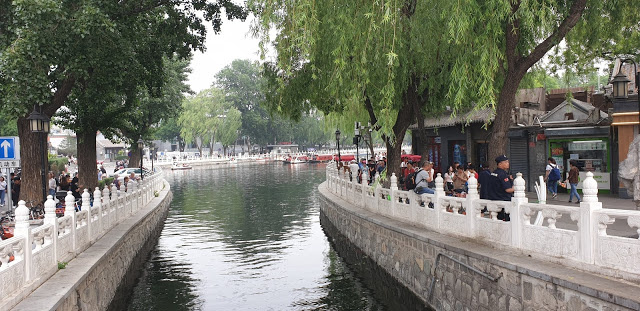
There is a lake, and if we had the time, there were boats you could take.
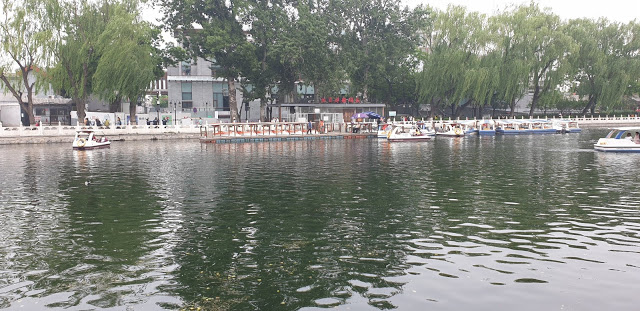
With some time to spare, we take a quick walk down one of the alleyways where on the ground level are small shops, and above, living quarters.

Then we go to the bell and drum towers before walking through some more alleys was to where the rickshaws were waiting.
The Bell tower

And the Drum tower. Both still working today.

The rickshaw ride took us through some more back streets where it was clear renovations were being made so that the area could apply for a world heritage listing. Seeing inside some of the houses shows that they may look dumpy outside but that’s not the case inside.
The rickshaw ride ends outside the house where dinner will be served, and is a not-so-typical house but does have all the elements of how the Chinese live, the boy’s room, the girl’s room, the parent’s room, the living area, and the North-south feng shui.
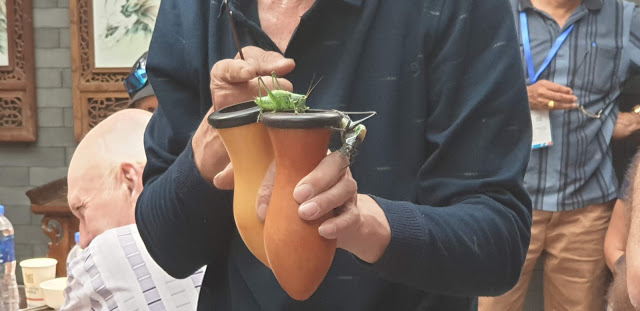
Shortly after we arrive, the cricket man, apparently someone quite famous in Beijing arrives and tells us all about crickets and then grasshoppers, then about cricket racing. He is animated and clearly enjoys entertaining us, westerners.

I’m sorry but the cricket stuff just didn’t interest me. Or the grasshoppers.
As for dinner, it was finally a treat to eat what the typical Chinese family eats, and everything was delicious, and the endless beer was a nice touch.
And the last surprise, the food was cooked by a man.
The cinema of my dreams – I always wanted to write a war story – Episode 40
For a story that was conceived during those long boring hours flying in a steel cocoon, striving to keep away the thoughts that the plane and everyone in it could just simply disappear as planes have in the past, it has come a long way.
Whilst I have always had a fascination with what happened during the second world war, not the battles or fighting, but in the more obscure events that took place, I decided to pen my own little sidebar to what was a long and bitter war.
And, so, it continues…
—
I had to almost restrain Carlo from going up to the castle and singlehandedly kill everyone in it. I didn’t doubt he could do it, for a short time at least, until they realized what was going on. There were too many of them to take on alone.
It would need a careful plan, and knowledge of the layout of the castle, and the likely spots where the soldiers were located. It was a plan that had been slowly formulating in the back of my mind, especially after Carlo’s help with an internal map of the castle, some parts of which I hadn’t got to see in my brief stay.
I forgot that being built back in the middle ages, and the history of cities fighting against each other, there were ways in, out, and around, both inside and in the walls, so that soldiers could travel from one part of the castle to another without being seen, and not having to go inside the castle itself.
There were, also, tunnels, one of which I had inadvertently found, but there were more, and it seems only Carlo knew of those. Some were useful, others would lead to an early confrontation, and give early notice of our intentions. Those we would avoid, or use to escape.
We had set up a command center at the church ruins, having found several rooms off the cellar that had two exits. I didn’t like the idea of being trapped, nor waiting in a location that Fernando was familiar with and was likely to return to.
Which, in a sense, I was hoping he would because we had set a trap and he and his men would be caught in the crossfire. He was not going to get a chance to explain, nor would I ask any questions, or show him any mercy.
Especially when I found out what he had done to Martina. If it was as bad as Chiara, he would be repaid in kind, if the opportunity arose. I tentatively agreed to give Carlo five minutes in the room alone with him, but he knew that expediency might not give him that luxury. Blinky was not happy about it, but he hadn’t been here long enough to know what the man or his people were like.
We’d also worked out the surveillance system so that we would know when anyone turned up in the village, particularly our prized defector Meyer, and whether anyone left the castle to come down to the village because it was possible there would be more defectors passing through, and they needed to be warned.
What was particularly useful was finding the radio that Martina had been using. It was in the church grounds, which was not entirely unexpected, but one of Blink’s men had stumbled over it when looking to set up a latrine.
Blinky had brought a radioman, but his radio had been damaged in the parachute landing. Now he had a new toy to tinker with, and got a connection back to Thompson, after some initial difficulty in translation. That I could help him with, my Italian was marginally better than a schoolboy.
Thompson was relieved to hear from me, as I was to talk to him.
“It’s been difficult to get a clear picture with Martina, but I got the impression you had to be precise with your questions.”
“A case of getting lost in translation, perhaps.” I had not had similar problems, but Thompson was from the aristocracy, and his version of English was sometimes quaint.
“The situation is bad, I understand.”
“It is. The castle is over-run with British-German double agents. The three you sent out, and reinforcements that followed. I get the impression we have about 20 odd dead soldiers languishing in shallow graves somewhere on the Italian countryside.”
It hadn’t been hard to realize that while the officers were known British officers, the soldiers were substituted Germans whose English language and mannerisms were impeccable. I had no doubt once they’d reeled in Meyer, they would move on, integrating into invasion forces and creating havoc from within, unless of course, we stopped them.
A sigh at the other end, perhaps a lamentation of such needless loss of life. This war was getting tiresome for both of us.
“How close is Meyer? We last heard he was in Gaole, waiting for a courier to take him to the village. His arrival is anticipated to be any time from tomorrow onwards.”
“We’ve got men out keeping tabs on everyone.”
“Blinky arrive with his team?”
“All bar the radio, but as you can hear, we have access to one do it will not be a problem. I think we might finish this and talk again tomorrow. Don’t want the Germans tracking the radio waves.”
“Good. Tomorrow, and hour before today.”
I’d almost forgotten that the Germans were good at tracking radio signals, especially when they thought the enemy was using them, as those at the castle would. That radio unit could also be used to trace other radio signals, and no doubt they had picked up the signal. Hopefully, we had not been on long enough for them to run the trace.
That was not going to be a problem. One of Blinky’s soldiers on village reconnaissance was waiting for us as we approached the church ruins.”
“What is it, man?”
“There are four people at the village, looking for someone or something.”
“More defectors,” I said. “We’d better get to them before Leonardo and his men get to them first.”
—
© Charles Heath 2020-2021
 Thrills, Spills, and just a dash of Romance