I’m trying to write a period piece

Televison is a great recorder of the past, and most channels, and especially cable tv have great libraries of films that go back more than a hundred years.

And, whilst it’s possible that modern day films and television series can try to recapture the past, the English as an exception being very good at it, often it is impossible to capture it correctly.

But, if you have a film shot in the moment, then you have a visual record of what life, and what was once part of our world before you in all it’s dated glory. The pity of it is that, then, we never appreciated it.

After all, in those particular times, who had the time to figuratively stop and smell the roses. Back then as life was going on, we were all tied up with just trying to get through each day.

Years later, often on reflection, we try to remember the old days, and, maybe, remember some of what it was like, but the chances are that change came far too rapidly, and often too radical, that it erases what we thought we knew existed before.

My grandmothers house is a case in point. In it’s place is a multi lane super highway, and there’s nothing left to remind us, or anyone of it, just some old sepia photographs.

I was reminded of how volatile history really is when watching an old documentary, in black and white, and how the city I grew up in used to look.

Then, even though it seemed large to me then, it was a smaller city, with suburbs that stretched about ten or so miles in every direction, and the outer suburbs were where people moved to get a larger block, and countrified atmosphere.

Now, those outer suburbs are no longer spacious properties, the acreage subdivided and the old owners now much richer for a decision made with profit not being the motivator, and the current suburban sprawl is now out to forty or fifty miles.

The reason for the distance is no longer the thought of open spaces and cleaner air, the reason for moving now is that land further out is cheaper, and can make buying that first house more affordable.

This is where I tip my hat to the writers of historical fiction. I myself am writing a story based in the 1970s, and its difficult to find what is and isn’t time specific.

If only I had a dollar for every time I went to write the character pulling out his or her mobile phone.

What I’ve found is the necessity to research, and this has amounted to finding old films, documentaries of the day, and a more fascinating source of information, the newspapers of the day.

The latter especially has provoked a lot of memories and a lot of stuff I thought I’d forgotten, some of it by choice, but others that were poignant.

Yes, and don’t get me started on the distractions.

If only I’d started this project earlier…

A photograph from the inspirational bin – 31

This is rugged bushland not far from suburbia, though you wouldn’t know exactly where it is just by looking at the photograph

But, for the writer, this is an excellent setting.

For instance, once again we are out wandering in the bush, lost. It’s not hard to get lost, and stay lost if there are no recognizable landmarks, and given we all walk with a bias to one side or the other, and we have to avoid objects like trees, ravines, animals, and rocks, keeping a straight line is impossible.

But the question is, how did you get into the bush in the first place?

It’s not as if you would deliberately go there, just to if you can get lost.

No, my idea is that you have been kidnapped and drugged, then taken to a location either in the book of a car or just in the back seat with a hood, then dropped off and left to die

The criminals in this story are more efficient in getting rid of pesky witnesses.

Or maybe it’s something less sinister, like going out and counting the koalas in the bush, well, what’s left of the bush as the suburban spray takes more and more of the koala’s habitat.

And it could also be like the planet of the apes, the koalas start fighting back.

Stranger things have been known to happen.

In a word: Land


And, yes, the simple description for this word is that area of the earth that isn’t covered by water.

It could also describe that little patch that my house is built on, and is generally covered by the expression, house and land as a package.

After all, a piece of land is not much used to you unless there’s a dwelling on it, or, on rare occasions, under it.  Does that mean then that land in this instance only as what you can see?

OK, now it’s getting confusing.

What if I wanted to live off the land.  A small patch will not do, in this case, is need a large area, perhaps thousands if hectares.

It is said that the Australian aborigines have lived off the land for thousands of years, with a nomadic lifestyle.

No small patch of land for them.

Now, what if I come down out of the sky. Oddly enough this means I have to land, even if I come back to earth over later.  It’s still a landing.

Now it’s getting interesting.

So what if you wanted to refer to where you live?  That would be your homeland or motherland, and it describes a country.

So it’s my patch, my country, any area where there isn’t water.  What about describing a country, say the land of the long white cloud, or the land of the rising sun?

And just to add to the confusion

I can land a fish

Make land, after being all at sea, and,

Best of all, land that much desired job.

Wow.

I’m beginning to think it’s another one of those ‘four-letter words’

‘Sunday in New York’ – A beta reader’s view

I’m not a fan of romance novels but …

There was something about this one that resonated with me.

This is a novel about a world generally ruled by perception, and how people perceive what they see, what they are told, and what they want to believe.

I’ve been guilty of it myself as I’m sure we all have at one time or another.

For the main characters Harry and Alison there are other issues driving their relationship.

For Alison, it is a loss of self-worth through losing her job and from losing her mother and, in a sense, her sister.

For Harry, it is the fact he has a beautiful and desirable wife, and his belief she is the object of other men’s desires, and one in particular, his immediate superior.

Between observation, the less than honest motives of his friends, a lot of jumping to conclusions based on very little fact, and you have the basis of one very interesting story.

When it all comes to a head, Alison finds herself in a desperate situation, she realises only the truth will save their marriage.

But is it all the truth?

What would we do in similar circumstances?

Rarely does a book have me so enthralled that I could not put it down until I knew the result. They might be considered two people who should have known better, but as is often the case, they had to get past what they both thought was the truth.

And the moral of this story, if it could be said there is one, nothing is ever what it seems.

Available on Amazon here: amzn.to/2H7ALs8

The cinema of my dreams – I never wanted to go to Africa – Episode 7

Alone, and awaiting your fate, minutes become hours, hours become a lifetime

Now that I’ve gone down the rabbit hole, it’s time to find out what sort of trouble is waiting.  It might be hot in the desert, but I think it’s going to get hotter in the underground lair.

“We can do this the easy way or the hard way, your choice.”

There was always a choice, I’m sure, but at the end of the day, it always ended up bring the hard way.

It had been a long, and somewhat sleepless, night, pondering the whys and wherefores of what just happened.

I’m guessing I was supposed to die, like the pilot, now I was a thorn in their side.

The two men sent to collect me were purposefully selected for terror value, a sign that if I was contemplating anything other than full co-operation, these were the sort of men I would have to deal with.

The reality, on the other hand, was sometimes completely different.

I still hadn’t got proof that this was an enemy, or rogue, unit, so no point panicking yet.

“Let’s try the easy way first,” I said, getting off the stretcher and standing.

One remained outside the room, the other, after unlocking the door, ventured as far as the doorway.  He seemed disappointed at my choice.

I walked between them further into the labyrinth until we reached another doorway, this with an opaque glass window, and though it I could see there was someone already in the room.

He opened the door, ushered me in, giving that little push in the back that was to remind me of the controlled force he had and would unleash.  A nod in the direction of the room’s occupant, he withdrew and closed the door.

The occupant was an older man, in his 60s, the sort one would mistake as a university professor, but on reality was a master torturer in the guise of an interrogator.

We had them, I’d heard about them, but this was a first.

“Sit, Mr. James.”

All this politeness was a front, it had to be, designed perhaps to take me off my guard.

There was a table on one side with two chairs opposite each other.  It wasn’t much of a table and the chairs looked cheap and uncomfortable, for both of us.

There was nothing else in the room and nothing on the table.  The discussion no doubt would be recorded, or perhaps the man had a very good memory.

To make a good first impression, I sat.

For five minutes I could feel him looking at me, trying to make me feel uncomfortable.  It was disconcerting, but I had decided to speak when spoken to.

And wait.

What happens next, not even I know.

Yet.

© Charles Heath 2019

An excerpt from “Betrayal” – a work in progress

It could have been anywhere in the world, she thought, but it wasn’t.  It was in a city where if anything were to go wrong…

She sighed and came away from the window and looked around the room.  It was quite large and expensively furnished.  It was one of several she had been visiting in the last three months.

Quite elegant too, as the hotel had its origins dating back to before the revolution in 1917.  At least, currently, there would not be a team of KGB agents somewhere in the basement monitoring everything that happened in the room.

There was no such thing as the KGB anymore, though there was an FSB, but such organisations were of no interest to her.

She was here to meet with Vladimir.

She smiled to herself when she thought of him, such an interesting man whose command of English was as good as her command of Russian, though she had not told him of that ability.

All he knew of her was that she was American, worked in the Embassy as a clerk, nothing important, whose life both at work and at home was boring.  Not that she had blurted that out the first tie she met, or even the second.

That first time, at a function in the Embassy, was a chance meeting, a catching of his eye as he looked around the room, looking, as he had told her later, for someone who might not be as boring as the function itself.

It was a celebration, honouring one of the Embassy officials on his service in Moscow, and the fact he was returning home after 10 years.  She had been there once, and still hadn’t met all the staff.

They had talked, Vladimir knew a great deal about England, having been stationed there for a year or two, and had politely asked questions about where she lived, her family, and of course what her role was, all questions she fended off with an air of disinterested interest.

It fascinated him, as she knew it would, a sort of mental sparring as one would do with swords if this was a fencing match.

They had said they might or might not meet again when the party was over, but she suspected there would be another opportunity.  She knew the signs of a man who was interested in her, and Vladimir was interested.

The second time came in the form of an invitation to an art gallery, and a viewing of the works of a prominent Russian artist, an invitation she politely declined.  After all, invitations issued to Embassy staff held all sorts of connotations, or so she was told by the Security officer when she told him.

Then, it went quiet for a month.  There was a party at the American embassy and along with several other staff members, she was invited.  She had not expected to meet Vladimir, but it was a pleasant surprise when she saw him, on the other side of the room, talking to several military men.

A pleasant afternoon ensued.

And it was no surprise that they kept running into each other at the various events on the diplomatic schedule.

By the fifth meeting, they were like old friends.  She had broached the subject of being involved in a plutonic relationship with him with the head of security at the embassy.  Normally for a member of her rank, it would not be allowed, but in this instance it was.

She did not work in any sensitive areas, and, as the security officer had said, she might just happen upon something that might be useful.  In that regard, she was to keep her eyes and ears open and file a report each time she met him.

After that discussion, she got the impression her superiors considered Vladimir more than just a casual visitor on the diplomatic circuit.  She also formed the impression that he might consider her an ‘asset’, a word that had been used at the meeting with security and the ambassador.

It was where the word ‘spy’ popped into her head and sent a tingle down her spine.  She was not a spy, but the thought of it, well, it would be fascinating to see what happened.

A Russian friend.  That’s what she would call him.

And over time, that relationship blossomed, until, after a visit to the ballet, late and snowing, he invited her to his apartment not far from the ballet venue.  It was like treading on thin ice, but after champagne and an introduction to caviar, she felt like a giddy schoolgirl.

Even so, she had made him promise that he remain on his best behaviour.  It could have been very easy to fall under the spell of a perfect evening, but he promised, showed her to a separate bedroom, and after a brief kiss, their first, she did not see him until the next morning.

So, it began.

It was an interesting report she filed after that encounter, one where she had expected to be reprimanded.

She wasn’t.

It wasn’t until six weeks had passed when he asked her if she would like to take a trip to the country.  It would involve staying in a hotel, that they would have separate rooms.  When she reported the invitation, no objection was raised, only a caution; keep her wits about her.

Perhaps, she had thought, they were looking forward to a more extensive report.  After all, her reports on the places, and the people, and the conversations she overheard, were no doubt entertaining reading for some.

But this visit was where the nature of the relationship changed, and it was one that she did not immediately report.  She had realised at some point before the weekend away, that she had feelings for him, and it was not that he was pushing her in that direction or manipulating her in any way.

It was just one of those moments where, after a grand dinner, a lot of champagne, and delightful company, things happen.  Standing at the door to her room, a lingering kiss, not intentional on her part, and it just happened.

And for not one moment did she believe she had been compromised, but for some reason she had not reported that subtle change in the relationship to the powers that be, and so far, no one had any inkling.

She took off her coat and placed it carefully of the back of one of the ornate chairs in the room.  She stopped for a moment to look at a framed photograph on the wall, one representing Red Square.

Then, after a minute or two, she went to the mini bar and took out the bottle of champagne that had been left there for them, a treat arranged by Vladimir for each encounter.

There were two champagne flutes set aside on the bar, next to a bowl of fruit.  She picked up the apple and thought how Eve must have felt in the garden of Eden, and the temptation.

Later perhaps, after…

She smiled at the thought and put the apple back.

A glance at her watch told her it was time for his arrival.  It was if anything, the one trait she didn’t like, and that was his punctuality.  A glance at the clock on the room wall was a minute slow.

The doorbell to the room rang, right on the appointed time.

She put the bottle down and walked over to the door.

A smile on her face, she opened the door.

It was not Vladimir.  It was her worst nightmare.

© Charles Heath 2020

“Trouble in Store” – Short stories my way:  Jack, the girl, and the shopkeeper

I have reworked the first part of the story with a few new elements about the characters and changed a few of the details of how the characters finish up in the shop before the policewoman makes her entrance.

This is part of the new first section is the one that involves the Jack, the girl, and the shopkeeper


Jack exchanged a look with the shopkeeper, who in return gave him a slight shrug as if to say he had no idea what this was about.

He could see the girl was not strung out on drugs; if she was it would be a good bet both would be shot or dead by now.  She was just the unfortunate partner of a boy who was on drugs and had found herself in a dangerous position.

Beth, his wife, had told him she didn’t like nor trust the shopkeeper and that her friend in the same apartment block had told her he had been seen selling drugs to youths who hung around just before he closed.  She had warned him it would not be safe, but he had ignored her.

It was a bit late to tell her she was right.

He took a half step towards the door, judging the distance and time it would take to open the door and get out.

Too far, and he would be too slow, his reward for running; a bullet in the back.

Perhaps another half step when she wasn’t looking.


The shopkeeper changed his expression to one more placatory, and said quietly to the girl, “Look, this is not this chap’s problem.”  He nodded in the direction of the customer.  “I’m sure he’d rather not be here, and you would glad of one less distraction.”

He could see she was wavering.  She was not holding the gun so steadily, and the longer this dragged on, the more nervous and unpredictable she would become.

And in the longer game, the customer would sing his praises no matter what happened if he could get him out of the shop alive and well.

This could still be a win-win situation.


The girl looked at Jack.  The shopkeeper was right.  If he wasn’t here this could be over. 

But there was another problem.  It didn’t look like Simmo was in any shape to getaway.  In fact, this was looking more like a suicide mission.

She waved the gun in his direction.  ‘Get out now, before I change my mind.’

As the gun turned to the shopkeeper, Jack wasn’t going to wait to be asked twice and started sidling towards the door.


© Charles Heath 2016-2020

Inspiration, maybe – Volume 1

50 photographs, 50 stories, of which there is one of the 50 below.

They all start with –

A picture paints … well, as many words as you like.  For instance:

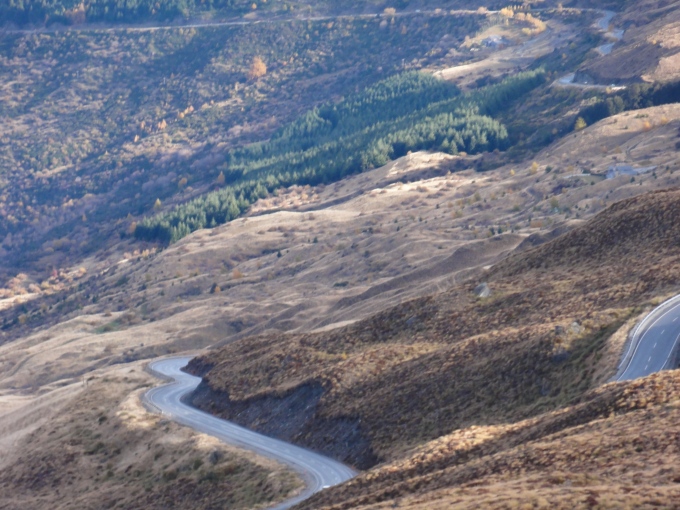
lookingdownfromcoronetpeak

And the story:

It was once said that a desperate man has everything to lose.

The man I was chasing was desperate, but I, on the other hand, was more desperate to catch him.

He’d left a trail of dead people from one end of the island to the other.

The team had put in a lot of effort to locate him, and now his capture was imminent.  We were following the car he was in, from a discrete distance, and, at the appropriate time, we would catch up, pull him over, and make the arrest.

There was nowhere for him to go.

The road led to a dead-end, and the only way off the mountain was back down the road were now on.  Which was why I was somewhat surprised when we discovered where he was.

Where was he going?

“Damn,” I heard Alan mutter.  He was driving, being careful not to get too close, but not far enough away to lose sight of him.

“What?”

“I think he’s made us.”

“How?”

“Dumb bad luck, I’m guessing.  Or he expected we’d follow him up the mountain.  He’s just sped up.”

“How far away?”

“A half-mile.  We should see him higher up when we turn the next corner.”

It took an eternity to get there, and when we did, Alan was right, only he was further on than we thought.”

“Step on it.  Let’s catch him up before he gets to the top.”

Easy to say, not so easy to do.  The road was treacherous, and in places just gravel, and there were no guard rails to stop a three thousand footfall down the mountainside.

Good thing then I had the foresight to have three agents on the hill for just such a scenario.

Ten minutes later, we were in sight of the car, still moving quickly, but we were going slightly faster.  We’d catch up just short of the summit car park.

Or so we thought.

Coming quickly around another corner we almost slammed into the car we’d been chasing.

“What the hell…” Aland muttered.

I was out of the car, and over to see if he was in it, but I knew that it was only a slender possibility.  The car was empty, and no indication where he went.

Certainly not up the road.  It was relatively straightforward for the next mile, at which we would have reached the summit.  Up the mountainside from here, or down.

I looked up.  Nothing.

Alan yelled out, “He’s not going down, not that I can see, but if he did, there’s hardly a foothold and that’s a long fall.”

Then where did he go?

Then a man looking very much like our quarry came out from behind a rock embedded just a short distance up the hill.

“Sorry,” he said quite calmly.  “Had to go if you know what I mean.”

I’d lost him.

It was as simple as that.

I had been led a merry chase up the hill, and all the time he was getting away in a different direction.

I’d fallen for the oldest trick in the book, letting my desperation blind me to the disguise that anyone else would see through in an instant.

It was a lonely sight, looking down that road, knowing that I had to go all that way down again, only this time, without having to throw caution to the wind.

“Maybe next time,” Alan said.

“We’ll get him.  It’s just a matter of time.”

© Charles Heath 2019-2021

Find this and other stories in “Inspiration, maybe”  available soon.

InspirationMaybe1v1

The cinema of my dreams – I always wanted to see the planets – Episode 29

Sometimes the easiest solution…

If I was to assume the recent visit by one of the so-called pirate ships as a benchmark for transporting a person between ships, then we’d have to get closer to the larger transport vessel where our crew member, logically, was being held.

The fact I was contemplating it was after the discussion with O’Mara, which, quite frankly, was like something out of a science fiction novel.

He’d started it with, “We have been working on a plan “

The same plan, I presumed, that the Lt Colonel had been referring to, only this time with more detail.

“You might not be aware that every member of this crew has a specific marker in their system that both enables us to track where they are, within a reasonable distance, and monitor their well-being.”

I was going to ask exactly what he meant by that, but amongst the reading material I’d been given before boarding, was a paper on the advances in medical science and how this related to space travel.

We all had a series of vaccinations, and I assumed one was to give us that specific marker. I suspect another was to give us nanites that would aid in our recovery as well as maintain our health in somewhat trying circumstances.

And, no, we’re were not meant to become super-soldiers, though work was being progressed on that too.

“It gives us the ability to track our people, and, yes, the two crew members’ life signs came back when we arrived here, and we are currently monitoring the scientist. That’s to say we know where she is, and that she had not been harmed.”

There was only one point about the plan that held any concern, we just didn’t transport people, not because we couldn’t, but because of the risk. Cargo was fine, but people were a little different. There had been testing, and it had worked, but then problems occurred, and it took only the slightest of issues during the transfer, for it to go wrong. After three accidental deaths, it was decided to ban it until the process could be more refined.

Of course, in line with everything else of this ship, the transporters were the latest versions with considerably upgraded hardware. The distance was still a problem, but getting a lock onto an individual was easier with the new markers provided to this crew.

We were, for all intents and purposes, guinea pigs for the new system, something else I didn’t know until now.

The question was, would she want to be transported? The fact the pirate ships were able to transport people with success was interesting given they would only have the old equipment, but they had an incentive to use it, it was a primary means for them to escape.

And that, too, had raised another issue, they had to have a marker, not necessarily the result of a vaccination, it could be a small device, and that could only be given to them by the guards, which meant it was likely the off-world prison authority was corrupt, not unheard of since it had been contracted out. It was just another paragraph in a report that was growing exponentially in size.

The Admiral was surprised to hear from me. I thought it best, in one of those cover your rear moments, to give him a heads up on what we were planning to do.

But to a more important matter I was sure he would be interested in hearing, “The trial for running at a much faster speed was a success, and that we are closer to travelling at the speed of light. But it seems we are not the first people to do so. It seems the people who stole the plutonium have the same capability.”

“The aliens?”

“No. Our scans of their ships and personnel show they are not. We believe the ships are older vessels discarded on the edge of space, refitted, and manned by escaped convicts from the Mars mining prison.” Saying it out loud didn’t quite sound the same as it had in my head.

“Or it is the result of a country that is not exactly playing by the rules that everyone agreed to for the exploration and exploitation of space.”

“So it was known we might run into some people who have another agenda?”

“Not in that direction, no.”

“Well, it seems they have a base on or under the surface of one of Uranus’s moons called Oberon. I suspect the plutonium is to fuel their base, which is far enough out of the mainstream that we might not have discovered it for years.”

“You then have to wonder why they told you about it?”

That answer was provided in a sudden and alarming manner.

“Bridge to Captain, we have three incoming vessels, and I think they are not here for a social visit.”

To the Admiral, “I have to go. Let’s hope the weapons we have are adequate.” I cut the call, saying, “Be there ASAP. Is the gunnery sergeant at her post?”

“Yes.”

“Then tell her she has permission to return fire if they attack.”

“Very good.”

I had considered why they hadn’t attacked when they had the chance earlier, but perhaps that visit was just to return the Captain’s body. If they were privy to information about our vessel, they might know of its capabilities, and not wish to engage. Of course, there was another reason, perhaps they were waiting until all three ships were free, and assume there was safety in numbers.

Whatever the reasons, we’d soon find out.

© Charles Heath 2021

The first case of PI Walthenson – “A Case of Working With the Jones Brothers”

This case has everything, red herrings, jealous brothers, femme fatales, and at the heart of it all, greed.

See below for an excerpt from the book…

Coming soon!

PIWalthJones1

An excerpt from the book:

When Harry took the time to consider his position, a rather uncomfortable position at that, he concluded that he was somehow involved in another case that meant very little to him.

Not that it wasn’t important in some way he was yet to determine, it was just that his curiosity had got the better of him, and it had led to this: sitting in a chair, securely bound, waiting for someone one of his captors had called Doug.

It was not the name that worried him so much, it was the evil laugh that had come after the name was spoken.

Doug what? Doug the ‘destroyer’, Doug the ‘dangerous’, Doug the ‘deadly’; there was any number of sinister connotations, and perhaps that was the point of the laugh, to make it more frightening than it was.

But there was no doubt about one thing in his mind right then: he’d made a mistake. A very big. and costly, mistake. Just how big the cost, no doubt he would soon find out.

His mother, and his grandmother, the wisest person he had ever known, had once told him never to eavesdrop.

At the time he couldn’t help himself and instead of minding his own business, listening to a one-sided conversation which ended with a time and a place. The very nature of the person receiving the call was, at the very least, sinister, and, because of the cryptic conversation, there appeared to be, or at least to Harry, criminal activity involved.

For several days he had wrestled with the thought of whether he should go. Stay on the fringe, keep out of sight, observe and report to the police if it was a crime. Instead, he had willingly gone down the rabbit hole.

Now, sitting in an uncomfortable chair, several heat lamps hanging over his head, he was perspiring, and if perspiration could be used as a measure of fear, then Harry’s fear was at the highest level.

Another runnel of sweat rolled into his left eye, and, having his hands tied, literally, it made it impossible to clear it. The burning sensation momentarily took his mind off his predicament. He cursed and then shook his head trying to prevent a re-occurrence. It was to no avail.

Let the stinging sensation be a reminder of what was right and what was wrong.

It was obvious that it was the right place and the right time, but in considering his current perilous situation, it definitely was the wrong place to be, at the worst possible time.

It was meant to be his escape, an escape from the generations of lawyers, what were to Harry, dry, dusty men who had been in business since George Washington said to the first Walthenson to step foot on American soil, ‘Why don’t you become a lawyer?” when asked what he could do for the great man.

Or so it was handed down as lore, though Harry didn’t think Washington meant it literally, the Walthenson’s, then as now, were not shy of taking advice.

Except, of course, when it came to Harry.

He was, Harry’s father was prone to saying, the exception to every rule. Harry guessed his father was referring to the fact his son wanted to be a Private Detective rather than a dry, dusty lawyer. Just the clothes were enough to turn Harry off the profession.

So, with a little of the money Harry inherited from one of his aunts, he leased an office in Gramercy Park and had it renovated to look like the Sam Spade detective agency, you know the one, Spade and Archer, and The Maltese Falcon.

There’s a movie and a book by Dashiell Hammett if you’re interested.

So, there it was, painted on the opaque glass inset of the front door, ‘Harold Walthenson, Private Detective’.

There was enough money to hire an assistant, and it took a week before the right person came along, or, more to the point, didn’t just see his business plan as something sinister. Ellen, a tall cool woman in a long black dress, or so the words of a song in his head told him, fitted in perfectly.

She’d seen the movie, but she said with a grin, Harry was no Humphrey Bogart.

Of course not, he said, he didn’t smoke.

Three months on the job, and it had been a few calls, no ‘real’ cases, nothing but missing animals, and other miscellaneous items. What he really wanted was a missing person. Or perhaps a beguiling, sophisticated woman who was as deadly as she was charming, looking for an errant husband, perhaps one that she had already ‘dispatched’.

Or for a tall, dark and handsome foreigner who spoke in riddles and in heavily accented English, a spy, or perhaps an assassin, in town to take out the mayor. The man was such an imbecile Harry had considered doing it himself.

Now, in a back room of a disused warehouse, that wishful thinking might be just about to come to a very abrupt end, with none of the romanticized trappings of the business befalling him. No beguiling women, no sinister criminals, no stupid policemen.

Just a nasty little man whose only concern was how quickly or how slowly Harry’s end was going to be.

© Charles Heath 2019