The cinema of my dreams – I always wanted to see the planets – Episode 31

A meeting with a nuclear scientist

Tara Benson was not my idea of a typical nuclear physicist, but then I always had been a bad judge of matching occupations to personnel.

I had read her biography and service record, mainly the one-paragraph summary, and it said she was one of the best in the world.

Criteria indeed for anyone on this ship apparently, though I didn’t regard myself as fitting into the category, someone must have thought I had the potential.

On the way down I had a few moments to contemplate her ordeal, not only being taken prisoner, but being transported back in the manner we had used, when it was a means I would not willingly use on myself.

It was why the first thought I had when I saw her was to apologise.

She was sitting in one of the special chairs that could analyse everything about you, what ailed you, what diseases you had, the state of your body.

When I had my first medical examination, they put me in an earlier model of that chair and it picked up the missing anatomical parts, the fact I once had several broken bones, that I was slightly anaemic, and the reason why I sometimes had bouts of indigestion.

They fixed all that, and a slight imperfection in my eyesight which I didn’t know about.

The doctor was looking at the monitor when I arrived.

“How is she?”

“Better than we expected. Other than being exposed to radiation for longer than prescribed, and which we can fix, she is in perfect health.”

“Mentally?”

“You can ask her yourself. I’m about to sign off on her going back to work, after a good night’s sleep.”

He spoke to her for a minute or so, then helped her up out of the chair.

“I assume you are the new captain,” she said when she saw me.

“Not by choice, but for the time being, yes.”

“I have a few questions, if I may?”

“Now?”

“If it’s possible”

There was a consultation room free, so I escorted her inside and closed the door. It was odd, I thought, that she sat behind the desk.

I also felt like she was making a mental assessment of me, perhaps thinking that I was not what she might have considered Captain material. To a certain extent, I may have once agreed with her, because everyone expected a captain to be much older and therefore wiser.

It was an analogy I’d heard before.

“Whose idea was it to transport me across to this vessel?”

I had expected that the means might be questionable, but in the moment, and considered along with the course of action I’d taken, it was the right decision.

“Mine. After discussion, of course, with the relevant experts. The risk was acceptable, proven by the fact you’re here now, and relatively unharmed.”

“It was a surprise, I’ll grant you that, and a first. From what I managed to overhear, the plutonium was sent down to their bunker to provide power to the facility, under the surface of the moon, and only accessible by the transporter. Given the risks, it also surprised me they were so committed to using it.”

“Since most of that crew were escaped convicts from the Mars mining prison, any means would be acceptable.”

“Prisoners, not aliens?”

“Yes. The ships were old personnel transports, and the big ship, where you were being held, an old freighter.”

“The Orion.”

I knew it well and surprised that I’d not recognised it. They had managed to disguise it well.

“A ship, I’m sure, you might be familiar with,” she added.

Perhaps my captain’s bland expression was not so bland.

“Ancient history,” I said, “from a time that I would rather leave in the past.”

There was a story, and not a pretty one, of a voyage not so long after commissioning, where systems failed and crew members died, all part of the experience in those early years in space. The quest for profits had outweighed the necessity for proper testing, and we had borne the brunt of the ‘test as you go’ mentality that had reigned before Space Command had taken over.

“You must tell me, one day.”

Her expression was one of curiosity and not one to be mistaken for anything else.

“Is there anything else?”

“If you are considering retrieving the plutonium, let me know and I’ll be happy to help. I suspect the people on Venus would like to see it sooner rather than later.”

“You know where this base is?”

“Of course.”

“Good. I’ll let you know after I’ve spoken to the security people.”

© Charles Heath 2021-2023

“Sunday in New York”, a romantic adventure that’s not a walk in the park!

“Sunday in New York” is ultimately a story about trust, and what happens when a marriage is stretched to its limits.

When Harry Steele attends a lunch with his manager, Barclay, to discuss a promotion that any junior executive would accept in a heartbeat, it is the fact his wife, Alison, who previously professed her reservations about Barclay, also agreed to attend, that casts a small element of doubt in his mind.

From that moment, his life, in the company, in deciding what to do, his marriage, his very life, spirals out of control.

There is no one big factor that can prove Harry’s worst fears, that his marriage is over, just a number of small, interconnecting events, when piled on top of each other, points to a cataclysmic end to everything he had believed in.

Trust is lost firstly in his best friend and mentor, Andy, who only hints of impending disaster, Sasha, a woman whom he saved, and who appears to have motives of her own, and then in his wife, Alison, as he discovered piece by piece damning evidence she is about to leave him for another man.

Can we trust what we see with our eyes or trust what we hear?

Haven’t we all jumped to conclusions at least once in our lives?

Can Alison, a woman whose self-belief and confidence is about to be put to the ultimate test, find a way of proving their relationship is as strong as it has ever been?

As they say in the classics, read on!

Purchase:

http://tinyurl.com/Amazon-SundayInNewYork

In a word: Great

Or is it grate?

Is it possible to mix the two up?  I don’t think so.

Great usually means: everything is great, or good, or excellent, whatever degree of goodness you want to put to it.

It could also mean something else, like:  Well, you were a great help! when in fact you want to say how useless they were.

Large or little.

Like all creatures great and small,  Why not say big or small.  Big doesn’t quite have the same effect.

Of course, you could be a great person, well, what I really mean is distinguished.  Besides, great could mean way above average, too.  Or grand, or impressive, the list goes on.

And haven’t we all, at some time had a great-aunt.  No not the good one, the ‘great’ one, denoting her seniority, not necessarily how nice she is.


As for the other grate, we can build a fire in it.

Or add an ‘un’ in front and ‘ful’ at the end, to denote what parents sometimes think of their children

Or get a block of cheese and ‘grate’ it into small shreds.

Or speak in a voice that grates on your nerves, possibly by that great-aunt.

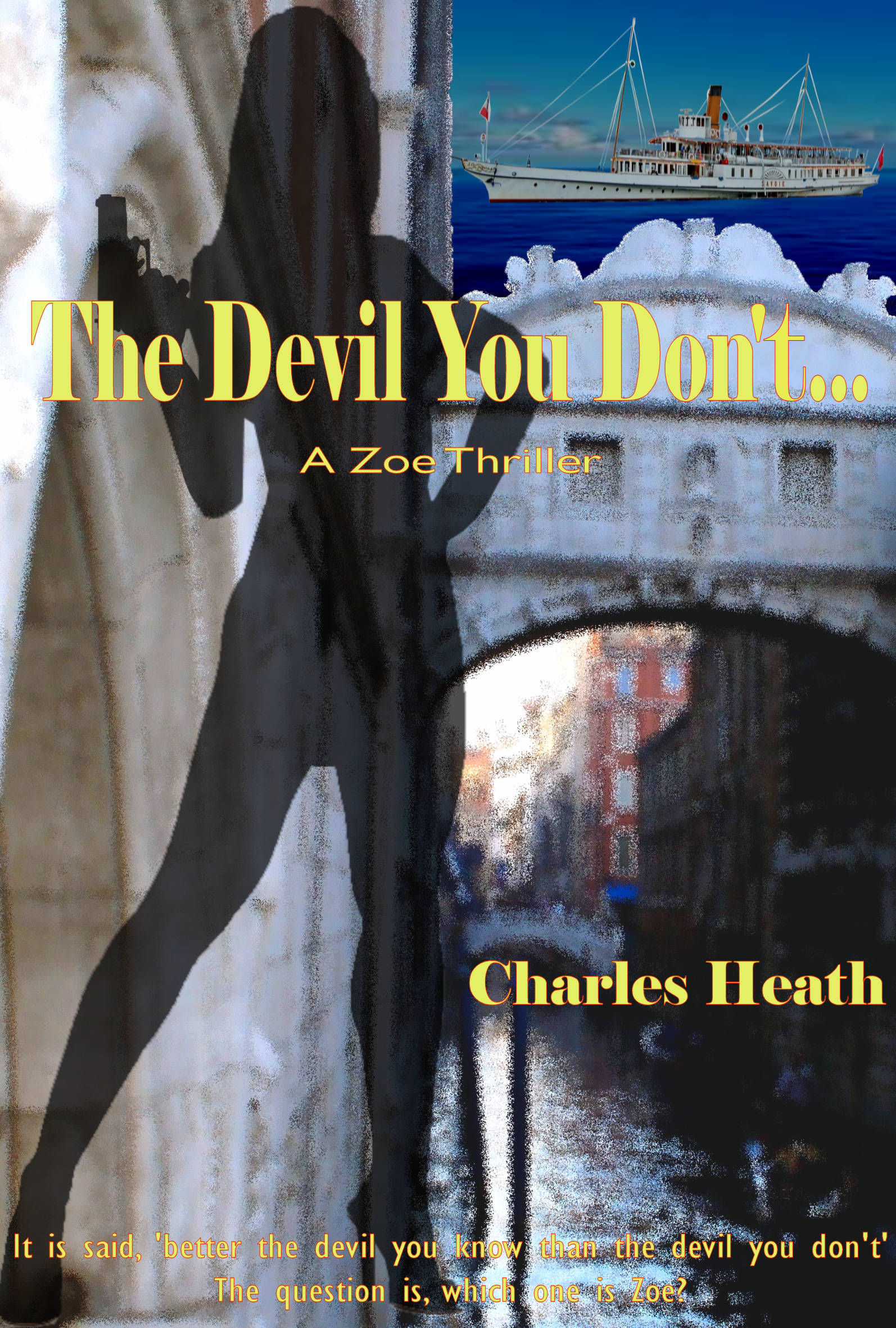
“The Devil You Don’t” – A beta readers view

It could be said that of all the women one could meet, whether contrived or by sheer luck, what are the odds it would turn out to be the woman who was being paid a very large sum to kill you.

John Pennington is a man who may be lucky in business, but not so lucky in love. He has just broken up with Phillipa Sternhaven, the woman he thought was the one, but relatives and circumstances, and perhaps because she was a ‘princess’, may also have contributed to the end result.

So, what do you do when you are heartbroken?

That is a story that slowly unfolds, from the first meeting with his nemesis on Lake Geneva, all the way to a hotel room in Sorrento, where he learns the shattering truth.

What should have been a high turns out to be something else entirely, and from that point every thing goes to hell in a handbasket.

He suddenly realises his so-called friend Sebastian has not exactly told him the truth about a small job he asked him to do, the woman he is falling in love with is not quite who she says she is, and he is caught in the middle of a war between two men who consider people becoming collateral damage as part of their business.

The story paints the characters cleverly displaying all their flaws and weaknesses. The locations add to the story at times taking me back down memory lane, especially to Venice where in those back streets I confess it’s not all that hard to get lost.

All in all a thoroughly entertaining story with, for once, a satisfying end.

Available on Amazon here: https://amzn.to/2Xyh1ow

The cinema of my dreams – I always wanted to write a war story – Episode 1

It’s the story that was inspired by the Castello di Briolio, which had small aspirations when first conceived, but now it’s reached a point where we need to fill in a few blanks at the start.

“You have got the guards set up on the back wall,” I asked Jackerby, the officer in charge of the rearguards.

“Can you see them?” he said in a tone that dripped sarcasm.

I didn’t like Jackerby, he seemed far too sure of himself and his men, and so far, we hadn’t had to rely on them.

But I expected that time was coming, and sooner than both of us wanted to believe.

“No.”

“Then no one else will either.  Trust me; no one will be coming over the back wall.”

That was a matter of opinion, and, in my assessment of the fortifications, and the security precautions, the only way the enemy could attack us, was from the sky.

And that was, given the current situation the enemy was in, practically impossible.  But, as my old commander used to say, ‘This is war, anything is possible, and when you least expect it.’

I’d survived four years of it, and didn’t want to be one of those who didn’t make it to the end.  For that reason, I trusted no one, particularly people who said ‘trust me’.

I glanced along the back wall again, just to make sure, but it didn’t make me feel any safer.

“I’ll be in the command post if you need me, and it has a clear view of anything coming.”

“Excellent,” I said, trying to sound more confident than I felt.

We were in an old castle, though not strictly speaking a real castle, built only a few hundred years ago.  It was an enemy stronghold up until a month ago when, acting on advice from the local resistance that the enemy strength had dropped as they had begun to retreat, a strike force came and liberated it.

And, given its strategic position between the front line and the sea, it became a gateway for anyone who wanted to escape the Germans and what was left of the Italians.

That also included departing boffins from the Reich, looking to bargain their way to a new home in England or the US.

To oversee that operation was a Colonel called Johansson, along with a dozen or so specialist soldiers, and the operation had been running smoothly.

Then came an attempted incursion, where a group of enemy soldiers who were fighting to the end, made a brave attempt to take the castle back.,  They failed, because of a twelfth-hour arrival of a Major called Jackerby, and a small motley crew of men.

When I read the report after the battle, it seemed odd.

As a result of his help, Jackerby was recruited by Johansson, in circumstances that seemed a little too coincidental for my liking.  Johansson was too easygoing for me, and although he had not made a mistake, yet, I felt sure one was going to happen on my watch.

I came later, sent by Command to ‘lend assistance where possible’ to the operation, assistance the good Colonel took no pains to tell command he didn’t need.  But they didn’t give him a choice.

Except…

On my way there, my driver and I had almost reached the castle when we were caught in a roadside bomb.  The driver was killed, and I’d been saved by a dog, one we had found on the side of the road, badly in need of water, and food.

I had brought him with me.  The thought of doing so, at the time, had been on the end of a single idea, a dog could not betray me, men and women could.  And the fact its name was Jack seemed to me to be rather poetic, if not somewhat ironic in the circumstances.

There was a communication in my pocket, one I’d received earlier in the afternoon, sent in a one-time code no one but I could decode.

A warning of a second attempt on the castle by the enemy, but for reasons unknown.

Tonight.

Jack and I were in the guard tower at the southwestern corner of the castle.  It overlooked the valley and gave a clear view of anyone or anything coming from that quadrant.  If I was going to retake the castle, that’s where I’d launch an attack from.

Of course, if it came by air, you’d expect to hear it.

I didn’t, but Jack did.  He suddenly stood and made a small moaning noise, as if he knew quiet communication was needed.  The stiffness in his body told me there was danger lurking.

Then I saw it, just as I came out of the guardhouse onto the gravel path, the moonlight shining of very large wings, and for a moment it didn’t make sense until I realized it was a glider.

Silent.  It passed, and behind I could see parachutes, then the sound of boots on the gravel walkways just down from the tower.  A precision flight and precision landing of a dozen stormtroopers.

And Jackerby’s guards were nowhere to be seen.

© Charles Heath 2018-2022

Writing stories can be fun

There is more going on on the story front, and just to keep my mind active, or tortured, as the case may be, there are a number of other stories I’m working on.

In particular, there is the story with the description, what happens after an action-packed start.

Quite a lot. In the third section of the story, after being shot out of the sky, interrogated, flown into northern Nigeria, and then crossed into the Democratic Republic of the Congo, to search search for two men being held to ransom, our players finally made it home.

Previous attempts to rescue them had failed, this one had to succeed. It’s a matter of dealing with local militias who are tricky to deal with and then get out of the country after affecting the rescue.

At times, while writing it, looking at a map and using google earth to see what it is like, I felt like I was there looking down the barrel of a gun, and then, in the helter-skelter of getting to the evacuation point, I’m sure my heart rate had lifted considerably, particularly when the battered DC3 was about to be shot at with air to air missiles.

Just imagine this …

A DC3 versus a very maneuverable helicopter. I was on the edge of my seat.

Next is the surveillance story where nothing is as it seems, which in the espionage business is nothing unusual. Nor is the fact you cannot trust anyone.

It starts out as a routine surveillance operation until a shop front explodes a moment or two after the target passes it. In the ensuing mayhem, the target reappears, now in fear of his life, and our main character tracks him to an alley where he is murdered before his eyes.

Soon after the two men whom our main character is working for appearing and start asking questions that make our main character think that they had perpetrated a hit on him, and decides that something is not right.

From there, the deeper he probes, the more interesting the characters and developments. Who was the target? What was he doing that got him killed? What does he have that everyone wants?

I’m about to start on the next phase of this story…

Then there is what I call comic light relief, the writing of stories inspired by photographs I’ve taken. Some, however, have exceeded the 1,000-word limit that I’ve set, only because I want to explore the story more, and some are spread over a number of stories.

The first book of stories, 1 to 50 are to be published soon. Currently, I’m working on number 148 of the third volume of stories, but number 88 is my favorite so far, simply because it involves a starship.


Searching for locations: From Zhengzhou to Suzhou by train, and the Snowy Sea Hotel, Suzhou, China

For the first time on this trip, we encounter problems with Chinese officialdom at the railway station, though we were warned that this might occur.

We had a major problem with the security staff when they pulled everyone over with aerosols and confiscated them. We lost styling mousse, others lost hair spray, and the men, their shaving cream.  But, to her credit, the tour guide did warn us they were stricter here, but her suggestion to be angry they were taking our stuff was probably not the right thing to do.

As with previous train bookings, the Chinese method of placing people in seats didn’t quite manage to keep couples traveling together, together on the train.  It was an odd peculiarity which few of the passengers understood, nor did they conform, swapping seat allocations.

This train ride did not seem the same as the last two and I don’t think we had the same type of high-speed train type that we had for the last two.  The carriages were different, there was only one toilet per carriage, and I don’t think we were going as fast.

But aside from that, we had 753 kilometers to travel with six stops before ours, two of which were very large cities, and then our stop, about four and a half hours later.  With two minutes this time, to get the baggage off the team managed it in 40 seconds, a new record.

After slight disorientation getting off the train, we locate our guide, easily ground by looking for the Trip-A-Deal flag.  From there it’s a matter of getting into our respective groups and finding the bus.

As usual, the trip to the hotel was a long one, but we were traveling through a much brighter, and well lit, city.

As for our guide, we have him from now until the end of the tour.  There are no more train rides, we will be taking the bus from city to city until we reach Shanghai.  Good thing then that the bus is brand new, with that new car smell.  Only issue, no USB charging point.

The Snowy Sea hotel.  

It is finally a joy to get a room that is nothing short of great.  It has a bathroom and thus privacy.

Everyone had to go find a supermarket to purchase replacements for the confiscated items.  Luckily there was a huge supermarket just up from the hotel that had everything but the kitchen sink.

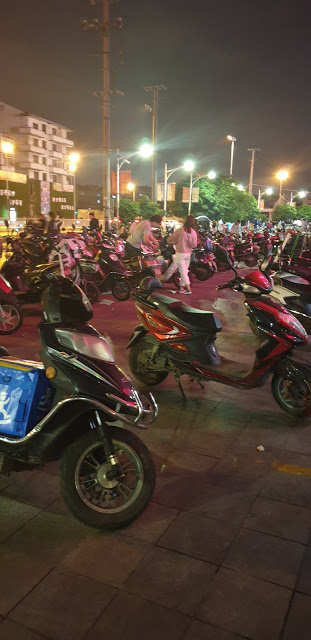
But, unlike where we live, the carpark is more of a scooter park!

It is also a small microcosm of Chinese life for the new more capitalistic oriented Chinese.

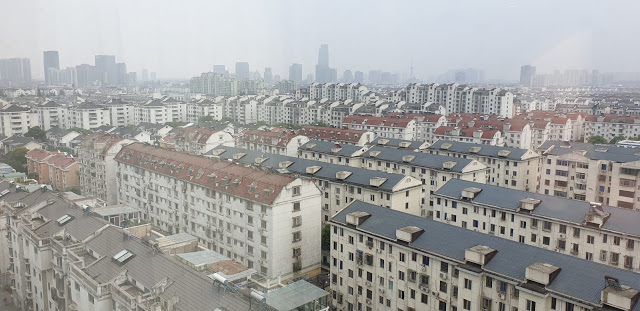
The next morning we get some idea of the scope of high-density living, though here, the buildings are not 30 stories tall, but still just as impressive.

These look like the medium density houses, but to the right of these are much larger buildings

The remarkable thing about this is those buildings stretch as far as the eye can see.

The cinema of my dreams – It all started in Venice – Episode 3

Making sure I recognized the target

It was mid-afternoon and a half hour before her plane touched down when I arrived at the airport by water taxi.  It was not a trip I made often, but that final run from the city across the open water was at times invigorating, sometimes quite pleasant.

Today the water had a chop, and the ride was less smooth than usual.  The driver also seemed to be in a hurry, just about leaving the dock before I’d got off the boat.  It was one of the more interesting ways of arriving at an airport.

It was a leisurely walk to the terminal building, and just as I passed the first of the arrival boards, I saw her plane had landed, about ten minutes early. 

I headed to the gate where as I arrived the first of the passengers were coming through the door.  She was not at the front of the plane, and it is a full flight, it might be a while before she appeared.

I checked to see if there was anyone who seemed out of place, expecting that Larry would not be that trusting to allow her any freedom, but there were no suspicious others, except if you counted me in that category, lurking within eyesight, but masked from the exiting passenger’s view.

It was several minutes before she appeared, casually dressed as a tourist might, in a bright coloured floral dress with a denim jacket, and travelling with a cabin bag she wheeled in front of her.

She looked different again than the photograph, not as gaunt in the face, as if she had recovered from a serious illness.  I could not see the expression on her face, but one thing was clear, she was not happy.

Then I saw why.

A man came up to her just as she left the lounge area, appearing suddenly which meant he had been hidden from me, and she looked surprised, then angry, angry enough that airport security started walking towards them.

The man, seeing the police approaching said something to her, then quickly walked away.  I took a photograph and looking at it realised it wouldn’t be difficult to remember him if I needed to.

Alfie would no doubt tell me who he was in due course.  In the meantime, Juliet had waited for the police and then spoke to them briefly before heading towards the water taxi terminal.

I was closer to that exit and got there before her, checking to see if the man who had accosted her was waiting outside, as he had left in that direction, and had passed quite close to me.  Most noticeable about him, the tattoo of a snake wrapped around his neck.

It gave him that fearsome look that he no doubt used in his profession.

I couldn’t see him, so I headed towards the terminal, this time with the intention of getting the public water bus otherwise known as a VaporettoShe followed more casually, taking in the sights as if it was her first time in Venice.

It also gave rise to the thought again of how she was going to ‘run into me’ in a city full of alleyways and hidden passageways, making it easy for even the most experienced traveller to get lost at least once during their visit.  The only possibility was in St marks square or the promenade along the Canal that led off the square from the Doges Palace.

Then I saw him, waiting by a water taxi, or perhaps a private motorboatShe saw him too and headed straight for the Vaporetto, boarding just before it departed, giving him no chance to catch her.  It was an amusing charade, and an act of defiance she would probably pay for later.

It provided an opportunity to follow him, and when he left, I asked the driver of my water taxi to follow him, coming up with a suitable excuse why I would want to do so, but not sure the driver believed me.  One thing was certain, with a captive passenger, he could charge a premium fare knowing I’d have to pay it.

Keeping a suitable distance between us, he followed the boat to Murano, the island of glass-blowing factories.  He waited until the driver of the boat left the dock and then took his place for me to disembark, and then I gave him a head start before following discreetly, or as discretely as I could in the circumstances.  There were not many visitors about, so I could hardly lose myself in the crowd.

We passed several glass showrooms on the way alongside the Canal until he reached a bridge and crossed it.  On the other side, I could see a basilica, yet another of the many churches in the city, each as old and ornate as the next, and one of the many I’d visited over time and many visits to the city.

But this was not one I’d been to before.

On the other side of the bridge, not far from the church, he stopped and turned around.  It was as if he knew he was being followed, and fortunately, just at that moment I was all but hidden behind the base of the bridge on the opposite side of the Canal.

A long hard stare at each of those he could see, including those crossing the bridge, then he shrugged and walked towards another man, similarly dressed, waiting outside the church. 

I managed to get a better photograph of him and one of his new companions too, just before they met and walked into the church.  I was not going to follow them in.  I was hoping Alfie would find out who they were, and where to find them, though I had a feeling I was going to meet them again, but not in similar circumstances.

Another question popped into my head as I walked back to the Vaporetto station.  Where was Larry right now?  On his way to Venice?  Or would he wait until Juliet made contact?  I knew which hotel she was staying in, a rather small but interesting one I’d stayed at the first time I came to Venice, do I could find her any time I wanted to.

© Charles Heath 2022

Is there something wrong?

I asked myself that question when about 1000 odd words into a current short story, one that I continue to go back to, but found an initial reluctance to write, and now seems to be difficult to continue.

Is the reason because I don’t feel like writing, that I’ve written myself into a corner, the story isn’t flowing, or there’s something else I’d rather be doing…

Like, scouring the internet…

Working on writing some blog posts, like this one…

Checking my email…

Checking my other blogs to see how many people have viewed my recent posts,

Or just puddle with anything other than what I should be doing.

The thing is, I know where most of the stories are going, it’s just a matter of sitting down, picking up the threads, and writing. Certainly, I could be working on one or another right now.

But, something is nagging at me.

I thought it was that I wanted to write another Being Inspired piece, having the photo I wanted to use for inspiration in my head. I sat down this morning and started it, and got seven or eight paragraphs done, and then it was time to go down to breakfast.

Attention diverted.

I could have written more after breakfast, but that seemed to segue into a chat over coffee that ran into lunch. It’s odd how it seems there is so much to talk about.

Then it’s been one excuse after another that has kept me from picking up that story and running with it. I could do it now, but that reluctance remains.

Perhaps tomorrow.

For now, I’m going to work on some crosswords and see if that doesn’t inspire me, and if it doesn’t I could always have an early night.

It’s the same every time we go away, on the run all day doing touristy stuff, making notes for later on, on the run, and then getting back to the room exhausted. After all, there is so much to see and do.

Maybe I’ll just reflect on today and worry about it tomorrow, except…

We have an equally hectic day planned.

Maybe I’ll get that holiday from writing after all.

A photograph from the Inspirational bin – 33

This is countryside somewhere inside the Lamington National Park in Queensland. It was one of those days where the rain come and went…

We were spending a week there, in the middle of nowhere on a working macadamia farm in a cottage, one of four, recuperating from a long exhausting lockdown.

It was not cold, and we were able to sit out of the verandah for most of the day, watching the rain come and pass over on its way up the valley, listing to the gentle pitter-patter of the rain on the roof and nearby leaves.

But as for inspiration:

This would be the ideal setting for a story about life, failed romance, or a couple looking to find what it was they lost.

It could be a story about recovering from a breakdown, or a tragic loss, to be anywhere else but in the middle of dealing with the constant reminders of what they had.

It could be a safe house, and as we all know, safe houses in stories are rarely safe houses, where it is given away by someone inside the program, or the person who it’s assigned to give it away because they can’t do as they’re supposed to; lay low.

Then there’s camping, the great outdoors, for someone who absolutely hates being outdoors, or those who go hunting, and sometimes become the hunted.

Oh, and watch out for the bears!