The cinema of my dreams – I always wanted to write a war story – Episode 8

This is a story inspired by a visit to an old castle in Italy. It was, of course, written while travelling on a plane, though I’m not sure if it was from Calgary to Toronto, or New York to Vancouver.

But, there’s more to come. Those were long flights…

And sadly when I read what I’d written, off the plane and in the cold hard light of dawn, there were problems, which now in the second draft, should provide the proper start.

A voice with a German accent, a male, middle-aged.  A scientist?  He sounded very frightened.

“Apparently I’m on the wrong side.”

“Englander?”  The voice sounded very close, perhaps the cell next to mine.

“Yes.  Seems the men upstairs are not, even though they look like my fellow soldiers, so you can imagine my surprise when I discovered they were German.  Did you come here looking for a better life away from the Reich?”

“I heard rumours of such a place in Italy where if you had certain information, they, the British and Americans would help you escape.  I thought it was another SS ruse, but a friend told me he believed it was true, and we came together.”

“Is he still here?”

“No.  He was granted safe passage with another group who left a week ago, or so I was told.”

“And why are you still here?”

“Waiting to be sent in the next group.”

I arrived a week ago, probably just after the last group had been dispatched, more than likely to their deaths, or back to the Reich.  No more had been processed since I’d arrived.  No one had come or gone.

“How did you specifically get here?”

“The Resistance.  We had a name to contact in the town not far from here.  He then arranged for us to be brought here.”

Not the resistance that may have originally been involved, but a collaborator.  I’d been having problems communicating with the resistance cells in this area, and now I think I knew why.  They’d been informed on by one of their own.  Because of the problems, we’d decided not to use the normal channels to get, and because they didn’t know I was coming it was the reason why there ‘d been the last minute botched attempt on my life in transit.

The problem was far worse than any of us had imagined.

And there was a lot less hope for a rescue by the local resistance.

“How many others are here?”

“Three.  There have been no new arrivals for several days.  And I think there are a few prisoners who are being tortured by the sound of it.”

And if Jackerby gets his way, I might be added to the list of suspects to be questioned.  I’m sure it wouldn’t be long before they realised I had usable information, especially about the resistance cells.  It certainly gave credence as to why Jackerby hadn’t been so rough with me.

It looked like it wasn’t going to be long before being asked a few sticky questions.

© Charles Heath 2019-2023

Setting goals, bad idea

Unfortunately, I’m not one of those people who work well to plans, so setting goals is not a good idea.

But…

I did make several new year’s resolutions that I would try and do things differently each year.

Except…

This year, I set a goal to restart editing one of my novels on 1st Feb.  I thought, setting it so far into the year it would be easy.

It would give me the time to clear up all the outstanding writing tasks that have been getting in the way, what are more commonly known as distractions, and be free to finally finish it.

No such luck.

Going away, spending long, sleepless hours flying from one side of the world to the other had fuelled my imagination more than I expected and I now have three stories that need either a continuing plot outline or be written as ideas come to me.

If only I could focus on one story at a time.

So…

I’ve been working hard on getting those stories done, and now that November is approaching, I have come up with a brilliant idea.

I’ll work on the novel then as my NANOWRIMO project.  At least I have completed every one I’ve started over the last four years.

Let’s see if I can stick to it.

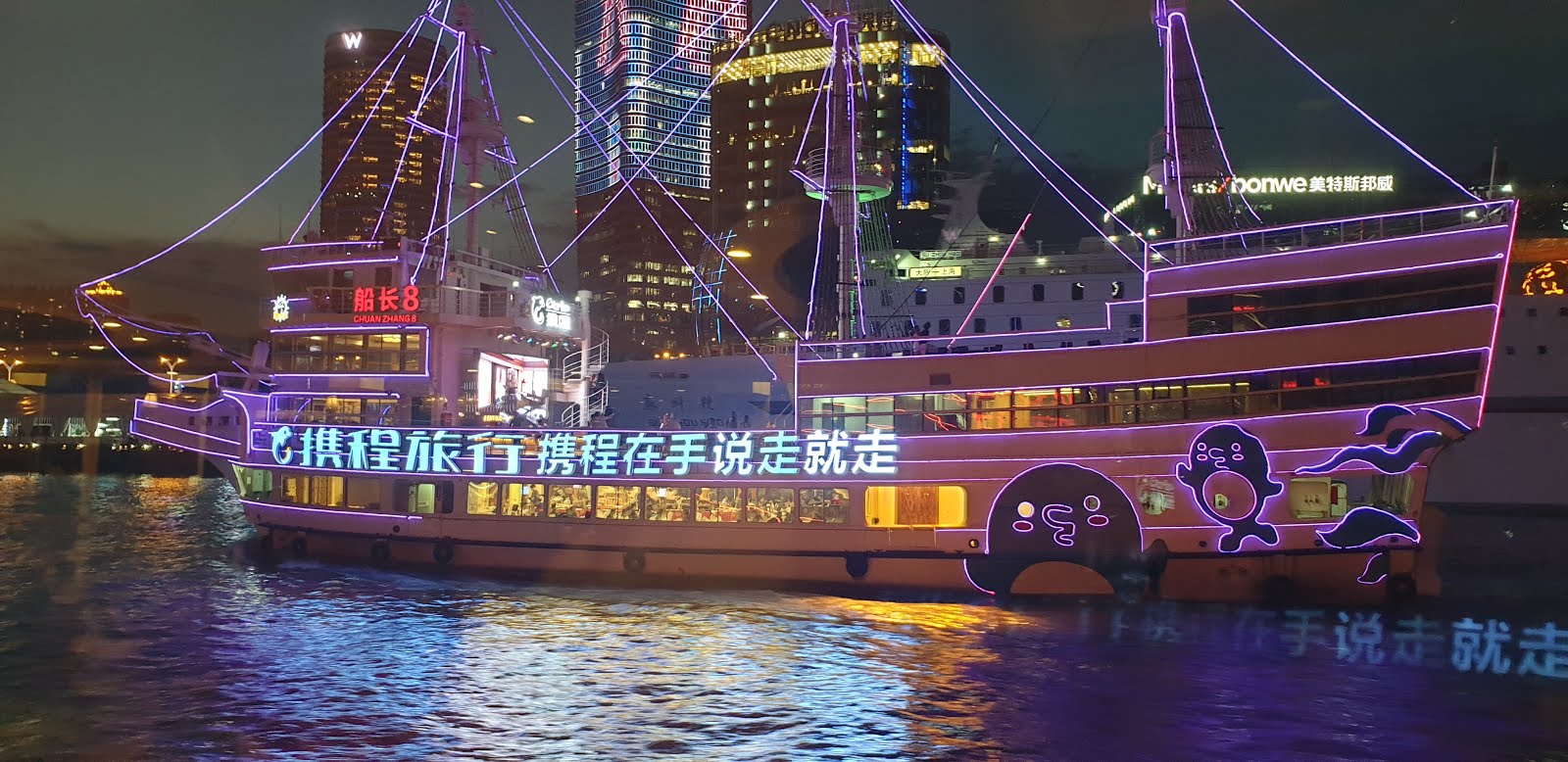
Searching for locations: Shanghai, China, by night.

When we arrive at the embarkation site we find at least 100 buses all lined up and parked, and literally thousands of Chinese and other Asians streaming through the turnstiles to get on another boat leaving earlier than ours.

Buses were just literally arriving one after the other stopping near where we were standing with a dozen or so other groups waiting patiently, and with people were everywhere it could only be described as organized chaos.

Someone obviously knew where everyone was supposed to go, and when it was our turn, we joined the queue.  There were a lot of people in front of us, and a lot more behind, so I had to wonder just how big the boat was.

We soon found out.

And it was amusing to watch people running, yes, they were actually running, to get to the third level, or found available seating.  Being around the first to board, we had no trouble finding a seat on the second level.

I was not quite sure what the name of the boat was, but it had 3 decks and VIP rooms and it was huge, with marble staircases, the sort you could make a grand entrance on.  The last such ornate marble staircase we had seen was in a hotel in Hong Kong, and that was some staircase.

But who has marble staircases in a boat?

We’re going out across the water as far as the Bund and then turn around and come back about 30 to 40 minutes.   By the time everyone was on board, there was no room left on the third level, no seats on the second level nor standing room at the end of the second level where the stairs up to the third level were.

No one wanted to pay the extra to go into the VIP lounge.

We were sitting by very large windows where it was warm enough watching the steady procession of the colored lights of other vessels, and outside the buildings.

It was quite spectacular, as were some of the other boats going out on the harbor.

All the buildings of the Bund were lit up

And along that part of the Bund was a number of old English style buildings made from sandstone, and very impressive to say the least.

On the other side of the harbour were the more modern buildings, including the communications tower, a rather impressive structure.

I had to go to the rear of the vessel to get a photo, a very difficult proposition given here was no space on the railing, not even on the stairs going up or down.  It was just luck I managed to get some photos between passengers heads.

And, another view of that communications tower:

There was no doubt this was one of the most colourful night-time boat tours I’ve ever been on.  Certainly, when we saw the same buildings the following day, they were not half as spectacular in daylight.

I never did get up to the third level to see what the view was like.

The cinema of my dreams – It all started in Venice – Episode 8

Cecilia and Juliet – trouble

How do you run into someone by accident, or randomly when it is neither an accident or random?

There was that problem of looking obvious, that it was staged, that, well you get the idea.

O was hoping staying at the same hotel on the same floor would solve the problem, but when I thought about it, living in Venice, why would I be staying in a hotel?

There was that unofficial reason I’d told Cecilia, that I was renovating, just in case of prying ears, but I was a bit slow in picking up on the new surveillance team Larry had out on Juliet, do he’d know what  I was up to, and if he informed Juliet, then it would ruin the surprise.

It all depended on whether or not the surveillance team was aware of who I was, which could be unlikely, given Giuseppe’s lack of recognition of my identity.  Larry’s mistrust of her might yet work to my advantage.

Then there was the name Juliet knew me by which was not the one Cecilia knew me, so I had to make sure that story was straight between us just in case she was with me when I ran into Juliet.

The trouble was, it was becoming a logistical nightmare.

So, it was rather a surprise when we finally did run into each other, in the restaurant the following morning after Cecilia arrived, and we were just sitting down.

I hadn’t seen Juliet, tucked away in a corner, not until she called out.  And I was with Cecilia, who was the consummate actor.

I heard my name and turned.  Cecilia looked over then sat.  I went over.

“What are you doing here, of all places?”

Was there a note of suspicion or surprise in her tone?

“I’m with an old friend, Cecilia, she’s in Venice for the film festival.  She’s an actor you know.  I didn’t until she called me.”

Juliet gave Cecilia the once over, then looked back at me.  I could see the unspoken question, ‘you still haven’t answered the question’.

“She needed a place to stay and my place is a renovator’s nightmare, so I decided to stay here with her for the duration.”

“Together?”

Not the first thing I expected from her.

“No, separate rooms.  She’s a bit above my pay grade.”

“Oh.”

“We’re off to the festival, she’s agreed to show me around, but if you’re free tonight perhaps we could meet up?  Dumb question, but what are you doing here?”

“I’m staying here.”

“Are you.  No surprise, of course, it’s a good hotel.  I guess we have the same taste in hotels.  Good to see you again, but I’d better go.”

I’d looked around a few times and Cecilia was making to sort of gestures an impatient movie star, ex-girlfriend type might make.

“You’d better go.  I’ll think about it.”

I could see her, ‘this is not a coincidence, look in her eyes and thought it oddly amusing.

Back at the table where Cecilia was waiting, she had been looking covertly in Juliet’s direction.  I sat down.

“She an old girlfriend, or something?”

“Or something.”

“You can tell.  I could feel the death stare.”

“That train left the station a long time ago.”

“Then someone forgot to tell her.  That whole encounter seemed very odd from where I’m sitting.”

“It was.  I asked her for dinner, but I’m not expecting a reply.  It caught me off guard.”

“Then a small suggestion, get your head back in the game.”

She was right.  Catching me by surprise put me on the back foot, and being so meant that the distraction could cause trouble.  I could remember back to the old days, and the training instructor’s words, ‘it only takes a fraction of a second, and you’re dead’.

He was right, it had happened once and I barely survived, coincidentally just before the first time I met Juliet.  That incident kept me vulnerable, a feeling I had hated at the time.

I glanced over at Cecilia, submersed in a text exchange on her cell phone, the conversation playing out in expressions, one of which was quite dark.

But, nevertheless, at least one of us was prepared.  I wondered if Rodby had spoken to her.  He knew of my association with Juliet, before Violetta, and the effect it had on me, especially after the mission that had almost left me broken.

And that, I thought, was another reason for my momentary loss of control; the effect she had on me when I was not prepared, not like the last encounter.  Taking me by surprise, she could still bring those old feelings to the surface, feelings I didn’t want to deal with.  I was still getting over the loss of Violetta which until this moment I had thought I was in a good place.

The text exchange ended.

“Trouble in paradise?” I asked.

“Men can be such idiots sometimes.”

“I know.  Who is he and do you want me to deal with him?”

“A pleasant thought, but no.  I can do that, but you might have to deal with Juliet by yourself.  Oh, she’s coming over.”

By the time I looked up, she was next to me.  “Tonight, here.  Bring your friend if you like.”  Juliet gave her a meaningful glare.

“Sorry, got to attend to man troubles.”

“Sorry to hear that.”  Back to me.

“Eight OK?”

“Fine.  See you then “

I watched her leave the restaurant, not sure what she hoped to gain other than once again to put me on the back foot.

“She has surveillance, the girl who looks like a librarian on holiday, by the door.”

I’d seen her before.  “There’ll be another.  Larry seriously doesn’t trust Juliet.”

“Of course.  French guy, pink shirt, so obvious you’d not think it was him.  Watch yourself.  I have to go for a while but don’t worry, I can find you later.  We need to talk about tonight.”

“Yes.  Later, then.”

© Charles Heath 2022

Reminiscing

I was sitting down discussing with my granddaughter how we’re going to approach what will become an author interview.

We were talking about how old I was when it was I first wrote a story, and what was that story about.

OK, that sent me back a long way into the distant past.

There was also a trick question; “What was the first story you read that put you on the path to wanting to become a writer”.

That was easy, Alistair Maclean’s HMS Ulysses.  I showed her a copy of the book.

But, back to the main question.

Grandparents are old, I said, older than your parents, so that should give you some idea.

When did I start writing, that required a little thought, and there were several triggers that gave me a date, where we lived at the time, the fact I used my mother’s old portable typewriter, and the fact I had not been long out of school.  I was, in fact, about 17, the wrong side of half a century ago.

What was it about; that I couldn’t tell her, but I said I had rescued a lot of old scribbling of mine and put them in a box to look at later when I had the time.

I guess that time had arrived.

And, yes, there was the book, the individually typed pages, some with corrections, unfinished.

The pages were brown with age.

The story, well, I read the first few pages, and it seems I’d started down the thriller path then, the story so far, an agent comes ashore from a trawler to a bleak and isolated village, perhaps on the Scottish coast,

The next question, understandably; “What was the first book you ever finished?”  That was The Starburst Conspiracy, soon to be published on Amazon.

It also led to a few more discoveries, including a book I had forgotten I’d written. And all of the short stories I’d written when at University.

The interview is proceeding.

The memories it is bringing about my earliest forays into the world of writing are priceless.

A photograph from the inspirational bin – 38

This is one of those images that could be anywhere.

So, here’s the problem:

Ethan was reluctant to agree to go to the stag night, knowing firstly, that the others going were a bit too unruly when they had too many drinks, secondly, that they had to agree to not know where they were being taken by the bus, and thirdly, anything they saw or did had to remain completely confidential.

That was particularly the case when it came to the ‘stag’.

In that case, Ethan knew exactly what this night was going to be, hours of unrelenting debauchery.

And, since Ethan was the stag’s brother, and he was the best man, there was no way he could wriggle his way out of this one.

On top of that, Ethan had to promise the bride to be that he would not let her husband to be go too far. That statement, of course, was like a box full of hand grenades. He didn’t ask for a definition of too far.

So, seven sober, respectable, hard-working junior executives in suits that were worth more than Ethan’s annual salary boarded the bus.

What happened from that moment the bus drove off, until Ethan’s brother’s body was found floating face down in the river behind the resort, handcuffed to a naked girl in a rubber dinghy, barely alive from an overdose, was anyone’s guess, and Ethan’s worst nightmare.

Especially when he was the last one to see his brother, and the girl, alive.

And, no, this is not based on a real-life experience, though in recurring nightmares I’m the one floating fase down in the river.

In a word: Dry

We all know what this means, without moisture, in other words not wet.

It could also mean dull factually, as in reading some non-fiction books, and quite often those prescribed as mandatory reading at school.

You could also have a dry sense of humour, where you have to be on your game to understand, or get, the humour.

It could also describe boredom by saying that it’s like watching paint dry.

For those who like a bit of a tipple, the last place you want to go is a dry bar, where no alcohol is served.

Perhaps this should be mandatory for weddings and funerals, places where feelings often run very high and do not need the stimulus of half a dozen double Scotches.

And speaking of alcohol and cider in particular, you can have it sweet, dry, or draft. Many people prefer dry, sometimes the drier the better, especially wine, and oddly martinis.

Aside from whether they are shaken or stirred.

But the most fascinating version of dry is dry cleaning. Just how can you ‘dry’ clean clothes?

Would that be what they call an oxymoron?

An excerpt from “The Devil You Don’t”

Available on Amazon Kindle here:  https://amzn.to/2Xyh1ow

By the time I returned to the Savoie, the rain had finally stopped, and there was a streak of blue sky to offer some hope the day would improve.

The ship was not crowded, the possibility of bad weather perhaps holding back potential passengers.  Of those I saw, a number of them would be aboard for the lunch by Phillippe Chevrier.  I thought about it, but the Concierge had told me about several restaurants in Yvoire and had given me a hand-drawn map of the village.  I think he came from the area because he spoke with the pride and knowledge of a resident.

I was looking down from the upper deck observing the last of the boarding passengers when I saw a woman, notable for her red coat and matching shoes, making a last-minute dash to get on board just before the gangway was removed.  In fact, her ungainly manner of boarding had also captured a few of the other passenger’s attention.  Now they would have something else to talk about, other than the possibility of further rain.

I saw her smile at the deckhand, but he did not smile back.  He was not impressed with her bravado, perhaps because of possible injury.  He looked at her ticket then nodded dismissively, and went back to his duties in getting the ship underway.  I was going to check the departure time, but I, like the other passengers, had my attention diverted to the woman in red.

From what I could see there was something about her.  It struck me when the light caught her as she turned to look down the deck, giving me a perfect profile.  I was going to say she looked foreign, but here, as in almost anywhere in Europe, that described just about everyone.  Perhaps I was just comparing her to Phillipa, so definitively British, whereas this woman was very definitely not.

She was perhaps in her 30’s, slim or perhaps the word I’d use was lissom, and had the look and manner of a model.  I say that because Phillipa had dragged me to most of the showings, whether in Milan, Rome, New York, London, or Paris.  The clothes were familiar, and in the back of my mind, I had a feeling I’d seen her before.

Or perhaps, to me, all models looked the same.

She looked up in my direction, and before I could divert my eyes, she locked on.  I could feel her gaze boring into me, and then it was gone as if she had been looking straight through me.  I remained out on deck as the ship got underway, watching her disappear inside the cabin.  My curiosity was piqued, so I decided to keep an eye out for her.

I could feel the coolness of the air as the ship picked up speed, not that it was going to be very fast.  With stops, the trip would take nearly two hours to get to my destination.  It would turn back almost immediately, but I was going to stay until the evening when it returned at about half eight.  It would give me enough time to sample the local fare, and take a tour of the medieval village.

Few other passengers ventured out on the deck, most staying inside or going to lunch.  After a short time, I came back down to the main deck and headed forward.  I wanted to clear my head by concentrating on the movement of the vessel through the water, breathing in the crisp, clean air, and let the peacefulness of the surroundings envelope me.

It didn’t work.

I knew it wouldn’t be long before I started thinking about why things hadn’t worked, and what part I played in it.  And the usual question that came to mind when something didn’t work out.  What was wrong with me?

I usually blamed it on my upbringing.

I had one of those so-called privileged lives, a nanny till I was old enough to go to boarding school, then sent to the best schools in the land.  There I learned everything I needed to be the son of a Duke, or, as my father called it in one of his lighter moments, nobility in waiting.

Had this been five or six hundred years ago, I would need to have sword and jousting skills, or if it had been a few hundred years later a keen military mind.  If nothing else I could ride a horse, and go on hunts, or did until they became not the thing to do.

I learned six languages, and everything I needed to become a diplomat in the far-flung British Empire, except the Empire had become the Commonwealth, and then, when no-one was looking, Britain’s influence in the world finally disappeared.  I was a man without a cause, without a vocation, and no place to go.

Computers were the new vogue and I had an aptitude for programming.  I guess that went hand in hand with mathematics, which although I hated the subject, I excelled in.  Both I and another noble outcast used to toss ideas around in school, but when it came to the end of our education, he chose to enter the public service, and I took a few of those ideas we had mulled over and turned them into a company.

About a year ago, I was made an offer I couldn’t refuse.  There were so many zeroes on the end of it I just said yes, put the money into a very grateful bank, and was still trying to come to terms with it.

Sadly, I still had no idea what I was going to do with the rest of my life.  My parents had asked me to come back home and help manage the estate, and I did for a few weeks.  It was as long as it took for my parents to drive me insane.

Back in the city, I spent a few months looking for a mundane job, but there were very few that suited the qualifications I had, and the rest, I think I intimidated the interviewer simply because of who I was.  In that time I’d also featured on the cover of the Economist, and through my well-meaning accountant, started involving myself with various charities, earning the title ‘philanthropist’.

And despite all of this exposure, even making one of those ubiquitous ‘eligible bachelor’ lists, I still could not find ‘the one’, the woman I wanted to spend the rest of my life with.  Phillipa seemed to fit the bill, but in time she proved to be a troubled soul with ‘Daddy’ issues.  I knew that in building a relationship compromise was necessary, but with her, in the end, everything was a compromise and what had happened was always going to be the end result.

It was perhaps a by-product of the whole nobility thing.  There was a certain expectation I had to fulfill, to my peers, contemporaries, parents and family, and those who either liked or hated what it represented.  The problem was, I didn’t feel like I belonged.  Not like my friend from schooldays, and now obscure acquaintance, Sebastian.  He had been elevated to his Dukedom early when his father died when he was in his twenties.  He had managed to fade from the limelight and was rarely mentioned either in the papers or the gossip columns.  He was one of the lucky ones.

I had managed to keep a similarly low profile until I met Phillipa.  From that moment, my obscurity disappeared.  It was, I could see now, part of a plan put in place by Phillipa’s father, a man who hogged the limelight with his daughter, to raise the profile of the family name and through it their businesses.  He was nothing if not the consummate self-advertisement.

Perhaps I was supposed to be the last piece of the puzzle, the attachment to the establishment, that link with a class of people he would not normally get in the front door.  There was nothing refined about him or his family, and more than once I’d noticed my contemporaries cringe at the mention of his name, or any reference of my association with him.

Yet could I truthfully say I really wanted to go back to the obscurity I had before Phillipa?  For all her faults, there were times when she had been fun to be with, particularly when I first met her when she had a certain air of unpredictability.  That had slowly disappeared as she became part of her father’s plan for the future.  She just failed to see how much he was using her.

Or perhaps, over time, I had become cynical.

I thought about calling her.  It was one of those moments of weakness when I felt alone, more alone than usual.

I diverted my attention back to my surroundings and the shoreline.  Out of the corner of my eye, I could see the woman in the red coat, making a move.  The red coat was like a beacon, a sort of fire engine red.  It was not the sort of coat most of the women I knew would wear, but on her, it looked terrific.  In fact, her sublime beauty was the one other attribute that was distinctly noticeable, along with the fact her hair was short, rather than long, and jet black.

I had to wrench my attention away from her.

A few minutes later several other passengers came out of the cabin for a walk around the deck, perhaps to get some exercise, perhaps checking up on me, or perhaps I was being paranoid.  I waited till they passed on their way forward, and I turned and headed aft.

I watched the wake sluicing out from under the stern for a few minutes, before retracing my steps to the front of the ship and there I stood against the railing, watching the bow carve its way through the water.  It was almost mesmerizing.  There, I emptied my mind of thoughts about Phillipa, and thoughts about the woman in the red coat.

Until a female voice behind me said, “Having a bad day?”

I started, caught by surprise, and slowly turned.  The woman in the red coat had somehow got very close me without my realizing it.  How did she do that?  I was so surprised I couldn’t answer immediately.

“I do hope you are not contemplating jumping.  I hear the water is very cold.”

Closer up, I could see what I’d missed when I saw her on the main deck.  There was a slight hint of Chinese, or Oriental, in her particularly around the eyes, and of her hair which was jet black.  An ancestor twice or more removed had left their mark, not in a dominant way, but more subtle, and easily missed except from a very short distance away, like now.

Other than that, she was quite possibly Eastern European, perhaps Russian, though that covered a lot of territory.  The incongruity of it was that she spoke with an American accent, and fluent enough for me to believe English was her first language.

Usually, I could ‘read’ people, but she was a clean slate.  Her expression was one of amusement, but with cold eyes.  My first thought, then, was to be careful.

“No.  Not yet.”  I coughed to clear my throat because I could hardly speak.  And blushed, because that was what I did when confronted by a woman, beautiful or otherwise.

The amusement gave way to a hint of a smile that brightened her demeanor as a little warmth reached her eyes.  “So that’s a maybe.  Should I change into my lifesaving gear, just in case?”

It conjured up a rather interesting image in my mind until I reluctantly dismissed it.

“Perhaps I should move away from the edge,” I said, moving sideways until I was back on the main deck, a few feet further away.  Her eyes had followed me, and when I stopped she turned to face me again.  She did not move closer.

I realized then she had removed her beret and it was in her left side coat pocket.  “Thanks for your concern …?”

“Zoe.”

“Thanks for your concern, Zoe.  By the way, my name is John.”

She smiled again, perhaps in an attempt to put me at ease.  “I saw you earlier, you looked so sad, I thought …”

“I might throw myself overboard?”

“An idiotic notion I admit, but it is better to be safe than sorry.”

Then she tilted her head to one side then the other, looking intently at me.  “You seem to be familiar.  Do I know you?”

I tried to think of where I may have seen her before, but all I could remember was what I’d thought earlier when I first saw her; she was a model and had been at one of the showings.  If she was, it would be more likely she would remember Phillipa, not me.  Phillipa always had to sit in the front row.

“Probably not.”  I also didn’t mention the fact she may have seen my picture in the society pages of several tabloid newspapers because she didn’t look the sort of woman who needed a daily dose of the comings and goings, and, more often than not, scandal associated with so-called celebrities.

She gave me a look, one that told me she had just realized who I was.  “Yes, I remember now.  You made the front cover of the Economist.  You sold your company for a small fortune.”

Of course.  She was not the first who had recognized me from that cover.  It had raised my profile considerably, but not the Sternhaven’s.  That article had not mentioned Phillipa or her family.  I suspect Grandmother had something to do with that, and it was, now I thought about it, another nail in the coffin that was my relationship with Phillipa.

“I wouldn’t say it was a fortune, small or otherwise, just fortunate.”  Each time, I found myself playing down the wealth aspect of the business deal.

“Perhaps then, as the journalist wrote, you were lucky.  It is not, I think, a good time for internet-based companies.”

The latter statement was an interesting fact, one she read in the Financial Times which had made that exact comment recently.

“But I am boring you.”  She smiled again.  “I should be minding my own business and leaving you to your thoughts.  I am sorry.”

She turned to leave and took a few steps towards the main cabin.

“You’re not boring me,” I said, thinking I was letting my paranoia get the better of me.  It had been Sebastian on learning of my good fortune, who had warned me against ‘a certain element here and abroad’ whose sole aim would be to separate me from my money.  He was not very subtle when he described their methods.

But I knew he was right.  I should have let her walk away.

She stopped and turned around.  “You seem nothing like the man I read about in the Economist.”

A sudden and awful thought popped into my head.  Those words were part of a very familiar opening gambit.  “Are you a reporter?”

I was not sure if she looked surprised, or amused.  “Do I look like one?”

I silently cursed myself for speaking before thinking, and then immediately ignored my own admonishment.  “People rarely look like what they are.”

I saw the subtle shake of the head and expected her to take her leave.  Instead she astonished me.

“I fear we have got off on the wrong foot.  To be honest, I’m not usually this forward, but you seemed like you needed cheering up when probably the opposite is true.  Aside from the fact this excursion was probably a bad idea.  And,” she added with a little shrug, “perhaps I talk too much.”

I was not sure what I thought of her after that extraordinary admission. It was not something I would do, but it was an interesting way to approach someone and have them ignoring their natural instinct.  I would let Sebastian whisper in my ear for a little longer and see where this was going.

“Oddly enough, I was thinking the same thing.  I was supposed to be traveling with my prospective bride.  I think you can imagine how that turned out.”

“She’s not here?”

“No.”

“She’s in the cabin?”  Her eyes strayed in that direction for a moment then came back to me.  She seemed surprised I might be traveling with someone.

“No.  She is back in England, and the wedding is off.  So is the relationship.  She dumped me by text.”

OK, why was I sharing this humiliating piece of information with her?  I still couldn’t be sure she was not a reporter.

She motioned to an empty seat, back from the edge.  No walking the plank today.  She moved towards it and sat down.  She showed no signs of being cold, nor interested in the breeze upsetting her hair.  Phillipa would be having a tantrum about now, being kept outside, and freaking out over what the breeze might be doing to her appearance.

I wondered, if only for a few seconds if she used this approach with anyone else.  I guess I was a little different, a seemingly rich businessman alone on a ferry on Lake Geneva, contemplating the way his life had gone so completely off track.

She watched as I sat at the other end of the bench, leaving about a yard between us.  After I leaned back and made myself as comfortable as I could, she said, “I have also experienced something similar, though not by text message.  It is difficult, the first few days.”

“I saw it coming.”

“I did not.”  She frowned, a sort of lifeless expression taking over, perhaps brought on by the memory of what had happened to her.  “But it is done, and I moved on.  Was she the love of your life?”

OK, that was unexpected.

When I didn’t answer, she said, “I am sorry.  Sometimes I ask personal questions without realizing what I’m doing.  It is none of my business.”  She shivered.  “Perhaps we should go back inside.”

She stood, and held out her hand.  Should I take it and be drawn into her web?  I thought of Sebastian.  What would he do in this situation?

I took her hand in mine and let her pull me gently to my feet.  “Wise choice,” she said, looking up at the sky.

It just started to rain.

© Charles Heath 2015-2020

newdevilcvr6

The cinema of my dreams – I never wanted to go to Africa – Episode 14

It’s still a battle of wits, but our hero knows he’s in serious trouble.

The problem is, there are familiar faces and a question of who is a friend and who is foe made all the more difficult because the enemy if it is the enemy, doesn’t look or sound or act like the enemy.


It was the smell, all hospitals seemed to smell the same.  Antiseptic.

And the first face I saw was Breeman’s.

How?

If  I could speak, which for some reason I knew I couldn’t, the first question would be, ‘Where am I?’

“Welcome back,” Breeman said.  “You gave us a few days of grave concern at the crash.  You’re in the base hospital, and lucky to be alive.”

OK, a few days missing, but lucky to survive?  I got out without a scratch, or did I?

I looked sideways and down.  Nothing but bandages, and, yes, plaster.  Broken bones?

“How you survived being thrown from the wreckage is anyone’s guess.  A search party found you last night, almost dead.  Broken legs, shattered shoulder, ribs, even a skull fracture.  The doctors are astonished.  So am I.”

She was holding my hand, a very unlike commanding officer thing to so, and it looked like a tear in her eye.  Perhaps our so-called casual fling was a little more than that.

“But you rest.  I’ll come back later when you’re better.”

Last I remember, except for some sore ribs, I’d been intact, and unharmed from the jump out of the helicopter.

Now, it appeared, I was the very epitome of a crash victim.  What the hell had happened to me from the time I was in the cell, getting that injection, and now?

Clearly, the people in the other camp didn’t want me to die.  But, surely they realized I would tell Breeman about my experiences at the camp.

Or not.  If anything, what I would have to tell them would be considered the ramblings of someone in very bad condition, mind wandering in the desert while fighting for his life, and then on return, ramblings fuelled by very high doses of painkillers.

And the fact none of it could be corroborated.  It was unlikely any flyover would locate the base if anyone was foolish enough to fly in the no-fly zone.

And, pushing the paranoia limits, I guessed that they would have someone in the base who was feeding them information, that’s how they knew so much about what was going on here.

I would have to lie low and choose my friends carefully.


© Charles Heath 2019

‘Sunday in New York’ – A beta reader’s view

I’m not a fan of romance novels but …

There was something about this one that resonated with me.

This is a novel about a world generally ruled by perception, and how people perceive what they see, what they are told, and what they want to believe.

I’ve been guilty of it myself as I’m sure we all have at one time or another.

For the main characters Harry and Alison there are other issues driving their relationship.

For Alison, it is a loss of self-worth through losing her job and from losing her mother and, in a sense, her sister.

For Harry, it is the fact he has a beautiful and desirable wife, and his belief she is the object of other men’s desires, and one in particular, his immediate superior.

Between observation, the less than honest motives of his friends, a lot of jumping to conclusions based on very little fact, and you have the basis of one very interesting story.

When it all comes to a head, Alison finds herself in a desperate situation, she realises only the truth will save their marriage.

But is it all the truth?

What would we do in similar circumstances?

Rarely does a book have me so enthralled that I could not put it down until I knew the result. They might be considered two people who should have known better, but as is often the case, they had to get past what they both thought was the truth.

And the moral of this story, if it could be said there is one, nothing is ever what it seems.

Available on Amazon here: amzn.to/2H7ALs8