Searching for locations: The Bund, Shanghai, China

The Bund

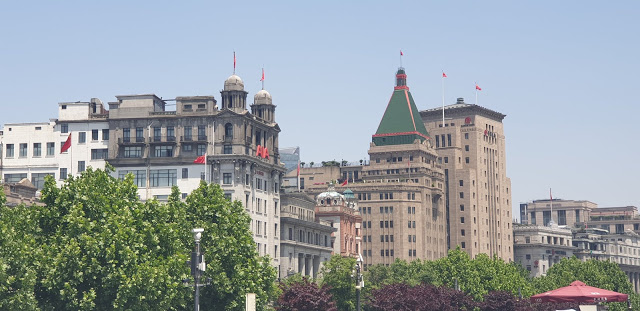
The architecture along the Bund or Waitan is a living museum of the colonial history of the 1800s.  The area centers on a section of Zhongshan Road within the former Shanghai International Settlement.

The word bund means an embankment or an embanked quay.   It was initially a British settlement; later the British and American settlements were combined in the International Settlement.

The Bund is a mile-long stretch of waterfront promenade along the Huangpu River. There are 52 buildings of various architectural styles, including Gothic, baroque, and neoclassical styles. The area is often referred to as “the museum of buildings”.

Building styles include Romanesque Revival, Gothic Revival, Renaissance Revival, Baroque Revival, Neo-Classical or Beaux-Arts, as well as a number in Art Deco style.

Having seen these buildings initially the night before, mostly lit up, our viewing this morning was from the land side, and particularly interesting in that the colonial architecture was really fascinating considering their location, but not surprising given Shanghai’s history.  A lot of these buildings would be more at home in London, that out in the far east.

The Bund waterfront is about two kilometers long and impossible to cover in the time allowed for this part of the tour.

There was just enough time to get photos of the waterfront and the old buildings.

Some of these buildings had odd shapes, like one on the far right that looks like a bottle opener.

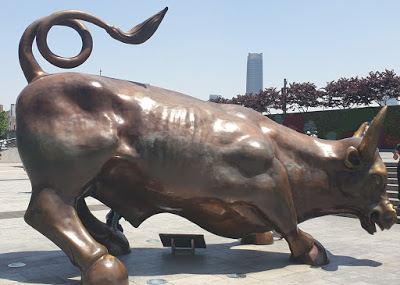
And, for some odd reason, a bull.

On the other side of the water, the sights that had been quite colorful the night before, were equally impressive though somewhat diminished by the haze.

We all need a little attention now and then

When I was last in Europe we decided to get the Eurostar, from London, through the Chunnel, to Paris Disneyland.  Not exactly as fast as the Japanese bullet trains, but faster than anything we have in this country.

You are hurtling along at up to 160 kph, though it feels a lot faster, and then you begin to brake, and it seems like nothing is happening, except for some outside friction noise, and the speed dropping.

I feel like that now, on my way to the bottom of the abyss.

At the end of that fall, it is something referred to as hitting rock bottom.

I’m told once you hit rock bottom the only way is up.

The question is, who do you know that has fallen into the abyss and come back to tell you about it?

Put into layman’s terms, hurling down the abyss is like having a severe episode of depression.  There are different types, some worse than others.  Hitting the ground is roughly the equivalent of looking for a way out that eases the pain and not finding one, and that, for some people, is a quite drastic answer.

But the sign that the free fall is braking, like the express train slowing down, is a sign that you’ve seen the light, that there are external forces that can render assistance.

I see them now, the hands of friends, the hands of people I don’t know, but who are concerned.

Writers like any other professional people are the same as everyone else, but with one rather interesting difference.  It is a profession where a lot of the time you are on your own, alone with your thoughts, your characters, your fantasy world, which sometimes so frighteningly drifts into your reality.

Some of us will make a fortune, some of us will make an adequate living, and live the ‘dream’ of doing the one job they always wanted to, and most will not.

I’m not rich, I’m not one who gets an adequate income, yet.

But I will get out of this abyss.

I can feel the brakes.

My eldest granddaughter, who is 15, tells me the fantasy story where she is a princess I’m writing for her is brilliant.

The free fall has stopped.  I step out into the sunshine.

All I needed was a little praise.

The cinema of my dreams – It all started in Venice – Episode 10

Could Juliet be slightly jealous?

I got back to the hotel just before Cecilia was leaving.  She was wearing what I would call her party clothes, something that left little to the imagination, but not different from the many others trying to be noticed.

I had thought of using the analogy that she was going to be a single tree in a forest of similar trees, but it was probably something she already knew.

And a pity she felt she needed to make such an entrance just to be noticed, and probably to some, for all the wrong reasons.  At least she was gaining experience for what I called her day job.

“I’ll be back to make an impression on your friend,” she said.

She didn’t need to say anymore.  Impression would be an understatement.  But it might, quite literally, shake the trees to see what falls out.

A half-hour later there was a light rapping on my door.  I was not expecting any visitors, so it could be one of three options, Cecilia was back early or changed her mind though I seriously doubted it, or Juliet was being pre emotive, or perhaps it was just one of the hotel staff.

Whomever it was, I made the necessary preparations, just like in the old days, and opened the door.  There was always that moment of unpreparedness, that someone would come crashing through the door and take you by surprise.

Happened once, not again.

“Juliet.”  More a statement than a question, it should not be a surprise but it was.

She had dressed for dinner, not as Cecilia would, but she had made an effort.  Had Cecilia made that happen?

And yet the first question to come to mind is, “How did you know I was here?”

“Simple, I saw you go into this room.  It had to be either you, or the girl, so I made a choice.  I was not sure what I was going to do or say if I was wrong.”

“It wouldn’t bother Cecilia.  She and I, were just old friends.”

“Like us?”

“Are we old friends.  It seems to me that we had something else back then, for a brief time, until I had to go back.”

“You never did explain what happened to you.”

“No, and the less said about it the better.  I was young and stupid, like all men of that age, and I cheated death.  I was lucky, very lucky, and, I might add, very lucky too that you were my doctor.”

“May I come in?”

Standing in the passage discussing personal matters might have been more embarrassing for her than for me.  I stood to one side and let her pass.  There was no fount in my mind she had a device that was sending our conversation back to Larry.

There would be questions, probing for the truth.  Who I was, what I did, where I’d been.  Now, or over dinner, it was her task

I closed the door and leaned against it.

I had to ask, “What are you doing here?”

A puzzled look came over her face, surprised perhaps I’d be that direct in asking.

“I thought you asked me to dinner.”

“I did.”

“We’re you just asking for the sake of asking?”  There was a tinge of disappointment in her tone.

“No.  I thought dinner would be good since Cecilia is out there promoting herself. She asked me to come along and see what it is like, but it’s too near the limelight for me.”

“Do you and her have a thing?”

I’m not sure what ‘a thing’ meant.  “If you mean, a romantic attachment, no.  It’s too soon after Angelina’s death.  I may never get over it, but Cecilia popped up and said she was coming and she’s good fun.  And being seen with her makes me look good for an over-the-hill retiree.”

That might make it reasonably clear if she wanted to push this to another level it wasn’t going ti work.  Larry would be disappointed.  It would be interesting to see what she had as a plan B.

“You’re not that old, just out of practice, but I get it.  That doesn’t mean we can’t have dinner.”

“No, it does not.”

I thought about taking her to the hotel restaurant, but in the end opted for a long walk to St Mark’s square, one where a band was playing Rogers and Hammerstein musical songs.

The distance between us wasn’t physical, she was right beside me, so close I could have reached out and taken her hand in mine, it was the thought of her duplicity.

If she told me what was happening, I would have tried very hard to get her out of the predicament and take away Larry’s perceived advantage.

I hadn’t activated the scrambler, so Larry was no doubt listening in, but the conversation wouldn’t be all that informative.  I spoke about Venice, deliberately, and of Angelina.  Larry could make of that whatever he wanted.

At the restaurant we sat near to the orchestra, to help obfuscate the sound, and opposite each other.  She was drinking champagne; I was having a beer.

“So, what have you been doing with yourself since I last met you?”

It begins.

© Charles Heath 2022

And what was the inspiration behind the story “[Any title you’ve written]”

As accomplished as we can be at putting words on paper, what is it that makes it so difficult to sit in a chair with a camera on you, and saying words rather than writing them?

Er and um seem to crop up a lot in verbal speech.

OK, it was a simple question; “What motivates you to write?”

Damn.

My brain just turned to mush, and the words come out sounding like a drunken sailor after a night out on the town.

The written answer to the question is simple; “The idea that someone will read what I have written, and quite possibly enjoy it; that is motivation enough.”

It highlights the difficulties of the novice author.

Not only are there the constant demands of creating a ‘brand’ and building a ‘following’, there is also the need to market oneself, and the interview is one of the more effective ways of doing this.

If only I can settle the nerves.

I mean, really, it is only my granddaughter who is conducting the interview, and the questions are relatively simple.

The trouble is, I’ve never had to do it before, well, perhaps in an interview for a job, but that is less daunting.  That usually sticks to a predefined format.

Here the narrative can go in any direction.  There are set questions, but the interviewer, in her inimitable manner, can sometimes slide a question in out of left field.

For instance, “Your character Zoe the assassin, is she based on someone you know, or an amalgam of other characters you’ve read about or seen in movies?”

That was an interesting question, and one that has several answers, but the one most relevant was; “It was the secret alter ego of one of the women I used to work with.  I asked her one day if she wasn’t doing what she was, what she would like to do.  It fascinated me that other people had a desire to be something more exotic in an alter ego.”

Of course, the next question was about what I wanted to be in an alter ego.

Maybe I’ll tell you next time.

In a word: There

Yes, the dog is over there. It’s a place somewhere other than where you are currently.

Or, you could say, there was a brave man, but he couldn’t help so there was no hope. It doesn’t refer to a place.

Or I’m taking you to the border, but from there you’re on your own.

Confused yet?

Let’s try by adding a similar word, their

It means belonging to a group as in, it was their dog that caused the damage.

Of course, this can be twisted a little, and you could say, everyone has to bring their own pack, meaning at times it could refer to one, or many,

Then just when you thought it was safe to go back into the water, there’s they’re.

This is a contraction for they are, so it’s they’re not going to fo as their told.

Wow, it starts getting complicated when you use two or more of those similar words in the same sentence.

Confusing?

That’s why it always pays to have a dictionary handy.

Just in case autocorrect fails, which it seems to quite often for me. I’m not sure why.

The story behind the story: A Case of Working With the Jones Brothers

To write a private detective serial has always been one of the items at the top of my to-do list, though trying to write novels and a serial, as well as a blog, and maintain a social media presence, well, you get the idea.

But I made it happen, from a bunch of episodes I wrote a long, long time ago, used these to start it, and then continue on, then as now, never having much of an idea where it was going to end up, or how long it would take to tell the story.

That, I think is the joy of ad hoc writing, even you, as the author, have as much idea of where it’s going as the reader does.

It’s basically been in the mill since 1990, and although I finished it last year, it looks like the beginning to end will have taken exactly 30 years.  Had you asked me 30 years ago if I’d ever get it finished, the answer would be maybe?

My private detective, Harry Walthenson

I’d like to say he’s from that great literary mold of Sam Spade, or Mickey Spillane, or Phillip Marlow, but he’s not.

But, I’ve watched Humphrey Bogart play Sam Spade with much interest, and modeled Harry and his office on it.  Similarly, I’ve watched Robert Micham play Phillip Marlow with great panache, if not detachment, and added a bit of him to the mix.

Other characters come into play, and all of them, no matter what period they’re from, always seem larger than life.  I’m not above stealing a little of Mary Astor, Peter Lorre or Sidney Greenstreet, to breathe life into beguiling women and dangerous men alike.

Then there’s the title, like

The Case of the Unintentional Mummy – this has so many meanings in so many contexts, though I image back in Hollywood in the ’30s and ’40s, this would be excellent fodder for Abbott and Costello

The Case of the Three-Legged Dog – Yes, I suspect there may be a few real-life dogs with three legs, but this plot would involve something more sinister.  And if made out of plaster, yes, they’re always something else inside.

But for mine, to begin with, it was “The Case of the …”, because I had no idea what the case was going to be about, well, I did, but not specifically.

Then I liked the idea of calling it “The Case of the Brother’s Revenge” because I began to have a notion there was a brother no one knew about, but that’s stuff for other stories, not mine, so then went the way of the others.

Now it’s called ‘A Case of Working With the Jones Brothers’, finished the first three drafts, and at the editor for the last.

I have high hopes of publishing it in early 2021.  It even has a cover.

PIWalthJones1

The cinema of my dreams – I never wanted to go to Africa – Episode 17

Our hero knows he’s in serious trouble.

The problem is, there are familiar faces and a question of who is a friend and who is foe made all the more difficult because of the enemy if it was the enemy, simply because it didn’t look or sound or act like the enemy.

Now it looks like he’s been renditioned by his own people.


Seeing Colonel Bamfield made my blood run cold.

This wasn’t an old commanding officer coming to see one of his protégés after being almost killed in a bad accident.

This was a man checking up on me, and whether or not I had relayed any of the details of my incarceration at the mystery camp in the desert.

The thing is, he didn’t have to come calling if I had said anything Breeman would have reported it directly to her superiors.

No, he was here for another reason, and one I had no doubt I was not going to like.

Firstly, it was apparent the feelings of dislike and mistrust ran deep between the two, and I could see, on first sight, there had been something between them once, and it had exploded on someone, and I suspect it was Breeman.

Male officers of Bamfield rank rarely got into trouble for fraternising with lower ranked female officers.  It was, I was told once, a man’s army, not for women.

And I expect Bamfield was old school.

He looked at me then at her.  “How is our patient?”

Our patient?  How did he have anything to do with me, unless he was reclaiming me for his command.

“Sergeant Digwater has a name, and he is not your patient.”  The accompanying look on her face told me that Bamfield better be ready for war.

“Perhaps that might be the case for now, but I have given orders to temporarily detach Sergeant Digwater from this command and assign him temporally to mine so that he can be sent to our medical facility in Germany before being sent home.  The sergeant has done enough for his country.”

Had I?  It was customary to patch soldiers like me up if the injuries were not life-threatening, and then send them back to the front line.  I had, as far as I was aware, a few broken bones, and nothing that a month or two of physical therapy wouldn’t put straight.

Besides, as a loner, I had made the Army my home, and where most of the people I knew were.  As a civilian, I would be like a fish out of water.

“Do I get to choose what happens to me?”  I spoke for the first time, directly at both of them.

Bamfield answered.  “No.”  Then gave me a genial look.  “How are you, Sam.  I’ve spoken to the doctors, and they say all you need is rest and recuperation and you’ll be as good as new.  But I want to know how you feel?”

I gave him a measured look.  “I would have to say a lot worse than a few days ago.”

His expression changed as a result of those words.  Breeman’s expression was a lot more interesting, processing what that statement might mean.

She was about to ask when he interrupted her.  “Understandable, since you were found unconscious in the cabin of the crashed aircraft.  A case perhaps of a delayed reaction.  You should tell the medics you need more pain killers.”  He then turned to Breeman.  “The sergeant will be evacuated at 0800 hours tomorrow morning.  Until then, no one is to visit him until he is debriefed.  Am I clear?”

Breeman stood.  She was a good six inches shorter than Bamfield in stature, and at least 100 pound in weight.  Still, she projected a formidable opponent.

“I take it that does not include me?”

“What part of everyone did you not understand?”

Fighting words and she was ready to take up the battle.  Except, I think she knew she was outranked, and if push came to shove, it was not worth losing her command over the visiting of a lowly Sergeant.  This was pulling rank at its worst.

“Something’s not right here,” she said.  “And you can be assured I will get to the bottom of it.”  A final glare in his direction and she left, almost slamming the ward door behind her.

Bamfield waited a moment to make sure she had left, then addressed me.

“What have you said about your time missing?”

“Nothing.  If anything I was almost sure you’d turn up.  I had no intention of telling her what happened to me because I’m not sure myself.  I don’t remember having any broken bones.”

“You had to look like you were in a crash, not sitting in a cell for the time you were missing.  I suggest you keep our discussion to yourself, and remember, we could have sent you back in a body bag.  The debriefing crew will be here in an hour or so.”

“What am I supposed to tell them?”

“Whatever you want.  It won’t go any further than them because they are assigned to me.  Now, I have to work to get back to.  I might see you again in Germany, but if I don’t, enjoy the rest of your life.”

The way he said it, I didn’t think this visit would be the last time I saw him.  Like Breeman said, something was not right.

He had a brief word to the guard, another soldier he had brought with him, and left him on guard outside the ward door.  It looked to me like he didn’t take Breeman at her word she wouldn’t return.


© Charles Heath 2019

An excerpt from “Strangers We’ve Become” – Coming Soon

I wandered back to my villa.

It was in darkness.  I was sure I had left several lights on, especially over the door so I could see to unlock it.

I looked up and saw the globe was broken.

Instant alert.

I went to the first hiding spot for the gun, and it wasn’t there.  I went to the backup and it wasn’t there either.  Someone had found my carefully hidden stash of weapons and removed them.

Who?

There were four hiding spots and all were empty.  Someone had removed the weapons.  That could only mean one possibility.

I had a visitor, not necessarily here for a social call.

But, of course, being the well-trained agent I’d once been and not one to be caught unawares, I crossed over to my neighbor and relieved him of a weapon that, if found, would require a lot of explaining.

Suitably armed, it was time to return the surprise.

There were three entrances to the villa, the front door, the back door, and a rather strange escape hatch.  One of the more interesting attractions of the villa I’d rented was its heritage.  It was built in the late 1700s, by a man who was, by all accounts, a thief.  It had a hidden underground room which had been in the past a vault but was now a wine cellar, and it had an escape hatch by which the man could come and go undetected, particularly if there was a mob outside the door baying for his blood.

It now gave me the means to enter the villa without my visitors being alerted, unless, of course, they were near the vicinity of the doorway inside the villa, but that possibility was unlikely.  It was not where anyone could anticipate or expect a doorway to be.

The secret entrance was at the rear of the villa behind a large copse, two camouflaged wooden doors built into the ground.  I move aside some of the branches that covered them and lifted one side.  After I’d discovered the doors and rusty hinges, I’d oiled and cleaned them, and cleared the passageway of cobwebs and fallen rocks.  It had a mildew smell, but nothing would get rid of that.  I’d left torches at either end so I could see.

I closed the door after me, and went quietly down the steps, enveloped in darkness till I switched on the torch.  I traversed the short passage which turned ninety degrees about halfway to the door at the other end.  I carried the key to this door on the keyring, found it and opened the door.  It too had been oiled and swung open soundlessly.

I stepped in the darkness and closed the door.

I was on the lower level under the kitchen, now the wine cellar, the ‘door’ doubling as a set of shelves which had very little on them, less to fall and alert anyone in the villa.

Silence, an eerie silence.

I took the steps up to the kitchen, stopping when my head was level with the floor, checking to see if anyone was waiting.  There wasn’t.  It seemed to me to be an unlikely spot for an ambush.

I’d already considered the possibility of someone coming after me, especially because it had been Bespalov I’d killed, and I was sure he had friends, all equally as mad as he was.  Equally, I’d also considered it nigh on impossible for anyone to find out it was me who killed him because the only people who knew that were Prendergast, Alisha, a few others in the Department, and Susan.

That raised the question of who told them where I was.

If I was the man I used to be, my first suspect would be Susan.  The departure this morning, and now this was too coincidental.  But I was not that man.

Or was I?

I reached the start of the passageway that led from the kitchen to the front door and peered into the semi-darkness.  My eyes had got used to the dark, and it was no longer an inky void.  Fragments of light leaked in around the door from outside and through the edge of the window curtains where they didn’t fit properly.  A bone of contention upstairs in the morning, when first light shone and invariably woke me up hours before I wanted to.

Still nothing.

I took a moment to consider how I would approach the visitor’s job.  I would get a plan of the villa in my head, all entrances, where a target could be led to or attacked where there would be no escape.

Coming in the front door.  If I was not expecting anything, I’d just open the door and walk-in.  One shot would be all that was required.

Contract complete.

I sidled quietly up the passage staying close to the wall, edging closer to the front door.  There was an alcove where the shooter could be waiting.  It was an ideal spot to wait.

Crunch.

I stepped on some nutshells.

Not my nutshells.

I felt it before I heard it.  The bullet with my name on it.

And how the shooter missed, from point-blank range, and hit me in the arm, I had no idea.  I fired off two shots before a second shot from the shooter went wide and hit the door with a loud thwack.

I saw a red dot wavering as it honed in on me and I fell to the floor, stretching out, looking up where the origin of the light was coming and pulled the trigger three times, evenly spaced, and a second later I heard the sound of a body falling down the stairs and stopping at the bottom, not very far from me.

Two assassins.

I’d not expected that.

The assassin by the door was dead, a lucky shot on my part.  The second was still breathing.

I checked the body for any weapons and found a second gun and two knives.  Armed to the teeth!

I pulled off the balaclava; a man, early thirties, definitely Italian.  I was expecting a Russian.

I slapped his face, waking him up.  Blood was leaking from several slashes on his face when his head had hit the stairs on the way down.  The awkward angle of his arms and legs told me there were broken bones, probably a lot worse internally.  He was not long for this earth.

“Who employed you?”

He looked at me with dead eyes, a pursed mouth, perhaps a smile.  “Not today my friend.  You have made a very bad enemy.”  He coughed and blood poured out of his mouth.  “There will be more …”

Friends of Bespalov, no doubt.

I would have to leave.  Two unexplainable bodies, I’d have a hard time explaining my way out of this mess.  I dragged the two bodies into the lounge, clearing the passageway just in case someone had heard anything.

Just in case anyone was outside at the time, I sat in the dark, at the foot of the stairs, and tried to breathe normally.  I was trying not to connect dots that led back to Susan, but the coincidence was worrying me.

A half-hour passed and I hadn’t moved.  Deep in thought, I’d forgotten about being shot, unaware that blood was running down my arm and dripping onto the floor.

Until I heard a knock on my front door.

Two thoughts, it was either the police, alerted by the neighbors, or it was the second wave, though why would they be knocking on the door?

I stood, and immediately felt a stabbing pain in my arm.  I took out a handkerchief and turned it into a makeshift tourniquet, then wrapped a kitchen towel around the wound.

If it was the police, this was going to be a difficult situation.  Holding the gun behind my back, I opened the door a fraction and looked out.

No police, just Maria.  I hoped she was not part of the next ‘wave’.

“You left your phone behind on the table.  I thought you might be looking for it.”  She held it out in front of her.

When I didn’t open the door any further, she looked at me quizzically, and then asked, “Is anything wrong?”

I was going to thank her for returning the phone, but I heard her breathe in sharply, and add, breathlessly, “You’re bleeding.”

I looked at my arm and realized it was visible through the door, and not only that, the towel was soaked in blood.

“You need to go away now.”

Should I tell her the truth?  It was probably too late, and if she was any sort of law-abiding citizen she would go straight to the police.

She showed no signs of leaving, just an unnerving curiosity.  “What happened?”

I ran through several explanations, but none seemed plausible.  I went with the truth.  “My past caught up with me.”

“You need someone to fix that before you pass out from blood loss.  It doesn’t look good.”

“I can fix it.  You need to leave.  It is not safe to be here with me.”

The pain in my arm was not getting any better, and the blood was starting to run down my arm again as the tourniquet loosened.  She was right, I needed it fixed sooner rather than later.

I opened the door and let her in.  It was a mistake, a huge mistake, and I would have to deal with the consequences.  Once inside, she turned on the light and saw the pool of blood just inside the door and the trail leading to the lounge.  She followed the trail and turned into the lounge, turned on the light, and no doubt saw the two dead men.

I expected her to scream.  She didn’t.

She gave me a good hard look, perhaps trying to see if I was dangerous.  Killing people wasn’t something you looked the other way about.  She would have to go to the police.

“What happened here?”

“I came home from the cafe and two men were waiting for me.  I used to work for the Government, but no longer.  I suspect these men were here to repay a debt.  I was lucky.”

“Not so much, looking at your arm.”

She came closer and inspected it.

“Sit down.”

She found another towel and wrapped it around the wound, retightening the tourniquet to stem the bleeding.

“Do you have medical supplies?”

I nodded.  “Upstairs.”  I had a medical kit, and on the road, I usually made my own running repairs.  Another old habit I hadn’t quite shaken off yet.

She went upstairs, rummaged, and then came back.  I wondered briefly what she would think of the unmade bed though I was not sure why it might interest her.

She helped me remove my shirt, and then cleaned the wound.  Fortunately, she didn’t have to remove a bullet.  It was a clean wound but it would require stitches.

When she’d finished she said, “Your friend said one day this might happen.”

No prizes for guessing who that friend was, and it didn’t please me that she had involved Maria.

“Alisha?”

“She didn’t tell me her name, but I think she cares a lot about you.  She said trouble has a way of finding you, gave me a phone and said to call her if something like this happened.”

“That was wrong of her to do that.”

“Perhaps, perhaps not.  Will you call her?”

“Yes.  I can’t stay here now.  You should go now.  Hopefully, by the time I leave in the morning, no one will ever know what happened here, especially you.”

She smiled.  “As you say, I was never here.”

© Charles Heath 2018-2022

strangerscover9

The cinema of my dreams – I always wanted to see the planets – Episode 39

Talk fast, and hope like hell!

Oh, to be back on a cargo ship with three other crew members and a robot that wasn’t trying to destroy ships and murder crew members.

On the cargo ship, the captain could hide in his or her cabin behind the bridge and never come out except to tell the robot he or she was doing a good job.

Sometimes you’d see the crew in the mess hall.

No major life-changing decisions.  It was point A to point B without drama, hold-ups, or anything really.

Not like being the captain of a brand-new class of explorer’s vessels with over 2,000 crewmen on the outer edges of our galaxy, on the verge of being destroyed.

“So, for the benefit of a human without the resources of countless generations of knowledge, and experience of countless alien entities, who or what are you that can make such a life-changing decision?  Especially after you said that we would be safe.”

“If you are inferring that I am a robot programmed to not look rationally at the pros and cons of any case you put to me, or that I am devoid of any empathy, you’re wrong.  That I should make such a threat, in our experience, you humans tend to do one of two possible actions, you retaliate with violence, or you make a rational argument. As for who I am, I have a living body that requires nourishment and ages not unlike your own, hosting a fully cognisant member of our race.  The only difference is that I do not appear in my true form, in deference to making your interaction simpler.  I could take any one of a hundred different forms, depending on whom we hold discussions.”

That cleared several questions that had formed in my mind.  This race was very advanced, being able to put their consciousness into another, or any, body.  Did that mean they never died?  Not the time to ask.  The fact they had found a way to assess human reaction to stress, or life or death situations so simply showed they had been observing us a long time.

“We chose not to shoot first.  You will see we might be at a battle state, but that’s only for our protection.  You cannot hold us responsible for the actions of that other ship because as far as the whole of our planet is concerned, we were the first to come here, and as the first, our mission is not to shoot first and ask questions later, as much as it is to explore, and learn.  The keyword is learning.”

“These are words, and our experiences with humans have taught us that what you say and what you do are quite often two entirely different things.”

My experience too, and it was an all too familiar scenario.  I suspect that the motives of my masters might equally be received with some skeptics, because not everyone in the alliance was on the same page, and decisions were sometimes based on possible shifting alliances.

Space travel still had a gloss on it, and everyone was looking to get a seat at the table.  I had no doubt my new friend, I’d I could call him that, would be equally aware of the situation, as it appeared he did, and it spoke volumes about the levels of their penetration in our world.

“I think, then, our best course of action is to prove we mean what we say.  You were chasing that other vessel, the one you say the occupants committed crimes upon people in your galaxy.”

“They did.  We were, but there was a measured reluctance on the part of the other crew members to pursue them beyond the limits of our galaxy.  Exploration is one thing, an offense that might cause conflict is something else.”

So, they had problems with being the instigators of actions that might be misinterpreted.

“Then let us apprehend them, and we will render the justice together.  I have no trouble bringing people who have criminal intentions to justice.  I would prefer it to be ours, but for the sake of creating at least an initial relationship between our worlds, I will accept the responsibility.”

I could see Nancy looking at me with a look that would kill mortal men and understood her concern.  This was going to be a tough sell all round

“It would be acceptable as a preliminary basis for discussions.  My people would consider your input if or when any or all of those responsible for crimes were arraigned.”

Good enough, for the moment.

“Excellent.  Now, could you lift the block you have on our communications so I can get the first officer on to finding where their ship is “

“You may have a hard job catching them.  Their ship is, as far as we are aware, the fastest your galaxy has.”

“Not quite, but that’s a discussion for another day.”

The green bar on my communicator returned.

“Number one.”

A moment later he came back with, Sir, you are OK?”

“Fine.  Have you been monitoring that Russian vessel?”

“Yes, sir.  It’s about a half-hour from here.”

“Good.  Ready the ship for pursuit.  We have a few questions that need answering.  I’ll explain more when I get back.”

“You can come with us, on our ship, or in yours.  I will communicate your existence with my superiors, just not the fact you’ve infiltrated us in deference to your people if you want to get them out, or declare their presence, a situation we can control if you agree to sit down and talk about it.  I suspect that they’ve been helping more than hindering, other than just keeping you informed of our progress.”

I didn’t get a smile, but that invisible change in expression was an interesting indicator.

“I’ll stay, we’ll follow discreetly.  Your actions will be judged, Captain.”

“No pressure then.  Could you send the names, or if not, photos, of the offenders?  How many are there?”

“Six.  We shall.  Good luck.”

The next instant I was back on the deck of my own ship.

© Charles Heath 2021-2022

Skeletons in the closet, and doppelgangers

A story called “Mistaken Identity”

How many of us have skeletons in the closet that we know nothing about? The skeletons we know about generally stay there, but those we do not, well, they have a habit of coming out of left field when we least expect it.

In this case, when you see your photo on a TV screen with the accompanying text that says you are wanted by every law enforcement agency in Europe, you’re in a state of shock, only to be compounded by those same police, armed and menacing, kicking the door down.

I’d been thinking about this premise for a while after I discovered my mother had a boyfriend before she married my father, a boyfriend who was, by all accounts, the man who was the love of her life.

Then, in terms of coming up with an idea for a story, what if she had a child by him that we didn’t know about, which might mean I had a half brother or sister I knew nothing about. It’s not an uncommon occurrence from what I’ve been researching.

There are many ways of putting a spin on this story.

Then, in the back of my mind, I remembered a story an acquaintance at work was once telling us over morning tea, that a friend of a friend had a mother who had a twin sister and that each of the sisters had a son by the same father, without each knowing of the father’s actions, both growing up without the other having any knowledge of their half brother, only to meet by accident on the other side of the world.

It was an encounter that in the scheme of things might never have happened, and each would have remained oblivious of the other.

For one sister, the relationship was over before she discovered she was pregnant, and therefore had not told the man he was a father. It was no surprise the relationship foundered when she discovered he was also having a relationship with her sister, a discovery that caused her to cut all ties with both of them and never speak to either from that day.

It’s a story with more twists and turns than a country lane!

And a great idea for a story.

That story is called ‘Mistaken Identity’.