Memories of the conversations with my cat – 12

As some may be aware, but many not, Chester, my faithful writing assistant, mice catcher, and general pain in the neck, passed away about 2 years ago, and I still miss him.

This is my way of remembering him.

20161008_135142

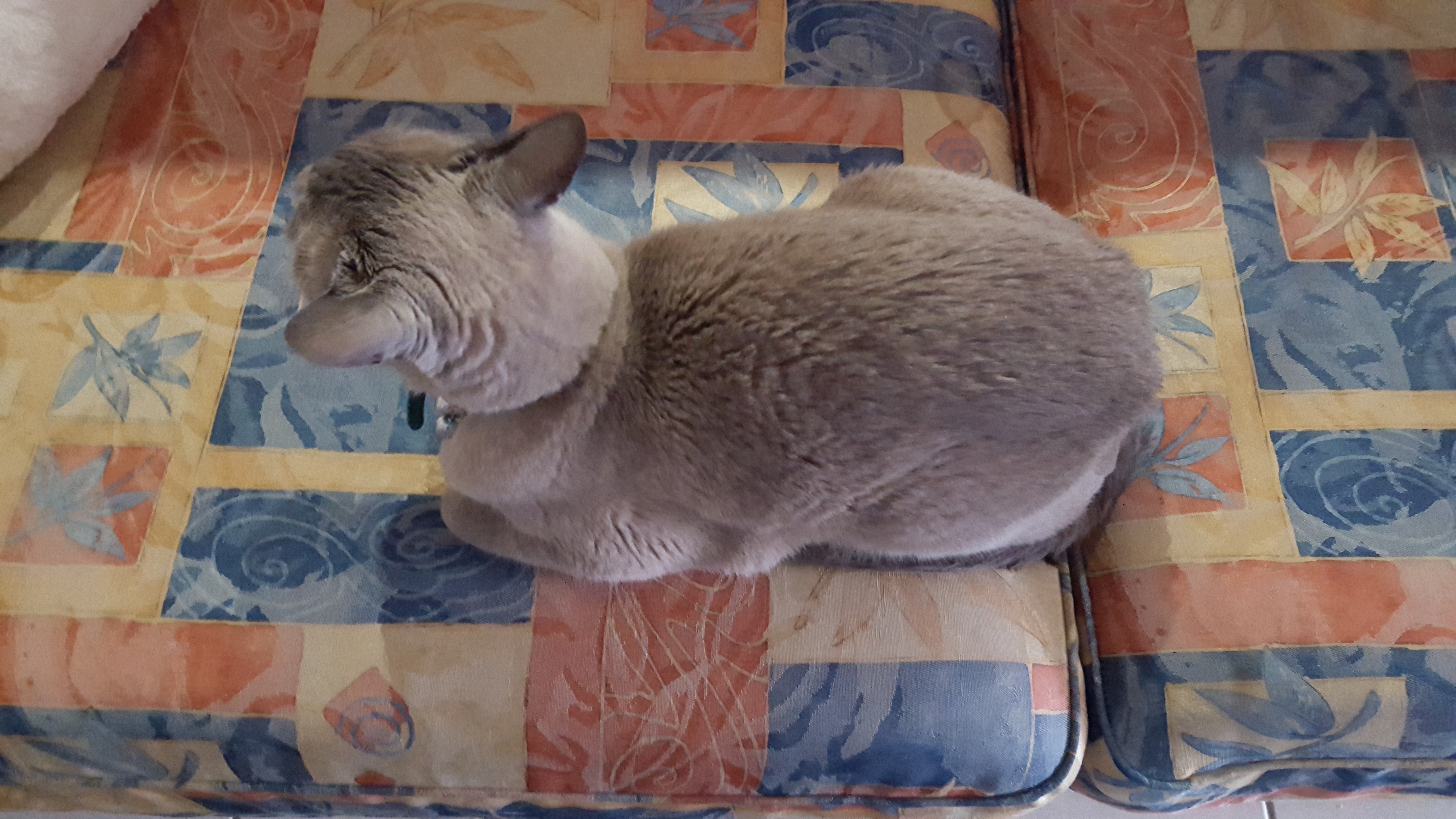
This is Chester.  He has broken the agreement we had when we first bought the settee.

No cats are allowed to sit on it.

Pleading will not cut it.  He is in serious trouble.

20161008_135120

No.  You cannot plead your case with Rosemary.

20161008_135131

Yes.  Hang your head in shame.

And get off the settee now!

An excerpt from “Amnesia”, a work in progress

I remembered a bang.
I remembered the car slewing sideways.
I remember another bang, and then it was lights out.
When I opened my eyes again, I saw the sky.
Or I could be under water.
Everything was blurred.
I tried to focus but I couldn’t. My eyes were full of water.
What happened?
Why was I lying down?
Where was I?
I cast my mind back, trying to remember.
It was a blank.
What, when, who, why and where, questions I should easily be able to answer. Questions any normal person could answer.
I tried to move. Bad, bad mistake.
I did not realise the scream I heard was my own. Just before my body shut down.

“My God! What happened?”
I could hear, not see. I was moving, lying down, looking up.
I was blind. Everything was black.
“Car accident, hit a tree, sent the passenger flying through the windscreen. Pity to poor bastard didn’t get the message that seat belts save lives.”
Was I that poor bastard?
“Report?” A new voice, male, authoritative.
“Multiple lacerations, broken collar bone, broken arm in three places, both legs broken below the knees, one badly. We are not sure of internal injuries, but ruptured spleen, cracked ribs and pierced right lung are fairly evident, x-rays will confirm that and anything else.”
“What isn’t broken?”
“His neck.”
“Then I would have to say we are looking at the luckiest man on the planet.”
I heard shuffling of pages.
“OR1 ready?”
“Yes. On standby since we were first advised.”
“Good. Let’s see if we can weave some magic.”

Magic.
It was the first word that popped into my head when I surfaced from the bottom of the lake. That first breath, after holding it for so long, was sublime, and, in reality, agonising.

Magic, because it seemed like I’d spent a long time under water.
Or somewhere.
I tried to speak, but couldn’t. The words were just in my head.
Was it night or was it day?
Was it hot, or was it cold?
Where was I?
Around me it felt cool.
It was very quiet. No noise except for the hissing of air through an air-conditioning vent. Or perhaps that was the sound of pure silence. And with it the revelation that silence was not silent. It was noisy.
I didn’t try to move.
Instinctively, somehow I knew not to.
A previous bad experience?
I heard what sounded like a door opening, and very quiet footsteps slowly come into the room. They stopped. I could hear breathing, slightly laboured, a sound I’d heard before.
My grandfather.
He had smoked all his life, until he was diagnosed with lung cancer. But for years before that he had emphysema. The person in the room was on their way, down the same path. I could smell the smoke.
I wanted to tell whoever it was the hazards of smoking.
I couldn’t.
I heard a metallic clanging sound from the end of the bed. A moment later the clicking of a pen, then writing.
“You are in a hospital.” A female voice suddenly said. “You’ve been in a very bad accident. You cannot talk, or move, all you can do, for the moment, is listen to me. I am a nurse. You have been here for 45 days, and just come out of a medically induced coma. There is nothing to be afraid of.”
She had a very soothing voice.
I felt her fingers stroke the back of my hand.
“Everything is fine.”
Define fine, I thought. I wanted to ask her what ‘fine’ meant.
“Just count backwards from 10.”
Why?
I didn’t reach seven.

Over the next ten days, that voice became my lifeline to sanity. Every morning I longed to hear it, if only for the few moments she was in the room, those few waking moments when I believed she, and someone else who never spoke, were doing tests. I knew it had to be someone else because I could smell the essence of lavender. My grandmother had worn a similar scent.
It rose above the disinfectant.
I also believed she was another doctor, not the one who had been there the day I arrived. Not the one who had used some ‘magic’ and kept me alive.
It was then, in those moments before she put me under again, that I thought, what if I was paralysed? It would explain a lot. A chill went through me.

The next morning she was back.
“My name is Winifred. We don’t know what your name is, not yet. In a few days, you will be better, and you will be able to ask us questions. You were in an accident, and you were very badly injured, but I can assure you there will be no lasting damage.”
More tests, and then, when I expected the lights to go out, they didn’t. Not for a few minutes more. Perhaps this was how I would be integrated back into the world. A little bit at a time.
The next morning, she came later than usual, and I’d been awake for a few minutes. “You have bandages over your eyes and face. You had bad lacerations to your face, and glass in your eyes. We will know more when the bandages come off in a few days. Your face will take longer to heal. It was necessary to do some plastic surgery.”
Lacerations, glass in my eyes, car accident, plastic surgery. By logical deduction, I knew I was the poor bastard thrown through the windscreen. It was a fleeting memory from the day I was admitted.
How could that happen?
That was the first of many startling revelations. The second was the fact I could not remember the crash. Equally shocking, in that same moment was the fact I could not remember before the crash either, and only vague memories after.
But the most shattering of all these revelations was the one where I realised I could not remember my name.
I tried to calm down, sensing a rising panic.
I was just disoriented, I told myself. After 45 days in an induced coma, it had messed with my mind, and it was only a temporary lapse. Yes, that’s what it was, a temporary lapse. I would remember tomorrow. Or the next day.
Sleep was a blessed relief.

The next day I didn’t wake feeling nauseous. Perhaps they’d lowered the pain medication. I’d heard that morphine could have that effect. Then, how could I know that, but not who I am?
I knew now Winifred the nurse was preparing me for something very bad. She was upbeat, and soothing, giving me a new piece of information each morning. This morning, “You do not need to be afraid. Everything is going to be fine. The doctor tells me you are going to recover with very little scarring. You will need some physiotherapy to recover from your physical injuries, but that’s in the future. We need to let you mend a little bit more before then.”
So, I was not going to be able to leap out of bed, and walk out of the hospital any time soon. I don’t suppose I’d ever leapt out of bed, except as a young boy. I suspect I’d sustained a few broken bones. I guess learning to walk again was the least of my problems.
But, there was something else. I picked it up in the timbre of her voice, a hesitation, or reluctance. It sent another chill through me.
This time I was left awake for an hour before she returned.
This time sleep was restless.
There were scenes playing in my mind, nothing I recognised, and nothing lasting longer than a glimpse. Me. Others, people I didn’t know. Or perhaps I knew them and couldn’t remember them.
Until they disappeared, slowly like the glowing dot in the centre of the computer screen, before finally fading to black.

The morning the bandages were to come off she came in bright and early and woken me. I had another restless night, the images becoming clearer, but nothing recognisable.
“This morning the doctor will be removing the bandages over your eyes. Don’t expect an immediate effect. Your sight may come back quickly or it may come back slowly, but we believe it will come back.”
I wanted to believe I was not expecting anything, but I was. It was probably human nature. I did not want to be blind as well as paralysed. I had to have at least one reason to live.
I dozed again until I felt a gentle hand on my shoulder. I could smell the lavender, the other doctor was back. And I knew the hand on my shoulder was Winifred’s. She told me not to be frightened.
I was amazed to realise in that moment, I wasn’t.
I heard the scissors cutting the bandages.
I felt the bandage being removed, and the pressure coming off my eyes. I could feel the pads covering both eyes.
Then a moment where nothing happened.
Then the pads being gently lift and removed.
Nothing.
I blinked my eyes, once, twice. Nothing.
“Just hold on a moment,” Winifred said. A few seconds later I could feel a cool towel wiping my face, and then gently wiping my eyes. Perhaps there was ointment, or something else in them.
Then a flash. Well, not a flash, but like when a light is turned on and off. A moment later, it was brighter, not the inky blackness of before, but a shade of grey.
She wiped my eyes again.
I blinked a few more times, and then the light returned, and it was like looking through water, at distorted and blurry objects in the distance.
I blinked again, and she wiped my eyes again.
Blurry objects took shape. A face looking down on me, an elderly lady with a kindly face, surely Winifred, who was smiling. And on the opposite side of the bed, the doctor, a Chinese woman of indescribable beauty.
I nodded.
“You can see?”
I nodded again.
“Clearly?”
I nodded.
“Very good. We will just draw the curtains now. We don’t want to overdo it. Tomorrow we will be taking off the bandages on your face. Then, it will be the next milestone. Talking.”
I couldn’t wait.

When morning came, I found myself afraid. Winifred had mentioned scarring, there were bandages on my face. I knew, but wasn’t quite sure how I knew, I wasn’t the handsomest of men before the accident, so this might be an improvement.
I was not sure why I didn’t think it would be the case.
They came at mid morning, the nurse, Winifred, and the doctor, the exquisite Chinese. Perhaps she was the distraction, taking my mind of the reality of what I was about to see.
Another doctor came into the room, before the bandages were removed, and he was introduced as the plastic surgeon that had ‘repaired’ the ravages of the accident. It had been no easy job, but, with a degree of egotism, he did say he was one of the best in the world.
I found it hard to believe, if he was, that he would be at a small country hospital.
“Now just remember, what you might see now is not how you will look in a few months time.”
Warning enough.
The Chinese doctor started removing the bandages. She did it slowly, and made sure it did not hurt. My skin was very tender, and I suspect still bruised, either from the accident or the surgery, I didn’t know.
Then it was done.
The plastic surgeon gave his work a thorough examination and seemed pleased with his work. “Coming along nicely,” he said to the other doctor. He issued some instructions on how to manage the skin, nodded to me, and I thanked him before he left.
I noticed Winifred had a mirror in her hand, and was somewhat reticent in using it. “As I said,” she said noticing me looking at the mirror, “what you see now will not be the final result. The doctor said it was going to heal with very little scarring. You have been very fortunate he was available. Are you ready?”
I nodded.
She showed me.
I tried not to be reviled at the red and purple mess that used to be my face. At a guess I would have to say he had to put it all back together again, but, not knowing what I looked like before, I had no benchmark. All I had was a snippet of memory that told me I was not the tall, dark, and handsome type.
And I still could not talk. There was a reason, he had worked on that area too. Just breathing hurt. I think I would save up anything I had to say for another day. I could not even smile. Or frown. Or grimace.
“We’ll leave you for a while. Everyone needs a little time to get used to the change. I suspect you are not sure if there has been an improvement on last year’s model. Well, time will tell.”
A new face?
I could not remember the old one.
My memory still hadn’t returned.

A photograph from the inspirational bin – 30

This is a rotunda at Newfarm Park in Brisbane, Queensland, Australia.

We were here a week or so ago to attend an open wedding in the park, in fact, under one of the majestic Moreton Bay Fig trees which is shaped much like an umbrella.

Weddings are conducted in the rotunda only if it is wet.

So, my first inclination is to write a story about a wedding that doesn’t quite go to plan, which I venture to say would be quite a few.

The one I attended had a few hiccups along the way, the odd bout of nerves, and a little tension from the lack of planning, or a practice.

But, in the end, all is well

Our story though will be slightly different. I have always wanted to attend a wedding where:

-The bride or groom or both didn’t turn up

-The celebrant got lost

-Someone had an objection when asked I’d someone had any reason why the wedding shouldn’t take place and the reason

-A fight breaks out between the bride and groom’s families, though that’s usually at the reception after when more alcohol has been consumed and feelings are running high.

-The bride or groom, at the last second, says ‘I don’t’.

But if it’s not a wedding, I’d use it as a meeting place for two old lovers who had made a pact seventy years before, no matter what happened, and if they were still alive, they’d meet there.

How much water would there have been under that bridge?

And conversely, two new acquaintances, in a stolen moment, decide to run away together and meet at the rotunda before leaving … only one of the siblings told their parents.

The wrong time!

The story behind the story: A Case of Working With the Jones Brothers

To write a private detective serial has always been one of the items at the top of my to-do list, though trying to write novels and a serial, as well as a blog, and maintain a social media presence, well, you get the idea.

But I made it happen, from a bunch of episodes I wrote a long, long time ago, used these to start it, and then continue on, then as now, never having much of an idea where it was going to end up, or how long it would take to tell the story.

That, I think is the joy of ad hoc writing, even you, as the author, have as much idea of where it’s going as the reader does.

It’s basically been in the mill since 1990, and although I finished it last year, it looks like the beginning to end will have taken exactly 30 years.  Had you asked me 30 years ago if I’d ever get it finished, the answer would be maybe?

My private detective, Harry Walthenson

I’d like to say he’s from that great literary mold of Sam Spade, or Mickey Spillane, or Phillip Marlow, but he’s not.

But, I’ve watched Humphrey Bogart play Sam Spade with much interest, and modeled Harry and his office on it.  Similarly, I’ve watched Robert Micham play Phillip Marlow with great panache, if not detachment, and added a bit of him to the mix.

Other characters come into play, and all of them, no matter what period they’re from, always seem larger than life.  I’m not above stealing a little of Mary Astor, Peter Lorre or Sidney Greenstreet, to breathe life into beguiling women and dangerous men alike.

Then there’s the title, like

The Case of the Unintentional Mummy – this has so many meanings in so many contexts, though I image back in Hollywood in the ’30s and ’40s, this would be excellent fodder for Abbott and Costello

The Case of the Three-Legged Dog – Yes, I suspect there may be a few real-life dogs with three legs, but this plot would involve something more sinister.  And if made out of plaster, yes, they’re always something else inside.

But for mine, to begin with, it was “The Case of the …”, because I had no idea what the case was going to be about, well, I did, but not specifically.

Then I liked the idea of calling it “The Case of the Brother’s Revenge” because I began to have a notion there was a brother no one knew about, but that’s stuff for other stories, not mine, so then went the way of the others.

Now it’s called ‘A Case of Working With the Jones Brothers’, finished the first three drafts, and at the editor for the last.

I have high hopes of publishing it in early 2021.  It even has a cover.

PIWalthJones1

“Trouble in Store” – Short stories my way: Adding a catalyst

Just when there’s enough complication in the story, we could leave it there with the current three protagonists and see what happens.

But I like mayhem.

So rather than another customer, it’s time to add a complication; an off duty policeman, or more to the point, policewoman.  A beat cop, if they still exist.

Her back story in a sentence or so:

It had been another long day at the office for Officer Margaret O’Donnell, or, out in the streets, coping with people who either didn’t know or didn’t care about the law.

People who couldn’t cross the road where there were crossings and lights to protect them, silly girls shoplifting on a dare, and boys who thought they were men and could walk on water.

The one they scraped of the road would never get to grow up, and his mother, well, she was not doing another call on a family to give them the bad news.

That was her day.  So far.

What is she doing near the shop?  She lives around the corner.  Perhaps she knows the reputation of the shopkeeper or perhaps not.  It’s not relevant, then, as it is a place she avoids.

Now, she may not have the option.  She sees the shop is still open, past the usual closing time.

Let’s continue:

She came around the corner into the street where she lived and saw the lights were on in the corner store.

She looked at her watch and saw it was ten minutes to midnight.  Long past closing time.  She looked through the window but from the other side of the road and could only see three heads and little else.

Damn, she thought, I’m going to have to check it out.  There were rumors, and she hoped they were not true.

Meanwhile, back in the shop how are the others faring?

The shopkeeper is in an invidious position, he can’t supply the kids with the drugs and get them out, not in front of the customer.

The fact the girl has a gun makes the situation almost impossible.  What would happen if he suggests the customer leave?  Without him, the situation would be simpler.

Alphonse had only a few moments to sum up the situation, and the sum of those deliberations was the remove the only problem, the customer.

He could still salvage this:

The shopkeeper changed his expression to one more placatory, and said quietly to the girl, ‘Look, this is not this chap’s problem.’  He nodded in the direction of the customer.  ‘I’m sure he’d rather not be here, and you would glad of one less distraction.’

He could see she was wavering, she was not holding the gun so steadily, and the longer this dragged on, the more nervous and unpredictable she would become.

And in the longer game, the customer would sing his praises no matter what happened after he left.

The girl looked at Jack.  The shopkeeper was right.  If he wasn’t here this could be over.  But there was another problem.  It didn’t look like Simmo was in any shape to get away.  In fact, this was looking more like a suicide mission.

She waved the gun in his direction.  ‘Get out now, before I change my mind.’

As the gun turned to the shopkeeper, Jack wasn’t going to wait to be asked twice and started sidling towards the door.

What happens next?


And the story for this section, with a few minor changes:


It had been another long day at the office for Officer Margaret O’Donnell, or, out in the streets, coping with people who either didn’t know or didn’t care about the law.

People who couldn’t cross the road where there were crossings and lights to protect them, silly girls shoplifting on a dare, and boys who thought they were men and could walk on water.

The one they scraped of the road would never get to grow up, and his mother, well, she was not doing another call on a family to give them the bad news.

That was her day.  So far.  For now, she was glad to be getting home, putting her feet up, and forgetting about everything until the next morning when it would start all over again.

Coming around that last corner, the home stretch she called it, she was directly opposite the corner shop, usually closed at this hour of the night.  It was not.  The lights were still on.

She looked at her watch and saw it was ten minutes to midnight, and long past closing time.  She looked through the window but from the other side of the road and could only see three heads and little else.

Damn, she thought, I’m going to have to check it out.  There were rumors, and she hoped they were not true.


The shopkeeper changed his expression to one more placatory, and said quietly to the girl, ‘Look, this is not this chap’s problem.’  He nodded in the direction of the customer.  ‘I’m sure he’d rather not be here, and you would glad of one less distraction.’

He could see she was wavering, she was not holding the gun so steadily, and the longer this dragged on, the more nervous and unpredictable she would become.

And in the longer game, the customer would sing his praises no matter what happened after he left.

The girl looked at Jack.  The shopkeeper was right.  If he wasn’t here this could be over.  But there was another problem.  It didn’t look like Simmo was in any shape to get away.  In fact, this was looking more like a suicide mission.

She waved the gun in his direction.  ‘Get out now, before I change my mind.’

As the gun turned to the shopkeeper, Jack wasn’t going to wait to be asked twice and started sidling towards the door.


Next:  Actions have consequences


© Charles Heath 2016-2020

“One Last Look”, nothing is what it seems

A single event can have enormous consequences.

A single event driven by fate, after Ben told his wife Charlotte he would be late home one night, he left early, and by chance discovers his wife having dinner in their favourite restaurant with another man.

A single event where it could be said Ben was in the wrong place at the wrong time.

Who was this man? Why was she having dinner with him?

A simple truth to explain the single event was all Ben required. Instead, Charlotte told him a lie.

A single event that forces Ben to question everything he thought he knew about his wife, and the people who are around her.

After a near-death experience and forced retirement into a world he is unfamiliar with, Ben finds himself once again drawn back into that life of lies, violence, and intrigue.

From London to a small village in Tuscany, little by little Ben discovers who the woman he married is, and the real reason why fate had brought them together.

It is available on Amazon here:  http://amzn.to/2CqUBcz

In a word: Blue

Of course, we all know this word is a colour, or colour depending on where you live.  You know, blue sky, deep blue sea, blonde hair blue eyes.  Very descriptive.

But it can also mean you are down in the dumps, a rather strange, for some, an expression that means you are sad or unhappy.

For others to have a blue means to have a fight with someone

And oddly, and I know this from first-hand experience, a red-haired person will be called bluey, or less pleasing either carrot top or blood nut.  I used to ignore those people who used those expressions, except for my father-in-law.

You can do something until you are blue in the face, which means do it without result until exhaustion, another way of saying you’re wasting your time.

And if something comes out of the blue, it usually means it’s entirely unexpected.  For me, that’s always a bill I wasn’t expecting, for someone else an inheritance.

And in some parts of the world, blue is used as a synonym for a conservative political party, for insistence, the Liberal party in Australia, and the Democrats in the United States

Blue should not be confused with the word blew, which is the past tense of the blow, which is wind causing an air current or blowing air through pursed lips.

That doesn’t mean that if something blew up it was just a giant air mass exploding because it can’t.  If a bomb blew up it means it detonated.

And if that sounds complicated:

What if something blew my mind?  Does that mean my head exploded?  No, it just means it’s incomprehensible, whether good or bad.

Or

What if I blew a fortune on a three-legged horse?  We all throw good money after bad, but you can quickly lose a fortune, or blew it.

It’s the same thing with opportunities, for instance, he had a chance and blew it.  Yes, obviously something better came along, not, or he just ignored a sterling opportunity.

In a word: Anonymous

Which is how I feel sometimes.

It can be a paradox in that an ordinary man may strive to be recognised, that is, to rise above his inherent anonymity simply because he feels he has something more to offer mankind than just making up the numbers.

But sadly, that desire will often be met with staunch resistance, not because there’s an active campaign against him, it’s just the way of the world.

The fact is, most of us will always be anonymous to the rest of the world, but in being so in that respect it’s that anonymity we can live with.  However, it’s far more significant if we become anonymous to those around us.  And, sadly, it can happen.

It’s when we take someone for granted.

At the other end of the scale, there is the celebrity, who has finally found fame, discovers that fame is not all it’s cracked up to be.  You find that meteoric rise from obscurity an adrenaline rush, and you’re no longer anonymous.

But all that changes when you are constantly bailed up in the street by well-meaning but annoying fans when you are being chased by the paparazzi and magazine reporters who thrive not on the fact that you are famous but watching and waiting for you to stumble.

Some often forget that there’s always a camera on them, or there’s a reporter lurking in the shadows, looking for the next scoop, capturing that awkward inexplicable moment when the celebrity is seen with someone who’s not their spouse, or worse, if it could be that, they get drunk and make a fool of themselves.

Do I really want to lose that anonymity that I have?

Not really.  It seems to me like it might be the lesser of two evils.

Searching for locations: Venice, Italy (Again)

We have visited Venice twice, in 2006 and not so long ago.

Not much had changed from visit to visit.

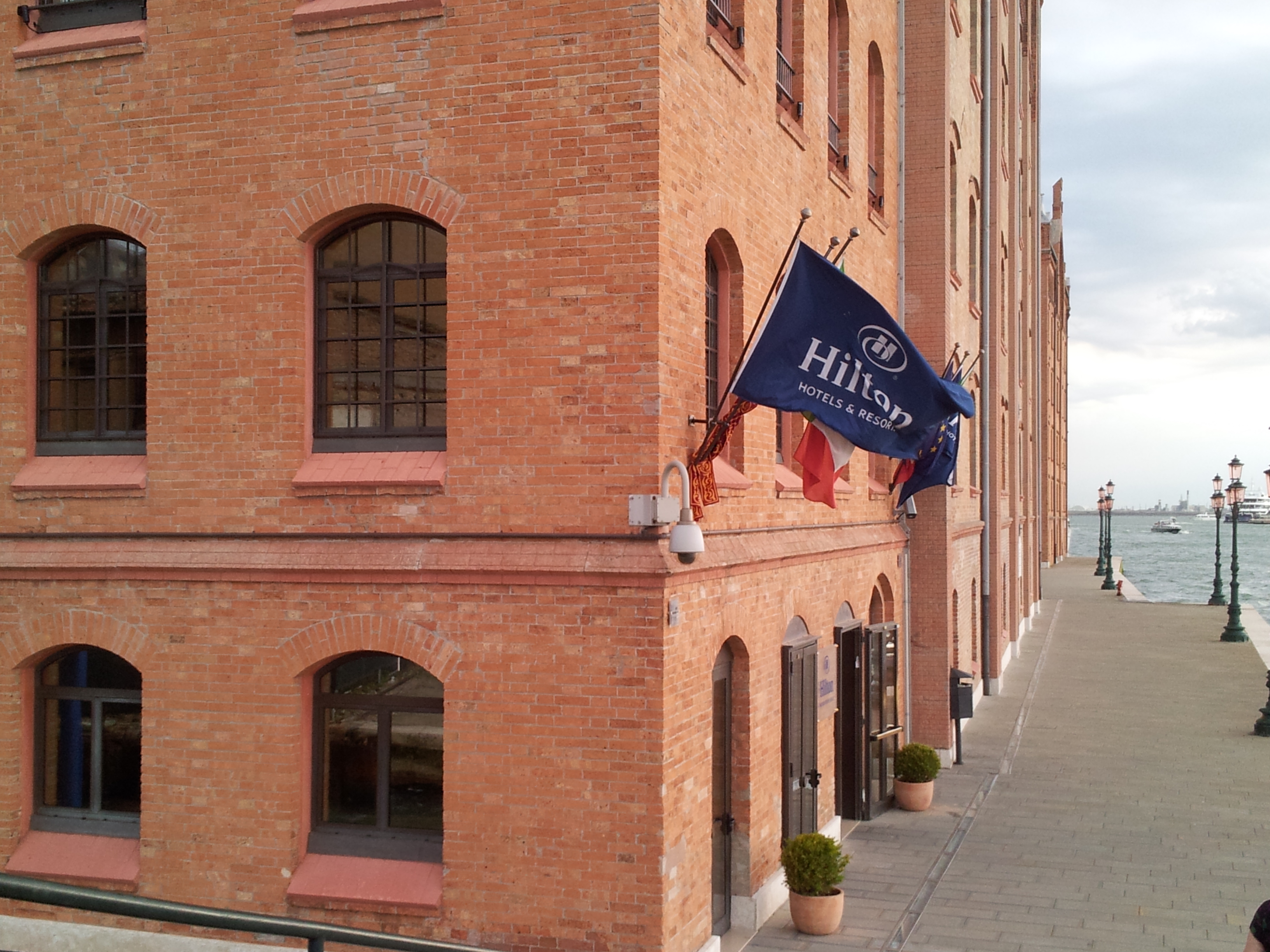
Instead of staying in a hotel selected by a travel agent, the Savoia and Jolanda on the waterfront of Riva Degli Schiavoni, because I’m a Hilton Honors member, more recently we stayed at the Hilton Molino Stucky.  It was located on an island, Giudecca, and had its own transport from the hotel to St Mark’s Square for a very reasonable one-off charge for the stay.

hiltonmolinostuckey2

On our first visit, we traveled from Florence to Venice.  We were advised to take a water taxi to the hotel, not only the most direct route but to see some of Venice from the water.  The only drawback, you have to negotiate a price with the driver.

We were not very good negotiators, and it cost 60 Euros.

But, despite the cost, it was worth every Euro because the taxi driver took us by the scenic route, directly from the Station to the doorstep of our hotel.  For a first time in Venice, and you want to see it from the water, a water taxi is the best option.

2013-06-25 17.09.16

The first time we stayed at the Savoia and Jolanda Hotel, which was at the time quite old, and the room we had, on the ground floor, was comfortable enough, but being November, they had just stopped using the air conditioning, it was still quite warm and at times uncomfortable.

There were better rooms, but this was beyond the knowledge of the travel agent, and one of the reasons we stopped using agents to book hotels.

The most recent visit we had driven down from Salzburg to Venice airport where we had to return the hire car.  From there we were intending to take a private water taxi from the airport to the hotel, for an estimated 120 Euros.

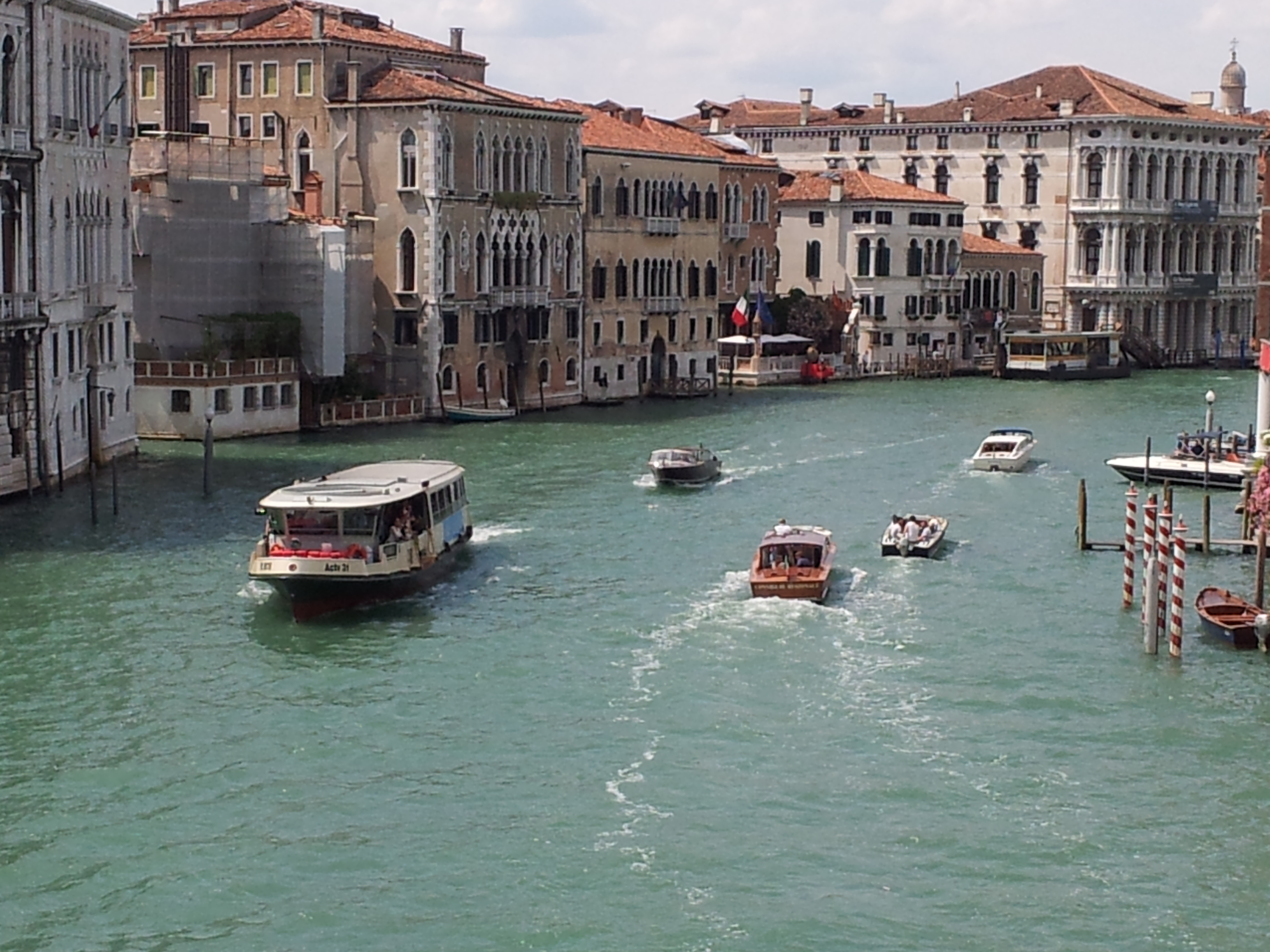
We saved our money and took the ACTV public waterbus, from the airport to the hotel, with one stop.  It took a little over an hour and was equally as scenic.

venicecanals1

Our room in the Hilton was on one of the upper levels, floor four, and had a view of the canal, the large passenger ships coming and going, as well as a remarkable view of Venice itself as far up the canal to St Marks Square in one direction, and the port for the passenger ships in the other.

20130627_081601

We got to see three or four very large passenger ships come and go, along with a lot of other craft.  I hadn’t realized how busy the waterways, and the Grand Canal, were.

20130627_174408

Each evening after a day’s exploring we would end up in the Executive Lounge, and then one of the many restaurants, usually Il Molino for breakfast, and the Rialto Lobby Bar and Lounge for dinner.  After that, it was a stroll down the waterfront taking in the night air, and perhaps to walk off the delicious dinner.

The cinema of my dreams – I always wanted to write a war story – Episode 35

For a story that was conceived during those long boring hours flying in a steel cocoon, striving to keep away the thoughts that the plane and everyone in it could just simply disappear as planes have in the past, it has come a long way.

Whilst I have always had a fascination with what happened during the second world war, not the battles or fighting, but in the more obscure events that took place, I decided to pen my own little sidebar to what was a long and bitter war.

And, so, it continues…


Leonardo was a happy man.

It was quite a by coincidence that they had run into Chiara, and it hadn’t taken long to break her.  He had thought of taking her to the castle to let Jackerby extract the information, but he was tired of them telling him what to do.

He would get the information, and then act, taking the ringleaders of the remnants of the resistance back to the castle, and expect to get that well-earned pat on the back for a job well done.

He’d said he would take care of the rabble, and he had.

Until Wallace had asked him where Atherton was.

And there was that small problem of Carlo, too, though he was not going to mention that in his report to Jackerby.

Francesco had softened the three leaders of the resistance up before taking them to the castle, taking particular pleasure in attending to Martina himself.  The three could barely walk and were almost dragged up to the castle.

The first question Jackerby asked was why he had beaten them when he’d expressly been told to bring them to the castle alive and in a fit state to be questioned.  None of the three was in any sort of state to do anything other than collapse.

Jackerby’s men took them to the dungeons.

The second question Jackerby asked was where Atherton was.

“That was basically the whole point of the exercise,” he yelled at Leonardo, who, by this time was getting annoyed himself.

“He’s still out there, and you can be assured he will be causing us trouble.  Those three you dragged back, whilst a nuisance, hardly compare to what Atherton can do.”

“There’s only one of him.  There’s no way he’s going to be able to break into this castle, by himself, and do anything.”

Jackerby shook his head.  It would not matter what he said, Leonardo was just a fool, a petty little thug who quite rightly had been ostracised by the rest of the village.  And when this exercise was over and Mayer was recaptured, he was going to take extreme pleasure in killing Leonardo and his followers.

“Go get something to eat, rest, then get back out there.  I want Atherton found.  Surely there is nowhere left where he can hide.”

There was a dozen, or more, places, Leonardo thought but he wasn’t going to tell Jackerby that.  Instead, he had made up his mind to do as Jackerby asked, rest, then take a few hours the check all the entrances and exits to the castle before going back out to find Atherton.

Or at least that was what he was going to tell Jackerby.

In reality, he had had enough of these interlopers, and it was time he removed them from the castle.  It was time he took over.  The war was not going to end any time soon according to his sources further north, and there were worse places than a castle to hole up in until the war ended.  Especially considering how much wine was being stored in the cellars.


Wallace was in the dining room and had been in the middle of lunch when Leonardo came back.  Rather than talk to him, he sent Jackerby to deal with it.

Johannsen was sitting at the other end of the table, contemplating the wine.  It was not a good idea to be drinking wine in the middle of the day when trouble could arrive from any number of quarters.

In fact, he was surprised that the other resistance hadn’t made an all-out attack on them.  It seemed unlikely to him that those that hadn’t followed Leonardo up the hill, were of little consequence.

If anything, and of his experience of the resistance in France, one resistance fighters was worth 10 or more enemy soldiers.  They had a reason to fight, for their country, and liberation for the Nazis.

Of course, Leonardo and his men were oblivious to the fact that they were working for the Germans, not the British, but to them, he thought, anyone other than an Italian was worth working for if they were prepared to pay.

Leonardo and his men were mercenaries.  Guns for hire.  They didn’t care who they worked for.  But there was something else.  Leonardo hated the villagers, and it wasn’t difficult to convince him they needed to be kept in line and report any newcomers to the castle.

Adding the reward was a bonus.

“Atherton’s not going to come and present himself at the front door, you know that,” he said to Wallace.

Then he decided to have some wine.  It’s not as if the war would be arriving any time soon.

“You know him best.  A fighter, an organizer, or office boy.”

“Paper pusher, by all accounts.  I’m not sure why Thompson would send him other than he was desperately out of good agents.  You saw how much resistance he put up.”

“Jackerby seems to think there’s more to him.”

“Jackerby sees shadows where there are none.  Where did you say he came from?”

“North Africa.”

“Then he’s had too much sun.”

“A little advice then.  I wouldn’t say that to his face.”

© Charles Heath 2020