‘What Sets Us Apart’ – A beta readers view

There’s something to be said for a story that starts like a James Bond movie, throwing you straight in the deep end, a perfect way of getting to know the main character, David, or is that Alistair?

A retired spy, well not so much a spy as a retired errand boy, David’s rather wry description of his talents, and a woman that most men would give their left arm for, not exactly the ideal couple, but there is a spark in a meeting that may or may not have been a set up.

But as the story progressed, the question I kept asking myself was why he’d bother.

And, page after unrelenting page, you find out.

Susan is exactly the sort of woman the pique his interest. Then, inexplicably, she disappears. That might have been the end to it, but Prendergast, that shadowy enigma, David’s ex boss who loves playing games with real people, gives him an ultimatum, find her or come back to work.

Nothing like an offer that’s a double edged sword!

A dragon for a mother, a sister he didn’t know about, Susan’s BFF who is not what she seems or a friend indeed, and Susan’s father who, up till David meets her, couldn’t be less interested, his nemesis proves to be the impossible dream, and he’s always just that one step behind.

When the rollercoaster finally came to a halt, and I could start breathing again, it was an ending that was completely unexpected.

I’ve been told there’s a sequel in the works.

Bring it on!

The book can be purchased here: http://amzn.to/2Eryfth

In a word: Vision

I had one myself once, whether it was a peek into my future, or whether it was just playing out a scene for one of my stories, it was rather intense.

That variation of the word vision is one that uses one’s imagination. I do it quite a lot, and I call it the cinema of my dreams.

But…

Vision, in the simplest sense of the word, is sight, what you see.

People can try to make it better, like movie studios, who have called it rather interesting titles such as VistaVision or Panavision, either of which sounds quite remarkable, and it may have been back in the day, but it’s probably quite ordinary these days.

A vision, in another sense, might be something like a dream as mentioned before, which might happen when we are asleep, but if awake, it might be because we are very bored with our job and we’re imagining what it would be like at Santorini or the Bahamas, or anywhere but where you are now.

It might also describe our particular slant on what else we would like to happen, whether at work or somewhere else, but it’s usually confined to our closest circle of friends. Bosses never invite nor want to hear plebs ideas of improving their lot.

Hence, I have a vision…

But no one will listen. Perhaps if I was Martin Luther King, things might be different.

Then, at the end of it all…

There are visions and then there are visions, like seeing something that no one else can see, whether driven by hallucinogenic drugs or magic mushrooms, or you just happened to be there to see what no one else could.

Dragons, lizard people, or the Virgin Mary.

And no, I have not seen any of the above.

Yet.

In a word: Incline

When you first think of this word, it is with a slippery slope in mind.

I’ve been on a few of those in my time.

And while we’re on the subject, those inclines measured in degrees are very important if you want a train to get up and down the side of a mountain.

For the train, that’s an incline plane, the point where traction alone won’t get the iron horse up the hill.

Did I say ‘Iron Horse’?  Sorry, regressed there, back to the mid-1800s in the American West for a moment.

It’s not that important when it comes to trucks and cars, and less so if you like four-wheel driving; getting up near-vertical mountainsides often present a welcome challenge to the true enthusiast

But for the rest of us, not so much if you find yourself sliding in reverse uncontrollably into the bay.  I’m sure it’s happened more than once.

Then…

Are you inclined to go?

A very different sort of incline, ie to be disposed towards an attitude or desire.

An inclination, maybe, not to go four-wheel driving?

There is another, probably more obscure use of the word incline, and that relates to an elevated geological formation.  Not the sort of reference that crops up in everyday conversation at the coffee shop.

But, you never know.  Try it next time you have coffee and see what happens.

Searching for locations: An old country homestead, Canungra, Australia

Or to be more precise, the homestead at what is now O’Reilly’s vineyard, where there is a pleasant lawn out back running down to the river for picnics, an alpaca farm next door, and the homestead plays host to functions, and wine tastings.

My interest was that we had assumed there was a restaraunt, and we were going to have lunch. There might be one, but not the day we visited, it was just cafe food or a picnic available.

I was more interested in the old homestead, because it was a fine example of the homesteads built in the ‘outback’.

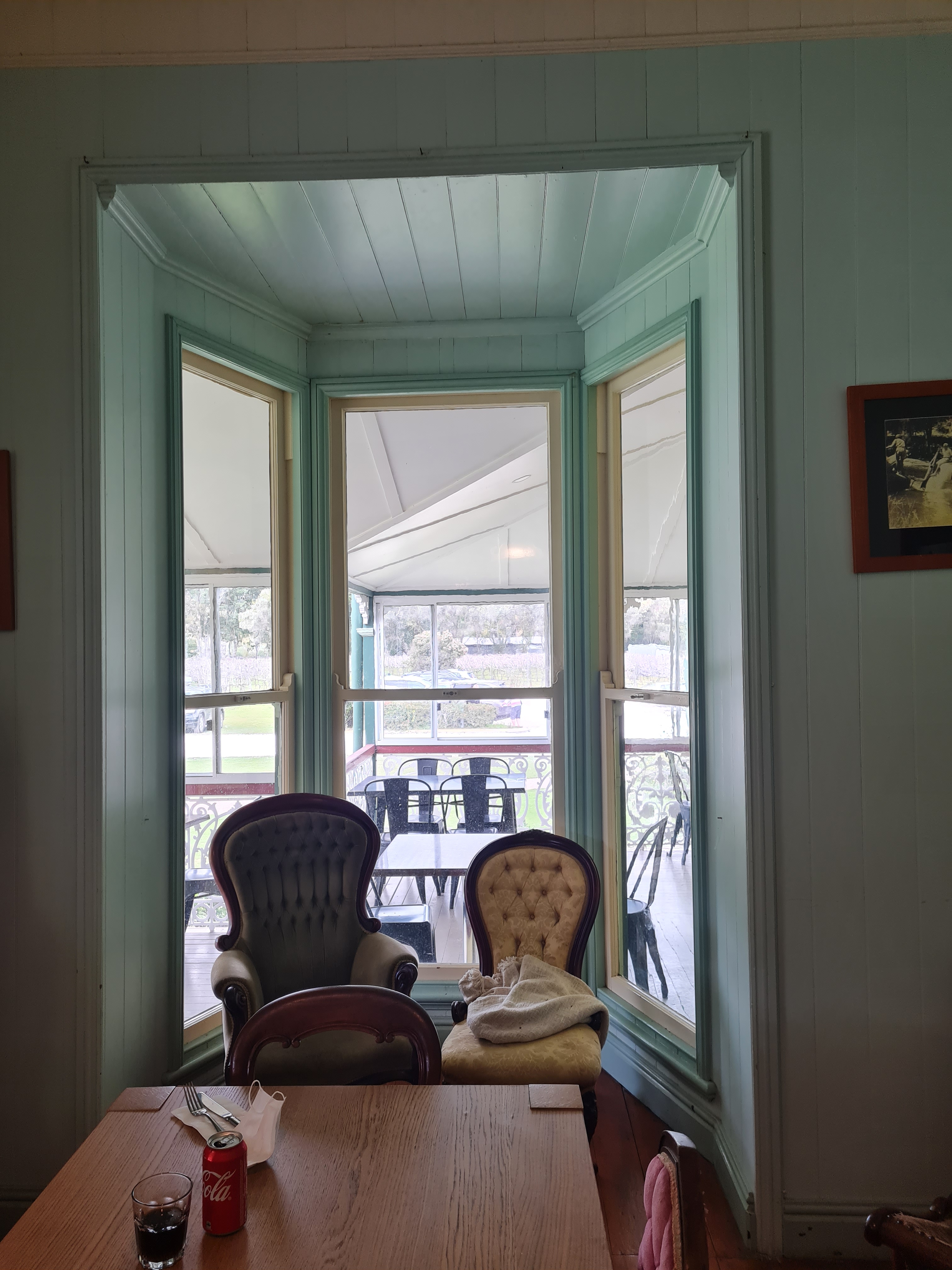
Today we are having lunch in the Platypus room, in the O’Reilly’s vineyard farmhouse, which, if you close your eyes and let your imagination run free, could see it as the master bedroom of a homestead.

Certainly the building is old, made completely of timber, inside and out, with the traditional high ceilings to keep the heat at bay.

At one end, a large bay window, which would be ideal to sir and view the outside, past the sweeping verandah.  There is a small lawn and a rotunda, but beyond that what might have been extended gardens, is the vineyard.

The homestead is in an ideal position midway between the main road and the river, has the traditional surrounding verandah, and shows signs of being extended on almost all sides.

On the other side of the wide corridor that leads you to the bar, and, coincidentally, down the centre of the house, is a smaller bedroom, also used as a dining room, and ubiquitously named the library.

It may be small but it does have a fireplace.  Which the assumed master bedroom does not, but now I’m thinking that room might have been the morning room.

Behind the room we’re in is another bedroom, or perhaps this might be the master, because it does have a fireplace and is quite large.  And a name, the Ambassador room.  Now it serves as the pick up place for picnic baskets.

There is another room on the opposite side of the corridor called the Drawing Room, but is not open to the public.  But, going into the room with the fireplace adjacent to it, you can sell the aroma of pizzas, so it’s probably an extension of the kitchen, and, walking around the outside that side of the house proves it to be case.

After all, they do catering for weddings and need a very large food preparation area which I discovered runs down the whole of that side of the house.

At the end of the corridor I’d the bar and spare space, and running off that and behind that is where there is a large dining area, perhaps prior to COVID, the restaurant.

It’s not hard to imagine that area as a very large entertaining area, either for very large dinner parties, or dancing.

As for the food, it’s either a picnic basket, or pizzas.  We chose the latter, not realising the bases were not home made, but bought in.  

The toppings however were both plentiful and tasty.  It could have been hotter, because it was a cold day, and it was cold in the room.

As for something to do other than taste the wine, and buy a few bottles, you can get up close to the vines, which, at this time of the year gave been pruned back and look quite dead, look at or walk an alpaca, even feed it, or all of them, or go down to the river and see if you can spot a Platypus.

Perhaps next time we’ll have a picnic down by the river.

Searching for locations: An old country homestead, Canungra, Australia

Or to be more precise, the homestead at what is now O’Reilly’s vineyard, where there is a pleasant lawn out back running down to the river for picnics, an alpaca farm next door, and the homestead plays host to functions, and wine tastings.

My interest was that we had assumed there was a restaraunt, and we were going to have lunch. There might be one, but not the day we visited, it was just cafe food or a picnic available.

I was more interested in the old homestead, because it was a fine example of the homesteads built in the ‘outback’.

Today we are having lunch in the Platypus room, in the O’Reilly’s vineyard farmhouse, which, if you close your eyes and let your imagination run free, could see it as the master bedroom of a homestead.

Certainly the building is old, made completely of timber, inside and out, with the traditional high ceilings to keep the heat at bay.

At one end, a large bay window, which would be ideal to sir and view the outside, past the sweeping verandah.  There is a small lawn and a rotunda, but beyond that what might have been extended gardens, is the vineyard.

The homestead is in an ideal position midway between the main road and the river, has the traditional surrounding verandah, and shows signs of being extended on almost all sides.

On the other side of the wide corridor that leads you to the bar, and, coincidentally, down the centre of the house, is a smaller bedroom, also used as a dining room, and ubiquitously named the library.

It may be small but it does have a fireplace.  Which the assumed master bedroom does not, but now I’m thinking that room might have been the morning room.

Behind the room we’re in is another bedroom, or perhaps this might be the master, because it does have a fireplace and is quite large.  And a name, the Ambassador room.  Now it serves as the pick up place for picnic baskets.

There is another room on the opposite side of the corridor called the Drawing Room, but is not open to the public.  But, going into the room with the fireplace adjacent to it, you can sell the aroma of pizzas, so it’s probably an extension of the kitchen, and, walking around the outside that side of the house proves it to be case.

After all, they do catering for weddings and need a very large food preparation area which I discovered runs down the whole of that side of the house.

At the end of the corridor I’d the bar and spare space, and running off that and behind that is where there is a large dining area, perhaps prior to COVID, the restaurant.

It’s not hard to imagine that area as a very large entertaining area, either for very large dinner parties, or dancing.

As for the food, it’s either a picnic basket, or pizzas.  We chose the latter, not realising the bases were not home made, but bought in.  

The toppings however were both plentiful and tasty.  It could have been hotter, because it was a cold day, and it was cold in the room.

As for something to do other than taste the wine, and buy a few bottles, you can get up close to the vines, which, at this time of the year gave been pruned back and look quite dead, look at or walk an alpaca, even feed it, or all of them, or go down to the river and see if you can spot a Platypus.

Perhaps next time we’ll have a picnic down by the river.

The cinema of my dreams – I always wanted to write a war story – Episode 39

For a story that was conceived during those long boring hours flying in a steel cocoon, striving to keep away the thoughts that the plane and everyone in it could just simply disappear as planes have in the past, it has come a long way.

Whilst I have always had a fascination with what happened during the second world war, not the battles or fighting, but in the more obscure events that took place, I decided to pen my own little sidebar to what was a long and bitter war.

And, so, it continues…

Leonardo was a fool, not that any of those who followed him would say that to his face, but all of them knew it and accepted that he made the best leader.

The reason for that, they all knew if anything went wrong, then the leader would be the first to be held accountable.

They all also knew that what Leonardo had done to Martina and Chiara, and the cold-blooded murder of the villagers, justifying it by saying they were collaborators, was also wrong, and had refused to take part in it.

Leonardo just thought they didn’t have the stomach to do what was necessary, failing to realize he was committing a crime, war or not.

Alberto, arguably the next man to take over the resistance group if anything happened to Leonardo, was nominally second in command and was there because he had the respect of the men, far more than their current leader.

He was the one who suspected there was something wrong at the castle, that the British soldiers there were not quite doing what they said they were there for.  He had seen, even directed, Germans seeking sanctuary in England in exchange for information, come, but not go.  Not like they did in the beginning.

And that man called Atherton, the one who arrived just before the paratroopers, he was British, and they had captured him.  The talk was that he was a German collaborator, but Alberto wasn’t convinced.

But, not having the full allegiance of all the resistance fighters, he could not say anything or try to organize the men to be more careful in their approach to those at the castle.  Leonardo still held sway with them. 

For now.

.

The Italians had their own section of the cells in the dungeons where they stayed, Leonardo, deeming it not safe in the village.  Alberto agreed because he had made several forays down there, only to discover that Leonardo would be shot on sight if he showed his face there again.  Some resistance they made, he thought, where they didn’t have the confidence of their own people.

Leonardo was up supping with the devil, as Alberto had been known to say, put of Leonardo’s earshot, and several of the men were resting.  The others, more loyal to Leonardo were in the cellar cell drinking their way through the wine stock and were most likely drunk and passed out.

Alberto didn’t care for the vintage, a subject that he was well versed in because before the war he had worked for the family of winemakers.  The wines stored, he had recognized when they’d first discovered them, as being of inferior quality, and had been left there rather than throwing it away.  Leonardo would not have known the difference.

“Something is not right.”  A voice from the corner, belonging to a man named Bolini, broke his reverie.  The truth was, he was tired and wished it were all done with.

“What makes you say that?” He asked.

“Killing the villagers.  What did they do wrong, other than just trying to survive?  It’s what we’re all trying to do.  It’s not our war.”

“You know what it’s like, stuck in the middle.  It’s a bit like the in-laws.  You don’t want them, but you’re stuck with them.”

“In-laws.  Don’t get me started.”  The other, a man named Christo, weighed in.  

“You do realize we may be held accountable for what happened back at the village,” Bolini had obviously been thinking about the repercussions.

“We brought the only witnesses here, and they sure as hell aren’t going to last long.  Not after what Leonardo did to them.”

“That’s possible, but we all know what happened.”

“But there are others outside who also know what happened, and if we want to keep out of trouble, we are going to have to take care of them,” Bolini said.

Alberto hadn’t quite got through considering the ramifications of what Fernando just did, and the fact they’d helped him.  Bolini was right, even if they hadn’t been as reckless, they were still going to be tarred with the same brush.

And Atherton was still out there.

The trouble with trying to clean up a mess is that eventually there’s a bigger mess to deal with.  Maybe it was time to get rid of Fernando.

The man called Wallace, the one who seemed to be in charge, came around the corner and stopped when he saw Alberto.

“Where’s your leader?”

Alberto pointed his head in the direction of the wine cellar.

Wallace shook his head, knowing what that meant.  “Tell him he’s got another pickup.  Two hours in the village.  A family, with two children.  Tell him to sober up, and if he doesn’t in time, you have my permission to shoot him.”

Surely the man wasn’t serious.

“Well, what are you sitting around for?  Get moving.”

Wallace cast a disapproving glance over the three, shook his head again, and left.

© Charles Heath 2020-2021

Knowledge can be dangerous… – A short story

It was, perhaps, the saddest week of my life.

It started with a phone call, then a visit by two police officers.  It was about my parents, but the news could not be imparted over the phone, only in person.  That statement alone told me it was very bad news, so I assumed the worst.

The two police officers, standing at the front door, grim expressions on their faces, completed the picture.  The news, my parents were dead, killed in a freak car accident.

At first, it didn’t sink in.  They were on their way back from another of their extensive holidays, one of many since my father had retired.  I’d seen them probably six months out of the last five years, and the only reason they were returning this time was that my mother needed an operation.

They hadn’t told me why, not that they ever told me very much any time since the day I’d been born, but that was who they were.  I thought them eccentric, being older when I’d come along, and others thought them, well, eccentric.

And being an only child, they packed me off to boarding school, then university, and then found me a job in London, and set me up so that I would only see them weekends if they were home.

I had once wondered if they ever cared about me, keeping me at arm’s length, but my mother some time ago had taken me aside and explained why.  It was my father’s family tradition.  The only part I’d missed was a nanny.

It most likely explained why I didn’t feel their passing as much as I should.

A week later, after a strange funeral where a great many people I’d never met before, and oddly who knew about me, I found myself sitting in the sunroom, a glass of scotch in one hand, and an envelope with my name on it, in the other.

The solicitor, a man I’d never met before, had given it to me at the funeral.   We had, as far as I knew an elderly fellow, one of my father’s old school friends, as the family solicitor, but he hadn’t shown at the funeral and wasn’t at home when I called in on my way home.

It was all very odd.

I refilled the glass and took another look at the envelope.  It was not new, in fact, it had the yellow tinge of age, with discoloration where the flap was.  The writing was almost a scrawl, but identifiable as my father’s handwriting, perhaps an early version as it was now definitely an illegible scrawl.

I’d compared it with the note he’d left me before they had embarked on their last adventure, everything I had to do while caretaking their house.  The last paragraph was the most interesting, instructing me to be present when the cleaning lady came, he’d all but accused her of stealing the candlesticks.

To be honest, I hadn’t realized there were candlesticks to steal, but there they were, on the mantlepiece over the fire in the dining room.  The whole house was almost like being in an adventure park, stairs going up to an array of rooms, mostly no longer used, and staircase to the attic, and then another going down to the cellar.  The attic was locked and had been for as long as I could remember, and the cellar was dank and draughty.

Much like the whole house, but not surprising, it was over 200 years old.

And perhaps it was now mine.  The solicitor, a man by the name of Sir Percival Algernon Bridgewater, had intimated that it might be the last will and testament and had asked me to tell him if it was.  I was surprised that Sir Percival didn’t have the document in question.

And equally. so that the man I knew as his solicitor, Lawerence Wellingham, didn’t have a copy of my father’s last will and testament either.

I finished the drink, picked up the envelope, and opened it.

It contained two sheets of paper, the will, and a letter.  A very short letter.

“If you are reading this I have died before my time.  You will need to find Albert Stritching, and ask him to help you find the murderer.”

Even the tenor of that letter didn’t faze me as it should have, because at this point nothing would surprise me.  In fact, as I  unfolded the document that proclaimed it was the will, I was ready for it to say that whole of his estate and belongings were to be left to some charity, and I would get an annual stipend of a thousand pounds.

In fact, it didn’t.  The whole of his estate was left to my mother should she outlive him, or in the event of her prior decease, to me.

I had to put all of those surprises on hold to answer a knock on the door.

Lawerence Wellingham.

I stood too e side, let him pass, closed the door, and followed him into the front room, the one my mother called the ‘drawing room’ though I never knew why.

He sat in one of the large, comfortable lounge chairs.  I sat in the other.

I showed him the will.  I kept the other back, not knowing what to make of it.

“No surprise there,” Wellingham said.

“Did you have any idea what my father used to do, beyond being, as he put it, a freelance diplomat?”

I thought it a rather odd description but it was better than one he once proffered, ‘I do odd jobs for the government’.

“I didn’t ask.  Knowledge can be dangerous, particularly when associated with your father.  Most of us preferred not to know, but one thing I can tell you.  If anyone tries to tell you what happened to your parents was not an accident, ignore them.  Go live your life, and keep those memories you have of them in the past, and don’t look back.  They were good people, Ken, remember them as such.”

We reminisced for the next hour, making a dent in the scotch, one of my father’s favorite, and he left.

Alone again, the thoughts went back to the second note from my father.  That’s when the house phone rang.

Before I could answer it, a voice said, “My name is Stritching.  Your father might have mentioned me?  We need to talk.”

—-

© Charles Heath 2020-2021

The cinema of my dreams – I wonder what it was like in the wild west – Part 2

I guess I have seen too many westerns, film fodder my parents liked to watch on TV, and especially with John Wayne, and later on Clint Eastwood.

In this day and age there are only scant reminders of a time that may have bristled with excitement, or so dangerous you would be lucky to survive if you got on the wrong side of a gunslinger.

But, for argument’s sake, what if there was a way to actually step back in time?

So, here’s the start of a story…

There are hundreds of places in the midwest, where you could see miles of plains, hills, winding rivers, and sleepy towns. Places with old-fashioned motels and hotels, general stores, farmers’ supplies, and everything else in between.

These are the towns where the young, fresh out of school and full of ideas and enthusiasm get on the bus to go to the big cities, promising to return.

Some do, some don’t.

For others who live in the cities, driving through the midwest would be a welcome change from the clogged highways, freeways, turnpikes, and the 14 hour days. Where a person could wind back the hectic to the sedate, and perhaps for a while, to the mundane. It was a dream to cling to, something that just barely kept a man sane in an insane world. And a dream that was about to become a reality.

Jack was on the verge of burnout, having spent the last year doing 80 hour weeks, gunning for the manager’s role that he had been promised, if he put in the time. That he had, and then some.

But the man who made the promise died suddenly, and it all came to naught, passed over by the replacement boss who had his own selection for the role, younger, better educated, but utterly no experience.

It was the straw that broke the proverbial camel’s back.

The next day he resigned, spoke not one word to anyone after handing in his keycard and resignation letter, and left. Perhaps the only consolation, no one else knew the complex plant operation systems, and when it broke down, as it always did, there was no one who could fix it.

There was one more ceremonial job he had to do before getting in his car, and that was to toss his cell phone in the bin. That done, the drive home took 20 minutes instead of the usual two hours, he threw what he needed into an overnight bag, and after taking a 30-second look back in the place he had called home for 25 years, shrugged, and closed the door.

There would be no coming back.

Of course, there were moments where the resolve was tested, those tendrils of loyalty to a company he had worked at for a long time, and who had treated him reasonably well.

The first night, in a quaint motel, was the hardest. Alone with his thoughts, without anyone to talk to, not that there were many back home, the idea of striking out on his own seemed drastic, even silly.

The second night, spent at a surprisingly rural town, he had supper in a diner that had few customers and a waitress his own age who was a talker. She recommended a guest house, one she stayed at herself, a runaway like he was, but for more desperate reasons, and liking the company stayed for a week.

It was difficult to move on, but he did.

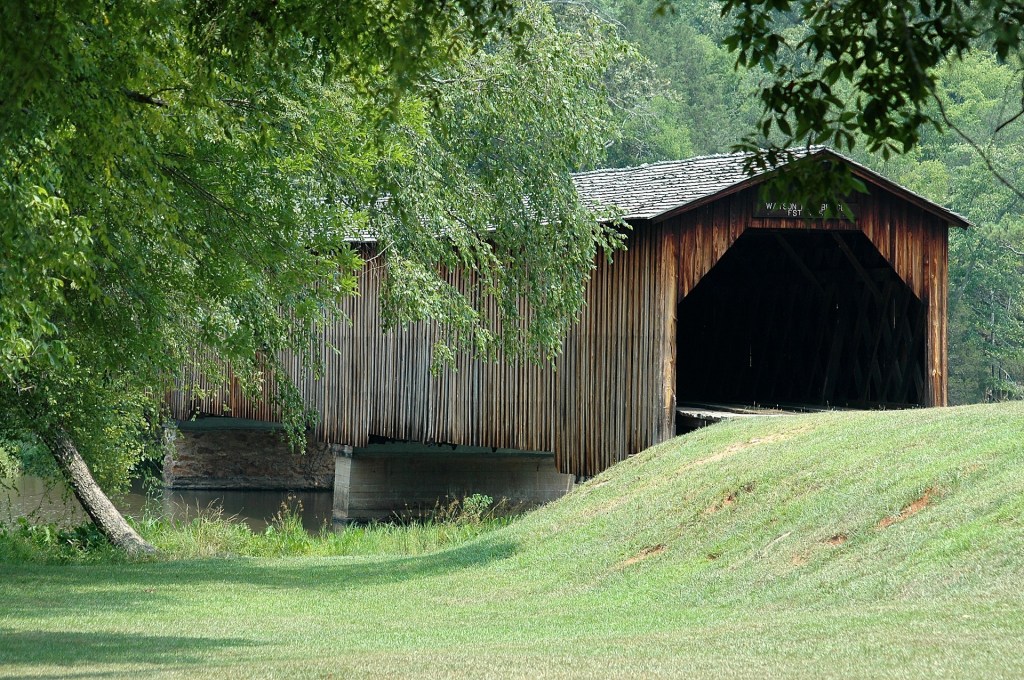
Which was why, five days later, in another small town by a river, he had reached the bridge.

The road went in two directions. West or north. North crossed the river, and the minor roads wound their way through hills and dales to Canada. West headed towards San Francisco, and he had no desire to visit another large city. Not for a while.

Over the bridge it was.

After a night in another interesting motel that had a small room that passed as a museum, and related the history of the area, a story in itself.

….

© Charles Heath 2022

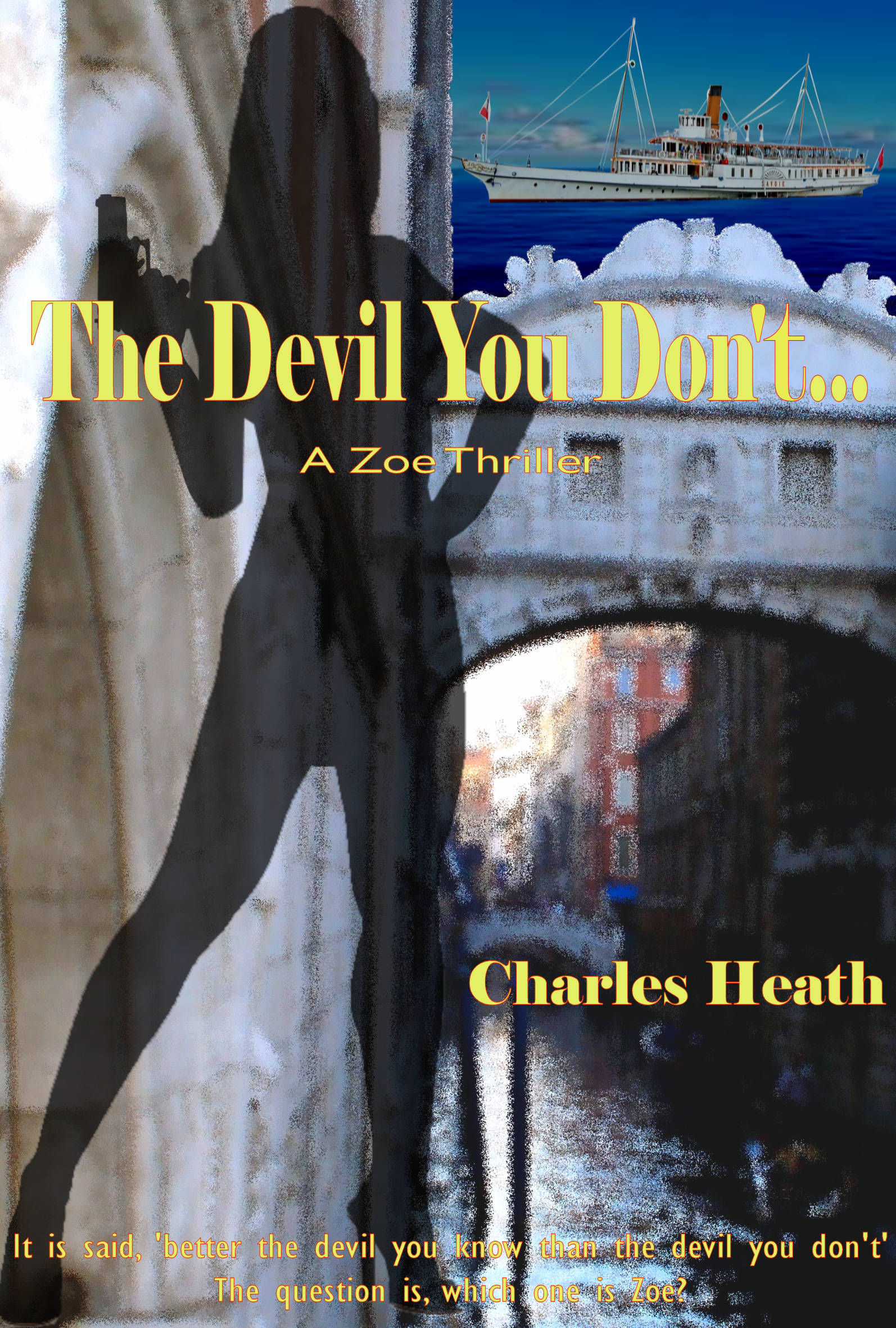
“The Devil You Don’t” – A beta readers view

It could be said that of all the women one could meet, whether contrived or by sheer luck, what are the odds it would turn out to be the woman who was being paid a very large sum to kill you.

John Pennington is a man who may be lucky in business, but not so lucky in love. He has just broken up with Phillipa Sternhaven, the woman he thought was the one, but relatives and circumstances, and perhaps because she was a ‘princess’, may also have contributed to the end result.

So, what do you do when you are heartbroken?

That is a story that slowly unfolds, from the first meeting with his nemesis on Lake Geneva, all the way to a hotel room in Sorrento, where he learns the shattering truth.

What should have been a high turns out to be something else entirely, and from that point every thing goes to hell in a handbasket.

He suddenly realises his so-called friend Sebastian has not exactly told him the truth about a small job he asked him to do, the woman he is falling in love with is not quite who she says she is, and he is caught in the middle of a war between two men who consider people becoming collateral damage as part of their business.

The story paints the characters cleverly displaying all their flaws and weaknesses. The locations add to the story at times taking me back down memory lane, especially to Venice where in those back streets I confess it’s not all that hard to get lost.

All in all a thoroughly entertaining story with, for once, a satisfying end.

Available on Amazon here: https://amzn.to/2Xyh1ow

Memories of the conversations with my cat – 14

As some may be aware, but many not, Chester, my faithful writing assistant, mice catcher, and general pain in the neck, passed away about 2 years ago, and I still miss him.

This is my way of remembering him.

For those who have not had the chance to read about all of his exploits, I will run the series again from Episode 1

20161008_135142

This is Chester, the literary critic

It’s important to get that first sentence right, so I’m rattling off a few lines to get his reaction

‘It was a day like no other’

‘Yes, I know’, says the all knowledgeable Chester looking down his nose at me, ‘it’s been used before’.

We are sitting in the writing room and as usual, Chester is trying to ignore me.

I’m trying to start a new novel, looking for that first line that’s going to hook the reader.

I read him a few lines.

He gives me a disdainful look, ‘Heard it all before old boy, try again’.

Once Upon a time?

‘You’ve been watching too much TV’.

It was a dark and stormy night.

He yawns widely, ‘As if you haven’t used that before’.

He’s right, damn him.

Why am I talking to this cat anyway?

He jumps up onto the desk and sits on the keyboard.

Ok, writing is over for the day.