In a word: Brevity

Now, brevity is something that I have not been able to fully wrap my head around.

The dictionary explains Brevity as

‘concise and exact use of words in writing and speech’

So…

I remember working with a writer a long time ago who explained certain authors styles, and for James A Michener of Hawaii fame, he said Michener wrote sentences instead of words, paragraphs instead of sentences, pages instead of paragraphs and chapters instead of pages.

It was a little harsh considering I’d just read the book and had liked it, despite its length and the time it took.

But some time later I realized he was not criticizing Michener, but trying to tell me, in his, what I came to discover, interesting way, that I should strive to write more compactly.

I then came across a book by Brian Callison which was exactly that, the concise version, a story that fitted into about 200 pages.

That too was a good book and it took me a day to read it, and by his use of that economy of words, it read quickly.

Of course, I have tried over the years to emulate both styles, and to a certain degree, failing, because I think I have created my own style which is somewhere in between.

Still, when editing, it is always in the back of my mind that I should be

Using words instead of sentences

Using sentences instead of paragraphs

Using paragraphs instead of pages, and

Using pages instead of chapters.

The chapters, he said, with an air of amusement, will always take care of themselves.


In a word: Sheet

Well, we all know what a sheet is, it’s one of those things you put on a bed.  A bottom sheet, a fitted sheet, a top sheet, flannelette sheet.

It could also be a piece of paper, e.g. pass me a sheet of paper please, only to get in reply, what size?

There can be a sheet of flames, best if you see one get away as fast as you can.

Of course, that fire can be put out by rain sheeting down.

You can have a sheet map, that is one that opens out.  Funny how you can never get them folded back the same way.  And a problem when you’re in a car and open it out – hang on, I can’t see out the window!

That lake is a lovely sheet of water, very still just as the sun comes up, and then, what a reflection.  Great if you are a landscape painter.

Then there’s sheet metal, did that in school and wasn’t very good at it.

If you’re a philatelist, then there’s always a sheet of stamps, might be worth something in a hundred years’ time.

Then, if it is worth millions, you might turn white as a sheet with shock.

But the best of all, if you drink too much it is said you are ‘two sheets to the wind’.

When you’re given another chance, it is like being given a clean sheet.

And another form might be to do with sailing when you sheet a sail, which is to say you are making it either tauter or less taut.

English can be confusing sometimes, can’t it?

Searching for locations: The Mary Valley Rattler, Gympie, Queensland, Australia

I have a passion for visiting transport museums, to see old trains, planes, buses, cars, even ships if it’s possible.

This has led to taking a number of voyages on the TSS Earnslaw in Queenstown, New Zealand.

Many, many, many years ago on Puffing Billy, a steam train in the Dandenongs, Victoria, Australia.

The steam train in Kingston, New Zealand, before it was closed down, but hopefully it will reopen sometime in the future.

The London Transport Museum in London England, which had a lot of buses.

The Workshops Railway Museum in Ipswich, Queensland, where once the many steam engines were built and maintained, and now had only a handful of engines remaining.

However, in the quest for finding and experiencing old transportation methods, we came across the Mary Valley Rattler, which runs out of Gympie, Queensland, Australia.

The ride begins in Gympie at the old Gympie Railway station, and as can be seen below, is one of the relics of the past, and, nothing like the new more modern stations.  Thankfully.

If you’re going to have a vintage train, then you have to have a vintage station.

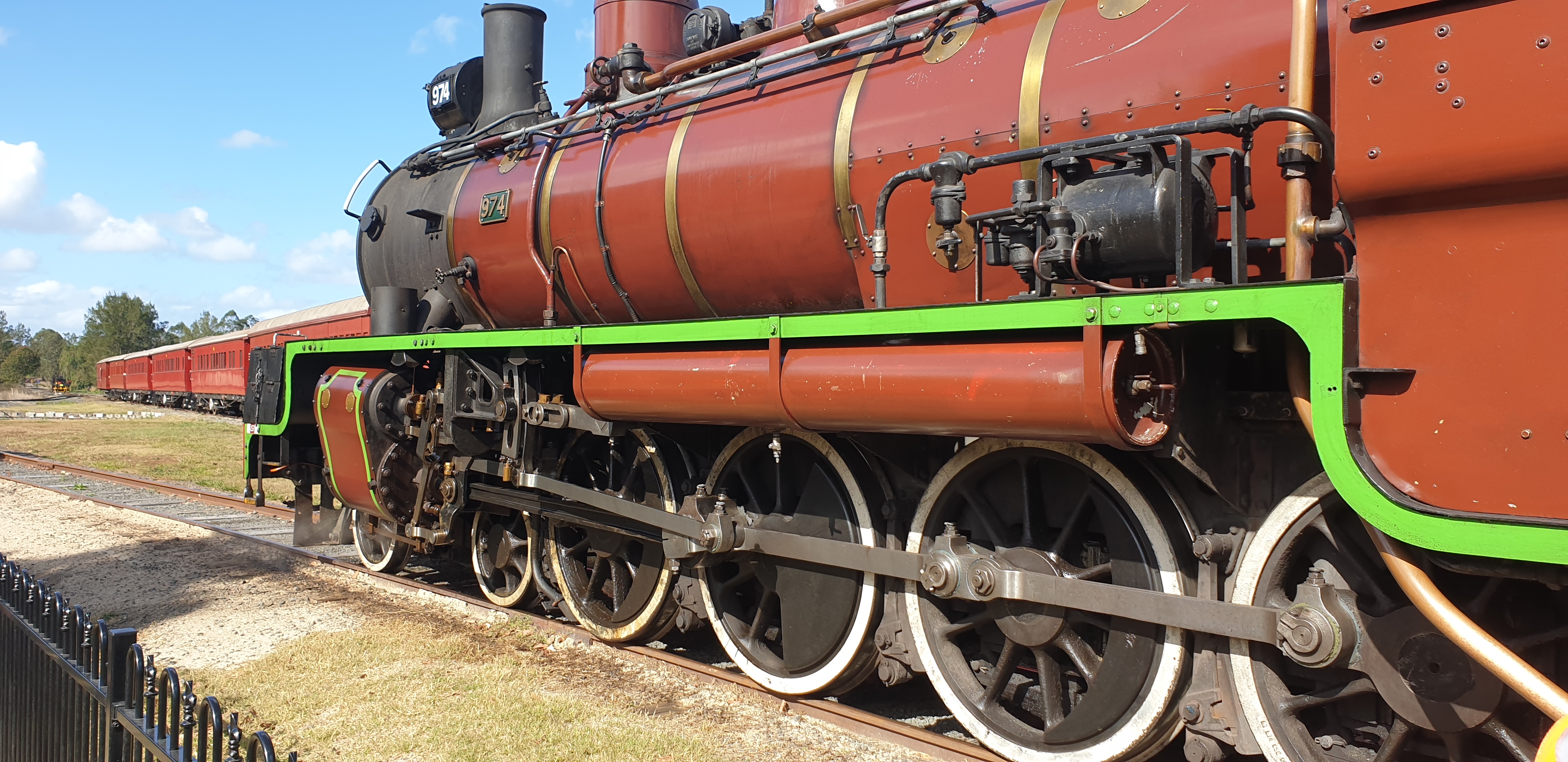
The Class of engine, seen below, is the C17, a superheated upgrade to the C16 it was based on, and first run in 1903.  This particular engine was built in 1951, although the first of its type was seen in  1920 and the last of 227 made in 1953.  It was the most popular of the steam engines used by Queensland Railways.

The C designation meant it had four driving axels and 17 was the diameter of the cylinder, 17 inches.  It is also known as a 4-8-0 steam locomotive
 and nicknamed one of the “Brown Bombers” because of its livery, brown with green and red trimming.

Also, this engine was built in Maryborough, not far from Gympie by Walkers Limited, one of 138.

This photo was taken as the train returned from Amamoor, a trip that takes up to an hour.

The locomotive is detached from the carriages, then driven to the huge turntable to turn around for the return journey to Amamoor.

This is the locomotive heading down to the water station, and then taking on water.  After that, it will switch lines, and reverse back to reconnect the carriages for the trip to Amamoor.

The carriages are completely restored and are extremely comfortable.  It brings back, for me, many memories of riding in older trains in Melbourne when I was a child.

The trains, then, were called Red Rattlers.

This is the locomotive climbing one of the hilly parts of the line before crossing over the Mary River on a trestle bridge.

This is the engine at Amamoor near the picnic area where young children and excited parents and grandparents can get on the locomotive itself and look inside where the driver sits.

And, no, I didn’t volunteer to shovel coal.

This particular locomotive spent most of its working life between Townsville and Mount Isa and was based in Cloncurry, Charters Towers, and Townsville, before being sent, at the end of its useful days in the late 1960s, to the Ipswich Railway Workshops.

The cinema of my dreams – I always wanted to write a war story – Episode 43

For a story that was conceived during those long boring hours flying in a steel cocoon, striving to keep away the thoughts that the plane and everyone in it could just simply disappear as planes have in the past, it has come a long way.

Whilst I have always had a fascination with what happened during the second world war, not the battles or fighting, but in the more obscure events that took place, I decided to pen my own little sidebar to what was a long and bitter war.

And, so, it continues…

——

Mayer fought the urge to panic, and then consider giving himself up.  He remembered what the Standartenfuhrer said, and knew that it was not an option.

He slid back into the forest, then far enough back, stood, and ran, the thick snow not only hampering his speed but also covering the sound of his flight. 

He stopped and listened for the sound of the following soldiers, but all he could hear was the sound of a locomotive and his breathing.  His heart was pounding, not used to such exercise or fear.

The soldiers must have stopped where the running person had fallen, and then on the verge of the tree line when the Standartenfuhrer had been shot.

He kneeled down and struggled to catch his breath.  He had the bad the Standartenfuhrer had thrust upon him as they got out of the car, and hoped it had a map, but it was too dark to look now.

From earlier, he remembered the other side of the railway tracks had trees too, and the road that led to the border, the village, if there was one, and the railway station.  There would also be a small shunting area, freight sheds, or something else to hide in, maybe even a signal tower.

Somewhere warm, and with some light, so he could plan his next move.  He was not sure what the Standartenfuhrer Had planned, but it certainly could not be by car the whole way, and they would not make the rendezvous by walking.

The plan had to include going by train.

Brenner pass was along the main track from Austria to the south of Italy, and from an earlier look at a map, the train would go through F, Verona, Bologna, to Florence where he would find the next guide.

Details of that guide hopefully were in the bag, a bag that he would have to hide or lose if he was captured because it would give away the escape route and resistance members who helped those fleeing Germany.

If he had the time or could think straight.  The cold was making that very difficult.  And there was the shock of losing the Standartenfuhrer.

It took five minutes to regain a certain amount of calm and be able to think. 

First, he had to get back to the tree line and see where he was, in proximity to the village, and the railway tracks.

That took about ten minutes carefully picking his way through the trees.  There was no path, it was dark, and he kept hitting low branches and getting covered in snow. There was enough down the back of his neck to make him very uncomfortable.

When he reached the tree line he looked back from where he had been, about a kilometer, and he could see the torches of the soldiers milling around where he and the Standartenfuhrer had been.  The train was still there, the locomotive’s light blazing in front, lighting a short distance of the track in front of it, almost blindingly bright. 

He was not sure why it was waiting on the track.

Looking the other way, there were two sets of tracks, a wide clear area, then another track with several flat cars and a guards van sitting in darkness, all of which were covered in snow.  They were not being used, so the van might provide some shelter.

He just had to get over there, about 100 meters distant.  The problem was there were lights, not very bright, at regular distances, but short enough that a man might present a shadowy outline if anyone was looking.

If he stayed low and run fast, it might just work.

A train whistle in the distance, coming from Italy caused him to shrink back into the cover of the trees.  Another train was coming.  It was oddly busy at a very late hour.

The locomotive also had a bright light that lit up the edge of the tree line, so he had to go further back to get away from it, and wait until the train passed.  It had a lot of flat cars with tanks and troop carriers on it, going back to Germany.  There were no soldiers so perhaps the equipment was needed elsewhere, maybe that final push to England he kept hearing about.

Once that train passed, the one that had been waiting finally restarted its journey south and slowly rumbled past him.  It was almost like a passenger train with no priority had had to wait until essential war trains passed.

When that train had gone, the surrounding area descended into a quiet, also silent field.  The snow had begun to fall heavier, which would be advantageous, and after several long looks in both directions, he ran, crossing the tracks, the empty space, and then to the guard van where he hid between it and the freight car until he caught his breath.

And see if anyone had seen him, expecting whistles and shouting coming from up the track.

Another look showed that only two torches remained back where there had been frenetic activity.  He hoped they considered they had caught the people they were looking for.

He went down the side of the guard’s van to the door, climbed the ladder, and tried the door.  It was unlocked.  There was no reason why it would be locked.

He went in and shut the door, and immediately it was warmer, and certainly dryer.  IT was impossibly dark inside, so he felt around in the bag and found a torch.  Someone had been clever enough to add a torch, some first aid equipment.  The papers included a map.

He checked the cabin for windows and found the shutters were closed, so he didn’t have to stifle the torches light.  A further check showed a bed at the end of the cabin, with a blanket, musty but dry.

There was a stove, a kettle with water, and a tin of tea leaves.  He wasn’t going to start a fire, so no tea.  There was no food, so the hunger would have to remain for a while longer.  The water tasted alright, but he could melt some snow if he needed more.

A place to stay, at least until daybreak when it would be wise to get into the forest on the roadside, and head towards the village, or perhaps wait for a train and see if he could hide on it for the trip south.

First, he needed some rest.

——-

© Charles Heath 2020-2022

Follow that cab… – A short story

Nothing ever good comes from eavesdropping.

Or, so my mother said, once, with such feeling that I suspect she had some experience of having done so. It might explain the enmity between her and her older sister, the aunt we never saw.

Except all that changed when I received an odd email from a woman who claimed to be that very aunt.

We had all been warned about scams that came from dubious sources online, and this initially struck me as one. I would need more information before I answered.

That meant poking the bear, that is, asking my mother about her sister.

And coming right out with the words she hoped she’d never heard.

“Aunt Guenivere sent me an email, asking if we could meet. It seems she wants to meet the nephew she hasn’t seen since I was born. What happened to you two?”

It brought a look of total hatred in return.

“You would be wise not to respond. That woman is just plain evil.”

“You do realize that a statement like that makes it even more imperative that I should meet her. If you’re not going to tell me what happened, I’m sure she will.”

“Then if you must, you must.”

It wasn’t resignation but suppressed rage. Whatever had happened, it was something she believed no one would believe her, or understand, least of all me.

With that, she stood, and walked out of the room, leaving me with the ominous feeling that it would be the last time I saw her.
After verifying that my so-called aunt was Aunt Guenivere, I arranged a meeting in a public place, a tea room in the next town to where I lived. And it wasn’t going to be hard to recognize her, she would just an older version of my mother.

I knew this because I had found a photograph of my mother and her two sisters, all of who looked very much alike. I’d know about the younger sister, she had died in an accidental car crash many years before, and what my mother regarded as a wasted life.

I saw her about the same time she saw me.

And she just made it to the table when her cell phone rang. She smiled, put a hand up and asked for a moment, and then went back outside. I watched her walk up and down, slowly at first, but I could see the conversation was getting heated.

After a few minutes, I went outside to see if I could be of any assistance.

Apparently not. One look was enough, and I knew what it meant. At least her sister and my mother shared the same facial expressions when angry.

Then the conversation ended. I thought, for a moment, she was going to throw the phone on the ground, and only just managed to stop herself.

Instead, she came over and said. “I’m sorry but something has come up and I have to go. I’ll call you.”

With that, she waved down a taxi, one stopped, and she jumped in.

Another pulled in behind her taxi and on the spur of the moment, and said with a flourish, “Follow that cab.”

The driver turned to look at me, and then said, “You’re kidding.”

I held up a hundred dollar note and said, seriously, “This is yours if you don’t lose them.”

Incentive enough.

It was a lot easier to follow that taxi than I thought. We caught up and the first set of lights and then proceeded to miss every second intersection as if the universe knew I needed to keep her in sight.

All the way to the upper west side and a very expensive apartment block. I paid the cabbie and jumped out, just in time to see a very familiar figure join my aunt.

My father.

And they didn’t look like people who didn’t know each other, or who were at war.

They remained outside the apartment block, and I could see my father had arrived by cab, and it was waiting for him.

I got as close as I could, hidden effectively behind the bushes that lined the building entrance. They were speaking loudly, which surprised me

“What the hell were you thinking,” he said, not angrily, but I could tell he was agitated.

“I was thinking it was time someone told him the truth.”

What truth?

“You know what Evelyn thinks of that, and I do too. You made an agreement.”

“I’ve changed my mind. After all, he is my son, not hers.”

—–

© Charles Heath 2020-2021

On the research trail…

Or as it might more commonly be known as, spending a few hours in a historical museum. which just happens to cover some of the material you need for a school project.

I brought up the subject of living history yesterday after we all packed off to have an hour ride on a steam train and accompanying equally aged carriages.

Since these trains have been missing for nearly fifty years, there is basically two generations of people who have never had the chance to travel in such a manner in their lifetime, unless, of course, they have found a tourist train like our example, the Mary Valley Rattler.

It’s the same as the early days of finding gold in Gympie, in Queensland, Australia.  It dates back to the 1860s, and one can only imagine what it was like because most of the history is in books.  Yes, they have sketches, and sometimes photographs, but these do not generally date back to the middle of the nineteenth century.

But, visiting a living example of what it was like in ‘the old days’ can give those generations a glimpse of what it was like.

Single room schools, because unlike today when schools now cater to over 1,000 children in varying years, one school held about 20 or 30 in all grades, with a single teacher.

In fact, today, I saw a collection of readers that I remember reading when I was in grade school, a long time ago.  Even the desks and the ink wells brought back interesting memories, one of which when I was ink monitor.

But housed in a number of old-style buildings was the information on the diggings, the mines and the impact of gold in general, and, at the very end, the children got to do a little panning for gold, and found a number of small fragments of real gold.

Once they’d been shown by a panning expert that looked as if he had been transported into this time from the past.

There are similar places elsewhere in this country that preserve the past to show future generations what it was like.

After this weekend, we have more than enough information to work on the project, based around gold mining, and it’s impact on the people, the area, and the government.

And best of all, it has generated an interest in the past, reading more, and perhaps if we’re lucky, an interest in writing something based on history, which sometimes is quite difficult when it has to compete with more interesting pastimes like computer games.

‘Sunday in New York’ – A beta reader’s view

I’m not a fan of romance novels but …

There was something about this one that resonated with me.

This is a novel about a world generally ruled by perception, and how people perceive what they see, what they are told, and what they want to believe.

I’ve been guilty of it myself as I’m sure we all have at one time or another.

For the main characters Harry and Alison there are other issues driving their relationship.

For Alison, it is a loss of self-worth through losing her job and from losing her mother and, in a sense, her sister.

For Harry, it is the fact he has a beautiful and desirable wife, and his belief she is the object of other men’s desires, and one in particular, his immediate superior.

Between observation, the less than honest motives of his friends, a lot of jumping to conclusions based on very little fact, and you have the basis of one very interesting story.

When it all comes to a head, Alison finds herself in a desperate situation, she realises only the truth will save their marriage.

But is it all the truth?

What would we do in similar circumstances?

Rarely does a book have me so enthralled that I could not put it down until I knew the result. They might be considered two people who should have known better, but as is often the case, they had to get past what they both thought was the truth.

And the moral of this story, if it could be said there is one, nothing is ever what it seems.

Available on Amazon here: amzn.to/2H7ALs8

Memories of the conversations with my cat – 19

As some may be aware, but many not, Chester, my faithful writing assistant, mice catcher, and general pain in the neck, passed away some months ago.

Recently I was running a series based on his adventures, under the title of Past Conversations with my cat.

For those who have not had the chance to read about all of his exploits I will run the series again from Episode 1

These are the memories of our time together…

20160917_075223

This is Chester, he thinks he is invisible.

No one has told him he’s not a zebra, and that he doesn’t have stripes the same color as the blinds.

I’ve told him over and over, just because he cannot see me, it doesn’t mean I can’t see him.

But, once again, we have to play the ‘game’.

I should be writing, but once again Chester has successfully distracted me.

If it was a cunning plan on his part, it worked.

An excerpt from “Betrayal” – a work in progress

It could have been anywhere in the world, she thought, but it wasn’t.  It was in a city where if anything were to go wrong…

She sighed and came away from the window and looked around the room.  It was quite large and expensively furnished.  It was one of several she had been visiting in the last three months.

Quite elegant too, as the hotel had its origins dating back to before the revolution in 1917.  At least, currently, there would not be a team of KGB agents somewhere in the basement monitoring everything that happened in the room.

There was no such thing as the KGB anymore, though there was an FSB, but such organisations were of no interest to her.

She was here to meet with Vladimir.

She smiled to herself when she thought of him, such an interesting man whose command of English was as good as her command of Russian, though she had not told him of that ability.

All her knew of her was that she was American, worked in the Embassy as a clerk, nothing important, who life both at work and at home was boring.  Not that she had blurted that out the first tie she met, or even the second.

That first time, at a function in the Embassy, was a chance meeting, a catching of his eye as he looked around the room, looking, as he had told her later, for someone who might not be as boring as the function itself.

It was a celebration, honouring one of the Embassy officials on his service in Moscow, and the fact he was returning home after 10 years.  She had been there one, and still hadn’t met all the staff.

They had talked, Vladimir knew a great deal about England, having been stationed there for a year or two, and had politely asked questions about where she lived, her family, and of course what her role was, all questions she fended off with an air of disinterested interest.

It fascinated him, as she knew it would, a sort of mental sparring as one would do with swords, if this was a fencing match.

They had said they might or might not meet again when the party was over, but she suspected there would be another opportunity.  She knew the signs of a man who was interested in her, and Vladimir was interested.

The second time came in the form of an invitation to an art gallery, and a viewing of the works of a prominent Russian artist, an invitation she politely declined.  After all, invitations issued to Embassy staff held all sorts of connotations, or so she was told by the Security officer when she told him.

Then, it went quiet for a month.  There was a party at the American embassy and along with several other staff members, she was invited.  She had not expected to meet Vladimir, but it was a pleasant surprise when she saw him, on the other side of the room, talking to several military men.

A pleasant afternoon ensued.

And it was no surprise that they kept running into each other at the various events on the diplomatic schedule.

By the fifth meeting, they were like old friends.  She had broached the subject of being involved in a plutonic relationship with him with the head of security at the embassy.  Normally for a member of her rank it would not be allowed, but in this instance it was.

She did not work in any sensitive areas, and, as the security officer had said, she might just happen upon something that might be useful.  In that regard, she was to keep her eyes and ears open, and file a report each time she met him.

After that discussion she got the impression her superiors considered Vladimir more than just a casual visitor on the diplomatic circuit.  She also formed the impression the he might consider her an ‘asset’, a word that had been used at the meeting with security and the ambassador.

It was where the word ‘spy’ popped into her head and sent a tingle down her spine.  She was not a spy, but the thought of it, well, it would be fascinating to see what happened.

A Russian friend.  That’s what she would call him.

And over time, that relationship blossomed, until, after a visit to the ballet, late and snowing, he invited her to his apartment not far from the ballet venue.  It was like treading on thin ice, but after champagne and an introduction to caviar, she felt like a giddy schoolgirl.

Even so, she had made him promise that he remain on his best behaviour.  It could have been very easy to fall under the spell of a perfect evening, but he promised, showed her to a separate bedroom, and after a brief kiss, their first, she did not see him until the next morning.

So, it began.

It was an interesting report she filed after that encounter, one where she had expected to be reprimanded.

She wasn’t.

It wasn’t until six weeks had passed when he asked her if she would like to take a trip to the country.  It would involve staying in a hotel, that they would have separate rooms.  When she reported the invitation, no objection was raised, only a caution; keep her wits about her.

Perhaps, she had thought, they were looking forward to a more extensive report.  After all, her reports on the places, and the people, and the conversations she overheard, were no doubt entertaining reading for some.

But this visit was where the nature of the relationship changed, and it was one that she did not immediately report.  She had realised at some point before the weekend away, that she had feelings for him, and it was not that he was pushing her in that direction or manipulating her in any way.

It was just one of those moments where, after a grand dinner, a lot of champagne, and delightful company, things happen.  Standing at the door to her room, a lingering kiss, not intentional on her part, and it just happened.

And for not one moment did she believe she had been compromised, but for some reason she had not reported that subtle change in the relationship to the powers that be, and so far, no one had any inkling.

She took off her coat and placed it carefully of the back of one of the ornate chairs in the room.  She stopped for a moment to look at a framed photograph on the wall, one representing Red Square.

Then, after a minute or two, she went to the mini bar and took out the bottle of champagne that had been left there for them, a treat arranged by Vladimir for each encounter.

There were two champagne flutes set aside on the bar, next to a bowl of fruit.  She picked up the apple and thought how Eve must have felt in the garden of Eden, and the temptation.

Later perhaps, after…

She smiled at the thought and put the apple back.

A glance at her watch told her it was time for his arrival.  It was if anything, the one trait she didn’t like, and that was his punctuality.  A glance at the clock on the room wall was a minute slow.

The doorbell to the room rang, right on the appointed time.

She put the bottle down and walked over to the door.

A smile on her face, she opened the door.

It was not Vladimir.  It was her worst nightmare.

© Charles Heath 2020

A photograph from the inspirational bin – 37

This is a residential tower down at the Gold Coast, Queensland, Australia, with every apartment on the beachside overlooking the ocean.

There could almost be a Die Gard scenarion going on here, but I like the idea of a drama unfolding in the penthouse, like

The husband comes home and finds the wife with her personal trainer, who is getting too personal, and he is about to thrown him over the balcony. That’s a long way down.

Uber eats arrive at the door, but it’s really two wannabe ransomers who take the daughter, tie her up, then start making absurd demands, and the daughter almost throws the two of them over the balcony.

But, not one to miss an opportunity, or get her stepmother, who is younger than her, into all sorts of trouble.

The brother of the owner, a single father is killed in a freak accident, and his son has to be taken in, brought back to the penthouse, and thinks he’s struck it rich. The conniving brat is about to be taught a lesson he’ll never forget when he discovers all is not what it seems.

Or my absolute favorite, I win the lottery, move into the apartment, and so do the other 27 layabout members of my family.

Don’t laugh, it happens…