The cinema of my dreams – I always wanted to go on a treasure hunt – Episode 7

Here’s the thing.

Every time I close my eyes, I see something different.

I’d like to think the cinema of my dreams is playing a double feature but it’s a bit like a comedy cartoon night on Fox.

But these dreams are nothing to laugh about.

Once again there’s a new installment of an old feature, and back on the treasure hunt.

My mother was happy that I’d been given a job, and when I relayed Benderby’s message, she said she would have to call and thank him.

It was in a tone that surprised me, and if I had not known better, I was left with the impression she might actually go out with him.  Aside from the fact Benderby was married, he also hit on every woman he could, especially those at work.

I shrugged.  My mother was old enough to look after herself.

Boggs came around, having realized I was not going to answer his calls and demanded to know what my problem was.

“Some of us have to work, Boggs.  It’s taken a while but I realize my mother cannot do it on her own.”

“But working for Benderby, that’s like selling out to Satan.”

“It’s one of the few places where there still is work.  Besides, I’m not shoveling the shit, just taking inventory of it.  Pencil pusher.  I have to make this work so anything we do will have to be outside working hours.”  Then, another thought came to me, one that might appease Boggs.  “In fact, you could think of me as your inside man.  Working there, I should be able to keep an eye on the Benderby’s and finds out what they know, and are doing, if anything.  Don’t you think?”

He looked both skeptical and reluctant, but, saying it out aloud made some sort of sense.

“I’m not putting the treasure hunt on hold, Sam,” he said, in that sulky tone he used when he didn’t get his way.

“Don’t expect you to, but I wouldn’t get to carried away with it.  I heard Rico trying to sell Alex Benderby the map this morning.”

“Where?”

“In the employee car park.  Alex reckons the map is a load a bunk.  You still got it?”

I saw his hand go over his back pocket.  “It’s safe.”

“And you reckon it’s real.  Maybe that was not the sort of thing you should be talking about in front of Rico.  He wants it, but peddling it to Alex wasn’t his best play.  You know what’ll happen if he gets his hands on it.”

“Rico will get cut out.

“So will you.”

“Not if I keep a copy and sell him the original.  We’re going to need money to carry out our own search.”

I shook my head.  “You will not come out ahead.  The Benderby’s of this world always win and the likes of us always lose.”

“That may or may not be the case, but we have to take control of this.  At least it will take Rico out of the equation.  I’ll work on a plan.  Thanks for the tip.  And, as you say, you can be my inside man.  That way we might be able to keep one step ahead of them.”

If they decided to be players.  But, would be no stopping him. 

I sighed.  This whole map thing was going to end badly.

© Charles Heath 2019-2021

Inspiration, maybe – Volume 1

50 photographs, 50 stories, of which there is one of the 50 below.

They all start with –

A picture paints … well, as many words as you like.  For instance:

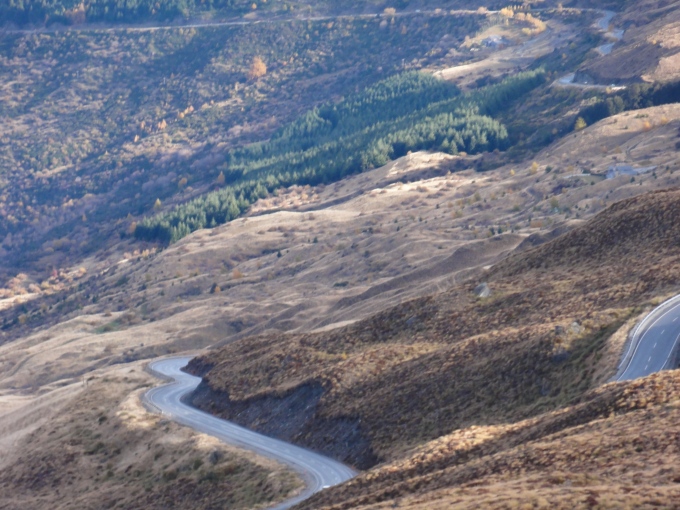
lookingdownfromcoronetpeak

And the story:

It was once said that a desperate man has everything to lose.

The man I was chasing was desperate, but I, on the other hand, was more desperate to catch him.

He’d left a trail of dead people from one end of the island to the other.

The team had put in a lot of effort to locate him, and now his capture was imminent.  We were following the car he was in, from a discrete distance, and, at the appropriate time, we would catch up, pull him over, and make the arrest.

There was nowhere for him to go.

The road led to a dead-end, and the only way off the mountain was back down the road were now on.  Which was why I was somewhat surprised when we discovered where he was.

Where was he going?

“Damn,” I heard Alan mutter.  He was driving, being careful not to get too close, but not far enough away to lose sight of him.

“What?”

“I think he’s made us.”

“How?”

“Dumb bad luck, I’m guessing.  Or he expected we’d follow him up the mountain.  He’s just sped up.”

“How far away?”

“A half-mile.  We should see him higher up when we turn the next corner.”

It took an eternity to get there, and when we did, Alan was right, only he was further on than we thought.”

“Step on it.  Let’s catch him up before he gets to the top.”

Easy to say, not so easy to do.  The road was treacherous, and in places just gravel, and there were no guard rails to stop a three thousand footfall down the mountainside.

Good thing then I had the foresight to have three agents on the hill for just such a scenario.

Ten minutes later, we were in sight of the car, still moving quickly, but we were going slightly faster.  We’d catch up just short of the summit car park.

Or so we thought.

Coming quickly around another corner we almost slammed into the car we’d been chasing.

“What the hell…” Aland muttered.

I was out of the car, and over to see if he was in it, but I knew that it was only a slender possibility.  The car was empty, and no indication where he went.

Certainly not up the road.  It was relatively straightforward for the next mile, at which we would have reached the summit.  Up the mountainside from here, or down.

I looked up.  Nothing.

Alan yelled out, “He’s not going down, not that I can see, but if he did, there’s hardly a foothold and that’s a long fall.”

Then where did he go?

Then a man looking very much like our quarry came out from behind a rock embedded just a short distance up the hill.

“Sorry,” he said quite calmly.  “Had to go if you know what I mean.”

I’d lost him.

It was as simple as that.

I had been led a merry chase up the hill, and all the time he was getting away in a different direction.

I’d fallen for the oldest trick in the book, letting my desperation blind me to the disguise that anyone else would see through in an instant.

It was a lonely sight, looking down that road, knowing that I had to go all that way down again, only this time, without having to throw caution to the wind.

“Maybe next time,” Alan said.

“We’ll get him.  It’s just a matter of time.”

© Charles Heath 2019-2021

Find this and other stories in “Inspiration, maybe”  available soon.

InspirationMaybe1v1

In a word: Green

Of course, it is a colour, one used for traffic lights, grass, and a lot of different shades.

It’s made up of blue and yellow, adjusting the amounts of each to get the shade you want.

I once had a dark green suit.

I don’t have any green emeralds.

When you get a green light, it means to go ahead, or just go, in traffic, or for the starting of a project

And a green run on the ski fields denotes the easiest run – just about my level!

Green with envy, yes, though I’m not sure why they picked green for envy

In England especially, green is a patch of grassy land, usually in the middle of a village

A green worker is one that is new to the job, and usually gets all the rotten jobs

Then there is the biggest money-spinner of all time: going green, which means eco-friendly.

I have only one question, why is it to go ‘green’ is to charge far more than normal

Oh, and by the way, political parties that are eco-centric are usually called the greens

And, these are the same people who chain themselves to trees, deterring bulldozers

The blue sea is really green, believe it or not!

In a word: Dear

Yes, it’s that simple word that we use to call someone affectionately.

Or sometimes, with a little accent on the word; yes, dear and no, dear.

In other words, it’s a person regarded with deep affection.

It can also mean expensive, by saying, that’s a bit dear, isn’t it, when we’re really saying it’s way overpriced.

I can’t remember how many times I’ve said something is ‘too dear’ to the children.

Grannies tend to use the expression, ‘be a dear and…’, to get you do do something for them.

Friends, sometimes tongue in cheek, will say, ‘oh dear, I’ve upset you’, when that was exactly what they meant to do.  Friends you say?  Yes, friends indeed.

And then we always start a letter (always?  Who writes letters any more?) with

Dear John (oops, not one of THOSE letters)

Dear Sir/Madam

Of course, instead of swearing, you could simply say ‘Oh dear, you’ve let us down again!’.

And when you lose your job, which is happening a lot at the moment, it is said it would cost you dear, though sometimes it would be more appropriate to use the adverb, dearly.

It is not to be confused with the word deer which is an animal, the males of which have antlers.

There are a number of different types of deer, such as reindeer and elk.  In Canada, they are called caribou.

In Robin Hood’s day, killing deer brought you very harsh punishment.

And one of my favourite meats is venison, meat from a deer, which are farmed in New Zealand along with sheep.

Searching for locations: Tiananmen Square, Beijing, China

Tiananmen Square

Some interesting facts before we get out of the bus…

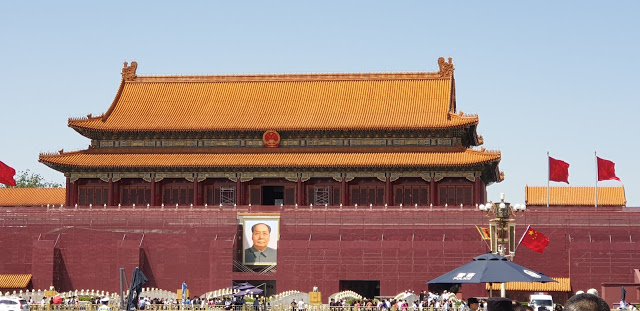
Tiananmen Square or Tian’anmen Square is in the centre of Beijing name after the Gate of Heavenly Peace, a gate that one separated the square from the Forbidden City.

The Square contains,

   the Monument to the People’s Heroes
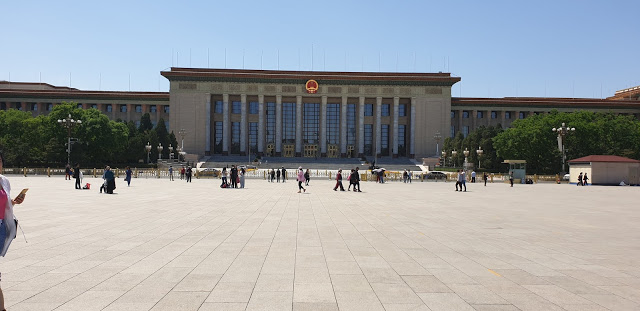
   the Great Hall of the People
   the National Museum of China
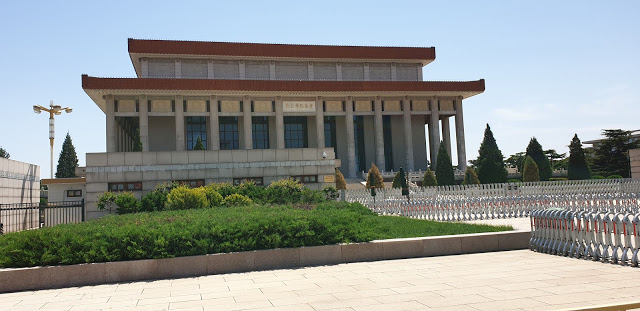
   the Mausoleum of Mao Zedong.

The square is about 109 acres and was designed and built in 1651, and since then been enlarged four times since, the most recent upgrade in the 1950s.

The Monument to the People’s Heroes

This is a ten-story obelisk built to commemorate the matters of the revolutions.  It was built between August 1952 and May 1958.  On the pedestal are reliefs depicting the eight major revolutionary episodes.

The Great Hall of the People

This was opened in September 1959, and covers 171809 square meters.  The Great Hall is the largest auditorium in China and can seat up to 10,000 people.  The State Banquet Hall can seat up to 5,000 diners.

The National Museum of China

This is one of the largest museums in the world and the second most visited museum in the world after the Louvre in Paris.   It was completed in 1959, and sits on 65 hectares, and rises four floors.  It has a permanent collection of over 1,000,000 items.

The Mauseloum of Mao Zedong

This was built shortly after his death, and completed on May 24th, 1977.  The embalmed body of the Chairman is preserved and on display in the center hall.

My own observations
This is huge; one of the largest public squares in the world, and if you’re going to walk it, like we did, make sure you’ve been exercising before you go.  It covers 44 hectares, borders on the Forbidden City, and has a memorial to Chairman Mao in the center of it.  But you cannot go near it, it’s fenced off, and it is guarded.

That’s both the statue and the square as there are random guards marching in random directions all the while watching us to see that we don’t misbehave.No one wants to find out what would happen if you jumped the fence around the statue, but I’m guessing you’ll have a few years to contemplate the stupidity of your actions with some very unhappy government officials.

 Around the edges of the square are huge buildings, on one side is the museum 

 and on the other is the Chinese equivalent of parliament.

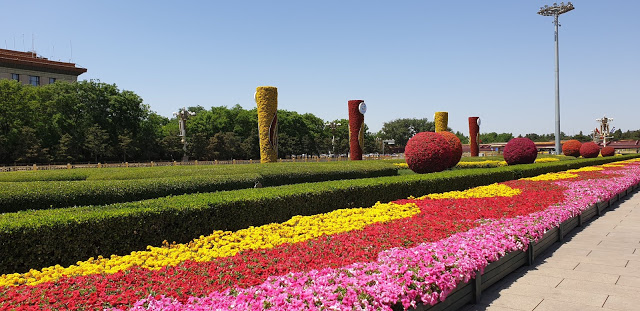
Around the sides are also large gardens

At one end, where the Forbidden City borders on the square, there’s a huge flag pole flying the Chinese flag, and this too like the monument is fenced off, and guarded by members of all of their armed services.  No tanks rolled out during our visit much to our disappointment.  There is no entrance to the Forbidden City from the square

 At the other end is the Mausoleum of Mao Zedong, which was closed the day we were there, as was the museum. 

 There are four sculptural groups installed outside the mausoleum.

Other than that, it’s just another square, albeit probably one of the largest in the world.  It can, we were told, hold about a million people.

The cinema of my dreams – I never wanted to go to Africa – Episode 10

It’s still a battle of wits, but our hero knows he’s in serious trouble.

The problem is, there are familiar faces and a question of who is a friend and who is foe made all the more difficult because the enemy if it is the enemy, doesn’t look or sound or act like the enemy.

Nor does it help when his old mentor walks through the door.


I don’t like surprises.  This dislike had started with a surprise birthday party about 10 years ago and since then I’ve assiduously tried to avoid them.

Of course, there are also surprises you have no control over, and I liked them even less.

Bluff and bravado would only carry me so far.  These people whoever they were would not accept that I knew nothing about what had just happened.

Which I didn’t.

It was not the A interrogation team with a chest full of torture tools and dressed in hazmat suits, but when the harbinger of my fate walked into the room, it was something a lot scarier.

A man I knew well or thought I did until he walked in the door, I had the utmost respected for.

Colonel Bamfield.  My first Commanding Officer, the man who cut me some slack, and made me into a soldier.

Now, all I had was questions, but I was on the wrong side of the table.

The first, what the hell was going on here?

My first inclination was to stand and salute a superior officer, but he was not wearing the uniform, not the proper uniform I was used to seeing him in.  My second inclination was to ask him what he was doing in that room with me, but I didn’t.

Speak when spoken to, and don’t volunteer information.

He too tried the silent treatment, or maybe it was that he was as surprised to see me as I was to see him.

Then, still standing behind the table, looking down on me, he said, “That was some jump you made from a moving helicopter.”  Was there a touch of admiration in his tone?

“Life or death.  Anyone one else is that situation would do the same.”

“Less than you’d think.”

Establishing camaraderie.  Or trying to.  I waited for the next question.

It wasn’t a question but a statement, “We have a problem Alan, and it’s not just with you.”


© Charles Heath 2019

Surely there’s a better way… – a short story

Surely there’s a better way…

When you have secrets, sometimes it’s very hard to hide them from others.

It was something Henry had to do since the day he could speak. The fact that his parents had been murdered because of their profession, something his grandfather told him was akin to ‘working for the government’. The fact that he was from a very wealthy and influential family. The fact he was heir to a fortune. The fact he was anything other than just another boy, who grew up to be just another man.

His whole life, to this point, had been ‘managed’ so that no one, other than a selected few chosen by his grandfather, knew who he was, or what he represented. And more to the point, he had been told to just live his life like any other of his age.

Yes, he went to a private school, but it wasn’t an exclusive one, yes he went to university, but he had got into Oxford on his own merit, and, yes, he was smart, smart enough to create his own business, and make a handsome income from it. And no, he never drew upon the stipend he had been granted by his parents will, so it just gathered dust in the bank.

Henry was an only child, and to a certain extent, introverted. It was a shyness that his grandfather knew existed in his son, Henry’s father. It could be an asset or it could be a liability. With Henry’s father, it had been an asset, a means by which many had misunderstood him. It might even serve him well for the next phase of his life.

Today, Henry was meeting his grandfather at Speaker’s Corner at Hyde Park, and an unusual meeting place because in the past it had always been at his grandfather’s club. At his grandfather’s request, he had undertaken a three-year program, one that his father had, and his father before him, and a pre-requisite for a profession that would be explained to him.

And it was all because Henry said he was bored. The business he’d built could run without him, his attempts at relationships with various girls and women hadn’t quite achieved what he was looking for, even though he had no idea what he was looking for, and, quite frankly, he told his grandfather, he needed something more exciting.

It was, he’d been told, the way of the MacCallisters. Ever since the British tried to put down the Scots.

Henry was listening to a rather animated man preaching the word of the Lord, but he was not sure what Lord that was. Anything he quoted from the bible resembled nothing he had read and remembered. Perhaps the man was on drugs.

Two or three people stopped, listened for a minute or two, shook their heads, some even laughed, and moved on.

“It’s the last bastion of freedom of speech, though I can say this man is not about to gather an army of insurrectionists any time soon. Let’s walk.”

His grandfather was getting old, and walking was getting more and more difficult. More scotch was needed, he had told Henry, to ward of the evils of arthritis. And, he added, ‘I should have had a less devil may care attitude when he was younger.’

It was a slow amble to the serpentine, which, being a bright sunny day, if not a little chilly, was alive with people.

He waited until his grandfather spoke. One lesson he had learned, speak when you’re spoken to, and if you’ve got nothing to say, best to remain silent.

“I have found a job you might like to have a go at. Nothing difficult, mind you, but a perhaps, at times, hard work. I think you’d be good at it.”

“Is that meant to be a hint, and I have to guess?”

“I think you’re smart enough to know what it might be yourself, young Henry.”

I think I did too. Everything I’d been doing over the last three years led me to believe I’d been training to walk in my father’s footsteps. It was with the Army, and I had imagined my father had been a soldier, though I’d never seen him in a uniform. But my Grandfather had said he worked for the government, so I wondered if that might be some sort of policeman, or some sort of internal agent, like MI6. It had not been boring, and the exercises had been ‘interesting’, but no one had said what the end result of this training might be; in fact no one had said who they were.

“Something hush, hush as the saying goes.”

We had gone about fifty yards and reached a cross path. As we did, a youngish woman dressed in leather appeared and walked towards us.

“I’d like you to meet a friend of mine, Henry. Her name is Marion, though I suggest you don’t call her that.”

She smiled. “Call me Mary. There’s only one person in the whole world that would dare call me that, and he’s standing here. Your grandfather has spoken a lot about you.”

Henry’s first impression; she had been to the training school he had. He could see it in her manner, and in the way she scanned the area, even though it didn’t look like she was. He’d been doing it himself, and he had seen her earlier. What made her stand out, she didn’t have a bag like all the other women.

“I hope it was good, not bad.”

“You have no bad traits?”

“Everyone had bad traits. You’ll just have to get to know me if you want to know what they are.”

“Well,” my grandfather said, “enough chit chat. Mary has a task, and she needs a little help. I thought you might want to join her.”

“Doing what?”

“She’ll explain it on the way. When it’s done, come and see me.” With that, a hug from Mary, and a handshake from his grandson, he turned and walked back the way they had come earlier.
“So,” Henry asked, “What’s the job?”

“I have to pick up a computer.”

“That doesn’t sound like something you would need help with.” In fact, if he was right in his assessment of her, he was the last person she needed, if at all. She looked to him as if she could handle anything.

“It’s one of those just in case situations.”

They walked a circuitous route back to Park Lane and crossed both roads, up Deanery Street, left where Tilney Street veered off, and then a short distance to Deanery Mews. Henry noted this was an area with a lot of expensive real estate, and scattered Embassies. If he was not mistaken, the Dorchester Hotel wasn’t far away.

Walking down the mews seemed to Henry to be walking into a trap. When he looked back towards Deanery Street he thought he saw two men position themselves, not quick enough to prevent him from getting a glimpse of them.

“You do realize that getting back out of here could be a problem.”

“It’s why I asked for help. Just in case.”

No visible sign of fear, or of what the consequences might be if this went south. Perhaps his grandfather had considered this a test. But what sort of test?

They reached the end, and, just around the corner, a van was parked with what Henry assumed was the driver, standing by the open driver’s door, smoking a cigarette.

Mary stopped about ten feet away from him. “Have you got the package?”

He reached inside the car and lifted up a computer case. There didn’t necessarily have to be a computer in it. I looked up and around. It was a good place for a meeting. No witnesses. But there were CCTV cameras. I wondered if they were working.

The man tossed the bag back in the car. “Have you got the money?”

She held up her phone. “Just need the bank account details.”

“OK. Just step over here and let’s get this done.”

She moved closer, and in a flash, he had grabbed her, holding her by the neck with a gun to her head. The two men Henry thought he’d seen at the top of the mews were now within sight, and both had guns trained on him. A trap, indeed.

“What do you want?” Henry asked.

“Tell your boss the price just doubled. Two million. You’ve got five minutes.”

I shook my head, not to clear the cobwebs, but to calm down and think rationally.

Talk first. “Surely there’s a better way to do this. You don’t need to hold a gun to her head.”

I held my hands out just to show I wasn’t a threat.

“No, probably not.” He released his grip and lowered the gun.

A very, very bad mistake.

—-

© Charles Heath 2020-2021
Curious children find a curiosity

I am constantly reminded of how curious grandchildren can be when they are not asking you what it was like to live with dinosaurs!

The second eldest who is a rather clever 15-year-old considers it interesting that I’m a writer, and having just met a ‘real’ author who came to visit them at school, asked me a few questions, some of which sounded like those that had been asked of my ‘real’ counterpart.

Like, “how old were you when you first wrote a story, and what was that story about?”

I didn’t think it was when I was at school, but sometime after that, and after a lot of reading.  Perhaps it had been one of those moments when a light bulb goes on in your head, and I said to myself, I can write these stories too.

Of course, that wasn’t an answer, so she asked again, when did I start writing?

That required a little thought, and there were several triggers that gave me a date, where I lived at the time, the fact I used my mother’s old portable typewriter, and the fact I had not been long out of school.  I was, in fact, about 17.  It was 45 years ago; I’ll let you do the math!

What was it about; that I couldn’t tell her, but I said I had rescued a lot of old scribbling of mine and put them in a box to look at later when I had the time.

I guess that time had arrived.

And, yes, there was the book, the individually typed pages, some with corrections, unfinished.

The pages were brown with age.

The story, well, I read the first few pages, and it seems I’d started down the thriller path then, the story so far, an agent comes ashore from a trawler to a bleak and isolated village, perhaps on the Scottish coast.

Then there was the inevitable next question; “What was the first story you read that put you on the path to wanting to become a writer”.

That was easy, Alistair Maclean’s HMS Ulysses.  I showed her a copy of the book.

That led to, “but this is about the British Royal Navy in World War 2…”

Perhaps I didn’t answer that correctly, it was after reading about a dozen of his novels, most of which were precursors to the modern-day thriller, perhaps more along the lines of action adventures.

The next question, understandably; “What was the first book you ever finished?”

That was The Starburst Conspiracy, the manuscript of which was in the box along with another completed novel, and quite a few short stories.

Back in those days, I remembered that I had sent some of my stories off to various publishers, and had entered a number of short story competitions, all to no avail.  And for a number of years, until I because to old, used to write and enter a novel in the Vogel novel competition but never made it to the shortlist.

It’s probably why I gave up writing for a number of years, until I worked for an interesting company who had a rich history of phosphate mining in the Pacific and being given permission to look into the archives, began writing what could only be described a saga, and by the time I’d left, it was over 1200 closely typed pages long.

I showed the bulky manuscript to her, but by this time her interest had moved to something else.

For me, however, it seemed there was a lot of unfinished business.

“Sunday in New York”, a romantic adventure that’s not a walk in the park!

“Sunday in New York” is ultimately a story about trust, and what happens when a marriage is stretched to its limits.

When Harry Steele attends a lunch with his manager, Barclay, to discuss a promotion that any junior executive would accept in a heartbeat, it is the fact his wife, Alison, who previously professed her reservations about Barclay, also agreed to attend, that casts a small element of doubt in his mind.

From that moment, his life, in the company, in deciding what to do, his marriage, his very life, spirals out of control.

There is no one big factor that can prove Harry’s worst fears, that his marriage is over, just a number of small, interconnecting events, when piled on top of each other, points to a cataclysmic end to everything he had believed in.

Trust is lost firstly in his best friend and mentor, Andy, who only hints of impending disaster, Sasha, a woman whom he saved, and who appears to have motives of her own, and then in his wife, Alison, as he discovered piece by piece damning evidence she is about to leave him for another man.

Can we trust what we see with our eyes or trust what we hear?

Haven’t we all jumped to conclusions at least once in our lives?

Can Alison, a woman whose self-belief and confidence is about to be put to the ultimate test, find a way of proving their relationship is as strong as it has ever been?

As they say in the classics, read on!

Purchase:

http://tinyurl.com/Amazon-SundayInNewYork

Memories of the Conversations with my cat – 32

As some may be aware, but many not, Chester, my faithful writing assistant, mice catcher, and general pain in the neck, passed away some months ago.

Recently I was running a series based on his adventures, under the title of Past Conversations with my cat.

For those who have not had the chance to read about all of his exploits I will run the series again from Episode 1

These are the memories of our time together…

20160922_162022

This is Chester.  I’ve just told him we will be going away for a few days.

What, again?  You do nothing but go away these days!  That look of disdain is meant to move me, but, sorry, it doesn’t.

It is retirement, you know, I say.  I’ve waited for 65 years so that I can do what I want.

Poor you!  Any idea how old you think I am?

15, mate, and lucky to have lived that long, despite the fact you’ve tried to escape.

That’s a matter of opinion, but not cat years, fool, human years.

I’d never quite worked that out.  We had a dog once, and I know that for every dog year it’s seven human years, so it was, in human terms, rather old.

But cats?

I’ll look it up on the internet.

Interesting.  The first two years are worth 24 human years and 4 years for each successive year.  That makes you, wow, 76.

A smug expression takes over.  Old, he says, you don’t know what it is to be old.

Except at your age, you’re too old to be travelling.

He wanders off, the tail indicating his annoyance.  I don’t think it was what he wanted to hear.