Writing about writing a book – Day 28

So after that rather undramatic ‘off with the fairies’ moment, it’s time to come back to earth.  Holiday or not, there’s always something that can go wrong.

Even when you’ve been told to take some vacation days, and reluctantly stayed home.  The notion that vacation meant going away somewhere doesn’t enter Bill’s mind.

Perhaps he’s like a lot of workaholics, using their job as an excuse to forget about life outside work.

Maybe he was hoping something would go wrong.  Maybe he had considered manufacturing a problem so that he would have to go back.

Maybe not, but that was the sort of employee he was, not one that could willingly take a day away, just in case.

Like now.


I’d almost managed to doze off again when the phone rang.

I jumped to its equally shrill sound cutting through the silence.  It had to be a wrong number because no one at work would call me, and I didn’t have many friends, so I let it ring out.  As far as I could remember, it was only the third time it had rung since I’d moved in, four years ago.

Blissful silence.  I looked at the bedside clock.  7 am.  Who called anyone at that hour?

It rang again.

Ignore it, I thought.  If it was anyone, it would be someone from the office.  I’d told them all not to call me, not unless the building was burning down and they were all trapped in it.

And even then, I’d have to think about it.

Burying my head under the pillow didn’t shut out the insistent ringing, compelling me to answer.  Almost reluctantly I rolled back, pulled the telephone out from under the bed, and lifted the receiver to my ear.

“Bill?”

It was Carl Benton, my immediate superior; an insipid, loathsome, irritating little man, the last person I would want to speak to.  He’d insisted I take this leave, that the office could survive without me, adding in his most condescending manner that I needed the break.

I slammed the receiver down in anger.  It was a forlorn gesture.  Seconds later, it rang again.

“I seem to remember you were the one to tell me to go on holiday, that I needed a holiday.  I’m off the roster.  It can’t be that important.  Call someone else.”  I wasn’t going to give him the opportunity to speak.  Not this morning.  I was not in the mood to listen to that squeaky, falsetto voice of his, one that always turned into a whine when he didn’t get his way.

And hung up again.

Not that it would do any good.  I knew that even if I was in Tibet, he would still call.  Then I realized it was too early for him to be in the office, and if he was, he would have been dragged out of bed and put in a position where if he didn’t produce results, they might realize just how incompetent he was.

At last, my holiday had some meaning and smiled to myself.  I’d make the bastard sweat.

He left it a few minutes before he rang again.  And I let it ring out.  I could see the expression on his face, bewilderment, changing slowly into suffused anger.  How dare I ignore him!

Another five minutes, then the phone began its shrill insistence again.  Before it rang again, I’d moved it from the floor to the bed.  I counted the rings, to ten, and then picked up the receiver.

“Bill?  Don’t hang up.”  Almost pleading.

“Why?  You said I should go, away from work, away from the phones, away to recharge my batteries, I believe you said.”

“That was Friday.  This is Monday. You’re needed.  Richardson has been found shot dead by his desk.  All hell has broken loose!”  Benton rarely used adjectives, so I assumed when he said all hell had broken loose, it meant something had happened he couldn’t fix.  His flowery language and telegram style had momentarily distracted my attention from Richardson’s fate.

Harold Richardson was an accountant, rather stuffy, but good at his job.  I’d spoken to him probably twice in as many years, and he didn’t strike me as the sort who would kill himself.  So why did I think that?  Benton had only said he was shot.

Benton’s voice went up an octave, a sure sign he was going into meltdown.  “It’s a circus down here.  Jennifer is missing, Giles is not in yet, the network is down, and that bunch of nincompoops you call support staff are running around the office like headless chooks.”

It all came out in a nonstop sentence, followed by a gasp for air.  It gave me time to sift the facts.  Jennifer, my sometime assistant, and responsible for data entry and accounts maintenance, was not there, which in itself was unusual, because she kept longer hours than me, Peter Giles, my youthful assistant, just out of university and still being beaten into shape was not in, and that was usual, so it could only mean one thing.

The network was down.


© Charles Heath 2016-2020


“What Sets Us Apart”, a mystery with a twist

David is a man troubled by a past he is trying to forget.

Susan is rebelling against a life of privilege and an exasperated mother who holds a secret that will determine her daughter’s destiny.

They are two people brought together by chance. Or was it?

When Susan discovers her mother’s secret, she goes in search of the truth that has been hidden from her since the day she was born.

When David realizes her absence is more than the usual cooling off after another heated argument, he finds himself being slowly drawn back into his former world of deceit and lies.

Then, back with his former employers, David quickly discovers nothing is what it seems as he embarks on a dangerous mission to find Susan before he loses her forever.

http://amzn.to/2Eryfth

whatsetscover

Questions, sometimes without answers

#Creative Writing, #Blog, #Writing

At what point does a writer become a journalist?

Quite often journalists become writers because of their vast experience in observing and writing about the news, sometimes in the category of ‘truth is stranger than fiction’.

I did journalism at University, and thought I would never get to use it.  I had to interview people, write articles, and act as an editor.  The hardest part was the headlines.

How much does that resemble the job of coming up with a title for your book?

Well, several opportunities arose over the last few months to dig out the journalist hat, put it on, and go to work.

Where?

Hospital.  I’ve had to go there a few times more in the last few months than I have in recent years.

And I’d forgotten just how hospitals are interesting places, especially the waiting room in Emergency.

After the second or third visit, I started to observe the people who were waiting, and ran through various scenarios as to the reason for their visit.  None may have been true, but it certainly was an exercise in creative writing, and would make an excellent article.

Similarly, once we got inside the inner sanctum, where the real work is done, there is any number of crises and operations going on, and plenty of material for when I might need to include a hospital scene in one of my stories.

Or I could write a volume in praise of the people who work there and what they have to endure.  Tending the sick, injured and badly injured is not a job for the faint hearted.

Research, if it could be called that, turns up in the unlikeliest of places.  Doctors who answer questions, not necessarily about the malady, nurses who tell you about what it’s like in Emergency on nights you really don’t want to be there, and other patients and their families, all of whom have a story to tell, or just wait patiently for a diagnoses and then treatment so they can go home.

We get to go this time about four in the morning.  Everyone is tired.  More people are waiting.  Outside it is cool and the first rays of light are coming over the horizon as dawn is about to break.

I ponder the question without an answer, a question one of the nurses asked a youngish doctor, tossed out in conversation, but was there a more intent to it; what he was doing on Saturday night.

He didn’t answer.  Another crisis, another patient.

I suspect he was on duty in Emergency.


An excerpt from “One Last Look”: Charlotte is no ordinary girl

This is currently available at Amazon herehttp://amzn.to/2CqUBcz


I’d read about out of body experiences, and like everyone else, thought it was nonsense.  Some people claimed to see themselves in the operating theatre, medical staff frantically trying to revive them, and being surrounded by white light.

I was definitely looking down, but it wasn’t me I was looking at.

It was two children, a boy and a girl, with their parents, in a park.

The boy was Alan.  He was about six or seven.  The girl was Louise, and she was five years old.  She had long red hair and looked the image of her mother.

I remember it now, it was Louise’s birthday and we went down to Bournemouth to visit our Grandmother, and it was the last time we were all together as a family.

We were flying homemade kites our father had made for us, and after we lay there looking up at the sky, making animals out of the clouds.  I saw an elephant, Louise saw a giraffe.

We were so happy then.

Before the tragedy.


When I looked again ten years had passed and we were living in hell.  Louise and I had become very adept at survival in a world we really didn’t understand, surrounded by people who wanted to crush our souls.

It was not a life a normal child had, our foster parents never quite the sort of people who were adequately equipped for two broken-hearted children.  They tried their best, but their best was not good enough.

Every day it was a battle, to avoid the Bannister’s and Archie in particular, every day he made advances towards Louise and every day she fended him off.

Until one day she couldn’t.

Now I was sitting in the hospital, holding Louise’s hand.  She was in a coma, and the doctors didn’t think she would wake from it.  The damage done to her was too severe.

The doctors were wrong.

She woke, briefly, to name her five assailants.  It was enough to have them arrested.  It was not enough to have them convicted.

Justice would have to be served by other means.


I was outside the Bannister’s home.

I’d made my way there without really thinking, after watching Louise die.  It was like being on autopilot, and I had no control over what I was doing.  I had murder in mind.  It was why I was holding an iron bar.

Skulking in the shadows.  It was not very different from the way the Bannister’s operated.

I waited till Archie came out.  I knew he eventually would.  The police had taken him to the station for questioning, and then let him go.  I didn’t understand why, nor did I care.

I followed him up the towpath, waiting till he stopped to light a cigarette, then came out of the shadows.

“Wotcha got there Alan?” he asked when he saw me.  He knew what it was, and what it was for.

It was the first time I’d seen the fear in his eyes.  He was alone.

“Justice.”

“For that slut of a sister of yours.  I had nuffing to do with it.”

“She said otherwise, Archie.”

“She never said nuffing, you just made it up.”  An attempt at bluster, but there was no confidence in his voice.

I held up the pipe.  It had blood on it.  Willy’s blood.  “She may or may not have Archie, but Willy didn’t make it up.  He sang like a bird.  That’s his blood, probably brains on the pipe too, Archie, and yours will be there soon enough.”

“He dunnit, not me.  Lyin’ bastard would say anything to save his own skin.”  Definitely scared now, he was looking to run away.

“No, Archie.  He didn’t.  I’m coming for you.  All of you Bannisters.  And everyone who touched my sister.”


It was the recurring nightmare I had for years afterwards.

I closed my eyes and tried to shut out the thoughts, the images of Louise, the phone call, the visit to the hospital and being there when she succumbed to her injuries.  Those were the very worst few hours of my life.

She had asked me to come to the railway station and walk home with her, and I was running late.  If I had left when I was supposed to, it would never have happened and for years afterwards, I blamed myself for her death.

If only I’d not been late…

When the police finally caught the rapists, I’d known all along who they’d be; antagonists from school, the ring leader, Archie Bannister, a spurned boyfriend, a boy whose parents, ubiquitously known to all as ‘the Bannister’s, dealt in violence and crime and who owned the neighbourhood.  The sins of the father had been very definitely passed onto the son.

At school, I used to be the whipping boy, Archie, a few grades ahead of me, made a point of belting me and a few of the other boys, to make sure the rest did as they were told.  He liked Louise, but she had no time for a bully like him, even when he promised he would ‘protect’ me.

I knew the gang members, the boys who tow-kowed to save getting beaten up, and after the police couldn’t get enough information to prosecute them because everyone was too afraid to speak out, I went after Willy.  There was always a weak link in a group, and he was it.

He worked in a factory, did long hours on a Wednesday and came home after dark alone.  It was a half mile walk, through a park.  The night I approached him, I smashed the lights and left it in darkness.  He nearly changed his mind and went the long way home.

He didn’t.

It took an hour and a half to get the names.  At first, when he saw me, he laughed.  He said I would be next, and that was four words more than he knew he should have said.

When I found him alone the next morning I showed him the iron bar and told him he was on the list.  I didn’t kill him then, he could wait his turn, and worry about what was going to happen to him.

When the police came to visit me shortly after that encounter, no doubt at the behest of the Bannister’s, the neighbourhood closed ranks and gave me an ironclad alibi.  The Bannister’s then came to visit me and threatened me.  I told them their days were numbered and showed them the door.

At the trial, he and his friends got off on a technicality.  The police had failed to do their job properly, but it was not the police, but a single policeman, corrupted by the Bannisters.

Archie could help but rub it in my face.  He was invincible.

Joe Collins took 12 bullets and six hours to bleed out.  He apologized, he pleaded, he cried, he begged.  I didn’t care.

Barry Mills, a strong lad with a mind to hurting people, Archie’s enforcer, almost got the better of me.  I had to hit him more times than I wanted to, and in the end, I had to be satisfied that he died a short but agonizing death.

I revisited Willy in the hospital.  He’d recovered enough to recognize me, and why I’d come.  Suffocation was too good for him.

David Williams, second in command of the gang, was as tough and nasty as the Bannisters.  His family were forging a partnership with the Bannister’s to make them even more powerful.  Outwardly David was a pleasant sort of chap, affable, polite, and well mannered.  A lot of people didn’t believe he could be like, or working with, the Bannisters.

He and I met in the pub.  We got along like old friends.  He said Willy had just named anyone he could think of, and that he was innocent of any charges.  We shook hands and parted as friends.

Three hours later he was sitting in a chair in the middle of a disused factory, blindfolded and scared.  I sat and watched him, listened to him, first threatening me, and then finally pleading with me.  He’d guessed who it was that had kidnapped him.

When it was dark, I took the blindfold off and shone a very bright light in his eyes.  I asked him if the violence he had visited upon my sister was worth it.  He told me he was just a spectator.

I’d read the coroner’s report.  They all had a turn.  He was a liar.

He took nineteen bullets to die.

Then came Archie.

The same factory only this time there were four seats.  Anna Bannister, brothel owner, Spike Bannister, head of the family, Emily Bannister, sister, and who had nothing to do with their criminal activities.  She just had the misfortune of sharing their name.

Archie’s father told me how he was going to destroy me, and everyone I knew.

A well-placed bullet between the eyes shut him up.

Archie’s mother cursed me.  I let her suffer for an hour before I put her out of her misery.

Archie remained stony-faced until I came to Emily.  The death of his parents meant he would become head of the family.  I guess their deaths meant as little to him as they did me.

He was a little more worried about his sister.

I told him it was confession time.

He told her it was little more than a forced confession and he had done nothing to deserve my retribution.

I shrugged and shot her, and we both watched her fall to the ground screaming in agony.  I told him if he wanted her to live, he had to genuinely confess to his crimes.  This time he did, it all poured out of him.

I went over to Emily.  He watched in horror as I untied her bindings and pulled her up off the floor, suffering only from a small wound in her arm.  Without saying a word she took the gun and walked over to stand behind him.

“Louise was my friend, Archie.  My friend.”

Then she shot him.  Six times.

To me, after saying what looked like a prayer, she said, “Killing them all will not bring her back, Alan, and I doubt she would approve of any of this.  May God have mercy on your soul.”


Now I was in jail.  I’d spent three hours detailing the deaths of the five boys, everything I’d done; a full confession.  Without my sister, my life was nothing.  I didn’t want to go back to the foster parents; I doubt they’d take back a murderer.

They were not allowed to.

For a month I lived in a small cell, in solitary, no visitors.  I believed I was in the queue to be executed, and I had mentally prepared myself for the end.

Then I was told I had a visitor, and I was expecting a priest.

Instead, it was a man called McTavish. Short, wiry, and with an accent that I could barely understand.

“You’ve been a bad boy, Alan.”

When I saw it was not the priest I told the jailers not to let him in, I didn’t want to speak to anyone.  They ignored me.  I’d expected he was a psychiatrist, come to see whether I should be shipped off to the asylum.

I was beginning to think I was going mad.

I ignored him.

“I am the difference between you living or dying Alan, it’s as simple as that.  You’d be a wise man to listen to what I have to offer.”

Death sounded good.  I told him to go away.

He didn’t.  Persistent bugger.

I was handcuffed to the table.  The prison officers thought I was dangerous.  Five, plus two, murders, I guess they had a right to think that.  McTavish sat opposite me, ignoring my request to leave.

“Why’d you do it?”

“You know why.”  Maybe if I spoke he’d go away.

“Your sister.  By all accounts, the scum that did for her deserved what they got.”

“It was murder just the same.  No difference between scum and proper people.”

“You like killing?”

“No-one does.”

“No, I dare say you’re right.  But you’re different, Alan.  As clean and merciless killing I’ve ever seen.  We can use a man like you.”

“We?”

“A group of individuals who clean up the scum.”

I looked up to see his expression, one of benevolence, totally out of character for a man like him.  It looked like I didn’t have a choice.


Trained, cleared, and ready to go.

I hadn’t realized there were so many people who were, for all intents and purposes, invisible.  People that came and went, in malls, in hotels, trains, buses, airports, everywhere, people no one gave a second glance.

People like me.

In a mall, I became a shopper.

In a hotel, I was just another guest heading to his room.

On a bus or a train, I was just another commuter.

At the airport, I became a pilot.  I didn’t need to know how to fly; everyone just accepted a pilot in a pilot suit was just what he looked like.

I had a passkey.

I had the correct documents to get me onto the plane.

That walk down the air bridge was the longest of my life.  Waiting for the call from the gate, waiting for one of the air bridge staff to challenge me, stepping onto the plane.

Two pilots and a steward.  A team.  On the plane early before the rest of the crew.  A group that was committing a crime, had committed a number of crimes and thought they’d got away with it.

Until the judge, the jury and their executioner arrived.

Me.

Quick, clean, merciless.  Done.

I was now an operational field agent.


I was older now, and I could see in the mirror I was starting to go grey at the sides.  It was far too early in my life for this, but I expect it had something to do with my employment.

I didn’t recognize the man who looked back at me.

It was certainly not Alan McKenzie, nor was there any part of that fifteen-year-old who had made the decision to exact revenge.

Given a choice; I would not have gone down this path.

Or so I kept telling myself each time a little more of my soul was sold to the devil.

I was Barry Gamble.

I was Lenny Buckman.

I was Jimmy Hosen.

I was anyone but the person I wanted to be.

That’s what I told Louise, standing in front of her grave, and trying to apologize for all the harm, all the people I’d killed for that one rash decision.  If she was still alive she would be horrified, and ashamed.

Head bowed, tears streamed down my face.

God had gone on holiday and wasn’t there to hand out any forgiveness.  Not that day.  Not any day.


New York, New Years Eve.

I was at the end of a long tour, dragged out of a holiday and back into the fray, chasing down another scumbag.  They were scumbags, and I’d become an automaton hunting them down and dispatching them to what McTavish called a better place.

This time I failed.

A few drinks to blot out the failure, a blonde woman who pushed my buttons, a room in a hotel, any hotel, it was like being on the merry-go-round, round and round and round…

Her name was Silvia or Sandra, or someone I’d met before, but couldn’t quite place her.  It could be an enemy agent for all I knew or all I cared right then.

I was done.

I’d had enough.

I gave her the gun.

I begged her to kill me.

She didn’t.

Instead, I simply cried, letting the pent up emotion loose after being suppressed for so long, and she stayed with me, holding me close, and saying I was safe, that she knew exactly how I felt.

How could she?  No one could know what I’d been through.

I remembered her name after she had gone.

Amanda.

I remembered she had an imperfection in her right eye.

Someone else had the same imperfection.

I couldn’t remember who that was.

Not then.


I had a dingy flat in Kensington, a place that I rarely stayed in if I could help it.  After five-star hotel rooms, it made me feel shabby.

The end of another mission, I was on my way home, the underground, a bus, and then a walk.

It was late.

People were spilling out of the pub after the last drinks.  Most in good spirits, others slightly more boisterous.

A loud-mouthed chap bumped into me, the sort who had one too many, and was ready to take on all comers.

He turned on me, “Watch where you’re going, you fool.”

Two of his friends dragged him away.  He shrugged them off, squared up.

I punched him hard, in the stomach, and he fell backwards onto the ground.  I looked at his two friends.  “Take him home before someone makes mincemeat out of him.”

They grabbed his arms, lifted him off the ground and took him away.

Out of the corner of my eye, I could see a woman, early thirties, quite attractive, but very, very drunk.  She staggered from the bar, bumped into me, and finished up sitting on the side of the road.

I looked around to see where her friends were.  The exodus from the pub was over and the few nearby were leaving to go home.

She was alone, drunk, and by the look of her, unable to move.

I sat beside her.  “Where are your friends?”

“Dunno.”

“You need help?”

She looked up, and sideways at me.  She didn’t look the sort who would get in this state.  Or maybe she was, I was a terrible judge of women.

“Who are you?” she asked.

“Nobody.”  I was exactly how I felt.

“Well Mr Nobody, I’m drunk, and I don’t care.  Just leave me here to rot.”

She put her head back between her knees, and it looked to me she was trying to stop the spinning sensation in her head.

Been there before, and it’s not a good feeling.

“Where are your friends?” I asked again.

“Got none.”

“Perhaps I should take you home.”

“I have no home.”

“You don’t look like a homeless person.  If I’m not mistaken, those shoes are worth more than my weekly salary.”  I’d seen them advertised, in the airline magazine, don’t ask me why the ad caught my attention.

She lifted her head and looked at me again.  “You a smart fucking arse are you?”

“I have my moments.”

“Have them somewhere else.”

She rested her head against my shoulder.  We were the only two left in the street, and suddenly in darkness when the proprietor turned off the outside lights.

“Take me home,” she said suddenly.

“Where is your place?”

“Don’t have one.  Take me to your place.”

“You won’t like it.”

“I’m drunk.  What’s not to like until tomorrow.”

I helped her to her feet.  “You have a name?”

“Charlotte.”


The wedding was in a small church.  We had been away for a weekend in the country, somewhere in the Cotswolds, and found this idyllic spot.  Graves going back to the dawn of time, a beautiful garden tended by the vicar and his wife, an astonishing vista over hills and down dales.

On a spring afternoon with the sun, the flowers, and the peacefulness of the country.

I had two people at the wedding, the best man, Bradley, and my boss, Watkins.

Charlotte had her sisters Melissa and Isobel, and Isobel’s husband Giovanni, and their daughter Felicity.

And one more person who was as mysterious as she was attractive, a rather interesting combination as she was well over retirement age.  She arrived late and left early.

Aunt Agatha.

She looked me up and down with what I’d call a withering look.  “There’s more to you than meets the eye,” she said enigmatically.

“Likewise I’m sure,” I said.  It earned me an elbow in the ribs from Charlotte.  It was clear she feared this woman.

“Why did you come,” Charlotte asked.

“You know why.”

Agatha looked at me.  “I like you.  Take care of my granddaughter.  You do not want me for an enemy.”

OK, now she officially scared me.

She thrust a cheque into my hand, smiled, and left.

“Who is she,” I asked after we watched her depart.

“Certainly not my fairy godmother.”

Charlotte never mentioned her again.


Zurich in summer, not exactly my favourite place.

Instead of going to visit her sister Isobel, we stayed at a hotel in Beethovenstrasse and Isobel and Felicity came to us.  Her husband was not with her this time.

Felicity was three or four and looked very much like her mother.  She also looked very much like Charlotte, and I’d remarked on it once before and it received a sharp rebuke.

We’d been twice before, and rather than talk to her sister, Charlotte spent her time with Felicity, and they were, together, like old friends.  For so few visits they had a remarkable rapport.

I had not broached the subject of children with Charlotte, not after one such discussion where she had said she had no desire to be a mother.  It had not been a subject before and wasn’t once since.

Perhaps like all Aunts, she liked the idea of playing with a child for a while and then give it back.

Felicity was curious as to who I was, but never ventured too close.  I believed a child could sense the evil in adults and had seen through my facade of friendliness.  We were never close.

But…

This time, when observing the two together, something quite out of left field popped into my head.  It was not possible, not by any stretch of the imagination, but I thought she looked like my mother.

And Charlotte had seen me looking in their direction.  “You seem distracted,” she said.

“I was just remembering my mother.  Odd moment, haven’t done so for a very long time.”

“Why now?”  I think she had a look of concern on her face.

“Her birthday, I guess,” I said, the first excuse I could think of.

Another look and I was wrong.  She looked like Isobel or Charlotte, or if I wanted to believe it possible, Melissa too.


I was crying, tears streaming down my face.

I was in pain, searing pain from my lower back stretching down into my legs, and I was barely able to breathe.

It was like coming up for air.

It was like Snow White bringing Prince Charming back to life.  I could feel what I thought was a gentle kiss and tears dropping on my cheeks, and when I opened my eyes, I saw Charlotte slowly lifting her head, a hand gently stroking the hair off my forehead.

And in a very soft voice, she said, “Hi.”

I could not speak, but I think I smiled.  It was the girl with the imperfection in her right eye.  Everything fell into place, and I knew, in that instant that we were irrevocably meant to be together.

“Welcome back.”


© Charles Heath 2016-2019
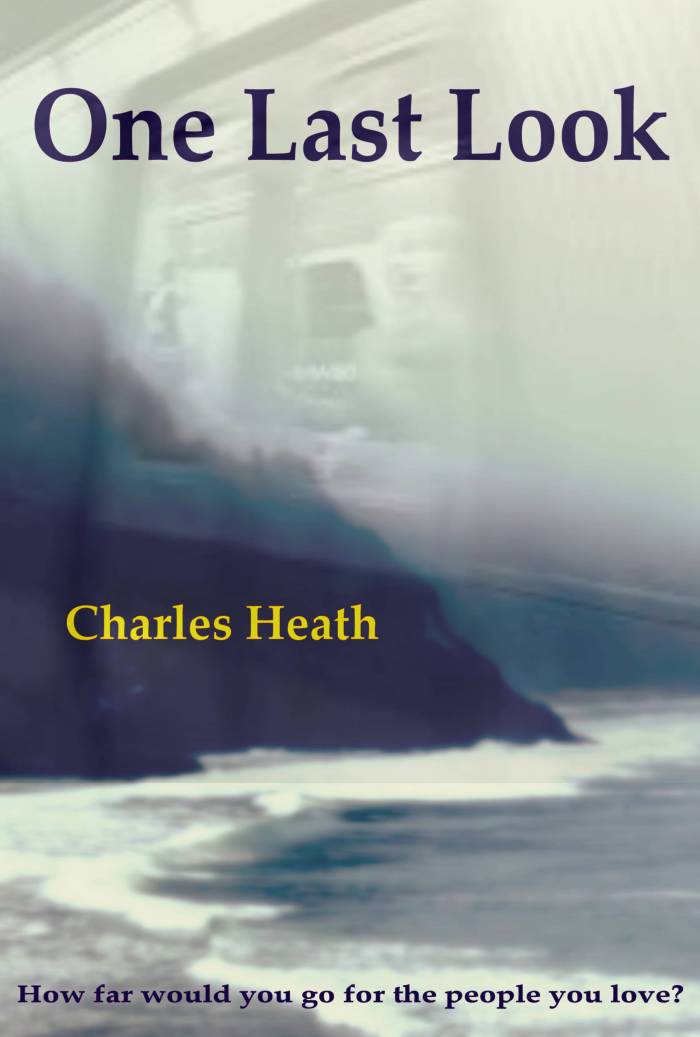
onelastlookcoverfinal2

“Anyone can have a bad day” – a short story

It had been one of those days, you know, the sort where you hoped, when you woke up again, it would be a distant memory if not gone altogether. Everything had gone wrong, the handover from my shift to the next, longer than usual, I got home late to find the building’s security system malfunctioning, and after everything that could go wrong had, I was late getting to bed, which meant I was going to be tired and cranky even before my shift started.

But what topped it all off was that the alarm didn’t go off. It was not as if I hadn’t set it, I remembered doing it. There was something else in play.

I rolled over and instantly noticed how dark it was. It was never this dark. It was why I chose an apartment as high up as I could, there would always be light coming from the advertising sign on the roof of the building over the road at night, or direct sunlight not blotted out by surrounding buildings.

I also left the curtains open, deliberately. I liked the notion of being able to see out, sometimes looking at the stars, other times watching the rain, but mostly to see that I was not in a dark place.

Not like now.

I got out of bed and went over to the window. Yes, there were lights, but they were all the way down on the street level. Everywhere else, nothing. It had to be a power blackout. Our first in a long time. I should have noticed the air conditioning was not on, and it was almost silent inside the room.

The apartment had windows that opened, not very far, but enough to allow some airflow, and the room feeling stuffy, I opened one in the bedroom. Instantly, sounds drifted up from street level, and looking down I could see the flashing lights of police cars and fire trucks, as well as the sounds of sirens.

The cold air was refreshing.

It took a few minutes before I realized the elevators would not be working, and I remembered the only pitfall of having a high-up apartment, it was a long way down by the stairs, and even longer going back up.

In the distance, I could see other buildings, about ten blocks away, with their lights on. It had to be a localized blackout, or perhaps a brownout. We had been having problems across the city with power supply caused by an unexplained explosion at several power stations on the grid.

Some were saying it was a terrorist attack, others were saying the antiquated infrastructure had finally given out.

My attention was diverted from the activity below by the vibration of my cell phone on the bedside table. I looked over at the clock and saw it was 3:10 in the morning, not a time I usually got a phone call.

I crossed the room and looked at the screen, just as the vibrating stopped. Louis Bernard. Who was Louis Bernard? It was not a name I was familiar with, so I ignored it. It wasn’t the first wrong number to call me, though I was beginning to think I had been given a recycled phone number when I bought the phone. Perhaps the fact it was a burner may have had something to do with it.

About the go back to the window, the phone started ringing again. The same caller, Louis Bernard.

Curiosity got the better of me.

“Yes?” I wasn’t going to answer with my name.

“Get out of that room now.”

“Who….” It was as far as I got before the phone went dead.

The phone displayed the logo as it powered off, a sign the battery was depleted. I noticed then though I’d plugged the phone in to recharge, I’d forgotten to turn the power on.

Damn.

Get out of that room now? Who could possibly know firstly who I was, and where I was living, to the point they could know I was in any sort of danger?

It took another minute of internal debate before I threw on some clothes and headed for the door.

Just in case.

As I went to open the door, someone started pounding on it, and my heart almost stopped.

“Who is it?” I yelled out. First thought; don’t open it.

“Floor warden, you need to evacuate. There’s a small fire on one of the floors below.”

“OK. Give me a minute or so and I’ll be right out.”

“Don’t take too long. Take the rear stairs on the left.”

A few seconds later I heard him pounding on the door next to mine. I waited until he’d moved on, and went out into the passage.

It was almost dark, the security lighting just above floor level giving off a strange and eerie orange glow. I thought there was a hint of smoke in the air, but that might have been the power of suggestion taking over my mind.

There were two sets of stairs down, both at the rear, one on the left and one on the right, designed to aid quick evacuation in the event of a calamity like a fire. He had told me to take the left. I deliberately ignored that and went to the right side, passing several other tenants who were going towards where they’d been told. I didn’t recognize them, but, then, I didn’t try to find out who my fellow tenants were.

A quick look back up the passage, noting everyone heading to the left side stairs, I ducked into the right stairwell and stopped for a moment. Was that smoke I could smell. From above I could hear a door slam shut, and voices. Above me, people had entered the stairwell and were coming down.

I started heading down myself.

I was on the 39th floor, and it was going to be a long way down. In a recent fire drill, the building had been evacuated from the top floor down, and it proceeded in an orderly manner. The idea was that starting at the top, there would not be a logjam if the lower floors were spilling into the stairwell and creating a bottleneck. Were those above stragglers?

I descended ten floors and still hadn’t run into anyone, but the smell of smoke was stronger. I stopped for a moment and listened for those who had been above me. Nothing. Not a sound. Surely there had to be someone above me, coming down.

A door slammed, but I couldn’t tell if it was above or below.

Once again, I descended, one floor, two, three, five, all the way down to ten. The smoke was thicker here, and I could see a cloud on the other side of the door leading out of the stairwell into the passage. The door was slightly ajar, odd, I thought, for what was supposed to be a fire door. I could see smoke being sucked into the fire escape through the door opening.

Then I saw several firemen running past, axes in hand. Was the fire on the tenth floor?

Another door slammed shut, and then above me, I could hear voices. Or were they below? I couldn’t tell. My eyes were starting to tear up from the smoke, and it was getting thicker.

I headed down.

I reached the ground floor and tried to open the door leading out of the fire escape. It wouldn’t open. A dozen other people came down the stairs and stopped when they saw me.

One asked, “Can we get out here?”

I tried the door again with the same result. “No. It seems to be jammed.”

Several of the people rushed past me, going down further, yelling out, “there should be a fire door leading out into the underground garage.”

Then, after another door slamming shut, silence. Another person said, “they must have found a way out,” and started running down the stairs, the others following. For some odd reason I couldn’t explain, I didn’t follow, a mental note popping up in my head telling me that there was only an exit into the carport from the other stairs, on this side, the exit led out onto an alley at the back of the building.

If the door would open. It should push outwards, and there should also be a bar on it, so when pushed, it allowed the door to open.

The smoke was worse now, and I could barely see, or breathe, overcome with a coughing fit. I banged on the door, yelling out that I was stuck in the stairwell, but there was no reply, nor could I hear movement on the other side of the door.

Just as I started to lose consciousness, I thought I could hear a banging sound on the door, then a minute later what seemed like wood splintering. A few seconds after that I saw a large black object hovering over me, then nothing.

It was the culmination of a bad night, a bad day, and another bad night. Was it karma trying to tell me something?

When I woke, I was in a hospital, a room to myself which seemed strange since my insurance didn’t really cover such luxuries. I looked around the room and stopped when I reached the window and the person who was standing in front of it, looking out.

“Who are you?” I asked, and realized the moment the words came out, they made me sound angry.

“No one of particular importance. I came to see if you were alright. You were very lucky by the way. Had you not stayed by that door you would have died like all the rest.”

Good to know, but not so good for the others. Did he know that the fire door was jammed? I told him what happened.

“Someone suspected that might be the case which is why you were told to take the other stairs. Why did you not do as you were told?”

“Why did the others also ignore the advice.” It was not a question I would deign to answer.

They didn’t know any better, but you did, and it begs the question, why did you take those stairs.”

Persistent, and beginning to bother me. He sounded like someone else I once knew in another lifetime, one who never asked a question unless he knew the answer.

The man still hadn’t turned around to show me his face, and it was not likely I’d be getting out of bed very soon.

“You tell me?”

He turned slightly and I could see his reflection in the window. I thought, for a moment, that was a familiar face. But I couldn’t remember it from where.

“The simple truth, you suspected the fire was lit to flush you out of the building and you thought taking those stairs would keep you away from trouble. We both know you’ve been hiding here.”

Then he did turn. Hiding, yes. A spot of trouble a year or so before had made leaving Florida a necessity, and I’d only just begun to believe I was finally safe.

I was not.

They had found me.

And it only took a few seconds, to pull the silenced gun out of his coat pocket, point it directly at me, and pull the trigger.

Two stabbing pains in the chest, and for a moment it was as if nothing happened, and then, all of a sudden, I couldn’t breathe.

The last thing I saw and heard, several rounds from at least two guns, voices yelling out on the passage, and people running.

As I lay dying, my last thought was, it had been a good run, but no one can run forever.


© Charles Heath 2021

“Echoes From The Past”, the past doesn’t necessarily stay there


What happens when your past finally catches up with you?

Christmas is just around the corner, a time to be with family. For Will Mason, an orphan since he was fourteen, it is a time for reflection on what his life could have been, and what it could be.

Until a chance encounter brings back to life the reasons for his twenty years of self-imposed exile from a life only normal people could have. From that moment Will’s life slowly starts to unravel and it’s obvious to him it’s time to move on.

This time, however, there is more at stake.

Will has broken his number one rule, don’t get involved.

With his nemesis, Eddie Jamieson, suddenly within reach, and a blossoming relationship with an office colleague, Maria, about to change everything, Will has to make a choice. Quietly leave, or finally, make a stand.

But as Will soon discovers, when other people are involved there is going to be terrible consequences no matter what choice he makes.

https://amzn.to/2CYKxu4

newechocover5rs

In a word: Incline

When you first think of this word, it is with a slippery slope in mind.

I’ve been on a few of those in my time.

And while we’re on the subject, those inclines measured in degrees are very important if you want a train to get up and down the side of a mountain.

For the train, that’s an incline plane, the point where traction alone won’t get the iron horse up the hill.

Did I say ‘Iron Horse’?  Sorry, regressed there, back to the mid-1800s in the American West for a moment.

It’s not that important when it comes to trucks and cars, and less so if you like four-wheel driving; getting up near-vertical mountainsides often present a welcome challenge to the true enthusiast

But for the rest of us, not so much if you find yourself sliding in reverse uncontrollably into the bay.  I’m sure it’s happened more than once.

Then…

Are you inclined to go?

A very different sort of incline, ie to be disposed towards an attitude or desire.

An inclination, maybe, not to go four-wheel driving?

There is another, probably more obscure use of the word incline, and that relates to an elevated geological formation.  Not the sort of reference that crops up in everyday conversation at the coffee shop.

But, you never know.  Try it next time you have coffee and see what happens.

The cinema of my dreams – Was it just another surveillance job – Episode 48

I’m back home and this story has been sitting on the back burner for a few months, waiting for some more to be written.

The trouble is, there are also other stories to write, and I’m not very good at prioritizing.

But, here we are, a few minutes opened up and it didn’t take long to get back into the groove.

Chasing leads, maybe


“You haven’t been truthful with me, have you?” 

That was Dobbin’s opening shot once we were in the car and out in traffic.  It was as if he was worried someone would be listening in on our conversation.

“Says the spider to the fly.  Isn’t it the nature of this business not to play all your cards at once?”

“You’ve been in this business all of five minutes.  You don’t get the right to play cards.”

“I’m still alive, no thanks to anyone but my own skill.”

I could see the disdain in his expression, and the annoyance in his eyes.  Perhaps he was a man used to getting his own way.  I was expecting a retort, but he said nothing.

“How many different organizations do you work for, or is it none, and you just have fake IDs to get you in the door?”

“Need to know.  Have you found O’Connell yet?”

“He’s dead.  I saw him killed in an alley.  I’m sure Maury and Severin had him shot, no coincidence they turned up just after he hit the ground.  I searched the body, there was nothing on it.  Before he was shot, he told me to speak to you.  I did.  Anything else I’m doing is for my own protection.  Assigning Jan to befriend me, then play me would have been a good plan if I hadn’t found out.  I know she found O’Connell’s other residence, but I’m willing to bet she found as much as I did nothing.  Your people do that to Maury?”

“In a manner of speaking.  He wasn’t going to talk, and we couldn’t let him back on the street.”

“And knowing that I would go back to the hotel, what were you hoping for, that I would get arrested for his murder?”

“We were hoping you would glean information from her handler, or the police.  Seems both are either tight-lipped, or they know nothing.  Her handler is an incompetent fool.”

“Where is she?”

“Waiting for you at her apartment.  I want the pair of you to find O’Connell.  He either has the information, or he knows where it is.  They found the charred remains of a body in the cafe where the explosion was, a freelance reporter, who, according to his editor, had the story of the century.  No other details, though.”

“That either means military or industrial secrets.  Why would the reporter want to meet with O’Connell?”

“That’s not your concern.”

“Well, you’re wrong if you think O’Connell had the USB.  He didn’t get inside the cafe before it blew up, I know, I was there, and witness the whole event.  You know the drill, he goes past, checking to see if the target is in place, then makes sure the location is clear, then goes back and facilitates the handover.  He only just got past the front when the bomb went off.  I’m sure you’ve seen the CCTV footage.”

Yes, his expression told me he had.

“So how do you come to the conclusion he still has it?”

Never cite logical arguments to a man who lives in a fantasy world.

“Law of averages tells me there is a copy, and O’Connell would have made sure there was a backup plan, and location.”

It then struck me, after having talked to O’Connell, and knowing Dobbin knew O’Connell was still alive because he had rescued him from the alley and Severin’s cleaners.  It was not just a matter of getting him to admit it, and the fact O’Connell had done a runner on him.

“You seem convinced O’Connell is still alive.”

He glared at me.  Truth or dare?

“Because he is.  The trouble is, he’s gone to ground and I can’t raise him.  He was supposed to wait a few days in a safe place while we hunted down Severin and Maury.  We had one, but not the other.  I doubt he’ll surface before he gets word that Severin has been neutralized.  Every hour that information is still out there, is the chance it will fall into the wrong hands, so we need him and the information found.”

“You think he’s gone rogue.”

“I don’t think anything.

The car stopped outside O’Connell’s apartment block.

“Place nice with Jan, and find him and the information.

I got out of the car and watched it rejoin the traffic.

Before heading to the front entrance, my phone rang.  Odd, because only two people knew my number, and it was neither of those two.

Curiosity overcame reluctance to answer.  “Yes.”

“I’m texting a meeting point.  Be there at six.”  The line went dead before I could say anything.  Four hours.

No doubting the voice.  Severin.  And he sounded scared.

I wondered if he knew what had happened to his partner in crime.

© Charles Heath 2020-2022

Searching for locations: Auckland, New Zealand – Another city that has a tower

Nearly every city has a high building, a tower, or a large Ferris wheel.

London had the London eye
Paris has the Eiffel tower
The Galata in Istanbul
The CN Tower in Toronto
The towers of San Gimignano
Pisa has a leaning tower

We’ve managed to see all of the above bar the Galata in Istanbul.  One day we might get there.

But, on this side of the world, there are two, the Sydney Tower, and the Sky Tower in Auckland, which we just visited recently.

20140522_153338

It’s not a tall tower, but it definitely gives great vies of Auckland, particularly to the north

20140522_150952

The mountain in the background at the top of the photo is of a volcano on Rangitoto Island.  When we were visiting, there were reports that it might become active again.

20140522_151039

To give a height perspective, it didn’t seem all that far down to the apartment building and gardens nearby.

The cinema of my dreams – I always wanted to write a war story – Episode 1

It’s the story that was inspired by the Castello di Briolio, which had small aspirations when first conceived, but now it’s reached a point where we need to fill in a few blanks at the start.

Thus, a revised Episode One

“You have got the guards set up on the back wall,” I asked Jackerby, the officer in charge of the rearguards.

“Can you see them?” he said in a tone that dripped sarcasm.

I didn’t like Jackerby, he seemed far too sure of himself and his men, and so far, we hadn’t had to rely on them.

But I expected that time was coming, and sooner than both of us wanted to believe.

“No.”

“Then no one else will either.  Trust me; no one will be coming over the back wall.”

That was a matter of opinion, and, in my assessment of the fortifications, and the security precautions, about the only way the enemy could attack us, was from the sky.

And that was, given the current situation the enemy were in, practically impossible.  But, as my old commander used to say, ‘This is war, anything is possible, and when you least expect it.’

I’d survived four years of it, and didn’t want to be one of those who didn’t make it to the end.  For that reason, I trusted no one, and particularly people who said ‘trust me’.

I glanced along the back wall again, just to make sure, but it didn’t make me feel any safer.

“I’ll be in the command post if you need me, and it has a clear view of anything coming.”

“Excellent,” I said, trying to sound more confident that I felt.

We were in an old castle, though not strictly speaking a real castle, built only a few hundred years ago.  It was an enemy stronghold up until a month ago when, acting on advice from the local resistance that the enemy strength had dropped as they had begun to retreat, a strike force came and liberated it.

And, given its strategic position between the front line and the sea it became a gateway for anyone who wanted to escape the Germans and what was left of the Italians.

That also included departing boffins from the Reich, looking to bargain their way to a new home in England or the US.

To oversee that operation was a Colonel called Johansson, along with a dozen or so specialist soldiers, and the operation had been running smoothly.

Then came an attempted incursion, where a group of enemy soldiers who were fighting to the end, made a brave attempt to take the castle back.,  They failed, because of a twelfth-hour arrival of a Major called Jackerby, and a small motley crew of men.

When I read the report after the battle, it seemed odd.

As a result of his help, Jackerby was recruited by Johansson, in circumstances that seemed a little too coincidental for my liking.  Johansson was too easy going for me, and although he had not made a mistake, yet, I felt sure one was going to happen on my watch.

I came later, sent by Command to ‘lend assistance where possible’ to the operation, assistance the good Colonel took no pains to tell command he didn’t need.  But they didn’t give him a choice.

Except…

On my way there, my driver and I had almost reached the castle when we were caught in a roadside bomb.  The driver was killed, and I’d been saved by a dog, one we had found on the side of the road, badly in need of water, and food.

I had brought him with me.  The thought of doing so, at the time, had been on the end of a single idea, a dog could not betray me, men and women could.  And the fact its name was Jack seemed to me to be rather poetic, if not somewhat ironic in the circumstances.

There was a communication in my pocket, one I’d received earlier in the afternoon, sent in a onetime code no one but I could decode.

A warning of a second attempt on the castle by the enemy, but for reasons unknown.

Tonight.

Jack and I were in the guard tower at the south-western corner of the castle.  It overlooked the valley and gave a clear view of anyone or anything coming from that quadrant.  If I was going to retake the castle, that’s where I’d launch an attack from.

Of course, if it came by air, you’d expect to hear it.

I didn’t, but Jack did.  He suddenly stood and made a small moaning noise, as if he knew quiet communication was needed.  The stiffness in his body told me it was danger.

Then I saw it, just as I came out of the guardhouse onto the gravel path, the moonlight shining of very large wings, and for a moment it didn’t make sense until I realized it was a glider.

Silent.  It passed, and behind I could see parachutes, then the sound of boots on the gravel walkways just down from the tower.  A precision flight and precision landing of a dozen stormtroopers.

And Jackerby’s guards were nowhere to be seen.

© Charles Heath 2018-2022