In a word: Line (and there’s more)

There’s more to that word ‘line’, a lot more, making it more confusing, especially for those learning English as a second language.

I keep thinking how I could explain some of the sayings, but the fact is, it’s only my interpretation, which could possibly have nothing to do with its real meaning if it has one.

Such as,

Hook, line, and sinker

We would like to think that this is only used in a fishing depot, but while it is generally, there are other meanings, one of which is, a con artist has taken in a victim completely, or as the saying goes, hook, line, and sinker.

At the end of the line

Exactly what it t says though the connotations of this expression vary.

For me, the most common use is when you’re waiting, like for a table in a restaurant with a time-specific reservation, and you see people who arrive after you, getting a table before you, it’s like being continually sent to the end of the line.

Line ball decision

This is a little more obscure, but for me, it means the result could go either way, and it’s a matter of making a call. The problem is both decisions are right, and unfortunately, you’re the poor sod who has to decide.

It of course partners very well with you can’t please everyone all of the time.

These are the most difficult because one side is going to be aggrieved at the decision especially when it is supposed to be impartial and sometimes isn’t.

Get it over the line

This, of course, has many connotations in sport, particularly rugby when the aim is to get the ball over the try line.

But another more vicarious meaning might be from a senior salesman to a junior, get [the sale] over the line, i.e. get it signed sealed and delivered by any means possible by close of business.

Line of credit

A more straight forward use of the word, meaning the bank will extend credit up to a certain limit, but it’s generally quite large and can feel like its neverending.

Until you have to pay it back.

There’s more, but it can wait till another day.

Searching for locations: Just how hard can it be to see some snow?

You would think it is a relatively simple thing to get to the snow.

Of course, there are a few necessities like skis, boots, poles, and warm dry clothing, but that can all be bought or rented when you get there, or if you are an enthusiast, you already have the gear.

So, you get in the car, set the navigator, and off you go.  Till you get within 20 k of the ski field, it’s all plain sailing, everyone is excited, and mentally preparing.

Then it all starts to go sideways.

Those last few kilometers to the top are going to be arduous particularly if it’s been snowing and the roads are icy, but the weather is fine with blue skies and no recent snow falls.  Were expecting a slow drive and a parking spot.

The road is open.

But…

So late in the morning, a sign at the bottom of the mountain warns all the car parks at the ski field are full, but we venture on anyway.

As you can see, the cars are parked so far away from the ski fields, the prospective skiers have to almost run a marathon before they get there!

And for some odd reason, we picked the very day everyone in New Zealand also wanted to go up to the ski fields so parking, even near the Chateau Tongariro was gone and there were endless cars looking for parking spots and traffic wardens had their hands full trying to keep traffic moving
So, for us and everyone else, everything stops at Chateau Tongariro, and from there the only vehicles allowed up are buses.

It’s about 10:30 and we are advised the only way we were getting to see snow was to take a bus

Now, there are two types of busses.  You can go up on a local bus, from Whakapapa Village that costs $20 a person which in the context of the cost of skiing not very much, but if you’re not, it’s quite expensive.

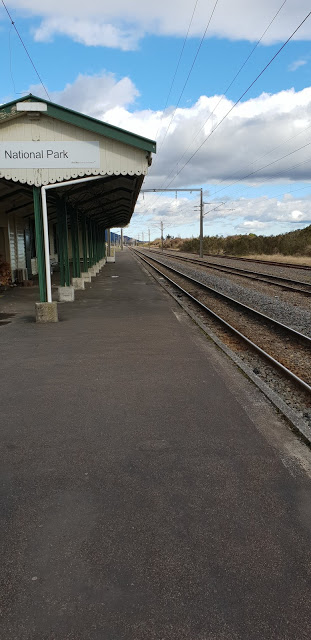
The second, one we were advised to use, operates from a place called National Park, about 9 km away, a snow shuttle that costs $6 each.  The trouble is by the time we were ready to go there, to catch a shuttle, there were no more shuttles.

We did not know what to expect when we got to ‘National Park’, but being a railway station makes sense.  It’s the only place with a very large carpark!

Oh, well, there’s always tomorrow.

The cinema of my dreams – I always wanted to write a war story – Episode 9

This is a story inspired by a visit to an old castle in Italy. It was, of course, written while travelling on a plane, though I’m not sure if it was from Calgary to Toronto, or New York to Vancouver.

But, there’s more to come. Those were long flights…

And sadly when I read what I’d written, off the plane and in the cold hard light of dawn, there were problems, which now in the second draft, should provide the proper start.


They always come for you just before dawn.

I could hear the words being spoken by Sergeant Major during lesson one of torture training.  Not us giving it to them, but them giving it to us.  Why?  For some reason at that hour of the morning, you were still asleep, or half asleep, and totally unprepared.

So, lesson number one, if you found yourself in that situation, waiting, you needed to prepare.

Easy to say, not so easy to do.  He then went on to outline the methods to employ when faced with an imminent interrogation.  The problem was, he also told us the methods that would be employed, and that was basically terrifying.  I saw men stronger than me wilting at the thought.

And, right there, sitting in that cold cell, it was not only the cold that was making me shiver.

I wasn’t a brave man.  I think sometimes I might classify myself as stupid, and with a devil may care attitude, to life and other situations; in war, every day could be your last, but I’d always considered it would be a bomb or a bullet.

Something instant, with no time to go through an agonising process of extreme pain, before dying.  Everything that went against the purpose of torture.

But not today.

I heard the sound of a key turning in a lock, in a door that was at the other end of the passage, the sound of the captors coming.

For me?  Or for someone else?

Was it selfish of me to want it to be someone else?

The door swung open with a groan, it had been oiled, but the rust was still thick enough to impede progress.  I was glad of it, it gave me time to compose myself.  I think by then I had convinced myself it was time.   Wallace wasn’t happy I was still alive, and I suspect Johansson had stopped Jackerby killing me for him because I had useful information.

That usefulness would end if I didn’t co-operate.

I could hear the boots on cobbles coming towards my cell, then felt, rather than saw the guards.

I stood and took several steps back from the door.  I could see one of the guards had a gun, trained on me, ready to shoot if I tried anything, flattered that someone thought I might try to resist or escape.  I had given it some thought, weighed the possibilities, and the odds were I’d be shot before I got 10 yards.

“Don’t try anything or you will be shot.”  Surprisingly unaccented English, but an unsurprising threat.  

A different guard, standing back from the door, key in hand, and in the light so that I could see him.  Why?  This one didn’t look German, and he was someone I hadn’t seen before, obviously one of the new arrivals.

Jackerby’s handpicked torture squad?

The door was unlocked and swung outwards, held onto by the man who issued the threat.

The other guard had stepped back two paces.  “Follow him.  I’ll be right behind.  Don’t try anything.”

He didn’t have to add anything to that command.  He was seven inches taller and 60 pounds plus heavier than I was.  Implied message understood.

I followed the guard in front.

© Charles Heath 2019

In a word: Line

The English language has some marvelous words that can be used so as to have any number of meanings

For instance,

Draw a line in the sand

We would all like to do this with our children, our job, our relationships, but for some reason, the idea sounds really good in our heads, but it never quite works out in reality. What does it mean, whatever it is, this I’d where it ends or changes because it can’t keep going the way it is.

Inevitably it leads to,

You’ve crossed the line

Which at some point in our lives, and particularly when children, we all do a few times until, if we’re lucky we learn where that line is. It’s usually considered 8n tandem with pushing boundaries.

Of course, there is

A line you should never cross

And I like to think we all know where that is. Unfortunately, some do not and often find their seemingly idyllic life totally shattered beyond repair. An affair from either side of a marriage or relationship can do that.

You couldn’t walk a straight line if you tried

While we might debate what straight might mean in this context, for this adaptation it means staying on the right side of legality. Some people find a life of crime more appealing than doing honest days work.

This goes hand in hand with,

You’re spinning me a line

Which means you are being somewhat loose with the truth, perhaps in explaining where you’ve been and what you’ve been doing. I think sometimes liars forget they need to have good memories.

Then there are the more practical uses of the word, such as

I have a new line of products

Is that a new fishing line?

Those I think most of us get, but it’s the more ambiguous that we have trouble with. Still, ambiguity is a writer’s best friend and we can make up a lot of stuff from just using one word.

“Trouble in Store” – Short stories my way: The shopkeeper

It’s now time to look at the shopkeeper’s involvement, and there’s more to him and his activities than meets the eye.

With this event, it appears his luck is about to run out.


This wasn’t the shopkeeper’s first hold up.  In fact, over the years there had been a dozen.  But only one got reported to the police, and that was only because the robber was shot and killed.

He’d taken a bullet that night, too, which, from the police point of view, made him a concerned citizen simply defending himself.

The rest had been scared off by the double-barrel shotgun he kept under the counter for just such emergencies.

The young punk who came into the shop with his girlfriend had pulled out the pistol and told him if he reached for the shotgun he’d shoot him.  The kid looked unstable and he’d backed away.

When the kid collapsed, he should have gone for the shotgun, but instead, he thought he could get to the gun before the girl realized what was happened.  She wasn’t an addict and clearly looked like she was only along for the ride.  Her look when the kid pulled out the gun told him she’d known nothing about her partner’s true intentions.

But, he wasn’t fast enough, and she had the gun pointing at him before he’d got past the counter.

From one pair of unpredictable hands to another.

Like the girl, he was just as surprised when the customer burst in the door, just before closing time.

The situation might have been salvageable before the customer came in the door, getting the girl to go along with the robbery being about money, but there was no denying what the kid on the floor’s problem was.

Damn.

He had to try and salvage the situation simply because there was a lot of money involved, and other people depending on him.  He looked at the boy, on the floor, then the girl.

“Listen to me, young lady, you would be well advised to let this man go as he suggests.  And, please put the gun down before someone gets hurt.  Your friend needs medical help and I can call an ambulance.”

The girl switched her attention back to him.  “No one’s going anywhere, so just shut the hell up and let me think.”

The storekeeper glanced over at the customer. 

He’d seen him come into the shop once or twice, probably lived in the neighborhood, the sort who’d make a reliable witness, either a lawyer or an accountant.  Not like most of the residents just beyond the fringe of respectability.

If only he hadn’t burst into the shop when he did.


© Charles Heath 2018-2020

An excerpt from “If Only” – a work in progress

Investigation of crimes doesn’t always go according to plan, nor does the perpetrator get either found or punished.

That was particularly true in my case.  The murderer was incredibly careful in not leaving any evidence behind, to the extent that the police could not rule out whether it was a male or a female.

At one stage the police thought I had murdered my own wife though how I could be on a train at the time of the murder was beyond me.  I had witnesses and a cast-iron alibi.

The officer in charge was Detective First Grade Gabrielle Walters.  She came to me on the day after the murder seeking answers to the usual questions like, when was the last time you saw your wife, did you argue, the neighbors reckon there were heated discussions the day before.

Routine was the word she used.

Her Sargeant was a surly piece of work whose intention was to get answers or, more likely, a confession by any or all means possible.  I could sense the raging violence within him.  Fortunately, common sense prevailed.

Over the course of the next few weeks, once I’d been cleared of committing the crime, Gabrielle made a point of keeping me informed of the progress.

After three months the updates were more sporadic, and when, for lack of progress, it became a cold case, communication ceased.

But it was not the last I saw of Gabrielle.

The shock of finding Vanessa was more devastating than the fact she was now gone, and those images lived on in the same nightmare that came to visit me every night when I closed my eyes.

For months I was barely functioning, to the extent I had all but lost my job, and quite a few friends, particularly those who were more attached to Vanessa rather than me.

They didn’t understand how it could affect me so much, and since it had not happened to them, my tart replies of ‘you wouldn’t understand’ were met with equally short retorts.  Some questioned my sanity, even, for a time, so did I.

No one, it seemed, could understand what it was like, no one except Gabrielle.

She was by her own admission, damaged goods, having been the victim of a similar incident, a boyfriend who turned out to be an awfully bad boy.  Her story varied only in she had been made to witness his execution.  Her nightmare, in reliving that moment in time, was how she was still alive and, to this day, had no idea why she’d been spared.

It was a story she told me one night, some months after the investigation had been scaled down.  I was still looking for the bottom of a bottle and an emotional mess.  Perhaps it struck a resonance with her; she’d been there and managed to come out the other side.

What happened become our secret, a once-only night together that meant a great deal to me, and by mutual agreement, it was not spoken of again.  It was as if she knew exactly what was required to set me on the path to recovery.

And it had.

Since then, we saw each about once a month in a cafe.   I had been surprised to hear from her again shortly after that eventful night when she called to set it up, ostensibly for her to provide me with any updates on the case, but perhaps we had, after that unspoken night, formed a closer bond than either of us wanted to admit.

We generally talked for hours over wine, then dinner and coffee.  It took a while for me to realize that all she had was her work, personal relationships were nigh on impossible in a job that left little or no spare time for anything else.

She’d always said that if I had any questions or problems about the case, or if there was anything that might come to me that might be relevant, even after all this time, all I had to do was call her.

I wondered if this text message was in that category.  I was certain it would interest the police and I had no doubt they could trace the message’s origin, but there was that tiny degree of doubt, about whether or not I could trust her to tell me what the message meant.

I reached for the phone then put it back down again.  I’d think about it and decide tomorrow.

© Charles Heath 2018-2020

We have this sport called Australian Rules Football

In Melbourne, it’s an institution even a religion.  Traditionally it is played on a Saturday afternoon and luckily for us, we were attending such a game.

Of course, this was before 2020, before the COVID 19 virus everything, including football, has been called off.

Now, we’re subject to the off outbreak that sees games transferred to other states, and sometimes without crowds. We just stick to watching it on TV these days.

Except now we have ‘flattened the curve’ football can start again, sometimes with sometimes without the spectators.  Social distancing means we can’t pack the stadium, or rarely even go to a game.  For a while, it was just to be from our lounge rooms, watching it on the TV.

But, as some of the states began to get on top of the virus, football teams moved from Victoria and played in Sydney, Adelaide, Perth, and the Northern Territory.

And as the Victorian situation got worse, the decision was made to move the grand final, which had never left the MCG in Victoria, to Brisbane. It was like America never lost the Americas Cup, until they did.

But, below, is the atmosphere that we have been missing, and has returned in a limited sense as coronavirus restrictions eased (but not completely), a game we attended last year:

The stadium is the MSG, one of the biggest and best in Australia.  Shortly after the start, I’d estimate there are about 40,000, but eventually, we were told there were 53,000, spectators here for a clash between the two Melbourne-based teams.  It is not unheard of to have closer to 90,000 spectators, and the atmosphere is at times electric.

For the die-hards like me who can remember the days when there were only Victorian-based teams,  in the modern-day form of the game, to have two such teams is something of a rarity.

However, it’s not so much about the antics on the field as it is about the spectators.  They are divided into three groups, the members, the private boxes, and the general public.

But in the end, there is no distinction between any of them because they all know the rules, well, their version of them, and it doesn’t matter who you are, if there is something that goes against your team, it is brings a huge roar of disapproval.

Then there are ebbs and flows in the crowd noise and reactions to events like holding the ball attracting a unified shout ‘ball, or a large collective groan when a free kick should have been paid or by the opposite team’s followers if it should have been.

It is this crowd reaction that makes going to a live game so much better than watching it televised live.  The times when players take marks, get the ball out of congestion, and when goals are scored when your team is behind and when one is needed to get in front.

This is particularly so when one of the stars goes near the ball and pulls off a miracle 1 percent movement of the ball.  These are what we come to see, the high-flying marks, the handball threaded through a needle, a kick that reaches one of our players that looked like it would never get there, an intercept mark or steal that throws momentum the opposite way.

This game is not supposed to be a game of inches but fast yards, a kick, a mark, a handball, a run, and a bounce or two.  You need to get the ball to your goal as quickly as possible.

That’s the objective.

But in this modern game, much to the dismay of spectators and commentators alike, there is this thing called flooding where all 36 players are basically in a clump around the ball and it moves basically in inches, not yards.

It is slow and it is ugly.

It is not the game envisioned by those who created it and there is a debate right now about fixing it.

Here, it is an example of the worst sort.  This game is played in four quarters and for the first two, it is ugly scrappy play with little skill on display.  The third shows improvement and it seems the respective coaches had told their players to open it up

They have and it becomes better to look at.

But this is the point where one team usually gets away with a handy lead, a third-quarter effort that almost puts the game out of reach.  The fourth quarter is where the losing team stages a comeback, and sometimes it works sometimes it does not.

The opposition gives it a red hot try but is unsuccessful.  Three goals in a row, it gave their fans a sniff of hope but as the commentators call it, a kick against the flow, and my team prevails.

It is the moment to stay for when they play the winning team’s song over the stadium’s loudspeaker system, and at least half the spectators sing along.  It is one of that hair raising on the back of your neck moments which for some can be far too few in a season

We have great hopes for our team this year, and it was worth the trek from Brisbane to Melbourne to see it live rather than on the TV

Leaving the ground with thousands of others heading towards the train station for the journey home there is a mixture of feelings, some lamenting their teams, and others jubilant their team won.  There is no rancor, everyone shuffles in an orderly manner, bearing the slow entry to the station, and the long lines to get on the train.

Others who perhaps came by car, or who have decided to wait for a later train or other transport, let their children kick the football around on the leaf-covered parkland surrounding the stadium.

It is an integral part of this game that children experience the football effect.  Kicking a ball with your father, brothers, and sisters, or friends on that late autumn afternoon is a memory that will be cherished for a long long time.

It’s where you pretend you are your favorite player and are every bit as good.  I know that’s what I used to do with my father, and that is what I did with my sons.

But no matter what the state of the game, it is the weekend the football fans look forward to and who turn out in their hundreds of thousands.  It is a game that ignites passions, it brings highs and it brings incredible lows.

And, through thick and thin, we never stop supporting them.

“The Things We Do For Love” – Coming soon

Is love the metaphorical equivalent to ‘walking the plank’; a dive into uncharted waters?

For Henry the only romance he was interested in was a life at sea, and when away from it, he strived to find sanctuary from his family and perhaps life itself.  It takes him to a small village by the sea, s place he never expected to find another just like him, Michelle, whom he soon discovers is as mysterious as she is beautiful.

Henry had long since given up the notion of finding romance, and Michelle couldn’t get involved for reasons she could never explain, but in the end both acknowledge that something happened the moment they first met.  

Plans were made, plans were revised, and hopes were shattered.

A chance encounter causes Michelle’s past to catch up with her, and whatever hope she had of having a normal life with Henry, or anyone else, is gone.  To keep him alive she has to destroy her blossoming relationship, an act that breaks her heart and shatters his.

But can love conquer all?

It takes a few words of encouragement from an unlikely source to send Henry and his friend Radly on an odyssey into the darkest corners of the red light district in a race against time to find and rescue the woman he finally realizes is the love of his life.

The cover, at the moment, looks like this:

lovecoverfinal1

A photograph from the inspirational bin – 2

It’s the obvious items in the photograph that you see first, or that your eyes go to first.

The ocean, the beach, the buildings. You can see a shopping mall with MacDonald’s sign above it.

Yes, it’s late afternoon, and you can see long shadows of the buildings.

So, if I asked you what did you see in this photo, what would your reply be?

From a thriller writer or murder mystery writer’s point of view, it’s what you don’t necessarily see.

So, for the purposes of the story, the opening line for the world-weary detective, handing the photo to his partner, “What’s is it you can’t see in this photo?”

A partner that hadn’t been on the job very long, in from the suburbs, and had seen little more than break and enters car theft, and school kids hi-jinks.

“What am I supposed to be looking for?”

“You want to be a detective, or be looking for old ladies cats?”

His partner takes the photo in hand and looks at it again.  There has to be a reason why the old man had given it to him, or perhaps there wasn’t and he was just playing with him again.

No, he thought, there has to be something…

And then he saw it, quite by accident.  A hand, a gun, and following the line of fire, at the end, what looked like someone in the bushes.

In a photo taken from a higher floor of the building over the road, looking down on what was supposed to be a rooftop recreational area.

Only there had been no report of a missing person or a gunshot wound in the last seven days.

“When was it taken?”

“Two days ago?”

“And no reports of a shooting, or a body?”

“No.  And yet the person who took this swears he saw a body, but by the time he came back, there was nothing.”

The detective handed his partner a second photo.  Time-stamped five minutes later.  With no gun and no body.

What will happen next?

The story behind the story: A Case of Working With the Jones Brothers

To write a private detective serial has always been one of the items at the top of my to-do list, though trying to write novels and a serial, as well as a blog, and maintain a social media presence, well, you get the idea.

But I made it happen, from a bunch of episodes I wrote a long, long time ago, used these to start it, and then continue on, then as now, never having much of an idea where it was going to end up, or how long it would take to tell the story.

That, I think is the joy of ad hoc writing, even you, as the author, have as much idea of where it’s going as the reader does.

It’s basically been in the mill since 1990, and although I finished it last year, it looks like the beginning to end will have taken exactly 30 years.  Had you asked me 30 years ago if I’d ever get it finished, the answer would be maybe?

My private detective, Harry Walthenson

I’d like to say he’s from that great literary mold of Sam Spade, or Mickey Spillane, or Phillip Marlow, but he’s not.

But, I’ve watched Humphrey Bogart play Sam Spade with much interest, and modeled Harry and his office on it.  Similarly, I’ve watched Robert Micham play Phillip Marlow with great panache, if not detachment, and added a bit of him to the mix.

Other characters come into play, and all of them, no matter what period they’re from, always seem larger than life.  I’m not above stealing a little of Mary Astor, Peter Lorre or Sidney Greenstreet, to breathe life into beguiling women and dangerous men alike.

Then there’s the title, like

The Case of the Unintentional Mummy – this has so many meanings in so many contexts, though I image back in Hollywood in the ’30s and ’40s, this would be excellent fodder for Abbott and Costello

The Case of the Three-Legged Dog – Yes, I suspect there may be a few real-life dogs with three legs, but this plot would involve something more sinister.  And if made out of plaster, yes, they’re always something else inside.

But for mine, to begin with, it was “The Case of the …”, because I had no idea what the case was going to be about, well, I did, but not specifically.

Then I liked the idea of calling it “The Case of the Brother’s Revenge” because I began to have a notion there was a brother no one knew about, but that’s stuff for other stories, not mine, so then went the way of the others.

Now it’s called ‘A Case of Working With the Jones Brothers’, finished the first three drafts, and at the editor for the last.

I have high hopes of publishing it in early 2021.  It even has a cover.

PIWalthJones1