“Quickly, quickly…” – a short story


It was odd having a voice in your head, well, not really in your head as such, but in your ear, and sounding like it was in your head.

You could truthfully say you were hearing voices.

It was the next step after going through some very intensive training, having someone else as your eyes and ears when breaching a secure compound, and avoiding the enemy.

I’d signed on for this extra training thinking one day it would land me in the thick of the action. Some of the others thought I was mad, but someone had to do it, and the fact it was quite dangerous added just that extra bit to it.

But as they say, what you learn in training, and practise in a non-hostile environment, is nothing like being in that same situation in reality.

Now on was on my first assignment, part of an elite team, packed and taken to what was to everyone else, an unspecified location, but to us, it was the point of incursion.

The mission?

To rescue a government official (that was how he was described to us) who had been illegally detained in a foreign prison.

Our job?

To break him out and get out without the knowledge of the prison staff, or anyone representing that government. Yes, what we were doing was highly illegal, and yes, if we were caught it was more likely than not we would be executed as spies.

We were under cover in an abandoned farmhouse about three miles from the prison. We had been brought in under cover of darkness, and had only a few hours to set up, and then wait it out until the following night.

It was now or never, the weather people predicting that there would be sufficient cloud cover to make us invisible. Two of us were going in, and two remaining strategically placed outside to monitor the inside of the prison through a system of infrared scanners. We also had a floor plan of the building in which the prisoner was being held, and intelligence supplied, supposedly, by one of the prison guards who had been paid a lot of money for information on guard movements.

To me, it was a gigantic leap of faith to trust him, but I kept those thoughts to myself.

We had been over the plan a dozen times, and I’d gone through the passageways, rooms, and doors so many times I’d memorised where they were and would be able to traverse the building as if I had worked there for a lifetime. Having people outside, talking me through it was just an added benefit, along with alerts on how near the guards were to our position.

I was sure the other person going with me, a more seasoned professional who had a number of successful missions under his belt, was going through the same motions I was. After all, it was he who had devised and conducted the training.

There was a free period of several hours before departure, time to listen to some music, empty the head of unwanted thoughts, and get into the right mindset. It was no place to get tangled up in what-ifs, if anything went wrong, it was a simple matter of adapting.

Our training had reinforced the necessity to instantly gauge a situation and make changes on the fly. There would literally be no time to think.

I listened to the nuances of Chopin’s piano concertos, pretending to play the piano myself, having translated every note onto a piano key, and observing it in my mind’s eye.

My opposite number played games of chess in his head. We all had a different method of relaxing.

Until it was 22:00 hours, and time to go.

“Go left, no, hang on, go right.” The voice on my ear sounded confused and it was possible to get lefts and rights mixed up, if you were not careful.

It didn’t faze me, I knew from my study of the plans that once inside the perimeter fence, I had to go right, and head towards a concrete building the roof of which was barely above the ground.

It was once used as a helipad, and underneath, before the site became a prison, the space was used to make munitions. And it was an exceptionally large space that practically ran under the whole of the prison, built above ground.

All that had happened was the lower levels were sealed, covered over and the new structures built on top. Our access was going to be from under the ground.

Quite literally, they would not see, or hear, us coming.

The meteorological people had got it right, there was cloud cover, the moon hidden from view, and the whole perimeter was in inky darkness. Dressed in black from head to foot, the hope was we would be invisible.

There were two of us heading to the same spot, stairs that led down to a door that was once one of the entrances to the underground bunker. We were going separate ways in case one of the other was intercepted in an unforeseen event.

But, that part of the plan worked seamlessly, and we both arrived at the same place nearly at the same time.

Without the planning, we might easily have missed it because I didn’t think it would be discernable even in daylight.

I followed the Sergeant downstairs, keeping a watchful eye behind us. I stooped at the point where I could see down, and across the area we had just traversed.

Nothing else was stirring.

As expected, the door was seamless and without an apparent handle. It may have had one once, but not anymore, so anyone who did stumble across it, couldn’t get in.

Except us. We had special explosives that were designed to break the lock, and once set, would not make a lot of noise. Sixty seconds later we were inside, and the door closed so no one would know we’d broken in.

I was carrying a beacon so that the voice in my head could follow my progress. The sergeant had one too, and he led.

“Straight ahead, 200 yards, then another door. It shouldn’t be locked, but it might be closed.”

In other words, we had no way of knowing. Our informant had said no one had been down in the dungeons, as he called them, since the munition factory closed, and had been sealed up soon after the prison building had been handed over for use.

We were using night goggles, and there was a lot of rubbish strewn over the floor area so we had to carefully pick our way through which took time we really didn’t have. It looked as though our informant was right, no one had been down there for a long time. We were leaving boot prints in the dust.

We reached the door ten minutes later than estimated. Losing time would have a flow-on effect, and this operation was on a very tight time constraint.

“Once you are through the door, there’s a passage. Turn left and go about 50 paces. There should be another passage to your right.”

“Anyone down here?”

“No, but there is a half dozen prison officers above you. Standard patrol, from guardhouse to guardhouse. Unless they can hear you through five feet of solid concrete, you’re safe.”

My instincts told me five feet of concrete were not enough, but I’ll let it ride for the moment.

The door was slightly ajar and it took the two of us to pull it open so that we could get past. Behind it was the passage, going left and right. Trusting my invisible guide was not getting mixed up again, I motioned right, and we headed down the passage.

Despite the fact we should be alone, both of us were careful not to make any noise, and trod carefully.

At 50 or so paces, the passage came into sight. The sergeant went ahead. I stayed back and kept an eye in both directions. The passage before us was the one that would take us under the cell of the captive we were sent to retrieve.

There would be no blasting our way in. The floor to the cell had a grate, and when removed, a person could drop down into the ‘dungeon’. Currently, the grate was immovable, but we had the tools to fix that.

The sergeant would verify the grate was where it was supposed to be, then come back to get me.

Five minutes passed, then ten. It was not that far away.

I was about to go search when the voice in my head returned, but with panic. “We’ve been compromised. Get the hell out of there, now. Quickly…”

Then I heard what sounded like gunshots, then nothing.

A minute later there was a new voice. “I don’t know who you are, but I’d strongly advise you give yourself up to the guards. Failure to do so within one hour, I’ll execute the two men I now have in custody.”

Ahead of me there was a sudden explosion, followed by a cloud of dust and fine debris.

Hand grenade, or mine, it didn’t matter. The sergeant wouldn’t be coming back.

I sighed.

Plan B it was.

© Charles Heath 2021

The story behind the story: A Case of Working With the Jones Brothers

To write a private detective serial has always been one of the items at the top of my to-do list, though trying to write novels and a serial, as well as a blog, and maintain a social media presence, well, you get the idea.

But I made it happen, from a bunch of episodes I wrote a long, long time ago, used these to start it, and then continue on, then as now, never having much of an idea where it was going to end up, or how long it would take to tell the story.

That, I think is the joy of ad hoc writing, even you, as the author, have as much idea of where it’s going as the reader does.

It’s basically been in the mill since 1990, and although I finished it last year, it looks like the beginning to end will have taken exactly 30 years.  Had you asked me 30 years ago if I’d ever get it finished, the answer would be maybe?

My private detective, Harry Walthenson

I’d like to say he’s from that great literary mold of Sam Spade, or Mickey Spillane, or Phillip Marlow, but he’s not.

But, I’ve watched Humphrey Bogart play Sam Spade with much interest, and modeled Harry and his office on it.  Similarly, I’ve watched Robert Micham play Phillip Marlow with great panache, if not detachment, and added a bit of him to the mix.

Other characters come into play, and all of them, no matter what period they’re from, always seem larger than life.  I’m not above stealing a little of Mary Astor, Peter Lorre or Sidney Greenstreet, to breathe life into beguiling women and dangerous men alike.

Then there’s the title, like

The Case of the Unintentional Mummy – this has so many meanings in so many contexts, though I image back in Hollywood in the ’30s and ’40s, this would be excellent fodder for Abbott and Costello

The Case of the Three-Legged Dog – Yes, I suspect there may be a few real-life dogs with three legs, but this plot would involve something more sinister.  And if made out of plaster, yes, they’re always something else inside.

But for mine, to begin with, it was “The Case of the …”, because I had no idea what the case was going to be about, well, I did, but not specifically.

Then I liked the idea of calling it “The Case of the Brother’s Revenge” because I began to have a notion there was a brother no one knew about, but that’s stuff for other stories, not mine, so then went the way of the others.

Now it’s called ‘A Case of Working With the Jones Brothers’, finished the first three drafts, and at the editor for the last.

I have high hopes of publishing it in early 2021.  It even has a cover.

PIWalthJones1

In a word: Dear

Yes, it’s that simple word that we use to call someone affectionately.

Or sometimes, with a little accent on the word; yes, dear and no, dear.

In other words, it’s a person regarded with deep affection.

It can also mean expensive, by saying, that’s a bit dear, isn’t it, when we’re really saying it’s way overpriced.

I can’t remember how many times I’ve said something is ‘too dear’ to the children.

Grannies tend to use the expression, ‘be a dear and…’, to get you do do something for them.

Friends, sometimes tongue in cheek, will say, ‘oh dear, I’ve upset you’, when that was exactly what they meant to do.  Friends you say?  Yes, friends indeed.

And then we always start a letter (always?  Who writes letters any more?) with

Dear John (oops, not one of THOSE letters)

Dear Sir/Madam

Of course, instead of swearing, you could simply say ‘Oh dear, you’ve let us down again!’.

And when you lose your job, which is happening a lot at the moment, it is said it would cost you dear, though sometimes it would be more appropriate to use the adverb, dearly.

It is not to be confused with the word deer which is an animal, the males of which have antlers.

There are a number of different types of deer, such as reindeer and elk.  In Canada, they are called caribou.

In Robin Hood’s day, killing deer brought you very harsh punishment.

And one of my favourite meats is venison, meat from a deer, which are farmed in New Zealand along with sheep.

In a word: Blank

Yes, I’m drawing a blank, which means I have no idea

It seems that I do this a lot these days, perhaps one of the perils of being a writer

But…

Using blank in a story doesn’t necessarily convey the antagonist is clueless, more likely he or she just used one in a gun, put there by a person who didn’t want to get shot.

No, still drawing a blank on this one.

A blank space means there’s nothing in it, and you see a lot of these in crosswords and sudoku, even when the user has been toiling for hours

I’m thinking anyone who met me might misinterpret my blank expression, well, it’s not too expressive in the first place

Perhaps before the coin becomes a coin; it is a piece of blank metal to begin with.  How good would it be to get a one-sided coin, that’d be worth a lot?

And the very worst description of blank; having a blank piece of paper in front of you, and you really are drawing a blank!

The cinema of my dreams – I always wanted to write a war story – Episode 16

For a story that was conceived during those long boring hours flying in a steel cocoon, striving to keep away the thoughts that the plane and everyone in it could just simply disappear as planes have in the past, it has come a long way.

Whilst I have always had a fascination in what happened during the second world war, not the battles or fighting, but in the more obscure events that took place, I decided to pen my own little sidebar to what was a long and bitter war.

And, so, it continues…


The message I sent to Forster, in London, was short and to the point,

‘Castle in hands of Germans led by Thompson, others, and a further 12 soldiers parachuted in.  Defectors, our original soldiers? and villagers held captive in dungeons.  Resistance limited to five plus self.  Available resources cannot retake castle and will have difficulty in intercepting incoming package.  Suggestions?’

Marina read it and added her name before it was sent.  Now, all we could do was wait for a reply, though I was not sure what Forster would make of my request for suggestions.  I was supposed to make decisions in the field, but that was when we had a full complement of resistance fighters.  What I’d discovered was the worst-case scenario, and everyone in London was hoping that would not be the case.

I wondered what happened to the two men who had been following me, hoping I would lead them to what were now the remaining resistance members.

“Did you see the two men from the castle that had been following me?  I told the two who had captured me, a man and a woman, though the man emphatically denied he worked for the resistance, about them before the woman shot me with a tranquilizer gun.”

Martina looked puzzled.  It was obvious the two hadn’t mentioned anything about my situation to her.

“That did not come up in the debriefing.  The man is, in fact, a farmer, Leonardo, who doesn’t advertise his involvement, and only works with us if we need him.  Chiara tends to shoot first and ask questions later.  You were lucky her gun wasn’t loaded with bullets.  What is this story of yours, then?”

“One of the guards released me from my cell, and then set me free with the intention of following, not too close, to see if I led them to you.  I was hiding from them when they passed by, shortly before you people turned up.  They would have had to see them if they came from the village.”

The implications of what I just said only dawned on me after I said it.

“That might mean…” I said.

She put her hand up, not wanting me to continue.

“It doesn’t necessarily mean anything, but I will have to talk to them.  If anything, they would have avoided them or ignored them.  We don’t use that track from the village to the castle for the simple reason we might run into any of them.  Whether they were originally our allies, or not, we never trusted them.”

“Did they bring me here?”

“No.  We have a separate meeting point for intercepts like yourself and the defectors.  Then, if we think it’s safe to do so, we bring them here.  Only three of us know about this place, and two of us are here now.”

“The third?”

“You’ll meet him later when he brings some food and wine.  His name is Carlo.  He used to be a gardener at the castle, and his mother was the cook.  The Germans killed her the first time they were here, and now he hates Germans.”

Good for us, very bad for anyone at the castle, particularly if they are German.

“Pity we didn’t know about that earlier so we could organise a trap for them  We could do with two fewer adversaries, and quite possibly we might get some information out of them.  They might be still in the village.”

She stood, and put on her coat, and put a gun in the coat pocket where she could easily reach it.  “I’m going to have a word with Chiara, and warn Carlo that you’re here.  He’s a little trigger happy too.  Nothing much is going to happen until we hear back from the Colonel.  I suggest you get some rest, we have a few long days ahead.”

Carlo was a surprise.  Six foot ten, over 250 pounds, and carrying a sten gun over his shoulder, not a man to become an enemy of.  He came into the room without warning, and it was clear he was expecting to see me, and equally that I might be the enemy.

It was clear that he knew how to use the weapon, and had it ready in case he had to use it.

“You this Anderson character?”

He was more English than Italian, but could certainly pass for an Italian.

“I am.”

“From up yon castle?”

“Escaped?”

“How?”

“The lower level, where there are a few storerooms turned into cells.  The passage ran alongside the outer wall to a room that had a door to the outside.  Not one you’d easily pick.”

“Neat the communications room?”

“Probably above there.”

“You know the castle?”

“A little.  I used to be an archaeologist before this war came along, and had been to the castle before the war.  I’m familiar with the above-ground parts, but not so much below.  You were, I was told, a gardener?”

“Once.”

“Then you’d know your way around?”

“Possibly.  Why?”

“Because at some point we’re going to have to retake the place, and it would be good to have someone who knows their way around.  At least, better than I do.”

“Taking prisoners?”

“No.    We will be assuming anyone there whose not a prisoner is hostile.”

“Good.  Count me in.”

He dropped a basket he’d brought with him on the table in the corner.  “Dinner.”  Marina will be back shortly.

“You’re not staying?”

“Guard duty.  So you can eat in peace.”

With that, he was gone.  A large man, but a very quiet one.  I didn’t hear him arrive, and it was very nearly the same when he left.  A useful man in a fight indeed.


© Charles Heath 2019

Searching for Locations: Waitomo caves house, North Island, New Zealand

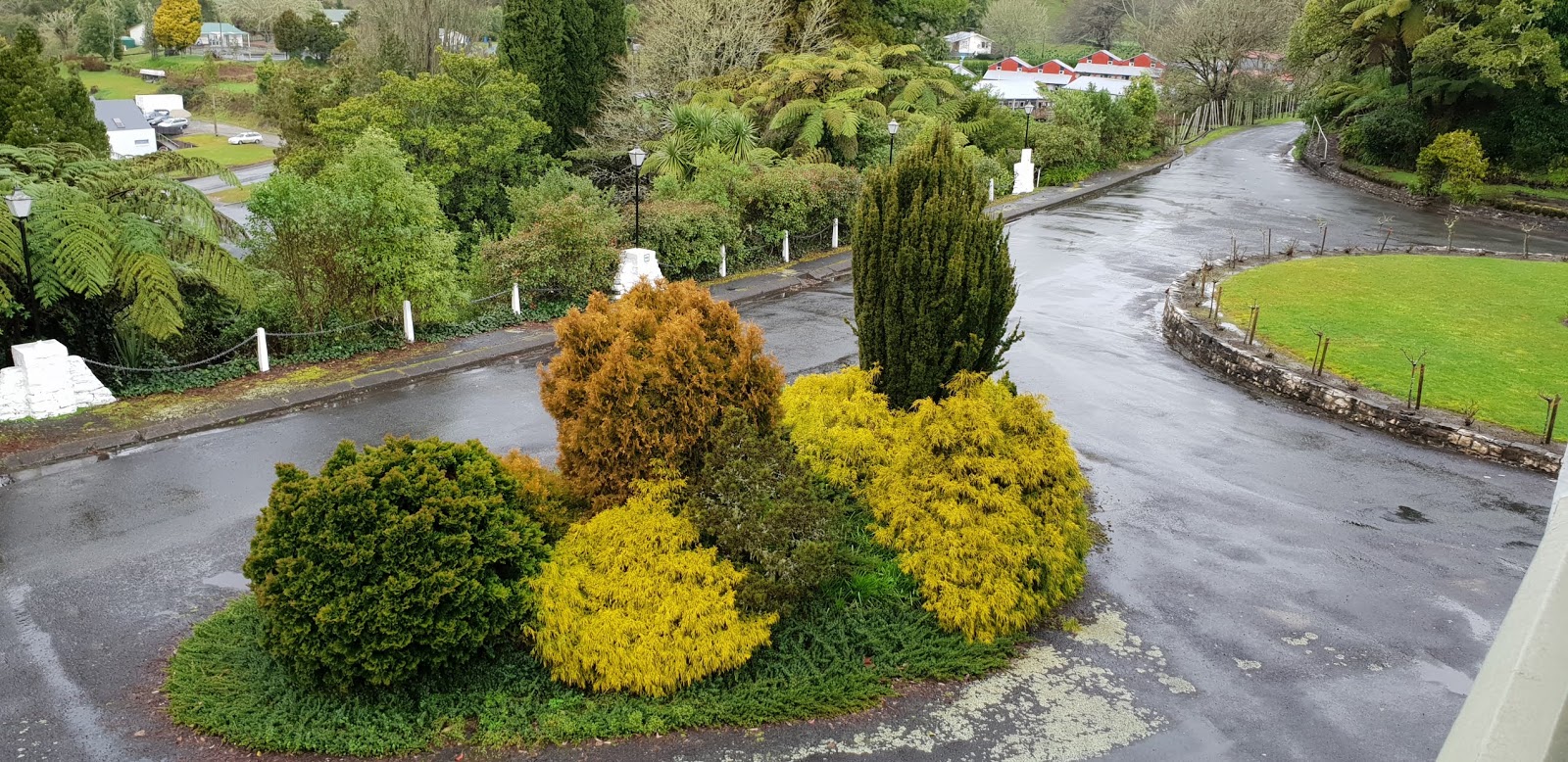
A relatively unassuming lane leads to what could be described as a grand hotel, called Waitomo Caves Hotel.

The original hotel was built in 1908, and it was later extended in 1928.  Part of it is ‘Victorian’, based on an eastern Europe mountain chalet, and part of it is ‘Art Deco’, the concrete wing, and a feature, if it could be called that, is none of the four corners are the same.

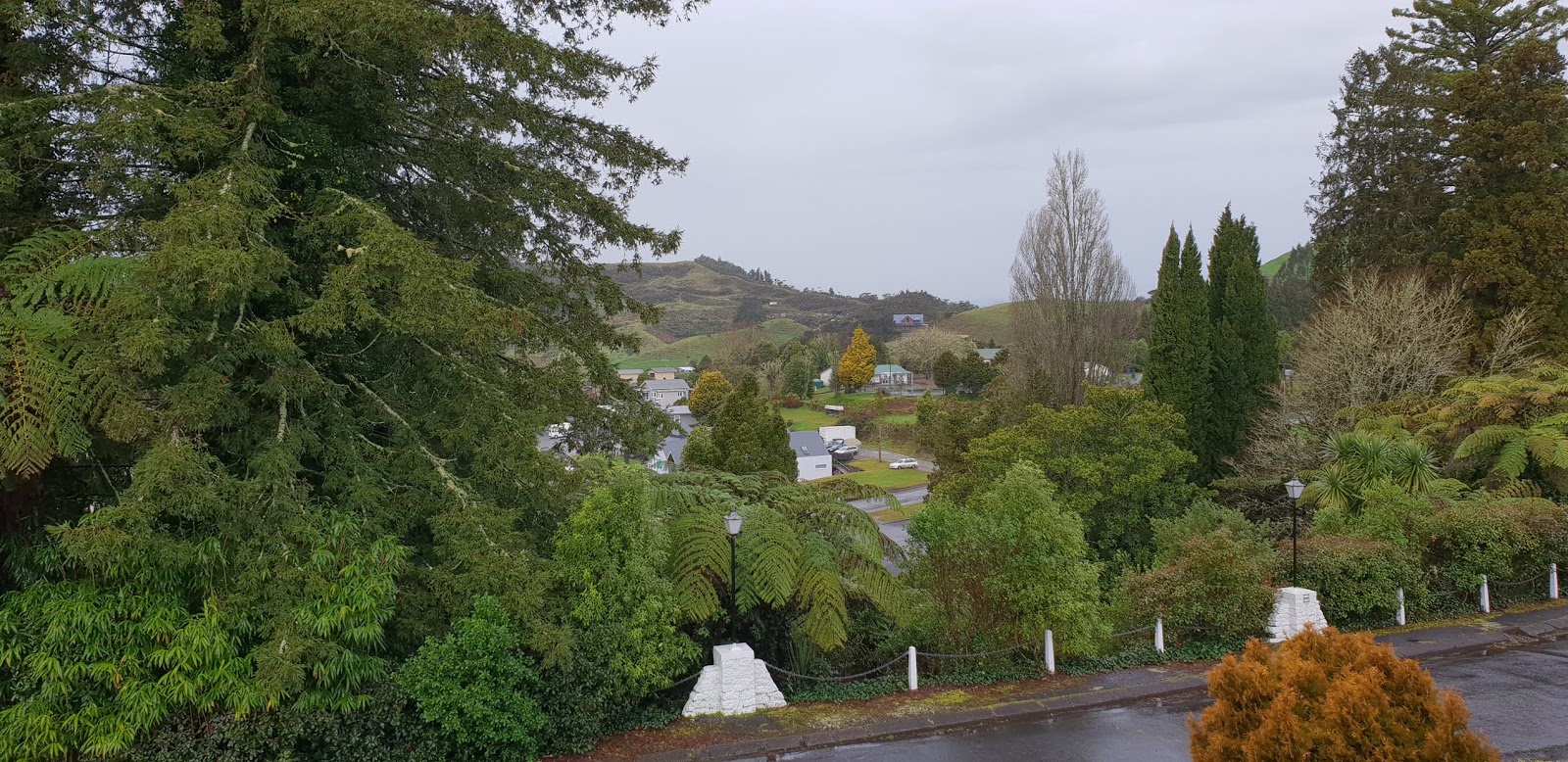
Views from the balcony show part of the surrounding gardens
 

and the town of Waitomo in the distance.
 

In gloomy weather, it does look rather spooky, and I suspect there may be a ghost or two lurking somewhere in the buildings.


But…
 

This a a very interesting, and the words of one of my younger grand daughters, a very creepy place. It would make an excellent base for paranormal activity, and there could very well be ghosts walking the corridors of this hotel.

It has the long darkish passageways that lead in all directions and to almost hidden rooms, a creepy nighttime aspect, and the creaky woodwork.

I know when we were exploring, it was easy to lose your bearings, if not get lost, trying to find certain places, and once found, hard to find your way back.

All in all, it was one of the best stays in a very old place going through the throes of modernisation.

And looking at it from the outside at night, I’ll leave you with that thought…

The cinema of my dreams – I always wanted to see the planets – Episode 50

A discussion with the Princess

I had the Princess put in one of the VIP guests’ rooms, quarters that were about four times the size of a junior officer’s room.

It was self-sufficient.

She had asked for an assistant which by her tone told me she really wanted a servant, a request I turned down because in our culture we did not believe in having servants.  We had long since removed subservience, though pockets of it still existed, labelled as something more palatable.

Instead, I assigned one of the medical staff as an assistant with strict instructions that firstly she was not there to take orders, secondly, she didn’t have to do anything she didn’t want to and thirdly to observe, and by any means possible within reason, find out more about their physiology and thought processes.

I called ahead of the visit to ensure it was convenient.  We had spoken briefly, but I had told her I would need to speak more comprehensively at a later time.  Like the other alien, she had a considerable comprehension of us and our language.

It just reinforced how insignificant we were in the universe, contrary to a lot of thinking back home who believed we were the centre of that same universe.

It was going to be a jolt to a lot of people back yo to realise we were not a superior race of beings.

Nurse Jolene Richardson was just leaving when I arrived at the door. 

“Everything going alright,” I asked.

“As well as it can.  It’s still quite difficult to wrap my head around the fact there are other people, other than us, though I have to say I never believed we were the only people in the universe.”

“I’m not sure what I believed, but that’s what we’re out here for.  You are one of the privileged few.  So far.  Done for now?”

“Time for a break.  She is very polite, but I get the impression she is lost.  If I was to make a guess, going home might be more stressful due to how long she had been away.  She wouldn’t tell me, but I suspect there might be some difficulties.”

“Thanks.”

Jolene continued on her way and I stepped into the room and the door closed behind me.

The princess was on the far side of the room, sitting comfortably on a settee, now dressed in a borrowed uniform, reading from a computer tablet.  Ancient technology to them perhaps.

“Captain.”  I waited until she looked up.

“Princess.”

“I’d rather you called me Elizabeth.  It’s not my real name, but it is an earth representation of it. Please sit.”  She waved at a chair opposite her, and I sat.  “You have questions?”

“I have an interest in where we are going, and what I might find there.  So far, we’ve met with hostility, but that, I fear, was due to some of my fellow humans doing the wrong thing, and, to a certain extent, our own lack of knowledge of local customs and protocols.  I hope to avoid that when we get to your home world.  As with the person we dealt with on the other world, you seem to know a little about us.”

“We know a lot about every world within our sphere of space travel simply because we have to.  Not all species are peaceful.  Your people, for instance, have spent centuries going to war with each other, and even now, still cannot put a combined mission together for a common cause.  That does not speak highly of your people.”

“We’ve come a long way in the last 50 years, but, as you say, not quite far enough. This mission’s parameters are to present a united front of many different people from our world.  The other ship belongs to a more avaricious group whose ideals are not the same as ours.  Unfortunately, I suspect these same traits are in your own people too.”

“We have, to use a word of yours, factions too.  We are not immune to internal struggles for leadership, and division of wealth, no matter how enlightened we become.”

And that might mean they have a little human in them.  In fact, I had always suspected that the human genome would be present in other galaxies like this, even if the people looked vastly different to us. 

In talking to the Astro physicists and anthropologists some of whom we had on board, they quite literally couldn’t predict what we might find, but the notion some of the people would be like us had been discussed.

So had the subject of robotics and the fact we might find very lifelike robots or androids.  In any case, it seemed we were predicting that the lifeforms would be far more advanced than us, and at no time have we considered they would be more primitive.

“In that, I guess we are not unlike.  But one question I have, are you like the others, a consciousness in a manufactured body?”

“I am not.  But we have developed a means of preserving our outer shells.  For instance, I am roughly 280 of your earth years old, though, in my own world, I am very young.  Our elders are roughly 1,000 of your earth years, and some of whom have transferred their consciousness mind to a more sustainable body.”

“How did you end up on the planet we rescued you from?”

“Hundreds of your years ago we were at war, not only with M but half a dozen others.  I was on a communications and transit outpost with a dozen other families when an enemy ship came, killed all the adult people and kidnapped me and twenty other children, taking us back to their world to be sold.  I have been gone a long time and I’m unsure if anyone related to me will still be very alive.”

“You see a princess.”

“A long time ago.  I went home once and it was a place I didn’t recognise.  My world had Bern conquered several times over time, and very few of my people were still alive then.  I suspect there are fewer now.”

“Then this will hardly be much of a homecoming for you.”

“But I will be home, such as it is.  I might have to beg your indulgence for a short time until I get settled.  You might also take the opportunity to talk to other new people.”

Well, I wasn’t thinking of dumping her and running, but I had to wonder if the current leadership might be equally hostile to us as the others. 

“I hope so.  I can see you’re tired.  We’ll pick this up later.”

“As you wish.”

© Charles Heath 2021-2022

An excerpt from “Strangers We’ve Become” – Coming Soon

I wandered back to my villa.

It was in darkness.  I was sure I had left several lights on, especially over the door so I could see to unlock it.

I looked up and saw the globe was broken.

Instant alert.

I went to the first hiding spot for the gun, and it wasn’t there.  I went to the backup and it wasn’t there either.  Someone had found my carefully hidden stash of weapons and removed them.

Who?

There were four hiding spots and all were empty.  Someone had removed the weapons.  That could only mean one possibility.

I had a visitor, not necessarily here for a social call.

But, of course, being the well-trained agent I’d once been and not one to be caught unawares, I crossed over to my neighbor and relieved him of a weapon that, if found, would require a lot of explaining.

Suitably armed, it was time to return the surprise.

There were three entrances to the villa, the front door, the back door, and a rather strange escape hatch.  One of the more interesting attractions of the villa I’d rented was its heritage.  It was built in the late 1700s, by a man who was, by all accounts, a thief.  It had a hidden underground room which had been in the past a vault but was now a wine cellar, and it had an escape hatch by which the man could come and go undetected, particularly if there was a mob outside the door baying for his blood.

It now gave me the means to enter the villa without my visitors being alerted, unless, of course, they were near the vicinity of the doorway inside the villa, but that possibility was unlikely.  It was not where anyone could anticipate or expect a doorway to be.

The secret entrance was at the rear of the villa behind a large copse, two camouflaged wooden doors built into the ground.  I move aside some of the branches that covered them and lifted one side.  After I’d discovered the doors and rusty hinges, I’d oiled and cleaned them, and cleared the passageway of cobwebs and fallen rocks.  It had a mildew smell, but nothing would get rid of that.  I’d left torches at either end so I could see.

I closed the door after me, and went quietly down the steps, enveloped in darkness till I switched on the torch.  I traversed the short passage which turned ninety degrees about halfway to the door at the other end.  I carried the key to this door on the keyring, found it and opened the door.  It too had been oiled and swung open soundlessly.

I stepped in the darkness and closed the door.

I was on the lower level under the kitchen, now the wine cellar, the ‘door’ doubling as a set of shelves which had very little on them, less to fall and alert anyone in the villa.

Silence, an eerie silence.

I took the steps up to the kitchen, stopping when my head was level with the floor, checking to see if anyone was waiting.  There wasn’t.  It seemed to me to be an unlikely spot for an ambush.

I’d already considered the possibility of someone coming after me, especially because it had been Bespalov I’d killed, and I was sure he had friends, all equally as mad as he was.  Equally, I’d also considered it nigh on impossible for anyone to find out it was me who killed him because the only people who knew that were Prendergast, Alisha, a few others in the Department, and Susan.

That raised the question of who told them where I was.

If I was the man I used to be, my first suspect would be Susan.  The departure this morning, and now this was too coincidental.  But I was not that man.

Or was I?

I reached the start of the passageway that led from the kitchen to the front door and peered into the semi-darkness.  My eyes had got used to the dark, and it was no longer an inky void.  Fragments of light leaked in around the door from outside and through the edge of the window curtains where they didn’t fit properly.  A bone of contention upstairs in the morning, when first light shone and invariably woke me up hours before I wanted to.

Still nothing.

I took a moment to consider how I would approach the visitor’s job.  I would get a plan of the villa in my head, all entrances, where a target could be led to or attacked where there would be no escape.

Coming in the front door.  If I was not expecting anything, I’d just open the door and walk-in.  One shot would be all that was required.

Contract complete.

I sidled quietly up the passage staying close to the wall, edging closer to the front door.  There was an alcove where the shooter could be waiting.  It was an ideal spot to wait.

Crunch.

I stepped on some nutshells.

Not my nutshells.

I felt it before I heard it.  The bullet with my name on it.

And how the shooter missed, from point-blank range, and hit me in the arm, I had no idea.  I fired off two shots before a second shot from the shooter went wide and hit the door with a loud thwack.

I saw a red dot wavering as it honed in on me and I fell to the floor, stretching out, looking up where the origin of the light was coming and pulled the trigger three times, evenly spaced, and a second later I heard the sound of a body falling down the stairs and stopping at the bottom, not very far from me.

Two assassins.

I’d not expected that.

The assassin by the door was dead, a lucky shot on my part.  The second was still breathing.

I checked the body for any weapons and found a second gun and two knives.  Armed to the teeth!

I pulled off the balaclava; a man, early thirties, definitely Italian.  I was expecting a Russian.

I slapped his face, waking him up.  Blood was leaking from several slashes on his face when his head had hit the stairs on the way down.  The awkward angle of his arms and legs told me there were broken bones, probably a lot worse internally.  He was not long for this earth.

“Who employed you?”

He looked at me with dead eyes, a pursed mouth, perhaps a smile.  “Not today my friend.  You have made a very bad enemy.”  He coughed and blood poured out of his mouth.  “There will be more …”

Friends of Bespalov, no doubt.

I would have to leave.  Two unexplainable bodies, I’d have a hard time explaining my way out of this mess.  I dragged the two bodies into the lounge, clearing the passageway just in case someone had heard anything.

Just in case anyone was outside at the time, I sat in the dark, at the foot of the stairs, and tried to breathe normally.  I was trying not to connect dots that led back to Susan, but the coincidence was worrying me.

A half-hour passed and I hadn’t moved.  Deep in thought, I’d forgotten about being shot, unaware that blood was running down my arm and dripping onto the floor.

Until I heard a knock on my front door.

Two thoughts, it was either the police, alerted by the neighbors, or it was the second wave, though why would they be knocking on the door?

I stood, and immediately felt a stabbing pain in my arm.  I took out a handkerchief and turned it into a makeshift tourniquet, then wrapped a kitchen towel around the wound.

If it was the police, this was going to be a difficult situation.  Holding the gun behind my back, I opened the door a fraction and looked out.

No police, just Maria.  I hoped she was not part of the next ‘wave’.

“You left your phone behind on the table.  I thought you might be looking for it.”  She held it out in front of her.

When I didn’t open the door any further, she looked at me quizzically, and then asked, “Is anything wrong?”

I was going to thank her for returning the phone, but I heard her breathe in sharply, and add, breathlessly, “You’re bleeding.”

I looked at my arm and realized it was visible through the door, and not only that, the towel was soaked in blood.

“You need to go away now.”

Should I tell her the truth?  It was probably too late, and if she was any sort of law-abiding citizen she would go straight to the police.

She showed no signs of leaving, just an unnerving curiosity.  “What happened?”

I ran through several explanations, but none seemed plausible.  I went with the truth.  “My past caught up with me.”

“You need someone to fix that before you pass out from blood loss.  It doesn’t look good.”

“I can fix it.  You need to leave.  It is not safe to be here with me.”

The pain in my arm was not getting any better, and the blood was starting to run down my arm again as the tourniquet loosened.  She was right, I needed it fixed sooner rather than later.

I opened the door and let her in.  It was a mistake, a huge mistake, and I would have to deal with the consequences.  Once inside, she turned on the light and saw the pool of blood just inside the door and the trail leading to the lounge.  She followed the trail and turned into the lounge, turned on the light, and no doubt saw the two dead men.

I expected her to scream.  She didn’t.

She gave me a good hard look, perhaps trying to see if I was dangerous.  Killing people wasn’t something you looked the other way about.  She would have to go to the police.

“What happened here?”

“I came home from the cafe and two men were waiting for me.  I used to work for the Government, but no longer.  I suspect these men were here to repay a debt.  I was lucky.”

“Not so much, looking at your arm.”

She came closer and inspected it.

“Sit down.”

She found another towel and wrapped it around the wound, retightening the tourniquet to stem the bleeding.

“Do you have medical supplies?”

I nodded.  “Upstairs.”  I had a medical kit, and on the road, I usually made my own running repairs.  Another old habit I hadn’t quite shaken off yet.

She went upstairs, rummaged, and then came back.  I wondered briefly what she would think of the unmade bed though I was not sure why it might interest her.

She helped me remove my shirt, and then cleaned the wound.  Fortunately, she didn’t have to remove a bullet.  It was a clean wound but it would require stitches.

When she’d finished she said, “Your friend said one day this might happen.”

No prizes for guessing who that friend was, and it didn’t please me that she had involved Maria.

“Alisha?”

“She didn’t tell me her name, but I think she cares a lot about you.  She said trouble has a way of finding you, gave me a phone and said to call her if something like this happened.”

“That was wrong of her to do that.”

“Perhaps, perhaps not.  Will you call her?”

“Yes.  I can’t stay here now.  You should go now.  Hopefully, by the time I leave in the morning, no one will ever know what happened here, especially you.”

She smiled.  “As you say, I was never here.”

© Charles Heath 2018-2022

strangerscover9

My grandmother’s house fuelled many a story

There is this thing called the march of progress.

It can be good, or it can be bad.

I remember, a long time ago now, the many holidays I spent at my grandmother’s place in the ‘country’.  Back then it was.

Now it is just another suburb of Melbourne.

I remember the drive, and it used to take about half an hour, perhaps longer, and as we traveled, it was mostly the countryside we saw.  Little towns like Beaconsfield, Officer, Berwick, oases in the middle of farming land.

The last time I went for that same drive, there was endless houses.

My grandmother’s house was very large, and the land it was built on, extensive.  There used to be gardens, several garages, a number of old cars, and a huge workshop.

My brother and I used to spend our Christmases exploring, and on a particular one, found some tools and decided to recover some of it.

We found a huge fountain buried beneath the overgrowth, the centerpiece of what must have been a remarkable display.

It was like we had our own secret garden.

There was also a fernery, also overgrown.

Now, sadly, all of it is gone, and in its place a multilane highway that follows an alternate coastal route between Melbourne and Sydney.

All I have left is the memories of a time that will never return.

And a pile of ideas for stories…

You learn something new every day (1)

And it’s not necessarily something that might be good. To be honest, I didn’t know what to think, but in a strange sort of way it put a few things into perspective.

My brother and I have been delving into the family history, or at least my brother is throwing everything at it, and I’m along for the ride.

I did have a trove of stuff that we found when cleaning out my parent’s house when they moved into aged care, and at the time I didn’t think much of it. It was more about getting them settled than figuring out what was kept.

Now, four or so years later, and having finally received an interim output of the family tree, it’s not so much the forebears that interested me, as it was my parents.

It seems that our looking at our immediate family’s potted lives is like walking through a minefield, riddled with contradictions, rumors, and anecdotal evidence that doesn’t, for the moment, have any hard evidence to back it up. Or at least some have, but that’s not the interesting part.

So, picture this. The extent of my knowledge of my immediate family was that my father is Australian, his mother English, and I’m a second-generation Australian with an English grandparent. It doesn’t sound much, but not so long ago I could have applied for and got an English passport and had dual nationality. Unfortunately, that cannot happen anymore, you have to be one or the other.

My mother’s mother was of English descent and her husband of German descent. It was understood that my grandfather on this side died not long after I was born, though for a long time we were never told how. Only recently it came to light that he had committed suicide, and my brother has a copy of the suicide note he wrote. Morbid, eh? It turns out he thought he had cancer, but didn’t and mistakenly ended his life thinking he might have been a burden on my grandmother.

But now we started digging, getting dates of birth, easy, dates of death, easy, marriage certificates, and parents’ names for this limited dip into history, relatively simple.

But the story, the real aspects of genealogy, is where they went to school, their first job, what the did in the war, that fascinating the story of their lives at different times, that’s where I’m more interested. My brother has the facts, I want to give them a story entwining those facts.

Something that adds some flesh to the story is letters.

Another recent addition to the pile of family documents are the letters between my mother and father before they were married, and the fact my mother had another boyfriend, something we never knew until the great clean up. I have those letters, or some of them too.

Those letters, from him, unfortunately, we don’t have hers, are fascinating, as are those from my father. There is no indication of why there was a breakup with the first boyfriend, but I did learn that my father had gone to an introduction agent by the name of Mrs. J Phillips who gave him her name. What factors had led him down this path?

It was, to me, very Dolly Levi-ish.

I discovered my father worked as a projectionist at the Snowy River hydro-electric project after the war., around 1948. He had spoken of showing pictures at the Athenaeum Theatre in Flinders Street, and the King’s Theatre in Melbourne, but not exactly when, which accounted for his amazing knowledge of Hollywood movie stars. It was, however, as much as he had shared for a long time.

I also discovered that he was in Perth, Western Australia immediately after the war, and then went overseas to England by ship 13th August 1947, arriving in London on 12th September, and stayed at Middlesex with relatives.

Ok, now it gets a little weird because when in Bedfordshire he became engaged to an English girl that he had (apparently) known for 10 years. How this came to pass is still a mystery awaiting an answer. The wedding was supposed to be on 21st December 1947 but never happened, because the marriage was forbidden by her parents because they did not want their daughter to move to Australia, and equally forbidden by his parents because she was Catholic.

Yes. Religion was a breaking point in those days because he was a protestant. He returned, perhaps heartbroken, a year after he left, in April 1948.

I found that for a period of two years there would be enough speculative material to fuel a very lively account of their lives, and particularly his.

My mother, by the way, spent the war years attending Dandenong High School, a steam train ride down from Pakenham to Dandenong. After that, she gained employment in Melbourne, and spend the weekdays at a Ladies Boarding House called Chalmers Hall, in Parliament Place, and going home to Pakenham on the weekends. From a note or two, it seems she was something of a ‘wild’ child who craved doing something with her evenings other than ‘staying in’, with references to her going out with her friends.

My father confessed that he was the family’s black sheep, that he didn’t get along with any of the family, and which was why he was never home and always traveling. He wrote, in one letter of October 1948, that when he got into an argument he got mad and walked out on them, and came back when calm had returned. I assume that meant it might take days, weeks, or even months for the dist to settle.

There were disputes with my father with both his brothers and his parents over marrying my mother, and there were problems between my mother and her parents, to the extent they might not attend the wedding. For a few months of tense silence, there might not have been a wedding at all, but eventually, this happened at Trinity Church, Camberwell, on the 28th of June, 1949.

Wow! It shows that illusions of what might have been their happy day turning out to be moments of high dudgeon. Oh, to have been a fly on the wall.

I still have no idea what split her and the original boyfriend, a man she’d known since she was 14, and was from her hometown area, Pakenham. It might have been something she said because there are indications on one of two draft letters that she was prone to speaking her mind, and had a temper which would not have helped in using discretion. I’m guessing a few years of war would make a man lose interest in a high minded, and perhaps a sharp-tongued woman. I suspect we’ll never know.

She is now 93 and has Alzheimer’s and dementia, and unlikely to remember back then.

Similarly, my father is 97 and I doubt sitting down with him would elicit much on the way of a sensible discussion. He was always irascible at best and oddly suffers from PTSD from his war service if that’s still possible. Over the years he was never prone to sharing his past life, except in snippets, and that, some of it was about the war. I guess war did terrible things to the participants back them

And, as for his war service, we have the physical documentation of where and when, but only a potted history of his own account of his service. But even that is a story and a half in itself.

More on that later.