The first attempt is exactly that, a first draft

That’s what it feels like after you’ve put words on paper.

The story is there waiting to be written, I know where it’s coming from, I know where I want it to go, but the words are not working.

I read it once, yuk, I read it twice, it’s begging me to press the delete button.

Now!

This is how it looks:

My life was going nowhere.  If I took a step back and took a good, long, hard look at it, what could I say was the one defining moment?

There was no defining moment.

I’d bounced around schools till the day I decided I was not cut out to learn anything more, or perhaps the teachers had given up trying to impart knowledge.  Whatever the reason, I dropped out of college and drifted.  Seasonal laborer, farmhand, factory worker, night watchman.

At least now I had a uniform and looked like I’d made something of myself.

Until I went home.

My parents were distinctly disappointed I was not married with children.

My overachieving brother always said I was a loser, and would never make anything of myself.

My ultra successful sister, married into a very wealthy family, had the regulation 2.4 children and lived in the lap of luxury, mostly pretended I didn’t exist, didn’t invite me to the wedding, and I had yet to meet the husband and children.  I guess she was ashamed of me.

This year I was avoiding going home.

This year I volunteered to work the holidays.

Yep, time to walk away and do something entirely different, like wrapping Christmas presents, my second favorite job to mowing the lawn.  Maybe if I contrive an accident with the lawnmower …

Back in front of the page, some hours later, an idea pops into my head.  The story continues:

It was 3 a.m. and it was like standing on the exact epicenter of the South Pole.  I’d just stepped from the warehouse into the car park.

The car was covered in snow.  The weather was clear now, but more snow was coming.

A white Christmas?  That’s all I needed.  I hoped I remembered to put the antifreeze in my radiator this time.

As I approached my car, the light went on in an SUV parked next to my car.  The door opened and what looked to be a woman was getting out of the car.

“Graham?”

It was a voice I was familiar with, though I hadn’t heard it for a long time.

My ultra successful sister, Penelope.  She was leaning against her car door, and from what I could see, she didn’t look too well.

“What do you want?”

“Help.”

My help, I was the last person to help her or anyone for that matter.  But curiosity got the better of me.  “Why?”

“Because my husband is trying to kill me.”

With that said, she slid down the side of the car, and I could see, in the arc lamps lighting the car park, a trail of blood.

To be honest, it needs some more thought.  IT’s got the makings of a story, but the MC shouldn’t come across as a hopeless case, he just needs to be, in part, a victim of circumstances, some of which he has to own.

But, as they say, anything on paper is better than nothing on paper.  Tomorrow, or the next day, I will edit and rewrite and see what happens.

Stay tuned.

© Charles Heath 2020

The first case of PI Walthenson – “A Case of Working With the Jones Brothers”

This case has everything, red herrings, jealous brothers, femme fatales, and at the heart of it all, greed.

See below for an excerpt from the book…

Coming soon!

PIWalthJones1

An excerpt from the book:

When Harry took the time to consider his position, a rather uncomfortable position at that, he concluded that he was somehow involved in another case that meant very little to him.

Not that it wasn’t important in some way he was yet to determine, it was just that his curiosity had got the better of him, and it had led to this: sitting in a chair, securely bound, waiting for someone one of his captors had called Doug.

It was not the name that worried him so much, it was the evil laugh that had come after the name was spoken.

Doug what? Doug the ‘destroyer’, Doug the ‘dangerous’, Doug the ‘deadly’; there was any number of sinister connotations, and perhaps that was the point of the laugh, to make it more frightening than it was.

But there was no doubt about one thing in his mind right then: he’d made a mistake. A very big. and costly, mistake. Just how big the cost, no doubt he would soon find out.

His mother, and his grandmother, the wisest person he had ever known, had once told him never to eavesdrop.

At the time he couldn’t help himself and instead of minding his own business, listening to a one-sided conversation which ended with a time and a place. The very nature of the person receiving the call was, at the very least, sinister, and, because of the cryptic conversation, there appeared to be, or at least to Harry, criminal activity involved.

For several days he had wrestled with the thought of whether he should go. Stay on the fringe, keep out of sight, observe and report to the police if it was a crime. Instead, he had willingly gone down the rabbit hole.

Now, sitting in an uncomfortable chair, several heat lamps hanging over his head, he was perspiring, and if perspiration could be used as a measure of fear, then Harry’s fear was at the highest level.

Another runnel of sweat rolled into his left eye, and, having his hands tied, literally, it made it impossible to clear it. The burning sensation momentarily took his mind off his predicament. He cursed and then shook his head trying to prevent a re-occurrence. It was to no avail.

Let the stinging sensation be a reminder of what was right and what was wrong.

It was obvious that it was the right place and the right time, but in considering his current perilous situation, it definitely was the wrong place to be, at the worst possible time.

It was meant to be his escape, an escape from the generations of lawyers, what were to Harry, dry, dusty men who had been in business since George Washington said to the first Walthenson to step foot on American soil, ‘Why don’t you become a lawyer?” when asked what he could do for the great man.

Or so it was handed down as lore, though Harry didn’t think Washington meant it literally, the Walthenson’s, then as now, were not shy of taking advice.

Except, of course, when it came to Harry.

He was, Harry’s father was prone to saying, the exception to every rule. Harry guessed his father was referring to the fact his son wanted to be a Private Detective rather than a dry, dusty lawyer. Just the clothes were enough to turn Harry off the profession.

So, with a little of the money Harry inherited from one of his aunts, he leased an office in Gramercy Park and had it renovated to look like the Sam Spade detective agency, you know the one, Spade and Archer, and The Maltese Falcon.

There’s a movie and a book by Dashiell Hammett if you’re interested.

So, there it was, painted on the opaque glass inset of the front door, ‘Harold Walthenson, Private Detective’.

There was enough money to hire an assistant, and it took a week before the right person came along, or, more to the point, didn’t just see his business plan as something sinister. Ellen, a tall cool woman in a long black dress, or so the words of a song in his head told him, fitted in perfectly.

She’d seen the movie, but she said with a grin, Harry was no Humphrey Bogart.

Of course not, he said, he didn’t smoke.

Three months on the job, and it had been a few calls, no ‘real’ cases, nothing but missing animals, and other miscellaneous items. What he really wanted was a missing person. Or perhaps a beguiling, sophisticated woman who was as deadly as she was charming, looking for an errant husband, perhaps one that she had already ‘dispatched’.

Or for a tall, dark and handsome foreigner who spoke in riddles and in heavily accented English, a spy, or perhaps an assassin, in town to take out the mayor. The man was such an imbecile Harry had considered doing it himself.

Now, in a back room of a disused warehouse, that wishful thinking might be just about to come to a very abrupt end, with none of the romanticized trappings of the business befalling him. No beguiling women, no sinister criminals, no stupid policemen.

Just a nasty little man whose only concern was how quickly or how slowly Harry’s end was going to be.

© Charles Heath 2019

In a word: Nobody

This is sometimes how we must feel when overlooked or ignored, like a nobody.

And some people will treat you like a nobody, i.e someone who is just not important.

That’s just one use of the word.

Another might be…

Who did that to your room?

‘Nobody’ is the plaintiff reply.  The infamous Mr. Nobody.  We’ve never met him, but he’s always there.  And, what’s more, he seems to be able to be in more than one place at a time.

Then there’s that time when there’s nobody in the room, nobody agreed with me, hell, that happens all the time, and when I rang your phone nobody answered.

Nobody?  Was I expecting Mr. Nobody to answer?  Surely the response should have been, ‘and you didn’t answer’.

Of course, let’s not delve too deep here, lest we might find out something we didn’t want to know.

I went to your house last night, but nobody was home.

How is it we refer to the people whom we know live in that house as ‘nobody’.  Shouldn’t we be saying, ‘none of you was at home’?

It seems nobody is one of those words we often use in vain.

In a word: Maybe

This word, where I live, had taken on a new meaning.  We have telephone scammers who ask your name when you answer the phone, and when you say yes, they hang up.

It doesn’t take much imagination how they can use that recording.

So, I now answer the phone with maybe, which confuses the real callers who want to know if it is you.

Of course, maybe is one of those words that have so many meaning, but the best one is to use it while you have time to think of a proper answer.

For example, did you get the potatoes?  You haven’t been out, it slipped your mind, or you just plain forgot, but run with a ‘maybe’ so you can judge the reaction.

Angry face, you know no matter what, you’re in trouble.

Genial face, you know that it didn’t really matter and all is forgiven.

Then there’s the person who doesn’t know you and comes up to you in a crowded room.  Are you [put name here]?

Maybe.  We want to know if we’re in trouble, or if it for something good.

Using ‘maybe’ in writing probably isn’t the best word to us, but I like defying the experts.  You can always find a maybe or two in any of my books.

Searching for locations: At large in Paris, France

We have been to Paris a number of times over the years.

The last time we visited Paris we brought the two eldest grandchildren.   We took the Eurostar train from St Pancras station direct to Disneyland, then took the free bus from the station to the hotel.  The train station was directly outside Disneyland.

We stayed at the Dream Castle Hotel, rather than Disneyland itself as it was a cheaper option and we had a family room that was quite large and breakfast was included every morning.  Then it was a matter of getting the free bus to Disneyland.

We spent three days, time which seem to pass far too quickly, and we didn’t get to see everything.  They did, however, find the time to buy two princess dresses, and then spent the rest of the time playing dress-ups whenever they could.

In Paris, we stayed at the Crown Plaza at Republique Square.

We took the children to the Eiffel Tower where the fries, and the carousel at the bottom of the tower, seemed to be more memorable than the tower itself.  The day we visited, the third level was closed.  The day was cold and windy so that probably accounted for the less than memorable visit.  To give you some idea of conditions, it was the shortest queue to get in I’ve ever seen.

We traveled on the Metro where it was pointed out to me that the trains actually ran on rubber tires, something I had not noticed before.  It was a first for both children to travel on a double-decker train.

The same day, we went to the Louvre.

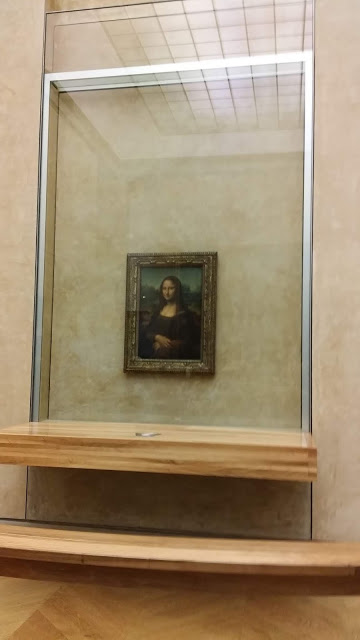
Here, it was cold, wet and windy while we waited,  Once inside we took the girls to the Mona Lisa, and after a walk up and down a considerable numkber of stairs, one said, “and we walked all this way to see this small painting”.

It quickly became obvious their idea of paintings were the much larger ones hanging in other galleries.

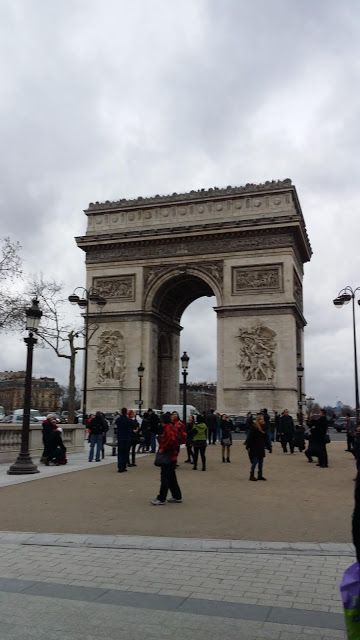
We also took them to the Arc de Triomphe.

We passed, and for some reason had to go into, the Disney shop, which I’m still wondering why after spending a small fortune at Disneyland itself.

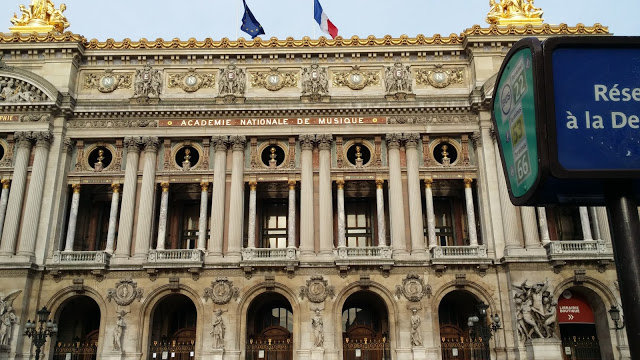
Next on the tour list was the Opera House.

 where one of the children thought she saw the ghost and refused to travel in one of the elevators.  At least it was quite amazing inside with the marble, staircases, and paintings on the roof.

Sadly, I don’t think they were all that interested in architecture, but at the Opera House, they did actually get to see some ballet stars from the Russian Bolshoi ballet company practicing.  As we were leaving the next day we could not go and see a performance.

Last but not least was Notre Dame with its gargoyles and imp[osing architecture.

All in all, traveling with children and experiencing Paris through their eyes made it a more memorable experience.

The first we visited Paris was at the end of a whirlwind bus tour, seven countries in seven days or something like that.  It was a relief to get to Paris and stay two nights if only to catch our breath.

I remember three events from that tour, the visit to the Eiffel Tower, the tour of the night lights, not that we were able to take much in from the inside of the bus, and the farewell dinner in one of the tour guides specially selected restaurants.  The food and atmosphere were incredible.  It was also notable for introducing us to a crepe restaurant in Montmartre, another of the tour guide’s favorite places.

On that trip to Paris, we also spent an afternoon exploring the Palace of Versailles.

The next time we visited Paris we flew in from London.  OK, it was a short flight, but it took all day.  From the hotel to the airport, the wait at the airport, departure, flying through time zones, arrival at Charles De Gaulle airport, now there’s an experience, and waiting for a transfer that never arrived, but that’s another story.

I can’t remember where we stayed the first time, it was somewhere out in the suburbs, but the second time we stayed at the Hilton near both the Eiffel Tower and the Australian Embassy, notable only because the concierge was dating an Australian girl working in the Embassy.  That was our ticket for special treatment, which at times you need to get around in Paris.

It was the year before 2000 and the Eiffel Tower was covered in lights, and every hour or so it looked like a bubbling bottle of champagne.  It was the first time we went to Level 3 of the Tower, and it was well worth it.  The previous tour only included Level 2.  This time we were acquainted with the fries available on the second level, and down below under the tower.

This time we acquainted ourselves with the Metro, the underground railway system, to navigate our way around to the various tourist spots, such as Notre Dame de Paris, The Louvre, Sacre-Coeur Basilica, and Les Invalides, and, of course, the trip to the crepe restaurant.

We also went to the Louvre for the express purpose of seeing the Mona Lisa, and I came away slightly disappointed.  I had thought it to be a much larger painting.  We then went to see the statue of Venus de Milo and spent some time trying to get a photo of it without stray visitors walking in front of us.  Aside from that, we spent the rest of the day looking at the vast number of paintings, and Egyptian artifacts in the Museum.

We also visited the Opera House which was architecturally magnificent.

The third time we visited Paris we took our daughter, who was on her first international holiday.  This time we stayed in a quaint Parisian hotel called Hotel Claude Bernard Saint Germain, (43 Rue Des Ecoles, Paris, 75005, France),  recommended to us by a relation who’d stayed there the year before.  It was small, and the elevator could only fit two people or one person and a suitcase.  Our rooms were on the 4th floor, so climbing the stairs with luggage was out of the question.

It included breakfast and wifi, and it was quite reasonable for the four days we stayed there.

It was close to everything you could want, down the hill to the railway station, and a square where on some days there was a market, and for those days when we were hungry after a day’s exploring, a baguette shop where rolls and salad were very inexpensive and very delicious.

To our daughter we appeared to be experienced travelers, going on the Metro, visiting the Louvre, going, yes once again, to the crepe restaurant and the Basilica at Montmartre, Notre Dame, and this time by boat to the Eiffel Tower.  We were going to do a boat rode on the Seine the last time but ran out of time.

We have some magnificent photos of the Tower from the boat.

Lunch on one of the days was at a restaurant not far from the Arc de Triomphe, where our daughter had a bucket of mussels.  I was not as daring and had a hamburger and fries.  Then we went to the center of the Arch and watched the traffic.

Our first time in Paris the bus driver got into the roundabout just to show us the dangers of driving in an unpredictable situation where drivers seem to take huge risks to get out at their exit.  Needless to say, we survived that experience, though we did make a number of circuits.

The cinema of my dreams – I always wanted to write a war story – Episode 18

For a story that was conceived during those long boring hours flying in a steel cocoon, striving to keep away the thoughts that the plane and everyone in it could just simply disappear as planes have in the past, it has come a long way.

Whilst I have always had a fascination in what happened during the second world war, not the battles or fighting, but in the more obscure events that took place, I decided to pen my own little sidebar to what was a long and bitter war.

And, so, it continues…


It was clear, however, that Marina was familiar with the man and very annoyed with the woman.

When I took a longer look at the man, I realised he was not a man at all, but a boy in his teens, blessed by the fact he looked older than he was.  My guess, about 16.  I was surprised he had not been conscripted into the war, there seemed very few young men in the area.

Marina went straight over to him and snatched the elderly rifle he was holding away from him, the glared at Chiara

“Are you stark staring mad.  Enrico is not supposed to be out in the open, hell, it’s been a battle to keep him hidden away.  What will his parents think when they discover he’s here?”

“Pleased,” Enrico said.  “My father said it’s about time I did something to rid of the Germans, of the English too for that matter.  None of you has any right to be here.”

Fervently spoken, and to the wrong person, it would earn him a bullet to the back of the head.  But I agreed with him.

“All well and good,” Marina said to him, “but now there’s no easy way of doing that.  We must be careful, and you must stay put with your parents.  What we’re doing isn’t a game, you are neither trained or equipped to take anyone on, except perhaps rabbits.”

Back at Chiara.  “Take him home, and never bring him back here.  You don’t want to be the one who has to tell his mother if he gets killed.  Now, both of you go now, before I shoot both of you myself.”

“This is not the end of the matter,” Enrico said.

“And when you’ve taken him back, come back here.  We need to talk.”

Chiara said nothing, just nodded sullenly.  I think she believed the less said the better and did as she was asked, nodding her head in his direction, and adding a few choice phrases in Italian to him that I couldn’t understand.  It also just occurred to me that she had not asked Chiara the questions about the two men from the castle.  I guess that would have to wait until the safety of Enrico was settled, and she returned.

“Make sure they’re safe,” she said to Carlo, and he disappeared, leaving us alone.

“I thought all of the young men had been taken away by the Italian Army.”

“Not all.  We managed to hide a few away, but as you can see, despite our best efforts, they don’t seem to appreciate the trouble they could get into.  We used to have about a hundred young men from 14 through to 20 at the start of the war.  Two have found their way back, casualties of war, the rest, we may never see them again.  Enrico just doesn’t see the trouble he could get into.”

“It’s called youthful enthusiasm.  In the first world war, joining up, or going to war, was a lark.  It was a little less so this time because most of the parents knew from firsthand experience what it was like and tried to shield them.  And if you didn’t join up, questions were asked, and quite often jail, except for some who landed cushy jobs away from the fighting.”

“You were not so lucky?”

“No, I was one of those mad buggers who thought joining up to fight would be an adventure.  That quickly faded when the enemy started shooting at me.”

“And now you’re here, and a spy to boot.  That’s what they’ll hang on you if you get caught.”

“Then I shall try very hard not to get caught.  Again.”


Chiara came back about an hour later.  It seemed to me it was a lot safer to move around at night with the blackout, and I doubted Thompson would spare any men from the castle to check up on the local farmers.

And while I was at the castle, I didn’t hear anything raised about the local resistance, which I thought odd at the time, but now I knew why.  Most of them had joined him.  Better that than be hunted down and killed.

Chiara still looked sullen.  A closer look showed she was not very old herself, barely out of her twenties, and surprising that the Italian army, or Thomson for that matter, had not rounded her up for ‘duties’ at the castle.

There were a number of the local women working up at the castle, but they were mostly staff, or more likely forced labour, though I had thought we, when I believed it to be a British outpost, would be fairer to the locals than either the Germans or their own Italian military.  It’s odd how you tend to look at certain situations because of who you are, and the fact you would not do similar things at home.  The Germans, however, we would always treat differently, because they were the enemy, and because we expected the worst from them.  At that moment, though, wouldn’t the Germans think the same of us if the positions were reversed?

Best not to think about that.  My view of the war and the people in it was clouded enough.

Chiara, however, clearly thought the worst of me, and of those in the castle, and certainly didn’t think I was as neutral as I appeared.  A gun always in hand, I was sure she would shoot me again with the least provocation.

We sat, both Chiara and Marina with their weapons on the table in front of them.  I wasn’t trusted enough to be given a weapon.

Marina’s first question was directed at Chiara, “I’m told there were two men from the castle following Sam, and that he told you about them.”

“He did.  We did not see them.  We didn’t take the path, because, as you know, it’s not safe.”

It was a reasonable answer.  If the men at the castle were unfamiliar with the area, as I’m sure they would be, because they hadn’t been there for very long, and I doubt Thompson would want to advertise the nationality of those at the castle unless he had to, they would stick to the clearly-marked roads and paths.

I had on my way to the castle, from a different direction.  It didn’t explain why I had not been met by the leader of the resistance as arranged, but that was now explained, both by the former leader trying to kill me in a roadside explosion, and then what I learned at the castle in the last few days.

“Even so, there’s not that much distance between the two, and it is possible to shadow them.”

“I keep well away from them.  Perhaps Leonardo saw them.  He doesn’t have to worry about what they might do because they use him to supply food.  Maybe he knows more.”

“Perhaps I shall ask him next time I see him.  We need to know who from the castle is about and when so that we don’t get caught.”

“I’ll remember next time.  Is that all?”

“Yes.”

Chiara picked up her gun, gave me an extra-long sullen stare.  “I don’t trust this one, Marina.  You 

need to be careful.”

“I will.”

We waited a few minutes until after she had departed, and then Marina said, “We should be going too.  This place is a little eerie at night.  There are far too many ghosts for my liking.”

I shuddered, then followed her out.


© Charles Heath 2019

While it seems like nothing is getting done…

This month is just beginning, and once again, I don’t feel like I’m going to make any more progress than I did the last.

Winter has all but disappeared, and Spring is around the corner. Not as cold as Lake Louise in December, but it feels like it.

What were my expectations last month? 

I had set a list of projects for the month, more episodes for the three continuing stories, and a start to the next episodic story, ‘motive, means, and opportunity’, though for this story I have brought together all the writing I’ve been doing in past weeks. But like most of these fringe stories, it has reached a point where more research is needed, and I have too much else to do.

Then there is the completion of ‘The things we do for love’. It’s finally finished and needs a read-through before going to the editor, but making time to just sit and read…?

The same applies to ‘Strangers we’ve become’ and it is in the same time-consuming basket. It needs a final read-through, so it’s on the to-do list.

It would be easy to blame COVID 19, but that’s not the problem.  I’ve been home and had the time, but there have been a number of distractions, and ideas for new stories that seem to divert my attention from what I should be doing.

It’s not writer’s block.  It’s not laziness.  It seems that I just don’t want to work on them, and that might be because there are problems with the narrative, and I’m just not ready to address them.

What has got my attention then?

I’m not sure how or why, but something triggered the idea of passing through a portal into another time, in the past.  I think I might have been looking for photographs to write another photo/story, and I came across a covered bridge, and that led to looking for photographs of ghost towns.  What topped it off, there was an old western in black and white, High Noon, which provoked a whole lot of memories of many westerns I’d seen in the past.

What other reason do you need to write your own story?

Then, when visiting my grandchildren, we just happened to do some star gazing, using Google Sky Map, and picking out the planets.  Somehow I managed to take a photo, and looking at it, took me back to the days of Star Trek, and the many series, which sort of gave me an idea for another story, which has been running off and on over the last month. It now has 53 episodes, and I need to write more, yep, on the to-do list.

Equally, I’m always on the lookout for photo opportunities that I can use to write short stories, and these continue apace, the latest being published this week, number 146.  These are being formed into anthologies, stories 1 to 50, and stories 51 to 100.  The first has been assembled into book form, and is awaiting the editors first reading and report.  I’m still working on the second.

Meanwhile, another 25 have been written and awaiting publishing.

Perhaps some of the time has been spent keeping up with Twitter, where over the last six months, and more recently, sales of my books on Amazon have been increasing.  Not to best-seller numbers, but people are reading my stories, and the reviews have been very good.

It has, of course, pushed me to work harder on marketing, and that had consumed some of my time, which unfortunately takes me away from writing.  It sometimes feels like a self-defeating exercise, but it is the same for all of us.

Oh, and something else that cropped up this month, my brother has been digging into our family history, and around the middle of the month, he found some interesting revelations about some family members, including a pseudo-Luddite, and then later on, when chasing down the places that we, as a family, lived, and this brought out some very interesting information about our father.

It also seems we may have had a distant relative on the ship that left after the Mayflower to Plymouth Rock, USA, at the very beginning. That will be remarkable if it is true.

I’m discovering for what I’d always assumed was an ordinary man, he had done a lot of very interesting things in his life, and not only that, I’ve been fictionalizing the story.  I have potted pieces written over various stages, and, one day, they might come together as a sort of biography.  It is astonishing just how much you don’t know about your family, until much later on, at least for some of us.  Our relatives have always been a mystery to me, and it’s fascinating as each one is brought to life with a new detail here and there.

Looking back on what I’ve just written, perhaps the passing of the month had been more productive than I first thought.  It just seems like nothing major has happened.

The cinema of my dreams – I always wanted to see the planets – Episode 52

Another discussion with the Princess

By definition, a voyage of exploration was about finding new lands and people.  Of course, it would be naive to think that all people would be peaceful but one could generally assume they would make some effort to make a gesture of goodwill, to begin with.

Either we had got off to bad start by starting out on the galactic version of the wrong side of the tracks or everyone in this galaxy was hostile.

Or perhaps I was making the wrong assumption but as number one said, why send three ships when one would suffice?

I decided another short visit to the Princess might clear up a few misconceptions before they became glaring errors in judgement.

She didn’t smile when she saw me.

“Let me guess, they sent a welcoming committee.”

She’d known.  And it looked like if I wanted the right answers I’d have to ask the right questions

“I take it your escape was too easy?”

“I’m surprised you didn’t realise that yourself.”

“I didn’t want to believe it, but that’s just the optimist in me.  Does this mean the people where we left are working with the people we’re going to, and are both conspiring against us?”

“Or perhaps it’s not the world, but just the one.  He knew my history, he’d know who was in power, and if I was to make an educated guess, he is likely a spy for them.  This galaxy has a history of wars, spies, and uneasy peace.  You have to pick your friends wisely.”

I’d participated in a war or two on land, not in space, and a few serious disputes over landing rights in space, but this was a whole new enterprise.

“We’re here to make friends with everyone, being the new kids on the block.”  When I saw her bewildered look, I added, ” an earth expression.  We try to make friends with everyone irrespective of who they are, where they come from, and what they’ve done.”

“I wish you well, but it’s doomed to failure.  You will have to pick a side.”

I shook my head.  “That’s the old way of thinking back home.  I’m not bringing that with us.  This is why we’re here now, mending other people’s bridges; sorry another earth expression.”

“I think I would like living on your planet now; are all the people like you?”

“Sadly no.  Unfortunately, we suffer from the problems you are all too familiar with, and even though there are enough sensible people in our world who are striving to be better, progress is slow.  Watching your planet slowly self-destruct because of greed and ignorance has helped.  It took a long time for everyone to realise we all had to live together whether we liked it or not, and that it was in everyone’s best interest to work together.”

“Everyone except the other ship’s captain.  He had a very different view of your world, one where some people are being marginalised simply because they didn’t want to join the collective.”

“It’s not that they didn’t want to join, it was because they didn’t want to share technology or resources without a cost.  We don’t like people who want to profit at the expense of others, that in itself if allowed to happen would create disproportionate wealth and inevitably power in a single entity.  We’ve been there, done that, and that’s why our world is dying.  I’m sure the first thing the other captain asked for was technology so they could take it back and sell it.”

“Isn’t that what you would also do?”

“No.  I was put here by a unified people who want what we find to be used for the benefit of everyone.  Even those who would not reciprocate if the roles were reversed.”

“Noble indeed, but most here would say misguided.  We have tried in the past to do just that, so I can tell you it will be a hard path.”

“Be that as it may it doesn’t solve our current situation.

“Then perhaps I can give you a solution, but not quite the one you’re looking for.  Maybe I could become the first alien crew member on your ship. As a member of the crew, and not leaving the ship, particularly in these parts of the galaxy, I would not be a threat to one side or used as an example by the other.  I’m sure you could find something for me to do.  It would be, using one of your analogies, a win-win situation?

© Charles Heath 2021-2022

An excerpt from “What Sets Us Apart”, a mystery with a twist

See excerpt from the story below, just a taste of what’s in store…

http://amzn.to/2Eryfth

whatsetscover

McCallister was old school, a man who would most likely fit in perfectly campaigning on the battlefields of Europe during the Second World War. He’d been like a fish out of water in the army, post-Falklands, and while he retired a hero, he still felt he’d more to give.

He’d applied and was accepted as head of a SWAT team, and, watching him now as he and his men disembarked from the truck in almost military precision, a look passed between Annette, the police liaison officer, and I that said she’d seen it all before. I know I had.

There was a one in four chance his team would be selected for this operation, and she had been hoping it would be one of the other three. While waiting for them to arrive she filled me in on the various teams. His was the least co-operative, and the more likely to make ad-hoc decisions rather than adhere to the plan, or any orders that may come from the officer in charge.

This, she said quite bluntly, was going to end badly.

I still had no idea why Prendergast instructed me to attend the scene of what looked to be a normal domestic operation, but as the nominated expert in the field in these types of situations, it was fairly clear he wasn’t taking any chances. It was always a matter of opinion between us, and generally I lost.

In this case, it was an anonymous report identifying what the authorities believed were explosives in one of the dockside sheds where explosives were not supposed to be.

The only reason why the report was given any credence was the man, while not identifying himself by name, said he’d been an explosive expert once and recognized the boxes. That could mean anything, but the Chief Constable was a cautious man.

With his men settled and preparing their weapons, McCallister came over to the command post, not much more than the SUV my liaison and I arrived in, with weapons, bulletproof vests, and rolls of tape to cordon off the area afterward. We both had coffee, steaming in the cold early morning air. Dawn was slowly approaching and although rain had been forecast it had yet to arrive.

A man by the name of Benson was in charge. He too had groaned when he saw McCallister.

“A fine morning for it.” McCallister was the only enthusiastic one here.

He didn’t say what ‘it’ was, but I thought it might eventually be mayhem.

“Let’s hope the rain stays away. It’s going to be difficult enough without it,” Benson said, rubbing his hands together. We had been waiting for the SWAT team to arrive, and another team to take up their position under the wharf, and who was in the final stages of securing their position.

While we were waiting we drew up the plan. I’d go in first to check on what we were dealing with, and what type of explosives. The SWAT team, in the meantime, were to ensure all the exits to the shed were covered. When I gave the signal, they were to enter and secure the building. We were not expecting anyone inside or out, and no movement had been detected in the last hour since our arrival and deployment.

“What’s the current situation?”

“I’ve got eyes on the building, and a team coming in from the waterside, underneath. Its slow progress, but they’re nearly there. Once they’re in place, we’re sending McKenzie in.”

He looked in my direction.

“With due respect sir, shouldn’t it be one of us?” McCallister glared at me with the contempt that only a decorated military officer could.

“No. I have orders from above, much higher than I care to argue with, so, McCallister, no gung-ho heroics for the moment. Just be ready to move on my command, and make sure you have three teams at the exit points, ready to secure the building.”

McCallister opened his mouth, no doubt to question those orders, but instead closed it again. “Yes sir,” he muttered and turned away heading back to his men.

“You’re not going to have much time before he storms the battlements,” Benson quietly said to me, a hint of exasperation in his tone. “I’m dreading the paperwork.”

It was exactly what my liaison officer said when she saw McCallister arriving.

The water team sent their ‘in position’ signal, and we were ready to go.

In the hour or so we’d been on site nothing had stirred, no arrivals, no departures, and no sign anyone was inside, but that didn’t mean we were alone. Nor did it mean I was going to walk in and see immediately what was going on. If it was a cache of explosives then it was possible the building was booby-trapped in any number of ways, there could be sentries or guards, and they had eyes on us, or it might be a false alarm.

I was hoping for the latter.

I put on the bulletproof vest, thinking it was a poor substitute for full battle armor against an exploding bomb, but we were still treating this as a ‘suspected’ case. I noticed my liaison officer was pulling on her bulletproof vest too.

“You don’t have to go. This is my party, not yours,” I said.

“The Chief Constable told me to stick to you like glue, sir.”

I looked at Benson. “Talk some sense into her please, this is not a kindergarten outing.”

He shrugged. Seeing McCallister had taken all the fight out of him. “Orders are orders. If that’s what the Chief Constable requested …”

Madness. I glared at her, and she gave me a wan smile. “Stay behind me then, and don’t do anything stupid.”

“Believe me, I won’t be.” She pulled out and checked her weapon, chambering the first round. It made a reassuring sound.

Suited up, weapons readied, a last sip of the coffee in a stomach that was already churning from nerves and tension, I looked at the target, one hundred yards distant and thought it was going to be the longest hundred yards I’d ever traversed. At least for this week.

A swirling mist rolled in and caused a slight change in plans.

Because the front of the buildings was constantly illuminated by large overhead arc lamps, my intention had been to approach the building from the rear where there was less light and more cover. Despite the lack of movement, if there were explosives in that building, there’d be ‘enemy’ surveillance somewhere, and, after making that assumption, I believed it was going to be easier and less noticeable to use the darkness as a cover.

It was a result of the consultation, and studying the plans of the warehouse, plans that showed three entrances, the main front hangar type doors, a side entrance for truck entry and exit and a small door in the rear, at the end of an internal passage leading to several offices. I also assumed it was the exit used when smokers needed a break. Our entry would be by the rear door or failing that, the side entrance where a door was built into the larger sliding doors. In both cases, the locks would not present a problem.

The change in the weather made the approach shorter, and given the density of the mist now turning into a fog, we were able to approach by the front, hugging the walls, and moving quickly while there was cover. I could feel the dampness of the mist and shivered more than once.

It was nerves more than the cold.

I could also feel rather than see the presence of Annette behind me, and once felt her breath on my neck when we stopped for a quick reconnaissance.

It was the same for McCallister’s men. I could feel them following us, quickly and quietly, and expected, if I turned around, to see him breathing down my neck too.

It added to the tension.

My plan was still to enter by the back door.

We slipped up the alley between the two sheds to the rear corner and stopped. I heard a noise coming from the rear of the building, and the light tap on the shoulder told me Annette had heard it too. I put my hand up to signal her to wait, and as a swirl of mist rolled in, I slipped around the corner heading towards where I’d last seen the glow of a cigarette.

The mist cleared, and we saw each other at the same time. He was a bearded man in battle fatigues, not the average dockside security guard.

He was quick, but my slight element of surprise was his undoing, and he was down and unconscious in less than a few seconds with barely a sound beyond the body hitting the ground. Zip ties secured his hands and legs, and tape his mouth. Annette joined me a minute after securing him.

A glance at the body then me, “I can see why they, whoever they are, sent you.”

She’d asked who I worked for, and I didn’t answer. It was best she didn’t know.

“Stay behind me,” I said, more urgency in my tone. If there was one, there’d be another.

Luck was with us so far. A man outside smoking meant no booby traps on the back door, and quite possibly there’d be none inside. But it indicated there were more men inside, and if so, it appeared they were very well trained. If that were the case, they would be formidable opponents.

The fear factor increased exponentially.

I slowly opened the door and looked in. A pale light shone from within the warehouse itself, one that was not bright enough to be detected from outside. None of the offices had lights on, so it was possible they were vacant. I realized then they had blacked out the windows. Why hadn’t someone checked this?

Once inside, the door closed behind us, progress was slow and careful. She remained directly behind me, gun ready to shoot anything that moved. I had a momentary thought for McCallister and his men, securing the perimeter.

At the end of the corridor, the extent of the warehouse stretched before us. The pale lighting made it seem like a vast empty cavern, except for a long trestle table along one side, and, behind it, stacks of wooden crates, some opened. It looked like a production line.

To get to the table from where we were was a ten-yard walk in the open. There was no cover. If we stuck to the walls, there was equally no cover and a longer walk.

We needed a distraction.

As if on cue, the two main entrances disintegrated into flying shrapnel accompanied by a deafening explosion that momentarily disoriented both Annette and I. Through the smoke and dust kicked up I saw three men appear from behind the wooden crates, each with what looked like machine guns, spraying bullets in the direction of the incoming SWAT members.

They never had a chance, cut down before they made ten steps into the building.

By the time I’d recovered, my head heavy, eyes watering and ears still ringing, I took several steps towards them, managing to take down two of the gunmen but not the third.

I heard a voice, Annette’s I think, yell out, “Oh, God, he’s got a trigger,” just before another explosion, though all I remember in that split second was a bright flash, the intense heat, something very heavy smashing into my chest knocking the wind out of me, and then the sensation of flying, just before I hit the wall.

I spent four weeks in an induced coma, three months being stitched back together and another six learning to do all those basic actions everyone took for granted. It was twelve months almost to the day when I was released from the hospital, physically, except for a few alterations required after being hit by shrapnel, looking the same as I always had.

But mentally? The document I’d signed on release said it all, ‘not fit for active duty; discharged’.

It was in the name of David Cheney. For all intents and purposes, Alistair McKenzie was killed in that warehouse, and for the first time ever, an agent left the Department, the first to retire alive.

I was not sure I liked the idea of making history.


© Charles Heath 2016-2020
You learn something new every day (3)

It is almost a year since my mother died and I’m still coming to grips with it.

The thing is, it all happened so fast, a message from the aged care home advising she had been sent to the hospital with breathing difficulties at 6:15, a call from the nurse and then doctor at 7:45 ti tell me that her death was imminent, and then the call at 8:45 to say she passed at 8:30.

Those are the facts

It was not as if we didn’t know this was going to happen, and it came out of left field.

It didn’t.

She had been suffering from dementia for about the last ten years, and it only got worse where five years ago she was no longer able to remember any of us, and then a few months ago, she was confined to bed. The writing, as they say, was on the wall. I know she is in a better place now

Another fact; we didn’t get along in those last few years before I was erased from her memory, and by the time we could have made amends it was too late. It’s a recurrent theme in so many broken relationships; words spoken in anger, an unhealthy rift, and then it’s too late.

But, I did get to see her, after she died, before she took that second to last journey to the morgue, and although it was not a pretty sight, she was as I remembered her, even though in the last stages of her life she had withered away.

After I left, it wasn’t until I got home that the truth of the matter sunk in. My mother had died, aged 94. And in all of that time, I couldn’t say I knew her. I was thinking about writing a eulogy, but realised when it came down to it, what could I say?

If was not until several years ago when my brother started delving deeply in our ancestry did we discover all those relatives we knew nothing about

Prior to that my knowledge of her family extended to a mother, whom she treated badly, a brother we only saw when we stayed with her mother on Christmas holidays, a large and forbidding man, and a system of whom she was insanely jealous, and never met other than two times in my life.

For all intents and purposes she shunned them.

What were the reasons for this?

It was the same on my father’s side, but he’s a different story, and, for the time being still alive.

So my own memories of growing up were that of someone believing she had no other relatives because we never saw them. It is odd to grow up in a sort of bubble like that. No family gatherings for Christmas, or any other events.

It seemed also that she never kept track of her sister, or her brother, and rarely visited her mother. We were, my brother and I, privileged to stay with her over two weeks of the end of year holidays

And the difference between staying with her and living at home was as dark as day and night. She actually cared about us, and made that stay memorable. It provided, very early on, a reason to start asking questions. Clearly her parents had money, but instead of accepting who she was and where she came from, it seemed to me that she resented her, and had rebelled.

Until I left home, to be married, and start a family of my own, where I met a girl with three bothers, and a mother to die for one who could actually cook, and showed genuine interest in her family. Only then did I understand the nuances of families, and what I had been missing for the first 21 years of my life.

But it was not until my parents had to move into a nursing home because the onset of her dementia made living independently impossible. Left to clean up the residue of 80 plus years of their lives we found a treasure trove of letters my mother had kept.

At first it was disjointed, until someone realised that she had a previous boyfriend to my father, a boy who lived in the same country town, a boy we could imagine had been to school with her, and they had been friends for a very long line, a boy called Eric

Like a great many young men, he signed up to go to war, and while he was there, the war was made more bearable knowing she was at home waiting for him to return

We didn’t have her letters, but she kept all of his, and they spoke of undying love, plans for the future, together. In 1944 should have been 18. She went to Dandenong High School, and then got work in the city (Melbourne), staying during the week at a ladies only boarding house and going home for the weekends.

She had friends at school, and got up to mischief like any other teenagers, but this we only discovered when my mother thought mt wife was one of her old school friends. Dementia wrecks recent memories we discovered, but the older memories they were still there.

There was also some notes in the pile of letters of her own, that spoke of a loneliness while in the city, when friends were away, and of a temper, but I was not quite sure what that meant. This was disjointed information, the sort that doesn’t make sense at time time, but later when a series of events happen, the pieces begin to fit together.

The first question: what happened to Eric.

I’m still trying to get some history on him. There’s a letter, he was back home, they met, and then…
A note, a draft of an apology, to him for losing her temper. Over what? And if their love was all conquering, what was it sge said that had him disappear they way he had?

Stay tuned, there’s more to this story.

So, those letters end in 1946 when he was about to be discharged.

Nothing started again until October 1947.

That’s when my father got an introduction card from a lady who specialised in introducing young women to prospective husbands.

Wow. A dolly Levi event.

He writes the first letter, after going to visit her and she had gone back home for the weekend. This friendship was going to be fought with absence as her was a projectionist working at the Snowy River Hydroelectric scheme, and not able to visit Melbourne as often as he would like.

It was like ships passing in the night.

And the letters of his, not hers, were completely different in tone and substance. The word love was never used or expressed. It explained a lot.

He spoke of domestication, heaven knows what she wrote about, but it was abundantly clear this to her was completely different from her first love. In fact, if we fast forward 30 odd years, it seems to me, now that I know all this, that she had given up on the idea of a marriage built on love, that her first love had drained the life out of her, and what was left was a woman going through the motions.