Skeletons in the closet, and doppelgangers

A story called “Mistaken Identity”

How many of us have skeletons in the closet that we know nothing about? The skeletons we know about generally stay there, but those we do not, well, they have a habit of coming out of left field when we least expect it.

In this case, when you see your photo on a TV screen with the accompanying text that says you are wanted by every law enforcement agency in Europe, you’re in a state of shock, only to be compounded by those same police, armed and menacing, kicking the door down.

I’d been thinking about this premise for a while after I discovered my mother had a boyfriend before she married my father, a boyfriend who was, by all accounts, the man who was the love of her life.

Then, in terms of coming up with an idea for a story, what if she had a child by him that we didn’t know about, which might mean I had a half brother or sister I knew nothing about. It’s not an uncommon occurrence from what I’ve been researching.

There are many ways of putting a spin on this story.

Then, in the back of my mind, I remembered a story an acquaintance at work was once telling us over morning tea, that a friend of a friend had a mother who had a twin sister and that each of the sisters had a son by the same father, without each knowing of the father’s actions, both growing up without the other having any knowledge of their half brother, only to meet by accident on the other side of the world.

It was an encounter that in the scheme of things might never have happened, and each would have remained oblivious of the other.

For one sister, the relationship was over before she discovered she was pregnant, and therefore had not told the man he was a father. It was no surprise the relationship foundered when she discovered he was also having a relationship with her sister, a discovery that caused her to cut all ties with both of them and never speak to either from that day.

It’s a story with more twists and turns than a country lane!

And a great idea for a story.

That story is called ‘Mistaken Identity’.

Read an extract tomorrow.

A few days without distractions – almost impossible!

I just spent a week away in one of our favourite places, in a cottage in the hills not far from the Gold Coast in Queensland.

The location is in a valley, at the bottom of which is a small creek.  There is nothing but farming land in every direction, and it’s a place where you can luxuriate in the silence, when not being interrupted by the sounds of wildlife and farm animals.

The serenity is simply amazing.

You can use it as a base because everything you could want is no more than two hours in any direction, but for us, there is no reason to leave the cottage.  We come for relaxation and to wind completely down, away from everything.

The good news is there’s no TV, and the internet and phone coverage are terrible at best, which means you need to find alternate ways of relaxing.

I can’t tell you how good it is not to be addicted to TV news, not to have the internet calling you via social media, and not have the phone ring once in four days.  After you get past that first day of withdrawal symptoms are nearly as bad as coming down off drugs.

Except…

This time I had a mission, to take the time to finish off one of my books. The Enchanted Horse, a story I’ve been promising my grandchildren I’d finish for the last five years.

There just never seems to be time at home with all the distractions, you know those trappings of modern life, the phone, the internet, TV.

And, the good news is I managed to review, collate and generally structure the 700 odd pages I’d already written, and comprehensively outline the last few remaining chapters so I can finally finish the first draft.

The other job that became apparent about one-third of the way through, was that the story is too big for one book, and now it is three, each instalment about 300 pages long, and it gave me the opportunity to write bridging chapters, a sort of the story so far, which will also serve as synopsis I can send to prospective publishers.

All in all, huge progress was made.

Pity I could stay for a month.  I have so much that needs doing without distraction

An excerpt from “Amnesia”, a work in progress

I remembered a bang.
I remembered the car slewing sideways.
I remember another bang, and then it was lights out.
When I opened my eyes again, I saw the sky.
Or I could be under water.
Everything was blurred.
I tried to focus but I couldn’t. My eyes were full of water.
What happened?
Why was I lying down?
Where was I?
I cast my mind back, trying to remember.
It was a blank.
What, when, who, why and where, questions I should easily be able to answer. Questions any normal person could answer.
I tried to move. Bad, bad mistake.
I did not realise the scream I heard was my own. Just before my body shut down.

“My God! What happened?”
I could hear, not see. I was moving, lying down, looking up.
I was blind. Everything was black.
“Car accident, hit a tree, sent the passenger flying through the windscreen. Pity to poor bastard didn’t get the message that seat belts save lives.”
Was I that poor bastard?
“Report?” A new voice, male, authoritative.
“Multiple lacerations, broken collar bone, broken arm in three places, both legs broken below the knees, one badly. We are not sure of internal injuries, but ruptured spleen, cracked ribs and pierced right lung are fairly evident, x-rays will confirm that and anything else.”
“What isn’t broken?”
“His neck.”
“Then I would have to say we are looking at the luckiest man on the planet.”
I heard shuffling of pages.
“OR1 ready?”
“Yes. On standby since we were first advised.”
“Good. Let’s see if we can weave some magic.”

Magic.
It was the first word that popped into my head when I surfaced from the bottom of the lake. That first breath, after holding it for so long, was sublime, and, in reality, agonising.

Magic, because it seemed like I’d spent a long time under water.
Or somewhere.
I tried to speak, but couldn’t. The words were just in my head.
Was it night or was it day?
Was it hot, or was it cold?
Where was I?
Around me it felt cool.
It was very quiet. No noise except for the hissing of air through an air-conditioning vent. Or perhaps that was the sound of pure silence. And with it the revelation that silence was not silent. It was noisy.
I didn’t try to move.
Instinctively, somehow I knew not to.
A previous bad experience?
I heard what sounded like a door opening, and very quiet footsteps slowly come into the room. They stopped. I could hear breathing, slightly laboured, a sound I’d heard before.
My grandfather.
He had smoked all his life, until he was diagnosed with lung cancer. But for years before that he had emphysema. The person in the room was on their way, down the same path. I could smell the smoke.
I wanted to tell whoever it was the hazards of smoking.
I couldn’t.
I heard a metallic clanging sound from the end of the bed. A moment later the clicking of a pen, then writing.
“You are in a hospital.” A female voice suddenly said. “You’ve been in a very bad accident. You cannot talk, or move, all you can do, for the moment, is listen to me. I am a nurse. You have been here for 45 days, and just come out of a medically induced coma. There is nothing to be afraid of.”
She had a very soothing voice.
I felt her fingers stroke the back of my hand.
“Everything is fine.”
Define fine, I thought. I wanted to ask her what ‘fine’ meant.
“Just count backwards from 10.”
Why?
I didn’t reach seven.

Over the next ten days, that voice became my lifeline to sanity. Every morning I longed to hear it, if only for the few moments she was in the room, those few waking moments when I believed she, and someone else who never spoke, were doing tests. I knew it had to be someone else because I could smell the essence of lavender. My grandmother had worn a similar scent.
It rose above the disinfectant.
I also believed she was another doctor, not the one who had been there the day I arrived. Not the one who had used some ‘magic’ and kept me alive.
It was then, in those moments before she put me under again, that I thought, what if I was paralysed? It would explain a lot. A chill went through me.

The next morning she was back.
“My name is Winifred. We don’t know what your name is, not yet. In a few days, you will be better, and you will be able to ask us questions. You were in an accident, and you were very badly injured, but I can assure you there will be no lasting damage.”
More tests, and then, when I expected the lights to go out, they didn’t. Not for a few minutes more. Perhaps this was how I would be integrated back into the world. A little bit at a time.
The next morning, she came later than usual, and I’d been awake for a few minutes. “You have bandages over your eyes and face. You had bad lacerations to your face, and glass in your eyes. We will know more when the bandages come off in a few days. Your face will take longer to heal. It was necessary to do some plastic surgery.”
Lacerations, glass in my eyes, car accident, plastic surgery. By logical deduction, I knew I was the poor bastard thrown through the windscreen. It was a fleeting memory from the day I was admitted.
How could that happen?
That was the first of many startling revelations. The second was the fact I could not remember the crash. Equally shocking, in that same moment was the fact I could not remember before the crash either, and only vague memories after.
But the most shattering of all these revelations was the one where I realised I could not remember my name.
I tried to calm down, sensing a rising panic.
I was just disoriented, I told myself. After 45 days in an induced coma, it had messed with my mind, and it was only a temporary lapse. Yes, that’s what it was, a temporary lapse. I would remember tomorrow. Or the next day.
Sleep was a blessed relief.

The next day I didn’t wake feeling nauseous. Perhaps they’d lowered the pain medication. I’d heard that morphine could have that effect. Then, how could I know that, but not who I am?
I knew now Winifred the nurse was preparing me for something very bad. She was upbeat, and soothing, giving me a new piece of information each morning. This morning, “You do not need to be afraid. Everything is going to be fine. The doctor tells me you are going to recover with very little scarring. You will need some physiotherapy to recover from your physical injuries, but that’s in the future. We need to let you mend a little bit more before then.”
So, I was not going to be able to leap out of bed, and walk out of the hospital any time soon. I don’t suppose I’d ever leapt out of bed, except as a young boy. I suspect I’d sustained a few broken bones. I guess learning to walk again was the least of my problems.
But, there was something else. I picked it up in the timbre of her voice, a hesitation, or reluctance. It sent another chill through me.
This time I was left awake for an hour before she returned.
This time sleep was restless.
There were scenes playing in my mind, nothing I recognised, and nothing lasting longer than a glimpse. Me. Others, people I didn’t know. Or perhaps I knew them and couldn’t remember them.
Until they disappeared, slowly like the glowing dot in the centre of the computer screen, before finally fading to black.

The morning the bandages were to come off she came in bright and early and woken me. I had another restless night, the images becoming clearer, but nothing recognisable.
“This morning the doctor will be removing the bandages over your eyes. Don’t expect an immediate effect. Your sight may come back quickly or it may come back slowly, but we believe it will come back.”
I wanted to believe I was not expecting anything, but I was. It was probably human nature. I did not want to be blind as well as paralysed. I had to have at least one reason to live.
I dozed again until I felt a gentle hand on my shoulder. I could smell the lavender, the other doctor was back. And I knew the hand on my shoulder was Winifred’s. She told me not to be frightened.
I was amazed to realise in that moment, I wasn’t.
I heard the scissors cutting the bandages.
I felt the bandage being removed, and the pressure coming off my eyes. I could feel the pads covering both eyes.
Then a moment where nothing happened.
Then the pads being gently lift and removed.
Nothing.
I blinked my eyes, once, twice. Nothing.
“Just hold on a moment,” Winifred said. A few seconds later I could feel a cool towel wiping my face, and then gently wiping my eyes. Perhaps there was ointment, or something else in them.
Then a flash. Well, not a flash, but like when a light is turned on and off. A moment later, it was brighter, not the inky blackness of before, but a shade of grey.
She wiped my eyes again.
I blinked a few more times, and then the light returned, and it was like looking through water, at distorted and blurry objects in the distance.
I blinked again, and she wiped my eyes again.
Blurry objects took shape. A face looking down on me, an elderly lady with a kindly face, surely Winifred, who was smiling. And on the opposite side of the bed, the doctor, a Chinese woman of indescribable beauty.
I nodded.
“You can see?”
I nodded again.
“Clearly?”
I nodded.
“Very good. We will just draw the curtains now. We don’t want to overdo it. Tomorrow we will be taking off the bandages on your face. Then, it will be the next milestone. Talking.”
I couldn’t wait.

When morning came, I found myself afraid. Winifred had mentioned scarring, there were bandages on my face. I knew, but wasn’t quite sure how I knew, I wasn’t the handsomest of men before the accident, so this might be an improvement.
I was not sure why I didn’t think it would be the case.
They came at mid morning, the nurse, Winifred, and the doctor, the exquisite Chinese. Perhaps she was the distraction, taking my mind of the reality of what I was about to see.
Another doctor came into the room, before the bandages were removed, and he was introduced as the plastic surgeon that had ‘repaired’ the ravages of the accident. It had been no easy job, but, with a degree of egotism, he did say he was one of the best in the world.
I found it hard to believe, if he was, that he would be at a small country hospital.
“Now just remember, what you might see now is not how you will look in a few months time.”
Warning enough.
The Chinese doctor started removing the bandages. She did it slowly, and made sure it did not hurt. My skin was very tender, and I suspect still bruised, either from the accident or the surgery, I didn’t know.
Then it was done.
The plastic surgeon gave his work a thorough examination and seemed pleased with his work. “Coming along nicely,” he said to the other doctor. He issued some instructions on how to manage the skin, nodded to me, and I thanked him before he left.
I noticed Winifred had a mirror in her hand, and was somewhat reticent in using it. “As I said,” she said noticing me looking at the mirror, “what you see now will not be the final result. The doctor said it was going to heal with very little scarring. You have been very fortunate he was available. Are you ready?”
I nodded.
She showed me.
I tried not to be reviled at the red and purple mess that used to be my face. At a guess I would have to say he had to put it all back together again, but, not knowing what I looked like before, I had no benchmark. All I had was a snippet of memory that told me I was not the tall, dark, and handsome type.
And I still could not talk. There was a reason, he had worked on that area too. Just breathing hurt. I think I would save up anything I had to say for another day. I could not even smile. Or frown. Or grimace.
“We’ll leave you for a while. Everyone needs a little time to get used to the change. I suspect you are not sure if there has been an improvement on last year’s model. Well, time will tell.”
A new face?
I could not remember the old one.
My memory still hadn’t returned.

In a word: Bill

Yes, it is a name, short for William, though I’m not sure how Bill was derived from William.

But…

As you know, like many words this one has several other meanings, like,

A bird has a bill, particularly those birds with webbed feet

A bill is something you are sent to pay for goods or services, and often turns up when least expected, or when money is tight

And, sadly, they are never-ending.

Then there’s fit the bill, which means it is suitable.

It could also be a list of people who appear in a program.

It is used to describe banknotes, such as a twenty-dollar bill.

It could be a waybill, used for the consignment of goods.

It could also be a piece of legislation introduced into parliament.

In some places in the world, it could be the peak of a cap

But the most obscure use of the word bill goes to the point of an anchor fluke.

In a word: Order

I gave the order to my assistant to order the supplies we needed in order to maintain stock levels.

Oh, yes, the word order is one of my favourites, because it can confuse the hell out of many people in its simplicity and yet complexity.

I gave the order, it’s what happens in the armed forces, and a lot of other places, but mostly we would associate it with organisations that have hierarchical authority.

The military, for one, cut orders, the means of sending one of its minions to another place, or to do a specific job.

Order supplies, well, just about anyone can order something from somewhere, usually on the internet, and sometimes require or are given an order number so it can be tracked.

In order to maintain, in order to get what I want, in order to get elected, this is just another way of using the word, with the aim of achieving something, though I’m sure there’s probably a better way of expressing these sentiments.

Law and order, well, doesn’t everyone want this, and doesn’t it always turn up in an election campaign, and seems to be the first thing sacrificed after the election.  The thing is, no one can guarantee law and order.

There is the law and there is administering it.  There is no order that comes with it, we just hope that order is maintained, and deplore the situation when it isn’t.

Perhaps in order to maintain law and order, we might need more police.

Then, of course, there is alphabetical order, and numerical order, where things can be designated from A to Z, like this challenge, or from 1 to 10, or more.  We can sort words alphabetically, numbers numerically and data items by keys or an index.

This is naturally called a sort order.

Then there is my car, or bike, or washing machine, or mixmaster.  They are currently in good working order, though that might not last.

And lastly, in deference to all those out there who are thinking of becoming dictators, it’s always possible, one day, there will be a new world order.  They might actually be in their own particular order, whose intellect might be (?) of the highest order.

Surely that is one order too many.

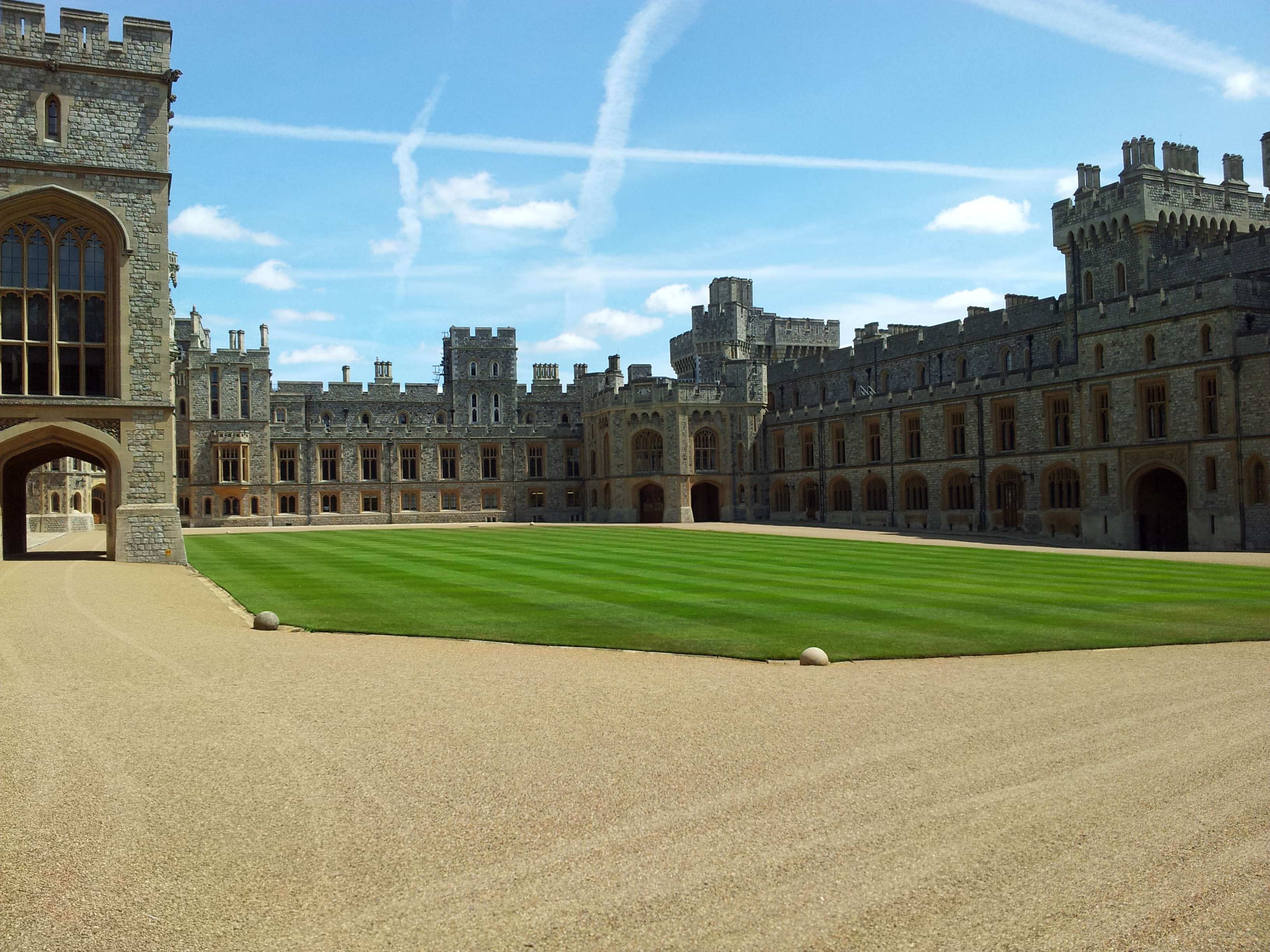
Searching for locations: Windsor Castle, London, England

A fine day, on this trip a rarity, we decided to take the train to Windsor and see the castle.

This is a real castle, and still in one piece, unlike a lot of castles.

Were we hoping to see the Queen, no, it was highly unlikely.

But there were a lot of planes flying overhead into Heathrow.  The wind must have been blowing the wrong day, and I’m sure, with one passing over every few minutes, it must annoy the Queen if she was looking for peace and quiet.

Good thing then, when it was built, it was an ideal spot, and not under the landing path.  I guess it was hard to predict what would happen 500 years in the future!

2013-06-30 12.09.56

I’m not sure if this was the front gate or back gate, but I was wary of any stray arrows coming out of those slits either side of the entrance.

You just never know!

2013-06-30 13.58.11

An excellent lawn for croquet.  This, I think, is the doorway, on the left, where dignitaries arrive by car.  The private apartments are across the back.

2013-06-30 13.58.00

The visitor’s apartments.  Not sure who that is on the horse.

2013-06-30 14.07.25

St George’s Chapel.  It’s a magnificent church for a private castle.  It’s been very busy the last few months with Royal weddings.

2013-06-30 12.12.29

The Round Tower, or the Keep.  It is the castle’s centerpiece.  Below it is the gardens.

2013-06-30 13.59.57

Those stairs are not for the faint-hearted, nor the Queen I suspect.  But I think quite a few royal children and their friends have been up and down them a few times.

2013-06-30 12.13.04

And well worth the effort to reach the bottom.

2013-06-30 14.00.40

Any faces peering out through the windows?

The cinema of my dreams – I always wanted to write a war story – Episode 24

For a story that was conceived during those long boring hours flying in a steel cocoon, striving to keep away the thoughts that the plane and everyone in it could just simply disappear as planes have in the past, it has come a long way.

Whilst I have always had a fascination with what happened during the second world war, not the battles or fighting, but in the more obscure events that took place, I decided to pen my own little sidebar to what was a long and bitter war.

And, so, it continues…


While waiting for Carlo and Chiara to return with the villagers, and taking some time to consider the plan that had almost formed in my mind, I went back to my room, which, I was guessing was once used for wine storage, because now that I had taken a moment to stop and consider my surroundings, I could smell the aroma of spilled wine.

With a little more light, I could see the arches within which the bottles would be stacked.  I’d also noticed while I’d been outside, that there were vines everywhere, albeit in bad shape as the people who tended them had either left, or been taken away, or shot.

Red grapes if I was not mistaken, though I had no idea what the variety might be.

If the war dragged on much longer, it would do a lot of damage to the wine-growing districts, and I doubted, when the Germans were here, they had any interest in tending the vines, but just drink the wine, and then probably not with the appreciation it deserved.

That had certainly been the case up at the castle before fate turned against me.  Perhaps that was where all of the wine from this cellar had been taken for safekeeping, once the locals thought the Germans had gone forever.  Maybe that was the reason why Leonardo spent so much of his time at the castle, the free wine.

Jack had returned from what I assumed was an inspection of our new quarters and was sitting on the ground next to me.  I wondered what he made of everything he had seen.  It was certainly not a dog’s life being caught in the middle of a war.  

“It’s a fine mess we’re in,” I said to him, and he looked back with uncomprehending eyes.  I would have to brush up on my German.  Or maybe Italian.  It only just occurred to me that he was probably someone’s dog from around here.  We’d only run into each other a few miles away.

“Yes, and I’m sure if you spoke English you could tell me a thing or two.  But, alas, you can’t, so a piece of advice.  Try to keep out of trouble, and by that, next time I go out, you might want to stay here.”

I shrugged.  Things must be bad; I’m talking to a dog.

Martina stopped outside the entrance.  “I heard voices.  Who are you talking to?”

“The dog.  He’s the only one who’s making any sense at the moment.”

“Are you sure he’s not a German spy.  Or, in fact, it’s a he?”

“You probably know as much as I do.  Anything happening?”

“Carlo’s back with a dozen or so of those who want to stay alive.  Chiara has a few more.  The rest have other places to hide if they need to.  We’ve told them to expect a raid.  Leonardo and a few of his men have been out looking for you and told everyone that you are a German spy and that he’ll pay them a lot of money for information about where you are or who’s hiding you.  He doesn’t understand everyone hates him, they always have.”

“Good to know if I run into him, he won’t be happy to see me.”

“This plan of yours?”

“Wallace will be getting edgy about the men he sent out, those men we ambushed at Chiara’s place.  It depends on who he sends, and where they go, but I was thinking we could prepare another ambush at Chiara’s.  All we have to do is wait because I’m sure they’ll get there eventually.”

“And if I know Leonardo, he’ll send them straight to my farm.  He knows that both Carlo and I, and the other two you’ve met were the other four who refused to join him in going up to the castle to make peace.  It seems he’s made a bad choice.”

“Wallace didn’t.  He needs someone like Leonardo to find us.  You’re probably right.  I was thinking Carlo and I could go.  No sense sending all of us, and if anything happens, there will be someone left to carry on.”

“You don’t sound too confident.  You are a soldier, aren’t you?”

“In a manner of speaking.  But I was not trained to be a commando, and not necessarily on the front line, or in this case behind enemy lines.”

“You’re not one of those rich kids whose father bought a commission, so you didn’t have to fight?”

Interesting the ideas foreigners had about elements of the army.  I was not sure if that was done anymore, at least not in this war.

“I have poor parents, that is if they have survived the bombs falling on London.  Refused to give in to Hitler’s aggression.”

I tried to convince them to go to the countryside, just to be safe, but one of the places they thought of going, had also been bombed, so as far as they were concerned, nowhere in England was safe.

“But yes, they did teach me how to shoot, and I know my way around several different types of gun.”  My mind flicked to the sniper rifle and the damage that could do.  

I’d be definitely taking that with me.

I saw her turn her head, and then heard the sound of new arrivals.  Chiara had returned.

“Time’s up for planning.”

I told the dog to stay, but as usual, he ignored me.  We went back into the main cavern where a dozen more people were settling in various places along one wall.  They looked as though they’d packed for a reasonably long stay.

But what worried me was the way they looked at me.  Those rumors Leonardo spread, I was hoping no one believed him.  Above the sound of voices, I could hear Marina speaking to them in Italian, hopefully, to tell them I was not a threat.

I found Carlo. 

“I have a small job to do.  After our last exercise at Chiara’s my old commander will no doubt send someone down to the village to seek answers, and I’m hoping you’ll come with me so we can convince them of the error of their ways.”

He smiled.  There was no mirth in it, and I knew I didn’t have to say anything more.

I saw movement coming from a group of people, and among them the boy I’d met earlier, Enrico.  He had jumped up off the floor when he saw me and came over.

“What are we going to do now.  I mean, we’re not going to sit here and do nothing.”

Boyish enthusiasm.  He had not been shot at yet, and to him, it was all a bit of a game.  I remembered back to the start of the war, and the number of boys who lied about their age, hardly waiting for the war to be declared.  They had no idea what a real war was, and if they had known, they would not have been so recklessly enthusiastic.

“You’re going to stay here and protect your family and all the others here.”

“No.  I want to be useful, fight the bastards.”

Carlo gave him one of his dark stares.  “You will stay here and help others if anything goes wrong.  Out there,” he pointed towards the entrance, “out there, if you’re not careful, you will die.”

Martina had seen him talking to us and came over.

“Enrico, we’ve talked about this.  Go back to your family.”

A last pleading look in case we changed our minds, then he reluctantly returned to his group.

Carlo handed me the sniper rifle and a pistol, a luger, probably captured from a German earlier, when they were in occupation.

“Good luck,” Martina said.

© Charles Heath 2019-2020

Questions, sometimes without answers

#Creative Writing, #Blog, #Writing

At what point does a writer become a journalist?

Quite often journalists become writers because of their vast experience in observing and writing about the news, sometimes in the category of ‘truth is stranger than fiction’.

I did journalism at University, and thought I would never get to use it.  I had to interview people, write articles, and act as an editor.  The hardest part was the headlines.

How much does that resemble the job of coming up with a title for your book?

Well, several opportunities arose over the last few months to dig out the journalist hat, put it on, and go to work.

Where?

Hospital.  I’ve had to go there a few times more in the last few months than I have in recent years.

And I’d forgotten just how hospitals are interesting places, especially the waiting room in Emergency.

After the second or third visit, I started to observe the people who were waiting, and ran through various scenarios as to the reason for their visit.  None may have been true, but it certainly was an exercise in creative writing, and would make an excellent article.

Similarly, once we got inside the inner sanctum, where the real work is done, there is any number of crises and operations going on, and plenty of material for when I might need to include a hospital scene in one of my stories.

Or I could write a volume in praise of the people who work there and what they have to endure.  Tending the sick, injured and badly injured is not a job for the faint hearted.

Research, if it could be called that, turns up in the unlikeliest of places.  Doctors who answer questions, not necessarily about the malady, nurses who tell you about what it’s like in Emergency on nights you really don’t want to be there, and other patients and their families, all of whom have a story to tell, or just wait patiently for a diagnoses and then treatment so they can go home.

We get to go this time about four in the morning.  Everyone is tired.  More people are waiting.  Outside it is cool and the first rays of light are coming over the horizon as dawn is about to break.

I ponder the question without an answer, a question one of the nurses asked a youngish doctor, tossed out in conversation, but was there a more intent to it; what he was doing on Saturday night.

He didn’t answer.  Another crisis, another patient.

I suspect he was on duty in Emergency.

An excerpt from “The Things We Do For Love”; In love, Henry was all at sea!

In the distance he could hear the dinner bell ringing and roused himself.  Feeling the dampness of the pillow, and fearing the ravages of pent up emotion, he considered not going down but thought it best not to upset Mrs. Mac, especially after he said he would be dining.

In the event, he wished he had reneged, especially when he discovered he was not the only guest staying at the hotel.

Whilst he’d been reminiscing, another guest, a young lady, had arrived.  He’d heard her and Mrs. Mac coming up the stairs, and then shown to a room on the same floor, perhaps at the other end of the passage.

Henry caught his first glimpse of her when she appeared at the door to the dining room, waiting for Mrs. Mac to show her to a table.

She was about mid-twenties, slim, long brown hair, and the grace and elegance of a woman associated with countless fashion magazines.  She was, he thought, stunningly beautiful with not a hair out of place, and make-up flawlessly applied.  Her clothes were black, simple, elegant, and expensive, the sort an heiress or wife of a millionaire might condescend to wear to a lesser occasion than dinner.

Then there was her expression; cold, forbidding, almost frightening in its intensity.  And her eyes, piercingly blue and yet laced with pain.  Dracula’s daughter was his immediate description of her.

All in all, he considered, the only thing they had in common was, like him, she seemed totally out of place.

Mrs. Mac came out of the kitchen, wiping her hands on her apron.  She was, she informed him earlier, chef, waitress, hotelier, barmaid, and cleaner all rolled into one.  Coming up to the new arrival she said, “Ah, Miss Andrews, I’m glad you decided to have dinner.  Would you like to sit with Mr. Henshaw, or would you like to have a table of your own?”

Henry could feel her icy stare as she sized up his appeal as a dining companion, making the hair on the back on his neck stand up.  He purposely didn’t look back.  In his estimation, his appeal rating was minus six.  Out of a thousand!

“If Mr. Henshaw doesn’t mind….”  She looked at him, leaving the query in mid-air.

He didn’t mind and said so.  Perhaps he’d underestimated his rating.

“Good.”  Mrs. Mac promptly ushered her over.  Henry stood, made sure she was seated properly and sat.

“Thank you.  You are most kind.”  The way she said it suggested snobbish overtones.

“I try to be when I can.”  It was supposed to nullify her sarcastic tone but made him sound a little silly, and when she gave him another of her icy glares, he regretted it.

Mrs. Mac quickly intervened, asking, “Would you care for the soup?”

They did, and, after writing the order on her pad, she gave them each a look, imperceptibly shook her head, and returned to the kitchen.

Before Michelle spoke to him again, she had another quick look at him, trying to fathom who and what he might be.  There was something about him.

His eyes, they mirrored the same sadness she felt, and, yes, there was something else, that it looked like he had been crying?  There was a tinge of redness.

Perhaps, she thought, he was here for the same reason she was.

No.  That wasn’t possible.

Then she said, without thinking, “Do you have any particular reason for coming here?”  Seconds later she realized she’s spoken it out loud, had hadn’t meant to actually ask, it just came out.

It took him by surprise, obviously not the first question he was expecting her to ask of him.

“No, other than it is as far from civilization, and home, as I could get.”

At least we agree on that, she thought.

It was obvious he was running away from something as well.

Given the isolation of the village and lack of geographic hospitality, it was, from her point of view, ideal.  All she had to do was avoid him, and that wouldn’t be difficult.

After getting through this evening first.

“Yes,” she agreed.  “It is that.”

A few seconds passed, and she thought she could feel his eyes on her and wasn’t going to look up.

Until he asked, “What’s your reason?”

Slight abrupt in manner, perhaps as a result of her question, and the manner in which she asked it.

She looked up.  “Rest.  And have some time to myself.”

She hoped he would notice the emphasis she had placed on the word ‘herself’ and take due note.  No doubt, she thought,  she had completely different ideas of what constituted a holiday than he, not that she had actually said she was here for a holiday.

Mrs. Mac arrived at a fortuitous moment to save them from further conversation.


Over the entree, she wondered if she had made a mistake coming to the hotel.  Of course, there had been no possible way she could know than anyone else might have booked the same hotel, but realized it was foolish to think she might end up in it by herself.

Was that what she was expecting?

Not a mistake then, but an unfortunate set of circumstances, which could be overcome by being sensible.

Yet, there he was, and it made her curious, not that he was a man, by himself, in the middle of nowhere, hiding like she was, but for very different reasons.

On discreet observance whilst they ate, she gained the impression his air of light-heartedness was forced and he had no sense of humor.

This feeling was engendered by his looks, unruly dark hair, and permanent frown.  And then there was his abysmal taste in clothes on a tall, lanky frame.  They were quality but totally unsuited to the wearer.

Rebellion was written all over him.

The only other thought crossing her mind, and rather incongruously, was he could do with a decent feed.  In that respect, she knew now from the mountain of food in front of her, he had come to the right place.

“Mr. Henshaw?”

He looked up.  “Henshaw is too formal.  Henry sounds much better,” he said, with a slight hint of gruffness.

“Then my name is Michelle.”

Mrs. Mac came in to take their order for the only main course, gather up the entree dishes, then return to the kitchen.

“Staying long?” she asked.

“About three weeks.  Yourself?”

“About the same.”

The conversation dried up.

Neither looked at the other, rather at the walls, out the window, towards the kitchen, anywhere.  It was, she thought, almost unbearably awkward.


Mrs. Mac returned with a large tray with dishes on it, setting it down on the table next to theirs.

“Not as good as the usual cook,” she said, serving up the dinner expertly, “but it comes a good second, even if I do say so myself.  Care for some wine?”

Henry looked at Michelle.  “What do you think?”

“I’m used to my dining companions making the decision.”

You would, he thought.  He couldn’t help but notice the cutting edge of her tone.  Then, to Mrs. Mac, he named a particular White Burgundy he liked and she bustled off.

“I hope you like it,” he said, acknowledging her previous comment with a smile that had nothing to do with humor.

“Yes, so do I.”

Both made a start on the main course, a concoction of chicken and vegetables that were delicious, Henry thought, when compared to the bland food he received at home and sometimes aboard my ship.

It was five minutes before Mrs. Mac returned with the bottle and two glasses.  After opening it and pouring the drinks, she left them alone again.

Henry resumed the conversation.  “How did you arrive?  I came by train.”

“By car.”

“Did you drive yourself?”

And he thought, a few seconds later, that was a silly question, otherwise she would not be alone, and certainly not sitting at this table. With him.

“After a fashion.”

He could see that she was formulating a retort in her mind, then changed it, instead, smiling for the first time, and it served to lighten the atmosphere.

And in doing so, it showed him she had another more pleasant side despite the fact she was trying not to look happy.

“My father reckons I’m just another of ‘those’ women drivers,” she added.

“Whatever for?”

“The first and only time he came with me I had an accident.  I ran up the back of another car.  Of course, it didn’t matter to him the other driver was driving like a startled rabbit.”

“It doesn’t help,” he agreed.

“Do you drive?”

“Mostly people up the wall.”  His attempt at humor failed.  “Actually,” he added quickly, “I’ve got a very old Morris that manages to get me where I’m going.”

The apple pie and cream for dessert came and went and the rapport between them improved as the wine disappeared and the coffee came.  Both had found, after getting to know each other better, their first impressions were not necessarily correct.

“Enjoy the food?” Mrs. Mac asked, suddenly reappearing.

“Beautifully cooked and delicious to eat,” Michelle said, and Henry endorsed her remarks.

“Ah, it does my heart good to hear such genuine compliments,” she said, smiling.  She collected the last of the dishes and disappeared yet again.

“What do you do for a living,” Michelle asked in an off-hand manner.

He had a feeling she was not particularly interested and it was just making conversation.

“I’m a purser.”

“A what?”

“A purser.  I work on a ship doing the paperwork, that sort of thing.”

“I see.”

“And you?”

“I was a model.”

“Was?”

“Until I had an accident, a rather bad one.”

“Oh, I’m sorry.”

So that explained the odd feeling he had about her.

As the evening had worn on, he began to think there might be something wrong, seriously wrong with her because she didn’t look too well.  Even the carefully applied makeup, from close up, didn’t hide the very pale, and tired look, or the sunken, dark ringed eyes.

“I try not to think about it, but it doesn’t necessarily work.  I’ve come here for peace and quiet, away from doctors and parents.”

“Then you will not have to worry about me annoying you.  I’m one of those fall-asleep-reading-a-book types.”

Perhaps it would be like ships passing in the night and then smiled to himself about the analogy.

Dinner now over, they separated.

Henry went back to the lounge to read a few pages of his book before going to bed, and Michelle went up to her room to retire for the night.

But try as he might, he was unable to read, his mind dwelling on the unusual, yet the compellingly mysterious person he would be sharing the hotel with.

Overlaying that original blurred image of her standing in the doorway was another of her haunting expressions that had, he finally conceded, taken his breath away, and a look that had sent more than one tingle down his spine.

She may not have thought much of him, but she had certainly made an impression on him.


© Charles Heath 2015-2020

lovecoverfinal1

Character development: children in stories

It seems that there are many ways of bringing children to life in your stories.

The most obvious is your own, but those traits might seem so polarised they and others might realise who they are based on, with the distress that comes with it.

Then there are the children of your friends and relationships, definitely fodder for many stories because those children are definitely far worse than your own, or better perhaps.

It leaves you questioning where you went wrong, or why you didn’t get the manual when the hospital kicked to the kerb with this screaming bundle of joy, their words not yours.

So we start with real-life experiences.

To muddy the waters so they don’t get the impression you’re paying out on them, you can always add the traits of those you see in the shopping malls.

Shopping malls are a gold mine for behavioural traits, from the very worst tantrum thrower to the best behaved. For my money and proven time and time again, those well-dressed, very well-behaved children are purely evil.

With the tantrum thrower, what you see if what you get.

With the well-behaved, you spend all of your time watching your back and waiting for the knife to penetrate your spine between the fourth and fifth vertebrae. You just know instinctively they’re medical school prodigies.

Of course, there are one or two good children, Santa has to have a reason for existence, but they are like 1,000 ounce gold nuggets; very, very hard to find.