Inspiration, maybe – Volume 1

50 photographs, 50 stories, of which there is one of the 50 below.

They all start with –

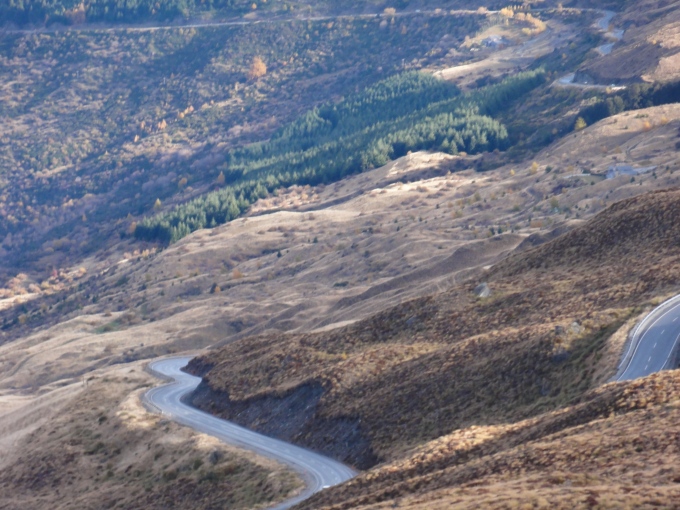
A picture paints … well, as many words as you like.  For instance:

lookingdownfromcoronetpeak

And the story:

It was once said that a desperate man has everything to lose.

The man I was chasing was desperate, but I, on the other hand, was more desperate to catch him.

He’d left a trail of dead people from one end of the island to the other.

The team had put in a lot of effort to locate him, and now his capture was imminent.  We were following the car he was in, from a discrete distance, and, at the appropriate time, we would catch up, pull him over, and make the arrest.

There was nowhere for him to go.

The road led to a dead-end, and the only way off the mountain was back down the road were now on.  Which was why I was somewhat surprised when we discovered where he was.

Where was he going?

“Damn,” I heard Alan mutter.  He was driving, being careful not to get too close, but not far enough away to lose sight of him.

“What?”

“I think he’s made us.”

“How?”

“Dumb bad luck, I’m guessing.  Or he expected we’d follow him up the mountain.  He’s just sped up.”

“How far away?”

“A half-mile.  We should see him higher up when we turn the next corner.”

It took an eternity to get there, and when we did, Alan was right, only he was further on than we thought.”

“Step on it.  Let’s catch him up before he gets to the top.”

Easy to say, not so easy to do.  The road was treacherous, and in places just gravel, and there were no guard rails to stop a three thousand footfall down the mountainside.

Good thing then I had the foresight to have three agents on the hill for just such a scenario.

Ten minutes later, we were in sight of the car, still moving quickly, but we were going slightly faster.  We’d catch up just short of the summit car park.

Or so we thought.

Coming quickly around another corner we almost slammed into the car we’d been chasing.

“What the hell…” Aland muttered.

I was out of the car, and over to see if he was in it, but I knew that it was only a slender possibility.  The car was empty, and no indication where he went.

Certainly not up the road.  It was relatively straightforward for the next mile, at which we would have reached the summit.  Up the mountainside from here, or down.

I looked up.  Nothing.

Alan yelled out, “He’s not going down, not that I can see, but if he did, there’s hardly a foothold and that’s a long fall.”

Then where did he go?

Then a man looking very much like our quarry came out from behind a rock embedded just a short distance up the hill.

“Sorry,” he said quite calmly.  “Had to go if you know what I mean.”

I’d lost him.

It was as simple as that.

I had been led a merry chase up the hill, and all the time he was getting away in a different direction.

I’d fallen for the oldest trick in the book, letting my desperation blind me to the disguise that anyone else would see through in an instant.

It was a lonely sight, looking down that road, knowing that I had to go all that way down again, only this time, without having to throw caution to the wind.

“Maybe next time,” Alan said.

“We’ll get him.  It’s just a matter of time.”

© Charles Heath 2019-2021

Find this and other stories in “Inspiration, maybe”  available soon.

InspirationMaybe1v1

In a word: Idle

It can relate to an object such as an engine in a car when sitting at traffic lights. Then the engine is not in gear or under any load, therefore it is idle.

That he is idle might mean he is currently not working or refuses to work. Then it could be said he is bone idle which is to say he is any or all of lazy, or shiftless, even indolent

It could refer to the time when nothing is happening.

It could also refer to money in accounts not earning any interest

How many of us indulge in idle chatter, which is meaningless?

And how many of us have made an idle threat, especially to a child who refuses to go to bed, or sleep.


This is not to be confused with idol

An idol is generally thought of as a representation of a god, one used as an object of worship.

An idol can also be a person who is greatly admired, like a celebrity or superstar or a hero.

It could also be a figment of the imagination.


Then there is idyll which could be an extremely happy place, or a picturesque period or situation, one that is unsustainable

It could also be a short verse about rustic life.

The cinema of my dreams – Was it just another surveillance job – Episode 44

I’m back home and this story has been sitting on the back burner for a few months, waiting for some more to be written.

The trouble is, there are also other stories to write, and I’m not very good at prioritizing.

But, here we are, a few minutes opened up and it didn’t take long to get back into the groove.

Chasing leads, maybe


I leaned back in the chair and shuddered.  It was not so much the cold as the stark realization before me, well, before all of us really.

The USB was gone.

But it was going to be impossible to convince any or all of Severin, Maury, and Nobbin.  Or for that matter Monica.  None of them were going to believe the explosion in the café was a deliberate act.  

But it did raise a question.

“How did whoever placed the bomb in the café know you and your contact were going to be there, and, for that matter, that either of you might have the USB?”

O’Connell seemed lost in thought.  After prodding him, I asked the question again.  His hesitation seemed to suggest that what he’d told me might be a lie, or a half-truth because the more I thought about it, the more implausible it sounded.  The other side of that was, what did he have to gain by lying?  Of no doubt, there was more to this story.

“There are more people involved in this than what you know.  Dobbin had me looking into a biological laboratory, one that was reportedly doing research on cures for various coronaviruses, like SARS.  The thing is, they had a store of nasties they were using as candidates for finding cures.

“The laboratory had been getting funding from the military so that to me meant they’d been working on weaponizing one of those nasty viruses, but there had been containment breach leading to a review, and they lost their funding.

“That, in turn, leads to the head of the company seeking funding from elsewhere, and that it was going to be an overseas government institution, one which they claimed commercial confidence so the donor could not be released.  Of course, our intelligence services went into a spin, thinking the worst, that it was either Russia or the Chinese, or some other rogue regime, and if they got their hands on those candidates, well, you can imagine the paranoia.

“There was also the problem of hacking, where various countries and/or individuals are looking for information to use for their own benefit, or to sell to the highest bidder.  That as far as I can tell is what happened here; it was not a case of external hacking, this was internal by one of the staff, downloading sensitive information onto the USB and smuggling it out.

“As soon as the breach was discovered, it triggered an internal review, which had a member of the military on the panel, and it concluded it was one of three ex-employees.  Dobbin gave me the three names, and I tracked them down.  One of the three had stolen the data, but far from stealing it to sell to the highest bidder, he had stolen it to pass on to a newspaper reporter, the person I was going to see.

“He could see the information was not the sort to be disseminated to the general public and wanted it returned.  I was going to get it.

“So, in answer to your question, it was possible that someone else had done the same as I had after I had visited each of the three, and decided to deal with the problem decisively.  But it would have required planning and an organization with infinite resources to pull it off.  Top of my list is the owners of the laboratory, simply because, they were not interested in getting the copy back, and the fact they didn’t want to have any witnesses, which meant the reporter and had to be silenced.”

“And the person who stole the information?”

“Burned to death in a house fire.  The fire department concluded it was a gas leak.”

“Helped by a person or persons unknown.”

“Given the distribution list of that final report, unless Dobbin has been moonlighting as an assassin, there’s only one other name on the list.”

No need to say it out loud.  That left one question, and probably a hundred others that wouldn’t get answers.

“What’s it to do with Severin and Maury?”

“That’s not their names.  Severin is really David Westcott, and Maury is Bernie Salvin.  Both used to be in the security detail at the company about three years ago when several biological entities were being researched, both of whom were assigned by the military to keep an eye on their investment.

“When the accident occurred, they were reassigned, but I suspect, at the time, they knew exactly what had happened, and what is involved.  It’s not a leap to come to the conclusion they had a shift in allegiance and may have helped the person who stole the information because there was no way the person who stole it had the knowledge to get it out.

“It was not something he would tell me.  That, he said, if he told me, would sign his death warrant.”

Which it did.  Was the original thief killed before or after the explosion?

“Do we Assume Severin is the man in charge?”

“No.  They’re basically blunt instruments, giving orders, and doing what they’re told.  We all are, to a certain extent.  This operation had someone else, someone far more clever, and connected.”

“But they did create a whole unit and train them in an existing facility without anyone knowing.”

“Is that you they told you?  And you believed them?  Nothing goes on in that place with an official sanction.  No.  Your operation was created on the books, but on the quiet so if anything went wrong, they could disavow any knowledge of it.  It went south and what happened?”

“They disavowed any knowledge of it.”

“And kept you on, only reassigned?”

“Those of us who survived, yes.”

“Then I suggest you watch your back and keep all of them at arm’s length.  You’ll only be useful until the USB is found, so you have to keep them believing it’s missing.”

“We’re not going to be able to do that forever.”

“No.  Which makes it imperative we find out who Severin and Maury’s bosses are and chop of the head.”

All while pretending he was dead.  Easier said than done.


© Charles Heath 2020-2021

Searching for locations: A typical diner, New York

We decided to have lunch in a traditional Diner.

On an early morning walk, I discovered the Brooklyn Diner, a small restaurant tucked away in a street not far from Columbus Circle, perhaps a piece of history from the American past.

After all, if you’re going to take in the sights, sounds, and food of a country what better way to do it than visiting what was once a tradition.

This one was called the Brooklyn Diner.  It had a combination of booths and counter sit down, though the latter was not a very big space, so we opted for a booth.

The object of going to a Diner is the fact they serve traditional American food, which when you get past the hot dogs and hamburgers and fries, takes the form of turkey and chicken pot pies among a variety of other choices.

Still looking for a perfectly cooked turkey, something I’ve never been able to do myself, I opted for the Teadition Turkey Lunch, which the menu invitingly said was cooked especially at the diner and was succulent.  I couldn’t wait.

We also ordered a hamburger, yes, yet another, and a chicken pot pie, on the basis the last one I had in Toronto was absolutely delicious (and cooked the same way since the mid-1930s)

While waiting we got to look at a slice of history belonging to another great American tradition, Baseball, a painting on the wall of the Brooklyn Dodgers at Ebbets field, long since gone from their home.

The Turnkey lunch looked like this

which didn’t seem to be much, and had this odd pasta slice on the plate, but the turkey was amazing and lived up to the menu description.

The Chicken Pot Pie looked like this

And looked a lot larger in reality than the photo shows.

But, sadly while it was not bad, it was a little dry, and could possibly do with using the more succulent thigh part of the chicken.

All of this was washed down by Long Island Ice Teas and Brooklyn Lager.

AS for the Diner experience, it’s definitely a 10 out of 10 for me.

Short Story Writing – Don’t try this at home! – Part 4

This is not a treatise, but a tongue in cheek, discussion on how to write short stories.   Suffice to say this is not the definitive way of doing it, just mine.  It works for me – it might not work for you.

You’ve got the place, now you want the who.

My main characters are quite often me.

Not the real me, because I’m boring.  No, those characters are what I would like to be, that imaginary superhuman that can do everything.

Until, of course, reality sets in, and the bullets start flying.  When that happens, we should be looking to run or at the very least get under cover, not walk into a hail of bullets, with a huge grin, staring down the enemy.

Hang on, that never happens except in superman comics.

What’s really needed here is a little vulnerability, a little humility and a lot of understanding, qualities at times I don’t have.

So, in order to create a more believable character, I start dragging traits from others I’ve met, or know, or really don’t want to know.  

In a writer’s environment, there are a plethora of people out there that you can draw on for inspiration.  I once spent and afternoon at a railway station just observing people.  Even now, I make observations, some of which are true, and others, wildly off course. 

I once tried to convince my other half that I could pick people’s traits, and we sat at a café outside a church in Venice.  I was lucky, I got more than 75% correct.

Other characters in my stories I have met along the way.

Like a piano player in a restaurant.  It was not so much the playing was bad, it was the way he managed to draw people into his orbit and keep them there.  The man has charisma, but sadly no talent for the instrument.

Like an aunt I met only twice in a lifetime, and who left a lasting impression.  Severe, angry looking, speaking a language I didn’t understand, even though it was English.  It was where I learned we came from England, and she was the closest thing I came to as an example of nineteenth-century prim and proper.  And, no, she didn’t have a sense of humour or time for silly little boys.

Like one of my bosses, a man of indeterminate age, but it had to be over 100, or so it seemed to my sixteen-year-old brain, who spoke and dressed impeccably, and yes, he did once say that I would be the death of him.

I can only hope I wasn’t.

Like a Captain of a ship I once met, a man who didn’t seem to have time for the minions, and a man who reeked authority and respect.  I’ve always wanted to be like him, but unfortunately, it was not in the genes.

Those are only a few, there are thousands of others over the years, a built-in library, if you will, of characters waiting to be taken off the shelf and used where necessary or appropriate.  We all have one of these banks.

You just have to know when to use them.

Sayings: Before you can say Jack Robinson

Once upon a time, you could have told me Jack Robinson was a jack in the box, the name meant nothing to me.

Not until Phryne Fisher came along, a rather brilliant 1920s private detective series set in the back streets of Melbourne, as well as more salubrious houses of the rich and famous.
In this series, there is a policeman, a foil for her detective moments, and a love interest that is always just beyond her grasp, a man by the name of Inspector Jack Robinson.

How coincidental.

But…

As for the saying, before you can say Jack Robinson…

It has nothing to do with Phryne Fishers Inspector.

Instead,

There is one story of a politician, Jack Robinson, in the late eighteenth century who was accused of bribery on the floor of the house of commons in England. His accuser was another MP who was asked to name the culprit, and thereby coined the term, ‘I could name him as soon as I could say Jack Robinson’.

The second was a Jack Robinson, the hero of a story written in the nineteenth century who came home to find his intended wife married to another, and to assuage the pain of it was back to the sea, ‘afore you could say Jack Robinson’.

I’m sure there’s a ton of other saying that could be attached to the name, but these seem to be the accepted reason for the term ‘before you can say Jack Robinson’.

“Trouble in Store” – Short stories my way: Setting the scene

I used to like writing short stories, somewhere between two and five thousand words, but, in the end, it was too much hard work.

No chance of getting into stride with a location description, no real chance of giving a background to a character, it was simply a case of diving straight in.

But …

I’ve been thinking about writing a short story, starting it with a short succinct sentence that will set the tone.

Something like:  “Jack was staring down the barrel of a gun”

What then?

Should he start analyzing what sort of gun it was, did it have a light trigger, was the person holding it shaking, a man or a woman, or a child?

Location, in a house, a disused factory, a shop, a petrol station, the side of the road.

So, where was Jack?

Something like:  “He had gone down to the corner shop to get a pack of cigarettes.”

For himself or someone else?  Is it day, is it night, or somewhere in between?

Something like:  “He had to hustle because he knew the shopkeeper, Alphonse, liked to close at 11:00 pm sharp, and came through the door, the sound of the bell ringing loudly and the door bashed into it.”

So, Jack’s state of mind, he is in a hurry, careless coming through the door, not expecting anything out of the ordinary.

How would you react when you saw a gun, pointed at Alphonse until the sound of the door warning bell attracted the gunman’s attention?

Is it a gunman?

Something like:  “It took a second, perhaps three, to sum up the situation.  Young girl, about 16 or 17, scared, looking sideways at a man on the ground, Alphonse, and then Jack.  A Luger, German, a relic of WW2, perhaps her father’s souvenir, now pointing at him.”

The punch line:  Cigarettes can kill in more ways than one.

The revelation:  The corner store also supplied the local drug addicts.

The revised start is now:

Jack was staring down the barrel of a gun.

He had gone down to the corner shop to get a pack of cigarettes.

He had to hustle because he knew the shopkeeper, Alphonse, liked to close at 11:00 pm sharp.  His momentum propelled him through the door, causing the customer warning bell to ring loudly as the door bashed into it, and before the sound had died away, he knew he was in trouble.

It took a second, perhaps three, to sum up the situation. 

Young girl, about 16 or 17, scared, looking sideways at a man on the ground, then Alphonse, and then Jack.  He recognized the gun, a Luger, German, relic of WW2, perhaps her father’s souvenir, now pointing at him then Alphonse, then back to him.

Jack to another second or two to consider if he could disarm her.  No, the distance was too great.  He put his hands out where she could see them.  No sudden movements, try to remain calm, his heart rate up to the point of cardiac arrest.

Pointing with the gun, she said, “Come in, close the door, and move towards the counter.”

Everything but her hand steady as a rock.  The only telltale sign of stress, the bead of perspiration on her brow.  It was 40 degrees Fahrenheit in the shop.

Jack shivered and then did as he was told.  She was in an unpredictable category.

“What’s wrong with your friend?”  Jack tried the friendly approach, as he took several slow steps sideways towards the counter.

The shopkeeper, Alphonse, seemed calmer than usual, or the exact opposite spoke instead, “I suspect he’s an addict, looking for a score.  At the end of his tether, my guess, and came to the wrong place.” 

Wrong time, wrong place, in more ways than one Jack thought, now realizing he had walked into a very dangerous situation.  She didn’t look like a user.  The boy on the ground, he did, and he looked like he was going through the beginnings of withdrawal.

 “Simmo said you sell shit.  You wanna live, ante up.”  She was glaring at Alphonse. 

The language was not her own, she had been to a better class of school, a good girl going through a bad boy phase.

Nest time, point of view.

© Charles Heath 2016-2021

The story behind the story – Echoes from the Past

The novel ‘Echoes from the past’ started out as a short story I wrote about 30 years ago, titled ‘The birthday’.

My idea was to take a normal person out of their comfort zone and led on a short but very frightening journey to a place where a surprise birthday party had been arranged.

Thus the very large man with a scar and a red tie was created.

So was the friend with the limousine who worked as a pilot.

So were the two women, Wendy and Angelina, who were Flight Attendants that the pilot friend asked to join the conspiracy.

I was going to rework the short story, then about ten pages long, into something a little more.

And like all re-writes, especially those I have anything to do with, it turned into a novel.

There was motivation.  I had told some colleagues at the place where I worked at the time that I liked writing, and they wanted a sample.  I was going to give them the re-worked short story.  Instead, I gave them ‘Echoes from the past’

Originally it was not set anywhere in particular.

But when considering a location, I had, at the time, recently been to New York in December, and visited Brooklyn and Queens, as well as a lot of New York itself.  We were there for New Years, and it was an experience I’ll never forget.

One evening we were out late, and finished up in Brooklyn Heights, near the waterfront, and there was rain and snow, it was cold and wet, and there were apartment buildings shimmering in the street light, and I thought, this is the place where my main character will live.

It had a very spooky atmosphere, the sort where ghosts would not be unexpected.  I felt more than one shiver go up and down my spine in the few minutes I was there.

I had taken notes, as I always do, of everywhere we went so I had a ready supply of locations I could use, changing the names in some cases.

Fifth Avenue near the Rockefeller center is amazing at first light, and late at night with the Seasonal decorations and lights.

The original main character was a shy and man of few friends, hence not expecting the surprise party.  I enhanced that shyness into purposely lonely because of an issue from his past that leaves him always looking over his shoulder and ready to move on at the slightest hint of trouble.  No friends, no relationships, just a very low profile.

Then I thought, what if he breaks the cardinal rule, and begins a relationship?

But it is also as much an exploration of a damaged soul, as it is the search for a normal life, without having any idea what normal was, and how the understanding of one person can sometimes make all the difference in what we may think or feel.

And, of course, I wanted a happy ending.

Except for the bad guys.


Get it here:  https://amzn.to/2CYKxu4

newechocover5rs


Writing about writing a book – Day 24, a missing piece of the puzzle

There’s always the necessity for creating backstories so that the reader doesn’t come across a part of the story that doesn’t make sense.

Perhaps one of my failings is that I have to go over what I’ve already written, sometimes to make sure there is continuity and that what I’ve written makes sense.

This collection of memories our main character is having serves the purpose of setting up later plot points, but more importantly, is supposed to give the reader an idea of what the main character has gone through before arriving at the start of the story.

This part will serve to provide a little more information on the relationship between Bill and Barry, though I rather like the nickname I gave him.

“Bastards,” Killer muttered.

We called him ‘Killer’ because it was the nickname the Army had given him.  We were sharing the guard duty and had spoken briefly over the watch, but up till then, the silence had stretched over an hour or so.  It didn’t take long for anyone to realize he was a man of few words.

He’d been in the regular army for years and asked for the posting.  He’d made Sergeant several times, only to lose those same stripes for fighting, usually after R&R and a bout of heavy drinking.  Now assigned to our platoon to lend his experience, the conscripts were expecting him to ‘look after’ them.  Other than myself and the Lieutenant, he was the only other regular soldier.  Unfortunately for them, he hated both conscripts and the Viet Cong in varying degrees, and depending on his mood there was little tolerance left for the rest of us.

“The people who sent us here or the people trying to kill us?” I asked before I realized I’d spoken.

I didn’t hear the reply, the skies opening up with another torrential downpour that lasted for about five minutes, and going as fast as it came.  When the sun finally came up, it would make the atmosphere steamy, hot, and unbearable.  It was quite warm now, and I was feeling both uncomfortable, and fatigued.

Killer looked just as stoic as he had before the rain.  He looked at me.  “Damn weather.  Worse than home.”

“Scotland?”

“Scapa Flow, Kirkwall.  I should have been an engineer on ships like my father, but I was too stupid.  Joined the Army, finished up here.  What’s your excuse?”

“Square peg in a round hole.  The army seems to handle us in its stride.”  It was more or less the truth.  I joined the Army to get away from my parents.

“That it does.  That it does.”

The rain came and went, during which the rest of the camp roused and went about its business.  It had been a long night for some, still getting over the shock of the attack, and the ever-pervading thought the enemy was still out there, biding their time.  It would be, for them, a waiting game, waiting for the conditions to wear us down, and lose concentration as inevitably we would.

Certainly, by the time we were relieved from sentry duty, I felt I was in no condition to match wits with a donkey, let alone the enemy on his own home ground.  When I stumbled over to the mess area and looked at the tired and haggard looks on the faces of the platoon, I realized that went for all of us.

Killer and I managed to get about an hour’s rest before the call came to move out, rain or no rain, and after a breakfast to make anyone ill, we left.  For hours it rained.  No one spoke as we strained to listen over the rain spattering on the undergrowth, all the time expecting the unexpected.  That was the benefit of the surprise attack; we no longer took for granted we would be safe.

Water gathered in pools along the trail, hiding any chance of seeing landmines.  Rainwater and sweat ran into our eyes, making it difficult to see.  Water leaked everywhere, making it very uncomfortable.  This was not war.  This was utter stupidity.

I was about to remark on the futility of it all to the Lieutenant, who had taken the lead, when one second he was talking to me and the next he crashed to the ground, a sniper’s bullet killing him instantly.   Someone yelled “Contact” and we hit the ground, bullets flying all around us. 

Too late, I thought, as I felt the hit of what seemed to be a large rock, then the searing pain in my leg, just as I hit the ground…


© Charles Heath 2015-2021

An excerpt from “The Devil You Don’t”

Available on Amazon Kindle here:  https://amzn.to/2Xyh1ow


By the time I returned to the Savoie, the rain had finally stopped, and there was a streak of blue sky to offer some hope the day would improve.

The ship was not crowded, the possibility of bad weather perhaps holding back potential passengers.  Of those I saw, a number of them would be aboard for the lunch by Phillippe Chevrier.  I thought about it, but the Concierge had told me about several restaurants in Yvoire and had given me a hand-drawn map of the village.  I think he came from the area because he spoke with the pride and knowledge of a resident.

I was looking down from the upper deck observing the last of the boarding passengers when I saw a woman, notable for her red coat and matching shoes, making a last-minute dash to get on board just before the gangway was removed.  In fact, her ungainly manner of boarding had also captured a few of the other passenger’s attention.  Now they would have something else to talk about, other than the possibility of further rain.

I saw her smile at the deckhand, but he did not smile back.  He was not impressed with her bravado, perhaps because of possible injury.  He looked at her ticket then nodded dismissively, and went back to his duties in getting the ship underway.  I was going to check the departure time, but I, like the other passengers, had my attention diverted to the woman in red.

From what I could see there was something about her.  It struck me when the light caught her as she turned to look down the deck, giving me a perfect profile.  I was going to say she looked foreign, but here, as in almost anywhere in Europe, that described just about everyone.  Perhaps I was just comparing her to Phillipa, so definitively British, whereas this woman was very definitely not.

She was perhaps in her 30’s, slim or perhaps the word I’d use was lissom, and had the look and manner of a model.  I say that because Phillipa had dragged me to most of the showings, whether in Milan, Rome, New York, London, or Paris.  The clothes were familiar, and in the back of my mind, I had a feeling I’d seen her before.

Or perhaps, to me, all models looked the same.

She looked up in my direction, and before I could divert my eyes, she locked on.  I could feel her gaze boring into me, and then it was gone as if she had been looking straight through me.  I remained out on deck as the ship got underway, watching her disappear inside the cabin.  My curiosity was piqued, so I decided to keep an eye out for her.

I could feel the coolness of the air as the ship picked up speed, not that it was going to be very fast.  With stops, the trip would take nearly two hours to get to my destination.  It would turn back almost immediately, but I was going to stay until the evening when it returned at about half eight.  It would give me enough time to sample the local fare, and take a tour of the medieval village.

Few other passengers ventured out on the deck, most staying inside or going to lunch.  After a short time, I came back down to the main deck and headed forward.  I wanted to clear my head by concentrating on the movement of the vessel through the water, breathing in the crisp, clean air, and let the peacefulness of the surroundings envelope me.

It didn’t work.

I knew it wouldn’t be long before I started thinking about why things hadn’t worked, and what part I played in it.  And the usual question that came to mind when something didn’t work out.  What was wrong with me?

I usually blamed it on my upbringing.

I had one of those so-called privileged lives, a nanny till I was old enough to go to boarding school, then sent to the best schools in the land.  There I learned everything I needed to be the son of a Duke, or, as my father called it in one of his lighter moments, nobility in waiting.

Had this been five or six hundred years ago, I would need to have sword and jousting skills, or if it had been a few hundred years later a keen military mind.  If nothing else I could ride a horse, and go on hunts, or did until they became not the thing to do.

I learned six languages, and everything I needed to become a diplomat in the far-flung British Empire, except the Empire had become the Commonwealth, and then, when no-one was looking, Britain’s influence in the world finally disappeared.  I was a man without a cause, without a vocation, and no place to go.

Computers were the new vogue and I had an aptitude for programming.  I guess that went hand in hand with mathematics, which although I hated the subject, I excelled in.  Both I and another noble outcast used to toss ideas around in school, but when it came to the end of our education, he chose to enter the public service, and I took a few of those ideas we had mulled over and turned them into a company.

About a year ago, I was made an offer I couldn’t refuse.  There were so many zeroes on the end of it I just said yes, put the money into a very grateful bank, and was still trying to come to terms with it.

Sadly, I still had no idea what I was going to do with the rest of my life.  My parents had asked me to come back home and help manage the estate, and I did for a few weeks.  It was as long as it took for my parents to drive me insane.

Back in the city, I spent a few months looking for a mundane job, but there were very few that suited the qualifications I had, and the rest, I think I intimidated the interviewer simply because of who I was.  In that time I’d also featured on the cover of the Economist, and through my well-meaning accountant, started involving myself with various charities, earning the title ‘philanthropist’.

And despite all of this exposure, even making one of those ubiquitous ‘eligible bachelor’ lists, I still could not find ‘the one’, the woman I wanted to spend the rest of my life with.  Phillipa seemed to fit the bill, but in time she proved to be a troubled soul with ‘Daddy’ issues.  I knew that in building a relationship compromise was necessary, but with her, in the end, everything was a compromise and what had happened was always going to be the end result.

It was perhaps a by-product of the whole nobility thing.  There was a certain expectation I had to fulfill, to my peers, contemporaries, parents and family, and those who either liked or hated what it represented.  The problem was, I didn’t feel like I belonged.  Not like my friend from schooldays, and now obscure acquaintance, Sebastian.  He had been elevated to his Dukedom early when his father died when he was in his twenties.  He had managed to fade from the limelight and was rarely mentioned either in the papers or the gossip columns.  He was one of the lucky ones.

I had managed to keep a similarly low profile until I met Phillipa.  From that moment, my obscurity disappeared.  It was, I could see now, part of a plan put in place by Phillipa’s father, a man who hogged the limelight with his daughter, to raise the profile of the family name and through it their businesses.  He was nothing if not the consummate self-advertisement.

Perhaps I was supposed to be the last piece of the puzzle, the attachment to the establishment, that link with a class of people he would not normally get in the front door.  There was nothing refined about him or his family, and more than once I’d noticed my contemporaries cringe at the mention of his name, or any reference of my association with him.

Yet could I truthfully say I really wanted to go back to the obscurity I had before Phillipa?  For all her faults, there were times when she had been fun to be with, particularly when I first met her when she had a certain air of unpredictability.  That had slowly disappeared as she became part of her father’s plan for the future.  She just failed to see how much he was using her.

Or perhaps, over time, I had become cynical.

I thought about calling her.  It was one of those moments of weakness when I felt alone, more alone than usual.

I diverted my attention back to my surroundings and the shoreline.  Out of the corner of my eye, I could see the woman in the red coat, making a move.  The red coat was like a beacon, a sort of fire engine red.  It was not the sort of coat most of the women I knew would wear, but on her, it looked terrific.  In fact, her sublime beauty was the one other attribute that was distinctly noticeable, along with the fact her hair was short, rather than long, and jet black.

I had to wrench my attention away from her.

A few minutes later several other passengers came out of the cabin for a walk around the deck, perhaps to get some exercise, perhaps checking up on me, or perhaps I was being paranoid.  I waited till they passed on their way forward, and I turned and headed aft.

I watched the wake sluicing out from under the stern for a few minutes, before retracing my steps to the front of the ship and there I stood against the railing, watching the bow carve its way through the water.  It was almost mesmerizing.  There, I emptied my mind of thoughts about Phillipa, and thoughts about the woman in the red coat.

Until a female voice behind me said, “Having a bad day?”

I started, caught by surprise, and slowly turned.  The woman in the red coat had somehow got very close me without my realizing it.  How did she do that?  I was so surprised I couldn’t answer immediately.

“I do hope you are not contemplating jumping.  I hear the water is very cold.”

Closer up, I could see what I’d missed when I saw her on the main deck.  There was a slight hint of Chinese, or Oriental, in her particularly around the eyes, and of her hair which was jet black.  An ancestor twice or more removed had left their mark, not in a dominant way, but more subtle, and easily missed except from a very short distance away, like now.

Other than that, she was quite possibly Eastern European, perhaps Russian, though that covered a lot of territory.  The incongruity of it was that she spoke with an American accent, and fluent enough for me to believe English was her first language.

Usually, I could ‘read’ people, but she was a clean slate.  Her expression was one of amusement, but with cold eyes.  My first thought, then, was to be careful.

“No.  Not yet.”  I coughed to clear my throat because I could hardly speak.  And blushed, because that was what I did when confronted by a woman, beautiful or otherwise.

The amusement gave way to a hint of a smile that brightened her demeanor as a little warmth reached her eyes.  “So that’s a maybe.  Should I change into my lifesaving gear, just in case?”

It conjured up a rather interesting image in my mind until I reluctantly dismissed it.

“Perhaps I should move away from the edge,” I said, moving sideways until I was back on the main deck, a few feet further away.  Her eyes had followed me, and when I stopped she turned to face me again.  She did not move closer.

I realized then she had removed her beret and it was in her left side coat pocket.  “Thanks for your concern …?”

“Zoe.”

“Thanks for your concern, Zoe.  By the way, my name is John.”

She smiled again, perhaps in an attempt to put me at ease.  “I saw you earlier, you looked so sad, I thought …”

“I might throw myself overboard?”

“An idiotic notion I admit, but it is better to be safe than sorry.”

Then she tilted her head to one side then the other, looking intently at me.  “You seem to be familiar.  Do I know you?”

I tried to think of where I may have seen her before, but all I could remember was what I’d thought earlier when I first saw her; she was a model and had been at one of the showings.  If she was, it would be more likely she would remember Phillipa, not me.  Phillipa always had to sit in the front row.

“Probably not.”  I also didn’t mention the fact she may have seen my picture in the society pages of several tabloid newspapers because she didn’t look the sort of woman who needed a daily dose of the comings and goings, and, more often than not, scandal associated with so-called celebrities.

She gave me a look, one that told me she had just realized who I was.  “Yes, I remember now.  You made the front cover of the Economist.  You sold your company for a small fortune.”

Of course.  She was not the first who had recognized me from that cover.  It had raised my profile considerably, but not the Sternhaven’s.  That article had not mentioned Phillipa or her family.  I suspect Grandmother had something to do with that, and it was, now I thought about it, another nail in the coffin that was my relationship with Phillipa.

“I wouldn’t say it was a fortune, small or otherwise, just fortunate.”  Each time, I found myself playing down the wealth aspect of the business deal.

“Perhaps then, as the journalist wrote, you were lucky.  It is not, I think, a good time for internet-based companies.”

The latter statement was an interesting fact, one she read in the Financial Times which had made that exact comment recently.

“But I am boring you.”  She smiled again.  “I should be minding my own business and leaving you to your thoughts.  I am sorry.”

She turned to leave and took a few steps towards the main cabin.

“You’re not boring me,” I said, thinking I was letting my paranoia get the better of me.  It had been Sebastian on learning of my good fortune, who had warned me against ‘a certain element here and abroad’ whose sole aim would be to separate me from my money.  He was not very subtle when he described their methods.

But I knew he was right.  I should have let her walk away.

She stopped and turned around.  “You seem nothing like the man I read about in the Economist.”

A sudden and awful thought popped into my head.  Those words were part of a very familiar opening gambit.  “Are you a reporter?”

I was not sure if she looked surprised, or amused.  “Do I look like one?”

I silently cursed myself for speaking before thinking, and then immediately ignored my own admonishment.  “People rarely look like what they are.”

I saw the subtle shake of the head and expected her to take her leave.  Instead she astonished me.

“I fear we have got off on the wrong foot.  To be honest, I’m not usually this forward, but you seemed like you needed cheering up when probably the opposite is true.  Aside from the fact this excursion was probably a bad idea.  And,” she added with a little shrug, “perhaps I talk too much.”

I was not sure what I thought of her after that extraordinary admission. It was not something I would do, but it was an interesting way to approach someone and have them ignoring their natural instinct.  I would let Sebastian whisper in my ear for a little longer and see where this was going.

“Oddly enough, I was thinking the same thing.  I was supposed to be traveling with my prospective bride.  I think you can imagine how that turned out.”

“She’s not here?”

“No.”

“She’s in the cabin?”  Her eyes strayed in that direction for a moment then came back to me.  She seemed surprised I might be traveling with someone.

“No.  She is back in England, and the wedding is off.  So is the relationship.  She dumped me by text.”

OK, why was I sharing this humiliating piece of information with her?  I still couldn’t be sure she was not a reporter.

She motioned to an empty seat, back from the edge.  No walking the plank today.  She moved towards it and sat down.  She showed no signs of being cold, nor interested in the breeze upsetting her hair.  Phillipa would be having a tantrum about now, being kept outside, and freaking out over what the breeze might be doing to her appearance.

I wondered, if only for a few seconds if she used this approach with anyone else.  I guess I was a little different, a seemingly rich businessman alone on a ferry on Lake Geneva, contemplating the way his life had gone so completely off track.

She watched as I sat at the other end of the bench, leaving about a yard between us.  After I leaned back and made myself as comfortable as I could, she said, “I have also experienced something similar, though not by text message.  It is difficult, the first few days.”

“I saw it coming.”

“I did not.”  She frowned, a sort of lifeless expression taking over, perhaps brought on by the memory of what had happened to her.  “But it is done, and I moved on.  Was she the love of your life?”

OK, that was unexpected.

When I didn’t answer, she said, “I am sorry.  Sometimes I ask personal questions without realizing what I’m doing.  It is none of my business.”  She shivered.  “Perhaps we should go back inside.”

She stood, and held out her hand.  Should I take it and be drawn into her web?  I thought of Sebastian.  What would he do in this situation?

I took her hand in mine and let her pull me gently to my feet.  “Wise choice,” she said, looking up at the sky.

It just started to rain.


© Charles Heath 2015-2020

newdevilcvr6