I always wanted to see the planets – Episode 25

Are we there yet?

Even being in the fastest ship we had in the fleet, it still felt like it would take a lifetime to catch up to the alien ship, and I had to wonder at the pioneers of space travel who had to hibernate for the better part of a year, and sometimes a lot longer, to get to the other planets.

For us, time versus distance was measured a lot less that it used to be, but it would still take a long time, and we were prepared for it. What the real problem was, how long it would take us to be in a position to rescue our crew members.

Or how they felt being prisoners on an alien space craft, and how they were being treated, or even whether the aliens were either willing or capable of looking after them.

It was going to be a very interesting conversation I would have with the captain if or when we finally found them.

But knowing we might be in a fruitless chase to rescue our crew members just added to the frustration. I divided my time between the day room and pacing the bridge, looking out into the inky blackness, at times wishing something, anything, would appear to break the monotony

The science department on the other hand had a plethora of data, and no shortage of theories, but little concrete evidence of what they were calling space corridors, which were much like elevators only horizontal.

Chalmers still stuck to his belief in what he called worm hole, but was unable to advance a theory of whether the pre existed, or whether the alien ships created them as a means if getting quickly from one part if the universe to the other.

My report to the Admiral was scant on facts, except for one, that we were not alone in the universe. It Waldo precipitated a meeting of the brightest scientific minds back on the planet on the subject of alien life, and the universe itself.

At least some people were happy.

Meanwhile, the question of the ship’s speed became another topic, and it was being suggested that with a little tinkering, we could push more out of the propulsion unit, ‘tinkering’ being the operative word.

The subject was quite technical and although I had some knowledge of the mechanics, it was not enough, and I felt a little out of my depth when included in the discussions, relying heavily on the expertise of the Chief Engineer and his staff.

It was quite daunting that they were mentioning speeds up to the speed of light, now that they knew the structural integrity of the ship was not affected by the higher speed. I was not aware that it could have been a factor, but then I hadn’t known the ship was made out of an alloy that some said came from alien technology found on our planet.

Like most I believed the story that the compound that enabled us to get onto space was a freak discovery, even despite the rumours. Now, within the confines of a select group on board the ship and back at space command, those rumours had become a reality.

It was a lot to take in and I had to wonder how much the previous captain knew, and whether he was ever going to tell me. Sometimes ignorance was bliss, or so the saying went.

We’d been hurtling through space for three days when the Chief Engineer called me. I was in the day room reading up on the protocols we were supposed to adopt if or when we met new entities, and at a point where I couldn’t believe some of what I was reading.

“Sir, we think we might be able the squeeze a little more out of the engines.”

I wondered how much that little more was.

“How so?”

“The technical explanation would probably take a week, but with a few adjustments we might get a hundred percent improvement.”

“Risk factor?”

“Nothing comes without a risk, sir, but more or less as it was explained at the last conference “

In other words, any risk was worth it.

“The downside being we could be stuck in space until someone could come and rescue us.”

“Provided life support remains up and running, yes. But I believe the risk is minimal. We all signed up knowing that in all likelihood it might be a one way trip.”

Stating the obvious didn’t make the decision Amy easier. That responsibility for over 2,000 others on board weighed heavily.

“OK. I’ll make an announcement to the crew. Be on the bridge in fifteen minutes.”

“Aye, sir.”

Fifteen minutes precisely, we were looking out into the inky blackness, everyone battened down. For the first time, I sat in the captains chair with the feeling that I should be there rather than just keeping the seat warm for when the real captain returned.

A strange phrase came into my head, just seconds before I gave the order, death or glory.

“Helmsman?”

He turned. “Sir?”

“Let’s go.”

© Charles Heath 2021

The cinema of my dreams – I always wanted to go on a treasure hunt – Episode 75

Here’s the thing…

Every time I close my eyes, I see something different.

I’d like to think the cinema of my dreams is playing a double feature but it’s a bit like a comedy cartoon night on Fox.

But these dreams are nothing to laugh about.

Once again there’s a new installment of an old feature, and we’re back on the treasure hunt.

Charlene after talking to Boggs

Charlene was standing in the elevator lobby, with the look of a person who was waiting.

Perhaps she was expecting Boggs to make a run for it, but that was hardly likely since there was a deputy outside the door to his room, a new addition after Charlene had been asked to leave.

“Have you got a few minutes?”  It was a question where the only answer was yes, or else.

I was not going to push the ‘or else’ button.

“Of course.”

She led the way to a room that looked to me like a consulting room for doctors, ushered me through then closed the door.  She sat behind the desk and left me to sit in an uncomfortable patient’s chair.

While she consulted her notebook, I took the time to think back to school days and the motley group that had been in my graduation year, of which Charlene was one.  She too had chosen to stay, despite the lack of post-graduation opportunities, and it was no surprise she ended up in the police, having once had the ambition of becoming an investigative journalist.  It was no surprise then she was now a detective in training.

She left the notebook open on a blank page and gave me her attention.  “So, what have you been doing with yourself since school?”

An odd question to ask, but in her mind, I suspect it was an opening gambit to set the interviewee’s mind at rest, a veritable calm before the storm. 

Odd also because she knew what happened as well as anyone, her father, the Sherriff, Being an occasional visitor at my mother’s house, an obligation he felt after my father passed.

Other than that, we had run into each other from time to time since leaving school but she had never shown any interest on any of those occasions. 

“Relevance?”

“Just curious.”

“I’m sure your father may have mentioned our family circumstances, so if you’re looking for information on Boggs, come out and say so, don’t try to feign interest in my welfare.”

Perhaps that was a little harsh, and certainly not how I wanted it to sound, but she had written an op-ed in the town newspaper reviling her contemporary’s lack of enthusiasm to get a job, and rather become the problem, not the solution to the counties economic woes.

She looked taken aback, not expecting such a response.  Her expression changed, more resolute.  “Boggs is looking at an array of charges.  What was he doing there?  You’re his friend, I’m sure he confides in you.”

“Hoe little you know what bring a friend means, but for the record, we were once, but like he said, my cavorting with Nadia put an end to that.”

“Before that, then.”

“You know as well as I do what the Boggs’s are about, father and son alike.”

“He was looking for fabled treasure.”

“Scaling a rock face?  I hardly think so.  He does rock climbing, caving, and a variety of things I have no interest in.  The Grove shoreline has some of the best rock climbing in the state.  The question you should be asking is how did such an experienced climber finish up half-dead on the beach.”

I wasn’t going to make it easy for her.

“What were you doing on the beach when you discovered him?”

“Cavorting with Nadia.”

It sounded salacious, and I wished on that moment it had been.  It provided the distraction I needed and made me consider her next gambit because I think I knew why we were in that room.

After a moment or two of silence, I added, “No chance of pinning a trespass charge on me then.”

She took a deep breath, a sigh from a person who knew she was not making any headway, or however she thought this conversation was going to go, it had been blown off course.

“Look, I’m not the enemy here.  I’m just trying to do my job and find out what happened.  We have no problem with Boggs’s conducting a treasure hunt, so long as he doesn’t break the law.  Old man Cossatino said Boggs was trespassing, which technically, he was.  Do you know why Boggs would think the treasure is located on The Grove?”

“It’s not.”

Time to diffuse this line of questioning.

“You know this or you’re just guessing?”

“There is no treasure, just the Cossatino’s promoting a myth.  Pirates may have sailed by, but I’m sure this wasn’t the place to leave their booty.  There’s plenty of once uninhabited islands in the Caribbean they could have used.”

“In other words, you really have no idea?”

“I’m a realist, and I’ve told Boggs he should be one too.”

“I hope that will include telling him that trespass is a crime, and if he keeps doing it, we will be forced to arrest and charge him.”

“I’ll tell him anything you want me to.”

“Just that.”

A thought popped into my head, one I probably should have thought of earlier, or perhaps it was because an opportunity presented itself.

The mall, and Alex.

“I have a tip for you, one that might help the case of the dead professor on Rico’s boat.  First of all, Rico didn’t do it.”

“He has form and he’s done something similar before.”

“Kill a professor?”

“Shakedown a mark with violence.  Only this time he went too far.”

I shook my head.  “He didn’t do it.  No, that more in Alex Benderby’s department.”

“Alex.  You must be kidding.  He just acts tough.”

I shrugged.  “Being naive about Alex will get you into trouble.  Alex is anything but harmless, and I can attest to that, school days and beyond. But, here’s some advice you might want to act on before the evidence is destroyed.  There’s a room in the mall on the second level where the mall cops hung out.  Back of the second one along there’s a safe.  At the back of the top desk drawers, there is a post-it note with the combination.  I think that’s where you will find a diary that the professor had before it was taken off him.”

“How do you know about this.”

“I overhead a conversation, remember I work for the Benderby’s and in Alex’s domain, the warehouse.”

“You know what they say about eavesdroppers…”

I shook my head again.  “Did the professor’s autopsy and the analysis of the boat show he was killed there?”

That question was met with a furrowed brow, but there was enough expression change to tell me he wasn’t killed on the boat. 

“You know I can’t comment on an ongoing investigation.”

“Don’t have to.  You’re going to need to work on your poker face.  I think that Alex lured the professor down here with the pirate’s diary perhaps offering a large sum of money as an incentive to share, and when he wouldn’t play nice, they encouraged him to change his mind.  I suspect they tried too hard, and the old professor had a heart attack.  Alex never was the patient type.”

“It makes a good story.” 

“Well, you can’t say I didn’t try.  I’ll have a go at trying to dissuade Boggs from anything illegal, but you know what the lure of fabulous riches can do.  Is the case of Boggs’s father still open?”

“If you mean, is it a cold case, yes, but there’s very little to go on.  The evening before he disappeared, he proclaimed he’d found the final resting place of the treasure trove, though he didn’t exactly say where.  At the time he was working for Cossatino, making treasure maps for the gullible.  Later, outside the hotel in the car park, he was confronted by one of those gullible people, who demanded his money back, a scuffle then fight broke out.  By the time the fight was broken up by a passing patrol, we believe that Boggs had sustained severe injuries, serious enough that it’s possible he died of them after blacking out or falling to his death.   They dredged the river from the hotel to the sea, but it may have been too late, and he’d been swept of to sea on the tide.  The other guy was charged, held in connection with Boggs’s disappearance, but ultimately released through lack of evidence or a body.  There may never be a resolution, nor Boggs ever being found, a sad state of affairs for the family.”

It was a sad tale, but one with some information I’d not heard before, and I didn’t think Boggs knew, or I’d he did, had failed to tell me.  The fight in the car park, and the fact it could have led to his death.  I guess that didn’t fit well with the treasure hunter myth that Boggs junior had built up about his father.

Being killed by a disgruntled punter was not exactly fit the Boggs ethos.

“Not exactly a fitting end, was it?”

“Defrauding people is not exactly going to make you friends, especially when the maps are fake, and they’re all different, purportedly made by the same pirate.  He knew what he was doing, and ultimately paid for it.”

Cold, but true.

“Then let’s hope Boggs doesn’t follow in his father’s footsteps.  I hope you consider investigating the mall room because I think you’re going to find something there, even if it doesn’t directly point the finger at Alex.”

“I’ll tell the sheriff, it’s ultimately his decision, not mine.”

“Good.  Now, if you have finished, I have a job to go to.”

© Charles Heath 2020-2022

An excerpt from “The Things We Do For Love”; In love, Henry was all at sea!

In the distance he could hear the dinner bell ringing and roused himself.  Feeling the dampness of the pillow, and fearing the ravages of pent up emotion, he considered not going down but thought it best not to upset Mrs. Mac, especially after he said he would be dining.

In the event, he wished he had reneged, especially when he discovered he was not the only guest staying at the hotel.

Whilst he’d been reminiscing, another guest, a young lady, had arrived.  He’d heard her and Mrs. Mac coming up the stairs, and then shown to a room on the same floor, perhaps at the other end of the passage.

Henry caught his first glimpse of her when she appeared at the door to the dining room, waiting for Mrs. Mac to show her to a table.

She was about mid-twenties, slim, long brown hair, and the grace and elegance of a woman associated with countless fashion magazines.  She was, he thought, stunningly beautiful with not a hair out of place, and make-up flawlessly applied.  Her clothes were black, simple, elegant, and expensive, the sort an heiress or wife of a millionaire might condescend to wear to a lesser occasion than dinner.

Then there was her expression; cold, forbidding, almost frightening in its intensity.  And her eyes, piercingly blue and yet laced with pain.  Dracula’s daughter was his immediate description of her.

All in all, he considered, the only thing they had in common was, like him, she seemed totally out of place.

Mrs. Mac came out of the kitchen, wiping her hands on her apron.  She was, she informed him earlier, chef, waitress, hotelier, barmaid, and cleaner all rolled into one.  Coming up to the new arrival she said, “Ah, Miss Andrews, I’m glad you decided to have dinner.  Would you like to sit with Mr. Henshaw, or would you like to have a table of your own?”

Henry could feel her icy stare as she sized up his appeal as a dining companion, making the hair on the back on his neck stand up.  He purposely didn’t look back.  In his estimation, his appeal rating was minus six.  Out of a thousand!

“If Mr. Henshaw doesn’t mind….”  She looked at him, leaving the query in mid-air.

He didn’t mind and said so.  Perhaps he’d underestimated his rating.

“Good.”  Mrs. Mac promptly ushered her over.  Henry stood, made sure she was seated properly and sat.

“Thank you.  You are most kind.”  The way she said it suggested snobbish overtones.

“I try to be when I can.”  It was supposed to nullify her sarcastic tone but made him sound a little silly, and when she gave him another of her icy glares, he regretted it.

Mrs. Mac quickly intervened, asking, “Would you care for the soup?”

They did, and, after writing the order on her pad, she gave them each a look, imperceptibly shook her head, and returned to the kitchen.

Before Michelle spoke to him again, she had another quick look at him, trying to fathom who and what he might be.  There was something about him.

His eyes, they mirrored the same sadness she felt, and, yes, there was something else, that it looked like he had been crying?  There was a tinge of redness.

Perhaps, she thought, he was here for the same reason she was.

No.  That wasn’t possible.

Then she said, without thinking, “Do you have any particular reason for coming here?”  Seconds later she realized she’s spoken it out loud, had hadn’t meant to actually ask, it just came out.

It took him by surprise, obviously not the first question he was expecting her to ask of him.

“No, other than it is as far from civilization, and home, as I could get.”

At least we agree on that, she thought.

It was obvious he was running away from something as well.

Given the isolation of the village and lack of geographic hospitality, it was, from her point of view, ideal.  All she had to do was avoid him, and that wouldn’t be difficult.

After getting through this evening first.

“Yes,” she agreed.  “It is that.”

A few seconds passed, and she thought she could feel his eyes on her and wasn’t going to look up.

Until he asked, “What’s your reason?”

Slight abrupt in manner, perhaps as a result of her question, and the manner in which she asked it.

She looked up.  “Rest.  And have some time to myself.”

She hoped he would notice the emphasis she had placed on the word ‘herself’ and take due note.  No doubt, she thought,  she had completely different ideas of what constituted a holiday than he, not that she had actually said she was here for a holiday.

Mrs. Mac arrived at a fortuitous moment to save them from further conversation.


Over the entree, she wondered if she had made a mistake coming to the hotel.  Of course, there had been no possible way she could know than anyone else might have booked the same hotel, but realized it was foolish to think she might end up in it by herself.

Was that what she was expecting?

Not a mistake then, but an unfortunate set of circumstances, which could be overcome by being sensible.

Yet, there he was, and it made her curious, not that he was a man, by himself, in the middle of nowhere, hiding like she was, but for very different reasons.

On discreet observance whilst they ate, she gained the impression his air of light-heartedness was forced and he had no sense of humor.

This feeling was engendered by his looks, unruly dark hair, and permanent frown.  And then there was his abysmal taste in clothes on a tall, lanky frame.  They were quality but totally unsuited to the wearer.

Rebellion was written all over him.

The only other thought crossing her mind, and rather incongruously, was he could do with a decent feed.  In that respect, she knew now from the mountain of food in front of her, he had come to the right place.

“Mr. Henshaw?”

He looked up.  “Henshaw is too formal.  Henry sounds much better,” he said, with a slight hint of gruffness.

“Then my name is Michelle.”

Mrs. Mac came in to take their order for the only main course, gather up the entree dishes, then return to the kitchen.

“Staying long?” she asked.

“About three weeks.  Yourself?”

“About the same.”

The conversation dried up.

Neither looked at the other, rather at the walls, out the window, towards the kitchen, anywhere.  It was, she thought, almost unbearably awkward.


Mrs. Mac returned with a large tray with dishes on it, setting it down on the table next to theirs.

“Not as good as the usual cook,” she said, serving up the dinner expertly, “but it comes a good second, even if I do say so myself.  Care for some wine?”

Henry looked at Michelle.  “What do you think?”

“I’m used to my dining companions making the decision.”

You would, he thought.  He couldn’t help but notice the cutting edge of her tone.  Then, to Mrs. Mac, he named a particular White Burgundy he liked and she bustled off.

“I hope you like it,” he said, acknowledging her previous comment with a smile that had nothing to do with humor.

“Yes, so do I.”

Both made a start on the main course, a concoction of chicken and vegetables that were delicious, Henry thought, when compared to the bland food he received at home and sometimes aboard my ship.

It was five minutes before Mrs. Mac returned with the bottle and two glasses.  After opening it and pouring the drinks, she left them alone again.

Henry resumed the conversation.  “How did you arrive?  I came by train.”

“By car.”

“Did you drive yourself?”

And he thought, a few seconds later, that was a silly question, otherwise she would not be alone, and certainly not sitting at this table. With him.

“After a fashion.”

He could see that she was formulating a retort in her mind, then changed it, instead, smiling for the first time, and it served to lighten the atmosphere.

And in doing so, it showed him she had another more pleasant side despite the fact she was trying not to look happy.

“My father reckons I’m just another of ‘those’ women drivers,” she added.

“Whatever for?”

“The first and only time he came with me I had an accident.  I ran up the back of another car.  Of course, it didn’t matter to him the other driver was driving like a startled rabbit.”

“It doesn’t help,” he agreed.

“Do you drive?”

“Mostly people up the wall.”  His attempt at humor failed.  “Actually,” he added quickly, “I’ve got a very old Morris that manages to get me where I’m going.”

The apple pie and cream for dessert came and went and the rapport between them improved as the wine disappeared and the coffee came.  Both had found, after getting to know each other better, their first impressions were not necessarily correct.

“Enjoy the food?” Mrs. Mac asked, suddenly reappearing.

“Beautifully cooked and delicious to eat,” Michelle said, and Henry endorsed her remarks.

“Ah, it does my heart good to hear such genuine compliments,” she said, smiling.  She collected the last of the dishes and disappeared yet again.

“What do you do for a living,” Michelle asked in an off-hand manner.

He had a feeling she was not particularly interested and it was just making conversation.

“I’m a purser.”

“A what?”

“A purser.  I work on a ship doing the paperwork, that sort of thing.”

“I see.”

“And you?”

“I was a model.”

“Was?”

“Until I had an accident, a rather bad one.”

“Oh, I’m sorry.”

So that explained the odd feeling he had about her.

As the evening had worn on, he began to think there might be something wrong, seriously wrong with her because she didn’t look too well.  Even the carefully applied makeup, from close up, didn’t hide the very pale, and tired look, or the sunken, dark ringed eyes.

“I try not to think about it, but it doesn’t necessarily work.  I’ve come here for peace and quiet, away from doctors and parents.”

“Then you will not have to worry about me annoying you.  I’m one of those fall-asleep-reading-a-book types.”

Perhaps it would be like ships passing in the night and then smiled to himself about the analogy.

Dinner now over, they separated.

Henry went back to the lounge to read a few pages of his book before going to bed, and Michelle went up to her room to retire for the night.

But try as he might, he was unable to read, his mind dwelling on the unusual, yet the compellingly mysterious person he would be sharing the hotel with.

Overlaying that original blurred image of her standing in the doorway was another of her haunting expressions that had, he finally conceded, taken his breath away, and a look that had sent more than one tingle down his spine.

She may not have thought much of him, but she had certainly made an impression on him.


© Charles Heath 2015-2020

lovecoverfinal1

Writing about writing a book – Day 7 continues

Will it ever end?

I’m late.

I’m not usually late.  One thing I always pride myself on is being on time.  If other people have the courtesy to turn up on time, I should too.  It’s one of those old-fashioned traits that was hammered into me when I was young.

I apologize.

It is the first time I have seen Marilyn for over a year, though we have exchanged a few phone calls.  It was much easier to talk to her from a distance, and over something as impersonal as a telephone.

Sitting opposite her was an entirely different proposition.

Like a giddy schoolboy on a first date, I was nervous.  It took me back about 40 years when I did go out with her, but it wasn’t a date.  She wanted to ask me about Hal, the man she eventually married, and the man who was once my best friend.

I was nervous then, but for different reasons, and then I was disappointed.  I guess I had a lot to learn then about life, and women.  I’m not so sure with the passing of time I had learned much at all.

I look at her now, forty years on, and I still see the same woman in front of me that was sitting practically in the same place.  It was the same café, she had selected the venue.  I thought it had burned down long ago and been replaced by a residential tower.

That was next door.

There was something to be said for nostalgia.  I think the furnishings and the building itself was the same as it was back then.

“I’ve been meaning to tell you, Hal and I got a divorce.  It seems your initial assessment of his character all those years ago was correct.”

It had been a passing comment.   He told me monogamy was for idiots, and there was a world of women out there just waiting for the right man.  Him apparently.  All I had said to her was that I didn’t think he was ready to settle down.

“I’m sorry to hear that.  I hope it wasn’t too painful.”

I had nothing to start with so my divorce was painless.  She took everything, not that it amounted to very much.

“The lawyers won, I guess they always win.”

Someone had an eloquent saying about lawyers, but I couldn’t remember who.  I’d have to remember not to quote literature to Marilyn.  She was not a ‘book’ person.

“How come you didn’t tell me?  I’m very good at holding hands.”

She smiles, perhaps remembering the one time we went for a stroll through a park near the university, a day she had come to tell me her problems with Hal.  I was a sympathetic listener, but I longed for more, for what I couldn’t have.

I could still feel the tugs at my heartstrings.

“You had your own problems to deal with.  Besides, I finally had to stand up for myself, after living in the shadows for so long.  You know how it is.”

Yes, I did.  Sacrifice, and not necessarily by the right partner in a marriage.  My ex-wife had told me enough times until I finally agreed with her.

“So now you’re free.”

“As a bird, as they say.  You hungry?” she asks.

“Not really.”

“Neither am I.”


© Charles Heath 2016-2019

‘Sunday in New York’ – A beta reader’s view

I’m not a fan of romance novels but …

There was something about this one that resonated with me.

This is a novel about a world generally ruled by perception, and how people perceive what they see, what they are told, and what they want to believe.

I’ve been guilty of it myself as I’m sure we all gave one time or another.

For the the main characters Harry and Alison there is others issues driving their relationship.

For Alison, it is a loss of self worth through losing her job and from losing her mother and, in a sense, her sister.

For Harry it is the fact he has a beautiful and desirable wife, and his belief she is the object of other men’s desires, and one in particular, his immediate superior.

Between observation, the less than honest motives of his friends, a lot of jumping to conclusions based on very little fact, and you have the basis of one very interesting story.

When it all come to a head, Alison finds herself in a desperate situation, she realises only the truth will save their marriage.

But is it all the truth?

What would we do in similar circumstances?

Rarely does a book have me so enthralled that I could not put it down until I knew the result. They might be considered two people who should have known better, but as is often the case, they had to get past what they both thought was the truth.

And the moral of this story, if it could be said there is one, nothing is ever what it seems.

Available on Amazon here: amzn.to/2H7ALs8

Travelling after a pandemic: Destination Hobart

Hobart in June – Winter – Day 2 – Sunday

It is not raining when we woke, but it had been most of the night.  After a cold start, the weather, seems to have improved, if only for the time being.

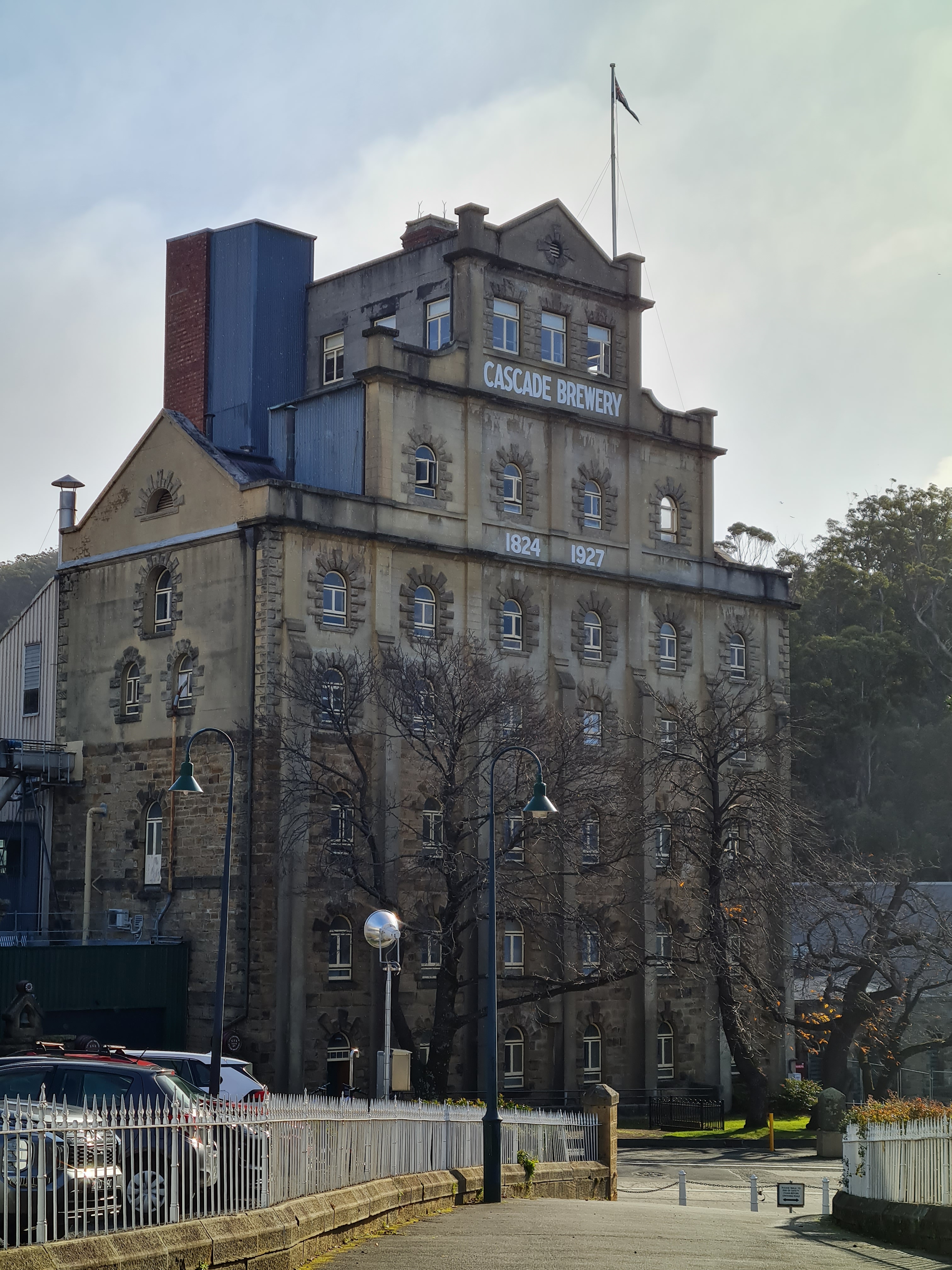
Today’s expedition is the Cascade Brewery, which doesn’t have tours at the moment because of staff issues with Covid, but does have a bar and restaurant.  There is also a historic site, an old women’s prison, and botanical gardens.  I’m not sure how far we’ll get in the gardens, but the bar and restaurant is looking good.

We get there and decide on lunch first then a visit to the women’s prison.

Fail.  The bar and restaurant are packed and there are no tables left.  Time for a photograph of the old brewery, and move on.

Instead of going to the prison, just down the road, we go off in a different direction, to Mt Wellington, thinking it might give excellent views of Hobart.

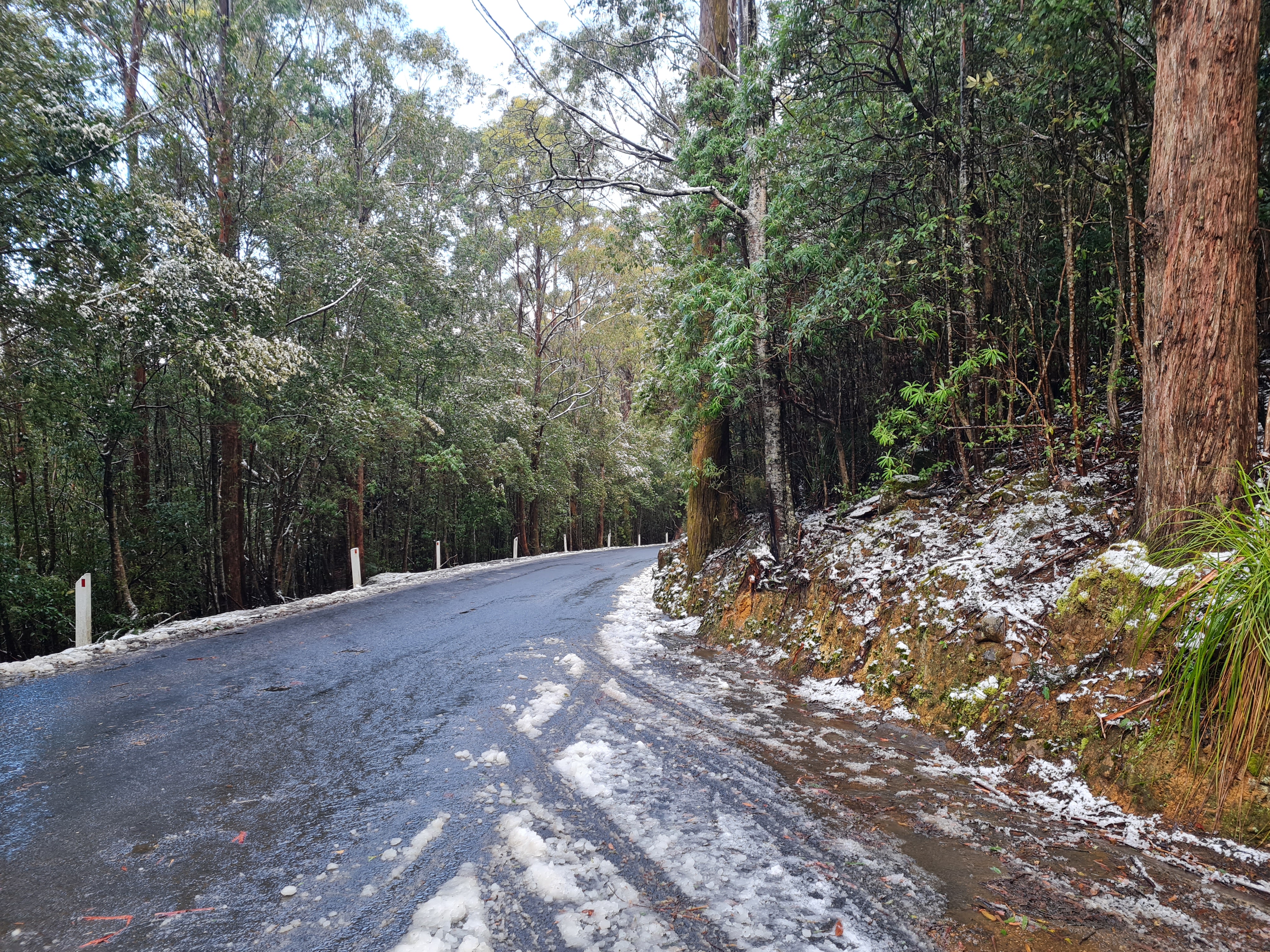
Only a sign says the road is supposed to be closed, but it is not, so we and a dozen others are venturing up the road towards the summit.

The road was probably opened temporarily, but it is getting more treacherous as the snow appears and the road is wet.  We make it about 2km before deciding it’s unsafe.

The adventure continues because at the bottom of the hill we decided to go to Huonville, hoping to chance upon the apple orchards and all things apple.

It was an immense letdown.  There was nothing, except for one innocuous building with a sign out front saying it was open, but for all intents and purposes looked like it was completely empty.

Until you drove around the back to the carpark where there were hundreds of cars, and inside, totally packed.

It’s where everyone in Huonville had gone.

And not where we were going to get a distinctly Tasmanian meal.

We had to settle for another pie from Banjo’s in Sandy Bay.

An excerpt from “Betrayal” – a work in progress

It could have been anywhere in the world, she thought, but it wasn’t.  It was in a city where if anything were to go wrong…

She sighed and came away from the window and looked around the room.  It was quite large and expensively furnished.  It was one of several she had been visiting in the last three months.

Quite elegant too, as the hotel had its origins dating back to before the revolution in 1917.  At least, currently, there would not be a team of KGB agents somewhere in the basement monitoring everything that happened in the room.

There was no such thing as the KGB anymore, though there was an FSB, but such organisations were of no interest to her.

She was here to meet with Vladimir.

She smiled to herself when she thought of him, such an interesting man whose command of English was as good as her command of Russian, though she had not told him of that ability.

All her knew of her was that she was American, worked in the Embassy as a clerk, nothing important, who life both at work and at home was boring.  Not that she had blurted that out the first tie she met, or even the second.

That first time, at a function in the Embassy, was a chance meeting, a catching of his eye as he looked around the room, looking, as he had told her later, for someone who might not be as boring as the function itself.

It was a celebration, honouring one of the Embassy officials on his service in Moscow, and the fact he was returning home after 10 years.  She had been there one, and still hadn’t met all the staff.

They had talked, Vladimir knew a great deal about England, having been stationed there for a year or two, and had politely asked questions about where she lived, her family, and of course what her role was, all questions she fended off with an air of disinterested interest.

It fascinated him, as she knew it would, a sort of mental sparring as one would do with swords, if this was a fencing match.

They had said they might or might not meet again when the party was over, but she suspected there would be another opportunity.  She knew the signs of a man who was interested in her, and Vladimir was interested.

The second time came in the form of an invitation to an art gallery, and a viewing of the works of a prominent Russian artist, an invitation she politely declined.  After all, invitations issued to Embassy staff held all sorts of connotations, or so she was told by the Security officer when she told him.

Then, it went quiet for a month.  There was a party at the American embassy and along with several other staff members, she was invited.  She had not expected to meet Vladimir, but it was a pleasant surprise when she saw him, on the other side of the room, talking to several military men.

A pleasant afternoon ensued.

And it was no surprise that they kept running into each other at the various events on the diplomatic schedule.

By the fifth meeting, they were like old friends.  She had broached the subject of being involved in a plutonic relationship with him with the head of security at the embassy.  Normally for a member of her rank it would not be allowed, but in this instance it was.

She did not work in any sensitive areas, and, as the security officer had said, she might just happen upon something that might be useful.  In that regard, she was to keep her eyes and ears open, and file a report each time she met him.

After that discussion she got the impression her superiors considered Vladimir more than just a casual visitor on the diplomatic circuit.  She also formed the impression the he might consider her an ‘asset’, a word that had been used at the meeting with security and the ambassador.

It was where the word ‘spy’ popped into her head and sent a tingle down her spine.  She was not a spy, but the thought of it, well, it would be fascinating to see what happened.

A Russian friend.  That’s what she would call him.

And over time, that relationship blossomed, until, after a visit to the ballet, late and snowing, he invited her to his apartment not far from the ballet venue.  It was like treading on thin ice, but after champagne and an introduction to caviar, she felt like a giddy schoolgirl.

Even so, she had made him promise that he remain on his best behaviour.  It could have been very easy to fall under the spell of a perfect evening, but he promised, showed her to a separate bedroom, and after a brief kiss, their first, she did not see him until the next morning.

So, it began.

It was an interesting report she filed after that encounter, one where she had expected to be reprimanded.

She wasn’t.

It wasn’t until six weeks had passed when he asked her if she would like to take a trip to the country.  It would involve staying in a hotel, that they would have separate rooms.  When she reported the invitation, no objection was raised, only a caution; keep her wits about her.

Perhaps, she had thought, they were looking forward to a more extensive report.  After all, her reports on the places, and the people, and the conversations she overheard, were no doubt entertaining reading for some.

But this visit was where the nature of the relationship changed, and it was one that she did not immediately report.  She had realised at some point before the weekend away, that she had feelings for him, and it was not that he was pushing her in that direction or manipulating her in any way.

It was just one of those moments where, after a grand dinner, a lot of champagne, and delightful company, things happen.  Standing at the door to her room, a lingering kiss, not intentional on her part, and it just happened.

And for not one moment did she believe she had been compromised, but for some reason she had not reported that subtle change in the relationship to the powers that be, and so far, no one had any inkling.

She took off her coat and placed it carefully of the back of one of the ornate chairs in the room.  She stopped for a moment to look at a framed photograph on the wall, one representing Red Square.

Then, after a minute or two, she went to the mini bar and took out the bottle of champagne that had been left there for them, a treat arranged by Vladimir for each encounter.

There were two champagne flutes set aside on the bar, next to a bowl of fruit.  She picked up the apple and thought how Eve must have felt in the garden of Eden, and the temptation.

Later perhaps, after…

She smiled at the thought and put the apple back.

A glance at her watch told her it was time for his arrival.  It was if anything, the one trait she didn’t like, and that was his punctuality.  A glance at the clock on the room wall was a minute slow.

The doorbell to the room rang, right on the appointed time.

She put the bottle down and walked over to the door.

A smile on her face, she opened the door.

It was not Vladimir.  It was her worst nightmare.

© Charles Heath 2020

It all started in Venice – Episode 11

Verbal sparring with Juliet

I had expected Juliet would try and maneuver the conversation in the direction Larry wanted, and I thought about whether I would be obtuse in simply ignoring her and talking about anything else, or just have fun with Larry who, no doubt, would be listening in.

Her first question was hardly surprising, an effort to see if I would tell her what my work was.  I couldn’t even if I wanted to, but I could intimate certain things.  But not straight away, Juliet was going to give to ask the right questions.

“Since retirement, I spent most of my time looking after Violetta.”

“Was she unwell?”

A natural assumption that everyone made, but nothing could be further from the truth.   She had given me purpose after so long in a trade that traded in endless lies and deception.

And it had been on one of those missions she had been caught in the crossfire, as I pretended to be, and got her out.  We found each other again, by accident, literally, and it developed from there.

I was done with that job and wandering aimlessly around Europe at the time.  She knew something was wrong with me, but never pushed, just accepted that everything would be better in time.

And it was.

It was a while before I answered, several vivid memories of her rising to the surface as they did, unexpectedly at times.

“No.  I often think she was exactly what she thought I needed to be for her.  She had come from a family that had servants all their lives, and there were certain expectations.”

I could see it in her expression, that Violetta treated me like a servant.   Good, let her.

“I had always wondered what it was you did, that you could end up I’m my hospital in such bad shape.  I never bought that car accident excuse we were given, because the injuries were inconsistent.”

“You were an expert on car injuries?”

“As a matter of fact, yes, I had made it a hobby if you like, to treat as many as possible, cataloging the injuries so that other doctors might treat patients with such injuries more efficiently.”

“So, having said that, what in your humble opinion was the cause of my injuries?”

“Being tossed out of a moving car, but more likely the result of a bar fight, the sort they had in the old wild west.”

And she’d be right.  It was six against two, and at a disadvantage, and, yes, I had been thrown a short distance, but not by the enemy.  It was a gesture to save me from a worse beating.  I had been lucky that night, my partner had not.

“Well, always an interesting topic for doctors sitting around a campfire talking shop.  But I will say this, I was a policeman once, with a blue uniform too.  I did spend time on the streets, but mostly doing paperwork, as I keep telling everyone.”

“And what caused your injuries?”

She was persistent, I’ll give her that.

“Getting involved in a domestic argument.  It’s not the sort of work anyone wants to get in the middle of, and my partner at the time was killed.  You saw what happened to me.  We were just in the wrong place at the wrong time.”

She gave me a measured look, one that seemed to say she didn’t believe a word of it, and I was fine with that.  In any other circumstance, we would not be talking about it, and I had tried to put the real events of that day behind me.

It wasn’t easy.  Not when you lose someone.  It becomes that situation where at first you blame yourself for the death, and then after enough people tell you it wasn’t your fault, you begin to wonder what you could have done better to prevent it.

A lot, perhaps, but I’d been younger then, and not as wise.  That came layer with experience.

“Tell me about you,” I said, changing the focus.

“Nothing to tell.”

“I read newspapers Juliet, and I know what happened.  It might have been on page 16, but it leaped off the page.  I wanted to believe it wasn’t true.”

If she thought she was going to escape the inquisition, she was wrong.

I had been surprised to see her name, more surprised at the circumstances, a dalliance with drugs, a bad call, an avoidable death, and the downward spiral from there.

The photo of her in the paper after her arrest was not pretty.  She went to jail for a short period, lost her license to practice medicine, and lost a whole lot more.

“If you read the news, then there’s nothing left to tell.  I’m clean now, have been for a few years.”

The admission came almost reluctantly, for someone in her situation, it was like an evening ender when the truth was out.

“You were a good doctor.  What happened?”

“Too many hours, not enough sleep.  A husband who was too consumed in his own career, I took the easy way out.  Life is a series of choices, and I made a few bad ones.  Shit happens.”

“So, what do you do now?”

“Forensic medicine, assisting coroners.  I work with the dead.  I figure I can’t hurt them anymore.  I try to see the people who don’t survive car crashes, and continue my work in the hope some of the death and mayhem can be prevented.”

As well as doing Larry’s dirty work.  Had she done this before?

Sparring suspended, the main courses arrived.

© Charles Heath 2022

Inspiration, maybe – Volume 1

50 photographs, 50 stories, of which there is one of the 50 below.

They all start with –

A picture paints … well, as many words as you like.  For instance:

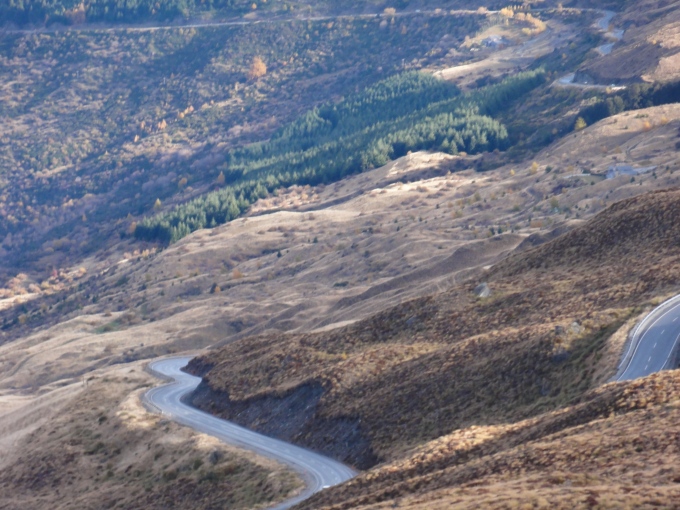
lookingdownfromcoronetpeak

And the story:

It was once said that a desperate man has everything to lose.

The man I was chasing was desperate, but I, on the other hand, was more desperate to catch him.

He’d left a trail of dead people from one end of the island to the other.

The team had put in a lot of effort to locate him, and now his capture was imminent.  We were following the car he was in, from a discrete distance, and, at the appropriate time, we would catch up, pull him over, and make the arrest.

There was nowhere for him to go.

The road led to a dead-end, and the only way off the mountain was back down the road were now on.  Which was why I was somewhat surprised when we discovered where he was.

Where was he going?

“Damn,” I heard Alan mutter.  He was driving, being careful not to get too close, but not far enough away to lose sight of him.

“What?”

“I think he’s made us.”

“How?”

“Dumb bad luck, I’m guessing.  Or he expected we’d follow him up the mountain.  He’s just sped up.”

“How far away?”

“A half-mile.  We should see him higher up when we turn the next corner.”

It took an eternity to get there, and when we did, Alan was right, only he was further on than we thought.”

“Step on it.  Let’s catch him up before he gets to the top.”

Easy to say, not so easy to do.  The road was treacherous, and in places just gravel, and there were no guard rails to stop a three thousand footfall down the mountainside.

Good thing then I had the foresight to have three agents on the hill for just such a scenario.

Ten minutes later, we were in sight of the car, still moving quickly, but we were going slightly faster.  We’d catch up just short of the summit car park.

Or so we thought.

Coming quickly around another corner we almost slammed into the car we’d been chasing.

“What the hell…” Aland muttered.

I was out of the car, and over to see if he was in it, but I knew that it was only a slender possibility.  The car was empty, and no indication where he went.

Certainly not up the road.  It was relatively straightforward for the next mile, at which we would have reached the summit.  Up the mountainside from here, or down.

I looked up.  Nothing.

Alan yelled out, “He’s not going down, not that I can see, but if he did, there’s hardly a foothold and that’s a long fall.”

Then where did he go?

Then a man looking very much like our quarry came out from behind a rock embedded just a short distance up the hill.

“Sorry,” he said quite calmly.  “Had to go if you know what I mean.”

I’d lost him.

It was as simple as that.

I had been led a merry chase up the hill, and all the time he was getting away in a different direction.

I’d fallen for the oldest trick in the book, letting my desperation blind me to the disguise that anyone else would see through in an instant.

It was a lonely sight, looking down that road, knowing that I had to go all that way down again, only this time, without having to throw caution to the wind.

“Maybe next time,” Alan said.

“We’ll get him.  It’s just a matter of time.”

© Charles Heath 2019-2021

Find this and other stories in “Inspiration, maybe”  available soon.

InspirationMaybe1v1

In a word: High or is it hie

When the boss says jump, the question is usually ‘how high’.

Not that it’s possible for many of us with a challenging centre of gravity to get much elevation.

High generally means height, how far something rises above ground level, is above our heads.

That plane flies very high in the sky.

Then there’s another meaning, increased intensity, such as a high temperature, a high fever, but my favourite is, a high dudgeon.

I’m still to get a definition on what a dudgeon is.

We have secondary schools here that we call high schools. Make of that what you will

And in the idiomatic world, flying high means we are very happy, and when were left high and dry then not so much. Unless it related to a ship, in which case a lot of people would be unhappy.

We can use high just about everywhere, high hopes, high ceilings, feelings that run high, a high chair for toddlers of course, high speed which may cause s crash and land you in a high security prison.

This is not to be confused with just plain hi which is a universal greeting.

But there is another, hie, which has a more obscure meaning, to hasten or go quickly.