Searching for locations: Vancouver, Canada – 4

Staying at Hampton Inn and Suites downtown, whatever that means because it looks like we are in the middle of nowhere.

But, judging by the crowd in the breakfast room, it’s a popular hotel.  Of course, it is Sunday morning so this could be the weekend escape people.

Two things I remember about staying in Hampton Inns is firstly the waffles and whipped butter.  It’s been five years but nothing has changed, they are as delicious as ever.  The other, its where I discovered vanilla flavored milk for coffee, and it, too, is addictive.

They also used to have flat burgers that were made out of sausage meat which was delicious, but on the first day, they were not on the menu.

Nevertheless, it was still a very yummy breakfast.

After some research into where we might find this pixmi unicorn, it appears that it is available at a ‘toys are us’ store in one of the suburbs of Vancouver.  So, resuming the quest, we took a taxi to West Broadway, the street the store is located.

A quick search of the store finds where the toys we’re looking for are, after asking one of the sales staff, and we find there are at least a dozen of them.  Apparently, they are not as popular in Canada as the might be in America.  Cheaper too, because the exchange rate for Canadian dollars is much better than for American dollars.  Still, 70 dollars for a stuffed toy is a lot of money.

We also get some slime, stuff that our middle granddaughter seems to like playing with.

After shopping we set off down West Broadway, the way we had come, looking for a taxi to return us to the hotel.  There’s no question of walking back to the hotel.

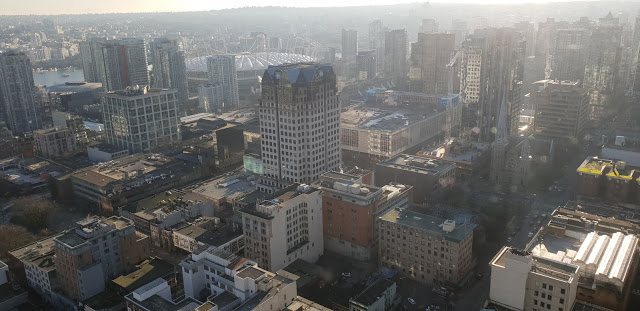
A few hours later we walk to the observation tower, which was not very far from the hotel,

a place where we could get a 360-degree view of the city of Vancouver although it was very difficult to see any of the old buildings because they were hidden by the newer buildings, nor could we see the distant mountains because of the haze.

After leaving the tower we walked down Water Street to see the steam clock and the old world charm of a cobbled street and old buildings

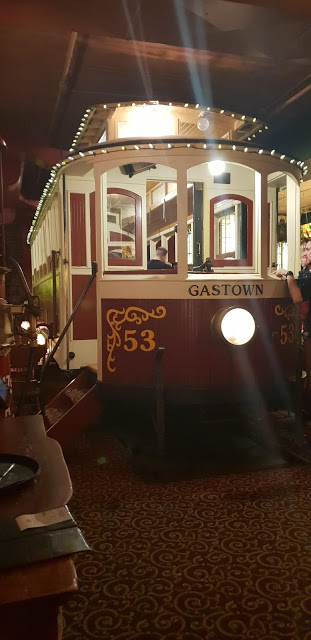
We stopped at the Spaghetti Factory Italian restaurant for dinner and is so popular that we have to wait, 10 minutes to start with.  It doesn’t take all that long to order and have the food delivered to the table.  Inside the restaurant, there is an actual cable car but we didn’t get to sit in it.

I have steak, rare, mushrooms, and spaghetti with marinara sauce.  No, marinara doesn’t mean seafood sauce but a very tasty tomato-based sauce.  The steak was absolutely delicious and extremely tender which made it more difficult to cut with a steak knife.

The write up for the marinara sauce is, ‘it tastes so fresh because it is made directly from vine-ripened tomatoes, not from concentrate, packed within 6 hours of harvest.  We combine them with fresh, high-quality ingredients such as caramelised onions, roasted garlic and extra virgin olive oil’.

Oh, and did I mention they have a streetcar right there in the middle of the restaurant

I’m definitely going to try and make this when we get home.

After dinner, we return to the observation tower,  the ticket allowing us to go back more than once, and see the sights at night time.  I can’t say it was all that spectacular.

Another day has gone, we are heading home tomorrow.

A photograph from the inspirational bin – 38

This is one of those images that could be anywhere.

So, here’s the problem:

Ethan was reluctant to agree to go to the stag night, knowing firstly, that the others going were a bit too unruly when they had too many drinks, secondly, that they had to agree to not know where they were being taken by the bus, and thirdly, anything they saw or did had to remain completely confidential.

That was particularly the case when it came to the ‘stag’.

In that case, Ethan knew exactly what this night was going to be, hours of unrelenting debauchery.

And, since Ethan was the stag’s brother, and he was the best man, there was no way he could wriggle his way out of this one.

On top of that, Ethan had to promise the bride to be that he would not let her husband to be go too far. That statement, of course, was like a box full of hand grenades. He didn’t ask for a definition of too far.

So, seven sober, respectable, hard-working junior executives in suits that were worth more than Ethan’s annual salary boarded the bus.

What happened from that moment the bus drove off, until Ethan’s brother’s body was found floating face down in the river behind the resort, handcuffed to a naked girl in a rubber dinghy, barely alive from an overdose, was anyone’s guess, and Ethan’s worst nightmare.

Especially when he was the last one to see his brother, and the girl, alive.

And, no, this is not based on a real-life experience, though in recurring nightmares I’m the one floating fase down in the river.

The cinema of my dreams – I always wanted to see the planets – Episode 38

On the alien ship

It looked like the bridge on any other spaceship, and for a moment it had me thinking this was another earth ship, in concert with the fleeing vessel, running an operation to separate the captain from his ship.

But, why?

“Why did you bring us here?” I asked, trying to keep an even tone.  I was working overtime suppressing the fear I felt and regretting being so impulsive.

This was not how I expected first contact with another species, at least for me, would go. 

What did I expect?

Certainly not the red-carpet treatment.

“A private discussion, Captain to captain.”

He looked at Nancy Woolmer, and I said, “anything you say will be in strictest confidence.  is our on-board police detective, part of the security team.”

He gave her another long stare, as if he could see into her mind and knew what she was thinking, then just shook his head.

For an alien, he had a lot of human attributes.

“You speak very good English for, if you’ll pardon the expression, an alien.”  Nnnn decided to throw in her on the question.

I didn’t think my captain’s severe stare would silence her or re-establish my authority over the proceedings.

But it was a good question.

“We speak many languages.  You have, in your planet, hundreds.  We have the same in our corner of the galaxy, so we use what we call a universal translator.”

One thing the space age introduced, was to unify countries into blocs and reduced the number of languages.  It had been touch and go for a few years that we’d all be speaking Spanish, the most widely used language on our planet, but somehow English won the battle.

“We’ve tried to unify it to just a few.  It’s not easy.”

“We had the same problem until the translator was created, not only for us but for communicating with other species, like yourself.”

“Nevertheless, how is it you know of us, and how we speak?”

“That’s easy.  We have been visiting, even living among you, for many thousands of your years.”

“And you’ve chosen never to introduce yourselves or make contact.”

“We tried, a number of times, but you are, always were, a primitive and violent people.  We have waited for signs that you had changed, become peaceful, shown unity, but instead, you continue to kill each other and destroy your world through greed and utter stupidity.  Now you have spaceships, albeit limited in technology and travel distance.  Now, unfortunately, we can’t ignore you.”

“The other ship?”

“It was as we expected.  We had hoped they would be peaceful and curious explorers and adopting a cautious approach, we decided to observe, not contact, see if our assessment of your people had changed.  Unfortunately, it had not.  First habitable planet, not far from here, they visited, the scientists examined the world for technology, resources, and then the people.  What they couldn’t take, they stole.  They treated the people badly, getting into disagreements, fighting, and killing.  The other captain was like you, saying they were explorers.”

That’s the thing I hated about first impressions, you do the wrong thing, it’s all you are remembered for, and the other ship had just made the whole of earth look bad.  Not that we hadn’t done that already ourselves in other ways.

Something else to note, aliens had been visiting us for a long, long time.  I didn’t think it was an appropriate moment to bring up Roswell.

OK, we’ve established that humans are not the nicest people in the galaxy but why was l here?

“I can’t answer for my fellow humans, nor will I apologize for them.  The only way they can improve, we can improve, is the get out there and learn about how others have overcome the obstacles we still face.  But, aside from all that, what was so private that I had to come here?”

“Oh, that.  You have about ten of your earth minutes to convince me not to destroy your ship and everyone in it.”

So much for the alien Captain’s promise no harm would come to us.

© Charles Heath 2021-2022

The cinema of my dreams – I always wanted to go on a treasure hunt – Episode 88

Here’s the thing…

Every time I close my eyes, I see something different.

I’d like to think the cinema of my dreams is playing a double feature but it’s a bit like a comedy cartoon night on Fox.

But these dreams are nothing to laugh about.

Once again there’s a new installment of an old feature, and we’re back on the treasure hunt.

I really am leaving, really

A lot can happen in a week.

After leaving the mall carpark, we drove past a scene that could have been right out of a movie, it seemed that surreal.  There were 6 police cars, lights flashing, and officers everywhere.

Cossatino was up against his car, with two officers standing over him.  Both the sheriff and Charlene were not far away, and I had no doubt Charlene’s career was about to take a huge leap, bringing down members of both crime families.

His two bodyguards were on the ground, looking like they’d just gone ten rounds against the reigning heavyweight boxing champion.

Nadia didn’t slow down when passing, and unless he recognized the car, Cossatino would not have seen us, so dense was the tint she had on the car windows.

One of the other cars had both Alex and Vince in the rear, both looking very forlorn.  At that moment in time, I felt like Boggs would get the justice he deserved, in a manner that didn’t require bloodshed, and had to admire the planning and forethought Nadia had put into the operation.

We didn’t go back to her hotel, she suspected the arrest of her father, brother and Alex would not go unnoticed, along with her part in it, despite Charlene assuring her she’d try to keep it under wraps.  Instead, we headed out of town to a small motel that few knew about, and an owner who wouldn’t recognize her, or me.

The room was dingy, with a musty aroma that comes from lack of use, but the sheets were clean, the water in the bathroom hot, and the company perfect.

We didn’t speak, there was no need to, and in the end, everything was just perfect.

Of course, expecting the serenity to last was a forlorn hope.

It wasn’t just the thunderstorm that passed through around midnight, but more a sense of foreboding left hanging in the air.

We were woken, firstly by the rhythmic sound of light rain on the roof, which in a way was quite soothing, but then by the sound of the TV news, part of an early morning show that I had only seen a few times, and disliked because of the presenters.

This morning they sounded positively garish, one reporting, in a tone that might have been used to report an end-of-world event,

“This morning we are waking to the news that the two largest crime families in the county have been finally brought to justice.”

It was a tag team event.

“Yes, John.  We are learning that the head of the Cossatino clan has been charged with conspiracy to murder and that his son Vincent, had been charged over the murder of a local boy, Anton Boggs.”

To the other presenter,

“Yes, Alice.  We understand that the Boggs family has a rather infamous connection to the search for Captain X, long believed to have stashed a large cache of his plunder somewhere along the coastline.  This treasure hunt was first started in earnest by another local identity, X Ormiston, who, like the victim’s father, disappeared mysteriously, some years ago.”

Back again,

“We also understand that the son of businessman and long believed to be involved in a number of suspect activities, none of which gave been proved I might add, Alexander Benderby, has also been arrested as an accomplice in the murder of Anton Boggs.”

There was a momentary break, time enough to turn on the TV in our room, and just as the picture came on, “Just a moment,” as the man held a hand to his ear, no doubt listening to someone updating the situation, or that something more important was happening.

Then, “we have breaking news, and we’re crossing to the Sheriff’s office where he’s about to make an announcement.”

The picture changed, coming live from outside the sheriff’s office, with a row of microphones and more standing in front, waiting.

“This is not looking good,”  Nadia said.

I think she thought the same as I did, and exactly what I’d told Charlene a few days before, that money trumps justice.

“You think the sheriff’s sold out and will recant the charges?”

“Given how much money both of them have funneled one way or another his way, I wouldn’t be surprised.  I honestly thought that Charlene was different “

“She means well, but you have to remember she is subject to the will of the sheriff’s first, and her father second, though those lines may be blurred at times.  Had it been anyone else, justice would prevail.”

No time for any more discussion, the sheriff came out to address the media pack.

“At 5:45 am this morning Vincent Cossatino was found deceased in his cell, along with a suicide note asking for absolution for his crimes.”

“Here it comes,” Nadia muttered.

“The note also stated that he alone was responsible for the death of Anton Boggs, the Alex Benderby had taken no part in it and therefore has been released from custody all charges dropped.”

Nadia turned off the TV.  “There’s no way in hell Vincent committed suicide or wrote such a note.  He was made the scapegoat. So all the others could go free. Something had to be done about Vince and this was dad’s way of cleaning up the mess he left behind.  Bastard.”

Deals were done, there was no doubt about it.  I wondered what Charlene thought about it?

So did Nadia, who had her phone in her hand, and no doubt calling her.

If I were Charlene, I would not answer, but she did.

Nadia put it on speaker, and put it between us.  “What the fuck was that all about?”

“I was taken off the case, for obvious reasons.  Is Sam there?”

“Yes,” I said.

“You were right.  A deal was done last night, but I had no idea what the outcome was until the same time you just heard.  This isn’t justice.”

“Nor what we agreed,” Nadia said.

“And for that, I’m sorry, but I stupidly thought that the law was the law, but apparently it isn’t.  I’m about to hand in my resignation but that won’t change anything.  Alex will get away with it, despite the confession.  Apparently, the recording was damaged when it came to anything he said.”

“Alex might like to think he has, but justice has a way of catching up with the guilty.”

“Don’t do anything stupid, Nadia.  They’ll be expecting you to do something.”

“Yes, I guess so.  Maybe Sam and I will just leave.  This place no longer has anything to keep me here.  I’m sure my father will get off with lesser charges, and seek to make my life hell for what he perceives as disloyalty.”

“Like I said, I was deliberately sidelined.  There’s not a lot I can do, and even if I tried, I’m sure they’d do something about it and then ruin my chances of getting another job.  I’m sorry.”

“It is what it is,” Nadia said, then disconnected the call.

She sat still for a minute, maybe more before she looked at me.  “How long will it take you to pack a bag?”

“Italy?”

“Anywhere but here.  Unless you have a compelling reason to stay?”

I thought about it for all of a minute.  There was nothing.  If my mother was staying with Benderby, then she would be acquiring a new husband and losing a son.  There was no way I was going to be associated with the Benderby’s, and less so, a stepbrother to Alex.

“None that I can think of.  I just have to go home and collect a few things.”

“You do have a passport, don’t you?”

Since I had never traveled out of the country, and never looked like I ever would, a few months ago the answer to that question would have been an emphatic no.  But my mother had floated the idea of going to England, where her ancestors came from, and, having mentioned a recent death of a relative I had not heard of before, decided that we might take the first step, and get passports, essential items if one wanted to travel.

The plan had not been mentioned again, not since getting the job in the warehouse, and the treasure hint started with Boggs, but the passport had arrived a few days before we disappeared, and she left it on my bedside table.

I was not sure how I was hoping to pay for my airfare, but that was a bridge to cross later.

“I do, as a matter of fact, all shiny and new.”

“Good.  I’ll pick you up at your place when you’re ready.  Just send me a text.”

© Charles Heath 2020-2022

An excerpt from “Betrayal” – a work in progress

It could have been anywhere in the world, she thought, but it wasn’t.  It was in a city where if anything were to go wrong…

She sighed and came away from the window and looked around the room.  It was quite large and expensively furnished.  It was one of several she had been visiting in the last three months.

Quite elegant too, as the hotel had its origins dating back to before the revolution in 1917.  At least, currently, there would not be a team of KGB agents somewhere in the basement monitoring everything that happened in the room.

There was no such thing as the KGB anymore, though there was an FSB, but such organisations were of no interest to her.

She was here to meet with Vladimir.

She smiled to herself when she thought of him, such an interesting man whose command of English was as good as her command of Russian, though she had not told him of that ability.

All her knew of her was that she was American, worked in the Embassy as a clerk, nothing important, who life both at work and at home was boring.  Not that she had blurted that out the first tie she met, or even the second.

That first time, at a function in the Embassy, was a chance meeting, a catching of his eye as he looked around the room, looking, as he had told her later, for someone who might not be as boring as the function itself.

It was a celebration, honouring one of the Embassy officials on his service in Moscow, and the fact he was returning home after 10 years.  She had been there one, and still hadn’t met all the staff.

They had talked, Vladimir knew a great deal about England, having been stationed there for a year or two, and had politely asked questions about where she lived, her family, and of course what her role was, all questions she fended off with an air of disinterested interest.

It fascinated him, as she knew it would, a sort of mental sparring as one would do with swords, if this was a fencing match.

They had said they might or might not meet again when the party was over, but she suspected there would be another opportunity.  She knew the signs of a man who was interested in her, and Vladimir was interested.

The second time came in the form of an invitation to an art gallery, and a viewing of the works of a prominent Russian artist, an invitation she politely declined.  After all, invitations issued to Embassy staff held all sorts of connotations, or so she was told by the Security officer when she told him.

Then, it went quiet for a month.  There was a party at the American embassy and along with several other staff members, she was invited.  She had not expected to meet Vladimir, but it was a pleasant surprise when she saw him, on the other side of the room, talking to several military men.

A pleasant afternoon ensued.

And it was no surprise that they kept running into each other at the various events on the diplomatic schedule.

By the fifth meeting, they were like old friends.  She had broached the subject of being involved in a plutonic relationship with him with the head of security at the embassy.  Normally for a member of her rank it would not be allowed, but in this instance it was.

She did not work in any sensitive areas, and, as the security officer had said, she might just happen upon something that might be useful.  In that regard, she was to keep her eyes and ears open, and file a report each time she met him.

After that discussion she got the impression her superiors considered Vladimir more than just a casual visitor on the diplomatic circuit.  She also formed the impression the he might consider her an ‘asset’, a word that had been used at the meeting with security and the ambassador.

It was where the word ‘spy’ popped into her head and sent a tingle down her spine.  She was not a spy, but the thought of it, well, it would be fascinating to see what happened.

A Russian friend.  That’s what she would call him.

And over time, that relationship blossomed, until, after a visit to the ballet, late and snowing, he invited her to his apartment not far from the ballet venue.  It was like treading on thin ice, but after champagne and an introduction to caviar, she felt like a giddy schoolgirl.

Even so, she had made him promise that he remain on his best behaviour.  It could have been very easy to fall under the spell of a perfect evening, but he promised, showed her to a separate bedroom, and after a brief kiss, their first, she did not see him until the next morning.

So, it began.

It was an interesting report she filed after that encounter, one where she had expected to be reprimanded.

She wasn’t.

It wasn’t until six weeks had passed when he asked her if she would like to take a trip to the country.  It would involve staying in a hotel, that they would have separate rooms.  When she reported the invitation, no objection was raised, only a caution; keep her wits about her.

Perhaps, she had thought, they were looking forward to a more extensive report.  After all, her reports on the places, and the people, and the conversations she overheard, were no doubt entertaining reading for some.

But this visit was where the nature of the relationship changed, and it was one that she did not immediately report.  She had realised at some point before the weekend away, that she had feelings for him, and it was not that he was pushing her in that direction or manipulating her in any way.

It was just one of those moments where, after a grand dinner, a lot of champagne, and delightful company, things happen.  Standing at the door to her room, a lingering kiss, not intentional on her part, and it just happened.

And for not one moment did she believe she had been compromised, but for some reason she had not reported that subtle change in the relationship to the powers that be, and so far, no one had any inkling.

She took off her coat and placed it carefully of the back of one of the ornate chairs in the room.  She stopped for a moment to look at a framed photograph on the wall, one representing Red Square.

Then, after a minute or two, she went to the mini bar and took out the bottle of champagne that had been left there for them, a treat arranged by Vladimir for each encounter.

There were two champagne flutes set aside on the bar, next to a bowl of fruit.  She picked up the apple and thought how Eve must have felt in the garden of Eden, and the temptation.

Later perhaps, after…

She smiled at the thought and put the apple back.

A glance at her watch told her it was time for his arrival.  It was if anything, the one trait she didn’t like, and that was his punctuality.  A glance at the clock on the room wall was a minute slow.

The doorbell to the room rang, right on the appointed time.

She put the bottle down and walked over to the door.

A smile on her face, she opened the door.

It was not Vladimir.  It was her worst nightmare.

© Charles Heath 2020

Writing about writing a book – Day 15

Our main character Bill probably needs to give an account of the situation he found himself in.  I have, for a while, considered that he is just another soldier who found himself in the wrong place at the wrong time, but now, I want to add a dimension.

He finishes up where he is, in the end, because he chose to be there, and it was something of a rocky ride to get there.

That I’m still planning in my head.

In the meantime, this is the initial piece I wrote for his situation description:

I used to joke about telling people my middle name was ‘danger’.  It seemed I was not the only one, and for a time, worked with a group of soldiers and ex-soldiers in a capacity similar to that of being a mercenary.

Each one of us had a specialty.  Mine was being the sniper.  Johnny had knife skills and not the sort that was used in a kitchen.  Freddie, explosives, Bill, well, you just left Bill alone because he had a grudge against the world and everyone in it.

The Colonel used to say we were all handpicked, but that wasn’t necessarily the case.  I knew for a fact some of the team came straight out of the stockade before their time was up.

Because some of us were expendable.

The thing was; none of us cared.  For those who were ‘rescued’, it was better out in the jungle, dodging bullets, than being inside, your fate left in the hands of the Gods. 

I knew how it was.  I’d been there once or twice myself.

This morning had started the same as many others.  Rise and shine, a breakfast of sorts, into the chopper, and after an hour or so, dropping into a grassy patch, with nothing but jungle in every direction.  Our mission was to find and liberate a number of our people who had gone missing, read captured, on the border between Cambodia and Vietnam.  It was a familiar country because I had, over the last year or so, gone hunting missing POW’s in the area.  Old prisons had been converted into drug laboratories, and we’d broken up a few of those too.

The noise of the chopper put paid to any sort of stealthy approach and, by the time it dropped us off, if there was anyone nearby, our advantage, if we ever had one, was gone.  The trouble was, to cover the same distance by foot would take a week, and, by the time we arrived, if we arrived, more than half the team would be dead.  We may have been good, but we were not that good.  It was not our home turf.

It was hot, sticky, and nothing like home.  There wasn’t a day that passed when I thought to myself it was getting harder and harder to remember when I wasn’t constantly hot and sweaty, nor as frightened.  It happened that way, towards the end of a tour.

Once on the ground, every man was on full alert.  We changed the lead and tail end constantly, to make sure we didn’t lose anyone.  And it was hard going, the constant heat, sweat, punctuated with slight relief when it rained.

Then as quickly as it came, it went, leaving you wet then sticky.

And if that wasn’t enough to contend with, there was the enemy.   You couldn’t see them, nor hear them yet you had the feeling he was watching you the whole time, and it made your skin crawl.

Sometimes the enemy attacked when we had to camp, invisibly swooping, shooting from the trees, and firing a mortar or two, then disappearing back into the luminous greenery without a trace.  These were the remnants of the Viet Cong, Cambodian armed forces, disaffected Laotians, or the Chinese, or so we believed, but they were well-trained mercenaries and just the sort of people the drug cartels would use.

And surviving the operation, any operation, was like playing Russian roulette.  Was it your turn this time, or someone else’s?  You could be walking along, straining your eyes and ears, and next minute, find the man who was covering your back, dead.  Booby traps were silent and swift.  Landmines are loud and very messy.  Both hangovers from the war, and never cleaned up.  People you’d meet, you never knew whose side they were on, so it was best to avoid all contact.

© Charles Heath 2015-2021

Inspiration, maybe – Volume 1

50 photographs, 50 stories, of which there is one of the 50 below.

They all start with –

A picture paints … well, as many words as you like.  For instance:

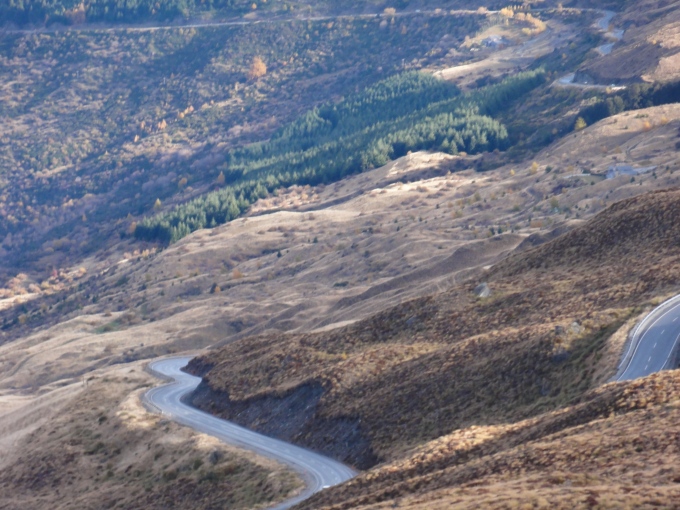
lookingdownfromcoronetpeak

And the story:

It was once said that a desperate man has everything to lose.

The man I was chasing was desperate, but I, on the other hand, was more desperate to catch him.

He’d left a trail of dead people from one end of the island to the other.

The team had put in a lot of effort to locate him, and now his capture was imminent.  We were following the car he was in, from a discrete distance, and, at the appropriate time, we would catch up, pull him over, and make the arrest.

There was nowhere for him to go.

The road led to a dead-end, and the only way off the mountain was back down the road were now on.  Which was why I was somewhat surprised when we discovered where he was.

Where was he going?

“Damn,” I heard Alan mutter.  He was driving, being careful not to get too close, but not far enough away to lose sight of him.

“What?”

“I think he’s made us.”

“How?”

“Dumb bad luck, I’m guessing.  Or he expected we’d follow him up the mountain.  He’s just sped up.”

“How far away?”

“A half-mile.  We should see him higher up when we turn the next corner.”

It took an eternity to get there, and when we did, Alan was right, only he was further on than we thought.”

“Step on it.  Let’s catch him up before he gets to the top.”

Easy to say, not so easy to do.  The road was treacherous, and in places just gravel, and there were no guard rails to stop a three thousand footfall down the mountainside.

Good thing then I had the foresight to have three agents on the hill for just such a scenario.

Ten minutes later, we were in sight of the car, still moving quickly, but we were going slightly faster.  We’d catch up just short of the summit car park.

Or so we thought.

Coming quickly around another corner we almost slammed into the car we’d been chasing.

“What the hell…” Aland muttered.

I was out of the car, and over to see if he was in it, but I knew that it was only a slender possibility.  The car was empty, and no indication where he went.

Certainly not up the road.  It was relatively straightforward for the next mile, at which we would have reached the summit.  Up the mountainside from here, or down.

I looked up.  Nothing.

Alan yelled out, “He’s not going down, not that I can see, but if he did, there’s hardly a foothold and that’s a long fall.”

Then where did he go?

Then a man looking very much like our quarry came out from behind a rock embedded just a short distance up the hill.

“Sorry,” he said quite calmly.  “Had to go if you know what I mean.”

I’d lost him.

It was as simple as that.

I had been led a merry chase up the hill, and all the time he was getting away in a different direction.

I’d fallen for the oldest trick in the book, letting my desperation blind me to the disguise that anyone else would see through in an instant.

It was a lonely sight, looking down that road, knowing that I had to go all that way down again, only this time, without having to throw caution to the wind.

“Maybe next time,” Alan said.

“We’ll get him.  It’s just a matter of time.”

© Charles Heath 2019-2021

Find this and other stories in “Inspiration, maybe”  available soon.

InspirationMaybe1v1

Writers need to have many alter egos, don’t they?

I have often wondered just how much or how little of the author’s personality and experiences end up in a fictional character.

Have they climbed mountains,

Have they escaped from what is almost the inescapable,

Have they been shot, tortured, or worse,

Have they been dumped, or divorced,

Have they travelled to dangerous places, or got locked up in a foreign jail?

We research, read, and I guess experience some or all of the above on the way to getting the book written, but it’s perhaps an interesting fundamental question.

Who am I today?  Or, more to the point, who do I want to be today?

Or it can be a question, out of left field, in an interview; “Who are you?”

My initial reaction was to say, “I’m a writer.”  But that wasn’t the answer the interviewer is looking for.

Perhaps if she had asked, “Who are you when you’re writing your latest story?” it would make more sense.

Am I myself today?

Am I some fictional character an amalgam of a lot of other people?

Have I got someone definite in mind when I start writing the story?

The short answer might be, “I usually want to be someone other than what I am now.  It’s fiction.  I can be anyone or anything I want, provided, of course, I know the limitations of the character.”

“So,” she says, “what if you want to be a fireman?”

“I don’t want to be a fireman.”

“But if the story goes in the direction where you need a fireman…”

“What is this thing you have with firemen?”  I’m shaking my head.  How did we get off track?

“Just saying.”

“Then I’d have to research the role, but I’m not considering adding a fireman anytime soon.”

She sighs.  “Your loss.”

Moving on.

And there is that other very interesting question; “Who would you like to be if you could be someone else?”

A writer in that period between the wars, perhaps like an F Scott Fitzgerald or Ernest Hemingway, in Paris, or if it is a fictional character, Jay Gatsby.

He’s just the sort of person who is an enigma wrapped up in a mystery.

The first case of PI Walthenson – “A Case of Working With the Jones Brothers”

This case has everything, red herrings, jealous brothers, femme fatales, and at the heart of it all, greed.

See below for an excerpt from the book…

Coming soon!

PIWalthJones1

An excerpt from the book:

When Harry took the time to consider his position, a rather uncomfortable position at that, he concluded that he was somehow involved in another case that meant very little to him.

Not that it wasn’t important in some way he was yet to determine, it was just that his curiosity had got the better of him, and it had led to this: sitting in a chair, securely bound, waiting for someone one of his captors had called Doug.

It was not the name that worried him so much, it was the evil laugh that had come after the name was spoken.

Doug what? Doug the ‘destroyer’, Doug the ‘dangerous’, Doug the ‘deadly’; there was any number of sinister connotations, and perhaps that was the point of the laugh, to make it more frightening than it was.

But there was no doubt about one thing in his mind right then: he’d made a mistake. A very big. and costly, mistake. Just how big the cost, no doubt he would soon find out.

His mother, and his grandmother, the wisest person he had ever known, had once told him never to eavesdrop.

At the time he couldn’t help himself and instead of minding his own business, listening to a one-sided conversation which ended with a time and a place. The very nature of the person receiving the call was, at the very least, sinister, and, because of the cryptic conversation, there appeared to be, or at least to Harry, criminal activity involved.

For several days he had wrestled with the thought of whether he should go. Stay on the fringe, keep out of sight, observe and report to the police if it was a crime. Instead, he had willingly gone down the rabbit hole.

Now, sitting in an uncomfortable chair, several heat lamps hanging over his head, he was perspiring, and if perspiration could be used as a measure of fear, then Harry’s fear was at the highest level.

Another runnel of sweat rolled into his left eye, and, having his hands tied, literally, it made it impossible to clear it. The burning sensation momentarily took his mind off his predicament. He cursed and then shook his head trying to prevent a re-occurrence. It was to no avail.

Let the stinging sensation be a reminder of what was right and what was wrong.

It was obvious that it was the right place and the right time, but in considering his current perilous situation, it definitely was the wrong place to be, at the worst possible time.

It was meant to be his escape, an escape from the generations of lawyers, what were to Harry, dry, dusty men who had been in business since George Washington said to the first Walthenson to step foot on American soil, ‘Why don’t you become a lawyer?” when asked what he could do for the great man.

Or so it was handed down as lore, though Harry didn’t think Washington meant it literally, the Walthenson’s, then as now, were not shy of taking advice.

Except, of course, when it came to Harry.

He was, Harry’s father was prone to saying, the exception to every rule. Harry guessed his father was referring to the fact his son wanted to be a Private Detective rather than a dry, dusty lawyer. Just the clothes were enough to turn Harry off the profession.

So, with a little of the money Harry inherited from one of his aunts, he leased an office in Gramercy Park and had it renovated to look like the Sam Spade detective agency, you know the one, Spade and Archer, and The Maltese Falcon.

There’s a movie and a book by Dashiell Hammett if you’re interested.

So, there it was, painted on the opaque glass inset of the front door, ‘Harold Walthenson, Private Detective’.

There was enough money to hire an assistant, and it took a week before the right person came along, or, more to the point, didn’t just see his business plan as something sinister. Ellen, a tall cool woman in a long black dress, or so the words of a song in his head told him, fitted in perfectly.

She’d seen the movie, but she said with a grin, Harry was no Humphrey Bogart.

Of course not, he said, he didn’t smoke.

Three months on the job, and it had been a few calls, no ‘real’ cases, nothing but missing animals, and other miscellaneous items. What he really wanted was a missing person. Or perhaps a beguiling, sophisticated woman who was as deadly as she was charming, looking for an errant husband, perhaps one that she had already ‘dispatched’.

Or for a tall, dark and handsome foreigner who spoke in riddles and in heavily accented English, a spy, or perhaps an assassin, in town to take out the mayor. The man was such an imbecile Harry had considered doing it himself.

Now, in a back room of a disused warehouse, that wishful thinking might be just about to come to a very abrupt end, with none of the romanticized trappings of the business befalling him. No beguiling women, no sinister criminals, no stupid policemen.

Just a nasty little man whose only concern was how quickly or how slowly Harry’s end was going to be.

© Charles Heath 2019

“The End of the Road”, a short story

From the days of wandering the remote country towns of New South Wales in Australia.


The End of the Road


The man who had said that we would never make the distance was right.

It had been my idea to go ‘troppo’, forsake everything, hop on a motorbike and go around Australia.  I was, at that stage fed up with everything and, catching Harry in one of his low spots, he decided there and then he would join me.

For the first few days, we believed we were stark staring mad and talked about calling it quits, but perseverance made all the difference.  After two months we were glad we had the resolve to keep going, and in that time we had managed to see more of the Australian countryside than we’d seen all our lives.

That was until this particular morning when we arrived in Berrigum, what could have been called a one-horse town.  It consisted of one hotel, one general store (that sold everything from toothpicks to petrol) and an agricultural machinery depot.  It also had a station and some wheat silos, and this appeared to be the only reason for a town in this particular spot in the middle of nowhere.

And it was the railway station that interested Harry, who was, by this time, getting a little homesick and fed up with his motorbike.

After coughing and spluttering for the last week it had finally died, and the five-mile walk to Berrigum had not helped either his temper, or his disposition, and had only served to firm his resolve to return home.

It was hot but not unbearably so, unlike a hot summer’s day in the city, and even worse still in public transport.  For miles around as we tramped those five miles all we could see was acres and acres of wheat, but no sign of life.  It was the same when we reached the town.  It appeared all the people were either hiding or had left.  Harry suspected the latter given the state of the road, and the buildings, more or less the epitome of a ghost town.

Standing at the end of what could have been called the main street with only our own dust for company, one look took in the whole town.  In a car, one wouldn’t have given it a second look, if one had time to give it a first.  I didn’t remember seeing neither any speed restriction signs nor signpost advertising a town ahead.

And since no amount of argument could sway him from his resolve, the first objective was to get a train timetable, if such a thing existed, and make arrangements for Harry’s return.

The station was as deserted as the town itself, and a quick glance in the stationmaster’s office showed no sign of life.

Leaving the bikes on the platform outside the office, we headed for the hotel for both a drink and make enquiries about rail services.  Being a hot day and the morning’s tramp somewhat hot and dusty, we were looking forward to a cold glass (or two) of beer.

The hotel looked as though it was a hundred years old though there was no doubting a few relentless summers would reduce it to the same state.  It was as bad inside as out, though the temperature was several degrees lower, and we could sit down in what appeared to be the main bar.  We were the only occupants and still to find any sign of life.  Overhead, two fans were struggling to move the hot air around.

More than once Harry reckoned it was a ghost town and I was beginning to believe him when, after five minutes, no one arrived.

After ten, we stood, ready to leave, only to stop halfway out of our chairs when a voice behind us said, “Surely you’re not going back out there without refreshment?”

“I was beginning to think the town was deserted,” I said.

“It is during the day, but when the sun goes down…”

I didn’t ask.  We followed him to the bar where he had stationed himself behind the counter.  “The name is Jack.”  He stretched out his hand towards us.  “We don’t bother with last names here.”

“Bill,” I said, shaking it, and nodding to Harry, “Harry.”

Harry nodded and shook his hand too.

“The first one’s on the house.”  He poured three glasses and put ours in front of us.  “Cheers.”

In all cases, it went down without touching the sides (as they say) and he poured a second, at the same time asking, “What brings you to our little corner of the earth?”

“Just passing through,” I said, “Or at least for me.”

“And you?”  Jack looked at Harry.

“I can’t hack the pace.  I can truthfully say I have thoroughly enjoyed the trip so far, except for a few mishaps, but for me, it’s time to get back to the big smoke.  My ‘do your own thing’ has run out of momentum.  Do you know if there is a train that goes anywhere important?”

The publican looked at him almost pityingly.  “Important, eh?”  He rubbed his chin feigning thought.  “You make it sound like you are in purgatory.”

“Aren’t we?”

I suppose one could hardly blame Harry for his attitude.  After all, at the beginning, he had numerous accidents, caught a virus that stayed with him (and a couple of torrential downpours had done little to help it), and now his motorbike had finally died.  No wonder his humour was at an all-time low.

For a moment I thought the publican was going to tell Harry what he thought of him, but then he smiled and the tension passed.  “Perhaps to a city fellow like you it might be,” he said.  “The mail train which has a passenger carriage comes through once a week, and, my good man, you’re in luck.  Today’s the day.”

“Good.  How do I get a ticket?”

“You’d have to see the Station Master.”

“And where might he be at the moment?  We were at the station a while back and there was no sign of life.”

“Nor will there be until the train comes.  Meanwhile, there’s time enough for lunch.  I’m sure you will stay?”  He looked questioningly at us.

I looked at Harry, who nodded.

“Why not.”


Over lunch, we talked.

I remember not so long ago when I had to attend a large number of lunches where the talk was of business, or, if anything, mostly about subjects that I had no interest in.  It was always some posh restaurant, time seemed important, the atmosphere never really relaxed, and to get into a relaxed state it took a large amount of alcohol to deaden the despair and distaste of that one had to fete in order to secure their business.

How different it was here.

We talked about the country, and, after seeing as much of it, and worked on it as we had to fund our odyssey, we could talk about it authoritatively.  And, most of all, it was interesting.

The atmosphere too was entirely different than it had been in the city.  Out here the people were always friendly, people always willing to stop and talk, particularly farmers; share a drink or some food.

There was none of this carefree purposefulness in the city, and more than once I’d thought of the fact one could travel in the same train with the same people for year after year and still not know any of them.  It was the same at work.  Even after five years I still hadn’t known three-quarters of the office staff, and most of them probably didn’t want to know me.  Harry was virtually the only real friend I’d had at work.

But here, in ‘the middle of nowhere’ as Harry had called it, I felt as though I’d known the publican all of my life instead of the few short hours.


Some hours later and after much argument, where Jack and I tried to talk Harry into staying (Jack said he knew someone who could fix anything including Harry’s bike), Harry remained unconvinced and resolute.  Jack, to round off the occasion (we were the first real guests from outside he had had in a week) provided another on-the-house ale and then saw us to the station.  “After all”, he had said, “I’ve nothing else to do at the moment.”

By that time the station was showing a little more life than it had before.  A station assistant, moving several parcels with a hand trolley, slowly ambled towards the end of the platform.

And whether it could be called a platform was a debatable point.  It was a gravel and grass affair that looked more like part of cutting through a hill than a station.

At the station, Jack portentously announced he was also the stationmaster and would be only too happy to take care of Harry’s requirements.  It would be, he added, “the first passenger ticket sold for several months.”  Certainly, the ticket he handed Harry bore witness to that.  It had yellowed with age.

One would have thought with the imminent arrival of the train there would be more people, but no.  The only event had been the station assistant’s stroll to the end of the platform and back.  Now both he and Jack had disappeared into the office and we were left alone on the platform.  Very little in the whole town stirred, nor had it the whole time we’d been there.

“Well,” I said to break the silence.  “I’m sorry to see you going through with it.  I thought I might have been able to talk you out of it…”  I shrugged, leaving the sentence unfinished.

“I’m sorry to be going too, but a body can take only so much bad luck, and God knows that’s all I’ve had.”

“Yes.”  I couldn’t think of much else to say.  “But it’s been good to have your company these last few months.”

“And you.  When do you think you’ll get back?”

“When I get sick of it I suppose.”

“Look us up then when you get back.”

“I will.”

Thankfully the appearance of the train in the distance broke off the conversation.  I had begun to think of what it was going to be like out on the road with no one to talk to but myself.  The thought was a little depressing and I tried not to let it show.

We said little else until the train pulled in, three flat cars, seven enclosed wagons, a passenger carriage and the guard’s van.  The train stopped with only part of the passenger carriage and the guard’s van at the station.

The guard took aboard the parcels the station assistant had left for him earlier, and then put those that were for Berrigum on the trolley.

I shook Harry’s hand and said I’d see him around.  Then he, the motorbike, and the guard were aboard and the train was off, disappearing slowly into the afternoon haze.

The station assistant then repeated his amble to the end of the platform to collect the hand trolley.

“Staying or moving on.”  Jack had come up behind me and gave me a bit of a start.

“Staying I guess, until tomorrow or maybe later.”

“I had heard one of the farm hands is leaving tomorrow heading back to Sydney.  There could be a vacancy.”

“Sounds like a plan,” I said.

“I could put in a word for you.”

“Thanks.”

Jack just grinned and we headed for the hotel.


© Charles Heath 2016-2019