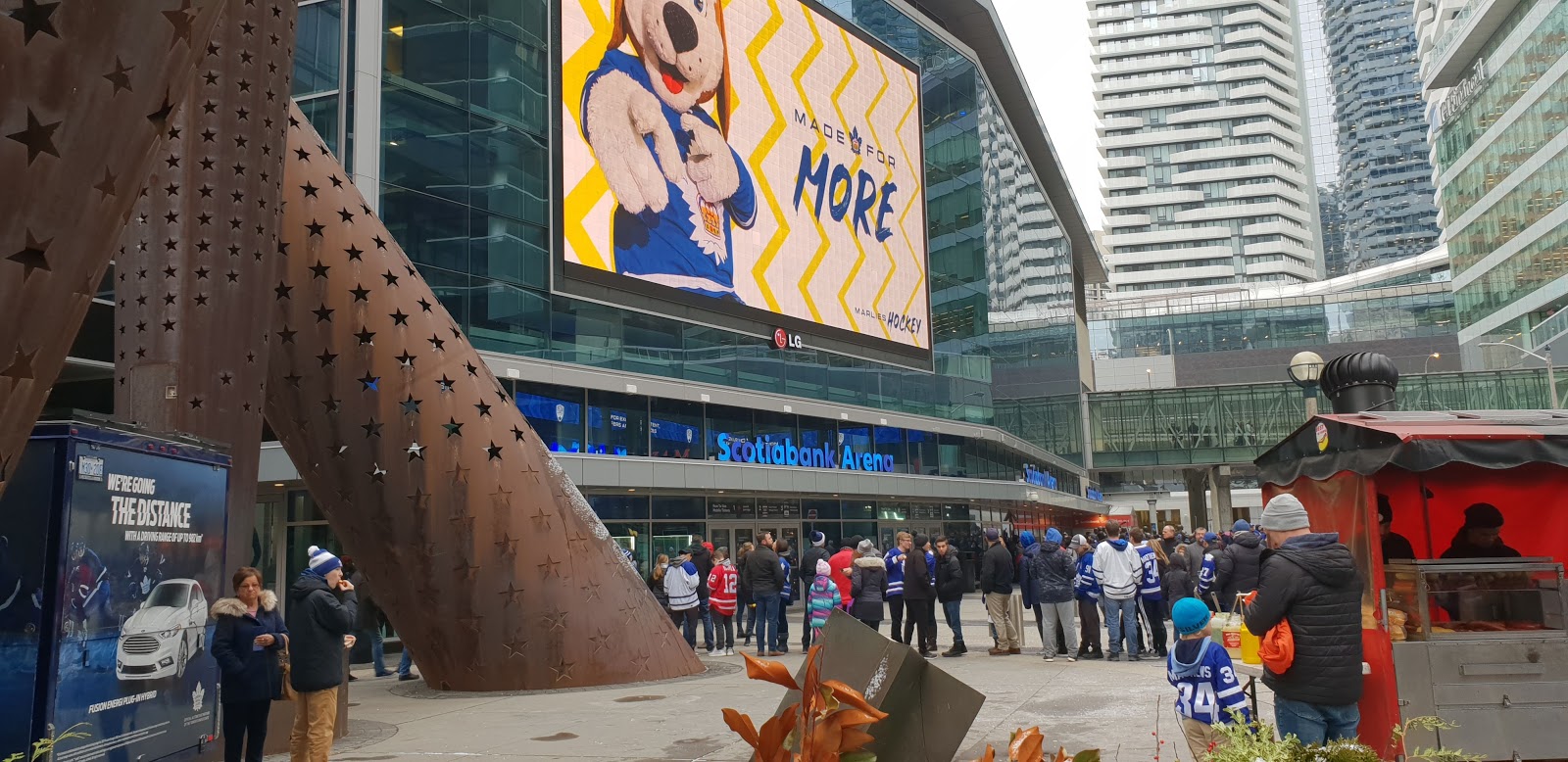
Searching for locations: Toronto, Canada

The touristy things

On the way to the Hall of Fame, we found an ice skating rink

The Hockey hall of fame

The hockey hall of fame is a very large exhibition which would take a whole day to see everything.  We sat through a very informative history of the game and the origins of the NHL, which for people who do not have hockey as a sport in their country, is saying something.

We follow the Maple Leafs, coincidentally Toronto’s franchise in the NHL, and we have been here before for a game, which they lost.  It didn’t matter, I was staggered by the energy and enthusiasm both the players and the fans put into making it a memorable experience.

I’m hoping for a repeat experience.

St Lawrence Market

We walked 1.8 km to the market and it was closed which is about right for us as we have a knack for turning up and the place is closed, for instance, the Canadian club distillery in Windsor, Canada.

Perhaps tomorrow, before or after the game.

Red Lobster

Ok, we’ve been here before and it was beyond any expectations anyone could have for a restaurant chain.

This was no different from the last.

What more could you want, scallops, shrimp, and a fried lobster tail all drowned in a superb garlic butter sauce.

Add a side of mash potatoes, and a 20oz glass of beer, and there is the definition of heaven on a plate.

St Lawrence Market, again

Snowing, but not heavily

St Lawrence market, everything is very expensive, crab legs $120 per kg, lobster, $50 to $80 per kg.  Oddly everything is quoted per pound, and it’s a good thing that we can convert lbs to kg.

It is, to say the least, a disappointment.

Ice Hockey at the Scotiabank Arena

There was a definite buzz in the air, and heading towards the stadium was both us, and many other Toronto supporters.  Blue Maple Leaf jerseys were in abundance.

We’ve been before, and the last time the Leafs lost.

What else is new?

They have had a very good season so far, and are second on the ladder overall, so it was not without the expectation that they might win this one.


Never have an expectation.

They lost.

But…

It was an incredible game that was none stop action.  It seems to me that you require a lot of skill and skating talent to play this game.  I certainly couldn’t, and freely admit that I’d probably last about five minutes.

The score didn’t reflect the play, but in the end, the Leafs lost 4 – 3, at the end of the three periods.

Souvenir hunting and other stuff

I woke tired and exhausted, not looking forward to walking around Toronto.

Got up early to do the walking.

Oh, did I tell you, this hotel has a laundry and it is the bugbear of staying in major hotels, not being able to wash clothes?

Breakfast is included, but it is the main meal of the day so we feast.  The selection is incredible.

We had to go back to the Maple Leafs franchise shop to exchange a Maple Leafs Jersey, which was no trouble.

So near to the CN tower, we go in to shop for souvenirs, of which there were plenty.  I liked the stuffed mooses and beavers.

We’ve been up the tower so it’s back to the Union Station and a short stay at upstairs, a little bar overlooking the Toronto Pearson train line.

Time for tasting some Canadian ales, the first a Mill Street tank house ale, the second a Mill Street hopped and confused.  Seriously, that’s what they were called.

The drinking mood music was old hits like Queen and a little bit of country and western.

We had a good view of the trains, too.

Union Station

Like all main stations very large very tall ceilings and openings that lead to the tracks of which there are about 24, and an underground system

Much the same as all large railway terminals and probably far busier in times gone by.

Dining, but not necessarily dinner

Not far from the station, and opposite to clock tower belonging to the old city hall was a restaurant called Bannock.

There I had a Moosehead Cracked Canoe lager, a light ale, and a house special since 1929, a chicken pot pie, and it was very good.

The importance of book reviews

Self-published authors are fully aware that perhaps the easiest part of the writing journey is the actual writing.  Well, compared to the marketing aspect I believe it is.

I have read a lot of articles, suggestions, and tips and tricks to market the book to the reading public.  It is, to say the least, a lot harder to market eBooks than perhaps their hard or paper-back relatives.

This is despite the millions of eReaders out there.

Then there is that other fickle part of the publishing cycle, the need for reviews.

Proper reviews of course.

As we are learning, reviews can be bought.  And Amazon is out there seeking what it calls unverified reviews and the reviewers and it had brought with it very strict control over who can leave a review, especially on Amazon.

Another site where reviews are taken seriously is the Goodreads website where I have established a presence, and expect in due course, some reviews.

But, all the advice I have seen and read tells me that reviews should not be paid for, and that reviews will come with sales.  It might be a difficult cycle, more reviews mean more sales, etc.

And getting those first sales …

Therein lies the conundrum.  It is a question of paying for advertising or working it out for ourselves.  I guess if I were to get more sales, I could afford the advertising … yes, back on the merry-go-round!

And yet, the harder the road, the more I enjoy what I do.  It is exhilarating while writing, it is a joy to finish the first draft, it is an accomplishment when it is published, but when you sell that first book, well, there is no other feeling like it.

The cinema of my dreams – I always wanted to see the planets – Episode 42

We seem to have a spot of bother

The next statement from Number One, “Sir, it seems we have a hostage situation.”

A glance back at the main screen showed the Russian ship’s bridge minus the captain and flickering on, the alien ship’s Captain.

“I didn’t open a channel, Sir,” the comms officer said quickly.

I glared at the alien representative for a few seconds, hoping to convey my displeasure, but I doubted it would have any effect.

Nor was it any surprise to discover that something indeed didn’t add up. 

Potentially we had a very bad situation, facing off an alien vessel with unknown capabilities and weapons, and a ship that was not supposed to exist, having reputedly committed unknown criminal activities.

“General, you might have to make an instant decision, so if the potential threat is life or ship threatening, don’t wait for confirmation.”

“Sir.”

“Code Red, and everyone, report anything no matter how trivial.”

“Number one, a hostage situation is only a hostage situation if the hostage-taker has a hostage.  You get a clear shot, shoot them.”

“There may potentially be casualties, sir.”

“Then at your discretion, but hold that thought until I have a word with our new, so-called, friends.”

“Sir.”

To say I was annoyed was an understatement, but I had to remember that our underlying mission was to make new friends, not enemies.

“Captain,” the alien commander decided now was the moment to speak.

“You have not been quite truthful with us, have you?”

“They did commit crimes, that is the truth.”

“Then why is one of your people holding the captain hostage?”

It only just struck me then that the alien vessel had beamed one of the people onto the Russian ship after the alien ship arrived with us.  But to what purpose?

“To force them to return to the planet where the crimes were committed.  I had no reason to believe you would force the issue.  Our experience with humans is they support each other before they do the right thing.”

“Your experience is narrow-minded, generally supported by few instances, and basically does not define the human race.  Like everyone, we have a bad element, but it doesn’t define who or what we are.  You obviously heard my instructions to my boarding party.  Your turn now to give me a good reason why I should not shoot them?”

“I assume you still want to open diplomatic relations between our worlds?”

“Not at the expense of gunboat diplomacy.”

“I could destroy both your ships.”

“You could try.  If you know as much as you claim to know about humans, you’ll know that we are at our most formidable when our backs are to the wall.  My ship is an unknown quantity to you, which means you have no idea what we are capable of, but if you want yo find out, by all means, try.”

It was hard to keep an even tone when you are terrified.  Our first encounter had been nothing but threats and violence.  Was I no better than the worse of our kind?

Number one was back in my ear, “Sir, the alien and the Captain just disappeared.”

“I would like you to join us on my ship for discussions, Captain.  I’m sure this situation can be resolved amicably.”

“I’d like a skilled diplomatic negotiator with me, and not agreeing will be considered a hostile act.”

Just in case he was intending to beam me aboard his ship.  A nod in the General’s direction showed he knew what to do if the alien tried.

“Send a message to our diplomatic representative to cone to the bridge urgently.”

I preferred this to be done privately so as not to alert the crew.

I had read the file on Margaret Simpson, and it was, to say the least, extraordinary.  Her achievements at getting the most disparate parties to the table spoke for itself, and it surprised me that she would go on what could prospectively be a one-way trip.

I had not yet spoken to her since boarding, but it had been on my list before we ran into an alien species.  Now, that introduction was lost.

She looked exactly as I’d expected, just in the prime of middle age, diminutive, but not overly imposing, but distinctive enough to stop and look when she walked into a room.

“Captain, I can’t say what comes next doesn’t excite me.”

“You got a brief description of events?”

“An alien race, hostile or not, is exactly why I came.”

“Things could go pear-shaped very quickly.”

“You are exactly as described Captain, refreshingly honest, but somehow I don’t think I need to worry too much if you’re coming with me.”

“A perk of the job, I’m afraid.”

I looked at the alien captain on screen.

“Ready.”

© Charles Heath 2021-2022

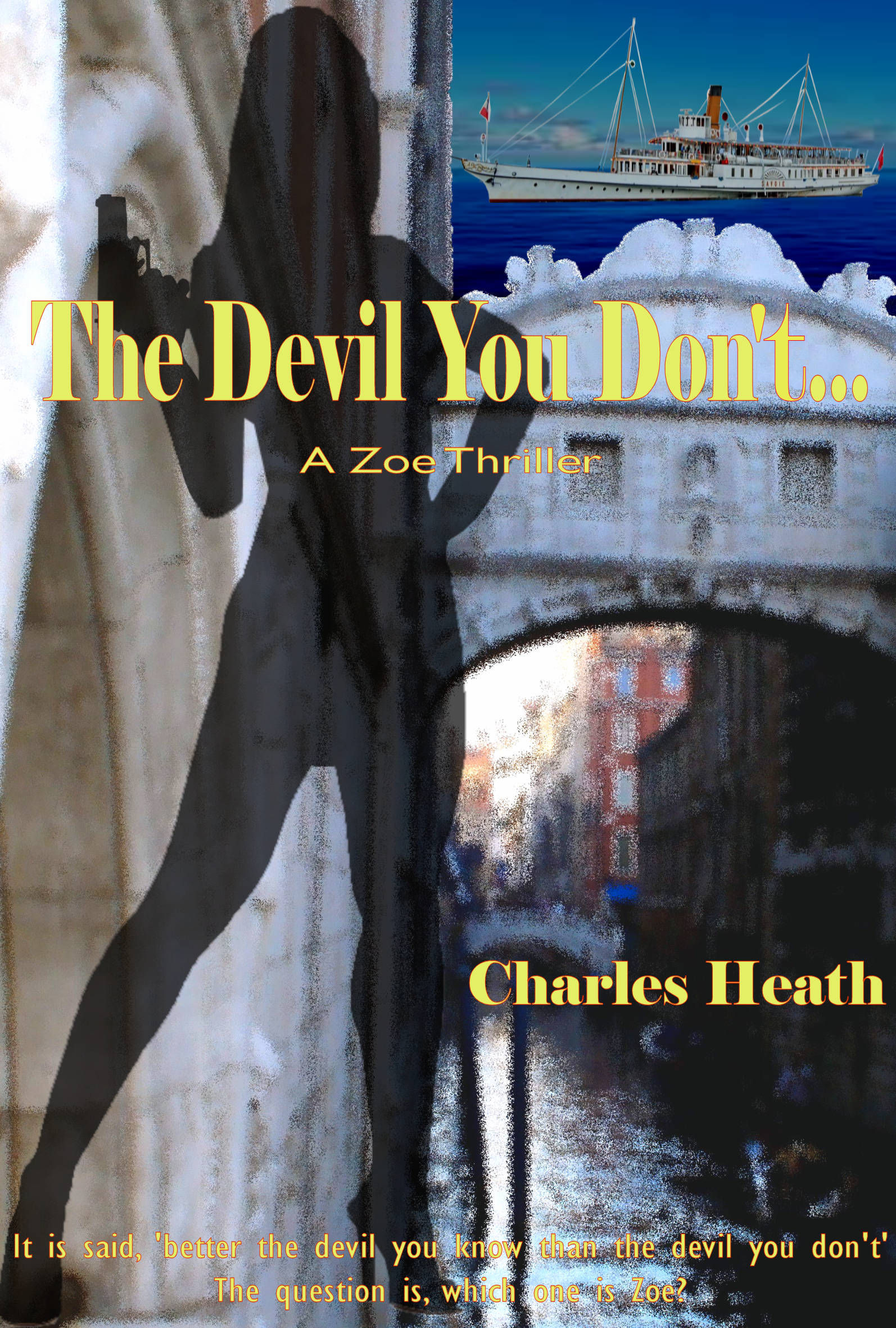
An excerpt from “The Devil You Don’t”

Available on Amazon Kindle here:  https://amzn.to/2Xyh1ow


By the time I returned to the Savoie, the rain had finally stopped, and there was a streak of blue sky to offer some hope the day would improve.

The ship was not crowded, the possibility of bad weather perhaps holding back potential passengers.  Of those I saw, a number of them would be aboard for the lunch by Phillippe Chevrier.  I thought about it, but the Concierge had told me about several restaurants in Yvoire and had given me a hand-drawn map of the village.  I think he came from the area because he spoke with the pride and knowledge of a resident.

I was looking down from the upper deck observing the last of the boarding passengers when I saw a woman, notable for her red coat and matching shoes, making a last-minute dash to get on board just before the gangway was removed.  In fact, her ungainly manner of boarding had also captured a few of the other passenger’s attention.  Now they would have something else to talk about, other than the possibility of further rain.

I saw her smile at the deckhand, but he did not smile back.  He was not impressed with her bravado, perhaps because of possible injury.  He looked at her ticket then nodded dismissively, and went back to his duties in getting the ship underway.  I was going to check the departure time, but I, like the other passengers, had my attention diverted to the woman in red.

From what I could see there was something about her.  It struck me when the light caught her as she turned to look down the deck, giving me a perfect profile.  I was going to say she looked foreign, but here, as in almost anywhere in Europe, that described just about everyone.  Perhaps I was just comparing her to Phillipa, so definitively British, whereas this woman was very definitely not.

She was perhaps in her 30’s, slim or perhaps the word I’d use was lissom, and had the look and manner of a model.  I say that because Phillipa had dragged me to most of the showings, whether in Milan, Rome, New York, London, or Paris.  The clothes were familiar, and in the back of my mind, I had a feeling I’d seen her before.

Or perhaps, to me, all models looked the same.

She looked up in my direction, and before I could divert my eyes, she locked on.  I could feel her gaze boring into me, and then it was gone as if she had been looking straight through me.  I remained out on deck as the ship got underway, watching her disappear inside the cabin.  My curiosity was piqued, so I decided to keep an eye out for her.

I could feel the coolness of the air as the ship picked up speed, not that it was going to be very fast.  With stops, the trip would take nearly two hours to get to my destination.  It would turn back almost immediately, but I was going to stay until the evening when it returned at about half eight.  It would give me enough time to sample the local fare, and take a tour of the medieval village.

Few other passengers ventured out on the deck, most staying inside or going to lunch.  After a short time, I came back down to the main deck and headed forward.  I wanted to clear my head by concentrating on the movement of the vessel through the water, breathing in the crisp, clean air, and let the peacefulness of the surroundings envelope me.

It didn’t work.

I knew it wouldn’t be long before I started thinking about why things hadn’t worked, and what part I played in it.  And the usual question that came to mind when something didn’t work out.  What was wrong with me?

I usually blamed it on my upbringing.

I had one of those so-called privileged lives, a nanny till I was old enough to go to boarding school, then sent to the best schools in the land.  There I learned everything I needed to be the son of a Duke, or, as my father called it in one of his lighter moments, nobility in waiting.

Had this been five or six hundred years ago, I would need to have sword and jousting skills, or if it had been a few hundred years later a keen military mind.  If nothing else I could ride a horse, and go on hunts, or did until they became not the thing to do.

I learned six languages, and everything I needed to become a diplomat in the far-flung British Empire, except the Empire had become the Commonwealth, and then, when no-one was looking, Britain’s influence in the world finally disappeared.  I was a man without a cause, without a vocation, and no place to go.

Computers were the new vogue and I had an aptitude for programming.  I guess that went hand in hand with mathematics, which although I hated the subject, I excelled in.  Both I and another noble outcast used to toss ideas around in school, but when it came to the end of our education, he chose to enter the public service, and I took a few of those ideas we had mulled over and turned them into a company.

About a year ago, I was made an offer I couldn’t refuse.  There were so many zeroes on the end of it I just said yes, put the money into a very grateful bank, and was still trying to come to terms with it.

Sadly, I still had no idea what I was going to do with the rest of my life.  My parents had asked me to come back home and help manage the estate, and I did for a few weeks.  It was as long as it took for my parents to drive me insane.

Back in the city, I spent a few months looking for a mundane job, but there were very few that suited the qualifications I had, and the rest, I think I intimidated the interviewer simply because of who I was.  In that time I’d also featured on the cover of the Economist, and through my well-meaning accountant, started involving myself with various charities, earning the title ‘philanthropist’.

And despite all of this exposure, even making one of those ubiquitous ‘eligible bachelor’ lists, I still could not find ‘the one’, the woman I wanted to spend the rest of my life with.  Phillipa seemed to fit the bill, but in time she proved to be a troubled soul with ‘Daddy’ issues.  I knew that in building a relationship compromise was necessary, but with her, in the end, everything was a compromise and what had happened was always going to be the end result.

It was perhaps a by-product of the whole nobility thing.  There was a certain expectation I had to fulfill, to my peers, contemporaries, parents and family, and those who either liked or hated what it represented.  The problem was, I didn’t feel like I belonged.  Not like my friend from schooldays, and now obscure acquaintance, Sebastian.  He had been elevated to his Dukedom early when his father died when he was in his twenties.  He had managed to fade from the limelight and was rarely mentioned either in the papers or the gossip columns.  He was one of the lucky ones.

I had managed to keep a similarly low profile until I met Phillipa.  From that moment, my obscurity disappeared.  It was, I could see now, part of a plan put in place by Phillipa’s father, a man who hogged the limelight with his daughter, to raise the profile of the family name and through it their businesses.  He was nothing if not the consummate self-advertisement.

Perhaps I was supposed to be the last piece of the puzzle, the attachment to the establishment, that link with a class of people he would not normally get in the front door.  There was nothing refined about him or his family, and more than once I’d noticed my contemporaries cringe at the mention of his name, or any reference of my association with him.

Yet could I truthfully say I really wanted to go back to the obscurity I had before Phillipa?  For all her faults, there were times when she had been fun to be with, particularly when I first met her when she had a certain air of unpredictability.  That had slowly disappeared as she became part of her father’s plan for the future.  She just failed to see how much he was using her.

Or perhaps, over time, I had become cynical.

I thought about calling her.  It was one of those moments of weakness when I felt alone, more alone than usual.

I diverted my attention back to my surroundings and the shoreline.  Out of the corner of my eye, I could see the woman in the red coat, making a move.  The red coat was like a beacon, a sort of fire engine red.  It was not the sort of coat most of the women I knew would wear, but on her, it looked terrific.  In fact, her sublime beauty was the one other attribute that was distinctly noticeable, along with the fact her hair was short, rather than long, and jet black.

I had to wrench my attention away from her.

A few minutes later several other passengers came out of the cabin for a walk around the deck, perhaps to get some exercise, perhaps checking up on me, or perhaps I was being paranoid.  I waited till they passed on their way forward, and I turned and headed aft.

I watched the wake sluicing out from under the stern for a few minutes, before retracing my steps to the front of the ship and there I stood against the railing, watching the bow carve its way through the water.  It was almost mesmerizing.  There, I emptied my mind of thoughts about Phillipa, and thoughts about the woman in the red coat.

Until a female voice behind me said, “Having a bad day?”

I started, caught by surprise, and slowly turned.  The woman in the red coat had somehow got very close me without my realizing it.  How did she do that?  I was so surprised I couldn’t answer immediately.

“I do hope you are not contemplating jumping.  I hear the water is very cold.”

Closer up, I could see what I’d missed when I saw her on the main deck.  There was a slight hint of Chinese, or Oriental, in her particularly around the eyes, and of her hair which was jet black.  An ancestor twice or more removed had left their mark, not in a dominant way, but more subtle, and easily missed except from a very short distance away, like now.

Other than that, she was quite possibly Eastern European, perhaps Russian, though that covered a lot of territory.  The incongruity of it was that she spoke with an American accent, and fluent enough for me to believe English was her first language.

Usually, I could ‘read’ people, but she was a clean slate.  Her expression was one of amusement, but with cold eyes.  My first thought, then, was to be careful.

“No.  Not yet.”  I coughed to clear my throat because I could hardly speak.  And blushed, because that was what I did when confronted by a woman, beautiful or otherwise.

The amusement gave way to a hint of a smile that brightened her demeanor as a little warmth reached her eyes.  “So that’s a maybe.  Should I change into my lifesaving gear, just in case?”

It conjured up a rather interesting image in my mind until I reluctantly dismissed it.

“Perhaps I should move away from the edge,” I said, moving sideways until I was back on the main deck, a few feet further away.  Her eyes had followed me, and when I stopped she turned to face me again.  She did not move closer.

I realized then she had removed her beret and it was in her left side coat pocket.  “Thanks for your concern …?”

“Zoe.”

“Thanks for your concern, Zoe.  By the way, my name is John.”

She smiled again, perhaps in an attempt to put me at ease.  “I saw you earlier, you looked so sad, I thought …”

“I might throw myself overboard?”

“An idiotic notion I admit, but it is better to be safe than sorry.”

Then she tilted her head to one side then the other, looking intently at me.  “You seem to be familiar.  Do I know you?”

I tried to think of where I may have seen her before, but all I could remember was what I’d thought earlier when I first saw her; she was a model and had been at one of the showings.  If she was, it would be more likely she would remember Phillipa, not me.  Phillipa always had to sit in the front row.

“Probably not.”  I also didn’t mention the fact she may have seen my picture in the society pages of several tabloid newspapers because she didn’t look the sort of woman who needed a daily dose of the comings and goings, and, more often than not, scandal associated with so-called celebrities.

She gave me a look, one that told me she had just realized who I was.  “Yes, I remember now.  You made the front cover of the Economist.  You sold your company for a small fortune.”

Of course.  She was not the first who had recognized me from that cover.  It had raised my profile considerably, but not the Sternhaven’s.  That article had not mentioned Phillipa or her family.  I suspect Grandmother had something to do with that, and it was, now I thought about it, another nail in the coffin that was my relationship with Phillipa.

“I wouldn’t say it was a fortune, small or otherwise, just fortunate.”  Each time, I found myself playing down the wealth aspect of the business deal.

“Perhaps then, as the journalist wrote, you were lucky.  It is not, I think, a good time for internet-based companies.”

The latter statement was an interesting fact, one she read in the Financial Times which had made that exact comment recently.

“But I am boring you.”  She smiled again.  “I should be minding my own business and leaving you to your thoughts.  I am sorry.”

She turned to leave and took a few steps towards the main cabin.

“You’re not boring me,” I said, thinking I was letting my paranoia get the better of me.  It had been Sebastian on learning of my good fortune, who had warned me against ‘a certain element here and abroad’ whose sole aim would be to separate me from my money.  He was not very subtle when he described their methods.

But I knew he was right.  I should have let her walk away.

She stopped and turned around.  “You seem nothing like the man I read about in the Economist.”

A sudden and awful thought popped into my head.  Those words were part of a very familiar opening gambit.  “Are you a reporter?”

I was not sure if she looked surprised, or amused.  “Do I look like one?”

I silently cursed myself for speaking before thinking, and then immediately ignored my own admonishment.  “People rarely look like what they are.”

I saw the subtle shake of the head and expected her to take her leave.  Instead she astonished me.

“I fear we have got off on the wrong foot.  To be honest, I’m not usually this forward, but you seemed like you needed cheering up when probably the opposite is true.  Aside from the fact this excursion was probably a bad idea.  And,” she added with a little shrug, “perhaps I talk too much.”

I was not sure what I thought of her after that extraordinary admission. It was not something I would do, but it was an interesting way to approach someone and have them ignoring their natural instinct.  I would let Sebastian whisper in my ear for a little longer and see where this was going.

“Oddly enough, I was thinking the same thing.  I was supposed to be traveling with my prospective bride.  I think you can imagine how that turned out.”

“She’s not here?”

“No.”

“She’s in the cabin?”  Her eyes strayed in that direction for a moment then came back to me.  She seemed surprised I might be traveling with someone.

“No.  She is back in England, and the wedding is off.  So is the relationship.  She dumped me by text.”

OK, why was I sharing this humiliating piece of information with her?  I still couldn’t be sure she was not a reporter.

She motioned to an empty seat, back from the edge.  No walking the plank today.  She moved towards it and sat down.  She showed no signs of being cold, nor interested in the breeze upsetting her hair.  Phillipa would be having a tantrum about now, being kept outside, and freaking out over what the breeze might be doing to her appearance.

I wondered, if only for a few seconds if she used this approach with anyone else.  I guess I was a little different, a seemingly rich businessman alone on a ferry on Lake Geneva, contemplating the way his life had gone so completely off track.

She watched as I sat at the other end of the bench, leaving about a yard between us.  After I leaned back and made myself as comfortable as I could, she said, “I have also experienced something similar, though not by text message.  It is difficult, the first few days.”

“I saw it coming.”

“I did not.”  She frowned, a sort of lifeless expression taking over, perhaps brought on by the memory of what had happened to her.  “But it is done, and I moved on.  Was she the love of your life?”

OK, that was unexpected.

When I didn’t answer, she said, “I am sorry.  Sometimes I ask personal questions without realizing what I’m doing.  It is none of my business.”  She shivered.  “Perhaps we should go back inside.”

She stood, and held out her hand.  Should I take it and be drawn into her web?  I thought of Sebastian.  What would he do in this situation?

I took her hand in mine and let her pull me gently to my feet.  “Wise choice,” she said, looking up at the sky.

It just started to rain.


© Charles Heath 2015-2020
newdevilcvr6

Writing about writing a book – Day 20

It is a day of rest although writers are ready and able to work on any given day at any hour of the day or night when an idea or thought comes to them.

I’m trying not to think, but that’s not working.

I’ve been going over the reasons for writing the first draft of the book 30 odd years ago and it had something to do with the fact I was working with personal computers and local area networking when both were in their infancy, and I wanted to blend this knowledge into a story.

Of course, I’d always wanted to write thrillers, and this presented the opportunity to use computers as a basis for a worldwide conspiracy.  How easy it is these days to do just that, but back in those days, it was a lot of hard work.

I remember sitting in a meeting when the company I was working for at the time had just implemented a network and personal computer to replace the mainframe and dumb terminals, also looking to leverage the new technologies of spreadsheets and word-processing, effectively making accounts staff more productive, and removing typists and moving into the world of centralized word processing.  It was not a new idea with Wangwriter, but using PC’s was.

One of the departmental managers got up to give his take on the new technology, this about six months after implementation, and after a lot of teething troubles caused mainly by people who were vehemently resisting change, and his message was, it should not be called ‘networking’, but ‘not working’, in reference to the number of times the network went down.

But this is a digression.  Computers are only a part of the story.

The story also goes back to a time when there was a clear demarcation between the management levels.  Management offices were oasis’s whereas the staff worked in a stark desert-like environment.  When one came to work for such an organization, it was with the belief that you start at the bottom, and over time, you work your way up the ladder.  There was, very definitely, class distinction, and the various management levels never mixed, at work or socially, except within their own level.

There were Managers, Assistant Managers, and Manager’s Assistants, a typing pool, a secretary, that young, or old, lady who did so many jobs for their boss, that these days it would be considered demeaning.  They were dedicated to their jobs and irreplaceable.  There was no such person as a Personal Assistant.

Nor was such a thing as sexual harassment.  One company I worked in where one of the Assistant Managers was sexually abusing an office girl, her complaints didn’t get a prosecution as it would now, it just had him transferred to another branch.  Reprehensible, yes, and thankfully no longer a problem, except of course, in Fifty Shades of Grey which apparently condones such behavior.

There were department heads, General Managers, and Board Members.  The upper management level and participants were in a world of their own, one few could ever aspire to.  This is the world in which Transworld, my fictitious (but based on a very real) company lives.

I have to work on my company structure to make sure it is right.

Now I have two charts.  A timeline, for both Bill, and the story, and a hierarchy for the office management and staff.

This is beginning to be more complicated than I thought.


© Charles Heath 2016-2020

An excerpt from “If Only” – a work in progress

Investigation of crimes doesn’t always go according to plan, nor does the perpetrator get either found or punished.

That was particularly true in my case.  The murderer was incredibly careful in not leaving any evidence behind, to the extent that the police could not rule out whether it was a male or a female.

At one stage the police thought I had murdered my own wife though how I could be on a train at the time of the murder was beyond me.  I had witnesses and a cast-iron alibi.

The officer in charge was Detective First Grade Gabrielle Walters.  She came to me on the day after the murder seeking answers to the usual questions like, when was the last time you saw your wife, did you argue, the neighbors reckon there were heated discussions the day before.

Routine was the word she used.

Her Sargeant was a surly piece of work whose intention was to get answers or, more likely, a confession by any or all means possible.  I could sense the raging violence within him.  Fortunately, common sense prevailed.

Over the course of the next few weeks, once I’d been cleared of committing the crime, Gabrielle made a point of keeping me informed of the progress.

After three months the updates were more sporadic, and when, for lack of progress, it became a cold case, communication ceased.

But it was not the last I saw of Gabrielle.

The shock of finding Vanessa was more devastating than the fact she was now gone, and those images lived on in the same nightmare that came to visit me every night when I closed my eyes.

For months I was barely functioning, to the extent I had all but lost my job, and quite a few friends, particularly those who were more attached to Vanessa rather than me.

They didn’t understand how it could affect me so much, and since it had not happened to them, my tart replies of ‘you wouldn’t understand’ were met with equally short retorts.  Some questioned my sanity, even, for a time, so did I.

No one, it seemed, could understand what it was like, no one except Gabrielle.

She was by her own admission, damaged goods, having been the victim of a similar incident, a boyfriend who turned out to be an awfully bad boy.  Her story varied only in she had been made to witness his execution.  Her nightmare, in reliving that moment in time, was how she was still alive and, to this day, had no idea why she’d been spared.

It was a story she told me one night, some months after the investigation had been scaled down.  I was still looking for the bottom of a bottle and an emotional mess.  Perhaps it struck a resonance with her; she’d been there and managed to come out the other side.

What happened become our secret, a once-only night together that meant a great deal to me, and by mutual agreement, it was not spoken of again.  It was as if she knew exactly what was required to set me on the path to recovery.

And it had.

Since then, we saw each about once a month in a cafe.   I had been surprised to hear from her again shortly after that eventful night when she called to set it up, ostensibly for her to provide me with any updates on the case, but perhaps we had, after that unspoken night, formed a closer bond than either of us wanted to admit.

We generally talked for hours over wine, then dinner and coffee.  It took a while for me to realize that all she had was her work, personal relationships were nigh on impossible in a job that left little or no spare time for anything else.

She’d always said that if I had any questions or problems about the case, or if there was anything that might come to me that might be relevant, even after all this time, all I had to do was call her.

I wondered if this text message was in that category.  I was certain it would interest the police and I had no doubt they could trace the message’s origin, but there was that tiny degree of doubt, about whether or not I could trust her to tell me what the message meant.

I reached for the phone then put it back down again.  I’d think about it and decide tomorrow.

© Charles Heath 2018-2020

The bane of our existence: social media

I’m back to writing, sitting at the desk, pad in front of me, pen in hand.

The only thing lacking is an idea.

It’s 9:03 am, too early to start on a six-pack.

I need a distraction.

Blogging, websites, Twitter, and Facebook, all of these social media problems are swirling around in my mind.

The more I read the more it bothers me that if I don’t have the right social media presence if I do not start to build an email list, all of my efforts in writing a book will come to naught.

Then I start trawling the internet for information on marketing and found a plethora of people offering any amount of advice for anything between a ‘small amount’ to a rather large amount that gives comprehensive coverage of most social media platforms for periods of a day, a week or a month.  I don’t have a book so it’s a bit early to be worrying about that.

I move on to the people who offer advice for a cost on how to build a following, how to build a web presence, how to get a thousand Twitter followers, and how to get thousands of email followers before the launch.

The trouble is I’m writing a novel, not a nonfiction book, or have some marvellous 30 page ebook on how to do something, for free just to drive people to my site.

I’m a novelist, not a handyman so those ideas while good are not going to help me.

Yet another problem to wrestle with along with actually creating a product to sell in the first place.

Except I’m supposed to be writing for the love of it without the premeditated idea of writing for gain or getting rich quick.

What am I missing here?

So should l be writing short stories and offering them for free to drive people to my site?  These would have to be genre-specific so it needs time and effort and fit into a convenient size story that will highlight or showcase my talent.

Or should I create a website for the novel and set up pages for the characters and get some interaction going that way?

It will be difficult without giving the whole plot away so if I do it will have to be carefully managed.

I don’t think I will have a good night’s sleep again with all of these social media problems I’m going to have.

Oh well, back to the book.  It’s time to have a nightmare of a different sort!

“The Things We Do For Love” – Coming soon

Is love the metaphorical equivalent to ‘walking the plank’; a dive into uncharted waters?

For Henry the only romance he was interested in was a life at sea, and when away from it, he strived to find sanctuary from his family and perhaps life itself.  It takes him to a small village by the sea, s place he never expected to find another just like him, Michelle, whom he soon discovers is as mysterious as she is beautiful.

Henry had long since given up the notion of finding romance, and Michelle couldn’t get involved for reasons she could never explain, but in the end both acknowledge that something happened the moment they first met.  

Plans were made, plans were revised, and hopes were shattered.

A chance encounter causes Michelle’s past to catch up with her, and whatever hope she had of having a normal life with Henry, or anyone else, is gone.  To keep him alive she has to destroy her blossoming relationship, an act that breaks her heart and shatters his.

But can love conquer all?

It takes a few words of encouragement from an unlikely source to send Henry and his friend Radly on an odyssey into the darkest corners of the red light district in a race against time to find and rescue the woman he finally realizes is the love of his life.

The cover, at the moment, looks like this:

lovecoverfinal1

No stone unturned… – A short story

Mondays were usually a slow day to start the week, a brief few hours after the storm the was every Friday. Some chose to come in late, others gathered on arrival to have a team debriefing.

Our department chose to have a debriefing, and it was my job to analyze all the data and turn it into a graphical representation that basically said the business was heading in the right direction – up.

But, this Monday morning, the circumstances were slightly different.

The head of the company had personally sent both an email and a memo to every employee, an event that had never happened before.

In fact, for most of us, it was an eye-opening discovery, one where had the company not become engulfed in a scandal of international proportions, his identity might have remained a secret.

Not that it mattered to the 15,000 odd people who worked for the company, because the bottom line was that it would not affect us, or our employment.  Well, that was the message the email and the memo was primarily about.

Was it too little too late?

The problem was that the morning’s paper’s headlines screamed scandal in large letters and then went on to describe how the company was basically a front for laundering money associated with various criminal activities. It stopped short of accusing the company’s upper management of being criminals, but it was clear, reading between the lines, they had to know something was wrong.

I walked into the meeting room where all of the Department’s staff were seated, talking among themselves, that dying down the moment I closed the door behind me. On the desk in front of each was one of the three morning papers, all with basically the same story.

I didn’t bring a paper in with me, nor a copy of the email, or the memo. I was hoping the meeting was not going to be about the scandal.

I was wrong.

It was one of those companies where everyone knew everyone. I knew everyone in the room, and regarded most as friends as well as workmates. The company promoted from within and on merit, and with this, I had the respect of everyone who worked under me.

I could see by the mood, and looks of expectation, that trust was going to be tested.

“I suspect that everyone has seen the news, and hopefully read both missives from management regarding the situation the company finds itself.”

That was met with a murmur of agreement.

“It was also, for some, a surprise.”

For others, it was not. Our department was basically in place to ensure that all transactions were conducted properly and that clients’ accounts were managed within the guidelines set by the company, and the various government institutions responsible for financial affairs.

Several of the senior officers had come to me with what they regarded as anomalies, and I have given them the authority to investigate. It was also within my remit to advise the relevant government authority. Most of the anomalies had simply been oversights by the account manager, except for one, which as far as I was aware, had been cleared.

Or not.

“Can we safely assume that Wally Anderson’s somewhat abrupt was not as described?”

Wally Anderson’s abrupt departure had been described to me in a one-line email, ‘taking some personal time to work through some family issues’. In the week leading up to his departure he had become increasingly agitated, and one call one of the others had taken in his absence was from a reporter.

It was one of his accounts that remained doubtful, until shortly after he left when an external investigator was brought in.

But I had a difficult line to walk, trying to placate both sides of the spectrum and management, and as a leader. Respect could be won or lost in a matter of words.

“That might or might not be the case, but the odds are, given what we’re reading, that there may be room for doubt. However, despite what we may conclude, or deduce, it is better for all of us to keep an open mind. I suspect, at some point, again based on what I read, we might be approached by the police or representatives of a number of regulatory organizations for information.”

It was as far as I got.

The side door swung open, and my superior, the Chief Accountant, strode in, along with the mystery man who was, the papers said, the Owner, followed by the harried personal assistant.

“Mr. Nelson…”

The Chief Accountant stood front and center to the group. I thought it wise to stand off to one side, the opposite, in fact, the Owner, now standing just inside the door, next to his PA who was quietly talking into her cell phone.

“I’ll take over from here, Max.”

He switched his attention back to the group and took a few seconds to run his eye over all over them, almost as if he was looking for someone or something.

“I have spent the last 48 hours in rather tedious discussions with the regulators who insist that they received information about the Ridley investigation. Unfortunately, without consulting the company, he took part of the results of the investigation to them. Was anyone here aware of his actions?”

Another eye cast over the group, and, in the end, a glance at me.

I felt responsible to answer for the group.

“Investigations are conducted by individuals, and as far as I was concerned, the Ridley investigation was his. As equally that after he departed, that investigation was completed and cleared. Are you intimating that it wasn’t?”

I knew as much about it as the others.

“It was, until someone else reopened it, and reported it. We believe it was someone in this room.”

“That’s not possible,” I said. “I have oversight of all the officers in this room, and the ability to monitor everything they do and everything they look at. You know the security protocols in place in the software itself.”

“An investigation into the software has been implemented, and it shows that certain log files were altered so that the user log wouldn’t show who looked at the records. Someone with database experience.”

“We’re basically auditors not database managers.”

“Well, someone apparently is. Everyone is on notice. We will find out who it was, and believe me when I say we will leave no stone unturned in the process.”

An almost imperceptible not from the Owner, the harried PA was still on the cell phone, the Chief Accountant gave the group another steely look, then glared at me, said, “My office, one hour,” then left pulling the other two along in his wake.

I cast an eye over the group, picking out those whom I suspected were capable of performing such a search and destroy operation. Three.

“My door is open for anyone who might have any information, with the promise of anonymity.”

I left them with that and also left.

What should have been a quiet morning’s discussion just became a witch hunt where someone would be burnt at the stake. Whether they were guilty or not.

© Charles Heath 2020-2021

The story behind the story: A Case of Working With the Jones Brothers

To write a private detective serial has always been one of the items at the top of my to-do list, though trying to write novels and a serial, as well as a blog, and maintain a social media presence, well, you get the idea.

But I made it happen, from a bunch of episodes I wrote a long, long time ago, used these to start it, and then continue on, then as now, never having much of an idea where it was going to end up, or how long it would take to tell the story.

That, I think is the joy of ad hoc writing, even you, as the author, have as much idea of where it’s going as the reader does.

It’s basically been in the mill since 1990, and although I finished it last year, it looks like the beginning to end will have taken exactly 30 years.  Had you asked me 30 years ago if I’d ever get it finished, the answer would be maybe?

My private detective, Harry Walthenson

I’d like to say he’s from that great literary mold of Sam Spade, or Mickey Spillane, or Phillip Marlow, but he’s not.

But, I’ve watched Humphrey Bogart play Sam Spade with much interest, and modeled Harry and his office on it.  Similarly, I’ve watched Robert Micham play Phillip Marlow with great panache, if not detachment, and added a bit of him to the mix.

Other characters come into play, and all of them, no matter what period they’re from, always seem larger than life.  I’m not above stealing a little of Mary Astor, Peter Lorre or Sidney Greenstreet, to breathe life into beguiling women and dangerous men alike.

Then there’s the title, like

The Case of the Unintentional Mummy – this has so many meanings in so many contexts, though I image back in Hollywood in the ’30s and ’40s, this would be excellent fodder for Abbott and Costello

The Case of the Three-Legged Dog – Yes, I suspect there may be a few real-life dogs with three legs, but this plot would involve something more sinister.  And if made out of plaster, yes, they’re always something else inside.

But for mine, to begin with, it was “The Case of the …”, because I had no idea what the case was going to be about, well, I did, but not specifically.

Then I liked the idea of calling it “The Case of the Brother’s Revenge” because I began to have a notion there was a brother no one knew about, but that’s stuff for other stories, not mine, so then went the way of the others.

Now it’s called ‘A Case of Working With the Jones Brothers’, finished the first three drafts, and at the editor for the last.

I have high hopes of publishing it in early 2021.  It even has a cover.

PIWalthJones1