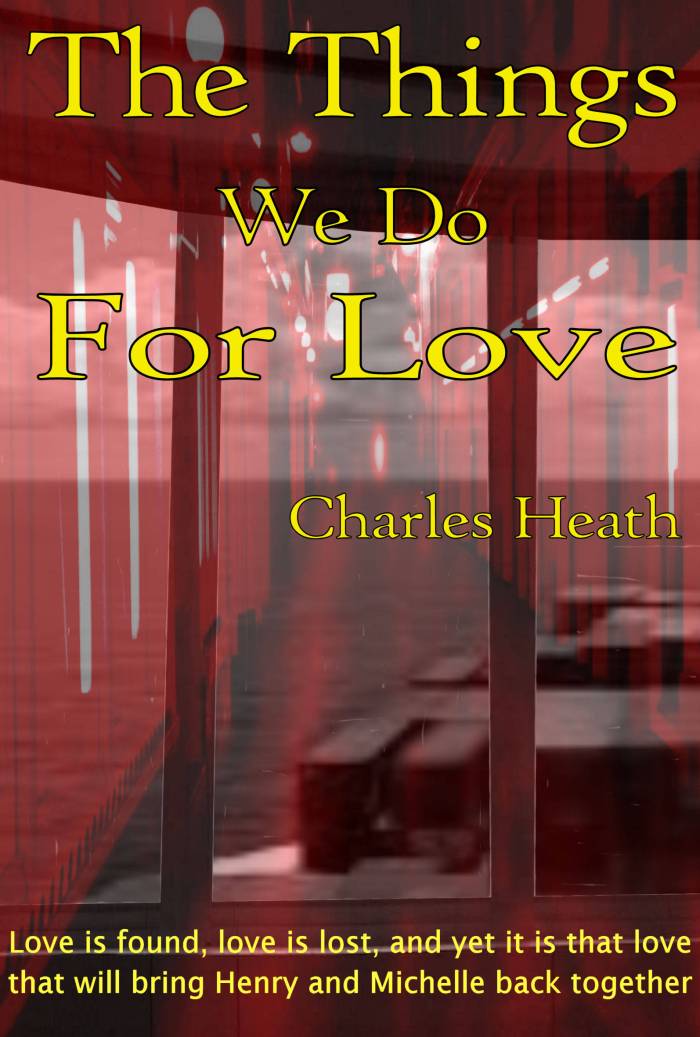
An excerpt from “The Things We Do For Love”; In love, Henry was all at sea!

In the distance he could hear the dinner bell ringing and roused himself.  Feeling the dampness of the pillow, and fearing the ravages of pent up emotion, he considered not going down but thought it best not to upset Mrs. Mac, especially after he said he would be dining.

In the event, he wished he had reneged, especially when he discovered he was not the only guest staying at the hotel.

Whilst he’d been reminiscing, another guest, a young lady, had arrived.  He’d heard her and Mrs. Mac coming up the stairs, and then shown to a room on the same floor, perhaps at the other end of the passage.

Henry caught his first glimpse of her when she appeared at the door to the dining room, waiting for Mrs. Mac to show her to a table.

She was about mid-twenties, slim, long brown hair, and the grace and elegance of a woman associated with countless fashion magazines.  She was, he thought, stunningly beautiful with not a hair out of place, and make-up flawlessly applied.  Her clothes were black, simple, elegant, and expensive, the sort an heiress or wife of a millionaire might condescend to wear to a lesser occasion than dinner.

Then there was her expression; cold, forbidding, almost frightening in its intensity.  And her eyes, piercingly blue and yet laced with pain.  Dracula’s daughter was his immediate description of her.

All in all, he considered, the only thing they had in common was, like him, she seemed totally out of place.

Mrs. Mac came out of the kitchen, wiping her hands on her apron.  She was, she informed him earlier, chef, waitress, hotelier, barmaid, and cleaner all rolled into one.  Coming up to the new arrival she said, “Ah, Miss Andrews, I’m glad you decided to have dinner.  Would you like to sit with Mr. Henshaw, or would you like to have a table of your own?”

Henry could feel her icy stare as she sized up his appeal as a dining companion, making the hair on the back on his neck stand up.  He purposely didn’t look back.  In his estimation, his appeal rating was minus six.  Out of a thousand!

“If Mr. Henshaw doesn’t mind….”  She looked at him, leaving the query in mid-air.

He didn’t mind and said so.  Perhaps he’d underestimated his rating.

“Good.”  Mrs. Mac promptly ushered her over.  Henry stood, made sure she was seated properly and sat.

“Thank you.  You are most kind.”  The way she said it suggested snobbish overtones.

“I try to be when I can.”  It was supposed to nullify her sarcastic tone but made him sound a little silly, and when she gave him another of her icy glares, he regretted it.

Mrs. Mac quickly intervened, asking, “Would you care for the soup?”

They did, and, after writing the order on her pad, she gave them each a look, imperceptibly shook her head, and returned to the kitchen.

Before Michelle spoke to him again, she had another quick look at him, trying to fathom who and what he might be.  There was something about him.

His eyes, they mirrored the same sadness she felt, and, yes, there was something else, that it looked like he had been crying?  There was a tinge of redness.

Perhaps, she thought, he was here for the same reason she was.

No.  That wasn’t possible.

Then she said, without thinking, “Do you have any particular reason for coming here?”  Seconds later she realized she’s spoken it out loud, had hadn’t meant to actually ask, it just came out.

It took him by surprise, obviously not the first question he was expecting her to ask of him.

“No, other than it is as far from civilization, and home, as I could get.”

At least we agree on that, she thought.

It was obvious he was running away from something as well.

Given the isolation of the village and lack of geographic hospitality, it was, from her point of view, ideal.  All she had to do was avoid him, and that wouldn’t be difficult.

After getting through this evening first.

“Yes,” she agreed.  “It is that.”

A few seconds passed, and she thought she could feel his eyes on her and wasn’t going to look up.

Until he asked, “What’s your reason?”

Slight abrupt in manner, perhaps as a result of her question, and the manner in which she asked it.

She looked up.  “Rest.  And have some time to myself.”

She hoped he would notice the emphasis she had placed on the word ‘herself’ and take due note.  No doubt, she thought,  she had completely different ideas of what constituted a holiday than he, not that she had actually said she was here for a holiday.

Mrs. Mac arrived at a fortuitous moment to save them from further conversation.


Over the entree, she wondered if she had made a mistake coming to the hotel.  Of course, there had been no possible way she could know than anyone else might have booked the same hotel, but realized it was foolish to think she might end up in it by herself.

Was that what she was expecting?

Not a mistake then, but an unfortunate set of circumstances, which could be overcome by being sensible.

Yet, there he was, and it made her curious, not that he was a man, by himself, in the middle of nowhere, hiding like she was, but for very different reasons.

On discreet observance whilst they ate, she gained the impression his air of light-heartedness was forced and he had no sense of humor.

This feeling was engendered by his looks, unruly dark hair, and permanent frown.  And then there was his abysmal taste in clothes on a tall, lanky frame.  They were quality but totally unsuited to the wearer.

Rebellion was written all over him.

The only other thought crossing her mind, and rather incongruously, was he could do with a decent feed.  In that respect, she knew now from the mountain of food in front of her, he had come to the right place.

“Mr. Henshaw?”

He looked up.  “Henshaw is too formal.  Henry sounds much better,” he said, with a slight hint of gruffness.

“Then my name is Michelle.”

Mrs. Mac came in to take their order for the only main course, gather up the entree dishes, then return to the kitchen.

“Staying long?” she asked.

“About three weeks.  Yourself?”

“About the same.”

The conversation dried up.

Neither looked at the other, rather at the walls, out the window, towards the kitchen, anywhere.  It was, she thought, almost unbearably awkward.


Mrs. Mac returned with a large tray with dishes on it, setting it down on the table next to theirs.

“Not as good as the usual cook,” she said, serving up the dinner expertly, “but it comes a good second, even if I do say so myself.  Care for some wine?”

Henry looked at Michelle.  “What do you think?”

“I’m used to my dining companions making the decision.”

You would, he thought.  He couldn’t help but notice the cutting edge of her tone.  Then, to Mrs. Mac, he named a particular White Burgundy he liked and she bustled off.

“I hope you like it,” he said, acknowledging her previous comment with a smile that had nothing to do with humor.

“Yes, so do I.”

Both made a start on the main course, a concoction of chicken and vegetables that were delicious, Henry thought, when compared to the bland food he received at home and sometimes aboard my ship.

It was five minutes before Mrs. Mac returned with the bottle and two glasses.  After opening it and pouring the drinks, she left them alone again.

Henry resumed the conversation.  “How did you arrive?  I came by train.”

“By car.”

“Did you drive yourself?”

And he thought, a few seconds later, that was a silly question, otherwise she would not be alone, and certainly not sitting at this table. With him.

“After a fashion.”

He could see that she was formulating a retort in her mind, then changed it, instead, smiling for the first time, and it served to lighten the atmosphere.

And in doing so, it showed him she had another more pleasant side despite the fact she was trying not to look happy.

“My father reckons I’m just another of ‘those’ women drivers,” she added.

“Whatever for?”

“The first and only time he came with me I had an accident.  I ran up the back of another car.  Of course, it didn’t matter to him the other driver was driving like a startled rabbit.”

“It doesn’t help,” he agreed.

“Do you drive?”

“Mostly people up the wall.”  His attempt at humor failed.  “Actually,” he added quickly, “I’ve got a very old Morris that manages to get me where I’m going.”

The apple pie and cream for dessert came and went and the rapport between them improved as the wine disappeared and the coffee came.  Both had found, after getting to know each other better, their first impressions were not necessarily correct.

“Enjoy the food?” Mrs. Mac asked, suddenly reappearing.

“Beautifully cooked and delicious to eat,” Michelle said, and Henry endorsed her remarks.

“Ah, it does my heart good to hear such genuine compliments,” she said, smiling.  She collected the last of the dishes and disappeared yet again.

“What do you do for a living,” Michelle asked in an off-hand manner.

He had a feeling she was not particularly interested and it was just making conversation.

“I’m a purser.”

“A what?”

“A purser.  I work on a ship doing the paperwork, that sort of thing.”

“I see.”

“And you?”

“I was a model.”

“Was?”

“Until I had an accident, a rather bad one.”

“Oh, I’m sorry.”

So that explained the odd feeling he had about her.

As the evening had worn on, he began to think there might be something wrong, seriously wrong with her because she didn’t look too well.  Even the carefully applied makeup, from close up, didn’t hide the very pale, and tired look, or the sunken, dark ringed eyes.

“I try not to think about it, but it doesn’t necessarily work.  I’ve come here for peace and quiet, away from doctors and parents.”

“Then you will not have to worry about me annoying you.  I’m one of those fall-asleep-reading-a-book types.”

Perhaps it would be like ships passing in the night and then smiled to himself about the analogy.

Dinner now over, they separated.

Henry went back to the lounge to read a few pages of his book before going to bed, and Michelle went up to her room to retire for the night.

But try as he might, he was unable to read, his mind dwelling on the unusual, yet the compellingly mysterious person he would be sharing the hotel with.

Overlaying that original blurred image of her standing in the doorway was another of her haunting expressions that had, he finally conceded, taken his breath away, and a look that had sent more than one tingle down his spine.

She may not have thought much of him, but she had certainly made an impression on him.


© Charles Heath 2015-2020
lovecoverfinal1

In a word: Straight

Yes, that man is straight as an arrow.

Well, in my experience based on the fact many years ago I used to play Cowboys and Indians, and I was always an Indian, I used to make a bow, and arrows, from the limbs of a tree in our back yard, those arrows were never straight.

How they got them so back in the middle ages without a lathe is anybody’s guess.

We all know what straight means, level, even, true, not deviating.  It could be a board, a road, the edge of a piece of paper.

But, of course, there are other meanings like,

He was straight, meaning heterosexual, a question not 50 odd years ago anyone would ask you, and 100 years ago, you wouldn’t dare admit anything but.

In poker, a card game, it is a sequence of five cards, and the sort of straight I’d like to get is ace high.  Chances of that happening, zero per cent.

It can mean being honest, that is, you should be straight with her, though I’m not sure telling your wide you’re having an affair would be conducive to continuing good health.

It could mean immediately, as in, I’ve got a headache and going straight to bed, probably after hearing news of that affair that was best left unspoken.

Perhaps that would be the time to have a whiskey straight, that is without mixers or ice.  I’ve tried, but still, at the very least I need ice.

This is not to be confused with the word strait, which is a narrow waterway between to areas of land.

But, here’s where it gets murky because a company can be in dire straits after being in desperate straits, and a person can be strait-laced, and just to be certain, most lunatics finish up in a straitjacket.


The cinema of my dreams – Was it just another surveillance job – Episode 41

I’m back home and this story has been sitting on the back burner for a few months, waiting for some more to be written.

The trouble is, there are also other stories to write, and I’m not very good at prioritizing.

But, here we are, a few minutes opened up and it didn’t take long to get back into the groove.

Chasing leads, maybe

I gave it about five minutes before I think I started breathing again and then headed back to Jennifer.

Or where I thought I had left her.

She wasn’t there. I think, in the end, it didn’t surprise me. She had been reluctant from the start so if I had to guess, she had done a bunk. This was not her fight, nor mine, but she had a ticket out. Why would you want to come back after being betrayed by the likes of Severin and Maury?

I hope she left the car behind.

Now that I was here there was no point leaving, so I took a few minutes to search the surrounding area, just in case she was still here, just someplace else, and when she wasn’t, I quickly and silently made my way back to the side of the house with the open door from a different direction.

There was another set of French doors, these curtained, and with an overhead light above the doorway, so I kept my distance in case there was a movement activator, another which looked to be a servant’s entrance at the back. Neither door looked to be an easy viable entrance.

The original side door was still unlocked, with no lights or movement inside.

I waited, then opened the door wide enough to slip through. Again, I waited in case there was a silent alarm, then when nothing stirred, slipped through and closed the door behind me.

On the other side of the door, it was quite dark, except now I could see, on one wall, the dying embers of a fire. Someone had been in the room earlier and most likely gone to bed.

It meant the house was occupied.

It also meant I had to be careful.

On the other side of the doors, it was a lot warmer. Again I waited a few minutes, just in case someone came, and, when they didn’t, I pulled out a small torch and turned it on.

In front of me were two chairs and a table, one I would have walked into without a light. The walls had shelves and those shelves were filled with books. Some behind glass doors, others not. There was another chair by the fire, and beside it, a stack of cooks, and a table with had an empty glass and a bottle, and a pair of reading glasses.

The downstairs reading room.

I cross the room slowly, hoping there were no squeaky floorboards, to be expected in an old house like this one. The timber flooring was exposed only at the edges of the room, the rest of the floor covered in a large, discolored, and fraying carpet square.

It was old, like everything else in the room.

I was tempted to have a look at how far the books dated back to but resisted the urge. I was looking for information on the owner.

At the doorway to what looked like a passage, I turned off the torch and peered out. It was not exactly dark, my eyes had adjusted to the low-level light from low wattage lights about a foot above the floor.

Lights to help guide the way at night.

Left, rooms, right, rooms, at the end of the passage a wide doorway leading towards the other side of the house. Larger rooms perhaps.

I turned right and headed towards the front, and they stopped at the doorway to the next room. I’d deliberately walked on the carpet runner in the middle of the passage, and just managed to catch my foot when one part of the floor creaked softly.

The room next door was almost the same as the one I’d entered by, with chairs and shelves but only on two sides. This room had a long window and no French doors.

On one side there was a writing desk, open, with papers scatted on the writing surface. I quickly crossed the room to it, switched on the light, and checked.

Bills. In the name of Mrs. Marianne Quigley. This had to be Adam Quigley’s mother, and by deduction, O’Connell’s mother.

Proof I was in the right place.

Then I heard the squeak of a floorboard followed by the clicking sound of a gun being cocked.

“Don’t move, or I’ll shoot. Hands in the air. And don’t make me ask twice.”

Hands up it was.

© Charles Heath 2020-2022

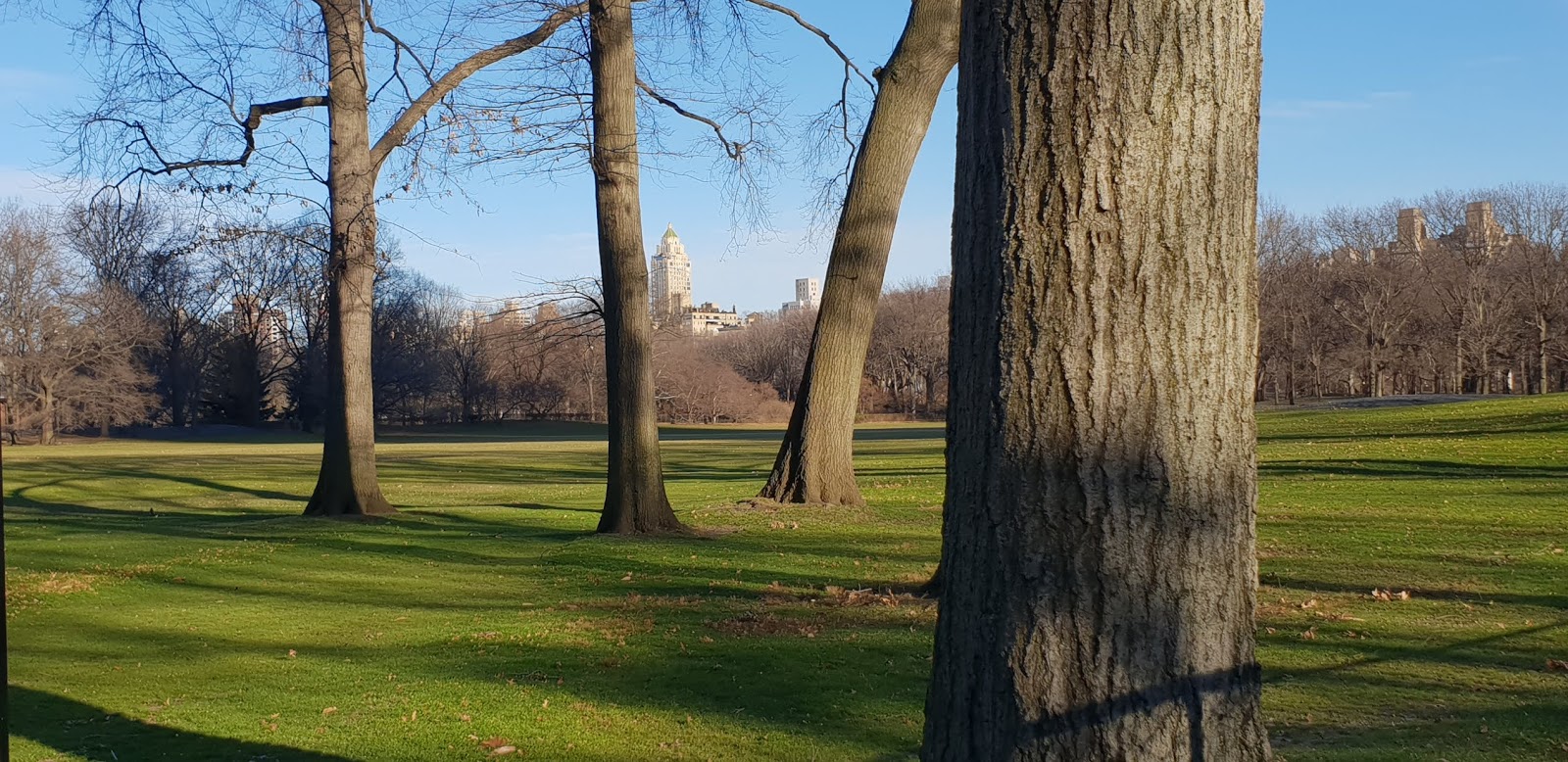
Searching for locations: Central Park, New York

It’s a place to go and spot the movie stars, or perhaps their dogs.

It’s a place to go for long walks on idyllic spring or autumn days

It’s a place to go to look at a zoo, though I didn’t realize there was one until I made a wrong turn.

It’s a place to go for a horse and carriage ride, although it does not last that long

It’s a place to go to look at statues, fountains, architecture, and in winter, an ice skating rink

I’m sure there’s a whole lot more there that I don’t know about.

I have to say I’ve only visited in winter, and the first time there was snow, the second, none.

Both times it was cold, but this didn’t seem to deter people.

But…

We decided to go visit another part of the park, this time walking to West 67th Street before crossing Central Park West and into the park where Sheep Meadow is.

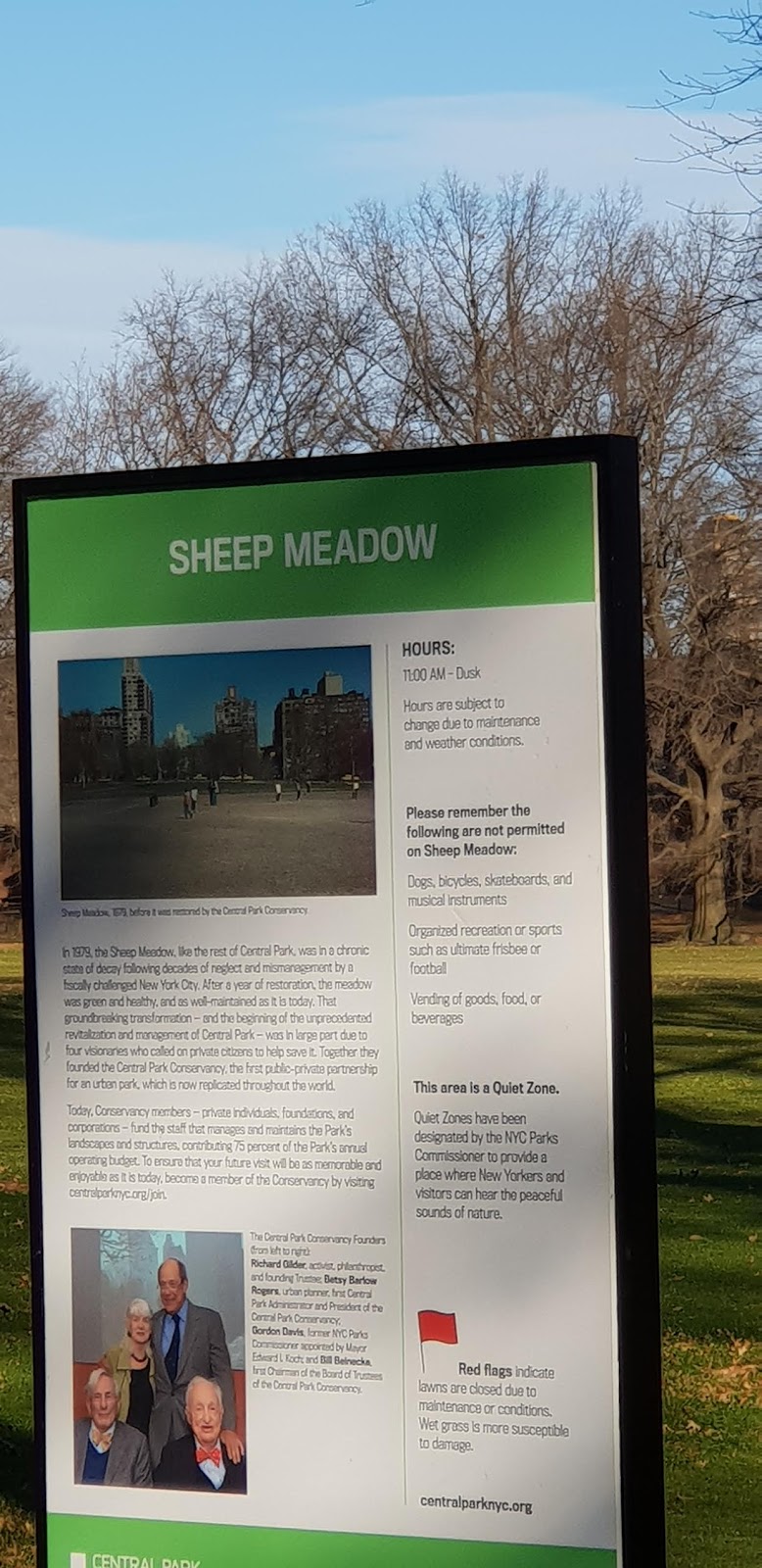
Once upon a time sheep did graze on the meadow, but these days it is designated a quiet area inspiring calm and refreshing thoughts, except for a period in the 1960s where there was more than one counter-culture protest, or love in, going on.

And, there’s the sign to say it was Sheep Meadow,

and that’s the meadow behind the sign,

Well, I don’t see any sheep, but of course, that’s not why the meadow is named or should there be any sheep on it.  That greenery that can be seen, restoring for the spring, was a very expensive addition to the park.

As a matter of fact, there is nothing was on it, because signs were up to say the meadow was closed for the winter, a new and interesting variation on the ‘Don’t Walk On The Grass’ signs.

I’m sure I could climb the fence, or, maybe not.  I’m a bit old to be climbing fences.

So, unable to walk on the grass, we tossed an imaginary coin, should we go towards West 110th Street, or back to West 59th Street.

West 59th Street won.

and, just in case we had any strange ideas about walking on the grass, the fence was there to deter us.  Perhaps if we had more determination…

One positive aspect of the park is that you could never get lost, and the tall buildings surrounding the park are nearly always visible through the trees, more so in winter because there is no foliage, maybe less so later in the year.

There is also a lot of very large rocky type hills, or outcrops where people seem to stand on, king of the mountain style, or sit to have a picnic lunch, quickly before it freezes.

Yes, it is cold outside and seems more so in the park.

I wondered briefly if it ever got foggy, then this place would be very spooky, particularly after the sun goes down.

Short Story writing – don’t try this at home! – Part 1

This is not a treatise, but a tongue in cheek, discussion on how to write short stories.   Suffice to say this is not the definitive way of doing it, just mine.  It works for me – it might not work for you.

Everyone has one in them, possibly more, and me, well, it’s how I keep the wolves from the door.

Yes, I read my stories to them and they fall asleep.

Or maybe not, I’m never quite sure what effect anything I write has on anyone.  And, reading a lot of the posts on how to handle bad reviews and rejection, such a recurrent theme, I don’t think I want to.

Ignorance is bliss, is it not?

Well, one day I’m sure something will happen.  It’s probably in the seven stages of writing:

Euphoria

Planning

Research

Writing

Failure

Search for the guilty

Distinction for the uninvolved

I guess you don’t fail if you don’t put it out there.  Searching for the guilty, well, there’s only one person to blame, the editor, and distinction for the uninvolved, didn’t your friend, relation, confidente, significant other, say it wasn’t going to work?

But, despite everything, I like writing short stories and try to produce one in a single sitting.  I try to keep the word count down, but the stories, somehow they just evolve in my head and don’t want to end the main character’s story.

In reality, there is no end to the story unless they die, and then, of course, the story branches off, just like a family tree,

Some stories are so intricate, they need another story to fill in the gaps, and then another because the plot is running through your head at a thousand miles an hour and your fingers won’t stop typing, because if you do, it will all dissipate into thin air like smoke.

Stories can, you know, dissipate like smoke, one minute your mining a rich vein the next, you’ve hit a ton of worthless quartz.

Then all the constraints come into play, nagging at the back of your mind, and you find yourself waking up in a bath of sweat crying out, I didn’t do it, the crime that is, not lose the best 2,000 words you’ve ever written.

But that’s all of those words you write, isn’t it?

But I digress, and I’ll write some more on the subject, what was it again?

Sayings: Going on a wild goose chase

Who hasn’t been on one of these, particularly if you have an older brother or sister, and they have nothing better to do than give you a hard time.

You know what I mean, going on a mission to find or do something, knowing full well that you won’t find it, or complete it because it was a lost cause to start with.

Yes, it goes very well with another saying, a dog chasing its tail.

We’ve seen that, too, watching the poor dog go round and round without ever achieving anything.

Sounds like my day today.

And it doesn’t stop there, the pointless search could also be described as ‘searching for a needle in a haystack’.

That is, to my mind the very definition of a living nightmare.

The origin of the idiom, well that’s a little more complicated because there isn’t just one definition.

The first:

Coined by William Shakespeare, but not necessarily in the sort of language we can read easily – it’s a bit like my ability to translate Spanish to English. It does, however, refer to a ‘wild goose chase’.

The second:

Refers to, of all things 16th Century horseracing, and because I don’t have a time machine I can’t go back to fact-check. However, it refers to the other riders following the leader around the course, in much the same formation as geese flying through the air.

My little story to go with it:

If you are good at your job, and that is beginning to be noticed, your boss will find one of these ‘wild goose chases’ just for you, in an effort to make you look bad.

It happened to me once: my task was to search the basement, where old records were stored, for a folder that a former employee had thought they had filed it in the wrong storage box, a supposition supported by the fact the folder was now needed to clear up a clerical error and the file wasn’t in the specifically marked storage box.

My job was to search every one of the other 765 boxes stored haphazardly in the basement until I found it.

It was, I was told later, sitting on his desk the whole time, and when I couldn’t find it, was going to swoop in and say he’d found it.

Of course, it went missing before he could, so he got a bollicking for not storing the files properly, and I got the job to clean up the basement. I’m not sure who got the worst punishment.

The fourth attempt, let’s look at the main character

So there are words on paper, and three times I’ve tried to fix it, or, perhaps just make it sound better because reading it in my head, there’s too little background and too many questions.

The flow of the story isn’t working for me, so I guess it’s time to sit down and work out what it is I’m trying to say.

The notion that our main character, Graham, is a loser seems to shine through, and that’s not what I’m trying to portray him as.  No, far from it, it’s been a lifetime of bad choices that have put him where he is, and he knows it.

So, in part, this is about owning your mistakes, and it’s my job to make him come across as a hero in waiting.  There’s good in him, perhaps too much, but there is also that attitude that led to all those bad choices, the one that can get him into trouble, and a sort of intransigence inherited from his father, that has more or less got him ostracised from the family. 

I want this character to be a chop off the old block, both of whom are the type not to back down, not to say sorry, and, to quote a rather apt allegory, would cut their nose off to spite their face.

Graham’s intransigence led to his refusal to follow his father into business, refusal to go to University despite having the necessary qualifications, and just to round out the defiance, his choice of women whom he knew would meet with family disapproval.

And these factors, over a period of time, saw him bounce from a low-paying job to jobs with no prospects, and a string of failed relationships, until this moment in time, where he was basically on his own, working the graveyard shift as a security guard.  The sort of job where qualifications weren’t looked for and workmates looked like and probably were ex-cons.

There are a few more details like the older brother, Jackson, politician and schemer, the same as his father before him (the seat was passed down through the family), like the younger sister who is a highly successful surgeon, married into immense wealth.  His brother had been less successful in the marital stakes but what he lacked in a wife was more than made up with a string of highly eligible and beautiful women.

And, no, he doesn’t resent the fact they’re rich, or that his parents were, too, just that they treated him with contempt.

It was almost five years since the last time he had seen any of them, that last time he attended the family Christmas in Martha’s Vineyard, the ‘Stockdale Residence’ an ostentatious sprawling fifty-room mansion that, in a drunken rage, he’s tried to burn down.

Once again, he had not received an invitation to the next, due in a few days, and it was not entirely unexpected.

Graham has his faults, but that even, five years ago, had pulled him off the road to self-destruction, helped along by a year stint in jail where he learned a great many lessons about life itself, and survival.

The four years since?

A lot of regrets, and a lot of repentance.  Life after jail was a lot worse than life trying to defy the family and the system.  There were two roads he could have gone down, and thankfully for him, it was not the wrong one.

So, he’s back on the path, a whole lot wiser, a whole lot tougher.

That might not have been exactly what I was thinking for him over the first three attempts.  I don’t think any character really begins to shine until halfway through, as you find him meeting various challenges in ways even you, as the writer, find quite unexpected.

Is that the end result of being a pantser over being a planner?

I don’t think, even as a planner, you can create a character that’s not going to change, or even surprise you, as the story evolves.

And somehow I don’t think I’m about to change from one to the other.

Well, not completely.

But there’s more, and no, it’s not steak knives!

© Charles Heath 2020-2021

“What Sets Us Apart”, a mystery with a twist

David is a man troubled by a past he is trying to forget.

Susan is rebelling against a life of privilege and an exasperated mother who holds a secret that will determine her daughter’s destiny.

They are two people brought together by chance. Or was it?

When Susan discovers her mother’s secret, she goes in search of the truth that has been hidden from her since the day she was born.

When David realizes her absence is more than the usual cooling off after another heated argument, he finds himself being slowly drawn back into his former world of deceit and lies.

Then, back with his former employers, David quickly discovers nothing is what it seems as he embarks on a dangerous mission to find Susan before he loses her forever.

http://amzn.to/2Eryfth

whatsetscover

Writing about writing a book – Day 22 continues

The main character, like all main characters, has a very interesting, deep, and very complicated background story, some of which will be played out later when the story develops.  Needless to say, at the start, we need to know as much as the story needs so that there are no real surprises.

So that’s why I’m still working on Bill’s backstory, and how he got mixed up in the war, and as a general background to his situation, and life before Davenport.

His story, of course, will be told told in the first person, over a series of flashbacks each necessarily preceding part of the action that requires a lead-in:


But whether we were stupid or naive, or completely mad, we were all eager to get into battle, filled with the sort of hate only Army propaganda films could fill you with.  They were our enemy, and they deserved to concede or die.

A fresh face in a hardened platoon, I was eager to get on with it.  They looked knowingly, having seen it all before.  No idea of the reality, and no time to tell us.  Have a few beers to celebrate, and then, the next morning, go out on patrol.  No problem.

There was camaraderie, but it was subdued.  We walked single file, the seasoned campaigners in front and at the rear, treading carefully, demanding quiet, and a general cautiousness.  In the middle of nowhere, where only the sound of rain, or the animals and birds for company, we were naive enough to think this was going to be a doddle.

Then it happened, six hours out, and just before we reached a small clearing.  I thought to myself it was odd there should be such a clear space with jungle all around it.  There must be a reason.

There was.

We had walked into an ambush, and everyone hit the ground.  I was bringing up the rear with another soldier, a veteran not much older than myself whose name was Scotty, a little farther back from the main group.  Bullets sprayed the undergrowth, pinging off trees and leaves.  I buried my face in the dirt, praying I would not die on my first patrol.

We became separated from the others, lying in a hollow, with no idea how far away help was.  He was muttering to himself.  “God, I hate this.  You can never see the bastards.  They’re out there, but you can never bloody well see them.”  Then he crawled up the embankment, gun first.

He let off a few rounds, causing a return of machine-gun fire, spattering the dirt at the top.  Next thing I knew he was sliding down the hill with half his face shot away.  Dead.  I threw up there and then.  What an initiation.

Then one of the enemy soldiers came over the hill to check on his ‘kill’.  I saw him at the same time he saw me and aimed my gun and shot.  It was instinct more than anything else, and I hadn’t stopped to think of the consequences.  He fell down, finishing up next to me, staring at me from black, lifeless eyes. 

Dead. 

I’ll never forget those lifeless eyes.  I just got up and ran, making it back to the rest of the group without getting hit.  No one could explain how I made it safely through the hail of gunfire, from our side and theirs.

Back in the camp later, the veterans remarked on how unlucky Scotty was and how lucky I was to shoot one of the enemies, and not be killed myself.  They all thought it was worth a celebration.

Before we went out the next day to do it all again.

I spent the night vomiting, unable to sleep, haunted look on his face, one I finally realized that reflected complete astonishment.


There will be more, as the story develops.


© Charles Heath 2016-2020

An excerpt from “One Last Look”: Charlotte is no ordinary girl

This is currently available at Amazon herehttp://amzn.to/2CqUBcz


I’d read about out of body experiences, and like everyone else, thought it was nonsense.  Some people claimed to see themselves in the operating theatre, medical staff frantically trying to revive them, and being surrounded by white light.

I was definitely looking down, but it wasn’t me I was looking at.

It was two children, a boy and a girl, with their parents, in a park.

The boy was Alan.  He was about six or seven.  The girl was Louise, and she was five years old.  She had long red hair and looked the image of her mother.

I remember it now, it was Louise’s birthday and we went down to Bournemouth to visit our Grandmother, and it was the last time we were all together as a family.

We were flying homemade kites our father had made for us, and after we lay there looking up at the sky, making animals out of the clouds.  I saw an elephant, Louise saw a giraffe.

We were so happy then.

Before the tragedy.


When I looked again ten years had passed and we were living in hell.  Louise and I had become very adept at survival in a world we really didn’t understand, surrounded by people who wanted to crush our souls.

It was not a life a normal child had, our foster parents never quite the sort of people who were adequately equipped for two broken-hearted children.  They tried their best, but their best was not good enough.

Every day it was a battle, to avoid the Bannister’s and Archie in particular, every day he made advances towards Louise and every day she fended him off.

Until one day she couldn’t.

Now I was sitting in the hospital, holding Louise’s hand.  She was in a coma, and the doctors didn’t think she would wake from it.  The damage done to her was too severe.

The doctors were wrong.

She woke, briefly, to name her five assailants.  It was enough to have them arrested.  It was not enough to have them convicted.

Justice would have to be served by other means.


I was outside the Bannister’s home.

I’d made my way there without really thinking, after watching Louise die.  It was like being on autopilot, and I had no control over what I was doing.  I had murder in mind.  It was why I was holding an iron bar.

Skulking in the shadows.  It was not very different from the way the Bannister’s operated.

I waited till Archie came out.  I knew he eventually would.  The police had taken him to the station for questioning, and then let him go.  I didn’t understand why, nor did I care.

I followed him up the towpath, waiting till he stopped to light a cigarette, then came out of the shadows.

“Wotcha got there Alan?” he asked when he saw me.  He knew what it was, and what it was for.

It was the first time I’d seen the fear in his eyes.  He was alone.

“Justice.”

“For that slut of a sister of yours.  I had nuffing to do with it.”

“She said otherwise, Archie.”

“She never said nuffing, you just made it up.”  An attempt at bluster, but there was no confidence in his voice.

I held up the pipe.  It had blood on it.  Willy’s blood.  “She may or may not have Archie, but Willy didn’t make it up.  He sang like a bird.  That’s his blood, probably brains on the pipe too, Archie, and yours will be there soon enough.”

“He dunnit, not me.  Lyin’ bastard would say anything to save his own skin.”  Definitely scared now, he was looking to run away.

“No, Archie.  He didn’t.  I’m coming for you.  All of you Bannisters.  And everyone who touched my sister.”


It was the recurring nightmare I had for years afterwards.

I closed my eyes and tried to shut out the thoughts, the images of Louise, the phone call, the visit to the hospital and being there when she succumbed to her injuries.  Those were the very worst few hours of my life.

She had asked me to come to the railway station and walk home with her, and I was running late.  If I had left when I was supposed to, it would never have happened and for years afterwards, I blamed myself for her death.

If only I’d not been late…

When the police finally caught the rapists, I’d known all along who they’d be; antagonists from school, the ring leader, Archie Bannister, a spurned boyfriend, a boy whose parents, ubiquitously known to all as ‘the Bannister’s, dealt in violence and crime and who owned the neighbourhood.  The sins of the father had been very definitely passed onto the son.

At school, I used to be the whipping boy, Archie, a few grades ahead of me, made a point of belting me and a few of the other boys, to make sure the rest did as they were told.  He liked Louise, but she had no time for a bully like him, even when he promised he would ‘protect’ me.

I knew the gang members, the boys who tow-kowed to save getting beaten up, and after the police couldn’t get enough information to prosecute them because everyone was too afraid to speak out, I went after Willy.  There was always a weak link in a group, and he was it.

He worked in a factory, did long hours on a Wednesday and came home after dark alone.  It was a half mile walk, through a park.  The night I approached him, I smashed the lights and left it in darkness.  He nearly changed his mind and went the long way home.

He didn’t.

It took an hour and a half to get the names.  At first, when he saw me, he laughed.  He said I would be next, and that was four words more than he knew he should have said.

When I found him alone the next morning I showed him the iron bar and told him he was on the list.  I didn’t kill him then, he could wait his turn, and worry about what was going to happen to him.

When the police came to visit me shortly after that encounter, no doubt at the behest of the Bannister’s, the neighbourhood closed ranks and gave me an ironclad alibi.  The Bannister’s then came to visit me and threatened me.  I told them their days were numbered and showed them the door.

At the trial, he and his friends got off on a technicality.  The police had failed to do their job properly, but it was not the police, but a single policeman, corrupted by the Bannisters.

Archie could help but rub it in my face.  He was invincible.

Joe Collins took 12 bullets and six hours to bleed out.  He apologized, he pleaded, he cried, he begged.  I didn’t care.

Barry Mills, a strong lad with a mind to hurting people, Archie’s enforcer, almost got the better of me.  I had to hit him more times than I wanted to, and in the end, I had to be satisfied that he died a short but agonizing death.

I revisited Willy in the hospital.  He’d recovered enough to recognize me, and why I’d come.  Suffocation was too good for him.

David Williams, second in command of the gang, was as tough and nasty as the Bannisters.  His family were forging a partnership with the Bannister’s to make them even more powerful.  Outwardly David was a pleasant sort of chap, affable, polite, and well mannered.  A lot of people didn’t believe he could be like, or working with, the Bannisters.

He and I met in the pub.  We got along like old friends.  He said Willy had just named anyone he could think of, and that he was innocent of any charges.  We shook hands and parted as friends.

Three hours later he was sitting in a chair in the middle of a disused factory, blindfolded and scared.  I sat and watched him, listened to him, first threatening me, and then finally pleading with me.  He’d guessed who it was that had kidnapped him.

When it was dark, I took the blindfold off and shone a very bright light in his eyes.  I asked him if the violence he had visited upon my sister was worth it.  He told me he was just a spectator.

I’d read the coroner’s report.  They all had a turn.  He was a liar.

He took nineteen bullets to die.

Then came Archie.

The same factory only this time there were four seats.  Anna Bannister, brothel owner, Spike Bannister, head of the family, Emily Bannister, sister, and who had nothing to do with their criminal activities.  She just had the misfortune of sharing their name.

Archie’s father told me how he was going to destroy me, and everyone I knew.

A well-placed bullet between the eyes shut him up.

Archie’s mother cursed me.  I let her suffer for an hour before I put her out of her misery.

Archie remained stony-faced until I came to Emily.  The death of his parents meant he would become head of the family.  I guess their deaths meant as little to him as they did me.

He was a little more worried about his sister.

I told him it was confession time.

He told her it was little more than a forced confession and he had done nothing to deserve my retribution.

I shrugged and shot her, and we both watched her fall to the ground screaming in agony.  I told him if he wanted her to live, he had to genuinely confess to his crimes.  This time he did, it all poured out of him.

I went over to Emily.  He watched in horror as I untied her bindings and pulled her up off the floor, suffering only from a small wound in her arm.  Without saying a word she took the gun and walked over to stand behind him.

“Louise was my friend, Archie.  My friend.”

Then she shot him.  Six times.

To me, after saying what looked like a prayer, she said, “Killing them all will not bring her back, Alan, and I doubt she would approve of any of this.  May God have mercy on your soul.”


Now I was in jail.  I’d spent three hours detailing the deaths of the five boys, everything I’d done; a full confession.  Without my sister, my life was nothing.  I didn’t want to go back to the foster parents; I doubt they’d take back a murderer.

They were not allowed to.

For a month I lived in a small cell, in solitary, no visitors.  I believed I was in the queue to be executed, and I had mentally prepared myself for the end.

Then I was told I had a visitor, and I was expecting a priest.

Instead, it was a man called McTavish. Short, wiry, and with an accent that I could barely understand.

“You’ve been a bad boy, Alan.”

When I saw it was not the priest I told the jailers not to let him in, I didn’t want to speak to anyone.  They ignored me.  I’d expected he was a psychiatrist, come to see whether I should be shipped off to the asylum.

I was beginning to think I was going mad.

I ignored him.

“I am the difference between you living or dying Alan, it’s as simple as that.  You’d be a wise man to listen to what I have to offer.”

Death sounded good.  I told him to go away.

He didn’t.  Persistent bugger.

I was handcuffed to the table.  The prison officers thought I was dangerous.  Five, plus two, murders, I guess they had a right to think that.  McTavish sat opposite me, ignoring my request to leave.

“Why’d you do it?”

“You know why.”  Maybe if I spoke he’d go away.

“Your sister.  By all accounts, the scum that did for her deserved what they got.”

“It was murder just the same.  No difference between scum and proper people.”

“You like killing?”

“No-one does.”

“No, I dare say you’re right.  But you’re different, Alan.  As clean and merciless killing I’ve ever seen.  We can use a man like you.”

“We?”

“A group of individuals who clean up the scum.”

I looked up to see his expression, one of benevolence, totally out of character for a man like him.  It looked like I didn’t have a choice.


Trained, cleared, and ready to go.

I hadn’t realized there were so many people who were, for all intents and purposes, invisible.  People that came and went, in malls, in hotels, trains, buses, airports, everywhere, people no one gave a second glance.

People like me.

In a mall, I became a shopper.

In a hotel, I was just another guest heading to his room.

On a bus or a train, I was just another commuter.

At the airport, I became a pilot.  I didn’t need to know how to fly; everyone just accepted a pilot in a pilot suit was just what he looked like.

I had a passkey.

I had the correct documents to get me onto the plane.

That walk down the air bridge was the longest of my life.  Waiting for the call from the gate, waiting for one of the air bridge staff to challenge me, stepping onto the plane.

Two pilots and a steward.  A team.  On the plane early before the rest of the crew.  A group that was committing a crime, had committed a number of crimes and thought they’d got away with it.

Until the judge, the jury and their executioner arrived.

Me.

Quick, clean, merciless.  Done.

I was now an operational field agent.


I was older now, and I could see in the mirror I was starting to go grey at the sides.  It was far too early in my life for this, but I expect it had something to do with my employment.

I didn’t recognize the man who looked back at me.

It was certainly not Alan McKenzie, nor was there any part of that fifteen-year-old who had made the decision to exact revenge.

Given a choice; I would not have gone down this path.

Or so I kept telling myself each time a little more of my soul was sold to the devil.

I was Barry Gamble.

I was Lenny Buckman.

I was Jimmy Hosen.

I was anyone but the person I wanted to be.

That’s what I told Louise, standing in front of her grave, and trying to apologize for all the harm, all the people I’d killed for that one rash decision.  If she was still alive she would be horrified, and ashamed.

Head bowed, tears streamed down my face.

God had gone on holiday and wasn’t there to hand out any forgiveness.  Not that day.  Not any day.


New York, New Years Eve.

I was at the end of a long tour, dragged out of a holiday and back into the fray, chasing down another scumbag.  They were scumbags, and I’d become an automaton hunting them down and dispatching them to what McTavish called a better place.

This time I failed.

A few drinks to blot out the failure, a blonde woman who pushed my buttons, a room in a hotel, any hotel, it was like being on the merry-go-round, round and round and round…

Her name was Silvia or Sandra, or someone I’d met before, but couldn’t quite place her.  It could be an enemy agent for all I knew or all I cared right then.

I was done.

I’d had enough.

I gave her the gun.

I begged her to kill me.

She didn’t.

Instead, I simply cried, letting the pent up emotion loose after being suppressed for so long, and she stayed with me, holding me close, and saying I was safe, that she knew exactly how I felt.

How could she?  No one could know what I’d been through.

I remembered her name after she had gone.

Amanda.

I remembered she had an imperfection in her right eye.

Someone else had the same imperfection.

I couldn’t remember who that was.

Not then.


I had a dingy flat in Kensington, a place that I rarely stayed in if I could help it.  After five-star hotel rooms, it made me feel shabby.

The end of another mission, I was on my way home, the underground, a bus, and then a walk.

It was late.

People were spilling out of the pub after the last drinks.  Most in good spirits, others slightly more boisterous.

A loud-mouthed chap bumped into me, the sort who had one too many, and was ready to take on all comers.

He turned on me, “Watch where you’re going, you fool.”

Two of his friends dragged him away.  He shrugged them off, squared up.

I punched him hard, in the stomach, and he fell backwards onto the ground.  I looked at his two friends.  “Take him home before someone makes mincemeat out of him.”

They grabbed his arms, lifted him off the ground and took him away.

Out of the corner of my eye, I could see a woman, early thirties, quite attractive, but very, very drunk.  She staggered from the bar, bumped into me, and finished up sitting on the side of the road.

I looked around to see where her friends were.  The exodus from the pub was over and the few nearby were leaving to go home.

She was alone, drunk, and by the look of her, unable to move.

I sat beside her.  “Where are your friends?”

“Dunno.”

“You need help?”

She looked up, and sideways at me.  She didn’t look the sort who would get in this state.  Or maybe she was, I was a terrible judge of women.

“Who are you?” she asked.

“Nobody.”  I was exactly how I felt.

“Well Mr Nobody, I’m drunk, and I don’t care.  Just leave me here to rot.”

She put her head back between her knees, and it looked to me she was trying to stop the spinning sensation in her head.

Been there before, and it’s not a good feeling.

“Where are your friends?” I asked again.

“Got none.”

“Perhaps I should take you home.”

“I have no home.”

“You don’t look like a homeless person.  If I’m not mistaken, those shoes are worth more than my weekly salary.”  I’d seen them advertised, in the airline magazine, don’t ask me why the ad caught my attention.

She lifted her head and looked at me again.  “You a smart fucking arse are you?”

“I have my moments.”

“Have them somewhere else.”

She rested her head against my shoulder.  We were the only two left in the street, and suddenly in darkness when the proprietor turned off the outside lights.

“Take me home,” she said suddenly.

“Where is your place?”

“Don’t have one.  Take me to your place.”

“You won’t like it.”

“I’m drunk.  What’s not to like until tomorrow.”

I helped her to her feet.  “You have a name?”

“Charlotte.”


The wedding was in a small church.  We had been away for a weekend in the country, somewhere in the Cotswolds, and found this idyllic spot.  Graves going back to the dawn of time, a beautiful garden tended by the vicar and his wife, an astonishing vista over hills and down dales.

On a spring afternoon with the sun, the flowers, and the peacefulness of the country.

I had two people at the wedding, the best man, Bradley, and my boss, Watkins.

Charlotte had her sisters Melissa and Isobel, and Isobel’s husband Giovanni, and their daughter Felicity.

And one more person who was as mysterious as she was attractive, a rather interesting combination as she was well over retirement age.  She arrived late and left early.

Aunt Agatha.

She looked me up and down with what I’d call a withering look.  “There’s more to you than meets the eye,” she said enigmatically.

“Likewise I’m sure,” I said.  It earned me an elbow in the ribs from Charlotte.  It was clear she feared this woman.

“Why did you come,” Charlotte asked.

“You know why.”

Agatha looked at me.  “I like you.  Take care of my granddaughter.  You do not want me for an enemy.”

OK, now she officially scared me.

She thrust a cheque into my hand, smiled, and left.

“Who is she,” I asked after we watched her depart.

“Certainly not my fairy godmother.”

Charlotte never mentioned her again.


Zurich in summer, not exactly my favourite place.

Instead of going to visit her sister Isobel, we stayed at a hotel in Beethovenstrasse and Isobel and Felicity came to us.  Her husband was not with her this time.

Felicity was three or four and looked very much like her mother.  She also looked very much like Charlotte, and I’d remarked on it once before and it received a sharp rebuke.

We’d been twice before, and rather than talk to her sister, Charlotte spent her time with Felicity, and they were, together, like old friends.  For so few visits they had a remarkable rapport.

I had not broached the subject of children with Charlotte, not after one such discussion where she had said she had no desire to be a mother.  It had not been a subject before and wasn’t once since.

Perhaps like all Aunts, she liked the idea of playing with a child for a while and then give it back.

Felicity was curious as to who I was, but never ventured too close.  I believed a child could sense the evil in adults and had seen through my facade of friendliness.  We were never close.

But…

This time, when observing the two together, something quite out of left field popped into my head.  It was not possible, not by any stretch of the imagination, but I thought she looked like my mother.

And Charlotte had seen me looking in their direction.  “You seem distracted,” she said.

“I was just remembering my mother.  Odd moment, haven’t done so for a very long time.”

“Why now?”  I think she had a look of concern on her face.

“Her birthday, I guess,” I said, the first excuse I could think of.

Another look and I was wrong.  She looked like Isobel or Charlotte, or if I wanted to believe it possible, Melissa too.


I was crying, tears streaming down my face.

I was in pain, searing pain from my lower back stretching down into my legs, and I was barely able to breathe.

It was like coming up for air.

It was like Snow White bringing Prince Charming back to life.  I could feel what I thought was a gentle kiss and tears dropping on my cheeks, and when I opened my eyes, I saw Charlotte slowly lifting her head, a hand gently stroking the hair off my forehead.

And in a very soft voice, she said, “Hi.”

I could not speak, but I think I smiled.  It was the girl with the imperfection in her right eye.  Everything fell into place, and I knew, in that instant that we were irrevocably meant to be together.

“Welcome back.”


© Charles Heath 2016-2019

onelastlookcoverfinal2