I’m lying awake in the dark, my mind is racing with endless thoughts centred on a world wide disaster. There are things happening that could lead to what could only be described as a catastrophic event that leads to a dystopian world, one no one thought could possible happen.
Of course, it hasn’t happened, but could it…
Here’s how my mind is connecting the dots.
There are two superpowers, both nuclear equipped, and both antagonistic towards each other. Tensions have been rising, but not only with one country, but a number of countries.
In the other, an election comes and goes, there’s no decisive result, and it leads to skirmishes that eventually break out into the second civil war. No heed is paid to the virus that had been killing indiscriminately before, and seemingly had disappeared.
A fearsome world is watching what will happen as millions are being killed.
The adversarial country deems, when the civil war is at it’s zenith to attack an uncoordinated and vulnerable country, thinking no one would have their finger on the button. Nuclear weapons are launched on either side, other countries join in, and that plunges the world into a nightmare no one could have predicted.
It takes three months for the dust to settle, and to realise that more than three billion people have died from the nuclear fallout, and whole countries are now just infertile and dangerous wastelands.
And then the virus comes back, because there are no medical facilities, no fresh or running water, and no food. No electricity, no oil, no petrol, no vehicles, or transport of any kind.
In one decisive and utterly stupid move, everyone is back in the stone age, or worse.
…
Every day is a battle to survive, to keep away from the virus infected people, find food, find or build shelter, and above all, find water. All of which are not contaminated.
The land in one country that was more or less suffered two destroyed cities and caused millions of deaths, looks from a certain perspective, as though nothing has happened. There are tracts of land that are still fertile, near water, but have been taken over by the few who thought to have weapons and the forethought to create fiefdoms.
People can go there, but they are subjugated into what could be called slavery, and sacrifice everything, including their freedom, as the price to live. It’s inevitable that some will rule and others will follow, much like feudal England in the early years.
The people thought that their rights and freedom had been trampled on before the great conflagration, but now, they realise that was nothing compared to the new normal. Executions, heinous punishment for simple crimes, starvation and dehydration. The dreaded socialism that was earlier feared has come home to roost.
It’s not the first story of it’s type, it follows a fairly standard formula that I’ve read in a few books, each using a different premise for the reason, and taking a more reasonable line in the aftermath where people help each other rather than the few subjugating the masses.
To be honest, I don’t think there would be much kindness and co-operation in a world like that, simply because we’ve gone too far down the road being greedy and searching for power, particularly over others.
The meek will certainly not inherit the earth.
Of course, there’s always an exception to very rule, and this is the protagonist for this story.
People just don’t like rain. All I ever hear is complaints because they want to go away camping, they want to go shopping, or they have to go to children’s sports.
Not, of course, because they can’t mow the lawn!
And that pesky rain, well, it just makes everything more difficult. Mud and dirt get trampled inside, the washing can’t be hung out to dry, it causes floods, it stops games being played, well, sometimes. The pitch would have to be six feet under water before that happens.
But…
Let’s think about the rain for a moment.
What if we didn’t get any rain?
There would be a drought. There might not be any water. Everything outside that needed water to survive, the sort of water rain provides, would die. Then we’d have no flowers, no trees, no grass, oh, quite possibly no food, or oxygen.
A bit radical don’t you think, no food, no water, and no oxygen?
Hey, wouldn’t that be an interesting premise for an apocalyptic novel?
Usually, in a post-apocalyptic world, there’s still rain, water, and oxygen, you’d p[robably have to fight for food, but no one seems to go down that unthinkable path of losing everything.
Seems that happened around the time of the dinosaurs, when that comet hit the earth, blotted out the sun, and everything died, well, nearly everything. It’s what I think is called an Earth Life Extinction Event.
Some say the same might happen if we have a nuclear holocaust, say America and Russia deciding to launch nuclear weapons on each other for some insane reason, knowing full well they would be condemning the whole world to a terrible end.
Nearly happened, I’m guessing. That would make a good story. Hang on, it’s been done before, a dozen or more times, and usually saved by a single man or woman whose actions never reach the ears of what would be a grateful public.
We’re a long way from simply wishing the rain to go away and come again some other day, aren’t we?
Let’s let someone else worry about the big picture.
And let’s not start thinking about post-apocalyptic novels that could get scarily real one day.
Sigh! Only three more months of winter to endure, and it’ll be spring again.
Every time I close my eyes, I see something different.
I’d like to think the cinema of my dreams is playing a double feature but it’s a bit like a comedy cartoon night on Fox.
But these dreams are nothing to laugh about.
Once again there’s a new installment of an old feature, and we’re back on the treasure hunt.
…
“A hundred square miles, that must have run up the coast close to Patterson’s Reach?” I asked.
Patterson’s reach was about five miles to the north, a small town, where there was little fishing done and allegedly a lot of ferrying drugs being dropped off by large ships coming along the offshore shipping lanes. No one could prove it, and every trap set by the coast guard had failed to find any evidence. That meant that someone was tipping them off.
It was also the domain of the Cossatino’s who discouraged anyone else from living there. It was said that Cossatino owned all of the lands the town sat on and the people who lived there worked for him.
“Only as far as Patterson’s reach and then inland for about 20 miles, about as far as the Faultline and perhaps the closest point between the foothills and the sea. Ormiston had bought all the land thinking that the treasure was buried on it. You see, he had a map too, long before Boggs senior had started forging them for the Cossatino’s.”
And in hearing that it begged the question, who had first found the original map? If Cossatino found it, then getting Boggs senior to forge a lot of useless maps would hide where it really was.
What if Boggs ‘original’ map was yet another elaborate forgery, given to him by Cossatino to create others? I put that thought to one side.
I wondered if Boggs had been to see her, to get some background. If there was going to be an expert on the treasure, if it existed or not, she would know. In fact, she probably knew old man Ormiston.
“Does that map still exist?”
“Perhaps. It was not found in his effects after he died. Spent his last years in an asylum. It wasn’t not finding the treasure, or losing his fortune that sent him mad, it was Alzheimer’s, poor old man. Whatever documents that were found when his relatives cleaned the place out were brought to the library to be stored, cataloged at some point, and one day when someone decides to write a history of the area, no doubt they want to see the collection.”
“I couldn’t look at the papers?”
“Are you interested in writing a local history. I’m sure your hunt for the treasure and the many fruitless other expeditions looking for it would make a very entertaining chapter.”
“Maybe I will.”
If that was what it took to look at the documents. There might be something interesting to be found. Especially if he kept a diary. I thought it best not to ask, and fuel suspicions.
“Elmer said there might be relations of Ormiston still around here?”
“Yes, I did say that which I now regret. There are, but I don’t know who they are. I knew his wife’s family name was Maunchen, and that the Maunchens came from California originally, and there’s nothing to say they didn’t go back. Certainly, the wife would be deceased by now, and they had three daughters, all of whom would have married, and changed names. You’d have to go digging through wedding records in at least a dozen parishes. If you were thinking of investigating.”
“Sound like too much hard work. Besides, the treasure doesn’t; exist. I’m only helping Boggs to keep him from doing something stupid.”
“Like father, like son, unfortunately. You do realize the father made some outlandish claim in the hotel one night that he had found the clue to where the treasure was buried. Trouble was, he was prone to making outlandish claims, and by that time, a drunkard. He went missing the next day, and has never been seen since.”
“You think he found it?”
“No. But I’m guessing someone thought he had and killed him trying to find out. We’ll never know.”
“A lesson to be learned then. I’ll keep an eye on Boggs junior just in case he’s thinking of making an equally outlandish claim.”
“You do that.”
She opened a drawer and pulled out a form and handed it to me.
“What’s this for?”
“A request to look at the archives. You have to register, and I have to give you a special card, the key to the history of Arkwon County.”
Where it said signature, I signed it.
“You fill out the rest. When do you want me to pick up the card?”
“Monday next week. In the meantime, be careful.”
She said it like she knew I would be walking into trouble.
This case has everything, red herrings, jealous brothers, femme fatales, and at the heart of it all, greed.
See below for an excerpt from the book…
Coming soon!
An excerpt from the book:
When Harry took the time to consider his position, a rather uncomfortable position at that, he concluded that he was somehow involved in another case that meant very little to him.
Not that it wasn’t important in some way he was yet to determine, it was just that his curiosity had got the better of him, and it had led to this: sitting in a chair, securely bound, waiting for someone one of his captors had called Doug.
It was not the name that worried him so much, it was the evil laugh that had come after the name was spoken.
Doug what? Doug the ‘destroyer’, Doug the ‘dangerous’, Doug the ‘deadly’; there was any number of sinister connotations, and perhaps that was the point of the laugh, to make it more frightening than it was.
But there was no doubt about one thing in his mind right then: he’d made a mistake. A very big. and costly, mistake. Just how big the cost, no doubt he would soon find out.
His mother, and his grandmother, the wisest person he had ever known, had once told him never to eavesdrop.
At the time he couldn’t help himself and instead of minding his own business, listening to a one-sided conversation which ended with a time and a place. The very nature of the person receiving the call was, at the very least, sinister, and, because of the cryptic conversation, there appeared to be, or at least to Harry, criminal activity involved.
For several days he had wrestled with the thought of whether he should go. Stay on the fringe, keep out of sight, observe and report to the police if it was a crime. Instead, he had willingly gone down the rabbit hole.
Now, sitting in an uncomfortable chair, several heat lamps hanging over his head, he was perspiring, and if perspiration could be used as a measure of fear, then Harry’s fear was at the highest level.
Another runnel of sweat rolled into his left eye, and, having his hands tied, literally, it made it impossible to clear it. The burning sensation momentarily took his mind off his predicament. He cursed and then shook his head trying to prevent a re-occurrence. It was to no avail.
Let the stinging sensation be a reminder of what was right and what was wrong.
It was obvious that it was the right place and the right time, but in considering his current perilous situation, it definitely was the wrong place to be, at the worst possible time.
It was meant to be his escape, an escape from the generations of lawyers, what were to Harry, dry, dusty men who had been in business since George Washington said to the first Walthenson to step foot on American soil, ‘Why don’t you become a lawyer?” when asked what he could do for the great man.
Or so it was handed down as lore, though Harry didn’t think Washington meant it literally, the Walthenson’s, then as now, were not shy of taking advice.
Except, of course, when it came to Harry.
He was, Harry’s father was prone to saying, the exception to every rule. Harry guessed his father was referring to the fact his son wanted to be a Private Detective rather than a dry, dusty lawyer. Just the clothes were enough to turn Harry off the profession.
So, with a little of the money Harry inherited from one of his aunts, he leased an office in Gramercy Park and had it renovated to look like the Sam Spade detective agency, you know the one, Spade and Archer, and The Maltese Falcon.
There’s a movie and a book by Dashiell Hammett if you’re interested.
So, there it was, painted on the opaque glass inset of the front door, ‘Harold Walthenson, Private Detective’.
There was enough money to hire an assistant, and it took a week before the right person came along, or, more to the point, didn’t just see his business plan as something sinister. Ellen, a tall cool woman in a long black dress, or so the words of a song in his head told him, fitted in perfectly.
She’d seen the movie, but she said with a grin, Harry was no Humphrey Bogart.
Of course not, he said, he didn’t smoke.
Three months on the job, and it had been a few calls, no ‘real’ cases, nothing but missing animals, and other miscellaneous items. What he really wanted was a missing person. Or perhaps a beguiling, sophisticated woman who was as deadly as she was charming, looking for an errant husband, perhaps one that she had already ‘dispatched’.
Or for a tall, dark and handsome foreigner who spoke in riddles and in heavily accented English, a spy, or perhaps an assassin, in town to take out the mayor. The man was such an imbecile Harry had considered doing it himself.
Now, in a back room of a disused warehouse, that wishful thinking might be just about to come to a very abrupt end, with none of the romanticized trappings of the business befalling him. No beguiling women, no sinister criminals, no stupid policemen.
Just a nasty little man whose only concern was how quickly or how slowly Harry’s end was going to be.
I hated it when I was younger, namely because my brothers always cheated, and that had been carried through to adulthood.
Now, I just avoided them.
It left me wondering how I managed to paint myself into a corner, and agree to do the one thing I assiduously avoided.
You could chalk it up to being persuaded by a pretty girl. Yes, I am the typical male, a sucker for a pretty face and a little flattery.
It would not have happened if I’d just gone home, instead of being asked to go and ‘just have one drink’ on the way home from work. I used to, once upon a time, before I got sick. But, perhaps it was a combination of cabin fever, and the monastic existence I’d adopted since that saw the one visit a chink of light at the end of a very long tunnel.
Whatever the reason, had I not gone, I would not have met Nancy. I’d seen her before, off and on, at work, and had noted, probably with a degree of disdain that where she was, was the most noise. You know, the one who talks loudest in the elevator, or the one who was the center of attention at a dining table.
And yet, underneath that, if or when anyone got close enough, there was something else. Something that fascinated me. But, having become reclusive had made me more reticent, and even though I was sitting at the same table, almost within arm’s length, I was too shy to strike up a conversation.
Until it was time to go home. I had moved out of the way so she could get out, and as she passed me she said, “You’ve been very quiet, Brian isn’t it?”
“Yes. And I know it’s rather lame but I don’t have as extensive knowledge of sports, which I guess I should. Ask me about old movies, and I’m your guy. Anyway, I pride myself on being a good listener.”
“Old movies eh. I’ll keep that in mind.” A smile, she went to leave, and then turned. “Look. I have this thing I have to go to, and I don’t want to go by myself. It’s not a date or anything like that, I just need someone to come with me. You might even find the people interesting.”
“I’m sure there’s someone else here more qualified than I am.” It was lame and I was floundering. It was not every day a girl asks you to go out with her. Even if it was, to a certain degree, and unflattering invitation.
“They all seem to have something else to do. Look, here’s my phone number,” she handed me a piece of paper with her cell number scrawled on it, “Call me if you change your mind. It’s not going to be as bad as you think.”
I should not have picked up the phone. I definitely should not have called her number. And I knew I was going to live to regret telling her I would go to her ‘thing’.
Before I walked out the door I looked at myself in the mirror. It seemed to be telling me, ‘you are a fool, Brian’, and I agreed. This had disaster written all over it. I hadn’t been out for a long time, and if anything, those few hours last evening were a sign I was not ready to face the world. Not after being so long away from it.
A lot had changed in the fifteen months I’d been in a coma. It was a miracle, the doctors said, that I came out of it with very little damage. I’d lost a chunk of memories, particularly surrounding the accident, and perhaps, I’d been told, that was a good thing. Cameron, the guy I worked with had summed up the change in a few short words, ‘you’ve gone from being the biggest dead shit in the world to something that resembles a human being’. I didn’t remember that person, though others did.
Maybe she remembered who I was, and, if she did, that didn’t explain why she asked me. The person Cameron described was not a person I would want to be with, so I guess the answer to my rhetorical question would soon be revealed.
Nancy was bright, talkative, and, at times, over the top. She was the loudest in the room and the center of attention. I wondered if the old Brian had been like that because if he was, I wouldn’t like him. It begged the question, why did I agree to go with her?
Curiosity? Maybe. That I might find some people who knew the old Brian? I certainly hoped not.
I had barely got out of the car to go and knock on her door when she came out, a small gym bag on her shoulder, dressed casually. I had to admit, in the morning sun and surrounded by an idyllic setting, she looked almost like an angel. She jumped in the car and all but slammed the door shut.
“You’re early.”
I looked at my watch, then the clock on the car’s dash. Both said the same, Eight a.m. exactly. “You did say eight a.m. and not p.m.” I couldn’t remember what she said, not right then.
“I mean most guys who come to collect me are always late.”
“Then I guess, by inference, I not like most guys.”
She smiled, one of those impish smiles I’d come to recognize from anther woman I’d dated somewhere in a distinct past, and who was trouble. I did, for some strange remember the night we spent in jail, though I couldn’t remember why, except the impish smile.
“I suspect you’re not. Cam said you were different.”
“Cam did, did he?” The mentioning of his name raised a red flag in the back of my mind. Cameron was not above playing complex pranks and I was beginning to see indications that this might be one. I would have to be careful.
“Not in a bad way, I mean. He had nothing but good things to say about you, though I had the feeling there was something he wasn’t saying. You’re not an ax murderer or anything like that?”
“Shouldn’t you have done some more research before asking me along?” I had also heard from another source, actually, a chap named, rather aptly, Jones, who was also at the party. He had left earlier but was still in the carpark, apparently his car parked next to mine, smoking a cigarette. A suspicious man might say he was waiting for me.
He had some ‘sage’ advice. “You want to be careful when you’re with Nancy. She’s not what she seems.”
I asked him to elucidate, but, cigarette finished, he stubbed it out rather violently under his blood, and left. He looked angry, sounded angry, and it was an angry warning. Perhaps he was a current or, more likely, ex-boyfriend. That ‘advice’ only added to the intrigue value.
Someone else, when he asked them about Nancy, had told him she was ‘brilliant’ with computers. Was that in programming, or hacking, or simply data entry? He only knew she had helped the web site programmers when the company had built its intranet. Computers and I never got on, and I was the only one who got a weekly visit from the IT help desk, just in case.
“I did. Do you remember anything from those fifteen months?”
“Like what?”
“They say that when you’re in a coma you can still hear people, you know, that sort of stuff.”
I thought about it for a minute. I wasn’t one of those lucky ones, though I did have one of those out of body experiences, where I suspect I’d nearly died. Just not my time, I’d thought, later.
“I’d like to meet the people who have that ubiquitous title of ‘they’. They have a lot of opinions, most of which are about the unknown.”
“So would I, to be honest. All you ever get to do is read about them. So, are you ready?”
“For what?”
“A weekend away. It will be fun if you want it to be.”
“Otherwise?”
“It’ll be fun. You have my promise.”
“And where is this ‘fun’ going to be?”
“Rhode Island. A friend of my parents, son is having a party and a few side events. There’s about 40 of us, so there’s no shortage of interesting if sometimes eclectic people. I’ll put the address in the GPS.”
Rhode Island, the other home of the New York rich, as well as others, and I hoped it was the others we were going to see. The host was the son of possible millionaires, so that was an interesting description for me to mull on. Would he be an ex? It seemed to me that Rhode Islanders would be less likely to mingle with the paupers, and if they did it would be for their own amusement.
There was a memory on the back of his mind, that popped up, albeit briefly when she mentioned the destination. The fact it didn’t want to come to the surface told me it was a bad memory. One from ‘old’ Brians days.
Nancy’s beauty, manner, and the fact she was clever might just win over the son of a millionaire, an heir to a fortune, whereas it would intimidate a lesser man. As for me, I was a means to an end, so it didn’t matter what I thought, other than it was better than staying home.
It was the house with all the cars parked out front. Multi stories, with towers that no doubt overlooked the ocean, and extensive gardens that seemed to be shared, that blocked the sightlines from the street front to that invisible ocean. I was will to be, once on the other side, the never-ending sound of the sea might be heard.
In winter, this would be bleak. In summer, well, what was the saying, anyone who is anyone would be here. Well, the sons and daughter thereof, perhaps.
I had expected the moment I parked the car she would be out, and gone, like a proverbial schoolgirl dying to get back to school after the holidays. She was not. She stood there, at the front of the car, and looked at the scene before us. To me, it was just a building, with trees, shrubs, and grass around it. To others, it was a portal into another world, one that would never be available to that 95% of the rest of the world. It was a phrase that popped into my mind, again, randomly, that said, the top 5% of any country held as much if not more of the wealth belongs to the other 95%.
I came up beside her and looked in the same direction, at one of the towers.
“Having a Rapunzel moment?” I hoped she had some memory of fairytales or it would seem an odd comment.
“I used to have long hair once. But, the last time I was here, I can’t remember. My mother’s hair was always long, some sort of hangover from hippy days, you know, the 1970s. She was here once. The stories she used to tell me about the houses, and the people she used to know. I’m ready. Are you?”
It was like a walk through the park, getting to the front door. There was a driveway, but there must have been a rule, no cars on the property. Or perhaps the front gate was locked and the owner had thrown away the key.
Or, more than likely, the butler, standing at the front door, welcoming guests, had it in his pocket. He was a tall, severe-looking man, with a military bearing. I somehow knew he was more than just the average butler.
Nancy gave him our names, and in return, he gave us a sheet of paper. The rules and the room number where we would be staying the night. I had thought that we would be given separate rooms, but that wasn’t the case, and it didn’t seem to worry Nancy that I would be staying with her. The only other words he said were, “The rotunda, 11 a.m.”
The room overlooked the ocean, today more or less a millpond, and a number of yachts were out making the most of the weather. There was a pier at the end of the property, and, yes, a reasonably large boat attached to it. There was also a view of a croquet lawn, the rotunda beside the rose garden. On the other side was a large pond, and seats where, no doubt on days when people like us were impinging on their solitude, they sat and contemplated how to make more money.
I didn’t realize I was that cynical.
The room had two beds, and it’s own bathroom. She had thrown her bag on one, checked out the bathroom, then dashed past saying, “I’ll see you at the rotunda.”
I followed her down about a half-hour later, descending the stairs at a more leisurely pace, looking at the paintings on the wall as I did. Forbears, and landscapes that were from around here. The one with the lighthouse was of particular interest. It brought another memory to the surface. I’d been there before, sometime in the distant past, and it was significant.
The Butler was standing at the bottom of the stairs, having stopped there when he saw me descending.
“It’s nice to see you again, Master Brian.”
“Not Master Brian, anymore, Jeffery. Sadly, I had to grow up.”
“We all do, sooner or later. Pity we can’t say the same for Chester.”
“Where is he?”
“You need to ask. I hope you’re up for a little X marks the spot.”
I groaned. Chester and his treasure hunts.
My last memory of that he had hidden a fluffy bunny stuffed with money. It was the weekend I had the crash the result I was told of too much booze, too much alcohol, too much of everything. I was just glad the girl I had brought up with me had left with another chap, a decision, I told her when she visited me in hospital, was probably the wisest thing she would ever do.
I just shook my head.
“Even if you don’t think so Brian, we have missed you.”
Another look around, I sighed, then went outside. My doctor had been right. Coming back had stirred up the mush in my brain, those thoughts, feelings, and memories of who I was, and what I was. And who I would never be again.
Nancy was waiting by the rotunda, talking to a more youthful version of myself, Chester. It was an awful name, one that our mother must have come up with in one of her drug-fuelled dreams, and he had taken a ribbing at school, and a willing participant in many a fight.
Chester looked surprised to see me, no, that wasn’t surprise, but shock.
“I thought you said you would never come back.”
Nancy looked from him, then to me, then back again.
“I’m not here, Chester. It’s just Nancy and Brian, here for the treasure hunt. And this time there better be more than a hundred dollars in that stuffed animal.”
Chester looked confused for a moment, then smiled he brand of childish smile, that of a child that would probably never grow up, the result of what I did to him, and would spend the rest of my life trying to earn forgiveness for.
“OK.”
“What was that about?” she asked.
“Long story. Remind me to tell you one day, if you stick around that long.”
In the background, I could hear Jeffery calling the treasure hunt participants together.
I remembered a bang. I remembered the car slewing sideways. I remember another bang, and then it was lights out. When I opened my eyes again, I saw the sky. Or I could be under water. Everything was blurred. I tried to focus but I couldn’t. My eyes were full of water. What happened? Why was I lying down? Where was I? I cast my mind back, trying to remember. It was a blank. What, when, who, why and where, questions I should easily be able to answer. Questions any normal person could answer. I tried to move. Bad, bad mistake. I did not realise the scream I heard was my own. Just before my body shut down.
“My God! What happened?” I could hear, not see. I was moving, lying down, looking up. I was blind. Everything was black. “Car accident, hit a tree, sent the passenger flying through the windscreen. Pity to poor bastard didn’t get the message that seat belts save lives.” Was I that poor bastard? “Report?” A new voice, male, authoritative. “Multiple lacerations, broken collar bone, broken arm in three places, both legs broken below the knees, one badly. We are not sure of internal injuries, but ruptured spleen, cracked ribs and pierced right lung are fairly evident, x-rays will confirm that and anything else.” “What isn’t broken?” “His neck.” “Then I would have to say we are looking at the luckiest man on the planet.” I heard shuffling of pages. “OR1 ready?” “Yes. On standby since we were first advised.” “Good. Let’s see if we can weave some magic.”
Magic. It was the first word that popped into my head when I surfaced from the bottom of the lake. That first breath, after holding it for so long, was sublime, and, in reality, agonising.
Magic, because it seemed like I’d spent a long time under water. Or somewhere. I tried to speak, but couldn’t. The words were just in my head. Was it night or was it day? Was it hot, or was it cold? Where was I? Around me it felt cool. It was very quiet. No noise except for the hissing of air through an air-conditioning vent. Or perhaps that was the sound of pure silence. And with it the revelation that silence was not silent. It was noisy. I didn’t try to move. Instinctively, somehow I knew not to. A previous bad experience? I heard what sounded like a door opening, and very quiet footsteps slowly come into the room. They stopped. I could hear breathing, slightly laboured, a sound I’d heard before. My grandfather. He had smoked all his life, until he was diagnosed with lung cancer. But for years before that he had emphysema. The person in the room was on their way, down the same path. I could smell the smoke. I wanted to tell whoever it was the hazards of smoking. I couldn’t. I heard a metallic clanging sound from the end of the bed. A moment later the clicking of a pen, then writing. “You are in a hospital.” A female voice suddenly said. “You’ve been in a very bad accident. You cannot talk, or move, all you can do, for the moment, is listen to me. I am a nurse. You have been here for 45 days, and just come out of a medically induced coma. There is nothing to be afraid of.” She had a very soothing voice. I felt her fingers stroke the back of my hand. “Everything is fine.” Define fine, I thought. I wanted to ask her what ‘fine’ meant. “Just count backwards from 10.” Why? I didn’t reach seven.
Over the next ten days, that voice became my lifeline to sanity. Every morning I longed to hear it, if only for the few moments she was in the room, those few waking moments when I believed she, and someone else who never spoke, were doing tests. I knew it had to be someone else because I could smell the essence of lavender. My grandmother had worn a similar scent. It rose above the disinfectant. I also believed she was another doctor, not the one who had been there the day I arrived. Not the one who had used some ‘magic’ and kept me alive. It was then, in those moments before she put me under again, that I thought, what if I was paralysed? It would explain a lot. A chill went through me.
The next morning she was back. “My name is Winifred. We don’t know what your name is, not yet. In a few days, you will be better, and you will be able to ask us questions. You were in an accident, and you were very badly injured, but I can assure you there will be no lasting damage.” More tests, and then, when I expected the lights to go out, they didn’t. Not for a few minutes more. Perhaps this was how I would be integrated back into the world. A little bit at a time. The next morning, she came later than usual, and I’d been awake for a few minutes. “You have bandages over your eyes and face. You had bad lacerations to your face, and glass in your eyes. We will know more when the bandages come off in a few days. Your face will take longer to heal. It was necessary to do some plastic surgery.” Lacerations, glass in my eyes, car accident, plastic surgery. By logical deduction, I knew I was the poor bastard thrown through the windscreen. It was a fleeting memory from the day I was admitted. How could that happen? That was the first of many startling revelations. The second was the fact I could not remember the crash. Equally shocking, in that same moment was the fact I could not remember before the crash either, and only vague memories after. But the most shattering of all these revelations was the one where I realised I could not remember my name. I tried to calm down, sensing a rising panic. I was just disoriented, I told myself. After 45 days in an induced coma, it had messed with my mind, and it was only a temporary lapse. Yes, that’s what it was, a temporary lapse. I would remember tomorrow. Or the next day. Sleep was a blessed relief.
The next day I didn’t wake feeling nauseous. Perhaps they’d lowered the pain medication. I’d heard that morphine could have that effect. Then, how could I know that, but not who I am? I knew now Winifred the nurse was preparing me for something very bad. She was upbeat, and soothing, giving me a new piece of information each morning. This morning, “You do not need to be afraid. Everything is going to be fine. The doctor tells me you are going to recover with very little scarring. You will need some physiotherapy to recover from your physical injuries, but that’s in the future. We need to let you mend a little bit more before then.” So, I was not going to be able to leap out of bed, and walk out of the hospital any time soon. I don’t suppose I’d ever leapt out of bed, except as a young boy. I suspect I’d sustained a few broken bones. I guess learning to walk again was the least of my problems. But, there was something else. I picked it up in the timbre of her voice, a hesitation, or reluctance. It sent another chill through me. This time I was left awake for an hour before she returned. This time sleep was restless. There were scenes playing in my mind, nothing I recognised, and nothing lasting longer than a glimpse. Me. Others, people I didn’t know. Or perhaps I knew them and couldn’t remember them. Until they disappeared, slowly like the glowing dot in the centre of the computer screen, before finally fading to black.
The morning the bandages were to come off she came in bright and early and woken me. I had another restless night, the images becoming clearer, but nothing recognisable. “This morning the doctor will be removing the bandages over your eyes. Don’t expect an immediate effect. Your sight may come back quickly or it may come back slowly, but we believe it will come back.” I wanted to believe I was not expecting anything, but I was. It was probably human nature. I did not want to be blind as well as paralysed. I had to have at least one reason to live. I dozed again until I felt a gentle hand on my shoulder. I could smell the lavender, the other doctor was back. And I knew the hand on my shoulder was Winifred’s. She told me not to be frightened. I was amazed to realise in that moment, I wasn’t. I heard the scissors cutting the bandages. I felt the bandage being removed, and the pressure coming off my eyes. I could feel the pads covering both eyes. Then a moment where nothing happened. Then the pads being gently lift and removed. Nothing. I blinked my eyes, once, twice. Nothing. “Just hold on a moment,” Winifred said. A few seconds later I could feel a cool towel wiping my face, and then gently wiping my eyes. Perhaps there was ointment, or something else in them. Then a flash. Well, not a flash, but like when a light is turned on and off. A moment later, it was brighter, not the inky blackness of before, but a shade of grey. She wiped my eyes again. I blinked a few more times, and then the light returned, and it was like looking through water, at distorted and blurry objects in the distance. I blinked again, and she wiped my eyes again. Blurry objects took shape. A face looking down on me, an elderly lady with a kindly face, surely Winifred, who was smiling. And on the opposite side of the bed, the doctor, a Chinese woman of indescribable beauty. I nodded. “You can see?” I nodded again. “Clearly?” I nodded. “Very good. We will just draw the curtains now. We don’t want to overdo it. Tomorrow we will be taking off the bandages on your face. Then, it will be the next milestone. Talking.” I couldn’t wait.
When morning came, I found myself afraid. Winifred had mentioned scarring, there were bandages on my face. I knew, but wasn’t quite sure how I knew, I wasn’t the handsomest of men before the accident, so this might be an improvement. I was not sure why I didn’t think it would be the case. They came at mid morning, the nurse, Winifred, and the doctor, the exquisite Chinese. Perhaps she was the distraction, taking my mind of the reality of what I was about to see. Another doctor came into the room, before the bandages were removed, and he was introduced as the plastic surgeon that had ‘repaired’ the ravages of the accident. It had been no easy job, but, with a degree of egotism, he did say he was one of the best in the world. I found it hard to believe, if he was, that he would be at a small country hospital. “Now just remember, what you might see now is not how you will look in a few months time.” Warning enough. The Chinese doctor started removing the bandages. She did it slowly, and made sure it did not hurt. My skin was very tender, and I suspect still bruised, either from the accident or the surgery, I didn’t know. Then it was done. The plastic surgeon gave his work a thorough examination and seemed pleased with his work. “Coming along nicely,” he said to the other doctor. He issued some instructions on how to manage the skin, nodded to me, and I thanked him before he left. I noticed Winifred had a mirror in her hand, and was somewhat reticent in using it. “As I said,” she said noticing me looking at the mirror, “what you see now will not be the final result. The doctor said it was going to heal with very little scarring. You have been very fortunate he was available. Are you ready?” I nodded. She showed me. I tried not to be reviled at the red and purple mess that used to be my face. At a guess I would have to say he had to put it all back together again, but, not knowing what I looked like before, I had no benchmark. All I had was a snippet of memory that told me I was not the tall, dark, and handsome type. And I still could not talk. There was a reason, he had worked on that area too. Just breathing hurt. I think I would save up anything I had to say for another day. I could not even smile. Or frown. Or grimace. “We’ll leave you for a while. Everyone needs a little time to get used to the change. I suspect you are not sure if there has been an improvement on last year’s model. Well, time will tell.” A new face? I could not remember the old one. My memory still hadn’t returned.
We have been to Paris a number of times over the years.
The last time we visited Paris we brought the two eldest grandchildren. We took the Eurostar train from St Pancras station direct to Disneyland, then took the free bus from the station to the hotel. The train station was directly outside Disneyland.
We stayed at the Dream Castle Hotel, rather than Disneyland itself as it was a cheaper option and we had a family room that was quite large and breakfast was included every morning. Then it was a matter of getting the free bus to Disneyland.
We spent three days, time which seem to pass far too quickly, and we didn’t get to see everything. They did, however, find the time to buy two princess dresses, and then spent the rest of the time playing dress-ups whenever they could.
In Paris, we stayed at the Crown Plaza at Republique Square.
We took the children to the Eiffel Tower where the fries, and the carousel at the bottom of the tower, seemed to be more memorable than the tower itself. The day we visited, the third level was closed. The day was cold and windy so that probably accounted for the less than memorable visit. To give you some idea of conditions, it was the shortest queue to get in I’ve ever seen.
We traveled on the Metro where it was pointed out to me that the trains actually ran on rubber tires, something I had not noticed before. It was a first for both children to travel on a double-decker train.
The same day, we went to the Louvre.
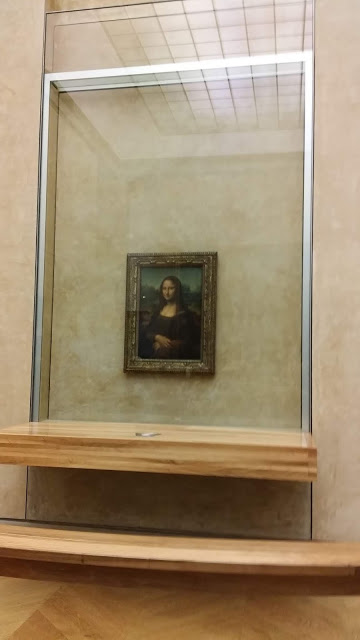
Here, it was cold, wet and windy while we waited, Once inside we took the girls to the Mona Lisa, and after a walk up and down a considerable numkber of stairs, one said, “and we walked all this way to see this small painting”.
It quickly became obvious their idea of paintings were the much larger ones hanging in other galleries.
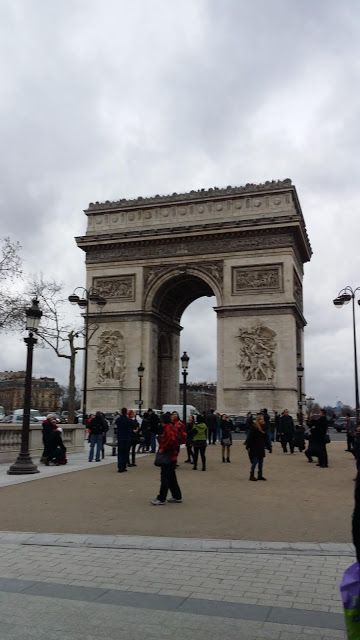
We also took them to the Arc de Triomphe.
We passed, and for some reason had to go into, the Disney shop, which I’m still wondering why after spending a small fortune at Disneyland itself.
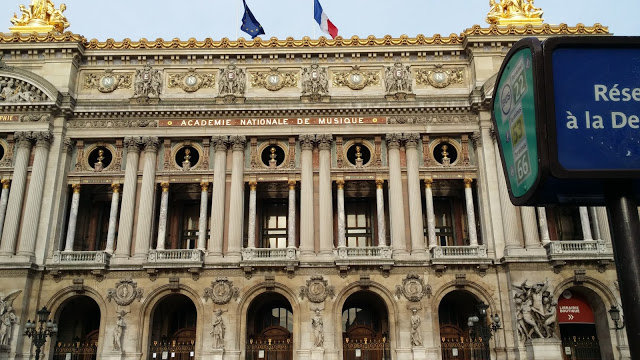
Next on the tour list was the Opera House.
where one of the children thought she saw the ghost and refused to travel in one of the elevators. At least it was quite amazing inside with the marble, staircases, and paintings on the roof.
Sadly, I don’t think they were all that interested in architecture, but at the Opera House, they did actually get to see some ballet stars from the Russian Bolshoi ballet company practicing. As we were leaving the next day we could not go and see a performance.
Last but not least was Notre Dame with its gargoyles and imp[osing architecture.
All in all, traveling with children and experiencing Paris through their eyes made it a more memorable experience.
The first we visited Paris was at the end of a whirlwind bus tour, seven countries in seven days or something like that. It was a relief to get to Paris and stay two nights if only to catch our breath.
I remember three events from that tour, the visit to the Eiffel Tower, the tour of the night lights, not that we were able to take much in from the inside of the bus, and the farewell dinner in one of the tour guides specially selected restaurants. The food and atmosphere were incredible. It was also notable for introducing us to a crepe restaurant in Montmartre, another of the tour guide’s favorite places.
On that trip to Paris, we also spent an afternoon exploring the Palace of Versailles.
The next time we visited Paris we flew in from London. OK, it was a short flight, but it took all day. From the hotel to the airport, the wait at the airport, departure, flying through time zones, arrival at Charles De Gaulle airport, now there’s an experience, and waiting for a transfer that never arrived, but that’s another story.
I can’t remember where we stayed the first time, it was somewhere out in the suburbs, but the second time we stayed at the Hilton near both the Eiffel Tower and the Australian Embassy, notable only because the concierge was dating an Australian girl working in the Embassy. That was our ticket for special treatment, which at times you need to get around in Paris.
It was the year before 2000 and the Eiffel Tower was covered in lights, and every hour or so it looked like a bubbling bottle of champagne. It was the first time we went to Level 3 of the Tower, and it was well worth it. The previous tour only included Level 2. This time we were acquainted with the fries available on the second level, and down below under the tower.
This time we acquainted ourselves with the Metro, the underground railway system, to navigate our way around to the various tourist spots, such as Notre Dame de Paris, The Louvre, Sacre-Coeur Basilica, and Les Invalides, and, of course, the trip to the crepe restaurant.
We also went to the Louvre for the express purpose of seeing the Mona Lisa, and I came away slightly disappointed. I had thought it to be a much larger painting. We then went to see the statue of Venus de Milo and spent some time trying to get a photo of it without stray visitors walking in front of us. Aside from that, we spent the rest of the day looking at the vast number of paintings, and Egyptian artifacts in the Museum.
We also visited the Opera House which was architecturally magnificent.
The third time we visited Paris we took our daughter, who was on her first international holiday. This time we stayed in a quaint Parisian hotel called Hotel Claude Bernard Saint Germain, (43 Rue Des Ecoles, Paris, 75005, France), recommended to us by a relation who’d stayed there the year before. It was small, and the elevator could only fit two people or one person and a suitcase. Our rooms were on the 4th floor, so climbing the stairs with luggage was out of the question.
It included breakfast and wifi, and it was quite reasonable for the four days we stayed there.
It was close to everything you could want, down the hill to the railway station, and a square where on some days there was a market, and for those days when we were hungry after a day’s exploring, a baguette shop where rolls and salad were very inexpensive and very delicious.
To our daughter we appeared to be experienced travelers, going on the Metro, visiting the Louvre, going, yes once again, to the crepe restaurant and the Basilica at Montmartre, Notre Dame, and this time by boat to the Eiffel Tower. We were going to do a boat rode on the Seine the last time but ran out of time.
We have some magnificent photos of the Tower from the boat.
Lunch on one of the days was at a restaurant not far from the Arc de Triomphe, where our daughter had a bucket of mussels. I was not as daring and had a hamburger and fries. Then we went to the center of the Arch and watched the traffic.
Our first time in Paris the bus driver got into the roundabout just to show us the dangers of driving in an unpredictable situation where drivers seem to take huge risks to get out at their exit. Needless to say, we survived that experience, though we did make a number of circuits.
It was in darkness. I was sure I had left several lights on, especially over the door so I could see to unlock it.
I looked up and saw the globe was broken.
Instant alert.
I went to the first hiding spot for the gun, and it wasn’t there. I went to the backup and it wasn’t there either. Someone had found my carefully hidden stash of weapons and removed them.
Who?
There were four hiding spots and all were empty. Someone had removed the weapons. That could only mean one possibility.
I had a visitor, not necessarily here for a social call.
But, of course, being the well-trained agent I’d once been and not one to be caught unawares, I crossed over to my neighbor and relieved him of a weapon that, if found, would require a lot of explaining.
Suitably armed, it was time to return the surprise.
There were three entrances to the villa, the front door, the back door, and a rather strange escape hatch. One of the more interesting attractions of the villa I’d rented was its heritage. It was built in the late 1700s, by a man who was, by all accounts, a thief. It had a hidden underground room which had been in the past a vault but was now a wine cellar, and it had an escape hatch by which the man could come and go undetected, particularly if there was a mob outside the door baying for his blood.
It now gave me the means to enter the villa without my visitors being alerted, unless, of course, they were near the vicinity of the doorway inside the villa, but that possibility was unlikely. It was not where anyone could anticipate or expect a doorway to be.
The secret entrance was at the rear of the villa behind a large copse, two camouflaged wooden doors built into the ground. I move aside some of the branches that covered them and lifted one side. After I’d discovered the doors and rusty hinges, I’d oiled and cleaned them, and cleared the passageway of cobwebs and fallen rocks. It had a mildew smell, but nothing would get rid of that. I’d left torches at either end so I could see.
I closed the door after me, and went quietly down the steps, enveloped in darkness till I switched on the torch. I traversed the short passage which turned ninety degrees about halfway to the door at the other end. I carried the key to this door on the keyring, found it and opened the door. It too had been oiled and swung open soundlessly.
I stepped in the darkness and closed the door.
I was on the lower level under the kitchen, now the wine cellar, the ‘door’ doubling as a set of shelves which had very little on them, less to fall and alert anyone in the villa.
Silence, an eerie silence.
I took the steps up to the kitchen, stopping when my head was level with the floor, checking to see if anyone was waiting. There wasn’t. It seemed to me to be an unlikely spot for an ambush.
I’d already considered the possibility of someone coming after me, especially because it had been Bespalov I’d killed, and I was sure he had friends, all equally as mad as he was. Equally, I’d also considered it nigh on impossible for anyone to find out it was me who killed him because the only people who knew that were Prendergast, Alisha, a few others in the Department, and Susan.
That raised the question of who told them where I was.
If I was the man I used to be, my first suspect would be Susan. The departure this morning, and now this was too coincidental. But I was not that man.
Or was I?
I reached the start of the passageway that led from the kitchen to the front door and peered into the semi-darkness. My eyes had got used to the dark, and it was no longer an inky void. Fragments of light leaked in around the door from outside and through the edge of the window curtains where they didn’t fit properly. A bone of contention upstairs in the morning, when first light shone and invariably woke me up hours before I wanted to.
Still nothing.
I took a moment to consider how I would approach the visitor’s job. I would get a plan of the villa in my head, all entrances, where a target could be led to or attacked where there would be no escape.
Coming in the front door. If I was not expecting anything, I’d just open the door and walk-in. One shot would be all that was required.
Contract complete.
I sidled quietly up the passage staying close to the wall, edging closer to the front door. There was an alcove where the shooter could be waiting. It was an ideal spot to wait.
Crunch.
I stepped on some nutshells.
Not my nutshells.
I felt it before I heard it. The bullet with my name on it.
And how the shooter missed, from point-blank range, and hit me in the arm, I had no idea. I fired off two shots before a second shot from the shooter went wide and hit the door with a loud thwack.
I saw a red dot wavering as it honed in on me and I fell to the floor, stretching out, looking up where the origin of the light was coming and pulled the trigger three times, evenly spaced, and a second later I heard the sound of a body falling down the stairs and stopping at the bottom, not very far from me.
Two assassins.
I’d not expected that.
The assassin by the door was dead, a lucky shot on my part. The second was still breathing.
I checked the body for any weapons and found a second gun and two knives. Armed to the teeth!
I pulled off the balaclava; a man, early thirties, definitely Italian. I was expecting a Russian.
I slapped his face, waking him up. Blood was leaking from several slashes on his face when his head had hit the stairs on the way down. The awkward angle of his arms and legs told me there were broken bones, probably a lot worse internally. He was not long for this earth.
“Who employed you?”
He looked at me with dead eyes, a pursed mouth, perhaps a smile. “Not today my friend. You have made a very bad enemy.” He coughed and blood poured out of his mouth. “There will be more …”
Friends of Bespalov, no doubt.
I would have to leave. Two unexplainable bodies, I’d have a hard time explaining my way out of this mess. I dragged the two bodies into the lounge, clearing the passageway just in case someone had heard anything.
Just in case anyone was outside at the time, I sat in the dark, at the foot of the stairs, and tried to breathe normally. I was trying not to connect dots that led back to Susan, but the coincidence was worrying me.
A half-hour passed and I hadn’t moved. Deep in thought, I’d forgotten about being shot, unaware that blood was running down my arm and dripping onto the floor.
Until I heard a knock on my front door.
Two thoughts, it was either the police, alerted by the neighbors, or it was the second wave, though why would they be knocking on the door?
I stood, and immediately felt a stabbing pain in my arm. I took out a handkerchief and turned it into a makeshift tourniquet, then wrapped a kitchen towel around the wound.
If it was the police, this was going to be a difficult situation. Holding the gun behind my back, I opened the door a fraction and looked out.
No police, just Maria. I hoped she was not part of the next ‘wave’.
“You left your phone behind on the table. I thought you might be looking for it.” She held it out in front of her.
When I didn’t open the door any further, she looked at me quizzically, and then asked, “Is anything wrong?”
I was going to thank her for returning the phone, but I heard her breathe in sharply, and add, breathlessly, “You’re bleeding.”
I looked at my arm and realized it was visible through the door, and not only that, the towel was soaked in blood.
“You need to go away now.”
Should I tell her the truth? It was probably too late, and if she was any sort of law-abiding citizen she would go straight to the police.
She showed no signs of leaving, just an unnerving curiosity. “What happened?”
I ran through several explanations, but none seemed plausible. I went with the truth. “My past caught up with me.”
“You need someone to fix that before you pass out from blood loss. It doesn’t look good.”
“I can fix it. You need to leave. It is not safe to be here with me.”
The pain in my arm was not getting any better, and the blood was starting to run down my arm again as the tourniquet loosened. She was right, I needed it fixed sooner rather than later.
I opened the door and let her in. It was a mistake, a huge mistake, and I would have to deal with the consequences. Once inside, she turned on the light and saw the pool of blood just inside the door and the trail leading to the lounge. She followed the trail and turned into the lounge, turned on the light, and no doubt saw the two dead men.
I expected her to scream. She didn’t.
She gave me a good hard look, perhaps trying to see if I was dangerous. Killing people wasn’t something you looked the other way about. She would have to go to the police.
“What happened here?”
“I came home from the cafe and two men were waiting for me. I used to work for the Government, but no longer. I suspect these men were here to repay a debt. I was lucky.”
“Not so much, looking at your arm.”
She came closer and inspected it.
“Sit down.”
She found another towel and wrapped it around the wound, retightening the tourniquet to stem the bleeding.
“Do you have medical supplies?”
I nodded. “Upstairs.” I had a medical kit, and on the road, I usually made my own running repairs. Another old habit I hadn’t quite shaken off yet.
She went upstairs, rummaged, and then came back. I wondered briefly what she would think of the unmade bed though I was not sure why it might interest her.
She helped me remove my shirt, and then cleaned the wound. Fortunately, she didn’t have to remove a bullet. It was a clean wound but it would require stitches.
When she’d finished she said, “Your friend said one day this might happen.”
No prizes for guessing who that friend was, and it didn’t please me that she had involved Maria.
“Alisha?”
“She didn’t tell me her name, but I think she cares a lot about you. She said trouble has a way of finding you, gave me a phone and said to call her if something like this happened.”
“That was wrong of her to do that.”
“Perhaps, perhaps not. Will you call her?”
“Yes. I can’t stay here now. You should go now. Hopefully, by the time I leave in the morning, no one will ever know what happened here, especially you.”
This is not a treatise, but a tongue in cheek, discussion on how to write short stories. Suffice to say this is not the definitive way of doing it, just mine. It works for me – it might not work for you.
There are two methods of writing, planning, sometimes meticulous planning, or flying by the seat of your pants, or being called a ‘pantser’.
The first has it all planned out before they start writing, from beginning to end, knowing what the end result will be. The second, well, we like to write and see where it takes us.
I like to think I fly by the seat of my pants, you know, like the reader who takes up the story and starts reading, not having a clue where it’s going to go. I prefer that blissful ignorance, of course, until I run out of ideas, roughly the equivalent of hitting a brick wall
Or that common enemy all writers have, the dreaded ‘writers block’.
I’ve tried both methods.
Each work, but in the case of the ‘planner’, you need to know where it’s going to start what’s going to happen in the middle and have the end firmly planted in your mind.
Not much good if a rotten character is making you angry and you want to kill him off, and in the most excruciatingly painful manner.
Flying blind gives you a little more creativeness and be able to go around a corner and see what’s there. It also allows for those complete changes of direction you come up with in the shower, the place that is a fertile ground for new ideas just when you’re running out of them.
But it can sometimes play havoc with word counts and if you’re trying to fit into 2,000 words, 5,000 words, or a lot less, taking the story where it wants to go is not a good idea, and sadly, I tend to let stories run their course.
And sometimes I like the idea of writing three different endings, and then can’t choose which one I like the best.
So, role model I am not. I like writing, and when I’m in the ‘zone’ it’s like I’m in another world.
How many of us have skeletons in the closet that we know nothing about? The skeletons we know about generally stay there, but those we do not, well, they have a habit of coming out of left field when we least expect it.
In this case, when you see your photo on a TV screen with the accompanying text that says you are wanted by every law enforcement agency in Europe, you’re in a state of shock, only to be compounded by those same police, armed and menacing, kicking the door down.
I’d been thinking about this premise for a while after I discovered my mother had a boyfriend before she married my father, a boyfriend who was, by all accounts, the man who was the love of her life.
Then, in terms of coming up with an idea for a story, what if she had a child by him that we didn’t know about, which might mean I had a half brother or sister I knew nothing about. It’s not an uncommon occurrence from what I’ve been researching.
There are many ways of putting a spin on this story.
Then, in the back of my mind, I remembered a story an acquaintance at work was once telling us over morning tea, that a friend of a friend had a mother who had a twin sister and that each of the sisters had a son by the same father, without each knowing of the father’s actions, both growing up without the other having any knowledge of their half brother, only to meet by accident on the other side of the world.
It was an encounter that in the scheme of things might never have happened, and each would have remained oblivious of the other.
For one sister, the relationship was over before she discovered she was pregnant, and therefore had not told the man he was a father. It was no surprise the relationship foundered when she discovered he was also having a relationship with her sister, a discovery that caused her to cut all ties with both of them and never speak to either from that day.
It’s a story with more twists and turns than a country lane!







 Thrills, Spills, and just a dash of Romance