There’s something to be said for a story that starts like a James Bond movie, throwing you straight in the deep end, a perfect way of getting to know the main character, David, or is that Alistair?
A retired spy, well not so much a spy as a retired errand boy, David’s rather wry description of his talents, and a woman that most men would give their left arm for, not exactly the ideal couple, but there is a spark in a meeting that may or may not have been a set up.
But as the story progressed, the question I kept asking myself was why he’d bother.
And, page after unrelenting page, you find out.
Susan is exactly the sort of woman the pique his interest. Then, inexplicably, she disappears. That might have been the end to it, but Prendergast, that shadowy enigma, David’s ex boss who loves playing games with real people, gives him an ultimatum, find her or come back to work.
Nothing like an offer that’s a double edged sword!
A dragon for a mother, a sister he didn’t know about, Susan’s BFF who is not what she seems or a friend indeed, and Susan’s father who, up till David meets her, couldn’t be less interested, his nemesis proves to be the impossible dream, and he’s always just that one step behind.
When the rollercoaster finally came to a halt, and I could start breathing again, it was an ending that was completely unexpected.
This was one of the more interesting experiences for the grandchildren as they were, as all young girls are, interested in ballet.
We thoroughly enjoyed our visit which included some time watching ballet practice.
I could not convince anyone to take the elevator back down to the ground floor as it was suspected we might be ‘attacked’ by the ‘phantom’. Certainly, the elevator was very old and I think at the time it was being repaired.
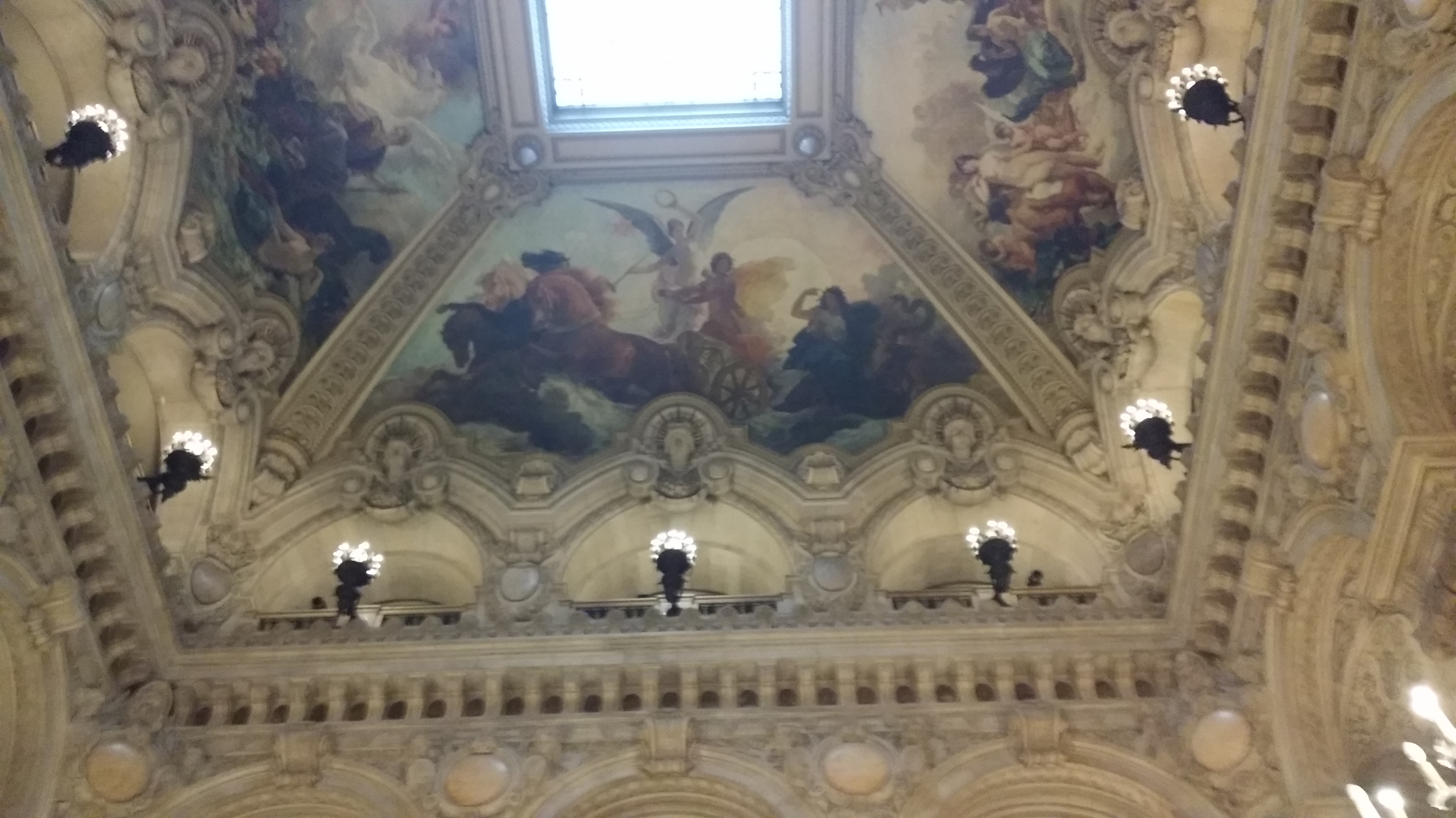
Part of the Grand Staircase in Palais Garnier Opera de Paris
The ceiling above the main staircase. The ceiling above the staircase was painted by Isidore Pils to depict The Triumph of Apollo, The Enchantment of Music Deploying its Charms, Minerva Fighting Brutality Watched by the Gods of Olympus, and The City of Paris Receiving the Plan of the New Opéra.
The ceiling of Chagall at the Palais Garnier
On 23 September 1964, the new ceiling of the Opéra Garnier was inaugurated with great pomp. It was painted by Marc Chagall at the request of André Malraux
Amphitheatre and Orchestra Pit entrance
Interior, and doorways to boxes
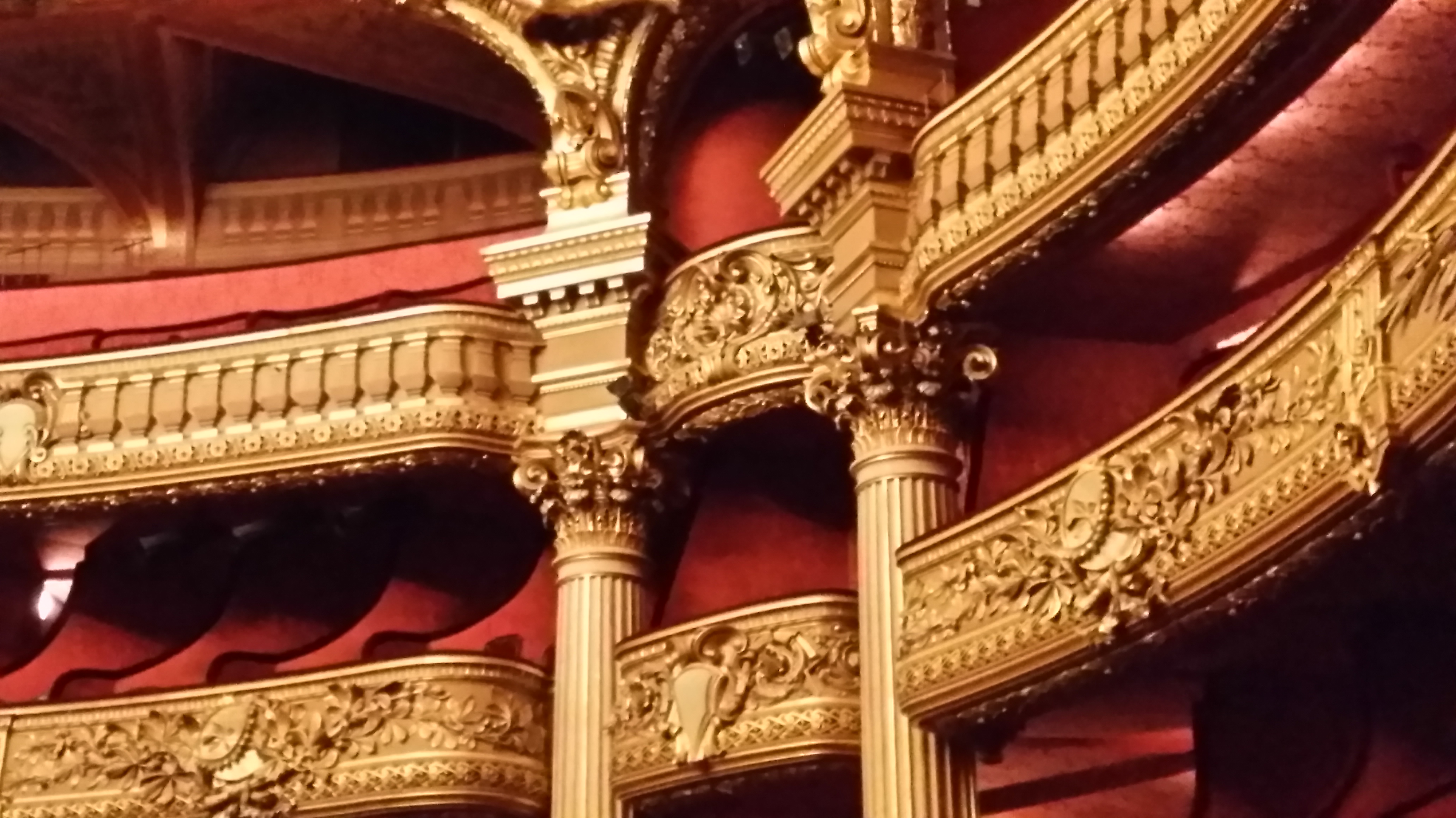
Box seats in the auditorium
Ornate ceilings and columns
Seating inside the auditorium
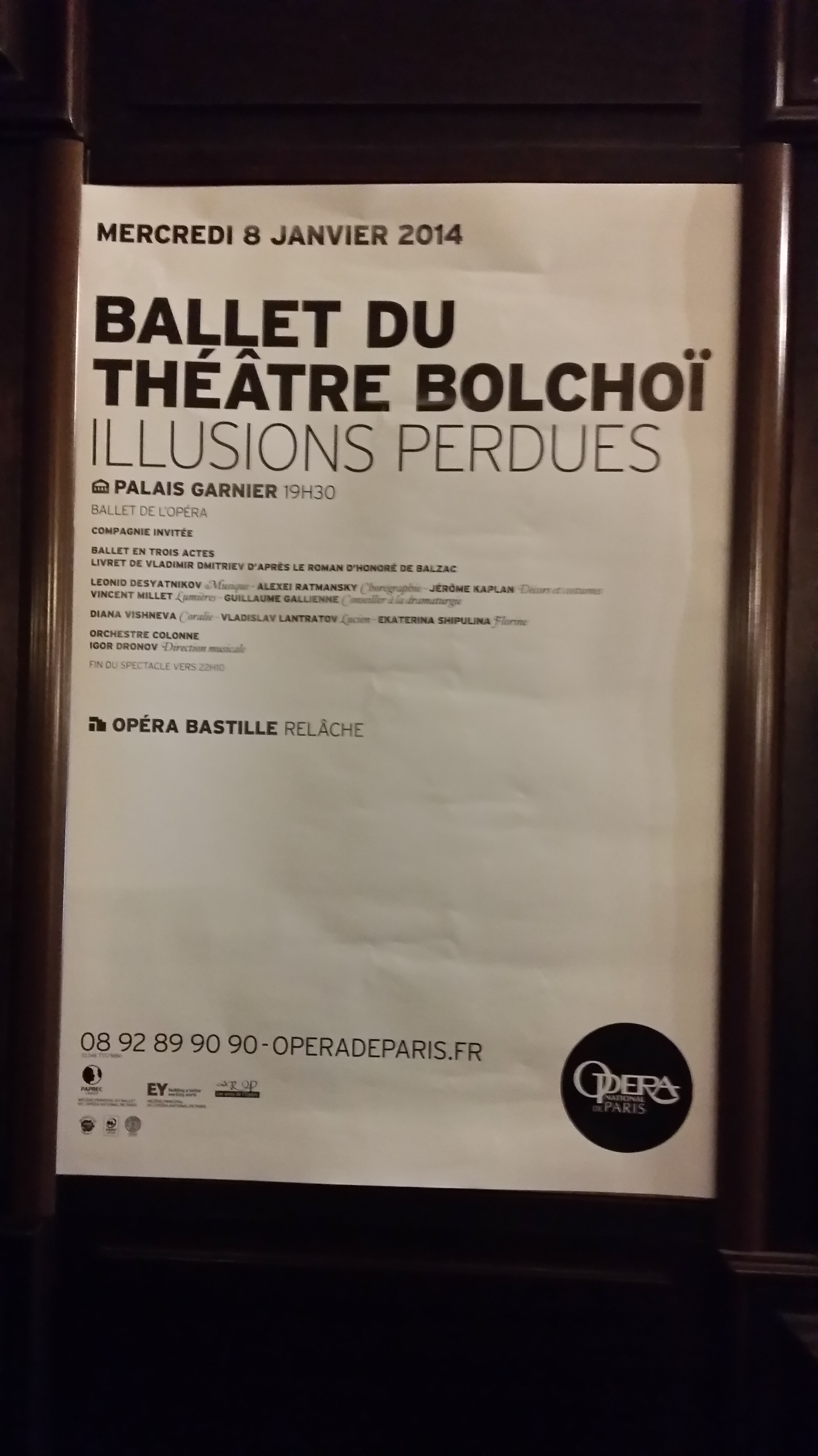
The day we were leaving Paris, was the first night of the Bolshoi Ballet. My two granddaughters were greatly disappointed at missing out on the opportunity of a lifetime, to see the Bolshoi Ballet at the Paris Opera House.
50 photographs, 50 stories, of which there is one of the 50 below.
They all start with –
A picture paints … well, as many words as you like. For instance:
And, the story:
Have you ever watched your hopes and dreams simply just fly away?
Everything I thought I wanted and needed had just left in an aeroplane, and although I said I was not going to, i came to the airport to see the plane leave. Not the person on it, that would have been far too difficult and emotional, but perhaps it was symbolic, the end of one life and the start of another.
But no matter what I thought or felt, we had both come to the right decision. She needed the opportunity to spread her wings. It was probably not the best idea for her to apply for the job without telling me, but I understood her reasons.
She was in a rut. Though her job was a very good one, it was not as demanding as she had expected, particularly after the last promotion, but with it came resentment from others on her level, that she, the youngest of the group would get the position.
It was something that had been weighing down of her for the last three months, and if noticed it, the late nights, the moodiness, sometimes a flash of temper. I knew she had one, no one could have such red hair and not, but she had always kept it in check.
And, then there was us, together, and after seven years, it felt like we were going nowhere. Perhaps that was down to my lack of ambition, and though she never said it, lack of sophistication. It hadn’t been an issue, well, not until her last promotion, and the fact she had to entertain more, and frankly I felt like an embarrassment to her.
So, there it was, three days ago, the beginning of the weekend, and we had planned to go away for a few days and take stock. We both acknowledged we needed to talk, but it never seemed the right time.
It was then she said she had quit her job and found a new one. Starting the following Monday.
Ok, that took me by surprise, not so much that it something I sort of guessed might happen, but that she would just blurt it out.
I think that right then, at that moment, I could feel her frustration with everything around her.
What surprised her was my reaction. None.
I simply asked where who, and when.
A world-class newspaper, in New York, and she had to be there in a week.
A week.
It was all the time I had left with her.
I remember I just shrugged and asked if the planned weekend away was off.
She stood on the other side of the kitchen counter, hands around a cup of coffee she had just poured, and that one thing I remembered was the lone tear that ran down her cheek.
Is that all you want to know?
I did, yes, but we had lost that intimacy we used to have when she would have told me what was happening, and we would have brainstormed solutions. I might be a cabinet maker but I still had a brain, was what I overheard her tell a friend once.
There’s not much to ask, I said. You’ve been desperately unhappy and haven’t been able to hide it all that well, you have been under a lot of pressure trying to deal with a group of troglodytes, and you’ve been leaning on Bentley’s shoulder instead of mine, and I get it, he’s got more experience in that place, and the politics that go with it, and is still an ally.
Her immediate superior and instrumental in her getting the position, but unlike some men in his position he had not taken advantage of a situation like some men would. And even if she had made a move, which I doubted, that was not the sort of woman she was, he would have politely declined.
One of the very few happily married men in that organisation, so I heard.
So, she said, you’re not just a pretty face.
Par for the course for a cabinet maker whose university degree is in psychology. It doesn’t take rocket science to see what was happening to you. I just didn’t think it was my place to jump in unless you asked me, and when you didn’t, well, that told me everything I needed to know.
Yes, our relationship had a use by date, and it was in the next few days.
I was thinking, she said, that you might come with me, you can make cabinets anywhere.
I could, but I think the real problem wasn’t just the job. It was everything around her and going with her, that would just be a constant reminder of what had been holding her back. I didn’t want that for her and said so.
Then the only question left was, what do we do now?
Go shopping for suitcases. Bags to pack, and places to go.
Getting on the roller coaster is easy. On the beginning, it’s a slow easy ride, followed by the slow climb to the top. It’s much like some relationships, they start out easy, they require a little work to get to the next level, follows by the adrenaline rush when it all comes together.
What most people forget is that what comes down must go back up, and life is pretty much a roller coaster with highs and lows.
Our roller coaster had just come or of the final turn and we were braking so that it stops at the station.
There was no question of going with her to New York. Yes, I promised I’d come over and visit her, but that was a promise with crossed fingers behind my back. After a few months in t the new job the last thing shed want was a reminder of what she left behind. New friends new life.
We packed her bags, three out everything she didn’t want, a free trips to the op shop with stiff she knew others would like to have, and basically, by the time she was ready to go, there was nothing left of her in the apartment, or anywhere.
Her friends would be seeing her off at the airport, and that’s when I told her I was not coming, that moment the taxi arrived to take her away forever. I remember standing there, watching the taxi go. It was going to be, and was, as hard as it was to watch the plane leave.
So, there I was, finally staring at the blank sky, around me a dozen other plane spotters, a rather motley crew of plane enthusiasts.
Already that morning there’s been 6 different types of plane depart, and I could hear another winding up its engines for take-off.
People coming, people going.
Maybe I would go to New York in a couple of months, not to see her, but just see what the attraction was. Or maybe I would drop in, just to see how she was.
As one of my friends told me when I gave him the news, the future is never written in stone, and it’s about time you broadened your horizons.
This is not a treatise, but a tongue in cheek, discussion on how to write short stories. Suffice to say this is not the definitive way of doing it, just mine. It works for me – it might not work for you.
…
Now, there’s this thing called continuity, but it covers a whole range of writing sins, most of which I eventually get caught out. Films sometimes miss a few items, like back in the roman days, there are plane trails in the sky, in a 1920’s period piece, there’s a mobile phone sitting on a desk.
Like one minute the hero has a gun, and the next he’s fighting for his life with a knife, and, hey presto, there’s that gun again. The error might not be that big but you can’t pull out a weapon you don’t have or wasn’t there in the first place.
Similarly, the hero pulls out a mobile phone, but there’s only one problem, it’s 1980, and there are no mobile phones. Our problem might be that we are so used to doing and using certain things that we might forget, for a minute or two, that were not available in the past.
Then there’s places like hotels and restaurants, both of which change hands and close and reopen with a different owner like someone changes their socks. There’s no substitute for checking, on the internet of course, whether a Hilton Hotel was in 6th Avenue, New York, in 1920.
The answer is no. The first Hilton Hotel was in Waco in 1927. The New York Hilton opened in 1963.
The same goes for the fashion of the day.
I’m no fashion guru, but I have to rely on Google once again to fill in the gaps.
And my all-time favourite, getting the right make and model of car.
Oh, and just for good measure, back in the old days they used acoustic couplers to attach to phones via a serial port to dial-up not a server, but a BBS, Bulletin Board Service, at a rate of 300 baud, or a little while later, 1,200 baud.
There was no internet in general use. If you wanted to call the office when out, use a telephone box. Or carrier pigeon.
And the use of language, there’s a lot of stuff relevant today that was not used back then, and there was a lot of stuff back then that isn’t tolerated now. Some of it might be hard to get your head around.
It isn’t for me, because I can remember the 1970s and 1980s, but I’m not too sure about allowing some of what happened then to creep into my work.
So, you get the picture. Try to use the past as the past, or leave it in the past.
Unless it’s a book about time travel, then all bets are off.
With my attention elsewhere, I walked into a man who was hurrying in the opposite direction. He was a big man with a scar running down the left side of his face from eye socket to mouth, and who was also wearing a black shirt with a red tie.
That was all I remembered as my heart almost stopped.
He apologized as he stepped to one side, the same way I stepped, as I also muttered an apology.
I kept my eyes down. He was not the sort of man I wanted to recognize later in a lineup. I stepped to the other side and so did he. It was one of those situations. Finally getting out of sync, he kept going in his direction, and I towards the bus, which was now pulling away from the curb.
Getting my breath back, I just stood riveted to the spot watching it join the traffic. I looked back over my shoulder, but the man I’d run into had gone. I shrugged and looked at my watch. It would be a few minutes before the next bus arrived.
Wait, or walk? I could also go by subway, but it was a long walk to the station. What the hell, I needed the exercise.
At the first intersection, the ‘Walk’ sign had just flashed to ‘Don’t Walk’. I thought I’d save a few minutes by not waiting for the next green light. As I stepped onto the road, I heard the screeching of tires.
A yellow car stopped inches from me.
It was a high powered sports car, perhaps a Lamborghini. I knew what they looked like because Marcus Bartleby owned one, as did every other junior executive in the city with a rich father.
Everyone stopped to look at me, then the car. It was that sort of car. I could see the driver through the windscreen shaking his fist, and I could see he was yelling too, but I couldn’t hear him. I stepped back onto the sidewalk, and he drove on. The moment had passed and everyone went back to their business.
My heart rate hadn’t come down from the last encounter. Now it was approaching cardiac arrest, so I took a few minutes and several sets of lights to regain composure.
At the next intersection, I waited for the green light, and then a few seconds more, just to be sure. I was no longer in a hurry.
At the next, I heard what sounded like a gunshot. A few people looked around, worried expressions on their faces, but when it happened again, I saw it was an old car backfiring. I also saw another yellow car, much the same as the one before, stopped on the side of the road. I thought nothing of it, other than it was the second yellow car I’d seen.
At the next intersection, I realized I was subconsciously heading towards Harry’s new bar. It was somewhere on 6th Avenue, so I continued walking in what I thought was the right direction.
I don’t know why I looked behind me at the next intersection, but I did. There was another yellow car on the side of the road, not far from me. It, too, looked the same as the original Lamborghini, and I was starting to think it was not a coincidence.
Moments after crossing the road, I heard the roar of a sports car engine and saw the yellow car accelerate past me. As it passed by, I saw there were two people in it, and the blurry image of the passenger; a large man with a red tie.
Now my imagination was playing tricks.
It could not be the same man. He was going in a different direction.
In the few minutes I’d been standing on the pavement, it had started to snow; early for this time of year, and marking the start of what could be a long cold winter. I shuddered, and it was not necessarily because of the temperature.
I looked up and saw a neon light advertising a bar, coincidentally the one Harry had ‘found’ and, looking once in the direction of the departing yellow car, I decided to go in. I would have a few drinks and then leave by the back door if it had one.
Yes, I actually heard that answer given in a television interview, and thought, at the time, it was a quaint expression.
But in reality, this was a person for whom English was a second language, and that was, quite literally, their translation from their language to English.
Suffice to say, that person was not happy when lost the event she was participating in.
But that particular memory was triggered by another event.
Someone asked me how happy I was.
Happy is another of those words like good, thrown around like a rag doll, used without consequence, or regard for its true meaning.
“After everything that’s happened, you should be the happiest man alive!”
I’m happy.
I should be, to them.
A real friend might also say, “Are you sure, you don’t look happy.”
I hesitate but say, “Sure. I woke up with a headache,” or some other lame reason.
But, in reality, I’m not ‘happy’. Convention says that we should be happy if everything is going well. In my case, it is, to a certain extent, but it is what’s happening within that’s the problem. We say it because people expect it.
I find there is no use complaining because no one will listen, and definitely, no one likes serial complainers.
True.
But somewhere in all those complaints will be the truth, the one item that is bugging us.
It is a case of whether we are prepared to listen. Really listen.
For a story that was conceived during those long boring hours flying in a steel cocoon, striving to keep away the thoughts that the plane and everyone in it could just simply disappear as planes have in the past, it has come a long way.
Whilst I have always had a fascination with what happened during the second world war, not the battles or fighting, but in the more obscure events that took place, I decided to pen my own little sidebar to what was a long and bitter war.
And, so, it continues…
——
Jackerby trusted no one. He had been given orders by someone further up the ranks than Wallace and his people, someone who suspected that some or all of the Englishmen turned German turned Englishmen were traitors.
The only men he could trust fully were those who had come with him in the glider, a dozen at most. It’s why he had just completed a secret briefing with his second in command who would take over the operation if anything happened to him.
Not that it would, but he liked the idea of being prepared, and humoring the others into believing they were essential to the operation. Eckhardt would be a good man in a crisis, battle scarred from the Russian front, and glad to be on this operation for obvious reasons.
He would do anything Jackerby asked, even kill Wallace and Johannsen if he was required to.
That might yet be necessary because Wallace didn’t seem interested in going after Atherton which made him think that Wallace wasn’t all that he appeared to be. Atherton was a thorn in their operation and had to be eliminated. The fact Wallace and Johannsen didn’t agree with him raised suspicions as to their motives.
Was there ultimately going to be a triple cross?
He had been lurking in the shadows when Wallace gave the drunken fool Leonardo his orders to go down to the village. More defectors. Jackerby couldn’t understand why anyone would want to leave the Reich, especially when they were winning the war, and, if it were up to him, he’d executer the lot of them not send them back.
But, orders were orders.
He went back to Eckhardt and told him he was going down to the village to observe Leonardo and his team in action, and that he was in charge of the men in his absence.
Eckhardt, on the other hand, knew that Jackerby, if he could find a way that would not cause them trouble, was going to eliminate Leonardo because they were a liability. The plan was once Leonardo and his men were gone, Jackerby would take over rounding up the defectors. Or, more to the point, they would go missing before reaching the castle. There was only one that mattered, the rest were dead weight. And once the prize had been captured, Jackerby would escort him home and collect the kudos for himself and his men.
The ultimate prize; leave to reunite briefly with their families and a cushy job in Berlin, away from the horrors of war in the trenches.
Leonardo and the five others that made up the resistance left the castle by one of the underground tunnels. Leonardo knew of two, both of them shown to him by Carlo. He knew that Carlo knew where more were, but Carlo was not particularly helpful at the best of times.
He also knew Carlo might be stupid enough to storm the castle, especially after what Leonardo had done to Martina, and, when it hadn’t happened, he suspected Atherton had appealed to him to wait.
Atherton, too, he knew had some idea of the layout of the castle, have been told to keep an eye on Atherton when he first arrived because he was reportedly an archaeologist. Leonardo had, and reported back to Wallace that it appeared Atherton had been surveying the castle. He had simply been told to keep Atherton under surveillance, and make notes of any discoveries, and particularly what Atherton was doing.
He had, not that it amounted to much. Not when he realized Leonardo was following him. Leonardo decided not to tell Wallace Atherton had rumbled him, just that he was roaming the passages looking for something.
It had worked so far and kept Wallace off his back, but it wasn’t going to last.
Bottom line, Leonardo had to find and kill Atherton before any trouble started, otherwise, it would be his neck on the block.
Jackerby followed.
It wasn’t hard to follow Leonardo because he and his man were the last people to know what stealth was. He could hear them crashing through the forest between the castle and the village up to 250 meters away, he was making so much noise.
But, Jackerby thought, perhaps Leonardo didn’t need to worry about alerting his presence to Atherton, not if he was already working with him.
To Jackerby and his paranoia, it made sense. Maybe he was going to meet with Atherton right now and do a deal with the defectors. How many others had turned up at the village in the last week or so, and never made it to the castle?
He was right, Jackerby told himself, not to trust them. Everyone, in the end, was an enemy of the Reich.
It took 20 minutes to reach the outskirts of the village, and when Jackerby could see the edge of the woods, and the barn and remains of the farmhouse just the other side of the tree line, he dropped back, found a suitable observation point, and waited.
Leonardo and his men had stopped at the back of the barn, and one of his men was about to go find the defectors. The rest of Leonardo’s men would wait with him, and surprise their guests, before taking them back to the castle.
As far as “Jackerby was concerned, they would never reach the castle, and this time, he would take care of Leonardo, and the others.
It would be easy to say that Atherton had killed all the members of the resistance, and then got killed himself in a shootout with Jackerby. It was a plausible reason for all the deaths, though he would have to come up with a suitable excuse for leaving the castle and following Leonardo and his men when Wallace had expressly forbidden it.
Wallace.
Perhaps if he got his hands on Atherton he’d ask him if Wallace was a traitor.
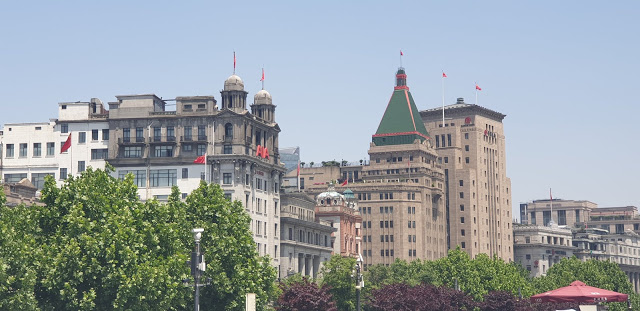
The architecture along the Bund or Waitan is a living museum of the colonial history of the 1800s. The area centers on a section of Zhongshan Road within the former Shanghai International Settlement.
The word bund means an embankment or an embanked quay. It was initially a British settlement; later the British and American settlements were combined in the International Settlement.
The Bund is a mile-long stretch of waterfront promenade along the Huangpu River. There are 52 buildings of various architectural styles, including Gothic, baroque, and neoclassical styles. The area is often referred to as “the museum of buildings”.
Building styles include Romanesque Revival, Gothic Revival, Renaissance Revival, Baroque Revival, Neo-Classical or Beaux-Arts, as well as a number in Art Deco style.
Having seen these buildings initially the night before, mostly lit up, our viewing this morning was from the land side, and particularly interesting in that the colonial architecture was really fascinating considering their location, but not surprising given Shanghai’s history. A lot of these buildings would be more at home in London, that out in the far east.
The Bund waterfront is about two kilometers long and impossible to cover in the time allowed for this part of the tour.
There was just enough time to get photos of the waterfront and the old buildings.
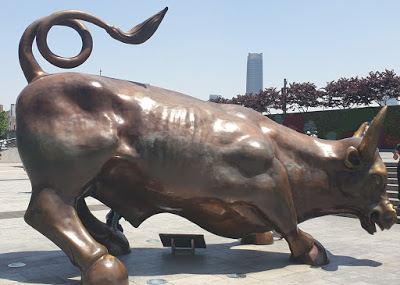
Some of these buildings had odd shapes, like one on the far right that looks like a bottle opener.
And, for some odd reason, a bull.
On the other side of the water, the sights that had been quite colorful the night before, were equally impressive though somewhat diminished by the haze.
I’m back to writing, sitting at the desk, pad in front of me, pen in hand.
The only thing lacking is an idea.
It’s 9:03 am, too early to start on a six-pack.
I need a distraction.
Blogging, websites, Twitter, and Facebook, all of these social media problems are swirling around in my mind.
The more I read the more it bothers me that if I don’t have the right social media presence if I do not start to build an email list, all of my efforts in writing a book will come to naught.
Then I start trawling the internet for information on marketing and found a plethora of people offering any amount of advice for anything between a ‘small amount’ to a rather large amount that gives comprehensive coverage of most social media platforms for periods of a day, a week or a month. I don’t have a book so it’s a bit early to be worrying about that.
I move on to the people who offer advice for a cost on how to build a following, how to build a web presence, how to get a thousand Twitter followers, and how to get thousands of email followers before the launch.
The trouble is I’m writing a novel, not a nonfiction book, or have some marvellous 30 page ebook on how to do something, for free just to drive people to my site.
I’m a novelist, not a handyman so those ideas while good are not going to help me.
Yet another problem to wrestle with along with actually creating a product to sell in the first place.
Except I’m supposed to be writing for the love of it without the premeditated idea of writing for gain or getting rich quick.
What am I missing here?
So should l be writing short stories and offering them for free to drive people to my site? These would have to be genre-specific so it needs time and effort and fit into a convenient size story that will highlight or showcase my talent.
Or should I create a website for the novel and set up pages for the characters and get some interaction going that way?
It will be difficult without giving the whole plot away so if I do it will have to be carefully managed.
I don’t think I will have a good night’s sleep again with all of these social media problems I’m going to have.
Oh well, back to the book. It’s time to have a nightmare of a different sort!
I guess the point is that I have at least crystallised my thoughts on paper so that I can do something with them. After all, anything is better than nothing, isn’t it?
Sometimes I wonder. I look back on a lot of the stuff I wrote forty or fifty years ago and it looks bad. The thing is, then, I thought it was great, and that I was destined to do great things with the written word.
Pity, all this time later, I’ve turned into a self-critical monster, where it seems nothing I write is any good.
So, does that mean we need to be less critical of our work? After all, through the years, when I’ve shared novels and short stories with others, they have all universally said they’re quite good.
So…
Ut’s time to go back to the previous day’s work and rework it. Yes, the idea that I wanted to write about is where I wanted the story to go, it’s just the execution.
The problem is, since then a few other ideas have been running around in the back of my head, and these could be added or used to further the current plotline.
The other problem is, it is one of the six stories that I’m writing by the seat of my pants, you know, the way some pilots like to fly a plane, without all that computer backup. Similarly, this is the way I sometimes like to write.
It’s as much a surprise to me is it is to the reader.
There’s good arguments for having planned the story from start to finish, but with these, I like to write it and see where it takes me. They’re episodic, so sometimes I get to write three of four episodes at a time, and these would most likely in a book become a chapter.
Last night I wrote two episodes, but it seems that it might need pointers back in previous episodes, because we all like to leave a trail of crumbs for the reader so when they get to the denouement, they remember, ah yes, back in chapter two such and such happened, but why am I only remembering it now?
Ok, enough convincing myself I’m a good writer, it’s time to get back to work…










 Thrills, Spills, and just a dash of Romance