Coming soon – “Strangers We’ve Become”, the sequel to “What Sets Us Apart”

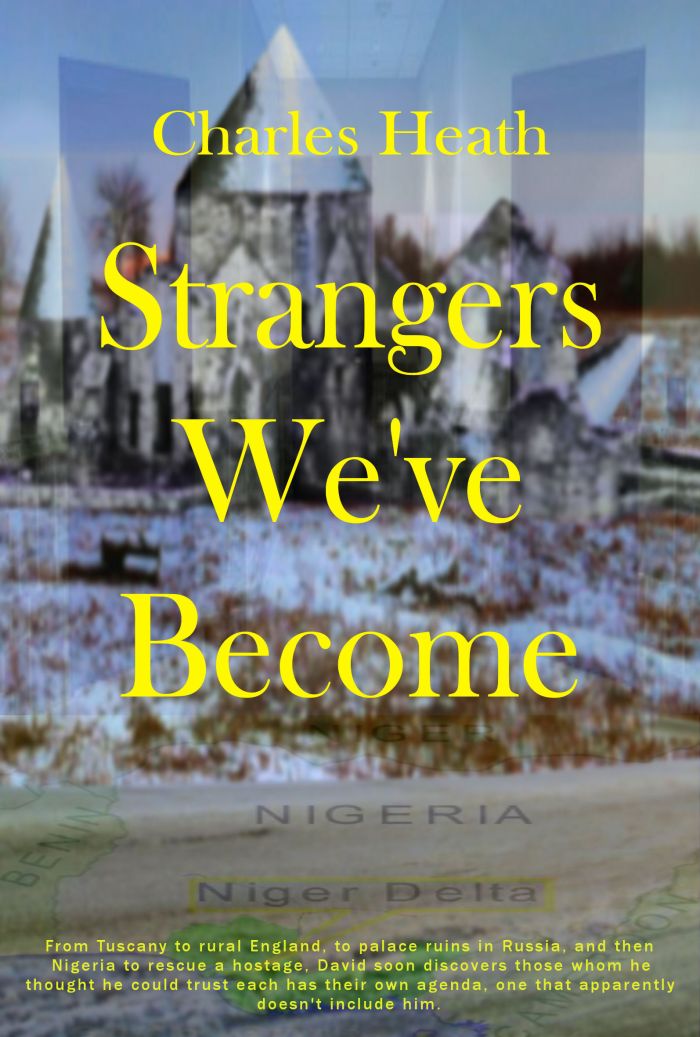
Stranger’s We’ve Become, a sequel to What Sets Us Apart.

The blurb:

Is she or isn’t she, that is the question!

Susan has returned to David, but he is having difficulty dealing with the changes. Her time in captivity has changed her markedly, so much so that David decides to give her some time and space to re-adjust back into normal life.

But doubts about whether he chose the real Susan remain.

In the meantime, David has to deal with Susan’s new security chief, the discovery of her rebuilding a palace in Russia, evidence of an affair, and several attempts on his life. And, once again, David is drawn into another of Predergast’s games, one that could ultimately prove fatal.

From being reunited with the enigmatic Alisha, a strange visit to Susan’s country estate, to Russia and back, to a rescue mission in Nigeria, David soon discovers those whom he thought he could trust each has their own agenda, one that apparently doesn’t include him.

The Cover:

strangerscover9

Coming soon


In a word: Choice

We are often told that it’s the choices we make that shape our lives.

It’s true.

What distinguishes the basis of those choices is the circumstances of the individual.

What a lot of people don’t realize is the diversity of backgrounds of everyone, and that in a minority of cases, the few that really have no choices at all.

Yes, there are those who have no control over their circumstances, and therefore no choice whatsoever.

Inevitably, the people who are first to criticize those who apparently made the wrong choice, are those that have never found themselves in similar circumstances.

And probably never will.

This perhaps is the biggest problem with governments who are staffed with advisors who do not understand the plight of the common man.

I never had the same opportunities as those who could afford a university education.  My family were working class and were relatively poor.  Had I not hot a scholarship who knows what sort of education I would have got, if any.

Certainly, my father never got an opportunity to get a good education, but, at the time, during the great depression, his choices were limited, whereas those with any sort of wealth it was a different story.

And his lack of choices reflected on us, and that lack of opportunity haunted all of us as time passed.

It was always a case of the haves and the have not’s.

Yes, we all have choices, but sometimes it really is the lesser of two evils, and not whether we will have the fillet or the rib eye steak.

The cinema of my dreams – Was it just another surveillance job – Episode 14

I’m back home and this story has been sitting on a back burner for a few months, waiting for some more to be written.

The trouble is, there are also other stories to write, and I’m not very good at prioritising.

But, here we are, a few minutes opened up and it didn’t take long to get back into the groove.

Was I working for a ghost?


Training sometimes was one of those things that went in one ear and came out the other.  That accounted for the boring bits, but our instructors called it tradecraft. 

I guess I should have taken more notice at the time.

Home was a bedsit in Bloomsbury, Not far from the Russell Square underground station, on the ground floor overlooking the small park.  Sometimes, in summer I would sit there and watch the world go by, thinking there had to be more to life than waiting for an opportunity.

To do what, at the time, I didn’t know.  But, when this opportunity presented itself, oddly as a rather strange ad in the help wanted pages of the newspaper, I guess the people who put it there were looking for the curious sort, with a sense of adventure.

My first impression of the job was that of a courier who would be required to travel a lot.  It said, in part, “must be prepared to travel to different locations worldwide, understand the requirement of confidentiality, and must be able to respond to emergencies that might occur in the carrying out of your duties.”

To me, it spelled courier, though I rather hoped it wasn’t the briefcase handcuffed to a wrist sort and no guns.

After the first interview, I think I had guessed correctly, though, in subsequent training, the word tradecraft put a slightly different slant to the job.  That, and the surveillance module, sold to us as “you need to know if you are being followed, recognise hostiles, and be able to deal with them.”

But, it was the notion that we should get out of any habits we had, those that made us predictable to an enemy, yes, they actually used the word, enemy.  Like for instance, if we caught the same train, or bus, into the city.  If we went to the same cafe for coffee, restaurant for lunch or dinner, met people in a pub on the same day, same time, each week.

Before all this, I found comfort in a regular schedule.  I hated being late, except when the transport system let me down.  I had a regular stop off on the way to the office for coffee, and usually went to the same cafe for lunch at the same time.

Inevitably I would leave home at the same time and quite often return home at the same time.  OK, I was boring and predictable.  Now it was a little different, with some variation in departure and arrival times, as well as the places I stopped for coffee, and lunch or dinner.

This day I was very late, after dark in fact, getting back to the flat.

I went in after checking for mail, not that anyone ever sent letters these days, unlocked my door, went in and switched on the light.

The whole of the living space had been trashed.  Well, more to the point, someone had checked everywhere it was possible to hide anything, which I didn’t, and hadn’t bothered cleaning up after them.

Had they been interrupted?

If that had happened the landlady would be down in a flash the moment I walked in the door, not to commiserate on my bad luck, but to issue me with an eviction notice.  Very little was tolerated in her establishment.

That she hadn’t told me that whoever did this had done it very quietly, and without anyone knowing.  We had been taught the same procedures which is why I recognised the signs.  This had to be done by my previous employers.  The only question I had was why?

I had nothing they could possibly want.

I took a few minutes to clean up the mess so that instead of a thorough trashing, it just looked like the aftermath of a wild party, then went out to get a coffee and think about why this had happened.

Not far up the road was a cafe I went to for dinner if I wasn’t doing something else, and, lo and behold, the minute I walked in the door, there was Severin, sitting at the back half disguised by the evening newspaper.

Obviously, he’d been waiting for me.

Yes, now I understood the implications of being someone who did the same thing over and over.

There was no mistaking the invitation, and, after briefly considering ignoring him, realised that was not going to work.  After seeing what happened to O’Connor at their hand, I didn’t want to join him.

I sat down.  “I have to say this is an unexpected surprise.”

He put the paper down.  “For both of us, I can assure you.  I’ll get straight to the point.  I want the USB.”

“What USB?”

“That your target was carrying, it wasn’t on him, so by elimination, not being anywhere at the crime scene, you must have it.  He either gave it to you, or you took it from him.  Where is it?”

I took a minute to process what he was saying.  I had not seen a USB, not had he given me one, not was there one nearby.  I would have seen it.  No need to pretend to be surprised.  I was.

“I haven’t got it.”

“He didn’t give you anything?”

“How could he, you were there just about the same time as I was.  And after you shot him, he had nothing on him.  Whatever you’re looking for, it must still be in the alley, or he hid it somewhere else.  And since you shot him, I doubt whether you’ll ever find out.”

He shook his head and folded his paper.  “If you’ve got it we’ll find out. and it will not bode well for you.  And if you accidentally find it, here’s my card.  Call me.”

He dropped a card on the table as he got up.

I picked it up just as he stopped and turned to give me a last look before walking out the door.  There was no mistaking the intent, if they thought I had it, I’d be dead now.”

And it meant that the evidence O’Conner was referring to was on a USB.  All I had to do was find it.  Or Nobbin did.


© Charles Heath 2019

Searching for locations: Surfers Paradise, Queensland, Australia

It was topical some years ago because of the Commonwealth Games, but we have been to the Gold Coast on many occasions and nearly always stayed at the Hilton.

Nearly all of the photos here are taken from floor 13 through to 45, some close to the ocean, others facing north, and west, towards the hinterland.

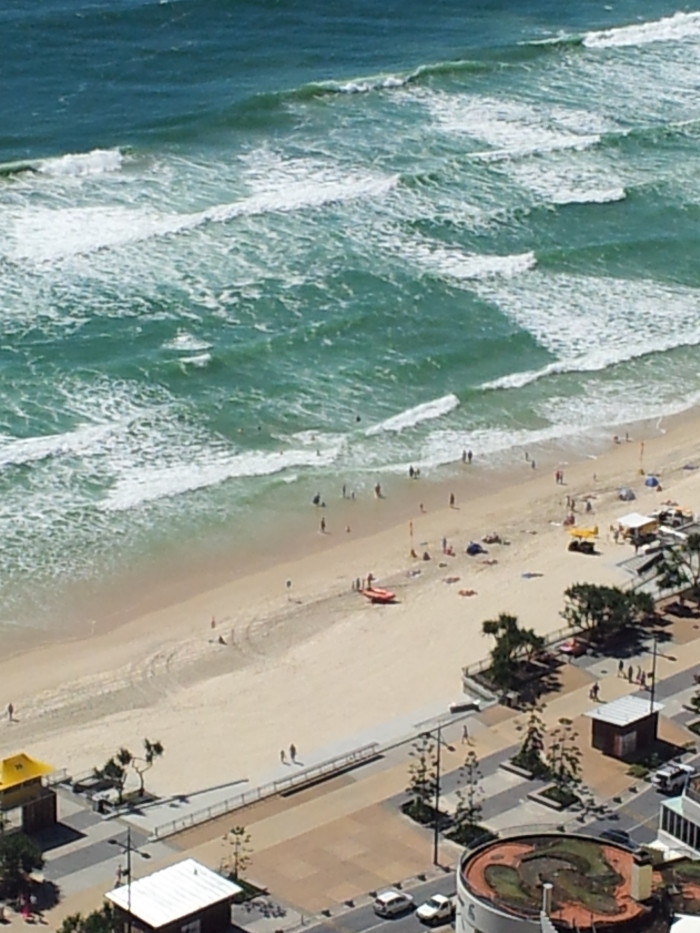
Below is one of the main beaches, where the typical sun, sand, and surf pretty well sums it up.  Been ion the water a few times myself, and it is amazing how warm it can be on some days, and how cold it can be on others.

And a surfer’s paradise it sure is!

2013-02-03 09.34.50

At the bottom, the start of the shopping centers and eateries.  The is more different types of food there that can be counted on the fingers and toes together.

2013-10-19 11.30.23

The beach just to the north, and where the market stalls set up at night.

2013-10-19 11.31.42

Further north, through the highrises, and far, far into the distance towards Brisbane.

2013-03-31 10.54.56

North, again, looking up Cavill Avenue.

2013-02-03 09.31.08

South, showing highrises and the Q Tower.

2013-10-19 11.44.04

South, taken from the Q Tower, the coastline to Coolangatta dotted with high rise apartment blocks.

2013-10-19 11.32.49

The two towers behind the Grand Chancellor, are the twin towers of the Hilton Hotel.

2013-10-19 11.52.33

From the Q Tower, looking towards the canal residential precinct.

2013-10-19 11.30.31

Yes, we were looking for whales, no we didn’t see any.  The ocean, though, was unusually calm.

A photograph from the inspirational bin – 20

20191216_175251

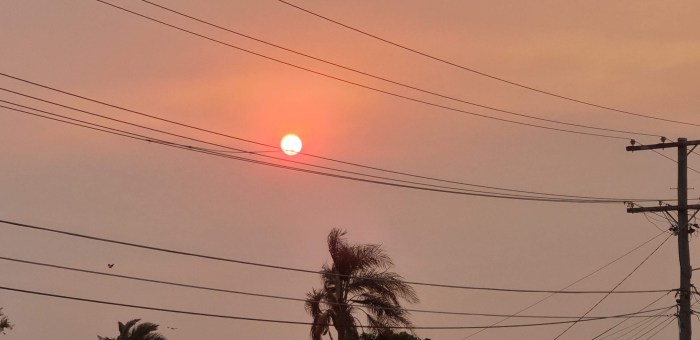
Suburbia, yes, reddish sky at night, yes, but what else might it be?

For just a moment, close your eyes, toss away everything you might accept as normal, and then, after a minute, open them again, and look at the photo with a new perspective.

Imagine…


It took two days for the dust to settle, figuratively and literally.

We heard screaming jet fighters overhead, followed by multiple explosions, then nothing but smoke and ash.  We assumed one of the jets had crashed.

Two days the media was saying it was an unfortunate accident.

On the third day, we discovered it was the result of multiple missile strikes on our power stations and oil refineries.  The jets had arrived too late to stop the attack.

And we only found out because an Army officer who lived in our street came home to collect his family and told us to leave, go anywhere but stay in the city.

The ash in the air was going to get worse, the sun was going to disappear altogether, and, well, he didn’t stay long enough to tell us the rest, but already the air was almost unbreathable.

But the leaving was easy, just take what we could in the car.  The problem was, everyone had the same idea, and by the time we reached the highway, it was a virtual carpark.

By then, it was day four.

That’s when the bombs started to fall.


It might not be an exact match for the photo, but that was the idea that came from it.

I’m sure there could be a far simpler and more pleasant story to be told.


I always wanted to see the planets – Episode 20

Just what do you talk to aliens about?

We were standing off the two ships, each about half the size of our ship.

I wondered briefly if the people on board were thinking the same as us.

What were the people like, friendly or hostile, what weapons the other had, and what technology?  We knew they could board us, by beaming in combatants, so I’d sent the third officer to organize the security team and other crew members to spread out through the ship and keep an eye out for boarders.

At the very least they knew we couldn’t send people over to their ships.

I walked over to the communications officer’s console where the communication expert sat, waiting.

“Can we broadcast a message so the other ship can hear us?”

“Assuming they understand any or all of the 32 languages we can convert any message to.”

And, if I read the crew briefing note on her correctly, she could speak fluently in every one of them.  Just, perhaps, not alien, but up till now, she didn’t have to.

“The last one I spoke to understood me just fine.”

“Very good.  Just speak when you are ready.  We’re transmitting now.”

I went back to stand in front of the Captain’s chair though I was not sure why.  I took a moment to consider what I should say, then proceeded with, “This is the commanding officer of the Earth space ship “Nautilus” hailing the two ships nearby.  We are following the vessel that kidnapped two of our crew members.  We have no quarrel with you, and this being the case, we will be proceeding with our pursuit forthwith.”

I put my hand up to indicate the message was done.

“Are systems online and ready to go?” I said in the direction of the helmsman who, like the rest of the crew, were looking at me.  Why I wasn’t sure.

The helmsman replied, “Ready when you are.”

I was going to give the alien ships five minutes, then leave.  They were either going to board us, or shoot at us, or maybe just let us go.

I looked at the military specialist.  “I assume we can retaliate if they start shooting at us?”

“It’s possible if they don’t hit any vital parts of the ship.”

It was a rather sardonic reply, or maybe that was her usual tone.  I didn’t get time to reflect on it.

“You might want to reconsider that plan, Earth ship Nautilus.”

It was an accented version of English, British perhaps, but very precise, and most likely the result of a translator.

“Who am I speaking to?”

“You may call me the commanding officer of my spaceship. 

“Are you with the people who kidnapped my crew members?”

There was silence, a period where I assumed they were considering a response.  Then, “I am not sure what you mean by with but were are of the same people, yes, but the one you speak of is not like us.  We have been seeking them as you appear to be, but for different reasons.”

“So why are here, impeding our progress, if you are not helping them?”

“We wanted to see who they have mistreated, and what they have done.  This is not the first time they have ventured into uncharted space.”

“Where have you come from?”

“Several thousands of what you call light-years away, in a system similar to yours, only each of the planets have a different people.  The people who have taken your crew come from one of the planets who are looking for weapons to fight a war they are losing.”

“Then I think you people are in a great deal of trouble.  They have also stolen a shipment of plutonium, which if they know what they’re doing, can be used to make bombs that can render a place unliveable for thousands of what we call years.  Believe me when I say it’s a very long time.”

“Nuclear bombs?”

“You’ve heard of them?”

“In a roundabout way.  You should know we are currently chasing the people who did this, and we are here to advise against you proceeding with your rescue mission.  The people you are chasing have a vastly superior ship, and weapons than you, as I suspect your ship is to you, a marvel, but to us, about a hundred of your earth years behind us.  We always believed your differences with your fellow humans would always hinder your space programs to the point where Mars would be the furthest you could travel.”

“You should realize we are out there on the very edge of our galaxy ready to find new ones.”

“That we cannot stop.  But I give you this warning, not everyone out there is ready to accept new people from other planets or systems.  And they are all more technologically advanced.”

Nothing surprising there.

“We’re still going out there, danger withstanding.”

“Be that on your head.  I suggest, however, that you do not follow those who have taken your crew members.  We will take care of them, and return your people in due course.”

“Thanks for the warning, but we do not abandon our people.”

“Then don’t say I didn’t warn you.”

Then, before our eyes, the two ships left, or that is to say, disappeared into a bright light that lasted a few seconds before the inky black returned.

“What just happened,” I said before I realized I’d said it out loud.

A voice from behind said, in reply, “I believe they disappeared into what might be described as a wormhole.”

© Charles Heath 2021

The cinema of my dreams – I always wanted to go on a treasure hunt – Episode 70

Here’s the thing…

Every time I close my eyes, I see something different.

I’d like to think the cinema of my dreams is playing a double feature but it’s a bit like a comedy cartoon night on Fox.

But these dreams are nothing to laugh about.

Once again there’s a new installment of an old feature, and we’re back on the treasure hunt.

The beach, and a body

I had expected to find the rocks we were slowly and carefully chambering over to be smooth, worn down by the constant washing over by the waves.

They were, to a certain extent, but there were places where the jagged edges were as sharp as a knife, and I had more than one cut on my hand.

Even with the stiff breeze coming in off the water, it was still hot, laborious work and it took over an hour to reach the first part of Sandy Beach, a thin strip below the rock line, and soaring behind it, a rocky cliff face that would required rock climb training to scale, and then notwithstanding a lot of safety gear.

It didn’t surprise me that Nadia was an expert rock climber.  She was built like a finely tuned cat, as lithe and graceful moving across the hazards.

At times she held my hand, keeping me from falling off, or worse, into danger, and certain injury.  At times, I didn’t want to let go.

Then on the windswept beach, she looked every bit the conqueror, hair blowing in the breeze, completely ignoring the conditions.  She belonged here, I didn’t.

The beach stretched for 200 yards or so and was, at times, up to 50 feet wide. Nothing had walked on this beach since the last tide, but more than likely, not for a long time because it was inaccessible from the shoreline unless you were a rock climber

But it was private land, and a fading sign, with Ormistons fading name at the bottom, told anyone who came ashore that trespassers would be prosecuted.

And, I thought. If they survived the reefs, at this tide semi-exposed and covered the whole of the distance.  No boat could get through. 

That also meant it was highly unlikely that the pirate had landed here, but we did a sweep with the metal detectors.  I had my hopes built up where my detector started making a lot of noise, but it was only a cupboard door with a metal hinge that had set it off, a bit of flotsam washed ashore.

We were both disappointed, then lamenting our luck or lack of it, we started heading towards the neck stretch of sand, barely discernable in the distance, but not before another hazardous trek across the rocks.

It took half an hour carefully picking our across the rocks before it was good to be on the sand again.  I helped her down from the rock perch and took a moment to rest.

“Did you see something further up the beach, just before you jumped?”

I had, but I thought it was the carcass of a beached fish. Perhaps a dolphin that had been savaged by sharks.  Or just a lump of kelp, of which some was scattered along the Highgate line.

“It might be just kelp.  Or more flotsam.  I’m sure we’ll soon find out.”

We also had to keep an eye on the tide, having started out just ashore or so before low tide, giving ourselves sufficient time to search and get back.

This part of the shoreline was longer, and closer to the edge of the property line, accessible only by climbing the rocks that jutted out into the sea, not exactly the easiest of tasks.  In fact, it served as a deterrent, and as far as Nadia was aware, no one had ever scaled that cliff face.

The object on the ground was no closer to being identified from a distance, but now, closer, it looked to me like it might be a body, my first thought, another of the Cossatino’s hit jobs, the shore being so remote it would never be discovered.

“That’s a body,” I heard the panic in her tone, right behind me.

We both dropped the detectors and ran, discovering as we came up to it, that we were both right.

It was covered from head to toe in black, including a balaclava covering the face.  It was impossible to tell what sex it was, lying front down with the head tilted to one side as if the ocean had washed it ashore.

The fact there were no tears in the clothing told me, I’d there were reefs out there, the body had not been washed ashore.  Just how did it get there.

These were all momentary thoughts because there was a more urgent thing to be done

“Help me roll it over,” I said.

She took the bottom half and I the top and gently lifted it just enough to turn it over onto the back, then I slowly pulled the balaclava off.

As soon as I saw the face, bruised and swollen, I knew who it was.

Nadia shrieked, then said, “What the hell is he doing here?”

The missing Boggs.

I could tell by the look on her face she was assuming her family had something to do with him being here.

But, all that aside, I tried not to panic, or let my surprise or shock take over, letting the medical training I’d received during a stint with the local fire station take over, first checking to see if he had a pulse.

It was faint, but there.  That meant we needed medical help. And fast.  I pulled my phone out and checked for a signal.  Then, with maps, got our location.  There was something familiar about the numbers, but their significance eluded me.  There were bigger problems to worry about.

Then I dialed 911, and when they answered, described the situation, gave them the location, and with a few other instructions to me from the dispatcher, I went back to Boggs.

By this time Nadia was beside him, wiping his face gently with tissues she must have had in her pocket.  I tried not to give her the impression I blamed her family for his situation, simply because that might not be the case.

The last time I saw him he had a rope and his mother had said he was an experienced climber.  And with his proximity to the cliff face, it wasn’t hard to put two and two together.

I checked his pulse again and listened closely to his breathing, shallow with a slight rattle.  I unzipped his jacket and lifted his shirt, and could see the discoloration from bruising.  It was possible he slipped, or lost his footing, and crashed against an outcrop, knocking himself out, or falling to the ground with the same effect.  A closer inspection showed the bare minimum of climbing equipment set up, and now, looking closer at the cliff face, I could see the rope dangling, but stopping short by about 20 feet.

Nadia didn’t speak, but I could see she was scared.

I touched her on the shoulder and she jumped.

“It’s not your fault,” I said.

“But it could be…”

“I don’t think so.  He looks like he tried coming down the side of the cliff and slipped or fell.  I think he may have collapsed here, but the tide has removed any foot or drag marks so it’s hard to tell what happened.”

“Why not go the way we did?”

“He might not know about it or considered it too far.  Or the climbing fanatic in him took over.  I have to say, I never knew he was a climber, in fact, there’s probably a lot I don’t know.  Maybe if I’d spent more time with him this mightn’t have happened.”

While waiting I called Boggs mother and relayed what had happened, where he’d been taken and the prognosis, which was good.  He was in no danger of dying, though had he not been found, that would have been a different story.  Then I called the sheriff’s office to let them know, but he had already had the news passed on, and I said I would drip in and answer any questions they might have.  I guess Boggs might have to explain why he was trespassing. 

Not long after that, I turned to look back towards the way we’d just come in response to the sound of a helicopter.  If it was, that was a remarkably quick response time.  When it came closer I could see it was one of the Coast Guards’ distinctive red Sikorski’s, which was surprising.

The helicopter veered inland and the sound of the approach was somewhat muffled.  I had thought they might come on on a sea approach, but then it occurred to me it might be an opportunity to fly over the Cossatino kingdom, having a legitimate excuse to do so.  Then it crossed the cliff line with a roar, and hovered while the pilot assessed a landing spot.

I could see several people at the side door making preparations as the pilot brought it down, gently landing on the sand.  As soon as it touched down two men jumped out, one, I assumed, a medic.

“You were quick.”

It had been less than a half-hour since I called.

“We just wrapped up at another accident.  What do we have here?”

I went through all the things I’d done and ended by showing him the chest bruising.

His was a more thorough check and confirmed what I’d discovered, no broken bones, possible cracked ribs, or sprains to both ankles, indicating he had fallen a short distance.

A stretcher was brought over, and they carefully put Boggs on it, then took him to the helicopter, the whole operation taking no more than ten minutes.  I declined the offer of going back with him, there being space only for one other passenger.  He gave me the name of the hospital they would be taking him to, and I watched the helicopter leave.

The whole time Nadia had kept her distance, and, I’d noticed, glanced up the cliff.  Did she think the arrival of a helicopter on their beach would summon a posse of Cossatinos?  That thought had also occurred to me, especially where there were signs, now somewhat faded, that said trespassers would be shot on sight.

I looked too.

And saw something I had not expected to see.

© Charles Heath 2020-2022

“What Sets Us Apart”, a mystery with a twist

David is a man troubled by a past he is trying to forget.

Susan is rebelling against a life of privilege and an exasperated mother who holds a secret that will determine her daughter’s destiny.

They are two people brought together by chance. Or was it?

When Susan discovers her mother’s secret, she goes in search of the truth that has been hidden from her since the day she was born.

When David realizes her absence is more than the usual cooling off after another heated argument, he finds himself being slowly drawn back into his former world of deceit and lies.

Then, back with his former employers, David quickly discovers nothing is what it seems as he embarks on a dangerous mission to find Susan before he loses her forever.

http://amzn.to/2Eryfth

whatsetscover

Writing about writing a book – Day 5 continues – Those annoying people called characters

Whilst it is always an idea to sit down and write and keep going, not worrying too much about the narrative, there’s always the problem of ideas about characters, and relationships that come back and need to be addressed.

I have issues with Jennifer in that we will need to know something about her, and need a little backstory.

Jennifer is the second most important character in this novel and one that has more talents than what my main character, or anyone else for that matter, thinks she has.  Of course, that is deliberate on her part for a number of reasons that will be introduced at the appropriate time.

But, at the start, all we will have to work with, is the introduction provided by the narrator.

It may go something like this:


Jennifer Pennington Smythe was, as you might expect, very English, very reserved, and very private.  She was the definitive ‘don’t judge a book by its cover’, and I was guilty, at first, of suspecting she had once been a schoolmistress due to the severity of dress, demeanor, and expression.

HR had sent her to me when I’d requested an IT Specialist, though of what particular discipline it was never divulged, neither by HR nor by her.  She arrived one morning, told me she was to ‘help resolve our technical difficulties’, moved into an office that had been used as a storeroom, and worked hard to prove her worthiness in the role.

My first attempt at conversation was rebuffed, the second met with a very cold stare.  Everyone, including me, learned very quickly that any other topic of conversation than work would be ignored.  At the time it suited me, there was trouble in paradise and I didn’t want anything more on my plate to deal with.


So, what is this trouble?

There are three distinct stages of this relationship between the two most important characters, and it is the actions of one of the protagonists that brings them together.  This particular protagonist, of course, is the main character’s wife, a woman that is on the periphery for the period the novel covers, but a little background will be needed at some point before we reach this part of the narrative.

This now means that I will have to put together a back story for Bill and his ex-wife Ellen, not too much yet but enough to explain the next part of the evolving relationship between Bill and Jennifer.


I’m sure this topic is going to raise it’s head again and again…

An excerpt from “One Last Look”: Charlotte is no ordinary girl

This is currently available at Amazon herehttp://amzn.to/2CqUBcz


I’d read about out of body experiences, and like everyone else, thought it was nonsense.  Some people claimed to see themselves in the operating theatre, medical staff frantically trying to revive them, and being surrounded by white light.

I was definitely looking down, but it wasn’t me I was looking at.

It was two children, a boy and a girl, with their parents, in a park.

The boy was Alan.  He was about six or seven.  The girl was Louise, and she was five years old.  She had long red hair and looked the image of her mother.

I remember it now, it was Louise’s birthday and we went down to Bournemouth to visit our Grandmother, and it was the last time we were all together as a family.

We were flying homemade kites our father had made for us, and after we lay there looking up at the sky, making animals out of the clouds.  I saw an elephant, Louise saw a giraffe.

We were so happy then.

Before the tragedy.


When I looked again ten years had passed and we were living in hell.  Louise and I had become very adept at survival in a world we really didn’t understand, surrounded by people who wanted to crush our souls.

It was not a life a normal child had, our foster parents never quite the sort of people who were adequately equipped for two broken-hearted children.  They tried their best, but their best was not good enough.

Every day it was a battle, to avoid the Bannister’s and Archie in particular, every day he made advances towards Louise and every day she fended him off.

Until one day she couldn’t.

Now I was sitting in the hospital, holding Louise’s hand.  She was in a coma, and the doctors didn’t think she would wake from it.  The damage done to her was too severe.

The doctors were wrong.

She woke, briefly, to name her five assailants.  It was enough to have them arrested.  It was not enough to have them convicted.

Justice would have to be served by other means.


I was outside the Bannister’s home.

I’d made my way there without really thinking, after watching Louise die.  It was like being on autopilot, and I had no control over what I was doing.  I had murder in mind.  It was why I was holding an iron bar.

Skulking in the shadows.  It was not very different from the way the Bannister’s operated.

I waited till Archie came out.  I knew he eventually would.  The police had taken him to the station for questioning, and then let him go.  I didn’t understand why, nor did I care.

I followed him up the towpath, waiting till he stopped to light a cigarette, then came out of the shadows.

“Wotcha got there Alan?” he asked when he saw me.  He knew what it was, and what it was for.

It was the first time I’d seen the fear in his eyes.  He was alone.

“Justice.”

“For that slut of a sister of yours.  I had nuffing to do with it.”

“She said otherwise, Archie.”

“She never said nuffing, you just made it up.”  An attempt at bluster, but there was no confidence in his voice.

I held up the pipe.  It had blood on it.  Willy’s blood.  “She may or may not have Archie, but Willy didn’t make it up.  He sang like a bird.  That’s his blood, probably brains on the pipe too, Archie, and yours will be there soon enough.”

“He dunnit, not me.  Lyin’ bastard would say anything to save his own skin.”  Definitely scared now, he was looking to run away.

“No, Archie.  He didn’t.  I’m coming for you.  All of you Bannisters.  And everyone who touched my sister.”


It was the recurring nightmare I had for years afterwards.

I closed my eyes and tried to shut out the thoughts, the images of Louise, the phone call, the visit to the hospital and being there when she succumbed to her injuries.  Those were the very worst few hours of my life.

She had asked me to come to the railway station and walk home with her, and I was running late.  If I had left when I was supposed to, it would never have happened and for years afterwards, I blamed myself for her death.

If only I’d not been late…

When the police finally caught the rapists, I’d known all along who they’d be; antagonists from school, the ring leader, Archie Bannister, a spurned boyfriend, a boy whose parents, ubiquitously known to all as ‘the Bannister’s, dealt in violence and crime and who owned the neighbourhood.  The sins of the father had been very definitely passed onto the son.

At school, I used to be the whipping boy, Archie, a few grades ahead of me, made a point of belting me and a few of the other boys, to make sure the rest did as they were told.  He liked Louise, but she had no time for a bully like him, even when he promised he would ‘protect’ me.

I knew the gang members, the boys who tow-kowed to save getting beaten up, and after the police couldn’t get enough information to prosecute them because everyone was too afraid to speak out, I went after Willy.  There was always a weak link in a group, and he was it.

He worked in a factory, did long hours on a Wednesday and came home after dark alone.  It was a half mile walk, through a park.  The night I approached him, I smashed the lights and left it in darkness.  He nearly changed his mind and went the long way home.

He didn’t.

It took an hour and a half to get the names.  At first, when he saw me, he laughed.  He said I would be next, and that was four words more than he knew he should have said.

When I found him alone the next morning I showed him the iron bar and told him he was on the list.  I didn’t kill him then, he could wait his turn, and worry about what was going to happen to him.

When the police came to visit me shortly after that encounter, no doubt at the behest of the Bannister’s, the neighbourhood closed ranks and gave me an ironclad alibi.  The Bannister’s then came to visit me and threatened me.  I told them their days were numbered and showed them the door.

At the trial, he and his friends got off on a technicality.  The police had failed to do their job properly, but it was not the police, but a single policeman, corrupted by the Bannisters.

Archie could help but rub it in my face.  He was invincible.

Joe Collins took 12 bullets and six hours to bleed out.  He apologized, he pleaded, he cried, he begged.  I didn’t care.

Barry Mills, a strong lad with a mind to hurting people, Archie’s enforcer, almost got the better of me.  I had to hit him more times than I wanted to, and in the end, I had to be satisfied that he died a short but agonizing death.

I revisited Willy in the hospital.  He’d recovered enough to recognize me, and why I’d come.  Suffocation was too good for him.

David Williams, second in command of the gang, was as tough and nasty as the Bannisters.  His family were forging a partnership with the Bannister’s to make them even more powerful.  Outwardly David was a pleasant sort of chap, affable, polite, and well mannered.  A lot of people didn’t believe he could be like, or working with, the Bannisters.

He and I met in the pub.  We got along like old friends.  He said Willy had just named anyone he could think of, and that he was innocent of any charges.  We shook hands and parted as friends.

Three hours later he was sitting in a chair in the middle of a disused factory, blindfolded and scared.  I sat and watched him, listened to him, first threatening me, and then finally pleading with me.  He’d guessed who it was that had kidnapped him.

When it was dark, I took the blindfold off and shone a very bright light in his eyes.  I asked him if the violence he had visited upon my sister was worth it.  He told me he was just a spectator.

I’d read the coroner’s report.  They all had a turn.  He was a liar.

He took nineteen bullets to die.

Then came Archie.

The same factory only this time there were four seats.  Anna Bannister, brothel owner, Spike Bannister, head of the family, Emily Bannister, sister, and who had nothing to do with their criminal activities.  She just had the misfortune of sharing their name.

Archie’s father told me how he was going to destroy me, and everyone I knew.

A well-placed bullet between the eyes shut him up.

Archie’s mother cursed me.  I let her suffer for an hour before I put her out of her misery.

Archie remained stony-faced until I came to Emily.  The death of his parents meant he would become head of the family.  I guess their deaths meant as little to him as they did me.

He was a little more worried about his sister.

I told him it was confession time.

He told her it was little more than a forced confession and he had done nothing to deserve my retribution.

I shrugged and shot her, and we both watched her fall to the ground screaming in agony.  I told him if he wanted her to live, he had to genuinely confess to his crimes.  This time he did, it all poured out of him.

I went over to Emily.  He watched in horror as I untied her bindings and pulled her up off the floor, suffering only from a small wound in her arm.  Without saying a word she took the gun and walked over to stand behind him.

“Louise was my friend, Archie.  My friend.”

Then she shot him.  Six times.

To me, after saying what looked like a prayer, she said, “Killing them all will not bring her back, Alan, and I doubt she would approve of any of this.  May God have mercy on your soul.”


Now I was in jail.  I’d spent three hours detailing the deaths of the five boys, everything I’d done; a full confession.  Without my sister, my life was nothing.  I didn’t want to go back to the foster parents; I doubt they’d take back a murderer.

They were not allowed to.

For a month I lived in a small cell, in solitary, no visitors.  I believed I was in the queue to be executed, and I had mentally prepared myself for the end.

Then I was told I had a visitor, and I was expecting a priest.

Instead, it was a man called McTavish. Short, wiry, and with an accent that I could barely understand.

“You’ve been a bad boy, Alan.”

When I saw it was not the priest I told the jailers not to let him in, I didn’t want to speak to anyone.  They ignored me.  I’d expected he was a psychiatrist, come to see whether I should be shipped off to the asylum.

I was beginning to think I was going mad.

I ignored him.

“I am the difference between you living or dying Alan, it’s as simple as that.  You’d be a wise man to listen to what I have to offer.”

Death sounded good.  I told him to go away.

He didn’t.  Persistent bugger.

I was handcuffed to the table.  The prison officers thought I was dangerous.  Five, plus two, murders, I guess they had a right to think that.  McTavish sat opposite me, ignoring my request to leave.

“Why’d you do it?”

“You know why.”  Maybe if I spoke he’d go away.

“Your sister.  By all accounts, the scum that did for her deserved what they got.”

“It was murder just the same.  No difference between scum and proper people.”

“You like killing?”

“No-one does.”

“No, I dare say you’re right.  But you’re different, Alan.  As clean and merciless killing I’ve ever seen.  We can use a man like you.”

“We?”

“A group of individuals who clean up the scum.”

I looked up to see his expression, one of benevolence, totally out of character for a man like him.  It looked like I didn’t have a choice.


Trained, cleared, and ready to go.

I hadn’t realized there were so many people who were, for all intents and purposes, invisible.  People that came and went, in malls, in hotels, trains, buses, airports, everywhere, people no one gave a second glance.

People like me.

In a mall, I became a shopper.

In a hotel, I was just another guest heading to his room.

On a bus or a train, I was just another commuter.

At the airport, I became a pilot.  I didn’t need to know how to fly; everyone just accepted a pilot in a pilot suit was just what he looked like.

I had a passkey.

I had the correct documents to get me onto the plane.

That walk down the air bridge was the longest of my life.  Waiting for the call from the gate, waiting for one of the air bridge staff to challenge me, stepping onto the plane.

Two pilots and a steward.  A team.  On the plane early before the rest of the crew.  A group that was committing a crime, had committed a number of crimes and thought they’d got away with it.

Until the judge, the jury and their executioner arrived.

Me.

Quick, clean, merciless.  Done.

I was now an operational field agent.


I was older now, and I could see in the mirror I was starting to go grey at the sides.  It was far too early in my life for this, but I expect it had something to do with my employment.

I didn’t recognize the man who looked back at me.

It was certainly not Alan McKenzie, nor was there any part of that fifteen-year-old who had made the decision to exact revenge.

Given a choice; I would not have gone down this path.

Or so I kept telling myself each time a little more of my soul was sold to the devil.

I was Barry Gamble.

I was Lenny Buckman.

I was Jimmy Hosen.

I was anyone but the person I wanted to be.

That’s what I told Louise, standing in front of her grave, and trying to apologize for all the harm, all the people I’d killed for that one rash decision.  If she was still alive she would be horrified, and ashamed.

Head bowed, tears streamed down my face.

God had gone on holiday and wasn’t there to hand out any forgiveness.  Not that day.  Not any day.


New York, New Years Eve.

I was at the end of a long tour, dragged out of a holiday and back into the fray, chasing down another scumbag.  They were scumbags, and I’d become an automaton hunting them down and dispatching them to what McTavish called a better place.

This time I failed.

A few drinks to blot out the failure, a blonde woman who pushed my buttons, a room in a hotel, any hotel, it was like being on the merry-go-round, round and round and round…

Her name was Silvia or Sandra, or someone I’d met before, but couldn’t quite place her.  It could be an enemy agent for all I knew or all I cared right then.

I was done.

I’d had enough.

I gave her the gun.

I begged her to kill me.

She didn’t.

Instead, I simply cried, letting the pent up emotion loose after being suppressed for so long, and she stayed with me, holding me close, and saying I was safe, that she knew exactly how I felt.

How could she?  No one could know what I’d been through.

I remembered her name after she had gone.

Amanda.

I remembered she had an imperfection in her right eye.

Someone else had the same imperfection.

I couldn’t remember who that was.

Not then.


I had a dingy flat in Kensington, a place that I rarely stayed in if I could help it.  After five-star hotel rooms, it made me feel shabby.

The end of another mission, I was on my way home, the underground, a bus, and then a walk.

It was late.

People were spilling out of the pub after the last drinks.  Most in good spirits, others slightly more boisterous.

A loud-mouthed chap bumped into me, the sort who had one too many, and was ready to take on all comers.

He turned on me, “Watch where you’re going, you fool.”

Two of his friends dragged him away.  He shrugged them off, squared up.

I punched him hard, in the stomach, and he fell backwards onto the ground.  I looked at his two friends.  “Take him home before someone makes mincemeat out of him.”

They grabbed his arms, lifted him off the ground and took him away.

Out of the corner of my eye, I could see a woman, early thirties, quite attractive, but very, very drunk.  She staggered from the bar, bumped into me, and finished up sitting on the side of the road.

I looked around to see where her friends were.  The exodus from the pub was over and the few nearby were leaving to go home.

She was alone, drunk, and by the look of her, unable to move.

I sat beside her.  “Where are your friends?”

“Dunno.”

“You need help?”

She looked up, and sideways at me.  She didn’t look the sort who would get in this state.  Or maybe she was, I was a terrible judge of women.

“Who are you?” she asked.

“Nobody.”  I was exactly how I felt.

“Well Mr Nobody, I’m drunk, and I don’t care.  Just leave me here to rot.”

She put her head back between her knees, and it looked to me she was trying to stop the spinning sensation in her head.

Been there before, and it’s not a good feeling.

“Where are your friends?” I asked again.

“Got none.”

“Perhaps I should take you home.”

“I have no home.”

“You don’t look like a homeless person.  If I’m not mistaken, those shoes are worth more than my weekly salary.”  I’d seen them advertised, in the airline magazine, don’t ask me why the ad caught my attention.

She lifted her head and looked at me again.  “You a smart fucking arse are you?”

“I have my moments.”

“Have them somewhere else.”

She rested her head against my shoulder.  We were the only two left in the street, and suddenly in darkness when the proprietor turned off the outside lights.

“Take me home,” she said suddenly.

“Where is your place?”

“Don’t have one.  Take me to your place.”

“You won’t like it.”

“I’m drunk.  What’s not to like until tomorrow.”

I helped her to her feet.  “You have a name?”

“Charlotte.”


The wedding was in a small church.  We had been away for a weekend in the country, somewhere in the Cotswolds, and found this idyllic spot.  Graves going back to the dawn of time, a beautiful garden tended by the vicar and his wife, an astonishing vista over hills and down dales.

On a spring afternoon with the sun, the flowers, and the peacefulness of the country.

I had two people at the wedding, the best man, Bradley, and my boss, Watkins.

Charlotte had her sisters Melissa and Isobel, and Isobel’s husband Giovanni, and their daughter Felicity.

And one more person who was as mysterious as she was attractive, a rather interesting combination as she was well over retirement age.  She arrived late and left early.

Aunt Agatha.

She looked me up and down with what I’d call a withering look.  “There’s more to you than meets the eye,” she said enigmatically.

“Likewise I’m sure,” I said.  It earned me an elbow in the ribs from Charlotte.  It was clear she feared this woman.

“Why did you come,” Charlotte asked.

“You know why.”

Agatha looked at me.  “I like you.  Take care of my granddaughter.  You do not want me for an enemy.”

OK, now she officially scared me.

She thrust a cheque into my hand, smiled, and left.

“Who is she,” I asked after we watched her depart.

“Certainly not my fairy godmother.”

Charlotte never mentioned her again.


Zurich in summer, not exactly my favourite place.

Instead of going to visit her sister Isobel, we stayed at a hotel in Beethovenstrasse and Isobel and Felicity came to us.  Her husband was not with her this time.

Felicity was three or four and looked very much like her mother.  She also looked very much like Charlotte, and I’d remarked on it once before and it received a sharp rebuke.

We’d been twice before, and rather than talk to her sister, Charlotte spent her time with Felicity, and they were, together, like old friends.  For so few visits they had a remarkable rapport.

I had not broached the subject of children with Charlotte, not after one such discussion where she had said she had no desire to be a mother.  It had not been a subject before and wasn’t once since.

Perhaps like all Aunts, she liked the idea of playing with a child for a while and then give it back.

Felicity was curious as to who I was, but never ventured too close.  I believed a child could sense the evil in adults and had seen through my facade of friendliness.  We were never close.

But…

This time, when observing the two together, something quite out of left field popped into my head.  It was not possible, not by any stretch of the imagination, but I thought she looked like my mother.

And Charlotte had seen me looking in their direction.  “You seem distracted,” she said.

“I was just remembering my mother.  Odd moment, haven’t done so for a very long time.”

“Why now?”  I think she had a look of concern on her face.

“Her birthday, I guess,” I said, the first excuse I could think of.

Another look and I was wrong.  She looked like Isobel or Charlotte, or if I wanted to believe it possible, Melissa too.


I was crying, tears streaming down my face.

I was in pain, searing pain from my lower back stretching down into my legs, and I was barely able to breathe.

It was like coming up for air.

It was like Snow White bringing Prince Charming back to life.  I could feel what I thought was a gentle kiss and tears dropping on my cheeks, and when I opened my eyes, I saw Charlotte slowly lifting her head, a hand gently stroking the hair off my forehead.

And in a very soft voice, she said, “Hi.”

I could not speak, but I think I smiled.  It was the girl with the imperfection in her right eye.  Everything fell into place, and I knew, in that instant that we were irrevocably meant to be together.

“Welcome back.”


© Charles Heath 2016-2019

onelastlookcoverfinal2