An excerpt from “The Devil You Don’t”

Available on Amazon Kindle here:  https://amzn.to/2Xyh1ow


By the time I returned to the Savoie, the rain had finally stopped, and there was a streak of blue sky to offer some hope the day would improve.

The ship was not crowded, the possibility of bad weather perhaps holding back potential passengers.  Of those I saw, a number of them would be aboard for the lunch by Phillippe Chevrier.  I thought about it, but the Concierge had told me about several restaurants in Yvoire and had given me a hand-drawn map of the village.  I think he came from the area because he spoke with the pride and knowledge of a resident.

I was looking down from the upper deck observing the last of the boarding passengers when I saw a woman, notable for her red coat and matching shoes, making a last-minute dash to get on board just before the gangway was removed.  In fact, her ungainly manner of boarding had also captured a few of the other passenger’s attention.  Now they would have something else to talk about, other than the possibility of further rain.

I saw her smile at the deckhand, but he did not smile back.  He was not impressed with her bravado, perhaps because of possible injury.  He looked at her ticket then nodded dismissively, and went back to his duties in getting the ship underway.  I was going to check the departure time, but I, like the other passengers, had my attention diverted to the woman in red.

From what I could see there was something about her.  It struck me when the light caught her as she turned to look down the deck, giving me a perfect profile.  I was going to say she looked foreign, but here, as in almost anywhere in Europe, that described just about everyone.  Perhaps I was just comparing her to Phillipa, so definitively British, whereas this woman was very definitely not.

She was perhaps in her 30’s, slim or perhaps the word I’d use was lissom, and had the look and manner of a model.  I say that because Phillipa had dragged me to most of the showings, whether in Milan, Rome, New York, London, or Paris.  The clothes were familiar, and in the back of my mind, I had a feeling I’d seen her before.

Or perhaps, to me, all models looked the same.

She looked up in my direction, and before I could divert my eyes, she locked on.  I could feel her gaze boring into me, and then it was gone as if she had been looking straight through me.  I remained out on deck as the ship got underway, watching her disappear inside the cabin.  My curiosity was piqued, so I decided to keep an eye out for her.

I could feel the coolness of the air as the ship picked up speed, not that it was going to be very fast.  With stops, the trip would take nearly two hours to get to my destination.  It would turn back almost immediately, but I was going to stay until the evening when it returned at about half eight.  It would give me enough time to sample the local fare, and take a tour of the medieval village.

Few other passengers ventured out on the deck, most staying inside or going to lunch.  After a short time, I came back down to the main deck and headed forward.  I wanted to clear my head by concentrating on the movement of the vessel through the water, breathing in the crisp, clean air, and let the peacefulness of the surroundings envelope me.

It didn’t work.

I knew it wouldn’t be long before I started thinking about why things hadn’t worked, and what part I played in it.  And the usual question that came to mind when something didn’t work out.  What was wrong with me?

I usually blamed it on my upbringing.

I had one of those so-called privileged lives, a nanny till I was old enough to go to boarding school, then sent to the best schools in the land.  There I learned everything I needed to be the son of a Duke, or, as my father called it in one of his lighter moments, nobility in waiting.

Had this been five or six hundred years ago, I would need to have sword and jousting skills, or if it had been a few hundred years later a keen military mind.  If nothing else I could ride a horse, and go on hunts, or did until they became not the thing to do.

I learned six languages, and everything I needed to become a diplomat in the far-flung British Empire, except the Empire had become the Commonwealth, and then, when no-one was looking, Britain’s influence in the world finally disappeared.  I was a man without a cause, without a vocation, and no place to go.

Computers were the new vogue and I had an aptitude for programming.  I guess that went hand in hand with mathematics, which although I hated the subject, I excelled in.  Both I and another noble outcast used to toss ideas around in school, but when it came to the end of our education, he chose to enter the public service, and I took a few of those ideas we had mulled over and turned them into a company.

About a year ago, I was made an offer I couldn’t refuse.  There were so many zeroes on the end of it I just said yes, put the money into a very grateful bank, and was still trying to come to terms with it.

Sadly, I still had no idea what I was going to do with the rest of my life.  My parents had asked me to come back home and help manage the estate, and I did for a few weeks.  It was as long as it took for my parents to drive me insane.

Back in the city, I spent a few months looking for a mundane job, but there were very few that suited the qualifications I had, and the rest, I think I intimidated the interviewer simply because of who I was.  In that time I’d also featured on the cover of the Economist, and through my well-meaning accountant, started involving myself with various charities, earning the title ‘philanthropist’.

And despite all of this exposure, even making one of those ubiquitous ‘eligible bachelor’ lists, I still could not find ‘the one’, the woman I wanted to spend the rest of my life with.  Phillipa seemed to fit the bill, but in time she proved to be a troubled soul with ‘Daddy’ issues.  I knew that in building a relationship compromise was necessary, but with her, in the end, everything was a compromise and what had happened was always going to be the end result.

It was perhaps a by-product of the whole nobility thing.  There was a certain expectation I had to fulfill, to my peers, contemporaries, parents and family, and those who either liked or hated what it represented.  The problem was, I didn’t feel like I belonged.  Not like my friend from schooldays, and now obscure acquaintance, Sebastian.  He had been elevated to his Dukedom early when his father died when he was in his twenties.  He had managed to fade from the limelight and was rarely mentioned either in the papers or the gossip columns.  He was one of the lucky ones.

I had managed to keep a similarly low profile until I met Phillipa.  From that moment, my obscurity disappeared.  It was, I could see now, part of a plan put in place by Phillipa’s father, a man who hogged the limelight with his daughter, to raise the profile of the family name and through it their businesses.  He was nothing if not the consummate self-advertisement.

Perhaps I was supposed to be the last piece of the puzzle, the attachment to the establishment, that link with a class of people he would not normally get in the front door.  There was nothing refined about him or his family, and more than once I’d noticed my contemporaries cringe at the mention of his name, or any reference of my association with him.

Yet could I truthfully say I really wanted to go back to the obscurity I had before Phillipa?  For all her faults, there were times when she had been fun to be with, particularly when I first met her when she had a certain air of unpredictability.  That had slowly disappeared as she became part of her father’s plan for the future.  She just failed to see how much he was using her.

Or perhaps, over time, I had become cynical.

I thought about calling her.  It was one of those moments of weakness when I felt alone, more alone than usual.

I diverted my attention back to my surroundings and the shoreline.  Out of the corner of my eye, I could see the woman in the red coat, making a move.  The red coat was like a beacon, a sort of fire engine red.  It was not the sort of coat most of the women I knew would wear, but on her, it looked terrific.  In fact, her sublime beauty was the one other attribute that was distinctly noticeable, along with the fact her hair was short, rather than long, and jet black.

I had to wrench my attention away from her.

A few minutes later several other passengers came out of the cabin for a walk around the deck, perhaps to get some exercise, perhaps checking up on me, or perhaps I was being paranoid.  I waited till they passed on their way forward, and I turned and headed aft.

I watched the wake sluicing out from under the stern for a few minutes, before retracing my steps to the front of the ship and there I stood against the railing, watching the bow carve its way through the water.  It was almost mesmerizing.  There, I emptied my mind of thoughts about Phillipa, and thoughts about the woman in the red coat.

Until a female voice behind me said, “Having a bad day?”

I started, caught by surprise, and slowly turned.  The woman in the red coat had somehow got very close me without my realizing it.  How did she do that?  I was so surprised I couldn’t answer immediately.

“I do hope you are not contemplating jumping.  I hear the water is very cold.”

Closer up, I could see what I’d missed when I saw her on the main deck.  There was a slight hint of Chinese, or Oriental, in her particularly around the eyes, and of her hair which was jet black.  An ancestor twice or more removed had left their mark, not in a dominant way, but more subtle, and easily missed except from a very short distance away, like now.

Other than that, she was quite possibly Eastern European, perhaps Russian, though that covered a lot of territory.  The incongruity of it was that she spoke with an American accent, and fluent enough for me to believe English was her first language.

Usually, I could ‘read’ people, but she was a clean slate.  Her expression was one of amusement, but with cold eyes.  My first thought, then, was to be careful.

“No.  Not yet.”  I coughed to clear my throat because I could hardly speak.  And blushed, because that was what I did when confronted by a woman, beautiful or otherwise.

The amusement gave way to a hint of a smile that brightened her demeanor as a little warmth reached her eyes.  “So that’s a maybe.  Should I change into my lifesaving gear, just in case?”

It conjured up a rather interesting image in my mind until I reluctantly dismissed it.

“Perhaps I should move away from the edge,” I said, moving sideways until I was back on the main deck, a few feet further away.  Her eyes had followed me, and when I stopped she turned to face me again.  She did not move closer.

I realized then she had removed her beret and it was in her left side coat pocket.  “Thanks for your concern …?”

“Zoe.”

“Thanks for your concern, Zoe.  By the way, my name is John.”

She smiled again, perhaps in an attempt to put me at ease.  “I saw you earlier, you looked so sad, I thought …”

“I might throw myself overboard?”

“An idiotic notion I admit, but it is better to be safe than sorry.”

Then she tilted her head to one side then the other, looking intently at me.  “You seem to be familiar.  Do I know you?”

I tried to think of where I may have seen her before, but all I could remember was what I’d thought earlier when I first saw her; she was a model and had been at one of the showings.  If she was, it would be more likely she would remember Phillipa, not me.  Phillipa always had to sit in the front row.

“Probably not.”  I also didn’t mention the fact she may have seen my picture in the society pages of several tabloid newspapers because she didn’t look the sort of woman who needed a daily dose of the comings and goings, and, more often than not, scandal associated with so-called celebrities.

She gave me a look, one that told me she had just realized who I was.  “Yes, I remember now.  You made the front cover of the Economist.  You sold your company for a small fortune.”

Of course.  She was not the first who had recognized me from that cover.  It had raised my profile considerably, but not the Sternhaven’s.  That article had not mentioned Phillipa or her family.  I suspect Grandmother had something to do with that, and it was, now I thought about it, another nail in the coffin that was my relationship with Phillipa.

“I wouldn’t say it was a fortune, small or otherwise, just fortunate.”  Each time, I found myself playing down the wealth aspect of the business deal.

“Perhaps then, as the journalist wrote, you were lucky.  It is not, I think, a good time for internet-based companies.”

The latter statement was an interesting fact, one she read in the Financial Times which had made that exact comment recently.

“But I am boring you.”  She smiled again.  “I should be minding my own business and leaving you to your thoughts.  I am sorry.”

She turned to leave and took a few steps towards the main cabin.

“You’re not boring me,” I said, thinking I was letting my paranoia get the better of me.  It had been Sebastian on learning of my good fortune, who had warned me against ‘a certain element here and abroad’ whose sole aim would be to separate me from my money.  He was not very subtle when he described their methods.

But I knew he was right.  I should have let her walk away.

She stopped and turned around.  “You seem nothing like the man I read about in the Economist.”

A sudden and awful thought popped into my head.  Those words were part of a very familiar opening gambit.  “Are you a reporter?”

I was not sure if she looked surprised, or amused.  “Do I look like one?”

I silently cursed myself for speaking before thinking, and then immediately ignored my own admonishment.  “People rarely look like what they are.”

I saw the subtle shake of the head and expected her to take her leave.  Instead she astonished me.

“I fear we have got off on the wrong foot.  To be honest, I’m not usually this forward, but you seemed like you needed cheering up when probably the opposite is true.  Aside from the fact this excursion was probably a bad idea.  And,” she added with a little shrug, “perhaps I talk too much.”

I was not sure what I thought of her after that extraordinary admission. It was not something I would do, but it was an interesting way to approach someone and have them ignoring their natural instinct.  I would let Sebastian whisper in my ear for a little longer and see where this was going.

“Oddly enough, I was thinking the same thing.  I was supposed to be traveling with my prospective bride.  I think you can imagine how that turned out.”

“She’s not here?”

“No.”

“She’s in the cabin?”  Her eyes strayed in that direction for a moment then came back to me.  She seemed surprised I might be traveling with someone.

“No.  She is back in England, and the wedding is off.  So is the relationship.  She dumped me by text.”

OK, why was I sharing this humiliating piece of information with her?  I still couldn’t be sure she was not a reporter.

She motioned to an empty seat, back from the edge.  No walking the plank today.  She moved towards it and sat down.  She showed no signs of being cold, nor interested in the breeze upsetting her hair.  Phillipa would be having a tantrum about now, being kept outside, and freaking out over what the breeze might be doing to her appearance.

I wondered, if only for a few seconds if she used this approach with anyone else.  I guess I was a little different, a seemingly rich businessman alone on a ferry on Lake Geneva, contemplating the way his life had gone so completely off track.

She watched as I sat at the other end of the bench, leaving about a yard between us.  After I leaned back and made myself as comfortable as I could, she said, “I have also experienced something similar, though not by text message.  It is difficult, the first few days.”

“I saw it coming.”

“I did not.”  She frowned, a sort of lifeless expression taking over, perhaps brought on by the memory of what had happened to her.  “But it is done, and I moved on.  Was she the love of your life?”

OK, that was unexpected.

When I didn’t answer, she said, “I am sorry.  Sometimes I ask personal questions without realizing what I’m doing.  It is none of my business.”  She shivered.  “Perhaps we should go back inside.”

She stood, and held out her hand.  Should I take it and be drawn into her web?  I thought of Sebastian.  What would he do in this situation?

I took her hand in mine and let her pull me gently to my feet.  “Wise choice,” she said, looking up at the sky.

It just started to rain.


© Charles Heath 2015-2020

newdevilcvr6

The cinema of my dreams – It’s a treasure hunt – Episode 74

Here’s the thing…

Every time I close my eyes, I see something different.

I’d like to think the cinema of my dreams is playing a double feature but it’s a bit like a comedy cartoon night on Fox.

But these dreams are nothing to laugh about.

Once again there’s a new installment of an old feature, and we’re back on the treasure hunt.

Cavorting with a snake?

I had no idea that Boggs resented me that much for spending time with Nadia, though I could see how he could assume she was the enemy.

But he knew me, or I thought he did.

That cavorting with a snake statement elicited an instant response from Charlene, a wide-eyed look of total surprise.  I wondered for a moment what her interpretation of cavorting was, certainly not the same as mine.

Something else that was very clear, he hated Nadia.  And I was close to the top of that same hate list, by association.

“I would hardly call it cavorting, Boggs, rather just hanging out.  It’s not what either of you thinks.” I gave Charlene a glare to emphasize my disappointment.

Despite it, it was clear her interpretation was still leaning the wrong way, but the surprise has passed, “I didn’t know Nadia had returned from Florence.”  Charlene obviously kept track of Nadia, because I hadn’t known exactly where she had been staying in Italy.

“I don’t think many people do.”

“Was there a reason?”

“She said her mother was sick and wanted to see her, but I think that was a ruse, and she’s not happy with any of them, which is why she’s not staying with them but just outside the town.”

“That woman is not her mother, but stepmother.  Old man Cossatino tossed her aside for a younger woman, and I’m not surprised.”

Interesting insight, she had not told me that it was her stepmother she was annoyed with, nor where her real mother was.

Boggs however was not interested in the details of Nadia’s parentage, nor Charlene’s opinions.

He turned his attention towards her, “Just what are you doing here.”

“I told you already…”

“Just leave, wait outside, do whatever you want, but leave me alone.”

She went to reiterate her reason for being there, but it was met with a very volatile, “get out now.”

I had expected him to round on me next, as he watched her reluctantly get up and slowly walk out of the room, phone in hand.  The sheriff was about to get a call.

His anger was apparent, but he didn’t say anything for a moment, as if mentally counting to ten before speaking.  Then, “Sit, you’re making me nervous standing there.”

A sigh of relief, I did as he asked.

“In view of this relationship with Nadia, does this mean you are working with Cossatino?”

“Actually I work in Benderby’s warehouse attached to the factory.  I think you know me better than to seek employment with the Cossatino’s, and no, it’s not any sort of relationship other than talking over coffee.”

“In her hotel room,” Boggs added.

So, he had been watching me too.  I should be flattered so many people were interested in whom I spent my time.

“At times, yes, but it’s not anything else, no matter what you might think.  I seriously doubt she thinks of me in that way.”

It was not what he wanted to hear, so he tuned out.    “It’s not the impression you give, but I get it.  She is a contradiction at times.”

I wondered what he meant by that.

It was time to change the conversation.  “Did you ever get to the library to read the documents in the Ormiston collection?”

Yes, it got the desired response.

“What collection?”

“All of the stuff at Ormiston’s house after he died.  His wife had asked the librarian to come and box it up, and it’s been sitting there all this time.  I think so far she’s the only one to read any of it, aside from me.”

“How did you pull that off.”

“You know I was always her protégé at school.  She said Alex had asked her about the documents, but she just told him she didn’t know about them, but that’s not going to hold them off for long.”

He thought about what I’d said, perhaps debating whether to trust me, but I could see curiosity taking over.

“Was there anything useful there?”

“One item scribbled in one of his search diaries.  Look for the big A.”

I watched him carefully when mentioning that piece of information, and it struck a chord, as much as he tried not to react.

“But you knew that already because we both know where that big A is.”

“Does Nadia?”

“No.  Despite what you might think, I’m still on your side, and still working towards finding the location of the treasure, but, I think you need to consider the possibility it’s long gone.  I’m sure the Cossatino’s have made a very extensive search of The Grove, over the years.”

“They don’t act like they’ve found it, or have any idea where it is.  You can see that from the many maps they’ve produced.  I’ve got at least twenty variations, and none of them lead to that spot on the shoreline.”

“There was a latitude and longitude reference hidden in one of the diary sleeves, and it matched the spot where I saw what looked like the big A.  It had another reference, one in the Caribbean, so it might have been taken from the pirate’s log, as the start and end of the run to stash their plunder.  How did you come across the location?”

“Something I remembered my father saying.  It came to me a week ago, when I was camping out and a storm hit.  He mentioned the letter A, a formation on a rockface he had climbed once at The Grove.  There are several, and it was at the last I saw something that resembled an A.”

“Since that shoreline looks as much the same along the whole cliff face, I suspect the pirate used it as a marker do he could find it again.  The fact it’s a little lopsided tells me there’s been some seismic activity that stretched from the inland mountains across the lake that no longer exists to the shoreline, here, and at the old marina.  That’s what you were looking fir, wasn’t it, a shift in the rocks?”

“No.  Not really.  I thought there might be a cavern that was covered by a rockfall, but if there was seismic activity, all it did was clear a path for the lake water to drain into the sea.  But, now we agree on the most likely location of the treasure, it’s not going to be possible to get back there, not now the Cossatino’s can guess why I was there.”

“There is a way, but it involves Nadia.”

He shook his head.  “No.  She can’t be trusted.”

“Well, she’s your only ticket there.  You make up your mind what you want to do, but I’ll be at her hotel tomorrow night if you want our help.  Otherwise, I’ll go myself.”

“That’s not what we agreed.”

“We didn’t agree on anything.  You just asked me if I wanted to go on a treasure hunt.  I’ll be honest with you, I don’t want the treasure because it’s cursed.  It cost you your father, countless Ormiston’s, and that professor on Rico’s boat.  He was tortured by the way in a secret room at the mall.  Nadia and I found it, and Alex Benderby’s stash of treasure documents and maps.  They think a map is going to lead them there, but I think your father, as the Cossatino’s cartographer, spent more time leading everyone away from the real location, all the while searching for it himself with permission from the Cossatino’s.  The fact he said he’d found it was always going to get him killed.  And, if he did, then the Cossatino’s have it.  But, like I said, come or not, I’ll be going.”

And, not to give him the opportunity to argue, I left, leaving him with a rather bemused expression.

© Charles Heath 2020-2022

An excerpt from “If Only” – a work in progress

Investigation of crimes doesn’t always go according to plan, nor does the perpetrator get either found or punished.

That was particularly true in my case.  The murderer was incredibly careful in not leaving any evidence behind, to the extent that the police could not rule out whether it was a male or a female.

At one stage the police thought I had murdered my own wife though how I could be on a train at the time of the murder was beyond me.  I had witnesses and a cast-iron alibi.

The officer in charge was Detective First Grade Gabrielle Walters.  She came to me on the day after the murder seeking answers to the usual questions like, when was the last time you saw your wife, did you argue, the neighbors reckon there were heated discussions the day before.

Routine was the word she used.

Her Sargeant was a surly piece of work whose intention was to get answers or, more likely, a confession by any or all means possible.  I could sense the raging violence within him.  Fortunately, common sense prevailed.

Over the course of the next few weeks, once I’d been cleared of committing the crime, Gabrielle made a point of keeping me informed of the progress.

After three months the updates were more sporadic, and when, for lack of progress, it became a cold case, communication ceased.

But it was not the last I saw of Gabrielle.

The shock of finding Vanessa was more devastating than the fact she was now gone, and those images lived on in the same nightmare that came to visit me every night when I closed my eyes.

For months I was barely functioning, to the extent I had all but lost my job, and quite a few friends, particularly those who were more attached to Vanessa rather than me.

They didn’t understand how it could affect me so much, and since it had not happened to them, my tart replies of ‘you wouldn’t understand’ were met with equally short retorts.  Some questioned my sanity, even, for a time, so did I.

No one, it seemed, could understand what it was like, no one except Gabrielle.

She was by her own admission, damaged goods, having been the victim of a similar incident, a boyfriend who turned out to be an awfully bad boy.  Her story varied only in she had been made to witness his execution.  Her nightmare, in reliving that moment in time, was how she was still alive and, to this day, had no idea why she’d been spared.

It was a story she told me one night, some months after the investigation had been scaled down.  I was still looking for the bottom of a bottle and an emotional mess.  Perhaps it struck a resonance with her; she’d been there and managed to come out the other side.

What happened become our secret, a once-only night together that meant a great deal to me, and by mutual agreement, it was not spoken of again.  It was as if she knew exactly what was required to set me on the path to recovery.

And it had.

Since then, we saw each about once a month in a cafe.   I had been surprised to hear from her again shortly after that eventful night when she called to set it up, ostensibly for her to provide me with any updates on the case, but perhaps we had, after that unspoken night, formed a closer bond than either of us wanted to admit.

We generally talked for hours over wine, then dinner and coffee.  It took a while for me to realize that all she had was her work, personal relationships were nigh on impossible in a job that left little or no spare time for anything else.

She’d always said that if I had any questions or problems about the case, or if there was anything that might come to me that might be relevant, even after all this time, all I had to do was call her.

I wondered if this text message was in that category.  I was certain it would interest the police and I had no doubt they could trace the message’s origin, but there was that tiny degree of doubt, about whether or not I could trust her to tell me what the message meant.

I reached for the phone then put it back down again.  I’d think about it and decide tomorrow.

© Charles Heath 2018-2020

In a word: Blind

I’m sure we’ve all been blinded by the light!

Oncoming headlights, a bright light flashed in our eyes or walking into a dark room and a halogen light suddenly snaps on.

You’re still seeing red flashes for hours afterwards.

Literally, blind means you’re not able to see anything, i.e. you are visually impaired.  That’s the first meaning of the word people will think of.

But…

It’s another of those words with a few other meanings, such as,

A blind is a window covering; usually it goes up and down, and some you can see through slats.  Very good for nosey parkers, and subplots in stories.

Being blind to the truth means that you refuse to accept it for specific reasons, generally brought on by a belief or a prejudice

It can be a hidden enclosure from which to observe or shoot animals

And for the more interesting uses

Blind drunk, I think a lot of people have been there

Flying blind, pilots do it at night, but some of us have figuratively done it a few times, but not in a plane

And lastly, a blind tasting, where you’re not sure what you’re going to get, but usually it’s for a wine tasting, to see if you can tell what’s good and what’s swill.

Sadly I can never tell the difference, which is why I usually stick to beer.


The cinema of my dreams – I always wanted to write a war story – Episode 43

For a story that was conceived during those long boring hours flying in a steel cocoon, striving to keep away the thoughts that the plane and everyone in it could just simply disappear as planes have in the past, it has come a long way.

Whilst I have always had a fascination with what happened during the second world war, not the battles or fighting, but in the more obscure events that took place, I decided to pen my own little sidebar to what was a long and bitter war.

And, so, it continues…

——

Mayer fought the urge to panic, and then consider giving himself up.  He remembered what the Standartenfuhrer said, and knew that it was not an option.

He slid back into the forest, then far enough back, stood, and ran, the thick snow not only hampering his speed but also covering the sound of his flight. 

He stopped and listened for the sound of the following soldiers, but all he could hear was the sound of a locomotive and his breathing.  His heart was pounding, not used to such exercise or fear.

The soldiers must have stopped where the running person had fallen, and then on the verge of the tree line when the Standartenfuhrer had been shot.

He kneeled down and struggled to catch his breath.  He had the bad the Standartenfuhrer had thrust upon him as they got out of the car, and hoped it had a map, but it was too dark to look now.

From earlier, he remembered the other side of the railway tracks had trees too, and the road that led to the border, the village, if there was one, and the railway station.  There would also be a small shunting area, freight sheds, or something else to hide in, maybe even a signal tower.

Somewhere warm, and with some light, so he could plan his next move.  He was not sure what the Standartenfuhrer Had planned, but it certainly could not be by car the whole way, and they would not make the rendezvous by walking.

The plan had to include going by train.

Brenner pass was along the main track from Austria to the south of Italy, and from an earlier look at a map, the train would go through F, Verona, Bologna, to Florence where he would find the next guide.

Details of that guide hopefully were in the bag, a bag that he would have to hide or lose if he was captured because it would give away the escape route and resistance members who helped those fleeing Germany.

If he had the time or could think straight.  The cold was making that very difficult.  And there was the shock of losing the Standartenfuhrer.

It took five minutes to regain a certain amount of calm and be able to think. 

First, he had to get back to the tree line and see where he was, in proximity to the village, and the railway tracks.

That took about ten minutes carefully picking his way through the trees.  There was no path, it was dark, and he kept hitting low branches and getting covered in snow. There was enough down the back of his neck to make him very uncomfortable.

When he reached the tree line he looked back from where he had been, about a kilometer, and he could see the torches of the soldiers milling around where he and the Standartenfuhrer had been.  The train was still there, the locomotive’s light blazing in front, lighting a short distance of the track in front of it, almost blindingly bright. 

He was not sure why it was waiting on the track.

Looking the other way, there were two sets of tracks, a wide clear area, then another track with several flat cars and a guards van sitting in darkness, all of which were covered in snow.  They were not being used, so the van might provide some shelter.

He just had to get over there, about 100 meters distant.  The problem was there were lights, not very bright, at regular distances, but short enough that a man might present a shadowy outline if anyone was looking.

If he stayed low and run fast, it might just work.

A train whistle in the distance, coming from Italy caused him to shrink back into the cover of the trees.  Another train was coming.  It was oddly busy at a very late hour.

The locomotive also had a bright light that lit up the edge of the tree line, so he had to go further back to get away from it, and wait until the train passed.  It had a lot of flat cars with tanks and troop carriers on it, going back to Germany.  There were no soldiers so perhaps the equipment was needed elsewhere, maybe that final push to England he kept hearing about.

Once that train passed, the one that had been waiting finally restarted its journey south and slowly rumbled past him.  It was almost like a passenger train with no priority had had to wait until essential war trains passed.

When that train had gone, the surrounding area descended into a quiet, also silent field.  The snow had begun to fall heavier, which would be advantageous, and after several long looks in both directions, he ran, crossing the tracks, the empty space, and then to the guard van where he hid between it and the freight car until he caught his breath.

And see if anyone had seen him, expecting whistles and shouting coming from up the track.

Another look showed that only two torches remained back where there had been frenetic activity.  He hoped they considered they had caught the people they were looking for.

He went down the side of the guard’s van to the door, climbed the ladder, and tried the door.  It was unlocked.  There was no reason why it would be locked.

He went in and shut the door, and immediately it was warmer, and certainly dryer.  IT was impossibly dark inside, so he felt around in the bag and found a torch.  Someone had been clever enough to add a torch, some first aid equipment.  The papers included a map.

He checked the cabin for windows and found the shutters were closed, so he didn’t have to stifle the torches light.  A further check showed a bed at the end of the cabin, with a blanket, musty but dry.

There was a stove, a kettle with water, and a tin of tea leaves.  He wasn’t going to start a fire, so no tea.  There was no food, so the hunger would have to remain for a while longer.  The water tasted alright, but he could melt some snow if he needed more.

A place to stay, at least until daybreak when it would be wise to get into the forest on the roadside, and head towards the village, or perhaps wait for a train and see if he could hide on it for the trip south.

First, he needed some rest.

——-

© Charles Heath 2020-2022

Searching for locations: The Castello di Brolio, Gaiole in Chianti, Tuscany, Italy

The castle is located in the southern Chianti Classico countryside and has been there for over ten centuries, and owned by the Ricasoli family since 1141.

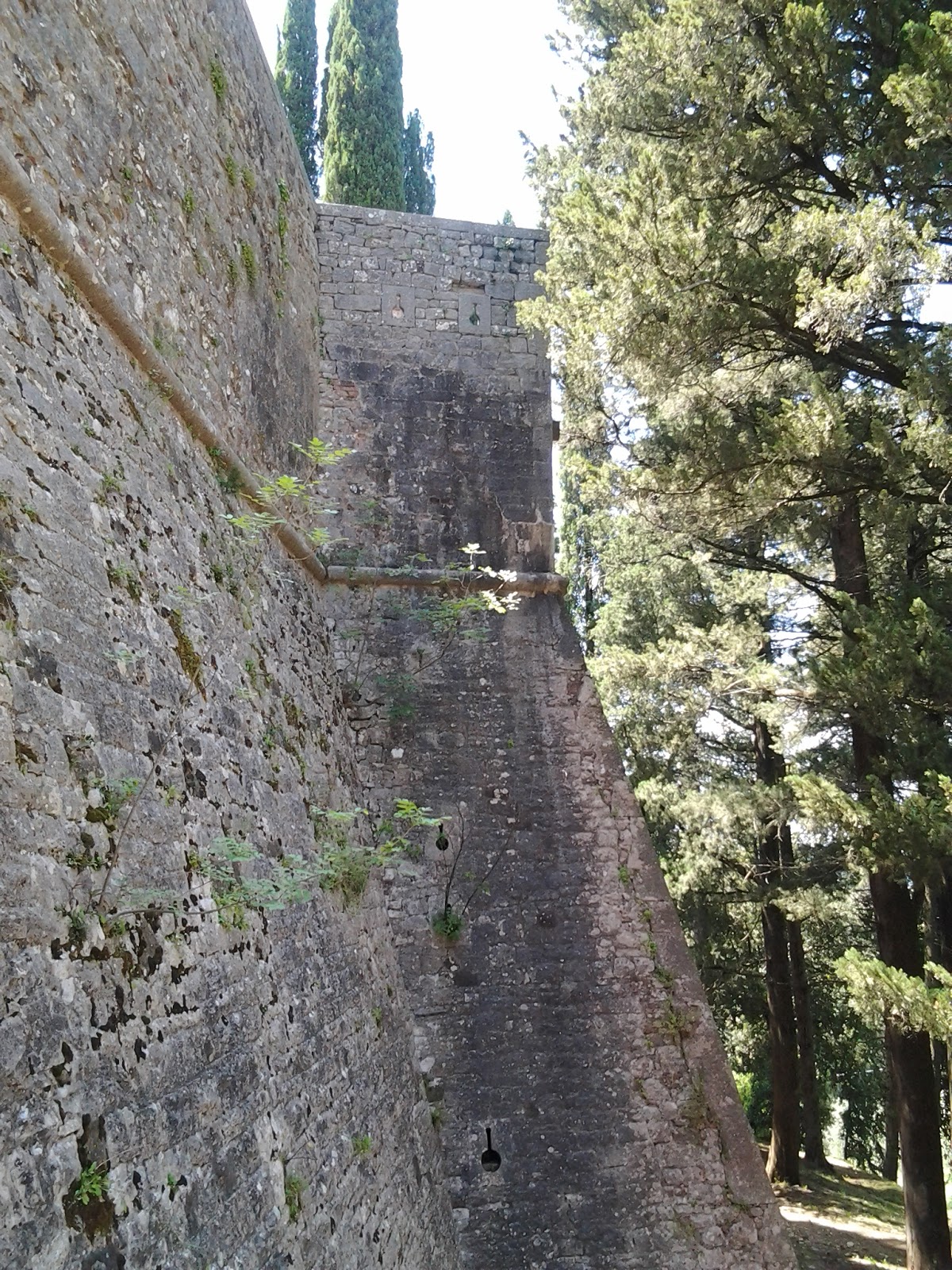
Like any good castle, it has strong defences, and I was looking for a moat and drawbridge, but it looks like the moat has become a lawn.

The very high walls in places no doubt were built to keep the enemy out

The castle has been destroyed and rebuilt many times over the last 900 years.  It was part of the Florentine defences, and withstood, and succumbed to many battles with Siena, which is only 20 km away.  More recently, it still bears the scars of artillery fire and bombing in WW2.

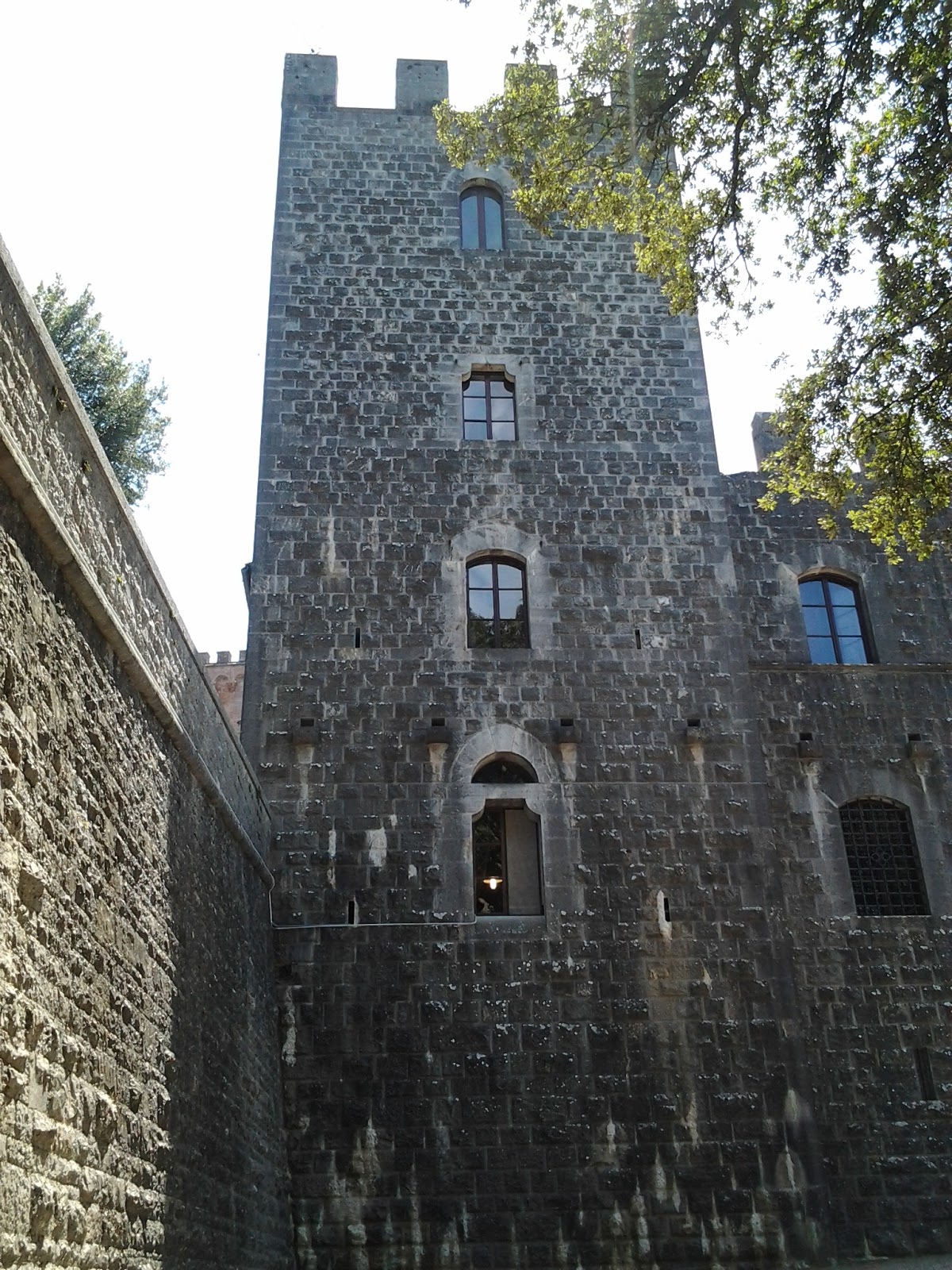
The room at the top of this tower would have an excellent view of the countryside.

Here you can see the old and the new, the red brick part of the rebuilding in the 1800’s in the style of an English Manor

We did not get to see where that archway led.

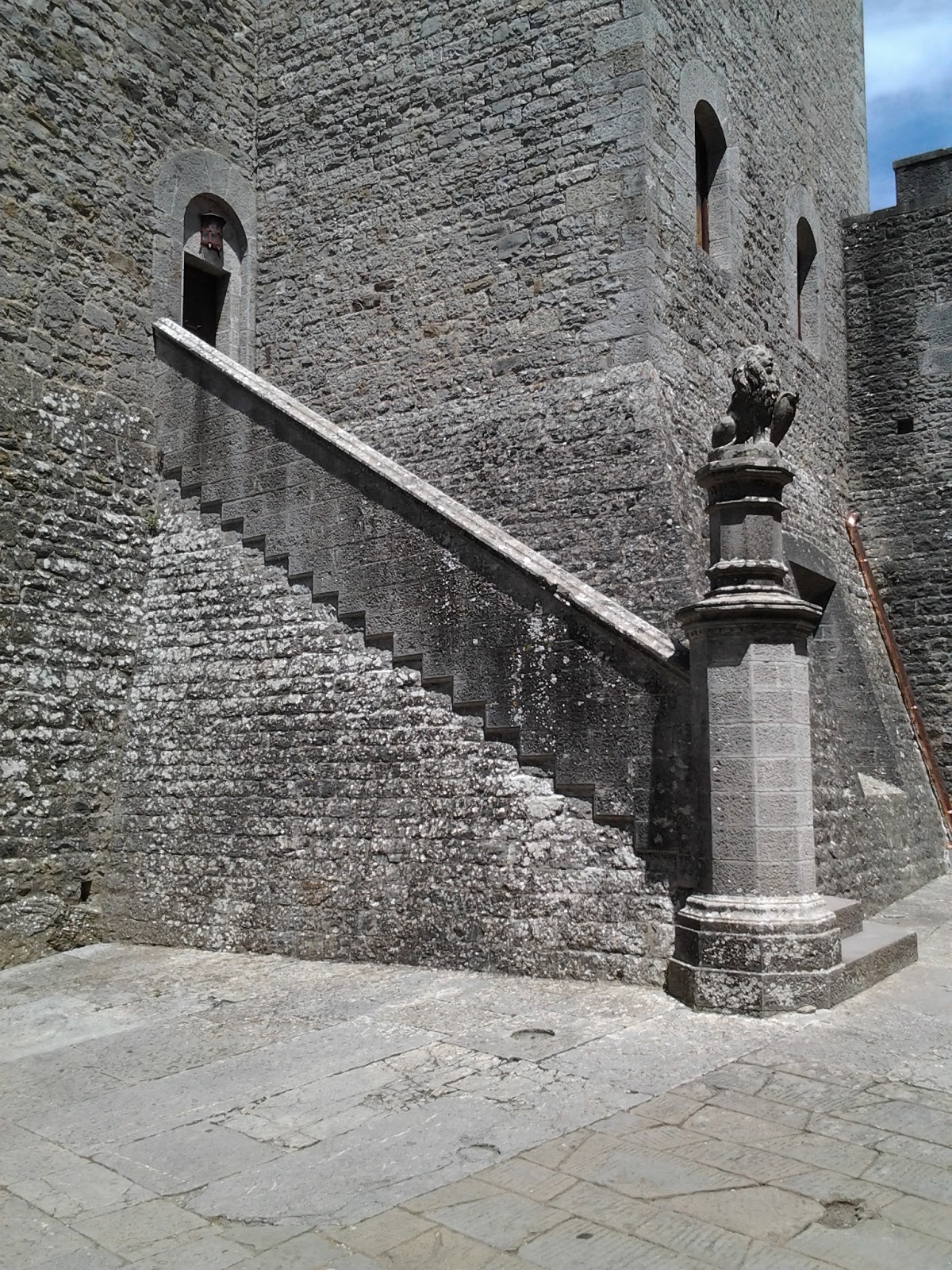
Nor what was behind door number one at the top of these stairs.  Rest assured, many, many years ago someone wearing armour would have made the climb.   It would not pass current occupational health and safety these days with a number of stairs before a landing.

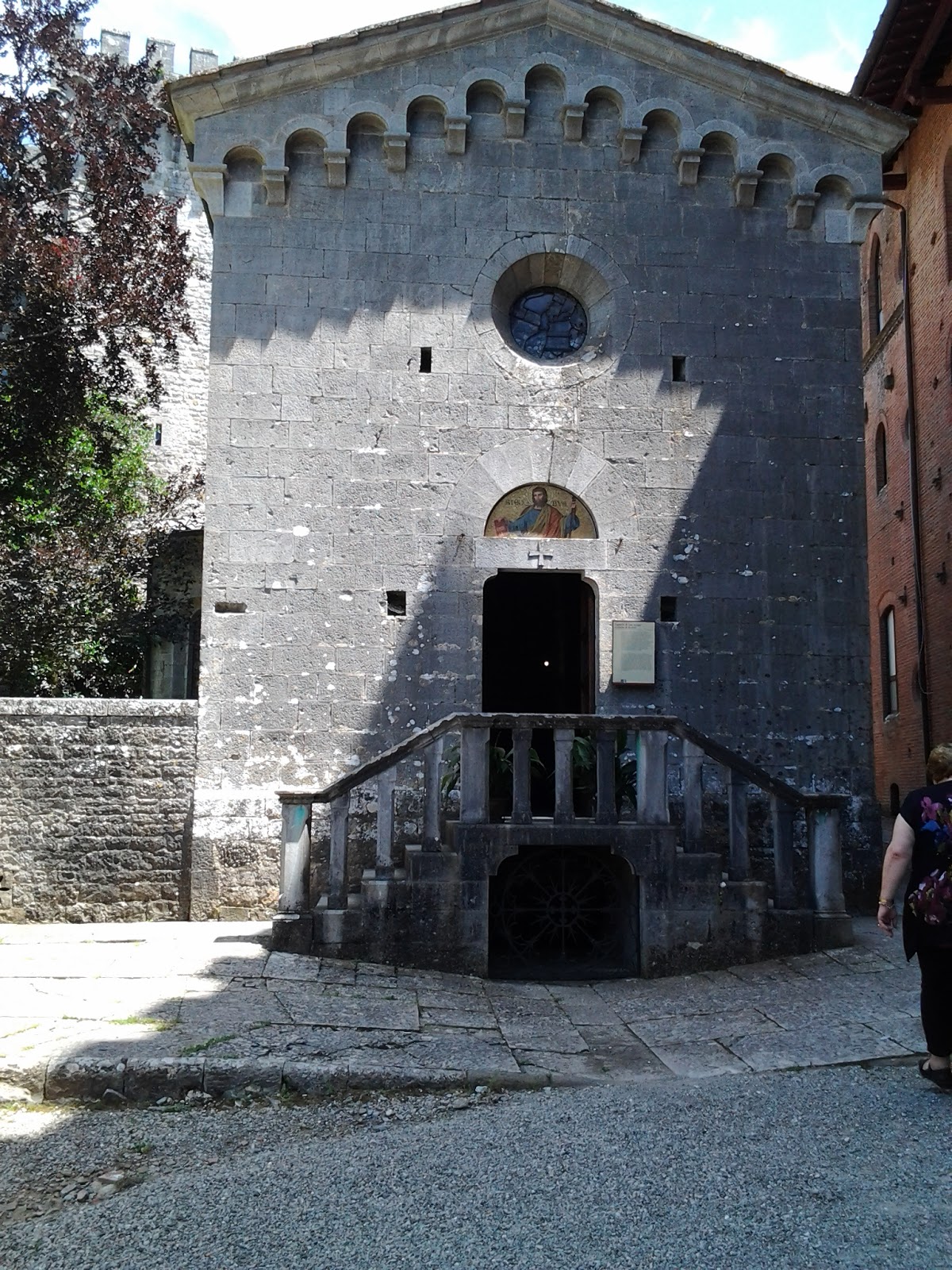
Cappella di San Jacopo.  Its foundations were laid in 1348.

Renovated in 1867-1869, it has a gabled façade preceded by a double stone staircase.  The interior, with a crypt where the members of the Ricasoli family are buried, has a nave divided into three spans with cross vaults.

The 1,200 hectares of the property include 240 hectares of vineyards and 26 of olive groves, in the commune of Gaiole.

A photograph from the inspirational bin – 1

We think of tropical Queensland having pristine white beaches and azure sparkling seas.

Not necessarily so.

This used to be a mangrove swamp.

Perhaps this is what happens when you mess with the natural environment, you’re left with something that’s not very nice.

There’s no beach, no sand, and sometimes not a very pleasant odor.

We can imagine what this might have looked like before man turned up to urbanize the area. In the background, there is an inlet and on either side lush vegetation.

It must have looked very inviting once upon a time. Now the shoreline is completely built on, the vegetation that was once there completely cleared, and the inlet leads to a marina.

Perhaps the story here might be about greedy destructive property developers who care not for anything but profits.  But in their quest to destroy, there is always someone else aiding and abetting, someone in government.

But what if there was an even darker secret hiding just below the surface, and about to be uncovered.  How far would someone go to preserve that secret?


I always wanted to see the planets – Episode 1

I’d been on the starship for almost three hours when…

The captain was coming up from the earth station by transport, not wanting to trust the transporters, and I’d just finished the orientation of the ship by the second officer, and had arrived on the bridge to see various crew members hunched over their consoles.

The captain had told me, before stepping onto the transport, that we would be leaving the dock shortly after he arrived.

Nothing I’d seen so far had led me to believe it would be going anywhere, anytime soon.

Nevertheless, the crew briefing had run smoothly, the second officer assigned to correlate the complaints/problems list, and everyone else had taken their assigned positions. 

I was waiting for the captain, standing beside the ‘chair’, ready to hand over.  In any other situation, we would be off to an illustrious start.

Until the dulcet tones of the Chief Engineer rang through the bridge, uttering those fateful words, “the warp coil has had a catastrophic failure”.

This was at odds with another statement he had made earlier when I was in Engineering, and given I was told the Chief Engineer was prone to hyperbole; his statement ‘they just don’t make warp coils like they used to’ hadn’t exactly filled me with confidence, but I had been expecting we would be ready to depart.

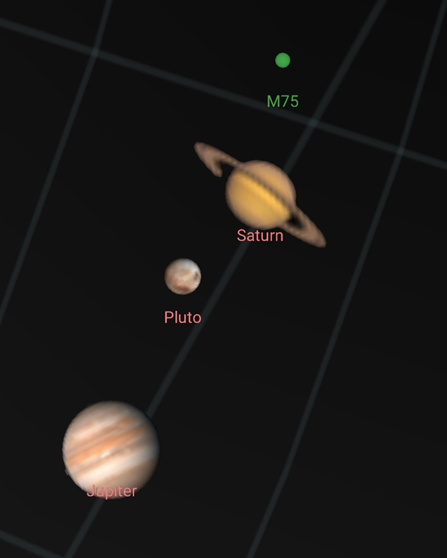
I had been looking at the screen, an overlay of the window that looked out over space, or at this moment, the space dock, where there was a representation of the planets that were ‘out there’.

I had been curious about M75, but the helmsman, a rather taciturn chap who seemed to resent the fact he was assigned to this ship, just shrugged and said, “it’s something, somewhere, but not of much interest,” then went back to his console.

If this was Star Trek, we’d be ejecting the warp coil by now, but in the space dock, that didn’t seem to me to be a viable option.

“How long before we can get this bucket of bolts moving,” I ask the Chief.

“I’m going as fast as I can.”

Yes, words ripped right out of the script of a Star Trek episode, I thought. A sad case of life imitating art.

A strange whistling sound emanated from the speakers, then the whoosh of the elevator just before the doors opened. OK, new ship, squeaky doors, another item to be put on the ‘look at’ list after the shakedown cruise.

The Captain had arrived.

“Why are dock workers still on the ship, Number One.”

For a moment there, I thought I was talking to John Luc Picard.

“Faulty warp coil. You know how it goes, save a billion by outsourcing to the cheapest supplier.”

The captain didn’t appreciate my sardonic humour, or my apparent disdain in outsourcing what we had once built ourselves.

He gave me a frown, a slight shake of his head, then said, “I’ll be in my quarters. Let me know when we’re about to leave.”

He didn’t wait for acknowledgement and disappeared through another squeaky door. More repairs.

The Chief’s voice then came over the speaker. “I can give you impulse speed, warp speed will take a little longer.”

“Doesn’t that refer to miracles over the impossible,” I ask.

“Perhaps.  But in the meantime, I need a specific spanner and the replicators are down. So, now we have to fix them first, before moving on. Might take a while.”

I look around the crew, seeing their expectant faces drop with disappointment.

Outer space was going to have to wait a little longer.

© Charles Heath 2021

The cinema of my dreams – I always wanted to go on a treasure hunt – Episode 51

Here’s the thing…

Every time I close my eyes, I see something different.

I’d like to think the cinema of my dreams is playing a double feature but it’s a bit like a comedy cartoon night on Fox.

But these dreams are nothing to laugh about.

Once again there’s a new installment of an old feature, and we’re back on the treasure hunt.

—-

We took her car.  It wasn’t a limousine of the sort I’d seen the other Cossatino’s driving around in, but a shabby old compact that had seen better days.  Perhaps it was selected for its camouflage qualities, it fitted in with a lot of other old cars that the general population drove.

No one in this town could afford any better.  Not unless you were a Cossatino or a Benderby.  Alex, for instance, had been given a Porsche on his 18th birthday.  By comparison, I was given a new, but second hand, bicycle.

She had parked in a back street some distance from the hotel, and the several times I checked, we were not being followed.  She had noticed me looking over my shoulder a few times but hadn’t commented.  Not until we had driven several miles.

“Alex has one of his mates following me,” I said by way of an explanation.  “Alex seems to think I might lead them to the treasure, which is about as daft as it can get.”

“He’s clutching at straws.  His old man had found out what he’s doing, not that he has told him he knows, and he’s going out of his way to distract Alex.  Old man Benderby doesn’t think there is any treasure.”

“How do you know what the old man is doing?”

“Talks to my father.  They might be sworn enemies, but that doesn’t mean they don’t talk.  It amuses them to see Alex and Vince go head to head.  It’s a waste of time trying to impress their respective fathers.”

“What about you?”

“I’m not trying to impress anyone.  At the right time, I’m packing my bags and going back to Italy to live with the other branch of the family, the ones who are not interested in being master criminals.  I just want to soak up the Tuscan sun and drink wine.”

“I’m sure your father would have something to say about that.”

“He has, but I’m not interested in using my ‘wiles’ as he calls them to get men to spill their secrets.  I’ve seen what it’s done to my mother and my sisters.  I’m not a criminal.”

Not now perhaps.  But back in school, she used every asset to get what she wanted.  It won over Alex, and a few others, particularly those who did her schoolwork for her.  She had nearly every boy at school dangling on a puppet string.

I was lucky she never gave me a second look.

“Well, I’m sure you made a lot of boys happy.”

A sidelong glance told me that wasn’t the wisest of statements to make.  Despite the fact it was true, I guess it was a time she’d rather forget.

I changed the subject.  “So when you went away, I’m thinking you went over to Italy?”

“For a while.  My father thought I was getting a little too close to Alex and sent me to what he thought would be purgatory.  I loved it.  Pity I had to come back.”

We’d reached a small area behind a row of shrubs that shielded us from being seen from the mall.  Something else I’d noticed, it was a cloudy night, and off and on the moon would disappear behind a bank of scudding clouds, and then just before we arrived, the moon had completely disappeared.

When we got out of the car, the darkness closed in around us, and it took a minute or so for my eyes to adjust.  The black clothes almost made us invisible.

I watched her as she wrapped her hair up into a bun and secure it with a band.  Dragged back off her forehead, it made her look older.  It also accentuated the fact she had carefully applied makeup, an odd thing to do when about to go running around in a very dirty place.

The parking spot was a long way from where Boggs and I had last gained entry, so did she have a different entry point.

“Ready?” she asked.

“As ever.”

She took off at a quick pace and I found myself almost jogging to keep up.  She was very fit.  I was not.  We cut across another carpark, one of several surrounding the mall, this one giving some cover because originally there had been landscaping.  It was now overgrown and out of control, and we could move through it and no one could see us.

Not that there was anyone else there.

We came out of the garden, crossed a road, and into an inset where there was a door.

The rusting sign on the door said that the outside should be kept clear as it was a fire exit.

The lock, from what I could see, looked reasonably clean, unlike patches of rust on the door itself, and around the edges of the lock.

“I presume you have a key?”

She pulled a keyring out of her pocket with several keys on it, selected one, and inserted it in the lock.

Nothing.

She tried the next key.  Same result.  She tried the last key.

It turned, and the door swung open.  For a door that showed the rust it did, it moved easily and silently.

She stood to one side as I passed through, then she followed me in, closing the door behind us.  A sign on the back said the door was not to be used, except for fire emergencies, and was alarmed.  No power, no alarm.

“Don’t suppose I should ask where you got the key?”

“Best not.”  She handed me a small torch and turned hers on.  I followed suit.  There was not a lot of light in front of us.  It was, however, quite dark.

“Follow me,” she said, and we set off down a long narrow passage.

—-

© Charles Heath 2020-2021

Coming soon – “Strangers We’ve Become”, the sequel to “What Sets Us Apart”

Stranger’s We’ve Become, a sequel to What Sets Us Apart.

The blurb:

Is she or isn’t she, that is the question!

Susan has returned to David, but he is having difficulty dealing with the changes. Her time in captivity has changed her markedly, so much so that David decides to give her some time and space to re-adjust back into normal life.

But doubts about whether he chose the real Susan remain.

In the meantime, David has to deal with Susan’s new security chief, the discovery of her rebuilding a palace in Russia, evidence of an affair, and several attempts on his life. And, once again, David is drawn into another of Predergast’s games, one that could ultimately prove fatal.

From being reunited with the enigmatic Alisha, a strange visit to Susan’s country estate, to Russia and back, to a rescue mission in Nigeria, David soon discovers those whom he thought he could trust each has their own agenda, one that apparently doesn’t include him.

The Cover:

strangerscover9

Coming soon