Simply because I want you to wait here while I go down the shops.
How long will that be?
I don’t know. A while. Anything from half an hour to a lifetime.
Then there’s another way of using the word: While I do this can you do that.
This is more definite but still ambiguous. How long will that be?
As long as it takes. Anything from half an hour to a lifetime.
it is by definition, a period of time.
Then it gets more ambiguous, in that the arrangements say in place while he is alive.
Being a murder mystery writer and reader, it becomes a sufficient reason to kill a wealthy relative to get their inheritance. But, if murder is not in mind, then it can be anything from a half-hour to a lifetime!
Less of an enigma is this use of the word: I’m going the while away the time playing computer games.
At least you know how long that’s going to be, i.e. till you get bored.
This is not to be confused with the word wile, which means to use a cunning or devious means to get someone to do your bidding.
We’ve all heard of feminine wiles. Granddaughters are experts in using them, I can personally attest to that.
There are other meanings but these are no longer used in modern English.
For a story that was conceived during those long boring hours flying in a steel cocoon, striving to keep away the thoughts that the plane and everyone in it could just simply disappear as planes have in the past, it has come a long way.
Whilst I have always had a fascination in what happened during the second world war, not the battles or fighting, but in the more obscure events that took place, I decided to pen my own little sidebar to what was a long and bitter war.
And, so, it continues…
Jack was the first to realise that Marina was coming back, hearing her outside long before I did. He stood up and looked in the direction of where he expected to see her.
A minute later she appeared, looking and sounding out of breath, as if she had been in a hurry?
Chased, or had some urgent news?
“Is everything OK?” I asked, waiting till she came in and shut the door behind her.
The building we were in used to be a factory or a repair shop. The strange smell I’d picked up a few hours ago was that of machine oil.
“We need to have a chat with the two who picked you up.”
“Where are they now?”
“I’ve organised to meet them at another facility we have. Not everyone comes here. It’s why we are still here. Francesco nor any of the resistance he took with him were aware of this location.
I considered myself lucky to be among the few.
“Is there a reason why I need to be there?”
“Yes. But it’ll wait until we get there. Let’s go.”
She had barely got in the door, nor caught her breath. It was just enough time to collect a spare clip of ammunition for a gun she had on her, but I couldn’t see.
I followed her out into the darkness, not realising it was night, for the first time since I’d arrived, and once outside, realised that it was an underground bunker rather than a building on an allotment, so it couldn’t be easily seen from any direction. It was surrounded by trees and bushes, looking as though they had not been tended properly for some time.
It was as much as I could see, close by because it was a moonless night.
We went up some stairs and came out in a clump of bushes, and walked several yards where there was a disguised walkway zig-zagging through the bushes. It, too, would be hard to see from a distance. When we came out the other side, I could just barely see a car parked under a tree, looking rather worse for wear, and I thought it had been abandoned there.
When Marina told me to get in, I realised it was, like everything else, well disguised.
The surrounding area was that of forest and farms. It was hard to imagine that this part of the world was in the grip of a world war, and not too far away, there was the castle, and further north, the Germans and what was left of the Italian military forces dug in for a last-ditch effort. The tide was turning, but ever so slowly.
It was hard to imagine just how dangerous it was for those defectors to try and get through without being shot.
And, just for good measure, Marina said, there were quite a few soldiers, disguised as ordinary workers who had infiltrated the villages, and surrounding farms, and reporting back what they saw and heard.
We were, in going about in the vehicle, attracting unwanted attention, but it was why we were doing this at night, she said, perhaps gleaning from my expression the fact I was worried about getting caught.
“The people at the castle tend not to go out at night for fear of being picked off. I’m surprised you didn’t learn this when you were there.”
“I suspect the suspended any activities from the moment I arrived. One of the prisoners told me that all movements of people had stopped, and they were waiting to be shipped out. Obviously, they thought I might discover what was going on. They definitely stopped me from going below the main floor.”
“I was told you have some knowledge of the castle layout?”
“Some. We have old plans back in London, but I suspect those would be out of date now and since the German occupation. The only time I got to look downstairs was when I tried to escape and found an old below ground exit, then when they locked me in a cell, and then when I was set free. It matched much of what I remember seeing on the plans. But, I suspect there’s more because I didn’t get to see the holding cells with the other prisoners.”
“Perhaps Carlo can help you with that.”
“We spoke about it. I think he’s going to pay them a visit and exact revenge.”
“I told him we have to wait for some reinforcements.”
“No word from London?”
“Not yet.”
We stopped and parked the car between a church and what was left of what might have been a rectory, set aside from some other buildings that looked like part of a village. It was not that dark that I couldn’t see that several of the buildings had been bombed, minus roofs, and one had the front section reduced to rubble. No attempt had been made to clean it up.
“German tanks,” Marina said. “An early landing party of your army parachuted in about a kilometre behind the church. The local commander mobilised his forces and chased them into those buildings, which, at the time, housed four families. They were given the option to surrender. They didn’t, so the commander gave the order to raze the buildings to the ground, with them in there. Along with the four innocent families. No one survived.”
“The church?”
“The commander thought it would be bad luck to destroy the house of God. The soldiers should have hidden in there. They shot the priest anyway.”
It seemed odd to me that any sort of group would parachute into this part of Italy for any reason, castle withstanding. There was, as far as I knew, nothing of interest or importance here. Perhaps I’d ask when I made it back to London. If I made it back.
I followed her through the rubble and in through a side entrance to the church. Inside it was dark, and Marina was using her torchlight sparingly in case someone was watching. From what I could see, the inside of the church was untouched, but everything was covered in dust from disuse.
“No one thought to send another priest?” I asked.
“No. When they heard what happened to the last one, they decided to wait until the war was over. Besides, with everything that’s happened, the people around here believe God has abandoned them.”
Perhaps he had. I know that I wasn’t all that religious to begin with, but a lot of people I knew had lost their faith in a God that allowed such tragedies to happen.
We passed through a door at the back of the church, behind the nave, and into what looked like the vestment room. To one side was another door, and then steps down. The church had a cellar.
At the bottom of the stairs, there was a large storage area lit by a portable lantern.
Carlo was standing to one side, his weapon ready to use.
Opposite him were a man and a woman, the woman I’d seen before, she was the one who shot me with the tranquilizer. The man, I’d not seen him before.
Beijing Zoo Founded in 1906 during the late Qing dynasty, it is the oldest Zoo in China. It also has an aquarium and has 450 land-based species, some of which are rare and endemic to China like the Giant Panda, and 500 marine-based species. Other rare animals to be seen are the Red Panda, the Golden Snub-nosed Monkey, the South China Tiger, the White Lipped deer, the Chinese alligator, the Yak,, and the Snow Leopard. Most of the original animals were bought in 1908 from Germany by the viceroy of Liangjiang Duanfang. The Zoo first opened on June 16th, 1908. Currently, the Zoo grounds resemble classical Chinese gardens, and among the attractions are a number of Qing dynasty buildings to view, as well as an Elephant hall, a Lion and tiger hall, a Monkey hall, and a Panda hall. In all, there are 30 halls. The Zoo is located at 137 Xizhimen WaiDajie in Xicheng district, near the 2nd ring road.
We are primarily at the Zoo to see the Pandas, and there is a specific hall devoted to them, and by the way, it costs extra to see them. Everyone in our group is particularly interested in seeing them because it’s rare that any can be found anywhere else in the world. Perhaps if there had been more time, another hour, maybe, it might have made all the difference, but I think that extra time might have clashed with the pearl factory, and that, for obvious reasons, was deemed to be more important.
Our first stop is in the Panda hall.
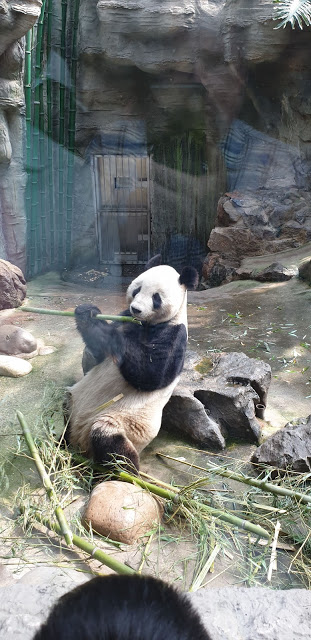
There are two pandas that we can see, one of whom is a little camera shy, and the other, above, who is demonstrating how pandas eat bamboo. They are behind a large glass wall, and you have to wait for the opportunity to get a good photo, and, sometimes only enough to include the top of the head of the person in front of you. Unfortunately, the Chinese visitors don’t understand the polite excuse me in English, and, can at times, be rude enough to shove their way to the front.
What is also a problem is the uncooperativeness of the pandas to pose for photos. I guess there’s no surprise there given the thousands of visitors every day with only one purpose in mind. We counted ourselves lucky to get the photos we did.
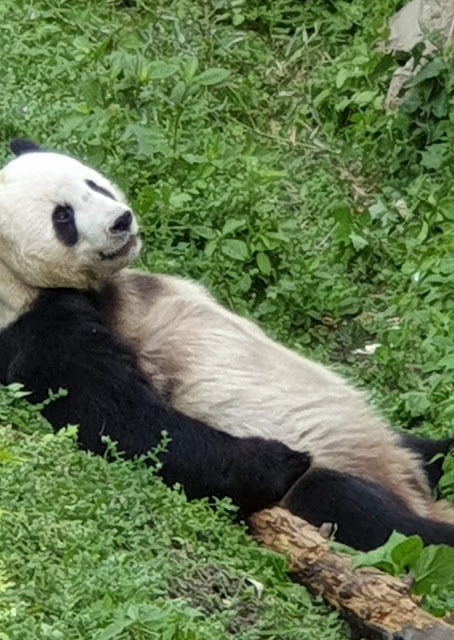
The hall itself is built on to the external enclosure where there are a number of giant pandas some of whom that were on show were relatively lethargic, as though they had a big weekend, and we’re sleeping it off, like this panda below:
Then, remarkably, we came across one that decided to be a little more energetic and did a walk in front of hundreds of Chinese who had undoubtedly come to show their children the animals.
This Panda was also easier to photograph whereas the other panda, one chewing on a morning feast of bamboo, saw a lot of pushing and shoving by the spectators to get the best spot to take his photograph. Having manners just doesn’t cut it here, so do what you have to to get that photograph.
We also saw a couple of monkeys that were also in the panda enclosure, but they were not much of a side benefit. They may have been there to use the Panda’s exercise equipment, though it was not quite like what we use.There was no time really to wander off to see much else, but apparently, there were also red pandas, and surprisingly, a category call Australian animals. But, who goes to another country to view your own animals?The cutest animals were the stuffed pandas, and they were quite reasonably priced.
We’re still in Bratislava with Zoe making a few repairs, having been injured in the getaway from the hotel, where bullets were flying around indiscriminately.
In a nondescript hotel near a railway station, the favorite accommodation for assassins, maybe, there’s enough time for John to get the message Zoe is not happy with him bringing along a hit squad.
And, they’re on the news, that is to say they know who it is that’s on the news, the blurry figures are too indistinct for anyone else to identify them. It was disconcerting to be called criminals fleeing the scene of a crime.
Back in London, Sebastian is about to have a set to with Worthington, who has decided Sebastian is too close and might compromise his black op, so he’s sending him to Paris.
It’s here we learn that Sebastian has both Isobel and Rupert locked up in the cells in the basement, awaiting interrogation, and Worthington orders him to send them home.
Of course, Sebastian is not going to so anything of the sort.
He knows they know where John is, and by implication, where Zoe is, and wants to know.
In the first edit, I suspect I will have to mention Sebastian ‘arresting’ Rupert and Isobel just to keep continuity, and no unfathomable surprises later on.
…
Today’s writing, with Worthington getting his ducks in a row, 1,445 words, for a total of 41,162.
I had, literally, just witnessed the end of the world on the large screen TV.
Live and on CNN.
There had been skirmishes, Russia looking to take back its satellite countries and restore the USSR, and NATO posturing when the leaders of the countries asked for help and received none. Everyone knew what would happen if they did. War.
But, the playing field changed when Russia set it sights on Poland.
Rollback 83 years, the last time a country rolled into Poland. What happened? War.
This time, threats, empty it seemed for a month, and then, yes, we were plunged back into War.
This time, however, everything was different. Yes, wars were once predominantly waged with men and machines. That type of warfare changed when Germany introduced the VI Rocket bombs, a means of remotely bombing selective targets. Hit and miss maybe, but it worked. Last time we had an atomic bomb, or two as it happened.
This time, we had guided missiles, with nuclear warheads, not a hundred, but thousands, deployed all around the world, aimed at selected targets, not necessarily military targets, but civilians.
There were some who thought they could negotiate a peace settlement.
And, in the middle of that, someone pressed the button. You know that infamous button that sends a nuclear weapon on its way.
We all saw it launch, live.
We all saw it land, dodging every defence system in its path, with devastating effect, as the camera melted, and everything just went black. Not one, but all over the world.
It was estimated that the whole world lost a third of its population in four hours, vaporised by missile strikes, and another third would be dead within a month from proximity radiation. The remaining third, when the dust settled, and those who were not in the direct line of fire, well, the weather would soon decimate them.
Us.
We all thought nuclear weapons were just a deterrent.
Now, well, it was too late to think about anything. We were, as I just heard on the TV, all going to die from the fallout. It was only a matter of time before it reached us. Then, according to the expert, we would all end up with radiation poisoning and die.
I was fortunate enough to live on one of the most southern parts of Australia, a small town by the name of Cockle Creek, Tasmania. Even though I had never heard of it until overwhelmed by the loss of my wife, I wanted to hide from the world, and Cockle Creek was just the place.
Now, for a while, it was going to be a haven.
Before the storm clouds arrived.
I switched off the TV, and most likely wouldn’t be turning it back on. There wasn’t going to be any good news, and I really didn’t want to know how long we had left. I put several bottles of red wine, some cheese, bread, and meat into a bag, and headed down to the beach.
It was part of a secluded part of the shore that backed onto a half dozen houses, and on rare occasions, the neighbours appeared, spoke briefly and went about their business. People in my street were at best recluses, at worst hermits, all of us running away from something.
It wasn’t long before Angie appeared, at the end of her evening run. I’d met her several times, and knew a little of her history, once married to a cheating bastard, once had a good job but because of him had to leave, now no longer interested in anything.
I understood her.
She stopped. I expected a wave as she passed by.
“Max.”
“Angie. How are you?”
“Usual. See the news?”
“Hard to miss it.”
“Not a lot to look forward to?”
“I came here to spend my last days in peace, there’s just fewer of them, I guess.”
“Pragmatic.”
“Realistic.
She came over and sat beside me. For some odd reason, I’d packed two glasses. Had I a premonition she would drop by?
“Red?”
“Why not?”
We sat there and drank wine, first from one bottle, then starting on the next. We didn’t say anything, there wasn’t anything to say.
“Would you believe me if I said I was once a scientist? There’s a more specific name, but the scientist will do?”
“Why wouldn’t I?”
“My dad refused to believe a woman could be that smart. My husband was a bit like that, never liked the idea that I might be smarter than him.”
“Some men feel threatened.”
“Would you?”
“My wife was far smarter than I was, but I loved her because she was her, not the smart part. That was just a small part of who she was. And she didn’t care if I was a dustman.”
“Were you?”
“No. I owned a bookshop, served coffee, and talked to strange people all day.”
“Lots of dusty books then?”
I had no idea if she was joking or just commenting, but it didn’t matter. It was amusing to think of it like that.
“Lots. So, what branch of science was it?”
“Snow science.”
OK, so my poker face wasn’t quite working, and it wasn’t hard to guess what I was thinking.
“Look it up, it’s real.”
“No internet anymore. Kind of got nuked along with a lot of other stuff. But, despite the scepticism I suspect there is such a thing, and, if I remember right, is that something to do with the study of snow and ice movement, possible for the prediction of similar events?”
“It had a lot to do with predicting storms, and how snow affected water supplies. There’s a whole lot more, but it’s rather irrelevant now. Like me.”
“Like all of us, I think, though if you’re feeling irrelevant, come and see me and I’ll try to think of a way to change that.”
“Could you?”
“Probably not. But I know how you feel. That’s why I’m here.”
Another few glasses of wine, enough time to consider what she said, and how to make sense of it, before she said, “My last job was for an eccentric billionaire. I never told anyone because it was the craziest two years of my life.”
“Why bring it up?”
“It doesn’t matter anymore. Turns out he wasn’t batshit crazy after all.
”OK, I’ll bite. Why was he crazy?”
“Because he built a huge city like complex under the ice in Antarctica. He said that man would destroy the earth sooner rather than later, and he wasn’t going to hang around and watch them do it. Space travel was too difficult, so he did the next best thing. A haven for 5,000 specially selected people. I was his snow and ice expert.”
“It’s all melting.”
“Deep in the ice. There are a few thousand years before it all dissipates, and even then, it’s below ground. We anticipated every scenario.”
“Bet you didn’t think of aliens with excavators.”
“Now you’re mocking me.”
I shook my head. “No. Ivan Rostov, an oligarch. Strange man, stranger idea, bet rich enough not to care what the world thought of him. You knew Ivan?”
“Slept with him once. Bit of a disappointment.”
“Sorry to hear that. Before or after your husband strayed.”
“After. I have principles.”
“You should be there, with him.”
“Wasn’t open for business. When I left, just before I came here, it was in the last stages of being shut up until when it would be needed. I guess that’s about now. But I don’t work for him, and he doesn’t need me, and I don’t think I could stay there anyway. How long do you think people would have to stay there?”
“From what I’ve been reading, between 5,000 and 25,000 years, but that’s very extreme and assumes plutonium has been used. A substantial amount of the northern hemisphere has been rendered radioactive, and if Chernobyl is anything to go by, a long time. People wouldn’t see daylight in this lifetime.”
“Sounds like fun then. You up for a home-cooked meal. Long time since I’ve entertained, seems like there might not be many more opportunities.”
“Why not?”
Sitting opposite a woman who I had probably seen a dozen times in a year, and spoke to here, albeit briefly, on three of those occasions, I felt remarkably at ease in her company.
Perhaps it was the fact we were all living on borrowed time, perhaps in those circumstances, we had let a lot of our guard down. Whatever it was, sitting there, enjoying the moment, I felt as though I’d known her all my life.
An odd ringing sound broke the silence that had settled on us.
She got up. “Excuse me for a moment.”
She went into another room, the ringing stopped and I could hear her muffled voice. A minute later she returned with a device that looked like a satellite phone in her hand.
She put it on the table and sat down. “You’re on speakerphone. Now, tell me what you just said again.”
A male voice, relatively old if I was to guess, and authoritative.
“We are just packing, and tomorrow we will be going to nowhere. I’m sorry I haven’t been as communicative in recent times, so much to do, so little time, but, as you are aware, the world has finally gone to hell in a handbasket, and we’re getting everything ready. I’d like you to come. After all, it’s as much your pet as it was mine.”
“Tempting offer, but I don’t think we’ll ever see daylight again.”
“That maybe so, or maybe not. We have no idea how mother nature is going to handle this swipe, but that’s in the future. Staying outside is simply a death sentence, and you’re too good for that.”
I looked at her, the look conveying the unspoken quester, ‘Is that your former boss?”
She nodded, a sign to me at least, that she could read minds. Perhaps then not a good thing.
“I have a friend here, if he wanted to, could I bring him as my plus one?”
“Certainly.”
“I need time to think about it. Can I call you back?”
“Any time. As I say we leave tomorrow and will be there in a week. I’ll be dropping in anyway, whatever you decide.”
“Ok. Thanks.”
She disconnected the call.
“Nowhere?”
We gave New Eden and name that people would never quite understand. We used to say, we’re going nowhere, when we were going to the building site. It was how we kept it secret.”
”You should go. Life is precious and you should hang on to it for as long as possible.”
“What about you?”
“I’m sure there are other more important people you could take.”
“There are none that I care about. Not anymore. Why do you think I’m here, alone, and never leave?”
I shrugged.
“You don’t know me.”
“I know enough. There’s no obligation on your part to be anything but a friend. If I go, I need to have at least one person there I know.”
“Won’t all the people who built it be there?”
“I never got to know any of them. Didn’t want to. But with you, after one afternoon, I feel as though I want, I need to know more about you. You are perhaps what some would call a kindred spirit. I know it doesn’t make any sense, but these are strange times, are they not?”
I smiled. They were. And oddly enough, I felt the same about her.
“Perhaps if we both take the week to think about it?”
She nodded. “Dinner at yours tomorrow?”
“Afternoon wine, same time, same place?”
A nod and a nod.
I saw the superyacht arrive and drop anchor about a mile offshore, and then, after a half-hour of activity on the rear deck, the launching of a tender, which then headed slowly towards our section of the beach.
It was a no brainer, in the end, we got along so well, why would I want it to end? So we had to live in a bunker for 50,000 years. It would be with her, and that’s all I cared about.
She took my hand in hers. “So, are you ready to catch the last boat to nowhere?”
Every time I close my eyes, I see something different.
I’d like to think the cinema of my dreams is playing a double feature but it’s a bit like a comedy cartoon night on Fox.
But these dreams are nothing to laugh about.
Once again there’s a new instalment of an old feature, and we’re back on the treasure hunt.
I was in the middle of a large building, sitting on a chair, a single light on above me creating a weird shadow in a circle of light. Beyond that circle was darkness.
But I was grateful there was no blindfold or gag.
It had to be one of the buildings on Benderby’s factory site. There were a number of older warehouses on the perimeter of the site, boarded up and in disrepair. I had heard rumours they were going to be refurbished or demolished, no one seemed to be able to decide what to do with them.
It was deathly quiet, but if I strained hard, I thought I could hear the sound of a generator not far away. Benderby’s had their own mini power station in case the main power grid went down, and I remembered that it was round the time for the six-monthly testing of the generators. I was definitely inside the Benderby complex.
So, did that make my captor one of Benderby’s men? Or was it Alex himself, trying to make a bold statement. I didn’t think he had that sort of aggressive behaviour in him, but he was a Benderby, and they all had violent streaks somewhere in their makeup.
“Good. You’re awake.” The distorted voice could be either male or female. I’d know more when I saw my assailant, but it came from beside me and I tried to look in that direction. It was difficult because whoever tied me up did a good job.
There was also an echo, brought on by the emptiness of the building.
“What do you want? I’m not much good to you if you’re trying to break into the main building. I don’t have night access.”
“I’m not interested in the main building.”
“What are you interested in?”
“You.”
I had expected to hear the word treasure, not me.
“Sadly, I’m not that interesting.”
“So you say. But maybe it might have something to do with that friend of yours, Boggs.”
“Then it’s the treasure you’re after.”
“Me, personally, no. The people I work for, I guess. The word is that Boggs has a treasure map that his father left him.”
This person had to be acquainted with Rico, because only he could possibly know about that particular map, that is, if Boggs had told him, or told his mother, and Rico had overheard him.
Or Boggs had told this person, under duress, that I had the map, holding it for safekeeping. My mind started conjuring up all sorts of terrifying scenarios, all of which ended badly.
“If Rico told you that, then he was only trying to save his own skin. He’s been trying to barter a copy of something to the Benderby’s, a map he didn’t have and hadn’t been able to get off Boggs. If there is such a map, then Boggs has it.”
“I’m sure he told you about it, didn’t he?”
“What are best friends for, but whether I believed him is a different matter. He told me about a map he said his father had in his possession, and I know he’s been hunting high and low for it, but if he’s found it, then he hasn’t told me about it yet.”
I was trying to sound sincere, but fear has a way of making you sound, well, afraid.
My captor took a step forward into the fringe of the light. Dressed in black, with a mask, the body shape looked more like a woman than a man, a figure that could be disguised by the bulky outer clothing.
“Who are you?”
“That’s irrelevant. What I will do to you if you do not tell me the truth, is. Boggs told me you had the map. I believe he was telling the truth.”
So, this person had interrogated Boggs. It would not have taken much. Boggs was not the bravest soul I knew. At school, Boggs had always been the first to capitulate in any confrontation.
I wondered if they had searched him. Of course, they had, and he didn’t have the map on him, which made it easier to deflect the onus to me.
But I didn’t have the map on me either. I took the precaution of hiding it away in a place no one would find except me. Now it was a matter of withstanding whatever this person decided was needed to extract ‘the truth’.
The problem was, I didn’t handle confrontation any better than Boggs had.
“And I’m telling you the truth when I tell you I haven’t got the map. But I do have one of those being peddled at Osborne’s bar. You can have that one if you like.”
I saw my captor shake their head. Disdain, or disappointment?
Two steps further into the circle of light, and the two slaps, either side of my face, very hard. The paid was instant and stinging, bringing tears to my eyes. It should have brought acquiescence, but deep down defiance was building. It surprised me.
My captor took a step back and looked down on me. “Don’t make me have to hurt you. All I want is the map.”
“I can’t give you what I don’t have.”
Closed fist this time, and aside from the teeth jarring, possible jaw-breaking, nose bleeding effect, I was starting to consider how long I could withstand this sort of beating.
“The map?” Patience was running thin, anger was building.
“I can’t…”
Several punches to the ribs and stomach, taking my breath away and making it very difficult to breathe. Pains where I’d never had pain before. I’d had beatings at school but never like this.
Once more a step back, I could now only see the black figure through blurry eyes.
Time to plead to deaf ears, “You can beat me to within an inch of my life, but I can’t give you what I don’t have. It’s as simple as that.”
And then I waited for the next round of punches.
A minute. Two.
Then a new voice, out in the void, said, “He doesn’t have it. This is a nothing but an elaborate hoax.”
Stranger’s We’ve Become, a sequel to What Sets Us Apart.
The blurb:
Is she or isn’t she, that is the question!
Susan has returned to David, but he is having difficulty dealing with the changes. Her time in captivity has changed her markedly, so much so that David decides to give her some time and space to re-adjust back into normal life.
But doubts about whether he chose the real Susan remain.
In the meantime, David has to deal with Susan’s new security chief, the discovery of her rebuilding a palace in Russia, evidence of an affair, and several attempts on his life. And, once again, David is drawn into another of Predergast’s games, one that could ultimately prove fatal.
From being reunited with the enigmatic Alisha, a strange visit to Susan’s country estate, to Russia and back, to a rescue mission in Nigeria, David soon discovers those whom he thought he could trust each has their own agenda, one that apparently doesn’t include him.
You know what it’s like on Monday morning, especially if it’s very cold and the double glazing is failing miserably to keep the cold out.
It was warm under three blankets thick sheets and a doona, and I didn’t want to get up.
It doesn’t help if in the last few months, the dream job you once had had turned into a drudge, and there was any number of reasons to stay home rather than go into the office. Once, that was trying to find an excuse to stay home because you’d rather go to work.
That was a long time ago or felt like it.
My cell phone vibrated, an incoming message, or more likely a reminder. I reached out into the icy wasteland that was the distance from under the covers to my phone on the bedside table. It was very cold out there, and for a moment I regretted that impulse to check.
It was a reminder; I had a meeting at HR with the manager. I had thought I might be eligible for redundancy since the company was in the throes of a cost cutting exercise. Once I might have been apprehensive, but now, given my recent change in department and responsibility, I was kind of hoping now that it was.
I felt a hand on my shoulder. “Time to get up sleepy head. You have a meeting to go to, not one to be late.”
It felt strange to wake up with someone else in the bed. My luck in that department hadn’t been all that hood lately, but something changed, and at the usual Friday night after work drinks at the pub I ran into one of the PA’s I’d seen around, one who was curious to meet me as much as I was to meet her.
One thing had led to another and when I asked her if she wanted to drop in on the way home, she did.
“I’d prefer not to. I can think of better things to do.”
“So, could I but that’s not the point. Five more minutes, then I’m pushing you out.”
She snuggled into my back, and I could feel the warmth of her body, and having the exact opposite effect than she intended. But she was right. It was important, and I had to go. But, in the meantime it was four more minutes and counting.
When you get a call from the head of HR it usually means one of two things, a promotion, or those two dreaded words, ‘you’re fired’, though not usually said with the same dramatic effect.
This year had already been calamitous enough getting sidelined from Mergers and Acquisitions because I’d been usurped. That was the word I was going with, but it was to a certain extent, my fault. I took my eye off the ball, and allowed someone else to make their case.
Of course, it helped that the person was connected to all the right people in the company, and, with the change in Chairman, it was also a matter of removing some of the people who were appointed by the previous incumbent.
I and four of my equivalent managers had been usurped and moved to places where they would have less impact. I had finished up in sales and marketing, and to be quite honest, it was such a step down, I had already decided to leave when the opportunity presented itself.
My assistant manager, who had already put in his resignation, was working out his final two weeks. I told him to take leave until the contract expired, but he was more dedicated than that. He had got in before me and was sitting at his desk a cup of coffee in his hand and another on the desk.
“How many days?”
“Six and counting. What about you? You should be out canvassing. There’s at least three other places I know would be waiting to hear from you.”
“It’s still in the consideration phase.”
“You’re likely to get the chop anyway, with this thing you have with Sharky.”
Sharkey was the HR manager.
You know something I don’t?” I picked up the coffee, removed the lid and took in the aroma. “They’re downsizing. Broadham had decided to go on a cost cutting exercise, and instead of the suggested efficiencies we put up last year, they’re going with people. I don’t think he quite gets it.”
“You mean my replacement doesn’t know anything about efficiency. He makes a good yes man though, telling Broadham exactly what he wants to hear.”
Broadham, the new Chairman, never did understand that people appointed to important positions needed to have the relevant qualifications and experience. My replacement had neither. That was when the employees loyal to the previous Chairman had started leaving.
We had called it death, whilst Broadham had called it natural attrition. He didn’t quite understand that so far, over 300 years of experience had left, and as much again was in the process of leaving.
“Are you going to tell Sharky you’re leaving?”
“I’ll wait and see what he has to say. I think he knows the ship is sinking.”
There wasn’t much I didn’t know about the current state of the company, and with the departures, I knew it was only a matter of time. Sharky was a good man, but he couldn’t stem the tide.
He also knew the vagaries of profits and share prices, and we had been watching the share price, and the market itself. It was teetering, and in the last few months, parcels of shares were being unloaded, not a lot at one time, but a steady trickle.
That told me that Broadham and his cronies were cashing in while the going was good, and quite possibly were about to steer the ship onto the rocks. The question was who was buying, and that, after some hard research I found to be certain board members. Why, I suspected, was to increase their holdings and leverage, but I don’t think they quite realised that there would be nothing left but worthless stock certificates.
It was evidence, when I finally left, that I would pass on to the relevant authorities.
In the meantime, I had a meeting to go to.
“Best of luck,” my assistant muttered as I passed his desk.
“If I don’t return, I’ll will have been escorted from the building. If that happens, Call me.”
It had happened before. When people were sacked, they were escorted to their office, allowed to pack their belongings, and were then escorted to the front door. It would be an ignominious end to an illustrious career, or so I’d been told by the girl who was no doubt still asleep in my bed.
She had heard the whispers.
The walk to the lift, the traversing of the four floors to the executive level, and then to the outer office where Sharky’s PA sat took all of three minutes. I had hoped it would be longer.
“He’s waiting for you,” she said, “go on in.”
I knocked on the door, then went in, closing it behind me. “Now, sir, what on earth could you want to see me about?
There’s something to be said for a story that starts like a James Bond movie, throwing you straight in the deep end, a perfect way of getting to know the main character, David, or is that Alistair?
A retired spy, well not so much a spy as a retired errand boy, David’s rather wry description of his talents, and a woman that most men would give their left arm for, not exactly the ideal couple, but there is a spark in a meeting that may or may not have been a set up.
But as the story progressed, the question I kept asking myself was why he’d bother.
And, page after unrelenting page, you find out.
Susan is exactly the sort of woman the pique his interest. Then, inexplicably, she disappears. That might have been the end to it, but Prendergast, that shadowy enigma, David’s ex boss who loves playing games with real people, gives him an ultimatum, find her or come back to work.
Nothing like an offer that’s a double edged sword!
A dragon for a mother, a sister he didn’t know about, Susan’s BFF who is not what she seems or a friend indeed, and Susan’s father who, up till David meets her, couldn’t be less interested, his nemesis proves to be the impossible dream, and he’s always just that one step behind.
When the rollercoaster finally came to a halt, and I could start breathing again, it was an ending that was completely unexpected.
Florence is littered with endless statues, and we managed to see quite a few,
If those statues came to life I wonder what they might tell us?
Like castles on the shores of the Rhine, there are only so many statues you can take photos of. Below are some of those I thought significant
Michelangelo’s David directs his warning gaze at someone else.
The impressive muscles of Baccio Bandinelli’s Hercules from 1533. The worked-out demi-god is pulling the hair of Cacus, who will be clubbed and strangled.
Achilles with Polyxena in arm, stepping over her brother’s body
Menelaus supporting the body of Patroclus, in the Loggia dei Lan
Statue of Hercules killing the Centaur by Giambologna in Loggia dei Lanzi. Piazza della Signoria.
On the back of the Loggia there are six marble female statues, probably coming from the Trajan’s Foro in Rome, discovered in 1541 and brought to Florence in 1789








 Thrills, Spills, and just a dash of Romance