An excerpt from “Mistaken Identity” – a work in progress

The odds of any one of us having a doppelganger are quite high. Whether or not you got to meet him or her, or be confronted by them was significantly lower. Except of course, unless you are a celebrity.

It was a phenomenon remarkable only for the fact, at times, certain high profile people, notorious or not, had doubles if only to put off enemies or the general public. Sometimes we see people in the street, people who look like someone we knew, and made the mistake of approaching them like a long lost friend, only to discover an embarrassed individual desperately trying to get away for what they perceive is a stalker or worse.

And then sometimes in is a picture that looms up on a TV screen, an almost exact likeness of you. At first you are fascinated, and then according to the circumstances, and narrative that is attached to that picture, either flattered or horrified.

For me one turned to the other when I saw an almost likeness of me flash up on the screen when I turned the TV on in my room. What looked to be my photo, with only minor differences, was in the corner of the screen, the news reader speaking in rapid Italian, so fast I could only translate every second or third word.

But the one word I did recognize was murder. The photo of the man up on the screen was the subject of an extensive manhunt. The crime, murder of woman in the very same hotel I was staying, and it was being played out live several floors above me. The gist of the story, the woman had been seen with, and staying with the man who was my double, and, less than an hour ago, the body had been discovered by a chambermaid.

The killer, the announcer said, was believed to be still in the hotel because the woman had died shortly before she had been discovered.

I watched, at first fascinated at that I was seeing. I guess I should have been horrified, but at that moment it didn’t register that I might be mistaken for that man.

Not until an another five minutes had passed, and I was watching the police in full riot gear, with a camera crew following behind, coming up a passage towards a room. Live action of the arrest of the suspected killer the breathless commentator said.

Then, suddenly, there was a pounding on the door. On the TV screen, plain to see, was the number of my room.
I looked through the peep hole and saw an army of police officers. It didn’t take much to realize what had happened. The hotel staff had identified me as the man in the photograph on the TV and called the police.

Horrified wasn’t what I was feeling right then.

It was fear.

My last memory was the door crashing open, the wood splintering, and men rushing into the room, screaming at me, waving guns, and when I put my hands up to defend myself, I heard a gunshot.

And in one very confused and probably near death experience, I thought I saw my mother, and thinking what was she doing in Rome?

I was the archetypal nobody.

I lived in a small flat, I drove a nondescript car, had an average job in a low profile travel agency, was single, and currently not involved in a relationship, no children, and according to my workmates, no life.

They were wrong. I was one of those people who preferred their own company, I had a cat, and travelled whenever I could. And I did have a ‘thing’ for Rosalie, one of the reasons why I stayed at the travel agency. I didn’t expect anything to come of it, but one could always hope.

I was both pleased and excited to be going to the conference. It was my first, and the glimpse I had seen of it had whetted my appetite for more information about the nuances of my profession.

Some would say that a travel agent wasn’t much of a job, but to me, it was every bit as demanding as being an accountant or a lawyer. You were providing a customer with a service, and arguably more people needed a travel agent than a lawyer. At least that was what I told myself, as I watched more and more people start using the internet, and our relevance slowly dissipating.

This conference was about countering that trend.

The trip over had been uneventful. I was met at the airport and taken to the hotel where the conference was being held with a number of other delegates who had arrived on the same plane. I had mingled with a number of other delegates at the pre conference get together, including one whose name was Maryanne.

She was an unusual young woman, not the sort that I usually met, because she was the one who was usually surrounded by all the boys, the life of the party. In normal circumstances, I would not have introduced myself to her, but she had approached me. Why did I think that may have been significant? All of this ran through my mind, culminating in the last event on the highlight reel, the door bursting open, men rushing into my room, and then one of the policemen opened fire.

I replayed that last scene again, trying to see the face of my assailant, but it was just a sea of men in battle dress, bullet proof vests and helmets, accompanied by screaming and yelling, some of which I identified as “Get on the floor”.

Then came the shot.

Why ask me to get on the floor if all they were going to do was shoot me. I was putting my hands up at the time, in surrender, not reaching for a weapon.

Then I saw the face again, hovering in the background like a ghost. My mother. Only the hair was different, and her clothes, and then the image was going, perhaps a figment of my imagination brought on by pain killing drugs. I tried to imagine the scene again, but this time it played out, without the image of my mother.

I opened my eyes took stock of my surroundings. What I felt in that exact moment couldn’t be described. I should most likely be dead, the result of a gunshot wound. I guess I should be thankful the shooter hadn’t aimed at anything vital, but that was the only item on the plus side.

I was in a hospital room with a policeman by the door. He was reading a newspaper, and sitting uncomfortably on a small chair. He gave me a quick glance when he heard me move slightly, but didn’t acknowledge me with either a nod, or a greeting, just went back to the paper.

If I still had a police guard, then I was still considered a suspect. What was interesting was that I was not handcuffed to the bed. Perhaps that only happened in TV shows. Or maybe they knew I couldn’t run because my injuries were too serious. Or the guard would shoot me long before my feet hit the floor. I knew the police well enough now to know they would shoot first and ask questions later.

On the physical side, I had a large bandage over the top left corner of my chest, extending over my shoulder. A little poking and prodding determined the bullet had hit somewhere between the top of my rib cage and my shoulder. Nothing vital there, but my arm might be somewhat useless for a while, depending on what the bullet hit on the way in, or through.

It didn’t feel like there were any broken or damaged bones.

That was the good news.

On the other side of the ledger, my mental state, there was only one word that could describe it. Terrified. I was looking at a murder charge and jail time, a lot of it. Murder usually had a long time in jail attached to it.

Whatever had happened, I didn’t do it. I know I didn’t do it, but I had to try and explain this to people who had already made up their minds. I searched my mind for evidence. It was there, but in the confused state brought on by the medication, all I could think about was jail, and the sort of company I was going to have.

I think death would have been preferable.

Half an hour later, maybe longer, I was drifting in an out of consciousness, a nurse, or what I thought was a nurse, came into the room. The guard stood, checked her ID card, and then stood by the door.

She came over and stood beside the bed. “How are you?” she asked, first in Italian, and when I pretended I didn’t understand, she asked the same question in accented English.

“Alive, I guess,” I said. “No one has come and told what my condition is yet. You are my first visitor. Can you tell me?”

“Of course. You are very lucky to be alive. You will be fine and make a full recovery. The doctors here are excellent at their work.”

“What happens now?”

“I check you, and then you have a another visitor. He is from the British Embassy I think. But he will have to wait until I have finished my examination.”

I realized then she was a doctor, not a nurse.

My second visitor was a man, dressed in a suit the sort of which I associated with the British Civil Service.  He was not very old which told me he was probably a recent graduate on his first posting, the junior officer who drew the short straw.

The guard checked his ID but again did not leave the room, sitting back down and going back to his newspaper.

My visitor introduced himself as Alex Jordan from the British Embassy in Rome and that he had been asked by the Ambassador to sort out what he labelled a tricky mess.

For starters, it was good to see that someone cared about what happened to me.  But, equally, I knew the mantra, get into trouble overseas, and there is not much we can do to help you.  So, after that lengthy introduction, I had to wonder why he was here.

I said, “They think I am an international criminal by the name of Jacob Westerbury, whose picture looks just like me, and apparently for them it is an open and shut case.”  I could still hear the fragments of the yelling as the police burst through the door, at the same time telling me to get on the floor with my hands over my head.

“It’s not.  They know they’ve got the wrong man, which is why I’m here.  There is the issue of what had been described as excessive force, and the fact you were shot had made it an all-round embarrassment for them.”

“Then why are you here?  Shouldn’t they be here apologizing?”

“That is why you have another visitor.  I only took precedence because I insisted I speak with you first.  I have come, basically to ask you for a favour.  This situation has afforded us with an opportunity.  We would like you to sign the official document which basically indemnifies them against any legal proceedings.”

Curious.  What sort of opportunity was he talking about?  Was this a matter than could get difficult and I could be charged by the Italian Government, even if I wasn’t guilty, or was it one of those hush hush type deals, you do this for us, we’ll help you out with that.  “What sort of opportunity?”

“We want to get our hands on Jacob Westerbury as much as they do.  They’ve made a mistake, and we’d like to use that to get custody of him if or when he is arrested in this country.  I’m sure you would also like this man brought into custody as soon as possible so you will stop being confused with him.  I can only imagine what it was like to be arrested in the manner you were.  And I would not blame you if you wanted to get some compensation for what they’ve done.  But.  There are bigger issues in play here, and you would be doing this for your country.”

I wondered what would happen if I didn’t agree to his proposal.  I had to ask, “What if I don’t?”

His expression didn’t change.  “I’m sure you are a sensible man Mr Pargeter, who is more than willing to help his country whenever he can.  They have agreed to take care of all your hospital expenses, and refund the cost of the Conference, and travel.  I’m sure I could also get them to pay for a few days at Capri, or Sorrento if you like, before you go home.  What do you say?”

There was only one thing I could say.  Wasn’t it treason if you went against your country’s wishes?

“I’m not an unreasonable man, Alex.  Go do your deal, and I’ll sign the papers.”

“Good man.”

After Alex left, the doctor came back to announce the arrival of a woman, by the way she had announced herself, the publicity officer from the Italian police. When she came into the room, she was not dressed in a uniform.

The doctor left after giving a brief report to the civilian at the door. I understood the gist of it, “The patient has recovered excellently and the wounds are healing as expected. There is no cause for concern.”

That was a relief.

While the doctor was speaking to the civilian, I speculated on who she might be. She was young, not more than thirty, conservatively dressed so an official of some kind, but not necessarily with the police. Did they have prosecutors? I was unfamiliar with the Italian legal system.

She had long wavy black hair and the sort of sultry looks of an Italian movie star, and her presence made me more curious than fearful though I couldn’t say why.

The woman then spoke to the guard, and he reluctantly got up and left the room, closing the door behind him.
She checked the door, and then came back towards me, standing at the end of the bed. Now alone, she said, “A few questions before we begin.” Her English was only slightly accented. “Your name is Jack Pargeter?”

I nodded. “Yes.”

“You are in Rome to attend the Travel Agents Conference at the Hilton Hotel?”

“Yes.”

“You attended a preconference introduction on the evening of the 25th, after arriving from London at approximately 4:25 pm.”

“About that time, yes. I know it was about five when the bus came to collect me, and several others, to take us to the hotel.”

She smiled. It was then I noticed she was reading from a small notepad.

“It was ten past five to be precise. The driver had been held up in traffic. We have a number of witnesses who saw you on the plane, on the bus, at the hotel, and with the aid of closed circuit TV we have established you are not the criminal Jacob Westerbury.”

She put her note book back in her bag and then said, “My name is Vicenza Andretti and I am with the prosecutor’s office. I am here to formally apologize for the situation that can only be described as a case of mistaken identity. I assure you it is not the habit of our police officers to shoot people unless they have a very strong reason for doing so. I understand that in the confusion of the arrest one of our officers accidentally discharged his weapon. We are undergoing a very thorough investigation into the circumstances of this event.”

I was not sure why, but between the time I had spoken to the embassy official and now, something about letting them off so easily was bugging me. I could see why they had sent her. It would be difficult to be angry or annoyed with her.

But I was annoyed.

“Do you often send a whole squad of trigger happy riot police to arrest a single man?” It came out harsher than I intended.

“My men believed they were dealing with a dangerous criminal.”

“Do I look like a dangerous criminal?” And then I realized if it was mistaken identity, the answer would be yes.

She saw the look on my face, and said quietly, “I think you know the answer to that question, Mr. Pargeter.”

“Well, it was overkill.”

“As I said, we are very sorry for the circumstances you now find yourself in. You must understand that we honestly believed we were dealing with an armed and dangerous murderer, and we were acting within our mandate. My department will cover your medical expenses, and any other amounts for the inconvenience this has caused you. I believe you were attending a conference at your hotel. I am very sorry but given the medical circumstances you have, you will have to remain here for a few more days.”

“I guess, then, I should thank you for not killing me.”

Her expression told me that was not the best thing I could have said in the circumstances.

“I mean, I should thank you for the hospital and the care. But a question or two of my own. May I?”

She nodded.

“Did you catch this Jacob Westerbury character?”

“No. In the confusion created by your arrest he escaped. Once we realized we had made a mistake and reviewed the close circuit TV, we tracked him leaving by a rear exit.”

“Are you sure it was one of your men who shot me?”

I watched as her expression changed, to one of surprise.

“You don’t think it was one of my men?”

“Oddly enough no. But don’t ask me why.”

“It is very interesting that you should say that, because in our initial investigation, it appeared none of our officer’s weapons had been discharged. A forensic investigation into the bullet tells us it was one that is used in our weapons, but…”

I could see their dilemma.

“Have you any enemies that would want to shoot you Mr Pargeter?”

That was absurd because I had no enemies, at least none that I knew of, much less anyone who would want me dead.

“Not that I’m aware of.”

“Then it is strange, and will perhaps remain a mystery. I will let you know if anything more is revealed in our investigation.”

She took an envelope out of her briefcase and opened it, pulling out several sheets of paper.

I knew what it was. A verbal apology was one thing, but a signed waiver would cover them legally. They had sent a pretty girl to charm me. Perhaps using anyone else it would not have worked. There was potential for a huge litigation payout here, and someone more ruthless would jump at the chance of making a few million out of the Italian Government.

“We need a signature on this document,” she said.

“Absolving you of any wrong doing?”

“I have apologized. We will take whatever measures are required for your comfort after this event. We are accepting responsibility for our actions, and are being reasonable.”

They were. I took the pen from her and signed the documents.

“You couldn’t add dinner with you on that list of benefits?” No harm in asking.

“I am unfortunately unavailable.”

I smiled. “It wasn’t a request for a date, just dinner. You can tell me about Rome, as only a resident can. Please.”

She looked me up and down, searching for the ulterior motive. When she couldn’t find one, she said, “We shall see once the hospital discharges you in a few days.”

“Then I’ll pencil you in?”

She looked at me quizzically. “What is this pencil me in?”

“It’s an English colloquialism. It means maybe. As when you write something in pencil, it is easy to erase it.”

A momentary frown, then recognition and a smile. “I shall remember that. Thank-you for your time and co-operation Mr. Pargeter. Good morning.”

© Charles Heath 2015-2021

Searching for locations: Ice hockey in Newark, New Jersey

That meant we had to make the journey from New York to New Jersey, by train. It involved the underground, or as New Yorkers call it, the subway, from Columbus Circle which by any other name was really, 80th street, to 34th street which apparently was the New Jersey jump-off point for us to get overground, well a lot of it was overground.
So, were we going uptown or downtown?

Apparently, it was downtown, and to 34th Street on the A train.

You would not think this to be a difficult task, but for people not used to the subway, and where they were going other than some internet derived instructions, but without the help of a man at the station, just getting tickets may have stopped us dead in our tracks. With his help, we determined the return fare for three of us and then get through the turnstile onto the platform.

We get on the A train, but soon discover it was not stopping at all stations. There was for a few minutes, a little apprehension we might just simply bypass our station. Luckily we did not.

Now, finding your way to the New Jersey transit part of Penn station might appear to be easy, on paper, but once there, on the ground, and mingling with the other passengers which all seemed to be purpose going somewhere, it took a few moments to realize we had to follow the New Jersey transit signs.

This led to a booking hall where luckily we realized we needed to buy more tickets, then find the appropriate platform, and then get on the right train, all of which, in the end, was not difficult at all.

Maybe on the return trip, it might be.

At Newark Penn station it was momentarily confusing because the exit was not readily in sight, so it was a case of following the majority of other passengers who’d got off the train.

This led us to exit onto the street under the train tracks. Luckily, having been before to Prudential Stadium to buy the tickets, we knew what the stadium looked like and roughly where it was, so it was a simple task to walk towards it.

We were early, so it was a case of finding a restaurant to get dinner before the game.
So was a great many others, and we passed about 6 different restaurants that looked full to overflowing before we stopped at one called Novelty Burger and Bar.

It looked inviting, and it was not crowded.

It was yet another excuse to have a hamburger and beer, both of which seemed to be a specialty in American. I could not fault either.

And soon after we arrived, this restaurant too was full to overflowing. Thankfully there were other Maple Leaf fans there because being in a room full of opposition teams supports can be quite harrowing.

That was yet to come when we finally got to the stadium. I was not expecting a lot of Maple Leaf fans.

We went to this game with high hopes. New Jersey Devils were not exactly at the top of the leader board, and coming off the loss in Toronto, this was make or break for whether we would ever go to another game.

It’s remarkable in that all the Ice Hockey stadiums are the same. Everyone has an excellent view of the game, the sound systems are loud, and the fans passionate.
Here it seems to be a thing to ride on the Zambonis.

At the front door they were handing out figurines of a Devil’s past player, and it seems a thing that you get a handout of some sort at each game. At Toronto we got towels.
And, finally, we were in luck

The Maple Leafs won.

And it was an odd feeling to know that even though their team lost, there did not seem to be any rancor amount the fans and that any expectation of being assaulted by losing fans was totally unfounded, unlike some sporting events I’ve been to.

Perhaps soccer should take a leaf out of the ice hockey playbook.

That also went for taking public transport late at night. I did not have any fears about doing so, which is more than I can say about traveling at night on our own transport system back home.

Oh, and by the way, there are train conductors who still come to every passenger to collect or stamp their tickets. No trusting the passenger has paid for his trip here. And, if you don’t have a ticket, I have it on good authority they throw you off the train and into the swamp. Good thing then, we had tickets.

It was, all in all, a really great day.

An excerpt from “The Things We Do For Love”; In love, Henry was all at sea!

In the distance he could hear the dinner bell ringing and roused himself.  Feeling the dampness of the pillow, and fearing the ravages of pent up emotion, he considered not going down but thought it best not to upset Mrs. Mac, especially after he said he would be dining.

In the event, he wished he had reneged, especially when he discovered he was not the only guest staying at the hotel.

Whilst he’d been reminiscing, another guest, a young lady, had arrived.  He’d heard her and Mrs. Mac coming up the stairs, and then shown to a room on the same floor, perhaps at the other end of the passage.

Henry caught his first glimpse of her when she appeared at the door to the dining room, waiting for Mrs. Mac to show her to a table.

She was about mid-twenties, slim, long brown hair, and the grace and elegance of a woman associated with countless fashion magazines.  She was, he thought, stunningly beautiful with not a hair out of place, and make-up flawlessly applied.  Her clothes were black, simple, elegant, and expensive, the sort an heiress or wife of a millionaire might condescend to wear to a lesser occasion than dinner.

Then there was her expression; cold, forbidding, almost frightening in its intensity.  And her eyes, piercingly blue and yet laced with pain.  Dracula’s daughter was his immediate description of her.

All in all, he considered, the only thing they had in common was, like him, she seemed totally out of place.

Mrs. Mac came out of the kitchen, wiping her hands on her apron.  She was, she informed him earlier, chef, waitress, hotelier, barmaid, and cleaner all rolled into one.  Coming up to the new arrival she said, “Ah, Miss Andrews, I’m glad you decided to have dinner.  Would you like to sit with Mr. Henshaw, or would you like to have a table of your own?”

Henry could feel her icy stare as she sized up his appeal as a dining companion, making the hair on the back on his neck stand up.  He purposely didn’t look back.  In his estimation, his appeal rating was minus six.  Out of a thousand!

“If Mr. Henshaw doesn’t mind….”  She looked at him, leaving the query in mid-air.

He didn’t mind and said so.  Perhaps he’d underestimated his rating.

“Good.”  Mrs. Mac promptly ushered her over.  Henry stood, made sure she was seated properly and sat.

“Thank you.  You are most kind.”  The way she said it suggested snobbish overtones.

“I try to be when I can.”  It was supposed to nullify her sarcastic tone but made him sound a little silly, and when she gave him another of her icy glares, he regretted it.

Mrs. Mac quickly intervened, asking, “Would you care for the soup?”

They did, and, after writing the order on her pad, she gave them each a look, imperceptibly shook her head, and returned to the kitchen.

Before Michelle spoke to him again, she had another quick look at him, trying to fathom who and what he might be.  There was something about him.

His eyes, they mirrored the same sadness she felt, and, yes, there was something else, that it looked like he had been crying?  There was a tinge of redness.

Perhaps, she thought, he was here for the same reason she was.

No.  That wasn’t possible.

Then she said, without thinking, “Do you have any particular reason for coming here?”  Seconds later she realized she’s spoken it out loud, had hadn’t meant to actually ask, it just came out.

It took him by surprise, obviously not the first question he was expecting her to ask of him.

“No, other than it is as far from civilization, and home, as I could get.”

At least we agree on that, she thought.

It was obvious he was running away from something as well.

Given the isolation of the village and lack of geographic hospitality, it was, from her point of view, ideal.  All she had to do was avoid him, and that wouldn’t be difficult.

After getting through this evening first.

“Yes,” she agreed.  “It is that.”

A few seconds passed, and she thought she could feel his eyes on her and wasn’t going to look up.

Until he asked, “What’s your reason?”

Slight abrupt in manner, perhaps as a result of her question, and the manner in which she asked it.

She looked up.  “Rest.  And have some time to myself.”

She hoped he would notice the emphasis she had placed on the word ‘herself’ and take due note.  No doubt, she thought,  she had completely different ideas of what constituted a holiday than he, not that she had actually said she was here for a holiday.

Mrs. Mac arrived at a fortuitous moment to save them from further conversation.


Over the entree, she wondered if she had made a mistake coming to the hotel.  Of course, there had been no possible way she could know than anyone else might have booked the same hotel, but realized it was foolish to think she might end up in it by herself.

Was that what she was expecting?

Not a mistake then, but an unfortunate set of circumstances, which could be overcome by being sensible.

Yet, there he was, and it made her curious, not that he was a man, by himself, in the middle of nowhere, hiding like she was, but for very different reasons.

On discreet observance whilst they ate, she gained the impression his air of light-heartedness was forced and he had no sense of humor.

This feeling was engendered by his looks, unruly dark hair, and permanent frown.  And then there was his abysmal taste in clothes on a tall, lanky frame.  They were quality but totally unsuited to the wearer.

Rebellion was written all over him.

The only other thought crossing her mind, and rather incongruously, was he could do with a decent feed.  In that respect, she knew now from the mountain of food in front of her, he had come to the right place.

“Mr. Henshaw?”

He looked up.  “Henshaw is too formal.  Henry sounds much better,” he said, with a slight hint of gruffness.

“Then my name is Michelle.”

Mrs. Mac came in to take their order for the only main course, gather up the entree dishes, then return to the kitchen.

“Staying long?” she asked.

“About three weeks.  Yourself?”

“About the same.”

The conversation dried up.

Neither looked at the other, rather at the walls, out the window, towards the kitchen, anywhere.  It was, she thought, almost unbearably awkward.


Mrs. Mac returned with a large tray with dishes on it, setting it down on the table next to theirs.

“Not as good as the usual cook,” she said, serving up the dinner expertly, “but it comes a good second, even if I do say so myself.  Care for some wine?”

Henry looked at Michelle.  “What do you think?”

“I’m used to my dining companions making the decision.”

You would, he thought.  He couldn’t help but notice the cutting edge of her tone.  Then, to Mrs. Mac, he named a particular White Burgundy he liked and she bustled off.

“I hope you like it,” he said, acknowledging her previous comment with a smile that had nothing to do with humor.

“Yes, so do I.”

Both made a start on the main course, a concoction of chicken and vegetables that were delicious, Henry thought, when compared to the bland food he received at home and sometimes aboard my ship.

It was five minutes before Mrs. Mac returned with the bottle and two glasses.  After opening it and pouring the drinks, she left them alone again.

Henry resumed the conversation.  “How did you arrive?  I came by train.”

“By car.”

“Did you drive yourself?”

And he thought, a few seconds later, that was a silly question, otherwise she would not be alone, and certainly not sitting at this table. With him.

“After a fashion.”

He could see that she was formulating a retort in her mind, then changed it, instead, smiling for the first time, and it served to lighten the atmosphere.

And in doing so, it showed him she had another more pleasant side despite the fact she was trying not to look happy.

“My father reckons I’m just another of ‘those’ women drivers,” she added.

“Whatever for?”

“The first and only time he came with me I had an accident.  I ran up the back of another car.  Of course, it didn’t matter to him the other driver was driving like a startled rabbit.”

“It doesn’t help,” he agreed.

“Do you drive?”

“Mostly people up the wall.”  His attempt at humor failed.  “Actually,” he added quickly, “I’ve got a very old Morris that manages to get me where I’m going.”

The apple pie and cream for dessert came and went and the rapport between them improved as the wine disappeared and the coffee came.  Both had found, after getting to know each other better, their first impressions were not necessarily correct.

“Enjoy the food?” Mrs. Mac asked, suddenly reappearing.

“Beautifully cooked and delicious to eat,” Michelle said, and Henry endorsed her remarks.

“Ah, it does my heart good to hear such genuine compliments,” she said, smiling.  She collected the last of the dishes and disappeared yet again.

“What do you do for a living,” Michelle asked in an off-hand manner.

He had a feeling she was not particularly interested and it was just making conversation.

“I’m a purser.”

“A what?”

“A purser.  I work on a ship doing the paperwork, that sort of thing.”

“I see.”

“And you?”

“I was a model.”

“Was?”

“Until I had an accident, a rather bad one.”

“Oh, I’m sorry.”

So that explained the odd feeling he had about her.

As the evening had worn on, he began to think there might be something wrong, seriously wrong with her because she didn’t look too well.  Even the carefully applied makeup, from close up, didn’t hide the very pale, and tired look, or the sunken, dark ringed eyes.

“I try not to think about it, but it doesn’t necessarily work.  I’ve come here for peace and quiet, away from doctors and parents.”

“Then you will not have to worry about me annoying you.  I’m one of those fall-asleep-reading-a-book types.”

Perhaps it would be like ships passing in the night and then smiled to himself about the analogy.

Dinner now over, they separated.

Henry went back to the lounge to read a few pages of his book before going to bed, and Michelle went up to her room to retire for the night.

But try as he might, he was unable to read, his mind dwelling on the unusual, yet the compellingly mysterious person he would be sharing the hotel with.

Overlaying that original blurred image of her standing in the doorway was another of her haunting expressions that had, he finally conceded, taken his breath away, and a look that had sent more than one tingle down his spine.

She may not have thought much of him, but she had certainly made an impression on him.


© Charles Heath 2015-2020

lovecoverfinal1

It all started in Venice – Episode 7

A new team member

I had gone over a number of different ways I could run into Juliet, but most seemed staged, and I got the impression from her most recent conversation with Larry, that she was not silly.

In fact, in my mind, a second meeting, coincidental or not, would send up a red flag.  This was where spycraft bordered on Hollywood, we needed to set the stage, and for that, we needed extras.

And that meant a phone call to Alfie.  I told him what I needed, and he asked for 24 hours to set it up, and true to his word, I was in the arrival hall of Venice Airport, waiting for the newest member of the team.

Cecilia Walker was an aspiring actress, an ideal cover for her so-called part-time profession as an agent at large.  We all had cover stories, with both personal and legitimate reasons for being in places that we’d not normally be expected to be.  And in her case, she was never the same person twice, quite literally the master of disguise.

For Cecilia, there was a film festival in Venice she would be attending.  Timing in this case was everything.

As for me, I had a background in archaeology and journalism and was actually employed to write articles for a number of publications, a job I kept up after I left the service, along with the idea of writing a book, which became the object of a long-standing joke between Violetta and I.

One day I would finish it

But ironically, Cecilia had the perfect cover, being able to slip into any role without having to work too hard on the finer details. 

Alfie had sent a photo of her, and even though I did spend a few moments wondering if I might recognize her from some part she may have played, it didn’t stir up any recollection.  Of course, there was always a vast difference between studio poses and real life, and the woman that came out of the gate was quite different from the one I was expecting.

Although the few paparazzi that were loitering in the terminal just in case a celebrity did suddenly arrive, didn’t recognize her, that might be due to the fact she was dressed casually and had changed both hairstyle and color, and, as I had learned from the woman I’d spent a lot of time with, nuances in make-up could make all the difference.

But there was one photographer that was interested, perhaps he had seen her before, and I waited until she had spoken to him before wandering over.  She had scanned the gate area, both to familiarise herself with the layout and people there, as well as locate me, all without looking like she was doing anything other than immediately disembarking the plane.

It showed experience, and preparedness, not her first, as they say, rodeo.

She had been tracking me the whole time, so once I was in her direct line of sight, anyone observing us would assume we were old friends.

There was a hug before words were spoken, the sort that made me realize what I had been missing for some time, warm personal contact.

“You haven’t aged a bit,” she said, a smile lingering.

“It’s the wine, excellent preservative.  You, on the other hand, have grown up.” 

The script called for old friends who hadn’t seen each other for a year or so.

She performed a pirouette and then burst into giggles.  “Sorry, it’s just when I did that for one of my grandmothers, she said I was acting like a tart.”

“Grandmothers can be like that,” I said, remembering Violetta used to use the same word for her sister’s grandchildren.

“My house is a renovator’s disaster at the moment, so we’re staying in a quaint hotel on the edge of the main Canal, and some interesting restaurants.”

Alfie had booked us adjoining rooms on the same floor as Juliet, which, when she learned I would be staying there too, would give me the surprise element I was looking for.

“I am so looking forward to this week.  If we get the time, you’ll have to show me everything.”

In that short distance from the airport terminal to the water taxi berths, there was time enough to discover what had exactly been missing in my life since Violetta had died.

Yes, there was a period of mourning, a period where there had been no point in getting out of bed, a period where I felt completely lost without the one person who made my life make sense.

But in those few short minutes, there it was again, and with it the belief that perhaps there was someone else out there who could fill that gap, but never replace her because there would never be anyone else like her.  Cecilia was not the one, but she was part of the process.

I had to remember, also, she was a consummate actress, that she was playing a role, and it was totally believable.

Once we were on the water taxi and away from prying eyes and ears, I had to ask, “how did you end up on Rodby’s roster, especially in light of how good an actor you are?”

“You think so, why thank you.  But the duality, accidentally.  I got caught in the crossfire, and thinking at the time, someone had changed the script and forgot to tell me, sort of kicked some ass.  Delusions of becoming a female version of Liam Neeson.  Instead, I was offered a recurring female James Bond, in real life.”

Good to know I could depend on her in a scrap.

“This might not come to that, in fact, it might be quite boring.”

She smiled.  “A free trip to Venice, a film festival pass to everything, working with a legend, what’s not to like?”

What had Alfie told her?  Legend I was not, perhaps slightly more successful than the average agent, but I was just doing my job until I didn’t want to do it anymore.  How many of us could say we preferred to sacrifice everything for the love of the one?

“I assume you are up to speed with what’s required of you in the first instance?”

“A role is a role, Evan, and I love a good role.  This woman you’re supposed to be cozying up to, and the guy using her, it’s almost like a plotline in a B grade movie.”

I hadn’t thought of it like that, but now that she mentioned it, it felt a bit like exactly that.

“Should I make her jealous?”

“It’s not like that, or at least that’s the impression I got when I ran into her.  Depends on what Larry’s intentions are.  Chances are when we get to the hotel we might see her again, and you might get an idea.  I’m not the best person reading women’s minds.”

“No man ever is.  We have to have that element of surprise to keep you interested, but if I was in her position, and I saw you with a woman like me, and I was supposed to get close to you for whatever reason, I might be forced into making a move I didn’t want to.  The fact she’s here with you in her sights generally means one thing.”

The question was, how desperate would she be?  That would depend on the motivation, or what leverage he had.  Pushing the envelope might, as Cecilia said force her hand.

So much for a softly, softly approach.

And it might force Larry’s hand as well

“So, is it your first time in Venice?”

“No, I used to come here when younger with my mother who was I guess a Venetian.  After she died, not so much.”

“No other baggage?”  It had surprised me she had only one carrying bag.

It was always excess baggage when traveling anywhere with my ex.

“Only emotional.  I was told to pack light, anything I needed you’d get for me.” 

The accompanying wicked smile was enough.  I’d have to make sure the expense account was big enough.

After a pleasant forty-five-minute grand tour of the canals going the long way to the berths not far from St Mark’s Square, we jumped off as soon as the taxi came alongside.

The hotel wasn’t far from the bronze equestrian monument to Victor Emmanuel II statue, which she took a moment to look at, almost causing several strollers to walk into her.

That element of careless tourist didn’t make her stand-up as much as if she had purposefully walked from the berth to the hotel, a small detail in a studied persona, the role of an extra perhaps in a film.

It was the part of the day, for late summer that I liked the best, and in a week or so, the weather would slowly get colder until Christmas, and winter, was upon us.

Then, she did the complete 360-degree turn just taking it all in.  “Some things never change, I remember all of this.”

Perhaps living off and on for so long here had made me a little immune to the charm of the place, but it was hard not to get caught up in the moment.

“Your hotel awaits.”

For a few seconds the reality of the situation faded into the background, and I could push all the nastiness of Larry and his machinations aside, but then the reality came back, I remembered who I was and what I’d been, and how important it was not to lose sight of the objective.

It had not been easy while Violetta was still alive, nor was hiding the real truth of my past from her.  Yes, I had told her a version of my precious life, and the possible dangers it could present, which was why she suggested we live in a number of different places, never the same in a single location, but with Venice, it had been different.  It had a profound effect on her, and it was where she chose to spend her last days.

It had not held the same effect on me. Not since she passed, and I had been looking to leave, find somewhere new, and different to stay, more so since I learned of Larry’s plans.

Now it just made me angry.

“I’m sorry,” she said, suddenly next to me, “do we need to be someplace?”

“What, no, sorry.”

“You looked annoyed, I hope not with me.”

“No, never.  Just thinking about Larry. And Juliet, I guess I’m lamenting the nuisance the pair of them are in intruding on my solitude.  Something to note, you don’t ever get the luxury of retirement in this business, except in death.”

“Then let’s hope it doesn’t happen.”

© Charles Heath 2022

‘Sunday in New York’ – A beta reader’s view

I’m not a fan of romance novels but …

There was something about this one that resonated with me.

This is a novel about a world generally ruled by perception, and how people perceive what they see, what they are told, and what they want to believe.

I’ve been guilty of it myself as I’m sure we all gave one time or another.

For the the main characters Harry and Alison there is others issues driving their relationship.

For Alison, it is a loss of self worth through losing her job and from losing her mother and, in a sense, her sister.

For Harry it is the fact he has a beautiful and desirable wife, and his belief she is the object of other men’s desires, and one in particular, his immediate superior.

Between observation, the less than honest motives of his friends, a lot of jumping to conclusions based on very little fact, and you have the basis of one very interesting story.

When it all come to a head, Alison finds herself in a desperate situation, she realises only the truth will save their marriage.

But is it all the truth?

What would we do in similar circumstances?

Rarely does a book have me so enthralled that I could not put it down until I knew the result. They might be considered two people who should have known better, but as is often the case, they had to get past what they both thought was the truth.

And the moral of this story, if it could be said there is one, nothing is ever what it seems.

Available on Amazon here: amzn.to/2H7ALs8

In a word: Leg

Aside from the fact it is one of those necessary items to walk with, and the fact we can have two or four for most humans and animals, there are a few other uses for the word ‘leg’.

Like…

‘You haven’t got a leg to stand on’, doesn’t necessarily mean you have no legs, but that you are in a precarious position.

“the table had ornate legs’, yes, even non-living objects can have legs, like tables and chairs.

“It was the fifth leg of the race’, meaning it can be a stage of a race.

“He was legless’, meaning that he was too drunk to stand up.  Some might think being legless is a badge of honour, but I suspect those people have been drinking a long time and the alcohol has destroyed most of their brain cells.

“leg it!’, meaning get the hell out of here before you’re caught.

Then, finally, ‘he’s on his last legs’, meaning that he’s exhausted, or about to die.

I’m sure there’s more but that’ll do for now.

I have to use my legs to get some exercise, of which the first leg is to the tripod to check if its legs are stable, and the second leg is to come back to the table and replace one of the legs which is broken.  Then I’ll leg it to the pub where hopefully I won’t become legless.

Hmm…

The cinema of my dreams – I always wanted to write a war story – Episode 27

For a story that was conceived during those long boring hours flying in a steel cocoon, striving to keep away the thoughts that the plane and everyone in it could just simply disappear as planes have in the past, it has come a long way.

Whilst I have always had a fascination with what happened during the second world war, not the battles or fighting, but in the more obscure events that took place, I decided to pen my own little sidebar to what was a long and bitter war.

And, so, it continues…

Rolf Mayer had only ever wanted to design and build rockets for exploration of space.

Somewhere between the germination of that desire, and where he was right now, in the back of a black Mercedes SS staff car heading south towards Nuremberg something had gone horribly wrong.

Back at Nordhausen, he may have been terrified most of the time from the demands of the Reich, and the horrors of how the Reich was achieving its goals, he was, at least, safe.

Now he was a traitor, with stolen plans, with two Britisher spies, heading for Italy and from there to, well it hadn’t quite been specified where he might end up, but he assumed it would be England.

As yet they had not asked him whether he had the answer to stop this new weapon, and, if he really thought about it, there wasn’t an answer.  Perhaps, with a sense of irony, he could say that in kidnapping him, they might not fix the gyro guidance system which caused a lot of the rockets to go off course and miss their intended targets, but still, a large number would still reach their destination with devasting effect.

As for stopping it, he doubted it could be done.  They were fired from mobile positions, there were no static launching sites so the enemy couldn’t bomb those sites, not could they stop the production of them because it was underground.  A lot of lessons had been learned since Pennemunde.

And that brought another thought to mind.  Who was the enemy now, if he was willing to go with these spies?  He was German, and he loved his country, but seeing what he had seen, it was hard to balance that patriotism with the means to achieve their goals.  Perhaps the blame lay with the Fuhrer, but no one ever spoke of what they really thought, only of their undying allegiance to the mother country and its heroic leader.

No doubt, when he reached his final destination he was going to hear a lot of things that may or may not be true about Reich and its leadership.

Mayer noticed the Standartenfuhrer had a map and at various times they would stop the car and consult the map, an older touring map that predated the war.

Listening to their conversations he had learned that the car had a 50-liter tank that was full at the start of their journey.  From Nordhausen to Weimar had been 120 kilometers and had used about 18 liters of petrol.  From that, he deduced that the car would go about 300 kilometers per tankful.  This means they would need more petrol before they reached Nurnberg.

It was one thing to say they were going to take care of the details but getting one of the most heavily rationed commodities in Germany, or anywhere within the sphere of the Reich was nigh on impossible.  He knew this simply because his superiors at the Nordhausen site couldn’t get any petrol for their vehicles.

At this stage of the war, a war they were continually told they were winning, there seemed precious little of anything still available or not rationed, especially food.  Because they were SS they fared reasonably well, but the others not so much, making him feel guilty that he was not going hungry like everyone else.

In fact, he was feeling hungry now, and he didn’t remember seeing any food in the car.

Some distances from Bayreuth, after passing through another checkpoint, they stopped a further 10 kilometers up the rood, in a layby that sheltered them from any other traffic, not that there had been anything other than army convoys.  Several ties there had been airplanes overhead, either coming or going in small groups, perhaps training runs, so perhaps there was a Luftwaffe station nearby

Outside there was another consultation of the map and then the driver headed towards the rear of the car and opened the trunk.  The Standartenfuhrer opened the door.  “You can get out and stretch your legs.”

Mayer climbed out and found just how stiff and sore he was, and it hadn’t been a very long drive, but the roads were not as good as they once were, before the war.

Then he noticed the driver lugging a large can to the petrol cap, opened it, put a funnel in and with some assistance, started refilling the tank.  When he walked towards the rear of the car he saw six such cans in the trunk.  They had come prepared, and given the nature of how they had collected him, he realized that he had been targeted, which meant someone inside the Nordhausen complex was an agent working for British Intelligence.

They emptied two of the tanks into the car, replaced the cans back in the trunk.

The Standartenfuhrer called him over to show him the map.

It had a line roughly drawn from Nordhausen down to Florence, and notes on the side in red, the most pertinent being the distance by road, if they could take the direct route, which now he knew the circumstances, they could not, was about 1,150 kilometers.

Even in the best of circumstances that would take about three days, maybe more.  And there was certainly not enough fuel in the rear truck to go the whole distance.

The Standartenfuhrer ran his finger down the line, “This is the intended route we decided on, though not exactly sticking to the main roads.  WE do not anticipate problems in Germany, but once we cross into Austria and onto Innsbruck there might be a few problems.  We’re not quite sure what to expect at the border.”

“There is no border, not as far as the Reich and the Fuehrer is concerned.”

“Let’s hope you’re right.  But I think it’s about time we had a talk about what happened if anything happens to the two of us.  We’re not planning to get captured, or killed if it’s possible but there’s a lot of risks involved in an operation like this.”

“You expect me to go on alone?”

“Yes.  With the plans and drawings.  You have to get to a town called Gaiole in Chianti which is about 70 kilometers south of Florence.  There you will need to find a man named Luigi Fosini, who will take care of the rest of your journey.  There is a code you will need to give him, but we’ll talk about that later.  All you need, for now, is the destination.”

Discussion over, the got back in the car and continued on their way.

Then he realized he’d forgotten to ask about food, but judging by the dark expressions they wore, he decided to wait a little longer.

© Charles Heath 2020

Searching for locations: Terracotta Warriors and Horses Museum, X’ian, China

Terracotta Warriors and Horses Museum

A little history, and anecdotal advice first:

In 1974 a 26-year-old farmer, Yang Jide, was drilling a well and found fragments of the terracotta soldiers and bronze weapons.

What was discovered later was one of the biggest attended burial pits of China’s first feudal Emperor, Qin Shi Huang.  In the following years remains had been found in 3 pits, yielding at least 8,000 soldiers and horses, and over 100 chariots.  The soldiers were infantry, cavalry, and others.

Emperor Qin was born in 259 BC and died in 210 BC.  He began building a mausoleum for himself at the foot of Mount Li when he was 13.  Construction took 38 years, from 247 BC to 208 BC.  It was divided into 3 stages and involved 720,000 conscripts.

The pits of pottery figures are 1.5 km east of Emperor Qin’s mausoleum.  Pit 1 has about 6,000 terracotta armored warriors and horses and 40 wooden chariots.  Pit 2 is estimated to have over 900 terracotta warriors and 350 terracotta horses with about 90 wooden chariots.  Pit 3 had so far yielded only 66 pottery figures and one chariot drawn by four horses.

Official records say it was discovered later that it was likely Xiang Yu, a rebel, intentionally damaged the Mausoleum and the soldiers in the pits, by setting fire to the wooden roof rafters, and these fell on and broke the warriors into pieces.

However, we were told that after the terracotta warriors were completed, the Emperor ordered the builders to be killed so that they would not tell anyone about the warriors, and then of those that remained alive deliberately smashed all of the artifacts.

The thing is, all of the terracotta figures that have been found are in pieces, and they need computers to piece them back together again.

The visit:
The first impression is the size of the car park and the number of buses parked in the lot, and a hell of a lot more outside up the road an off on side streets.  Obviously, it costs money to park in the parking lot.

The other first impressions; the numbers waiting to get in were not as many as yesterday outside the forbidden city, in fact, a lot less.

Be warned there’s a long walk from the entrance gate where your bags are scanned and a body scan as well, before admittance.  This walk is through a landscaped area which it is expect might sometime in the future reveal more soldiers, or other artifacts.

At the end of the walk that takes about ten minutes, you can get a one-way ride to the second checkpoint, but we opted not to as no one else in our group did.

That walk is the warm-up exercise to an organized viewing of the exhibits after going through a second ticket checkpoint.  On the other side, we had to hand our tickets back to the tour guide which was disappointing not to end up with a memento of actually having been there.

So, on the other side in the courtyard, the guide told us the most important parts of the exhibition, that we should spend most of the time looking at pit 1, and then spent a little time in 2 which is only there in the first stages of excavation.  Then move onto the museum if only to see the replica chariots.

We do.

The chariots were small but interesting

The horses were better and intricately detailed

These are soldiers, perhaps complete examples of those types found in the end pit.

This is one of the archers.  You can tell by the way he wears his hair.

Pit 2

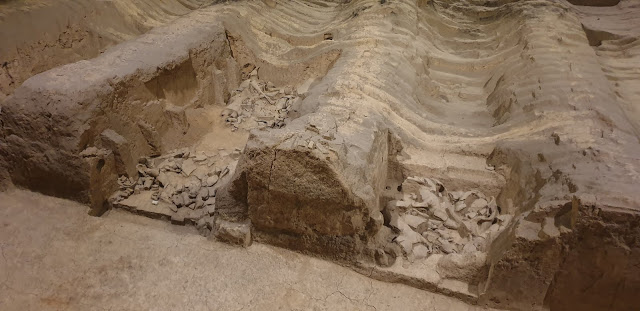
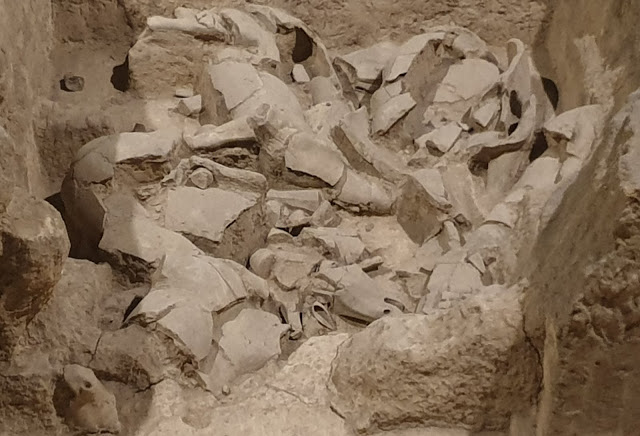
The excavation of this pit has only just begun, so it is possible to see where they have carefully removed the top cover, and you can see the broken parts of the warriors lying in a heap.

Some parts of the warriors are more discernible closer up

These parts are carefully extracted and taken to the ‘hospital’ where they are digitised and the computer will match each part with the warrior it belongs to.

Pit 1

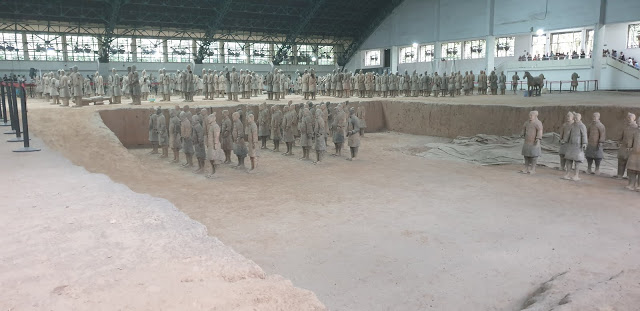
This has quite a number of standing soldiers that have been glued back together, but not necessarily complete and I notice a number if the statues were incomplete. And if they cannot find the missing pieces, then they are not added to or filled in.

The scale of the pit is enormous, and they have hardly scratched the surface in the restoration process.

What is there is a number of horses as well.

That’s at the front of the pit, a long line of statues, and what is clear is the location of the well where the first fragments were found by a farmer.

There are about eight lines of soldiers, and some lining the sides.

Midway down there is a large area currently under excavation

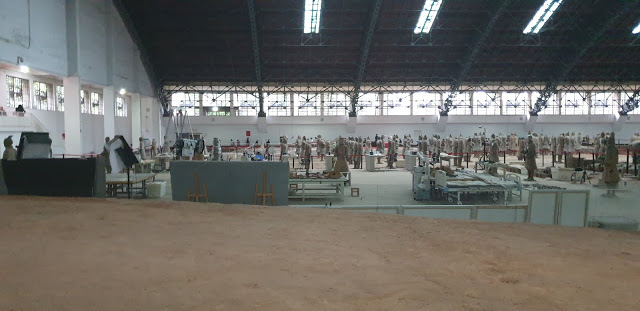
At the back is the hospital where the soldiers are reassembled.  There’s nearly a hundred in the various stages of rebuilding.  These days the soldiers are rebuilt using computer imaging.

The hospital area is where they are put back together

And these are some of the statues in various stages of reconstruction

Another two views of the size and scale of the reconstruction project

The coffee shop is also a sales centre, but there are too many people waiting for coffee and too few places to sit down.

NaNoWriMo – April 2022 – Day 24

First Dig Two Graves, the second Zoe thriller.

Zoe is now painfully reminded why she did not get involved with other people, why it was better to be responsible only for herself.  It was easy perhaps to blame John for making his own problems by not heeding her advice, but, just the same, she felt a small shred of responsibility for his current situation.

After learning that John has been kidnapped by Olga, Zoe first goes to see an old colleague, and Yuri’s friend, Dominica to interrogate her, then meets up with Yuri, and it does not end well for one of them.  After telling her he’s the elusive Romanov, Yuri informs her of the fact Olga has taken John, and that Worthington is about to use John’s mother as leverage against her.

Not knowing immediately where Olga is, but believing she will not kill him because Zoe will come to her, she detours to take care of Worthington, having finally realized why he was searching for her.  In another of her many disguises, room service visits his room, and Worthington gets more than dinner served up to him.

Of course, Yuri lies. He is not Romanov, and Romanov is not trying to kill her, but find her.

Who is her, well, you’ll have to read the book to find out.

And, as for Olga, well, hell hath no fury than a woman avenging a woman avenging her son!

Today’s writing, with Zoe languishing in a dungeon waiting for a white knight, 1,923 words, for a total of 59,911.

The A to Z Challenge – V is for – “Very well, I’ll tell you the truth”

From the age of 23, my life had been a complete work of fiction, and I have been so wrapped up in that web of lies that I no longer knew what was true and what wasn’t.

23 years and 1 day to be exact, the day after my birthday.  It was the last thing I remembered about who I might have been.

Before a truck nearly wiped me out, destroyed my car, and very neatly me with it.

My survival had been described as a miracle, a triumph for the bionic engineers who got a subject to implant their technology, overcoming the bans for creating and installing such technology in humans by simply not telling anyone.

It was why, when I work up, I was in a small room buried a long way from the surface of the planet, a sort of Frankenstein’s secret laboratory.

But I didn’t know any of this, not for a long time, not till things started to go wrong.

All I knew was what I was told, and that was that I was very lucky to be alive, that I had the best team of surgeons, and they had quite literally glued me back together.

Judging by the number of bandages, I could believe them.  It took six months for all of the operations to be completed, and another few for the skin grafts and physical healing.

Not only they were impressed by the way I had recovered, but when I finally got to look at the new me, it was as if nothing had ever happened.  Certainly, this time around, I was much better looking, physically fit, and tired, but mentally, I was still on a knife-edge.

That accident replayed in my head at least once every day, and that would probably never leave me.  There were other jumbled memories in my head that I couldn’t make sense of, of people who looked like aliens, to be in what might call a laboratory.

And then one recurring, of a woman who might have been an angel or a doctor, or both.  She never spoke, just remained by my side nearly all the time, sitting there observing me.

It felt strange, but it was not uncomfortable.  And it was hard to tell if the memories were real or just my imagination because since I’d woken and returned to what they called the real world I had not seen her again.

I never understood what the expression red-letter day meant, other than in the current context, it was to be the day they sent me home.

There were moments when I never thought I’d see home again, and then moments where I knew no one would recognize me.

The reality is they wouldn’t.  In saving me, they completely reconstructed me, from the face down.  When I first looked in the mirror my face was bandages.  Then I’d was scarred and almost bloody pulp.  In the end, staring back at me was the face of someone I didn’t know.

It was the price of being saved, but somewhere behind the tonal inflection of the plastic surgeon was the real reason for the transformation, and perhaps it didn’t have to be that way.

But I was grateful and didn’t want to rock the boat. It just makes it that little bit more difficult to consider re-joining the world.

I’d been escorted to a large lounge that overlooked a snow-covered mountain range, where the sky was blue and the sun shone brightly, giving the whole scene a sort of shimmering effect.

A touch of the glass that separated outside from in was very, very cold to the touch.  Was this a secret hideaway in the Swiss mountains, and had I been in a secret laboratory?

Or was this another planet?

Was it the drugs they’d been going me every day making me like this, unsure, uncertain, unsettled, and afraid?

I’d been brought to the room and left there, and for a half-hour I alternately sat, made coffee, stood and admired the scenery, checked all of the books in the bookcase, the bottles of alcohol in the bar, then sat again, trying to dispel the nerves.

Then the door opened, the one I tried and found locked, and to my surprise, the angel walked in, looking more beautiful than ever.

I watched her walk across the room, mesmerized.

She stopped in front of me, smiled, then sat in the chair opposite, or rather not so much sit as curl up into the contours of the seat, feet tucked under her, and arm outstretched across the back, almost as if she was inviting me to snuggle into her.

“How are you this morning Matthew?”

Her voice was equally mesmerizing, and I would be happy to listen to her reading a book or the definition of rocket science.

“Very well.”

“It’s been a long road, sometimes difficult, sometimes almost impossible, but we got there in the end.  You are, according to the doctors, fully recovered, and it’s time for you to leave.”

“About that…”

“You have questions, I suspect, and a lot of them.  They will be answered, all in good time.  But for the present, we will not be casting you out to fend for yourself.  I will be coming with you, your intermediary so to speak while you reassimilate.  Of course, you cannot go back to the life you had before, that life, that person no longer exists.  For all intents and purposes, you had died on the operating table after the accident.”

“That was not what I understood.”

What I had understood was very hazy, after they had brought me to the facility.  Bits and pieces of that night, of the accident, and the aftermath, of being in the hospital, and what I thought was me looking down at me on an operating table, being declared dead.

And then being whisked away in an ambulance to somewhere else where there were more doctors and nurses, and a man in a suit saying ‘sign this if you want to live.

I was not sure what I signed, then, but now, it was to save my life, but at what cost?

“Things are not always as they seem.  You have been treated with largely experimental treatments that otherwise could not be performed on people within the current medical regime.  Your life, however, was never in any danger, and, as you can see, you have recovered remarkably.  All we ask is that you accept the responsibility of being one of the few that have been granted a second life.  I am also another such person, and it will be my honor to help you through what can be a difficult stage, reintegration.  You are, for all intents and purposes, Andrew Tavener, but as he is no longer alive, your name will be Mathew Welles.  I was once Mary Ballen, I’m now Felicity Welkinshaw.  Names are only a part of who you are now.”

It was beginning to sound like I was one of a select group.  That Felicity was like me, and she accepted who she was, now.  Perhaps things were not so bad, a good job, and a girl like Felicity as a friend, perhaps that was only a small price to pay.

Except…

“So, I cannot go back to where I lived, where I worked, see those people I once knew, friends, family?”

“Not as Andrew, no.  But, when we believe you can manage it, you will be able to see those people but only as an outsider who has forged a relationship with all or any of them.  However, there is one exception, Wendy.  You cannot see her, not even accidentally meet her.  For that reason, your new life will be as a new junior executive for the company that oversees the medical research that you have been treated, in England.  It is for the best, and you will come to realize that.”

I shrugged.  It could be worse.  But there was something else on my mind.  Something borne out of a lot of fractured memories, after coming to the facility.

“This is going to sound very freakish, but I have to ask.  Am I still human?”

Those odd memories, I thought I was being ‘assembled’.

“Yes, though a number of what may seem like robotic changes have been made, what we regard as the next step in human evolution.  Now, I think it’s time for our going away party.  Everyone will be there.”

She stood, and held out her hand.

I took it and had an immediate tingling sensation, such a human reaction.

Followed by a single memory that came back right at that moment, a snippet of a conversation I’d overheard.

“He’s the best god-damned robot we’ve made to date, even better than Felicity, and that’s saying something.”

And the face of the man was the first one I saw as I entered the room.

Why did I notice him? 

Because I looked exactly like him.


© Charles Heath 2022