NaNoWriMo – April 2022 – Day 27

First Dig Two Graves, the second Zoe thriller.

It’s the final battle.

Never trust anyone else to do the job you should have done yourself in the first place.

It’s an interesting premise, but somehow encapsulates the ethos of this story.

Who is Romanov?  Zoe, Irina, whatever you want to call her, he’s her father.

But…

The notion that anonymously putting out a finder’s fee on his daughter’s head, coupled with the ire of Olga over the death of her son, sent everyone from the Minister in the Kremlin down into a tailspin.

The first effort, had the kidnappers just followed the rules, would have got an enormous payday, and everything would have been resolved there and then, in Marseilles.

No, people got greedy.

So did all the others, getting wind of what was at stake, enough to retire, or continue to retire in style.

Dominica, Yuri, and even Olga had she been smart.

She was not.

People didn’t have to die.  Zoe could have been spared a killing spree, and John some maybe quality time with Olga.  It’s a mistake Olga won’t make again.

And John, now with a father in law, well it’s just another surprise in a long list of surprises.

Today’s writing, with everyone, almost, getting their just desserts, 2,111 words, for a total of 65,265.

The A to Z Challenge – Y is for – “You’re not going to believe what’s happened”

I wanted to be somewhere else, away from everything and everyone.

Work, family, decisions, and pressure, all came together at once, to such an extent that, finally, I just couldn’t find a reason to get out of bed.

I looked up at the ceiling, then around the loft, a space I had to fight for, and could, at first, barely afford.  Then, it symbolized my success, the first of many.

Now?

If I was to think long and hard about where I was right now, I wouldn’t want to think long and hard about it.

Last night lingered in my mind.  The girl I thought was the one, who broke up with me, at least not by text, but in person.  It was not me, she said, but she was not ready for a serious commitment.  Neither was I, but I think I wasn’t the one for her.

Work had taken precedence, as it always did, despite the constant advice from both friends and family that I should draw a line in the sand before it was too late, I didn’t listen.

The cell phone on the side table erupted with a song that Anne had put on there some time back, a reminder of something I’d lost.

Work.

I ignored it, suppressing the temptation to throw it against the wall in the hope that breaking it would somehow provide some relief.

Then I counted down the seconds to when it would ring again.  Arty, my business partner, and truly a man with no life other than work, was persistent.

Sixty seconds passed.

That awful song!

I picked it up and answered, “What?”

“Where are you?  Tell me you’re just running late.”  No mistaking the panic in his tone.  Nothing unusual.  He was capable of doing it himself, just chose not to.  Not today.

“Get it done, and don’t call me again until it’s settled.”

I disconnected the call and switched the phone off.

I rolled over hoping the perspective would change but it was still the same space, except for one minor detail, a painting my mother did a few years back of the house by the lake we had grown up in.

It was, and still is a sleepy little town few people visited, and the young couldn’t wait to get out of, like my brother and I.  My sister, she had no big-city dreams, married the bit next door, and lived nearby.

I hadn’t seen the house, or her, since my mother’s funeral eight months before, and was always promising to go but never found the time.

I guess now was the perfect time to go home, and try to make some changes, before it was too late.

There were several ways of getting to Alpenville, tucked away on a small Cove, off an estuary, not far from the border, a picturesque setting with mountains on one side and the water on the other.

The first, by ferry, buy that had timing limitations, and I had to get to the ferry berth first.  The second, by road, but it was an unnecessarily long and convoluted drive.  The third was by floatplane, where I could go to the airport and catch a plane.

I had only done that once when an old friend of my father ran the service, a long while back.  He’d obviously sold it, and the new people had turned it into a glossy tourist brochure.

It was expedient, and I knew the flight in over the water would be a sight to behold, which clinched the deal.  It would also take the least amount of time.

I turned my phone back on, and it beeped constantly with missed messages.  I ignored them and called the airline and lucky for me there was a seat available.  But I had just on an hour to get to the airport.

Of course, everything was conspiring against me, as if fate didn’t want me to leave the city, but by a quirk of fate, I walked through the terminal office door five minutes before departure.

The girl behind the counter smiled.  “Just in time,” she said, handing me a ticket and boarding pass.

She pointed to the plane, and I could see the pilot waiting.  When I was about twenty yards from the plane, I recognized the pilot, just as she recognized me.  Lucy Benn.  Granddaughter of my father’s friend, who, it seemed, followed in her grandfather, and father’s footsteps.

“As I live and breathe, Alpenville’s prodigal son.  Returning in disgrace, are we?”

Lucy had been a girlfriend, we had been engaged, I left promising to return.  Promises not honored.  That she would hate me was understandable.  We had not parted on the best of terms, and this was the first time I’d seen her since.

“It’s nice to see you too Lucy.”

She simply shook her head, took my backpack and put it in a compartment upfront, then opened the side door to let me climb in.  I would be sitting next to her the whole way, which could be uncomfortable.  She got in the other side. Sorted put the seatbelts, then handed me headphones.

“Put them on.  If there’s trouble, I’ll let you know.”

She went through the pre-flight checks and got clearance from the tower, and we were off.

It didn’t surprise.me.she was a pilot, though back before I left home, she had always said she was going to fly real planes.  At twelve she had already been proficient at flying the small plane her father owned and operated.

She had taken me up in it once and it had been both terrifying and exhilarating.

A very few had a poker face.

Hers overall suggested contempt.

“Did you ever get to fly big planes,” I asked, picking a moment when she was distracted, looking out the side window.

She turned back.  “Did you find what you were looking for in the big city?”

Answering a question with a question, it was her way of evasion she used to use when she didn’t want to answer.

“No. It might please you to know that when I woke up this morning, I realized that I have no idea what I’m doing anymore.  My first thought was to come home but given your depth of feeling and the fact I can’t cry on my mother’s shoulder, I guess I made a terrible mistake.”

It was a sad story, but true.  I hadn’t thought for one moment I might not be welcome, except by my sister, Suzanne, who didn’t care what anyone else thought.

She said nothing, which was probably better she didn’t.

A few minutes passed before she said, “Yes. Had to go through hoops simply because I was a girl.  Showed them.  Got to fly A380s, slightly bigger than this, married a pilot, the basted cheated on me, so I came home and stuck to what I know, flying these planes.  They don’t let you down.”

So maybe we would not have spent the rest of our lives together like we had promised each other at graduation.

“I guess we both have our unresolved issues.”

We did.

The conversation ended there, and for the rest of the flight, there was silence, except when she checked in with the various flight controllers. I may also have nodded off for a whole venture when I was jolted away, we had just landed on the water and headed towards the pontoon.

I could see Suzanne and Cecile, her daughter, waiting on the pontoon.

As soon as I was off the plane she came over and gave me a hug.

“It’s good to see you, but you’re not going to believe what’s happened.  Dad’s just been taken to the hospital, and they don’t think he’s going to last much longer.”


© Charles Heath 2022

The cinema of my dreams – I always wanted to go on a treasure hunt – Episode 38

Here’s the thing…

Every time I close my eyes, I see something different.

I’d like to think the cinema of my dreams is playing a double feature but it’s a bit like a comedy cartoon night on Fox.

But these dreams are nothing to laugh about.

Once again there’s a new installment of an old feature, and we’re back on the treasure hunt.


Before we embarked on the great driving expedition, for which I was beginning to think might be harder than it seemed to Boggs’ one-track mind, we decided to go and check out the mall, and if, indeed, there was an underground river, or, at the very least, if his flooding theory was correct. 

We were going to need very old clothes, and when I left the next morning, my mother noticed it.

“I’m going to do some gardening with Boggs.  He came up with this notion we could help out tat the old folk’s home.”

“That’s a nice thought.”

And it was a lie I knew would eventually come back to bite me.  My mother hadn’t exactly told me to stop seeing Boggs, because she was beginning to think his mental capacity had been diminished after the beating.

It was a logical and perfectly acceptable reason for his odd behavior.

I went directly to Boggs’ house, and he was waiting for me.  From there it was about twenty minutes, to a spot where he knew the surrounding fence had a hole big enough for us to crawl through.

It was odd seeing the place again, sitting out a few miles from the town, looking forlorn.  At the front entrance, off the road specially built between it and the town, there were miles of cyclone fencing, with signs alternately telling people to keep out on threat of prosecution for trespass, and more recently, hazard signs proclaiming the whole area was unsafe.

From where we’d stopped, we could see the carpark, enough for hundreds of cars, a bus terminus, a taxi rank, and the front façade of the shopping center, mostly looking like the front of a castle, with towers and ramparts.

There had been auxiliary plans for a medieval theme park at one stage, that would have blended in with the mall buildings, but that had to be abandoned, even though the land allocated to it was stable.  Or so a surveyor said.

We continued on until we reached the side leading to the marina.  From this vantage point looking one way, there was the ocean, and the other, the damage to the side of the mall buildings, the cracks, and, in places, where the roof had collapsed.

This would be the first time I’d set foot in the place since it had been a mall.

It had been popular, and there was always plenty of people shopping, eating and drinking, going to the cinemas, or just having a day out.  There had also been a museum dedicated to the naval days.

Now there was nothing.

It was ironic that as many of the castles in the British Isles that had been reduced to rubble, that was exactly what was going to happen here if someone didn’t take a bulldozer to the lot and level it out.

And that might happen sooner rather than later.  This was reputed to be the site of many a disappearance of a local person.  Three girls, two men, and a boy were supposedly hidden somewhere inside the mall, but the bodies had never been found.

I was thinking of those missing people when I said, with a degree of trepidation, “Do you really want to do this?  I mean, if you’re sure there’s an underground waterway here, I’ll happily take your word for it.”

Boggs just shook his head.  “You’re the last person I’d expect to chicken out.”

“It not that.”

“Isn’t it?  I can go by myself if you’re worried about getting hurt.”

“No.  You and me together.  I have to learn to fight those fears.”

Another look, then, “OK.  “Just a little further.”

Another minute or so, we reached a large rusting cylinder which had an almost illegible sign on it say the tank held inflammable liquid.  I tapped on the metal and it sounded empty.  I guess as part of the shut down they would have had to drain the tank.  I followed the tangle of pipes that ran slightly downhill for about 20 yards and then saw the opening in the fence Boggs had referred to.

We left our bikes behind the tank, among some bushes.

We then walked down to the fence line where the pipes passed through, and Boggs pulled back the chain wire.  A closer look showed it had been cut halfway up, making it easy to slip by, easier if there were two people along for the visit.

“Did you cut the fence,” I asked him.

He didn’t answer.  I guess he wanted me to think he had.

“Have you been here before?”

“Through here, yes.  A few times.”  He held the wire away and I climbed through.  I did the same for him on the other side, and he joined me.  The two halves melded back together so from a distance no one could tell the fence had been tampered with.

From the fence, we had to cross the access road to the marina, and across a carpark, now overgrown with weeds, and bushes, with the odd tree springing up through the cracks in the concrete.

The wall, when we reached it, was where several large cracks joined, and part of the wall had fallen away leaving a hole large enough to crawl through.  I put my head through the crack and could barely see anything.  There was light coming from the seaward side, but on the other, it was inky darkness.

There was also a very disturbing aroma, like freshly laid concrete crossed with the smell of a garage repair shop.  Years of spilled oil and grease.

“Is it safe?”  I asked.

Boggs shrugged.  “It could all fall down at any moment.  You read the signs on the fence.  Basically, this is, on one hand, cheating death.  On the other, we could be on the verge of an interesting discovery.”  Then, without another word, he went through the gap and inside. 

A few seconds later, I could see the light from his cell phone.

I shrugged.  If anything happened, like the building falling on me, I probably wouldn’t feel it.  And he was right, we could be on the verge of an interesting discovery.

I followed him inside and slid down the broken concrete and bricks to a dirty but solid-feeling floor, where Boggs was waiting, the light from his phone pointed in the direction of a storefront.

And looking at a dummy still dressed in clothes left behind.

I couldn’t help but think I’d seen that style of clothes somewhere before.

© Charles Heath 2020

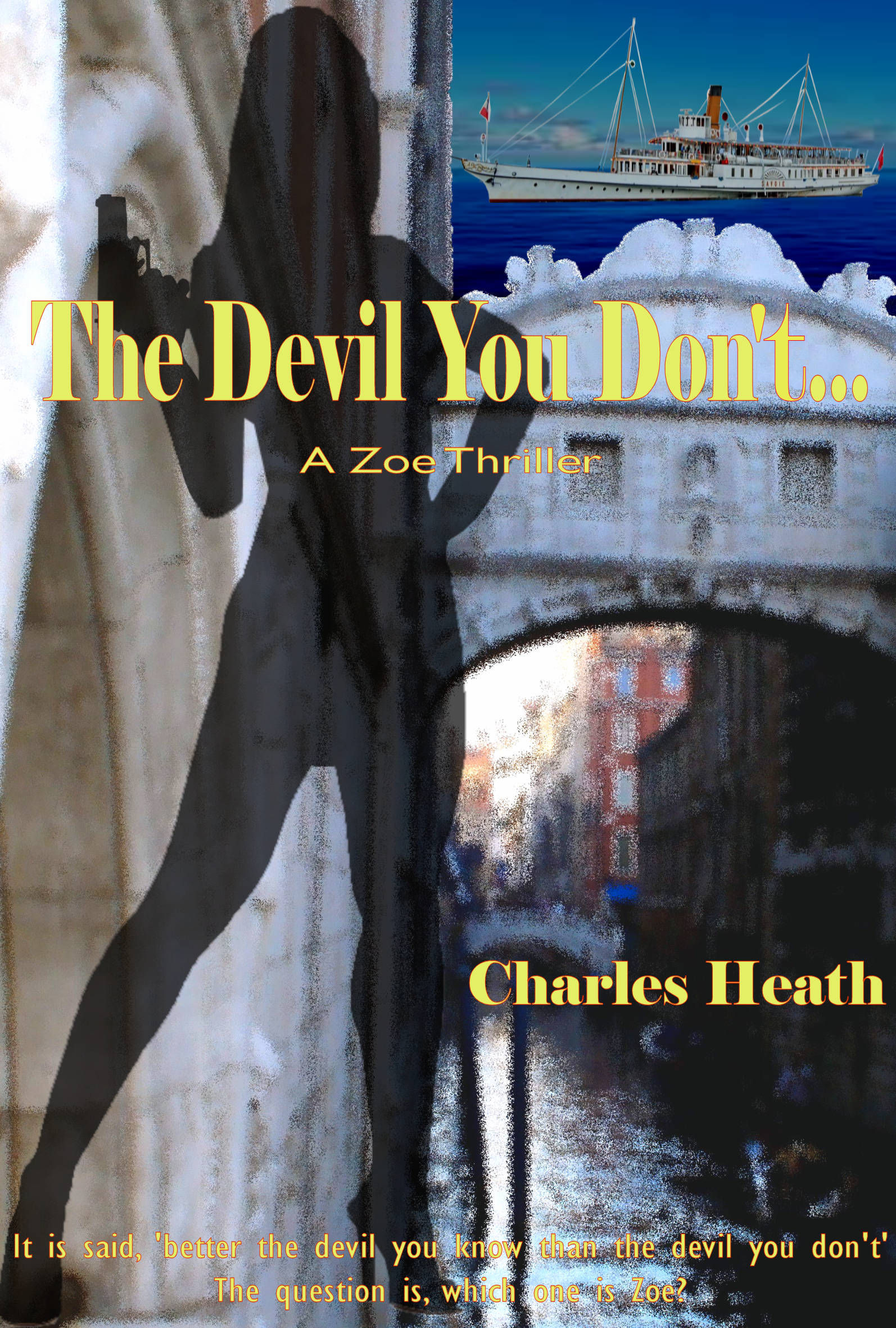
An excerpt from “The Devil You Don’t”

Available on Amazon Kindle here:  https://amzn.to/2Xyh1ow


By the time I returned to the Savoie, the rain had finally stopped, and there was a streak of blue sky to offer some hope the day would improve.

The ship was not crowded, the possibility of bad weather perhaps holding back potential passengers.  Of those I saw, a number of them would be aboard for the lunch by Phillippe Chevrier.  I thought about it, but the Concierge had told me about several restaurants in Yvoire and had given me a hand-drawn map of the village.  I think he came from the area because he spoke with the pride and knowledge of a resident.

I was looking down from the upper deck observing the last of the boarding passengers when I saw a woman, notable for her red coat and matching shoes, making a last-minute dash to get on board just before the gangway was removed.  In fact, her ungainly manner of boarding had also captured a few of the other passenger’s attention.  Now they would have something else to talk about, other than the possibility of further rain.

I saw her smile at the deckhand, but he did not smile back.  He was not impressed with her bravado, perhaps because of possible injury.  He looked at her ticket then nodded dismissively, and went back to his duties in getting the ship underway.  I was going to check the departure time, but I, like the other passengers, had my attention diverted to the woman in red.

From what I could see there was something about her.  It struck me when the light caught her as she turned to look down the deck, giving me a perfect profile.  I was going to say she looked foreign, but here, as in almost anywhere in Europe, that described just about everyone.  Perhaps I was just comparing her to Phillipa, so definitively British, whereas this woman was very definitely not.

She was perhaps in her 30’s, slim or perhaps the word I’d use was lissom, and had the look and manner of a model.  I say that because Phillipa had dragged me to most of the showings, whether in Milan, Rome, New York, London, or Paris.  The clothes were familiar, and in the back of my mind, I had a feeling I’d seen her before.

Or perhaps, to me, all models looked the same.

She looked up in my direction, and before I could divert my eyes, she locked on.  I could feel her gaze boring into me, and then it was gone as if she had been looking straight through me.  I remained out on deck as the ship got underway, watching her disappear inside the cabin.  My curiosity was piqued, so I decided to keep an eye out for her.

I could feel the coolness of the air as the ship picked up speed, not that it was going to be very fast.  With stops, the trip would take nearly two hours to get to my destination.  It would turn back almost immediately, but I was going to stay until the evening when it returned at about half eight.  It would give me enough time to sample the local fare, and take a tour of the medieval village.

Few other passengers ventured out on the deck, most staying inside or going to lunch.  After a short time, I came back down to the main deck and headed forward.  I wanted to clear my head by concentrating on the movement of the vessel through the water, breathing in the crisp, clean air, and let the peacefulness of the surroundings envelope me.

It didn’t work.

I knew it wouldn’t be long before I started thinking about why things hadn’t worked, and what part I played in it.  And the usual question that came to mind when something didn’t work out.  What was wrong with me?

I usually blamed it on my upbringing.

I had one of those so-called privileged lives, a nanny till I was old enough to go to boarding school, then sent to the best schools in the land.  There I learned everything I needed to be the son of a Duke, or, as my father called it in one of his lighter moments, nobility in waiting.

Had this been five or six hundred years ago, I would need to have sword and jousting skills, or if it had been a few hundred years later a keen military mind.  If nothing else I could ride a horse, and go on hunts, or did until they became not the thing to do.

I learned six languages, and everything I needed to become a diplomat in the far-flung British Empire, except the Empire had become the Commonwealth, and then, when no-one was looking, Britain’s influence in the world finally disappeared.  I was a man without a cause, without a vocation, and no place to go.

Computers were the new vogue and I had an aptitude for programming.  I guess that went hand in hand with mathematics, which although I hated the subject, I excelled in.  Both I and another noble outcast used to toss ideas around in school, but when it came to the end of our education, he chose to enter the public service, and I took a few of those ideas we had mulled over and turned them into a company.

About a year ago, I was made an offer I couldn’t refuse.  There were so many zeroes on the end of it I just said yes, put the money into a very grateful bank, and was still trying to come to terms with it.

Sadly, I still had no idea what I was going to do with the rest of my life.  My parents had asked me to come back home and help manage the estate, and I did for a few weeks.  It was as long as it took for my parents to drive me insane.

Back in the city, I spent a few months looking for a mundane job, but there were very few that suited the qualifications I had, and the rest, I think I intimidated the interviewer simply because of who I was.  In that time I’d also featured on the cover of the Economist, and through my well-meaning accountant, started involving myself with various charities, earning the title ‘philanthropist’.

And despite all of this exposure, even making one of those ubiquitous ‘eligible bachelor’ lists, I still could not find ‘the one’, the woman I wanted to spend the rest of my life with.  Phillipa seemed to fit the bill, but in time she proved to be a troubled soul with ‘Daddy’ issues.  I knew that in building a relationship compromise was necessary, but with her, in the end, everything was a compromise and what had happened was always going to be the end result.

It was perhaps a by-product of the whole nobility thing.  There was a certain expectation I had to fulfill, to my peers, contemporaries, parents and family, and those who either liked or hated what it represented.  The problem was, I didn’t feel like I belonged.  Not like my friend from schooldays, and now obscure acquaintance, Sebastian.  He had been elevated to his Dukedom early when his father died when he was in his twenties.  He had managed to fade from the limelight and was rarely mentioned either in the papers or the gossip columns.  He was one of the lucky ones.

I had managed to keep a similarly low profile until I met Phillipa.  From that moment, my obscurity disappeared.  It was, I could see now, part of a plan put in place by Phillipa’s father, a man who hogged the limelight with his daughter, to raise the profile of the family name and through it their businesses.  He was nothing if not the consummate self-advertisement.

Perhaps I was supposed to be the last piece of the puzzle, the attachment to the establishment, that link with a class of people he would not normally get in the front door.  There was nothing refined about him or his family, and more than once I’d noticed my contemporaries cringe at the mention of his name, or any reference of my association with him.

Yet could I truthfully say I really wanted to go back to the obscurity I had before Phillipa?  For all her faults, there were times when she had been fun to be with, particularly when I first met her when she had a certain air of unpredictability.  That had slowly disappeared as she became part of her father’s plan for the future.  She just failed to see how much he was using her.

Or perhaps, over time, I had become cynical.

I thought about calling her.  It was one of those moments of weakness when I felt alone, more alone than usual.

I diverted my attention back to my surroundings and the shoreline.  Out of the corner of my eye, I could see the woman in the red coat, making a move.  The red coat was like a beacon, a sort of fire engine red.  It was not the sort of coat most of the women I knew would wear, but on her, it looked terrific.  In fact, her sublime beauty was the one other attribute that was distinctly noticeable, along with the fact her hair was short, rather than long, and jet black.

I had to wrench my attention away from her.

A few minutes later several other passengers came out of the cabin for a walk around the deck, perhaps to get some exercise, perhaps checking up on me, or perhaps I was being paranoid.  I waited till they passed on their way forward, and I turned and headed aft.

I watched the wake sluicing out from under the stern for a few minutes, before retracing my steps to the front of the ship and there I stood against the railing, watching the bow carve its way through the water.  It was almost mesmerizing.  There, I emptied my mind of thoughts about Phillipa, and thoughts about the woman in the red coat.

Until a female voice behind me said, “Having a bad day?”

I started, caught by surprise, and slowly turned.  The woman in the red coat had somehow got very close me without my realizing it.  How did she do that?  I was so surprised I couldn’t answer immediately.

“I do hope you are not contemplating jumping.  I hear the water is very cold.”

Closer up, I could see what I’d missed when I saw her on the main deck.  There was a slight hint of Chinese, or Oriental, in her particularly around the eyes, and of her hair which was jet black.  An ancestor twice or more removed had left their mark, not in a dominant way, but more subtle, and easily missed except from a very short distance away, like now.

Other than that, she was quite possibly Eastern European, perhaps Russian, though that covered a lot of territory.  The incongruity of it was that she spoke with an American accent, and fluent enough for me to believe English was her first language.

Usually, I could ‘read’ people, but she was a clean slate.  Her expression was one of amusement, but with cold eyes.  My first thought, then, was to be careful.

“No.  Not yet.”  I coughed to clear my throat because I could hardly speak.  And blushed, because that was what I did when confronted by a woman, beautiful or otherwise.

The amusement gave way to a hint of a smile that brightened her demeanor as a little warmth reached her eyes.  “So that’s a maybe.  Should I change into my lifesaving gear, just in case?”

It conjured up a rather interesting image in my mind until I reluctantly dismissed it.

“Perhaps I should move away from the edge,” I said, moving sideways until I was back on the main deck, a few feet further away.  Her eyes had followed me, and when I stopped she turned to face me again.  She did not move closer.

I realized then she had removed her beret and it was in her left side coat pocket.  “Thanks for your concern …?”

“Zoe.”

“Thanks for your concern, Zoe.  By the way, my name is John.”

She smiled again, perhaps in an attempt to put me at ease.  “I saw you earlier, you looked so sad, I thought …”

“I might throw myself overboard?”

“An idiotic notion I admit, but it is better to be safe than sorry.”

Then she tilted her head to one side then the other, looking intently at me.  “You seem to be familiar.  Do I know you?”

I tried to think of where I may have seen her before, but all I could remember was what I’d thought earlier when I first saw her; she was a model and had been at one of the showings.  If she was, it would be more likely she would remember Phillipa, not me.  Phillipa always had to sit in the front row.

“Probably not.”  I also didn’t mention the fact she may have seen my picture in the society pages of several tabloid newspapers because she didn’t look the sort of woman who needed a daily dose of the comings and goings, and, more often than not, scandal associated with so-called celebrities.

She gave me a look, one that told me she had just realized who I was.  “Yes, I remember now.  You made the front cover of the Economist.  You sold your company for a small fortune.”

Of course.  She was not the first who had recognized me from that cover.  It had raised my profile considerably, but not the Sternhaven’s.  That article had not mentioned Phillipa or her family.  I suspect Grandmother had something to do with that, and it was, now I thought about it, another nail in the coffin that was my relationship with Phillipa.

“I wouldn’t say it was a fortune, small or otherwise, just fortunate.”  Each time, I found myself playing down the wealth aspect of the business deal.

“Perhaps then, as the journalist wrote, you were lucky.  It is not, I think, a good time for internet-based companies.”

The latter statement was an interesting fact, one she read in the Financial Times which had made that exact comment recently.

“But I am boring you.”  She smiled again.  “I should be minding my own business and leaving you to your thoughts.  I am sorry.”

She turned to leave and took a few steps towards the main cabin.

“You’re not boring me,” I said, thinking I was letting my paranoia get the better of me.  It had been Sebastian on learning of my good fortune, who had warned me against ‘a certain element here and abroad’ whose sole aim would be to separate me from my money.  He was not very subtle when he described their methods.

But I knew he was right.  I should have let her walk away.

She stopped and turned around.  “You seem nothing like the man I read about in the Economist.”

A sudden and awful thought popped into my head.  Those words were part of a very familiar opening gambit.  “Are you a reporter?”

I was not sure if she looked surprised, or amused.  “Do I look like one?”

I silently cursed myself for speaking before thinking, and then immediately ignored my own admonishment.  “People rarely look like what they are.”

I saw the subtle shake of the head and expected her to take her leave.  Instead she astonished me.

“I fear we have got off on the wrong foot.  To be honest, I’m not usually this forward, but you seemed like you needed cheering up when probably the opposite is true.  Aside from the fact this excursion was probably a bad idea.  And,” she added with a little shrug, “perhaps I talk too much.”

I was not sure what I thought of her after that extraordinary admission. It was not something I would do, but it was an interesting way to approach someone and have them ignoring their natural instinct.  I would let Sebastian whisper in my ear for a little longer and see where this was going.

“Oddly enough, I was thinking the same thing.  I was supposed to be traveling with my prospective bride.  I think you can imagine how that turned out.”

“She’s not here?”

“No.”

“She’s in the cabin?”  Her eyes strayed in that direction for a moment then came back to me.  She seemed surprised I might be traveling with someone.

“No.  She is back in England, and the wedding is off.  So is the relationship.  She dumped me by text.”

OK, why was I sharing this humiliating piece of information with her?  I still couldn’t be sure she was not a reporter.

She motioned to an empty seat, back from the edge.  No walking the plank today.  She moved towards it and sat down.  She showed no signs of being cold, nor interested in the breeze upsetting her hair.  Phillipa would be having a tantrum about now, being kept outside, and freaking out over what the breeze might be doing to her appearance.

I wondered, if only for a few seconds if she used this approach with anyone else.  I guess I was a little different, a seemingly rich businessman alone on a ferry on Lake Geneva, contemplating the way his life had gone so completely off track.

She watched as I sat at the other end of the bench, leaving about a yard between us.  After I leaned back and made myself as comfortable as I could, she said, “I have also experienced something similar, though not by text message.  It is difficult, the first few days.”

“I saw it coming.”

“I did not.”  She frowned, a sort of lifeless expression taking over, perhaps brought on by the memory of what had happened to her.  “But it is done, and I moved on.  Was she the love of your life?”

OK, that was unexpected.

When I didn’t answer, she said, “I am sorry.  Sometimes I ask personal questions without realizing what I’m doing.  It is none of my business.”  She shivered.  “Perhaps we should go back inside.”

She stood, and held out her hand.  Should I take it and be drawn into her web?  I thought of Sebastian.  What would he do in this situation?

I took her hand in mine and let her pull me gently to my feet.  “Wise choice,” she said, looking up at the sky.

It just started to rain.


© Charles Heath 2015-2020
newdevilcvr6

The A to Z Challenge – P is for “Possibilities”


How many choices could one person have?

Usually, from a very early age, you have some idea of what you intend to do with your life.

Those early choices of fireman, policeman, doctor, fighter pilot, slowly disappear from the list as the education requirements become clearer, and their degree of impossibility.

Then you have to factor in academic achievement or failure, hone situation, what blows life has dealt you, and your financial ability to fund any it all of your hopes and dreams, especially for that all-important university education, and even then, it has to be the right one.

Then there are the family aspirations where parents really want you to follow in their footsteps, as a doctor or a lawyer or in the military.

And if you get past all that, and everything has fallen into place, and you’re ready to head out on that highway of life, you should be fully imbibed with the knowledge and the drive to make everything happen.

Now I was lying in a hospital bed staring at the ceiling wondering at what point it all went wrong.

Right on the starting line where everything I had worked for was about to come to fruition, it had all come to an abrupt halt.

My memory got as far as driving home from a work party where we had been celebrating the company’s most recent success, and my progression to the next level of management, when a car failed to stop at a stop sign and T-boned me.

The car was a write-off. I was still not sure what happened to me, but I had heard someone say, in that murky twilight of pain medication, that if I was a horse, they would have to shoot me. It was the only thing I remembered between the car hitting mine and waking up in the hospital bed.

But that was not all the story, and I had plenty of time mull over everything that had happened in that last week. There was a certain symmetry to it all, as if one event led to the next, and then the next, and it was the last straw, on the last day, that broke the proverbial camel’s back.

And here’s the thing.

I would not have been in that accident had I not taken the car. I wasn’t going to, I had intended to take the train to a friends place and stay there for a few days, what the boss had told me would be a well earned rest.

Even then, I might have not taken the car, except for a cryptic text message I received from my sister, about needing to be ‘rescued’ from a bad date.

Nothing unusual for her, she was currently on a dating site binge, and after half a dozen bad experiences, I thought she had given up.

That was the thought that ran through my head as I watched her curled up in the chair next to the bed, half asleep.

Her first words, on arrival, and when she was allowed to see me, was to apologise, believing it had been her fault. She knew I hated driving in the city, so coming to get her, as I always did, had been preying on her mind, and I could see the tangible effects of it in the worried expression, and unkempt manner which was so totally unlike her.

“It was simply an accident, and could have happened to anyone,” I told her.

“You were going to Jeremy’s, I should have sorted my own problem out for once. IT’s not as if I couldn’t just call up an Uber, and now look what’s happened. I’m so sorry.”

She wouldn’t accept that it was not her fault, nor would she leave until she knew I would be OK. I didn’t understand what she meant by that because in the three discussions I had with the head doctor, I was going to make a full recovery.

He had used the work lucky more than once, and seemingly the sequence of events, and other factors like the car safety features, the angle the car had struck, and where, the fact the other driver had to dodge a pedestrian, all of it played a part.

Had they not, quite simply I would be dead.

My sister and her dating was only one aspect of how my life was being driven.

Another memory returned, from that week, that of another text message, from a girl I used to know back at University.

Erica.

She was what some might have called a free soul. She didn’t conform to what I would have called normal. Her clothes sense was somewhat odd, she always looked as though her hair needed combing, and she never had any money.

And, for a while, she lived with me, in a small, cramped room ideal for single University students on a budge, but not for two. Yet, for some strange reason, she never seemed to get in the way, or mind the closeness of our existence.

In that short period, she became my first real love, but she had said that while we were together, it was fine, but she was not seeking anything permanent. Nor, she said, did she believe in monogamy. Until she left, studies completed, I wanted to believe she would stay, but a last lingering kiss goodbye and she was gone.

Now, the message said, she wondered if I was still free, and like to meet. Of course, ten years of water had passed under that bridge, so I was not sure where it would go. I hadn’t replied, and the message was still sitting on my phone.

That invitation, however, had been n my mind moments before the crash, and I had to wonder, thinking of her, contributed to it.

Then, on top of all that, there was my parents. Married for 40 years, and the epitome of the perfect marriage.

Or so I thought.

That morning, before I went to work, I had called in to see them after my mother had called the day before saying she wanted to talk to me about something.

Before I knocked on the door, I could hear yelling from behind the door, and it seemed the perfect marriage had hit a rocky stretch.

Or simply that my father had chosen to have an affair, and had been caught out by the simplest of means, my mother answered his phone when he was out of the room thinking it was important work matters, only to discover it was his ‘floozie’.

No guessing then why my mother had called me. After hearing all I wanted to, and not wanting to face an angry couple I just headed on to work.

My mother had yet to come to the hospital to see me. My father had been, but he made no mention of her, or anything else, except to tell me if there was anything I wanted, all I had to do was ask. Then he left, and hadn’t come back.

Then, last but not least, were the rumours.

The owner of the company I worked for was getting older and didn’t have an heir. One thing or another had managed to foil his succession plans, and in the end, he did not have a son or a daughter to pass the reins to.

With the latest success, the company was about to have a bigger profile which meant more work, and plans to open branches in other cities. It was too much for one man, now in his 70s, and looking to wind down.

A rumour had started about a week before the accident that he was looking to sell, and there were at least half a dozen suitors. There was supposed to be an announcement, but it hadn’t happened while I was at work, but, considering how long I’d been in hospital, and the two weeks in an induced coma, anything could have happened.

Louisa stretched, and changed positions.

“You look better,” she said.

“Relative to what, or when?”

“Half an hour ago.”

I shook my head. Sometimes Louisa was prone to saying the oddest stuff. “What’s the deal between our parents. Dad was here for all of five minutes. Where’s our mother?”

“She left.”

OK. Blunt, but plausible. “Why?”

“Dad was being an ass.”

“Does she know I was in an accident?”

“I told her.”

“So, you’re seeing her?”

“She calls. I don’t know where she is. I think she might have gone to stay with one of our aunt’s.”

I sighed. Louise had an awfully bad memory, and I was sure one day she was going to forget who I was.

There were four sisters, mother the youngest. She had a love hate relationship with the middle two, so the best bet would be the eldest sister, Jane. Jane was also the crankiest because she hated children, never got married, and was set in her ways.

Then, there was something else lurking in the back of my mind. Another item I’d overheard when I suspect I was not meant to be listening.

I might not have a job to go back to if the company had been sold, I might not have a home to go back to if my parents had split up, and I might not be able to do anything for a long, long time. Recovery might be complete, but it wasn’t going to happen overnight.

I had a sister who blamed herself for my accident, and an old girlfriend who wanted to see me, though I suspect not like this, broken and useless. What else could there be.

Oh, yes. Another snipped from the shouting match behind the door. And an explanation why my father had all but abandoned me. My mother had also had an affair, and his son, well he was not his son.

No surprise then I had a father who didn’t want to know me.

What else could go wrong?

There was movement outside the room, and raised voices, one of which was saying that whoever was out there couldn’t go into the room. It didn’t have any effect as seconds later, a man and a police officer came in. The officer stood by the door.

Louisa looked surprised, but didn’t move.

The man, obviously a detective, came over. “Your name Oliver Watkins?”

It was, and hopefully still is. “Yes.”

“I need you to answer some questions.”

“About the accident?”

He looked puzzled for a moment, then realised what I was referring to. “No. Not the accident. About the embezzlement of 50 million dollars from the company you work for. It seems you didn’t cover your tracks very well.” He turned around to look at Louisa, “You need to leave now, miss.”

“I’ll stay.”

He nodded to the officer, “You leave now, or he will remove you.”

She looked at me, a different expression, “You didn’t tell me you were a crook, Olly.”

“Because I’m not.”

The officer escorted her from the room and shut the door.

The detective sat in the recently vacated chair. “Now, Mr Watkins. It seems there is such a thing as karma.”

© Charles Heath 2021

An excerpt from “If Only” – a work in progress

Investigation of crimes doesn’t always go according to plan, nor does the perpetrator get either found or punished.

That was particularly true in my case.  The murderer was incredibly careful in not leaving any evidence behind, to the extent that the police could not rule out whether it was a male or a female.

At one stage the police thought I had murdered my own wife though how I could be on a train at the time of the murder was beyond me.  I had witnesses and a cast-iron alibi.

The officer in charge was Detective First Grade Gabrielle Walters.  She came to me on the day after the murder seeking answers to the usual questions like, when was the last time you saw your wife, did you argue, the neighbors reckon there were heated discussions the day before.

Routine was the word she used.

Her Sargeant was a surly piece of work whose intention was to get answers or, more likely, a confession by any or all means possible.  I could sense the raging violence within him.  Fortunately, common sense prevailed.

Over the course of the next few weeks, once I’d been cleared of committing the crime, Gabrielle made a point of keeping me informed of the progress.

After three months the updates were more sporadic, and when, for lack of progress, it became a cold case, communication ceased.

But it was not the last I saw of Gabrielle.

The shock of finding Vanessa was more devastating than the fact she was now gone, and those images lived on in the same nightmare that came to visit me every night when I closed my eyes.

For months I was barely functioning, to the extent I had all but lost my job, and quite a few friends, particularly those who were more attached to Vanessa rather than me.

They didn’t understand how it could affect me so much, and since it had not happened to them, my tart replies of ‘you wouldn’t understand’ were met with equally short retorts.  Some questioned my sanity, even, for a time, so did I.

No one, it seemed, could understand what it was like, no one except Gabrielle.

She was by her own admission, damaged goods, having been the victim of a similar incident, a boyfriend who turned out to be an awfully bad boy.  Her story varied only in she had been made to witness his execution.  Her nightmare, in reliving that moment in time, was how she was still alive and, to this day, had no idea why she’d been spared.

It was a story she told me one night, some months after the investigation had been scaled down.  I was still looking for the bottom of a bottle and an emotional mess.  Perhaps it struck a resonance with her; she’d been there and managed to come out the other side.

What happened become our secret, a once-only night together that meant a great deal to me, and by mutual agreement, it was not spoken of again.  It was as if she knew exactly what was required to set me on the path to recovery.

And it had.

Since then, we saw each about once a month in a cafe.   I had been surprised to hear from her again shortly after that eventful night when she called to set it up, ostensibly for her to provide me with any updates on the case, but perhaps we had, after that unspoken night, formed a closer bond than either of us wanted to admit.

We generally talked for hours over wine, then dinner and coffee.  It took a while for me to realize that all she had was her work, personal relationships were nigh on impossible in a job that left little or no spare time for anything else.

She’d always said that if I had any questions or problems about the case, or if there was anything that might come to me that might be relevant, even after all this time, all I had to do was call her.

I wondered if this text message was in that category.  I was certain it would interest the police and I had no doubt they could trace the message’s origin, but there was that tiny degree of doubt, about whether or not I could trust her to tell me what the message meant.

I reached for the phone then put it back down again.  I’d think about it and decide tomorrow.

© Charles Heath 2018-2020

Searching for locations:  Vancouver, Canada – 1

It’s raining.  There should be no surprise there.  And cold.  It’s late December and well into winter.

Perhaps not as cold as it could be, somewhere between three and four degrees.

We are staying at the Hilton Metrotown, at Burnaby.  Metrotown is also the largest shopping mall in British Columbia.  I agree that it is large and found it a great way to get some exercise after being in and off planes for the previous 24 hours.

The first discovery for the day was a trolley bus, something that I thought didn’t exist anymore. 

The second was to discover so many global brands, but how different the products are to what we can get back in Australia.  This is particularly so for cars where we discover that GM-based vehicles and Mazdas are so much better than what is available for us.

The third was to discover it seems we are almost in the heart of Chinatown, where going out an exit on the second floor takes you to a Chinese food court, with all manner of food types, and, it seems, tea bars.  It also explained why, in one supermarket we went in, signs were in both Chinese and English.

Being still tired from the travel, we don’t venture further than the mall where we have lunch, for me, the Canadian version of KFC, which seems to defeat the purpose of trying local food.  It seems most of the food that I can see in the food shops does not seem that appetizing.

Later we go out and find a Boston Pizza with a sports bar where we indulge in a 21 ounce Molton on tap, and a lime mojito, while watching the ice hockey on the big and surrounding small screens.  The ice hockey is some world junior championship (but mostly north hemisphere hockey playing nations) and seems as ferocious as the NHL.

But it does raise a question, why isn’t there a female NHL?  I guess this wasn’t the time to canvass opinions in the bar.

Something else we discover is that alcohol is relatively cheap, and get a case of Molten Canadian ale, Bacardi Black label, and maple flavored whiskey, for about a third of what it would cost at home.  Of course, it must be cheaper than firewood in keeping Canadians warm in the dead of winter.

We didn’t try the pizza, which kind of defeated the purpose of going there.

Meanwhile back at the room, we find the local ice hockey channel, and then to make sure we get to see the Maple Leafs, plug in the computer so that we can test it.  Good to go.  

That’s tomorrow, tonight we watching the Vancouver Canucks.

“The Things We Do For Love” – Coming soon

Is love the metaphorical equivalent to ‘walking the plank’; a dive into uncharted waters?

For Henry the only romance he was interested in was a life at sea, and when away from it, he strived to find sanctuary from his family and perhaps life itself.  It takes him to a small village by the sea, s place he never expected to find another just like him, Michelle, whom he soon discovers is as mysterious as she is beautiful.

Henry had long since given up the notion of finding romance, and Michelle couldn’t get involved for reasons she could never explain, but in the end both acknowledge that something happened the moment they first met.  

Plans were made, plans were revised, and hopes were shattered.

A chance encounter causes Michelle’s past to catch up with her, and whatever hope she had of having a normal life with Henry, or anyone else, is gone.  To keep him alive she has to destroy her blossoming relationship, an act that breaks her heart and shatters his.

But can love conquer all?

It takes a few words of encouragement from an unlikely source to send Henry and his friend Radly on an odyssey into the darkest corners of the red light district in a race against time to find and rescue the woman he finally realizes is the love of his life.

The cover, at the moment, looks like this:

lovecoverfinal1

Sayings: Before you can say Jack Robinson

Once upon a time, you could have told me Jack Robinson was a jack in the box, the name meant nothing to me.

Not until Phryne Fisher came along, a rather brilliant 1920s private detective series set in the back streets of Melbourne, as well as more salubrious houses of the rich and famous.
In this series, there is a policeman, a foil for her detective moments, and a love interest that is always just beyond her grasp, a man by the name of Inspector Jack Robinson.

How coincidental.

But…

As for the saying, before you can say Jack Robinson…

It has nothing to do with Phryne Fishers Inspector.

Instead,

There is one story of a politician, Jack Robinson, in the late eighteenth century who was accused of bribery on the floor of the house of commons in England. His accuser was another MP who was asked to name the culprit, and thereby coined the term, ‘I could name him as soon as I could say Jack Robinson’.

The second was a Jack Robinson, the hero of a story written in the nineteenth century who came home to find his intended wife married to another, and to assuage the pain of it was back to the sea, ‘afore you could say Jack Robinson’.

I’m sure there’s a ton of other saying that could be attached to the name, but these seem to be the accepted reason for the term ‘before you can say Jack Robinson’.

The story behind the story: A Case of Working With the Jones Brothers

To write a private detective serial has always been one of the items at the top of my to-do list, though trying to write novels and a serial, as well as a blog, and maintain a social media presence, well, you get the idea.

But I made it happen, from a bunch of episodes I wrote a long, long time ago, used these to start it, and then continue on, then as now, never having much of an idea where it was going to end up, or how long it would take to tell the story.

That, I think is the joy of ad hoc writing, even you, as the author, have as much idea of where it’s going as the reader does.

It’s basically been in the mill since 1990, and although I finished it last year, it looks like the beginning to end will have taken exactly 30 years.  Had you asked me 30 years ago if I’d ever get it finished, the answer would be maybe?

My private detective, Harry Walthenson

I’d like to say he’s from that great literary mold of Sam Spade, or Mickey Spillane, or Phillip Marlow, but he’s not.

But, I’ve watched Humphrey Bogart play Sam Spade with much interest, and modeled Harry and his office on it.  Similarly, I’ve watched Robert Micham play Phillip Marlow with great panache, if not detachment, and added a bit of him to the mix.

Other characters come into play, and all of them, no matter what period they’re from, always seem larger than life.  I’m not above stealing a little of Mary Astor, Peter Lorre or Sidney Greenstreet, to breathe life into beguiling women and dangerous men alike.

Then there’s the title, like

The Case of the Unintentional Mummy – this has so many meanings in so many contexts, though I image back in Hollywood in the ’30s and ’40s, this would be excellent fodder for Abbott and Costello

The Case of the Three-Legged Dog – Yes, I suspect there may be a few real-life dogs with three legs, but this plot would involve something more sinister.  And if made out of plaster, yes, they’re always something else inside.

But for mine, to begin with, it was “The Case of the …”, because I had no idea what the case was going to be about, well, I did, but not specifically.

Then I liked the idea of calling it “The Case of the Brother’s Revenge” because I began to have a notion there was a brother no one knew about, but that’s stuff for other stories, not mine, so then went the way of the others.

Now it’s called ‘A Case of Working With the Jones Brothers’, finished the first three drafts, and at the editor for the last.

I have high hopes of publishing it in early 2021.  It even has a cover.

PIWalthJones1