An excerpt from “The Things We Do For Love”; In love, Henry was all at sea!

In the distance he could hear the dinner bell ringing and roused himself.  Feeling the dampness of the pillow, and fearing the ravages of pent up emotion, he considered not going down but thought it best not to upset Mrs. Mac, especially after he said he would be dining.

In the event, he wished he had reneged, especially when he discovered he was not the only guest staying at the hotel.

Whilst he’d been reminiscing, another guest, a young lady, had arrived.  He’d heard her and Mrs. Mac coming up the stairs, and then shown to a room on the same floor, perhaps at the other end of the passage.

Henry caught his first glimpse of her when she appeared at the door to the dining room, waiting for Mrs. Mac to show her to a table.

She was about mid-twenties, slim, long brown hair, and the grace and elegance of a woman associated with countless fashion magazines.  She was, he thought, stunningly beautiful with not a hair out of place, and make-up flawlessly applied.  Her clothes were black, simple, elegant, and expensive, the sort an heiress or wife of a millionaire might condescend to wear to a lesser occasion than dinner.

Then there was her expression; cold, forbidding, almost frightening in its intensity.  And her eyes, piercingly blue and yet laced with pain.  Dracula’s daughter was his immediate description of her.

All in all, he considered, the only thing they had in common was, like him, she seemed totally out of place.

Mrs. Mac came out of the kitchen, wiping her hands on her apron.  She was, she informed him earlier, chef, waitress, hotelier, barmaid, and cleaner all rolled into one.  Coming up to the new arrival she said, “Ah, Miss Andrews, I’m glad you decided to have dinner.  Would you like to sit with Mr. Henshaw, or would you like to have a table of your own?”

Henry could feel her icy stare as she sized up his appeal as a dining companion, making the hair on the back on his neck stand up.  He purposely didn’t look back.  In his estimation, his appeal rating was minus six.  Out of a thousand!

“If Mr. Henshaw doesn’t mind….”  She looked at him, leaving the query in mid-air.

He didn’t mind and said so.  Perhaps he’d underestimated his rating.

“Good.”  Mrs. Mac promptly ushered her over.  Henry stood, made sure she was seated properly and sat.

“Thank you.  You are most kind.”  The way she said it suggested snobbish overtones.

“I try to be when I can.”  It was supposed to nullify her sarcastic tone but made him sound a little silly, and when she gave him another of her icy glares, he regretted it.

Mrs. Mac quickly intervened, asking, “Would you care for the soup?”

They did, and, after writing the order on her pad, she gave them each a look, imperceptibly shook her head, and returned to the kitchen.

Before Michelle spoke to him again, she had another quick look at him, trying to fathom who and what he might be.  There was something about him.

His eyes, they mirrored the same sadness she felt, and, yes, there was something else, that it looked like he had been crying?  There was a tinge of redness.

Perhaps, she thought, he was here for the same reason she was.

No.  That wasn’t possible.

Then she said, without thinking, “Do you have any particular reason for coming here?”  Seconds later she realized she’s spoken it out loud, had hadn’t meant to actually ask, it just came out.

It took him by surprise, obviously not the first question he was expecting her to ask of him.

“No, other than it is as far from civilization, and home, as I could get.”

At least we agree on that, she thought.

It was obvious he was running away from something as well.

Given the isolation of the village and lack of geographic hospitality, it was, from her point of view, ideal.  All she had to do was avoid him, and that wouldn’t be difficult.

After getting through this evening first.

“Yes,” she agreed.  “It is that.”

A few seconds passed, and she thought she could feel his eyes on her and wasn’t going to look up.

Until he asked, “What’s your reason?”

Slight abrupt in manner, perhaps as a result of her question, and the manner in which she asked it.

She looked up.  “Rest.  And have some time to myself.”

She hoped he would notice the emphasis she had placed on the word ‘herself’ and take due note.  No doubt, she thought,  she had completely different ideas of what constituted a holiday than he, not that she had actually said she was here for a holiday.

Mrs. Mac arrived at a fortuitous moment to save them from further conversation.


Over the entree, she wondered if she had made a mistake coming to the hotel.  Of course, there had been no possible way she could know than anyone else might have booked the same hotel, but realized it was foolish to think she might end up in it by herself.

Was that what she was expecting?

Not a mistake then, but an unfortunate set of circumstances, which could be overcome by being sensible.

Yet, there he was, and it made her curious, not that he was a man, by himself, in the middle of nowhere, hiding like she was, but for very different reasons.

On discreet observance whilst they ate, she gained the impression his air of light-heartedness was forced and he had no sense of humor.

This feeling was engendered by his looks, unruly dark hair, and permanent frown.  And then there was his abysmal taste in clothes on a tall, lanky frame.  They were quality but totally unsuited to the wearer.

Rebellion was written all over him.

The only other thought crossing her mind, and rather incongruously, was he could do with a decent feed.  In that respect, she knew now from the mountain of food in front of her, he had come to the right place.

“Mr. Henshaw?”

He looked up.  “Henshaw is too formal.  Henry sounds much better,” he said, with a slight hint of gruffness.

“Then my name is Michelle.”

Mrs. Mac came in to take their order for the only main course, gather up the entree dishes, then return to the kitchen.

“Staying long?” she asked.

“About three weeks.  Yourself?”

“About the same.”

The conversation dried up.

Neither looked at the other, rather at the walls, out the window, towards the kitchen, anywhere.  It was, she thought, almost unbearably awkward.


Mrs. Mac returned with a large tray with dishes on it, setting it down on the table next to theirs.

“Not as good as the usual cook,” she said, serving up the dinner expertly, “but it comes a good second, even if I do say so myself.  Care for some wine?”

Henry looked at Michelle.  “What do you think?”

“I’m used to my dining companions making the decision.”

You would, he thought.  He couldn’t help but notice the cutting edge of her tone.  Then, to Mrs. Mac, he named a particular White Burgundy he liked and she bustled off.

“I hope you like it,” he said, acknowledging her previous comment with a smile that had nothing to do with humor.

“Yes, so do I.”

Both made a start on the main course, a concoction of chicken and vegetables that were delicious, Henry thought, when compared to the bland food he received at home and sometimes aboard my ship.

It was five minutes before Mrs. Mac returned with the bottle and two glasses.  After opening it and pouring the drinks, she left them alone again.

Henry resumed the conversation.  “How did you arrive?  I came by train.”

“By car.”

“Did you drive yourself?”

And he thought, a few seconds later, that was a silly question, otherwise she would not be alone, and certainly not sitting at this table. With him.

“After a fashion.”

He could see that she was formulating a retort in her mind, then changed it, instead, smiling for the first time, and it served to lighten the atmosphere.

And in doing so, it showed him she had another more pleasant side despite the fact she was trying not to look happy.

“My father reckons I’m just another of ‘those’ women drivers,” she added.

“Whatever for?”

“The first and only time he came with me I had an accident.  I ran up the back of another car.  Of course, it didn’t matter to him the other driver was driving like a startled rabbit.”

“It doesn’t help,” he agreed.

“Do you drive?”

“Mostly people up the wall.”  His attempt at humor failed.  “Actually,” he added quickly, “I’ve got a very old Morris that manages to get me where I’m going.”

The apple pie and cream for dessert came and went and the rapport between them improved as the wine disappeared and the coffee came.  Both had found, after getting to know each other better, their first impressions were not necessarily correct.

“Enjoy the food?” Mrs. Mac asked, suddenly reappearing.

“Beautifully cooked and delicious to eat,” Michelle said, and Henry endorsed her remarks.

“Ah, it does my heart good to hear such genuine compliments,” she said, smiling.  She collected the last of the dishes and disappeared yet again.

“What do you do for a living,” Michelle asked in an off-hand manner.

He had a feeling she was not particularly interested and it was just making conversation.

“I’m a purser.”

“A what?”

“A purser.  I work on a ship doing the paperwork, that sort of thing.”

“I see.”

“And you?”

“I was a model.”

“Was?”

“Until I had an accident, a rather bad one.”

“Oh, I’m sorry.”

So that explained the odd feeling he had about her.

As the evening had worn on, he began to think there might be something wrong, seriously wrong with her because she didn’t look too well.  Even the carefully applied makeup, from close up, didn’t hide the very pale, and tired look, or the sunken, dark ringed eyes.

“I try not to think about it, but it doesn’t necessarily work.  I’ve come here for peace and quiet, away from doctors and parents.”

“Then you will not have to worry about me annoying you.  I’m one of those fall-asleep-reading-a-book types.”

Perhaps it would be like ships passing in the night and then smiled to himself about the analogy.

Dinner now over, they separated.

Henry went back to the lounge to read a few pages of his book before going to bed, and Michelle went up to her room to retire for the night.

But try as he might, he was unable to read, his mind dwelling on the unusual, yet the compellingly mysterious person he would be sharing the hotel with.

Overlaying that original blurred image of her standing in the doorway was another of her haunting expressions that had, he finally conceded, taken his breath away, and a look that had sent more than one tingle down his spine.

She may not have thought much of him, but she had certainly made an impression on him.


© Charles Heath 2015-2020
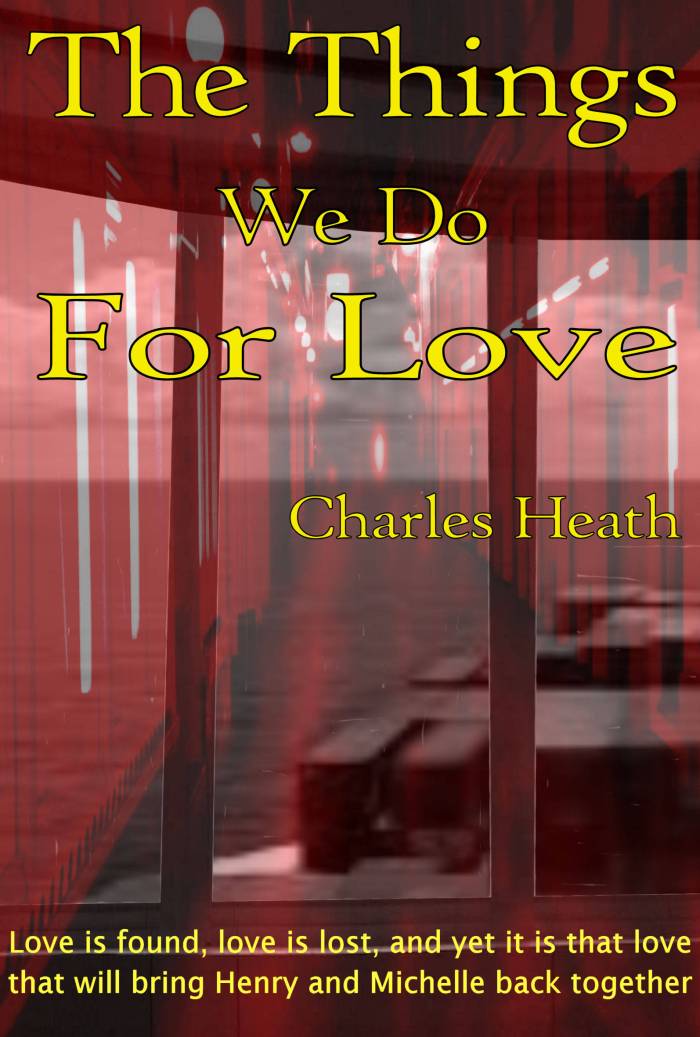
lovecoverfinal1

In a word: will

Now that I’ve hit the age of 65, I now have to give some consideration to creating a will.

You know, that document that specifies which child gets what, or if you think any or all of them don’t deserve what’s left of the hard-earned millions, which cat or dog will inherit a fortune.

A will is both a reason for siblings or beneficiaries to kill to get a reward or the fact you have to make one so that the state doesn’t inherit your fortune.

This is only one use of the word.

Another might be that it’s possible to have something like the will to carry on.

Carry on what?

Life, a marriage, a business relationship.

Does it require will power, or is it a matter of where there’s a will there’s a way?

I will come over. I will turn up tomorrow.

In this sense, it is promoting futility.

Of course, seeing is believing.

And as a bit of self-serving advertising, I’m going to promote a new story, actually titled, The Will.

Inheritance can resolve monetary problems, and not only that, set one of the siblings up financially for life. All they have to do is wrest the family home from the dying fingers of a mother who had seen it all.

Into the mix comes the grandson, a man who sometimes is a son but mostly a grandson, someone who doesn’t fit in, who doesn’t want to follow family tradition, and who prefers to go to his grandmothers rather than going home to his family.

He is constantly appalled at his mother’s lack of respect for her mother and suddenly finds himself in the middle of a battle between his grandmother and her daughter, his mother, over the family estate.

Who will win?

That’s a question that will be answered when you read the book.

The cinema of my dreams – I never wanted to go to Africa – Episode 27

Our hero knows he’s in serious trouble.

The problem is, there are familiar faces and a question of who is a friend and who is foe made all the more difficult because of the enemy, if it was the enemy, simply because it didn’t look or sound or act like the enemy.

Now, it appears, his problems stem from another operation he participated in.


It took almost an hour to recover.  Monroe didn’t come looking for me, so I think they knew it would take some time for me to get my legs back.

And it felt good to stand under the hot shower for twenty-odd minutes, letting the warmth of the water sink into my bones and clear my head.

And think.

How long had Bamfield have an eye on me?  It was a question that sprung to mind the moment I saw him in the desert camp.  I’d heard if you were transferred to one of his commands, at some point, it was not because it was another posting, it was because he wanted you there.

I’d been specially selected by Bamfield personally, out of the preliminary training camp, to further my military career under his oversight.  I’d made it very clear from the outset that I was not interested in a commission, that I preferred the lower ranks.  Officers were a different breed, and I’d not been cut from that cloth.  Bamfield had admitted as much when I was first interviewed by him, and several other’s on what I soon discovered was his selection panel.

They were charged by him to find the best of the best.

And at that first interview, I’d disagreed with his assessment.  I’d been in trouble before, and the military was the only place I could go if I didn’t want to serve a stretch in jail.  Perhaps it was that innate ability of mine to seek out and become embroiled in trouble that caught his attention.

Certainly over time he and his instructors had honed those skills to a more refined set that, in civilian life, would set me up for a long stay in prison.  It begged the question of what I was going to do with myself after the military had finished with me, a question I hadn’t really thought about until I’d been shunted to my last post in a training school of sorts.

I realised now that it had been Bamfield sidelining me until an operation crying out for my particular talents came along.

That disastrous operation with Treen.

Was it his?  Or was it someone else who pulled it together, and he just provided the manpower.  It had been the first major active offshore operation I’d been on.  There’d been a few skirmishes along the way, but that was the first, and in a zone where I don’t think we were meant to be operating.

That had, I thought, been the sole purview of the CIA, and if I looked back on what had happened, there was no doubt the two agents we were supposed to pull out were CIA operatives, it had got too hot for them to stay, and they had clandestinely called for help.

It begged another question, was Bamfield CIA or working with the CIA, with or without the military hierarchy knowing?

The thing is, if it had been pulled off, as expected, no one would be any the wiser in that country, but once they found out, by whatever means it happened, the proverbial had hit the fan.  It goes hand in hand with trusting people on the ground who were purportedly working against their country’s regime, for better or worse.

That country had a ‘friendly’ government, that had been ‘supported’ and then been deposed in the usual coup by the military, and, afterwards, the new hardliners got the benefit of those times when the country was a friendly and had military hardware and knowledge to wage war clandestinely or otherwise with its neighbours, given willingly.

Lessons hadn’t been learned after a particular middle east debacle.  Maybe lessons would never be learned.  Just look at the number of times had relations turned sour after a coup and agents had to hastily withdraw.  It seems that my visit had been at the end of another of those ‘diplomatic’ missions that had gone wrong.

If this was such a case, I was about to find out.

© Charles Heath 2019

No stone unturned… – A short story

Mondays were usually a slow day to start the week, a brief few hours after the storm the was every Friday. Some chose to come in late, others gathered on arrival to have a team debriefing.

Our department chose to have a debriefing, and it was my job to analyze all the data and turn it into a graphical representation that basically said the business was heading in the right direction – up.

But, this Monday morning, the circumstances were slightly different.

The head of the company had personally sent both an email and a memo to every employee, an event that had never happened before.

In fact, for most of us, it was an eye-opening discovery, one where had the company not become engulfed in a scandal of international proportions, his identity might have remained a secret.

Not that it mattered to the 15,000 odd people who worked for the company, because the bottom line was that it would not affect us, or our employment.  Well, that was the message the email and the memo was primarily about.

Was it too little too late?

The problem was that the morning’s paper’s headlines screamed scandal in large letters and then went on to describe how the company was basically a front for laundering money associated with various criminal activities. It stopped short of accusing the company’s upper management of being criminals, but it was clear, reading between the lines, they had to know something was wrong.

I walked into the meeting room where all of the Department’s staff were seated, talking among themselves, that dying down the moment I closed the door behind me. On the desk in front of each was one of the three morning papers, all with basically the same story.

I didn’t bring a paper in with me, nor a copy of the email, or the memo. I was hoping the meeting was not going to be about the scandal.

I was wrong.

It was one of those companies where everyone knew everyone. I knew everyone in the room, and regarded most as friends as well as workmates. The company promoted from within and on merit, and with this, I had the respect of everyone who worked under me.

I could see by the mood, and looks of expectation, that trust was going to be tested.

“I suspect that everyone has seen the news, and hopefully read both missives from management regarding the situation the company finds itself.”

That was met with a murmur of agreement.

“It was also, for some, a surprise.”

For others, it was not. Our department was basically in place to ensure that all transactions were conducted properly and that clients’ accounts were managed within the guidelines set by the company, and the various government institutions responsible for financial affairs.

Several of the senior officers had come to me with what they regarded as anomalies, and I have given them the authority to investigate. It was also within my remit to advise the relevant government authority. Most of the anomalies had simply been oversights by the account manager, except for one, which as far as I was aware, had been cleared.

Or not.

“Can we safely assume that Wally Anderson’s somewhat abrupt was not as described?”

Wally Anderson’s abrupt departure had been described to me in a one-line email, ‘taking some personal time to work through some family issues’. In the week leading up to his departure he had become increasingly agitated, and one call one of the others had taken in his absence was from a reporter.

It was one of his accounts that remained doubtful, until shortly after he left when an external investigator was brought in.

But I had a difficult line to walk, trying to placate both sides of the spectrum and management, and as a leader. Respect could be won or lost in a matter of words.

“That might or might not be the case, but the odds are, given what we’re reading, that there may be room for doubt. However, despite what we may conclude, or deduce, it is better for all of us to keep an open mind. I suspect, at some point, again based on what I read, we might be approached by the police or representatives of a number of regulatory organizations for information.”

It was as far as I got.

The side door swung open, and my superior, the Chief Accountant, strode in, along with the mystery man who was, the papers said, the Owner, followed by the harried personal assistant.

“Mr. Nelson…”

The Chief Accountant stood front and center to the group. I thought it wise to stand off to one side, the opposite, in fact, the Owner, now standing just inside the door, next to his PA who was quietly talking into her cell phone.

“I’ll take over from here, Max.”

He switched his attention back to the group and took a few seconds to run his eye over all over them, almost as if he was looking for someone or something.

“I have spent the last 48 hours in rather tedious discussions with the regulators who insist that they received information about the Ridley investigation. Unfortunately, without consulting the company, he took part of the results of the investigation to them. Was anyone here aware of his actions?”

Another eye cast over the group, and, in the end, a glance at me.

I felt responsible to answer for the group.

“Investigations are conducted by individuals, and as far as I was concerned, the Ridley investigation was his. As equally that after he departed, that investigation was completed and cleared. Are you intimating that it wasn’t?”

I knew as much about it as the others.

“It was, until someone else reopened it, and reported it. We believe it was someone in this room.”

“That’s not possible,” I said. “I have oversight of all the officers in this room, and the ability to monitor everything they do and everything they look at. You know the security protocols in place in the software itself.”

“An investigation into the software has been implemented, and it shows that certain log files were altered so that the user log wouldn’t show who looked at the records. Someone with database experience.”

“We’re basically auditors not database managers.”

“Well, someone apparently is. Everyone is on notice. We will find out who it was, and believe me when I say we will leave no stone unturned in the process.”

An almost imperceptible not from the Owner, the harried PA was still on the cell phone, the Chief Accountant gave the group another steely look, then glared at me, said, “My office, one hour,” then left pulling the other two along in his wake.

I cast an eye over the group, picking out those whom I suspected were capable of performing such a search and destroy operation. Three.

“My door is open for anyone who might have any information, with the promise of anonymity.”

I left them with that and also left.

What should have been a quiet morning’s discussion just became a witch hunt where someone would be burnt at the stake. Whether they were guilty or not.

© Charles Heath 2020-2021

Writing about writing a book – Day 24, a missing piece of the puzzle

There’s always the necessity for creating backstories so that the reader doesn’t come across a part of the story that doesn’t make sense.

Perhaps one of my failings is that I have to go over what I’ve already written, sometimes to make sure there is continuity and that what I’ve written makes sense.

This collection of memories our main character is having serves the purpose of setting up later plot points, but more importantly, is supposed to give the reader an idea of what the main character has gone through before arriving at the start of the story.

This part will serve to provide a little more information on the relationship between Bill and Barry, though I rather like the nickname I gave him.

“Bastards,” Killer muttered.

We called him ‘Killer’ because it was the nickname the Army had given him.  We were sharing the guard duty and had spoken briefly over the watch, but up till then, the silence had stretched over an hour or so.  It didn’t take long for anyone to realize he was a man of few words.

He’d been in the regular army for years and asked for the posting.  He’d made Sergeant several times, only to lose those same stripes for fighting, usually after R&R and a bout of heavy drinking.  Now assigned to our platoon to lend his experience, the conscripts were expecting him to ‘look after’ them.  Other than myself and the Lieutenant, he was the only other regular soldier.  Unfortunately for them, he hated both conscripts and the Viet Cong in varying degrees, and depending on his mood there was little tolerance left for the rest of us.

“The people who sent us here or the people trying to kill us?” I asked before I realized I’d spoken.

I didn’t hear the reply, the skies opening up with another torrential downpour that lasted for about five minutes, and going as fast as it came.  When the sun finally came up, it would make the atmosphere steamy, hot, and unbearable.  It was quite warm now, and I was feeling both uncomfortable, and fatigued.

Killer looked just as stoic as he had before the rain.  He looked at me.  “Damn weather.  Worse than home.”

“Scotland?”

“Scapa Flow, Kirkwall.  I should have been an engineer on ships like my father, but I was too stupid.  Joined the Army, finished up here.  What’s your excuse?”

“Square peg in a round hole.  The army seems to handle us in its stride.”  It was more or less the truth.  I joined the Army to get away from my parents.

“That it does.  That it does.”

The rain came and went, during which the rest of the camp roused and went about its business.  It had been a long night for some, still getting over the shock of the attack, and the ever-pervading thought the enemy was still out there, biding their time.  It would be, for them, a waiting game, waiting for the conditions to wear us down, and lose concentration as inevitably we would.

Certainly, by the time we were relieved from sentry duty, I felt I was in no condition to match wits with a donkey, let alone the enemy on his own home ground.  When I stumbled over to the mess area and looked at the tired and haggard looks on the faces of the platoon, I realized that went for all of us.

Killer and I managed to get about an hour’s rest before the call came to move out, rain or no rain, and after a breakfast to make anyone ill, we left.  For hours it rained.  No one spoke as we strained to listen over the rain spattering on the undergrowth, all the time expecting the unexpected.  That was the benefit of the surprise attack; we no longer took for granted we would be safe.

Water gathered in pools along the trail, hiding any chance of seeing landmines.  Rainwater and sweat ran into our eyes, making it difficult to see.  Water leaked everywhere, making it very uncomfortable.  This was not war.  This was utter stupidity.

I was about to remark on the futility of it all to the Lieutenant, who had taken the lead, when one second he was talking to me and the next he crashed to the ground, a sniper’s bullet killing him instantly.   Someone yelled “Contact” and we hit the ground, bullets flying all around us. 

Too late, I thought, as I felt the hit of what seemed to be a large rock, then the searing pain in my leg, just as I hit the ground…


© Charles Heath 2015-2021

Searching for locations: Vancouver, Canada – 2

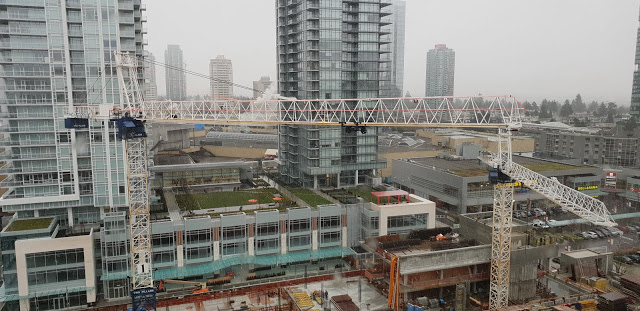
This morning we wake up to rain.  Or so we thought.  Taking a closer look out the window of our room on the 16th floor, we notice the rain is speckled with snowflakes.  As the morning progressed the snow got harder until there were flurries.

 Later we discover this is called wet snow by the local Vancouverians, and whilst they winge a lot over the endless rain, to them rain is infinitely better than snow.

To us, by the afternoon, it was almost blizzard conditions, with lots of snow.  Then the only thing is that it does not accumulate on most of the ground so there are no drifts to play in.

Because the weather is so dismal we decided not to go into Vancouver to do some sightseeing because the clouds were down to the ground and then the snow set in.

Another interesting fact is that construction workers do not go off the job if it’s raining, or worse when it is snowing.  Our room overlooks a new apartment complex under construction and the workers battled on through what seemed like appalling conditions.

At four in the afternoon, the Maple Leafs are playing the Ohio Blue Jackets, in Ohio.  It is a game we expect they will win.  Sparks is the goalkeeper, not Anderson, they’re playing back to back games and Anderson’s starting tomorrow.

They win, four goals to two.  

Just before darkness falls, about four thirty, the snow stops and there is a little rain, which melts the snow.

Time to go up to the executive lounge to get some snacks and coffee, then sleep because the next day we’re taking on the Trans Canada highway from Vancouver to Kamloops.

The forecast is for snow, more snow, and just for a change, more snow.

Memories of the conversations with my cat – 96

As some may be aware, but many not, Chester, my faithful writing assistant, mice catcher, and general pain in the neck, passed away some months ago.

Recently I was running a series based on his adventures, under the title of Past Conversations with my cat.

For those who have not had the chance to read about all of his exploits I will run the series again from Episode 1

These are the memories of our time together…

20160902_093753

This is Chester

Once again, it’s Sunday night, and he’s looking for a philosophical discussion.   COVID 19 is off the topic list.

He’s suitably disappointed that the Trump Show is over, as far as we are aware, though he’s not surprised.

But he is worried that two cats have tested positive.

I try to tell him that it is in New York, about 18,000 miles away, where there are over 200,000 cases. We have just over 1,000 and they are all isolated so we cannot be harmed.

I guess it’s hard to convince a cat when his mind is made up.

We’ve also taken the grandchildren off the list of topics too,

They arrive a few hours ago, and studiously ignored him when they arrived. I tried to point out that he was in hiding when they arrived, but again, the stubbornness of opinion is amazing, or normal.

I should be used to this sort of contrariness.

So, what is on the discussion list?

Outlander, Season 5 Episode 10. Well, I say, we haven’t seen it yet, so don’t tell me what the plots is.

He looks at me as if I’m mad. I only get to see it when you do, he says. How should I know what the plot is?  In fact, what is the plot?

Time travel, I say.

Pity we can’t do some of that, he says.

Why I asked, and really, I should know better.

Because I could go back to the day you came to the pet shop and hide. I have given you 18 years to improve, and you’re still the same as you were then.

Discussion over.

Not his favorite food for dinner tonight.

An excerpt from “The Devil You Don’t”

Available on Amazon Kindle here:  https://amzn.to/2Xyh1ow


By the time I returned to the Savoie, the rain had finally stopped, and there was a streak of blue sky to offer some hope the day would improve.

The ship was not crowded, the possibility of bad weather perhaps holding back potential passengers.  Of those I saw, a number of them would be aboard for the lunch by Phillippe Chevrier.  I thought about it, but the Concierge had told me about several restaurants in Yvoire and had given me a hand-drawn map of the village.  I think he came from the area because he spoke with the pride and knowledge of a resident.

I was looking down from the upper deck observing the last of the boarding passengers when I saw a woman, notable for her red coat and matching shoes, making a last-minute dash to get on board just before the gangway was removed.  In fact, her ungainly manner of boarding had also captured a few of the other passenger’s attention.  Now they would have something else to talk about, other than the possibility of further rain.

I saw her smile at the deckhand, but he did not smile back.  He was not impressed with her bravado, perhaps because of possible injury.  He looked at her ticket then nodded dismissively, and went back to his duties in getting the ship underway.  I was going to check the departure time, but I, like the other passengers, had my attention diverted to the woman in red.

From what I could see there was something about her.  It struck me when the light caught her as she turned to look down the deck, giving me a perfect profile.  I was going to say she looked foreign, but here, as in almost anywhere in Europe, that described just about everyone.  Perhaps I was just comparing her to Phillipa, so definitively British, whereas this woman was very definitely not.

She was perhaps in her 30’s, slim or perhaps the word I’d use was lissom, and had the look and manner of a model.  I say that because Phillipa had dragged me to most of the showings, whether in Milan, Rome, New York, London, or Paris.  The clothes were familiar, and in the back of my mind, I had a feeling I’d seen her before.

Or perhaps, to me, all models looked the same.

She looked up in my direction, and before I could divert my eyes, she locked on.  I could feel her gaze boring into me, and then it was gone as if she had been looking straight through me.  I remained out on deck as the ship got underway, watching her disappear inside the cabin.  My curiosity was piqued, so I decided to keep an eye out for her.

I could feel the coolness of the air as the ship picked up speed, not that it was going to be very fast.  With stops, the trip would take nearly two hours to get to my destination.  It would turn back almost immediately, but I was going to stay until the evening when it returned at about half eight.  It would give me enough time to sample the local fare, and take a tour of the medieval village.

Few other passengers ventured out on the deck, most staying inside or going to lunch.  After a short time, I came back down to the main deck and headed forward.  I wanted to clear my head by concentrating on the movement of the vessel through the water, breathing in the crisp, clean air, and let the peacefulness of the surroundings envelope me.

It didn’t work.

I knew it wouldn’t be long before I started thinking about why things hadn’t worked, and what part I played in it.  And the usual question that came to mind when something didn’t work out.  What was wrong with me?

I usually blamed it on my upbringing.

I had one of those so-called privileged lives, a nanny till I was old enough to go to boarding school, then sent to the best schools in the land.  There I learned everything I needed to be the son of a Duke, or, as my father called it in one of his lighter moments, nobility in waiting.

Had this been five or six hundred years ago, I would need to have sword and jousting skills, or if it had been a few hundred years later a keen military mind.  If nothing else I could ride a horse, and go on hunts, or did until they became not the thing to do.

I learned six languages, and everything I needed to become a diplomat in the far-flung British Empire, except the Empire had become the Commonwealth, and then, when no-one was looking, Britain’s influence in the world finally disappeared.  I was a man without a cause, without a vocation, and no place to go.

Computers were the new vogue and I had an aptitude for programming.  I guess that went hand in hand with mathematics, which although I hated the subject, I excelled in.  Both I and another noble outcast used to toss ideas around in school, but when it came to the end of our education, he chose to enter the public service, and I took a few of those ideas we had mulled over and turned them into a company.

About a year ago, I was made an offer I couldn’t refuse.  There were so many zeroes on the end of it I just said yes, put the money into a very grateful bank, and was still trying to come to terms with it.

Sadly, I still had no idea what I was going to do with the rest of my life.  My parents had asked me to come back home and help manage the estate, and I did for a few weeks.  It was as long as it took for my parents to drive me insane.

Back in the city, I spent a few months looking for a mundane job, but there were very few that suited the qualifications I had, and the rest, I think I intimidated the interviewer simply because of who I was.  In that time I’d also featured on the cover of the Economist, and through my well-meaning accountant, started involving myself with various charities, earning the title ‘philanthropist’.

And despite all of this exposure, even making one of those ubiquitous ‘eligible bachelor’ lists, I still could not find ‘the one’, the woman I wanted to spend the rest of my life with.  Phillipa seemed to fit the bill, but in time she proved to be a troubled soul with ‘Daddy’ issues.  I knew that in building a relationship compromise was necessary, but with her, in the end, everything was a compromise and what had happened was always going to be the end result.

It was perhaps a by-product of the whole nobility thing.  There was a certain expectation I had to fulfill, to my peers, contemporaries, parents and family, and those who either liked or hated what it represented.  The problem was, I didn’t feel like I belonged.  Not like my friend from schooldays, and now obscure acquaintance, Sebastian.  He had been elevated to his Dukedom early when his father died when he was in his twenties.  He had managed to fade from the limelight and was rarely mentioned either in the papers or the gossip columns.  He was one of the lucky ones.

I had managed to keep a similarly low profile until I met Phillipa.  From that moment, my obscurity disappeared.  It was, I could see now, part of a plan put in place by Phillipa’s father, a man who hogged the limelight with his daughter, to raise the profile of the family name and through it their businesses.  He was nothing if not the consummate self-advertisement.

Perhaps I was supposed to be the last piece of the puzzle, the attachment to the establishment, that link with a class of people he would not normally get in the front door.  There was nothing refined about him or his family, and more than once I’d noticed my contemporaries cringe at the mention of his name, or any reference of my association with him.

Yet could I truthfully say I really wanted to go back to the obscurity I had before Phillipa?  For all her faults, there were times when she had been fun to be with, particularly when I first met her when she had a certain air of unpredictability.  That had slowly disappeared as she became part of her father’s plan for the future.  She just failed to see how much he was using her.

Or perhaps, over time, I had become cynical.

I thought about calling her.  It was one of those moments of weakness when I felt alone, more alone than usual.

I diverted my attention back to my surroundings and the shoreline.  Out of the corner of my eye, I could see the woman in the red coat, making a move.  The red coat was like a beacon, a sort of fire engine red.  It was not the sort of coat most of the women I knew would wear, but on her, it looked terrific.  In fact, her sublime beauty was the one other attribute that was distinctly noticeable, along with the fact her hair was short, rather than long, and jet black.

I had to wrench my attention away from her.

A few minutes later several other passengers came out of the cabin for a walk around the deck, perhaps to get some exercise, perhaps checking up on me, or perhaps I was being paranoid.  I waited till they passed on their way forward, and I turned and headed aft.

I watched the wake sluicing out from under the stern for a few minutes, before retracing my steps to the front of the ship and there I stood against the railing, watching the bow carve its way through the water.  It was almost mesmerizing.  There, I emptied my mind of thoughts about Phillipa, and thoughts about the woman in the red coat.

Until a female voice behind me said, “Having a bad day?”

I started, caught by surprise, and slowly turned.  The woman in the red coat had somehow got very close me without my realizing it.  How did she do that?  I was so surprised I couldn’t answer immediately.

“I do hope you are not contemplating jumping.  I hear the water is very cold.”

Closer up, I could see what I’d missed when I saw her on the main deck.  There was a slight hint of Chinese, or Oriental, in her particularly around the eyes, and of her hair which was jet black.  An ancestor twice or more removed had left their mark, not in a dominant way, but more subtle, and easily missed except from a very short distance away, like now.

Other than that, she was quite possibly Eastern European, perhaps Russian, though that covered a lot of territory.  The incongruity of it was that she spoke with an American accent, and fluent enough for me to believe English was her first language.

Usually, I could ‘read’ people, but she was a clean slate.  Her expression was one of amusement, but with cold eyes.  My first thought, then, was to be careful.

“No.  Not yet.”  I coughed to clear my throat because I could hardly speak.  And blushed, because that was what I did when confronted by a woman, beautiful or otherwise.

The amusement gave way to a hint of a smile that brightened her demeanor as a little warmth reached her eyes.  “So that’s a maybe.  Should I change into my lifesaving gear, just in case?”

It conjured up a rather interesting image in my mind until I reluctantly dismissed it.

“Perhaps I should move away from the edge,” I said, moving sideways until I was back on the main deck, a few feet further away.  Her eyes had followed me, and when I stopped she turned to face me again.  She did not move closer.

I realized then she had removed her beret and it was in her left side coat pocket.  “Thanks for your concern …?”

“Zoe.”

“Thanks for your concern, Zoe.  By the way, my name is John.”

She smiled again, perhaps in an attempt to put me at ease.  “I saw you earlier, you looked so sad, I thought …”

“I might throw myself overboard?”

“An idiotic notion I admit, but it is better to be safe than sorry.”

Then she tilted her head to one side then the other, looking intently at me.  “You seem to be familiar.  Do I know you?”

I tried to think of where I may have seen her before, but all I could remember was what I’d thought earlier when I first saw her; she was a model and had been at one of the showings.  If she was, it would be more likely she would remember Phillipa, not me.  Phillipa always had to sit in the front row.

“Probably not.”  I also didn’t mention the fact she may have seen my picture in the society pages of several tabloid newspapers because she didn’t look the sort of woman who needed a daily dose of the comings and goings, and, more often than not, scandal associated with so-called celebrities.

She gave me a look, one that told me she had just realized who I was.  “Yes, I remember now.  You made the front cover of the Economist.  You sold your company for a small fortune.”

Of course.  She was not the first who had recognized me from that cover.  It had raised my profile considerably, but not the Sternhaven’s.  That article had not mentioned Phillipa or her family.  I suspect Grandmother had something to do with that, and it was, now I thought about it, another nail in the coffin that was my relationship with Phillipa.

“I wouldn’t say it was a fortune, small or otherwise, just fortunate.”  Each time, I found myself playing down the wealth aspect of the business deal.

“Perhaps then, as the journalist wrote, you were lucky.  It is not, I think, a good time for internet-based companies.”

The latter statement was an interesting fact, one she read in the Financial Times which had made that exact comment recently.

“But I am boring you.”  She smiled again.  “I should be minding my own business and leaving you to your thoughts.  I am sorry.”

She turned to leave and took a few steps towards the main cabin.

“You’re not boring me,” I said, thinking I was letting my paranoia get the better of me.  It had been Sebastian on learning of my good fortune, who had warned me against ‘a certain element here and abroad’ whose sole aim would be to separate me from my money.  He was not very subtle when he described their methods.

But I knew he was right.  I should have let her walk away.

She stopped and turned around.  “You seem nothing like the man I read about in the Economist.”

A sudden and awful thought popped into my head.  Those words were part of a very familiar opening gambit.  “Are you a reporter?”

I was not sure if she looked surprised, or amused.  “Do I look like one?”

I silently cursed myself for speaking before thinking, and then immediately ignored my own admonishment.  “People rarely look like what they are.”

I saw the subtle shake of the head and expected her to take her leave.  Instead she astonished me.

“I fear we have got off on the wrong foot.  To be honest, I’m not usually this forward, but you seemed like you needed cheering up when probably the opposite is true.  Aside from the fact this excursion was probably a bad idea.  And,” she added with a little shrug, “perhaps I talk too much.”

I was not sure what I thought of her after that extraordinary admission. It was not something I would do, but it was an interesting way to approach someone and have them ignoring their natural instinct.  I would let Sebastian whisper in my ear for a little longer and see where this was going.

“Oddly enough, I was thinking the same thing.  I was supposed to be traveling with my prospective bride.  I think you can imagine how that turned out.”

“She’s not here?”

“No.”

“She’s in the cabin?”  Her eyes strayed in that direction for a moment then came back to me.  She seemed surprised I might be traveling with someone.

“No.  She is back in England, and the wedding is off.  So is the relationship.  She dumped me by text.”

OK, why was I sharing this humiliating piece of information with her?  I still couldn’t be sure she was not a reporter.

She motioned to an empty seat, back from the edge.  No walking the plank today.  She moved towards it and sat down.  She showed no signs of being cold, nor interested in the breeze upsetting her hair.  Phillipa would be having a tantrum about now, being kept outside, and freaking out over what the breeze might be doing to her appearance.

I wondered, if only for a few seconds if she used this approach with anyone else.  I guess I was a little different, a seemingly rich businessman alone on a ferry on Lake Geneva, contemplating the way his life had gone so completely off track.

She watched as I sat at the other end of the bench, leaving about a yard between us.  After I leaned back and made myself as comfortable as I could, she said, “I have also experienced something similar, though not by text message.  It is difficult, the first few days.”

“I saw it coming.”

“I did not.”  She frowned, a sort of lifeless expression taking over, perhaps brought on by the memory of what had happened to her.  “But it is done, and I moved on.  Was she the love of your life?”

OK, that was unexpected.

When I didn’t answer, she said, “I am sorry.  Sometimes I ask personal questions without realizing what I’m doing.  It is none of my business.”  She shivered.  “Perhaps we should go back inside.”

She stood, and held out her hand.  Should I take it and be drawn into her web?  I thought of Sebastian.  What would he do in this situation?

I took her hand in mine and let her pull me gently to my feet.  “Wise choice,” she said, looking up at the sky.

It just started to rain.


© Charles Heath 2015-2020

newdevilcvr6

The A to Z Challenge – D is for – “Did you hear that?”

It started with a phone call, a phone call that I never expected to get.

I was one of those people who went through life, almost invisible.  It was not what I wanted, it just happened.

I was not the sociable sort, at school I tended to spend my time studying and then being labeled a nerd, I didn’t make friends, except for those who wanted help with their homework.

Few friends in elementary school, fewer in middle school, and none in college, that is no one that you could call a true friend.  They were more acquaintances that were there for the help I could give them, but no one that would invite me to parties, or to just hang out.

That continues on into university. Except there were several new acquainted that were a little more than that, though not quite BFFs.

There was one, in particular, Anna, who was one of the study group, the one who needed the most help, someone who had been wavering on returning after the first year.

My trouble was that I liked her more than she liked me, my opinion of course, based on what I called the indifference factor, but perhaps I had more expectations than she did

She was doing uni because it was expected of her, not because she wanted to be there.  She could take it or leave it, and the last time I spoke to her, she was going to leave.

And when she left to go back home, it was the last time I expected to see or hear from her.

Until that phone call.

“What are you doing this weekend?”

A dumb question, nothing of course, but I wouldn’t tell her that.  I was still in shock that Anna would call me, for anything other than school, if at all.

“Not a lot.”

“Good.  How would you like to housesit with me?”

House sit?  Surely she had a dozen others who would do anything for her.  She was that popular and well-liked.  And would probably be far more amusing than I ever could be.

“If you like.  I had no idea you did house minding.”

“I don’t, but an aunt is going away for the weekend, and she wants someone to look after the cat.  I hope you like cats.  And gardens.  It has a nice garden.”

Cats I could take or leave.  Gardens, it was probably a birdbath, two beds of roses, a large tree with a seat under it, and neighbors peering over the fence.

But it was a weekend somewhere else other than my little room, and Anna would be there.  Maybe I could try to get past my shyness and actually talk to her.

“OK.  I’m in.  Do I need to bring anything?”

“No.  I’ll send you the address and see you there at 5 pm. Friday.”

Why did I get the feeling I was being set up?

That feeling of impending doing followed me down the path from the front gate to the front door.

Far from the house being a small thatch cottage, based on the address she gave me, it turned out to be a three-story manor house with a large outhouse that looked to be once a stable and coach house

It seemed far too large to be a house for one person.

When I rang the doorbell, I expected a butler to answer the door, but it was Anna herself.

“Nice place,” I said.

“Too large and too hard to maintain.  Were trying to convince her that she would be better off in something smaller.  But you should see the back.”

Based on the front garden which could happily grace the front cover of any country living magazine, I couldn’t wait.

She let me pass and closed the door behind us.  It sounded like the vault was closing and there would be no damage until the timer released the locks.

Inside, the whole place reeked of heritage and antiques, and the personality of its owner.  The walls had paintings, table tops had old magazines, the seats worn leather, and worn carpet squares covered floorboards that creaked when you walked on them.

At the end of a long corridor was the kitchen at the end if the house, after passing several sitting and dining rooms.  It was a very large house and raised a very important question.

She had not mentioned any family or relatives with anything like the wealth this house exuded.  In fact, she had often implied that she was just an ordinary person.

This was anything but ordinary.

I caught up with her on the back patio, just off a large sunroom, to view what had to be an acre or more of manicured laws, garden beds, and trees.  All it was missing was a maze.

“Do you actually have a secret life?”

“I was always told not to advertise our wealth.”

“Isn’t showing me this, a form of advertising?  After all, I’m apparently from the wrong side of the tracks.”

“I trust you.”

“But you don’t know me, or anything about me.”

“Why do you think you’re here?”

If I wanted to make an educated guess, my first thought was to set me up for something, for the very reason she was aloof, and people like her, and those she kept company with, were not people like me associated with.

I was surprised not to see the two girls I’d once nicknamed ‘the dynamic duo’, Melissa and Winona, with her.  Maybe they would turn up later.

My second thought, the most improbable reason, was that she wanted to get to know me, but, why choose a place like this?  To make me feel small, grateful, impressed? Ten minutes in a Cafe was all she needed to find out what she needed to know about me.

An alarm bell went off when I asked her where I could get a drink of water, and she said, the kitchen, but didn’t really know where it was. I got an instant bad feeling.

That was followed by a bang that I thought came from the rear of the house.

“Did you hear that?” I asked.

“You hear all sorts of noises in places like these.”

If she wasn’t worried, neither was I.

Then the door chime rang.

“You expecting more visitors?”  My internal fear factor was rising exponentially.

“No, but I’d better find out who it is, just in case.”

I shrugged and headed towards where she indicated the kitchen was, the rear of the house, what I would call an educated guess

After I found the kitchen, not technically at the rear, I returned to find my worst fears had come true.  Not only the dynamic duo but also their boyfriends, Chad and Lester, two of the worst bullies from school days.

“Well, look who it is.”  Chad was particularly menacing.

A glance to the side, it was hard to tell if Anna was looking pleased or neutral, but she wasn’t surprised. I glanced in Anna’s direction and all I got was a tilt of her head.

“Shouldn’t you be down the country club trying to prove you’re a new version of your drunken bully of a father?”

His smile turned into a very angry look.  “Don’t go there, Scanlon.”

“Why are you here then?”

I expected to hear Anna had invited them.  Instead, “we’re here to make sure Anna doesn’t make a mistake.”

“I don’t need your help or advice Chad.  In fact, you should leave.”

None of the four looked like they had any intention of leaving.  “Not until we’ve impressed upon both of you, the error of your ways.  We thought you were smarter than this or did Scanlon force himself on you?”

She shook her head, not necessarily in anger, but more in despair.  “I don’t know where you get your ideas from Chad, but you are very much mistaken.  So, I will only say this once more, Chad,” she added quietly, “otherwise you will find yourself in a world of pain.  Leave now while you still can.”

Chad, being Chad, was the master of ceremonies, puffed up as he had been in the schoolyard when he was about the unleash his gang on some poor misguided fool, usually me, or one of three others.  But it was Melissa who spoke instead, “You go teach Scanlon a lesson outside by the pool while we have a talk to Anna.”

Lester took the cue, came over, and grabbed me by the shoulder.  I thought about trying to shrug him off, but Chad was across the room before I could initiate anything.  Best to leave calmly and sort it out outside.

I gave Anna a last look, but she was wearing her poker face.  Had she set this up?  It seemed as though she hadn’t, but then, it didn’t look like she was worried about the dynamic duo.

I shrugged.

Intentional or not, Chad and Lester were about to learn a very valuable lesson, and revenge, at least on them, was going to be sweet.

©  Charles Heath 2022

An excerpt from “Amnesia”, a work in progress

I remembered a bang.
I remembered the car slewing sideways.
I remember another bang, and then it was lights out.
When I opened my eyes again, I saw the sky.
Or I could be under water.
Everything was blurred.
I tried to focus but I couldn’t. My eyes were full of water.
What happened?
Why was I lying down?
Where was I?
I cast my mind back, trying to remember.
It was a blank.
What, when, who, why and where, questions I should easily be able to answer. Questions any normal person could answer.
I tried to move. Bad, bad mistake.
I did not realise the scream I heard was my own. Just before my body shut down.

“My God! What happened?”
I could hear, not see. I was moving, lying down, looking up.
I was blind. Everything was black.
“Car accident, hit a tree, sent the passenger flying through the windscreen. Pity to poor bastard didn’t get the message that seat belts save lives.”
Was I that poor bastard?
“Report?” A new voice, male, authoritative.
“Multiple lacerations, broken collar bone, broken arm in three places, both legs broken below the knees, one badly. We are not sure of internal injuries, but ruptured spleen, cracked ribs and pierced right lung are fairly evident, x-rays will confirm that and anything else.”
“What isn’t broken?”
“His neck.”
“Then I would have to say we are looking at the luckiest man on the planet.”
I heard shuffling of pages.
“OR1 ready?”
“Yes. On standby since we were first advised.”
“Good. Let’s see if we can weave some magic.”

Magic.
It was the first word that popped into my head when I surfaced from the bottom of the lake. That first breath, after holding it for so long, was sublime, and, in reality, agonising.

Magic, because it seemed like I’d spent a long time under water.
Or somewhere.
I tried to speak, but couldn’t. The words were just in my head.
Was it night or was it day?
Was it hot, or was it cold?
Where was I?
Around me it felt cool.
It was very quiet. No noise except for the hissing of air through an air-conditioning vent. Or perhaps that was the sound of pure silence. And with it the revelation that silence was not silent. It was noisy.
I didn’t try to move.
Instinctively, somehow I knew not to.
A previous bad experience?
I heard what sounded like a door opening, and very quiet footsteps slowly come into the room. They stopped. I could hear breathing, slightly laboured, a sound I’d heard before.
My grandfather.
He had smoked all his life, until he was diagnosed with lung cancer. But for years before that he had emphysema. The person in the room was on their way, down the same path. I could smell the smoke.
I wanted to tell whoever it was the hazards of smoking.
I couldn’t.
I heard a metallic clanging sound from the end of the bed. A moment later the clicking of a pen, then writing.
“You are in a hospital.” A female voice suddenly said. “You’ve been in a very bad accident. You cannot talk, or move, all you can do, for the moment, is listen to me. I am a nurse. You have been here for 45 days, and just come out of a medically induced coma. There is nothing to be afraid of.”
She had a very soothing voice.
I felt her fingers stroke the back of my hand.
“Everything is fine.”
Define fine, I thought. I wanted to ask her what ‘fine’ meant.
“Just count backwards from 10.”
Why?
I didn’t reach seven.

Over the next ten days, that voice became my lifeline to sanity. Every morning I longed to hear it, if only for the few moments she was in the room, those few waking moments when I believed she, and someone else who never spoke, were doing tests. I knew it had to be someone else because I could smell the essence of lavender. My grandmother had worn a similar scent.
It rose above the disinfectant.
I also believed she was another doctor, not the one who had been there the day I arrived. Not the one who had used some ‘magic’ and kept me alive.
It was then, in those moments before she put me under again, that I thought, what if I was paralysed? It would explain a lot. A chill went through me.

The next morning she was back.
“My name is Winifred. We don’t know what your name is, not yet. In a few days, you will be better, and you will be able to ask us questions. You were in an accident, and you were very badly injured, but I can assure you there will be no lasting damage.”
More tests, and then, when I expected the lights to go out, they didn’t. Not for a few minutes more. Perhaps this was how I would be integrated back into the world. A little bit at a time.
The next morning, she came later than usual, and I’d been awake for a few minutes. “You have bandages over your eyes and face. You had bad lacerations to your face, and glass in your eyes. We will know more when the bandages come off in a few days. Your face will take longer to heal. It was necessary to do some plastic surgery.”
Lacerations, glass in my eyes, car accident, plastic surgery. By logical deduction, I knew I was the poor bastard thrown through the windscreen. It was a fleeting memory from the day I was admitted.
How could that happen?
That was the first of many startling revelations. The second was the fact I could not remember the crash. Equally shocking, in that same moment was the fact I could not remember before the crash either, and only vague memories after.
But the most shattering of all these revelations was the one where I realised I could not remember my name.
I tried to calm down, sensing a rising panic.
I was just disoriented, I told myself. After 45 days in an induced coma, it had messed with my mind, and it was only a temporary lapse. Yes, that’s what it was, a temporary lapse. I would remember tomorrow. Or the next day.
Sleep was a blessed relief.

The next day I didn’t wake feeling nauseous. Perhaps they’d lowered the pain medication. I’d heard that morphine could have that effect. Then, how could I know that, but not who I am?
I knew now Winifred the nurse was preparing me for something very bad. She was upbeat, and soothing, giving me a new piece of information each morning. This morning, “You do not need to be afraid. Everything is going to be fine. The doctor tells me you are going to recover with very little scarring. You will need some physiotherapy to recover from your physical injuries, but that’s in the future. We need to let you mend a little bit more before then.”
So, I was not going to be able to leap out of bed, and walk out of the hospital any time soon. I don’t suppose I’d ever leapt out of bed, except as a young boy. I suspect I’d sustained a few broken bones. I guess learning to walk again was the least of my problems.
But, there was something else. I picked it up in the timbre of her voice, a hesitation, or reluctance. It sent another chill through me.
This time I was left awake for an hour before she returned.
This time sleep was restless.
There were scenes playing in my mind, nothing I recognised, and nothing lasting longer than a glimpse. Me. Others, people I didn’t know. Or perhaps I knew them and couldn’t remember them.
Until they disappeared, slowly like the glowing dot in the centre of the computer screen, before finally fading to black.

The morning the bandages were to come off she came in bright and early and woken me. I had another restless night, the images becoming clearer, but nothing recognisable.
“This morning the doctor will be removing the bandages over your eyes. Don’t expect an immediate effect. Your sight may come back quickly or it may come back slowly, but we believe it will come back.”
I wanted to believe I was not expecting anything, but I was. It was probably human nature. I did not want to be blind as well as paralysed. I had to have at least one reason to live.
I dozed again until I felt a gentle hand on my shoulder. I could smell the lavender, the other doctor was back. And I knew the hand on my shoulder was Winifred’s. She told me not to be frightened.
I was amazed to realise in that moment, I wasn’t.
I heard the scissors cutting the bandages.
I felt the bandage being removed, and the pressure coming off my eyes. I could feel the pads covering both eyes.
Then a moment where nothing happened.
Then the pads being gently lift and removed.
Nothing.
I blinked my eyes, once, twice. Nothing.
“Just hold on a moment,” Winifred said. A few seconds later I could feel a cool towel wiping my face, and then gently wiping my eyes. Perhaps there was ointment, or something else in them.
Then a flash. Well, not a flash, but like when a light is turned on and off. A moment later, it was brighter, not the inky blackness of before, but a shade of grey.
She wiped my eyes again.
I blinked a few more times, and then the light returned, and it was like looking through water, at distorted and blurry objects in the distance.
I blinked again, and she wiped my eyes again.
Blurry objects took shape. A face looking down on me, an elderly lady with a kindly face, surely Winifred, who was smiling. And on the opposite side of the bed, the doctor, a Chinese woman of indescribable beauty.
I nodded.
“You can see?”
I nodded again.
“Clearly?”
I nodded.
“Very good. We will just draw the curtains now. We don’t want to overdo it. Tomorrow we will be taking off the bandages on your face. Then, it will be the next milestone. Talking.”
I couldn’t wait.

When morning came, I found myself afraid. Winifred had mentioned scarring, there were bandages on my face. I knew, but wasn’t quite sure how I knew, I wasn’t the handsomest of men before the accident, so this might be an improvement.
I was not sure why I didn’t think it would be the case.
They came at mid morning, the nurse, Winifred, and the doctor, the exquisite Chinese. Perhaps she was the distraction, taking my mind of the reality of what I was about to see.
Another doctor came into the room, before the bandages were removed, and he was introduced as the plastic surgeon that had ‘repaired’ the ravages of the accident. It had been no easy job, but, with a degree of egotism, he did say he was one of the best in the world.
I found it hard to believe, if he was, that he would be at a small country hospital.
“Now just remember, what you might see now is not how you will look in a few months time.”
Warning enough.
The Chinese doctor started removing the bandages. She did it slowly, and made sure it did not hurt. My skin was very tender, and I suspect still bruised, either from the accident or the surgery, I didn’t know.
Then it was done.
The plastic surgeon gave his work a thorough examination and seemed pleased with his work. “Coming along nicely,” he said to the other doctor. He issued some instructions on how to manage the skin, nodded to me, and I thanked him before he left.
I noticed Winifred had a mirror in her hand, and was somewhat reticent in using it. “As I said,” she said noticing me looking at the mirror, “what you see now will not be the final result. The doctor said it was going to heal with very little scarring. You have been very fortunate he was available. Are you ready?”
I nodded.
She showed me.
I tried not to be reviled at the red and purple mess that used to be my face. At a guess I would have to say he had to put it all back together again, but, not knowing what I looked like before, I had no benchmark. All I had was a snippet of memory that told me I was not the tall, dark, and handsome type.
And I still could not talk. There was a reason, he had worked on that area too. Just breathing hurt. I think I would save up anything I had to say for another day. I could not even smile. Or frown. Or grimace.
“We’ll leave you for a while. Everyone needs a little time to get used to the change. I suspect you are not sure if there has been an improvement on last year’s model. Well, time will tell.”
A new face?
I could not remember the old one.
My memory still hadn’t returned.