An excerpt from “The Things We Do For Love”; In love, Henry was all at sea!

In the distance he could hear the dinner bell ringing and roused himself.  Feeling the dampness of the pillow, and fearing the ravages of pent up emotion, he considered not going down but thought it best not to upset Mrs. Mac, especially after he said he would be dining.

In the event, he wished he had reneged, especially when he discovered he was not the only guest staying at the hotel.

Whilst he’d been reminiscing, another guest, a young lady, had arrived.  He’d heard her and Mrs. Mac coming up the stairs, and then shown to a room on the same floor, perhaps at the other end of the passage.

Henry caught his first glimpse of her when she appeared at the door to the dining room, waiting for Mrs. Mac to show her to a table.

She was about mid-twenties, slim, long brown hair, and the grace and elegance of a woman associated with countless fashion magazines.  She was, he thought, stunningly beautiful with not a hair out of place, and make-up flawlessly applied.  Her clothes were black, simple, elegant, and expensive, the sort an heiress or wife of a millionaire might condescend to wear to a lesser occasion than dinner.

Then there was her expression; cold, forbidding, almost frightening in its intensity.  And her eyes, piercingly blue and yet laced with pain.  Dracula’s daughter was his immediate description of her.

All in all, he considered, the only thing they had in common was, like him, she seemed totally out of place.

Mrs. Mac came out of the kitchen, wiping her hands on her apron.  She was, she informed him earlier, chef, waitress, hotelier, barmaid, and cleaner all rolled into one.  Coming up to the new arrival she said, “Ah, Miss Andrews, I’m glad you decided to have dinner.  Would you like to sit with Mr. Henshaw, or would you like to have a table of your own?”

Henry could feel her icy stare as she sized up his appeal as a dining companion, making the hair on the back on his neck stand up.  He purposely didn’t look back.  In his estimation, his appeal rating was minus six.  Out of a thousand!

“If Mr. Henshaw doesn’t mind….”  She looked at him, leaving the query in mid-air.

He didn’t mind and said so.  Perhaps he’d underestimated his rating.

“Good.”  Mrs. Mac promptly ushered her over.  Henry stood, made sure she was seated properly and sat.

“Thank you.  You are most kind.”  The way she said it suggested snobbish overtones.

“I try to be when I can.”  It was supposed to nullify her sarcastic tone but made him sound a little silly, and when she gave him another of her icy glares, he regretted it.

Mrs. Mac quickly intervened, asking, “Would you care for the soup?”

They did, and, after writing the order on her pad, she gave them each a look, imperceptibly shook her head, and returned to the kitchen.

Before Michelle spoke to him again, she had another quick look at him, trying to fathom who and what he might be.  There was something about him.

His eyes, they mirrored the same sadness she felt, and, yes, there was something else, that it looked like he had been crying?  There was a tinge of redness.

Perhaps, she thought, he was here for the same reason she was.

No.  That wasn’t possible.

Then she said, without thinking, “Do you have any particular reason for coming here?”  Seconds later she realized she’s spoken it out loud, had hadn’t meant to actually ask, it just came out.

It took him by surprise, obviously not the first question he was expecting her to ask of him.

“No, other than it is as far from civilization, and home, as I could get.”

At least we agree on that, she thought.

It was obvious he was running away from something as well.

Given the isolation of the village and lack of geographic hospitality, it was, from her point of view, ideal.  All she had to do was avoid him, and that wouldn’t be difficult.

After getting through this evening first.

“Yes,” she agreed.  “It is that.”

A few seconds passed, and she thought she could feel his eyes on her and wasn’t going to look up.

Until he asked, “What’s your reason?”

Slight abrupt in manner, perhaps as a result of her question, and the manner in which she asked it.

She looked up.  “Rest.  And have some time to myself.”

She hoped he would notice the emphasis she had placed on the word ‘herself’ and take due note.  No doubt, she thought,  she had completely different ideas of what constituted a holiday than he, not that she had actually said she was here for a holiday.

Mrs. Mac arrived at a fortuitous moment to save them from further conversation.


Over the entree, she wondered if she had made a mistake coming to the hotel.  Of course, there had been no possible way she could know than anyone else might have booked the same hotel, but realized it was foolish to think she might end up in it by herself.

Was that what she was expecting?

Not a mistake then, but an unfortunate set of circumstances, which could be overcome by being sensible.

Yet, there he was, and it made her curious, not that he was a man, by himself, in the middle of nowhere, hiding like she was, but for very different reasons.

On discreet observance whilst they ate, she gained the impression his air of light-heartedness was forced and he had no sense of humor.

This feeling was engendered by his looks, unruly dark hair, and permanent frown.  And then there was his abysmal taste in clothes on a tall, lanky frame.  They were quality but totally unsuited to the wearer.

Rebellion was written all over him.

The only other thought crossing her mind, and rather incongruously, was he could do with a decent feed.  In that respect, she knew now from the mountain of food in front of her, he had come to the right place.

“Mr. Henshaw?”

He looked up.  “Henshaw is too formal.  Henry sounds much better,” he said, with a slight hint of gruffness.

“Then my name is Michelle.”

Mrs. Mac came in to take their order for the only main course, gather up the entree dishes, then return to the kitchen.

“Staying long?” she asked.

“About three weeks.  Yourself?”

“About the same.”

The conversation dried up.

Neither looked at the other, rather at the walls, out the window, towards the kitchen, anywhere.  It was, she thought, almost unbearably awkward.


Mrs. Mac returned with a large tray with dishes on it, setting it down on the table next to theirs.

“Not as good as the usual cook,” she said, serving up the dinner expertly, “but it comes a good second, even if I do say so myself.  Care for some wine?”

Henry looked at Michelle.  “What do you think?”

“I’m used to my dining companions making the decision.”

You would, he thought.  He couldn’t help but notice the cutting edge of her tone.  Then, to Mrs. Mac, he named a particular White Burgundy he liked and she bustled off.

“I hope you like it,” he said, acknowledging her previous comment with a smile that had nothing to do with humor.

“Yes, so do I.”

Both made a start on the main course, a concoction of chicken and vegetables that were delicious, Henry thought, when compared to the bland food he received at home and sometimes aboard my ship.

It was five minutes before Mrs. Mac returned with the bottle and two glasses.  After opening it and pouring the drinks, she left them alone again.

Henry resumed the conversation.  “How did you arrive?  I came by train.”

“By car.”

“Did you drive yourself?”

And he thought, a few seconds later, that was a silly question, otherwise she would not be alone, and certainly not sitting at this table. With him.

“After a fashion.”

He could see that she was formulating a retort in her mind, then changed it, instead, smiling for the first time, and it served to lighten the atmosphere.

And in doing so, it showed him she had another more pleasant side despite the fact she was trying not to look happy.

“My father reckons I’m just another of ‘those’ women drivers,” she added.

“Whatever for?”

“The first and only time he came with me I had an accident.  I ran up the back of another car.  Of course, it didn’t matter to him the other driver was driving like a startled rabbit.”

“It doesn’t help,” he agreed.

“Do you drive?”

“Mostly people up the wall.”  His attempt at humor failed.  “Actually,” he added quickly, “I’ve got a very old Morris that manages to get me where I’m going.”

The apple pie and cream for dessert came and went and the rapport between them improved as the wine disappeared and the coffee came.  Both had found, after getting to know each other better, their first impressions were not necessarily correct.

“Enjoy the food?” Mrs. Mac asked, suddenly reappearing.

“Beautifully cooked and delicious to eat,” Michelle said, and Henry endorsed her remarks.

“Ah, it does my heart good to hear such genuine compliments,” she said, smiling.  She collected the last of the dishes and disappeared yet again.

“What do you do for a living,” Michelle asked in an off-hand manner.

He had a feeling she was not particularly interested and it was just making conversation.

“I’m a purser.”

“A what?”

“A purser.  I work on a ship doing the paperwork, that sort of thing.”

“I see.”

“And you?”

“I was a model.”

“Was?”

“Until I had an accident, a rather bad one.”

“Oh, I’m sorry.”

So that explained the odd feeling he had about her.

As the evening had worn on, he began to think there might be something wrong, seriously wrong with her because she didn’t look too well.  Even the carefully applied makeup, from close up, didn’t hide the very pale, and tired look, or the sunken, dark ringed eyes.

“I try not to think about it, but it doesn’t necessarily work.  I’ve come here for peace and quiet, away from doctors and parents.”

“Then you will not have to worry about me annoying you.  I’m one of those fall-asleep-reading-a-book types.”

Perhaps it would be like ships passing in the night and then smiled to himself about the analogy.

Dinner now over, they separated.

Henry went back to the lounge to read a few pages of his book before going to bed, and Michelle went up to her room to retire for the night.

But try as he might, he was unable to read, his mind dwelling on the unusual, yet the compellingly mysterious person he would be sharing the hotel with.

Overlaying that original blurred image of her standing in the doorway was another of her haunting expressions that had, he finally conceded, taken his breath away, and a look that had sent more than one tingle down his spine.

She may not have thought much of him, but she had certainly made an impression on him.


© Charles Heath 2015-2020
lovecoverfinal1

In a word: will

Now that I’ve hit the age of 65, I now have to give some consideration to creating a will.

You know, that document that specifies which child gets what, or if you think any or all of them don’t deserve what’s left of the hard-earned millions, which cat or dog will inherit a fortune.

A will is both a reason for siblings or beneficiaries to kill to get a reward or the fact you have to make one so that the state doesn’t inherit your fortune.

This is only one use of the word.

Another might be that it’s possible to have something like the will to carry on.

Carry on what?

Life, a marriage, a business relationship.

Does it require will power, or is it a matter of where there’s a will there’s a way?

I will come over. I will turn up tomorrow.

In this sense, it is promoting futility.

Of course, seeing is believing.

And as a bit of self-serving advertising, I’m going to promote a new story, actually titled, The Will.

Inheritance can resolve monetary problems, and not only that, set one of the siblings up financially for life. All they have to do is wrest the family home from the dying fingers of a mother who had seen it all.

Into the mix comes the grandson, a man who sometimes is a son but mostly a grandson, someone who doesn’t fit in, who doesn’t want to follow family tradition, and who prefers to go to his grandmothers rather than going home to his family.

He is constantly appalled at his mother’s lack of respect for her mother and suddenly finds himself in the middle of a battle between his grandmother and her daughter, his mother, over the family estate.

Who will win?

That’s a question that will be answered when you read the book.

The cinema of my dreams – I never wanted to go to Africa – Episode 29

Our hero knows he’s in serious trouble.

The problem is, there are familiar faces and a question of who is a friend and who is foe made all the more difficult because of the enemy, if it was the enemy, simply because it didn’t look or sound or act like the enemy.

Now, it appears, his problems stem from another operation he participated in.


I had to wonder if Lallo had already called the number on the phone he had handed Jacobi, and then considered, if that was the case, there would be no need for Jacobi to call anyone.  Or Lallo had got an answer, just not the answer he was expecting.

Jacobi looked at the phone, and I got the impression he was weighing his options.  The first was how long Lallo would hold him in custody.  That I think we could both assumed to be forever if necessary.  There was, no doubt, a cell at a black site with his name on it already.  The second, if he did call his contact, would that contact co-operate, though it was hard what it was Lallo was expecting Jacobi’s co-operation for.

But there was no doubt Lallo had a plan.

Jacobi took a moment to consider any further options I hadn’t thought of, and then made the call.  We were only going to get one side of the call.

A raised eyebrow indicated Jacobi had an answer on the other end.

“It’s me.”

Why did everyone say it’s me when asked to identify themselves, or as in the case announce themselves?

“No.  An unfortunate set of circumstances, and a gross breach of our agreement.  I am supposed to have autonomy of operations at home.  These bumbling idiots may have blown my cover.”

Somehow, the fact he was sitting in a small room told me his cover was more than likely a myth.  If this was our supposed point man in the failed operation I’d been on, then I could see why it cost a lot of good men their lives.

He had been playing both sides of the fence and sold us out.

“You would have to ask them.”

A moment later he handed the phone to Lallo.  “Prepare to die,” was all Jacobi said.

It didn’t move Lallo in the slightest,

He took the phone and asked, “Whom am I speaking to?”

The expression change told me that it was most likely none of his business.

“This man is responsible for the deaths of a good many men.”  A minute’s silence, then, “I doubt that would be the case considering the number of phones and their credentials.  He had been playing you, and perhaps many others.”

The silence was a lot longer, but the expressions changing by the minute told me that Lallo was not going to get what he wanted.

“No, that is not going to happen, not in the circumstances you describe.  I will be sending him back, yes, but for another mission.  I think it’s time you realized he’s been feeding you false intel for some time.”  Silence again, then, “By the time you do, he will no longer be here, there.  I’m sorry.”

He disconnected the call and put the phone back in the plastic evidence bag.

Then he sat, and gave Jacobi a long, hard stare.

No effect.

“What is happening,” Jacobi finally asked.

“You’re going home.”

“Good.  I expect once I get back there you will leave me alone.”

“On the contrary, Mr Jacobi, you will not be going back alone.  In fact, I’m sending you back with my team, and we are going to extract the same people you were supposed to help us extract the last time.”

“I had nothing to do with that.  It was simply your incompetence.”

“Be that as it may, you will do as I ask.”

“You are a fool.  Why would I do anything for you, and especially since they are both probably dead now, or, if not, past the point of saving.”

“You will then want to hope that isn’t the case, simply because if they are, then three members of your family will be executed.  You can say goodbye to them before you leave, or tell them you will see them again, it’s your choice.”

Lallo, it seems, was no fool, and had ensured he had the necessary leverage.  There was no mistaking the shock on Jacobi’s face.

“You lie.”

Lallo got up from his seat and knocked on the door.  It opened and two men brought in a large screen connected to a computer on a trolley.  They moved it to the vacant wall and left.  Lallo pressed several keys and a picture came up on the screen.  A woman and two small children, and judging from the expression on Jacobi’s face, exactly who he was hoping he would not see.

There were two hooded soldiers either side with guns loosely pointing in their direction.

“One word from me, and they will be shot.  Considering the treachery you have perpetrated, it’s taking a great deal of restraint for me not to give the order to kill them.”

He took a few seconds to regain his composure.  “This serves no purpose,” Jacobi said in a rising pitch, “your people are most likely dead.  It has been a long time.”

“I don’t think so.  We have word from a different source, a more reliable source, that they are still alive.  Barely, but alive, serving a life sentence for treason.  And helping the General with information.  All you need to do is get a small team of mine in and assist them to effect an escape.  They come home alive and, well, your family lives.  They don’t come back alive, well, I don’t think that’s an option, is it?”

Jacobi was in an invidious position of being damned if he did help us, or damned if he didn’t.  Either way, it didn’t guarantee his co-operation or assistance.  Painted into a corner, sometimes people like Jacobi chose the easy road, sacrificing everything to stay alive.  No doubt, until this predicament, he was well in favour with Bahti, and from what I’d heard, Bahti was not a man to cross.  There was a graveyard in the prison that was full of the remains of his enemies.  And people who were once his friends.

I knew firsthand what it was like to be between the proverbial rock and a hard place, and unfortunately, there was no upside.  No doubt the team leader of this new folly would have orders to shoot Jacobi once his work was done.  Lallo would not be able to leave a man in his position alive because of what he knew.

And from my perspective, I felt sorry for the team Lallo had selected to go on what could quite possibly be another suicide mission.


© Charles Heath 2019

Surely there’s a better way… – a short story

Surely there’s a better way…

When you have secrets, sometimes it’s very hard to hide them from others.

It was something Henry had to do since the day he could speak. The fact that his parents had been murdered because of their profession, something his grandfather told him was akin to ‘working for the government’. The fact that he was from a very wealthy and influential family. The fact he was heir to a fortune. The fact he was anything other than just another boy, who grew up to be just another man.

His whole life, to this point, had been ‘managed’ so that no one, other than a selected few chosen by his grandfather, knew who he was, or what he represented. And more to the point, he had been told to just live his life like any other of his age.

Yes, he went to a private school, but it wasn’t an exclusive one, yes he went to university, but he had got into Oxford on his own merit, and, yes, he was smart, smart enough to create his own business, and make a handsome income from it. And no, he never drew upon the stipend he had been granted by his parents will, so it just gathered dust in the bank.

Henry was an only child, and to a certain extent, introverted. It was a shyness that his grandfather knew existed in his son, Henry’s father. It could be an asset or it could be a liability. With Henry’s father, it had been an asset, a means by which many had misunderstood him. It might even serve him well for the next phase of his life.

Today, Henry was meeting his grandfather at Speaker’s Corner at Hyde Park, and an unusual meeting place because in the past it had always been at his grandfather’s club. At his grandfather’s request, he had undertaken a three-year program, one that his father had, and his father before him, and a pre-requisite for a profession that would be explained to him.

And it was all because Henry said he was bored. The business he’d built could run without him, his attempts at relationships with various girls and women hadn’t quite achieved what he was looking for, even though he had no idea what he was looking for, and, quite frankly, he told his grandfather, he needed something more exciting.

It was, he’d been told, the way of the MacCallisters. Ever since the British tried to put down the Scots.

Henry was listening to a rather animated man preaching the word of the Lord, but he was not sure what Lord that was. Anything he quoted from the bible resembled nothing he had read and remembered. Perhaps the man was on drugs.

Two or three people stopped, listened for a minute or two, shook their heads, some even laughed, and moved on.

“It’s the last bastion of freedom of speech, though I can say this man is not about to gather an army of insurrectionists any time soon. Let’s walk.”

His grandfather was getting old, and walking was getting more and more difficult. More scotch was needed, he had told Henry, to ward of the evils of arthritis. And, he added, ‘I should have had a less devil may care attitude when he was younger.’

It was a slow amble to the serpentine, which, being a bright sunny day, if not a little chilly, was alive with people.

He waited until his grandfather spoke. One lesson he had learned, speak when you’re spoken to, and if you’ve got nothing to say, best to remain silent.

“I have found a job you might like to have a go at. Nothing difficult, mind you, but a perhaps, at times, hard work. I think you’d be good at it.”

“Is that meant to be a hint, and I have to guess?”

“I think you’re smart enough to know what it might be yourself, young Henry.”

I think I did too. Everything I’d been doing over the last three years led me to believe I’d been training to walk in my father’s footsteps. It was with the Army, and I had imagined my father had been a soldier, though I’d never seen him in a uniform. But my Grandfather had said he worked for the government, so I wondered if that might be some sort of policeman, or some sort of internal agent, like MI6. It had not been boring, and the exercises had been ‘interesting’, but no one had said what the end result of this training might be; in fact no one had said who they were.

“Something hush, hush as the saying goes.”

We had gone about fifty yards and reached a cross path. As we did, a youngish woman dressed in leather appeared and walked towards us.

“I’d like you to meet a friend of mine, Henry. Her name is Marion, though I suggest you don’t call her that.”

She smiled. “Call me Mary. There’s only one person in the whole world that would dare call me that, and he’s standing here. Your grandfather has spoken a lot about you.”

Henry’s first impression; she had been to the training school he had. He could see it in her manner, and in the way she scanned the area, even though it didn’t look like she was. He’d been doing it himself, and he had seen her earlier. What made her stand out, she didn’t have a bag like all the other women.

“I hope it was good, not bad.”

“You have no bad traits?”

“Everyone had bad traits. You’ll just have to get to know me if you want to know what they are.”

“Well,” my grandfather said, “enough chit chat. Mary has a task, and she needs a little help. I thought you might want to join her.”

“Doing what?”

“She’ll explain it on the way. When it’s done, come and see me.” With that, a hug from Mary, and a handshake from his grandson, he turned and walked back the way they had come earlier.
“So,” Henry asked, “What’s the job?”

“I have to pick up a computer.”

“That doesn’t sound like something you would need help with.” In fact, if he was right in his assessment of her, he was the last person she needed, if at all. She looked to him as if she could handle anything.

“It’s one of those just in case situations.”

They walked a circuitous route back to Park Lane and crossed both roads, up Deanery Street, left where Tilney Street veered off, and then a short distance to Deanery Mews. Henry noted this was an area with a lot of expensive real estate, and scattered Embassies. If he was not mistaken, the Dorchester Hotel wasn’t far away.

Walking down the mews seemed to Henry to be walking into a trap. When he looked back towards Deanery Street he thought he saw two men position themselves, not quick enough to prevent him from getting a glimpse of them.

“You do realize that getting back out of here could be a problem.”

“It’s why I asked for help. Just in case.”

No visible sign of fear, or of what the consequences might be if this went south. Perhaps his grandfather had considered this a test. But what sort of test?

They reached the end, and, just around the corner, a van was parked with what Henry assumed was the driver, standing by the open driver’s door, smoking a cigarette.

Mary stopped about ten feet away from him. “Have you got the package?”

He reached inside the car and lifted up a computer case. There didn’t necessarily have to be a computer in it. I looked up and around. It was a good place for a meeting. No witnesses. But there were CCTV cameras. I wondered if they were working.

The man tossed the bag back in the car. “Have you got the money?”

She held up her phone. “Just need the bank account details.”

“OK. Just step over here and let’s get this done.”

She moved closer, and in a flash, he had grabbed her, holding her by the neck with a gun to her head. The two men Henry thought he’d seen at the top of the mews were now within sight, and both had guns trained on him. A trap, indeed.

“What do you want?” Henry asked.

“Tell your boss the price just doubled. Two million. You’ve got five minutes.”

I shook my head, not to clear the cobwebs, but to calm down and think rationally.

Talk first. “Surely there’s a better way to do this. You don’t need to hold a gun to her head.”

I held my hands out just to show I wasn’t a threat.

“No, probably not.” He released his grip and lowered the gun.

A very, very bad mistake.

—-

© Charles Heath 2020-2021

Writing about writing a book – Day 26

On the surface, the relationship between Bill and Barry is an odd one.  I’ve thought about it, and at the moment, there’s some aspects that need to be written to provide background for what follows later.

I think I would like to make Barry one of those people who were built for soldiering, and not for civilian life, and it has to be said, he is a bit of a sloth once he becomes a civilian.

And, yet, under all of that, he’d be the first one in line to help his friends.

I just have to strike that balance so that I don’t make him too unsociable.

So, a little more about them, and Barry in particular.

A groan emanated from the table, and Barry moved his head slightly.

I shifted the drink in front of him, and then a hand went out and moved it back.  He lifted his head to look at me, and then lowered it again.

“I thought it was you.” A croak.

“Mate.  Not looking too good this afternoon?”

He groaned again, and then struggled to sit up, trying to smooth his hair back into place, and failing.  He rubbed his face and realized he had a week’s stubble, giving him the look of a deranged sanatorium inmate.

“Someone’s gotta try and get me off the gut rot Ogilvy calls booze.”  He nodded in Ogilvy’s direction, but typically, Ogilvy ignored him.

“You don’t have to drink it.”

“That’s what I keep telling myself.  Only it doesn’t work.”

“Perhaps you should try harder.”

He looked me over, looking for the changes since the last time he saw me, about four months ago.

“Where you been?”

“Hospital.”

“Not surprising.  Work too hard, no fun.”  He looked at the drink on the table, took it in his hand, then holding it up to the light.  Perhaps he thought it was the magic elixir that would fix him.

“Someone shot at me.  I nearly didn’t make it.  One thing it did, though.  Brought back all those memories I’d shut away.  Now I know why I did.”

“Shot at you?  Why?”

“I don’t know.  You should see the other guy.  He’s dead.”

“What other guy?”  He put the drink down, untouched.  He was beginning to look a little more alert.

I had not expected it would make much of a difference telling him about my problems, but it had.

“Take it from the top.”  Then, over towards Ogilvy, “Bring me some coffee.  Black.”

I started, a little hesitantly, not quite sure how much or little I should say.

Ogilvy came over with coffee for him and my orange juice.  He glared at me, then Barry.

“Your account is a little overdue,” Ogilvy said, standing over him.

“It’ll get paid.”

By little, I assumed it was more than Ogilvy was willing to stand.  He was kind, but kindness had its limits.

I pulled out two hundred dollar notes and gave them to him.  “Will this settle it?”

“I don’t want your money.  You should throw him in a detox center.  That would make more sense.”

“It’s only money.  If he wants to drink himself to death, who am I to argue?”

Ogilvy shrugged and took the money.  As he turned to leave, Barry said, “And take the scotch back.  I’ve had enough.”

He looked at Barry with surprise, no, I think it was more shock, but did as he was asked.  Out of the corner of my eye, I saw Ogilvy drink the scotch himself, and another for good measure.

I picked up the story where Aitchison and I were shot in the street and related what I knew from there.  He asked only two questions, who was Jennifer, and what had happened to Ellen.  He’d absorbed the rest, and judging by his reaction, probably not understood any of it.

“You have a friend?  Does Ellen know about this friend?”

“Ellen and I are divorced.  Don’t you remember me telling you several years ago?”

“Has it been that long?”

He’d been like this off and on over the last twenty years.  It had been getting worse in the last few years, his health failing, and, at times, his memory.  I watched him pick up the coffee cup, his hand shaking so badly, he needed to hold it was two.  It took a minute or so before he could drink it, and then, his face was of a child, taking medicine.

He looked over towards the bar.  “More coffee.”  He set the cup down carefully, and then looked back at me.

“What can I do?”

“I need someone to watch my back.  I have the odd feeling I’ve got myself into a situation.  The people I work for, well, I can’t put my finger on it, but they’re probably doing something they shouldn’t.  I have some evidence, and I think they know I’ve got it, and they’ve attacked me, like I said, at least once since I got out of the hospital.”

“You want me to get this Kowalski character and beat it out of him?

I smiled at the thought.  I had no doubt if I asked him, he would do exactly that.

“Not yet.  We have to get a better case against them first.”

“So, just watch your back?”

“For the moment.  And for Jennifer.”

“But you are not sure about her.  I get the impression you think she might be involved in more ways than one.”

“Did I give that impression?”  I had no idea he would pick up on my doubts.  But he was right.  I did.

“Yes.  But it doesn’t matter.  If she is we’ll find out soon enough.”

In the space of five minutes and the arrival of the second cup of coffee, to be followed by a third, his whole manner had changed.  There was still the pained look from the hangover, but the eyes were brighter, and he had a purpose.

“Then you’re in?”

“Might as well.  It’ll be better than the last bodyguard gig I had.  Had to thump the little turd.  Smart arse needed it.”

To be honest, I didn’t expect Barry to take up the challenge.  Perhaps I’d become used to seeing him down and out, and not expecting anything else.  It was the look in his eyes that changed my opinion.  The same look I’d seen all those years ago, in the jungle.

It was another good sign when he asked for an hour to clean up so he could become inconspicuous.  I told him he could take over my place, gave him the key, gave him some money, and then told him where he could find me in an hour.

It was exactly what I needed.  The Barry of old.

© Charles Heath 2016-2021

Searching for locations: Vancouver, Canada – 4

Staying at Hampton Inn and Suites downtown, whatever that means because it looks like we are in the middle of nowhere.

But, judging by the crowd in the breakfast room, it’s a popular hotel.  Of course, it is Sunday morning so this could be the weekend escape people.

Two things I remember about staying in Hampton Inns is firstly the waffles and whipped butter.  It’s been five years but nothing has changed, they are as delicious as ever.  The other, its where I discovered vanilla flavored milk for coffee, and it, too, is addictive.

They also used to have flat burgers that were made out of sausage meat which was delicious, but on the first day, they were not on the menu.

Nevertheless, it was still a very yummy breakfast.

After some research into where we might find this pixmi unicorn, it appears that it is available at a ‘toys are us’ store in one of the suburbs of Vancouver.  So, resuming the quest, we took a taxi to West Broadway, the street the store is located.

A quick search of the store finds where the toys we’re looking for are, after asking one of the sales staff, and we find there are at least a dozen of them.  Apparently, they are not as popular in Canada as the might be in America.  Cheaper too, because the exchange rate for Canadian dollars is much better than for American dollars.  Still, 70 dollars for a stuffed toy is a lot of money.

We also get some slime, stuff that our middle granddaughter seems to like playing with.

After shopping we set off down West Broadway, the way we had come, looking for a taxi to return us to the hotel.  There’s no question of walking back to the hotel.

A few hours later we walk to the observation tower, which was not very far from the hotel,

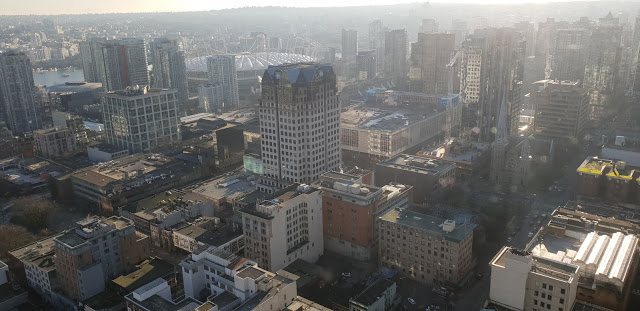
a place where we could get a 360-degree view of the city of Vancouver although it was very difficult to see any of the old buildings because they were hidden by the newer buildings, nor could we see the distant mountains because of the haze.

After leaving the tower we walked down Water Street to see the steam clock and the old world charm of a cobbled street and old buildings

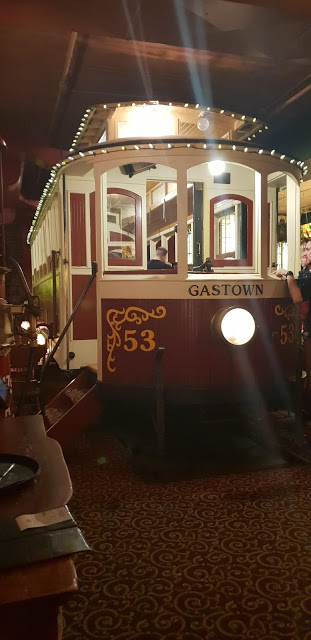
We stopped at the Spaghetti Factory Italian restaurant for dinner and is so popular that we have to wait, 10 minutes to start with.  It doesn’t take all that long to order and have the food delivered to the table.  Inside the restaurant, there is an actual cable car but we didn’t get to sit in it.

I have steak, rare, mushrooms, and spaghetti with marinara sauce.  No, marinara doesn’t mean seafood sauce but a very tasty tomato-based sauce.  The steak was absolutely delicious and extremely tender which made it more difficult to cut with a steak knife.

The write up for the marinara sauce is, ‘it tastes so fresh because it is made directly from vine-ripened tomatoes, not from concentrate, packed within 6 hours of harvest.  We combine them with fresh, high-quality ingredients such as caramelised onions, roasted garlic and extra virgin olive oil’.

Oh, and did I mention they have a streetcar right there in the middle of the restaurant

I’m definitely going to try and make this when we get home.

After dinner, we return to the observation tower,  the ticket allowing us to go back more than once, and see the sights at night time.  I can’t say it was all that spectacular.

Another day has gone, we are heading home tomorrow.

Memories of the conversations with my cat – 98

As some may be aware, but many not, Chester, my faithful writing assistant, mice catcher, and general pain in the neck, passed away some months ago.

Recently I was running a series based on his adventures, under the title of Past Conversations with my cat.

For those who have not had the chance to read about all of his exploits I will run the series again from Episode 1

These are the memories of our time together…

20160903_163902

This is Chester.  He’s now over having the grandchildren staying with us.

As part of the COVIS 19 restrictions in place, the grandchildren cannot go to school.

However, because their parents are both working (which is very fortunate as so many others are not) they have asked us to look after them.

So, they arrive Sunday night, stay the whole week, and go back home on Friday.  It means they are homeschooling, so the internet is taking a beating, I have to feed them, morning tea, lunch. After school snack at three and then dinner.

Chicken nuggets, pies, and shoestring chips can only go so far, and, no, he does not like scraps from their plates.

And having to cater for four rather than two means a gentle shift in logistics.  More shopping for food, having to do the washing every day, tormenting the cat.

OK, that last part is where Chester comes in, or, rather, he stays hidden away.

Remember that phobia he has when the grandchildren are around?

Now they’re here semi-permanently, he’s in hiding, and coming out only for food and water.

And to let me know just how displeased he is.

He wants his domain back.

Pity I haven’t told him yet they’re going to be back next week.


“What Sets Us Apart”, a mystery with a twist

David is a man troubled by a past he is trying to forget.

Susan is rebelling against a life of privilege and an exasperated mother who holds a secret that will determine her daughter’s destiny.

They are two people brought together by chance. Or was it?

When Susan discovers her mother’s secret, she goes in search of the truth that has been hidden from her since the day she was born.

When David realizes her absence is more than the usual cooling off after another heated argument, he finds himself being slowly drawn back into his former world of deceit and lies.

Then, back with his former employers, David quickly discovers nothing is what it seems as he embarks on a dangerous mission to find Susan before he loses her forever.

http://amzn.to/2Eryfth

whatsetscover

An excerpt from “One Last Look”: Charlotte is no ordinary girl

This is currently available at Amazon herehttp://amzn.to/2CqUBcz


I’d read about out of body experiences, and like everyone else, thought it was nonsense.  Some people claimed to see themselves in the operating theatre, medical staff frantically trying to revive them, and being surrounded by white light.

I was definitely looking down, but it wasn’t me I was looking at.

It was two children, a boy and a girl, with their parents, in a park.

The boy was Alan.  He was about six or seven.  The girl was Louise, and she was five years old.  She had long red hair and looked the image of her mother.

I remember it now, it was Louise’s birthday and we went down to Bournemouth to visit our Grandmother, and it was the last time we were all together as a family.

We were flying homemade kites our father had made for us, and after we lay there looking up at the sky, making animals out of the clouds.  I saw an elephant, Louise saw a giraffe.

We were so happy then.

Before the tragedy.


When I looked again ten years had passed and we were living in hell.  Louise and I had become very adept at survival in a world we really didn’t understand, surrounded by people who wanted to crush our souls.

It was not a life a normal child had, our foster parents never quite the sort of people who were adequately equipped for two broken-hearted children.  They tried their best, but their best was not good enough.

Every day it was a battle, to avoid the Bannister’s and Archie in particular, every day he made advances towards Louise and every day she fended him off.

Until one day she couldn’t.

Now I was sitting in the hospital, holding Louise’s hand.  She was in a coma, and the doctors didn’t think she would wake from it.  The damage done to her was too severe.

The doctors were wrong.

She woke, briefly, to name her five assailants.  It was enough to have them arrested.  It was not enough to have them convicted.

Justice would have to be served by other means.


I was outside the Bannister’s home.

I’d made my way there without really thinking, after watching Louise die.  It was like being on autopilot, and I had no control over what I was doing.  I had murder in mind.  It was why I was holding an iron bar.

Skulking in the shadows.  It was not very different from the way the Bannister’s operated.

I waited till Archie came out.  I knew he eventually would.  The police had taken him to the station for questioning, and then let him go.  I didn’t understand why, nor did I care.

I followed him up the towpath, waiting till he stopped to light a cigarette, then came out of the shadows.

“Wotcha got there Alan?” he asked when he saw me.  He knew what it was, and what it was for.

It was the first time I’d seen the fear in his eyes.  He was alone.

“Justice.”

“For that slut of a sister of yours.  I had nuffing to do with it.”

“She said otherwise, Archie.”

“She never said nuffing, you just made it up.”  An attempt at bluster, but there was no confidence in his voice.

I held up the pipe.  It had blood on it.  Willy’s blood.  “She may or may not have Archie, but Willy didn’t make it up.  He sang like a bird.  That’s his blood, probably brains on the pipe too, Archie, and yours will be there soon enough.”

“He dunnit, not me.  Lyin’ bastard would say anything to save his own skin.”  Definitely scared now, he was looking to run away.

“No, Archie.  He didn’t.  I’m coming for you.  All of you Bannisters.  And everyone who touched my sister.”


It was the recurring nightmare I had for years afterwards.

I closed my eyes and tried to shut out the thoughts, the images of Louise, the phone call, the visit to the hospital and being there when she succumbed to her injuries.  Those were the very worst few hours of my life.

She had asked me to come to the railway station and walk home with her, and I was running late.  If I had left when I was supposed to, it would never have happened and for years afterwards, I blamed myself for her death.

If only I’d not been late…

When the police finally caught the rapists, I’d known all along who they’d be; antagonists from school, the ring leader, Archie Bannister, a spurned boyfriend, a boy whose parents, ubiquitously known to all as ‘the Bannister’s, dealt in violence and crime and who owned the neighbourhood.  The sins of the father had been very definitely passed onto the son.

At school, I used to be the whipping boy, Archie, a few grades ahead of me, made a point of belting me and a few of the other boys, to make sure the rest did as they were told.  He liked Louise, but she had no time for a bully like him, even when he promised he would ‘protect’ me.

I knew the gang members, the boys who tow-kowed to save getting beaten up, and after the police couldn’t get enough information to prosecute them because everyone was too afraid to speak out, I went after Willy.  There was always a weak link in a group, and he was it.

He worked in a factory, did long hours on a Wednesday and came home after dark alone.  It was a half mile walk, through a park.  The night I approached him, I smashed the lights and left it in darkness.  He nearly changed his mind and went the long way home.

He didn’t.

It took an hour and a half to get the names.  At first, when he saw me, he laughed.  He said I would be next, and that was four words more than he knew he should have said.

When I found him alone the next morning I showed him the iron bar and told him he was on the list.  I didn’t kill him then, he could wait his turn, and worry about what was going to happen to him.

When the police came to visit me shortly after that encounter, no doubt at the behest of the Bannister’s, the neighbourhood closed ranks and gave me an ironclad alibi.  The Bannister’s then came to visit me and threatened me.  I told them their days were numbered and showed them the door.

At the trial, he and his friends got off on a technicality.  The police had failed to do their job properly, but it was not the police, but a single policeman, corrupted by the Bannisters.

Archie could help but rub it in my face.  He was invincible.

Joe Collins took 12 bullets and six hours to bleed out.  He apologized, he pleaded, he cried, he begged.  I didn’t care.

Barry Mills, a strong lad with a mind to hurting people, Archie’s enforcer, almost got the better of me.  I had to hit him more times than I wanted to, and in the end, I had to be satisfied that he died a short but agonizing death.

I revisited Willy in the hospital.  He’d recovered enough to recognize me, and why I’d come.  Suffocation was too good for him.

David Williams, second in command of the gang, was as tough and nasty as the Bannisters.  His family were forging a partnership with the Bannister’s to make them even more powerful.  Outwardly David was a pleasant sort of chap, affable, polite, and well mannered.  A lot of people didn’t believe he could be like, or working with, the Bannisters.

He and I met in the pub.  We got along like old friends.  He said Willy had just named anyone he could think of, and that he was innocent of any charges.  We shook hands and parted as friends.

Three hours later he was sitting in a chair in the middle of a disused factory, blindfolded and scared.  I sat and watched him, listened to him, first threatening me, and then finally pleading with me.  He’d guessed who it was that had kidnapped him.

When it was dark, I took the blindfold off and shone a very bright light in his eyes.  I asked him if the violence he had visited upon my sister was worth it.  He told me he was just a spectator.

I’d read the coroner’s report.  They all had a turn.  He was a liar.

He took nineteen bullets to die.

Then came Archie.

The same factory only this time there were four seats.  Anna Bannister, brothel owner, Spike Bannister, head of the family, Emily Bannister, sister, and who had nothing to do with their criminal activities.  She just had the misfortune of sharing their name.

Archie’s father told me how he was going to destroy me, and everyone I knew.

A well-placed bullet between the eyes shut him up.

Archie’s mother cursed me.  I let her suffer for an hour before I put her out of her misery.

Archie remained stony-faced until I came to Emily.  The death of his parents meant he would become head of the family.  I guess their deaths meant as little to him as they did me.

He was a little more worried about his sister.

I told him it was confession time.

He told her it was little more than a forced confession and he had done nothing to deserve my retribution.

I shrugged and shot her, and we both watched her fall to the ground screaming in agony.  I told him if he wanted her to live, he had to genuinely confess to his crimes.  This time he did, it all poured out of him.

I went over to Emily.  He watched in horror as I untied her bindings and pulled her up off the floor, suffering only from a small wound in her arm.  Without saying a word she took the gun and walked over to stand behind him.

“Louise was my friend, Archie.  My friend.”

Then she shot him.  Six times.

To me, after saying what looked like a prayer, she said, “Killing them all will not bring her back, Alan, and I doubt she would approve of any of this.  May God have mercy on your soul.”


Now I was in jail.  I’d spent three hours detailing the deaths of the five boys, everything I’d done; a full confession.  Without my sister, my life was nothing.  I didn’t want to go back to the foster parents; I doubt they’d take back a murderer.

They were not allowed to.

For a month I lived in a small cell, in solitary, no visitors.  I believed I was in the queue to be executed, and I had mentally prepared myself for the end.

Then I was told I had a visitor, and I was expecting a priest.

Instead, it was a man called McTavish. Short, wiry, and with an accent that I could barely understand.

“You’ve been a bad boy, Alan.”

When I saw it was not the priest I told the jailers not to let him in, I didn’t want to speak to anyone.  They ignored me.  I’d expected he was a psychiatrist, come to see whether I should be shipped off to the asylum.

I was beginning to think I was going mad.

I ignored him.

“I am the difference between you living or dying Alan, it’s as simple as that.  You’d be a wise man to listen to what I have to offer.”

Death sounded good.  I told him to go away.

He didn’t.  Persistent bugger.

I was handcuffed to the table.  The prison officers thought I was dangerous.  Five, plus two, murders, I guess they had a right to think that.  McTavish sat opposite me, ignoring my request to leave.

“Why’d you do it?”

“You know why.”  Maybe if I spoke he’d go away.

“Your sister.  By all accounts, the scum that did for her deserved what they got.”

“It was murder just the same.  No difference between scum and proper people.”

“You like killing?”

“No-one does.”

“No, I dare say you’re right.  But you’re different, Alan.  As clean and merciless killing I’ve ever seen.  We can use a man like you.”

“We?”

“A group of individuals who clean up the scum.”

I looked up to see his expression, one of benevolence, totally out of character for a man like him.  It looked like I didn’t have a choice.


Trained, cleared, and ready to go.

I hadn’t realized there were so many people who were, for all intents and purposes, invisible.  People that came and went, in malls, in hotels, trains, buses, airports, everywhere, people no one gave a second glance.

People like me.

In a mall, I became a shopper.

In a hotel, I was just another guest heading to his room.

On a bus or a train, I was just another commuter.

At the airport, I became a pilot.  I didn’t need to know how to fly; everyone just accepted a pilot in a pilot suit was just what he looked like.

I had a passkey.

I had the correct documents to get me onto the plane.

That walk down the air bridge was the longest of my life.  Waiting for the call from the gate, waiting for one of the air bridge staff to challenge me, stepping onto the plane.

Two pilots and a steward.  A team.  On the plane early before the rest of the crew.  A group that was committing a crime, had committed a number of crimes and thought they’d got away with it.

Until the judge, the jury and their executioner arrived.

Me.

Quick, clean, merciless.  Done.

I was now an operational field agent.


I was older now, and I could see in the mirror I was starting to go grey at the sides.  It was far too early in my life for this, but I expect it had something to do with my employment.

I didn’t recognize the man who looked back at me.

It was certainly not Alan McKenzie, nor was there any part of that fifteen-year-old who had made the decision to exact revenge.

Given a choice; I would not have gone down this path.

Or so I kept telling myself each time a little more of my soul was sold to the devil.

I was Barry Gamble.

I was Lenny Buckman.

I was Jimmy Hosen.

I was anyone but the person I wanted to be.

That’s what I told Louise, standing in front of her grave, and trying to apologize for all the harm, all the people I’d killed for that one rash decision.  If she was still alive she would be horrified, and ashamed.

Head bowed, tears streamed down my face.

God had gone on holiday and wasn’t there to hand out any forgiveness.  Not that day.  Not any day.


New York, New Years Eve.

I was at the end of a long tour, dragged out of a holiday and back into the fray, chasing down another scumbag.  They were scumbags, and I’d become an automaton hunting them down and dispatching them to what McTavish called a better place.

This time I failed.

A few drinks to blot out the failure, a blonde woman who pushed my buttons, a room in a hotel, any hotel, it was like being on the merry-go-round, round and round and round…

Her name was Silvia or Sandra, or someone I’d met before, but couldn’t quite place her.  It could be an enemy agent for all I knew or all I cared right then.

I was done.

I’d had enough.

I gave her the gun.

I begged her to kill me.

She didn’t.

Instead, I simply cried, letting the pent up emotion loose after being suppressed for so long, and she stayed with me, holding me close, and saying I was safe, that she knew exactly how I felt.

How could she?  No one could know what I’d been through.

I remembered her name after she had gone.

Amanda.

I remembered she had an imperfection in her right eye.

Someone else had the same imperfection.

I couldn’t remember who that was.

Not then.


I had a dingy flat in Kensington, a place that I rarely stayed in if I could help it.  After five-star hotel rooms, it made me feel shabby.

The end of another mission, I was on my way home, the underground, a bus, and then a walk.

It was late.

People were spilling out of the pub after the last drinks.  Most in good spirits, others slightly more boisterous.

A loud-mouthed chap bumped into me, the sort who had one too many, and was ready to take on all comers.

He turned on me, “Watch where you’re going, you fool.”

Two of his friends dragged him away.  He shrugged them off, squared up.

I punched him hard, in the stomach, and he fell backwards onto the ground.  I looked at his two friends.  “Take him home before someone makes mincemeat out of him.”

They grabbed his arms, lifted him off the ground and took him away.

Out of the corner of my eye, I could see a woman, early thirties, quite attractive, but very, very drunk.  She staggered from the bar, bumped into me, and finished up sitting on the side of the road.

I looked around to see where her friends were.  The exodus from the pub was over and the few nearby were leaving to go home.

She was alone, drunk, and by the look of her, unable to move.

I sat beside her.  “Where are your friends?”

“Dunno.”

“You need help?”

She looked up, and sideways at me.  She didn’t look the sort who would get in this state.  Or maybe she was, I was a terrible judge of women.

“Who are you?” she asked.

“Nobody.”  I was exactly how I felt.

“Well Mr Nobody, I’m drunk, and I don’t care.  Just leave me here to rot.”

She put her head back between her knees, and it looked to me she was trying to stop the spinning sensation in her head.

Been there before, and it’s not a good feeling.

“Where are your friends?” I asked again.

“Got none.”

“Perhaps I should take you home.”

“I have no home.”

“You don’t look like a homeless person.  If I’m not mistaken, those shoes are worth more than my weekly salary.”  I’d seen them advertised, in the airline magazine, don’t ask me why the ad caught my attention.

She lifted her head and looked at me again.  “You a smart fucking arse are you?”

“I have my moments.”

“Have them somewhere else.”

She rested her head against my shoulder.  We were the only two left in the street, and suddenly in darkness when the proprietor turned off the outside lights.

“Take me home,” she said suddenly.

“Where is your place?”

“Don’t have one.  Take me to your place.”

“You won’t like it.”

“I’m drunk.  What’s not to like until tomorrow.”

I helped her to her feet.  “You have a name?”

“Charlotte.”


The wedding was in a small church.  We had been away for a weekend in the country, somewhere in the Cotswolds, and found this idyllic spot.  Graves going back to the dawn of time, a beautiful garden tended by the vicar and his wife, an astonishing vista over hills and down dales.

On a spring afternoon with the sun, the flowers, and the peacefulness of the country.

I had two people at the wedding, the best man, Bradley, and my boss, Watkins.

Charlotte had her sisters Melissa and Isobel, and Isobel’s husband Giovanni, and their daughter Felicity.

And one more person who was as mysterious as she was attractive, a rather interesting combination as she was well over retirement age.  She arrived late and left early.

Aunt Agatha.

She looked me up and down with what I’d call a withering look.  “There’s more to you than meets the eye,” she said enigmatically.

“Likewise I’m sure,” I said.  It earned me an elbow in the ribs from Charlotte.  It was clear she feared this woman.

“Why did you come,” Charlotte asked.

“You know why.”

Agatha looked at me.  “I like you.  Take care of my granddaughter.  You do not want me for an enemy.”

OK, now she officially scared me.

She thrust a cheque into my hand, smiled, and left.

“Who is she,” I asked after we watched her depart.

“Certainly not my fairy godmother.”

Charlotte never mentioned her again.


Zurich in summer, not exactly my favourite place.

Instead of going to visit her sister Isobel, we stayed at a hotel in Beethovenstrasse and Isobel and Felicity came to us.  Her husband was not with her this time.

Felicity was three or four and looked very much like her mother.  She also looked very much like Charlotte, and I’d remarked on it once before and it received a sharp rebuke.

We’d been twice before, and rather than talk to her sister, Charlotte spent her time with Felicity, and they were, together, like old friends.  For so few visits they had a remarkable rapport.

I had not broached the subject of children with Charlotte, not after one such discussion where she had said she had no desire to be a mother.  It had not been a subject before and wasn’t once since.

Perhaps like all Aunts, she liked the idea of playing with a child for a while and then give it back.

Felicity was curious as to who I was, but never ventured too close.  I believed a child could sense the evil in adults and had seen through my facade of friendliness.  We were never close.

But…

This time, when observing the two together, something quite out of left field popped into my head.  It was not possible, not by any stretch of the imagination, but I thought she looked like my mother.

And Charlotte had seen me looking in their direction.  “You seem distracted,” she said.

“I was just remembering my mother.  Odd moment, haven’t done so for a very long time.”

“Why now?”  I think she had a look of concern on her face.

“Her birthday, I guess,” I said, the first excuse I could think of.

Another look and I was wrong.  She looked like Isobel or Charlotte, or if I wanted to believe it possible, Melissa too.


I was crying, tears streaming down my face.

I was in pain, searing pain from my lower back stretching down into my legs, and I was barely able to breathe.

It was like coming up for air.

It was like Snow White bringing Prince Charming back to life.  I could feel what I thought was a gentle kiss and tears dropping on my cheeks, and when I opened my eyes, I saw Charlotte slowly lifting her head, a hand gently stroking the hair off my forehead.

And in a very soft voice, she said, “Hi.”

I could not speak, but I think I smiled.  It was the girl with the imperfection in her right eye.  Everything fell into place, and I knew, in that instant that we were irrevocably meant to be together.

“Welcome back.”


© Charles Heath 2016-2019

onelastlookcoverfinal2

The A to Z Challenge – G is for – “Got a moment to myself”

Here’s the thing … good guys come last

It’s as simple as that.

The thing is, we had all been taken in, and no one, well, there was one person who had an inkling, but I didn’t take her seriously, simply because it was the girl who cried wolf once too often.

And, consequently, the ramifications could have been very serious.

Was that the price for deciding to take people at face value, that we would eventually discover their true nature before it was too late?

I’d lived in a house full of people who trusted no one, and who was always prepared to believe the worst in people.

My parents trusted no one and consequently suffered relatively lonely lives.

My sister, Davina, was not so bad but underlying every decision that was to do with people, she would have them investigated within an inch of their lives, and that too, had been very costly for her, especially when they found out.  It ended three marriages and estranged two of her three children.

As for me, I made the decision not to be like them, and it had served me well.  By and large, everyone I knew and had dealings with was fine.  But even with this happy-go-lucky attitude, I still found it difficult to find what one might call the woman of my dreams.

That’s why, when Helen appeared one night at a party I’d only just decided to go to at the last minute, I thought my luck had changed.

How do you ‘run into’ the one?  Was it an accidental bump, excuse me, and then a lingering look as she sashays off, or is it reaching for the same glass of champagne, with the consequent touching of hands?

There are an infinite variety of ‘first’ moments, moments that left lingering thoughts of ‘who was that woman?”

There is that thought, could it have been a contrivance to get my attention?  If it was, it did.

It was a large banquet hall, and there were plenty of places to hide, and I wasn’t particularly interested in staying until our paths crossed.  But was my curiosity enough to make a move?

To begin with, it was not.

I shrugged it off as a one-off moment, something to remember from an unremarkable gala that proved, once I arrived, why I had been hesitating in the first place.

Old people displaying their wealth, young people flirting with the rich and famous.  I was, perhaps, a little rich, but definitely not famous, hence the reason why a bevy of eligible girls was not beating a path to my door.

There were three others of my ilk there who fitted that bill and willingly took the heat for me.  One, Augustus, last name unpronounceable, had that Latin, dark, sultry look going, sauntered over after he had witnessed the ‘meeting’.

“I see you’ve met Helen?”

“She stole my drink.”

“All part of the plan, Ian.  She just tossed away another of the pretenders, and if you play your cards right, you might be the next.”

“Pretender?”

His smirk was imprinted on his face and never changed, amused, or annoyed.  “You know you can be such a prat sometimes.”

It had been said, more than once.  “Do I want to play my cards right?”

“She is interested in a mysterious way.  I asked her out, but she seemed disinterested, and as you know, I only ask once.  Aside from that, we want to know who she is, really.”

“And you think she’ll tell me?”

“You’re not a player, Ian, and have that perfect aloofness thing going, one that can drive a certain type of girl crazy.  I think she’s one of them.”

“Then how do I find her?”

He shook his head.  “That’s not how this will be played.  She has to come to you.  Aloof, remember, Ian, aloof.  Now, I must be off.  Say hello to Davina for me will you?”

He’d seen her crossing the room and had no interest in sparring with her.  For some reason, she just didn’t like him.  Or was that because he spurned her?  I never could get an answer from her.

Aloof.

I could do aloof, though I was not sure how that would seem interesting to a woman like her.

Aside from my belief that as beautiful as her would be remotely interested in me, aside perhaps from the family wealth that one day I would inheritance s point Davina took great pains to remind me.

And that was something I wasn’t looking forward to.

There was an art to mingling at these affairs, on one hand, the obligatory meet and greet of our contemporaries, deference to our peers, letting them know we were upholding the proper values, and respect as was warranted by our position, and on the other, a casual greeting to those who were on the fringe of our society.

I’d learn the lessons from Davina when she deemed it I was ready, but the truth is, no matter what age you are, you’re never ready for this.

There was a third category, those that came up to you, wishing to make an acquaintance, whether it was for publicity, or for prestige, it was impossible to tell, then and there, sometimes it was a matter of reading the social pages to find out how your name gad been taken in vain.

I preferred not to talk to any of them unless it was absolutely necessary.

Or someone you knew brought them to you, which then, out of deference to them, sometimes put you on the spot.

Nnn chose that path, selecting another person who was known to me, Alison Burkwater, a rare, unbiased reporter, to slip in under the radar.

Not realizing I was the eventual target, I watched them stroll through the crowded floor, stopping momentarily for an introduction, or a polite exchange, Alison gathering information for her next article before they headed in my direction.

I was with one of my father’s oldest friends, Jacob, his wife, Mary, and one of their three daughters, Amy, whom I knew would be pleased if we were together, but fate seemed to keep us apart.

I watched Helen, almost entranced by the fluid motion she moved, reminding me of a cat just before it pounced on unsuspecting prey until she was standing in front of me, unaware that Alison was speaking.

“This is Helen Dunbar, over from England, checking us Americans out as the British do.”

She then introduced each of us, leaving me till last, deliberately.

Each had a comment, or a question, so when it came to me, I asked, “Holiday or business?”

In my experience, they usually said both, but if she was here, it was business, making contacts, getting a feel for the market.  Perhaps even at this age, I’d become cynical

“Both.”

Suspicion confirmed.  “But I hear you are an unofficial tour guide, and I am in need of someone to show me this great city.”

Flattery, no doubt.  And a smile from Alison, a nod to the time when she had written a bad piece about the city, and I took the trouble to prove otherwise.

To one side I heard Jacob excuse himself, and the others left with him.  Alison’s job done, she left us together.  Out of the corner of my eye, I could see Davina deep in conversation with the family’s head of security.

Davina had so little faith in me.

“Perhaps that might be a topic we could discuss over coffee later?”

“Tonight?”

“Unless you’re otherwise engaged?”

“No.”

There was a slight exodus from the main hall, an indication that unusual for a gala like this, there would be dancing.  It was a pet pastime of the host, an orchestra had been commissioned, and it was to be a nod to the old days.

“Do you dance,” I asked?

“It was part of my finishing school curriculum that nearly finished me in more ways than one.  Long story, but yes.”

“Would you like to lead a poor boy around the floor and make him look good?”

She smiled.  “I know you are pulling my leg, but I’ll bite.”  She held out her hand, “Take me away before I change my mind “

Dancing was a social etiquette that was forced on me, and I was, for a long time, dreadful at it.  It was only in my last year of middle school that a girl by the name of Wendy Whiles took the nervous bumbler with two left feet onto something that might make Fred Astaire proud.

She also introduced me to other more interesting things teenagers did, albeit in the comfort of a very expensive hotel suite, rather than in the back of a car.  I thought I’d loved her, but she was not interested in wealth and fame, and I didn’t blame her, though I still insisted someone paid her a large sum of money to break off whatever we didn’t have going.

All her lessons paid off, and I found myself almost floating on air as we waltzed around the floor deftly avoiding the others brave enough to take to the dance floor.

“Do you do this often,” she asked, not long into the routine.

“No.”

“You dance well.”

“Only when I’m not talking.   Arthur Murray didn’t include how to handle chatty girls on the dance floor.”

Any other girl I was sure would have been insulted.  I could be like that sometimes.  I called it being blunt.

“A new experience then.”

“Can’t count and talk at the same time?”

“And yet you dance so well.”

“Flattery will get you only so far.”

We finished in silence, and I thought I had ruined my opportunity, though for what was questionable.  I should have been content to dance with one of the most beautiful girls at the ball.

She took my hand as we left the dance floor and headed toward the bar.  That walk felt natural, holding hands, and the feeling there was a connection between us.  She had not forced it, I had not looked for it, it had just happened.

She drank club soda.  She said she didn’t drink alcohol, and it seemed logical.  She was effervescent enough without any aids, unlike some of my friends who needed drugs and copious quantities of alcohol to get into a ‘groove’.  I could take it or leave it and did the latter.

We picked a quiet corner.

“Why are you really here?” I asked.  Start with the hard questions first.

“Sometime told me about this rich, handsome, bored young man who hates galas, and the mating rituals that go with them.”

“And yet here you are?”

“Secretly,” she whispered, “my real name is Rapunzel, I escaped from a tower, and am here to rescue anyone who needs rescuing.  Do you need rescuing?”

I did, but I did not want to incur Davina’s wrath.  And then I thought about the possibility, that she might just be bait for something more sinister.  It was improbable, but Davina had impressed on me that there were a lot of nasty people in the world, and sometimes it was hard to see through the facades.

If she was evil, then it came beautifully gift wrapped.

“Rescue does involve a rather full-on security detail as well, and, the filling out of paperwork that would take till dawn to do.”

“I assume then, that weedy little man pretending to have a quiet drink over there is one of them.”

She nodded in his direction, and I recognized him instantly.  “Warren.  Dangerous as a cut snake.  Even I keep my distance from him.”

Another glance, impassive expression, it would be interesting what she was thinking at that moment.

“So, what do you do for fun?”

“An occasional waltz with the most beautiful girl at the gala.”

“And…?”

“My life is ruled by responsibility.  If you’re looking for fun, there are six other very eligible young men here that will be happy to fete you, and indulge your wildest dreams?”

“Aren’t you the least bit curious?”  There was an invitation there, for what, I suspect would be whatever I wanted, but Davina’s voice was well and truly planted in my head.  If it’s too good to be true…

I smiled wanly and finished my drink.  “That is a luxury that I can only dream about.  Thank you for the few brief moments of possibilities.”

Not an hour later, from a distance, I saw two men in civilian suits escorting her out of the building.  There was no disguising their true identities, ex-military, or military police.

Odd for a girl that looked like her to be involved with such people.

A few minutes later Davina appeared beside me.  “I could have told you that girl was trouble.”

“Looking at her, I thought the exact opposite.”

“You need to be more careful.”

“Warren was there.  I’m sure he could handle her.  I made sure I was in a position where if trouble came it would have to pass him, and I have the taser in my pocket.  What was her crime.”

“None apparently.  Some high-ranking Generals’ daughter out for a lark.  Now come back and talk to Amy.”


© Charles Heath 2022