The cinema of my dreams – I always wanted to write a war story – Episode 2

This is a story inspired by a visit to an old castle in Italy.  It was, of course, written while traveling on a plane, though I’m not sure if it was from Calgary to Toronto, or New York to Vancouver.

But, there’s more to come.  Those were long flights…

And sadly when I read what I’d written, off the plane and in the cold hard light of dawn, there were problems, which now in the second draft, should provide the proper start.


I calculated the odds.  Thirty to one.  I wasn’t going to add Jack to the team, because he could never understand what was going on.  I was finding it hard myself.  

The man who sent me on this mission, the man whom I had given a detailed report on what I thought was happening at the castle, gleaned from soldiers passing through and the local resistance, had taken me aside in London, told me the mission he was sending me on was top secret and I could tell no one.

Only now did I realize the import of those words.  Someone I had trusted with my life, for a very long time, was not the person I thought they were.

That was in the second the message I’d received, read, and immediately destroyed.  I hadn’t believed it.  Not at first.  But it had one other piece of information as proof, one when I thought about, made sense of everything that had been happening.  The word coincidence had become overused in the last week.

But I didn’t have time to think about it now, I had to try and get away if only as far as the resistance, to get help and report on what had just happened.

But I couldn’t understand what the enemy would gain from retaking the castle.  Behind enemy lines, it would only be a matter of time before they were caught, or killed.

Enough.  I could hear the footsteps approaching.

Jack had found the passage when he and I had been doing some reconnaissance of the old castle.  I thought it odd that no one knew of any secret passages when all of these old places usually had at least a few.  The lord of the manor would want to be able to move about secretly, visiting mistresses, escaping from enemies, or just sneaking about checking up on staff and family

We’d found one that ran from the guard tower to the grand hall.  A lot of cobwebs, a musty odor, and signs it hadn’t been used for a long time, it was perfect for my soon to be unannounced arrival.

The passage ended at a large wooden cabinet which had a compartment that opened out into the hall.  From within, it was possible to hear conversations and see a veiled view of any activity.

Johansson and that man I’d been warned about, that man I had trusted, Lieutenant General Wallace.  I could only assume he had arrived with the stormtroopers, so for a moment, I was confused as to whether they were ours or the enemy.

I could see Wallace was angry. “I thought I told you I wanted Atherton neutralized before I got here.  Where is he?”

Just then Jackerby came in and looked flustered.  “He’s gone.”

“What the hell do you mean, he’s gone.  Gone where, for God’s sake.  There’s nowhere to go.”

I wondered what neutralized meant.  It didn’t sound very pleasant.  Jack was nudging my leg.  What was he trying to tell me?

“He was in the south tower with that mangy dog of his, where he usually hangs out.”

“Then he can’t be far.  Find him and bring him, to me.  Pity that bomb didn’t kill him or we wouldn’t be in this situation.”

Why did it have to be Wallace?  I actually liked the man.  Until now.  I kneeled down, “Well, Jack,” I whispered.  “It looks like we are both in serious trouble.  What’s say we get out of here?”

A lick on the side of my face told me all I needed to know.


© Charles Heath 2019

Bloody hell… – a short story

The cell phone’s insistent and shrill ring dragged my mind away from the crossword, and after a fairly mild curse, I picked it up.

Sidney, my brother.  Odd he was calling me at this hour of the night.

“What,” I barked into the microphone.

“That’s no way to speak to your baby brother.”  His smooth tones rarely reached a screaming point, which was often the reason why mine did.

And who called the younger brother ‘baby’ brother these days?

“What do you want?”

A hesitation.  He was in trouble again, I could feel it.

“Can you come down to the bar?  I seem to have left my wallet at home.”  Sheepish, and just enough to stop me from yelling at him.  It was not the first time, nor would it be the last.

“I told you the last time was the last time.”

“Just this once, please?”

I shook my head.  That was probably my biggest fault, giving in to him.  After our mother had died, and our father had to work, it was left to me to bring him up.  He was going to be the death of me yet.  “Where?”

“The usual place.”

I was surprised because the last I’d heard they’d banned him from going in there.  It was only a twenty-minute walk from my apartment, but, late at night, and in winter, there was snow in the air.  And the odd snowflake falling, a prelude to much worse.

About a hundred yards from the bar I had a shiver go down my spine.  I’d not had that for a long time, not since school, and the trouble with Wiley, the school bully.  Wiley had graduated to the local thug, done a few stints in jail, and last I heard he had been sent down for a few years for an assault.

I stopped and took a moment.  Perhaps karma was trying to tell me something.

I shrugged.  Just in my imagination.  I reached the door, took a moment then went in.  He was standing by the bat looking a little apprehensive.  He was in more trouble than just not paying his bar bill.

Close up I could see the fear in his expression.  “Bloody hell, Sid, what have you done now?”

“A problem that he insists his older brother would be happy to pay for.”

I knew that voice and felt instant dread.

Wiley.

In the flesh, and not looking very happy at all.

© Charles Heath 2020-2021

The first attempt is exactly that, a first draft

That’s what it feels like after you’ve put words on paper.

The story is there waiting to be written, I know where it’s coming from, I know where I want it to go, but the words are not working.

I read it once, yuk, I read it twice, it’s begging me to press the delete button.

Now!

This is how it looks:

My life was going nowhere.  If I took a step back and took a good, long, hard look at it, what could I say was the one defining moment?

There was no defining moment.

I’d bounced around schools till the day I decided I was not cut out to learn anything more, or perhaps the teachers had given up trying to impart knowledge.  Whatever the reason, I dropped out of college and drifted.  Seasonal laborer, farmhand, factory worker, night watchman.

At least now I had a uniform and looked like I’d made something of myself.

Until I went home.

My parents were distinctly disappointed I was not married with children.

My overachieving brother always said I was a loser, and would never make anything of myself.

My ultra successful sister, married into a very wealthy family, had the regulation 2.4 children and lived in the lap of luxury, mostly pretended I didn’t exist, didn’t invite me to the wedding, and I had yet to meet the husband and children.  I guess she was ashamed of me.

This year I was avoiding going home.

This year I volunteered to work the holidays.

Yep, time to walk away and do something entirely different, like wrapping Christmas presents, my second favorite job to mowing the lawn.  Maybe if I contrive an accident with the lawnmower …

Back in front of the page, some hours later, an idea pops into my head.  The story continues:

It was 3 a.m. and it was like standing on the exact epicenter of the South Pole.  I’d just stepped from the warehouse into the car park.

The car was covered in snow.  The weather was clear now, but more snow was coming.

A white Christmas?  That’s all I needed.  I hoped I remembered to put the antifreeze in my radiator this time.

As I approached my car, the light went on in an SUV parked next to my car.  The door opened and what looked to be a woman was getting out of the car.

“Graham?”

It was a voice I was familiar with, though I hadn’t heard it for a long time.

My ultra successful sister, Penelope.  She was leaning against her car door, and from what I could see, she didn’t look too well.

“What do you want?”

“Help.”

My help, I was the last person to help her or anyone for that matter.  But curiosity got the better of me.  “Why?”

“Because my husband is trying to kill me.”

With that said, she slid down the side of the car, and I could see, in the arc lamps lighting the car park, a trail of blood.

To be honest, it needs some more thought.  IT’s got the makings of a story, but the MC shouldn’t come across as a hopeless case, he just needs to be, in part, a victim of circumstances, some of which he has to own.

But, as they say, anything on paper is better than nothing on paper.  Tomorrow, or the next day, I will edit and rewrite and see what happens.

Stay tuned.

© Charles Heath 2020

Searching for locations: Just how hard can it be to see some snow?

You would think it is a relatively simple thing to get to the snow.

Of course, there are a few necessities like skis, boots, poles, and warm dry clothing, but that can all be bought or rented when you get there, or if you are an enthusiast, you already have the gear.

So, you get in the car, set the navigator, and off you go.  Till you get within 20 k of the ski field, it’s all plain sailing, everyone is excited, and mentally preparing.

Then it all starts to go sideways.

Those last few kilometers to the top are going to be arduous particularly if it’s been snowing and the roads are icy, but the weather is fine with blue skies and no recent snow falls.  Were expecting a slow drive and a parking spot.

The road is open.

But…

So late in the morning, a sign at the bottom of the mountain warns all the car parks at the ski field are full, but we venture on anyway.

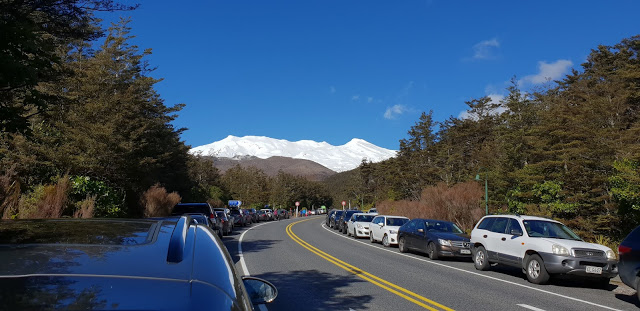
As you can see, the cars are parked so far away from the ski fields, the prospective skiers have to almost run a marathon before they get there!

And for some odd reason, we picked the very day everyone in New Zealand also wanted to go up to the ski fields so parking, even near the Chateau Tongariro was gone and there were endless cars looking for parking spots and traffic wardens had their hands full trying to keep traffic moving
So, for us and everyone else, everything stops at Chateau Tongariro, and from there the only vehicles allowed up are buses.

It’s about 10:30 and we are advised the only way we were getting to see snow was to take a bus

Now, there are two types of busses.  You can go up on a local bus, from Whakapapa Village that costs $20 a person which in the context of the cost of skiing not very much, but if you’re not, it’s quite expensive.

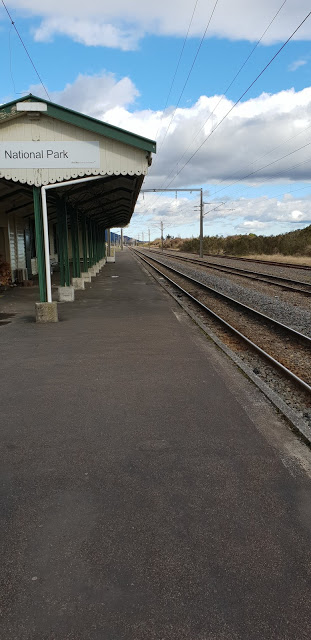
The second, one we were advised to use, operates from a place called National Park, about 9 km away, a snow shuttle that costs $6 each.  The trouble is by the time we were ready to go there, to catch a shuttle, there were no more shuttles.

We did not know what to expect when we got to ‘National Park’, but being a railway station makes sense.  It’s the only place with a very large carpark!

Oh, well, there’s always tomorrow.

The cinema of my dreams – I always wanted to go on a treasure hunt – Episode 10

Here’s the thing…

Every time I close my eyes, I see something different.

I’d like to think the cinema of my dreams is playing a double feature but it’s a bit like a comedy cartoon night on Fox.

But these dreams are nothing to laugh about.

Once again there’s a new instalment of an old feature, and back on the treasure hunt.

I’d kept out of Nadia’s way since then, and the few occasions our paths had crossed, she had studiously ignored me. After graduating she disappeared, and seeing here with Alex, just now, was the first time in years.

She had grown into the sort of woman you’d see in the social pages of the newspapers and magazines, sometimes for all the wrong reasons, and I wondered if that was how Alex had leveraged her co-operation.

But, there were bigger problems to overcome before I had a chance or find out her back-story.

Alex was going after Rico for the map, a map he didn’t have, a map that Rico was going to need and Boggs was going to suffer the consequences.

Or not, if I could do something about it.

I had a stroke of luck when I got back to the warehouse office where McDonald was waiting, not necessarily for me, but most likely Alex.

“Ah, Sam,” he said when he saw me walk through the door, “Come into the office. We need to have a chat.”

That sounded ominous. I wondered if it had anything to do with my absence for what seemed a long time when I’d been watching Alex and Nadia.

“We have a new opening on the afternoon shift, and I thought you might consider it because it pays a little more, with a shift allowance. The hours are 4pm to Midnight. What do you think?”

On the way back to the warehouse I’d been thinking about how I was going to help Boggs and keep the job because the hours I was working made it impossible to do anything during the day, other than spy on Alex.

Taking this afternoon job, I could work, and, in the mornings, help Boggs in his quest.

“When would this start?”

“Tomorrow. You would not have to come in till 4pm.

“Sounds good then, I’ll take it.”

He seemed more relieved that I had accepted. It made me think for a moment whether this was Alex’s idea, and he had an ulterior notice. If he did I guess I would soon find out.

An hour later I was on my way home.

I had a lot of items to talk about when I saw Boggs and a possible mission.

© Charles Heath 2019

An excerpt from “One Last Look”: Charlotte is no ordinary girl

This is currently available at Amazon herehttp://amzn.to/2CqUBcz


I’d read about out of body experiences, and like everyone else, thought it was nonsense.  Some people claimed to see themselves in the operating theatre, medical staff frantically trying to revive them, and being surrounded by white light.

I was definitely looking down, but it wasn’t me I was looking at.

It was two children, a boy and a girl, with their parents, in a park.

The boy was Alan.  He was about six or seven.  The girl was Louise, and she was five years old.  She had long red hair and looked the image of her mother.

I remember it now, it was Louise’s birthday and we went down to Bournemouth to visit our Grandmother, and it was the last time we were all together as a family.

We were flying homemade kites our father had made for us, and after we lay there looking up at the sky, making animals out of the clouds.  I saw an elephant, Louise saw a giraffe.

We were so happy then.

Before the tragedy.


When I looked again ten years had passed and we were living in hell.  Louise and I had become very adept at survival in a world we really didn’t understand, surrounded by people who wanted to crush our souls.

It was not a life a normal child had, our foster parents never quite the sort of people who were adequately equipped for two broken-hearted children.  They tried their best, but their best was not good enough.

Every day it was a battle, to avoid the Bannister’s and Archie in particular, every day he made advances towards Louise and every day she fended him off.

Until one day she couldn’t.

Now I was sitting in the hospital, holding Louise’s hand.  She was in a coma, and the doctors didn’t think she would wake from it.  The damage done to her was too severe.

The doctors were wrong.

She woke, briefly, to name her five assailants.  It was enough to have them arrested.  It was not enough to have them convicted.

Justice would have to be served by other means.


I was outside the Bannister’s home.

I’d made my way there without really thinking, after watching Louise die.  It was like being on autopilot, and I had no control over what I was doing.  I had murder in mind.  It was why I was holding an iron bar.

Skulking in the shadows.  It was not very different from the way the Bannister’s operated.

I waited till Archie came out.  I knew he eventually would.  The police had taken him to the station for questioning, and then let him go.  I didn’t understand why, nor did I care.

I followed him up the towpath, waiting till he stopped to light a cigarette, then came out of the shadows.

“Wotcha got there Alan?” he asked when he saw me.  He knew what it was, and what it was for.

It was the first time I’d seen the fear in his eyes.  He was alone.

“Justice.”

“For that slut of a sister of yours.  I had nuffing to do with it.”

“She said otherwise, Archie.”

“She never said nuffing, you just made it up.”  An attempt at bluster, but there was no confidence in his voice.

I held up the pipe.  It had blood on it.  Willy’s blood.  “She may or may not have Archie, but Willy didn’t make it up.  He sang like a bird.  That’s his blood, probably brains on the pipe too, Archie, and yours will be there soon enough.”

“He dunnit, not me.  Lyin’ bastard would say anything to save his own skin.”  Definitely scared now, he was looking to run away.

“No, Archie.  He didn’t.  I’m coming for you.  All of you Bannisters.  And everyone who touched my sister.”


It was the recurring nightmare I had for years afterwards.

I closed my eyes and tried to shut out the thoughts, the images of Louise, the phone call, the visit to the hospital and being there when she succumbed to her injuries.  Those were the very worst few hours of my life.

She had asked me to come to the railway station and walk home with her, and I was running late.  If I had left when I was supposed to, it would never have happened and for years afterwards, I blamed myself for her death.

If only I’d not been late…

When the police finally caught the rapists, I’d known all along who they’d be; antagonists from school, the ring leader, Archie Bannister, a spurned boyfriend, a boy whose parents, ubiquitously known to all as ‘the Bannister’s, dealt in violence and crime and who owned the neighbourhood.  The sins of the father had been very definitely passed onto the son.

At school, I used to be the whipping boy, Archie, a few grades ahead of me, made a point of belting me and a few of the other boys, to make sure the rest did as they were told.  He liked Louise, but she had no time for a bully like him, even when he promised he would ‘protect’ me.

I knew the gang members, the boys who tow-kowed to save getting beaten up, and after the police couldn’t get enough information to prosecute them because everyone was too afraid to speak out, I went after Willy.  There was always a weak link in a group, and he was it.

He worked in a factory, did long hours on a Wednesday and came home after dark alone.  It was a half mile walk, through a park.  The night I approached him, I smashed the lights and left it in darkness.  He nearly changed his mind and went the long way home.

He didn’t.

It took an hour and a half to get the names.  At first, when he saw me, he laughed.  He said I would be next, and that was four words more than he knew he should have said.

When I found him alone the next morning I showed him the iron bar and told him he was on the list.  I didn’t kill him then, he could wait his turn, and worry about what was going to happen to him.

When the police came to visit me shortly after that encounter, no doubt at the behest of the Bannister’s, the neighbourhood closed ranks and gave me an ironclad alibi.  The Bannister’s then came to visit me and threatened me.  I told them their days were numbered and showed them the door.

At the trial, he and his friends got off on a technicality.  The police had failed to do their job properly, but it was not the police, but a single policeman, corrupted by the Bannisters.

Archie could help but rub it in my face.  He was invincible.

Joe Collins took 12 bullets and six hours to bleed out.  He apologized, he pleaded, he cried, he begged.  I didn’t care.

Barry Mills, a strong lad with a mind to hurting people, Archie’s enforcer, almost got the better of me.  I had to hit him more times than I wanted to, and in the end, I had to be satisfied that he died a short but agonizing death.

I revisited Willy in the hospital.  He’d recovered enough to recognize me, and why I’d come.  Suffocation was too good for him.

David Williams, second in command of the gang, was as tough and nasty as the Bannisters.  His family were forging a partnership with the Bannister’s to make them even more powerful.  Outwardly David was a pleasant sort of chap, affable, polite, and well mannered.  A lot of people didn’t believe he could be like, or working with, the Bannisters.

He and I met in the pub.  We got along like old friends.  He said Willy had just named anyone he could think of, and that he was innocent of any charges.  We shook hands and parted as friends.

Three hours later he was sitting in a chair in the middle of a disused factory, blindfolded and scared.  I sat and watched him, listened to him, first threatening me, and then finally pleading with me.  He’d guessed who it was that had kidnapped him.

When it was dark, I took the blindfold off and shone a very bright light in his eyes.  I asked him if the violence he had visited upon my sister was worth it.  He told me he was just a spectator.

I’d read the coroner’s report.  They all had a turn.  He was a liar.

He took nineteen bullets to die.

Then came Archie.

The same factory only this time there were four seats.  Anna Bannister, brothel owner, Spike Bannister, head of the family, Emily Bannister, sister, and who had nothing to do with their criminal activities.  She just had the misfortune of sharing their name.

Archie’s father told me how he was going to destroy me, and everyone I knew.

A well-placed bullet between the eyes shut him up.

Archie’s mother cursed me.  I let her suffer for an hour before I put her out of her misery.

Archie remained stony-faced until I came to Emily.  The death of his parents meant he would become head of the family.  I guess their deaths meant as little to him as they did me.

He was a little more worried about his sister.

I told him it was confession time.

He told her it was little more than a forced confession and he had done nothing to deserve my retribution.

I shrugged and shot her, and we both watched her fall to the ground screaming in agony.  I told him if he wanted her to live, he had to genuinely confess to his crimes.  This time he did, it all poured out of him.

I went over to Emily.  He watched in horror as I untied her bindings and pulled her up off the floor, suffering only from a small wound in her arm.  Without saying a word she took the gun and walked over to stand behind him.

“Louise was my friend, Archie.  My friend.”

Then she shot him.  Six times.

To me, after saying what looked like a prayer, she said, “Killing them all will not bring her back, Alan, and I doubt she would approve of any of this.  May God have mercy on your soul.”


Now I was in jail.  I’d spent three hours detailing the deaths of the five boys, everything I’d done; a full confession.  Without my sister, my life was nothing.  I didn’t want to go back to the foster parents; I doubt they’d take back a murderer.

They were not allowed to.

For a month I lived in a small cell, in solitary, no visitors.  I believed I was in the queue to be executed, and I had mentally prepared myself for the end.

Then I was told I had a visitor, and I was expecting a priest.

Instead, it was a man called McTavish. Short, wiry, and with an accent that I could barely understand.

“You’ve been a bad boy, Alan.”

When I saw it was not the priest I told the jailers not to let him in, I didn’t want to speak to anyone.  They ignored me.  I’d expected he was a psychiatrist, come to see whether I should be shipped off to the asylum.

I was beginning to think I was going mad.

I ignored him.

“I am the difference between you living or dying Alan, it’s as simple as that.  You’d be a wise man to listen to what I have to offer.”

Death sounded good.  I told him to go away.

He didn’t.  Persistent bugger.

I was handcuffed to the table.  The prison officers thought I was dangerous.  Five, plus two, murders, I guess they had a right to think that.  McTavish sat opposite me, ignoring my request to leave.

“Why’d you do it?”

“You know why.”  Maybe if I spoke he’d go away.

“Your sister.  By all accounts, the scum that did for her deserved what they got.”

“It was murder just the same.  No difference between scum and proper people.”

“You like killing?”

“No-one does.”

“No, I dare say you’re right.  But you’re different, Alan.  As clean and merciless killing I’ve ever seen.  We can use a man like you.”

“We?”

“A group of individuals who clean up the scum.”

I looked up to see his expression, one of benevolence, totally out of character for a man like him.  It looked like I didn’t have a choice.


Trained, cleared, and ready to go.

I hadn’t realized there were so many people who were, for all intents and purposes, invisible.  People that came and went, in malls, in hotels, trains, buses, airports, everywhere, people no one gave a second glance.

People like me.

In a mall, I became a shopper.

In a hotel, I was just another guest heading to his room.

On a bus or a train, I was just another commuter.

At the airport, I became a pilot.  I didn’t need to know how to fly; everyone just accepted a pilot in a pilot suit was just what he looked like.

I had a passkey.

I had the correct documents to get me onto the plane.

That walk down the air bridge was the longest of my life.  Waiting for the call from the gate, waiting for one of the air bridge staff to challenge me, stepping onto the plane.

Two pilots and a steward.  A team.  On the plane early before the rest of the crew.  A group that was committing a crime, had committed a number of crimes and thought they’d got away with it.

Until the judge, the jury and their executioner arrived.

Me.

Quick, clean, merciless.  Done.

I was now an operational field agent.


I was older now, and I could see in the mirror I was starting to go grey at the sides.  It was far too early in my life for this, but I expect it had something to do with my employment.

I didn’t recognize the man who looked back at me.

It was certainly not Alan McKenzie, nor was there any part of that fifteen-year-old who had made the decision to exact revenge.

Given a choice; I would not have gone down this path.

Or so I kept telling myself each time a little more of my soul was sold to the devil.

I was Barry Gamble.

I was Lenny Buckman.

I was Jimmy Hosen.

I was anyone but the person I wanted to be.

That’s what I told Louise, standing in front of her grave, and trying to apologize for all the harm, all the people I’d killed for that one rash decision.  If she was still alive she would be horrified, and ashamed.

Head bowed, tears streamed down my face.

God had gone on holiday and wasn’t there to hand out any forgiveness.  Not that day.  Not any day.


New York, New Years Eve.

I was at the end of a long tour, dragged out of a holiday and back into the fray, chasing down another scumbag.  They were scumbags, and I’d become an automaton hunting them down and dispatching them to what McTavish called a better place.

This time I failed.

A few drinks to blot out the failure, a blonde woman who pushed my buttons, a room in a hotel, any hotel, it was like being on the merry-go-round, round and round and round…

Her name was Silvia or Sandra, or someone I’d met before, but couldn’t quite place her.  It could be an enemy agent for all I knew or all I cared right then.

I was done.

I’d had enough.

I gave her the gun.

I begged her to kill me.

She didn’t.

Instead, I simply cried, letting the pent up emotion loose after being suppressed for so long, and she stayed with me, holding me close, and saying I was safe, that she knew exactly how I felt.

How could she?  No one could know what I’d been through.

I remembered her name after she had gone.

Amanda.

I remembered she had an imperfection in her right eye.

Someone else had the same imperfection.

I couldn’t remember who that was.

Not then.


I had a dingy flat in Kensington, a place that I rarely stayed in if I could help it.  After five-star hotel rooms, it made me feel shabby.

The end of another mission, I was on my way home, the underground, a bus, and then a walk.

It was late.

People were spilling out of the pub after the last drinks.  Most in good spirits, others slightly more boisterous.

A loud-mouthed chap bumped into me, the sort who had one too many, and was ready to take on all comers.

He turned on me, “Watch where you’re going, you fool.”

Two of his friends dragged him away.  He shrugged them off, squared up.

I punched him hard, in the stomach, and he fell backwards onto the ground.  I looked at his two friends.  “Take him home before someone makes mincemeat out of him.”

They grabbed his arms, lifted him off the ground and took him away.

Out of the corner of my eye, I could see a woman, early thirties, quite attractive, but very, very drunk.  She staggered from the bar, bumped into me, and finished up sitting on the side of the road.

I looked around to see where her friends were.  The exodus from the pub was over and the few nearby were leaving to go home.

She was alone, drunk, and by the look of her, unable to move.

I sat beside her.  “Where are your friends?”

“Dunno.”

“You need help?”

She looked up, and sideways at me.  She didn’t look the sort who would get in this state.  Or maybe she was, I was a terrible judge of women.

“Who are you?” she asked.

“Nobody.”  I was exactly how I felt.

“Well Mr Nobody, I’m drunk, and I don’t care.  Just leave me here to rot.”

She put her head back between her knees, and it looked to me she was trying to stop the spinning sensation in her head.

Been there before, and it’s not a good feeling.

“Where are your friends?” I asked again.

“Got none.”

“Perhaps I should take you home.”

“I have no home.”

“You don’t look like a homeless person.  If I’m not mistaken, those shoes are worth more than my weekly salary.”  I’d seen them advertised, in the airline magazine, don’t ask me why the ad caught my attention.

She lifted her head and looked at me again.  “You a smart fucking arse are you?”

“I have my moments.”

“Have them somewhere else.”

She rested her head against my shoulder.  We were the only two left in the street, and suddenly in darkness when the proprietor turned off the outside lights.

“Take me home,” she said suddenly.

“Where is your place?”

“Don’t have one.  Take me to your place.”

“You won’t like it.”

“I’m drunk.  What’s not to like until tomorrow.”

I helped her to her feet.  “You have a name?”

“Charlotte.”


The wedding was in a small church.  We had been away for a weekend in the country, somewhere in the Cotswolds, and found this idyllic spot.  Graves going back to the dawn of time, a beautiful garden tended by the vicar and his wife, an astonishing vista over hills and down dales.

On a spring afternoon with the sun, the flowers, and the peacefulness of the country.

I had two people at the wedding, the best man, Bradley, and my boss, Watkins.

Charlotte had her sisters Melissa and Isobel, and Isobel’s husband Giovanni, and their daughter Felicity.

And one more person who was as mysterious as she was attractive, a rather interesting combination as she was well over retirement age.  She arrived late and left early.

Aunt Agatha.

She looked me up and down with what I’d call a withering look.  “There’s more to you than meets the eye,” she said enigmatically.

“Likewise I’m sure,” I said.  It earned me an elbow in the ribs from Charlotte.  It was clear she feared this woman.

“Why did you come,” Charlotte asked.

“You know why.”

Agatha looked at me.  “I like you.  Take care of my granddaughter.  You do not want me for an enemy.”

OK, now she officially scared me.

She thrust a cheque into my hand, smiled, and left.

“Who is she,” I asked after we watched her depart.

“Certainly not my fairy godmother.”

Charlotte never mentioned her again.


Zurich in summer, not exactly my favourite place.

Instead of going to visit her sister Isobel, we stayed at a hotel in Beethovenstrasse and Isobel and Felicity came to us.  Her husband was not with her this time.

Felicity was three or four and looked very much like her mother.  She also looked very much like Charlotte, and I’d remarked on it once before and it received a sharp rebuke.

We’d been twice before, and rather than talk to her sister, Charlotte spent her time with Felicity, and they were, together, like old friends.  For so few visits they had a remarkable rapport.

I had not broached the subject of children with Charlotte, not after one such discussion where she had said she had no desire to be a mother.  It had not been a subject before and wasn’t once since.

Perhaps like all Aunts, she liked the idea of playing with a child for a while and then give it back.

Felicity was curious as to who I was, but never ventured too close.  I believed a child could sense the evil in adults and had seen through my facade of friendliness.  We were never close.

But…

This time, when observing the two together, something quite out of left field popped into my head.  It was not possible, not by any stretch of the imagination, but I thought she looked like my mother.

And Charlotte had seen me looking in their direction.  “You seem distracted,” she said.

“I was just remembering my mother.  Odd moment, haven’t done so for a very long time.”

“Why now?”  I think she had a look of concern on her face.

“Her birthday, I guess,” I said, the first excuse I could think of.

Another look and I was wrong.  She looked like Isobel or Charlotte, or if I wanted to believe it possible, Melissa too.


I was crying, tears streaming down my face.

I was in pain, searing pain from my lower back stretching down into my legs, and I was barely able to breathe.

It was like coming up for air.

It was like Snow White bringing Prince Charming back to life.  I could feel what I thought was a gentle kiss and tears dropping on my cheeks, and when I opened my eyes, I saw Charlotte slowly lifting her head, a hand gently stroking the hair off my forehead.

And in a very soft voice, she said, “Hi.”

I could not speak, but I think I smiled.  It was the girl with the imperfection in her right eye.  Everything fell into place, and I knew, in that instant that we were irrevocably meant to be together.

“Welcome back.”


© Charles Heath 2016-2019

onelastlookcoverfinal2

The A to Z Challenge – X is for, well, you figure it out

There was an X marked on a star map, a place where someone said was a liveable planet, designated M.  None of us knew why it was designated M when on the map it was an X, maybe we’d find out when we got there.

But that was a part of the confusion that surrounded this mission.  What kicked it off was an imminent threat of an ELE, otherwise known as an extinction life event, when an approaching meteor was on track to collide with our planet in eighteen months’ time.

Of course, none of these predictions ever came true, but this time someone had pressed the panic button, and the mission, which had been slated for two years’ time, was brought forward.

I was just one of 10 astronauts pressed into service ahead of time, brought together in haste, of different temperaments, attitudes, and ideals.  It was not the most cohesive group, but the thinking was, in a crisis we would all pull together.

I had my doubts.

But I wasn’t in charge of anything, just an engineer that essential was there to keep everything running, one of three who were specifically there to keep everything running.

The rest all had designated roles, from mission commander down, but everyone had to know everyone else’s job, just in case.  Mission commander or 2IC were the two jobs I never wanted, so long as there was someone in front of me in the pecking order.

And, having the role I had, I was there, every hour of every day, working with the scientists and engineers and constructors, so I could know every nut and bolt on the ship.

Then, our time on earth was up, and we were blasted into space, on our way to the moon base where the spacecraft we were to make the voyage to X, or M, in.  It had been built on earth, deconstructed, sent into space, and rebuilt at the moon base, as had others before it, with varying degrees of success.

That record, one out of four a success weighed on our minds heavily.  Well, on the record, it didn’t bother me all that much because I’d seen it put back together, and the team had done a brilliant job

We had a final inspection, the moon base commander signed the clear for take-off form, and without any formal acknowledgment or ceremony, we launched.

Successfully.

The voyage to M, or X, was to take the better part of five months, and there was no need for all of the crew to be available all the time.

It had been decided that only one crew member was needed at any one time to look after the systems, that were designed to run themselves.

That one person was also assisted by the mission robot, or Android, a very life-like almost person who was for all intents and purposes a human.  Except it could hold in storage every schematic, every piece of data about the ship, the mission, if not everything we knew about space and the galaxy.

There had been a debate about whether to build a computer or an Android, and the Android won.  Personally, I liked the Android, whose name was official David, reputedly an acronym, but while he and I were alone on the final shift before arriving at the X on the map, I shortened it to Davy

One of David’s principal jobs was to monitor the crew while in stasis, to bring them out, and put them in.  Soon he would have to bring them all out, once we arrived.  Once there, individual missions were organized, and it would be left to David and me to maintain the main ship, so we could get back home to report on the feasibility of life being preserved elsewhere in the galaxy if we lost earth.

It would be terrible if M was not viable.

How are our sleepyheads,” I asked, the start of the new day’s routine?

“Nominal.”

They could have programmed a dozen different responses than just nominal.

“You could say fine, Davy.”

“My name is David.  Do you need me to explain the significance of my name again?”

“No.  You’ve already told me.  You need to lighten up, Davy.  Everything is not about exactness or correctness.  There is more than just black and white, there are various shades of grey.  Do you know what grey is Davy?”

“A color of paint once used to cover the hulls of sea-going naval ships, hence the term battleship grey.  It’s one of many examples.  Would you like more?”

“No, Davy.  How are the ship’s systems?”

“Nominal.”  Then a few seconds later, he added, “except for a power glitch in the stasis room.”

“Is it serious?”

“No.  But it could lead to…”

A red light started blinking on the panel in front of me, indicating a problem with the connection of life support to one of the stasis pods, that of the mission commander.

“On my way, Davy.  You have the bridge.”

The stasis room was at the end of the living quarters and crew recreation and dining area.  It was, with no one in it a largely empty, very quiet space.

The ship was designed to have nearly five hundred people on board, the deck below, completely given over to passenger quarters, and it was envisaged that this ship and a dozen or so others would form the first fleet of colonists bound for a new world.

Below that deck was the cargo hold where all the materials to build a space station, or rather, the infrastructure in the new world.  It was a huge leap for mankind, like the pilgrims going to America, or the convicts to Australia.

Except, for now, there were ten of us in a large empty cavernous ship.  Just imagine if there were five hundred stasis pods.

I crossed quickly to the pod and checked all the systems.  On the parent in front, there was no alarm, and nothing other than, as Davy would say system nominal.

That means we had a glitch on the bridge. 

I started on my way back, heard a noise, then stopped.

Had the pod just opened and was the Commander awake.

I turned to see a boy, about ten or twelve years of age standing by the pod, peering in.  His hand was touching the Perspex window, and the panel was going crazy.

“Who are you,” I asked, somewhere between shock and surprise.

“I come from the planet where your ship is heading towards.”

“That’s not possible.”

“I assure you it is.  You see me as a boy, not unlike your people, actually a rendition of the person inside this capsule.  This is not my true form.  I have been sent to ascertain your intentions.”

“My intention at this moment is to prevent this person from dying.  It might help if you didn’t touch the pod.  I suspect you are generating some electrical charge…” or he was pure electrical or other energy.

OK, now I was beyond shock and curiosity.  It was pure fear.

“You always wanted to travel in space.”  A statement, not a question.  The exact thought I had at that exact moment.

Oh, God, he could read minds.

“That is rather remarkable sir, how do you create a child version of the commander?”

Davy had come down to check on me, standing orders if we didn’t report back in an emergency.

“A robot.  You are indeed more civilized than we expected.”

“You know about us?”

“Of you, not by experience.  Your world is about to suffer a catastrophic event, but, then if it wasn’t going to be a meteor, you were managing to destroy it yourselves.  You come to see if this was a place you could send people if or when your planet became uninhabitable.”

I had to stop thinking.  Too late to ease my way into the conversation.

To the robot, the boy said, “I’m borrowing this person.  I assume you can run this ship?”

“Better than the humans can, yes.”

“Then we’ll be back soon.”

With that, one second I was standing on the deck of the ship, hurtling through space, then next I was standing in a field with trees, grass, blue sky, a gentle breeze, and sunshine, and yet none of it felt real.

“It is a world created to make you feel at ease. Now, tell me.  What is the real reason you people are coming here?”


© Charles Heath 2022

“Echoes From The Past”, a past buried, but not deep enough


What happens when your past finally catches up with you?

Christmas is just around the corner, a time to be with family. For Will Mason, an orphan since he was fourteen, it is a time for reflection on what his life could have been, and what it could be.

Until a chance encounter brings back to life the reasons for his twenty years of self-imposed exile from a life only normal people could have. From that moment Will’s life slowly starts to unravel and it’s obvious to him it’s time to move on.

This time, however, there is more at stake.

Will has broken his number one rule, don’t get involved.

With his nemesis, Eddie Jamieson, suddenly within reach, and a blossoming relationship with an office colleague, Maria, about to change everything, Will has to make a choice. Quietly leave, or finally, make a stand.

But as Will soon discovers, when other people are involved there is going to be terrible consequences no matter what choice he makes.

https://amzn.to/2CYKxu4

newechocover5rs

NaNoWriMo – April 2022 – Day 28

First Dig Two Graves, the second Zoe thriller.

So, what happened really happened to Worthington?

Did John get reunited with his mother in the hospital?

What of Rupert and Isobel?  Did she get to meet the elusive and enigmatic Tsar?

These are all questions that will be answered in due course.

There is also the matter of what happens when John and Zoe/Irina finally meet up after he learns that she regarded him as expendable, and knowing her as he did, didn’t doubt for a minute she meant it.

Is it the folly of falling in love with an assassin?

Once again we end up at the grandmother’s residence in Sorrento, languishing sans Zoe, contemplating the future, a future that might not have Zoe in it.

His idea of setting up an investigation bureau is alive and well, run by Rupert, staffed by people who have the skills but not the confidence of others who had employed them.  Rupert is the master of picking lame ducks and turning them into swans.

Isobel, on the other hand, does not improve with age or being in a somewhat iffy, long-range, possible romance, thing.

Does Zoe return, does she call, can she drag herself away from her recently rediscovered father?

Again, you’ll have to read the book.

There’s no word count at the moment because everything is in outline awaiting writing. That will happen, I hope, tomorrow.

“Sunday in New York”, a romantic adventure that’s not a walk in the park!

“Sunday in New York” is ultimately a story about trust, and what happens when a marriage is stretched to its limits.

When Harry Steele attends a lunch with his manager, Barclay, to discuss a promotion that any junior executive would accept in a heartbeat, it is the fact his wife, Alison, who previously professed her reservations about Barclay, also agreed to attend, that casts a small element of doubt in his mind.

From that moment, his life, in the company, in deciding what to do, his marriage, his very life, spirals out of control.

There is no one big factor that can prove Harry’s worst fears, that his marriage is over, just a number of small, interconnecting events, when piled on top of each other, points to a cataclysmic end to everything he had believed in.

Trust is lost firstly in his best friend and mentor, Andy, who only hints of impending disaster, Sasha, a woman whom he saved, and who appears to have motives of her own, and then in his wife, Alison, as he discovered piece by piece damning evidence she is about to leave him for another man.

Can we trust what we see with our eyes or trust what we hear?

Haven’t we all jumped to conclusions at least once in our lives?

Can Alison, a woman whose self-belief and confidence is about to be put to the ultimate test, find a way of proving their relationship is as strong as it has ever been?

As they say in the classics, read on!

Purchase:

http://tinyurl.com/Amazon-SundayInNewYork