In a word: arm

Like leg, arm is a word that is mostly associated with a body part.

Like being legless, another description for being drunk, being rendered ‘armless’ means you are no threat, in a rather awful but funny way by saying it.

I guess we all have a dash of ‘sick’ humour in all of us.

However, arm can also be used to describe a part of a structure too.

It could also describe the arm of an ‘armchair’.

But…

Arm also means to give people weapons like guns, usually from an armoury.

I’m guessing that a whole lot of people with arms is an army!

You can also say that taking those weapons away would be to disarm them.

It might take the long arm of the law to do it, too.

And to disarm someone doesn’t necessarily mean to take away their arms, but to ‘charm’ them with your wit and humour.

An arm can also be a river or streams tributary, so I could say instead of staying on the main river, I’ll take the ‘named’ arm, but just remember, sometimes this can be dangerous, getting off the main route.

On a boat, there is a yardarm, and this was once used to hang seamen who committed serious crimes such as mutiny.

A call to arms was to declare war,

And lastly, an arm of the defence services could be any one of Army, Navy, Marines or Airforce.

Just steer clear of the Navy for the aforementioned reasons.

The cinema of my dreams – I never wanted to go to Africa – Episode 35

Our hero knows he’s in serious trouble.

The problem is, there are familiar faces and a question of who is a friend and who is foe made all the more difficult because of the enemy, if it was the enemy, simply because it didn’t look or sound or act like the enemy.

Now, it appears, his problems stem from another operation he participated in, and because of it, he has now been roped into what might be called a suicide mission.


04:00 in Africa was an interesting time of the morning, especially after a few hours of intense rain during the night.  I could see what the Colonel meant if it had been raining because outside the barracks it was very wet.

Whilst the others appeared to get some sleep, in a much better environment than the back of an aircraft, I lay awake, at first waiting for the sound of the aircraft leaving, and then listening to the rain that started an hour or so later, followed by the sounds that came afterward.  It was never silent, and there was always that suspicion of being attacked when you’re at your most vulnerable.  I had a weapon ready, just in case.

Outside the cloud cover had gone and it looked like it would be a fine day.

When I did the headcount, I noticed Mobley was missing as agreed, and by the time we had assembled, the cars had arrived.  We would be driving ourselves in a convoy behind Monroe and the Colonel, who was no longer dressed in army fatigues, along with Jacobi and one of his guards.

For the trip, we had been supplied with the western notion of jungle wear, safari suits, that identified us not only garrulous visitors, but typical tourists hardly prepared for what was to come.  It made a good cover for a group of ‘fools’ making a documentary.  

All we had to do was get to the location for the exchange of the hostages reportedly between Aba, a town in the Democratic Republic of the Congo, and somewhere on the outskirts of the Park.  It was going to be an easy drive from Uganda to Aba, then the situation might change.

I was going to be in the rear vehicle, with Leslie Davies.  The more I thought about her being assigned to this mission, it seemed she was here solely for her ability to fly anything with wings.  It was the part that was missed on her resume, perhaps for a reason, but whatever that reason was, it would become clear eventually.


We left at 04:05.  Monroe had a slight problem starting her car.

Other than exchanging a few words before getting on the plane and then getting off the plane, Davies and I had not spoken.  After half an hour of driving in silence, I decided to break the ice.

“What did you do to get nominated for this mission?”

A glance sideways gave me no indication of her thoughts, or what look was hidden behind the aviator sunglasses.  I hadn’t seen her smile, or talk to any of the other team members other than a few brief words with Monroe, likely because she was the only other female.

Even then, I didn’t get the impression they were going to be best friends.

“Best you don’t know.”

Her reply came about three minutes after I’d asked, and at a point where I assumed she was going to ignore me.

“Let’s say I’m curious.”

“Curiosity killed the cat.”

“I’m not a cat.”

Another two minutes of silence, then, “Disobeyed a direct order.”

Not as bad as killing your immediate superior because you didn’t like him.  And I could sympathize.  Some orders were utterly ridiculous.

“Not a bad thing.”

“Not what the court-martial thought.”

I noticed she didn’t use sir.  I could live with that.

“You volunteer?”

“In a manner of speaking.  You?”

She raised her glasses slightly and gave me a sideways glance.

“In a manner of speaking.  Been here before, not that it was for very long, and in a different part of the country, but the powers that be deemed my experience adequate for the mission.”

“I take it the mission isn’t to take pictures of animals?”

It might.  Just not the animals you’re expecting.”


It was our lucky day.  At the Vurra customs post we were met by a Ugandan official who had been forewarned of our arrival, and whom I expect was well compensated for his work, and after going through a half-hour of paperwork, we were taken to the Congo counterpart with whom Jacobi weaved his magic.

I say lucky because the border crossing was often closed, either because of the weather, the road conditions, or the fact neither country was talking to the other, though it was more to do with the Congo villagers and their dispute over lands that stretched into Uganda.

We arrived with a number of trucks, to join a long line waiting to cross, and included were several United Nations vehicles.

Everyone seemed to take the delays and administrative diligence in their stride.

We were moving again, behind several tracks, almost an hour and a half after arriving.  All of the crates of equipment had been opened and inspected, as had our packs, and the raft of documents Monroe had been supplied.  She had a satellite phone at the ready in case we needed to make any calls, though I was not sure what Bamfield would have been able to do.

But, after a few tense moments, everyone lost interest in the documentary crew and moved onto the next vehicle.

Jacobi said it was the easiest crossing he’d made.

About a half-hour, after we had driven on our way, then my radio crackled, and Mobley reported in.  He had just crossed over and was behind us, and a number of trucks.

I got a strange look from Davies.

“Insurance,” was all I said.  “Which no one else needs to know about.”

The road was not exactly in the best of condition in places and having four-wheel drives was a help.  The lie of the land was quite flat, and we passed a lot of small villages and curious looks from the villagers.  Some parts of the road were quite bad, and we had to drive very slowly, especially where it was damp, but for the most part, it was reasonably dry and the roads were navigable.

Other times, Jacobi said, after the rains, those same roads were impossible to drive on and would often see villagers out trying to help the truck drivers keep moving.

I had expected to run into a number of soldiers, but for the first few hours after leaving the border, there wasn’t a lot to see other than flat land, villages, and people on the side of the road, along with the occasional vehicle, belying the fact it was a major road between the border and a town called Aba, a distance that was measured at about 170 kilometers.

Anywhere else in the world it would have taken about an hour and a half, but here, it was early afternoon and finally on a stretch of reasonable road into Aba.  A refuel and we’d be on our way quickly.  The first of the kidnappers appointed times was 16:00 hours and I was hoping the roads would get us there by that time.


© Charles Heath 2019-2020

Jump Now – A short story

It was 2 am, the ideal time to assemble a team that would be clandestinely boarding a vessel.

Dark and moonless, it was fortuitous rather than planned, and, dressed in black from head to toe, it was hard to see the others in the inky darkness.  At least something was on our side.

Up until this point, we’d had nothing but bad luck, though I was more of the opinion we had a traitor in our midst because some of the events could not have any other explanation.

It had caused me to be far more selective in who I gave details of the mission to.

Each of the four team members had arrived and let themselves into the shed.  It was not far from the ocean, and a small pier where there was a landing craft waiting.  From there, it would be a half-hour trip out to the ship in question, where, if we got close enough, we would either have to go over the side and swim, or pull alongside, but either way we’d have to go up a rope.

A lot depended on the crew member we had recruited getting a rope overboard, and given the luck we had so far, if there was a flaw in the plan, that was it.

Aside from the four people sitting in front of me, there were only three others privy to what was about to happen.  Now, with recent events, it was hard to imagine that one of them could betray us. That’s why I hadn’t completely told them what they were about to do, just that they needed to be prepared to get wet.

“I’m sure, now we’re here, you can tell us what’s going on.”  Robert was the most trusted of my team and my best friend.

“And why all the hush-hush,”  Linda added.  She had been amused at the secrecy and my explanation.

I was never very good at spinning a story.  She knew that but had not questioned why.

“It’s been touch and go for the last week.  It’s why we’ve all been on standby, with this last-minute call out.  We’ve been waiting for a particular ship to leave port, and now it has.  So, without further ado, let’s get to it.  A boat ride, just enough time to gather the courage to the sticking point, and then with any luck we won’t have to go into the water and swim, but a short shimmy up a rope.  I hope you’ve all been working out.”

The boat ride was in silence.  I’d worked with this group before and they were not big on talking.  Aside from the fact that noise traveled over water, and since we had a specially silenced motor on the boat, there was not going to be any unnecessary conversation.

We could see the ship once we reached the headland, and aside from it’s running lights, there were lights where I presumed the bridge was, and several in the crew quarters.  Closer again, I got the impression it was not moving, or if it was, it was very slow.  It was hard to tell in the darkness.  That same darkness aided our approach.

When we were within several hundred yards I could see that the ship was not moving, and, in fact, had the anchor out.

That was not expected.  Were they waiting for us?  Had they discovered the cream member who was working with us?  We’d know soon enough if there was no rope in the designated point, not far forward of the stern, a spot where we could maneuver the boat under the hull curvature.

The driver piloted the boat slowly to the designated point and the rope was there.  He would stay with the boat and wait.  The four of us would go up and collect what we came for.

I watched the three go up the rope before me, waiting for the last to stop at the top and then go over the side onto the deck.  It took nearly a minute before I got the signal it was clear to follow.

It had been too easy.

I went up the rope slowly, slower than the others, something else other than the object of the exercise on my mind.  Not three days before I had a conversation with my boss, telling him that I’d been doing the job too long and that it was time to retire.  Approaching forty wasn’t exactly retirement age, but in this job, lasting that long was almost a miracle.  The places I’d been, the sights I’d seen, and the people I’d met.  And how many lives I’d used up.

It was a dangerous thing, thinking about anything other than the job when you’re on the job.

I reached the top and pulled myself over the railing and onto the deck.  A little off balance it took a moment to stand.  By then it was too late.

Two of the three other members of the team were sitting by the superstructure, heads on their heads, two members of the crew were watching them, guns at the ready, and Linda had one pointing at me.

“I can’t imagine how MacIntyre thought he was going to convince Petra to defect.  Or how this charade of a rescue attempt was ever going to work.”

I put my hands up.  Not entirely unexpected.  “It was not the mission objective.”

“What…”

I was surprised that she had made her move so early.  If it was my operation, I would wait until we were well into the superstructure, heading to the cabin where Petra would be waiting, and then make the move.

Three seconds, three shots, two guards taken out, and Linda incapacitated.  She would not be moving or fighting back any time soon.  The Petra came out of the shadows, and I collected Linda’s gun and stood near her, just in case Petra missed the target.

Petra cut the two other’s bindings, and said, “get to the side and jump now.”

Linda looked up at me.  “What now?”

I shrugged.  “Time for us to leave.”  I gave Petra a nod, and she went over to the side, took one look back at Linda, shook her head, then jumped.

“You’re just going to leave me here?”

“If it were up to me, I’d shoot you, but MacIntire is getting a little soft in his old age.  But yes, I’m leaving you here.  Now, I really must go.”

I took a last look at Linda, who realized that if she moved it would only worsen her injury, and jumped, not exactly my preferred way of leaving the ship.

The boat came up alongside me and two hands dragged me on board, at the same time we could hear the sound of the anchor chain being pulled up, and the propellers creating a wash as the ship started moving.

Job done, and not one that pleased me.  “Let’s go home,” I told the driver, “it’s past my bedtime.”

—-

© Charles Heath 2020-2021

Writing about writing a book – Day 32

I used to have these strange ideas about upper management, and in some cases, how they lived in offices up in the clouds.

The perks, I guess, of making it to the top, a combination, sometimes, of good luck and in others hard work.

Perhaps I make too much of it, but it is only an observation from someone who never quite made it to the top of the pile.  Alas, I didn’t have that killer instinct, nor the desire to use others on my way to the top.

But, those notions stuck with me and had found their way into this story.

It also introduces a new character, one that has an idea he might be in trouble though not quite why.

I stopped for a moment to take in the vista   It was like stepping into a different world.  Everything was new, clean and fresh.  Strategically placed flowers, carpets deep piled and clean, expensive landscape paintings adorned the walls, and the support staff tucked away on various nooks and crannies, usually smiling and happy.  And why not?  They were far, far away from the problematic day to day running of the company.  Here the tea, coffee, and sugar didn’t come from tiny paper packets and taste like floor sweepings.

Merrilyn, Aitchison’s personal assistant, had the gift of being able to dress to suit the weather or mood.  This particular day, the bright colors were in deference to the coming of spring.  Added to this was her impeccable manner and attitude.  It was hard to believe she was still in her early twenties.

She smiled as I turned the corner and headed towards Aitchison’s office, in a manner that infused all who came near her with equal joy and enthusiasm.  It brightened my morning.

“How do you di it?” I asked.  It was a standard question.

“Do what?”  It was the standard reply.

“Manage to look so good on a Monday morning.”

“It’s called grooming, Bill.  “What can we do for you?”

“Mr. Aitchison wishes to see me.  Perhaps it will finally be a promotion to these lofty heights.”

“There’s a long queue before you.”

“Sad, but true.”  I shrugged.  “But you never know. I live in hope if only to be near you.”

She smiled again.  “Perhaps one day.”  Then, in an instant, she switched to somber, efficient, business mode, “Go on in.  I’m sure he’s expecting you.”

I knocked on his door, waited for the muffled “Enter”, and went in.

Thick carpet, velvet wallpaper, mahogany furniture, the best examples of comfortable easy chairs arranged around a coffee table, the office was one of the perks of the job.  There was a carefully hidden private bar somewhere in the room, and the subject of much lower floor speculation.  Everyone who lived on the lower floors aspired to this level of luxury and recognition of personal achievement.

He pointed to the chair in front of his desk without looking up from the file he was reading.  On his desk were two glasses and a bottle of Scotch.  He leaned forward, took a sip out of one, and then returned his original position, leaning back as far as the large, leather-covered and padded seat would let him.  He looked agitated, far from his usual self-assured and calm demeanor.

He was one of the very few in the executive who frequently came down to visit us, and always had an amicable manner, whether the news was good or bad.  That amiable manner was missing this morning, replaced by something I’d not seen in him before.

Or in anyone else for a long, long time.  Fear.

He looked up, took his reading glasses off and placed them carefully on the desk.  “Did Benton tell you what happened?”  His tone was constricted, tinged with worry.  Yes.  The eyes gave it away.  I’d seen the look before, in a momentary flash, a detail in memory rising to the surface.

“Yes.  Briefly.  He said it was something to do with Richardson.  Rather melodramatic to be suiciding in his office, or words to that effect.”

“Well, the police might be calling it a suicide, and that fool Benton would like it to be suicide, but in my opinion, it’s a case of murder.”  He emptied the glass and poured another.  The rim of the bottle rattled on the rim of the glass.  He was shaking and trying to keep it under control.  “He’s dead.  Very dead.”

It took a few moments before I realized the importance of his statement.  Dead was serious, very dead was very serious.

“How?”  My voice moved up one octave.  I wondered where this was heading.  Why he was telling me?

“One shot to the head.  He was supposedly holding the gun when they found him, making it look a perfectly normal suicide.”

I quickly reviewed the rest of what I knew about Richardson, albeit second hand.

His wife had walked out on him.  He spent a few months trying to climb into the bottle, came out of it fairly well, and had recently struck up a friendship with one of the many middle-aged women who worked in the office.  Speculation had it she was already married.  It was not a course I would take in similar circumstances, but he was closer to a number of them than most.  Suicide seemed a bit out of character.

Was Aitchison also was suggesting that might be the case?

Or did he know something about Richardson the rest of us didn’t?

“He didn’t seem the type,” I said, expecting a rebuke.  I was not sure if Aitchison was asking for an opinion.

“No he was not, and I agree you.  Everyone seems to have thrown caution to the wind, and want this case settled, and the police out of here.  But, not at the expense of a good man’s name.”

“So, I take it you think otherwise?”

© Charles Heath 2015-2021

Searching for locations: Auckland, New Zealand, a rare day for the port

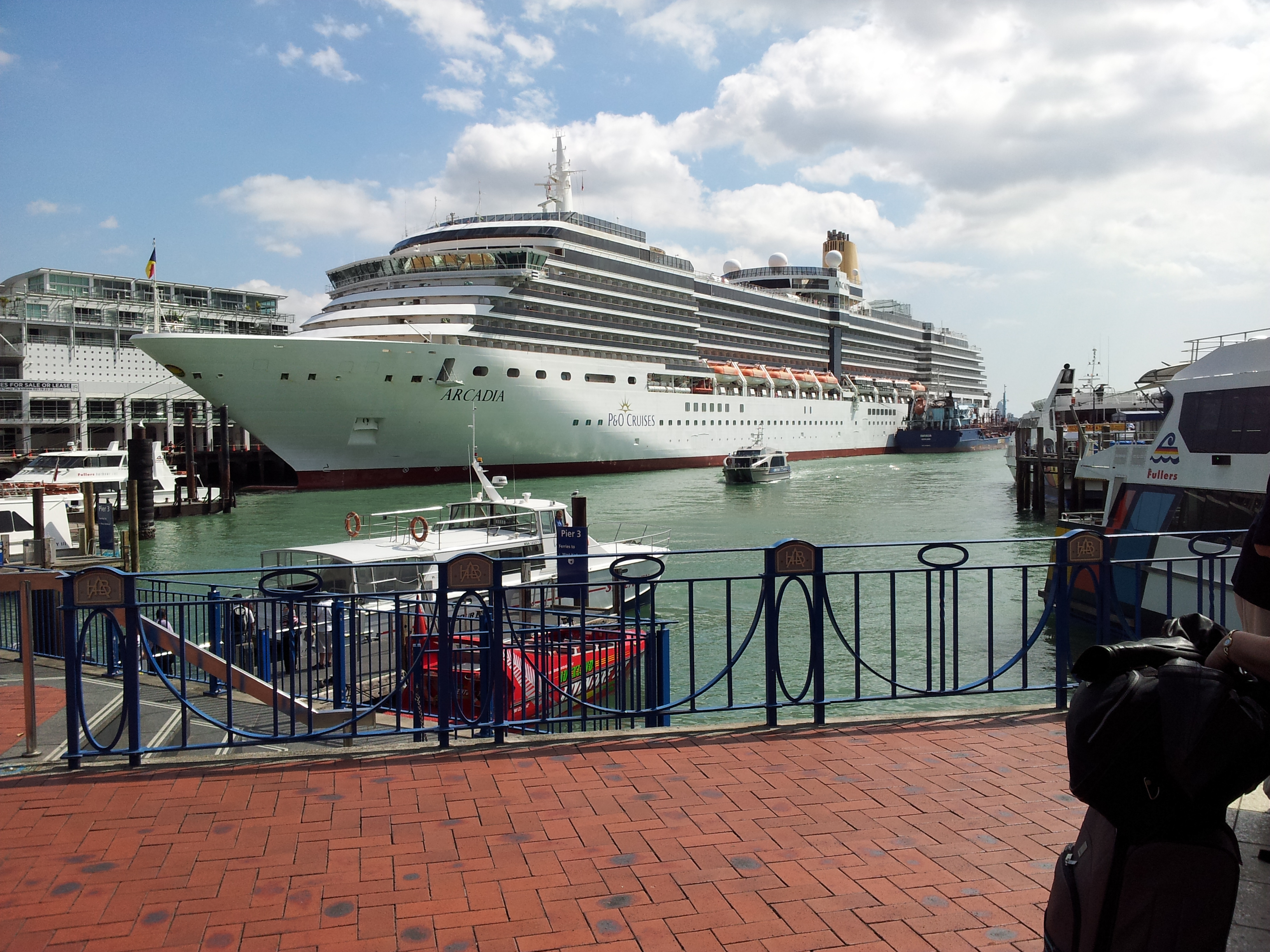
We were staying at the Hilton and advised there would be a large cruise liner berthing next to the hotel.  There was the Arcadia.

2013-03-08 11.51.48

This is the view from the other side of the hotel.  Where our room was, we could almost walk onto the aft end of the ship.

We were also told this was a rather extraordinary day because there were two cruise ships in the port. particularly because it was near the end of the cruising season.

The other ship was two berths along, the Sun Princess.

2013-03-08 11.56.17

Not as big as the Arcadia, up close it was still very impressive.

The cinema of my dreams – Was it just another surveillance job – Episode 48

I’m back home and this story has been sitting on the back burner for a few months, waiting for some more to be written.

The trouble is, there are also other stories to write, and I’m not very good at prioritizing.

But, here we are, a few minutes opened up and it didn’t take long to get back into the groove.

Chasing leads, maybe


“You haven’t been truthful with me, have you?” 

That was Dobbin’s opening shot once we were in the car and out in traffic.  It was as if he was worried someone would be listening in on our conversation.

“Says the spider to the fly.  Isn’t it the nature of this business not to play all your cards at once?”

“You’ve been in this business all of five minutes.  You don’t get the right to play cards.”

“I’m still alive, no thanks to anyone but my own skill.”

I could see the disdain in his expression, and the annoyance in his eyes.  Perhaps he was a man used to getting his own way.  I was expecting a retort, but he said nothing.

“How many different organizations do you work for, or is it none, and you just have fake IDs to get you in the door?”

“Need to know.  Have you found O’Connell yet?”

“He’s dead.  I saw him killed in an alley.  I’m sure Maury and Severin had him shot, no coincidence they turned up just after he hit the ground.  I searched the body, there was nothing on it.  Before he was shot, he told me to speak to you.  I did.  Anything else I’m doing is for my own protection.  Assigning Jan to befriend me, then play me would have been a good plan if I hadn’t found out.  I know she found O’Connell’s other residence, but I’m willing to bet she found as much as I did nothing.  Your people do that to Maury?”

“In a manner of speaking.  He wasn’t going to talk, and we couldn’t let him back on the street.”

“And knowing that I would go back to the hotel, what were you hoping for, that I would get arrested for his murder?”

“We were hoping you would glean information from her handler, or the police.  Seems both are either tight-lipped, or they know nothing.  Her handler is an incompetent fool.”

“Where is she?”

“Waiting for you at her apartment.  I want the pair of you to find O’Connell.  He either has the information, or he knows where it is.  They found the charred remains of a body in the cafe where the explosion was, a freelance reporter, who, according to his editor, had the story of the century.  No other details, though.”

“That either means military or industrial secrets.  Why would the reporter want to meet with O’Connell?”

“That’s not your concern.”

“Well, you’re wrong if you think O’Connell had the USB.  He didn’t get inside the cafe before it blew up, I know, I was there, and witness the whole event.  You know the drill, he goes past, checking to see if the target is in place, then makes sure the location is clear, then goes back and facilitates the handover.  He only just got past the front when the bomb went off.  I’m sure you’ve seen the CCTV footage.”

Yes, his expression told me he had.

“So how do you come to the conclusion he still has it?”

Never cite logical arguments to a man who lives in a fantasy world.

“Law of averages tells me there is a copy, and O’Connell would have made sure there was a backup plan, and location.”

It then struck me, after having talked to O’Connell, and knowing Dobbin knew O’Connell was still alive because he had rescued him from the alley and Severin’s cleaners.  It was not just a matter of getting him to admit it, and the fact O’Connell had done a runner on him.

“You seem convinced O’Connell is still alive.”

He glared at me.  Truth or dare?

“Because he is.  The trouble is, he’s gone to ground and I can’t raise him.  He was supposed to wait a few days in a safe place while we hunted down Severin and Maury.  We had one, but not the other.  I doubt he’ll surface before he gets word that Severin has been neutralized.  Every hour that information is still out there, is the chance it will fall into the wrong hands, so we need him and the information found.”

“You think he’s gone rogue.”

“I don’t think anything.

The car stopped outside O’Connell’s apartment block.

“Place nice with Jan, and find him and the information.

I got out of the car and watched it rejoin the traffic.

Before heading to the front entrance, my phone rang.  Odd, because only two people knew my number, and it was neither of those two.

Curiosity overcame reluctance to answer.  “Yes.”

“I’m texting a meeting point.  Be there at six.”  The line went dead before I could say anything.  Four hours.

No doubting the voice.  Severin.  And he sounded scared.

I wondered if he knew what had happened to his partner in crime.

© Charles Heath 2020-2022

An excerpt from “The Things We Do For Love”; In love, Henry was all at sea!

In the distance he could hear the dinner bell ringing and roused himself.  Feeling the dampness of the pillow, and fearing the ravages of pent up emotion, he considered not going down but thought it best not to upset Mrs. Mac, especially after he said he would be dining.

In the event, he wished he had reneged, especially when he discovered he was not the only guest staying at the hotel.

Whilst he’d been reminiscing, another guest, a young lady, had arrived.  He’d heard her and Mrs. Mac coming up the stairs, and then shown to a room on the same floor, perhaps at the other end of the passage.

Henry caught his first glimpse of her when she appeared at the door to the dining room, waiting for Mrs. Mac to show her to a table.

She was about mid-twenties, slim, long brown hair, and the grace and elegance of a woman associated with countless fashion magazines.  She was, he thought, stunningly beautiful with not a hair out of place, and make-up flawlessly applied.  Her clothes were black, simple, elegant, and expensive, the sort an heiress or wife of a millionaire might condescend to wear to a lesser occasion than dinner.

Then there was her expression; cold, forbidding, almost frightening in its intensity.  And her eyes, piercingly blue and yet laced with pain.  Dracula’s daughter was his immediate description of her.

All in all, he considered, the only thing they had in common was, like him, she seemed totally out of place.

Mrs. Mac came out of the kitchen, wiping her hands on her apron.  She was, she informed him earlier, chef, waitress, hotelier, barmaid, and cleaner all rolled into one.  Coming up to the new arrival she said, “Ah, Miss Andrews, I’m glad you decided to have dinner.  Would you like to sit with Mr. Henshaw, or would you like to have a table of your own?”

Henry could feel her icy stare as she sized up his appeal as a dining companion, making the hair on the back on his neck stand up.  He purposely didn’t look back.  In his estimation, his appeal rating was minus six.  Out of a thousand!

“If Mr. Henshaw doesn’t mind….”  She looked at him, leaving the query in mid-air.

He didn’t mind and said so.  Perhaps he’d underestimated his rating.

“Good.”  Mrs. Mac promptly ushered her over.  Henry stood, made sure she was seated properly and sat.

“Thank you.  You are most kind.”  The way she said it suggested snobbish overtones.

“I try to be when I can.”  It was supposed to nullify her sarcastic tone but made him sound a little silly, and when she gave him another of her icy glares, he regretted it.

Mrs. Mac quickly intervened, asking, “Would you care for the soup?”

They did, and, after writing the order on her pad, she gave them each a look, imperceptibly shook her head, and returned to the kitchen.

Before Michelle spoke to him again, she had another quick look at him, trying to fathom who and what he might be.  There was something about him.

His eyes, they mirrored the same sadness she felt, and, yes, there was something else, that it looked like he had been crying?  There was a tinge of redness.

Perhaps, she thought, he was here for the same reason she was.

No.  That wasn’t possible.

Then she said, without thinking, “Do you have any particular reason for coming here?”  Seconds later she realized she’s spoken it out loud, had hadn’t meant to actually ask, it just came out.

It took him by surprise, obviously not the first question he was expecting her to ask of him.

“No, other than it is as far from civilization, and home, as I could get.”

At least we agree on that, she thought.

It was obvious he was running away from something as well.

Given the isolation of the village and lack of geographic hospitality, it was, from her point of view, ideal.  All she had to do was avoid him, and that wouldn’t be difficult.

After getting through this evening first.

“Yes,” she agreed.  “It is that.”

A few seconds passed, and she thought she could feel his eyes on her and wasn’t going to look up.

Until he asked, “What’s your reason?”

Slight abrupt in manner, perhaps as a result of her question, and the manner in which she asked it.

She looked up.  “Rest.  And have some time to myself.”

She hoped he would notice the emphasis she had placed on the word ‘herself’ and take due note.  No doubt, she thought,  she had completely different ideas of what constituted a holiday than he, not that she had actually said she was here for a holiday.

Mrs. Mac arrived at a fortuitous moment to save them from further conversation.


Over the entree, she wondered if she had made a mistake coming to the hotel.  Of course, there had been no possible way she could know than anyone else might have booked the same hotel, but realized it was foolish to think she might end up in it by herself.

Was that what she was expecting?

Not a mistake then, but an unfortunate set of circumstances, which could be overcome by being sensible.

Yet, there he was, and it made her curious, not that he was a man, by himself, in the middle of nowhere, hiding like she was, but for very different reasons.

On discreet observance whilst they ate, she gained the impression his air of light-heartedness was forced and he had no sense of humor.

This feeling was engendered by his looks, unruly dark hair, and permanent frown.  And then there was his abysmal taste in clothes on a tall, lanky frame.  They were quality but totally unsuited to the wearer.

Rebellion was written all over him.

The only other thought crossing her mind, and rather incongruously, was he could do with a decent feed.  In that respect, she knew now from the mountain of food in front of her, he had come to the right place.

“Mr. Henshaw?”

He looked up.  “Henshaw is too formal.  Henry sounds much better,” he said, with a slight hint of gruffness.

“Then my name is Michelle.”

Mrs. Mac came in to take their order for the only main course, gather up the entree dishes, then return to the kitchen.

“Staying long?” she asked.

“About three weeks.  Yourself?”

“About the same.”

The conversation dried up.

Neither looked at the other, rather at the walls, out the window, towards the kitchen, anywhere.  It was, she thought, almost unbearably awkward.


Mrs. Mac returned with a large tray with dishes on it, setting it down on the table next to theirs.

“Not as good as the usual cook,” she said, serving up the dinner expertly, “but it comes a good second, even if I do say so myself.  Care for some wine?”

Henry looked at Michelle.  “What do you think?”

“I’m used to my dining companions making the decision.”

You would, he thought.  He couldn’t help but notice the cutting edge of her tone.  Then, to Mrs. Mac, he named a particular White Burgundy he liked and she bustled off.

“I hope you like it,” he said, acknowledging her previous comment with a smile that had nothing to do with humor.

“Yes, so do I.”

Both made a start on the main course, a concoction of chicken and vegetables that were delicious, Henry thought, when compared to the bland food he received at home and sometimes aboard my ship.

It was five minutes before Mrs. Mac returned with the bottle and two glasses.  After opening it and pouring the drinks, she left them alone again.

Henry resumed the conversation.  “How did you arrive?  I came by train.”

“By car.”

“Did you drive yourself?”

And he thought, a few seconds later, that was a silly question, otherwise she would not be alone, and certainly not sitting at this table. With him.

“After a fashion.”

He could see that she was formulating a retort in her mind, then changed it, instead, smiling for the first time, and it served to lighten the atmosphere.

And in doing so, it showed him she had another more pleasant side despite the fact she was trying not to look happy.

“My father reckons I’m just another of ‘those’ women drivers,” she added.

“Whatever for?”

“The first and only time he came with me I had an accident.  I ran up the back of another car.  Of course, it didn’t matter to him the other driver was driving like a startled rabbit.”

“It doesn’t help,” he agreed.

“Do you drive?”

“Mostly people up the wall.”  His attempt at humor failed.  “Actually,” he added quickly, “I’ve got a very old Morris that manages to get me where I’m going.”

The apple pie and cream for dessert came and went and the rapport between them improved as the wine disappeared and the coffee came.  Both had found, after getting to know each other better, their first impressions were not necessarily correct.

“Enjoy the food?” Mrs. Mac asked, suddenly reappearing.

“Beautifully cooked and delicious to eat,” Michelle said, and Henry endorsed her remarks.

“Ah, it does my heart good to hear such genuine compliments,” she said, smiling.  She collected the last of the dishes and disappeared yet again.

“What do you do for a living,” Michelle asked in an off-hand manner.

He had a feeling she was not particularly interested and it was just making conversation.

“I’m a purser.”

“A what?”

“A purser.  I work on a ship doing the paperwork, that sort of thing.”

“I see.”

“And you?”

“I was a model.”

“Was?”

“Until I had an accident, a rather bad one.”

“Oh, I’m sorry.”

So that explained the odd feeling he had about her.

As the evening had worn on, he began to think there might be something wrong, seriously wrong with her because she didn’t look too well.  Even the carefully applied makeup, from close up, didn’t hide the very pale, and tired look, or the sunken, dark ringed eyes.

“I try not to think about it, but it doesn’t necessarily work.  I’ve come here for peace and quiet, away from doctors and parents.”

“Then you will not have to worry about me annoying you.  I’m one of those fall-asleep-reading-a-book types.”

Perhaps it would be like ships passing in the night and then smiled to himself about the analogy.

Dinner now over, they separated.

Henry went back to the lounge to read a few pages of his book before going to bed, and Michelle went up to her room to retire for the night.

But try as he might, he was unable to read, his mind dwelling on the unusual, yet the compellingly mysterious person he would be sharing the hotel with.

Overlaying that original blurred image of her standing in the doorway was another of her haunting expressions that had, he finally conceded, taken his breath away, and a look that had sent more than one tingle down his spine.

She may not have thought much of him, but she had certainly made an impression on him.


© Charles Heath 2015-2020

lovecoverfinal1

The A to Z Challenge – K is for “Kevin, who’s Kevin?”

It had to be the worst job on the lot.

I had moved heaven and earth to get a job in the movies, not as an actor, but as one of those essential background types that kept everything going.

Props, wardrobe, clapper boy, someone significant, where I’d get my name among the other few hundred at the end of the film.

But script deliverer?  At the end of everyone’s pent up anger when the previous day went badly, after issues with the script caused filming delays and actor revolt.

And don’t get me started on the director.  Not a job I’d want.

From the moment he said through clenched teeth, “shut it down, this script is..”  and then a string of expletives, followed by “useless.”

It was.

I could have done better.

After delivering what was a last-minute change requested by the lead actor, and a small rewrite around it, I stayed to watch the magic happen.

Well out of the way of course.

It went well till they got to the last line when for some unaccountable reason, the actress burst into giggles.

I could see why.  It had a very rude connotation that some might pick up on, especially if I could.

And that was where the day ended, two pages short, adding to the other delays making the total days behind schedule to 12.

We were perilously close to being shut down.

The production company I worked for did not make A grade blockbusters.  We were more about creating quality entertaining films for the cable channels.  It was not rocket science, just have a brilliant script, good actors, a schedule, and get it done.  There were another 25 waiting in the wings, keeping everyone busy.

Yesterday it was a period romance, today it’s got a Sci-Fi ring to it, tomorrow, a romantic comedy.  Same set, different props, same actors, same crew, different script but more of the same.

It was a formula and it worked

Until it didn’t.  And usually, the reason it didn’t came down to the script.  Or an actor dies halfway through, and it’s reshot with a replacement, or shut down and come back later.

Out problem was the script. Or more specifically, the scriptwriter.

The rumour mill had been working overtime before the shoot started, that the scriptwriter was the brother of the A-List actress that was married to the director’s brother.  Some convoluted set of relationships that could easily pass as the plot of a film itself.

The thing is, he was a dilettante, thinking he could trade on his sister’s name, and no one was having any of it.  I don’t think he quite grasped the concept that his sister would not take his side if the director finally kicked him out. 

She knew the value of favours, and this was the only one she would use for him.

And what made matters worse was the script was a really good one, if only he’d stop playing with it.

Oliver Fosdyke was in his room, a small box attached to the meeting room for the crew of the shoot, where we all met the last thing to go over the next day’s shoot.

I knocked on the door, and he looked up sharply.  He’d heard what happened at the shoot.

“Directors not happy.  I expect you’ll need some ammo for the meeting, which gives you about a half-hour.  He wants tomorrow’s pages, unchanged for what he read the other day, the fix you fixed, fixed, that is so it doesn’t make the leading lady laugh.”

“The man’s a philistine.”

“He’s the director.  I don’t think you need me to tell you he can fire you.”

“I’d like to see him try?”

“OK, put it this way, he has fifteen solid hits, an Academy Award nomination, and a schedule that would break a camel’s back.  You have, oh, yes, this is your first script.  I think a little humility might go a long way, Oliver.  Aside from the fact I need this job.  You’ve got twenty-five minutes now.”

“Has my sister been talking to you? David.”

“You’d know if she had.  I’d be the one fainting on the floor.”

I came back to the meeting room five minutes early to see one of the cinematography assistants eating salad out of a plastic container.

“Where’s everyone?” I asked her.

“Meetings moved back an hour.  Director got haul up to the main office.  Hope it’s not bad news.”

So did I.

The script pages were sitting on the table, and I picked one up and scanned through it.

Damn.  The foolish man had not made the necessary changes.  This was going to be the end of him, defying common sense.  Fortunately, I’d kept the pages of the original script, with a minor change I thought was needed, and substituted them. 

Someone had to try and save him.

“You drew the short straw, you know, David.” She said.

“Oliver?”

“The man is impossible to work with.  I told HR you were good at working with impossible people, so they took you on.  Don’t thank me now, but I will want the favour repaid.”

Madeleine.  She had been at the recruitment session with a hundred others vying for 20 priceless jobs.  She had succeeded, I’d failed, only to get a phone call three days later asking if I was still interested.  I thought luck had something to do with it.

“I’m not sure, now, if I should thank you.”

“Oh, you will.  Now ask me if I want to have dinner with you tomorrow.”

I shrugged.  I didn’t understand her, or women in general.

“Would you like to have dinner with me tomorrow night?”

“Yes, I would.”  She smiled, and then went back to her salad.

There were thirty people in a room that should only have twenty.  Fortunately, meetings didn’t last very long.

We got through everything, except the script.

The director picked it up and scanned through the pages, apparently satisfied.  Except, when he got to the last page…

“Kevin?  Who the hell is Kevin?  Oliver?”

Oliver looked like a deer caught in the headlights, so I jumped in quickly, “An improvisation that takes away that humorous result in the final scene we were shooting.  Oliver and I were throwing ideas around and we came back to a point you made in the first script read-through, that point where you could feel there was something unsaid but couldn’t quite put your finger on it.”

Oliver looked up, after reading the line, not annoyed, but intrigued.

“Oliver?”

“I’ll let David have his moment in the spotlight,” and gave me the death stare. 

Something was going to hit the fan when we got back to the office.

“As I was saying, we’ve moved that thing into a sort of reality because there will be a post-it note pad on the bench with the name Kevin written on it and underlined.  We’ve added two lines, but the thing is, instead of ending the way it did, Larry’s eyes go down to the bench, sees the name, and adds rather sharply, ‘who’s Kevin?’   She looks all quizzical, sees the note, and says, “I don’t know, I must have written it down for some reason, but not recently.”

“Which then feeds into the follow on from that the next day, where there is a slight tension between the two whereas everything had been bright and easy, which then leads to Larry’s suspicion that she is seeing someone else.”

Which in my view cleared up a continuity issue that the continuity people should have caught, and hadn’t.

“Then, just for interest’s sake, who is this Kevin?

I shrugged.  “It doesn’t really matter, but it could be explained with a single line from Mary’s sister when they’re discussing Larry’s apparent change in demeanour, where she notices the tap in the kitchen is not dripping, so something like, I see you got that annoying tap fixed, at which point Mary says, oh, that Kevin.  He was the plumber.  But you can see the opening for misinterpretation.”

“Real life impinging on art, I like it.  Well, done Oliver.  Make sure everyone has the script amendments before the day is out.  Nothing else?”  A look around the table, then, “Let’s make it happen tomorrow.  David, walk with me.”

As I got up, I could see Oliver.

“After the director’s done with you, can you come back?”

It was not a bad-tempered tone, but it still had an edge.  No point putting it off.

“Sure.”

In the corner, I could see Madeleine with a smirk.  Like most, she didn’t like Oliver, and I’m sure she couldn’t quite believe he could have thought of the Kevin angle.

“Far enough away from the building, the director said, “Did Oliver come up with that scenario?”

“It fits the script and follows the nuances he was getting across.  I think he just forgot, momentarily, there were some gaps in the continuity, which, I know from experience, are easy to miss unless you get to the sixth or seventh edit.  It helps when you read it out loud, like the first run through, and you picked it up.”

“OK, I’ll come right out with it, did you write those changes?”

“Do you want me to lie?”

“Why would you bother?”

“Because it’s a great script, it just has a few gaps if you like.”

“How many more are there?”

“Three, which I’ve fixed, so no one will ever know, and I don’t think Oliver will object.  Not now, anyway.”

“Well, that’s your job, keeping the bear in his cage.  Here,” he slipped some paper into my hand, keeping it covered, “Madeleine likes French Champagne.  Treat her right, OK.”

“Yes, sir.  Always.”

“Good man.  Now go get your bollocking.”


© Charles Heath 2022

‘Sunday in New York’ – A beta reader’s view

I’m not a fan of romance novels but …

There was something about this one that resonated with me.

This is a novel about a world generally ruled by perception, and how people perceive what they see, what they are told, and what they want to believe.

I’ve been guilty of it myself as I’m sure we all gave one time or another.

For the the main characters Harry and Alison there is others issues driving their relationship.

For Alison, it is a loss of self worth through losing her job and from losing her mother and, in a sense, her sister.

For Harry it is the fact he has a beautiful and desirable wife, and his belief she is the object of other men’s desires, and one in particular, his immediate superior.

Between observation, the less than honest motives of his friends, a lot of jumping to conclusions based on very little fact, and you have the basis of one very interesting story.

When it all come to a head, Alison finds herself in a desperate situation, she realises only the truth will save their marriage.

But is it all the truth?

What would we do in similar circumstances?

Rarely does a book have me so enthralled that I could not put it down until I knew the result. They might be considered two people who should have known better, but as is often the case, they had to get past what they both thought was the truth.

And the moral of this story, if it could be said there is one, nothing is ever what it seems.

Available on Amazon here: amzn.to/2H7ALs8

NaNoWriMo – April 2022 – Day 13

First Dig Two Graves, the second Zoe thriller.

Today we are in Bratislava in Slovakia.

John has found Zoe after playing a little cat and mouse in the streets near the hotel. Back at the hotel, they just get back to the room when a member of Worthington’s hit team arrives and comes off second best.

Of course, the rest are stationed at the obvious exits, and it takes some effort to getaway.

Even that escape is fraught with danger, but with all the cunning she can muster, Zoe makes sure they get back to Vienna.

With Worthington’s hit team hot on their train, a diversion in the main railway station helps aid their departure.

By now, two things are certain:

Worthington is behind the latest attempted hit, and they are both in the firing line, and

John had to decide whether or not he wants a life always looking over his shoulder.

No prizes for guessing his choice!

Today’s writing, with John throwing his lot in with Zoe, 2,905 words, for a total of 39,717.