The cinema of my dreams – I wonder what it was like in the wild west – Part 2

I guess I have seen too many westerns, film fodder my parents liked to watch on TV, and especially with John Wayne, and later on Clint Eastwood.

In this day and age there are only scant reminders of a time that may have bristled with excitement, or so dangerous you would be lucky to survive if you got on the wrong side of a gunslinger.

But, for argument’s sake, what if there was a way to actually step back in time?

So, here’s the start of a story…

There are hundreds of places in the midwest, where you could see miles of plains, hills, winding rivers, and sleepy towns. Places with old-fashioned motels and hotels, general stores, farmers’ supplies, and everything else in between.

These are the towns where the young, fresh out of school and full of ideas and enthusiasm get on the bus to go to the big cities, promising to return.

Some do, some don’t.

For others who live in the cities, driving through the midwest would be a welcome change from the clogged highways, freeways, turnpikes, and the 14 hour days. Where a person could wind back the hectic to the sedate, and perhaps for a while, to the mundane. It was a dream to cling to, something that just barely kept a man sane in an insane world. And a dream that was about to become a reality.

Jack was on the verge of burnout, having spent the last year doing 80 hour weeks, gunning for the manager’s role that he had been promised, if he put in the time. That he had, and then some.

But the man who made the promise died suddenly, and it all came to naught, passed over by the replacement boss who had his own selection for the role, younger, better educated, but utterly no experience.

It was the straw that broke the proverbial camel’s back.

The next day he resigned, spoke not one word to anyone after handing in his keycard and resignation letter, and left. Perhaps the only consolation, no one else knew the complex plant operation systems, and when it broke down, as it always did, there was no one who could fix it.

There was one more ceremonial job he had to do before getting in his car, and that was to toss his cell phone in the bin. That done, the drive home took 20 minutes instead of the usual two hours, he threw what he needed into an overnight bag, and after taking a 30-second look back in the place he had called home for 25 years, shrugged, and closed the door.

There would be no coming back.

Of course, there were moments where the resolve was tested, those tendrils of loyalty to a company he had worked at for a long time, and who had treated him reasonably well.

The first night, in a quaint motel, was the hardest. Alone with his thoughts, without anyone to talk to, not that there were many back home, the idea of striking out on his own seemed drastic, even silly.

The second night, spent at a surprisingly rural town, he had supper in a diner that had few customers and a waitress his own age who was a talker. She recommended a guest house, one she stayed at herself, a runaway like he was, but for more desperate reasons, and liking the company stayed for a week.

It was difficult to move on, but he did.

Which was why, five days later, in another small town by a river, he had reached the bridge.

The road went in two directions. West or north. North crossed the river, and the minor roads wound their way through hills and dales to Canada. West headed towards San Francisco, and he had no desire to visit another large city. Not for a while.

Over the bridge it was.

After a night in another interesting motel that had a small room that passed as a museum, and related the history of the area, a story in itself.

….

© Charles Heath 2022

An excerpt from “Echoes from the Past”

Available on Amazon Kindle here:  https://amzn.to/2CYKxu4

With my attention elsewhere, I walked into a man who was hurrying in the opposite direction.  He was a big man with a scar running down the left side of his face from eye socket to mouth, and who was also wearing a black shirt with a red tie.

That was all I remembered as my heart almost stopped.

He apologized as he stepped to one side, the same way I stepped, as I also muttered an apology.

I kept my eyes down.  He was not the sort of man I wanted to recognize later in a lineup.  I stepped to the other side and so did he.  It was one of those situations.  Finally getting out of sync, he kept going in his direction, and I towards the bus, which was now pulling away from the curb.

Getting my breath back, I just stood riveted to the spot watching it join the traffic.  I looked back over my shoulder, but the man I’d run into had gone.  I shrugged and looked at my watch.  It would be a few minutes before the next bus arrived.

Wait, or walk?  I could also go by subway, but it was a long walk to the station.  What the hell, I needed the exercise.

At the first intersection, the ‘Walk’ sign had just flashed to ‘Don’t Walk’.  I thought I’d save a few minutes by not waiting for the next green light.  As I stepped onto the road, I heard the screeching of tires.

A yellow car stopped inches from me.

It was a high powered sports car, perhaps a Lamborghini.  I knew what they looked like because Marcus Bartleby owned one, as did every other junior executive in the city with a rich father.

Everyone stopped to look at me, then the car.  It was that sort of car.  I could see the driver through the windscreen shaking his fist, and I could see he was yelling too, but I couldn’t hear him.  I stepped back onto the sidewalk, and he drove on.  The moment had passed and everyone went back to their business.

My heart rate hadn’t come down from the last encounter.   Now it was approaching cardiac arrest, so I took a few minutes and several sets of lights to regain composure.

At the next intersection, I waited for the green light, and then a few seconds more, just to be sure.  I was no longer in a hurry.

At the next, I heard what sounded like a gunshot.  A few people looked around, worried expressions on their faces, but when it happened again, I saw it was an old car backfiring.  I also saw another yellow car, much the same as the one before, stopped on the side of the road.  I thought nothing of it, other than it was the second yellow car I’d seen.

At the next intersection, I realized I was subconsciously heading towards Harry’s new bar.   It was somewhere on 6th Avenue, so I continued walking in what I thought was the right direction.

I don’t know why I looked behind me at the next intersection, but I did.  There was another yellow car on the side of the road, not far from me.  It, too, looked the same as the original Lamborghini, and I was starting to think it was not a coincidence.

Moments after crossing the road, I heard the roar of a sports car engine and saw the yellow car accelerate past me.  As it passed by, I saw there were two people in it, and the blurry image of the passenger; a large man with a red tie.

Now my imagination was playing tricks.

It could not be the same man.  He was going in a different direction.

In the few minutes I’d been standing on the pavement, it had started to snow; early for this time of year, and marking the start of what could be a long cold winter.  I shuddered, and it was not necessarily because of the temperature.

I looked up and saw a neon light advertising a bar, coincidentally the one Harry had ‘found’ and, looking once in the direction of the departing yellow car, I decided to go in.  I would have a few drinks and then leave by the back door if it had one.

Just in case.

© Charles Heath 2015-2020

newechocover5rs

In a word: Bar

There’s more than one way … er, perhaps it’s better to say, there are many ways to use the word bar, which is not bad for a three letter word.


Bar, the one you associate with drinks, in hotels, restaurants and we’ll, just bars.

Probably the best type of bar you might find me in is a Sports Bar, where you can snack on buffalo wings a tall glass of beer and watch with ice hockey in winter or baseball in summer.

It’s one I use from time to time when asked, what will we do, and the reply is often let’s go to a bar.  The best bars are underground, dark and dingy, full of eclectic people, with a band playing almost passable music or better still jazz


Bar, as in the legal variety

There are so many legal references to using bar, that the one that I am most familiar with is being admitted to the bar which means that you can now practice law.

Raising the bar, if that’s possible, where the bar is that imaginary level which offers sinks very low.  When someone says they’re going to try and raise the bar, you may be assured there will be a long battle ahead, simply because people generally find it hard to change.


Bar, as in we are not going to let you in here.  Yes, this is the irksome one where you find yourself, often for reasons unknown, barred from somewhere or something.  This may also be referred to by saying everyone may enter bar you.  


Bar, as in an iron bar, the sort that is sometimes used as a blunt force object by villains to remind the victim they owe any one of a loan shark, bookie or the mafia.  God help you if it is all three.

There are also iron bars of a different sort, those that are set in concrete outside a window most likely in a prison where the objective is to prevent escape.

It gives rise to an old expression, that person should be behind bars.


Then there is just a bar, such as a bar of gold, which I’m sure we’d all like to have stashed away, but not necessarily in the mattress, or the more common variety, a chocolate bar, which I have one now.  What’s your favorite?


And just to add to the list of meanings you can always refer to sashes or stripes as bars.

Confused?  Well, there’s still music, and the bane of yachtsmen, sand bars but I think we’ll leave it there.

Welcome to the English language

The cinema of my dreams – I never wanted to go to Africa – Episode 9

What just happened?

My turn to put him under the spotlight, for a minute, then two.

“There are no optional questions here, Mr. James.”

No, but some needed careful consideration, like throwing the dead pilot under the bus.

“Roy, the pilot, was adding some hours to his fly time, probably looking for a promotion.”

“So it was not a proper sanctioned operation.”

Looking for a scapegoat higher up the food chain.

“You need the commander’s authority to go up, so it was sanctioned.”

“Then this commander could have ordered the pilot to fly into the no-fly zone.”

My thought too, but I wasn’t going to fuel his suspicions.

“For what reason, after all, it’s not called a no-fly zone just so people can write the words on a map.”

He didn’t reply. I had thought he might tell me he was the one asking the questions.

He let me stew for a few more minutes, then, “You don’t seem to know much about anything Mr. James, whereas we know a lot about you.”

The ‘you’ he was referring to wasn’t just me, but our whole operation and what we were doing, which, of course, I wasn’t privy to. Did we have a spy in our midst?

“One more time, Mr James, can you tell me what the helicopter was doing in the no-fly zone?”

It was accompanied by another of those smiles, all-knowing perhaps, or trying to make me believe he did. But the bottom line was, if he did, he was not going to tell me.

Instead, the smile turned to a scowl. “I do not believe you are as uninformed as you say you are so I suggest most strongly that you give up this appearance of innocence. I shall ask once more Mr. James, and if you are not forthcoming, the matter will be out of my hands. I assure you, you will not like the alternative.”

I was sure I wouldn’t like the alternative.

“The answer sadly will still be the same, so if you must, I’m sure I won’t be able to talk you out of it.”

He simply shook his head and left the room, leaving me to ponder what my fate would be.

© Charles Heath 2019-2021

Writing about writing a book – Day 12 continues

Digging deeper into the war.

There is always something to be found that can be very interesting, and sometimes, when following more obscure links in web pages, you can either finish up having your computer trashed, or you find a gem.

As you can imagine, when I saw the CIA, I thought, OK, this fits my penchant for conspiracies and subterfuge, and when I stumbled across this thing called the Phoenix Program.  Whether it existed or not, one can never sure when reading about CIA activities, its premise gives me an avenue to attach a few shady characters and let them run with it.

Then, of course, there was a film which I noticed was on cable TV, so I watched it.  Air America, and whether that was true or not, it gave me another idea, and so the characterization of Colonel Davenport will fit into both these scenarios.

I suspect there may have been one or two more enterprising officers who saw an opportunity to not only appear to fulfill the parameters of their mission, but also make a little money on the side, setting up an operation within an operation, whether it’s to move into a black market arms supply, or moving and selling drugs from what was called the golden triangle that may or may not have included Cambodia.

That also lends itself to Davenport, when Bill finally catches on to what he is up to, arranging for his capture and removal to a prisoner of war campo over the border in Cambodia.  It could also probably have been in Laos, at the CIA may or may not have been running an operation there as well.

There is so much now to consider.

I now have to find out about airbases and personnel, come up with a suitable band of misfits, find out what sort of aircraft and land transport could be involved in moving the contraband, and a little more about Saigon back in the mid-sixties.


Memories of the conversations with my cat – 78

As some may be aware, but many not, Chester, my faithful writing assistant, mice catcher, and general pain in the neck, passed away some months ago.

Recently I was running a series based on his adventures, under the title of Past Conversations with my cat.

For those who have not had the chance to read about all of his exploits I will run the series again from Episode 1

These are the memories of our time together…

20160903_163858

This is Chester.  He doesn’t like stormy weather, particularly at night.

We’ve been having a lot of hot days with no relief in temperatures.  From mid-morning, the air conditioning had been running until midnight.

But, Chester’s usual hiding place has been in the non-aircoditioned part of the house, so he’s had to come down to join me.

There’s been no rain for weeks and although some days are cloudy all it does is worsen the humidity which at times even the airconditioning can’t relieve.

But when the storms come, after a long dry period, they are intense, and when the lightning strikes the thunder is particularly loud, and the cat jumps.

Never let a scaredy-cat sit on your lap in a storm.  I did.  Once.  Never again.

I put him on the chair next to me and covered him up.  It helps.

An hour later the storm has passed, and he goes back to lying on the floor.

Oops, was that another crack of lightning?

“Sunday in New York”, a romantic adventure that’s not a walk in the park!

“Sunday in New York” is ultimately a story about trust, and what happens when a marriage is stretched to its limits.

When Harry Steele attends a lunch with his manager, Barclay, to discuss a promotion that any junior executive would accept in a heartbeat, it is the fact his wife, Alison, who previously professed her reservations about Barclay, also agreed to attend, that casts a small element of doubt in his mind.

From that moment, his life, in the company, in deciding what to do, his marriage, his very life, spirals out of control.

There is no one big factor that can prove Harry’s worst fears, that his marriage is over, just a number of small, interconnecting events, when piled on top of each other, points to a cataclysmic end to everything he had believed in.

Trust is lost firstly in his best friend and mentor, Andy, who only hints of impending disaster, Sasha, a woman whom he saved, and who appears to have motives of her own, and then in his wife, Alison, as he discovered piece by piece damning evidence she is about to leave him for another man.

Can we trust what we see with our eyes or trust what we hear?

Haven’t we all jumped to conclusions at least once in our lives?

Can Alison, a woman whose self-belief and confidence is about to be put to the ultimate test, find a way of proving their relationship is as strong as it has ever been?

As they say in the classics, read on!

Purchase:

http://tinyurl.com/Amazon-SundayInNewYork

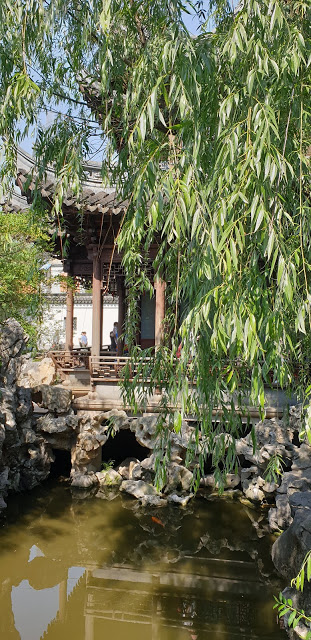
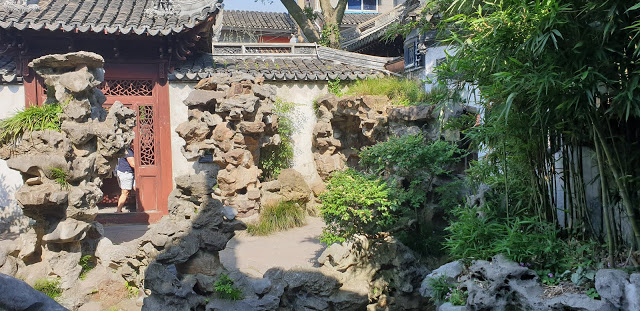
Searching for locations: The Yu Gardens, Shanghai, China

The Yu Gardens or Yuyuan Gardens

The Yu Gardens (or Yuyuan Gardens) are located at No. 137, Anren Street, Huangpu District, very close to the Old City God Temple, in the northeast of the Old City of Shanghai at Huangpu.

Yu Garden was first built in 1559 during the Ming Dynasty by Pan Yunduan and finished approximately 1577, created specifically as a private garden of the Pan family for Pan Yunduan’s parents to enjoy in their old age.

Yu Garden occupies an area of 5 acres, and is divided into six general areas:

  -Sansui Hall which includes the Grand Rockery was originally used to entertain guests,

  -Wanhua Chamber is a delicate building surrounded by derious cloisters,

  -Dianchun Hall, built in 1820, includes Treasury Hall and the Hall of Harmony,

  -Huijing Hall which includes Jade Water Corridor.

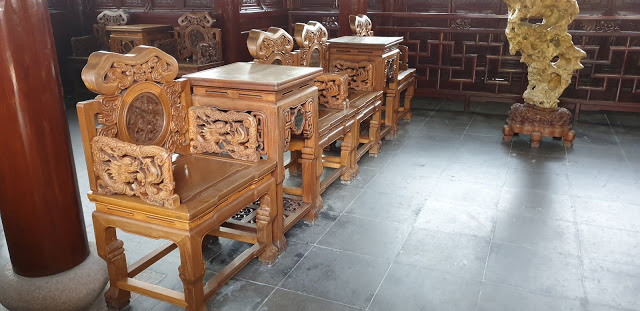
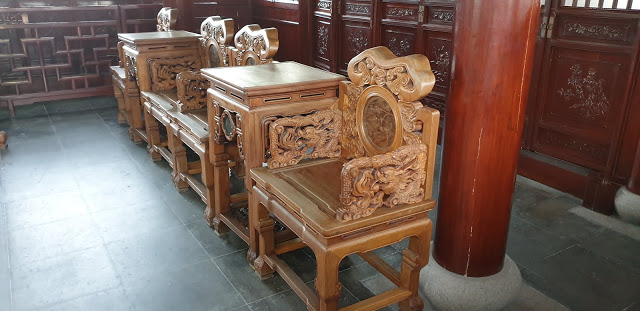
  -Yuhua Hall which is furnished with rosewood pieces from the Ming Dynasty, and,

  -The Inner Garden with rockeries, ponds, pavilions, and towers; first laid out in 1709.  As the quietest part of Yu Gardens, it includes the Hall of Serenity and the Acting and Singing Stage.

The Mid-Lake Pavilion Teahouse, within the gardens, is the oldest teahouse in Shanghai.

A centerpiece of the gardens is the Exquisite Jade Rock, a 5-ton boulder that was originally meant for the Huizong Emperor (Northern Song Dynasty from 1100-1126 AD) but was salvaged from the Huangpu River after the boat carrying it had sunk.

These gardens house a lot of buildings that seemed to be a perfect blend of the old and the new, and if it was up to me, I’d keep the old.  Both the building and the gardens they are set in are like an oasis in the middle of an industrial complex, and perhaps impractical for the number of people living in Shanghai.

All of the ponds had a lot of fish in them

It was a pleasant afternoon, for both a stroll through the gardens

In and out of the rockery on narrow pathways

And to look inside the buildings that were sparsely furnished

There was even an area set aside for entertainment.

An excerpt from “What Sets Us Apart”, a mystery with a twist

See excerpt from the story below, just a taste of what’s in store…

http://amzn.to/2Eryfth

whatsetscover

McCallister was old school, a man who would most likely fit in perfectly campaigning on the battlefields of Europe during the Second World War. He’d been like a fish out of water in the army, post-Falklands, and while he retired a hero, he still felt he’d more to give.

He’d applied and was accepted as head of a SWAT team, and, watching him now as he and his men disembarked from the truck in almost military precision, a look passed between Annette, the police liaison officer, and I that said she’d seen it all before. I know I had.

There was a one in four chance his team would be selected for this operation, and she had been hoping it would be one of the other three. While waiting for them to arrive she filled me in on the various teams. His was the least co-operative, and the more likely to make ad-hoc decisions rather than adhere to the plan, or any orders that may come from the officer in charge.

This, she said quite bluntly, was going to end badly.

I still had no idea why Prendergast instructed me to attend the scene of what looked to be a normal domestic operation, but as the nominated expert in the field in these types of situations, it was fairly clear he wasn’t taking any chances. It was always a matter of opinion between us, and generally I lost.

In this case, it was an anonymous report identifying what the authorities believed were explosives in one of the dockside sheds where explosives were not supposed to be.

The only reason why the report was given any credence was the man, while not identifying himself by name, said he’d been an explosive expert once and recognized the boxes. That could mean anything, but the Chief Constable was a cautious man.

With his men settled and preparing their weapons, McCallister came over to the command post, not much more than the SUV my liaison and I arrived in, with weapons, bulletproof vests, and rolls of tape to cordon off the area afterward. We both had coffee, steaming in the cold early morning air. Dawn was slowly approaching and although rain had been forecast it had yet to arrive.

A man by the name of Benson was in charge. He too had groaned when he saw McCallister.

“A fine morning for it.” McCallister was the only enthusiastic one here.

He didn’t say what ‘it’ was, but I thought it might eventually be mayhem.

“Let’s hope the rain stays away. It’s going to be difficult enough without it,” Benson said, rubbing his hands together. We had been waiting for the SWAT team to arrive, and another team to take up their position under the wharf, and who was in the final stages of securing their position.

While we were waiting we drew up the plan. I’d go in first to check on what we were dealing with, and what type of explosives. The SWAT team, in the meantime, were to ensure all the exits to the shed were covered. When I gave the signal, they were to enter and secure the building. We were not expecting anyone inside or out, and no movement had been detected in the last hour since our arrival and deployment.

“What’s the current situation?”

“I’ve got eyes on the building, and a team coming in from the waterside, underneath. Its slow progress, but they’re nearly there. Once they’re in place, we’re sending McKenzie in.”

He looked in my direction.

“With due respect sir, shouldn’t it be one of us?” McCallister glared at me with the contempt that only a decorated military officer could.

“No. I have orders from above, much higher than I care to argue with, so, McCallister, no gung-ho heroics for the moment. Just be ready to move on my command, and make sure you have three teams at the exit points, ready to secure the building.”

McCallister opened his mouth, no doubt to question those orders, but instead closed it again. “Yes sir,” he muttered and turned away heading back to his men.

“You’re not going to have much time before he storms the battlements,” Benson quietly said to me, a hint of exasperation in his tone. “I’m dreading the paperwork.”

It was exactly what my liaison officer said when she saw McCallister arriving.

The water team sent their ‘in position’ signal, and we were ready to go.

In the hour or so we’d been on site nothing had stirred, no arrivals, no departures, and no sign anyone was inside, but that didn’t mean we were alone. Nor did it mean I was going to walk in and see immediately what was going on. If it was a cache of explosives then it was possible the building was booby-trapped in any number of ways, there could be sentries or guards, and they had eyes on us, or it might be a false alarm.

I was hoping for the latter.

I put on the bulletproof vest, thinking it was a poor substitute for full battle armor against an exploding bomb, but we were still treating this as a ‘suspected’ case. I noticed my liaison officer was pulling on her bulletproof vest too.

“You don’t have to go. This is my party, not yours,” I said.

“The Chief Constable told me to stick to you like glue, sir.”

I looked at Benson. “Talk some sense into her please, this is not a kindergarten outing.”

He shrugged. Seeing McCallister had taken all the fight out of him. “Orders are orders. If that’s what the Chief Constable requested …”

Madness. I glared at her, and she gave me a wan smile. “Stay behind me then, and don’t do anything stupid.”

“Believe me, I won’t be.” She pulled out and checked her weapon, chambering the first round. It made a reassuring sound.

Suited up, weapons readied, a last sip of the coffee in a stomach that was already churning from nerves and tension, I looked at the target, one hundred yards distant and thought it was going to be the longest hundred yards I’d ever traversed. At least for this week.

A swirling mist rolled in and caused a slight change in plans.

Because the front of the buildings was constantly illuminated by large overhead arc lamps, my intention had been to approach the building from the rear where there was less light and more cover. Despite the lack of movement, if there were explosives in that building, there’d be ‘enemy’ surveillance somewhere, and, after making that assumption, I believed it was going to be easier and less noticeable to use the darkness as a cover.

It was a result of the consultation, and studying the plans of the warehouse, plans that showed three entrances, the main front hangar type doors, a side entrance for truck entry and exit and a small door in the rear, at the end of an internal passage leading to several offices. I also assumed it was the exit used when smokers needed a break. Our entry would be by the rear door or failing that, the side entrance where a door was built into the larger sliding doors. In both cases, the locks would not present a problem.

The change in the weather made the approach shorter, and given the density of the mist now turning into a fog, we were able to approach by the front, hugging the walls, and moving quickly while there was cover. I could feel the dampness of the mist and shivered more than once.

It was nerves more than the cold.

I could also feel rather than see the presence of Annette behind me, and once felt her breath on my neck when we stopped for a quick reconnaissance.

It was the same for McCallister’s men. I could feel them following us, quickly and quietly, and expected, if I turned around, to see him breathing down my neck too.

It added to the tension.

My plan was still to enter by the back door.

We slipped up the alley between the two sheds to the rear corner and stopped. I heard a noise coming from the rear of the building, and the light tap on the shoulder told me Annette had heard it too. I put my hand up to signal her to wait, and as a swirl of mist rolled in, I slipped around the corner heading towards where I’d last seen the glow of a cigarette.

The mist cleared, and we saw each other at the same time. He was a bearded man in battle fatigues, not the average dockside security guard.

He was quick, but my slight element of surprise was his undoing, and he was down and unconscious in less than a few seconds with barely a sound beyond the body hitting the ground. Zip ties secured his hands and legs, and tape his mouth. Annette joined me a minute after securing him.

A glance at the body then me, “I can see why they, whoever they are, sent you.”

She’d asked who I worked for, and I didn’t answer. It was best she didn’t know.

“Stay behind me,” I said, more urgency in my tone. If there was one, there’d be another.

Luck was with us so far. A man outside smoking meant no booby traps on the back door, and quite possibly there’d be none inside. But it indicated there were more men inside, and if so, it appeared they were very well trained. If that were the case, they would be formidable opponents.

The fear factor increased exponentially.

I slowly opened the door and looked in. A pale light shone from within the warehouse itself, one that was not bright enough to be detected from outside. None of the offices had lights on, so it was possible they were vacant. I realized then they had blacked out the windows. Why hadn’t someone checked this?

Once inside, the door closed behind us, progress was slow and careful. She remained directly behind me, gun ready to shoot anything that moved. I had a momentary thought for McCallister and his men, securing the perimeter.

At the end of the corridor, the extent of the warehouse stretched before us. The pale lighting made it seem like a vast empty cavern, except for a long trestle table along one side, and, behind it, stacks of wooden crates, some opened. It looked like a production line.

To get to the table from where we were was a ten-yard walk in the open. There was no cover. If we stuck to the walls, there was equally no cover and a longer walk.

We needed a distraction.

As if on cue, the two main entrances disintegrated into flying shrapnel accompanied by a deafening explosion that momentarily disoriented both Annette and I. Through the smoke and dust kicked up I saw three men appear from behind the wooden crates, each with what looked like machine guns, spraying bullets in the direction of the incoming SWAT members.

They never had a chance, cut down before they made ten steps into the building.

By the time I’d recovered, my head heavy, eyes watering and ears still ringing, I took several steps towards them, managing to take down two of the gunmen but not the third.

I heard a voice, Annette’s I think, yell out, “Oh, God, he’s got a trigger,” just before another explosion, though all I remember in that split second was a bright flash, the intense heat, something very heavy smashing into my chest knocking the wind out of me, and then the sensation of flying, just before I hit the wall.

I spent four weeks in an induced coma, three months being stitched back together and another six learning to do all those basic actions everyone took for granted. It was twelve months almost to the day when I was released from the hospital, physically, except for a few alterations required after being hit by shrapnel, looking the same as I always had.

But mentally? The document I’d signed on release said it all, ‘not fit for active duty; discharged’.

It was in the name of David Cheney. For all intents and purposes, Alistair McKenzie was killed in that warehouse, and for the first time ever, an agent left the Department, the first to retire alive.

I was not sure I liked the idea of making history.


© Charles Heath 2016-2020
I am the most disorganized person on the planet

It’s something that I have never been able to get a handle on, and I seem to stagger from one day to the next without getting anything done.

Over the years many people tried, some with limited success, others completely failing.  I had a boss who once sent my to time management classes, and then expected me to manage my time better.  Alas, I can still see her shrugging at the impossibility of it.

THe thing is, I’m one of those freeform sorts of people and I guess it goes with the star sign, Gemini.

Yes, I’ve been to quite a few of those time management courses over time, with the books and diaries to seem to want you to time manage your life.  I considered it a bit like micromanagement where your supervisor had access to the diary and put in the work, the estimated time and when it was expected to be finished.  Their idea of managing their expectations in your space.

I didn’t work well with deadlines.

But oddly enough most of the jobs I’ve had over the years have involved time management of one sort or another and I have survived, mostly due to the fact most of my managers had given up.  Stuff got done, more or less on time, so all was well.

Now, in semi-retirement, I really need something to organize my days so something gets done.  As a writer allocating 12 midnight to 2am for writing doesn’t seem to be a good idea.

Unfortunately it is the best time for me to write.

Anyone else out there with the same problem, and if so what was your answer to the time management problem?